BORANG PENGESAHAN STATUS TESIS
SESI PENGAJIAN: td '"
/
Lo 0mengaku membenarkan tesis(PSM/Sarjana ) ini disimpan di Perpustakaan Fakulti Teknologi Maklumat dan Komunikasi degna syarat-syarat kegunaan seperti berikut:
1. Tesis dan projek adalah hakrnilik Universiti Teknikal Malaysia Melaka.
2. Perpustakaan Fakulti Teknologi Maklumat dan Komunikasi dibenarkan membuat salinan untuk tujuan pengajian sahaja.
3. Perpustakaan Fakulti Teknologi Maklumat dan Komunikasi dibenarkan mmbuat salinan tesis ini sebagai bahan pertukaran antara institusi pengajian tingi.
4. **Silatandakan (/)
SULIT (Mengandungi maklumat yang berdarjah keselamatan atau kepentingan Malaysia seperti yang trrnaktub di dalam AKTA RAHSIA RASMI 1972)
TERHAD (Mengandungi maklumat TERHAD yang telah ditentukan oleh organisasi / badan di mana penyelidikan dijalankan)
TIDAK TERHAD
(TANDATANGAN PENULIS) Alamat tetap:
4\73
f C i O fib ~ k ( 7 S&?i'Z 7 3 1 A T l
i - J @ v I ~ I L ~
Tarikh:
(T NDAT NGAN PENYELIA)
$
P
Tarikh:
6dbFg
DECLARATION
I hereby declare that this project report entitled
ARABIC COURSEWARE USINGCONSTRUCTIVISM
is written by me and is my own effort and that have no part has been plagiarized without citations.
STUDENT : p c e m A ~
97
/fsa-
Date: (STUDENT NAME)SUPERVISOR :
/&&%ctrm
a.
~M--D
(SUPERVISOR NAME)Date:
0&/+8
DEDICATION
ACKNOWLEDGEMENT
BISMILLAH.. .alhamdulillah, finally my hard times for finishing this project has ended. Special praise is due to Allah, and peace is upon His Messenger. Because of His blessing, I can come out with this idea and completing this project.
Thanks also to Mr. Ibrahim bin Ahmad for giving such idea for the whole process of this courseware development. I would like to express my gratitude to all my lecturers that that have been teaching me since the last 3 years. All your advices and your lessons will always in my mind and heart.
Finally, lots of love and thanks to my beloved parents and all my fiiends for the support and kindness they gave to me.
ABSTRACT
The thesis of Arabic Courseware Using Constructivism is about a courseware for final year student of session 2008.This courseware about learning through constructivism techniques which are include real world learning, problem based learning and so o n The
ABSTRAK
Tesis ini ialah CD Pembelajaran Bahasa Arab menggunakan teknik konstruktivism, merupakan projek akhir pelajar sesi 200812009. CD ini ialah tentang pembelajaran menerusi teknik konstruktivism yang mana ia meliputi pembelajaran melalui dunia sebenar, belajar melalui permasalahan dan sebagainya. Tujuan utama membinaan CD pembelajaran ini ialah untuk menggalakkan dan membantu pelajar dalam mempelajari bahasa yang agak rumit ini. Laporan ini mengandungi pengenalan tentang pengenalan projek, literature review, metodologi projek, analisa projek, rekabentuk prototaip dan akhir sekali kesimpulan projek. Kaji selidik dijalankan pada permulaan projek. Ia mengandungi kaji selidik tentang sejarah CD Pembelajaran, ciri-ciri konstruktivism dan bagaimana manusia berfikir dan belajar mencari ilrnu. Analisa juga dilakukan dengan membuat tinjam dan pemerhatian di internet atau sistem-sistem yang ada di pasaran dan soalan-soalan di edarkan untuk menentukan keberkesanan kepada pengguna yang disasarkan. Secara asasnya, CD Pembelajaran ini ialah untuk pelajar sekolah rendah sekitar Tahun 1 hingga Tahun 3 tetapi peringkat umur yang lebih tinggi juga boleh menggunakannya. Kesimpulannya, laporan
ini
menunjukkan semua kajiTABLE OF CONTENTS
CHAPTER SUBJECT
DECLARATION DEDICATION
ACKNOWLEDGEMENT ABSTRACT
ABSTRAK
TABLE OF CONTENTS LIST OF TABLES LIST OF FIGURES
CHAPTER I INTRODUCTION
1.1 Project Background
1.2 Problem Statement
1 3 Objective
1.4 Scopes
1.5 Project Significance
1.6 Conclusion
CHAPTER I1 LITERATURE REVIEW AND PROJECT METHODOLOGY
2.1 Introduction 2.2 Fact and Finding
2.2.1 Definition of Courseware
2.2.1.1 Primary Courseware
2.2.1.2 Secondary Courseware
2.2.1.3 Tertiary Courseware
PAGE i ii iii iv v vi
X
2.2.2 Educational Courseware 9
2.2.3 What Makes A Good Courseware? 11
2.2.4 Constructivism Theory 13
2.2.5 Characteristics of Constructivism 14 2.2.5.1 Two Way Communication or Active Learning 14 2.2.5.2 Contents inside Courseware (A Good Content) 15
2.2.53 Real World Learning 17
2.2.5.4 Problem Based Learning (PBL) 19
2.2.5.5 Assessment should be Authentic and Interwoven 21 with Teaching
2.2.6 Courseware 1 e-learning (technology) as Cognitive 23 Tools in Constructivism
2.2.6.1 Rationales for Using Technology as Cognitive 24 Tools
2.2.7 Constructivism and Human Brain 27
2.3 Project Methodology 28
2.4 Project Requirement 30
2.4.1 Development Requirement 30
2.4.1.1 Software Requirement 30
2.4.1.2 Hardware Requirement 31
2.4.2 Runtime Requirement 32
2.4.2.1 Software Requirement 32
2.4.2.2 Hardware Requirement 32
2.43 Other Requirement 32
2.5 Project Schedule and Milestones 33
2.6 Conclusion 34
CHAPTER 111 ANALYSIS 3.1 Introduction 3.2 Problem Analysis
viii
3.2.1.1 Observation 3.2.1.2 Existing System 3.2.1.3 Reading Material 3.2.2 Problems Clarification 3.3 Requirement Analysis
3.3.1 Content Analysis
3.3.2 Functional Requirements 3.3.3 Non-functional Requirements 3.3.4 Development Requirements
3.3.4.1 Software Requirements 3.3.4.2 Hardware Requirements 3.4 Conclusion
CHAPTER
n7
DESIGN4.1 Introduction
4.2 System Architecture 4.3 Preliminary Design
4.3.1 Storyboard Design 4.4 User Interface Design
4.4.1 Navigation Design 4.4.2 Input Design 4.4.3 Output Design 4.5 Conclusion
CHAPTER V IMPLEMENTATION 5.1 Introduction
5.2 Production and Implementation 5.2.1 Production of Text
5.2.3 Production of Audio 5.2.4 Production of Animation 5.2.5 Process of Integration
5.3 Software Configuration Management 5.3.1 Configuration Environment Setup 5.3.2 Version Control Procedure
5.4 Implementation Status 5.5 Conclusion
CHAPTER VI TESTING 6.1 Introduction 6.2 Test Plan
6.2.1 Test Organization 6.2.2 Test Environment 6.2.3 Test Schedule 6 3 Test Strategy
63.1 Classes of Test 6.4 Test Design
6.4.1 Test Description 6.4.1.1 Alpha Testing 6.4.1.2 Beta Testing 6.4.2 Test Data
6.5 Test Results and Analysis 6.6 Conclusion
CHAPTER VII PROJECT CONCLUSION
7.1 Observation on Weaknesses and Strength 7.1.1 Weaknesses
7.1.2 Strength
7.4 Conclusion
LIST OF TABLES
TABLE
Table 2.1
Table 2.2 Table 2.3 Table 2.4 Table 2.5 Table 3.1 Table 5.1 Table 5.2 Table 5.3 Table 6.1 Table 6.2
TITLE
How instructional design principles can complement the operational capabilities of the computer to ensure learning
Information Delivery Performance Feedback
ADDIE Model Phases and its Deliverables
Hardware Specification for Courseware Development Hardware Specification for Courseware Development Configuration Environment Setup
Version's of Software Used
Description on the Implementation Status Test schedule for Arabic Courseware Description of test cases
FIGURE
LIST OF FIGURES
TITLE PAGE
Figure 2.1 Figure 3.1 Figure 4.1 Figure 4.2 Figure 4.3 Figure 4.4 Figure 4.5 Figure 4.6
' Figure 4.7
Figure 4.8 Figure 5.1 Figure 5.2 Figure 5.3 Figure 5.4 Figure 5.5 Figure 6.1 Figure 6.2 Figure 6.3 Figure 6.4 Figure 6.5 Figure 6.6 Figure 6.7 Figure 6.8 Figure 6.9 Figure 6.10 Figure 6.1 1
The ADDIE Model
The Flow of this Courseware
System Architecture Model for Arabic Courseware Format of Storyboard
The Main Character Interface Design for Intro Main Menu
Interface Design for Mengenal
Huruf
Belajar Ayat Arab page Perbualan page
Exercises Illustration Lesson Illustration Normalization Process 1 Normalization Process 2 Lip Sync Animations Test Case form
Test Case 1 Alpha Testing Test Case 2 Alpha Testing Test Case 3 for Alpha Testing Test Case 1 for Beta Testing Question 1
CHAPTER I
INTRODUCTION
1.1 Project Background
Technologies from the ecological perspective such as Gibson (1979), afford the most meaningful thinking when used as tools. The process of building knowledge bases using technologies will engage the children more and result in more meaningful and transferable knowledge to the children. Example of application in technologies is courseware.
According to Amit Schitai Multimedia Design Specialist Long Beach College, information, computation and multimedia are three popular components found in educational courseware. In many cases, courseware programs include these components by making use of the computer's operational capabilities, however instructional design considerations need to be applied to each one of these components to ensure learning has indeed occurred.
therefore, is simply the process of adjusting our mental models to accommodate new experience.
1.2 Problem Statement
Teaching and learning process involves two types of material; paper based material (conventional approach) and computer based. In market and Internet, there was a lot of courseware and e-learning courseware available for every subject, level and age. All of this courseware is designed creatively and interesting where it features includes multimedia elements like animation, audio, video and so on but it was dficult to find an Arabic courseware.
There were only Arabic coursewares which are not suitable for Malaysian especially kids. This is because almost Arabic developers not coming fiom this country but other country like Middle
East, Iran, United State and they not use
Malaysian's Arabic pronunciation. This situation makes Arabic courseware in market dficult to understand and learning by Malaysian's people. That is why Malaysian not interested in learning Arabic- because the lack of suitable additional tools.1.3 Objectives
There are three objectives to be achieved in this project which are:
To develop an interactive courseware that stimulate children to learning Arabic language, whereby the courseware will be in CD for children at Year 1 till Year 3
To identify student's mastery in Arabic language after use this courseware and this will be show in testing chapter
To see an expert opinion and this will be explained in questionnaire section
1.4 Scope
This courseware is very suitable for primary school's children who learning basic Arabic language. It provides a basic learning such as alphabets, objects and simple conversation based on MOE Arabic language syllabus for Year 1 till Year 3. The main target user was student at primary school in Year 1 till Year 3 but also suitable for anyone who wants to learn about Arabic language. This courseware also can use by teachers as an instrument in teaching Arabic language to their students.
This courseware is a standalone courseware that will be running on normal personal computer using Window platform. Malay will be the communication language in this language. Expected output of this courseware would be in a form of CD application where it is a standalone application.
1.5 Project Significance
Due to that, it will increase the student understanding towards the language during class within a short time. Children in age seven until nine will get benefits from this product. This is because it not only a good lesson but also an interactive and interesting activities. When it coming with CD, student can keep it and use it when they need it again.
1.6 Conclusion
It can be concluded that, this chapter emphasizes of project determination on its scope, objective as well as the study area of this topic. Problem statement is also stated in this chapter so that this project's significance can be determined. Thus, the benefits of this project can be measured.
CHAPTER I1
LITERATURE REVIEW AND PROJECT METHODOLOGY
2.1 Introduction
A literature review is an account of what has been published on a topic by accredited scholars and researchers. Based on Oxford Dictionary, Second Edition (2001), research is a careful study or investigate carryout on order to discover new fact or information as knowledge or perhaps to find solutions to overcome a problem. It also refer to searching, collecting, analyzing and drawing conclusion from all debates and issues raised in relevant body of literature.
In this chapter, fact and finding is one of the literature review elements based on the development of this courseware. This include of searching, collecting, analyzing and drawing conclusion from all debates and issues raised in relevant body of literature. This chapter will discuss about the meaning of courseware and courseware development according to expert perspectives.
2.2 Fact and Finding
This part of the chapter will discuss on the fact and finding focusing on the technical issues in developing Arabic courseware. Beside that, the criteria of choosing characteristics of constructivism will be explained in this chapter.
2.2.1 Definition of Courseware
Courseware is educational material intended as kits for teachers or trainers or as tutorials for students, usually packaged for use with a computer. Courseware can encompass any knowledge area, but information technology subjects are most common. Courseware is frequently used for delivering education about the personal computer and its most popular business applications, such as word processing and spreadsheet programs. Courseware is also widely used in information technology industry certification programs, such as the Microsoft Certified Systems Engineer (MCSE) and the Computing Technology Industry Associaton's A+ examination.
Courseware can include:
J Material for instructor-led classes
J Material for self-directed computer-based training (CBT) J Web sites that offer interactive tutorials
J Material that is coordinated with distance learning, such as live classes conducted
over the Internet
J Videos for use individually or as part of classes
*
advanced learning technology (ALT) for education. Three kinds of courseware can be identified:
Primary courseware (conceptualization) will support the presentation of content. Secondary courseware (construction) will provide resources for the doing of learning tasks.
Tertiary courseware (dialogue) will support dialogue through communication.
2.2.1.1 Primary Courseware
Primary courseware is courseware produced professionally, authored by subject matter experts but usually designed and programmed by specialists. It involves the presentation of what is termed the 'primary exposition. Traditional linear media, especially film and television, and the new multimedia environments, are highly effective for orientation; to give interesting overviews and entice people into a new subject area.
Much recent literature has discussed the suitability of hypermedia for exploration, whether a rich set of interconnections will allow opportunity for learning by browsing. Initial enthusiasm for this paradigm
has
given way to a realization that free exploration is inefficient and needs to be supplemented by guidance.2.2.1.2 Secondary Courseware
Secondary courseware is constructed by teachers for their own courses or is tailored from primary sources. The same tools can also be used by the learners to create their own courseware. Secondary courseware supports the tasks students actually do when learning. This covers formal activities such as the completion of assignments, essays, projects, laboratory work as well as informal activities such as organizing notes, searching for material, practicing for exams. Here productivity tools can be used far more effectively if put in the hands of the learners to create their own material rather than for teachers to deliver material. It is the process of collecting, organizing and explaining the material for other people which facilitates learning rather than reading the results of other people's learning activities. These tools range h m word processors, graphics packages, authoring packages, expert system shells and even video conferencing.
2.2.1.3 Tertiary Courseware
Tertiary courseware is a new kind of courseware, which hardly exists at present, but represents an idea which is currently attracting attention. Learning is facilitated through communication. The communication may take the form of questions, answers and discussion. This provides material for re-conceptualization.
Tertiary courseware provides the best current oppor!mity for adding effective support to learning. It is centered on communications and uses technology to provide opportunities for discussion and reflection. This is particularly relevant to the needs of distant learners to provide a sense of belonging to a group, but is also relevant to campus based institutions, especially multi-campus or those wishing to share resources and those wishing to broaden the learning experience for their students by introducing guest lecturers and broadening their peer community.
simultaneously present Video conferencing makes distance unimportant but time is still crucial. Therefore this is not suitable for open learning. With the use of asynchronous communication tools such as computer conferencing and email either time or location are important. Moreover, technologies such as the Internet allow the appropriate participants to locate one another in the first place.
2.2.2 Educational Courseware
Technology was integrated into class curricular and more online courses were offered in many educational institutions. The ways technology is used and positively affect student's learning in these courses were examined. Information, computation and multimedia were three popular components found in educational courseware. In many cases, courseware programs include these components by making use of the computer's operational capabilities, however instructional design considerations need to be applied to each one of these components to ensure learning has indeed occurred. When using the computer operational capabilities to provide information, computation and multimedia, it is important to recognize three premises:
-
delivering information learning-
provide performance computation learning-
including multimedia in the course learningTable 2.1: how instructional design principles can complement the operational capabilities of the computer to ensure learning
OPERATIONAL CAPABILITY
Information delivery Performance computatian
Multimedia
INSTRUCTIONAL DESIGN LINK TO LEARNING
Design information processors / strategies Provide individualized feedback
Courseware of various types ( e.g linear presentations like Powerpoint, non-linear courseware, Web pages used to facilitate class and on-line courses) often provide learners with screens full of information and students are required to scroll down pages or click on buttons to go through the material delivered their way. However, the fact that material was delivered is not enough to assume that learning has indeed occurred; there is no guarantee that students have successfblly processed the information and retained it. To acquire information and learn, students need tools with which they can process the information passed on to them.
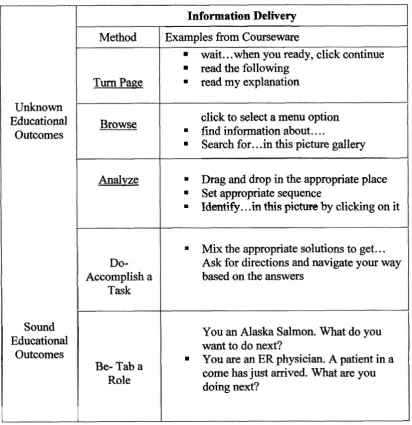
Table 2.2: Information Delivery
Unknown Educational Outcomes Sound Educational Outcomes Method
Turn Page
Browse
Analyze
Do- Accomplish a
Task
Be- Tab a Role
Information Delivery Examples fi-om Courseware
wait.. .when you ready, click continue read the following
= read my explanation
click to select a menu option find information about.. .
.
Search for.. .in this picture gallery
Drag and drop in the appropriate place Set appropriate sequence
Identify.. .in t!s picture by clichg on it
Mix the appropriate solutions to get..
.
Ask for directions and navigate your way based on the answersYou an Alaska Salmon. What do you want to do next?
[image:23.541.59.472.277.703.2]Educational courseware programs often include images, sounds and movies. Unfortunately, in many instances, the inclusion of media in the courseware has very little effect on learning. Displaying a picture, for example, because "it's cute" or because it breaks a text segment does not mean that students learn better with it.
Analyzing the characteristic of each medium leads to many potential learning hurdles. Video grabs students' attention, however it is a very passive medium. After a short time of watching video, students' concentration level and interest often decreases. Learning fiom audio is quite difficult, it requires concentration, internalization and processing skills that in many cases are not easy to apply.
2.2.3 What Makes A Good Courseware?
To develop a good courseware, there are two features need to be added to make sure that the courseware more educational and interesting. According to Amit Schitai(2000), all successful courseware should have both of this features:
Performance Computation. Reporting on students' performance does not mean that learning has indeed occurred. Since computation is what computers do best, it is very natural for courseware developers to use this capability as a performance analysis tool. Thus, many courseware programs include a quiz or a similar assessment and then provide feedback like: "You have answered 20 questions and 14 of them COTT~C~". Some programs make use of the computer's ability to