A COMPARISON STUDY OF STANDARD TEST METHOD FOR THE DETERMINATION OF FLEXURAL PROPERTY OF GLASS FIBER POLYESTER
LAMINATES
MOHD FAIEZUL BIN JOHARI
This report is submitted in partial fulfillment of the requirements for the Bachelor in Mechanical Engineering (Structure and Materials)
Faculty Mechanical Engineering Universiti Teknikal Malaysia Melaka
ii DECLARATION
I hereby declare that this project report entitled
A COMPARISON STUDY OF STANDARD TEST METHOD FOR THE DETERMINATION OF FLEXURAL PROPERTY OF GLASS FIBER
POLYESTER LAMINATES
is written by me and is my own effort and that no part has been plagiarized without citations.
Signature : ………...
Writer Name : ………...
iii
DEDICATION
To my beloved mother and father, Johari bin Dailam and Saniah binti Sulaiman. Who inspired me with their love and kindness.
To all my sisters,
For giving me endless strength and support.
iv
ACKNOWLEDGEMENT
v
ABSTRACT
vi
ABSTRAK
vii
TABLE OF CONTENT
CHAPTER TOPIC PAGE
ACKNOWLEDGMENTS iv
ABSTRACT v
TABLE OF CONTENT vii
LIST OF TABLES x
LIST OF FIGURES xi
CHAPTER 1 INTRODUCTION 1
1.1 Background 1
1.2 Objective 2
1.3 Problem Statement 2
1.4 Scope 2
1.5 Report Outline 3
1.6 Conclusion 4
CHAPTER 2 LITERATURE REVIEW 5
2.1 Definition of FRP 5
2.2 Composition of FRP 7
2.2.1 Reinforcement 8
2.2.2 Glass fiber 9
2.2.2.1 Formation 10
viii
CHAPTER TOPIC PAGE
2.2.3 Resin 11
2.2.3.1 Polyester Resin 12
2.3 Standard 14
2.4 Standards Organization 15
2.4.1 ASTM Background 16
2.4.2 BSI Background 17
2.5 Mechanical Properties 18
2.5.1 Flexural Strength 19
2.6 Flexural Test 18
2.6.1 ASTM D790 22
2.6.2 BS ISO 178 24
CHAPTER 3 METHODOLOGY 27
3.1 Introduction 28
3.2 Flow Chart 25
3.2.1 Literature review 25
3.2.2 Fabrication Process 29
3.2.2.1 Hand lay up operation overview 30
3.2.2.2 Cutting process 33
3.2.3 Flexural Test 33
3.2.3.1 ASTM D790 Overview 34
3.2.3.2 BS ISO 178 Overview 35
3.2.3.3 Test Procedure 38
3.2.4 Results 38
ix
CHAPTER TOPIC PAGE
CHAPTER 4 RESULT AND ANALYSIS 40
4.1 Test by Using ASTM D790 40
4.1.1 Results 42
4.1.2 Table Analysis 43
4.1.3 Graph Analysis 44
4.2 Test by using BS ISO 178 51
4.2.1 Results 52
4.2.2 Table Analysis 53
4.2.3 Graph Analysis 54
CHAPTER 5 DISCUSSION 61
5.1 Discussion of the ASTM D790 and BS IS0 178 61
5.1.1 Scope of standard 61
5.1.2 Test Specimen 62
5.1.3 Equipment 63
5.1.4 Test Procedure 63
5.1.5 Content of Report 63
5.1.6 Precision of Results 64
5.2 Discussion of Graph Analysis 65
5.3 Discussion of the Flexural Test Results 67
CHAPTER 6 CONCLUSION 70
REFERENCES 73
x
LIST OF TABLES
NO TITLE PAGE
2.1 Properties of high performance fibers in reinforced polymers 8 2.2 ASTM test methods for characterizing mechanical properties
for fiber 18
2.3 Two types of procedures used in ASTM D790 23
2.4 Definition of term used in ASTM D790 24
2.5 Definition of term used in BS ISO 178 25
3.1 Materials options for hand lay up process 32 4.1 Specimen types and it orientation 41 4.2 Experimental data from three point bending test (ASTM D790) 42
4.3 Specimen types and it orientation 51
xi
LIST OF FIGURES
NO TITLE PAGE
2.1 Composition of FRP 7
2.2 Idealized Chemical Structure of a Typical Isophthalic Polyester 13
2.3 Direction of load application 19
2.4 Three point loading flexure test 21
2.5 Position of test specimen at the start of the test 26
3.1 Flow of project activities 28
3.2 Chopped strand mat material 29
3.3 Woven roving [0/90] material 29
3.4 Hand lay up fabrication 31
3.5 BOSCH jigsaw cutter 33
3.6 T130RF – jigsaw blade 33
3.7 Shape of specimen 33
3.8 Universal Material Testing Machine 37
3.9 INSTRON 5585 with three points bending jig 38
3.10 Specimens setup 38
xii
NO TITLE PAGE
4.8 Graph Flexure Load versus Flexure Extension for 'B' Specimens 56 4.9 Graph Flexure Load versus Flexure Extension for 'C' Specimens 57 4.10 Graph Flexure Load versus Flexure Extension for 'D' Specimens 58 4.11 Graph Flexure Load versus Flexure Extension for 'E' Specimens 59 4.12 Graph Flexure Load versus Flexure Extension for 'F' Specimens 60 5.1 Graph flexure load vs. displacements for E specimens 65 5.2 Bar graph for comparison of average flexural load value
for each specimen 66
5.3 Failure modes the associated stress-strain curves obtained from
epoxy composite specimens 68
5.4 Image of tensile fractured surface of laminate under flexural load 68 5.5 Optical micrograph showing fiber rupture and pull-out in unidirectionally
reinforced specimen 69
1
CHAPTER 1
INTRODUCTION
This chapter is to provide the reader with an introduction to the research conducted for this comparison study. This chapter discussed on the objective, problem statement, scope of study and outline for each chapter of this study.
1.1 Background
Fiberglass is material made from extremely fine fibers of glass. It is used as a reinforcing agent for many polymer products, the resulting composite material, usually known as fiber-reinforced polymer (FRP) or glass-reinforced plastic (GRP), is called "fiberglass" in popular usage.
A fiber-reinforced plastic is a composite material comprising a polymer matrix reinforced with fibers. The fibers are usually fiberglass, carbon, or aramid, while the polymer is usually an epoxy, vinylester or polyester thermosetting plastic. Fiber-reinforced plastic are commonly used in the aerospace, automotive, marine, and construction industries (Miracle, 2001)
2 fibers (fiberglass). The plastic is most often polyester or vinylester, but other plastics, like epoxy (GRE), are also sometimes used. The glass is mostly in the form of chopped strand mat (CSM), but woven fabrics are also used. (Miracle, 2001)
1.2 Objective
The objective of this comparison study is to identify and compare the differences of standard test method that are used in two standard institutes for determination of flexural property of glass fiber polyester laminates
1.3 Problem Statement
Traditionally, there is a lot of test method that was used to determine the flexural property of glass fiber polyester laminates. American Society of Testing and Materials (ASTM) and British Standard Institution (BSI) are the institutes that have their own standard in determining the flexural property of composite material. Even though the recommendation standards of these two institutes are commonly similar, but it has a lot of substantial difference between them.
1.4 Scope
Scopes of this study include:
3 b) Study on the standard test methods that are use in determining the flexural
property of glass fiber polyester laminates.
c) Fabrication and preparation the specimen based on the standard test method. d) Study of differences of test method that was developed by ASTM and BSI.
1.5 Report Outline
Chapter 2 is discuss on the literature search on definition and composition of
fiber reinforced polymer, background for American Society of Testing and Material (ASTM), and the British Standard Institution (BSI), as well as the test method in determining the flexural property that were developed by these two well known standards organization.
Chapter 3 is based on the experimental work and technique that will be conduct
during this study in obtaining the data. The process of this study starts with researching the relevant literature review, the fabrication of the specimen and the laboratory works. The laboratory works that will be used is the flexural test by using three point bending test.
Chapter 4 is mainly about the result and how the data will be analyzed after the
test has been completed.
Chapter 5 is the discussion on the result and interpretation of the results that
4 Chapter 6 is the conclusion for this project. This chapter will conclude based on
5
CHAPTER 2
LITERATURE REVIEW
Chapter two will discuss on literature review of fiber reinforced plastic composite and its main composition, standard organization. Some information about mechanical properties especially on flexural properties, flexural test and the standard method that was used by international standard organization for this composite will be mention in this chapter.
2.1 Definition of FRP
In general, Fiber Reinforced Polymer (FRP) can be classified as composite materials that combine a polymer matrix with reinforcing agents. The polymer matrix can be either thermoset or thermoplastic resin such as polyester, isopolyester, vinyl ester, epoxy and phenolic that reinforced with fibers such as glass, carbon, aramid or other reinforcing materials. FRP may also contain fillers, additives and core materials added to modify and enhance the final product for structural application.
6 achieved. For these reasons, FRP can be developed specifically to meet the required performance versus the traditional materials such as timber, steel and ceramic. (Tan Sim Thye, 2003)
Many terms can be used to define the FRP composites. Basically, they are identified by a specific fiber such as Glass Fiber Reinforced Polymer (GFRP), Carbon Fiber Reinforced Polymer (CFRP) and Aramid Fiber Reinforced Polymer (AFRP). Another familiar term being used is the Fiber Reinforced Plastics. All these refer to the same meaning of the FRP composites.
2.2 Composition of Fiber Reinforced Plastic
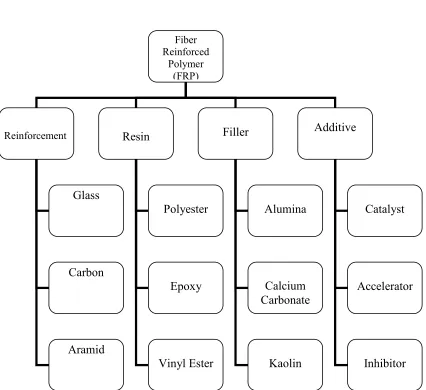
Basically, the FRP is a composition of resin, reinforcement, filler and additive. Each constituent plays an important role in the processing and final products. The constituents retain their identities in the composites and can be physically identified.
Polymer or resin acts as the glue that holds the composite together and influence the properties of the end product. The reinforcement or fiber provides the mechanical strength while fillers and additives are added as performance aids to the special properties of the end product. (Tan Sim Thye, 2003)Figure 2.1 shows the composition of FRP that commonly used.
It is important to study the composition of FRP and their characteristics. The type, quality, quantity and proportion of materials used to fabricate the FRP products are directly influence their mechanical properties and performance. Among the criteria to be considered during the design stage includes:
• Type of reinforcement or fiber
7
[image:19.612.115.541.167.557.2]• Orientation of fiber • Type of resin • Service conditions
Figure 2.1: Composition of FRP (Tan Sim Thye, 2003)
Fiber Reinforced
Polymer (FRP)
Reinforcement Resin Filler Additive
Glass
Polyester Alumina Catalyst
Carbon
Epoxy
Vinyl Ester Aramid
Calcium Carbonate
Kaolin
Accelerator
8 2.2.1 Reinforcement
Reinforcing agents can be either natural or man-made. The primary function of the reinforcement is to sustain load along the length of the reinforcement in order to improve the structural characteristics. In addition, they can be continuous in the form of fibers, filaments or tapes, or discontinuous in form of whiskers, flakes, spheres, powders, platelets or particulates. Reinforcements are permanently combined with the polymer matrix on a microscopic scale. (Composites Basic Material, 2004) By adding such reinforcements, a lot of improvements can be achieved by:
• Improve formability
• Increase strength to density and stiffness to density ratio
• Increase resistance to corrosion,fatigue, creeps and stress rupture • Reduce coefficient of thermal expansion
• Produce higher temperature performance
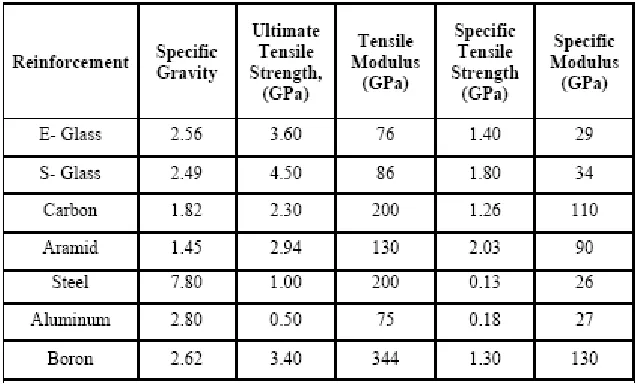
9 Table 2.1 Properties of high performance fibers in reinforced polymers
(Composites Basic Material, 2004)
2.2.2 Glass fiber
10 In comparison, glass is generally good in the impact resistance, but higher in weight compare to carbon and aramid. It has an equal or better than the steel in certain forms of characteristics. However, the lower modulus made it need a special design in order to perform well in its applications.
Glass Fiber Reinforced Polymer is widely used in the construction and automobile industries. For examples, highway sign and post, manhole cover, aesthetic building structures and commercial roofing. As proven, bridge columns that were wrapped with the GFRP were not shaken during earthquake. (Composites Basic Material, 2004)
2.2.2.1Formation of glass fiber
11 2.2.2.2Properties
Glass fibers are useful because of their high ratio of surface area to weight. However, the increased surface makes them much more susceptible to chemical attack. By trapping air within them, blocks of glass fiber make good thermal insulation.
Glass strengths are usually tested and reported for "virgin" fibers which have just been manufactured. The freshest, thinnest fibers are the strongest and this is thought to be due to the fact that it is easier for thinner fibers to bend. The more the surface is scratched, the less the resulting tenacity is. Because glass has an amorphous structure, its properties are the same along the fiber and across the fiber. Humidity is an important factor in the tensile strength. Moisture is easily adsorbed, and can worsen microscopic cracks and surface defects, and lessen tenacity.( )
In contrast to carbon fiber, glass can undergo more elongation before it breaks. The viscosity of the molten glass is very important for manufacturing success. During drawing (pulling of the glass to reduce fiber circumference) the viscosity should be relatively low. If it is too high the fiber will break during drawing, however if it is too low the glass will form droplets rather than drawing out into fiber. (Dominick V. R., 1997)
2.2.3 Resin
Resin offers an adhesive property to the composition in FRP. It acts as a glue to hold the fibers together so that the stress can be transferred between the reinforcing fibers and protect them from mechanical damage and environmental attack. Basically, resin can be divided into two categories, known as thermoplastic and thermoset.
12 when cooled. However, thermoplastic resins will melt at high temperature and become brittle at low temperature. Low heat distortion temperature makes them unsuitable for structural application. Below the Glass Transition Temperature, they behave like glass with strong, rigid but brittle properties. Examples of the thermoplastic resins include polypropylene, polystyrene, phenoxy, polyvinylchloride and nylon.
Thermoset resins are usually available in liquids monomer-polymer mixtures or partially polymerized compounds. They pass through one soft plastic stage and then harden irreversibly. Unlike the thermoplastic resins, once they are cured, they can not be reshaped or return to their original liquid form. With cross linking and inter-linking, thermoset resins are stiffer than the thermoplastic resins. These make them more suitable for the construction purposes. Their types include polyester, epoxy, melamine, urethane and silicon. (Dominick V. R., 1997)
2.2.3.1 Polyester Resin
Unsaturated polyester resin is a family of thermoplastic polyesters that being used as in the textile industry and represents about 75 % of the total resin used. For the manufacturing industry of FRP, thermosetting polyester is commonly used, varied for the small structures until very large construction. When reinforced with various fibers, particularly E-glass fiber, they develop outstanding mechanical properties in order to be applied for the structural applications. By adding fillers, finished surface can be improved. Besides, fillers are also added to reduce shrinkage and minimize crazing.