Rochester Institute of Technology
RIT Scholar Works
Theses
Thesis/Dissertation Collections
6-5-1991
Computerized machine knitting and felted-knits
Marie Scheponick
Follow this and additional works at:
http://scholarworks.rit.edu/theses
This Thesis is brought to you for free and open access by the Thesis/Dissertation Collections at RIT Scholar Works. It has been accepted for inclusion
in Theses by an authorized administrator of RIT Scholar Works. For more information, please contact
Recommended Citation
ROCHESTER
INSTITUTE OF TECHNOLOGY
A Thesis
Submitted
to the
Faculty
ofThe
College
ofFine
andApplied
Arts
in
Candidacy
for
the
Degree
ofMASTER OF FINE ARTS
COMPUTERIZED MACHINE
KNITTING
AND FELTED-KNITS
By
Marie Scheponick
ROCHESTER INSTITUTE OF TECHNOLOGY
This
volumeis
the
property
ofthe
Institute,
but
the
literary
rightsof
the
authormustbe
respected.Passages
must notbe
copiedorclosely
paraphrasedwithout
the
previous written consent ofthe
author.If the
readerobtainsany
assistancefrom
this
volumehe
must give proper creditin
his
own work.This
Thesis has been
usedby
the
following
persons,
whosesignatures attestto their
acceptance ofthe
above restrictions.Name
Address
Date
COPYRIGHT
CONTENTS
PREFACE
ii
LIST
OF
ILLUSTRATIONS
iii
INTRODUCTION
iv
PART I. HISTORY
CHAPTER
1.
FASHION DESIGN
1
2.
COMPUTERIZED MACHINE KNITTING
4
3.
FELTING
6
PART
H. TECHNIQUES
AND
MATERIALS
4.
FELTED-KNIT
YARDAGES
8
5.
KNIT YARDAGES AND SWEATER
14
6.
DYED
YARDAGES
21
7.
SKETCHES,
PATTERNS AND CONSTRUCTION
22
8.
CONCLUSION
25
ENDNOTES
30
PREFACE
Continuously
being
drawn
to the
limitless
variety
oftextures
availablein
fabrics,
especially
knits,
was amotivating
factor
andinspiration
to
begin
this
study.From
the
narrowest perspective of
the thesis
conception a goal wasto
create afabric
uniqueto the
marketplace.
There
werethree
majorqualities, among others,
that
were sought.It
wasto
possess
different layers
oftexture,
display
the
sensitivity
the
designer had for
the
utilizedfibers,
and potential
for
mass production after some modifications.Over
months ofresearch,
which preceded an officialbeginning
to thesis work,
there
was a continuousflow
oftiny
samplesfrom
the
knitting
machine.Each
piece was thenfelted
through various techniques.This
experimental process continued untilthe time
of aninstinctive,
aesthetic conclusion.A
few
resultsfrom
the
samplemaking
became
the
modelsfor
the
yardagesthat
wouldlater
be
produced.From
this
initial
researchthe
scope ofthe thesis
naturally
evolved.Hopefully,
by
reading
the
following
pagesthe
enthusiasm and almost addictivechallenge
felt
towards this
project willbe
communicated.LIST
OF ILLUSTRATIONS
Figure
Page
1.
First
Felted-Knit
Yardage
12
2.
Second Felted-Knit Yardage
13
3.
Textured Gold Knit
16
4.
Purl
Side Gold
Knit
18
5.
Silk Sweater
20
6.
Group
1
26
7.
Group
2
27
8.
Group
3
28
9.
The Collection
29
INTRODUCTION
One
ofthe
highest
prioritiesthroughout the thesis
process wasto
incorporate
knowledge
offashion design
withthe
mostimportant
elementslearned
in
the
pasttwo
yearsfor
my
personal and professional growth.As
an undergraduatethere
was afascination developed for
the
process andtechniques
involved
with computerknitting
machines.Attention
and experimentation werequickly
absorbedin
this
method ofcreating fabrics
andclothing because
it is
away
to
createinfinite
textures.
This
technique
is
onethat
was exploredin
moredepth
throughout
graduatestudies and
later became
alarge
part ofthe thesis.
Felting
is
also a method ofproducing
cloththat
wasnaturally
appealing.The
nature of
the
fusing
process alloweddifferent
types
oftexture to
be
combined withthe
felt.
Through
experiments and practiceit
became
a methodthat
couldbe
controlledto
some extent.For
these
reasonsit became
evidentthat
felt
would also somehowbe
combined as a materialfor
garments.Brainstorming
continued untilthe
idea
offelting
the
knits
developed.
Completing
onelarge
sample of afelt-knit
combination madeit
evidentthat this
wouldbe
pursued
to
produce yardages offabric.
It
possessedthe
unique qualities oftexture
anddrapability
that
lend
themselvesnicely
to
clothing.Whenever there
was alack
of motivation orinspiration
to
proceed withwork,
Indian
miniaturepainting,
costumes ofthis
culture andfashion designer
Issey
Miyake
filled
the
void.
Indian
art andclothing from
the
17th
and18th
centuriesis filled
with naturalforms
andcolors which are
extremely
appealing.Issey
Miyake'sclothing
andphilosophy
aboutdesign
arerefreshing
and unconcerned withthe
currenttrend.
In
the
pastboth
ofthese
sourceshave
always
been
successfulin
providing
afresh beginning.
The
garmentsdesigned
from
these
fabrics
are meantto
become individual
statements about
the
wearer.Each
pieceis relatively
simplein
its
patterning
and construction.The
intention is
to
have
the
beauty
ofthe
fabrics
regardedequally
as much asthe
forms
andthe
imagination
ofthe
person who assemblesthe
outfit.It
has been both rewarding
andchallenging
to
design
agroup
of garmentsfrom
fabrication
to
construction.At
times the
workbecame
more complicatedthan
initially
expected,
CHAPTER
1
FASHION DESIGN
It
wouldbe
virtually
impossible
to
cover all aspectsin
the
history
offashion
design
in
one chapter.The
most effective methodis
to
discuss
the
points which relatedirectly
to this
body
of work.Between
1876
and1888
aFrenchman,
Albert
Racient,
produced a six volumeHistory
ofWorld
Costume.
It
is
one ofthe
earliestbooks
onthe
subject andhas
neverbeen
surpassed
in
its
scope anddetail.
In
orderto
redefine andsimplify
a complicatedtopic
he
separates
many important
cultureshe
considersto
be
uncultured,
anddeviant
from
mainstreamEuropean
style andfashion
into
separate sections.One
ofthese
sectionsincludes
China,
Japan,
India,
American Indians
andAfricans,
only
to
name afew.
Cultures
that
werethen thought
to
be
barbaric,
unwesternized,
or slowerto
change,
aretoday
enviedfor
their
ability
to
keep
intact
a sense ofdistinct heritage.
These
historical
costumes and societies areinspirational
to the
trends
and stylesthat
develop
in
the
fashions
coming
out ofAmerica
andEurope
today.
"The House
andClothes
have
answeredthe
human
requirementfor
shelterand,
whether we will or
not,
they
also expressthe
individual
andthe
nationalideal
ofbeauty
in
colour and
in
form,
satisfying
in
this
way
the
demands
ofthe
aestheticinstinct.
The degree
ofsatisfaction
these things
givethe
cultivated aesthetic senseis
the
measure oftheir
artisticvalue,
it is
nottheir
period,
their
oddity,
ortheir
costthat
determines
it."1This
statementfrom
Frank
Parsons,
in his book
the
Art
ofDress,
ties the
historical
value of clothesto the
many
otherinfluences
that
affect what peoplehave
wornthroughout
history.
Below,
is
alist
ofthings that
will alwaysinfluence fashion:
1
.Religion
2.
Monarch
government3.
Commercial
interests
4.
Social
5.
Geographical
6.
Time
7.
Principles
of artNothing
is
moreimportant in studying
costumesthan the
silhouette.Although
the
details
changeoften,
the
silhouette changes moreslowly
anddefines
the
character.The
silhouette remained
basically
the
samefrom
the
Egyptian
to
Byzantine
periods.As
civilizationdeveloped,
changes occurred more rapidly.Between
the
12th
and18th
centuries a slowtransformation
in
silhouettesis
evident.Now,
the
silhouetteis
redefinedevery
year ortwo.
It
is impossible
notto
believe
that
clothes reveal alot
about a person andthe
culture
to
whichthey
belong.
Being
familiar
withthe
changing
silhouettesthrough the
agesassociate with clothing.
From
an economicstandpoint,
the
production ofclothing
andtextiles
CHAPTER
2
COMPUTERIZED MACHINE KNITTING
Today,
computerized machineknitting
can produce mosttraditional
designs
andstructures of
traditional
hand knits.
These
machines alsohave
the
capability
to
makeknits
which are
too
complex orfine
for
hand
knitting.
The
commercialindustry
has become
highly
competitive
because
moderntechnology
must meetthe
demands
offashion
and usage.There
is
a uniqueinvolvement
between
the
knitting industry
in
garment andfabric
production.This
relationship
has
providedthe
knitting
industry
withthe
need and appreciationto
respondto
consumer
demands.
Knitting
technology
provides a wide range offacilities
to
achievethis
goal.In
orderto
understandhow
complexthis
industry
has
become,
it is first
necessary
to
learn
somefacts
aboutits
origin.The invention
ofthe
stocking
frame is
creditedto
Reverend William Lee
ofCalverton
in
Nottinghamshire in
1589.
It
provedto
be
ten times
faster
than
knitting
withhand
held
pins and wasthe
foundation
of modern weft andwarp
knitting.
From
this
invention
the
technology
to
produce machinelace
wasdeveloped,
andalthough still
in its
crude stagesthe
results were of poor quality.It
was encouragedto
improve
the
frame in
orderto
knit
silk.Elizabeth
I
andJames I
madeit impossible
to
obtain a patentfor
the
invention
because
they
feared
it
would cause unemploymentfor
hand knitters.
The
frame
was movedto
London
afterthe
assassination ofHenry
IV.
Until
1810
the
industry
expandedrapidly
whichresulted
in
over-production,
stagnation andthen
unemployment.Conditions
did
notimprove
until
the
secondhalf
ofthe
nineteenthcentury
with newinnovations
andinventions
in
knitting
CHAPTER 3
FELTING
It
is unlikely
we will everknow
the
causesfor
the
invention
offelt,
but its
earliest
form is
of atextile
found in
the
Central Asian
Steppes
dating
about600
B.C.
Literary
references
in China date
back
to
2300
B.C.
Warriors
protectedthemselves
withfelt
shields,
hats,
clothes andfelted
boots.
The Greek
word"pilos"
refers
to
felt
cloth oranything
madefrom felt.
In
the
Iliad
felt
caps weredescribed
andOdysseus
was saidto
have
warn ahelmet
lined
withfelt.
Central Asia has
the
most abundantfelt
referencesin
writing,
connecting
it
to
all aspects of
life.
The
earliest recordedillustration
offelt
making,
was awallpainting
outsideVerecundus'
workshop in Pompeii.
Unfortunately,
felt has
alow
survivalratein
archeologicalconditions.
"Although
it is
now such a common productin
the
West,
apartfrom
its
use asunderfelt or
roofing
felt
and otherindustrial
demand,
it
was,
up
to the
nineteenthcentury, very
widely
used,
especially
in
the
hatting
industry."2
The
use offelt
canbe
followed
up
to the
nineteenth and twentieth centuries.
Not
untilthe
nineteenthcentury
werethere
any
socialdistinctions between
the
users offelt,
it
wouldbe found
in
a palace or a circularfelt
coveredtent.
Only
in
this
century
when so muchritualistic
belief
ofthe
sophisticated classes wastextile
is found in
the
nomads'thoughts
andbeliefs
and wasoriginally
offundamental
CHAPTER 4
FELTED-KNIT YARDAGES
Before
explaining
the
processes usedto
createthis
workit
willbe helpful
to
statethat the
order ofChapters four
through
sevenis
notnecessarily
the
way in
whichthe
work wasstarted or completed.
The
paperis
arrangedin
this
mannerto
makeit
as organized aspossiblefor
the
reader.Nothing
has
atitle
as seenin
mostthesis.
This
collectionis divided into
sections
only
for
technical
anddescriptive
purposes.It had been
established through samplemaking
that
knitted lace
and sometuck
stitch patterns were
the
most effectiveknitting
technique to
usein knitted-felt. Additional
fibers
could
be
addedalong
withthe
roving in
the
felting
process andthe
resulting
fabric
would retainthe
qualities ofknits
as well asthe
stability
offelt.
Knit
patterns withthe
largest
holes
werealso used which
helped
its
drapability.
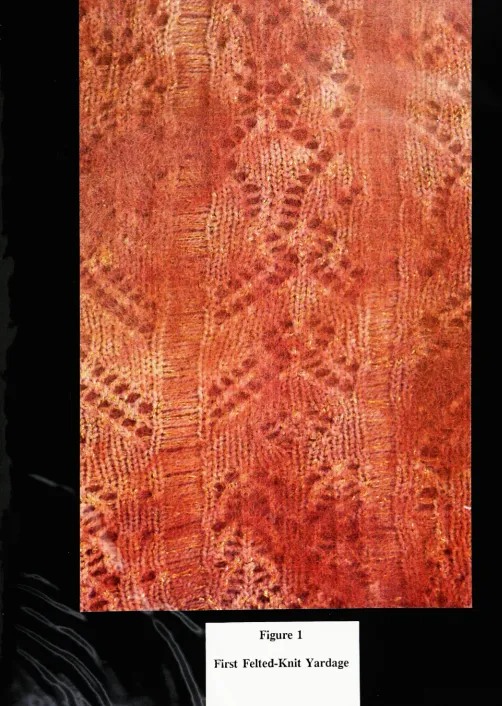
The first
yardageknitted
wasvery
experimentalin
terms
ofcolor,
andthe
proper amount of
roving
addedfor felting.
To
add variationto the
knit,
aboutevery
twenty
rows
the
patternnumberofthe
lace
was changedin
the
computer.Metallic
yarn wascombinedwith
the
wool yarnin
the
knitting
processin
the
first
third
andlast
third
ofthe
yardage.The
center of
the
fabric
wasknitted entirely
of wool.Metallic
yarnis very brittle.
Evenly
spunand pliable yarns result
in
the
best
machineknit
withthe
least
mechanical problems.The
metallic yarn made
knitting
atedious
processbecause it breaks
as a result of uneventension.
The
sectionsin
whichthe
metallic yarns were used arevisibly
andtactilely
stifferthan the
center.
Clothes
wouldeventually
be
madefrom
these
yardages soit
wasnecessary
to
make
it
as wide asthe
bed
of needles onthe
machine,
approximately
one yard.Each
piece wasfour
orfive
yardsin length before
being
dyed
orfelted.
It
was takeninto
accountthat
theyarnused
in
the
piece would shrinktremendously
in
the
felting
process.Five
yards shrankto
aboutthree.
Next,
the
fabric
androving
weredyed
along
with some silk stripsthat
wouldbe
combinedin
the
felt.
Silk
strips and metallic yarn were usedto
contrastthe
dull
color ofwool.
The
fabric
waslaid
out and the strips and yarn were pulled throughthe
holes in
the
knitting
with a crochet needle.After
this,
the
woolbatting
couldbe
addedin
abottom
layer,
underneath
the
yardage offabric
and alayer
ontop
ofthe
fabric.
Both
layers
enclosedthe
added elements.
Batting
is
carded woolfibers in
aflat form
preparedfor
felting.
Felting
took about onehour.
The
secret wasto
find
atime
limit
long
enoughto
fuse
allthe
fibers
together
into
onefabric but
notfelt
too
long.
If
this
happened
the
yardagewould
be
stiff andlose
its
drapability.
Unfortunately,
too
muchroving
was added andthe
fabric
was alittle
too
heavy
for
the
end use.In
orderto
correctthe
situationthe
fabric
wascombed with a wire
brush
andthe
loose
fibers
were cut offthe
entire piece.A
desired
From
this
initial
yardageit
was possibleto
calculatethat
metallic yarn wouldnot
be knitted into
future fabrics because
ofthe
problemsit
created.Thinner
layers
of woolhad
to
be
used whenfelting
to
eliminatethe
heaviness
ofthe
first
piece.More
contrast neededto
be
madebetween
the
color andtexture
ofthe
knit,
and silk strips.Overall,
this
yardage metthe
initial
goals,
but it
was possibleto
improve
the
nextfabric
with afew
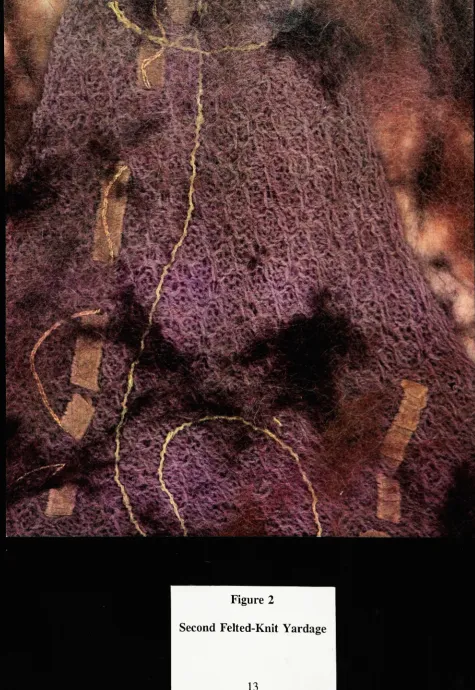
minor changes.The
second yardage was producedin
the
sameway
asthe
first
but
with someminor adjustments.
There
weredivided
opinions onthe
peach-pink color ofthe
first fabric
soit
wasdecided
to
movetoward
earthtones.
A
satin weave silk was usedfor
the
silk stripsbecause,
this type
of weave creates alot
of sheen whendyed.
This
addedthe
needed contrastbetween
the
wool andknit.
Also,
along
withthe
metallic yarn and silk strips a gold color seedrayon yarn was added.
More
contrast was addedby laying
this
yarn ontop
ofthe
knit
yardagein
aswirling
patternbefore felting.
Another fiber
changetook
placeby
using camel, mohair,
and cashmereroving
in
this
fabric,
as comparedto
using
only
wool and mohairin
the
peach piece.Utilizing
these
wools resulted
in
asofter,
lighter
fabric
with more color variationsfrom dyeing.
It
had been
planned
to
makethese
surface changesbefore starting
the
secondknit fabric.
The
sametuck
stitch pattern was used
throughout the
entireknitted
piece.The
second piece was more than satisfactory.Looking
atboth
fabrics it
wasobvious
that
they
would work welltogether.
The
colors complemented each other andthe
peach color of
the
first
piecebrought
out rosetones
in
the
second.No clipping
wasnecessary
for
the
brown fabric because
muchless
bating
waslaid
down
for felting.
fr\
'Wis"
M*-
Sr
*.;i*"'
4W
3k"-Hi'
[image:20.534.0.503.12.718.2]If*
\%m
Figure 1
First Felted-Knit Yardage
*
H
[image:21.534.31.507.11.701.2];
Figure 2
Second
Felted-Knit
Yardage
CHAPTER
5
KNIT
YARDAGES
AND SWEATER
Originally
one yardage ofknit
large
enoughto
cut outtwo
pairs ofpants wasto
be
made.Considering
the
short amount oftime
left for
the thesis to
be
completed andthe
nature of
the
knit
which wasto
be
made,
the
constructiontechnique
of cut and sew wasthe
best
option.
This
is
the
same method used when woven pieces are cut outfor
sewing.Joining
knit
pattern pieces
together
by
sewing
eliminatesthe
needto
constructthe
pieceentirely
onthe
machine.
Another
way
ofmaking
knits for
garmentsis
to
graph out each pattern piece andcalculate
the
number of stitches perinch.
When
the
pieces arefinished
they
canbe
puttogether
by
hand,
sewing
through the
salvages.Depending
onthe type
ofknit,
andthe
garmentfor
which
it
willbe
applied,
eithertype
of constructionis
appropriate.Finding
a suitable yarnto
createleggings became
the
biggest
obstacle.The
yarn needed
to
be
elastic,
relatively
strong, shinny,
and aboveall,
textured.
After
producing
a
lot
of swatchesfor
possible combinations ofyarns, texture
andpattern,
adecision
was made.The
yardage wouldbe
madefrom
a mixture of a seed rayon and a10/2
cotton.This
choicesolved one problem
but
created another.There
wasonly
enough seed rayonto
makefabric
for
one pair of
leggings
and more cones ofthis
yarn were not available.The
second pair of pantshad
to
be
madefrom different
yarns.A
platedtuck
stitch patternderived
from
the
computer was used.This
methodproduced
the
mosttexture
on one side ofthe
fabric
whilethe
other sideknitted
stocking,
orplain stitch.
It
resultedin
alot
of surfaceinterest.
The
slubsin
the
seed rayon stayed on oneside and created a random pattern.
Once
the
yardage was completedit
wasdyed
in
the
piecedyer.
This
method ofdying
fabric
wasthe
most efficientfor
almost all ofthe thesis.
It
ensured an evendye
and achance
to
match colors asclosely
as possible.After
the
fabric
wasdyed it
was alittle
disappointing,
because
this type
of rayonproduced a greenish
hue.
It
was closeto the
old gold used onthe
silk strips.There
was aconcern
that
it
might clash withthe
rest ofthe
woven silk garments which werealsoto
be dyed
old gold.
Something
that
became
even clearer werethe technicalities
involved
in dyeing. Even
if
the
fibers
arethe
samethere
aremany
otherdetails
to
considerin
orderto
reach a similarcolor.
Many long
floats
emergedthroughout this
piecebecause
ahighly
textured
yarnwas used.
Mending
these
mechanical errors was avery
time
consuming
process.Excluding
the
concern aboutthe
color,
andthe
mending
that
had
to take
place,
this
was afavorite
piece.It
wasexciting
to
imagine
the
fabric
as a pair ofleggings.
Examining
the
amount oftexture
in
allofthe
finished
yardages, the
choice wasmade
to
use a smoothertextured
yarnfor
the
second pair of pants.A
smoothtexture
wouldunify
the
piecesinstead
ofadding
anew element.With
this
in
mind,
athicker
cotton yarn withW-
I
Figure
3
Textured Gold Knit
[image:24.534.0.534.12.703.2]rayon
twisted
in
the
center was used.The
rayon would addluster
to the
yardage and pickup
the
qualities ofthe
silk.This
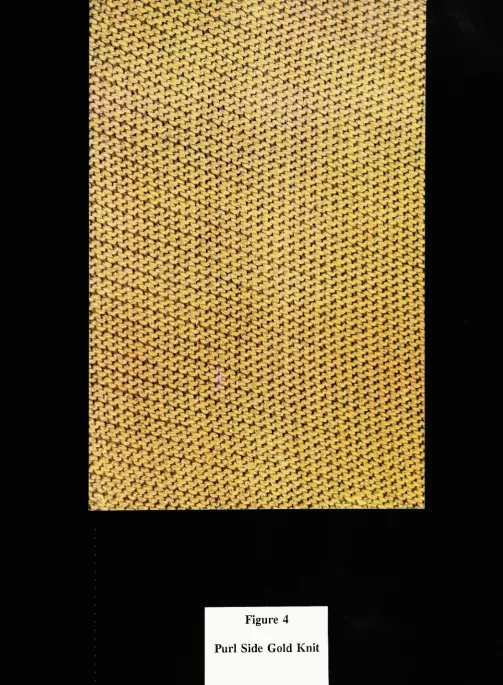
yardage wasknitted in
astocking
stitch.To
add a subtledifference,
the
purlside,
normally
consideredthe
wrong
side ofknits,
wouldbe
onthe
right
side of
the
finished
garment.Fortunately, knitting
this
fabric
resultedin
the
least
technical
or mechanicalproblems of all
the
yardages.The
processis
straightforward
andthe
use ofthe
computeris
not required
in
knitting
stocking
stitch.It
is
acompletely
manual operation.The
color wasvery
closeto the
goldin
the
silk stripsin
the
knitted
felt fabrics.
Dying
withthe
piecedyer
was
very
successfulfor
this
piece.The
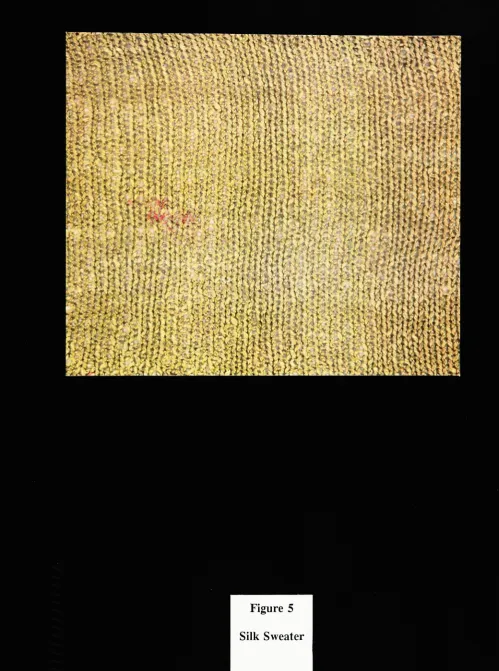
only
garmentknitted entirely
onthe
machine wasthe
silk sweater.It
wasconstructed
using
the
methodpreviously described.
All
increasing
anddecreasing
of stitcheswas
done
onthe
machineaccording
to
a graphed pattern.Although
this
approachtends to take
longer,
it is
visually, the
best
methodto
construct astocking
stitch sweater of silk yarn.Instead
of piecedyeing,
asdone
withthe
otherknit
fabrics,
the
skeins of yarnwere
dyed before
knitting.
A
slightvariation,
similarto
spacedyeing
occurred.It
reflectedlight
in
an unusualway but
this
was not considered a problem.Compared
withthe
silkthat
had already
been
dyed gold,
this
yarn camevery
closeto the
same shade.The
mosttrying
aspect offinishing
the
sweater wasfinding
the
mostappropriatemethod of
finishing
the
edges.A
sweaterthis
elegantlooking
requiresthe
seamsto
be
asFigure 4
Purl
Side
Gold Knit
hidden
as possible.Hand sewing
seamsis
time
consuming but it
addsthe
mostprofessionally
constructed
look
to
certainknits.
Unbelievabley,
the
sweater came outto
look
almostexactly
as planned.Except
for
the
slight variationin
colorthe
garment would work well withthe
rest ofthe
fabrics.
Figure 5
Silk Sweater
CHAPTER 6
DYED YARDAGES
Before
beginning
to
constructany
ofthese
garmentsit
wasdecided
that
muchof
the thesis
wouldbe
made of silk charmeuse.This
particular wovenfabric
was chosenfor
important
reasons.It
would add alighter
elementto the
heavier knitted
andfelted
pieces andalso,
afterbeing
dyed
it
wouldhave
anincredible luster.
One
side ofthe
fabric is
plain weaveand
the
other sideis
satin weave.Satin
weave producesdiagonal
lines
ofwarp
yarns whichreflect
light.
The
same silk was also usedin
the
strips of clothin
the
knitted
felt fabrics
sothis
would
tie
all ofthe
piecestogether.
About
seventeen yards offabric had
to
be dyed
old goldin
the
piecedyer.
The
color was
very
uniform afterthe
process and appeared asif it
would work well withthe
othergold pieces.
CHAPTER
7
SKETCHES,
PATTERNS
AND
CONSTRUCTION
SKETCHES
One
ofthe
most significant aspects offashion design
is
to
visually
communicateideas for designs
with croquis.Transferring
concepts onto paperis
away
to
redefine andexpand upon good
ideas,
andleave
the
weaker onesbehind.
Sketches
are alsonecessary
to
accurately
startdrafting
patterns.Having
a croquisin
front
of you whenmaking
patternseliminates a
lot
of mistakes and problems.A
basic
conceptfor
the silhouette,
and mood of the collection wasformulated
before fabric
productionbegan.
Transforming
these
ideas
onto paper andmaking
them
clearto
other peopleis
always challenging.Ink
sketches were made.After choosing
the
ideas
withthe
most potential andadaptability
to
existing
fabrics,
color croquisfollowed.
These
exhibitfabrication,
silhouette,
colorandtexture
for
each garment.From
these
sketchesideas
approachreality.
PATTERNS
Drafting
patternshas
neverbeen
the
mostexciting
part offashion
design.
It
is
technical,
time
consuming
and repetitive.As
with mosttechnically
related creativeprocesses,
proficiency
comes with practice.Accurate
patterns makethe
transitionfrom
two
dimensional
pictures,
to three
dimensional
garments muchfaster.
Nine
patterns were made.As
usualthe
processbegan
by
starting
withslopers,
or
blocks,
which arethe
basic
patternsfrom
which garments are made.Pattern
adjustmentswere made
according
to the
sketches.From
pastexperiences,
four
orfive
separate patternadjustments were made
before
beginning
to
makethe
final
garments.Considering
the
amountof
time
left
for
construction,
it
wasimpossible
to
makethatnumberofcorrections.Previously,
the
construction of garmentsinvolved
sketches, patterns,
muslins and construction.This
thesis
was more
in
depth
because
the
fabric
was also made.Therefore,
it
wasimportant
to
make patternsthat
neededlittle
adjustment.After
the
patterns were completedthe
nextstep
wasto
make muslins.Muslin,
is
aterm
usedto
describe
a mockup
of whatthe
actual garments willlook like.
They
are made offabric
approximately
the
same weight andhand
asthe
final fabric but
muchless
expensive.Taking
this
step
ensuresthe
exactfit
and silhouette ofthe
final
garments.In
this
phase, hash
markscan
be
made onthe
muslinsfor
pattern changes anddetails
canbe
checked.Analyzing
the
muslins madeis
clearthat
only
small adjustments neededto
be
made.
This
was greatbecause
it
meantstaying
onthe
planned schedule.Minor
adjustmentshad
to
be
madeto
hems
and sleeves.The
rest ofthe
problems wouldbe
solved asthey
surfaced.
There
was no needto
make second muslinsbecause
the
correctionsthat
wereto
be
made
did
not affectthe
silhouette ofthe
garments.CONSTRUCTION
Constructing
the
nine piecesin
this thesis
involved
attacking
each problem asit
arose.
Each
pieceis
uniquein
its
construction andfabrication
so most ofthe
problems weredifferent.
Each
garments requiredtest
samples of stitchesuntilthe
correct combination ofhand
sewing,
surging
and machinestitching
was reached.It
is important
to
keep
in
mindthat these
were not garments
that
wereto
be
mass produced andkeep
them on an experimentallevel,
asfar
asfabrication
and construction were concerned.There
were no major problemsputting
the
woven piecestogether.
The
majorchallenge was
finishing
the
brown
jacket
withthe
collar.If
the
jacket
wereto
be
completedas
originally
plannedthe
entire piece wouldhave been
madefrom
felt.
To
substitutefor
the
lack
offelt it
was suggestedto
useonly knit for
the
sleeves and collar.It
wasdyed
a similarbut slightly
contrasting
color andlined
with silklike
the
rest ofthe
felt
pieces.Surprisingly,
after
the problems, this
solution madethe
jacket
one ofthe
strongest pieces.CONCLUSION
Working
onthis thesis
wasthe
mostconsuming
and complex creative projectever experienced.
The
mostrewarding
aspect wascreating
the
fabric
from
whichthe
jackets
and vest were made and
exploring
the
possibilities ofthe
knitting
machine.Having
the
facilities
andopportunity
to
producea color palettefor
the
collectionexpanded upon
already
establishedideas
aboutthe
importance
of colorin
clothing.Some
piecesare stronger
than
othersbut
they
work together as planned.The felt-knit
fabric is
now areality.
The
process andidea
canbe
researchedfurther
sometimein
the
future.
If
onething
could
have
been
changedit
wouldbe
to
have
moretime.
Details
andfinishes
ofthe
piecesprobably
couldhave been
more refined.Unifying
fashion
andtextile
design
in
this
body
of work clarifiedthe
belief
that
these
two
disciplines
areinterdependent.
Being
surroundedby
avariety
of creative people andprocesses
for
the
pasttwo
yearshas had
anextraordinary
effect onthis thesis.
Hopefully,
the
creative growth experienced
working
onthe
collection will continue after school.Pr-y
Figure 6
Group
1
26
gpgEKBM
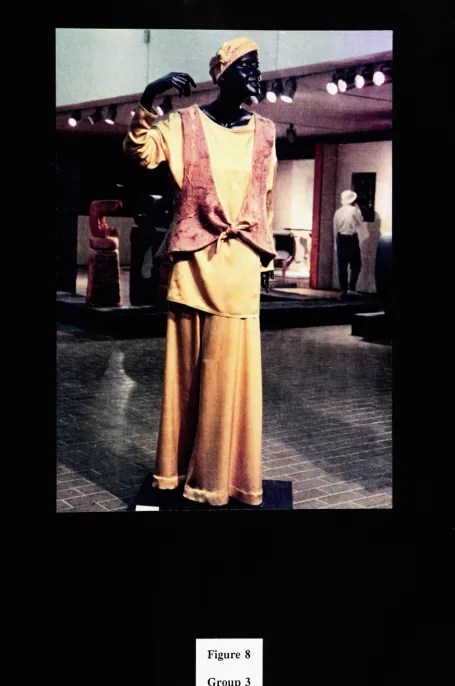
-Figure
8
Group
3
[image:36.534.56.512.11.698.2]NOTES
T^rank Alvah
Parsons,
The Art
ofDress (New York:
Doubleday,
Doran
andCo., Inc.,
1928),
xxii.2M.E.
Burkett,
Art
ofthe
Felt Makers
(Kendal:
Abbot Hall Art
Gallery,
1979),
1.
WORKS CITED
Burkett,
M.E.
Art
ofthe
Felt Makers.
Kendal,
England:
Abbot Hall Art
Gallery,
1979.
Spencer,
David J.
Knitting
Technology.
New York:
Pergamon
Press,
1989.
Recient,
Albert.
The Historical Encyclopedia
ofCostumes.
New York:
Facts
onFile,
Inc.
,1988.
Parsons,
Frank
Alvah.
The Art
ofDress.
New
York:
Doubleday,
Doran
andCo., Inc.,
1928.
Wilson,
Carrie.
Fashions Since
their
Debut.
Scranton:
International Textbook
Co.,
1939.
Adviser:
*Date:
Doriald Bujnowski
,I
Dorfald
Associate Adviser:
*Max Lenderman
/**_____
^^
cM/vn^uv,-Date:
(^lk
Associate
Adviser:*Nancv Ciolek
/**///
A/iar^/
sf;
lser:*
Nancy
#*#
Phil Bornarth
Special Assistant
to the
Dean
for
Gradually
auiairs:-_
run oorriann ,
Date:
_[___\
I
V
**
MUC^r_0i
^^UuUOJU^
Dean,
Collegt
oftFine andApplied
Date:
'((M^U
** Hfa-fe1^,
hereby
(grant,
deny)
permissionto the
Wallace Memorial
Library
ofRIT,
to
reproducemy
thesis
in
whole orin
part.Any
reproduction will notbe
for
commercial use or profit.OR
** T **
a request
for
productionis
made.I
/&anbe
reached atthe
following
address.*****
10780 Chester
Road*., prefer
to
be
contacted eachtime
Date:
Cincinnati. Ohio
45246