The teaching and learning of performance measurement in UK
undergraduate MS/OR degrees
Mik Wisniewski and Farhad Shafti, Department of Management Science, University of Strathclyde, Glasgow G1 1QE
Contents
Executive Summary
1. Introduction 1
2. Overview of the Project 2
3. Performance Measurement 3
4. MS/OR and Performance Measurement The PM process
4
5. Project Methodology Practitioners of PM
Academic content of MS/OR undergraduate classes 7
6. Results
Revisiting the research objectives
Teaching PM on MS/OR undergraduate degrees in the UK
Practitioner views on PM Further analysis
Qualitative data from practitioners
8
7. Teaching PM: a case study 15
8. Summary 17
References 18
Appendices
1 Performance Measurement Websites 2 Practitioner Questionnaire
3 UK University Websites 4 Academics Questionnaire 5 Overseas University Websites 6 Performance Measurement Tools 7 Performance Measurement Module
Executive Summary
The last decade or so has seen increasing practitioner and academic interest in organisational performance measurement (PM). Management Science/Operational Research (MS/OR) as a discipline potentially has a considerable contribution to make ranging from the use of soft MS/OR to help with the overall design of performance measurement frameworks through to the harder analytical MS/OR techniques which can help make sense of performance measurement data.
A review of existing UK MS/OR undergraduate programmes was completed to assess the extent and nature of performance measurement teaching. In addition, a survey of performance measurement practitioners was undertaken to obtain views on what should be taught in relation to performance measurement.
A survey of 23 undergraduate MS/OR degrees in the UK revealed that all the academic respondents supported the inclusion of PM teaching. However, only four distinct PM classes could be found amongst these degrees. The PM techniques taught were broadly similar although the wider context of PM was taught in only 2 of the classes.
A survey of a small number of PM practitioners revealed that the Balanced Scorecard and Benchmarking were the two most commonly applied PM techniques with the majority of respondents learning about PM from personal experience and reading rather than through formal education.
It appears that there is an opportunity for MS/OR teaching to make a major contribution to the development of PM as a discipline. However, academic respondents whose MS/OR degree course did not teach PM indicated that lack of staff expertise in PM combined with an already full syllabus were the main barriers to introducing a PM class.
1. Introduction
The issues around how organisations measure their performance effectively are attracting increasing interest from both practitioners and from academics. Within the last 10 years or so, there has been a widely-reported “revolution” in performance measurement (Neely, A. (1999), Johnston, R., Brignall, S. and Fitzgerald, L. (2002)). Historically, Operational Research (MS/OR) has made a number of major contributions to the debate about performance measurement at both the strategic and operational levels and to the performance measurement “toolkit” available to organisations (for example, through the development of techniques such as data envelopment analysis).
However, given the rapidly changing theoretical and practical base around performance measurement it is essential that effective teaching and learning approaches are developed, particularly at undergraduate level.
2. Overview of the Project
This project focussed on investigating:
• the extent to which performance measurement is taught on MS/OR undergraduate degrees in the UK
• subject content on performance measurement on these courses
• assessment approaches on performance measurement on these courses
• practitioner and academic views on what should be taught in relation to performance measurement
3. Performance Measurement
In 1991 Prof. Bob Eccles of Harvard Business School commented “Within the next five years every company will have to redesign how it measures its business performance”. In 1997 the US Institute of Management Accountants reported that 64% of US businesses were actively experimenting with new ways of measuring business performance.
It is perhaps no surprise that the last 10 years or so has seen a rapidly increasing interest in PM. Professor Andy Neeley from Cranfield University commented in 1998 that reports and articles on PM had been appearing at the rate of 1 every 5 hours of every working day since 1994 and that by 1996 a new PM book was being published in the USA every two weeks. In 1998 he found over 170,000 references to PM on the Web. In 2003, we found over 355,000 references.
4. MS/OR and Performance Measurement
It is fairly self-evident that MS/OR potentially has a substantial contribution to make to the PM agenda. As Dyson (2000) commented “… performance measures are here to stay and if that is accepted then there is an inviting role for OR to contribute to the design of effective performance measurement systems both in the public and private sectors”. And yet relatively little has been published on the relationship between MS/OR and PM. A search on both the Emerald and ProQuest (ABI/INFORM) publication databases using the keywords “performance measurement” and/or “operational research”, “management science” revealed only a handful of articles which discussed the relationship in any meaningful sense.
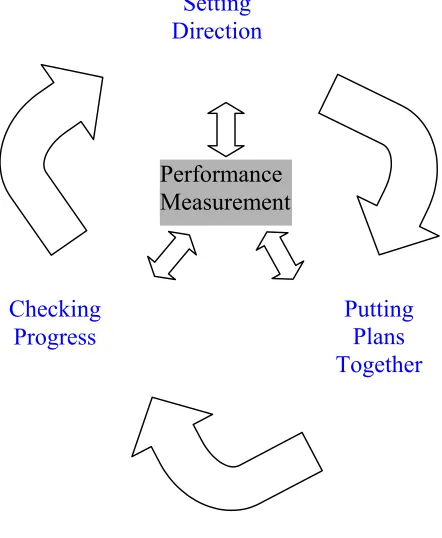
[image:7.595.184.405.446.715.2]Performance measurement is clearly important to the process of business strategy as illustrated in Fig. 1. The overall strategy process can be viewed as three inter-relating stages. Setting direction requires an organisation to develop a view as to where it is trying to get to in the long-term and will result in the setting of a vision or mission for the organisation together with overall strategic goals or priorities. Following on from this, the second stage involves Putting plans together – planning how the overall strategic goals will be achieved. The third stage, Checking progress, involves checking that the plans are being delivered, that they are producing the results expected and that progress is being made in terms of the overall strategic direction set.
Figure 1
The strategy process and performance measurement
Performance Measurement
Checking Progress
Putting Plans Together Setting
Arguably, effective performance measurement lies at the heart of this strategy process. Appropriate performance measures allow managers to monitor performance at both the strategic and operational levels; they allow managers to control and manage organisational performance; they allow managers to identify where and how performance needs to be improved.
The PM process
The process of developing effective performance measures comprises four stages:
First, deciding which aspects of organisational performance to measure. Given that is neither feasible nor cost-effective to measure every single aspect of an organisation’s performance, it becomes necessary to select those aspects to be measured. Historically, much of the focus of performance measurement has been on financial aspects of performance. Increasingly, however, in response to more complex environments and the need for more effective performance measurement approaches, attention has been turned to developing more holistic models and frameworks of performance measures such as the Balanced Scorecard.
Second, deciding how best to measure these aspects of performance. Once it has been decided what to measure, then appropriate measures have to be agreed and defined which are accurate, reliable and cost-effective. In addition, it is frequently necessary to incorporate standards or targets into these measures.
Third, making sense of the performance measurement data that is collected. The collected data will need to be analysed and interpreted in order to extract useful management information. As Smith and Goddard (2002) comment “Performance data are frequently worthless until they are translated into meaningful signals of performance”.
Finally, deciding how best to use the performance information. This will involve making management judgments based on the performance measurement information available.
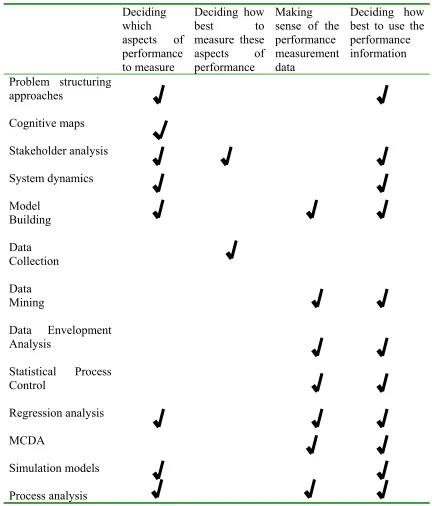
Initially, it may be thought that MS/OR’s contribution to this process would concentrate on the third stage – that of the analysis of performance data. However, as the matrix below shows the MS/OR contribution is potentially considerably greater. The matrix maps particular MS/OR techniques/approaches against the four stages of performance measurement.
Figure 2
Potential contribution of MS/OR to performance measurement
Deciding which
aspects of performance to measure
Deciding how
best to measure these
aspects of performance
Making sense of the performance measurement data
Deciding how best to use the performance information
Problem structuring approaches
Cognitive maps
Stakeholder analysis
System dynamics
Model Building
Data Collection
Data Mining
Data Envelopment Analysis
Statistical Process Control
Regression analysis
MCDA
Simulation models
5. Project Methodology
Data was collected from practitioners of PM and from universities about the academic content of OR/MS undergraduate classes in the UK.
Practitioners of PM
It was decided to collect data from practitioners of PM to try to assess the different performance measurement tools which are commonly used and to solicit their views as to what they felt should be taught in a performance measurement class. Practitioners were surveyed first so that the data collected could inform the questions to be asked of academics.
Consideration was given as to the sampling frame to be used. Clearly in any organisation performance measurement of some description will be taking place and someone will be responsible for the PM system however informal it might be. However, there was no obvious way of identifying who, in general, these people might be and it was felt that trying to contact such individuals would be a resource-intensive and generally unproductive exercise. In addition, the resources available for this project were quite limited. Accordingly, it was decided to publicise the research project through a small number of dedicated PM websites and through this to attract interest from practitioners. It is accepted that this would be purely a convenience sample.
A number of PM websites were approached to seek permission to publicise the project to users/members. A full list is shown in Appendix 1. Only two of these gave the appropriate permissions (BAM and PMA). For practical, logistical reasons it was decided to use a web-based questionnaire to collect data from practitioners. A copy of this is shown in Appendix 2. The questionnaire was available for access between December 2002 and April 2003. It attracted 40 useable responses.
Academic content of MS/OR undergraduate classes
A twofold approach was adopted in collecting information about current teaching of PM on MS/OR undergraduate degrees in the UK.
A list of 23 UK university undergraduate MS/OR degrees (Appendix 3) was obtained from the UCAS website and individual University websites were then checked for any information about the degree and, where appropriate, PM teaching. In addition, a short questionnaire (Appendix 4) was emailed to a named academic associated with each MS/OR degree. Reminders were sent two weeks after the initial emailing and these were then followed up by individual phone calls in an attempt to increase responses. A total of 13 responses was received.
6. Results
Revisiting the research objectives:
The research objectives were as follows. To investigate:
• the extent to which performance measurement (PM) is taught on MS/OR undergraduate degrees in the UK
• subject content on performance measurement on these courses
• assessment approaches on performance measurement on these courses
• practitioner and academic views on what should be taught in relation to performance measurement
The low number of responses to practitioner and academic questionnaires should be borne in mind when considering the following results. In particular, it is possible that some PM classes or classes that include PM material have been missed in the course of the research due to lack of responses to the questionnaire and difficulty in accessing the curriculum of these classes on the internet.
Teaching PM on MS/OR undergraduate degrees in the UK
All the academic respondents, including those with no PM class in their department, commented on the accepted importance of PM.
However, the responses to the academics questionnaire and the web searches revealed only four recognisable PM classes in UK undergraduate operational research degrees (out of the twenty three universities that offer an MS/OR degree). Of the four classes, only two comprehensively concentrate on PM. The remaining two integrate topics on PM as part of the overall class content.
The four PM classes had a number of similarities and differences:
Similarities:
• available to students in their final year at university • modules all comprise a mix of lectures and case studies • assessment is through a mix of assignments and an exam • classes are all taught by staff in the MS/OR department
Differences:
• classes concentrating on PM as a discrete subject as opposed to classes concentrating only on the quality management aspects in PM.
• classes focussing on the background, importance and role of PM as opposed to classes focussing primarily on the technical aspects of the tools and techniques of PM.
In general, the topics covered on the four undergraduate classes included:
Balanced Scorecard Benchmarking
Business process reengineering (BPR) Customer satisfaction
Data Envelopment Analysis (DEA) EFQM/Business Excellence model Implementation issues of PM Leadership aspects of PM The PM “revolution” Process Mapping PM and MS/OR Quality measurement Six Sigma
Total Quality Management (TQM) Traditional approaches to PM
A question was included in the academics questionnaire to ask those with no PM class about any particular reasons for not having a class on this subject. Seven responses were received with the main reasons given as:
• the degree concentrated more on mathematical topics such as computing science, information studies and mathematics.
• there was no room for “another” class due to the existing intensive teaching programme
• lack of knowledge on the subject in the department. Some respondents indicated that they were interested in adding a PM class but the lack of expertise in the department would not allow this.
In terms of assessment it was impossible to obtain any detailed information on the assessment of the PM classes other than that a mixture of assignments and exam was typically used.
Although not technically part of this study, an informal investigation was also conducted examining whether PM was more frequent on postgraduate MS/OR courses. It appears that while the number of classes and modules on PM on postgraduate studies is higher than those of the undergraduate studies, the features are mainly the same.
Practitioner views on PM
In this section practitioners’ views are presented and compared in three parts. First, the profile of the respondents and their respective organisations is presented, then the main PM tools used by practitioners are discussed. Finally the main difficulties in PM affairs, as pointed out by practitioners, are given. Further analysis was then done to look at possible relationships between responses.
Respondents’ Profile
[image:13.595.89.459.279.410.2]The respondents are distinguished in terms of the type of organisation they work in and the number of employees, country they are based in and their source of expertise in PM. The profile of the respondents is very important as it allows us investigating of any relationships or trends between the features in the profiles and the PM issues as will be discussed later. Tables 1 to 4 summarise the results:
Table 1: Type of Organisations
Organisation Number of Responses
Consultancy 20 Manufacturing 4
IT 2
Public Sector – Local Government 4
Public Sector – Other (not local government or health) 3
Utilities 1 Teaching 4 HRM 2 n = 40
[image:13.595.86.307.499.599.2]50% of the respondents were consultants. This is not unexpected given the sampling frame. The responses also revealed that these consultants have been involved in PM projects in a variety of organisations that include Manufacturing, IT, Public Sector, Transportation and Utilities.
Table 2. Number of Employees in the Organisation
No. of employees Number of Responses
below 1000 16
1000 < 5000 10
5000 < 10000 4
10000 < 50000 5
50000 or more 5
n = 40
Table 3. Location of Base
Location of Base Number of Responses
Australia 1 China 2 Europe 3
South America 3
UK 16 USA 7 Asia 3 Canada 1 Africa 4 n=40
[image:14.595.87.304.311.384.2]Table 3 shows that there is a wide range of countries from which responses were received with most from the UK.
Table 4: Source of Expertise
Source of Expertise Number of Responses University 8 Personal Experience 17
Personal Reading 12
Training 3 n = 40
Table 4 relates to how respondents developed expertise in PM with almost 3/4th of respondents citing personal experience or reading as the way they developed knowledge of PM approaches and techniques.
PM Tools
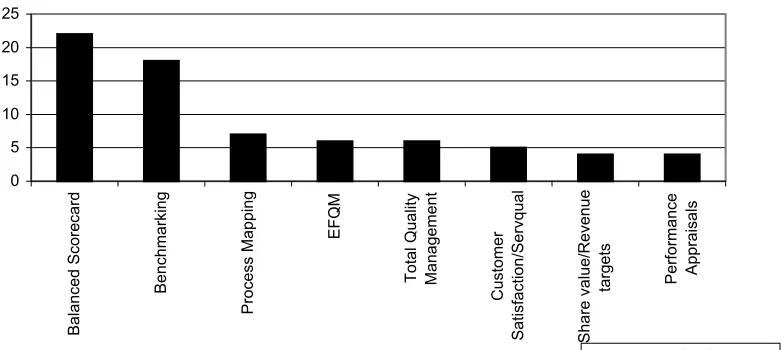
[image:14.595.102.493.553.728.2]Respondents were asked to detail which specific PM tools and techniques they had used in the organisations they were working in. Altogether 30 PM tools were referred to in the responses (a complete list given in Appendix 6) although the list also reflects the difficulty of defining what a PM tool is.
Figure 3: Popular PM Tools among practitioners
0 5 10 15 20 25 Ba la n ce d Sco re ca rd Be n ch ma rki n g Pro ce ss Ma p p in g EF Q M T o ta l Q u a lit y Ma n a g e me n t C u st o me r Sa ti sf a ct io n /Se rvq u a l Sh a re va lu e /R e ve n u e ta rg e ts Pe rf o rma n ce Ap p ra isa ls
Figure 3 shows the tools referred to by at least two respondents. The Balanced Scorecard comprises 22.7% of the responses1 on tools and proves to be the most popular PM tool among the practitioners with just over 50% of respondents saying they have applied the Balanced Scorecard in their organisation. Benchmarking had 18.6% of responses, with 45% of respondents using this in their organisation.
Respondents were also asked to indicate if there were any tools they have not yet used but which they think are applicable to the organisation. The answers followed almost the same pattern, with the Balanced Scorecard being the most popular response. Among the tools that were currently little used, there were three that received a significant attention when it came to referring to the potentially applicable tools. These are Performance Prism with 3 responses, Programme Performance Reports with 4 responses and DEA with 5 responses.
PM Difficulties:
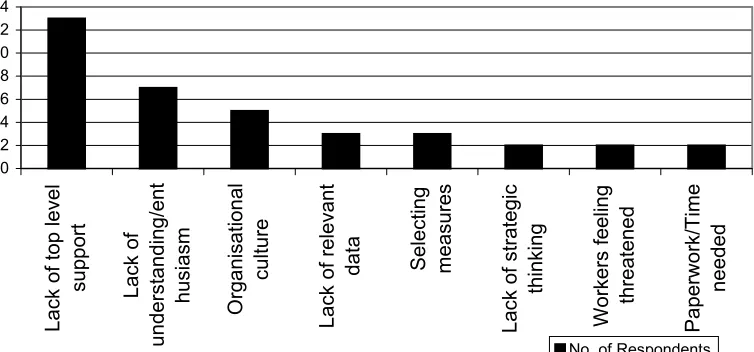
[image:15.595.107.484.396.572.2]Respondents were asked to point out the practical difficulties they had in applying PM tools. Figure 4 shows the responses: “lack of top level support” was the most common difficulty cited by almost 1/3rd of respondents.
Figure 4: PM Difficulties as Introduced by Practitioners
0 2 4 6 8 10 12 14 L a ck o f to p l e ve l su p p o rt L a ck o f u n d e rst a n d in g /e n t h u si a sm O rg a n isa ti o n a l cu lt u re L a ck o f re le va n t d a ta Se le ct in g me a su re s L a ck o f st ra te g ic th in ki n g W o rke rs fe e lin g th re a te n e d Pa p e rw o rk/ T ime n e e d e d
Further analysis
The small amount of data collected does not allow a statistically satisfactory analysis to be undertaken on the data. However, crosstab analysis was undertaken to examine possible relationships between responses as it was felt that the results might help highlight areas for further research.
Organisation type versus Tools Applied:
In all but two of the organisations types, the Balanced Scorecard is the most commonly applied/one of the most commonly applied PM tools. The two organisation types that are exceptions are Local Government, in which Benchmarking is referred to twice as often as the Balanced Scorecard, and HRM in which Programme Performance Reports and Performance Appraisal are the only applied PM tools.
Organisation type versus Difficulties
While “Lack of Top Level support” is generally introduced as the most difficult problem in applying PM tools, in IT organisations and in Teaching organisations there are no references to the issue of top level support. Instead in IT organisations, “Culture” and “Lack of Strategic Thinking” are introduced as the main difficulties and in Teaching organisations, “Lack of Understanding/enthusiasm”, “Selecting Measures” and “Workers Feeling Threatened” are the difficulties highlighted.
Size of organisation versus Tools Applied:
For the organisations below 5000 employees the Balanced Scorecard is the most commonly applied tool. For larger organisations it is only one of the most applied tools.
Size of organisation versus Difficulties There were no obvious patterns.
Learning Sources versus Tools Applied
Practitioners who indicated that they developed their expertise mainly through personal experience tend to have applied Benchmarking more than the Balanced Scorecard. For the other three learning source, the latter is applied more.
Difficulties versus Tools Applied
Qualitative Data from Practitioners
Those completing the practitioner questionnaire were also asked their views on what they saw as necessary future developments in PM and what they felt should be taught within a PM class.
In answering the first question, all the respondents commented on what they think has to be tackled in future in the area of PM rather than describing their view of where realistically PM is going in near future. The comments are summarised as follows:
• improving managers’ understanding of PM tools and the benefits of non-financial PM.
• Integration of the different PM approaches • Improvements in data capture
• Enhanced linkage between strategy and PM.
In terms of what should be taught within a PM class the most common suggestions were:
• the concepts and principles of PM • the tools commonly used in PM
• the main obstacles to implementing effective PM • the impact of PM on an organisation
7. Teaching PM: a case study
Although it was not possible to detail teaching, learning and assessment approaches on PM classes, it was felt to be of value for this report to outline how the PM class at Strathclyde Business School (one of the four classes on PM that were discussed earlier in the report) is taught and assessed. Whilst this cannot necessarily be seen as “best practice” it is interesting to note that the topics covered reflect both the more popular PM tools reported here and many of the suggestions for topic coverage highlighted in the practitioner survey.
Description of the PM module
This is a final year undergraduate one semester module taught by staff in the MS Department. It is an optional course and has attracted around 20 students in the three times it has been offered. The course was first offered in the 2000/2001 academic year and this coincided with the appointment of a part-time member of staff in the department who had considerable research and practitioner experience in PM.
The class builds upon the knowledge already gained by Honours students throughout their studies in previous years. The class focuses at the strategic level of performance measurement while providing the essential knowledge and skills in the technical level. Detailed class content can be seen in Appendix 7 together with the reading list made available to students and assessment material.
The teaching team took the view from the start that learning on the module should be student-centred, case study based and involve group work. The team also took the view that students should become familiar with commonly applied PM tools (specifically benchmarking, process mapping, customer satisfaction measurement techniques and the Balanced Scorecard). These techniques were chosen based on the team’s practical experience and research interests. In addition to techniques, it was also decided that subject content should include an understanding of the business importance of effective PM, why the PM “revolution” was occurring, appreciation of the importance of stakeholders and the use of stakeholder mapping and the practical implementation issues involved in re-thinking PM.
Each group is given two tasks, both of which are formally assessed. The first task is to research one of 3 PM tools (benchmarking, process mapping, customer satisfaction measurement) and to give an informal presentation to the rest of the class covering:
• a detailed explanation of what the technique is
• why it is used (with examples of real case studies required) • how it is used
• the practical issues faced by organisations in using it (again with case studies required)
Each group must respond to questions at the end of their presentation from tutors and students.
The second task for each group, which runs to near the end of semester, is to develop a Balanced Scorecard together with suitable performance metrics for their chosen organisation. Each group also outlines how the PM tool they have studied can be used with Balanced Scorecard in the organisation. This is presented as a management report supported by an informal presentation. To allow time to focus on researching and preparing the reports, groups have typically three weeks of semester where they have no PM classes, although informal tutor contact with each group is maintained.
Students are also assessed through an end-of-semester examination. This is also case study based and students are given the case study, but not the exam questions, the day before the examination. The examination is open-book.
Commentary
This is an unusual class for most students with the emphasis on informal workshop-style presentations led both by tutors and by students and, as such, it differs in workshop-style from other classes students have completed. Formal and informal feedback from students can be summarised:
• students generally appreciated the opportunity to undertake directed reading around the class topics
• a popular feature of the course is the group assignment, learning how to apply performance measurement tools to a given organisation. This is seen as a challenge by students but one which they generally enjoy and commit considerable time and effort to.
• students comment that they pay more attention to what is being said in class because classes involve active student participation and that this has helped their understanding of the class content.
• students comment that, although the effort required is greater than other classes, they felt their understanding of class content was also greater
• students have found the class quite helpful in relation to other classes and in the final year student projects, an increasing number of which are connected to PM.
8 Summary
The main aim of this research was to investigate the extent to which PM is taught on UK MS/OR undergraduate programmes, the nature of those classes and to gain an insight into the requirements of the professional world (practitioners).
The results revealed only four distinct PM classes taught in the UK on MS/OR undergraduate degrees. The main reasons given for the absence of PM classes were lack of staff expertise in PM, the lack of space in the programme and the focus on hard MS/OR. All the academic respondents appreciated the importance of PM.
From the survey of a small number of PM practitioners, the Balanced Scorecard and Benchmarking were found to be the most popular PM tools. Practitioners cited “Lack of Top Level Support” as the main difficulty in applying PM, with other popular answers being “Lack of Understanding/enthusiasm” and “Organisational Culture”. “Personal experience” and “Personal reading” were given as the main ways practitioners had developed their knowledge and skills in PM.
Notwithstanding, the small sample sizes in this research, there appears to be a significant gap in MS/OR undergraduate teaching and a real opportunity for MS/OR to contribute to the PM “revolution” not just through the more obvious modelling and analytical techniques but also by utilising soft OR approaches. Given the increasing interest in PM, it appears that it is up to MS/OR academia to catch up with the requirements of the real world and, perhaps, to re-prioritise what is taught to MS/OR undergraduates.
As one of the academic respondents commented:
“Even though the business world has recognised the importance of performance measurement, academia is only just starting to do serious research into the subject and it will therefore become a very important subject in the future possibly instigating the appearance of future performance measurement classes”
References
Neely A (1999). The performance measurement revolution: why now and what next? International Journal of Operations and Production Management; Volume 19 No. 2; 1999
Dyson R.G. (2000). Strategy, performance and operational research. JORS 51, 5-11
Smith P.C. and Goddard M. (2002). Performance management and Operational Research: a marriage made in heaven? JORS 53, 247-255
Appendix 1
Performance Measurement Websites
British Academy of Management, Performance Management Special Interest Group: www.bam.ac.uk/sig/pm/members.htm
Centre for Business Performance, Cranfield University: www.som.cranfield.ac.uk/som/cbp/
Centre for Strategy and Performance, University of Cambridge: www.mmd.eng.cam.ac.uk/csp/default.htm
Chartered Institute of Management Accountants – www.cima.org.uk
The Foundation for Performance Measurement – www.fpm.com
Operational Research Society – www.orsoc.org.uk
Appendix 2
Practitioner questionnaire
1. What type of organisation do you work for?
Consultancy (please go to question 2) Manufacturing
IT
Local government Health
Public Sector Other (please specify) Retail
Transport Utilities
Other (please specify)
2. (For Consultants only):
What type of organisation do you do consultancy work in? (Please select the main type)
Manufacturing IT
Local government Health
Public Sector Other (please specify) Retail
Transport Utilities
Other (please specify)
3. What size is the organisation that you practise performance measurement in? (in terms of employees)
Below 1000 1000 < 5000 5000 < 10000 10000 < 50000 5000 or more
4. Where is your organisation’s main base?
Australia China Europe Japan
5. What performance measurement tools do you actually use?
(Performance measurement tools should include individual techniques such as benchmarking as well as wider approaches and frameworks such as the Balanced Scorecard.)
6. Are there other performance measurement tools that would be useful in your organisation?
7. Where did you learn about performance measures?
University
Training course(s) Personal reading Other (please specify)
8. What do you find are the main difficulties in trying to apply performance measurement techniques and approaches effectively?
9. What do you think the main developments in performance measurement should be over the next 5 years?
Appendix 3
UK University Websites
1. Swansea University: http://www.swan.ac.uk/ebms/mods9697/ebr121.htm 2. Canterbury University: http://www.mang.canterbury.ac.nz/courseinfo/
3. Salford University: http://www.salford.ac.uk/course-finder/details.php?course=114 4. Lancaster University:
http://www.lums.lancs.ac.uk/pages/Departments/ManSci/DeptProfile/International 5. Edinburgh University: http://www.cpa.ed.ac.uk/calendar/sciengh/courses/032.html 6. Stirling University:
http://www.stir.ac.uk/departments/management/management&organisation/teaching/ Man%20Science/Units/40M4.htm
7. Keele University: http://www.keele.ac.uk/depts/mn/teach/mgtlinks.html 8. Warwick University: http://www.warwick.ac.uk/undergrad/wbs/N100 9. Coventry University: http://www.mis.coventry.ac.uk/courseinfo/mansci.htm 10. De Monfort University:
http://www.dmu.ac.uk/Subjects/Db/course2.php?courseid=393&NavIn=A&NavInVal =-1
11. Greenwich University:
http://www.gre.ac.uk/courses/under/sch/cms/mansci_bsc.html
12. Hertfordshire University: http://www.herts.ac.uk/bus/fb2/courses/man_sci.htm 13. Huddersfield University: http://www.hud.ac.uk/u_grad03/courses/119.htm 14. Hull University:
http://www.hull.ac.uk/home/prospectus/new_undergrad/ug_mathematics.html 15. London School of Economics: http://www.lse.ac.uk/Depts/op-research/ 16. Loughborough University: http://www.lboro.ac.uk/departments/bs/ug/ms.html 17. Paisley University:
http://www.paisley.ac.uk/courses.asp?Group=bsbec&Category=ug
18. Plymouth University: http://www.plym.ac.uk/courses/course.asp?id=0174 19. Sheffield Hallam University: http://www.shu.ac.uk/schools/cms/ug/courses.html 20. St Andrews University:
Appendix 4
Academics Questionnaire
Questionnaire
1. Name of University 2. Position within University
3. Is there a distinct Performance Measurement unit/module taught on the OR/MS degree?
Yes _____ (go to question 4) No _____ (go to question 13)
4. If there is a performance measurement class, to what level is it taught within the course? (For example, 1st year, 2nd year, honours, etc)
5. Is the class a stand-alone module or part of another class?
6. Is the class compulsory or one of the options that can be chosen within the course?
7. How many credits or hours is the performance measurement section worth? 8. How many students took the class last year and are there an average number of
students each year who take the class?
9. What aspects of performance measurement are taught? (If possible please email the class content.)
10. Which of these performance measurement tools, if any are taught?
Balanced Scorecard Service Planning
Benchmarking Share value/Revenue targets
Servqual/customer Satisfaction Quality Assurance Agency
Process Mapping
Rummler Performance Management Systems
EFQM
Total Quality Management systems (ISO,BPR,TQM)
Other (please state)
___________________________
11. How is the class taught? (e.g. lectures, tutorials, workshops, student centred learning) (Please email class details if available.)
12. How is the class assessed? (Please email class details if available)
13. Who teaches the performance measurement class? (For example lecturers from Management Science, Finance, HRM)
Please go to question 16
15. Is there any particular reason why performance measurement is not taught within this particular Management Science course? (For example is it not relevant to the course?)
Appendix 5
Overseas Universities Websites
Boston University, School of Management: http://smgnet.bu.edu/mgmt/fac_directory.cfm
Duke University: http://www.fuqua.duke.edu/faculty/areas/operations/index.html Harvard University: http://www.hbs.edu/units/tom/teaching-mba.html
MIT: http://web.mit.edu/orc/www/ NC State: http://www.or.ncsu.edu/
Ohio State University: http://fisher.osu.edu/mgtsci/
Indiana University: http://pacioli.bus.indiana.edu/ODT/faculty_staff/soni.html Temple University: http://www.sbm.temple.edu/~msomdept/faculty.html University of California, Irvine: http://www.gsm.uci.edu/academicareas/ODT/
University of California, Los Angeles: http://www.anderson.ucla.edu/acad_unit/dotm/ University of Colorado: http://leeds.colorado.edu/undergraduate/degrees/mgmt.cfm University of Missouri, St Louis:
http://www.umsl.edu/divisions/business/ms/lomfolk.html University of North Carolina: http://www.or.unc.edu/
University of Washington: http://www.depts.washington.edu/mgtsci/staff.shtml University of Wisconsin: http://www.bus.wisc.edu/departments/oim.htm
George Washington University: http://www.sbpm.gwu.edu/depts/mgt/default.htm Northeastern University: http://www.coe.neu.edu/Depts/MIME/
Rutgers Centre for Operational Research: http://new-rutcor.rutgers.edu/
W.P Carey School of Business: http://wpcarey.asu.edu/scm/Case Western Reserve University: http://weatherhead.cwru.edu/orom/
Indiana University, Kelley School of Business: http://pacioli.bus.indiana.edu/ODT/ Hong Kong Polytechnic University: www.polyu.edu.hk/~mgt/
Northern University of Malaysia: www.uum.edu.my/ssk/english/main.html University of Auckland: www.business.auckland.ac.nz
University of Saarland:www.wiwi.uni-sb.de/lst/ufo/main_e.html University of Southern Denmark:www.sam.sdu.dk
University of British Colombia: www.commerce.ubc.ca/oplog/ University of Tel Aviv: http://recanati.tau.ac.il/
Appendix 6
Performance Measurement Tools (as referred to by practitioners):
Numbers in brackets indicate the number of references to each tool, where no numbers appear, the tool has been referred to only once:
Balanced Scorecard [22] Benchmarking [18] Process Mapping [7]
EFQM Excellence Model [6] TQM Systems [6]
Customer Satisfaction [5] Revenue Targets [4]
Performance Appraisals [4] Service Planning [2]
Performance Prism [2]
Programme Performance Reports [2]
Activity Analysis
Behaviour Anchored Rating Scales Capability Maturity Model
Database Models
Data Envelopment Analysis (DEA) Interrelationship Diagrams
Logic Modelling
Organisational Performance Measurement Patch Activity Based Tools
Profit Plan PuMP
Research Assessment Exercise
Rummler-Brache Performance Management System SEIME Model
Six-Sigma
Statistical Process Control Systems Thinking
Appendix 7
Performance Measurement Module, Dept. of Management Science, University of Strathclyde, Glasgow
Edited version of the student guidelines for this module
Class Aims
This class aims to develop an understanding of the key issues of performance measurement in an organisational context, the main approaches to performance measurement and key techniques of performance measurement.
Learning Outcomes
Subject specific knowledge and skills
By the end of the class, the students should be able to
• explain the role of PM in an organisational context for both private and public sector organisations
• evaluate critically the common approaches to PM
• appreciate the evolution of PM through out the business history and the reasons, factors and outcomes of the evolution
Cognitive abilities and non-subject specific skills
By the end of the class, the students are expected to be capable of
• discussing the applicability and appropriateness of different PM tools in organisations and proposing the best possible choices/solutions
• applying a range of performance measurement tools and techniques, including Balanced Scorecard, Process Mapping, Benchmarking, Customer Satisfaction Measurement Techniques, etc.
• evaluating the contribution of such tools and techniques to effective performance measurement
Learning and teaching methods
Indicative Content/Structure of class/lecture Programme
Week Content
1 Introduction to the overall class: Content, approach, administration, assessment. Introduction to PM. The need for PM in every organisation. Challenges facing organisations in the 21st Century. Measuring strategic and operational performance. The role of MS/OR in PM.
2 Traditional approaches to PM. Manufacturing vs. service. Public vs. private sector. Dissatisfaction with traditional approaches. Developments in PM. 3 Workshop on benchmarking, customer satisfaction, processes, performance
frameworks
4 An overview of Balanced Scorecard approach to PM.
Groups begin to work on a scorecard for their chosen organisation
5-7 Free for group work but with arranged meetings with tutors to check progress
8 Group presentations #1: Process Mapping 9 Group presentations #2: Benchmarking
10 Group presentations #3: Customer Satisfaction Measures 11 Group presentations: Scorecards
12 Issues in implementing effective PM
Reading List
There are no recommended textbooks for this module. A detailed reading list, mostly journal articles available in full text format, is made available.
Assessment
There are two assessments for this class.
Case study examination
NB: the case study itself is given to students the day before the examination.
Instructions:
This is a 2 hour examination.
The examination is an open-book examination.
Case Study
1990. The South of Scotland Electricity Board (SSEB) is part of the UK’s
nationalised electricity industry and with its 12,000 employees generates and supplies electricity to its customer base of fewer than 2 million customers in the south of Scotland.
2002. ScottishPower, the privatised SSEB, is one of the world’s top 15 global utility businesses and rated the very best FTSE 100 company by The Times newspaper. The group has a turnover of over £4 billion in the UK and the USA, a customer base exceeding 7 million, around 20,000 employees and as well as electricity has moved into gas, water and wastewater, appliance retailing, telecoms and internet services.
Strategic change and success on such a scale rarely happens by accident. Each part of the business must contribute to success and to promote this, the company has required each part of the company to operate as a mini-business. Corporate attention has now turned to the internal services provided within the business: IT, Personnel, Finance.
The head of the Finance department is aware that her Department, like all parts of the business, will have to demonstrate improvement and its contribution to the company as a whole. As she’s well aware from other companies, internal services that are seen to be not performing are prone to outsourcing to reduce company costs. The
Department is a fairly traditional one, employing several hundred staff mostly with accounting or finance backgrounds. The Department carries out typical finance activities: payroll; invoice payment and so on (customer billing is already
outsourced). Recently the Department has been asked to take on more of an advisory role to other parts of the business.
Other parts of ScottishPower have a good track record in using performance measurement techniques. However, they have not been used to date in the Finance Department with the Head somewhat sceptical that performance measure is of no use unless it has a £ sign in front.
Required:
a) The Head of Finance has read in some of the accounting magazines that traditional approaches to performance measurement have a number of
shortcomings. She’s asked you to draft a short report for her setting out whether you think that the more recent approaches and techniques have addressed these weaknesses. She’s keen to hear about other organisations’ experiences as part of this.
(40 Marks)
b) Choose two of the performance measurement techniques introduced on the module (process mapping; benchmarking; Servqual).
You MUST NOT choose the technique your group used for the in-course
presentations. If you do, that part of this exam question will be marked at ZERO.
Draft a management report for the Head of Finance with the following structure for each of the two techniques:
i) outline in detail what the technique is (bearing in mind the Head of Finance has heard of none of them)
ii) discuss the practical benefits this technique could bring to this Department (include examples of other organisations who have applied this technique successfully)
iii) discuss the practical difficulties and problems this Department might have in actually implementing this technique successfully and suggest how these could realistically be overcome (include examples from other organisations)
(30 marks for each of the two techniques covered)
Indicative solutions Part a)
The student should put an argued case forward relating to the perceived shortcomings in traditional/historic performance measurement approaches (historic/backward looking; financial bias; information overload; uni-dimensional).
15 marks
The student should then critically consider how current approaches/techniques perform against these shortcomings. Argued, but critical, use of each of the 4 main approaches/techniques covered on the course is expected.
20 marks
5 marks are available for use of illustrative real-world examples
Part b)
i) 10 marks.
For all of the techniques there should be a clear, non-technical explanation of what the technique actually covers.
Process mapping
The explanation should include: process maps comprise flowcharts and process definition charts; help map in varying levels of details tasks and activities as they are actually carried out; can be used to help improve key process in terms of
simplification, redesign, benchmarking etc.
Benchmarking
The explanation should include: the different types of benchmarking; the different levels of benchmarking; an outline approach to implementing benchmarking.
Servqual
The explanation should include: an outline description of the model (gaps,
dimensions, statements, weight); its benefits/uses; its weaknesses and drawbacks; commentary on its connection with other approaches to assessing customer satisfaction (general surveys, focus groups etc);
ii) 10 marks
For each of the techniques there should be a clear and critical discussion of the benefits in the context of the case study given.
Generalised benefits which are not linked to the case will gain no credit.
5 marks of the 10 are awarded for use of relevant real-world examples used to support the benefits described.
iii)10 marks
Reading list
This is a detailed reading list for the topic areas covered on the module. The BOLD items are compulsory reading.
Most of the articles are available in full text format via the Emerald and ProQuest e-journal databases on the Library system.
Students are expected to be able to demonstrate that they have undertaken comprehensive reading around the module topics.
You should also the following websites:
British Academy of Management, Performance Management Special Interest Group: www.bam.ac.uk/sig/pm/members.htm
Centre for Business Performance (Cranfield University): www.som.cranfield.ac.uk/som/cbp/
Centre for Strategy and Performance (University of Cambridge): www-mmd.eng.cam.ac.uk/csp/default.htm
Performance Measurement Association: www.som.cranfield.ac.uk/som/cbp/pma/ 2GC Active Management
http://www.2gc.co.uk/ Balanced Scorecard Institute www.balancedscorecard.org/
Performance Measurement
Boland Tony, Fowler Alan (2000), “A Systems Perspective of Performance Management in Public Sector Organisations”, The International Journal of Public Sector Management, Vol. 13 No. 5, 417 – 446.
Bond T.C. (1999), “The Role of Performance Measurement in Continuous Improvement”, International Journal of Operations & Production Management, Vol. 19 No. 12, 1318-1334. Bourne Mike, et al. (2000) “Designing, Implementing and Updating Performance Measurement Systems”, International Journal of operations & Production Management, Vol. 20 No. 7, 754 – 771.
Brignall Stan, Ballantine Joan (1996), “Performance Measurement in Service Businesses Revisited”, International Journal of Service Industry Management, Vol. 7 No. 1, 6-31.
Eccles RG (1991) “The Performance Measurement Manifesto”, Harvard Business Review Jan-Feb pp 131-137
Faucett Allen, Kleiner Brian H., (1994) “New Developments in Performance Measures of Public Programmes”, International Journal of Public Sector Management, Vol. 7 No. 3, 63-70.
Fitzgerald L. et al., Performance Measurement in Service Businesses, The Chartered Institute of Management Accountants, London. Chp. 1.
Ghalayini Alaa M., Noble James S. (1996), “The Changing Basis of Performance Measurement”, International Journal of Operations & Production Management, Vol. 16 No. 8, 63-80.
Jackson PM (1995) Reflections on performance Measurement in Public Sector Organisations. In Jackson PM (Ed) Measures for Success in the Public Sector. CIPFA: London
Manoochehri Gus (1999), “Overcoming Obstacles to Developing Effective Performance Measures”, Work Study, Vol. 48 No. 6, 223-229.
Maskell Brian H. (1991), Performance Measurement for World Class Manufacturing, a model for American companies, Productivity Press, Inc., Chp. 3.
Nanni AJ, Dixon JR and Vollmann TE (1990), “Strategic control and performance measurement”. Journal of Cost Management Summer 33-42
Neely A (1998) Measuring Business performance: Why what and how. Profile Books, London, UK ISBN 1881970552 Chp.s 1,2,3
Neely A (1999) “The performance measurement revolution: why now and what next?” International Journal of Operations and Production Management 19,2 pp 205-228
Neely A, Richards H, Mills J, Platts K and Bourne M (1997). “Designing performance measures: a structured approach”. International Journal of Operations and Productions Management 17:11 1131-1152
Neely Andy, et al. (1995), “Performance Measurement System Design, A Literature Review and Research Agenda”, International Journal of Operations & Production Management, Vol. 15 No 4, 80 –116.
Oakland John (1998), Total Quality Management text with cases, Butterworth Heinemann, Oxford, Chp. 6.
Parker Charles (2000), “Performance Measurement”, Work Study, Vol. 49 No. 2, 63 – 66. Slack Nigel, et al. (1998), Operations Management, Pitman Publishing, Chp.s 2, 20.
Waggoner Daniel B. et al. (1999), “The Forces that Shape Organisational Performance Measurement Systems: An Interdisciplinary Review”, International Journal of Production Economics, Vol. 60 – 61, 53 – 60.
Wilson A (2000) “The use of performance information in the management of service delivery”. Marketing Intelligence and Planning 18:3 pp 127-134
Stakeholders:
Accounts Commission for Scotland (2001) “Getting to know your services”, http://www.audit-scotland.gov.uk/index/00ms_02.asp
Briner Wendy, et al. (1996), Project Leadership, Gower Publishing Limited, Chp. 5.
Eden Colin, Ackermann Fran (1998), Making strategy: the journey of strategic management, London: Sage Publications Ch. C7.
Garavan Thomas N. (1995), “Stakeholders and Strategic Human Resource Development”, Journal of European Industrial Training, Vol. 19 No. 10, 11-16.
Hennell A., Warner A. (1998), Financial Performance Measurement and Shareholder Value Explained, Financial Times Management.
Balanced Scorecard
The Measures of Success: developing a Balanced Scorecard to measure performance (1998). Accounts Commission for Scotland, Edinburgh
http://www.audit-scotland.gov.uk/index/99ms_01.asp
Butler A, Letza SR, Neale B (1997), “Linking the balanced scorecard to strategy”, Long Range Planning, 30 (2): 242-253
Corrigan J (1996). “The Balanced Scorecard: the new approach to performance measurement”. Australian Accountant 66:7 47-8
Hassan Helen, Tibbits Hendrika (Rita), (2000), “Strategic management of electronic commerce: an adaptation of the balanced scorecard”, Internet Research; 10:5; pp. 439-450 Hepworth P. (1998) “Weighing it up – a literature review for the balanced scorecard”, Journal of Management Development, 12, 8, 559 – 563
Kaplan RS and Norton DP (1993). “Putting the Balanced Scorecard to work”. Harvard Business Review 71:5 134-142Kaplan RS and Norton DP (1996). “Using the Balanced Scorecard as a strategic management system”. Harvard Business Review 74:1 75-85
Kaplan RS and Norton DP (1996). The Balanced Scorecard: Translating Strategy into Action. Harvard Business School Press. Boston MA
Kaplan RS and Norton DP (1996) “Linking the Balanced Scorecard to Strategy”. California Management Review 99:1 53-79
Kaplan RS and Norton DP (1993). “Implementing the Balanced Scorecard at FMC Group: an interview with Larry Brady”. Harvard Business Review 71:5 143-7
Scalpone RW (1998). “Building a strategic scorecarding process at Amoca Corporation”. Employment Relations Today Winter 41-56
Olve et ai. (1999), Performance drivers : a practical guide to using the balanced scorecard. Chichester [England] ; New York : J. Wiley.
Phillips Jack (2000), The Consultant's Scorecard : Tracking Results and Bottom-Line Impact of Consulting Projects, McGraw-Hill.
Pienaar H, Penzhorn C (2000), Using the Balanced Scorecard to facilitate strategic management at an Academic Information Service, LIBRI, 50 (3): 202-209 SEP.
Quinlivan D (2000), “Rescaling the Balanced Scorecard for Local Government” Australian Journal of Public Administration, 59 (4): 36-41 DEC 2000
Rose R, Stefan M, Bloom J (2000), “Balanced scorecard: A tool to create organizational focus”, Transfusion, 40 (10): 151S-151S, Suppl. S OCT
Santiago JM (1999), Use of the balanced scorecard to improve the quality of behavioral health care, Psychiatric Services, 50 (12): 1571-1576 DEC
Vitale M, Maurinac SC and Hauser M (1994). “DHC: the chemical division's Balanced Scorecard”. Planning Review 22:4 17-45
Walker KB (1996), “Corporate performance reporting revisited - The balanced scorecard and dynamic management reporting”, Industrial Management & Data Systems, 96 (3): 24
Wisniewski M. and Dickson A (2001) “Measuring performance in Dumfries and Galloway Constabulary with the balanced scorecard”, Journal of the Operational Research Society 52,10 pp 1057-1066
The Balanced Scorecard (a presentation by René Ewing): www.governor.wa.gov/quality/bsc/bscrene/index.htm
The Balanced Scorecard (a presentation by Linda Steinmann): www.governor.wa.gov/quality/bsc/bsclinda/index.htm
The Balanced Scorecard Newswire http://www.bscnews.com/
Balanced Scorecard (BSC) Home Page: http://www.pr.doe.gov/bsc001.htm
Benchmarking
Accounts Commission for Scotland (1999) Measuring up to the best. A Manager’s guide to benchmarking.
www.audit-scotland.gov.uk/search/ndx/98msu_02.htm
http://www.audit-scotland.gov.uk/index/98msu_02.asp
Ahmed PK and Rafiq M (1998) “Integrated benchmarking: a holistic examination of select techniques for benchmarking analysis”. Benchmarking for Quality Management and Technology 5 (3) pp 225-242
Andersen B. (1996), The benchmarking handbook : step-by-step instructions Per-Gaute Pettersen. London ; New York : Chapman & Hall.
Drew AW (1997) “From knowledge to action: the impact of benchmarking on organisational performance”. Long Range Planning 30 (3) pp 427-441
Foot J. (1997) Benchmarking: measuring up to the best London : Local Government Management Board.
Fowler A., Campbell D. (2001), “Benchmarking and performance management in clinical pharmacy”, International Journal of Operations & Production Management; 21:03; pp. 327-351
Freytag P.V., Hollensen S. (2001), “The process of benchmarking, benchlearning and benchaction”, The TQM Magazine; 13:1; pp. 25-34
Kumar S., Chandra C. (2001), “Enhancing the effectiveness of benchmarking in manufacturing organizations”, Industrial Management & Data Systems; 101:02 2001; pp. 80-89
Love R, Bunney HS, Smith M and Dale BG (1998) “Benchmarking in water supply services: the lessons learnt”. Benchmarking for Quality Management and Technology 5 (1) pp 59-70 Parker N (1998), “The Employment Service benchmarking study”. Benchmarking for Quality Management and Technology 5 (3) pp 200-224
Pilcher T (1999) “Company benchmarking as a tool to aid competitiveness”. The TQM magazine 11 (1) pp 49-53
Rolstadas A. (1995), Performance Management, A Business Process Benchmarking Approach, Chapman & Hall.
Rolstadas A. (1995), Benchmarking : theory and practice, on behalf of the International Federation for Information Processing, London, Chapman & Hall.
Voss CA, Ahlstrom P and Blackmon K (1997) “Benchmarking and operational performance: some empirical results”. International Journal of Operations Management 17 (10) pp 1046-1058
Watson, Gregory H. (1993), Strategic benchmarking : how to rate your company's performance against the world's best, New York : J. Wiley and Sons.
Process mapping
Accounts Commission for Scotland (2000) The map to success. Using process mapping to improve performance.
http://www.audit-scotland.gov.uk/index/01m01ac.asp
Bal J (1998) “Process analysis tools for process improvement”, The TQM magazine 10, 5 342-354
Cheung Y and Bal J (1998) “Process analysis techniques and tools for improvement” Business Process Management Journal 4,4 274-290
Collins, P. (1997) “Using process mapping as a quality tool” Management Services Vol. 41 No. 3 pp 24-26
Bendell, Boulter and Kelly (1993) Benchmarking for Competitive Advantage FT/Pitman Publishing ISBN 0273601687
Hunt, V. Daniel (1996) Process mapping. How to reengineer your business processes John Wiley and Sons, New York
Lee RG and Dale BG “Business process management: a review and evaluation” Business Process Management Journal 4,3 214-225
Reding KF, Ratiiff RL and Fullmer RR (1998) “Flowcharting business processes” Managerial Auditing Journal 13, 7 397-402
Yingling R (1997) “How to manage key business processes” Quality Progress April 107-110
Customer satisfaction
Accounts Commission for Scotland (1999) Can’t get no satisfaction? Using a gap approach to measure service quality.
http://www.audit-scotland.gov.uk/index/00m01ac.asp
Buttle, F. (1996) “Servqual: review, critique, research agenda”. European Journal of Marketing 30,1 pp 8-32
Donnelly, M., Dalrymple, J.F., Wisniewski, M., Curry, A.C. (1995) “Measuring Service Quality in Local Government: the Servqual approach”, International Journal of Public Sector Management Vol. 8 No. 7 pp 14-19
Donnelly, M. and Shiu, E. (1999) “Assessing service quality and its link with value for money in a UK local authority’s housing repairs service using the Servqual approach”, Total Quality Management 10,4&5 pp S498-S506
Dotchin, J.A. & Oakland, J.S. (1994a) “Total quality management in services: Part 2 Service quality”. International Journal of Quality and Reliability Management Vol. 11 No. 3 pp 27-42 Dotchin, J.A. & Oakland, J.S. (1994b) “Total quality management in services: Part 3 Distinguishing perceptions of service quality”. International Journal of Quality and Reliability Management Vol. 11 No. 4 pp 6-28
Lewis, B.R. and Mitchell, V.W. (1990) “Defining and measuring the quality of customer service”, Marketing Intelligence & Planning, 8,6 11-17
Nagel, P. and Cilliers, W. (1990) “Customer satisfaction: a comprehensive approach”, International Journal of Physical Distribution & Logistics Management 20,6 pp 2-46
Parasuraman, A., Zeithaml, V.A. and Berry, L.L. (1985) “A conceptual model of service quality and its implications for future research”, Journal of Marketing, 49, pp 41-50
Parasuraman, A., Zeithaml, V.A. and Berry, L.L. (1986) “Servqual: a multiple-item scale for measuring customer perceptions of service quality”, Report No. 86-108, Marketing Science Institute, Cambridge, MA
Parasuraman, A., Zeithaml, V.A. and Berry, L.L. (1988) “Servqual: a multiple item scale for measuring customer perceptions of service quality”, Journal of Retailing, 64 pp 12-40
Parasuraman, A., Zeithaml, V.A. and Berry, L.L. (1991) “Refinement and reassessment of the Servqual scale”, Journal of Retailing, 67, pp 420-450
Parasuraman, A., Zeithaml, V.A. and Berry, L.L. (1993) “Research note: more on improving service quality measurement”, Journal of Retailing 69,1 pp 140-147
Parasuraman, A., Zeithaml, V.A. and Berry, L.L. (1994) “Reassessment of expectations as a comparison standard in measuring service quality: implications for future research”, Journal of Marketing 58, pp111-124
Parasuraman, A., Berry, L.L. and Zeithaml, V.A. (1991) “Perceived service quality as a customer-based performance measure: an empirical examination of organizational barriers to using an extended service quality model”, Human Resource Management, 30,3 pp 335-364 Philip, G. and Stewart, J. (1999) “Assessment of the service quality of a cancer information service using a new P-C-P attributes model”, Managing Service Quality 9,3 pp 167-179 Robinson, S. (1999) “Measuring service quality: current thinking and future requirements”, Marketing Intelligence and Planning 17,1 1999 pp 21-32
Speller, S. and Ghobadian, A. (1993a) “Change for the public sector I”, Managing Service Quality, July, pp 29-32
Speller, S. and Ghobadian, A. (1993b) “Change for the public sector II”, Managing Service Quality, September, pp 29-34
Wisniewski, M. and Donnelly, M. (1996) “Measuring service quality in the public sector: the potential for Servqual”, Total Quality Management 7,4 pp 357-365
Wisniewski M. (2001) “Using Servqual to assess customer satisfaction with public sector services” Managing Service Quality, 11,6 pp 380-388