Int. J. Electrochem. Sci., 12 (2017) 11594 – 11601, doi: 10.20964/2017.12.81
International Journal of
ELECTROCHEMICAL
SCIENCE
www.electrochemsci.orgLow Temperature Synthesis of SrCe
0.9Eu
0.1O
3-by Sol-Gel
Method and SrCe
0.9Eu
0.1O
3--NaCl-KCl Composite Electrolyte
for Intermediate Temperature Fuel Cells
Ruijuan Shi, Junlong Liu, Hongtao Wang*, Fufang Wu, Hui Miao, Yumin Cui**
School of Chemical and Material Engineering, Fuyang Normal College; Anhui Provincial Key Laboratory for Degradation and Monitoring of Pollution of the Environment, Fuyang 236037, China
*
E-mail: [email protected], [email protected]
Received: 22 August 2017 / Accepted: 13 October 2017 / Published: 12 November 2017
SrCe0.9Eu0.1O3- (SCEu-SG) electrolyte was prepared via the sol-gel method at a low heat-treating
temperature of 1100 oC. The transport properties of SCEu-SG are studied using gas concentration cells. The results indicate that the protonic conduction of SCEu-SG is good in hydrogen-containing atmospheres. SrCe0.9Eu0.1O3--NaCl-KCl (SCEu-SG-NK) composite electrolyte was also fabricated
and tested at between 500-700 °C. The conductivity of SCEu-SG-NK was observed to be 1.44×10⁻¹ S·cm-1 in dry nitrogen at 700 °C. A maximum power density of 207 mW·cm-2 at 700 °C was achieved for the fuel cell based on the SCEu-SG-NK composite electrolyte which is much higher than that of single cerium strontium material, SCEu-SG (13.1 mW·cm-2).
Keywords: SrCe0.9Eu0.1O3-(SCEu-SG); Composite electrolyte; Fuel cell; Ceramics; sol-gel
preparation
1. INTRODUCTION
With the advantages of high efficiency, long-term stability, fuel flexibility, and low cost, solid oxide fuel cells (SOFCs) are recognized as the most perspective electrochemical conversion device with a solid oxide or ceramic electrolyte [1-2]. The perovskite-structured oxides such as SrCeO3- and
BaCeO3-based materials have excellent protonic conduction at high temperatures [3-5]. The SrCeO3
-based perovskite ceramics exhibit higher protonic conduction than that of BaCeO3-based perovskite
ceramics in the high temperature range. Traditionally, the approach for the synthesis of SrCeO3-based
1500 oC) for the full densification of solid electrolyte. [6-9]. A recent study found that a novel solid state reaction method is used to synthesize nano-structured Ce0.8Er0.2-xLaxO1.9 and the maximum
conductivity of Ce0.8Er0.18La0.02O1.9 solid electrolyte which sintered at the optimum temperature of
1250°C reached 3.5×10⁻² S·cm-1 at 800 oC [10]. In recent years, the sol-gel method has been widely used for the synthesis of SrCeO3-based electrolyte [4,6,11]. The sol-gel process usually takes place
under mild reaction conditions, the reactants can be uniformly mixed at the molecular level and pure, homogeneous and fine perovskite powders can be obtained easily at lower temperature.
Compared to high temperature fuel cells (HTFCs), intermediate temperature fuel cells (ITFCs) have generally been accepted in the commercialization of fuel cells (FCs), owing to their outstanding virtues such as excellent mechanical and thermal properties, high conductivity, long life and low cost [12-14]. Hence, novel composite electrolytes, such as ceria-carbonates or ceria-chlorides, which operate in an intermediate temperature range (400–700 °C) have been researched extensively [15-21]. In past years, SrCeO3-based oxides focused on high temperatures between 600 and 1000 °C have
received widespread attention [6-11]. However, to the best of our knowledge, there are very few reports on intermediate temperature (500–700 °C) electrical properties of doped SrCeO3-inorganic salt
composite electrolytes. SrCe0.9Yb0.1O3--NaCl-KCl composite electrolyte was found to display higher
fuel cell performance than SrCe0.9Yb0.1O3--Li2CO3-K2CO3 and SrCe0.9Yb0.1O3--NaCl-CaCl2
electrolytes in our previous study [22].
In this study, we synthesized SrCe0.9Eu0.1O3- (SCEu-SG) at a low temperature of 1100 oC via
the sol-gel method. Then, SrCe0.9Eu0.1O3--NaCl-KCl (SCEu-SG-NK) composite electrolyte was
developed. The structural and morphological properties of the electrolytes were investigated by a variety of characterization methods. The conduction behaviors of SCEu-SG-NK composite electrolyte in intermediate temperature (500–700 °C) were investigated and H2/O2 fuel cell was also tested.
2. EXPERIMENT
SrCe0.9Eu0.1O3- (SCEu-SG) electrolyte was prepared through the sol-gel method using citric
acid as a sequestering agent. Firstly, Eu2O3 was dissolved by stirring in concentrated nitric acid and the
stoichiometric Sr(C2H3O2)2 and (NH4)2Ce(NO3)6 were dispersed into deionized water. They were then
added to the citric acid solution with the molar ratio of citric acid/total metal ions at 3. The solution pH was adjusted with NH4OH solution to 8.0 and the obtained solution was then evaporated at 90 °C for 5
h to give a gel. The gel was dried at 120 °C for 12 h and heated for ashing treatment [4,6,11]. The resultant ash was calcined at 1100 °C for 5 h to obtain SCEu-SG electrolyte.
The molten salt of NaCl/KCl (50 mol% NaCl : 50 mol% KCl) was obtained and heated at 720 °C twice [23]. 80 wt% SrCe0.9Eu0.1O3--20 wt% (Na/K)Cl powder was then mixed and ground
thoroughly. The resulting powder was uniaxially pressed into disks under pressure of 200 MPa and sintered at 750 °C for 1 h to obtain SrCe0.9Eu0.1O3--NaCl-KCl (SCEu-SG-NK) composite electrolyte.
The microstructures of SCEu-SG and SCEu-SG-NK were observed by scanning electron microscope (SEM). The powder X–ray diffraction (XRD) pattern of samples was determined with a Panalytical X′ Pert Pro MPD diffractometer using Cu K radiation (=0.15418 nm).
To study the ionic conduction of the SCEu-SG under hydrogen-containing atmospheres, the observed electromotive forces (EMFobs) of water vapor and hydrogen concentration cells using
SCEu-SG as electrolyte and porous 20%Pd-80%Ag paste as anode and cathode were investigated in the temperature range of 500 to 700 °C and calculated as [24-25].
EMFobs =
F 2
RT {–t
ion ln[pH2 (A) / pH2 (B)] + tO ln [pH2O (A) / pH2O (B)]} (1)
The conductivities of SCEu-SG and SCEu-SG-NK as a function of temperature in nitrogen atmospheres were tested on an electrochemical analyzer (CHI660E, made in China) in the temperature range of 500–700 °C. Silver wires with 20%Pd-80%Ag paste were applied as electrodes on both sides (with area of 0.5 cm2) of the electrolytes. The effect of oxygen partial pressure (pO2) on the
conductivities was measured with a gas mixture of O2, air, N2 and H2 in proper ratio using an oxygen
sensor. The H2/O2 fuel cells of SCEu-SG and SCEu-SG-NK were also established.
3. RESULTS AND DISCUSSION
20 30 40 50 60 70 80
(2
2
4
)
(2
2
0
)
(1
1
2
)
(1
1
0
)
SCEu-SG
▽
▽ ▼
▼ SCEu-SG-NK
NaCl
▽
KCl
▼
2/o
Int
ensity
/a
.u.
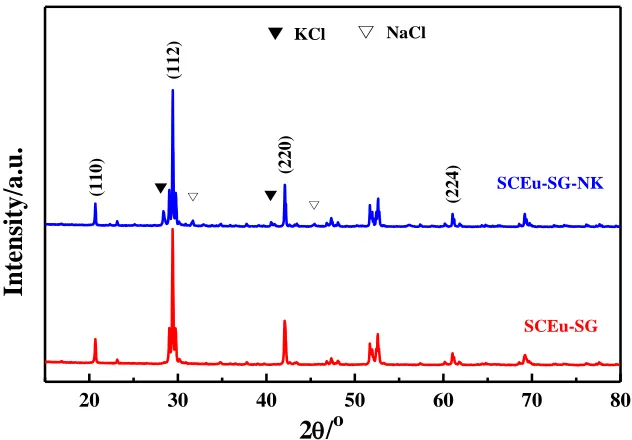
Figure 1. The XRD patterns of SrCe0.9Eu0.1O3- (SCEu-SG) and SrCe0.9Eu0.1O3--NaCl-KCl
(SCEu-SG-NK).
The powder X–ray diffraction (XRD) patterns of SCEu-SG and SCEu-SG-NK are given in Fig. 1. All the peaks of the SCEu-SG are indexed to the cubic SrCeO3 phase (JCPDS 01-082-2370). The
diffraction peaks at 20.75 º, 29.48 º, 42.18 º and 61.13 º correspond to the (110), (112), (220) and (224) crystal planes of SrCeO3, respectively. As is clearly shown in Fig. 1, SCEu-SG-NK composite
[image:3.596.139.455.393.613.2]
peaks of NaCl (JCPDS 01-072-1668) and KCl (JCPDS 01-073-0380) were also detected. However, peaks for NaCl and KCl are very small. It may be due to during the crystallization process of the sintered composites from 750 °C down to room temperature, SrCe1-xYbxO3- crystallized firstly come
out of solution on the SrCe1-xYbxO3- crystal nucleus, and then pure NaCl crystal, pure KCl crystal and
amount of amorphous NaCl-KCl eutectic phase come out of solution due to the partly miscibility in NaCl-KCl solid-state binary. That is to say, the SCYbx-NK composite electrolytes is a mixture of more fine and dense SrCe1-xYbxO3-, a portion of crystalline NaCl and KCl, and some amorphous
[image:4.596.84.529.234.571.2]NaCl-KCl eutectic phase. It can be deduced that there was no reaction between SCEu-SG and the inorganic salts during heat treatment [15-20].
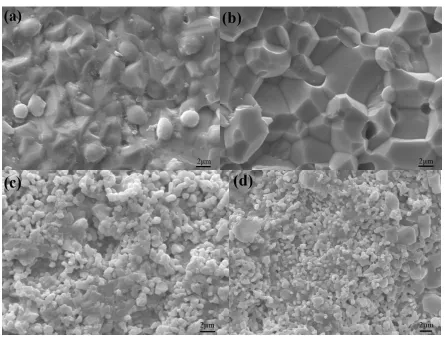
Figure 2. The surface and cross-sectional SEM images of SCEu-SG (a, b) and SCEu-SG-NK (c, d).
The surface and cross-sectional SEM images of SCEu-SG are displayed in Fig. 2(a,b). Fig. 2(a) demonstrates that the SCEu-SG is dense and free of cracks after being calcined at 1500 °C for 5 h. The cross-sectional image (Fig. 2(b)) shows that the morphology of SCEu-SG grains is uniform and dense, but there are some closed pores in the crystalline structures [6-10]. Fig. 2(c,d) illustrates the surface and cross-sectional morphologies of SCEu-SG-NK. Apparently, SrCe0.9Eu0.1O3- particles are linked to
each other and their surface is uniformly covered by NaCl/KCl after sintering at 750 °C for 1 h [21]. Moreover, the SrCe0.9Eu0.1O3- particle size is smaller than in our previous report [22]. In summary,
performance of the SOCFs, was not high compared to the high-temperature solid state reaction method.
In the hydrogen-containing atmosphere, water vapor and hydrogen concentration cells were fabricated as follows.
H2 (pH2O = 2.34103 Pa), Pt∣ SrCe0.9Eu0.1O3-∣ Pt, 30 % H2 (pH2O = 2.34103 Pa) (cell A)
H2 (pH2O = 2.34103 Pa), Pt∣ SrCe0.9Eu0.1O3-∣ Pt, H2 (pH2O = 1.23104 Pa) (cell B)
450 500 550 600 650 700 750
0 20 40 60 80
Temperature/℃
the theoretical EMF value of cell A the observed EMF value of cell A the theoretical EMF value of cell B the observed EMF value of cell B
EMF
/mV
Figure 3. EMFs of hydrogen concentration cell (cell A) and EMFs of water vapor concentration cell (cell B) of SrCe0.9Eu0.1O3- (SCEu-SG) at 500-700 °C.
As can be seen from Fig. 3, transport numbers of total ions (tion = tH + tO = EMFobs / EMFcal) as
high as approximately 0.94–0.98 were obtained by using hydrogen concentration cell (cell A) at 500– 700 °C and are very close to the theoretical electromotive forces EMFcal value (EMFcal =
F RT
2 ln [pH2
(A) / pH2 (B)]) of the hydrogen concentration cell. Similarly, the transport numbers of the oxide ions (tO)
is 0.00–0.14 at 500–700 °C were calculated in the water vapor concentration cell (cell B). These results demonstrate that the protonic conduction of SCEu-SG is good in a hydrogen-containing atmosphere, and there is a certain degree of oxide ionic conduction [26].
1.0 1.1 1.2 1.3 -1.0
-0.5 0.0 0.5 1.0 1.5 2.0 2.5
SCEu-SG-NKdry N
2
SCEu-SGwet N
2
SCEu-SGdry N
2
1000 T-1 / K-1
Log
(
T/ Scm
-1 K
[image:5.596.229.363.193.363.2])
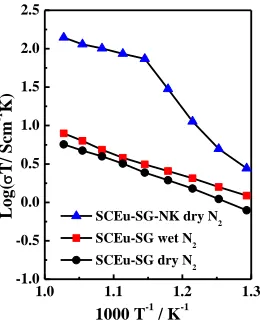
Figure 4. The plots of log (T) ~ 1000 T-1 of SrCe0.9Eu0.1O3- (SCEu-SG) and SrCe0.9Eu0.1O3-
[image:5.596.234.371.566.728.2]
Fig. 4 presents the plots of log (T) ~ 1000 T-1
of SrCe0.9Eu0.1O3- (SCEu-SG) and
SrCe0.9Eu0.1O3--NaCl-KCl (SCEu-SG-NK) from 500 to 700 °C in nitrogen atmospheres. Apparently,
the conductivity of SCEu-SG-NK is much higher than that of SCEu-SG in dry nitrogen and the highest conductivity is observed to be 1.44×10⁻¹ S·cm-1 for SCEu-SG-NK at 700 °C. It was demonstrated that the introduction of NaCl/KCl molten mixture improved the effective concentration and conduction velocity of oxygen vacancy [16,18]. Besides, the conductivity plot of the composite electrolyte exhibits an elongated “Z”-type shape, which is consistent with the reported results [15,16].
-20 -15 -10 -5 0
-2.5 -2.0 -1.5 -1.0 -0.5
SCEu-SG-NK dry
SCEu-SG wet SCEu-SG dry
Log( pO
2/atm )
Log ( /S cm -1 )
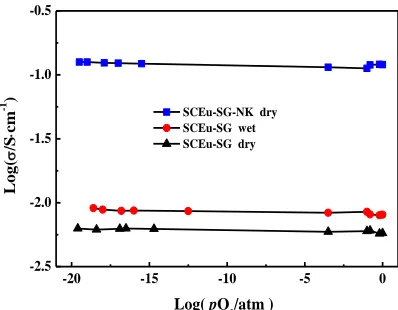
Figure 5. The conductivities of SrCe0.9Eu0.1O3- (SCEu-SG) and SrCe0.9Eu0.1O3--NaCl-KCl
(SCEu-SG-NK) as a function of pO2 at 700 °C.
To explore the ionic conduction of SCEu-SG and SCEu-SG-NK, the effect of oxygen partial pressure (pO2 = 10-20 ~ 1 atm) on the conductivities was also investigated. Fig. 5 shows the log ~ log
(pO2) plots of SCEu-SG and SCEu-SG-NK in dry and wet atmospheres at 700 °C. No, or only a slight
change was observed in the conductivity with pO2, which indicates that all the three electrolytes are
pure ionic conductors. In the case of the SCEu-SG-NK composite electrolytes, the mobility of softened NaCl/KCl and H, O2−
greatly enhances at the cell operation temperature of 700 °C which leads to a reduction of activation energy for ion transport through the interface of the SrCe0.9Eu0.1O3- and
NaCl/KCl molten salts [27].
0.0 0.2 0.4 0.6 0.8 1.0 1.2
SCEu-SG 700 o
C (a) P ow er /mW cm -2 V ol tage/ V
Current density/mAcm-2
0 10 20 30 40
0 5 10 15 20 0.0 0.2 0.4 0.6 0.8 1.0 1.2 Power /mW cm -2 V ol tage/ V
Current density/mAcm-2
0 100 200 300 400 500
0 50 100 150 200 250 300
SCEu-SG-NK 700 o
C (b)
Figure 6. I-V and I-P curves for the H2/O2 fuel cells with SCEu-SG (a) and SCEu-SG-NK (b)
[image:6.596.192.391.209.364.2] [image:6.596.106.493.587.718.2]
The cell performance was studied using hydrogen as fuel and oxygen as oxidant for SCEu-SG and SCEu-SG-NK at 700 °C, and is shown in Fig. 6.
As can be seen in Fig. 6(b), the open circuit voltage is approximately 1.06 V, which is very approximate to the theoretical value [22]. The results agree well with the SEM, that the NaCl/KCl eutectic melt is bound to the surface of SCEu-SG during the heat treatment, causing the dense texture. The fuel cell based on SCEu-SG-NK generated the maximum power output density of 207 mW·cm-2 at 700 °C which is remarkably higher than that of SCEu-SG (13.1 mW·cm-2 in Fig. 6(a)). Such performance can be attributed to the highly ionic conducting composite electrolyte, and makes the SCEu-SG-NK a suitable and promising electrolyte material for an intermediate temperature fuel cell.
4. CONCLUSIONS
In this work, novel SrCe0.9Eu0.1O3- was successfully prepared through the sol-gel method at a
low temperature of 1100 oC for the first time. The surface and cross-sectional morphologies of SEM show SrCe0.9Eu0.1O3- is dense and free of cracks after being calcined at 1500 °C for 5 h.
SrCe0.9Eu0.1O3- particles are linked to each other with NaCl/KCl covered uniformly after sintering at
750 °C for 1 h. The highest conductivity was observed to be 1.44×10⁻¹ S·cm-1 for SCEu-SG-NK in dry nitrogen at 700 °C. The plots of log ~ log (pO2) indicate that SCEu-SG and SCEu-SG-NK are
almost pure conductors of ion. The fuel cell based on the SCEu-SG-NK composite electrolyte displayed a good performance compared to the SCEu-SG, with a maximum power output density of 207 mW·cm-2 at 700 °C.
ACKNOWLEDGEMENTS
This work was supported by the National Natural Science Foundation of China (No. 51402052, 21402029, 21602029) and the Natural Science Foundation of Department of Education of Anhui Province (2015KJ008).
References
1. S. Su, S. Zhang, C. Yan, Z. Yang, F. Zheng and L. Zhang, Int. J. Electrochem. Sci., 12 (2017) 230. 2. L. Fang, Int. J. Electrochem. Sci., 12 (2017) 218.
3. G. S. Reddy and R. Bauri, J. Alloy Compd., 688 (2016) 1039.
4. W. Xing, P.I. Dahl, L.V. Roaas, M.-L. Fontaine, Y. Larring, P.P. Henriksen and R. Bredesen, J. Membrane Sci., 473 (2015) 327.
5. J. Xiao, L. Chen, H. Yuan, L. Ji, C. Xiong, J. Ma and X. Zhu, Mater. Lett., 189 (2017) 192. 6. I.-M. Hung, Y.-J. Chiang, J. S.-C. Jang, J.-C. Lin, S.-W. Lee, J.-K. Chang and C.-S. His, J. Eur.
Ceram. Soc., 35 (2015) 163.
7. C. Liu, J.-J. Huang, Y.-P. Fu, C. Li, J.-Y. Wang and S. Lee, Ceram. Int., 41 (2015) 2948. 8. Y. Okuyama, K. Isa, Y.S. Lee, T. Sakai and H. Matsumoto, Solid State Ionics, 275 (2015) 35. 9. K.S. Knight, R. Haynes, N. Bonanos and F. Azough, Dalton Trans., 44 (2015) 10773.
12.C. Zhang and K. Huang, J. Power Sources, 342 (2017) 419.
13.C. Li, R. Dai, R. Qi, X. Wu and J. Ma, Int. J. Electrochem. Sci., 12 (2017) 2485. 14.M.K. Rath and K.-T. Lee, J. Alloy Compd., 657 (2016) 537.
15.A.I.B. Rondao, S.G. Patricio, F.M.L. Figueiredo and F.M.B. Marques, Int. J. Hydrogen Energ., 39 (2014) 5460.
16.S. Shawuti and M.A. Gulgun, J. Power Sources, 267 (2014) 128.
17.N.C.T. Martins, S. Rajesh and F.M.B. Marques, Mater. Res. Bull., 70 (2015) 449. 18.B. Zhu, S. Li and B.E. Mellander, Electrochem. Commun., 10 (2008) 302.
19.Q.X. Fu, W. Zhang, R.R. Peng, D.K. Peng, G.Y. Meng and B. Zhu, Mater. Lett., 53 (2002) 186. 20.Q.X. Fu, S.W. Zha, W. Zhang, D.K. Peng, G.Y. Meng and B. Zhu, J. Power Sources, 104 (2002)
73.
21.J.T. Kim, T.H. Lee, K.Y. Park, Y. Seo, K.B. Kim, S.J. Song, B. Park and J.Y. Park, J. Power Sources, 275 (2015) 563.
22.W. Zhang, M. Yuan, H. Wang and J. Liu, J. Alloy Compd., 677 (2016) 38. 23.X. Liu, N. Fechler and M. Antonietti, Chem. Soc. Rev., 42 (2013) 8237.
24.J. Guan, S.E. Dorris, U. Balachardran and M. Liu, Solid State Ionics, 100 (1997) 45.
25.X. Chen, C.S. Wang, E.A. Payzant, C.R. Xia and D. Chu, J. Electrochem. Soc., 155 (2008) B1264. 26.H. Wang, H. Zhang, G. Xiao, F. Zhang, T. Yu, J. Xiao and G. Ma, J Power Sources, 196 (2011)
683.
27.C. Slim, L. Baklouti, M. Cassir and A. Ringuedé, Electrochim. Acta, 123 (2014) 127.