RIT Scholar Works
Theses
Thesis/Dissertation Collections
8-27-1997
The Predictive validity of the Bender-Gestalt test
emotional indicators
Jeffrey Torch
Follow this and additional works at:
http://scholarworks.rit.edu/theses
This Thesis is brought to you for free and open access by the Thesis/Dissertation Collections at RIT Scholar Works. It has been accepted for inclusion in Theses by an authorized administrator of RIT Scholar Works. For more information, please [email protected].
Recommended Citation
The Predictive Validity of the Bender-Gestalt Test Emotional Indicators
Master's Thesis
Submitted to the Faculty
Of the School Psychology Program
College of Liberal Arts
ROCHESTER INSTITUTE OF TECHNOLOGY
By
Jeffrey G. Torch
In Partial Fulftllment of the Requirements
for the Degree of
Master of Science
Rochester, New York
August 27, 1997
Approved:
_
James
B.
Hale, Ph.D., Committee Chair
Nicholas Difonzo, Ph.D., Committee Member
Dean:
Permission to Reproduce Thesis
PERMISSION
GRANTED
Title of thesis
\i.\t
~\l.nyt.
VA\..4lhl'i oP- ,HE~N~' 6~:l.\Al.-r
'-hi l\'<\c.nc.\J""IN()\41ro~)
I
~i;H~t
G
T~~
hereby grant permission to the
Wallace Memorial Library of the Rochester Institute of Technology to reproduce my
thesis in whole or in part. Any reproduction will not be for commercial use or piOfit.
Date:
21
Av..bv..)i
\'1"\1-
Signature of Author:
PERMISSION FROM AUTHOR REQUIRED
Title of thesis
_
I
prefer to be contacted each ti me a
request for reproduction is made. I can be reached at the following address:
PHONE:
_
Date:
_
Signature of Author: _
PERMISSION
DENIED
TITLE OF THESIS
_
I
hereby deny permission to theWallace
Memorial Library of the Rochester Institute of Technology to reproduce my
thesis in whole or in part.
Abstract
Although clinical reports ofthe predictive validity ofthe Emotional Indicators
(El's)
of the Bender-Gestalt Test(BGT)
have been presented, objective researchsupportingtheseclaimshave beenlimited. This study investigatedthevalidity ofthe
El's on the BGT in predicting maladaptive behaviors of 23 elementary school
children referred for psychoeducational evaluation. Several ofthe El's were related
to the behavior factors ofthe Devereux
Elementary
School BehaviorRating
Scale(DESBRS). Althoughprojective implications of some El's were supported
by
theirregression on DESBRS
factors,
few strong relationships were found. Implicationsand suggestionsfor futureresearch willbe discussed.
Abstract ii
Copyright iii
TableofContents iv
ListofTables v
CHAPTER
I. Introduction 6
StatementoftheProblem 6
Importanceofthe
Study
6OrderofPresentation 7
II. Literature Review 8
DevelopmentoftheBender-Gestalt Test 8
The Dichotomous UseoftheBender-Gestalt Test 9
Bender-Gestalt Test Administration 13
Projective
Scoring
oftheBender-Gestalt Test 13 FactorsAffecting
Bender-Gestalt Performance 15ResearchQuestion 17
III. Methods 18
Subjects 18
Procedure 18
Instrumentation 19
IV. Results 23
V. Discussion 29
Limitations 30
REFERENCES 33
1.
Mean,
StandardDeviation,
andRangeofSubject Scores 242.
Frequency
DistributionofCoded Emotional Indicators 253. Intercorrelations Between Emotional IndicatorsandBehavior Ratings...26
Introduction
StatementoftheProblem
Thepurpose ofthis studywasto investigatethepropensityof children's Koppitz
EmotionalIndicators
(El's; Koppitz,
1964)
ontheBender-Gestalt Test(BGT; Bender,
1946)
to predict maladaptiveclassroombehaviors as ratedby
school personnelusingtheDevereux
Elementary
School BehaviorRating
Scale(DESBRS;
Spivack &Swift,
1967).
Importance ofthe
Study
Although BGT El's have been found in acting-out, withdrawn, or severely
anxious children, rarely have these signs been compared to specific observable
behaviors (McCormick &
Brannigan,
1984). As it is often used in clinical practice,there is a need for more research in
determining
the BGT's ability to accuratelydifferentiate specific symptoms of maladaptive classroom behaviors (Tolor &
Brannigan,
1980). If predictive of maladaptive classroombehavior,
the BGT canhelp identify
potential environmentaldeterminants of aberrant behaviors.Using
thisinformation,
teacherscantakepreventativemeasuresto effectivelymanage classroomenvironments and provide themost effective
learning
strategiesfor all students. Theprevention of classroom discipline problems allows teachers to guide their students
through
learning
activities more effectivelyby
maximizing on-task behavior(Edwards,
1993).The present study will contribute to the literature
by
evaluating the BGT El'saccuracy in predicting thepotential formaladaptive classroombehaviors in children,
Order of Presentation
Chapter II contains a literature review ofthe BGT as an indicator of emotional
adjustment in relation to the research questions. Chapter III consists of an
explanation ofthestudy goals and anticipated results. Includedis adescriptionofthe
subjects,
instrumentation,
studydesign,
and procedure. In addition,terminology
isdefinedanddependentandindependentvariablesare identified. Chapter IV describes
the nature ofthe
data,
statisticaltreatment,
and the analyses. Chapter V contains asummary and interpretation ofthe results in terms of both the specific hypotheses
generated and research reviewed above. Implications and recommendations are
CHAPTERII
Literature Review
DevelopmentoftheBender-GestaltTest
In the relatively short
history
of school psychology, many psychological testshave been developed to assess a wide range ofhuman functions within the school
environment. The Bender Visual Motor Gestalt Test
(commonly
referred to as theBender-Gestalt
Test;
BGT)
has remained popular among clinical and schoolpsychologists since its introductionto thefieldin 1938
by
Dr. Lauretta Bender (Tolor&
Brannigan,
1980). This review will present abriefhistory
oftheBGT,
its originsand uses in the field ofpsychology, and the use ofthe BGT as a diagnostic and
projective tool.
The
BGT,
based on Gestalt psychologytheory
and principles, was firstintroduced
by
Wertheimer, Kohler,
andKoffka(Bender,
1938). Gestaltpsychologistsemphasize perception as a function of environmental stimuli and dynamics ofthe
individual,
or dynamic inner factor(Bender,
1938). In an attemptto investigate thenature of the visual Gestalten and the principles that determined them (Tolor &
Schulberg, 1963),
geometric figures were presented to normal individuals providedwiththe instruction to describe theirperceptions. In
1932,
Benderbecame interestedinthe use ofthis Gestalten method with patients with dementia (Tolor &
Schulberg,
1963). Her procedure consisted of subjects copying designs rather than
describing
them.
Thus,
Benderwas credited fortransforming
the test from averbal to aTheDichotomous Use oftheBender-GestaltTest
Two
different,
butreportedly complementary,approacheshave beenemployedintheuse oftheBGTsincetheir
inception
inthe 1930's. The first isusingtheBGTasatool to assess perceptual-graphomotor development in young children between the
ages of 4 and 1 1 years old. Considered a valuable test of visual-motor gestalt
maturation (Tolor &
Brannigan,
1980),
Bender(1938)
first described sevenmaturational patterns of visual-motor perceptioninchildren:
1)
Vortical movement(biologically
determined in the opticfield)
gives rise tothemost primitivevisuallyperceived
forms,
such as circles andloops;
2)
Movement (always present) is directional-clockwiseorcounter-clockwise, oron ahorizontalplane;
3) By
controlling orinhibiting
this action-pattern, globes, circles, and arcs areconstructed;
4)
Visualfieldsare organizedinto bothaforegroundandbackground;
5)
Boundaries betweenobjects aredefined;
6)
Verticalization develops withbody-image maturation as infantposture shiftsfromtheproneto theuprightposition; and
7)
Crossedlines,
diagonal or slanting relations, and angle formationsdevelop
later,
approximately sixtoeight yearsof age.Bender reported that these principles are often not integrated until 1 1 years of age
(Tolor &
Brannigan,
1980).However,
at six to eight years themain principles haveThe BGT is the second most prevalent instrument used
by
practitioners tomeasure perceptual-graphomotor
development.
A survey of school psychologypractitioners and
training
programs found that the BGT remained the second mostcommonlyused instrument(Wilson &
Reschly,
1996). The decrease intheuse oftheBGT since 1986 is possibly attributable to the increase in use ofthe
Beery
VisualMotorIntegrationTest (Wilson &
Reschly,
1996).The BGThas also beenused
by
cliniciansas a projective measure ofpersonalityandhasbeen recordedinliteraturesincetheearly 1960's (Tolor &
Brannigan,
1980).Despite its early popularity for this use, skepticism toward the validity of projective
testing
had beengrowingfromnegative researchfindingsduring
thefortiesandfifties(Tolor &
Brannigan, 1980),
and has been recently challenged for its poor technicalquality (Wilson &
Reschly, 1996);
however,
it is widelyrecognizedthat early studiessuffered from serious methodological limitations
(Blatt,
1978). Priorto1963,
therewas little research on the validity ofthe BGT as a tool to evaluate the personality
adjustmentof children(Tolor&
Brannigan,
1980).Methodological
flaws,
as was typical in the sciences inthe 1930's and1940's,
limited Bender's work. Itis more usefulto acceptBender's work as descriptive case
studies that provide a rich source of testable hypotheses rather than sound
experimentsyieldingvalid results(Tolor&
Schulberg,
1963). Inorderforatest tobevalid it mustbe able to predict what itpurportsto measure. Althoughthe predictive
validity ofthe BGT has been questioned, the information the test elicits beyond that
There has been inconsistent evidence supporting the use of the BGT as a
projectiveassessmenttool. The accuracyoftheBGT in
differentiating
betweenwell-adjusted and malwell-adjusted children has been supported
by
early research (Tolor &Brannigan,
1980). Inastudyinvolving
childrenagefiveto ten years,Kopptiz(1960)
investigated BGT protocols of normal school children who had no
history
ofemotional problems and children who had been referred to a clinic or school
psychologistbecause ofemotionalproblems. Out of atotaloften El's hypothesized
to be indicative of adjustment problems
(Koppitz, 1964),
six El's were clearlydifferentiated between the two groups. The group exhibiting emotional problems
displayed ahigher incidence ofthe
following
six El's: ConfusedOrder,
Dashes forCircles,
Large Size ofDrawings,
Overwork or ReinforcedLines,
SecondAttempt,
andExpansion.
The BGT El's ability to differentiate between well-adjusted and maladjusted
children was supported in a second study
(Byrd,
1956). In reviewing the BGTprotocols of maladjusted and well-adjusted childrenbetweentheages of8 and
16,
sixfactors discriminated between the two groups. The maladjusted group had more
problems withorderlysequenceof
designs;
changeincurvature andinthe angulationof
figures;
figure closure;rotation ofdesigns;
andchangeinthesize ofthedesign.A subsequent investigation of the El's examined three groups of normal,
adjustment
disordered,
orbehavior disordered childrenaged 7to 10 years (Rossini &Kaspar,
1987). Although the El'sby
themselves were not predictive of groupOneofthefew studiesthat correlatedbehaviorproblems withBGT performance
examinedtheparentDESBRSratings andEl'sofschoolchildrenbetweentheages of
5 and 13
(Gregory,
1977).Strong
relationshipswere foundbetweenthe total numberof El's and the Pathological Use of
Senses;
Poor Coordination andBody
Tonus;
Unresponsiveness to
Stimulation;
Anxious-FearfulIdeation;
andInability
toDelay
factorsoftheDESBRS.
The BGT El's have differentiated between children exhibiting normal and
maladaptive behaviors in one study examining acting out behaviors (Handler &
Mcintosh,
1971).Comparing
the performance ofthree groups ofthird graders whowere classified as normal, withdrawn, or aggressive based on their classroom
behavior,
the BGTwasfound amongother projectivetests to bethe bestpredictor ofaggressive behavior. In addition, withdrawn subjects also displayed more El's than
normal subjects.
Althoughthese findings are worthnoting, negativeresults have also been found.
In one study, the BGT did not predict maladaptive acting-out classroom behavior
(Trahan &
Stricklin,
1979). Children ranging between 5 and 12 years of age wereadministered a
BGT,
while teachers completed behavior rating scales. This studycreated a serious doubt among the authors in utilizing the BGT as a projective
assessmenttool foracting-outbehavior.
Subsequent research has also concluded that the BGT
inconsistently
predictsschool achievement, neurological
impairment,
or emotional problems on anare
invalid,
articlesdemonstrating
theprojective techniqueas valid can alsobe found(Karon,
1994).Bender-Gestalt Test Administration
There have been five different forms ofthe BGT used prominently in research.
Thefive differ in relationto test administration, response
format,
scoring procedure,and interpretation.
They
range in use from projective to objective multiple choicetools in assessing visual-motor coordination, organic brain
disorders,
or emotionalstatus
(Canter, 1963; Hurt, 1960; Koppitz, 1964; Spraings, 1966;
Rosenberg
&Rosenberg,
1965).These versions -ire
dramatically
different,
butatopic of greater relevant concernis the minor variations in the administration of the
BGT,
despite Bender'sdevelopment of an instructionmanual 50 years ago
(Bender,
1946). Clinical studiessupporting the BGT were questioned because ofthe different administration modes
(Tolor &
Brannigan,
1980). Verbal instructions have variedfrom simple requests tocopy figurestospecific detailed instructions foreach card.
Considering
thevariety inadministration procedures and significant differences in some of the figures
themselveson different
forms,
thereis no singletest thatmay be appropriately calledthe Bender-Gestalt Visual-MotorTest
(Dana, Field,
&Bolton,
1983).Projective
Scoring
oftheBender-GestaltTestProjective interpretation ofBGT performancehas been based on either
clinical-intuitive methods or objective scoring methods
(Dana, Field,
&Bolton,
1983).Psychologists in support of projective BGT use argue that a child cannot make a
maturation atthe timeofperformance
(Bender,
1970). Nomethod ofscoring discreteitemscando justiceto thefull valueofthe test
(Bender,
1970)
and as a result clinicalutility may bedemonstrated
by
objective scoringsystems.Various objective scoring systems have been used to determine personality
adjustmentinbothchildren andadults,yet one ofthemost common are offeredhere.
Koppitz
(1964)
introduced an objective scoring systeminvolving
ten El's. Herdevelopment oftheEl'swasbasedonherclinical experience,and supported
by
otherresearch
(Byrd, 1956; Clawson, 1959;
Hutt &Briskin, 1960; Kitay, 1950;
Murray
&Roberts, 1956;
Pascal &Suttell, 1951;
Tucker &Spielberg, 1958),
all of whichfailedto reject the null hypothesisthat the BGT can not distinguish between children who
are well adjusted and those who are maladjusted
(Koppitz,
1964). Koppitz(1964)
claims that the total numberofBGT El's appears to be related to the seriousness of
theemotionaldisturbance.
Diagnosing
emotional disturbancethroughprojective interpretation oftheEl's isconsideredto be one ofthe best objective scoring system uses (Tolor &
Brannigan,
1980). Bendercriticized all objectivescoring systemsfortheir oversimplification and
failure to do justice to the testrichness (Tolor &
Brannigan,
1980). She contendedthat the primary task is not to reproduce the designs perfectly, but to express a
"living,
unique perceptual-motorexperience" (Tolor &
Brannigan, 1980,
p. 162).Interpreting
theBGT using El's requiresthe examinertodevelop
hypotheses that aremeasured against other psychological data and observations
(Koppitz,
1975).Without ecological validity, the BGT should not be used as a sole indicator of
Although objective scoring systems of personality adjustment offer valuable
data,
clinical judgment yields a greater wealth of information (Wagner &Murray,
1969). In their comprehensive survey study, Wade and Baker
(1977)
showed thatclinical psychologists continue to devote substantial time to personality testing,
despite the many criticisms
leveled,
and negative reactions to projective techniquesby
university trainers.Moreover,
this survey upheld the assessment importanceattributedto theBGT
by
clinical psychologists.Factors
Affecting
Bender-Gestalt PerformanceThe greatest factor that must be taken into consideration when evaluating a
child's BGT protocol is the role that maturation plays in the reproduction of the
designs (Tolor &
Schulberg,
1963). There have been limited studies of thedevelopmentof perceptual-motor skills or artisticability onBGT designreproduction
(Tolor &
Brannigan,
1980). Although Bender(1970)
originally believed that theperceptual-motor skills generally mature
by
about eleven years ofage, thefollowing
studieshaverefutedthisclaim .
One studyfounda rapiddecrease in Bender DevelopmentalErrors between5 and
approximately 8 years of age
(Taylor, Kauffman,
&Partenio,
1984).Among
thissample of children5 to 1 1 years old, itwas also foundthat the greatest variability or
scatter of scores occurred forchildrenbetweenthe ages of5 and 8 years old.
Nearly
accurate performance on the BGT was found to begin around 9 years of age, two
years earlier than what Bender proposed, suggesting that perceptual motor
development has
truly
maturedby
this age(Taylor,
Kauffman,
&Partenio,
1984).perceptual-motor maturation for children ages 9 or 10
(Taylor,
Kauffman &Partenio,
1984). This study suggests that between the ages of nine and eleven, the relevantdevelopmental processes attain maturity and all ofthe designs can be successfully
reproduced. Errors that persist can then be attributed to factors other than normal
motoric
immaturity,
such as neuropsychological impairment or personality functioning.Other studieshave demonstrated that some El's purported to be associated with
acting-out behaviors are
directly
related to the subject's level of perceptual motor development(Koppitz, 1964;
Pascal &Suttell,
1951). Correlation studies suggestthat age is significantly related to the quality of BGT reproductions only at the
extremes of the age
distribution, (i.e.,
young subjects who have not achieved fulldevelopment)
and in older subjects who are motorically impaired because ofaging(Tolor &
Schulberg,
1963)
ordysfunction.In addition to age, the differences in performance between boys and girls have
also been investigated. Although girls mature earlier in the perceptual-motor skills
and completethe BGT quicker, therewere no significant differencesatany age level between boys and girls
(Koppitz,
1960).Buckley
(1978),
in reviewing researchbetween 1966 and
1977,
concluded that a majority of studies found no significancebetweenmale orfemale BGTperformance.
The validity ofthe BGT as a projective tool to assess personality and
social-emotional
functioning
in children appears to relyheavily
on the examiner's role inwhen
interpreting
the results ofa child's BGT performance. In addition, there arethree risks that must be avoided in all assessment (Tolor &
Brannigan,
1980). Thefirst is an excessive preoccupation with one
instrument
indiagnosing
psychologicalproblems. The secondisthefailureto takeinto accountthecomplex person-situation
interaction. The third risk to be avoided in assessment is overlooking the subject's
competencieswhilestressingpathology.
Although limitations ofthe BGT inassociating performancewith personality or
behavior,
they
can be reduced wheninterpretations
involve objectivity anddevelopmental considerationsofvisual-motordevelopment. The
BGT,
accordingtothe
literature,
has the potential to gather rich information in assessing thesocial-emotional status of achild, butthevalidityofthe informationitproduces relies onthe
examiner'sknowledgeoftheselimitationsand objective skillsin
interpreting
the tool.ResearchQuestions
The present study was designed to evaluate the predictive validity ofthe BGT
El's. The investigationexaminedtherelationshipbetweenthe BGT
El's,
objectivelyscored, andteacherratings ontheDESBRS. The nullhypothesis wasthere wouldbe
CHAPTER
IIIMethods Subjects
A total of 23 children, ranging in age from 6 years 6 months to 12 years 9
months, from an elementary school in the Northeast participated in the study. The mean age ofthe subjectswas9years,6months. All23 students had beenreferredfor psychological
testing
due to academic or social-emotional difficulties in theclassroom. Ofthe 23 subjects, 19 were male. Subjects obtained an average standard score of 93 on the Wechsler Intelligence Scale for Children-Revised
(WISC-R;
Wechsler,
1974)
or Wechsler Intelligence Scale for Children-Third Edition(WISC-III; Wechsler, 1991),
andscoresrangedfrom 61 to 139. ProcedureThis study involvedcorrelating BGT El's withbehaviorratings on theDESBRS
of children referred for psychological testing. An archival record review of student performance on the
BGT,
WISC-R orWISC-III,
and teacher ratings of studentbehavior was employed. This review involved student records between 1974 and
1996. The independentvariables werethe
El's,
which weredichotomously
coded aspresent or absent for each child. The dependent variables were DESBRS teacher
ratingsforeach ofthe 1 1 behavior factors.
Each student was administered anintelligencetest,theWISC-Ror
WISC-III,
andBGT as two components of a full
battery
of tests used to determinedisability
The BGT was
individually
administered to each subjectduring
thecomprehensive evaluation. Five ofthe
battery
testswere administered and scoredby
a certified school psychologist, with the remaining tests administered and scored
by
the current investigator. Teacher behavior rating forms were completed within one
week ofthe testing. For interrater reliability, a second investigator scored all BGT
protocolswith91 percent simple concurrencewiththeinvestigator.
The data were entered into a confidential SPSS-X computer file anddescriptive
statisticswerecalculated. The study employed zero order correlationsto examinethe
relationships among the variables. To control for Type I error, stepwise multiple
regression analyses were undertaken, with each dependent DESBRS subscale
analyzedina separate equation.
Instrumentation
The BGT consists of nine geometric figures. Eachfigure is presented on a card
about the size of a3X5-index card. The client is given 8
'/_"
by
11" paper, a pencilwith an eraser, andthenasked to copy thedesigns exactly as
they
are shown. Thereisno time limit fortestcompletion. The basic assumptionunderlying the use ofthe
BGT is that the ability to perceive and reproduce the Bender-Gestalt designs is not
only afunctionof perceptual-motordevelopmentormaturation, butalso afunctionof
theindividual's experienceandpersonality(Pascal &
Suttell,
1951).The BGT was interpreted projectively utilizing Koppitz's
(1964)
objectivescoring systemforEl's. The
following
isadescriptionoftheEl's:1)
Confused Order ofDesign Placement The individual scatters the BGT2)
Wavy
Line (Figures 1 and 2. Two or more abrupt changes in thedirectionofthelineofdots in Figure 1 orlineof circlesin Figure
2;
3)
Dashes Substituted for Circles .Figure2. Thisentails at least halfof allcircles in Figure 2
being
replaced with dashes one-sixteenth of an inchlong
orlonger;
4)
Increasing
Size (Figures1,
2 and 3) Dots and circles increaseprogressively insize untilthelast ones are atleastthreetimes as largeas
thefirstones;
5)
Large Size One or more designs are drawn one-third larger than thedesignonthestimuluscard;
6)
Small Size Oneor moredesigns are drawn halfas largeasthe designonthe stimuluscard;
7)
Fine Line The individual'spencil line is sothin that itrequires efforttoseethecompleted
design;
8)
OverworkofReinforced Lines Thetotal design or part ofit is redrawnor reinforced with
heavy,
impulsivelines;
9)
Second Attempt atDrawingFigures Thedrawing
of a designor part ofit is spontaneouslyabandonedbeforeorafterit has beencompleted and a
new
drawing
ofthedesignismade;10. Expansion Two or more sheets of paper are used to complete the
drawing
of all nineBGTdesigns;
andThe DESBRS provides a profile of 11 overt problem behavior factors or
subscales that are believed to interfere with
learning
in the first six grades ofelementary school(Spivack &
Swift,
1967). Researchutilized inthe developmentofthis scale involved 147 teachers who made 1719 ratings on a total of 1546 children
(Spivack&
Swift,
1967). The DESBRS reliabilities range from .85 to .91 onthe 11subscale scores. Informationofthescale's validitywas not providedintheDESBRS
manual.
The 1 1 DESBRS subscales consist ofbetweenthree andfivebehavior itemseach
(Spivack&
Swift,
1967). The 1 1 DESBRS subscales are asfollows:1)
Classroom Disturbance The extent to which behavior is active, social(although
inappropriate),
and disruptive. Behavior is seen asdisrupting
thefunctioning
of others andinterrupting
theflowofwork;2)
Impatience An inappropriate drive to enter into and to complete the workassigned or never
thinking
much about the quality and neatness of theeducationalproduct;
3)
Disrespect-Defiance Theextenttowhichthechild manifests open disrespectfor or resistance to the school, the subject matter
being
taught, and theteacher;
4)
External Blame The extentto whichthechild expressesthefeeling
that it isthe external circumstances
(e.g.,
theteacher,the work)which are the sources5)
AchievementAnxiety The outwarddisplay
ofdisturbance(worry
andupset)concerning the
inability
to meet the achievement demands of the teacherand/or school situation;
6)
External Reliance The degree ofthe child'sinability
to make independentdecisions,
to hold opinions, and to take independent action without thesupport and directionofothers;
7)
Comprehension Theextenttowhichthestudent comprehendstheday-to-day
workdemanded
by
thecurriculum andteacher;
8)
Inattentive-Withdrawn Thetendency
tolose contact with whatis going oninclass;
9)
Irrelevant-Responsiveness The extentto which the child's verbal responsesinclass are
irrelevant, intrusive,
and/or exaggerated oruntruthful;10)Creative Initiative measures the degree to which the child exhibits active
personal involvement
in,
and positive motivation to contributeto,
theclassroom
learning
situation; and1 DNeed for Closenessto Teacher The extenttowhich children like to be close
CHAPTER
IVResults
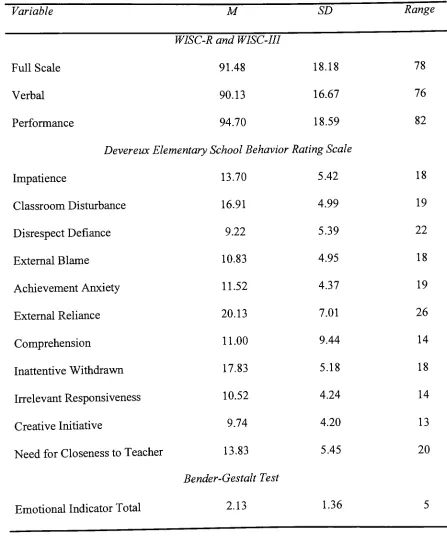
Located in Table 1 are the subject means, standard
deviations,
and ranges ofWISC-Ror
WISC-III, DESBRS,
andTotal BGT EI scores.Subjects'
meanWISC-R
or WISC-III scores indicate cognitive skills in the Average range, while
subjects'
meanTotal EI scores do not suggest severe emotional disturbance in thepopulation.
Scoresonthe
Impatience,
ExternalBlame,
ExternalReliance,
Inattentive-Withdrawn,
and
Irrelevant-Responsiveness
subscales of the DESBRS indicate maladaptivebehaviors for the sample and were within one Standard Deviation above the norm.
The remainingsubscale means were scored withinthenormal range.
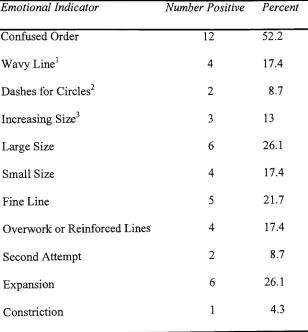
Table 2 represents the
frequency
ofEl's occurring onsubjects'
protocols when
objectively scored. Confused Order was the most common
EI,
with approximatelytwo-thirds of children receiving this EI. Expansion and Large Size were equally
common, occurring inabout one-third ofthesampleBGTprotocols.
Table 3 illustrates the intercorrelations between the El's and the DESBRS
subscalescores. Moderate correlations were found for theDashes for Circles EI and
Need for Closeness subscale
(-.42);
Confused Order EI and Creative Initiativesubscale
(.47);
Fine Line EI and External Blame subscale(.45);
Fine Line EI andDisrespect-Defiance subscale
(.42);
Fine Line EI and Creative Initiative subscale(.50);
Increasing
Size EI and Creative Initiative subscale(.54);
Second Attempt atDrawing
Figures EI andAchievementAnxiety
subscale(-.47);
andExpansionEI andTable 1.
Mean,
StandardDeviation,
andRange ofSubject ScoresVariable M SD Range
WISC-RandWISC-III
Full Scale 91.48 18.18 78
Verbal 90.13 16.67 76
Performance 94.70 18.59 82
Devereux
Elementary
School BehaviorRating
ScaleImpatience 13.70 5.42 18
ClassroomDisturbance 16.91 4.99 19
Disrespect Defiance 9.22 5.39 22
External Blame 10.83 4.95 18
Achievement
Anxiety
11.52 4.37 19External Reliance 20.13 7.01 26
Comprehension 11.00 9.44 14
Inattentive Withdrawn 17.83 5.18 18
Irrelevant Responsiveness 10.52 4.24 14
CreativeInitiative 9.74 4.20 13
NeedforCloseness toTeacher 13.83
Bender-GestaltTest
5.45 20
Table2.
Frequency
Distribution ofCodedEmotional IndicatorsEmotional Indicator Number Positive Percent
Confused Order 12 52.2
Wavy
Line1 4 17.4Dashes forCircles2 2 8.7
Increasing
Size 3 13Large Size 6 26.1
Small Size 4 17.4
Fine Line 5 21.7
OverworkorReinforced Lines 4 17.4
Second Attempt 2 8.7
Expansion 6 26.1
Constriction 1 4.3
Note.'Figures 1 and
2;
"Figure2;
^Figures1, 2,
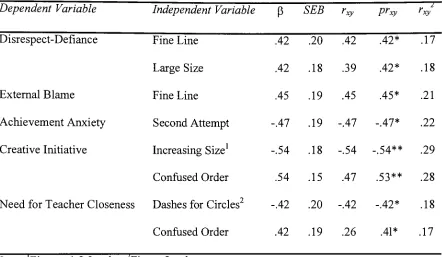
and3Reportedin Table
4,
themultipleregressionanalyses yielded eight relationshipsbetween El'sandtheDESBRS subscales. Forthe Disrespect-Defiance subscale,
which is associatedwith impulsive and acting-out
behavior,
theFine Line EI enteredthe equation
first,
accounting for 17% ofthe variance in predicting shy, timid orwithdrawn behavior (F =
4.44;
p = .047). An additional effect in predictingDisrespect-Defiant behavior was exhibited
by
the Large SizeEI,
associated withexplosive and acting-out
behavior,
accountingfor 18% ofthevariance (F=
5.41;
p= [image:27.571.79.387.117.449.2]Table3.
Intercorrelations Between Emotional IndicatorsandBehavior Ratings
Bl B2 B3 B4 B5 B6 B7 B8 B9 BIO Bll ET
DA .15 .11 -.22 -.12 .24 .13 .37 -.23 -.24 .05 .37 .20
DB .13 .01 .10 -.12 .17 -.11 .33 .06 .04 .07 .22 .20
DC .24 .02 -.07 -.11 .39 -.21 -.13 .02 .11 -.09 .23
DD .25 -.01 -.02 -.31 .18 -.20 .06 -.18 -.10 -.08 .09
DE -.23 -.16 .18 .29 .04 -.00 .12 .21
-.47*
.02 -.23 .26
DF -.08 .21 .22 .12 .15 -.13 -.10 .07 .13 -.20 .24 .11
DG .31 .17 .18 -.38 -.27 .00 .38 -.34 -.05 -.09 .00 .08
DH -.26 .17 .19 .24 .35 -.37 -.17 -.17 .25 .26 .22 .14
DI .27 .19 -.15 -.20 .21 -.25 .37 -.11 .04 .07 -.08 .17
DJ .14 -.17 -.25 .03 -.19 -.09
-.42*
-.30 -.14
DK .26 -.18
-.42*
-.30 -.17 .06 .20 -.03 -.34 -.30 -.11 -.29
Note. DA = Classroom
Disturbance;
DB =Impatience;
DC =Disrespect-Defiance;
DD =External
Blame;
DE = AchievementAnxiety;
DF = ExternalReliance;
DG =Comprehension;
DH =Inattentive-Withdrawn;
DI = IrrelevantResponsiveness;
DJ =Creative
Initiative;
DK=NeedforClosenesstoTeacher;
B 1 =ConfusedOrder;
B2=Wavy
Line (Figures
1,2);
B3=Dashes forCircles (Figure2);
B4=Increasing
Size(Figures1,2,3);
B5=Large
Size;
B6=SmallSize;
B7 =FineLine;
B8 =OverworkorReinforced
Lines;
B9= Second
Attempt;
B10 =Expansion;
Bll =Constriction;
and ET =Emotional Indicator
Total.
*p<.05. **e<-01
External Blame was the second DESBRS subscale that was found to have a
significant relationship with an EI The Fine Line
EI,
implying
shy and timidbehavior,
accounted for 21% of the variance in predicting External Blame or theextent to which the child attributes success or failure to external sources such as
teacherexpectationsorjudgments(F=
5A6;p
=Table 4.
RegressionAnalysisofEmotional Indicatorsin
Predicting
BehaviorDependent Variable IndependentVariable
P
SEB ry PfxyDisrespect-Defiance
Fine Line .42 .20 .42 .17Large Size .42 .18 .39 .18
External Blame Fine Line .45 .19 .45 .21
Achievement
Anxiety
Second Attempt -.47 .19 -.47-.47*
.22
Creative Initiative
Increasing
Size1-.54 .18 -.54
-.54**
.29
Confused Order .54 .15 .47 .28
NeedforTeacher Closeness Dashes for Circles -.42 .20 -.42
-.42*
.18
Contused Order .42 .19 .26 .17
Note. Figures 1,2,3 only. Figure 2 only.
*E<.05;
**<.01The Second Attempt
EI,
associatedwith anxiousbehavior,
accounted for22% ofthe variancein predictingtheAchievement
Anxiety
subscale {F=5.99;
p=.023).
The DESBRS Creative Initiative subscale was predicted
by
two El's.Increasing
Size accounted for 29% of the variance in predicting active, positive classroom
involvement (F =
8.69;
p =
.007). The Confused Order
EI,
implying
acting-outbehavior,
was a second variable thataccounted for 28% ofthe variance inpredictingpositive classroombehaviors (F=
13.6;
p<.001).The Need for Teacher Closeness subscale was predicted
by
two El's. TheDashes for Circles
EI,
associated with explosive and acting-outbehavior,
accounted [image:29.571.68.510.113.370.2]affiliation (F=
4.61;
p=.044) andthe Confused Order EI accounted for 17% ofthe
variance (F=8.43 ;p=
CHAPTERV
Discussion
This study
intended
to explore the BGT El's validity in predicting maladaptiveclassroom behaviors as rated
by
teachers on the DESBRS. The clinical use oftheBGT in assessing personality has beenemphasized in early literature with regard to
the test's potential in
differentiating
normal subjects from those that exhibitmaladaptive behaviors
(Byrd, 1956; Gregory, 1977;
Handler &Mcintosh, 1971;
Koppitz, 1964;
Rossini &Kaspar, 1987;
Tolor &Brannigan,
1980). Althoughscrutinized
by
current research for weak methodology and inconsistent results, theBGT's potential for gathering rich information in assessing the social-emotional
status of a child continuesto beexplored.
The results ofthe zero order correlation analysis yielded fourpositive and four
inverse relationships between El's and behavior ratings. The relationship between
Fine Line EI and External Blame subscale could be expected ifthe child's shyness
and
timidity
leads to less ownership ofhis orher difficulties inthe classroom. TheConfused Order and Creative Initiative relationship might be explained
by
the factthat creative children exhibit more divergent and less structured thought
leading
toless structure intheir work products. Ofthe four inverse relationships, children who
produce dashes for circles on the BGT may exhibit impulsive and acting-out
behaviors,
thus probably would not be seen ashaving
a high need to be close toteachers.
The multiple regression analyses yielded five positive and three inverse
Research supports the
finding
that Large Size EI implies disrespectful and defiantbehavior in children
(Koppitz,
1975).Also,
a child who displays Confused Order EIwhen reproducingthe BGT designs may be seenas
having
ahigherneedto be closeto teachers for additional structure and regular redirection. The rationale for the
relationshipsbetween Fine Line EI and External
Blame,
and Confused Order EI andCreative Initiativewere mentionedpreviously.
The inverse relationship between Dashes for Circles and Teacher Closeness is
interpreted as a logical relationship in that children who
display
acting-out andimpulsive behaviormost
likely
would notbe seenashaving
ahighneedtobe closetotheteacher.
Instead,
these children probably oppose authorityfigures,
thus teacher contactwith them would often be related to their inappropriate behavior. The remaining
positive and inverse relationships resulting from the multiple regression analyses
were not
logically
anticipated. The BGT's ability to accurately predictlogically
anticipated behaviors is not entirely supported
by
this research.Considering
thesmall sample size and limitednumber of subjects codedfor
El's,
these results shouldbe interpretedwith caution. Furtherinvestigationand analysis would be necessary to
understandtheseperplexingrelationships.
Limitations
This research does have potential shortcomings that may impact on the
generalizability of the study. The limited size of the sample makes it difficult to
generalize the BGT El's findings to other children in elementary school. The small
significant correlations were found between El's and DESBRS
factors,
few El'sconsistently predicted maladaptive DESBRS factors.
Also,
this study involvedchildren
between
theages of6years 7 months and 12 years 1 1 months old, thereforetheresults areonlygeneralizable or applicabletopopulations withinthisage range.
Although the data analysis yielded significant relationships between El's and
DESBRS subscales, only one relationship was found tobe consistent with
Koppitz'
s
original hypotheses. The arguments presented to explain these relationships were
purelyspeculativeandbasedonlogicalreasoning.
Athird limitation ofthe study was themethodology in collecting the data. The
archival record review provided limited information about the subjects
during
theBGT administration. Behavioral observations were not recorded or reviewed inthis
study. Behavioral observations could have led to different explanations of the
significant relationshipsbetween El'sandDESBRS factors.
The DESBRS was standardized using 1960 census
data,
limiting
the validity ofthe scale in
deteiniining
maladaptive classroom behaviors of students. In addition,the DESBRS was only completed
by
the teacher making the initial referral, thus theratings are possibly biased interpretations of the child's classroom behavior. The
results are also limitedto students exhibiting academic or social-emotional problems
inthe classroomina ruralNew York Statepublicschool.
Subjects'
classroom difficulties may have been due to problems with
neurological functioning. Children with
learning
problems could perform poorer onthe BGT and positive El's could be related to
learning,
not personality problems.The results obtained from this research suggest that elementary school children's
performance on the BGT cannot completely predict specific maladaptive behaviors as
suggested
by
Koppitz. Although the results were not consistent with Koppitz'sinterpretations
ofEl's,
the scoring ofBGT El's did yield noteworthy correlations withstudents'
classroom
behaviors
as ratedby
school personnel. These findings resulted inunsupported
hypotheses
ofthe relationship between BGT El's and classroom behaviors.It is recommended that further research be conducted to investigate the validity ofthe
relationships found in this study. Several possible changes would be helpful in future
research.
First,
a larger sample of subjects should be used and matched onperceptual-motor development. In addition, future research could utilize a more current objective
behavior assessment tool and obtain student behavior ratings from at least two school
personnel. These changes may lead to a higher degree of result validity and
References
Bender,
L. (1938). A visual motor gestalttest andits clinical use. New York:American Orthopsychiatric
Association,
Research Monographs.Bender,
L. (1946). Bender Motor Gestalt Test: Cards and manual ofinstructions.NewYork: American Orthopsychiatric
Association,
Inc.Bender,
L. (1970). Use ofthe Visual Motor Gestalt Test in the diagnosis oflearning
disabilities. JournalofSpecialEducation, 4,29-39.Blatt,
S.J. (1978). Review ofE. Aronow and M. Reznikoff"Rorschach contentinterpretation."
New York: Grune & Stratton. In Contemporary
Psychology, 23,
251-253.
Brown,
F. (1965). The Bender Gestalt and acting out. In Abt & Weissman(Eds.),
Acting out, theoretical and clinical aspects, (pp. 320-332). New York: Grune& Stratton.
Buckley,
P.D. (1978). The Bender-Gestalt Test: A review of reported researchwith school agesubjects, 1966-1977. Psychologyinthe
Schools,
15, 327-338.Byrd,
E. (1956). The clinical validity ofthe Bender-Gestalt Test with children:A developmental comparison of children in need of psychotherapy and children
judgedwell adjusted. JournalofProjective
Techniques, 20,
127-136.Canter,
A. (1963). A background interferenceprocedureforgraphomotortests inthe studyofdeficit. PerceptualandMotor
Skills, 16,
914.Clawson,
A. (1959). The Bender Visual Motor Gestalt Test as an index ofDana, R.,
Field,
K.,
&Bolton,
B. (1983). Variations oftheBender-Gestalt Test:implications
fortraining
and practice. JournalofPersonalityAssessment, 47,
76-84.Edwards,
CH. (1993). Classroom discipline and management. New York:Macmillan.
Gregory,
M. (1977). Emotional indicators on the Bender-Gestalt and theDevereux Child Behavior
Rating
Scale. PsychologyintheSchools, 14,
433-437.Handler, L.,
&Mcintosh,
J. (1971).Predicting
aggression and withdrawal inchildren with the Draw-A-Person and Bender Gestalt. Journal of
Personality
Assessment
35.331-337.Hurt
M.L.,
&Briskin,
G.J. (1960). The Hutt adaptation ofthe Bender-GestaltTest. New York: Grune & Stratton.
Karon,
B.P. (1994). Artisticcreation as adaptive egofunctionand not regressionintheservice oftheego. PsychoanalysisandPsychotherapy, 11, 80-89.
Kitay,
J. (1950). The Bender-Gestalt Test as a projective technique. Journal ofClinicalPsychology,6, 170-174.
Koppitz,
E.M. (1960). The Bender-Gestalt Test forchildren: Anormative study.Journal ofClinicalPsychology, 16,432-435.
Koppitz,
E.M. (1964). The Bender-Gestalt Test for youngchildren. New York:Grune&Stratton.
Koppitz,
E.M. (1975). The Bender-Gestalt Test for young children: Vol. 2.McCormick,
T.T. &Brannigan,
G.G. (1984). Bender-Gestalt signs as indicantsof anxiety, withdrawal, and acting-out behaviors in adolescents. The Journal of
Psychology. 118. 71-74.
Murray, E.,
&Roberts,
F. (1956). The Bender-Gestalt Test in a patientpassingthrough a briefmanic depressive cycle. U.S. Armed Forces Medicine Journal,
7,
1206.
Pascal, G.R.,
&Suttell,
B.J. (1951). TheBender-Gestalt Test: Its quantificationandvalidityforadults. New York: GruneandStratton.
Rossini,
E.,
&Kaspar,
J.C. (1987). The validity ofthe Bender-Gestaltemotionalindicators. JournalofPersonality Assessment, 57,254-261.
Rosenberg,
L.A.,
&Rosenberg,
A.M. (1965). The effect of tachistoscopicpresentation onthe Hutt-Briskin Bender-Gestalt scoring system. Journal ofClinical
Psychology. 21,314-316.
Spraings,
V. (1966). The Spraings Multiple Choice Bender-Gestalt Test.Olympia,
Washington: Sherwood Press.Spivack,
G.,
&Swift,
M. (1967). DevereuxElementary School Behavior RatingScale Manual.
Devon,
PA: TheDevereuxPress.Taylor,
R.,
Kauffman,
D.,
&Partenio,
I. (1984). The Koppitz developmentalscoring system for the Bender-Gestalt: Is it developmental? Psychology in the
Schools.21, 425-428.
Tolor,
A.,
&Brannigan,
G. (1980). Research and clinical applications oftheTolor, A.,
&Schulberg,
H.C. (1963). Anevaluation oftheBender-Gestalt Test.Springfield,
Illinois: Charles C. Thomas.Trahan, D.,
&Stricklin,
A. (1979). Bender-Gestalt emotional indicators andacting-out behavior in young children. Journal ofPersonality Assessment, 43,
365-375.
Tucker, J.,
&Spielberg,
M. (1958). Bender-GestaltTestcorrelates of emotionaldepression. JournalofConsultative
Psychology, 22,
56.Wade, T.C,
&Baker,
T.B. (1977). Opinions and use of psychological tests: Asurvey of clinical psychologists. AmericanPsychologist, 32, 874-882.
Wagner, E.E.,
&Murray,
A. (1969). Bender-Gestalts of organic children:Accuracy
of clinical judgment. Journal of Projective Techniques andPersonality
Assessment
32,
395-396.Wechsler,
D. (1974). Manual forthe Wechsler IntelligenceScales forChildren-Revised. San
Antonio,
TX: The Psychological Corporation.Wechsler,
D. (1991). Manual fortheWechsler Intelligence Scales forChildren-Third Edition. New York: The Psychological Corporation.
Wilson,
M.S.,
&Reschly,
D.J. (1996). Assessment inschoolpsychology