Contents lists available atScienceDirect
Climate Services
journal homepage:www.elsevier.com/locate/cliser
Perspective
Toward a multi-faceted conception of co-production of climate services
Scott Bremer
a,⁎, Arjan Wardekker
a,b, Suraje Dessai
c, Stefan Sobolowski
d, Rasmus Slaattelid
a,
Jeroen van der Sluijs
a,b,eaCentre for the Study of the Sciences and the Humanities, University of Bergen, Bergen, Norway bCopernicus Institute of Sustainable Development, Utrecht University, Utrecht, The Netherlands
cSustainability Research Institute and ESRC Centre for Climate Change Economics and Policy, School of Earth and Environment, University of Leeds, Leeds, United
Kingdom
dNORCE Norwegian Research Centre, The Bjerknes Centre for Climate Research, Bergen, Norway eDepartment of Chemistry, University of Bergen, Bergen, Norway
A R T I C L E I N F O
Keywords: Climate services Co-production Evaluation Voss
A B S T R A C T
Increasing numbers of scholars and practitioners appeal to procedural theories of‘co-production’as they work to transform climate science into climate services. Most work in this direction theorises co-production as an
‘iterative and interactive’process between climate service providers and users, with success measured mainly in terms of the usefulness and usability of the information product for the user. But notwithstanding thesefirst important steps, this perspective paper argues that the current study of climate service co-production is too narrowly framed, and fails to properly engage with the broad and rich literature that conceives of co-production processes in a diversity of ways. The authors suggest a fresh look on co-production as a process best examined simultaneously from several complimentary perspectives, with reference to recent work reconceptualising co-production as an eight-sided‘prism’. Using an illustrative example of climate services developed to predict and visualise futureflooding in the municipality of Voss, in Norway, the paper demonstrates how this prism concept of co-production can enable a more comprehensive view on co-production as a multi-faceted phenomenon, improve mutual understanding among actors and, ultimately, help design climate services that are better tai-lored for climate change responses in particular contexts.
1. Introduction
Climate services emerge from a process of transforming climate science into bespoke information products and decision-support for society. They represent one important way of linking climate knowl-edge and action at the science-society interface, at different levels. Climate services is an emergingfield of work, growing and maturing according to iterative moves between theory and practice around this complicated and contentious transformation process. As such many aspects of design and evaluation of climate services remain ad hoc and while some best practices have emerged, a theory of practice has not been developed (Vaughan et al., 2018). There are numerous working definitions of‘climate services’, but one widely used in Europe covers “the transformation of climate-related data–together with other relevant information –into customised products such as projections, forecasts, in-formation, trends, economic analysis, assessments (including technology assessment), counselling on best practices, development and evaluation of solutions and any other service in relation to climate that may be of use for
society at large” (European Commission, 2015). Climate services have increased in popularity over the past 15 years (Buontempo et al., 2014) with major initiatives at the global scale, e.g. through the Global Fra-mework for Climate Services for example (Hewitt et al., 2012), re-gionally in Europe through the Copernicus Climate Change Service (https://climate.copernicus.eu/), ClimateKIC (http://www.climate-kic. org/) or Climate-Adapt portal (http://climate-adapt.eea.europa.eu/) for instance, and nationally through the emergence of national climate service centres. But there remain important barriers to realising the effective and reliable transformation of climate data into useable cli-mate services.
Increasing numbers of scholars and practitioners have appealed to procedural theories of ‘co-production’ to shape the climate service transformation process (Bremer and Meisch, 2017). Co-production has in thisfield mainly meant the deliberate, collaborative product-devel-opment work between climate scientists, or producers of climate data, and practitioners, or users who require climate information, including potential or even‘imagined users’(Porter and Dessai, 2017). But there
https://doi.org/10.1016/j.cliser.2019.01.003
Received 12 April 2018; Received in revised form 11 November 2018; Accepted 21 January 2019 ⁎Corresponding author.
E-mail address:[email protected](S. Bremer).
Available online 11 February 2019
2405-8807/ © 2019 The Authors. Published by Elsevier B.V. This is an open access article under the CC BY license (http://creativecommons.org/licenses/BY/4.0/).
is confusion about when climate services should be co-produced and what kind of process this involves, especially given that the nature of co-production can be highly case dependent. As a result it may range from informal discussions about climate science over coffee, to formal processes of multi-institutional negotiation. Thefirst important steps in this direction have primarily theorized co-production as ‘interactive science’(Lemos and Morehouse, 2005), which measures success mainly in terms of the usefulness and usability of developed climate services (Hewitt et al., 2017). However, in this perspective piece we argue that a narrow (albeit important) focus on co-production as a process of de-veloping climate services misses other aspects of this complex, multi-faceted process. We assert that other things are simultaneously co-produced– deliberately or not– while we develop climate services; learning, empowerment, institutional capacity or new representations of nature and society for instance. We suggest a fresh look on co-pro-duction as a process best regarded simultaneously from several com-plimentary theoretical perspectives, in order to: (i) understand the context of climate services; (ii) design better performing procedures for co-producing these services, and (iii) (co-) evaluate their quality (fitness for function) and measure their impact.
This perspective piece builds on recently published work byBremer and Meisch (2017)who re-conceptualise co-production as a prism. That is, a compound concept that integrates eight different‘lenses’on co-production; distinguishable by the emphasis they give to different as-pects of co-production, their academic tradition, the work that they do, and the criteria for their evaluation. We suggest that this prism concept can help us see the different sides to the climate service co-production process, or to use another metaphor, help us unravel, interpret, and steer the different strands of work that are wound up in this process like a rope. This is a strong concept for broadening the study and practice of co-production in climate services in an ordered way, and by extension, offering up a multi-faceted portfolio of criteria for evaluating quality and impact of co-produced products and practices. We illustrate what such a research programme could look like with reference to an on-going controversy, drawing on climate services to predict future
flooding in the municipality of Voss, in Norway. We start inSection 2 by presenting the context for this discussion, beforeSection 3discusses current work on climate service co-production, andSection 4 rationa-lises the use of the prism as a promising focus for the future.Section 5 presents our conclusions and suggest a way forward.
2. Background: transformation at the science-society interface
2.1. Uncertainty and debate on the transformation to climate services
Climate services represent a move toward distilling scientific un-derstanding of climate variability and change into useful products and services, tailored to support society’s particular–often local– climate-related action. In this way they aim to embed scientific knowledge in societal decision-making contexts, and over the past 15–20 years have become a central part of countries’ strategies to decentralise and strengthen climate governance at the local scales where impacts will be felt (Hewitt et al., 2012; Visbeck, 2008), and where decisions and po-licies are needed to support action. This has resulted in a transformation in how we organise and practice climate science at the science-society interface; the hybrid institutional spaces where science is mobilised in support of climate adaptation by different actors in society, from businesses to the public sector or individuals. This transformation has been driven by progress in both science and policy; (i) important ad-vances in the science, with increasingly complex and precise climate assessments and projections at regional scales (Brasseur and Gallardo, 2016; Vaughan and Dessai, 2014), and (ii) steps by national policy to better incorporate climate science. This began with the US National Academy of Sciences report highlighting a need for climate information as“the timely delivery of useful products through direct and accessible user interface”to help manage risks and support decision-making (NRC,
2001). These national policy efforts have been further bolstered by international work by the World Meteorological Organisation, and the Global Framework for Climate Services (GFCS) (Hewitt et al., 2012).
Amid these institutional transformations practitioners and scholars alike recognise that, as an emergingfield of work, there is uncertainty and debate about the development process and practices of converting climate science into‘something else’called a climate service. While we have seen important advances in the precision and reliability of climate information, this has not necessarily translated into better-informed adaptation, suggesting a persistent gap between the climatescienceand the required high quality climateservices. Given the technological ad-vances‘in the lab’, this gap has, since the early conception of climate services, been more associated with how the science is communicated and used (Hooke and Pielke, 2000). Such transformation implies fun-damental and potentially destabilising challenges for countries’climate services communities–networks of science providers and users in the public and private sectors, purveyors, policy and funding bodies, and other stakeholders working at the science-society interface–leading to mixed success. Many lament a‘valley of death’dividing science pro-viders and users (e.g.Brooks, 2013). Providers often do not fully un-derstand the contexts in which decisions are being made, and users are not fully aware (or expect more or different things) of what climate science can and cannot provide (Buontempo et al., 2014; McNie, 2007, 2013). Some of the persistent challenges to communicating and using climate services include: (i) defining high quality climate services (quality is currently quite case-dependent, but could encompass broad criteria like salience, credibility and legitimacy (Cash et al., 2003)) (ii) making climate services freely available (e.g., Webber and Donner, 2017); (iii) developing a market for climate services; (iv) increasing interaction between science providers and users; (v) improving the quality and communication of climate services for users’ needs; (vi) increasing users’capacity to responsibly use climate services; and (vii) addressing legal, institutional and cultural barriers to using climate information (Hewitt et al., 2012; Kirchhoffet al., 2013; Lorenz et al., 2016; van der Sluijs and Wardekker, 2015; Vaughan and Dessai, 2014). There are also signs of a broadening view on what climate services are, and who the users and producers might be. The limits to the cli-mate service process are unclear; for instance, do clicli-mate services end with the delivery of an information product or do they extend to sup-port for decision-making? Are they limited to communicating climate science, or can other knowledge systems develop climate services, communicating proverbs or stories, maps or artwork, or citizen science measurements for instance?Goosen et al. (2014)suggest that climate services currently focus primarily on information on basic climate data and impacts of climate change, but argue (like the European Commission, 2015) for more decision-driven and science-informed climate services. They propose a wider perspective, translating climate data to indicators, consequences and tools that are directly policy-re-levant, such as those related to spatial claims and land-use or to local vulnerability (see alsoGiuliani et al., 2017). These might be more easily used in engaging stakeholders in discussions on adaptation. A climate ‘service’in that respect could also include more than developing user-centric data and scenarios, and range from new tools to the facilitation of the impact assessment and adaptation process at the user organisa-tion (i.e. climateadaptationservices according toGoosen et al., 2014). Another observation is a blurring of the lines between traditional pro-ducers and users of climate services. Indeed, even the distinction be-tween“users”and“providers”is subject to debate as it compartmen-talizes participants into traditional roles and implies a unidirectional
and housing companies, and citizen groups, as they take a more pro-minent role in implementing adaptation (e.g. neighbourhood greening initiatives).
Scholars and practitioners are working together to improve under-standing of this transformation process, through iterative moves be-tween theory and practice. A growing corpus of studies of climate service practices draw on theoretical lenses to analyse the conditions that promote high-quality, high-value services, in order to inductively build a body of climate service theory (see e.g.Dilling and Lemos, 2011; McNie, 2013; NRC, 2005; Prokopy et al., 2016). Such a dynamic ap-proach to reciprocal theory- and practice-building is essential in a
fledglingfield, where scholars and practitioners are operating interra incognita, and must pragmatically‘learn-by-doing’. Linked to this, some scholars (Cash et al., 2006; Kirchhoffet al., 2013) are building theory through the comparative study of how climate services are organised, practiced and used in different countries to provide surprising insights on context, dynamics and success factors. Others convene practitioners from climate service communities in discussion about barriers to cli-mate information uptake and how to overcome them (e.g.Buizer et al., 2016; Bruno Soares and Dessai, 2015; Cavelier et al., 2017; Laudien et al., 2018).
2.2. Climate services in action: the Voss controversy
Here we introduce an example of climate services in action, to il-lustrate one contentious and complicated process of climate service development. The township of Voss in Western Norway is currently appealing to climate services to inform a heated debate about future
flooding in the Vosso river it sits beside. After a particularly damaging
flood in 2014, Voss municipality commissioned information on future rainfall, and were told by the Norwegian Water and Energy Directorate (NVE) that there would likely be an elevated risk of flooding. The municipality then issued an open invitation for anyone to submit ideas for a solution to theflooding problem. In response, competing hydro-electric companies have offered to construct tunnels through the mountain range separating the watershed from the Hardanger fjord to channel water away, to simultaneously generating carbon-free elec-tricity and reducingflooding. The decision of whether to support these works is locally and nationally contentious, because the river is legally protected from any works owing to its unique natural, recreational and scenic values as an iconic (largely unmanaged) wild Norwegian river. The polemic is drawn up: people are said to be “for the river, or for saving peoples lives”. Climate information is having an important and highly politicised role in this debate, revealing the challenges offinding the appropriate place for climate services in public decision-making.
Most prominent in this debate was an alarming fly-through 3D animation, shown at a public municipality council meeting, depicting the path and extent of a possible future flood through the centre of Voss, with massive damage to houses and infrastructure. This vivid climate service product was designed and developed by a private cli-mate service consultancy under commission from two of the hydro-electric companies. It was designed to demonstrate the future impact of
flooding on Voss in a no-action-scenario, contrasted to the diminishing impacts in three alternative scenarios ending with the measures pro-posed by the two hydroelectric companies. The consultancy used data provided by the Norwegian Water Resources and Energy Directorate (NVE), based on a 200-year flood with a projected 40% increase in extreme rainfall due to future climatic change (projected for the period 2071–2100 compared to 1971–2000). The data provided from the NVE was a scaled down projection based on the“business as usual”-scenario (RCP 8.5) from the 5th IPCC assessment report. The product wasfirst presented as a 3D-image in the local newspaper, and then as an ani-mation at the public meeting some months later, where it provided a turning point in the debate, translating numerical data into a visualised
flooding event. In the ensuing public debate, the animation was re-ferred to as 'a movie' representing the expert view of the watershed's
future state. The animation was also critiqued in the public sphere, with some local residents and environmental NGOs condemning it as shock tactics favouring the interests of the hydroelectric companies and their supporters, while hiding the cascading uncertainties inherent to the scenario on which the animation was built. One Voss resident wrote in a local newspaper questioning whether the projection had allowed for the increased vegetation that might accompany a warmer, wetter climate, and the influence of this up-stream vegetation on reducing peak run-off andflooding. NVE responded, admitting the omission, but justifying their scenario, an example of how climate services are being appraised and challenged in the public sphere. The debate is suspended for the moment while the NVE review and assures the quality of the best proposals for dealing with the challenges caused byflooding. This case can be opened up to analysis from the perspective offered by co-pro-duction.
In sum, the 3D animation is a climate service in that it translates abstract climate data into a visualisation of a futureflooding event, at a specific concrete location. It is co-produced as a response to a call by the Voss municipality for solutions to a concreteflooding problem, within the existing legal and economical constraints, and as a collaboration between the partners in the bid; hydroelectrical companies and the consultancy. The animation framed the following discussion by adopting a control and direct approach to nature to deal with the
flooding problem. In turn, the animation was framed by municipality politicians as an argumentative resource supporting specific policies towards the problem.
3. Effecting and evaluating transformation to climate services through co-production processes
Co-production has been put forward as a promising procedural theory for better understanding and practicing the complex transfor-mative process to climate services at the science-society interface. Co-production concepts can guide our iterative research between climate service theory and practice; steering climate service processes ac-cording to theoretical co-production principles and methods, in order to appraise and revise this theory based on practical experience. Co-pro-duction can also help us understand how climate knowledge is inter-preted and exchanged in different social, decision-making contexts. It has rapidly grown in popularity in the academic literature (Bremer and Meisch, 2017; Moss et al., 2013) and is equally recognized in climate service policy, being incorporated into the GFCS (Hewitt et al., 2012), and endorsed by theEuropean Commission’s Roadmap (2015)for in-stance. But, what shape has this concept taken so far?
targeted, effective engagement. Unlike other perspectives on co-pro-duction, this approach is strongly iterative, pragmatic, and highly fo-cused on the divide and interaction between supply and demand of information between producer and user.
Subsequent work on co-production as iterative interaction has been led largely by scholars from political science, geography and environ-mental science, influenced by work in‘science and technology studies’ on the social context of science (Jasanoffand Wynne, 1998), and lit-erature on science at the science-policy interface from interactive sci-ence (Scott et al., 1999), Mode 2 science (Gibbons et al., 1994), and boundary work (Guston, 1999) for instance. In this way, various au-thors (e.g.Dilling and Lemos, 2011; McNie, 2013) have further devel-oped this theory of co-production, and it has come to underpin a large literature about overcoming limitations to the useful uptake of climate information, through: (i) co-production processes (Prokopy et al., 2016); (ii) boundary organisations (Cash et al., 2006; Buizer et al., 2016; Kettle and Trainor, 2015); (iii) understanding users’ needs in decision-making contexts (Furman et al., 2011; Porter et al., 2015; Bruno Soares and Dessai, 2015; Lorenz et al., 2016); and (iv) building capacity to use climate information, and creating an informed com-munity of users and providers to support future developments and evolutions of climate services (Diehl et al., 2015; Lorenz et al., 2015; Lowrey et al., 2009). For example, a number of papers have assessed the co-production of climate information in the NOAA Regional Integrated Sciences and Assessments (RISA) programme in the US, analysing the barriers to interaction and how they were overcome to build a engaged and informed community of users/providers (Bartels et al., 2013; Briley et al., 2015; Kirchhoffet al., 2013; Lemos et al., 2014; McNie, 2013).
The way we conceptualise co-production also has implications for how and who evaluates the quality of climate services. Given the sig-nificant technical advances that increasingly enable us to provide weather and climate information at smaller scales, most people see the bottle-neck to the transformation to climate services lies not in the lab-work but in the social lab-work. There is a need for robust framelab-works for (co-)evaluating the co-production of climate services where, with some exceptions (NRC, 2005; Vaughan and Dessai, 2014), there is generally a lack of work on evaluation frameworks. Vaughan and Dessai (2014, p588)note there has been,“relatively little evaluation of [climate services] performance…leav[ing] climate service users, providers, and funding agen-cies with very little information about the quality and relative value of cli-mate services.”The early frameworks that have been developed have mainly taken their lead from models of iterative, interactive co-pro-duction, and thus sought to distil key factors (or criteria) enabling the co-production of useful and useable information from comparative studies (Cash et al., 2006; McNie, 2013; Wall et al., 2017), and litera-ture reviews (Dilling and Lemos, 2011; Kirchhoffet al., 2013). Others have tried bringing practitioners together to‘co-produce criteria of high quality co-production’(Buizer et al., 2016; Bruno Soares and Dessai, 2015). Some more comprehensive frameworks have been developed and tested. Ford et al. (2013)created a list of attributes of useable science from the literature, for assessing projects in Canada.Wall et al. (2017)defined a set of 45 indicators related to inputs, processes, out-puts, outcomes and impacts of co-producing useable science from the literature, and tested them in two case studies.
If we (crudely and illustratively) apply the iterative, interactive perspective on co-production processes to the Voss case – and the animation product in particular – we see the ex-post analysis and evaluation it permits (that is, not applying this perspective to plan new co-productive processes, but to study how co-production was con-ducted). One focus goes to the processof provider-user interaction in negotiating thefinal form of the product, which in Voss extends to the complex and multi-tiered interaction between NVE as data provider, the consultant as animation provider, the hydroelectric companies that commissioned it, and Voss municipality as decision-maker (comprised of elected officials and municipality staff). What deliberate attempts, if any, were made to bring these four groups together in dialogue, what
was the quality of this dialogue, and how did this dialogue iteratively evolve over the process? How were the different users’(hydroelectric companies and the municipality) needs and expectations, and different providers’(NVE and the consultant) interpretations of the science
re-flected in designing the animation? Which interested parties were ex-cluded from this dialogue, like the Voss constituents for example, and how could their perspectives be incorporated, through elected officials representation for instance? A second focus goes to the institutional elements and capacitythat shaped this negotiation process; how did the institutions of the four groups–NVE, the consultant, the hydroelectric company and Voss municipality–facilitate or hinder this negotiation process? Did any institution assume a‘boundary’role in initiating and facilitating this negotiation? A third focus will be on the usability and usefulness of the animation product output for supporting the public decision-making process. And a fourth focus might be on theoutcomes for those involved in the negotiation; what was learned? By extension, an evaluation like that ofWall et al. (2017)would look at the extent to which the institutional framework and process gave effect to factors and principles that promote high quality interaction and dialogue, and some measure of the animation products usability and usefulness in the debate, perhaps according to criteria of legitimacy, credibility and salience.
An advantage of this approach is that it takes a focused look at whether providers and users understand each other and whether or not the climate services actually contribute to addressing the challenges faced by, and meeting the goals set by, the user. A disadvantage is that this strong focus on immediate client satisfaction can miss the broader societal impacts and qualities (whether positive or negative) that are inherent when working within a public arena. This risks developing climate services that are highly politicised and highly vulnerable to changes in the political leadership of the user. Inherent to developing any service is framing its focus, goals and problems. This is not only a technical, scientific matter, it is also political and part of the policy process (e.g.Robards et al., 2011). Consequently, the policy process can become‘scientized’or the science‘politicized’(Sarewitz, 2004) if the technical tools overshadow or obscure the political process. Moreover, political and social understandings of climate change and adaptation can change, with consequences for the perceived legitimacy, salience and credibility of adaptation policies and the climate services that support these (Offermans et al., 2011; Offermans, 2012). In Voss this also appears to be the case. The animation was developed to support a specific, highly political adaptation solution, and was consequently attacked as uncredible and illegitimate. In other words, this provider-client oriented approach risks delivering climate services that have low societal and political robustness (cf.Nowotny, 2003).
4. Broadening the study of co-production processes using a‘prism’
can observe, and the ways we can learn from and steer climate service practice. Co-production study in climate services is arguably con-ceptually poor.
Co-production is itself part of an extended family of related colla-borative, or‘co-‘terms. Sometimes co-production is used synonymously with terms like co-creation, and sometimes as subsidiary or relational to these other terms (Lang et al., 2012; Mauser et al., 2013).Mauser and colleagues (2013)for instance, presenting discussions within the Future Earth programme, talk about the ‘co-creation’of science along three phases of a transdisciplinary research process: (i) the co-designof the research; (ii) the co-productionof science through conducting the re-search work; and (iii) theco-dissemination(and co-evaluation) of the results. The level of involvement, including who has a leading role, can vary between stages as well as studies.
Some scholars have suggested employing other models of co-pro-duction for guiding climate services. Some have put forward alternative normative models of co-production as ‘extended modes of science’ where co-production aims to reorganise ways of doing science; from epistemological representations, to methods and norms. One key ap-proach put forward is‘transdisciplinarity’, which begins from assertions that complex societal challenges like climate change involve multiple disciplines and research should integrate these rather than exploring them separately (interdisciplinarity). However, when analysing societal challenges, non-scientific actors also hold key knowledge, and invol-ving such actors is described as transdisciplinarity (going beyond sci-entific disciplines) (Nicolescu, 2002). This implies working with sta-keholders at all stages of the research process, from problem framing and research design, to knowledge generation, or knowledge dis-semination and application (Lang et al., 2012; Mauser et al., 2013; Wamsler, 2017); an approach that has been promoted within co-pro-duction efforts in Future Earth networks. Another similar approach put forward is ‘post-normal science’ (PNS) (Buontempo et al., 2014; Bremer, 2017; Kirchhoffet al., 2013; Krauss and von Storch, 2012; van der Sluijs et al., 2010; Van der Sluijs, 2012). PNS is both a critical
concept for describing the limits of climate science in the face of un-certainty and high stakes, and a normative inspiration for a participa-tory mode of science. It promotes co-production as an extended mode of scientific inquiry, integrating users and other stakeholders into the scientific peer community jointly developing climate services. Central to such extended peer review is the systematic appraisal of thequalityof climate service products, where quality is contingent to the context and use of the product–itsfitness for function–and goes beyond standard scientific measures to incorporate other disparate considerations; from political legitimacy, to legal defensibility, and practical implementa-tion.
Others have argued for more attention to descriptive models of co-production, analysing the more indirect social and natural orders at once influencing and influenced by climate services. This means looking beyond the direct collaborative work to consider the shaping influence of wider policy frameworks, institutions, societal needs, po-litical discourse, cultural frameworks or markets for climate informa-tion (Lövbrand, 2011).
4.1. Seeing climate service co-production processes through a prism
[image:5.595.127.471.54.358.2]‘interactional’lenses do the descriptive work. We argue that this prism concept has significant promise for broadening the study and practice of co-producing climate services beyond a one-dimensional process of product development; it is a strong concept for doing this in an ordered way. By re-framing co-production as multi-dimensional, the prism en-ables us to ask and answer new questions about how best to study and practice this complex transformation (seeFig. 1).
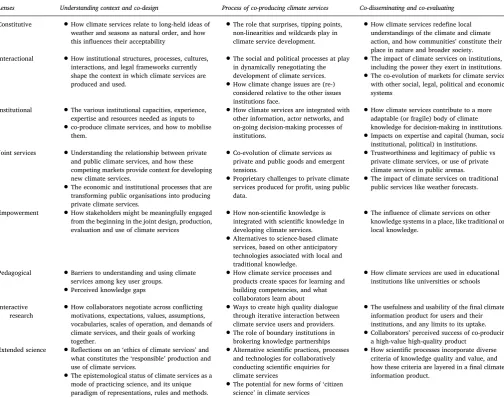
Bremer and Meisch (2017) do caution against tensions between some of these lenses, but point out that owing to their overlapping nature, they are largely complimentary in what they reveal about processes of co-production; “As each lens permits only one narrow observation on the complex processes of co-production, certain scholars (deliberately or not) define co-production in a way that combines several lenses to provide a more comprehensive view” (Bremer and Meisch, 2017: p. 12). Indeed, there is a great potential and precedent for using two or more lenses in concert for a more comprehensive analysis, without necessarily making the analysis over-complicated (see e.g.Armitage et al., 2011). The prism systemises a way of looking at eight dimensions of the co-production process in an organised, stepwise fashion (seeTable 1). It can help us study and learn lessons from on-going co-production practices; looking at what each lens reveals about what is going on in this complex process, and comparing across the lenses for new and surprising insights. As such, it promotes and enables integrated and nested systemic analysis of the people, institutions and
processes that come together, affect each other, come into conflict or cooperate in co-producing climate services and defining their value in a context. At the same time, it gives us more latitude in planning new co-production processes, with consideration for different types of co-pro-duction work; emphasising policy products or science, learning or in-stitutional capacity.
Arguably such integrated study could improve both the way we observeand interpret the role of climate services in a context,intervene to effect co-production approaches, andevaluatethe impact of climate services within that context. Here we echo the three phases ofMauser et al. (2013)in concretely demonstrating the value of the prism, and how it could contribute to designing better performing climate services in practice.
4.1.1. Understanding climate issues in context and co-designing climate services
[image:6.595.46.551.79.478.2]Scholars and practitioners have been ill-equipped to describe the contexts where climate services are introduced, or interpret how con-text can shape the way they develop. But we can draw on the de-scriptive work of Science and Technology Studies scholars, in the ‘constitutive’and‘interactional lenses’, for seeing how science is pro-duced from institutions, politics and socio-cultural frameworks. Proper consideration for context is vital for designing climate services that address the real need, and with different co-production perspectives, Table 1
Examples of different aspects of climate service co-production, visible at different stages, through different co-production lenses.
Lenses Understanding context and co-design Process of co-producing climate services Co-disseminating and co-evaluating
Constitutive
•
How climate services relate to long-held ideas of weather and seasons as natural order, and how this influences their acceptability•
The role that surprises, tipping points, non-linearities and wildcards play in climate service development.•
How climate services redefine local understandings of the climate and climate action, and how communities’constitute their place in nature and broader society. Interactional•
How institutional structures, processes, cultures,interactions, and legal frameworks currently shape the context in which climate services are produced and used.
•
The social and political processes at play in dynamically renegotiating the development of climate services.•
How climate change issues are (re-)considered relative to the other issues institutions face.
•
The impact of climate services on institutions, including the power they exert in institutions.•
The co-evolution of markets for climate serviceswith other social, legal, political and economic systems
Institutional
•
The various institutional capacities, experience, expertise and resources needed as inputs to•
co-produce climate services, and how to mobilisethem.
•
How climate services are integrated with other information, actor networks, and on-going decision-making processes of institutions.•
How climate services contribute to a more adaptable (or fragile) body of climate knowledge for decision-making in institutions.•
Impacts on expertise and capital (human, social,institutional, political) in institutions. Joint services
•
Understanding the relationship between privateand public climate services, and how these competing markets provide context for developing new climate services.
•
The economic and institutional processes that are transforming public organisations into producing private climate services.•
Co-evolution of climate services as private and public goods and emergent tensions.•
Proprietary challenges to private climate services produced for profit, using public data.•
Trustworthiness and legitimacy of public vs private climate services, or use of private climate services in public arenas.•
The impact of climate services on traditionalpublic services like weather forecasts.
Empowerment
•
How stakeholders might be meaningfully engaged from the beginning in the joint design, production, evaluation and use of climate services•
How non-scientific knowledge is integrated with scientific knowledge in developing climate services.•
Alternatives to science-based climateservices, based on other anticipatory technologies associated with local and traditional knowledge.
•
The influence of climate services on other knowledge systems in a place, like traditional or local knowledge.Pedagogical
•
Barriers to understanding and using climate services among key user groups.•
Perceived knowledge gaps•
How climate service processes and products create spaces for learning and building competencies, and what collaborators learn about•
How climate services are used in educational institutions like universities or schoolsInteractive
research
•
How collaborators negotiate across conflicting motivations, expectations, values, assumptions, vocabularies, scales of operation, and demands of climate services, and their goals of working together.
•
Ways to create high quality dialogue through iterative interaction between climate service users and providers.•
The role of boundary institutions in brokering knowledge partnerships•
The usefulness and usability of thefinal climate information product for users and their institutions, and any limits to its uptake.•
Collaborators’perceived success of co-producinga high-value high-quality product Extended science
•
Reflections on an‘ethics of climate services’andwhat constitutes the‘responsible’production and use of climate services.
•
The epistemological status of climate services as a mode of practicing science, and its unique paradigm of representations, rules and methods.•
Alternative scientific practices, processes and technologies for collaboratively conducting scientific enquiries for climate services•
The potential for new forms of‘citizen science’in climate servicesthis opens up more design options. Does a policy-making process need a single number (e.g. of average rainy days), when an ‘interactive re-search’approach is best? Or are climate services part of a long-term effort to involve vulnerable groups in decision-making, using an‘ em-powerment lens?’Or do we need spaces where community members learn about their local climate (‘pedagogic lens’)? Understanding con-text is equally important for developing climate service markets.
4.1.2. The process of co-producing climate services
Methodologically, the prism assembles the toolboxes of approaches that are associated with each of these perspectives on co-production, which in many cases show significant overlap. This enriches the ways we can practice climate service co-production. There are new methods from‘extended science’, like citizen science, or convening an extended peer review for example. Or participatory policy approaches for building institutional capacity from the‘institutional lens’. Or institu-tional economic research on economic tools for involving local people in‘joint public service provision’for instance.
4.1.3. Co-disseminating climate services and co-evaluating their impact Climate services has seen a lot of work on communication and dissemination, but including ‘pedagogical’ and ‘empowerment’ per-spectives could present new opportunities; targeting services to vul-nerable groups, and helping them ‘learn to learn’ about climate. Evaluation of wider impact, beyond the usefulness of a product, is an-other key value in adopting different perspectives on co-production (see Section 4.3). It admits a wider spectrum of evaluation criteria asso-ciated with sets of intended and unintended impacts. So while a par-ticular climate service product–like an animation–may formally be useless to a decision-making process, the learning from developing it, or the political conflicts it triggers, may be seen as important and worth-while.
Finally, we can challenge the adequacy of the prism’s eight lenses for covering all facets of co-production; are there aspects of co-pro-duction overlooked by this concept?Bremer and Meisch (2017)do note that the eight lenses resulted from their own synthetic interpretation of a rich and overlapping literature, which could potentially have been interpreted differently. For instance, the impact of co-production on policy-making seems under-stated in the public service and institutional lenses, and could have stood alone. But these weaknesses notwith-standing, the prism is already afirst big step away from the one-di-mensional focus on product development, and can be subject to
re-finement and challenge later.
4.2. Looking at the Voss case through the co-production prism
The prism takes clarity and definition when applied to particular cases, so what kind of analysis might we conduct by turning it on the Voss case? We have already seen how the iterative interaction lens can help us study the co-production of climate services in Voss, but how might the other seven lenses help to build a more comprehensive un-derstanding?
4.2.1. Constitutive lens
We see how climate services connect with on-going debates in Voss about how to represent and live with the river. One group sees the river as part of an inherently wild and untameable nature that should be left in its natural state; that rivers will alwaysflood, and society needs to live with this risk. Another group sees the river as a feature to be controlled through engineering, to eliminate or reduce the flooding risk. The animation demonstratedflooding risk without any works to control the river, presenting a highly precise scenario that gives an impression of exact knowledge of the future river.
4.2.2. Interactional lens
We see how climate services, combined with other influences, were
used to re-frame Voss municipality’s (and other institutions’) under-lying representations of weather and natural phenomena in terms of global climate change. Flooding is reframed from being a normal im-pact of climate variability, to being a harbinger of pervasive climate change. This in turn can influence the type of information seen as salient and legitimate for addressingflooding, with for instance a shift in emphasis from modelling past flood events, to more predictive models of future flooding events that in this case included flooding supposedly beyond local experience.
4.2.3. Joint services
We see potential tensions between climate services as public or private goods, and how they are used in public and private arenas. Climate services are continuing a long trend toward the privatisation of previously public weather services. The Voss animation was privately commissioned, but built using public data, and used to stimulate debate in a public decision-making process. To what extent can the product be considered a public good, and then, what standards should it meet to be a public piece of information?
4.2.4. Empowerment
We see an ambivalent attitude to engaging non-scientific knowledge systems and social groups in the public debate in Voss. On one hand, alternative knowledge systems (local, traditional and craft knowledge) were not involved in the production of climate information for the decision-making process, including the animation; this despite a rich local knowledge and records offlooding events over the past 100 years. It is also recognised that when climate services are used in a public arena to inform publicly relevant decisions (decisions for which there is a broad constituency) local actors should have a critical voice in chal-lenging these climate services (e.g. through local environmental and recreational groups).
4.2.5. Extended science
We see a limited recourse to alternative modes of science in Voss, but the animation shows the technologies available for creating so-phisticated information products. It also shows the importance of ex-tending ethics to climate services, for promoting responsible production and use (see e.g.Adams et al., 2015). Some argued that the animation was irresponsible in its shock tactics, in the way it portrayed damage, and in hiding the significant uncertainties underlying the animation. For these critics, this lack of transparency seems to undermine the le-gitimacy of the animation for public decision-making.
4.2.6. Institutional
We can see how the animation has contributed to the knowledge base, representations, and culture of the Voss municipality, and argue whether it has made that institution more‘adaptable’. In one sense, the animation may form part of a precautionary master plan, to steer de-velopment away from potentiallyflood-prone areas. In another sense, the animation is a snapshot of one uncertain distant scenario, which does not allow for incremental change and surprise along the way, or the ability to learn from futurefloods. Sticking rigidly to the animation could blinker Voss municipality to the other changes they may be ex-periencing even now, and may be taking Voss towards alternative scenarios.
4.2.7. Pedagogic
We see how the Voss public debate enables learning along several different dimensions. We see discussion of the future climate of Voss, but also reflection on the quality of the science and climate service products themselves. It also reveals procedural learning about the de-cision-making process itself, and how information is used in support of positions.
place.
4.3. Evaluating the multi-faceted co-production of climate services
By employing a richer understanding of climate service co-produc-tion processes, there are also opportunities for building more compre-hensive evaluation frameworks. Most current frameworks are struc-tured around interactive research (Lemos and Morehouse, 2005), which has usability as the central criterion of quality. This is a good starting point, but with a regard for the other perspectives on co-production comes a greater appreciation for the other disparate criteria that un-derpin the quality and value of climate services; where quality is so-cially construed and value soso-cially constructed. Usefulness alone is ar-guably insufficient. This literature suggests that at the very least, issues like scientific credibility, legitimacy of co-production processes and ensuring sustained commitment of actors should be critically scruti-nised (Armitage et al., 2011; Cash et al., 2003; Dessai van der Sluijs, 2011; Hegger et al., 2012). Conceptually,Bremer and Meisch (2017) also engage with how each different lens evaluates‘good’ co-produc-tion, highlighting the need for more multi-faceted evaluation frame-works of climate services too (Table 2).
Methodologically, assembling multi-faceted evaluation frameworks is itself an exercise in co-production. We need to co-produce frame-works for evaluating co-production if we are going to be true and consistent with the concept. This implies going back to climate service communities and exploring with them how they appraise quality and value. For instance, if we opt for post-normal science, this means ac-tively engaging all stakeholders about the principles, processes, people, purposes and pedigrees that together determine quality and value in a context (Funtowicz and Ravetz, 1993; Kloprogge and Van der Sluijs, 2006). Related to quality, co-production concepts can render insights into how value is layered on climate services,and how we can evaluate value according to different criteria. Understanding direct and indirect co-production processes, and layers of value, is a critical step towards mainstreaming climate services and developing its markets.
5. Conclusions and the way forward
In this perspective piece we have argued for extending our under-standing of the process of‘co-production’in climate services. We claim that recognising knowledge co-production as a multi-faceted phenom-enon, able to be worked on along several different dimensions, could help climate services scholars and practitioners more fully realise the potential of this process. A more nuanced approach to co-production can potentially reform the way that thefield understands the needs and interpretations of climate science, transforms climate science into cli-mate services, and evaluates the quality of these clicli-mate services as salient, legitimate and credible. On one hand, it allows more explicit attention to the contexts where climate services are being produced, and how producing climate information is re-shaping these contexts, with implications for its social legitimacy. On the other hand, it opens up for a wider spectrum of creative methods and tools for co-produc-tion, which can be borrowed from neighbouring fields of research;
unlocking exciting ways for‘learning to learn’about climate and cli-mate action, extending voice to marginalised communities, or ex-tending into alternative modes of doing science with non-scientists– like citizen science–for instance.
Role of the funding source
This paper emerged from collaboration as part of the UC4A project ‘Understanding Cultural Conditions for Climate Change Adaptation’, funded under the Research Council of Norway’s SAMKUL programme. The funder did not have any direct influence on the conceptualisation, planning or writing of this perspective piece.
Acknowledgements
This perspective piece is derived from research designed in the ‘ACCORD’project proposal (Appraising Climate services COpRoDuction in Europe), versions of which were submitted to the Norwegian Research Council’s KLIMAFORSK Programme and the European Commission’ Horizon 2020 Programme (SC5-01-2017). This collaboration was sup-ported by the UC4A project ‘Understanding Cultural Conditions for Climate Change Adaptation’, funded under the Research Council of Norway’s SAMKUL programme. The authors would like to acknowledge the input and advice of other consortium partners who contributed to the project proposal, particularly Sissel Småland Aasheim, Laura Drivdal, Mathew Stiller-Reeve, Stephanie Mayer, Erik Kolstad, Dries Hegger, Joost Vervoort, Ariella Helfgott, Phillip Thornton, Werner Krauss, Louis Lemkow Zetterling, Hasse Goosen, Jordi Cunillera, Insa Meinke, Jean-Paul Vanderlinden and Ghislain Dubois. Suraje Dessai acknowledges the support of the European Research Council under the European Union’s Seventh Framework Programme (FP7/2007-2013)/ ERC Grant Agreement No. 284369 and the UK Economic and Social Research Council (ESRC) for the Centre for Climate Change Economics and Policy (CCCEP). Stefan Sobolowski acknowledges the support of the Research Council of Norway project, R3 (grant no. 255397).
Appendix A. Supplementary data
Supplementary data to this article can be found online athttps:// doi.org/10.1016/j.cliser.2019.01.003.
References
Adams, P., Eitland, E., Hewitson, B., Vaughan, C., Wilby, R., Zebiak, S., 2015. Toward an ethical framework for climate services: a white paper of the climate services part-nership. Working Group on Climate Services Ethics. C. S. Partpart-nership.
Armitage, D., et al., 2011. Co-management and the co-production of knowledge: learning to adapt in Canada’s Arctic. Global Environ. Change 21, 995–1004.
Bartels, W.L., Furman, C.A., Diehl, D.C., Royce, F.S., Dourte, D.R., Ortiz, B.V., et al., 2013. Warming up to climate change: a participatory approach to engaging with agri-cultural stakeholders in the Southeast US. Reg. Environ. Change 13, S45–S55. Brasseur, G.P., Gallardo, L., 2016. Climate services: lessons learned and future prospects.
Earth’s Future 4, 79–89.
Bremer, S., 2017. Have we given up too much? On yielding climate representation to experts. Futures 91, 72–75.
[image:8.595.39.560.80.172.2]Bremer, S., Meisch, S., 2017. Co-production in climate change research: reviewing Table 2
Criteria for evaluating good or successful co-production of climate services (fromBremer and Meisch, 2017).
Co-production lens Evaluation criteria
Constitutive lens The diagnosis of climate services role in rebuilding representations of climate, and the social orders for living with this climate Interactional lens The exposure and critical challenge to dominant social forces steering climate services
Iterative interaction lens The usability of climate information products in a decision-making context
Extended science lens The social robustness, accountability, and legitimacy of climate information in the face of uncertainty Public services lens The efficient and effective provision of public services
Institutional lens The building of adaptive capacity in institutions Social learning lens The creation of a setting for learning to learn
different perspectives. WIREs Clim. Change 8 (6), 1–22.
Briley, L., Brown, D., Kalafatis, S.E., 2015. Overcoming barriers during the co-production of climate information for decision-making. Clim. Risk Manage. 9, 41–49. Brooks, M.S., 2013. Accelerating innovation in climate services: The 3 E’s for climate
service providers. Bull. Am. Meteorol. Soc. 807–819.
Bruno Soares, M.B., Dessai, S., 2015. Exploring the use of seasonal climate forecasts in Europe through expert elicitation. Clim. Risk Manage. 10, 8–16.
Buizer, J., Jacobs, K., Cash, D.W., 2016. Making short-term climate forecasts useful: linking science and action. PNAS 113, 4597–4602.
Buontempo, C., Hewitt, C.D., Doblas-Reyes, F.J., Dessai, S., 2014. Climate service de-velopment, delivery and use in Europe at monthly to inter-annual timescales. Clim. Risk Manage. 6, 1–5.
Cash, D.W., Clark, W.C., Alcock, F., et al., 2003. Knowledge systems for sustainable de-velopment. PNAS 100, 8086–8091.
Cash, D.W., Borck, J.C., Patt, A.G., 2006. Countering the loading-dock approach to linking science and decision making: comparative analysis of El Niño/Southern Oscillation (ENSO) forecasting systems. Sci. Technol. Human Values 31, 465–494.
Cavelier, R., Borel, C., Charreyron, V., Chaussade, M., Le Cozannet, G., Morin, D., Ritti, D., 2017. Conditions for a market uptake of climate services for adaptation in France. Clim. Serv. 6, 34–40.
Corburn, J., 2009. Cities, climate change and urban heat island mitigation: localising global environmental science. Urban Stud. 46 (2), 413–427.
Dessai, S., van der Sluijs, J.P., 2011. Modelling climate change impacts for adaptation assessments. In: Senn, S., Dawid, P., Christie, M., Cliffen, K.A. (Eds.), Simplicity, Complexity and Modelling. Wiley & Sons, Chichester, pp. 83–102.
Diehl, D.C., Sloan, N.L., Galindo-Gonzalez, S., Bartels, W.L., Dourte, D.R., Furman, C.A., et al., 2015. Toward engagement in climate training:findings from interviews with agriculture extension professionals. J. Rural Soc. Sci. 30 (1), 25–50.
Dilling, L., Lemos, M.C., 2011. Creating usable science: opportunities and constraints for climate knowledge use and their implications for science policy. Global Environ. Change 21, 680–689.
European Commission, 2015. A European Research and Innovation Roadmap for Climate Services, Directorate-Gen. Res. Innovation.
Ford, J.D., Knight, M., Pearce, T., 2013. Assessing the‘usability’of climate change re-search for decision- making: a case study of the Canadian International Polar Year. Global Environ. Change 23, 1317–1326.
Funtowicz, S., Ravetz, J., 1993. Science for the post-normal age. Futures 25, 739–755. Furman, C.A., Roncoli, C., Crane, T., Hoogenboom, G., 2011. Beyond the“fit”:
introdu-cing climate forecasts among organic farmers in Georgia (United States). Clim. Change 109, 791–799.
Gibbons, M., Limoges, C., Nowotny, H., Schwartzman, S., Scott, P., Trow, M., 1994. The New Production of Knowledge: The Dynamics of Science and Research in Contemporary Societies. Sage, London.
Giuliani, G., Nativi, S., Obregon, A., Beniston, M., Lehmann, A., 2017. Spatially enabling the global framework for climate services: reviewing geospatial solutions to effi -ciently share and integrate climate data & information. Clim. Serv. 8, 44–58. Goosen, H., De Groot-Reichwein, M.A.M., Masselink, L., Koekoek, A., Swart, R.,
Bessembinder, J., Witte, J.M.P., Stuyt, L., Blom-Zandstra, G., Immerzeel, W., 2014. Climate adaptation services for the Netherlands: an operational approach to support spatial adaptation planning. Reg. Environ. Change 14, 1035–1048.
Guston, D., 1999. Stabilizing the boundary between US politics and science: the role of the office of technology transfer as a boundary organization. Soc. Stud. Sci. 29 (1), 87–111.
Hegger, D., Lamers, M., van Zeijl-Rozema, A., Dieperink, C., 2012. Conceptualising joint knowledge production in regional climate change adaptation projects: Success con-ditions and levers for action. Environ. Sci. Policy 18, 52–65.
Hewitt, C., Mason, S., Welland, D., 2012. The global framework for climate services. Nat. Clim. Change 2, 831–832.
Hewitt, C.D., Stone, R.C., Tait, A.B., 2017. Improving the use of climate information in decision-making. Nat. Clim. Change 7, 614–616.
Hooke, W.H., Pielke Jr., R., 2000. Short-term weather prediction: an orchestra in need of a conductor. In: Sarewitz, D., Pielke, R.A., Byerly, R. (Eds.), Prediction: Science, Decision Making and the Future of Nature. Island Press, Washington DC, pp. 61–84. Jasanoff, S., Wynne, B., 1998. Science and decisionmaking. In: Rayner, S., Malone, E.L.
(Eds.), Human Choice and Climate Change: The Societal Framework. Battelle Memorial Institute, USA, pp. 1–87.
Kettle, N.P., Trainor, S., 2015. The role of remote engagement in supporting boundary chain networks across Alaska. Clim. Risk Manage. 9, 6–19.
Kirchhoff, C.J., Lemos, M.C., Dessai, S., 2013. Actionable knowledge for environmental decision making: broadening the usability of climate science. Annu. Rev. Environ. Resour. 38, 393–414.
Klenk, N., Fiume, A., Meehan, K., Gibbes, C., 2017. Local knowledge in climate adaptation research: moving knowledge frameworks from extraction to co-production. WIREs Clim. Change 8 (5).
Kloprogge, P., van der Sluijs, J.P., 2006. The inclusion of stakeholder knowledge and perspectives in integrated assessment of climate change. Clim. Change 75 (3), 359–389.
Krauss, W., von Storch, H., 2012. Post-normal practices between regional climate services and local knowledge. Nat. Culture 7, 213–230.
Lang, D.J., Wiek, A., Bergmann, M., Stauffacher, M., Martens, P., Moll, P., Swilling, M., Thomas, C.J., 2012. Transdisciplinary research in sustainability science: practice, principles and challenges. Sustain. Sci. 7, 25–43.
Laudien, R., Boon, E., Goosen, H., van Nieuwaal, K., 2018. The Dutch adaptation web
portal: seven lessons learnt from a co-production point of view. Clim. Change. https://doi.org/10.1007/s10584-018-2179-1.
Lemos, M.C., Morehouse, B.J., 2005. The co-production of science and policy in in-tegrated climate assessments. Global Environ. Change 15, 57–68.
Lemos, M.C., Kirchhoff, C.J., Kalafatis, S.E., Scavia, D., Rood, R.B., 2014. Moving climate information offthe shelf: boundary chains and the role of RISAs as adaptive orga-nizations. Weather Clim. Soc. 6 (2), 273–285.
Lorenz, S., Dessai, S., Forster, P.M., Paavola, J., 2015. Tailoring the visual communication of climate projections for local adaptation practitioners in Germany and the UK. Phil. Trans. R. Soc. A 373, 1–17.
Lorenz, S., Dessai, S., Forster, P.M., Paavola, J., 2016. Adaptation planning and the use of climate change projections in local government in England and Germany. Reg. Environ. Change.
Lövbrand, E., 2011. Co-producing European climate science and policy: a cautionary note on the making of useful knowledge. Sci. Publ. Policy 38, 225–236.
Lowrey, J.L., Ray, A.J., Webb, R.S., 2009. Factors influencing the use of climate in-formation by Colorado municipal water managers. Clim. Res. 40, 103–119. Mauser, W., Klepper, G., Rice, M., Schmalzbauer, B.S., Hackmann, H., Leemans, R.,
Moore, H., 2013. Transdisciplinary global change research: the co-creation of knowledge for sustainability. Curr. Opin. Environ. Sustainability 5, 420–431. McNie, E., 2007. Reconciling the supply of scientific information with user demands: an
analysis of the problem and review of the literature. Environ. Sci. Policy 10, 17–38. McNie, E., 2013. Delivering climate services: organizational strategies and approaches for
producing useful climate-science information. Weather Clim. Soc. 5, 14–26. Moss, R.H., Meehl, G.A., Lemos, M.C., et al., 2013. Hell and high water: practice-relevant
adaptation science. Science 8, 753.
National Research Council of the National Academies, 2001. Board on Atmospheric Sciences and Climate. In: Barron, E.J. (Ed.), First Steps Toward the Future. The National Academies Press, Washington D.C.
National Research Council of the National Academies (NRC), 2005. Thinking Strategically: The appropriate use of metrics for the climate change science program. The National Academies Press, Washington D. C.
Nicolescu, B., 2002. Manifesto of Transdisciplinarity. State University of New York Press, New York.
Nowotny, H., 2003. Democratising expertise and socially robust knowledge. Sci. Publ. Policy 30 (3), 151–156.
Offermans, A.G.E., 2012. The Perspectives Method: Towards Socially Robust River Management. Maastricht University, Maastricht.
Offermans, A., Haasnoot, M., Valkering, P., 2011. A method to explore social response for sustainable water management strategies under changing conditions. Sustainable Dev. 19 (5), 312–324.
Porter, J.J., Dessai, S., 2017. Mini-me: Why do climate scientists’misunderstand users and their needs? Environ. Sci. Policy 77, 9–14.
Porter, J.J., Demeritt, D., Dessai, S., 2015. The right stuff? Informing adaptation to cli-mate change in British Local Government. Global Environ. Change 35, 411–422. Prokopy, L.S., Carlton, J.S., Haigh, T., et al., 2016. useful to usable: developing usable
climate science for agriculture. Clim. Risk Manage. 15, 1–7.
Robards, M.D., Schoon, M.L., Meek, C.L., Engle, N.L., 2011. The importance of social drivers in the resilient provision of ecosystem services. Global Environ. Change 21 (2), 522–529.
Sarewitz, D., 2004. How science makes environmental controversies worse. Environ. Sci. Policy 7, 385–403.
Scott, A., Skea, J., Robinson, J., Shove, E., 1999. Designing‘interactive’Environmental Research for Wider Social Relevance (Special Briefing no. 4). Economic and Social Research Council/Global Environmental Change Programme, Brighton, UK. Specter, M., 2013. Climate by Numbers: Can a Tech Firm Help Farmers Survive Global
Warming? New Yorker.
van der Sluijs, J.P., 2012. Uncertainty and dissent in climate risk assessment, a post-normal perspective. Nat. Culture 7 (2), 174–195.
van der Sluijs, J.P., Wardekker, J.A., 2015. Critical appraisal of assumptions in chains of model calculations used to project local climate impacts for adaptation decision support–the case of Baakse Beek. Environ. Res. Lett. 10, 045005.
van der Sluijs, J.P., van Est, R., Riphagen, M., 2010. Beyond consensus: reflections from a democratic perspective on the interaction between climate politics and science. Curr. Opin. Environ. Sustainability 2, 409.
van Vliet, A.J., Bron, W.A., Mulder, S., van der Slikke, W., Odé, B., 2014. Observed cli-mate-induced changes in plant phenology in the Netherlands. Reg. Environ. Change 14 (3), 997–1008.
Vaughan, C., Dessai, S., 2014. Climate services for society: origins, institutional ar-rangements, and design elements for an evaluation framework. WIREs Clim. Change 5, 587–603.
Vaughan, C., Dessai, S., Hewitt, C., 2018. Surveying climate services: what can we learn from a bird’s-eye view? Weather Clim. Soc. 10 (2), 373–395.
Visbeck, M., 2008. From climate assessment to climate services. Nat. Geosci. 1, 2–3. Wall, T., Meadow, A.M., Horganic, A., 2017. Developing evaluation indicators to improve
the process of coproducing usable climate science. Weather Clim. Soc. 9, 95–107. Wamsler, C., 2017. Stakeholder involvement in strategic adaptation planning:
transdis-ciplinarity and co-production at stake? Environ. Sci. Policy 75, 148–157. Webber, S., Donner, S.D., 2017. Climate service warnings: cautions about
commercia-lizing climate science for adaptation in the developing world. WIREs Clim. Change 8 (1), e424.