Politicizing Council decision-making:
The effect of EP empowerment*
Frank M. Häge1
Department of Politics and Public Administration University of Limerick, Ireland
17 April 2009
Abstract
Research on the intra-institutional consequences of differences in the EU’s inter-institutional rule configurations is rare. This study investigates the effect of the empowerment of the European Parliament (EP) on the active involvement of ministers in Council decision-making. I argue that the empowerment of the EP increases the incentives for bureaucrats in the Council’s preparatory bodies to refer decisions on legislative dossiers to ministers. The empirical analysis examines this argument with data on more than 6000 legislative decision-making processes that were concluded between 1980 and the end of 2007. The analysis demonstrates a strong and robust association between the type of legislative procedure and different decision-making levels in the Council: a more powerful EP leads to more politicized Council decision-making. In terms of the legitimacy of EU decision-making, this finding implies that empowering the EP does not only create a direct link between EU lawmaker and ordinary citizens, but also contributes to strengthening the indirect link between Council members and their national electorates.
* The collection of the data used in this research was supported by a postdoctoral research grant of the Netherlands
Institute of Government.
The EP and Council in EU law-making
Over the last three decades, the European Parliament (EP) has gained substantial law-making powers. The EP’s original role was to be a purely consultative body in the legislative decision-making process of the European Union (EU), giving advice to the Commission and the Council of Ministers. While the Commission was, and still is, responsible for drafting legislative proposals, the Council, as the institution representing member states’ interests, used to be the only institution whose agreement was required to pass EU law. From its humble beginnings as an advisory body, the Parliament has developed into a fully-fledged legislative institution with prerogatives that in many respects equal those of the Council (see e.g. Rittberger 2005).
Not surprisingly, the rather extraordinary transformation of the EP has caught the attention of a number of scholars studying this process. Corresponding to the elevation of the Parliament’s role in the legislative decision-making process, research on its internal workings and its external influence has flourished in recent years (e.g. Kreppel 2002a; Hix et al. 2007). However, little research exists that examines the consequences of the empowerment of the EP on decision-making within the other major institutions involved in EU law-making. This study investigates whether and to what extent the increase in Parliament’s legislative powers led to a politicization of Council decision-making. In this paper, politicization refers to the degree to which an issue receives the attention of high-ranking political decision-makers. In the Council of the European Union, only ministers from member state governments have the legal authority to adopt legislative decisions. However, ministers are often not directly involved in the substantive negotiations on a dossier and just rubber-stamp the agreement reached by bureaucrats in so-called preparatory bodies of the Council. Thus, the majority of legislative proposals adopted by the Council are never brought to the attention of ministers (van Schendelen 1996; Hayes-Renshaw & Wallace 2006; Häge 2008).
ministers themselves. The work in Council working parties and committees usually takes place outside the limelight. In any event, officials do not answer directly to national parliaments. I argue that the empowerment of the EP politicizes decision-making within the Council. If this hypothesis holds, then granting the EP legislative powers increases the EU’s legitimacy not only directly by empowering the institution that represents European citizens, but also indirectly by strengthening the accountability link between ministers in the Council and their national parliaments and electorates.
In this paper, I examine the consequences of granting legislative powers to the EP for the involvement of ministers in Council decision-making. The literature review in the next section establishes that the effect of EP empowerment on decision-making within the Council has not received much attention yet. In the subsequent section, I elaborate on the theoretical mechanism linking EP involvement with the decision-making level in the Council. Somewhat simplified, the theoretical argument states that the introduction of politically contested issues and extreme positions and the increase in the level of public and political awareness that accompanies the empowerment of the EP discourages national officials from making Council decisions themselves. Being primarily motivated by blame-avoidance, national officials are more likely to refer decisions to ministers when the chances of bureaucrats making and ministers discovering ‘wrong’ working party or committee decisions increase. This simple model yields a clear hypothesis about the effect of EP empowerment on the level of politicization of Council decision-making.
in line with the expectations derived from the theoretical model. In the last section, I summarize the study and its findings and discuss possible normative conclusions.
Previous research
Research on the EP’s internal functioning and external influence has been a burgeoning field in recent years. Thus, this review cannot claim comprehensiveness. Regarding the internal workings of the EP, several studies have analysed the voting behaviour of members of the EP (Kreppel & Tsebelis 1999; Hix et al. 2007). Amongst other topics, these studies examined coalition formation, party group cohesion, and the relative influence of national parties compared to European party groups. The Parliament’s system of standing committees has also received considerable attention (Bowler & Farrell 1995; Mamadouh & Raunio 2003; Whitaker 2005; McElroy 2006). The degree of representativeness of committees compared to the full plenary has been a major issue of concern in this area of research. Rasmussen (2008a) conducted a similar study of the representativeness of the EP’s delegation to the conciliation committee under the codecision procedure. A number of other studies have examined the selection and influence of rapporteurs, who are responsible for drafting committee reports (Kaeding 2004; Benedetto 2005; Kaeding 2005; Hausemer 2006; Hoyland 2006). Finally, Ringe (2005) examined the internal preference formation process of the EP.
Accompanying the increase in legislative powers of the EP, many studies have focused on the effect of this empowerment on policy outcomes. Early contributions in this field took a purely theoretical perspective on the effects of different legislative procedures (Steunenberg 1994; Tsebelis 1994; Crombez 1996). The first generation of empirical studies used the adoption of EP amendments to gauge the Parliament’s influence in EU decision-making (Kreppel 1999; Tsebelis
et al. 2001; Kreppel 2002b; see also Häge & Kaeding 2007; Kardasheva 2009). Most of the more
With the exception of Farrel and Héritier (2004), no previous study has discussed the intra-institutional consequences of inter-institutional rule changes. These authors argue that “exogenous changes in macro-institutional rules, which result in a move from formal and sequential to informal simultaneous interaction between collective actors, will lead to changes in individual actors’ respective influence over outcomes within organizations” (Farrell & Héritier 2004: 1208). Specifically, informal simultaneous interactions are supposed to advantage individuals that control information flows between the collective actors. With respect to the EU, the increasing reliance on informal negotiations between the institutions to come to an early agreement under the codecision procedure is a case in point. These informal negotiation practices are hypothesized to increase the influence and power of those individuals that are directly involved in the negotiations at the expense of the other members of their institution who are not involved. The argument in this paper is similar to Farrel and Héritier’s (2004) in that inter-institutional rule changes are expected to result in intra-inter-institutional power shifts. However, Farrel and Héritier (2004) focus on the development and effect of informal negotiation practices within the codecision procedure while this paper compares the effects of different legislative procedures. The theoretical expectations also differ considerably. Based on their theoretical argument, Farrel and Héritier (2004) expect an increase in the power of the Presidency vis-à-vis other member states and of Council committees vis-à-vis ministers. In contrast, the theoretical argument advanced in this study leads to the expectation that an increase in EP powers leads to more rather than less ministerial power in Council decision-making.2
The brief review of research on the EP and its role in inter-institutional decision-making shows that the effect of EP empowerment on decision-making in the Council has received little attention. Research that focuses on decision-making within the Council does not fare much better in this respect. A number of studies investigate the voting behaviour of member states (Mattila & Lane 2001; Mattila 2004). Others study preference alignments (Selck 2004; Thomson et al. 2004; Zimmer et al. 2005) of member states or the communication and cooperation networks existing in working parties and committees (Beyers & Dierickx 1997, 1998; Naurin 2008). A common concern of all of these studies is the identification of conflict structures underlying Council
2 Note that the two arguments are not necessarily inconsistent. A relatively high ministerial involvement under the
codecision procedure, as compared to the consultation procedure, might be partly but not completely offset by the
decision-making. Lewis (1998, 2003, 2005) conducted qualitative research on the negotiation behaviour in Council committees, especially the Committee of Permanent Representatives (Coreper). The role of the Presidency in Council decision-making has also received considerable attention (Tallberg 2003, 2004; Schalk et al. 2007; Warntjen 2007; Thomson 2008). All of these studies do not distinguish between different organizational levels and therefore do not inform us about the hierarchical division of labour within the Council.
The studies by Fouilleux and colleagues (2005) and Häge (2007a, b) are more relevant as they explicitly deal with the question of why some decisions are made in working parties and committees while others are referred to ministers. The argument is often made that bureaucrats deal with the ‘technical’ issues while ministers handle the ‘political’ problems. Based on findings from qualitative case studies, Fouilleux et al. (2005) challenge this perception. They argue that no clear-cut, objective distinction exists between technical and political issues. Whether or not an issue is considered to be of a political nature is a result of social construction rather than certain characteristics of the dossier. Relying on an analysis of quantitative data, Häge (2007a) comes to partly different conclusions. According to this study, a large amount of the variation in ministerial involvement can indeed be traced back to basic characteristics of the proposal under consideration. Still, objective characteristics of the dossier do not completely determine the level of decision-making in the Council, context factors and the outcomes of social interactions affect the decision to involve ministers as well. Häge (2007a, b) also studied the effect of EP involvement on the Council decision-making level. Based on different samples and measures of EP power, both studies find a positive effect on ministerial involvement. However, the findings are based on samples covering relatively limited time periods. Thus, the generalizability of the results is questionable. This study improves on earlier research by extending the timeframe during which the relationship between legislative procedure and decision-making level in the Council is considered. At least equally important, this study clarifies the theoretical link between EP involvement and Council decision-making level. The next section elaborates on this connection.
Linking EP power and ministerial involvement in Council decision-making
proposed by the Commission and decided upon by the Council. The Parliament has only a consultative function. The Council cannot adopt legislation before the Parliament has delivered its opinion, but the Council is under no obligation to take any of the Parliament’s amendments into account. The Single European Act introduced the cooperation procedure. The cooperation procedure added another reading to the consultation procedure. The Council adopts a common position by qualified majority in its first reading and sends it back to the Parliament. The EP has the opportunity to make amendments to the common position, adopt or reject it. If it rejects the common position, or if it makes amendments that are subsequently adopted by the Commission, the Council can overrule the Parliament’s suggestions only by unanimity. Tsebelis (1994) has argued that this procedure confers conditional agenda-setting power to the EP. Still, if the Council position enjoys unanimous consent among member states, the Council is not bound to incorporate any of the Parliament’s amendments.
In 1993, the Treaty of Maastricht added yet another procedure to the repertoire. The so-called codecision procedure consists of three readings with a conciliation stage between the second and third one. If the Council cannot accept all amendments made by the EP in second reading, a conciliation committee has to be convened. This committee consists of equally sized delegations from the Parliament and the Council. The committee’s task is to find a compromise solution. If it does not reach an agreement, the act falls3. If it reaches an agreement, the compromise text still has to be adopted by both parent institutions in the third reading. While the cooperation procedure increases the influence of the Parliament as compared to the consultation procedure, only the codecision procedure establishes the Parliament as an equal co-legislator next to the Council. Finally, the Treaty of Amsterdam extended the scope of the applicability of the codecision procedure considerably. This extension included almost all areas previously covered by the cooperation procedure.
3 The first version of the codecision procedure, as introduced by the Treaty of Maastricht, allowed the Council to
re-introduce its common position in third reading if the conciliation committee did not find a compromise. The Council
could essentially make a take-it-or-leave-it offer to the Parliament at the end of the procedure. In practice, this
provision was irrelevant as the Parliament committed itself through a change in its internal rules of procedure to
categorically reject any common position re-introduced by the Council. The second version of the codecision
procedure introduced by the Treaty of Amsterdam in 1999 merely formalized the way the procedure had been
Successive Treaty reforms strengthened the powers of the EP both in kind and scope. What consequences does the EP’s empowerment have for Council decision-making? When the EP has only a consultative function, national officials in the Council can work in relative insulation from political and public scrutiny. Exceptions not withstanding (see Kardasheva 2009), the opinion of the EP is hardly taken into account by the Council. In accordance with this minor role in the decision-making process, interest groups do not consider the EP to be a serious access point and the EP’s proceedings receive little coverage by the media. Without substantial law-making powers, the EP is not considered to be a serious player and its activities are not able to generate much publicity. The cooperation procedure and especially the codecision procedure change this situation. The EP is an influential actor under these procedures. The Parliament has enough leverage to be heard by national bureaucrats and politicians. The Parliament’s views are taken seriously; interest groups try to influence them to suit their purposes and the media transmits them to a wider audience. Thus, EP empowerment means that the Parliament’s views have to be taken into account by the other actors in the legislative decision-making process and, as a result, they receive attention from a wider audience. Both of these interrelated aspects of EU empowerment are likely to lead to a politicization of Council decision-making.
I assume that bureaucrats are primarily motivated by blame avoidance or, in more positive terms, they just want to do ‘a good job’. In hierarchical organizations like government ministries, doing a good job means delivering the results most preferred by the bureaucrat’s superior. The head of a hierarchical organization is in direct control of many of the goods most valued by her subordinates, like promotions, salary raises or even just continuing employment. Thus, I assume that the preferences of bureaucrats and their ministers are rather closely aligned and that the risk of moral hazard on behalf of bureaucrats does not play a significant role in explaining the involvement of ministers.4 In technical terms, I assume that the utility received by the bureaucrat from the results of various courses of action is a direct function of the utility received by his minister. More precisely, the utility functions take the following form:
UMinister = -|P-M|-c UBureaucrat = -d(|P-M|-c)
where P∈ {A = 0, B = 1} stands for the policy adopted by the Council and M∈ {A = 0, B = 1} for the policy most preferred by the minister. For simplicity, I consider only two possible policy options A and B with values 0 and 1, respectively. The costs for the minister of negotiating herself are captured by c, which stands for a positive, real number. The dummy variable
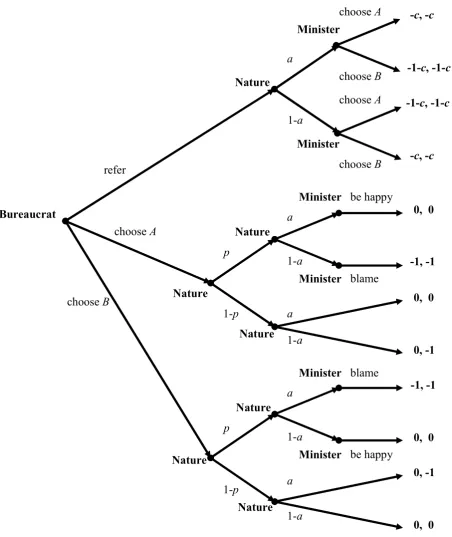
d∈{0, 1} indicates whether or not the minister is aware of the policy outcome P. The utility functions take their maxima at zero. Thus, the minister is most happy when she realizes her most preferred policy without the need to become personally involved. Then both the term |P-M| and the cost variable c are zero. This situation is also one of the outcomes most favoured by the bureaucrat. However, for the bureaucrat, any other outcome of which the minister is not aware of yields the same payoff. In these situations, d is zero. The bureaucrat is not intrinsically motivated to achieve the result most favoured by his minister. The bureaucrat only actively pursues the minister’s goals as long as a chance exists that the minister becomes aware of the policy outcome (Prob[d = 1] > 0). If the bureaucrat can rule out this possibility, he becomes indifferent between different policy options. In this sense, the bureaucrat is politically neutral. Figure 1 describes the sequence of interaction between the bureaucrat and the minister.
4 This assumption contrasts with standard principal-agent models, which consider preference divergence between
Figure 1: Sequence of interaction between bureaucrat and minister
In the first stage of the model, the bureaucrat decides about referring the proposal to his minister or selecting a policy himself. If the bureaucrat refers the proposal, the minister simply chooses the policy she most prefers (so |P-M| = 0) but incurs a positive cost c for spending some of her
refer 1-p p a 1-a 0, -1
0, 0
choose A
choose B
a
1-a
-1, -1
0, 0
1-p p
a
1-a
0, 0
0, -1
a
1-a
0, 0
-1, -1
a
-c, -c
-c, -c
Minister Nature Nature Bureaucrat Nature Nature Nature Nature Nature Minister Minister Minister Minister Minister
choose A
choose B
blame be happy
be happy blame 1-a
choose A
choose B -1-c, -1-c
valuable time on the proposal. If the bureaucrat chooses to decide about the policy himself, he faces two problems that in combination make a clear-cut policy decision difficult. Firstly, the bureaucrat is not certain about the policy option preferred by his minister. The bureaucrat believes that the minister prefers policy A with probability a∈[0, 1] and policy B with probability 1-a. Furthermore, the bureaucrat is uncertain about whether the minister will become aware of the adopted policy or not. With probability p∈[0, 1], the minister will be informed about the adopted policy, and with probability 1-p, she will remain unaware of the policy. The minister’s payoff in the different scenarios just depends on which policy is selected by the bureaucrat. The minister is not involved in negotiations, so the cost term c is always zero. If the bureaucrat selects the option favoured by the minister, the minister receives its maximum payoff of zero. If the bureaucrat selects the option not favoured by the minister, the minister receives a negative payoff of -1. From the point of view of the bureaucrat, the choice of the policy option is inconsequential as long as the minister does not know about it. Thus, the bureaucrat receives his maximum payoff of zero whenever the minister remains unaware of the bureaucrat’s policy choice (then d = 0), whatever that choice may be. In contrast, the payoffs of the bureaucrat mirror the payoffs of the minister exactly when the latter scrutinizes the formers decision. Any disagreement about the policy option chosen by the bureaucrat will be directly reflected in his payoff. If he chose the minister’s preferred policy option, he will receive a payoff of zero. If he chose the option not preferred by the minister, he will receive a payoff of -1. This relationship between the bureaucrat’s and the minister’s payoffs represents the idea that the bureaucrat is sensitive towards the minister’s evaluation of his job but that this evaluation depends on what the minister can actually observe.
The game can be solved via backward induction. When the bureaucrat refers the proposal to the minister, nature reveals which policy the minister prefers and the minister simple selects this policy. The minister incurs only decision-making costs resulting from the need to deal with the proposal herself. These decision-making costs occur regardless of which policy option the minister selected and are directly transferred to the bureaucrat. Thus, the bureaucrat’s payoff for referring the proposal is -c. The payoff for deciding about the proposal himself is somewhat more difficult to identify. Given the choice for a certain policy option, the bureaucrat’s payoff depends on the probability p that the minister becomes aware of the selected policy and on the probability
payoff from selecting policy A is p(1-a)(-1) and the payoff from selecting policy B is pa(-1). Comparing these two payoffs, the bureaucrat will choose policy A over B if p(1-a)(-1) > pa(-1), which reduces to a > 1-a. In words, the bureaucrat will choose policy A if the probability that the minister prefers policy A is larger than the probability that the minister prefers policy B. Solving for a, we can easily see that this will be the case when a > 0.5. If a > 0.5, then the bureaucrat’s choice between referring the proposal to ministers and deciding about the proposal himself becomes one between referring and selecting policy A.5 Formally, the bureaucrat will refer the proposal if -c > p(1-a)(-1), which reduces to c < p(1-a). If a < 0.5, then the bureaucrat’s choice becomes one between referring and selecting policy B. In this case, the bureaucrat refers the proposal if -c > pa(-1), which reduces to c < pa. In both cases, the bureaucrat faces a trade-off between the certain costs c of a referral and the losses he is likely to receive in the event that he inadvertently does not select the minister’s preferred policy and his policy choice is discovered by the minister. For a given level of negotiation costs, the bureaucrat is more likely to refer the proposal to the minister the larger the probability that he accidentally selects the policy option not favoured by the minister and the larger the probability that the minister subsequently learns about his policy choice. Looking at it from a different angle, the bureaucrat will decide to select policy himself either if he is relatively sure about which policy is favoured by his superior or if the chances that his policy choice will be discovered by the minister are rather small.
I argue that the bureaucrat’s uncertainty about the minister’s preferred policy choice and the bureaucrat’s belief about the probability that the minister will learn the bureaucrat’s policy choice are both influenced by the powers of the EP in legislative decision-making. The Parliament is likely to introduce additional issues and more extreme positions (Rittberger 2000; Kaeding & Selck 2005; Costello 2008) to those that were deemed relevant by national officials when developing their negotiation positions and strategies. Often, these newly introduced issues are also of a politically more controversial nature. While such amendments can be ignored under the consultation procedure, they have to be taken more seriously under the cooperation and particularly under the codecision procedure, when the Council has to reach a compromise with the Parliament. In the face of relatively extreme EP positions or unfamiliar, controversial new issues, the bureaucrat will find it more difficult to predict the reaction of his minister (i.e., a will be close to 0.5). As long as the minister does not learn the bureaucrat’s policy choice, this
uncertainty about the minister’s preference is not consequential. However, a more powerful EP is also likely to be taken more seriously by interest groups and the media on both the European and national level. The increased interest in the Parliament’s positions by lobbyists and the media creates additional channels through which information about the policy choice of the bureaucrat can be transmitted to the minister. Thus, the minister is more likely to hear about the bureaucrat’s policy choice (i.e. p increases) when the act in question was adopted according to the cooperation or codecision procedure rather than the consultation procedure. In short, the involvement of a powerful EP in legislative decision-making increases the uncertainty about the preferences of the minister and the likelihood that ministers will become aware of the bureaucrat’s policy choice. Both of these factors in turn increase the probability that the bureaucrat refers a proposal to the minister. Having outlined the linkages between the legislative powers of the EP and the different variables determining the decision-making level in the Council, the following hypotheses can be stated:
Hypothesis: Ministers in the Council are more likely to personally decide on a proposal the
more powers the EP has been granted in the legislative decision-making process.
Corresponding to the power of the EP in these different procedures, I expect to observe the lowest degree of ministerial involvement under the consultation procedure, the second-lowest under the cooperation procedure and the highest under the codecision procedure.6 In the next section, I examine the extent to which these expectations are borne out by the data.
Sample selection, data collection and measurement
I extracted the data used for this analysis from the European Commission’s Prelex database. Prelex monitors the inter-institutional decision-making process and is accessible online.7 The database provides information on all Commission documents submitted to the other EU institutions since the mid 1970s. For legislative proposals, the database tracks their progress through the inter-institutional decision-making process, providing a considerable amount of
6 In the theoretical literature, disagreement exists about whether the cooperation procedure or the first version of the
codecision procedure as introduced by the Treaty of Maastricht was more beneficial for Parliament. However, a
consensus exists that the second version of the codecision procedure, which has been formally introduced by the
Amsterdam Treaty, grants more powers to the EP than the cooperation procedure. As mentioned earlier, the second
version of the codecision procedure was effectively already in operation under the rules of the Maastricht Treaty.
information on major events related to the dossier, like EP plenary or Council meetings. To extract the information from the database’s webpages, I developed a computer script in the programming language Python. The script first searches for all Commission documents that were submitted in a certain year and downloads the respective webpages. In a second step, the relevant information in the webpages is identified through search functions and copied into a database table.
The data analysis focuses on decision-making processes that started after 1974 and ended between the beginning of 1980 and the end of 2007. I also restrict the analysis to proposals for decisions, regulations and directives that were introduced by the Commission and discussed under the consultation, cooperation, or codecision procedure. The focus on decisions, regulations, and directives excludes several types of non-legislative acts. To keep the sample somewhat homogenous, I do not consider legislative proposals introduced by a member state or by the European Central Bank. In cases where direct information on the legislative procedure was missing, I relied on the occurrence of different types of EP meetings to code the procedure variable.8 Finally, I excluded proposals if evidence suggested that the legislative procedure had changed during the decision-making process due to changes in the Treaty. How to code the procedure variable is ambiguous in such cases. This selection procedure resulted in a sample of 6,245 decision-making processes. The distribution of different types of procedures included in the sample is given in Table 1. With almost 78 percent, the vast majority of decision-making proposals followed the consultation procedure. Another 8 percent were decided under the cooperation procedure and about 14 percent under the codecision procedure.
Table 1: Distribution of types of legislative procedures
Legislative procedure Freq. Percent
Consultation procedure 4,865 77.9 Cooperation procedure 491 7.9 Codecision procedure 889 14.2
Total 6,245 100.00
8 I coded proposals that involved an “EP opinion single reading” as consultation files and proposals that involved an
“EP opinion first reading” as cooperation or codecision files. Drawing the distinction between cooperation and
codecision files required individually inspecting each proposal. I assumed that cases that do not indicate the type of
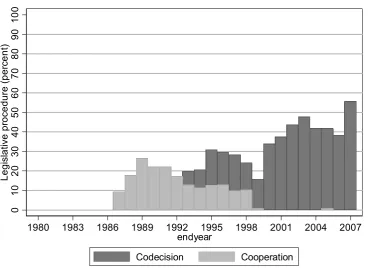
Figure 2 shows the distribution of different types of procedures over time. Before 1987, all decision-making processes followed the consultation procedure. As the Single European Act came into force in 1987, the cooperation procedure was added. The Maastricht Treaty introduced the codecision procedure in 1993, which almost completely replaced the cooperation procedure after its scope of applicability was considerably enlarged by the Treaty of Amsterdam in 1999. Figure 2: Distribution of types of legislative procedures over time
0 1 0 2 0 3 0 4 0 5 0 6 0 7 0 8 0 9 0 1 0 0 L e g is la ti v e p ro c e d u re ( p e rc e n t)
1980 1983 1986 1989 1992 1995 1998 2001 2004 2007
endyear
Codecision Cooperation
I measure the politicization of Council decision-making by a dummy variable indicating whether or not ministers personally decided on the dossier. The analysis focuses on the first formal Council decision in the procedure. In the case of the consultation procedure, this decision coincides with the final adoption of the act. In the case of the cooperation and codecision procedure, the first formal Council decision refers to the adoption of the Council’s common position in the first reading stage of these procedures. In both instances, the first formal Council decision reflects the collective view to which member states agree.9 Thus, the focus on the first
9 The exception occurs when the Parliament and the Council reach an early agreement under the codecision
procedure. Then the Council’s first decision reflects the compromise between the Parliament and the Council. The
formal Council decision maximizes the comparability of the cases. The meeting in which the ministers formally adopt the proposal or the common position is often preceded by another meeting in which the ministers reached the substantive agreement on the dossier.10 If ministers discussed the proposal in such a meeting or in the meeting in which the first formal decision was made, the politicization variable is coded as 1. If the proposal was not discussed in any of the Council meetings leading up to the first formal decision, the variable is coded as 0.
A proposal that is to be discussed by ministers is indicated as a B-item on the ministers’ meeting agenda. If ministers just endorse the decision made by one of the working parties or Coreper without deliberation, then the proposal is indicated as an A-item on the agenda. In many cases, Prelex includes information on what type of item a proposal formed on the ministers’ agenda. Unfortunately, information on the type of agenda-item is missing particularly often for meetings in which the Council reached a substantive agreement on the proposal. In such cases, assuming that the proposal formed a B-item on the agenda seems reasonable. If a substantive agreement is reached at lower levels of the Council, no need exists for ministers to endorse the agreement informally before adopting the proposal or common position in a subsequent meeting. This assumption is also plausible from an empirical point of view. The overwhelming majority of meetings at which ministers adopted a substantive agreement and for which information on the type of agenda-item is available indeed indicate that the proposal formed a B-item on the agenda.11 Thus, I coded proposals for which Prelex specifies that ministers reached an agreement but lacks information on the type of agenda-item as B-items. Similarly, for meetings in which the ministers adopted the formal Council decision but information on the agenda-item was missing, I assumed that the decision was adopted without discussion as an A-item. Again, the large majority of cases on which information about the type of agenda-item was available showed that ministers usually make the formal adoption decision through the A-item procedure.12 I also coded adoptions through written procedure, replacements or withdrawals of the proposal by the Commission before any ministerial meeting had been taken place as a lack of ministerial
10 In Prelex, the events referring to these meetings are called ‘Council agreement’ and ‘Political agreement common
position’, respectively.
11 86 percent in the case of agreements on final acts and 91 percent in the case of agreements on common positions.
12 Ministers took more than 82 percent of the formal adoption decisions as A-items. In general, Prelex included
information on the type of agenda-item for most formal adoption events. Thus, in contrast to the substantive
involvement. Table 2 describes the distribution of the politicization variable. About 60 percent of the studied decision-making processes did not directly involve ministers at all. Ministers were actively involved in only about 37 percent of the cases. In about 3 percent of the cases, no information on the outcome of the decision-making process was available yet. These cases will be excluded from the subsequent analysis.13
Table 2: Distribution of agenda-items of ministerial meetings
Agenda-item Freq. Percent
A-Item 3,751 60.1
B-Item 2,328 37.3
Pending 166 2.7
Total 6,245 100.00
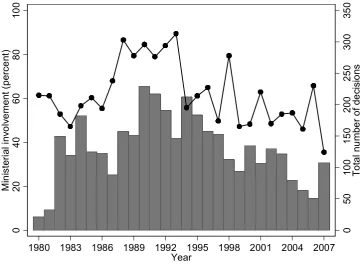
Figure 3 shows the proportion of proposals that the ministers dealt with as B-items over time. A first surprising observation is the large variation in the degree of ministerial involvement, ranging between 6 percent in 1980 and 66 percent in 1990. The figure also indicates that his variability is not just due to differences in legislative workload. One could assume that a larger number of adopted proposals goes hand in hand with a lower proportion of these proposals discussed by ministers, but the opposite seems to be the case. The more proposals the Council adopts during a certain year, the more of them are decided by ministers. The lack of a clear-cut trend in the degree of ministerial involvement also comes as a surprise. This finding stands in contrast to recent work arguing that EU policy-making is increasingly politicized (e.g. Hooghe & Marks 2009). At least with respect to Council decision-making, such a development is not visible. If at all, the data show a hump of increased ministerial involvement during the drive for the completion of the internal market in the early 1990s, which has steadily levelled off since then. Recent years have seen a move towards less politicization in the Council.
13 Given their relatively low number, the exclusion of these observations is unlikely to cause any substantial selection
Figure 3: Proportion of proposals discussed by ministers and the total number of completed decision-making processes over time
0 5 0 1 0 0 1 5 0 2 0 0 2 5 0 3 0 0 3 5 0 T o ta l n u m b e r o f d e c is io n s 0 2 0 4 0 6 0 8 0 1 0 0 M in is te ri a l in v o lv e m e n t (p e rc e n t)
1980 1983 1986 1989 1992 1995 1998 2001 2004 2007 Year
This paper is not primarily concerned with describing changes in ministerial involvement over time. Nor does it aim at a full and complete explanation of these historical changes. The primary aim is to examine the causal effect of one particular factor, the legislative powers of the EP, on ministerial involvement in Council decision-making. In the next section, I investigate this relationship.
The effect of EP empowerment on the politicization of Council decision-making
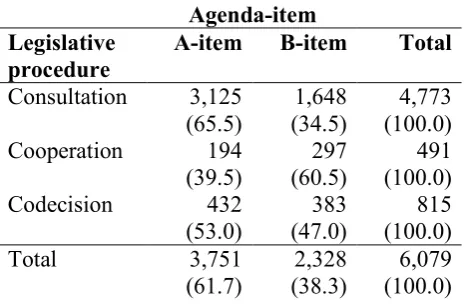
[image:18.595.83.444.154.423.2]the codecision procedure is somewhat surprising. This finding is most likely due to the generally high involvement of ministers in the early 1990s, when the codecision procedure had not been introduced yet and much legislation was still adopted through the cooperation procedure. The multivariate analysis shows that the findings are completely in line with the theoretical expectations after controlling for time-specific effects.
Table 4: Legislative procedure vs. ministerial involvement
Agenda-item Legislative
procedure
A-item B-item Total
Consultation 3,125 1,648 4,773 (65.5) (34.5) (100.0)
Cooperation 194 297 491
(39.5) (60.5) (100.0)
Codecision 432 383 815
(53.0) (47.0) (100.0)
Total 3,751 2,328 6,079
(61.7) (38.3) (100.0)
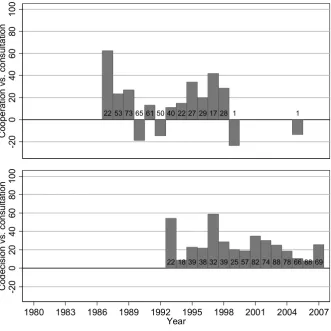
The figures in the previous section indicated that the politicization of Council decision-making actually decreased over time as more and more powers and competences were transferred to the Parliament. At first sight, this development contradicts the theoretical expectations. However, these figures are based on aggregate data. Figure 3 demonstrates that the overall level of politicization decreased over time, but it does not indicate the differences in politicization between different legislative procedures. Figure 4 is more useful for an initial evaluation of the theoretical expectations. The upper part of the figure compares the percentage of politicized Council decisions under the cooperation procedure to the percentage of politicized Council decisions under the consultation procedure. As expected, the differences in the percentages are mostly positive. Except for the years 1990 and 199214, the percentage of politicized Council decisions under cooperation was always considerably higher than the percentage of politicized Council decisions under codecision. This pattern is even more visible in the lower part of Figure 4, which compares the politicization under the codecision procedure to the politicization under the consultation procedure. Here, the differences in the percentages are consistently positive over
14 The negative differences in percentages for the years 1999 and 2005 are both based on only a single cooperation
the entire time period. Thus, the bivariate analysis is consistent with the hypotheses. The statistical analysis below further explores the robustness of these bivariate relationships.
Figure 4: Differences in politicization over time
22 53 73 65 61 50 40 22 27 29 17 28 1 1
-2 0 0 2 0 4 0 6 0 8 0 1 0 0 C o o p e ra ti o n v s . c o n s u lt a ti o n
22 18 39 38 32 39 25 57 82 74 88 78 66 88 69
-2 0 0 2 0 4 0 6 0 8 0 1 0 0 C o d e c is io n v s . c o n s u lt a ti o n
1980 1983 1986 1989 1992 1995 1998 2001 2004 2007 Year
Notes: Bars indicate the difference between procedures in the percentage of politicized Council decisions in a certain
year. The top part of the figure compares the percentage of politicized Council decisions under cooperation to the
percentage under consultation. The bottom part compares the percentage of politicized decisions under codecision to
the percentage under consultation. The numbers at the lower end of each bar indicate the number of observations on
which the percentages for the cooperation and codecision procedure are based.
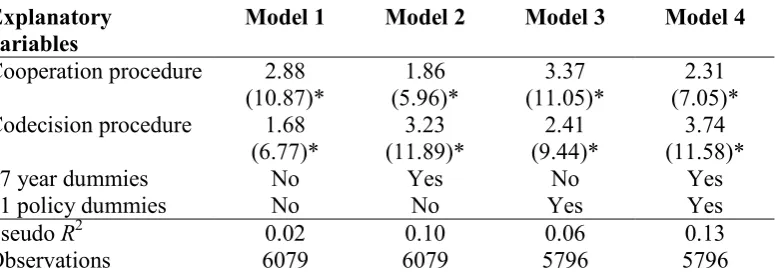
codecision procedure, respectively. Thus, the consultation procedure acts as the baseline or comparison category. Model 2 also includes 27 dummy variables indicating the different years in which the decision-making process ended.15 These dummy variables account for period-specific factors that affected all decision-making processes in a similar manner during a certain year. Model 3 controls for policy-specific effects. Based on the information given in Prelex on the ‘field of activity’, I coded a policy field variable distinguishing 21 different policy fields.16 Unfortunately, information on the policy field was missing for some cases, so the sample is somewhat smaller when the policy field dummy variables are included in the analysis. Finally, model 4 includes controls for both the year in which the decision-making process ended and for the policy field. Since the estimated coefficients for the control variables are not of substantive interest, I do not report them below. To ease interpretation, the entries in Table 5 present the odds ratios rather than the estimated regression coefficients.
Table 5: Estimation results for logistic regression analysis of ministerial involvement, 1980-2007
Explanatory variables
Model 1 Model 2 Model 3 Model 4
Cooperation procedure 2.88 1.86 3.37 2.31
(10.87)* (5.96)* (11.05)* (7.05)*
Codecision procedure 1.68 3.23 2.41 3.74
(6.77)* (11.89)* (9.44)* (11.58)*
27 year dummies No Yes No Yes
21 policy dummies No No Yes Yes
Pseudo R2 0.02 0.10 0.06 0.13
Observations 6079 6079 5796 5796
Notes: * significant at 1%; the dependent variable is ministerial involvement with 1 indicating that ministers made the Council decision themselves and 0 that they just rubber-stamped a decision reached by a preparatory body; entries are odds ratios with the absolute value of z statistics in parentheses.
All the results reported in Table 5 are statistically significant at the 1 percent level. Thus, we can almost be certain that the null hypothesis of no relationship between the explanatory and the response variable is incorrect in these instances. Thus, in the following, the interpretation of the regression results focuses on the estimated effect sizes and the substantive significance of the different explanatory variables. In general, all the estimation results reported in Table 5 are
15 The year 1980 was arbitrarily chosen as the baseline category.
16 If proposals were related to several policy fields, I classified them as being part of the ‘multiple policy fields’
broadly consistent with the theoretical argument that the empowerment of the EP leads to a politicization of Council decision-making. The results indicate that the odds of ministers deciding on the dossier are at least 1.8 times (Model 2) higher under the cooperation procedure than under the consultation procedure. Similarly, the odds of ministers becoming involved under the codecision procedure are at least 1.7 times (Model 1) higher than under consultation procedure.
The estimation results without control variables (Model 1) are somewhat puzzling as they again indicate that the cooperation procedure has a stronger effect on the politicization of Council decision-making than the codecision procedure. However, if the analysis controls for time-specific effects as in Model 2, the effect sizes of the different procedure variables take the theoretically expected order. Given the fact that some legislative procedures are far more prevalent in certain time periods than others, the change in the estimation results caused by the inclusion of dummy variables for different years is not surprising.17 Interestingly, the inclusion of policy field control variables accentuates the estimated effects of the legislative procedure variables. Again, without time dummies, the effect of the cooperation procedure seems larger than the effect of the codecision procedure (Model 3). However, the order of the effect sizes reverses as soon as control variables for time-specific effects are introduced (Model 4). The estimation results for the full specification of Model 4 indicates that, compared to the consultation procedure, the odds of ministers becoming involved in Council decision-making are 2.3 times higher under the cooperation procedure and 3.7 times higher under the codecision procedure. As the different model specifications show, the exact numerical sizes of the estimated effects are not very stable. However, all of them are of substantial size, and when the appropriate control variables are included, the order of the magnitude of the different effects is also in line with theoretical expectations.
In order to further investigate the influence of different time periods and to check the robustness of the findings, I conduct a number of sub-sample analyses. I divide the sample in three different Treaty regime periods. The first period ranges from 1987 to 1992 and covers the
17 A logistic regression analysis of the politicization variable without imputed values yields the expected order of
effect sizes even without any control variables. Although the imputation of values affects the results of the
descriptive analysis reported in the tables and figures in this paper, the substantive conclusions about the effect of EP
involvement on the politicization of Council decision-making are unaffected. In fact, the results of a correlational
analysis that does not rely on imputed values on the dependent variable lend even stronger support to the theoretical
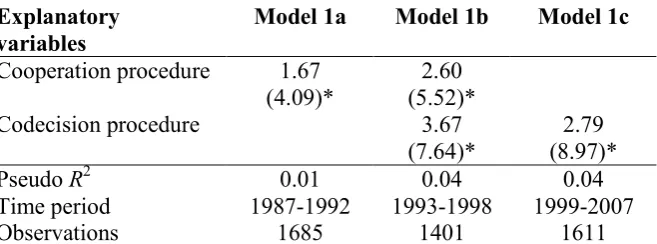
period governed by the Treaty rules as amended by the Single European Act. Only the consultation and cooperation procedure were in use during this period. The second period ranges from 1993 to 1998. This period is exceptional in that all three legislative procedures were in use during that time18. The last period covers the years from 1999 to 2007. The Amsterdam Treaty in 1999 almost completely replaced the cooperation procedure by the codecision procedure. Therefore, this sub-sample analysis focuses on a comparison of the effects of the consultation and codecision procedure. The estimation results are given in Table 6. Regression results based on models including time dummies are almost identical to those reported below. Estimates based on models with policy control variables indicate even stronger effects for the legislative procedure variables. For simplicity, I report only the results based on models without time and policy field dummy variables.
Table 6: Estimation results for the sub-sample analysis of different time periods
Explanatory variables
Model 1a Model 1b Model 1c
Cooperation procedure 1.67 2.60 (4.09)* (5.52)*
Codecision procedure 3.67 2.79
(7.64)* (8.97)*
Pseudo R2 0.01 0.04 0.04
Time period 1987-1992 1993-1998 1999-2007
Observations 1685 1401 1611
Notes: * significant at 1%; the dependent variable is ministerial involvement with 1 indicating that ministers made the Council decision themselves and 0 that they just rubber-stamped a decision reached by a preparatory body; entries are odds ratios with the absolute value of z statistics in parentheses.
The results of the sub-sample analysis are also consistent with the theoretical argument. In the pre-Maastricht period (Model 1a), the cooperation procedure is associated with more involvement of ministers than the consultation procedure. The effect of the cooperation procedure is even larger after 1993 (Model 1b), but now the newly introduced codecision procedure is even more consequential for the politicization of Council decision-making. After the changes brought about by the Treaty of Amsterdam (Model 1c), the effect of the codecision procedure weakens somewhat but is still substantially significant. In summary, the analysis demonstrated a strong and robust relationship between the type of legislative procedure and the decision-making level in
18 The cooperation procedure still applies in a few, very limited policy areas after 1998. However, the extremely low
the Council. Stronger powers of the EP are associated with more involvement of ministers in Council decision-making. In this respect, the empirical findings are clearly in line with the theoretical expectations. In the next section, I summarize the study and discuss possible normative conclusions.
Conclusions
A considerable body of research exists on the working of the EP and its influence on policy outcomes under different legislative procedures. However, few studies consider the effect of differences in inter-institutional procedures on intra-institutional decision-making processes. This paper sheds some light on the consequences of the EP’s empowerment on the politicization of decision-making within the Council. Often, working parties and committees composed of officials representing their national governments exclusively deal with a proposal; ministers only rubber-stamp their decision. I argued that the empowerment of the EP through the introduction of the cooperation and codecision procedures leads to more direct involvement of ministers in Council decision-making. These procedures grant the EP sufficient powers to make sure that its views are seriously considered by political actors and the media.
The empirical analysis relied on a sample of about 6000 decision-making cases recorded in the European Commission’s online database Prelex. The sample included all decision-making processes that concerned the adoption of a regulation, decision, or directive, and which were discussed according to the consultation, cooperation, or codecision procedure. The sample was also restricted to decision-making processes initialized by a Commission proposal and to cases that did not change the legislative procedure during the decision-making process. The statistical analysis identified a strong and clear relationship between the legislative procedure and the Council decision-making level. The analysis also confirmed the further implication about the stronger effect of the EP under the codecision than under the cooperation procedure.
From a normative point of view, the granting of legislative powers to the EP is often justified by referring to the reduction of the alleged democracy deficit of the EU. Establishing the Parliament as a co-legislator next to the Council is supposed to create a direct link between the institutions and the people of the EU, as the Parliament is the only body whose members are directly elected by citizens. Whether the EP really fulfils these high hopes is questionable as long as European elections are just second-order national elections determined by domestic issues. However, this study has pointed to a secondary effect of EP empowerment with consequences for the legitimacy of EU decision-making. The study showed that a powerful EP also leads to more ministerial involvement in the other main legislative institution of the EU, the Council of Ministers. As a result, accountability in the other, ‘territorial’ channel of interest representation is strengthened. When the Parliament has real legislative powers, Council decisions are less often made in obscure committee meetings by largely anonymous bureaucrats. National legislatures can more easily monitor and control the actions of their government ministers than the actions of relatively low-ranking bureaucrats that operate outside the limelight. But of course, the stronger politicization of Council decision-making also has its negative effects. Officials from the Council’s secretariat are concerned that national officials in preparatory bodies are less and less inclined ‘to take responsibility’ and that they tend to refer even minor issues to ministers.19 As a result, the agendas of ministerial meetings are often cluttered up with issues of secondary importance. This loss in efficiency is the flip-side of an increased politicization of Council decision-making. Finding the right balance between accountability and efficiency in Council decision-making will largely determine the perceived legitimacy of its decisions.
References
Benedetto, Giacomo (2005): Rapporteurs as Legislative Entrepreneurs: The Dynamics of the Codecision Procedure in Europe's Parliament. Journal of European Public Policy 12(1): 67-88.
Beyers, Jan and Guido Dierickx (1997): Nationality and European Negotiations: The Working Groups of the Council of Ministers. European Journal of International Relations 3(4): 435-71. Beyers, Jan and Guido Dierickx (1998): The Working Groups of the Council of the European Union: Supranational or Intergovernmental Negotiations? Journal of Common Market Studies
36(3): 289-317.
Bowler, Shaun and David M. Farrell (1995): The Organizing of the European Parliament: Committees, Specialization and Co-Ordination. British Journal of Political Science 25(2): 219-243.
Costello, Rory (2008): Partisan Composition and Bicameral Relations in EU Legislative Politics.
Paper presented at the NIG Work Conference, 20-21 November. Enschede.
Crombez, Christophe (1996): Legislative Procedures in the European Community. British
Journal of Political Science 26(2): 199-228.
Farrell, Henry and Adrienne Héritier (2003): Formal and Informal Institutions under Codecision: Continuous Constitution-Building in Europe. Governance 16(4): 577-600.
Farrell, Henry and Adrienne Héritier (2004): Interorganizational Negotiation and Intraorganizational Power in Shared Decision Making. Early Agreements under Codecision and Their Impact on the European Parliament and Council. Comparative Political Studies
37(10): 1184-212.
Fouilleux, Eve, Jaques de Maillard and Andy Smith (2005): Technical or Political? The Working Groups of the EU Council of Ministers. Journal of European Public Policy 12(4): 609-23. Häge, Frank M. (2007a): Committee Decision-Making in the Council of the European Union.
European Union Politics 8(3): 299-328.
Häge, Frank M. (2007b): The Division of Labour in Legislative Decision-Making of the Council of the European Union. Journal of Legislative Studies 13(4): 497-516.
Häge, Frank M. (2008): Who Decides in the Council of the European Union? Journal of Common
Häge, Frank M. and Michael Kaeding (2007): Reconsidering the European Parliament's Legislative Influence: Formal vs. Informal Procedures. Journal of European Integration 29(3): 341 - 61.
Hausemer, Pierre (2006): Participation and Political Competition in Committee Report Allocation: Under What Conditions Do MEPs Represent Their Constituents? European Union
Politics 7(4): 505-30.
Hayes-Renshaw, Fiona and Helen Wallace (2006): The Council of Ministers. Basingstoke: Palgrave Macmillan.
Hix, Simon (2002): Constitutional Agenda-Setting through Discretion in Rule Interpretation: Why the European Parliament Won at Amsterdam. British Journal of Political Science 32(02): 259-80.
Hix, Simon, Abdul G. Noury and Gérard Roland (2007): Democratic Politics in the European
Parliament. Cambridge: Cambridge University Press.
Hooghe, Liesbet and Gary Marks (2009): A Postfunctionalist Theory of European Integration: From Permissive Consensus to Constraining Dissensus. British Journal of Political Science
39(01): 1-23.
Hoyland, Bjorn (2006): Allocation of Codecision Reports in the Fifth European Parliament.
European Union Politics 7(1): 30-50.
Kaeding, Michael (2004): Rapporteurship Allocation in the European Parliament. European
Union Politics 5(3): 353-71.
Kaeding, Michael (2005): The World of Committee Reports: Rapporteurship Assignment in the European Parliament. Journal of Legislative Studies 11(1): 82-104.
Kaeding, Michael and Torsten J. Selck (2005): Mapping out Political Europe: Coalition Patterns in EU Decision-Making. International Political Science Review 26(3): 271-90.
Kardasheva, Raya (2009): The Power to Delay: The European Parliament's Influence in the Consultation Procedure. Journal of Common Market Studies 47(2): 385-409.
König, Thomas, Björn Lindberg, Sandra Lechner and Winfried Pohlmeier (2007): Bicameral Conflict Resolution in the European Union: An Empirical Analysis of Conciliation Committee Bargains. British Journal of Political Science 37: 281-312.
Kreppel, A. and G. Tsebelis (1999): Coalition Formation in the European Parliament.
Kreppel, Amie (1999): What Affects the European Parliament's Legislative Influence? An Analysis of the Success of EP Amendments. Journal of Common Market Studies 37(3): 521-38.
Kreppel, Amie (2002a): The European Parliament and Supranational Party System: A Study in
Institutional Development. Cambridge: Cambridge University Press.
Kreppel, Amie (2002b): Moving Beyond Procedure. An Empirical Analysis of European Parliament Legislative Influence. Comparative Political Studies 35(7): 784-813.
Lewis, Jeffrey (1998): Is the 'Hard Bargaining' Image of the Council Misleading? The Committee of Permanent Representatives and the Local Elections Directive. Journal of Common Market
Studies 36(4): 479-504.
Lewis, Jeffrey (2003): Institutional Environments and Everyday EU Decision Making. Rationalist or Constructivist? Comparative Political Studies 36(1/2): 97-124.
Lewis, Jeffrey (2005): The Janus Face of Brussels: Socialization and Everyday Decision Making in the European Union. International Organization 59(4): 937-71.
Mamadouh, Virginie and Tapio Raunio (2003): The Committee System: Powers, Appointments and Report Allocations. Journal of Common Market Studies 41(2): 333-51.
Mattila, Mikko (2004): Contested Decisions: Empirical Analysis of Voting in the European Union Council of Ministers. European Journal of Political Research 43: 29-50.
Mattila, Mikko and Jan-Erik Lane (2001): Why Unanimity in the Council? A Roll Call Analysis of Council Voting. European Union Politics 2(1): 31-52.
McElroy, Gail (2006): Committee Representation in the European Parliament. European Union
Politics 7(1): 5-29.
Moravcsik, Andrew (2002): In Defence of the 'Democratic Deficit': Reassessing Legitimacy in the European Union. Journal of Common Market Studies 40(4): 603-24.
Naurin, Daniel (2008): Coalition-Building in International Multilateral Negotiations: Party Ideology, National Interests and in-Group Bias in the Council of the European Union. Paper
presented at the APSA Annual Meeting, 28-31 August. Boston.
Nilsson, Hans G. (2004): The Justice and Home Affairs Council. Pp. 113-142 in Martin Westlake and David Galloway (eds): The Council of the European Union. London: John Harper.
Rasmussen, Anne (2008a): The EU Conciliation Committee: One or Several Principals?
Rasmussen, Anne (2008b): Time Choices in Bicameral Bargaining: Evidence from the Co-Decision Legislative Procedure of the European Union. Paper presented at the Fourth
Pan-European Conference on EU Politics, 25-27 September. Riga.
Ringe, Nils (2005): Policy Preference Formation in Legislative Politics: Structures, Actors, and Focal Points. American Journal of Political Science 49(4): 731-45.
Rittberger, Berthold (2000): Impatient Legislators and New Issue-Dimensions: A Critique of the Garrett-Tsebelis 'Standard Version' of Legislative Politics. Journal of European Public Policy
7(4): 554-75.
Rittberger, Berthold (2005): Building Europe's Parliament: Democratic Representation Beyond
the Nation State. Oxford: Oxford University Press.
Schalk, Jelmer, Rene Torenvlied, Jeroen Weesie and Frans Stokman (2007): The Power of the Presidency in EU Council Decision-Making. European Union Politics 8(2): 229-50.
Selck, Torsten J. (2004): On the Dimensionality of European Union Legislative Decision-Making. Journal of Theoretical Politics 16(2): 203-22.
Selck, Torsten J. and Bernard Steunenberg (2004): Between Power and Luck: The European Parliament in the EU Legislative Process. European Union Politics 5(1): 25-46.
Steunenberg, Bernard (1994): Decision Making under Different Institutional Arrangements: Legislation by the European Community. Journal of Institutional and Theoretical Economics
150(4): 642-69.
Tallberg, Jonas (2003): The Agenda-Shaping Powers of the EU Council Presidency. Journal of
European Public Policy 10(1): 1-19.
Tallberg, Jonas (2004): The Power of the Presidency: Brokerage, Efficiency and Distribution in EU Negotiations. Journal of Common Market Studies 42(5): 999-1022.
Thomson, Robert (2008): The Council Presidency in the European Union: Responsibility with Power. Journal of Common Market Studies 46(3): 593-617.
Thomson, Robert, Jovanka Boerefijn and Frans Stokman (2004): Actor Alignments in European Union Decision Making. European Journal of Political Research 43(2): 237-61.
Thomson, Robert, Frans Stokman, Christopher H. Achen and Thomas König (eds) (2006): The
European Union Decides. Cambridge: Cambridge University Press.
Tsebelis, George (1994): The Power of the European Parliament as a Conditional Agenda Setter.
American Political Science Review 88(1): 128-42.
van Schendelen, Marinus P. M. C. (1996): "The Council Decides": Does the Council Decide?
Journal of Common Market Studies 34(4): 531-48.
Warntjen, Andreas (2007): Steering the Union. The Impact of the EU Presidency on Legislative Activity in the Council. Journal of Common Market Studies 45(5): 1135-57.
Whitaker, Richard (2005): National Parties in the European Parliament: An Influence in the Committee System? European Union Politics 6(1): 5-28.