Rochester Institute of Technology
RIT Scholar Works
Theses
Thesis/Dissertation Collections
12-5-1996
Reflections on wood
Katherine Park
Follow this and additional works at:
http://scholarworks.rit.edu/theses
This Thesis is brought to you for free and open access by the Thesis/Dissertation Collections at RIT Scholar Works. It has been accepted for inclusion
in Theses by an authorized administrator of RIT Scholar Works. For more information, please contact
Recommended Citation
ROCHESTER INSTITUTE
OF
TECHNOLOGY
A Thesis
Submitted
to the
Faculty
ofThe
College
ofImaging
Arts
andSciences
In
Candidacy
for
the
Degree
ofMASTER OF FINE
ARTS
REFLECTIONS
ON
WOOD
BY
{CATHERINE PARK
Adviser: Douglas
E.
Sigler
Associate Adviser: William Keyser
Date:
,';' /'>/
/ \ / • fi',(
,l...
.,
~.Associate Adviser: Richard Tannen
Date:
Associate Adviser: Bruce Sodervick
Date:
,
~."
"",
I'
'" ' ,• .I"
"
J.~. .\;;
t.,. ,
!,
...
~.Department chairperson: Robert Schmitz
Date:
j l ..,J·;~-''''
I, __
~a!~er~!_~ark
,
hereby grant permission to the Wallace
Memorial Library of Rochester Institute of Technology, to reproduce my
thesis
in
whole or in part. Any reproduction will not be for commercial
use or profit.
o
Acknowledgement
ii
Introduction
1-9
Reflection
onWood
-10-14
The Works
1 5-28
Conclusion
29-30
[image:5.552.71.495.70.591.2]Illustrations:
Figure 1: The
Chest
ofDrawers
-Self-Portrait
3
Figure
2: The
Chest
ofDrawers
-Detail
---4
Figure 3:
Sam
Maloof's Chair Arm Rest
Shaping
Examples
6
Figure
4: The Works
ofRandy
Shull
andBrent Skidmore
7
Figure 5: Cabinet
8
Figure
6:
Sam
Maloof's Door Locks Designs
11
Figure 7: Clock
16
Figure 8: Clock Detail
- -18
Figure
9:
Vanity
-Front View
19
Figure 10:
Vanity
Detail
1
-Chakte
cocContainers
21
Figure 11:
Vanity
-Bottom View
22
Figure 12:
Vanity
Detail
2
-Bowl, Cover,
andhandle
24
Figure
13:
Rockers
26
Figure 14:
Rockers
-Front View
27
Thesis Plates:
Plate 1: Clock
31
Plate
2:
Vanity
-As
theDeer
Pants
for
theWater
32
Plate 3: Rockers
-My
Parents
-33
o
First
and most ofall,
I
thank
God
for
allthe
achievements andHis
unconditional
love. This
thesis
work would nothave been
possiblewithout
Him.
I
own aninestimable
thanks to
my
parents and sisterfor
theircontinuous supports
to
endure allmy hard days.
They
weremy
strength
to
overcome allthe
barriers.
Finally,
I
wouldlike
to thank
all ofmy
advisers,
professors andfriends here
atRochester
Institute
ofTechnology
for
sharing
their
experiences and
knowledge.
Especially
I
wantto thank
William
Keyser,
Doulas
Sigler,
Richard Tannen
andmy dear friend
Hee-man
whobelieved
o
Exploring
many
different
materials wassomething
I
enjoyedthroughout
my
undergraduate years.My
ultimate goal wasto
use mixed-mediafor everything
I
designed,
notonly because
ofmy
eager nessto
learn
newthings
but partly because
ofmy Industrial
Design
background,
which emphasized costfactors for inexpensive
production.My
first
products combined materialslike
glass, metal, wood, paper,
ceramics,
photography,
computerimages
andfabrics
in my
designs.
They
werenothing
morethan
simply
materials.However in my
graduate workthe
mediabecame
morethan
issues
ofutilizing basic
materials.I
neverknew how
muchmy
concepts would change whenI
began
my
major,
woodworking
andfurniture design.
My
first
year,
I
was curi ous about materials and eagerto
explore their potentials.Although I
nolonger had
to
focus
uponcheap
production andcosts,
the materialsI
used werejust
tools
for
building
things.
The
media was nolonger
a vehiclefor
producing
things cheaply,
but
ratherto
actualizemy
designs.
I
regarded wood asboth
technical
andfunctional.
When making
amodel with
wood, the
wood waseasily
shaped and absorbed paints anddyes
well.A very
realisticmodel,
assimilating
plastic and notwood,
couldbe
produced.In
this
process the wood was not usedexpressively
but
instead,
it
wasincorporated
for
the
purpose of construction.This
utilization of woodI
adopted,
notattempting
to gobeyond
the
bound
aries of model making.
I
did
not utilize wood as adesign
media untilmy
second year.I
was
using
paper,
metal,
andphotography
onthe
wood surfacefor
achest of
drawers (Figure
1)
that
I
built
in
the
previousSpring. Although
these
materials, separately,
were notstrong
enoughto
exist withoutthe
wood,
they
startedto
become
important
aspects ofmy design
concept.By
this
I
meanthat the
photography
couldbe
substituted with apainting
and
the
media exchange would nothave
made a significantdifference
in
my
concept.However,
the
photographwas nolonger
a construction element;
it
became
my
vehiclefor
expressive sculpture.I really
enjoyed thewhole process of
choosing
appropriate materialsfor
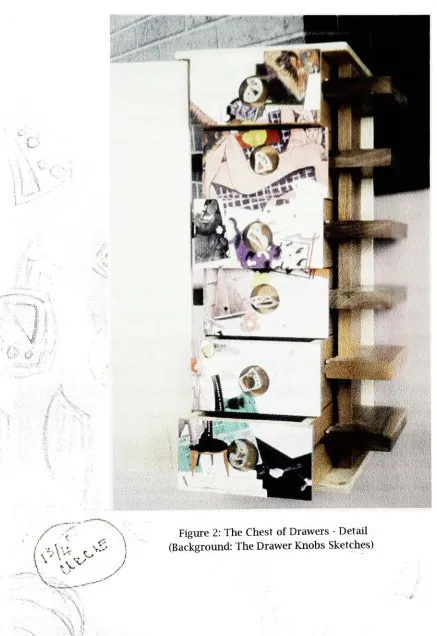
specificdesigns
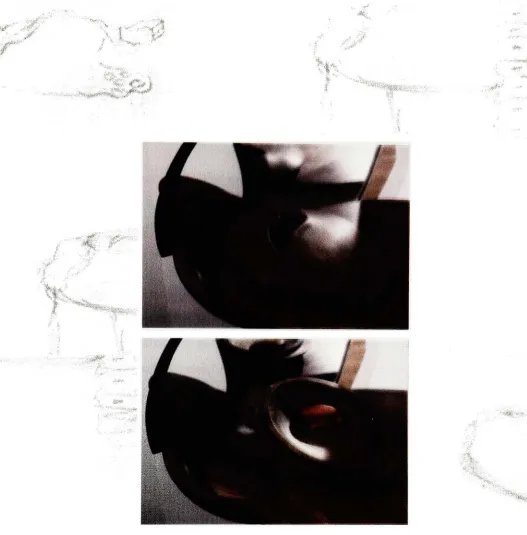
(Figure 2).
I
was certainthat this
wassomething
that
I
wantedto
pursuein
my future
work.Then
I
discovered something
important;
I
found
myself
approaching
mixed-mediadifferently
than
in my
previous work.I
was nolonger
solely
adesigner but
I
assumedthe
role of anartist,
expressing my
inner
feelings
andpersonality
through
my
mixed-mediafurniture
pieces.I
had
worked with woodfor
sometime, but
it
was not untilmy
second year
that
I
startedto
concentrate onusing
wood asmy primary
material.
I
was aware of numerousinfluential
woodworkers and appreciated thework of
Sam
Maloof,
George
Nakashima,
andWendell
Castle.
I
thought
thatI
washighly
aware ofthe
field
ofwoodworking
althoughI
lacked
alot
of experiencein creating
traditionalfurniture.
I
was rathercomfortable dematerializing1 wood and
I
enjoyedthe
process.My
thesis
work caused me
to think
aboutthings that
I
did,
and allowed meto
question
why
I
did
them.
1
Dematerialization,
Websteris 1988Editionby
LexiconPublications,
Inc.:(di:metieri:elaiz)
pres. part,dematerializing
pastandpast part,dematerializedv.r.todepriveof materi alformor qualities11v.r.tolosematerialformor qualities.A~""
A&
Figure
1: TheChest
ofDrawers
-Self-Portrait
(Background:
TheChest
ofDrawers Final Form
Sketches)
V&
'.'..
,.,.^..^.W(AiVJI^MJ^
J:C.a... *
I
i J]'
i
I
1/
'^^T^.^.^^.WJ^*
c^.V^V/T(rV>MsB.*''*v
<r
-,r
[image:11.552.3.529.14.740.2]>*.-'
\\
<
*>,,
\
S..*.'
V.-'
-"^.
'
[image:12.552.9.446.103.739.2]. x
Figure 2: The Chest ofDrawers - Detail
(Background:The Drawer Knobs
Sketches)
I
metSam
Maloof
aboutfour
years ago.I
wasimpressed
withhis
work,
but his design
style(Figure
3)
was not onethat
I
wantedto
emulate.
However,
in
someways,
his
approachesto
wood werethe
mosthelpful
in
interpreting
my
owndirections
in
wood.I
wasdematerializ
-ing
my
furniture
withouthaving
afundamental
knowledge
of wooditself.
I
realizedthat
it
wasmy responsibility
to
understandthe
characteristics
of wood andits intrinsic
beauty
before
I
could embellish woodwith another medium.
I
began
to
identify
artists who wereworking
withwood as
their
singular medium.Artist
woodworkersGeorge
Nakashima,
James
Krenov,
Wharton
Esherick,
andArthur Espenet Carpenter
werecritical
influences,
helping
meto
comprehendthe
potentials andlimita
tions
of wood.I
have
seen alot
of surface embellishedfurniture
andI
assumedthat
mostcontemporary
furniture
today
was painted.I
had
no personalopinions or
feelings
about paintedfurniture,
sinceI
wasconcentrating
on
designing
ready-to-assemble,
knock-down furniture.
The
summerbefore
I
changedmy
majorto
woodworking
andfurniture
design,
I
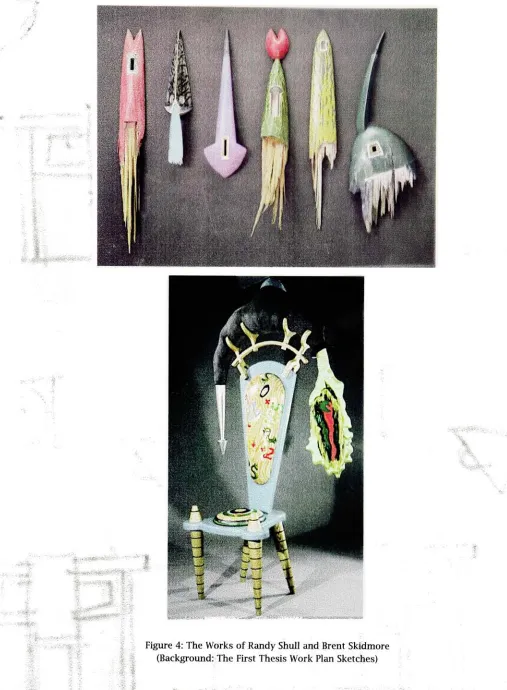
metartists
Randy
Shull
andBrent Skidmore
who wereusing
acrylic paint ontheir
furniture
pieces(Figure
4).
I
found
the
approach radicalfor
my
taste
atthattime.
Still
my
curiosity
for
surfacepainting
prompted meto explore mixed-media surface embellishment possibilities
(Figure
5).
However,
it
was notlong
before
I
realizedmy
limited
appreciationfor
the
beauty
and techniquesin
designing
with natural woods.I
had
jumped
from
creating
factory,
knock-down
furniture
to
hand-crafted
,
'
'
[image:14.552.0.545.13.686.2]*
Figure 3:SlamMaloof's Chair ArmRest
Shaping
Examples- Roughniture.
I
realizedthat
I
had
skippedthe
process oflearning
andknow
ing
the
one materialI
choseto
study
in
depth.
I
found
myselfdemateri
alizing
wood evenbefore
I
developed
an appreciationfor
wood's naturalbeauty.
I
neededto
goback
to the
fundamentals
ofwoodworking.I
wantedto
createtactile
furniture
which addressedthe relationship between
materials andforms,
the
forms
relatedto
wood.I
intend
ed
to
find
my
own stylefor creating
tactile
furniture
that couldbe beau
tiful
withoutany
surface embellishments.I
felt
thatI
could then movebeyond
the
primary issues
ofform
afterfirst
gaining
a comprehensiveappreciation
for
wood as the medium.I
wouldthen
be
preparedto
explore the parameters of
demateriahzation
asit
would thenbegin
to
define my future
work anddirections.
Reflectim
o"How
much more meaningfulit
becomes
if
one wears abit
ofhumility
that
allowshim
to
acknowledgethat
it is
truly
God
whois
the
Master Craftsman. He
uses us.Our hands
areHis
instruments."2Within
the
School for American Crafts
Woodworking
andFurniture
Design
program atRochester Institute
ofTechnology,
my
three
first
yearprojects were experiments with surface embellishments.
Technically,
painting
wasvery
forgiving.
I
was surethat
I
wantedto
continue painting
my
work untilI
had
anopportunity
to
research a well-known craftsman,
Sam
Maloof.
I
methim
athis lecture
atRhode Island
School
ofDesign.
I
found his
worksto
be very
beautiful; however,
my
responseto
his
work wasfleeting.
I
wasconcentrating
on otherdesign
techniques
atthat time
andI
was notsearching for furniture
stylesthat
would specifically influence
my
owndesign.
Four
yearslater
I
re-encountered examples of
Maloof's
work,
reproducedin
library
books.
I
wasreally
intrigued
by
Maloof's
techniques
for
shaping
wood,
handling
furniture
details,
and most ofall,
for
his
philosophy
and appreciation of wood."The distinctive
shapes and surface patterns ofSam's
furniture
are oftenderived from his
observations and appreciation ofnature,
especially
ofwood
itself.
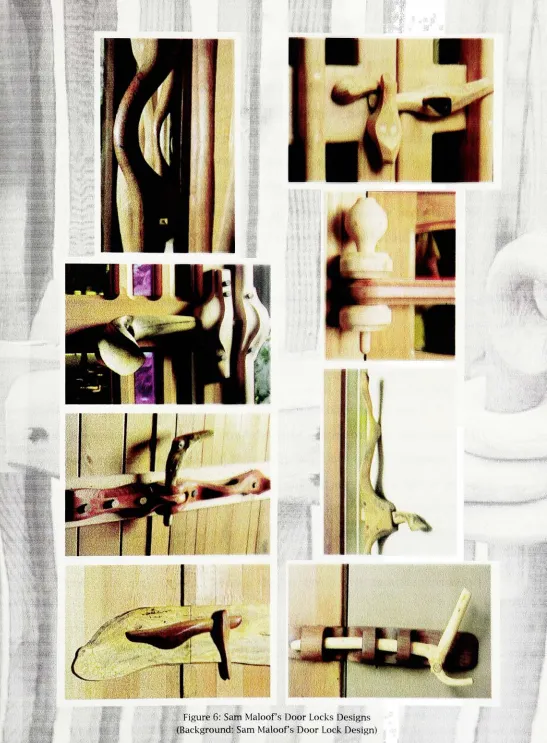
. .Maloof's
tactilequality in
his furniture details (Figure
6)
really fas
cinate me.
I
want todevelop
my
own techniques to create abetter
relationship
between
the material andtactile
forms.
Like
Maloof,
my
main2
Fairbanks,
Jonathan,"SamMaloof, Woodworker",
(New York: KodanshaInternationalLtd.),
P. 193.3
Ibid.,
P. 15."'. .:.;:
Figure6:Sam Maloof's DoOr Locks Designs {Background:Sam MaloofsDoor Lock
Design)
[image:20.552.5.552.10.753.2]focus
is
to
bring
outthe
beauty
of wooditself,
and atthe
sametime
I
want
the
woodto
be
morethan
a mediumfor furniture
that
I
build.
My
intent is
to
utilizewood asthe
primary
supportfor my design
concept.As Maloof
describes
in
his
process, I
make a nonverbalstatement4with
my
works and woodis
the
important
elementin
my
piecesthat
willlead
to that
statement.It is
alsoimportant for
my
workto
have function.
Like
Sam
Maloof,
no matterhow
sculpturalmy furniture
becomes,
if
"it
ceases
to
serve afunctional
need,
it
runsthe
risk ofbecoming
artfor
art's sake and untrue
to
its
nature."5The
conceptsfor
each pieceI
build
comesfrom
my
personal experiences and
feelings.
I
believe
that
part of
the
realmeaning
of artis
realinvolvement
withlife,
whether
it
be
the
complex statement of anovel,
hidden
beauty
revealedin
picture orsculpture,
agracefully
formed
piece of
furniture,
or a clever and effectivedoor
knob.6One
wellknown furniture
artist,
Rosanne
Somerson,
alsosuccessfully
expresses
her
own personalfeelings
through
her
work.Somerson
statesthat,
"each
time
a person sitsin
one ofmy
chairs,
eats at one ofmy
tables,
or opens one ofmy
cabinets,
I
wanthim
to
feel
that
particularpiece was made
especially
for him
to
use."7I
hope
to
help
to
generatethese
same specialfeelings
through
my furniture
to
viewersrecalling
their own experiences.
Wood is
the
materialI
wantto
utilizebecause
I
4
Fairbanks,
P. 15.5
Ibid.,
P. 15.6
Anderson,
EricA.,
andEarle,
GeorgeF.,
"DesignandAesthetics inWood",
(New York:The State
University
ofNewYork CollegeofEnvironmentalScienceandForesty),
P. 1 7.7
Fairbanks,
P. 189.believe "solid
woodis
honest
and real".8Different
materialshave
different
characteristics.When
someoneasks,
"if
the
artist makessomething
beautiful
withwood,
willit
be dif
ferent from
whathe
makes with steel orstone?"9, my
responseis clearly
yes, there
is
adifference.
The
solidity
and volumetric qualitiesin
woodautomatically
provides a chanceto
shapemy furniture
into
organicforms
when other materials cannotdo
this
as well as wood can.Wood
is
the
essence ofthe
concept andfurniture
I
design.
My
goalis
to createunique,
hand-crafted
furniture.
The
medium always makes a contribution.But
the contribution
canbe
slight,
minimal.Normally,
the
wood makesonly
a minimaldifference
in
thework ofart,
a greaterdifference
in
a work ofcraftsmanship,
and a maximaldifference
in
the
purely
confrontational situation where we attendto the
wood itself.10My
furniture
is
madeonly
withwood;
it
can notbe
produced with othermaterials without
altering
the
design,
concept,
orform.
This is
reflectedin
all ofmy
thesis pieces.Eric
Anderson
andGeorge
Earle,
two authorsof a
book
calledDesign
andAesthetics in
Wood,
said,
"The
object ofthe
artist
is
.... tomakesomething
beautiful.
Maybe
he
willdo
thisbest
by
paying
attentionto
what wood can or cannot do."11And
they
continuedsaying,
From
the
aesthetic standpoint, there
is nothing
that
can8Dr.
Wald, George,
"TheSoulofATree,
AWoodworker'sReflections",
(NewYork: KodanshaInternatinal), P. 116.9Andersonand
Earle,
P. 24. 10Ibid.,
P. 24.11
Ibid.,
P. 24.quite compare with wood.
The many
limitations
onthe
market
merely
emphasizethe
aesthetic qualities andthe
wide spread public acceptance of wood as a
beautiful
material.
It
does have
beauty;
it
has
texture,
pattern,
andcolor which cannot
be
matched else where.12Not
all artists agree with whatAnderson
andEarle
believe.
Tom
Loeser,
acontemporary furniture
maker,
challengesthis
reasoning.Loeser,
who uses artificial color and patternto
elucidatehis
shapes,
saysthat
"once
youknow
the
correctway
to
do things,
you can never goback."13
He
thinks that the
chance of oneventuring
out andinventing
one's own
kind
of systemdecreases
as onelearns
andincreases
respectfor
the traditional
way
ofdoing
things.
He
also mentionsthat
I'm
really
againstthe
preciousness of materials.Another
thing
furniture has
againstit is
that
it
takes
ahell
of along
time to
makestuff,
andthe
morehours
you putinto
apiece, the tighter
you get and theless willing
you areto
take
risks.14It is my intention
to
investigate
the possibilitiesfor
creating
contemporary
furniture
without thehelp
ofany
othermedia,
otherthan
wood.While I
respectLoeser's
views onfurniture
making,
his
approachis
onethat
I
have
experiencedin my
undergraduate work andI
nolonger find
that this
philosophy
appliesto
my
owndirections
in
wood.12 Andersonand
Earle,
P. 167.13
Clowes, Jody, "Romancing
theSurface",
AmericanCraft(August/September1994,
Vol54/
No.4),
P. 55.14
Ibid.,
P. 54.o
Each
ofmy
furniture
projectsbegin
as a significant challenge.I
found
it
difficult
to
focus first
onthe
form
andto
focus
secondly
onsurface embellishment
for
viewerinterest.
Therefore,
I
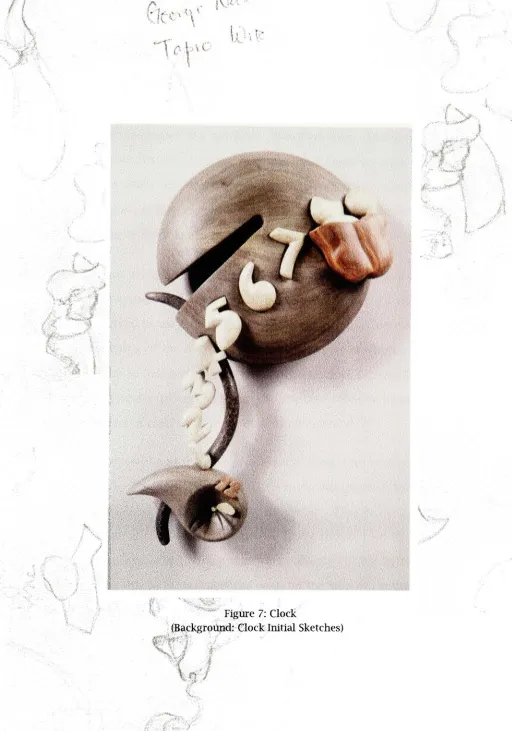
selected a clockas
my first
project(Figure
7).
I
coulddesign
avery
sculpturalclock,
providing
that there
was clock movementin
the
structure.My
clockdirect
ed
my
ideas
for my
next works.Experimental design
in shaping
andcarving
the
clockthen
influenced my
next projects.The
conceptwasto
practice all
the
shaping
techniques that
I
would usein
the vanity,
my
second project.
Consideration for
the
color and arrangement of exoticwood
choices,
chakte coc andwenge,
were criticalto the
finished
work.The
clock was a combination ofshaping
abig
roundform
in
walnut,
thelargest
part ofthe
clockin
size,
as abackground for
other,
smaller and more
intricate
parts.Delicate,
smallcherry
numbersdecreased
asthey
progressed aroundtheface
ofthis
roundwalnut,
right
to
left.
These
numbersbegin
to
appearfrom
asmall,
red chaktecoc pocketthat was
imbedded
into
the round walnut surface.A
curved,
wenge element connected this round
form
withthe
small walnut clockface.
Here
the movements were concealed.The
clockinvolved
a minimal number of traditionalwoodworking
techniques.
There
weresimple,
dowel
joints
whereevery
number overlapped
and thehalf
-lapjoints
in
each ends ofthe
wenge piece connectedthe
big
andthe
small walnutforms.
Even
thebig
walnutform
washand-shaped with
the
angle grinder and a rasp.Instead
ofturning
this
roundform
onthelathe
to
get a perfectcircle,
I
preferredto
createthe
"1
r
I
xh
,<e
i*
"ox;
,'. .'..:.
I!
.-'/:. .; I '
'"--'
Figure7: Clock
(Background:
Clock
InitialSketches)
[image:26.552.24.536.10.741.2]irregular
rounded surface shapeI
createdby
hand.
All
the
elementswere pre-cut with either
the
band
saw or scroll saw andthen
shapedwith an angle
grinder,
arasp
and sand paper.A
scroll saw was usedto
cut
the
delicate
shapeslike
numbers.Numbers
were shapedin
the
sameway,
exceptin
this
step
I
used arasp
and sand paperbecause
they
weretoo
smallto
shape withthe
big
grinder(Figure
8).
The
clockface
wasmade
in
the
sameway,
exceptbefore
shaping, I
drilled
ahole first
onthe
backside
ofthe
form
to
house
the
clock movements.Walnut,
wenge,
chaktecoc,
andcherry
areincorporated in
the
clock.
My
personalinterpretation
oftactile
furniture
is,
for
thefirst
time,
evidencedin
the
clockdesign.
There
exists aplayfulness,
in
the
delicate shaping
ofthe
numbers which expresslyrical whimsy
andplay
fulness.
This is
balanced
by
asmooth,
organic clockface
surface.The
clock
is
physically
inviting
to touch
andhandle. "Hidden
beauty
indeed
is
to
be found
in
man'singenious way
ofusing
wood."15Exotic
wood and the choice of organicform
were evidentin my
second
work, the
vanity
(Figure
9).
This
work wasinspired
by
asong
ofpraise,
entitledAs
the
Deer
pantsfor
the
Water.
This
project expressesmy
appreciationfor
God
and the peopleI
care about.I
setup
an environment expressive of
feelings
that were conveyedin
the
hymn.
I
selected
bird's
eye mapleto
interpret
the
sand on the side ofthe
river.A
deep
river ofdark
walnut wasincorporated
for
thetable top.
A
roundbowl
with a cover symbolized a rock.A
back-lit,
curly
maple mirrorsug-15 Andersonand
Earle,
P. 29.'{$:
.Figure8: Clock Detail
(Background: Clock Initial
Sketches)
gestedMoses'
burning
ambush.Two
red containers created sound asthey
were removedfrom
and replacedto their
location
in
the
vanity
(Figure
10). The
wordsfrom
the
hymn
provided me with symbolic elements.
The
audiencedoes
nothave
to
know
the
exactmeaning
for
allthe
symbolism andthe
wholestory behind
the
vanity.My
intention
wassimply
to
capturethe
feeling
expressedin
the
hymn.
I interpreted
the
lyrics
as a message ofbeauty,
intimacy, imagination,
andhappiness.
A
famous
woodworker, Rosanne
Somerson
explains a similar conceptin
aninterview in
American
Craft
magazineJanuary,
1994.
She
talked
about acouch she
designed
that
expressedher
personal experiences.She
said,
The
couchdoes
not seekto
replicate either experiencebut
instead
provides an environmentin
which others can conjure
similarfeelings
that
mightderive from
very
different
experiences.
If
someonesays,
'This
reminds me ofpara-sailing in
the
Caribbean.'I'm
notgoing
to
be
upset,
aslong
asit
giveshim
orher
away
to get tosomething
thatwas apleasantexperience.16
The
organicvanity
encourages the audience to examineit closely,
perhaps even
to touch
the piece(Figure
11).
It is
small enoughto
sug
gest
intimacy,
yetlarge
enoughto
function
well as a vanity.It is
designed
withmany
smallbowls,
adding
adistinct feature
tothe
work.If
this
vanity
wasdesigned
in
metal,
glass orstone,
notonly it
wouldbe
extremely
heavy
but
alsoit
would seemcold andimpersonal.
The
templateswere made with1/8"
masonite
from
the
full-sized
16
Frakes, Mary,
"AlphonseMattia,
RosanneSomerson",
American Craft(December1993/ January 1994,
Vol53/
No.6),
P. 43./
,,jfto
1 - Chakte
coc Containers
anity Mirror
Sketches)
f
. ... . . . .
>$f
.
...
Figure 1 1:
Vanity
-Bottom View
(Background:
Vanity
InitialSketches)
[image:32.552.16.541.35.735.2]foam
core model to routerthe
exact shapes.This vanity
neededto
be
precisely
cut sinceit
involved
many different
angles and wallhanging
hardware.
With
thesetemplates the
mirrorframes
weretraced.
The
mirror
frame had both hidden
and visible mortise andtenon
joints.
After
the
inside
frames
were cutaccurately,
the
outsides were cut roughly
for gluing
andclamping
the
frames.
Then
the
outsides were alsorouted accurately.
The
back
woodenbracket
holding
the
mirror wasscrewed
directly
ontothe
wall andthe
keyhole brass hardware
was usedto
hang
the
mirror onthe
bracket.
The
table
was stacklaminated,
although
there
was another set of mortise andtenon
joints in
the table
and
the
leg. Color
wasderived from
maple,
curly
andbird's
eyemaple,
wenge,
walnut and chakte coc.Chakte
coc was usedonly
on smalldetails,
to
accentuatethe
piece.All shaping
wasdone both before
andafter gluing.
The
coveredbowl
was an example(Figure
12). A
hole
wascut out
from
the
table surface.A roughly
carved walnutbowl
wasthen
glued underneath the
table
rightbelow
the
hole
thatwas cut out.Then
the
final
shaping
ofthebowl
wasdone.
The
sametechniques
were usedfor
the opposite end of the tablewheretwo
smallholes
were cut outfor
two
chakte coc containers andthe
stackedlaminated bird's
eye maplemember.
The differences
were atthe
leg
where one set of mortise andtenon joints
werelocated
before laminating.
This
accommodated aleg
which supported the table andnecessitated
my using
anewtool,
a powered
Dremmel
tool,
thatwas used to carvethe
small containers.The
table
was supported at threedifferent
points andlocations:
aleg,
awall,
and thewenge mirror
frame.
y
i
'''
[image:34.552.10.537.30.565.2],
Figure 12 :
Vanity
Detail 2-Bowl,
Cover,
andHandleI
enjoyed the process oftransforming
rough woodinto
a smoothform.
I
rough-cutmy
shape on aband
saw.Next,
I
laminated
walnutlayers
for
the
vanity.Then
I
began
to
shapethe
wood with a powergrinder and a rasp.
Finally
the
wood wastransformed
into
its
final
form.
Then
the
finishing
oil was applied anddarkened
the
vanity.I
dedicated
the
last
ofmy
thesis to
my
parents,
the
subject andthe title
ofthe
nextpiece,
the
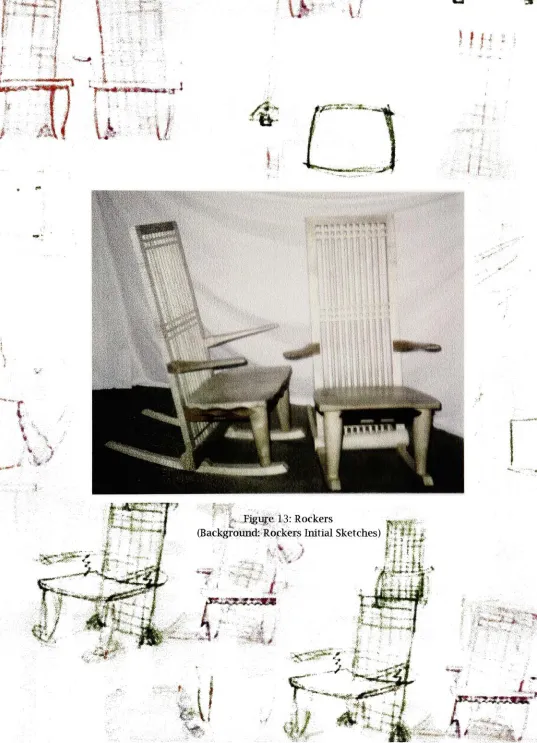
rockers(Figure
13).
I
wantto
recognizemy
mother andfather,
in
gratitudefor
their
support andlove,
andassisting
mein
my
educational pursuits.I
wantedto
approachthe
wooddifferently
withthe
rockers.I
designed
these
rockersto
have
contrastbetween
their
straight and curvelines. This
was similarto
my
textured,
wood experimentationin
the
vanity.
Juxtaposing
straight and curvedlines
wasthe
main conceptfor
the
rockers.The
straightlines
representOriental
culture and the curvessymbolize
Western
culture.Traditionally
the
rockersthemselves
symbolize
acouple,
sitting
sideby
side,
holding
hands (Figure
14).
I
addedatraditional
Korean
architecturalfeature.
The
backs
ofthe
rockerssug
gest
sliding
door
design,
emphasizing
theheritage
ofmy
parents.Only
three species of wood were used.
I
chose avery
white,
curly
maple,
along
withcherry
and walnut.This
light,
curly
maple gavemy
rockers acontemporary
appearance, unliketraditional, dark
rockers.My
selectionof
cherry
andwalnut wasintentional.
The
two rockers were sizeddiffer
ently;
oneis
little bit
smaller thanthe
otherto
distinguish
the
female
and the
male,
mother andfather,
rockers.The
use ofdifferent
woodwm^m^mmmmms
I
U
i^SSSS
"wr"
*w
'1
1
H
* lk
Figure13:Rockers
*^,(Background: Rockers Initial
Sketches)
XX',
..'!. o-j ;k ;\ fil
- *a
JX.W
'&\l
[image:36.552.2.539.6.749.2]r
If
o;:t
r-^
I...
4;1
!
:mnm
.-A
f
f:
Rockers - Front(Ball^rOund: Rockers Initial
Sketches)
***t
A
M^1***
rt
'
'?*%*ii*'
;\0;
I"i
species
helped
to
differentiate
the
rocker'sidentities.
Cherry
denoted
feminity.
The
dark
walnut gavethe
impression
ofthe
dignified,
malefigure.
This
concept workedbest
whenthese two
rockers were positioned
sideby
side,
sothat the
relationship
couldbe easily
recognized.Each
rocker wasidentified
by
human
traits.
This
wasespecially
evident
in
arm restsfor
the
rockers.They
werebent
toward
eachother,
reaching
, asif
to
hold hands.
The
smaller rocker wasdesigned
to
be
positioned
left
ofthe
larger
walnutrocker,
in
orderto
create thishumanistic
gesture.The
texture
ofcurly
maple reinforced the concept.o
It is
easierto
paint woodlike Tom Loeser
suggests.It is
very for
giving.
One
can alwaysfill
mistakes with woodfiller,
sandthe
surfacewell and paint over
it
withmany
layers.
Two
years agoI
wouldhave
totally
agreed with whathe
saidbecause
that
was whatI
wasdoing.
My
first
cabinet was not artistic.It
was nottruly
functional
or sculptural.It
was an
Industrial Design
solutionto
furniture
making
Today
in
my
woodworking,
I
find
it
important
to
usethe
full
potential of each woodselected.
I
have
just
begun
the
learning
processby building
this
newfurniture
series.Like
Loeser
mentionedearlier,
this
furniture
took
alonger
time to
executethan
my
previous paintedfurniture.
However,
I
don't
agree with Loeser'sthinking
that
people are notwilling
to take
risks
in
developing
their
own style whenthey
are caughtup in
atradi
tion
woodworking
approach.One
cansuccessfully
develop
a personalsystem and style no matter
how
much one considers wood as a preciousmaterial and
has
experiencedtraditional
woodworking."Wood
is
amaterial related
to man,
a materialthat
fills
a needin
human
consciousness . . .
"17
I
have learned
to
truly
appreciate wood.At
first
I
was nervousabout
the
idea
of notusing
surfacecover-ups,
like
dyes,
epoxy,
paints orstains.
I
alsodeveloped
a style and a systemfor
designing
my
ownfur
niture
that
couldbe
understood,
appreciated andhave
strong
aestheticqualities.
Wood
allowsmy
work tobe
unique and expressive.This is
more evident as
the
woodages,
darkens,
and wears out which arethe
17
Piatt, Alan,
"GeorgeNakashima, Letting
theWoodSpeak forItself",
(December1989,
No.79),
P.97.unique qualifications of wood
that
no other materialshave. Now I
canmore
fully
appreciateSam
Maloof,
George
Nakashima,
James
Krenov
andmany
othercontemporary
woodworkers whohave
employed traditionalwoodworking
techniques
in
their
work.Through
their
work andmy
personal
explorations,
I
have begun
to
recognizethat
wooddoes
notrequire surface embellishment as a criteria
for
creating contemporary
furniture.
Wood
has
intrinsic
qualitiesthat
givesit
substance andbeau
ty,
and wood also provides methe
full
range ofmany
other possiblilitiesfor
meto
explore.Most
importantly,
perhaps,
wood canbest
expressmy design
concepts,
simple or complex asthey
may
be.
o
Plate 2:
Vanity
- As theDeer Pants for' r r r
-1 -1 > r i r P ;
:-rrrrr
i
!
-1 -1 i i t i r -r r r ( r r -r r r f f r r -r fPlate 3: Rockers
o
Eric
A.
Anderson
andGeorge
F.
Earle,
"Design
andAesthetics in
Wood",
New York:
The
State
University
ofNew York: College
ofEnvironmental Science
andForestry,
1972.
Jim
Boesel,
"James Krenov
andFriends",
Fine Woodworking.
December
1991,
No.
91,
P.
94-96.
Jim
Boesel,
"'The
Language
ofWood'
Highlights
Woodworking
in
Finland",
Fine Woodworking.
May/
June
1989,
P.
106.
Jody
Clowes,
"Romancing
the
Surface",
American
Craft,
August/
September
1994,
Vol.
54/
No.
4,
P.
54-57,
68.
Patricia
Conway,
"Art for
Everyday",
New York: Clarkson Potter
Publishers,
1990.
Jonathan
Fairbanks,
"Sam
Maloof,
Woodworker",
New
York: Kodansha
International
Ltd.,
1983.
Mary
Frakes,
"Alphonse
Mattia,
Rosanne
Somerson",
American
Craft.
December
1993/ January
1994,
Vol.
53/
No.
6,
P.
38-40,
68.
Jongseok
Lee,
"Wood
andLacquer Art
ofKorea",
Seoul:
Yulwhadang,
1986.
Alan
Piatt,
"George
Nakashima,
Letting
theWood Speak
for
Itself",
Fine
Woodworking. December
1989,
No.
79,
P.
97-99.
Bernice
Steinbaum,
"The
Rocker",
New York: Rizzoli International
Publications,
Inc.,
1992.
Michael
Stone,
"The
Quiet Object in
Unquiet Times".
American
Craft.
February/
March
1984,
P.
39-43.
Dr.
George
Wald,
"The
Soul
ofA
Tree,
A
Woodworker's
Reflection;
George
Nakashima",
New York: Kodansha
International,
1981.