Theses Thesis/Dissertation Collections
2009
Range voting is resistant to control
Curtis Menton
Follow this and additional works at:http://scholarworks.rit.edu/theses
This Thesis is brought to you for free and open access by the Thesis/Dissertation Collections at RIT Scholar Works. It has been accepted for inclusion in Theses by an authorized administrator of RIT Scholar Works. For more information, please [email protected].
Recommended Citation
Master of Science Thesis
Curtis Menton
Rochester Institute of Technology
Golisano College of Computing and Information Science
Department of Computer Science
102 Lomb Memorial Drive
Rochester, NY 14623
USA
Signatures
Dr. Edith Hemaspaandra Date
Committee Chair
Dr. Christopher Homan Date
Reader
Dr. Ivona Bezakova Date
1 Introduction 1
2 Complexity Theory 3
3 Voting Theory 7
3.1 Elections and Voter Representation . . . 7
3.2 Condorcet’s Criterion . . . 7
3.3 Arrow’s Theorem . . . 8
3.4 Gibbard-Satterthwaite and Duggan-Schwartz Theorems . . 10
3.5 Voting Systems . . . 11
3.5.1 Scoring Protocols . . . 11
3.5.2 Condorcet Compatible . . . 13
3.6 Control . . . 14
3.7 Caveats . . . 20
3.8 Other Voting Systems and Control . . . 20
3.9 Manipulation and Bribery . . . 22
3.10 Range Voting . . . 24
3.10.1 Other Similar Voting Systems . . . 26
3.11 Normalized Range Voting . . . 27
4 Results 29 4.1 Immunity and Susceptibility . . . 29
4.2 Vulnerability Results . . . 34
4.2.1 Destructive Control by Partition of Voters . . . 34
4.3 Resistance Results . . . 36
4.3.1 Generalization of Resistance Results . . . 36
4.3.2 Results Derived From Approval . . . 37
4.3.3 Adding/Deleting Candidates . . . 38
4.3.4 Destructive Control by Partition of Voters . . . 42
4.3.5 Partition of Candidates . . . 44
4.3.6 Missing Case . . . 49
4.4 Manipulation . . . 50
4.5 Bribery . . . 50
5 Future Work 51
Social choice theory is concerned with developing and evaluating voting systems, both for the use of political and organizational elections and for use as decision making process for multiagent systems. Particularly in the context of multiagent systems, computational resistance to various types of control has become a desired property of a voting system. Though ma-nipulative actions may always be possible, strong computational barriers to efficient control can give us sufficient confidence in the integrity of an election.
Introduction
Many of the key results in voting theory show that all voting systems are flawed in some way. Arrow’s impossibility theorem states that that in any election with more than two candidates any voting system will disobey at least one of several reasonable and natural criteria [1]. The Gibbard-Satterthwaite and Duggan-Schwartz theorems show that all reasonable voting systems are susceptible to strategic voting, where a voter votes counter to their true preferences in order to achieve a better outcome [22] [27] [12]. A dishonest election organizer might always be able to subtly alter the election to achieve their desired end. Thus, much of the subse-quent study of voting systems has been directed towards finding the best compromises and most reasonable, if imperfect solutions.
The concept of election control represents cases where the authority conducting the election attempts to alter the outcome by changing the structure of the election. The study of control of elections was initiated by Bartholdi, Tovey, and Trick [3], who also introduced a novel defense against it. Even if control is possible, it may be computationally very dif-ficult to find an ideal plan. The standard tools of complexity theory can be brought to bear on the problem and help to restore confidence in elec-tion systems. In many cases, a control problem can be shown to be
hard and therefore very unlikely to be solvable in polynomial time. We may be able to accept theoretical vulnerability to control if computational difficulty would make it essentially impossible for any computationally limited attacker.
Since the initial work of Bartholdi et al. a number of voting systems have been studied with an eye towards computational resistance. Several systems have been found with a high number of resistances [13] [23] [17], although some of them are not sufficiently natural for practical use, remain vulnerable to some of the cases of control, or have other technical flaws. Thus it is still desirable to search for natural and robust voting systems with high degrees of control resistance.
Range voting is a voting system with an alternate voter preference rep-resentation that allows a voter to score their level of approval of each can-didate [28]. Though primarily lauded for its expressiveness and good be-havior with several candidates, it also has an increased degree of resis-tance to control over closely related systems. We will also introduce a variant of range voting which has the highest degree of resistance to con-trol among natural voting systems.
Complexity Theory
One of the key topics in computer science is analyzing the computational difficulty of various problems.
Though general algorithms may have a wide variety of types of out-put, in the context of complexity theory, we are concerned primarily with
decision problems, those where the output is just yes or no. Though this may seem like a severe limitation, it is not much of an issue, as most prob-lems can easily be phrased in this way. For example, instead of computing the size of the largest clique in a graph, we can ask if there is a clique of size ≥ k. Given an algorithm for that problem, the actual size could be extracted through binary search in a reasonable number of steps.
Modern computers are too complicated for mathematical analysis and so the model of choice is the Turing machine, an abstract machine consist-ing of a rewritable tape for input and memory and a finite set of defined transitions. Though Turing machines are generally more difficult to pro-gram compared to our modern computers, the model is simpler and easier to define formally our notions of algorithms, running time, and other key concepts with.
Furthermore, it is equivalent in power to any other reasonable
putational model, including modern computers and programming lan-guages. So while the important theorems and classes are formally defined in terms of Turing machines, much work can be done more informally with the use of a more a familiar computational model.
Problems are organized into complexity classes, which define their re-quirements of computation and performance characteristics. One of the simplest and most important is the class P, which contains all problems which are computable in polynomial time, or where the runtime is bounded by some polynomial on the size of the input. An algorithm would not nor-mally be considered to be very fast if it runs in time O(n100), but in
prac-tice most problems with polynomial-time algorithms are not especially high in degree, and so we frequently use this as a convenient analogue for tractability.
Also, if a problem has a polynomial-time algorithm for any reasonable Turing-equivalent computer model, there will be a polynomial algorithm for all Turing-equivalent models. This conveniently allows us to work in the more familiar territory of modern computers while achieving results that apply across all types of computers, including Turing machines. This also solidifies the usefulness of P for this analysis, as membership in P is independent of the messy details of the computation.
The class NP consists of problems that are computable on a non-deterministic Turing machine (NTM) in polynomial time. This model is equivalent to a Turing machine that is allowed to guess what path to take whenever it reaches a branch, or one that can simultaneously run a number of paths at the same time. For instance, an NTM for the max clique problem could guess for each vertex whether to try to include that vertex in the clique it is searching for. An algorithm on an NTM can be naively simulated on a deterministic TM with an exponential slowdown. However, that is not necessarily the best that can be done.
sim-ply providing an algorithm for it. Providing an lower bound is some-what more difficult. Just because no one has yet successfully designed a polynomial-time algorithm for a problem does not mean it does not exist. However the technique of problem reductions is useful for this purpose.
Formally, a problem L is many-one polynomial-time reducible to M
(written L ≤p
m M) if there is a polynomial-time function f such that for
every instancex ofL, xis a yes-instance for Lif and only if f(x)is a yes instance for M. We can then use M to solve L with only a polynomial amount of additional work for the bookkeeping. Consequently, Lcan be no harder than M. Also, it shows that we can embedLinside of M, and soM is at least as hard asL. It will be helpful to define a few more classes.
Definition 1. A languageLis NP-hard if for everyL′ ∈NP,L′ ≤p
m L
Definition 2. A languageLis NP-complete if it is NP-hard and additionally it
is in NP
The NP-complete problems are thus in a sense the hardest problems in NP, and that seems like a good goal if we want to prove a problem’s difficulty. Showing that a problem is in NP is usually easy, but showing that each problem in an infinite class can be reduced to one sounds a bit imposing. Fortunately, most of the work has been done for us. The Cook-Levin theorem, independently discovered by Stephen Cook and Leonid Levin, showed that the boolean satisfiability problem is NP-complete, and so such a problem does actually exist [9]. From this point, rather than show that every possible problem in NP can reduce to our problem, we can just reduce from one of the thousands of known NP-complete problems, a much more reasonable process.
prob-lems in computer science whether P=NP. An enormous amount of results are contingent on the way this lies.
For instance, the problem of factoring integers lies in NP and thus would have a polynomial time algorithm if P=NP. This problem is at the foundation of the RSA algorithm, a public key cryptosystems that is essen-tial for secure communication and commerce on the internet. If P=NP, this algorithm would be effectively broken, and any archived encrypted com-munications could potentially be cracked. Every time someone sends their credit card information over the internet, they are depending on P not be-ing equal to NP, whether they know it or not. If P=NP countless problems of practical significance such as image recognition, language processing, and industrial optimization would suddenly be much easier. Other scien-tific disciplines would be affected as well, as fundamental problems in eco-nomics, biology, physics, and mathematics are known to be NP-complete [19].
Voting Theory
3.1
Elections and Voter Representation
The standard model of an election is as a tupleE = (C, V)whereC is the set of candidates and V is the set of voters, each identified by their pref-erences. The voters preferences are traditionally represented as a strict or-dering of the candidates from most preferred to least preferred. This is the primary model dating back to the work of Arrow [1]. This model forces the voter’s preferences to be rational, that is, they are transitive and acyclic. Occasionally irrational voter preferences are considered, where voters ex-press preferences as a potentially cyclic relation over C [17]. Other than any sort of ranked ballot the most common voter model is a 0,1 vector over the candidates denoting approval or disapproval, most prominently used by approval voting.
3.2
Condorcet’s Criterion
The Marquis de Condorcet developed a voting system in 18th century France based around the concept of pairwise comparisons of the
dates. The idea is that the winner should be a candidate that is pairwise preferred to every other candidate in the election, with such a candidate known as the Condorcet winner. However, such a candidate will not al-ways exists. Even when voter’s preference relations are guaranteed to be rational, the combined societal preferences may be irrational and contain cycles. This is known as the “Condorcet paradox.” Still, some voting sys-tems are designed to select as the winner the Condorcet winner if it exists, and are described as “Condorcet methods” or “Condorcet compatible.”
For instance, consider the following election among candidates a, b,
andc, and with the voters shown below. # Voters Preferences
1 a > b > c
1 b > c > a
1 c > a > b
Two out of three preferatob,b toc, andctoa. Thus there is a cycle in the aggregate preference relation and this election admits no clear winner.
3.3
Arrow’s Theorem
Arrow’s theorem implies that all election systems are flawed in some way. His election model requires voter preferences be provided as strict order-ings and a voting system must generate an aggregate preference ordering of the candidates rather than just a single winner. Given an election with at least three candidates and following this model, no voting system can satisfy all of the following:
Nondictatorship No one voter always decides the election.
Citizen sovereignty All aggregate preferences are possible.
candi-date does not do any worse.
Independence of irrelevant alternatives (IIA) Aggregate preferences
be-tween two candidates should only depend on the relative prefer-ences between those two candidates. Changes to the candidate set or changes to the rankings of other candidates should not change the result of an election.
The first three criteria are reasonably straightforward but the fourth deserves a bit more explanation. IIA captures that a preference for one al-ternative over another should depend on any other alal-ternatives. Yet many voting systems violate this. For example, plurality does not satisfy IIA. Consider the following election withC={a, b, c}andV as follows.
# Voters Preferences 5 a > b > c
4 b > a > c
2 c > b > a
Here, plurality will rank the candidatesa > b > cand thusawill be the winner. Consider, however, what happens if c, the third place candidate, drops out. The voters will now be as follows.
# Voters Preferences
5 a > b
6 b > a
The aggregate preferences flip andbchanges to become the winner of the election, an arguably undesirable result.
and the process repeats. This system is used in political elections around the world. Its use is advocated in the United States by the organization FairVote under the name “instant runoff voting” [14].
Consider the following example election over the candidates{a, b, c}
# Voters Preferences 6 a > b > c
5 b > a > c
4 c > b > a
2 c > a > b
Initially, b is the first candidate eliminated. The votes of the second class of voter shift to aand awins the election. However, consider if the fourth class of voters all change their votes to rankafirst and the following election occurs instead:
# Voters Preferences 6 a > b > c
5 b > a > c
4 c > b > a
2 a > c > b
Now, c will be eliminated in the first round. The votes of the third class of voters will shift to b and b will win the election. By raising their preference fora, the voters causedato lose the election, and so STV is not monotonic.
3.4
Gibbard-Satterthwaite and Duggan-Schwartz
Theorems
with certain uses of randomness, there will always be cases where a voter will receive a more beneficial result by distorting their true preferences.
Consider the following election over candidates{a, b, c}, using the plu-rality voting system.
# Voters Preferences 5 a > b > c
4 b > c > a
2 c > b > a
Initially,a will be the winner. However, note that if the two voters of the third type instead vote as b > c > a, b will instead be the winner, a better result according to their true preferences.
3.5
Voting Systems
Whatever the preference representation, a voting system aggregates the voter preferences to determine a winner. Note that the preference repre-sentation includes much more information than many real-world ballots. However voting systems are not required to use all of the information on the ballot.
3.5.1
Scoring Protocols
A large class of voting systems qualify asscoring protocols. A scoring proto-col is a vector(α1, α2, . . . , αm)of natural numbers in non-increasing order,
# Voters Preferences 3 a > b > c
2 b > c > a
1 c > b > a
areceives 3∗3 points from the first type of voters and none from the rest for 9 total. b receives 2∗3 points from the first class, 3∗2 from the second, and2∗1from the third for 14 total. creceives none from the first voters, but then2∗2from the second and3∗1from the third for7points total. Thus the final preference ordering isb > a > c.
As a scoring protocol is a fixed-length vector, families of scoring proto-cols exists, which are sets of scoring protoproto-cols which use the same scoring technique over all sizes of elections. Many common voting systems can be represented as families of scoring protocols.
Plurality
Plurality is the most familiar real world election system. It can be repre-sented as a family of scoring protocols as(1,0, . . . ,0).
Veto
Veto is in a sense the inverse of plurality, where each voter must reject exactly one candidate. As a family of scoring protocols it is(1,1, . . . ,1,0).
k-Approval
k-approval is a family of systems where voters must select and approve ex-actlykcandidates. As a family of scoring protocols this is(1, . . . ,1
| {z } k
,0, . . . ,0
| {z } m−k
Borda
Borda count awards points in steadily decreasing order from the most pre-ferred down. It can be represented as(m−1, m−2, . . . ,1,0)as a family of scoring protocols.
3.5.2
Condorcet Compatible
Another class of voting systems follow Condorcet’s ideas by basing the election on pairwise comparisons of the candidates and meeting the Con-dorcet criteria.
Dodgson Dodgson elections were introduced by Charles Dodgson,
bet-ter known by his pen name Lewis Carrol.
The winner of the election is the candidate with the lowest Dodgson score, where the Dodgson score is the number of swaps of adjacent candi-dates in a voter’s preferences are required to make a candidate the Con-dorcet winner. Naturally, if there is a ConCon-dorcet winner, this candidate requires zero swaps and so they will win the election.
Consider the following election among candidates{a, b, c, d, e, f}. # Voters Preferences
10 a > d > b > e > c > f
10 c > a > e > b > d > f
10 b > f > c > a > d > e
This election has no Condorcet winner asa, b,andcform a cycle witha
preferred tob,bpreferred toc, andcpreferred toa. However, we can make
# Voters Preferences 10 a > d > b > e > c > f
9 c > a > e > b > d > f
1 a > c > e > b > d > f
10 b > f > c > a > d > e
The other two near-Condorcet candidates will require at least two swaps to become Condorcet winners, as the candidates d, e, f, though they are not close to winning the election, are in the way of the candidates they need to supersede.
Though this seems to be a reasonable voting system, it is actually NP-hard to calculate the Dodgson score of a candidate, severely limiting its practicality [2]. Approximation algorithms have been developed for find-ing the [8], though this does not lead to the kind of confidence we usually seek in a voting system.
Llull-Copeland Llull-Copeland voting is a Condorcet-compatible
vot-ing system with polynomial-time winner determination. The system was described by Copeland in 1951 [10], though it was recently discovered to have been first described by the 13th century mystic Ramon Llull [17] who proposed it as a method for electing figures in the church.
The system works by selecting the candidate that has the most pair-wise victories over other candidates. Variations on the system are possible by changing how many points are awarded for a tie. Clearly, this is a Condorcet-compatible system, as a Condorcet winner will have the maxi-mum number of pairwise victories possible.
3.6
Control
This involves changing either the candidate or voter sets or partitioning either into subelections. In real world political elections, this corresponds to voter fraud and voter suppression, back-room dealings with potential candidates, and gerrymandering and similar manipulations. In the con-text of multiagent systems, it is related to any efforts by a system designer or administrator to alter the results by changing the parameters of the sys-tem.
More formally, for the purposes of the complexity theoretic analysis of the control problems, we will analyze the cases of control in the form of decision problems. That is, we will define a problem where the goal is to find whether in a particular election a certain case of control can succeed in its goals.
The goal is to classify a voting system as vulnerable, resistant, or im-mune to each of the various cases of control, with these terms initially defined by Bartholdi et al. [3] and widely adopted since. It is helpful now to define these notions precisely.
Vulnerability A voting system is vulnerable to a case of control if that
action has potential to affect the result of an election, and the associated decision problem can be solved in polynomial time; that is, it is in P. This has a very good practical correspondence with real world efficiency of the problem, and thus the case of control is computationally easy.
Resistance A voting system isresistant to a case of control if that action
Immunity A voting system is immuneto a case of control if that action cannot affect the result of the election. This is obviously a desirable notion but it is generally harder to come by, and many immunities are incompat-ible with very basic and reasonable properties of voting systems [13].
The control cases of Bartholdi et al. were all constructive, that is, the control is directed towards making a distinguished candidate the win-ner. In some cases, a malicious chair could conceivably want above all to prevent a particular candidate from winning the election, regardless of who else wins. This idea was introduced by Conitzer et al. as destructive
manipulation and later by Hemaspaandra et al. in the context of control [24]. Though this may seem to be a less desirable goal, it may be feasible in some cases where constructive control is not and thus is it also worth studying.
Among the cases of control are control by adding or deleting either vot-ers or candidates. In the case of adding votvot-ers or candidates, the new par-ticipants must be chosen from a set rather than arbitrarily created. While this type of control is not necessarily thus limited, the decision problems are defined as having a limit on the number of voters or candidates that can be added or deleted. In the candidate cases, the distinguished candi-date must be in the original candicandi-date set. In the cases of destructive con-trol by deleting candidates, the distinguished candidate cannot be among those deleted as that would trivially solve the problem.
The various cases of control by partition are not quite straightforward and deserve a little explanation. In any control by partition problem, initial subelections are performed with segments of the voter and candidate sets and a final election is performed with the candidates that survive these subelections.
winner of the election.
Control by partition of candidates has two major variants. In one vari-ant,control by partition, one set of candidates is separated off from the rest for an initial subelection. Whatever candidates survive this election then rejoin the rest of the candidates for the final election with the entire voter set. In the other variant, control by run-off partition, the candidate set is partitioned into two sets and each set conducts an initial subelection. The candidates that survive each of these elections then are brought together for the final election with the entire voter set.
There is an additional variation in the tiebreaking rule that is chosen in the subelections. In the case of a tie, either all of the top scoring candidates are promoted to the final election, or none of them are. These two cases are called ties-promote and ties-eliminate. Notably, in the second case, an election can fail to elect any candidate. Though these may seem like subtle differences, many voting systems will resist one of the cases while being vulnerable to another. It is probably sufficient to skim this section and read a few definitions to get the flavor, and refer to it later to clarify a specific definition.
Control by Adding Candidates
Given An electionE = (C, V), a distinguished candidatew∈C, a spoiler
candidate setD, andk ∈N
Question (Constructive Is it possible to makewthe winner of an election
(C∪D′, V)with someD′ ⊆Dwhere|D′| ≤k?
Question (Destructive) Is it possible to makewnot the winner of an
Control by Deleting Candidates
Given An election E = (C, V), a distinguished candidate w ∈ C, and
k ∈N
Question (Constructive) Is it possible to makewthe winner of an election
(C−C′, V)with someC′ ⊆C where|C′| ≥k?
Question (Destructive) Is it possible to makewnot the winner of an
elec-tion(C−C′, V)with someC′ ⊆(C− {w})where|C′| ≤k?
Control by Adding Voters
Given An election E = (C, V), a distinguished candidates w ∈ C, an
additional voter setU, andk ∈N
Question (Constructive) Is it possible to makewthe winner of an election
(C, V ∪U′)for someU′ ⊆U where|U′| ≤k?
Question (Destructive) Is it possible to makewnot the winner of an
elec-tion(C, V ∪U′)for someU′ ⊆U where|U′| ≤k?
Control by Deleting Voters
Given An election E = (C, V), a distinguished candidates w ∈ C, and
k ∈N
Question (Constructive) Is it possible to makewthe winner of an election
(C, V −V′)for someV′ ⊆V where|V′| ≤k?
Question (Destructive) Is it possible to makewnot the winner of an
Control by Partition of Candidates
Given An electionE = (C, V)and a distinguished candidatesw∈C
Question (Constructive) Is there a partitionC1, C2 ofCsuch thatwis the
final winner of the election(D∪C2, V), whereDis the set of candi-dates surviving the initial subelection(C1, V)?
Question (Destructive) Is there a partitionC1, C2 ofC such that wis not
the final winner of the election (D ∪C2, V), where D is the set of candidates surviving the subelection(C1, V)?
Control by Runoff Partition of Candidates
Given An electionE = (C, V)and a distinguished candidatesw∈C
Question (Constructive) Is there a partitionC1, C2 ofCsuch thatwis the
final winner of the election(D1∪D2, V), whereD1andD2are the sets of surviving candidates from the subelections(C1, V)and(C2, V)?
Question (Destructive) Is there a partition C1, C2 ofC such thatw is the
final winner of the election(D1∪D2, V), whereD1andD2are the sets of surviving candidates from the subelections(C1, V)and(C2, V)?
Control by Partition of Voters
Given An electionE = (C, V)and a distinguished candidatesw∈C
Question (Constructive) Is there a partitionV1, V2 ofV such thatwis the
final winner of the election(D1∪D2, V)whereD1andD2are the sets of surviving candidates from the subelections(C, V1)and(C, V2)?
Question (Destructive) Is there a partition V1, V2 ofV such that wis not
the sets of surviving candidates from the subelections (C, V1) and
(C, V2)?
3.7
Caveats
It is important to note that hardness is a worst case notion and an NP-hard problem could still be easy in many cases, or it could be easy to find a good approximation. Recent research has shown that many NP-hard control problems are easy when voter’s preferences are arranged in the common single-peaked model [18]. Work by Friedgut et al. has shown that random manipulations of the voters in an election are reasonably likely to be effective in any reasonable election system [20]. Other research has studied the application of approximation algorithms to manipulative problems in voting systems, which can potentially find a solution within a fixed bound of the ideal solution, even if the ideal solution is out of reach [15] [7]. Therefore this work is a good first step in providing confidence in the integrity of range voting, but it is not the final word.
3.8
Other Voting Systems and Control
Most natural systems have at least a few gaps with regard to control re-sistance. Several systems have been designed and considered specifically for their high number of resistances. Hemaspaandra et al. developed a hy-brid election system that is resistant to all standard types of control [23]. Though the construction is highly unnatural, it resolved the open problem of whether it is possible for a election system to possess all of the resis-tances.
among the other candidates. Faliszewski et al. found Copeland voting to be resistant to every case of constructive control and to have a good num-ber of resistances to destructive control [17]. This was also a useful result, as it established that natural voting systems could hold at least every con-structive resistance. See table 3.1 for their results.
is to force a distinction between candidates that a voter may have honestly ranked the same. Therefore it is still desirable to continue the search for a natural system with a similar or better level of resistance.
Table 3.1: Control Results for Plurality and Copeland [17]
Control by Tie Model Plurality Copeland C D C D Adding candidates R R R V Deleting candidates R R R V Partition of Candidates TE R R R V TP R R R V Run-off Partition of Candidates TE R R R V R R R V Adding Voters V V R R Deleting Voters V V R R Partition of Voters TE V V R R TP R R R R
3.9
Manipulation and Bribery
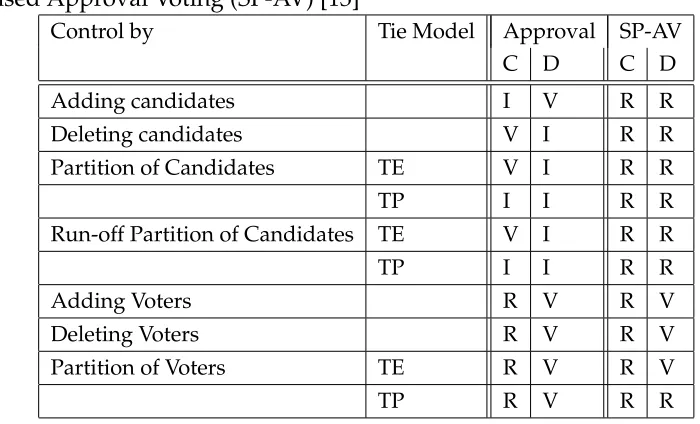
Table 3.2: Control Results for Approval and Sincere-Strategy Preference-Based Approval Voting (SP-AV) [13]
Control by Tie Model Approval SP-AV C D C D Adding candidates I V R R Deleting candidates V I R R Partition of Candidates TE V I R R TP I I R R Run-off Partition of Candidates TE V I R R TP I I R R Adding Voters R V R V Deleting Voters R V R V Partition of Voters TE R V R V TP R V R R
Manipulation
Given An electionE = (C, V), a distinguished candidate w ∈ C, and an
additional collection of manipulatorsV′with votes as yet unassigned
Question (Constructive) Is it possible assign the votes of V′ in a way to
makewthe winner of the election(C, V ∪V′)?
Question (Destructive) Is it possible assign the votes of V′ in a way to
makewnot the winner of the election(C, V ∪V′)?
Note that this differs slightly from the traditional social choice defini-tion as in the Gibbard-Satterthwaite theorem, which instead is concerned with voters who already have preferences changing their vote as to get a better outcome by these preferences. For the rest of this thesis, “manipula-tion” will refer to the computational social choice definition given above.
buy-ing the votes of some limited set of voters.
Bribery
Given An election E = (C, V), a distinguished candidate w ∈ C, and
k ∈N
Question (Constructive) Is it possible to make w the winner of the
elec-tion by changing the votes of up tok voters?
Question (Destructive) Is it possible to makewnot the winner of the
elec-tion by changing the votes of up tok voters?
Manipulation is easy in many voting systems while bribery is more frequently difficult. Bribery is usually at least as hard as manipulation for a given voting system. We can think of the bribery problem of first finding an ideal set of voters to alter, and then running the manipulation problem on them to assign their votes. However this is not always the case, and unnatural voting systems do exist where the bribery problem is easy (∈P) and the manipulation problem is hard (NP-hard) [16].
3.10
Range Voting
Range voting (RV) is a voting system with an alternate voter representa-tion that allows voters to express their degree of approval in each candi-date. We will describe ak-range election asE = (C, V)whereC is the set of candidates with|C|=m, andV is the set of voters with|V|=nand for a voterv ∈ V,v ∈(0,1, . . . , k)m. Each voter expresses their preferences by
Example The following is an example of a 2-range election of the candi-dates{a, b, c}. awill be the winner with a total of 14 points.
# Voters a b c
5 2 0 1
6 0 2 0
4 1 2 0
Though range voting is sometimes described allowing scores over a real interval such as[0,1][28], this paper will deal with the more limited integral version for its practicality of implementation and to avoid issues with the size of representation. Our primary concern is to study the dif-ficulty of decision problems relating to the system and allowing scores of unbounded size would greatly complicate that analysis. Note that any bounded size and precision real number representation would be equiva-lent to an integral representation, so this version will be just as expressive as a rational representation or any other which would be suitable for com-putational analysis.
Arrow’s theorem was formulated with the traditional voter preference models of a strict ordering. Since range voting uses a different model, it is not bound by that result and, though subject to interpretation, achieves all of the normally impossible criteria [28] [26].
To demonstrate, let us revisit the earlier example that showed violation of IIA, which is typically the hardest criteria to achieve. Let us formulate this as a 1-range election, and assume that each voter only gives any points to their top candidate.
# Voters a b c
5 1 0 0
4 0 1 0
2 0 0 1
# Voters a b
5 1 0
4 0 1
2 0 0
The cvoters are left not awarding any points to anybody, which is a perfectly legal vote, and perfectly rational, if one does feel no distinction between the candidates. Consequently the original result stands and a
remains the winner.
3.10.1
Other Similar Voting Systems
Approval Voting Approval voting is a voting system where voter
pref-erences are represented by approving or disapproving of each candidate individually [5].
Range voting can be seen as a straightforward extension of approval voting where voter’s preferences are cast over a {0, . . . , k} vector rather than a{0,1}vector. Consequently we can express an approval election as a 1-range election. This is quite useful for the purpose of analyzing the computational properties of range voting and finding problems to which it is resistant. Since approval is just a special case of range voting, any problem relating to approval which is hard will automatically be NP-hard for range voting as well.
Utility Based Voting The model utility based voting allows voters to
maxi-mum number of points that can be allocated to a given candidate. Also, in afree-formelection, voters are not required to allocate all their points. This model is flexible enough to describe such systems as plurality, approval,
n-approval, and also range voting. Ak-range election withm candidates is equivalent to a free-form utility based election allowing up tok points per candidate andmk points total for each voter.
Utilitarian Voting Range voting is part of a class of voting systems termed
utilitarian voting by Hillinger [26]. This encompasses any system that al-lows the voters to independently score each candidate according to their personal utility derived from that candidate winning. This includes ap-proval, range voting, and evaluative voting, which allows voters to score candidates as−1,0,or1. Such systems have the potential to satisfy condi-tions, such as the conditions of Arrow’s impossibility theorem, which are out of reach for any voting system with the traditional ordered ballot [26].
3.11
Normalized Range Voting
A rational voter seeking to maximize their impact in an election would al-ways give their most preferred candidate the highest score possible (k) and their least preferred candidate the lowest score possible (0). The system Normalized Range Voting (NRV) captures this and also gives the system more interesting behavior under several types of centralized control.
In this system each voter specifies their preferences as in standard range voting. However, as part of the score aggregation, the system normalizes each vote to the rational range[0, k]. Formally, for a votervand their max-imum and minmax-imum scores a and b, their each scores for a candidate is changed to k(s−b)
a−b . If a = b, a voter shows no preference among the
be-tween the candidates.
The relationship between RV and NRV is closely analogous to the re-lationship between approval voting and SP-AV. The normalization step ends up removing several cases of control immunity, but it introduces more complex behavior on alterations of the candidate set that gain back a greater number of control resistances.
Unlike RV, NRV unambiguously fails the criteria independence of ir-relevant alternatives. Consider a2-NRV election withC = {a, b, c}andV
below.
# Voters a b c
7 2 0 0
4 0 2 0
4 0 1 2
awill win this election with a score of14, with12and8for their rivals
bandc. However, consider the election with the same voters but with the candidatecremoved.
# Voters a b
7 2 0
4 0 2
4 0 1
At first, a appears to still be winning the election. However the nor-malization step will scale up the votes from the third group of voters to giveb16 points in total, makingbthe winner of the election.
Results
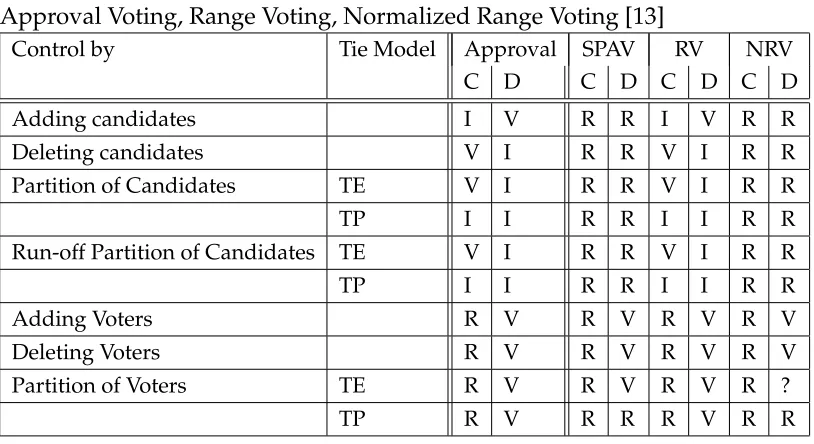
This chapter will consist of technical proofs of immunity/susceptibility as well as proofs of complexity using the standard technique of many-one problem reductions. The idea is to show that we can convert an instance of a known difficult problem into an instance of the problem under study and thus our new problem is at least as hard as one known to be difficult. Table 4.1 summaries these results as well as comparing them to the resistances possessed by approval voting and SP-AV. The results for RV and NRV are original to this thesis.
4.1
Immunity and Susceptibility
Before analyzing resistance, it is necessary to examine whether it is in fact possible to alter an election through that type of control, that is, whether the voting system issusceptibleorimmuneto that case of control.
Several of the control cases are linked in terms in susceptibility, as one may be the inverse of the other, or just a slightly more elaborate version. This simplifies the matter of achieving the full set of results as fewer cases actually have to be proved. Furthermore several susceptibility results
Table 4.1: Control Results for Approval, Sincere-Strategy Preference-Based Approval Voting, Range Voting, Normalized Range Voting [13]
Control by Tie Model Approval SPAV RV NRV C D C D C D C D Adding candidates I V R R I V R R Deleting candidates V I R R V I R R Partition of Candidates TE V I R R V I R R TP I I R R I I R R Run-off Partition of Candidates TE V I R R V I R R TP I I R R I I R R Adding Voters R V R V R V R V Deleting Voters R V R V R V R V Partition of Voters TE R V R V R V R ?
TP R V R R R V R R
low from simple properties of the voting system.
One simple property, the unique version of the Weak Axiom of Re-vealed Preference (or Unique-WARP) implies several control immunities.
Definition 3. In a voting system satisfying Unique-WARP, a unique winner
among a collection of candidates will remain the winner among any subcollection of which they are a part [3].
Any voting system obeying this property will be immune to construc-tive control by adding candidates, destrucconstruc-tive control by deleting candi-dates, and destructive control by partition or runoff partition of candidates in both tie handling models [24]
Theorem 4.1.1. RV is immune to constructive control by adding candidates,
Proof RV can easily be seen to satisfy Unique-WARP. The unique winner among a collection of candidates has the highest sum score among all the voters. In any subcollection they will still have the highest score and they will still be the winner. Thus RV achieves the immunities.
Theorem 4.1.2. RV is immune to constructive control by partition and runoff
partition in the ties-promote model.
Proof In RV, any candidate that is in first place (possibly tied) will be in
first in any subset of the candidates of which they are a part. Therefore they will survive any initial subelection in the ties-promote model. Con-sequently no candidate that is not already the unique winner can be made to be the unique winner through partition of candidates in this model.
Hemaspaandra et al. [24] defined the notion of avoicedvoting system, where an election with exactly one candidate will result in that candidate as the winner. For every voiced voting system, the following is true: it is susceptible to constructive control by deleting candidates, destructive control by adding candidates, and if it is susceptible to destructive control by partition of voters, it is susceptible to destructive control by deleting voters.
Theorem 4.1.3. RV and NRV are susceptible to constructive control by deleting
candidates, destructive control by adding candidates, constructive and destruc-tive control by partition of voters, and destrucdestruc-tive control by deleting voters.
Proof Consider the following election over the candidates{a, b, c}, either
a 2-range or 2-normalized-range election: # Voters a b c
2 2 0 0
4 1 2 0
The initial winner of this election is a. However, we can affect this election through partition of voters to makebthe winner, as follows.
# Voters a b c
1 2 0 0
4 1 2 0
# Voters a b c
1 2 0 0
3 1 0 2
bwins the first subelection andcwins the second, withbcoming ahead in the final election between the two. We have both prevented a from winning the election and madeb the winner of the election. Thus RV and NRV are susceptible to constructive and destructive control by partition of voters in either tie handling model. This, plus the fact that both of these systems are voiced, imply the other cases.
Notably, NRV does not satisfy Unique-WARP and does not posses the immunities that RV does. We can show it is in fact susceptible to these cases of control.
Theorem 4.1.4. NRV is susceptible to destructive control by deleting candidates
and constructive control by adding candidates.
Proof Consider the follow 2-normalized-range election over candidates
{a, b, c}.
# Voters a b c
7 2 0 0
4 0 2 0
4 0 1 2
The winner of the original election will bea. However, with candidate
Theorem 4.1.5. RV and NRV are susceptible constructive and destructive con-trol by adding and deleting voters.
Proof Consider the following election over{a, b}(interpreted as either a
1-range or 1-normalized-range election). # Voters a b
5 1 0
4 0 1
By deleting two or more of the first class of voter we will make a no longer the winner (destructive control by deleting voters) as well as mak-ingbthe new winner (constructive control by deleting voters). These cases imply the other two. .
Theorem 4.1.6. RV is susceptible to constructive control by partition and runoff
partition of candidates in the ties-eliminate model.
Consider the following 1-range election over{a, b, c}. # Voters a b c
1 1 0 0
2 0 1 0
2 0 0 1
Initially, this election has no unique winner, though candidatesbandc
are tied for first. However, by partitioning the candidate set into{a},{b, c}, the outcome is different. band cwill tie in their subelection and be elim-inated. If this action is interpreted as control by runoff partition, a will win their single candidate election. In either case, ais the sole remaining candidate and becomes the winner of the election.
Theorem 4.1.7. NRV is susceptible to constructive and destructive control by
partition and runoff partition of candidates in both tie handling models.
Consider the following 2-normalized-range election over candidates
# Voters a b c
7 2 0 0
4 0 2 0
4 0 1 2
The initial winner of this election isa. Partitioning the candidates into
{a},{b, c} will change the outcome of the election. If this action is inter-preted as runoff partitionawill win their initial subelection, or otherwise
{a}is the remaining set of candidates. bwill win their subelection and go on to win the final election overaafter the scores are normalized. No ties occur so this will work in either tie handling model. We both prevent a
from becoming the winner and cause b to become the winner, so NRV is susceptible to both constructive and destructive control by partition and runoff partition of candidates in both tie handling models.
4.2
Vulnerability Results
The majority of the problems to which RV and NRV are vulnerable have trivial algorithms which are only slight variations of those used for ap-proval voting, which can be seen in the work of Hemaspaandra et al [24]. The following problems are sufficiently different and interesting to merit detailed inclusion.
4.2.1
Destructive Control by Partition of Voters
Theorem 4.2.1. k-RV is vulnerable to destructive control by partition of voters
in either tie handling model, for any fixedk.
is the original winner, a partition must causewto lose to one candidate in the first partition and another candidate in the second to make them lose the election. The algorithm loops over pairs of candidates and checks if a successful partition exists for that pair of candidates.
Given an instance(C, V), w of the control problem with |C| = m and
|V| =n, first perform the initial check ifwis the winner, and if not return true immediately. Then perform the following procedure for every pair of candidates inC− {w}.
Givenwand the two other candidatesc1, c2fromC, construct a(2∗m∗ k+ 1)×(2∗m∗k+ 1)×(n+ 1)three-dimensional array, with the first two indices ranging from−2∗m∗kto2∗m∗kand with the third index ranging from 0 to n. The cell at position (x, y, z) records whether a partition of voters in V1, V2 can be made using the firstz voters (in some fixed order) such that x is the score of c1 in V1 minus the score of w in V1, and y is the score of c2 in V2 minus the score of w in V2. The cell (0,0,0) will be marked as reachable and all cells will initially be marked as unreachable. Reachable cells will also record whether this allocation came from placing the last voter inV1orV2, in order to aid in retrieving the actual allocation. A successful partition of the voters will exist causingwto lose the election if there is some reachable cell at an index (x, y, n) where x, y > 0 in the ties-promote model, orx, y ≥0in the ties-eliminate model.
The array can be filled in as follows. Given a reachable cell(x, y, z), fill in cell(x+d1, y, z+ 1)with(T,1), denoting that that cell is reachable with voterz+ 1placed inV1, whered1is the difference of the scores ofc1andw
according to voter z+ 1. Fill in cell(x, y+d2, z+ 1)with(T,2), denoting that that cell is reachable with voter z + 1 placed in V2, where d2 is the difference of the scores ofc2 andwaccording to voter z+ 1. Also, do not rewrite over the contents of a cell if it has already been marked.
work-ing backwards down the table from the cell at the top level by checkwork-ing the contents of the cell and the preferences of the appropriate voter. If a suc-cessful partition is found for any this of candidates, exit and return true. Otherwise continue through to the next pair of candidates, eventually re-turning false if no successful partition is ever found.
This algorithm will run in time O(m4k2n). Since k is a fixed constant
andmandnare polynomial in the size of the input, the algorithm runs in polynomial time. Therefore RV is vulnerable to these control problems.
4.3
Resistance Results
4.3.1
Generalization of Resistance Results
The proofs here will refer necessarily to specific RV and NRV elections with a particular scoring range k. However we want to be able to show resistance for any arbitraryk.
Theorem 4.3.1. If RV or NRV exhibits resistance to a case of control for a
par-ticular scoring rangek, it will exhibit that resistance for any rangel≥k
We can reduce an instance of a control problem for ak-range election to a l-range election for any l ≥ k by simply modifying the theoretical maximum score without changing anything else about the election. Since the bound does not affect the votes except by setting the maximum score, this will not change the election or its behavior under control.
normalized range election, all votes that rank any candidates differently are normalized to k(s−b)
a−b where a and b are the maximum and minimum
scores allotted to a candidate by that particular voter. Thus in our new
l-normalized-range election, all votes will instead be changed to l(s−b)
a−b , a
change of kl. All votes and thus all cumulative candidate scores will in-crease uniformly and whoever won the original election will win the new election as well. However, in cases of candidate control, the minimum and maximum scores for a particular voter can change as well and thus further affect the election. Consider a vote with the initial minimum and maximum scores ofaandband with new scores ofa′ andb′ after changes
to the candidate set due to control. If aand b and a′ and b′ are both
dis-tinct, this voter’s scores will change from k(s−b)
a−b to k(s−b)
a′−b′ , a factor of
a−b a′−b′.
In the new election, the voter’s scores will change from l(s−b)
a−b to l(s−b)
a′−b′. If
eithera and b ora′ and b′ are equal, that vote will be ignored in both the
originalk-normalized-range election and thel-normalized-range election. Therefore the score for any candidate from that voter will go from 0 to 0 and thus will also change at a factor of kl. Thus in every case all scores and also the aggregate scores will change at a ratio of kl and so the election will proceed in the same way.
4.3.2
Results Derived From Approval
Due to RV’s great similarity with approval voting, many results relating to approval trivially apply to RV and NRV.
Theorem 4.3.2. If approval voting is resistant to a case of control, RV and NRV
will also be resistant for any scoring range.
techni-cally include the normalization step which can modify the election, when the score range is 1, no normalization is actually performed, so again this election is equivalent to the original approval election. These results will also generalize tok-RV andk-NRV anyk ≥1as previously described.
Theorem 4.3.3. 1-RV and 1-NRV are resistant to the following cases of control
for: constructive control by adding voters, constructive control by deleting voters, and constructive control by the partition of voters in the promote and ties-eliminate models.
All of these resistances are derived from reductions from approval as described above, and the fact that approval is resistant to these cases of control [24].
4.3.3
Adding/Deleting Candidates
Theorem 4.3.4. 2-NRV is resistant to constructive and destructive control by
adding or deleting candidates.
This proof is based on a similar proof relating in SP-AV by Erd´elyi et al. [13], which itself was based on proofs relating to plurality by Bartholdi et al [3] and Hemaspaandra et al. [24].
We will reduce from an instance of the hitting set problem, defined as follows [21].
Given: A collectionS of subsets of a setB,k ∈Z+
Question: DoesB contain a hitting setB′ of sizek or less that contains at
least one element from everyS ∈ S?
• 2m(k+ 1) + 4n voters have a score of 2 forc, and a score of 0 for all other candidates.
• 3m(k+ 1) + 2k+ 1voters have a score of 2 forw, and a score of 0 for all other candidates.
• For eachb∈B, 4 voters have a score of 2 forb, a score of 1 forw, and a score of 0 for all other candidates.
• For eachSi ∈ S,2(k+ 1)voters have a score of 2 forb, for eachb ∈Si,
a score of 1 forc, and a score of 0 for all other candidates.
This will lead to scores in({c, w}, V)as follows: Candidate Score
c 8m(k+ 1) + 8n
w 6m(k+ 1) + 8n+ 4k+ 2
The candidatecwill win with a margin of2m(k+ 1)−4k−2. Additionally the scores in({c, w} ∪B, V)will be as follows:
Candidate Score
c 6m(k+ 1) + 8n
w 6m(k+ 1) + 4n+ 4k+ 2
b ∈B ≤8 + 4m(k+ 1)
Here,cwill win with a margin of4n−4k−2, which will be positive as long ask < n.
wwill be the winner of({c, w} ∪B′, V)if and only ifB′ ⊆B is a hitting
set of size≤k.
Proof (→) The candidate w loses 4 points for each b ∈ B′ chosen, of
which there are no more than k. c loses 2(k + 1) points for each Si hit.
There will bemsuch sets ifB′ is a hitting set, so they lose2m(k+ 1)points
Candidate Score
c 6m(k+ 1) + 8n
w ≥6m(k+ 1) + 8n+ 2
b∈B′ ≤8 + 4m(k+ 1)
w will end up with an advantage of at least 2 points and thereforew
will be the winner of the election.
Proof (←) NoB′ ⊆ B which is not a hitting set of size≤ k will makew
the winner by adding those candidates. IfB′is a hitting set but|B′|> k, c
will have6m(k + 1) + 8n points andw will have≤ 6m(k+ 1) + 8n. If B′
is not a hitting set cwill have ≥ 6m(k + 1) + 8n+ 2(k+ 1) points andw
will have≤6m(k+ 1) + 8n+ 2k+ 2points. In either casewwill not be the unique winner.
This construction can be used to create cases of constructive and de-structive control by adding candidates and dede-structive control by adding candidates. ((C, V),(m−k), c)is such an instance of destructive control by deleting candidates. (({c, w}, V), k, c)is an instance of destructive control by adding candidates, and(({c, w}, V), k, w)is an instance of constructive control by adding candidates.
As in Erd´elyi et al. this reduction is not sufficient to show resistance to constructive control by deleting candidates as c and w are the only can-didates with a shot at winning and deleting c will instantly make w the winner. The remaining case can be handled by the following reduction.
We will again reduce from an instance of hitting set(B,S, k).
The candidate setCwill consist ofB∪ {w}, the setBfrom the instance of hitting set together with an additional candidate.
The voter setV will be constructed as follows:
• 3 + 2mk voters have a score of 2 for wand a score of 0 for all other candidates.
• For eachS ∈ S,4k+ 1voters have a score of 2 fors for everys ∈ S, a score of 1 for each candidate inB−S, and a score of 0 forw.
• For eachS ∈ S,4k+1voters have a score of 2 forbfor everyb ∈B−S, a score of 2 forw, and a score of 1 forsfor everys ∈S
• For eachb ∈ B,2n−k voters have a score of 2 forb, a score of 1 for
w, and a score of 0 for every other candidate.
wwill be the winner of (B′ ∪ {w}, V)if and only if B′ is a hitting set
overS of size no more thank or ifB′ =∅.
Proof (→): AssumeB′is a hitting set and|B′|=kEachb∈B′will receive
12mk+ 4n−2k+ 4points. wwill receive8mk+ 6 + 4mk+ 4(n−k) + 2k= 12mk+ 4n−2k+ 6points. Thereforewwill be the winner in the election.
Proof (←): First assume B′ is a hitting set but |B′| = l > k. SinceB′ is a
hitting set, everyb ∈B′ will receive exactly12mk + 4n−2k+ 4points. w
will receive 4mk + 6 + 8mk + 4(n−l) + 2l = 12mk + 4n−2l+ 4 points.
score(b) −score(w) = −2k + 2l −2 which is non-negative since l > k. Thereforewwill lose the election.
Next consider the case where|B′| = l ≤ k butB′ is not a hitting set.
Therefore everyb∈B′ will have a score≥12nk+ 4m−2k+ 4 + 4kas they
will gain an extra4kpoints from one set of group 3 voters. wwill have the score12nk+ 4m−2l+ 6Thereforescore(b)−score(w) = 2k+ 2l−2which is non-negative andwwill again lose the election.
An instance of hitting set(B,S, k)can thus be reduced to finding whether
wcan be made the winner of(C, V)as above by deletingm−kcandidates.
4.3.4
Destructive Control by Partition of Voters
Theorem 4.3.5. 2-NRV is resistant to destructive control by partition of voters
in the ties-promote model.
We will reduce from restricted hitting set. Restricted hitting set is an NP-complete hitting set variant introduced by Hemaspaandra et al. with additional restrictions on the sizes of the sets in an instance [24]. The ver-sion as used here has a slightly stronger bound which is necessary due to the somewhat larger numbers required in this proof.
Given: A collectionS of subsets of a setB,k∈Z+, with|S|=m,|B|=n,
and the additional restriction thatm(k+ 1) + 3≤n−k
Question: DoesB contain a hitting setB′ of sizek or less that contains at
least one element from everyS ∈ S?
Given an instance of restricted hitting set (B,S, k) with |B| = n and
|S| = m, create a 2-normalized-range election withC =B ∪ {w, c}andV
as follows.
• 2m(k+ 1) + 4nvoters have a score of 2 forc, and a score of 0 for every other candidate.
• 3m(k + 1) + 2k voters have a score of 2 for w, and a score of 0 for every other candidate.
• For eachb∈B, 4 voters have a score of 2 forb, a score of 1 forw, and a score of 0 for every other candidate.
• For eachSi ∈ S,2(k+ 1)voters have a score of 2 forb, a score of 1 for
c, and a score of 0 for every other candidate.
ccan be made to lose(C, V)through partition of voters if and only if there is a hitting set of size≤koverS inB.
Proof (→) Given an appropriate hitting setB′, partition V into setsV
1, V2. Let V1 contains a voter from the final group corresponding to every b ∈ B′ and one voter from the second group (allotting just 2 points tow)
and letV2 =V −V1. After the initial subelections, we will be left withw,c,
and the candidatesB′corresponding to the hitting set, andwwill win this
election (see the reduction to adding/deleting candidates for the details of that proof).
Proof (←) If there is no hitting setB′ ∈ B of size≤ k,ccannot be made
to lose the election through partition of voters. For any actions attempting to control the election by forcing the final candidate set, see the previous reduction to adding/deleting candidates. As for other efforts concentrated at more typically partitioning the voters, among the initial candidates, c
has as high of a score as any two other candidates, so they must at least tie in at least one of the subelections and so they will always make it to the final election. The scores of the candidates in the initial election follow.
Candidate Score
c 6m(k+ 1) + 8n
w 6m(k+ 1) + 4k+ 4n
b ≤4m(k+ 1) + 10
c’s score minus the next two highest scores will therefore be at least
4.3.5
Partition of Candidates
Theorem 4.3.6. 4-NRV is resistant to constructive control by partition and
runoff partition of candidates
We will reduce from control by deletion of candidates in NRV. We will show the reduction to constructive control by run-off partition, though the other partition case quite similar.
Given anr-NRV election1 (C, V)with|C| = mand|V| =n the distin-guished candidatew ∈ C, and a deletion limitk ∈N, construct a2r-NRV election(C′, V′)as follows. C′ = C ∪ {a, b}, wherea andb are additional
auxiliary candidates. V′ will consist of the original voter setV in addition
to the following:
• For each c ∈ C, 2n voters have a score of2rfor c, a score of rfora, and a score of 0 for every other candidate.
• For eachc∈ C∗, 3nmvoters have a score of2rforcand a score of 0
for every other candidate.
• 2nmvoters have a score of2r forw, a score ofrfora, and a score of 0 for every other candidate.
• nm voters have a score of 2r forw and a score of 0 for every other candidate.
• (m−k −1)nvoters have a score of 2r for all c∈ C and a score of 0 for every other candidate.
• 2n+ 1voters have a score of2rforaand a score of 0 for every other candidate.
1Note that sincek-NRV is resistant to deletion of candidates fork≥2, this reduction
• 3n+ 3nm+ (m−k−1)n+ 2voters have a score of2rfor b and a score of 0 for every other candidate.
Lets0(c)be the score of candidatecamong the original votersV. Note for any candidates0(c)≤nr.
The following are the scores for the candidates in(C′, V′)and various
relevant subelections thereof:
(C′, V′)
Candidate Score
a 4nmr+ 4nr+ 2r
b 6nr+ 6nmr+ 2(m−k−1)nr+ 4r c∈C∗ 4nr+ 6nmr+ 2(m−k−1)nr+ 2s
0(c) w 4nr+ 6nmr+ 2(m−k−1)nr+ 2s0(w)
The winner in this case will beb.
({a, w}, V′)
Candidate Score
a 4nr+ 6nmr+ 2
w 4nr+ 6nmr+ 2(m−k−1)nr+ 2s0(w)
The winner of this election will bew.
({w} ∪D, V′)whereD⊆C∗,|D|=l
Candidate Score
c∈D 4nr+ 6nmr+ 2(m−k−1)nr+ 2s0(c) w 4nr+ 6nmr+ 2(m−k−1)nr+ 2s0(w)
({a, b} ∪D, V′)whereD⊆C∗,|D|=l
Candidate Score
a 4nr+ 6nmr+ 2(m−l)nr+ 2r b 6nr+ 6nmr+ 2(m−k−1)nr+ 4r c∈D 4nr+ 6nmr+ 2(m−k−1)nr+ 2s0(c)
In this election, a will be the winner whenever l ≤ k. Otherwise the winner will beb.
({b, w}, V′)
Candidate Score
b 6nr+ 6nmr+ 2(m−k−1)nr+ 4r w 4nr+ 6nmr+ 2(m−k−1)nr+ 2s0(w)
In this case,bis the clear winner.
({a, w} ∪D, V′)whereD⊆C∗,|D|=l
Candidate Score
c∈D 4nr+ 6nmr+ 2(m−k−1)nr+ 2s0(c) a 4nr+ 4nmr+ 2(m−l)nr+ 2
w 4nr+ 6nmr+ 2(m−k−1)nr+ 2s0(w)
The winner will again be whatever candidate is the winner over the original voter setV.
wcan be made the winner of(C, V)through deleting candidates if and only if they can be made the winner of(C′, V′)through partition or runoff
partition of candidates.
Proof (→) Supposewcan be made the winner of(C, V)through deleting
{a, b}, V′)and(C−D, V′). awill win the first subelection as shown above.
w will win the second subelection, as it must if it is capable of winning with the candidates inDdeleted. The final election will then come down towanda, and as we see above,wwill come out the victor. Alternately, in the non-runoff partition case, let the initial subelection be(D cup{a, b}, V′),
whichawill win. The final election will come down to({a, w}∪C−D, V′),
whichwwill win.
Proof (←) Suppose w can be made the winner of the election (C′, V′)
through control by runoff partition of candidates. It must be that this occurs through a partition of the form ({a.b} ∪D,{w} ∪(C∗ −D)) with
D ⊆ C∗,|D| ≤ k. b will always beatw, so they cannot face each other in
either the initial or final elections. The only candidate capable of beating
b isawhen not in an election withwand when accompanied by no more thankother candidates fromC. wmust also be able to defeat the remain-ingm−k candidates. In the final electionw will then facea and win, or in the partition case a andC −D. Consequentlyw can also be made the winner of(C, V)by deletingk candidates.
The preceding construction will shows that NRV is resistant to con-structive cases of partition of candidates. However it is not sufficient for the destructive cases, as a winning candidate in the original election(C, V)
will not actually win in(C′, V′). Therefore we will present a new
construc-tion to handle the destructive cases.
Theorem 4.3.7. 2-NRV is resistant to destructive control by partition and runoff
partition of candidates.
We can reduce the Hitting set problem to the problem of destructive control by partition of candidates. Let(B,S, k)be an instance of hitting set where B = {b1, b2, . . . , bn},S = {S1, S2, . . . , Sm}, Si ⊆ B, and k ∈ Z+, k ≤
We will construct a2-range election based on this instance. The candi-date setCwill consist ofB∪ {w}. The voter setV will be as follows.
• For eachS ∈ S,4(k+ 1)voters have a score of2for eachb∈Sand a score1forw
• For eachS ∈ S,4(k+ 1)voters have a score of2for eachb∈B, b /∈S, and a score of 0 for every other candidate.
• For eachb ∈ B, 4voters have a score of2forb, a score of 1 for each
b′ ∈B, b′ 6=b, and a score of 0 forw
• 2(k+ 1)m+ 4n−2k+ 1voters have a score2forwand a score of 0 for every other candidate.
Again, we will first consider the outcome of several forms of subelec-tions of this election.
(C, V)
Candidate Score
w 8(k+ 1)m+ 8n−4k+ 2
b∈B 8(k+ 1)m+ 4n+ 4
wwill win this election for anyk ≤n.
({w} ∪D, V),Dis a hitting set,|D|=l
Candidate Score
w 8(k+ 1)m+ 8n−4k+ 2
b∈B 8(k+ 1)m+ 8n−4l+ 4
Ifl ≤k, everyb ∈Bwill tie for first withwas the clear loser. Otherwise
({w} ∪D, V),Dis not a hitting set,|D|=l
Candidate Score
w 8(k+ 1)m+ 8n−4k+ 2 + 4(k+ 1)
b∈B 8(k+ 1)m+ 8n−4l+ 4
wwi
![Table 3.1: Control Results for Plurality and Copeland [17]](https://thumb-us.123doks.com/thumbv2/123dok_us/57189.5292/28.595.131.479.196.420/table-control-results-plurality-copeland.webp)