Rochester Institute of Technology
RIT Scholar Works
Theses Thesis/Dissertation Collections
10-1-2007
High resolution source localization in near field
sensor arrays by MVDR technique
Joseph J. Handfield
Follow this and additional works at:http://scholarworks.rit.edu/theses
This Thesis is brought to you for free and open access by the Thesis/Dissertation Collections at RIT Scholar Works. It has been accepted for inclusion Recommended Citation
HIGH RESOLUTION SOURCE LOCALIZATION IN NEAR FIELD SENSOR ARRAYS
BY MVDR TECHNIQUE
by
Joseph J. Handfield
B.S. State University of New York at Oswego
(2002)
A thesis submitted in partial fulfillment of the requirements for the degree of Master of Science in the Chester F. Carlson Center for Imaging Science
of the College of Science Rochester Institute of Technology
October 2007
Signature of the Author _________________________________________
Accepted by __________________________________________________
CHESTER F. CARLSON CENTER FOR IMAGING SCIENCE
COLLEGE OF SCIENCE
ROCHESTER INSTITUTE OF TECHNOLOGY ROCHESTER, NEW YORK
CERTIFICATE OF APPROVAL
M.S. DEGREE THESIS
The M.S. Degree Thesis of Joseph J. Handfield has been examined and approved by the
thesis committee as satisfactory for the thesis requirement for the Master of Science degree
_______________________________ Dr. Raghuveer M. Rao, Thesis Advisor
_______________________________ Dr. Navalgund A. H. K. Rao
_______________________________ Dr. John Kerekes
THESIS RELEASE PERMISSION
ROCHESTER INSTITUTE OF TECHNOLOGY COLLEGE OF SCIENCE
CHESTER F. CARLSON CENTER FOR IMAGING SCIENCE
Title of Thesis:
High Resolution Source Localization in Near-Field Sensor Arrays by MVDR Technique
I, Joseph J. Handfield, hereby grant permission to the Wallace Memorial Library of R.I.T. to reproduce my thesis in whole or in part. Any reproduction will not be for commercial use or profit.
High Resolution Source Localization in Near-Field Sensor Arrays by MVDR Technique
by
Joseph J. Handfield
Submitted to the Chester F. Carlson Center for Imaging Science
College of Science
in partial fulfillment of the requirements for the Master of Science Degree at the Rochester Institute of Technology
ABSTRACT
Research over the last decade has led to technological advances in high frequency active
and passive detection technology and signal processing. An emerging application area is
the standoff detection of concealed objects such as weapons and explosives using
penetrating electromagnetic radiation such as terahertz waves (THz). Here sensor arrays
are employed in the near field to image the concealed objects. A new approach is
investigated to improve upon methods such as Fourier inversion and sum and delay
beamforming. A method based on the Minimum Variance Distortionless Response
(MVDR) filter technique is developed to localize source points in the electric field
coming from a subject. To pinpoint near field sources with precision, this MVDR routine
To understand its limitations, this new method is tested for angular resolution in various
directions of arrival, ranges, and SNR levels. The results show that this technique has
potential to accurately detect closely spaced point sources when only a few sensors are
Acknowledgements
I would like to thank the Center for Imaging Science at Rochester Institute of Technology
for funding my studies and my stipend as a graduate student. I would also like to thank
Dr. Raghuveer M. Rao for his continued guidance, support and enthusiasm over the last
year. His advice at all points in this research process always helped me identify problems
and regain my focus and concentration when I needed it most. I also appreciate the
contributions of my committee members Dr. John Kerekes and Dr. Navalgund Rao. Their
help was instrumental toward many reader-friendly revisions of the content of this thesis.
Lastly, I would like to thank my family. Special thanks go out to my loving wife Amy,
my wonderful two year old daughter Lilian, Mom, Dad, Grandma and Grandpa Forsythe,
and Grandpa Joe Handfield. Each of them has been there for me in one way or another,
through good times and bad times alike. I would like to thank them for their continued
Contents
1 Introduction 1
2 Background 5
2.1 Fourier Inversion 6
2.2 The van Cittert-Zernike Theorem 7
2.3 The Periodogram and Correlative Interferometry 10
2.4 Capon Beamforming 13
2.5 Source Localization 15
3 Approach 19
3.1 Correlative Interferometry Method Results 19
3.2 Derivation of a Near Field MVDR Filter 23
4 Research Results 27
4.1 Experimental Setup 27
4.2 Experiment 1 31
4.3 Experiment 2 32
4.4 Experiment 3 33
4.5 Experiment 4 36
4.6 Experiment 5 38
4.7 Experiment 6 39
5 Conclusion 44
Appendix 1 – Table of Abbreviations 46
Appendix 2 – MATLAB Source Code for Correlative Interferometry 47
Appendix 3 - MATLAB Source Code for Near Field MVDR Method 54
List of Figures
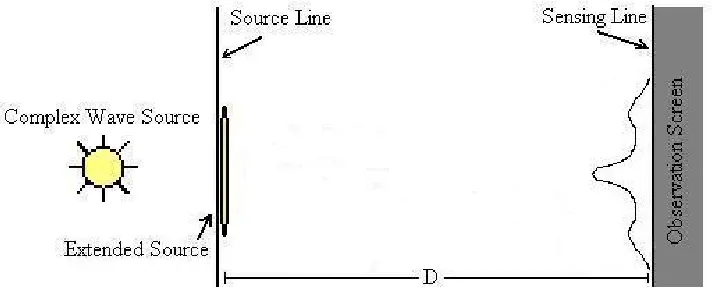
2.1 General illustration of complex source distribution upon a sensing line 5
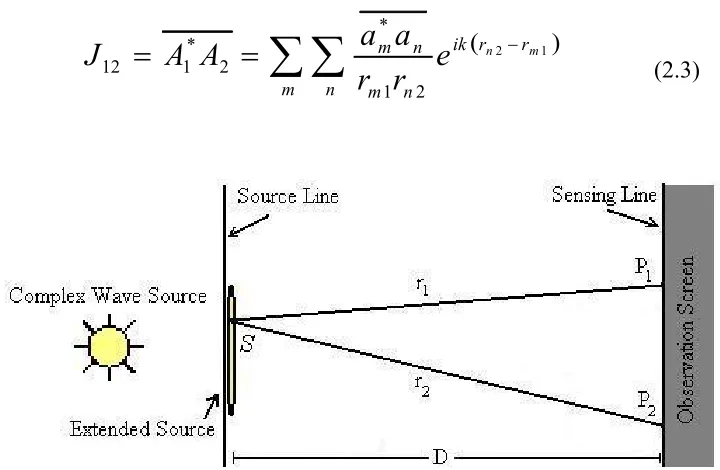
2.2 One of ‘m’ source line measurements to be used in the
degree of coherence calculation 8
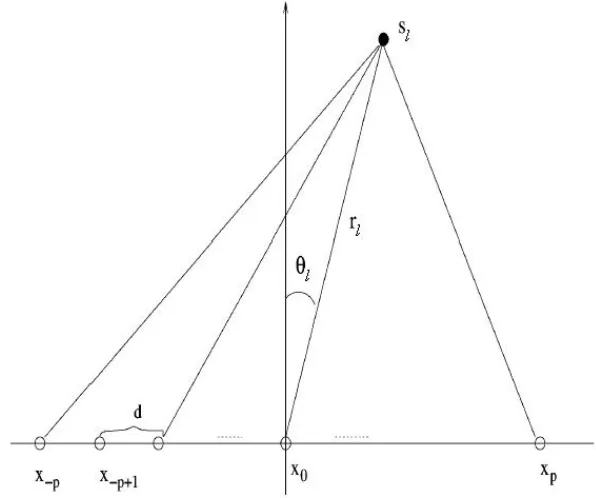
2.3 Helpful illustration for source localization with a 2p+1 sensor array 16
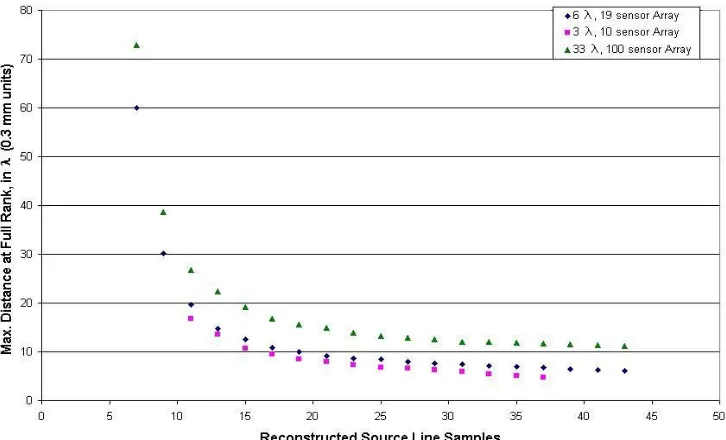
3.1 Plot of maximum source line range in for accurate resolution versus
number of source samples being reconstructed. 22
3.2 The effects of increasing the linear array width using the same
criteria as Figure 3.1 22
3.3 Geometry of a modified Capon MVDR method scan that uses
Fresnel-influenced delays 25
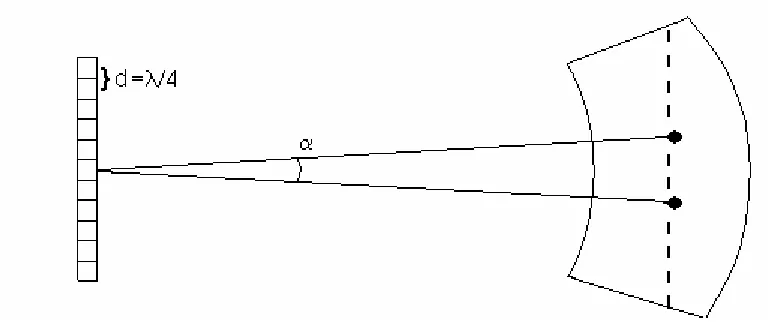
4.1 Sensor array angular resolution of a pair of point sources, noted by
the angle 29
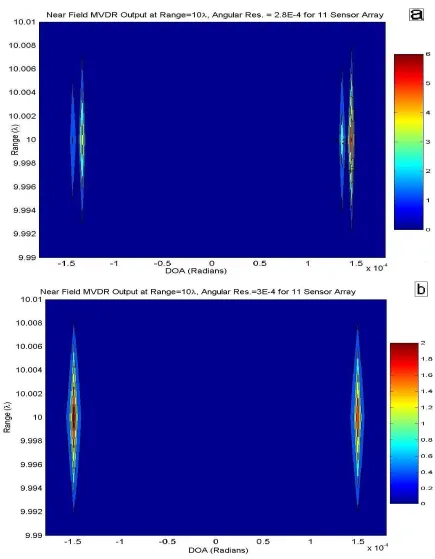
4.2 Contour Plots of Near Field MVDR with poor resolution (a) and
good resolution (b) 30
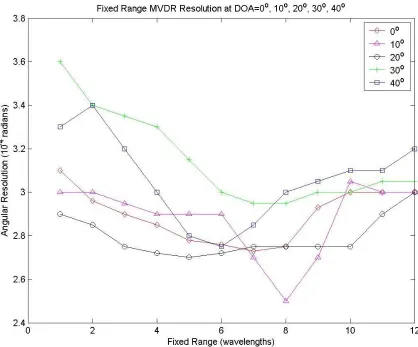
4.3 Source pair resolution for a series of DOAs, over several fixed range
distances 32
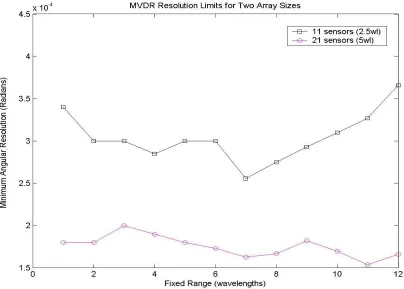
4.4 MVDR method angular resolution as a function of array length,
4.5 Minimum angular resolution vs. SNR of spectral peaks for 20
averaged records 34
4.6 Angular resolution measurement taken at 10 with 60 records 35
4.7 Angular resolution measurement taken at 1 with 60 records 36
4.8 Effect of increasing the number of records used in the ensemble average 37
4.9 Resolution of sources as the number of sensors in the array are increased 38
4.10 Geometry of the simulated sources for Experiment 6 39
4.11 Spatial frequency peaks of 7 sources from 1000 records in
Log intensity units 40
List of Tables
4.1 Resolution Comparison of ‘Delay and Sum’ and Near Field MDVR
Chapter 1
Introduction
Security imaging devices have been an area of great interest for the last few
decades, especially after an escalation in acts of terrorism involving government
buildings and airports. After the events of 9/11/01 in particular, the political and scientific
community have been aggressively searching for improvements to security screening
measures. There were needs for close range sensing devices similar to walk-through
metal detectors and stand-off detectors that could spot threats from secure distances.
Concealed Weapon Detection, abbreviated as CWD, is an area of security research that
was established to design methods that meet some of these security goals. Over a decade
ago, CWD researchers found that terahertz and millimeter wave emissions had the ability
to see through nonmetallic and nonpolar solids. Items such as clothing, leather, and
plastics that were scanned by a high frequency sensor become partially transparent when
imaged by these bands, and if metallic items are concealed, they will reflect high
frequency radiation and produce distinct shapes in processed sensor scans (Federeci et al.,
2005),(Chen et al., 2005). There is no question that the desire for heightened security
after 9/11/01 and technological advances in hardware developments and research have
spurred recent growth in CWD.
To further motivate this research, scientists have found several explosive
their absorption spectrum that will identify these bomb materials on a scanned subject.
The spectral peaks are in the range of 0.5-10 Terahertz (THz) and have been commonly
found despite the sample’s preparation: as grains, powder or mixed in a matrix or
container (Federeci et al., 2005). Similar research found that illegal drugs, such as
methamphetamine and MDMA can also be recognized by distinct gigahertz (GHz) and
THz spectra (Federeci et al., 2005).
The Pacific Northwest National Laboratory was one of the first groups to develop
a walk-through active detection millimeter wave scanner for close range CWD. Their
portal scanner uses wideband holographic imaging technology that conducts planar or
cylindrical scans within seconds (Sheen et al., 2001). The wideband frequencies of 27 –
33 GHz produced higher quality images with increased depth than narrowband CWD
scans (Sheen et al., 2001). A company called Safeview commercialized the portal
technology and has installed them in several U.S. and international security checkpoints.
Field testing is now being performed to confirm its improved reliability and efficiency
over metal detectors and other security measures (National Research Council, 2007).
The first conclusive near field results for a THz system were published in 1995 by
Hu and Nuss, using an active detection technique called Terahertz Time Domain
Spectroscopy, or THz-TDS (Hu and Nuss, 1995). This method created THz backscatter
with femtosecond laser pulses that rapidly photo-induce currents upon a THz wave
Michelson interferometer to enhance the sensitivity in images of microscopic cracks and
air bubbles that weaken materials in samples of industrial adhesives, formed plastics and
ceramics (Johnson et al., 2000). Later, Zimdars performed high definition 2D scans
within 8 minutes using hardware available at the time, but envisioned near video rates as
new sensor arrays are developed (D. Zimdars, 2005).
To develop an improved high frequency source field reconstruction algorithm,
requirements must be addressed. Since THz wavelengths are less than a millimeter in
length, any increases in the imaging aperture size to capture distant sources with the
required imaging resolution will force imaged subjects to be in the near field. For
example, if a 6 cm object was to be resolved at a frequency of 3 THz from a distance of
25 m, the aperture would need to be 4.2 cm across (Rao and Himed, 2005). This example
has requirements that do not satisfy the far field approximation, which is calculated by:
2
2d
D (1.1)
In this well-known equation variable d is the aperture width, D is the range from the
central sensor to the source, and is the source wavelength. In addition, the maximum
sensing range of some THz and millimeter wave frequencies will also be constrained due
to atmospheric attenuation. As a result of these factors, a near field imaging method is
needed and a few complications are introduced that invalidate standard far field imaging
The focus of the research work underlying this thesis was on the development of a
near field source localization method. Many areas of near field and far field imaging
analysis were reviewed in this thesis research, specifically interferometry-based methods
which contrast the incoming signal between pairs of sensors in a linear sensor array. To
understand the workings of a near field algorithm and identify where progress can be
made, a previously published least squares algorithm was constructed (Rao and Himed,
2005). An improvement over Rao & Himed’s optimization routine was then chosen from
the realm of high resolution techniques, such as multiple signal classification (sometimes
referred to by its abbreviation, MUSIC) and Auto Regressive methods. Finally, a
minimum variance distortionless response (MVDR) beamformer method was chosen and
modified to use near-field assumptions. This method was derived from recently published
work in source localization and the Capon method. Several experiments were then
simulated to test the new method’s resolution, noise performance, and efficiency when
compared to a simpler Delay and Sum beamformer. The next chapter will provide an
overview of several radiative point source measurement methods and their influences on
Chapter 2
Background
In imaging systems, the reconstruction of a source distribution using conventional
sensing hardware is an intricate process. To clarify the principles of source reconstruction
imaging, an example of a complex source incident upon an observation screen is shown
in Figure 2.1. When a diffraction pattern is measured along the sensing line, these
methods convert its spatial frequencies into a source distribution estimate. Many imaging
methods also simplify the reconstruction for far and near field systems by reconstructing
a planar projection of the source distribution, called an ‘extended source’. This approach
can resolve distant far field objects and also reduce the complexity of items with uneven
near field source distributions. To approach the thesis problem, a literature search was
conducted into published work that dealt with these specific source distribution
[image:17.612.145.501.513.657.2]reconstruction issues. These areas of interest are discussed in this chapter.
2.1 Fourier Inversion
In linear shift-invariant imaging systems, the inverse Fourier transform of the
far-field correlation is a common method of source distribution reconstruction. Fourier
transforms of far field source illumination can reconstruct the spectrum well with
standard linear sensor arrays due to the flat planar nature of far field wavefronts.
Unfortunately, near-field imaging systems have nonlinear wavefronts so it is difficult to
produce images without spherical aberrations. Walsh et al researched near field scanning
methods for THz sources that used Fourier inversion techniques and found that spatial
modifications were required to transform spherical wavefronts without distortion (Walsh
et al., 2004). Fourier methods can commonly produce side lobe artifacts and other noise
in the frequency plane that can only be diminished by gathering enough spatial data
points on the imaged aperture plane to adequately cover the resulting frequency space.
Walsh et al. first suggested transform enhancement strategies such as adding to the
number of sensor elements or rotating smaller arrays and then taking multiple
measurements to cover the Fourier space well (Walsh et al., 2004). Walsh et al. finally
improved the spatial intensity distribution from the interferogram by positioning sensors
along curves that match the wavefront’s shape. Their simulation results showed that
sensors placed along a meniscus that matches a spherical surface works best at modeling
the wavefront (Walsh et al., 2004). This can prove to be problematic, since specialized
sizes would require repositioning of the sensors along to avoid distortion. It is also
uncertain how time consuming this method would be in achieving high resolution.
2.2 The van Cittert-Zernike Theorem
When examining the radiation from a complex source field, interferometry is an
effective tool for increasing imaging sensitivity spatially. Spatial coherence in particular
is important to this research because it allows one to measure a complex wavefront’s
shape from the interferogram that a set of radiating sources produces on an observation
plane (Hecht 1998). Initial experiments in this field found that source distributions could
exhibit some measurable interference while the frequency of the illumination was not
100% coherent. As a result, the term partial coherence was used to classify these
situations. In 1938, the van Cittert–Zernike theorem was devised to measure the ‘degree
of coherence’ that two random points in the interferogram have by correlating the
composite source field measured at each point. To do this discretely, one must model the
source field intensities on an extended projection line that lies parallel to the
interferogram, as mentioned in the introduction of this chapter. The projection line,
labeled as source line in Figure 2.1, can be subdivided into several finite elements of
extended sources regardless of their actual position in being in the near field or far field.
r
e
jwt ikra
2
k
where
(2.1)In equation 2.1, is the angular frequency in radians, t is the elapsed time in seconds, r is
the sensing distance from the element, and ‘a’ is a complex random variable that
indicates the wavefront’s initial amplitude and phase at point P1 (Zernike, 1990). The
overall wave amplitude, or intensity, of m electric field measurements upon point P1 is
m
ikr m
m
e
mr
a
1 1 1A
(2.2)To find the ‘likeness’ of the measured wavefront at two separate sensing positionsP1 and
P2, as depicted in Figure 2.2, the degree of coherence can be used. Zernike called this
expression the ‘mutual intensity’:
m n r r ik n m nm
e
n mr
r
a
a
A
A
J
2 1 [image:20.612.141.501.430.665.2]2 1 * 2 * 1 12 (2.3)
The bar above the amplitudes in (2.3) indicates the use of their statistical mean amplitude
value. Since waves from an illumination source have numerous statistically independent
points of origin, they are also spatially uncorrelated (Zernike, 1990).J12then becomes:
(2.4)
To calculate the theoretical mutual intensity along the source line, an integral over the
extended source is needed (Zernike, 1990). If the position of S in Figure 2.2 was moved
across the extended source, the integration variables are the displacements from points P1
and P2, noted as x1 and x2respectively. The resulting diagonal distances from P1 and P2 to
S can then be denoted as rx1 and rx2, thus making the theoretical mutual intensity:
1 22 1
2 1
12 2 1
)
(
)
(
1
dx
dx
e
r
r
x
a
x
a
J
ik rX rXX X
(2.5)By means of the coherence method, one can construct distinct intensities of the
interferogram for any composite source field. When P1 and P2 are close together and the
extended source is small when compared to the distance to the observation plane, the
degree of coherence equals the normalized Fourier transform of the irradiance
distribution across the source (Hecht, 1998). The areas of near field optical coherence
tomography and visible band coherence imaging methods have already benefited from
n
m
when
a
a
m n
0
m r r ik m m mm
e
m mr
r
a
a
J
2 1this relationship (Marks et al., 1999). Correlative interferometry, also referred to as
sensor interferometry, uses the mutual intensities for all unique pairs of a certain detector
or antenna geometry to produce a spectrum. This is a common technique in other areas of
research such as radio astronomy (Cohen, 1973). A correlative interferometry source
reconstruction method for a uniform linear array signal is analyzed in the next section.
2.3 The Periodogram and Correlative Interferometry
In the search for desirable spatial domain alternatives to the problematic Fourier
inversion process, the well established methods of spectral estimation emerged. In order
to compute a spectral estimate of an input waveform, the waveform must be sampled
over a finite time window as a time function (Kay and Marple, 1981). An ideal spectral
estimation technique called the ‘periodogram’ is a fast Fourier transform estimate that has
been used in the past to discretely calculate the power spectral density, or spectrum, of
incoming signals. To construct the periodogram, a waveform x(t) can be measured at N
samples per period using summation variable ‘n’. For each sampled frequency, as noted
by ‘m’, the periodogram is calculated as follows:
Kay and Marple indicated that care must be taken in computing the spectrum due to the
need to preserve its statistical consistency. Since actual data has random initial phases
and some random additive noise over a time interval, the expectation operation needs to
be achieved on the sample waveforms by producing correct time averages or ensemble
averages (Kay and Marple, 1981). The ideas behind the periodogram can then be applied
to a time-sampled spatial correlation estimate. For example, the spatial correlation of two
source points can be formed from a slightly modified version of the degree of coherence
equation (2.4) as follows:
(2.7)
1
)
,
(
2 22 0 1 21 0 2 12 0 1 11 0 22 2 21 1 1 0 12 2 11 1 2 1
j N nT c r j j N nT c r j N n j c r N nT j j c r N nT je
r
x
a
e
r
x
a
e
r
x
a
e
r
x
a
N
y
y
R
Equation (2.7) calculates the autocorrelation of the sensed field over a linear sensor array.
In the calculation, there are N time samples over a period T, and the angular temporal
frequency ωo= 2/T. Since the two source waveforms coming into sensor 1 and 2 have a
different incident random phase, 1 and 2 are shown outside the complex amplitudes.
The source radii, denoted by r in the equation, are given subscripts to indicate the
measuring sensor and secondly the source point to which the radii connects, since each
will differ significantly in near field analysis. As more source points are added along the
Since the autocorrelation of a source distribution from several sensing positions
cannot reconstruct an extended source alone, one solution involved the use of an
optimization framework. Rao and Himed theorized a least squares solution that
reconstructed a projected source distribution as several discrete samples along the source
line. The minimum mean squared error between the spatial correlation estimate and the
following computed correlation produced their result (Rao and Himed, 2005).
2.82 1 1
, 2 2
2 D x e x f where D y f x f y x g D x j
In (2.8), x and y are angular displacement distances from a sensor to a source line sample,
and D is the distance that a sensor array is separated from a parallel source line, similar to
the illustration in Figure 2.2. To fit the least squares analysis, the computed correlation
was reformed into a N2 by k matrix, where k is the number of finite source line samples,
and the spatial correlation as a N2long column vector. The least squares equation is then:
,
,
2.9ˆ ) min( 1 2 1 1
N m N n k n k m M k k n mk R y y I g y x y x
I
The least squares solution vector Ik is the intensities along the source line at evenly
spaced source line positions (xk) in the sensor array’s field of view. To produce realistic
solutions, the least squares method is then computationally limited to being nonnegative
2.4 Capon Beamforming
After using correlation-dependent equations to measure the simulated electric
fields in this thesis work, more detail about the near-field signals is desirable. The best
way to quantitatively examine the location and intensity of near-field sources is by
employing spectrum analysis techniques. In spectrum analysis, the spatial sensor data is
transformed into a spectrum of its frequency components. These components have
significant traits in their magnitudes, phases and characteristic frequencies that can be
used to identify the sources that are being imaged. When significant source distribution
data is known, such as the field of view that they reside in, their approximate range, and
their peak spectral frequencies, high resolution techniques can be used.
High resolution techniques can consist of many different formulations, but they
all generate a spectral estimate of the gathered source data and improve the resolution and
detectability by way of filtering, statistical data, or other means. Beamforming methods
are generally known as FIR filtering techniques which use multiple frequency steering
vectors to align the signal with a certain azimuth angle, commonly called the direction of
arrival (DOA). The steering vector is an array of bandpass filters that boosts the
frequencies relative to a desired DOA. Nikias and Mendel remarked that Capon’s
beamformer was ‘one of the most popular and important beamformers’ and it ‘has been
the starting point for both signal enhancement and high-resolution DOA estimation’
To use Capon’s method, a spatial correlation estimate must be calculated to
optimize this filter. Assume matrix Ris an N x N spatial correlation of the detected field:
x xH
E
R (2.10)
where superscript H distinguishes the use of the Hermetian, or complex transpose of the
far field signal vectorx. The Capon method then evaluates a set of spectra from the signal
vector that are the result of a criterion being met (Stoica and Moses, 1997):
min hHRh subject to ha
1 (2.11)In (11), the steering vector a() is a series of phase delays made for a sensor spacing d:
1
e
e
2e
where
2
d
sin
a
j j
jm T
(2.12)
The Power Spectral Density, or PSD, of the Capon method has been used in several
journal articles to solve the optimization problem (2.11). The PSD is denoted by PCapon
below. A particular solution to (2.11) involves applying a finite impulse response (FIR)
distortionless filterhto a sample signal vector x to form XCaponas shown below:
P
aH
R1a
1Capon (2.13)
R
a
P
X
x
h
h
HCapon
Capon
1(2.14)
When using standard Capon beamforming, the filter selects weights that minimize the
interest (Jiang et al., 2003). By consistently incrementing the value of in the steering
vector array, filter responses as shown by either equation (2.13) or (2.14) can be plotted
and assessed for a series of DOA angles in the field of view. If any steering method like
this is used, very specific and detailed information is needed to construct an effective
array steering vector. Source steering angles, array geometry, and receiver responses
affect the accuracy of steering vectors, so a sufficient knowledge of incident radiation is
critical to the Capon MVDR process (Nikias and Mendel, 1993).
This method has also been called the minimum variance distortionless response
(MVDR) beamformer because it can perform well at identifying many signal component
peaks by minimizing the variance in the solution weights, producing suitable results with
signals traveling at any speed that may have good or poor SNR. It was first used by
Capon to spectrally pinpoint centers of activity from seismic sensor data taken by the
large aperture seismic array, or LASA, in eastern Montana (Capon, 1969). He went on to
show that the optimizing ability of the frequency windows used outperformed traditional
methods and pointed out the potential use of the method in radio astronomy.
2.4 Source Localization
Similar to MVDR, source localization methods attempt to identify the origination
of complex field sources from the recorded sensor array signals. These methods have
and robotics in the past (Grosicki et al., 2005). To measure the field along a 2p+1 sensor
[image:28.612.173.471.177.426.2]ULA as a function of time in near-field, consider the geometry in Figure 2.3.
Figure 2.3 – Helpful illustration for source localization with a 2p+1 sensor array
Using the illustration, the field at array indexes –p ≤ k ≤ p is (Grosicki et al., 2005):
(2.15)
where sl(t) represents the lth source signal of m additive sources and wk(t) is a zero mean
complex Gaussian random noise matrix. For a unique solution, Grosicki also assumes that
mp, and that τkl is the source signal delay between the central sensor ‘0’ and sensor k:
2 1 2 sin 1
2 l l l l kl r kd r kd r (2.16)
t s
t e w
tx kl k
j m
l l
k
1
rl and θl are the range and angle parameters of source l, and d is the sensor separation
along the array. Since the delay term is difficult to resolve as the square root of a
quadratic polynomial, a Fresnel approximation of the field’s phase delay across the
sensors was suggested (Grosicki et al., 2005). The approximation below can replace τkl
with a second order Taylor expansion, allowing efficient localization by several methods.
t
s
t
e
w
t
x
k k k j m l lk
2 1 (2.17)
2.18
cossin
2 2 2
l l l r d and d where
Grosicki et al. suggested solving for the possible binomial exponents of each individual
field source by isolating coefficients of the spatial correlation that would allow solutions
for each of the quadratic terms. Two solution approaches were proposed: use a
subspace-based high resolution estimate, or proceed as the authors did by applying a weighted
linear prediction criterion using a polynomial filter (Grosicki et al., 2005). This filter
isolates coefficients from the correlation matrix that can be used to derive the unknown
sources in the signal. The successful use of a Fresnel approximation to describe a random
source field proved a Taylor expansion to be ideal for near field scanning technology,
thereby inspiring the approach of this thesis.
Source localization techniques have been used to identify data in speech
recognition, communication, radar, and sonar research (Grosicki et al., 2005). These
(Vaidyanathan and Buckley, 1995). Research in near field source localization has
previously benefited by merging aspects beamforming and steering methods together,
showing potential for pairing the methods in this research. Chen et al. performed
wideband near field source localization by initially transforming some sample wideband
signal data into the frequency domain and separating it into several narrowband
frequency bins. They then used a Capon-influenced maximum likelihood criterion on
each binned signal to localize the sources (Chen et al., 2002). The paper indicated that
this work was based on sensing complex near field acoustic or seismic wave sources.
Another research paper (Arceo-Olague et al., 2006) went into detail about efficiency in a
near field DOA estimation method called the unconditional maximum likelihood (UML)
approach. Their improvement on MVDR and similar techniques involved minimizing a
negative log-likelihood function to create the maximum likelihood of the signal. Their
UML estimation function outperformed a MUSIC algorithm in root mean square error
(RMSE) analysis of angular separation estimation along the range of 5 - 11, when
averaging 1000 samples (Arceo-Olague, 2006). The MUSIC algorithm had much higher
RMSE and wider range, for example, when a signal with SNR=11dB was used, it
resulted in a 25 error for 5 of separation, to 0.25 error at 11 separation, and SNR
values of 9dB-0dB performed worse. The UML function achieved a RMSE range of
0.41 - 0.22 for the same angular separations when SNR values of 11dB – 0dB were
plotted. When the algorithms were reused with 500 samples, similar behavior was noticed
Chapter 3
Approach
The goals of this research were to develop a technique for near field source
localization that could be used in terahertz or millimeter wave security scanning, and to
evaluate its strengths and limitations. To understand the needs of such a system, a
correlative interferometry algorithm was generated from a previously published paper
(Rao and Himed, 2005). The resulting program provided insight into the reconstruction of
source distributions from their incident radiation without the use of Fourier Transform
techniques. The performance of the Rao-Himed routine’s simulations then pointed out
efficient and sub-par imaging algorithm qualities. These developments and a desire to
enhance the sensing ability of near field sources inspired the high resolution technique
approach of this thesis. As a result of this progressive research, a superior source
distribution analysis method was derived that merged the MVDR method and Source
Localization, as shown in the following sections.
3.1 Correlative Interferometry Method Results
In the background section of this thesis, equations 2.7 through 2.9 showed in
detail how an accurate 1D reconstruction of a simulated source field can be produced
requires several parameters: the distance between source line and center sensor (D), the
number of sensors (N) and sensor element width, the number of finite source
reconstruction points (k), the placement of example field points on the source line (xk),
the signal-to-noise ratio (SNR), and the input frequency. Once the sensor size and the
desired source line reconstruction points are listed by the user, the program can then
simulate the spatial correlation as an ensemble average of several sample records, and the
computed correlation (2.8) for all source points. As a result of the calculations, resolution
accuracy of an optimized reconstruction can only be possible if the computed correlation
matrix is full rank. Here, the rank of a matrix is the number of linearly independent rows
or columns it has, and full rank certifies that the rank is equal to the shortest dimension of
the matrix. To test the Rao-Himed method while ensuring accuracy in spatial
reconstructions, its factors were tested while using a full rank correlation matrix.
Several sets of narrowband test source simulations at a frequency of 1 THz were
then used to verify the algorithm’s source line signal reconstruction accuracy. These
simulation inputs consisted of a source point pair with unit amplitude that was separated
along the source line by several wavelengths. The reconstruction points selected for these
input signals then occupy a field of view that reaches beyond the source point positions.
In this way, accurate reconstruction of the source point pair can be verified while other
sample reconstruction points around the source points remain zero.
This resolution accuracy technique was first applied to variations in sensor
method had a maximum range limitation for each number of samples taken, where
surpassing the range degraded the reconstruction and correlation matrix rank. As the
number of reconstruction samples was increased, the max range decreased exponentially.
Also, the maximum range required for resolution accuracy of a 6λ wide array did not
change significantly as sensor elements were decreased to smaller than ⅓ λ.
A second test observed the range limitation of a 6λ wide 19 sensor array as an
effect of the sampling distance intervals. Initial simulations that sampled the source line
reconstruction at increments of less than λ shortened the maximum range for accurate
sample resolution significantly. An exponential increase in the number of ensemble
average records was also needed to minimize reconstruction mean square errors below
10% in these simulations, suggesting that sampling point sources at under λ intervals is
not practical for this method. Finally, a separated source point pair was simulated for
increasing amounts of samples and decreasing maximum range, as mentioned in the
previous paragraph. The reconstruction samples were taken in intervals of λ and 2λ. The
2λ intervals produced a 50% larger maximum range, as shown in Figure 3.1, while
maintaining accurate reconstruction resolution.
A third test simulation was then devised to identify the change in the maximum
range limitation as the sensor array width was varied from 10 sensors (3λ) to 19 sensors
(6λ). This resulted in an average accurate resolution range increase of 21%. To enhance
the possible accurate resolutionrange of the 6λ array by 50%, similar to the results in 3.1,
Figure 3.1 - Plot of maximum source line range in for accurate resolution versus number of source samples being reconstructed. The data sets show results of doubling the separation between samples.
[image:34.612.144.507.437.657.2]Further results concluded a few performance issues with the least squares method,
particularly that hundreds sample measurements are needed to create an accurate
ensemble average of distributions with more than two separated sources. A much larger
sensor array is also needed in order to get quality imaging scans by this method alone.
The implementation of this method allowed insight toward desirable characteristics in a
near field imaging method, such as variability in range and the field of view, and quality
resolution. The attempt of this thesis approach is to improve these factors measurably.
3.2 Derivation of a Near Field MVDR Filter
A better understanding of the near field imaging methods and high resolution
spectral estimation methods was required to improve results. Standard Capon
beamforming, as discussed earlier, is strictly for far field signals because the wavefronts
are assumed to be planar in equations (2.10) through (2.14). To consider a Capon-type
method’s potential in the near field required localizing waves with curved wavefronts,
using phase delays that are a function of both range and DOA. This can be achieved by
creating steering vectors with a Fresnel phase delay. The equation for a near field steering
vector shown below was borrowed from an earlier mentioned research paper on
unconditional maximum likelihood estimation (Arceo-Olague, 2006). The delay terms in
the vector can be constructed using the Taylor expansion shown in (2.17) and the
definitions of ω and from (2.18). If the sensors in the interferometric array are indexed
j
p p
j j j
p p
ll
r
e
e
e
e
a
2 2 1
,
(3.1)l l l r d and d where
2 sin 2 cos2
Using this innovative steering vector, the Capon MVDR method can then be revamped as
a function of two parameters, as shown in this modified derivation
,
1min , H ,r ,r l l
r Rh subject to h a r
h (3.2)
1
1,
,
H l l l l
Capon a r R a r
P (3.3)
rH Capon Capon
l l
r
R
a
r
P
X
x
h
h
1 ,,
,
(3.4)The power spectral density, calculated by equation (3.3), can be used as a general
solution to localize a near field source distribution, or equation (3.4) can be used to
produce the output of an MVDR filter and a certain signal of interest, XCapon. Equations
(3.1) through (3.4) are functions of the angle θl which can be replaced by a series of
distinct DOA values in a predetermined aperture or field of view. The range rl in the
term can then be incremented over several MVDR iterations to perceive depth of the
sources that impinge on the detecting array from significant DOA. The resulting filter
responses give the user a set of spectral intensities for all (rl ,θl) pairs in the field of view
of the sensor array, as illustrated in Figure 3.3. Depending on the desired sampling rate of
rl andθl, and the ideal field of view size needed for certain targets, the scanned area can
Figure 3.3 – Geometry of a modified Capon MVDR method scan that uses Fresnel-influenced delays
To model actual fields that would impinge on a sensor array, equations (2.17) and
(2.18) are used to create a test signal. Time averaging at a user defined sampling interval
is then needed to treat the signal vector as a function of time, as shown in the
periodogram spectral estimator. The following equation simulates an actual signal record:
t
s
e
e
e
W
t
X
T j kt n j m
l
k k j
l l
2
1
2
(3.5)
The signal record in (3.5) is obtained over 2p+1 sensors where k is the sensor position
within –p≤ k≤ p. The second exponential term ensures that the signal is measured atT/t
samples per period. The algorithm will calculate this in matrix fashion, and ensure that
random Gaussian noise matrix Wk(t) is the same size as the number of sensors -by- the
correlation with limited accuracy, the equivalent to the use of the expectation operator on
a correlation estimate is needed. This can be achieved by ensemble averaging several
signal record samples with random incident phases applied to each simulated source. To
calculate the correlation of one random phase record using a signal record as shown in
(3.5), the following matrix product is needed:
H
X
X
T
t
R
ˆ
(3.6)Equation (3.6) will perform a time average as the signal matrix is spatially autocorrelated,
since t/T is the inverse of the number of time samples. When a desired number of
random phased signal records is obtained using (3.5), a correlation estimate can be
obtained by averaging the correlations from each record. As the number of records used
is increased to achieve similar results to an expectation, the resolution of the MVDR
method is expected to increase. Once a correlation of desired accuracy is computed, the
algorithm requires several inputs:
DOA, to establish the center of the field of view if larger DOA values are required
The perpendicular distance from the sensor to source line (minimum range)
o The range can be incremented smaller or larger as needed in the algorithm
if the range sampling is not sufficient for peak detection in previous runs.
The width of the field of view, which then passes the minimum and maximum
The SNR of simulated noise for the test signal, if needed
The distance increment to be used when subdividing the field of view
To decode the detected field into individual source field points, equation (3.1) can be
used to compute a steering vector for every unique (rl , θl) pair that can then produce
output spectra for each vector used. Each steering vector is then combined with the
spatial correlation of the detected field using equations (2.13) and (2.14) to produce
spectra. The spectra are collected in a ‘Range-DOA-space’ matrix. Automatic detection
techniques or having a technician examine a 3-dimensional mesh plot of the complete
matrix can then be used to identify signal component peaks.
The idea of using a superresolution technique to scan across a target plane can be
found in some Synthetic Aperture Imaging work as well. Benitz developed a technique
called High-Definition Vector Imaging (HDVI) which scanned a plane across the ground
using range and cross-range axes. Using techniques based on Capon’s method and
MUSIC, he identified distant trucks and other vehicles in a forested area from overhead
radar scans (Benitz, 1997). The results of this study showed lower false alarm rates,
increased resolution, and reduced sidelobes, clutter and speckle (Benitz, 1997). The
Fresnel-Capon-Type method should have analogous benefits to the HDVI method, as
Chapter 4
Research Results
To determine the usefulness of the near field MVDR algorithm, an investigation
into its abilities and limitations is needed. A MATLAB algorithm was generated using
three functions: a sample signal generator that gathered several input values, a MVDR
filtering function, and a SNR function that generated random complex Gaussian noise. To
test the abilities of the newly-derived two parameter MVDR method in the near field, a
series of experiments were simulated. The MVDR source code is posted in Appendix 3.
4.1 Experimental Setup
The data sets that are discussed in these research results are gathered from several
simulations. The sensor arrays are assumed to have an inter-element spacing d equal to
/4, to avoid ambiguity in sensor measurements of a source with wavelength . The size
of the sensor will be discussed in each experiment, since sensors with different amounts
of elements will be simulated. The signals used in each of the experiments will consist of
a pair of point sources that are located at the same range from the center sensor of the
measuring array but separated in angle as shown in Figure 4.1. A field of view is then
measured using the 2D scanning technique mentioned in the Approach, and pictured in
Figure 3.3. The resulting MVDR filter responses for each range and DOA intersection
Figure 4.1- Sensor array angular resolution of a pair of point sources, noted by the angle
To have accurate resolution in angle and range, the resulting spectral peaks will have a
crest that is located in the correct spatial frequency position of the contour or mesh plot.
If the source pair simulation parameters are manipulated to place the sources closer and
closer, eventually the peaks of each source will start to converge, creating noise and
incorrect spatial frequency peak positions. Minimum angular resolution data was then
taken from the smallest clear angular separation, and care was taken in visually
confirming this data at all values in each experiment in the same manner. In the future, a
peak identification routine can be written to confirm the resolution as well. To
supplement this discussion, a contour showing acceptable resolution and poor resolution
status can be seen in Figure 4.2. The poor resolution example has multiple noisy spiked
peaks about the actual DOA and range positions of the input simulated source point pair.
Since the DOA and Range positioning of the crest of each peak should correspond to the
The resolution measurements in the following research are gathered using these
inferences. In order to achieve these results, the near field MVDR signal correlation input
is created using ensemble averages of many random initial phase signal records and
periodic time averages, as mentioned in the derivation.
4.2 Experiment 1
The two parameter MVDR algorithm was first tested for imaging resolution of a
source point pair as a function of mean DOA and sensing distance. To measure the
effects of these factors alone, a signal correlation was simulated from 150 noiseless signal
records. The minimum angular resolution was plotted at multiple range distances that
incremented between 1 and 12, to keep within the far field approximation for an 11
sensor array with /4 interelement spacing. The minimum angular resolution between
source point pairs for varying range measurements was then generated for several mean
DOA: broadside (0 for this data), +10, +20, +30, and +40. A plot of resolution
results for each of the signals is posted in Figure 4.2. The angular resolution
measurements have an overall range of 2.5–3.6 10-4 radians, showing no significant
variations. It is valid to say that the angular resolution of this method should be quite
uniform over a wide field of view at any DOA or fixed range. This positive attribute
makes this method much more useful than an imaging technique that suffers from
Figure 4.3 – Source pair resolution at several fixed range distances for a series of DOAs.
4.3 Experiment 2
This next experiment was conducted with a noiseless signal and 20 signal records
to estimate the improvement in angular resolution by doubling the sensor array length. A
plot in Figure 4.3 provides a resolution comparison of the 11 sensor array with 2.5
indicated that angular resolution is almost 50% better on average for the larger sensor
array. Since a much larger sensor than these is needed for CWD in the near field, it can
[image:45.612.120.524.212.501.2]be concluded that resolution will not be an issue over these longer ranges.
Figure 4.4 – MVDR method angular resolution as a function of array length, at a broadside DOA
4.4 Experiment 3
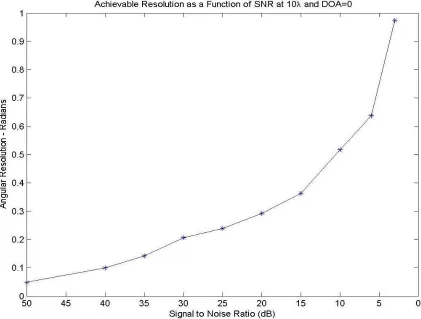
To estimate the performance in noise using the same approach as previously
noted, another experiment was simulated. Initial results were attempted by averaging 20
simulated for previous results. Source point pairs located at a mean DOA of broadside
and fixed range of 10 were then resolved at various SNR values. These minimum
[image:46.612.115.536.217.536.2]angular resolution measurements are plotted for analysis in Figure 4.4.
Figure 4.5 – Minimum angular resolution vs. SNR of spectral peaks for 20 averaged records
The y-axis range of the plot in Figure 4.4 corresponds to angular resolution of
2.8 at 50dB and 55.85 at 3dB, which is not particularly reasonable. The resolution plots
revealed a second issue as well, a flattening of the spectral peaks across their range axes.
component of the peak was hard to identify when checking simulation results. This
occurred particularly in plots as the SNR was increased past 40dB, so an increase to 60
records was used to take better source range measurements at 3dB. The range was varied
from 10 to 1 for a few measurements to see if proximity to the sensor array could
increase range resolution. Figure 4.5 is a plot of the pair of spectral peaks identified by
[image:47.612.116.535.312.627.2]the MVDR filter, and Figure 4.6 shows improvement in range detection for the 1 data.
Figure 4.7 – Angular resolution measurement taken at 1 with 60 records
4.5 Experiment 4
Since the angular resolution and the resolution along the range axis are adversely
affected by both larger range distances and poorer SNR, a better ensemble average is
obviously needed. The objective of experiment 4 was to note the improvements in
resolution as the number of sample records is steadily increased. To do this, the angular
resolution of signals with SNR values of 10dB, 6dB, and 3dB was then obtained as a
Figure 4.8 – Effect of increasing the number of records used in the ensemble average
This plot suggests that using 100 records or more will especially be important to the
sensor data resolution of signals with an SNR value around 3dB. The data taken at 6dB
and 10dB indicate that fewer records are needed to increase the resolution notably, but it
also seems that a noise resolution limit for this small sensor configuration is met at 17.8.
4.6 Experiment 5
For experiment 5, an increase in sensors is seen as another possible method of
resolution enhancement. In addition, a longer aperture length will also allow a much
deeper near field range. Signals were then simulated from an ensemble average of 140
sample records at a SNR value of 10dB, 6dB, and 3dB. The size of the sensor array was
[image:50.612.116.529.325.660.2]varied using 11 -51 sensors, producing the data set in Figure 4.8.
The information given in Figure 4.8 proves that resolution is significantly enhanced while
the number of sensor elements is increased. This also provides proof that a near field
MVDR method can excel at identification of noisy source distributions and lead to
effective source intensity reconstructions as well.
4.7 Experiment 6
The near field source localization work of Grosicki et al. was reviewed in this
thesis due to its successful use of a desirable Fresnel approximation. The Grosicki et al.
paper also ensured accuracy and prevented phase ambiguities by assuming m p for a
2p+1 element sensor array, where m is the number of localized sources. To see if the
assumption of Grosicki et al. should also be honored by the MVDR method of the thesis,
an evaluation of this limitation using the two parameter source localization technique is
needed. To test this, equally spaced sources were simulated along a source line in front of
an 11 sensor array with /4 interelement spacing. After some trial and error, seven
[image:51.612.153.519.542.669.2]sources were simulated over a field of view of 3at positions shown in Figure 4.10.
These sources were then successfully localized as shown in Figure 4.11 using 1000
ensemble average records. The results clearly indicate that this method can resolve more
sources than the approach of Grosicki et al. Please note that the peak at 0 radians only
[image:52.612.112.529.341.649.2]looks broader than the rest because of the log units used in the plot.
4.8 Near Field Delay and Sum Beamformer Data
To gauge the usefulness of the previous data taken by the Near-Field MVDR
method, a simpler method was attempted in a data comparison effort. A simpledelay and
sum beamforming method was implemented to provide this comparison. A traditional
delay and sum beamformer identifies the source DOA of far field signals by totaling the
signals from each sensor when the signal is delayed by a certain phase:
x j kd for p k pX
p
p k input Sum
Delay
exp 2 sin (4.1)
Delay and sum (4.1) does not use the correlation matrix like a MVDR filter, but produces
peaks when the phase product between the signal and steering vector produces a
maximum. If d is measured in wavelength units, we can assume =1 in (4.1). The only
drawback to the function is that excessive oversampling is needed to get a precise
response in many far field cases. To reconfigure delay and sum for near field sources and
index the sensors as –p ≤ k≤ p, the following expression involving range and DOA may
be used:
2 cos
2 exp
,r x j r2 k2d2 kd X p p k input Sum Delay (4.2)
The square root in (4.2) is a geometrically derived expression for the diagonal distance
from the source to each k-indexed sensor. Several results were then derived with this
equation without noise using similar array sizes, ranges, and DOA measurements to the
Table 4.1 – Resolution Comparison of ‘Delay and Sum’ and Near Field MDVR Method
Range from 11 Element
Sensor Array Delay and Sum Resolution(radians) MVDR Resolution(radians)
1 0.795 0.00031
1.5 1.10 0.0003
Range from 21 Element Sensor Array
Delay and Sum Resolution (radians)
MVDR Resolution (radians)
1 0.622 0.00018
2 0.827 (DOA = 0)
0.873 (DOA = 30) 0.00018
3 1.14 (DOA = 0) 0.0002
The spatial frequency peaks of the Delay and Sum method for 11 and 21 sensors that
were generated within a 1 range were distinct but had large sidelobes. As the Delay and
Sum measurements of both sensor arrays were attempted at slightly larger ranges, the pair
of peaks increase in width at an exponential rate. As a result, increases in range beyond
1.5 for the 11 sensor array, and 3 for the 21 sensor array, lead to inconclusive Delay
and Sum measurements. An example of the near field delay and sum plots used in these
calculations is in Figure 4.12. The results posted in Table 4.1 and this discussion show
that accuracy and resolution are faulty in this implementation of the Delay and Sum
method, and that the range limitations are an issue as well. This also establishes why
there is a credible need for precise peak results from a method like the Near-Field MVDR
Chapter 5
Conclusion
Through the course of this research, a new algorithm was developed to perform
high resolution spectral analysis of source points in the near field. The need for effective
field measurement algorithms in high frequency concealed weapon detection has been
established. Several previous methods and procedures have been outlined, along with
their groundbreaking results and restrictions. This thesis then outlined a desired 2D
localization method based on a MVDR routine that calculates filter responses along range
and DOA axes. This method was tested with signals of varying noise and direction, but
continued to show promise in simulations. Simulations were able to predict limitations to
resolution as a result of sensor size and distance from the array. Sources that are close to
the array were much easier to resolve along the range axis than those placed towards the
far field threshold. Direction of arrival resolution was maximized by both increasing the
record samples used to calculate the ensemble average, and increasing the number of
sensor elements to enhance sensitivity. Some of the background literature that has been
analyzed in this thesis has shown that there are still more ways of increasing the
efficiency and sensitivity of methods such as this.
In future studies, one of the first directions for research with a MVDR algorithm
would be testing with actual data. If output from a uniform linear array of known size is
could be attempted with lines of horizontal data initially, and then modified into a two
dimensional method. In two dimensions, the algorithm would need to allow measurement
of sources by horizontal DOA, vertical pitch angle, and by their approximate range. In
order for this to be possible, a method must be coupled with the MVDR filter output to
correctly identify the intensities of the localized field sources. This could be achieved by
such means as an eigenspace solution, least squares routine, or a set of optimization
commands. Another challenge that may be presented in actual data is obtaining desired
results despite hardware limitations, since high frequency sources have brief periods.
A second direction for accomplishment in an MVDR method would be to apply it
to wideband data. There are several current methods for wideband data analysis, and
research such as that presented by J. C. Chen et al. provides a catalyst for weapon
detection using wideband localization of high frequency sources (J. C. Chen et al., 2002).
Wideband methods have already shown resolution improvements in their
millimeter-wave scanning portal technology as well (Sheen et al., 2001). Since certain terahertz
frequencies would aid detector units in automatic identification of concealed explosive
Appendix 1
Table of Abbreviations
CWD Concealed Weapon Detection
dB Decibels
DOA Direction of Arrival
GHz Gigahertz
MUSIC Multiple Signal Classification
MVDR Minimum Variance Distortionless Response
PSD Power Spectral Density, also referred to as the ‘Spectrum’ of a signal
RMSE Root Mean Square Error
SNR Signal to Noise Ratio
THz Terahertz
THz-TDS Terahertz Time-Domain Spectroscopy
Appendix 2
MATLAB Source Code for Correlative Interferometry
function thzImage(xv,ex,yv,snr)
% Written by Joseph Handfield ~ongoing revisions 6/12/06 %
% This function calculates an array of spatial correlations of the sensed field % using an appended array (first half of columns are real parts, others are % imaginary). It also calculates a theoretical correlation using the
% solution to its integral. The output is an intensity array indicating the % location of the sources from the least squares computation of both % correlations.
%
% thzImage uses inputs:
% yv = Array of sensor locations along the sensing line, less than