City, University of London Institutional Repository
Citation
:
Wang, J., Otgaar, H., Howe, M. L., Smeets, T., Merckelbach, H. & Nahouli, Z. (2016). Undermining belief in false memories leads to less efficient problem-solving behaviour. Memory, doi: 10.1080/09658211.2016.1249888This is the accepted version of the paper.
This version of the publication may differ from the final published
version.
Permanent repository link:
http://openaccess.city.ac.uk/15968/Link to published version
:
http://dx.doi.org/10.1080/09658211.2016.1249888Copyright and reuse:
City Research Online aims to make research
outputs of City, University of London available to a wider audience.
Copyright and Moral Rights remain with the author(s) and/or copyright
holders. URLs from City Research Online may be freely distributed and
linked to.
City Research Online: http://openaccess.city.ac.uk/ [email protected]
Running Head: UNDERMINING BELIEF AND PROBLEM-SOLVING
Undermining Belief in False Memories Leads to Less Efficient Problem-solving Behavior
Jianqin Wang1, Henry Otgaar1,2, Mark L. Howe1,2, Tom Smeets1, Harald Merckelbach1, and Zacharia Nahouli3.
1
Maastricht University, The Netherlands
2
City, University of London, UK
3
University of Hull, UK
Words: 7865
Authors’ Note
We want to thank Athina Bisback and Sofia Sacchetti for their help in the data collection. Correspondence to Jianqin Wang, Clinical Psychological Science, Faculty of Psychology and
Neuroscience, Maastricht University, PO Box 624, 6200 MD, Maastricht, the Netherlands,
Tel.: +31-43-3881613, Fax: +3143-3884196. E-mail address:
This paper has been supported by a fellowship from the China Scholarship Council (CSC) to Jianqin Wang, by a grant from the Edmond Hustinx Foundation and by a grant from the Netherlands Organization for Scientific Research (NWO 415-12-003) to Henry Otgaar.
Abstract
Memories of events for which the belief in the occurrence of those events is undermined, but recollection is retained, are called nonbelieved memories (NBMs). The present experiments examined the effects of NBMs on subsequent problem-solving behavior. In Experiment 1, we challenged participants’ beliefs in their memories and examined whether NBMs affected subsequent solution rates on insight-based problems. True and false memories were elicited using the Deese/Roediger-McDermott (DRM) paradigm. Then participants’ belief in true and
false memories was challenged by telling them the item had not been presented. We found that when the challenge led to undermining belief in false memories, fewer problems were solved than when belief was not challenged. In Experiment 2, a similar procedure was used except that some participants solved the problems one week rather than immediately after the feedback. Again, our results showed that undermining belief in false memories resulted in lower problem solution rates. These findings suggest that for false memories, belief is an important agent in whether memories serve as effective primes for immediate and delayed problem-solving.
Undermining belief in false memories leads to less efficient problem-solving
behavior
Jack has a memory in which he put his hand in a cage at the Philadelphia Zoo and his left wrist was bitten by a monkey. Years later, his mother assured him that it never happened. He does not believe the horrible event actually happened, but he cannot stop having vivid
‘recollections’ or ‘memories’ concerning the event (http://www.falsememoryarchive.com/).
The question is, when Jack comes across monkeys in the zoo, will he stay away from them? Memories of events for which the belief in the occurrence of those events has been undermined but the recollection has been preserved, are called nonbelieved memories (NBMs). This recently studied phenomenon turns out not to be rare, with more than 20% of people reporting that they have vivid but non-believed autobiographical memories (Mazzoni, Scoboria, & Harvey, 2010). A lingering question is whether these NBMs have any impact on behavior (e.g., avoiding monkeys). The current experiments delve into this question by examining the (in)dependent behavioral consequences of beliefs and recollections on performance on subsequent problem-solving tasks.
Previous research on the behavioral consequences of memories has predominantly focused on believed memories (Scoboria, Jackson, Talarico, Hanczakowski, Wysman, & Mazzoni, 2014), with few studies looking at the behavioral consequences of nonbelieved
truth-value related to the occurrence of an event, whether or not a recollection is present.
Recollection refers to the mental re-experiencing of an event (e.g., Rubin, 2006). Various theorists argue that memories contain key components that lead to both a sense of re-experiencing the event and a belief that the event actually occurred (e.g. James, 1890/1950; Brewer, 1996; Schacter, 1996; Tulving, 1985).
In recent years, this view has gained more attention, with the distinction between belief and recollection being supported by empirical research. For example, Scoboria et al. (2014) used structural equation modelling and found that factors that predicted recollection (e.g., perception, re-experiencing) were distinct from factors that predicted belief (e.g., plausibility), suggesting a dissociation between recollection and belief. For most of our memories, belief and recollection both contribute to remembering. Scoboria and Talarico (2013) found that for believed autobiographical memories, belief and recollection ratings both tend to be at the high end (above 7) on a 1 to 8 likert scale.
However, in other cases, only belief or recollection is present. For example, there are family stories (e.g., your birth) that one believes occurred but cannot recollect. There are also NBMs where vivid recollections of events exist (e.g., believing you actually saw Santa Claus putting presents under the tree as a child) but beliefs for these events are undermined (e.g., by acquiring knowledge that Santa Claus is a fictional character) (Mazzoni, Scoboria, & Harvey, 2010; Otgaar, Scoboria, & Mazzoni, 2014).
were both believed and recollected, it is hard to know whether it was recollection, belief, or both that were responsible for the changes in subsequent behavior.
Research concerning false memories has also examined the impact of belief on behavior. For example, Bernstein and Loftus (2009) reviewed a number of studies where researchers created false memories about childhood events, such as being ill after eating egg-salad. These memories resulted in a subsequent reduction in eating egg-salad. Again, however, it is hard to determine the source of change in subsequent behavior as belief and recollection were
confounded. That is, participants developed a false belief about the false memory (event) with approximately a quarter of participants reporting having recollections of the false event (also see, Scoboria, Mazzoni, Jarry, & Bernstein, 2012). Indeed, these authors were acutely aware of this problem as Laney, Morris, Bernstein, Wakefield, and Loftus (2008, p. 291) noted that, “the data in the present paper represent some false memories and some false beliefs. But
because it is awkward to say ‘false memories and false beliefs’ repeatedly, we generally just use one term (either “false memory” or “false belief”) to encompass the notion of planting a
false entity.”
To our knowledge, there is no research that has directly and experimentally tested whether it is false belief or false recollection that affects behavior (but see Otgaar, Moldoveanu, Wang, & Howe, 2016). Recently, Bernstein, Scoboria, and Arnold (2015) conducted a mega-analysis on previously published food-preference experiments (see above) and concluded that for false events, belief is more important than memory in modifying food preference. Indeed, they stated that, “[c]ompared to memory of past events, belief in the occurrence of past events is more important for altering attitudes and behaviors” (p. 6).
result in part from decision-making processes that are analytic and occur consciously. For instance, participants might reason: “Since egg-salad made me ill, I’d better not eat it.” However, in a problem-solving process that involves intuitive thinking or ‘Aha!’ experiences (e.g., insight-based problem-solving; Bowden, Jung-Beeman, Fleck, & Kounios, 2005; Howe, Garner, Dewhurst, & Ball, 2010), there is usually no explicit reasoning about facts/knowledge. Recollection might play a vital role independent of belief in insight-based problem-solving behavior where people are unaware of the processes underlying the solutions to these types of problems.
The Current Experiments
The main purpose of the current experiments is to examine the impact of nonbelieved memories on insight-based problem-solving behavior. We decided not to use the food preference paradigm to elicit false beliefs/memories because this paradigm only allows one false belief or false memory to be created per participant. Because so few false beliefs and memories are created, it is even more difficult to produce the necessary number of
nonbelieved memories. Therefore, we opted for a method that leads to high and reliable levels of false memories, the Deese/Roediger-McDermott (DRM) paradigm (Deese, 1959; Roediger & McDermott, 1995). In this paradigm, participants are presented with lists of associated words (e.g., butter, food, eat, sandwich) that are all related to a non-presented critical lure (i.e.,
paradigm we were able to examine the impact of beliefs on true memory and explore the effects of nonbelieved true memories on behavior.
Following the challenges to true and false memories, participants were asked to solve compound remote associate task (CRAT) problems, in which solutions referred to
nonbelieved and believed words (true and false memories from DRM lists). A CRAT problem consists of three words (e.g., Board/Mail/Magic). To solve the problem, participants have to come up with a word that could link all the three words (in the example given above, the answer was Black). Howe et al., (2010) presented participants with DRM lists and then asked participants to solve CRAT problems whose solutions were critical lures for the DRM lists. They found that CRAT problems primed by false memories for critical lures were solved more frequently and significantly faster than problems that were not primed. Subsequent research typically showed the priming effect of believed false memories on CRAT problems (Howe, Garner, Charlesworth, & Knott, 2011; Howe, Wilkinson, Garner, & Ball, 2015); and found that the priming effect of false memories was similar to or even stronger than that observed for true memories (Howe, Threadgold, Norbury, Garner, & Ball, 2013; Howe, Wilkinson, Monaghan, Ball, & Garner, 2013). Based on Bernstein et al.’s work (2015), we predicted that if belief is more influential than recollection when it comes to impacting subsequent behaviors that ostensibly require non-conscious problem-solving processes, no priming effect would be found after beliefs for false memories are withdrawn. However, if recollection plays a more vital role in priming the CRATs than beliefs, then nonbelieved false memories should prime as many CRATs as believed false memories.
Furthermore, a scale measuring dissociative symptoms was administered because dissociation has frequently been linked to the formation of false memories (Giesbrecht, Lynn, Lilienfeld, & Merckelbach, 2008).
Experiment 1
Method
Participants
Before the recruitment of participants, we ran a power analysis using G*Power 3.1 (Faul, Erdfelder, Lang, & Buchner, 2007), with an estimated power of 0.80 and a medium effect size of 0.25 (f). The power analysis revealed that 34 participants needed to be tested. A total of 36 students from Maastricht University participated in the experiment in exchange for credit points or a financial reward of €7.50. Two participants were excluded because they did not complete the CRAT problem-solving session, thus leaving 34 participants (14 males and 20 females). All participants were native English speakers, aged between 17 and 34 (Mage = 21.6,
SD = 3.26). The experiment was approved by the ethical committee of the Faculty of Psychology and Neuroscience, Maastricht University.
Materials
DRM lists. Sixteen DRM lists were used in our experiment. These lists have
were presented items from the DRM lists, 8 were non-presented critical lures from the DRM lists, and 24 words were not presented and served as unrelated lures.
CRAT problems. We used 24 CRAT problems in this experiment (taken from Howe et al., 2013). Each CRAT was comprised of three words (e.g., crust, stale, French), all of which could be solved by a single linking word (i.e., bread). Sixteen CRATs were primed by the preceding sixteen DRM lists: half of the CRAT problems were primed by lists whose false memories (critical lures) were the solution words and the other half were primed by lists whose true memories (studied items) were the solution words (see Appendix). The other eight CRATs were not primed and served as an unprimed control condition. The mean solution rate and solution time for each CRAT were known from previous research (Howe et al., 2013). Figure 1 illustrates the alignment of DRM items and CRAT problems.
Gudjonsson Compliance Scale (GCS; Gudjonsson, 1989). The GCS is a self-report questionnaire measuring the degree of compliance. It contains 20 true/false statements (e.g., “I often give in to people when I am under pressure”). The total score of GCS ranges from 0
to 20, with higher scores indicating more compliant tendencies. The CGS has an internal consistency of .71 and a test-retest reliability coefficient of .88.
Dissociative Experiences Scale (DES; Bernstein & Putman, 1986). The DES measures the degree to which people experience dissociative symptoms. It consists of 28 items (e.g., “Some people find that sometimes they are listening to someone talk and they suddenly realize that they did not hear part of all of what was said.”) and participants have to select
what percentage of time this happens to them from 0% to 100% with 10% increments. It has a good internal consistency, with Cronbach α= .92.
A 3(Memory Type: critical lures, studied items, unrelated items) × 2 (Belief: challenged vs. control) within-subject design was used. Participants were tested individually for
approximately 50 minutes in lab facilities at the faculty. There were four phases.
1) Study phase: DRM words were presented to participants on a computer screen. Participants were instructed to remember as many words as they could. Each word was visually presented for 1500ms, with 500ms inter-stimulus interval using the program Visual Basic. The sequence of the words within a list was fixed, but the order of the lists was randomized.
2) Recognition phase: After a distractor task (playing the game Bejeweled for 3 min), participants were involved in a recognition task, in which 8 critical lures, 24 studied words, and 24 unrelated words were included to examine false memories and true memories, respectively. Participants were asked to identify the word on the screen as to whether it had been presented by clicking on a “Yes” or “No” button. Next, participants completed the dissociation questionnaire (DES) before they moved to the challenging phase (see below).
3) Challenging phase: Participants were told that the computer graded their answers and gave them feedback on their performance on the previous recognition test. Before their responses were challenged, participants were told why our memories were sometimes unreliable and they were shown an extra DRM list to illustrate how a DRM list could lead to the formation of false memories. This explanation was given so participants understood why feedback was presented.
In the challenged belief condition, when a certain target word (e.g., bread) appeared on the screen, a label beneath the word popped up stating that “Sorry, your previous answer was
incorrect. This word was not presented.” In the control condition, the feedback was “Congratulations, your answer was correct. This word was presented.” In this way, we
provided, the experimenter showed participants a printed fake proof where presented words were listed and gave oral social feedback asking them to rethink their previous answer. Then immediately after the challenge for each word, participants rated their memory and belief for that word on 1-8 Likert scales (i.e., “Do you have a memory for this word?”, 1= no memory at all, 8 = clear and complete memory; “Do you believe that this word was presented to you?”, 1= definitely did not happen, 8 = definitely did happen; adapted from Scoboria et al., 2004). The experimenter explained thoroughly to the participant the difference between memory (i.e., recollection) and belief. The sequence of all challenged words was randomized. In total, 56 words from the recognition test were given feedback, but we were only interested in the 24 target words that served as solutions to the corresponding CRAT problems. The belief in half of the target words (4 critical lures, 4 studied words, and 4 unrelated) was always challenged regardless of their original recognition responses. The other words were in the control condition in which participants’ belief in their presence was not challenged.
4) Problem-solving phase: Twenty-four CRAT problems were presented in which the correct answers were the target words in the challenging phase. The twenty-four CRATs were assigned to six (3×2) conditions. An ANOVA revealed no statistically significant differences between mean solution rates across different item types (F(2, 18) = 0.01; p = 0.99) and different belief conditions (F(1, 18) = 0.001; p = 0.97). There were no solution time
differences across item types (F(2, 18) = 0.02; p = 0.98) and belief conditions (F(1, 18) = 0.16;
p = 0.70). These analyses were done as a manipulation check to make sure there was no baseline difference in reaction times and solution rates among clusters of CRATs across conditions.
and their task was to come up with a word that could link all the three words. Participants were given an example first (e.g., the answer to the problem apple/family/house was tree), followed by one practice CRAT problem that they had completed themselves before they began the test CRATs. Problems were presented in a random order. A countdown timer appeared in the upper right corner of the screen and participants were asked to type their solution within 60 seconds. Upon completion of each CRAT, no correct answer was given to lower the risk that participants would connect the memory task with the problem-solving task. Solution rates and times were recorded by the computer. After all sessions, participants filled in the compliance scale (GCS) and were debriefed about the purpose of the study.
Results and Discussion
Recognition rates
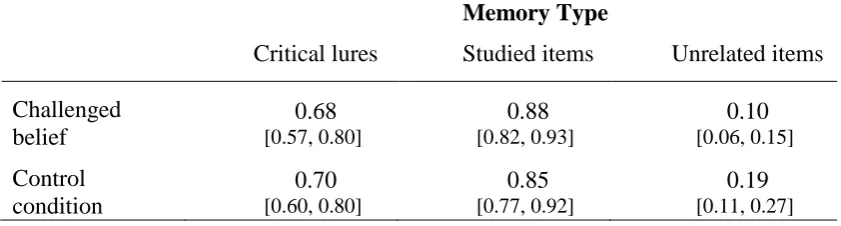
The mean recognition rate for all studied items was 74.50% (N = 608). The mean false recognition rate for critical lures was 69.13% (N = 188), which is consistent with previous research (e.g., Blair, Lenton, & Hastie, 2002). Participants falsely recognized 14.63% (N = 20) of non-presented unrelated items.
The mean recognition rate in each condition is shown in Table 1. Recognition rates were analyzed using a 3(Memory Type: critical lures, studied items, unrelated items) × 2(Belief: challenged vs. control) repeated measures ANOVA. No interaction was found, F(2, 66) = 1.57, p = .22, partial η2 = .05. There was a main effect of Memory Type, F(2, 66) = 185.51, p
< .001, partial η2 = .85, where Bonferroni post-hoc analyses showed that participants recognized statistically more critical lures and studied words than non-presented words (ps < .001). There was no main effect of Belief, F(1, 33) = 0.91, p = .35, partial η2 = .03, indicating that there were an equivalent number of true and false memories in both the challenged belief and control conditions.
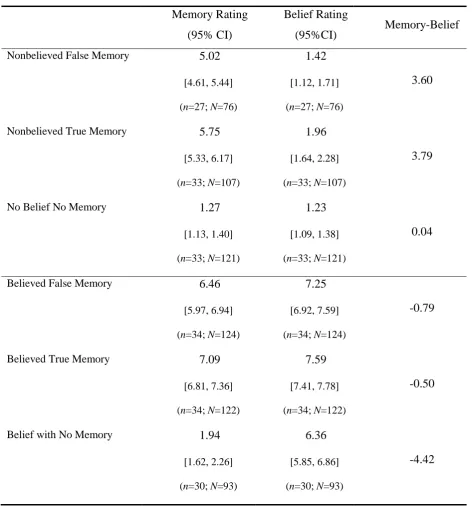
We recorded memory and belief ratings for each word after the challenge manipulation. Analogous to previous research, we employed the following criteria for nonbelieved
memories: recollection needed to be rated at least 2 scale points higher than belief (see Mazzoni, Clark, & Nash, 2014; Otgaar, Moldoveanu, Wang, & Howe, 2016), and within this criterion, the recollection rating should be at least 3. For believed memories, we set the same criterion for recollection rating (at least 3) as in nonbelieved memories, and belief rating should be equal to, or above, 3. Within the categories of nonbelieved and believed memories, if the item was a critical lure, it was a false memory; if it was a studied item, it was a true memory. For unrelated items, there were two categories: items with no belief and no memory (ratings ≤ 2) and items with no memory but belief. Table 2 shows the mean Memory and
Belief ratings for words in each condition.
After the challenge manipulation, 97.1% of the participants (n = 33) had formed at least one nonbelieved true memory for studied items, with an average number of 3.15 (SD = 1.05) nonbelieved memories. 79.4% of the participants (n= 27) had developed at least one
nonbelieved false memory, with an average number of 2.24 (SD = 1.52). In the challenged belief condition, participants formed nonbelieved false memories for 55.88% of the critical lures and formed nonbelieved true memories for 78.68% of the studied words. In the control condition, participants formed believed false memories for 91.18% of the critical items and formed believed true memories for 89.71% of the studied words.
Solution rates of CRATs
The mean CRAT solution rates (in proportions) were calculated for each participant. We focused on words that were effectively manipulated into believed/nonbelieved memories. We labelled the effect of successfully challenging or lowering participants’ beliefs as
“undermining.” Seven participants had formed either zero nonbelieved false memories or zero
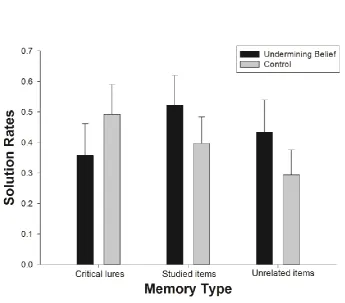
missing values. However, these participants had CRAT solution values in the believed memory conditions, thus we used a multiple imputation method (Schafer, 1997) to impute missing data values. In total, 3.9% of the data (8 out of 204 cells) were imputed over five cycles of imputations. We compared the CRAT solution rates in the undermining belief condition with the CRAT solution rate in the control condition for the following three memory types: critical lures, studied items, and unrelated items1. Interestingly, undermining belief led to different results for false and true memories. In the critical lures condition, undermining belief (M = 0.36, SD = 0.29) led to statistically lower solution rates than control (M = 0.49, SD = 0.28), t = -2.04, dfpooled = 884, p = .04. However, for studied items,
undermining belief increased solution rates significantly (undermining belief, M = 0.52, SD = 0.27; control condition, M = 0.40, SD = 0.25, t = 2.04, dfpooled = 3353, p =.04; see Figure 2).
We compared the CRAT solution rates in the control condition to see whether the results in the control condition were consistent with previous research. Paired samples t-tests showed that false memories did not differ significantly from true memories in priming the CRATs (p
=.27); false and true memories both primed more CRATs than unrelated items (p = .008; p
= .02). Thus, the results in the control condition replicate previous findings on the consequences of false memories on problem-solving (e.g., Howe et al., 2013).
As has been done in previous related work (e.g., Otgaar, Howe, van Beers, van Hoof, Bronzwaer, & Smeets, 2015), we also performed an additional analysis by focusing only on the items that participants recognized as “presented” in the recognition test. When words with “yes (presented)” recognition responses only were included in analysis, a similar interaction
effect between memory and belief was found, F(2, 64) = 5.36, p < .01, partial η2 = .14. No main effect of belief was found, F(1, 32) = 0.35, p = .56. No main effect of memory was
1 In this analysis, words were evaluated as nonbelieved memories when memory ratings for them were two
found, F(2, 64) = 2.37, p = .10. Solution times of CRATs
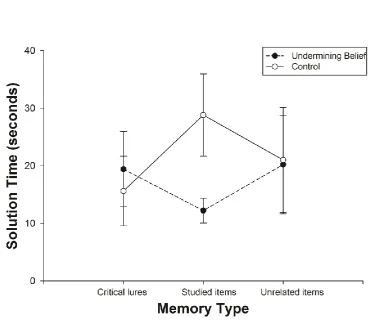
Mean solution times of CRATs (in seconds) in each condition were calculated. We were particularly interested in comparing the solution times between nonbelieved and believed memories. In some cases, participants solved no CRATs under the priming of (non)believed memories, thus solution times in that condition were counted as missing. In total, there were 19.11% (N = 39) of the cases where solution times were missing. We conducted several paired sample t-tests and again found decreasing belief had different effects for false and true memories. In the critical lures condition, nonbelieved false memory (M = 17.75, SD = 9.07) primed problems as fast as believed false memory (M = 14.47, SD = 7.16; p = .27); however, in the studied items condition, undermining belief (M = 12.80, SD = 5.18) resulted in faster solution times to CRAT problems than in the control condition (M = 20.33, SD = 10.30; p
= .003). Undermining belief (M = 15.33, SD = 9.58) and control conditions (M = 18.28, SD = 12.15) did not differ in solution times for unrelated items (p = .77). 2
Exploratory Analysis
We conducted Pearson’s correlations between the scores on the GCS and the different memories (believed true/false memory; nonbelieved true/false memory). We found a statistically significant correlation between GCS scores and false recognition rates (r (32) = .38, p = .03): the higher scores on the GCS, the higher false recognition rates. No correlation between GCS scores and true recognition rates was detected. As GCS scores measure compliance, we expected that the more compliance participants exhibited, the more nonbelieved memories they would report. However, no statistically significant correlation was found between GCS scores and number of nonbelieved false memories (r (32)= .31, p = .07). Correlations between DES scores and different kinds of memories were also analyzed.
2
We found a statistically significant negative correlation between dissociative symptoms and true recognition rates (r (32) = -.44, p = .01). Thus, participants scoring high on dissociation had worse memories for presented words. No correlation was found between DES scores and false recognition rates. Interestingly, dissociation scores correlated negatively with the number of nonbelieved unrelated items (r (32)= -.36, p = .04) but not nonbelieved true memories (r (32)= -.08, p = .64) or nonbelieved false memories (r (32)= -.01, p = .94). Of course, we had a small sample size for executing correlation analyses, so the results of these analyses should be cautiously treated.
Experiment 1 examined the behavioral consequences of belief and recollection. We found that in the control condition, false memories primed the CRATs as efficiently as true memories, a finding consistent with previous research (Howe et al., 2010). Interestingly and for the first time, our data also showed that, without belief, the priming effect of false
memories was changed under the conditions tested. This is in line with research by Bernstein and colleagues (2015). That is, when belief in false memories was withdrawn, participants solved fewer CRAT problems. This result constitutes the first experimental attempt that shows that nonbelieved (false) memories impact problem-solving behavior and do so differently than true memories.
Hence, nonbelieved memories for events might exhibit greater behavioral impact than nonbelieved memories for words.
Although our data suggest that for false memory, belief might play an active role in problem solving, our study is still preliminary and needs replication. Furthermore, the results of this experiment were somewhat limited because of the following. First, in this experiment, there were only four CRATs in each condition. When we attempted to induce nonbelieved memories for the four solution words to these CRATs, not all of the items could be
successfully transformed into nonbelieved memories. The average nonbelieved memory rate of critical lures and studied items was in the 55%-80% range. If there are more items in each condition, more NBMs can be created and thus, the effects of beliefs and recollections can be better investigated. Second, the CRAT problems in each condition were fixed; that is, they not completely randomized for every participant. Although the mean solution rates and times for CRATs were counterbalanced across conditions, it is unknown whether the difficulty of CRATs impacted our results. In order to address these issues and thus, replicate our results, we conducted an additional experiment.
In Experiment 2, we assigned more CRAT problems to each condition and CRAT problems were no longer fixed in each condition. Furthermore, having established the immediate effect of undermining belief on problem solving, Experiment 2 explored the long-lasting effects of nonbelieved memories on problem-solving behavior. From a theoretical perspective, this is important because previous studies have found that the superior priming effect of false memories emerged particularly after a 1-week delay while the priming effect of true memories declined (Howe et al., 2013). One possible explanation is that true memories decay faster than false memories because true memories are often other-generated (e.g., presented on a list by the experimenter), whereas false memories tend to be self
activation (Howe, Garner, Threadgold, & Ball, 2015)]. This pattern corresponds to findings from previous studies on false memories and food preferences in which the behavioral impact of belief could last for months (Bernstein & Loftus, 2009). Furthermore, previous research has shown that false beliefs can last up to four months (see Geraerts, Bernstein, Merckelbach, Linders, Raymaekers, & Loftus, 2008; Laney, Fowler, Nelson, Bernstein, & Loftus, 2008) and experimentally evoked nonbelieved false memories endure for as long as a month (Otgaar, Scoboria, & Smeets, 2013).
Because the behavioral effects of false beliefs may be long-lasting and because belief is more easily manipulated than memory, one could anticipate the following. If belief is the more active agent in guiding behavior than memory, then undermining belief should lead to behavioral effects even after a delay. As belief is assumed to be part of knowledge related to the self (e.g., Scoboria et al., 2004), the enduring behavioral effects of belief would be especially evident for false memories as they are the result of internal associative activation and thus, self-generated. Hence, in Experiment 2, half of the participants had to complete the CRAT problem-solving task immediately and the other half following a one-week delay.
Experiment 2
Method
Participants
A power analysis indicated 70 participants were needed when a power of 0.80 and a medium effect size of 0.27 (f) were estimated. A total of 71 participants were tested in exchange for credit points or a financial reward of €7.50. The sample consisted of 22 males and 49 females, with a mean age of 22.3 years old (SD = 5.97). 84.5% of the participants (n = 60) were native English speakers, and 15.5% (n = 11) of the participants were fluent in English, but used English as a second language.
Twenty-four DRM lists were used in Experiment 2. Each list contained 10 associates. The recognition phase included 12 non-presented critical lures from 12 of the DRM lists, 48 studied items (in which 12 were targeted items for belief manipulation), and 36 unrelated items. Twenty-four CRATs whose answers were 12 critical lures and 12 studied items (corresponding to the 24 DRM lists) were used. The GCS and DES questionnaires were administered to participants as well (see Experiment 1).
Design and Procedure
A 2 (Time Interval: immediate vs. 1 week) × 2 (Memory Type: critical lures vs. studied items) × 2 (Belief: challenged vs. control) mixed design was used, where the first factor was between-subjects and the other two were within-subject factors. Thirty-six participants were randomly allocated to the immediate condition and 35 to the 1-week delay condition.
Experiment 2 followed the same procedure as Experiment 1, except that 35 of the participants did not finish the problem-solving phase immediately after the challenging phase, but instead, did so one week later. Because the items in the challenged belief and control belief conditions were fixed, we switched the items in these two conditions for half of the participants in each Time Interval group. That is, belief for the same 12 target words was undermined in around half of the participants (n= 31), but belief for these words was not challenged in the other participants.
Results and Discussion
Recognition rates
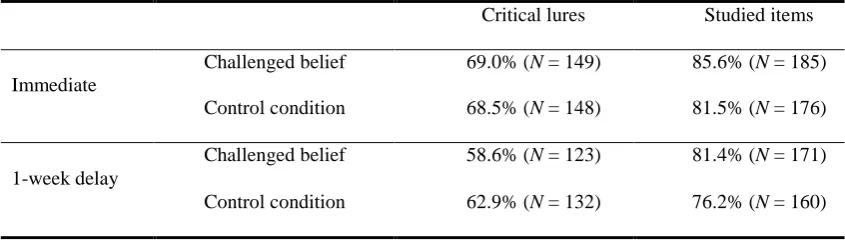
The mean recognition rate for unrelated items was 14.5%. For the targeted studied items and critical lures (i.e., those that served as the solutions to the subsequent 24 CRATs), the mean recognition rates in each condition are shown in Table 3.
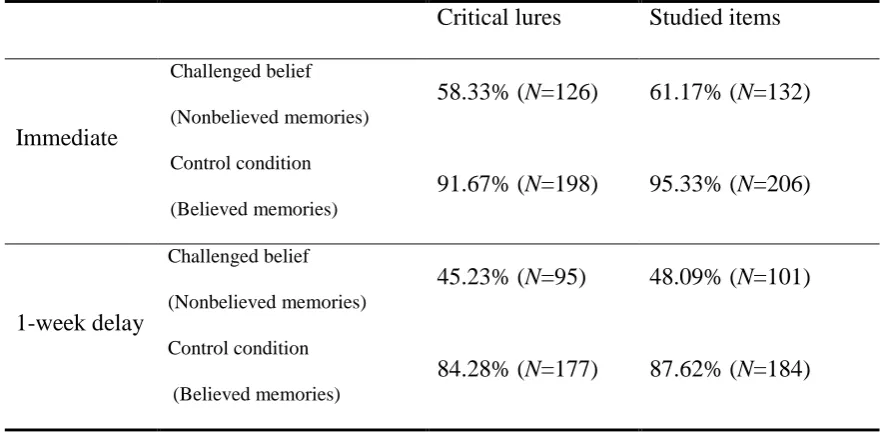
Memory and belief ratings for each word were recorded after the belief manipulation for that word. The same criteria for nonbelieved and believed memories used in Experiment 1 were used here. Table 4 shows the mean percentages of critical lures and studied items that were nonbelieved and believed memories.
Solution rates of CRATs
Again, we labelled the effect of successfully challenging or lowering participants’ beliefs as “undermining.” A 2 (Time Interval: immediate vs. 1 week) × 2 (Memory Type: critical
lures vs. studied items) × 2 (Belief: undermining vs control) repeated measures ANOVA was conducted, with Time Interval as a between-subjects variable. Note that there were 14
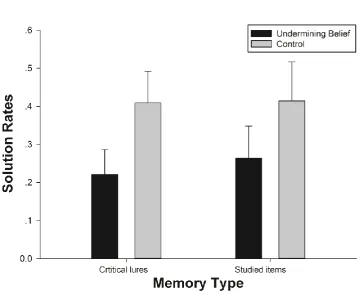
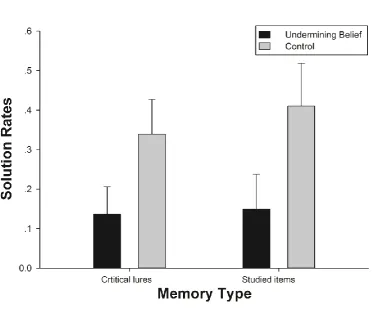
participants in total who did not form a nonbelieved true or a nonbelieved false memory. These participants’ CRAT data were not entered into the analysis. As a result, 34 participants were in the immediate condition and 23 were in the delay condition. There was no statistically significant three-way interaction effect for Time Interval × Memory Type × Belief, F(1, 55) = 0.14, p = .71, and also no statistically significant two-way interactions. There was a main effect for Belief, F(1, 55) = 20.68, p < .001, partial η2 = .27, which, like Experiment 1,
showed that undermining belief resulted in lower solution rates. There was no main effect for Memory Type, F(1, 55) = 1.37, p =.25, partial η2 = .02. Neither was there a main effect for Time Interval, F(1, 55) = 0.44, p =.51, partial η2 = .008.
effect of Belief was found, F(1, 67) = 18.70, p <.001, partial η2 = .21, showing that
undermining belief led to less efficient problem-solving behavior. No main effect of Memory Type was found, F(1, 67) = 1.25, p =.26. There was no significant main effect of Time Interval, F(1, 67) = 0.003, p =.96 and no statistically significant interactions were detected. 3
To rule out the possibility that the effect of belief was due to the difficulty of the CRATs, we changed the CRAT problems in the undermining belief and control conditions in around half (45.1%, n = 32) of the participants. We split the data into two groups in which
participants received the opposite belief manipulation for the same materials. For instance, in one group, belief for “bread” was undermined and then participants solved a corresponding CRAT; in the other group, belief for “bread” was confirmed and participants solved the same
CRAT. We conducted a 2 (Change: yes vs. no) × 2 (Memory Type: critical lures vs. studied items) ×2 (Belief: undermining vs. control) repeated measures ANOVA, with Change as a between-subject variable. No significant main effect of Change was found, F(1, 55) = 2.44, p
=.12, indicating the materials did not impact our results. Solution times of CRATs
We were also interested in whether undermining belief would impact CRAT solution times. For critical items, we conducted a 2 (Time Interval: immediate vs. 1-week delay) ×2 (Belief: undermining vs. control) repeated measures ANOVA, with the first variable being between-subjects. Like Experiment 1, when participants solved no CRAT under the priming of (non)believed memories, no solution time data in that condition could be analyzed. There were 37 participants’ solution time data that could be used. There was no main effect of Belief,
F(1, 36) = 0.45, p =.51, Time Interval, F(1, 36) = 0.28, p = .60, or interaction effect, F(1, 36) = 1.34, p =.25. For studied items, we conducted the same analysis. We found no main effects
3We examined whether being native English speaker or not would impact the results. When non-native
of Time Interval or Belief. Thus, CRAT solution times for false and true memories were not impacted by Belief and Time interval.
Exploratory Analysis
We found no statistically significant correlation between compliance scores and number of nonbelieved memories (r (69)= .04, p = .73), which is consistent with Experiment 1. The data from both experiments suggest that compliance does not impact the formation of
nonbelieved memories. Correlations between dissociative symptoms and number of true/false believed and nonbelieved memories were analyzed. We found no significant correlation between dissociative symptoms and true recognition rates (r (69)= -.21, p = 0.08), and also no significant correlation between dissociation and false recognition rate (r (69)= -.20, p
= .09) emerged. No correlation was found between DES scores and overall number of nonbelieved memories (r (69)= .07, p = .59).
Consistent with Experiment 1, we found that undermining belief in false memories led to fewer CRAT problems being solved than the control condition. Belief is conceptualized as the truth value of an event. Even though a CRAT is an insight-based problem-solving task,
retracting belief in false memories impacts the ability of false memories to prime CRATs. The results on false memories from Experiment 1 and Experiment 2 align with Bernstein et al.’s (2015) conclusion that false autobiographical beliefs, not memories, alter behavioral
performance.
What we also found was that undermining belief in true memories resulted in lower CRAT solution rates. In Experiment 1, we did not find this. The reason might be that we made several improvements in Experiment 2, such as including more CRATs in each
when participants solved at least one CRAT problem could we obtain solution time data. This can be resolved in future studies by using easier CRAT problems. Also, our results showed that the deleterious effects of belief retraction on problem solving occurred both immediately and after one week. This shows that when belief is undermined, it does not have a short-lived effect, but it endures over time. This is line with research by Otgaar and colleagues (2013) who showed that nonbelieved memories can last for a month.
General Discussion
The current experiments serve as the first attempt to simultaneously assess the behavioral consequences of nonbelieved and believed memories on problem-solving behavior. We found evidence across two experiments that nonbelieved memories impacted problem-solving behavior under the conditions tested. The most intriguing finding was that undermining belief in false memories led to less efficient problem-solving behavior. This result persisted even after a 1-week delay. To our knowledge, this is the first experimental demonstration that for false memories, retracting belief adversely affects subsequent behavior.
This novel finding implies that belief contributed more to the behavioral performance on the CRATs than recollection. This is in line with previous research suggesting belief in the occurrence of past events was more important in determining eating behavior than
recollection (Bernstein et al., 2015). However, in this work, no experimental test was
performed to manipulate belief separately and examine whether this would impact behavior. Our study is the first showing the consequences of belief and recollection on behavior by using a non-inferential, and perhaps more automatic, insight-based problem-solving task.
Scoboria et al., 2004; Scoboria et al., 2014; Mazzoni & Kirsch, 2002). Previous studies mostly showed dissociation of belief and recollection for autobiographical events. For
instance, research has shown that belief in actions (e.g., clapping hands) could be undermined while the recollected aspect of the actions remained intact (Clark, Nash, Fincham, & Mazzoni, 2012; Mazzoni, Clark, & Nash, 2014). Also, experiments showed that belief in experiencing a hot balloon ride can be manipulated while recollection of the event remained intact (Otgaar et al., 2013). In our two experiments, we undermined belief for associatively-related words and recorded belief and memory ratings afterwards. We found that for both false and true
memories, belief ratings dropped while memory/recollection ratings were high after undermining belief.
Scoboria et al. (2014) proposed a theoretical model to explain the relationship between belief and memory (recollection). In this model, autobiographical belief and recollection are two independent continuous dimensions that result in different categories such as believed memories and nonbelieved memories. Our experiments support this view inasmuch as we successfully manipulated participants’ beliefs while recollections were retained. Based on the
independence of these two components, it is proposed that belief in the occurrence of an event, rather than a specific memory for the event, is highly malleable and is the critical component in influencing behavior (Bernstein et al., 2015; Scoboria et al., 2014). Importantly, we found that for false memories, undermining belief led to a reduction in subsequent problem-solving behavior, a finding that accords well with the above proposition. As belief in occurrence is based in various inputs, just one of which is recollection, , theories that focus on episodic recollection alone may not be the best predictors of behavior.
In Experiment 2, we found evidence that for true memory as well, problem-solving was more difficult when belief was undermined. This suggests that for memory in general,
It is unclear why we did not find this effect in Experiment 1. Although one might expect that challenging true memories is more difficult than false memories (e.g., Otgaar, Candel, Smeets, & Merckelbach, 2010), this is not what we found in the present experiments. Here, both
nonbelieved true and false memories were evoked, something that might be related to the fact that the DRM procedure leads both to high levels of true and false recognition, with false recognition rates often not differing from true recognition rates (Roediger & McDermott, 1995). Of course, future research should examine more closely whether belief is also important in guiding behavior for true memory.
Associative-activation theory (AAT, Howe, Wimmer, Gagnon, & Plumpton, 2009; Otgaar, Howe, Peters, Smeets, & Moritz, 2014), as well as the activation-monitoring theory (AMT, Roediger, Balota, & Watson, 2001) provide explanations for the priming effects of false memories. AAT suggests that processing of one concept activates a corresponding node and this activation spreads automatically to nearby associative concept nodes. When DRM list items are presented and encoded, their activation spreads to non-presented, but related items (i.e., the critical lure) resulting in false memories. Because false memories are highly
associated to true memories, they often exert similar priming effect on CRAT problems (Howe et al., 2013). In our experiments, we manipulated participants’ beliefs for the items after false and true memories were formed, and we found similar reduced priming effect for both true and false memories (Experiment 2). One possibility might be that undermining belief adversely affects spreading activation in one’s knowledge base thereby reducing its effects on subsequent tasks including the spreading activation required to solve CRATs. Of course, further investigation is needed to examine the precise mechanism by which belief and recollection can impact problem-solving behavior.
solution rates primed by true memories still remained high even after a one-week interval, but previous research has found that these rates dropped after a one-week delay (Howe et al., 2013). Priming CRATs in prior research is considered to occur automatically by associative activation (Howe et al., 2010). Querying belief (e.g., undermining) in the current experiments may have made the recollections of true and false items more conscious and salient, which may have fundamentally changed the priming process. However, if we look at the data of the control condition in the immediate testing group, we found the exact same result with
previous studies (solution rates: critical lures ≥ studied items > unrelated items), and in the
immediate group, belief was also queried in the control condition. This suggests that our belief manipulation might not have affected the automatic nature of our priming effects.
Our study also explored the relationship between compliance and nonbelieved memories. Both experiments demonstrated no statistical link between compliance scores and number of nonbelieved memories. Scoboria, Boucher, and Mazzoni (2015) found that the primary reason people retracted their belief in a memory was social feedback, such as someone telling you that your memory was not true. Our study found that people who were more compliant did not form more NBMs than people who were less compliant. One reason for this is that social feedback is more related to external pressure, such as suggestive information, whereas compliance can be regarded as an internal personality characteristic. Our null result begs the question whether the formation of NBMs might be more affected by external factors such as who provides social feedback (e.g., authority or stranger).
One might object that our memory task is related to the problem-solving task and that this is a potential confound in our experiments. However, in food preference studies
session (e.g., Geraerts et al., et al., 2008; Scoboria et al., 2012). They were told that the second session was a completely irrelevant experiment as to reduce the chance that participants could link the two sessions with each other. Importantly, in the current
experiments, we also told participants that our problem-solving task was an unrelated task. By way of confirmation that our manipulation succeeded, we interviewed some participants after the experiments and none of them could see the link between the memory task and the
problem-solving task.
References
Bernstein, D. M., & Loftus, E. F. (2009). The consequences of false memories for food
preferences and choices. Perspectives on Psychological Science, 4, 135–139.
Bernstein, E.M., & Putnam, E.W. (1986). Development, reliability, and validity of a
dissociation scale. Journal of Nervous and Mental Disease, 174, 727–734.
Bernstein, D. M., Scoboria, A., & Arnold, R. (2015). The consequences of suggesting false
childhood food events. Acta Psychologica, 156, 1–7.
Biondolillo, M. J., & Pillemer, D. B. (2015) Using memories to motivate future behavior: An
experimental exercise intervention, Memory, 23, 390–402.
Blair, I. V., Lenton, A. P., & Hastie, R. (2002). The reliability of the DRM paradigm as a
measure of individual differences in false memories. Psychonomic Bulletin & Review,
9, 590–596
Bowden, E.M., Jung-Beeman, M., Fleck, J., & Kounios, J. (2005). New approaches to
demystifying insight. Trends in Cognitive Sciences, 9, 322–328.
Brewer, W. F. (1996). What is recollective memory? In D. C. Rubin (Ed.), Remembering our
past: Studies in autobiographical memory (pp. 19–66). New York, NY: Cambridge
University Press.
Clark, A., Nash, R. A., Fincham, G., & Mazzoni, G. (2012). Creating non-believed memories
Deese, J. (1959). On the prediction of occurrence of particular verbal intrusions in immediate
recall. Journal of Experimental Psychology,58, 17–22.
Faul, F., Erdfelder, E., Lang, A.-G., & Buchner, A. (2007). G*Power 3: A flexible statistical
power analysis program for the social, behavioral, and biomedical sciences. Behavior
Research Methods, 39, 175–191.
Geraerts, E., Bernstein, D. M., Merckelbach, H., Linders, C., Raymaekers, L., & Loftus, E. F.
(2008). Lasting false beliefs and their behavioral consequences. Psychological
Science, 19, 749–753.
Giesbrecht, T., Lynn, S. J., Lilienfeld, S. O., & Merckelbach, H. (2008). Cognitive processes
in dissociation: An analysis of core theoretical assumptions. Psychological Bulletin,
134, 617–647.
Gudjonsson, G. H. (1989). Compliance in an interrogation situation: A new scale. Personality
and Individual Differences, 10, 535–540.
Howe, M. L., Garner, S. R., Charlesworth, M., & Knott, L. (2011). A brighter side to memory
illusions: False memories prime children's and adults’ insight-based problem solving.
Journal of Experimental Child Psychology, 108, 383–393.
Howe, M. L., Garner, S. R., Dewhurst, S. A., & Ball, L. J. (2010). Can false memories prime
Howe, M. L., Garner, S.R., & Patel, M. (2013). Positive consequences of false memories.
Behavioral Sciences and the Law, 31, 652–665.
Howe, M.L., Garner, S. R., Threadgold, E., & Ball, L.J. (2015). Priming analogical reasoning
with false memories. Memory & Cognition, 43, 879–895.
Howe, M.L., Threadgold, E., Norbury, J., Garner, S., & Ball, L.J. (2013). Priming children's
and adults' analogical problem solutions with true and false memories.. Journal of
Experimental Child Psychology, 116, 96–103.
Howe, M. L., Wilkinson, S., Garner, S. R., & Ball, L. J. (2015). On the adaptive function of
children's and adults' false memories. Memory, 1–16.
Howe, M. L., Wilkinson, S., Monaghan, P., Ball, L. J., & Garner, S. R. (2013). Why are
illusions adaptive? The curious case of false memories. Manuscript submitted for
publication.
Howe, M. L., Wimmer, M. C., Gagnon, N. & Plumpton, S. (2009). An associative activation
theory of children's and adults' memory illusions. Journal of Memory and Language,
60, 229–251.
James, W. (1950). The principles of psychology (Vols. 1 and 2). Mineola, NY: Dover
Publications. (Original work published 1890)
Laney, C., Fowler, N.B., Nelson, K.J., Bernstein, D.M., & Loftus, E.F. (2008). The
Mazzoni, G.A.L., Clark, A., & Nash, R.A. (2014). Disowned recollections: Denying true
experiences undermines belief in occurrence but not judgments of remembering. Acta
Psychologica, 145, 139–146.
Mazzoni, G. A. L., & Kirsch, I. (2002). False autobiographical memories and beliefs: a
preliminary metacognitive model. In T. Perfect, & B. Schwartz (Eds.), Applied
metacognition (pp.121–145). Cambridge, UK: Cambridge University Press.
Mazzoni, G. A. L., Scoboria, A., & Harvey, L. (2010). Nonbelieved memories. Psychological
Science, 21, 1334–1340.
Otgaar, H., Candel, I., Smeets, T., & Merckelbach, H. (2010). “You didn’t take Lucy’s skirt
off”: The effect of misleading information on omissions and commissions in
children’s memory reports. Legal and Criminological Psychology, 15, 229–241.
Otgaar, H., Howe, M. L., Peters, M., Smeets, T., & Moritz, S. (2014). The production of
spontaneous false memories across childhood. Journal of Experimental Child
Psychology, 121, 28–41.
Otgaar, H., Howe, M. L., van Beers, J., van Hoof, R., Bronzwaer, N., & Smeets, T. (2015).
The positive ramifications of false memories using a perceptual closure task. Journal
of Applied Research in Memory and Cognition, 4, 43–50.
Otgaar, H., Moldoveanu, G., Wang, J., & Howe, M.L. (2016). Exploring the consequences of
Otgaar, H., Scoboria, A., & Mazzoni, G. (2014). On the existence and implications of
nonbelieved memories. Current Directions in Psychological Science, 23, 349–354.
Otgaar, H., Scoboria, A., & Smeets, T. (2013). Experimentally evoking nonbelieved
memories for childhood events. Journal of Experimental Psychology: Learning,
Memory, and Cognition, 39, 717–730.
Pezdek, K., & Salim, R. (2011). Physiological, psychological and behavioral consequences of
activating autobiographical memories. Journal of Experimental Social Psychology, 47,
1214–1218.
Roediger, H., Balota, D., & Watson, J. (2001). Spreading activation and arousal of false
memories. In H. Roediger, J. Nairne, & A. Surprenant (Eds.), The nature of
remembering: Essays in honor of Robert G. Crowder. Science conference series (pp.
95–115). Washington, DC: American Psychological Association.
Roediger, H.L., & McDermott, K.B. (1995). Creating false memories: remembering words
not presented in lists. Journal of Experimental Psychology: Learning, Memory and
Cognition, 21, 803–14.
Rubin, D. C. (2006). The basic-systems model of episodic memory. Perspectives on
Psychological Science,1, 277–311.
Schacter, D. L. (1996). Searching for memory: The brain, the mind and the past. New York,
Schafer, J. L. (1997). Analysis of incomplete multivariate data. London, UK: Chapman &
Hall.
Scoboria, A., Boucher, C., & Mazzoni, G. (2015). Reasons for withdrawing belief in vivid
autobiographical memories. Memory, 23, 545–562.
Scoboria, A., Jackson, D., Talarico, J., Hanczakowski, M., Wysman, L., & Mazzoni, G.
(2014). The role of belief in occurrence within autobiographical memory. Journal of
Experimental Psychology: General, 143, 1242–1258.
Scoboria, A., Mazzoni , G. , Jarry, J. , & Bernstein, D. (2012). Personalized and not general
suggestion produces false autobiographical memories and suggestion-consistent
behavior . Acta Psychologica, 139, 225–232 .
Scoboria, A., Mazzoni, G., Kirsch, I. & Relyea, M. (2004). Plausibility and belief in
autobiographical memory. Applied Cognitive Psychology, 18, 791–807.
Scoboria, A., & Talarico, J. M. (2013). Indirect cueing elicits distinct types of
autobiographical event representations. Consciousness and Cognition, 22, 1495–1509.
Scoboria, A., Talarico, J. M., & Pascal, L. (2015). Metamemory appraisals in
autobiographical event recall. Cognition, 136, 337–349.
Appendix
Examples of DRM lists and CRAT problems
Critical Lures
Black Bread Car Needle Fruit Shirt
white dark charred night funeral colour grief death ink coal brown grey butter Food Eat sandwich Rye Jam Milk flour Jelly dough crust Slice truck bus automobile vehicle drive jeep Ford keys garage highway van taxi thread pin eye sewing sharp point prick thimble haystack thorn injection syringe apple vegetable orange kiwi citrus ripe pear banana berry cherry basket juice Blouse sleeves pants tie button shorts iron polo collar vest pocket jersey Associated
CRAT Board/
Table 1. Recognition rates in different Memory Type and Belief conditions (M, 95%CI).
Memory Type
Critical lures Studied items Unrelated items Challenged
belief
0.68
[0.57, 0.80]
0.88
[0.82, 0.93]
0.10
[0.06, 0.15]
Control condition
0.70
[0.60, 0.80]
0.85
[0.77, 0.92]
0.19
Table 2. Mean memory and belief ratings in each kind of induced memory (CI: confidence interval; n: number of participants contributing to the mean score; N: number of items contributing to the mean score).
Memory Rating (95% CI)
Belief Rating
(95%CI) Memory-Belief Nonbelieved False Memory 5.02
[4.61, 5.44] (n=27; N=76) 1.42 [1.12, 1.71] (n=27; N=76) 3.60
Nonbelieved True Memory 5.75
[5.33, 6.17] (n=33; N=107) 1.96 [1.64, 2.28] (n=33; N=107) 3.79
No Belief No Memory 1.27
[1.13, 1.40] (n=33; N=121) 1.23 [1.09, 1.38] (n=33; N=121) 0.04
Believed False Memory 6.46
[5.97, 6.94] (n=34; N=124) 7.25 [6.92, 7.59] (n=34; N=124) -0.79
Believed True Memory 7.09
[6.81, 7.36] (n=34; N=122) 7.59 [7.41, 7.78] (n=34; N=122) -0.50
Belief with No Memory 1.94
Table 3. Mean recognition rates for critical lures and studied items in different conditions (N: number of recognized items).
Critical lures Studied items
Immediate
Challenged belief 69.0% (N = 149) 85.6% (N = 185)
Control condition 68.5% (N = 148) 81.5% (N = 176)
1-week delay
Challenged belief 58.6% (N = 123) 81.4% (N = 171)
Table 4. Percentages of critical lures and studied items that were nonbelieved and believed memories in each condition.
Critical lures Studied items
Immediate
Challenged belief
(Nonbelieved memories)
58.33% (N=126) 61.17% (N=132)
Control condition
(Believed memories)
91.67% (N=198) 95.33% (N=206)
1-week delay
Challenged belief
(Nonbelieved memories)
45.23% (N=95) 48.09% (N=101)
Control condition
(Believed memories)
Figure captions
Figure 1. Diagram of alignment between DRM items and CRAT problems.
Figure 2. Mean solution rates in different Memory Type and Belief conditions (Experiment 1). Error bars indicate 95% confidence intervals.
Figure 3. Mean solution times in different Memory Type and Belief conditions (Experiment 1). Error bars indicate 95% confidence intervals.