City, University of London Institutional Repository
Citation
:
Hasson, N. and Dodd, B. (2014). Planning intervention using dynamic
assessments: A case study. Child Language Teaching and Therapy, 30(3), pp. 353-366. doi:
10.1177/0265659014521642
This is the accepted version of the paper.
This version of the publication may differ from the final published
version.
Permanent repository link:
http://openaccess.city.ac.uk/5128/
Link to published version
:
http://dx.doi.org/10.1177/0265659014521642
Copyright and reuse:
City Research Online aims to make research
outputs of City, University of London available to a wider audience.
Copyright and Moral Rights remain with the author(s) and/or copyright
holders. URLs from City Research Online may be freely distributed and
linked to.
City Research Online:
http://openaccess.city.ac.uk/
[email protected]
Abstract
Dynamic assessments (DA) of language have been shown to be a useful addition to the battery of tests used to diagnose language impairments (LI) in children, and to evaluate their skills. The current paper explores the value of the information gained from a DA in planning intervention for LI. A single case study was used to
demonstrate the detailed qualitative information that can be derived from a DA procedure, and how that information may be used to elicit greater gains from intervention. The participant was a boy, aged 9, with a previously diagnosed language impairment. He was receiving language therapy regularly in a language resource base attached to his school. The CELF-3 (UK) was used to monitor changes in his language, before and after two periods of intervention. The initial baseline phase consisted of regular ongoing language therapy. The second phase of therapy was modified by the SLT after receiving a report of the child’s performance on the Dynamic Assessment of Sentence Structure (DASS Hasson et al 2012), and observations of the child’s metalinguistic and metacognitive awareness. Greater gains observed in the second phase of therapy, reflected the good modifiability shown by the child’s performance on the DASS.
Keywords
Introduction
Assessment for clinical management and the planning of intervention is a different process to assessment for diagnostic purposes (Lloyd and Blandford 1991), and one for which standardised tests are not specifically designed. None of the standardised language tests or measures commonly used in practice by Speech and Language Therapists (SLTs) are sufficient on their own to fully diagnose and comprehensively describe a child’s language impairment. Most are not intended to formulate recommendations for intervention beyond the identification of structures that the individual has failed to master. Alternatives to traditional assessments, such as dynamic assessment (DA) have been found to have greater predictive validity than standardised tests (Campione and Brown 1987, Grigorenko and Sternberg 1998, Hessels 2009, Camilleri and Botting 2013). DA provides comprehensive information about an individual’s language performance that could be used to plan intervention. Alternative assessments and combinations of standardised tests with additional sources of information have been advocated in the fields of psychometrics, education and SLT (e.g., Mislevy and Lin, 2009; Gillam and McFadden, 1994; Meltzer and Reid, 1994; Lloyd and Blandford, 1991; and Laing and Kamhi, 2003). Links to intervention outcome, however, have not been established.
The selection of targets for remediation, strategies for facilitating achievement, and prognoses for improvement are vital components of intervention planning. Yet in a survey of SLTs’ intervention practices for children with receptive language
plans by providing theoretical rationales, and the links between their assessment data and intervention strategy were not evident, with assessments failing to differentiate the individual needs of children. Furthermore, obtaining evidence for the effectiveness of interventions is an ongoing challenge for Speech and Language Therapists, with outcomes difficult to achieve in the face of heterogeneous
populations of clients. Vance and Clegg (2012), propose that ‘case study research that includes some element of experimental control can and does contribute to the evidence base for speech, language and communication interventions’ (P255). It is the contention of the present paper that the individual case study also provides the opportunity to link the outcomes of intervention to the specific findings of detailed assessment.
A Dynamic Assessment is one in which the assessor actively intervenes in order to elicit an improved performance from the testee, that is a measure of his potential for learning (Haywood and Lidz 2007). In contrast to a static assessment, that measures the crystallized product of learning, the focus in DA is on the process of learning, and the responsiveness of the individual to instruction and learning (Haywood and Lidz 2007). An increasing number of research studies in SLT are exploring the uses of DA in differential diagnosis, and prognosis for improvement through intervention.
on the measure, and those obtained on the standardised tests. The correlations, however, are weak, as anticipated by the assumption that only part of the
achievement on the DA measure is related to achievements in content, as also measured by the standardised tests. This would be consistent with the
interpretation of Embretson (1987b), who asserted that validity of a DA may be demonstrated by only partial correlation with criterion tests, as the achievement criteria are frequently not the targets of the DA. The remaining variance is
influenced by the learning potential measures, such as the number of cues required for the child to produce the targeted response. Hessels, Berger and Bosson (2008) demonstrated low-moderate correlation (.45) between the Hessels Analogical Reasoning Test (HART) and a static test, the Ravens SPM with which only some of the same dimensions are assessed. Likewise Camilleri and colleagues (Camilleri and Law 2007; Camilleri and Botting, 2013) reported statistically significant but
moderate correlations between their dynamic measures of word learning and the static BPVS.
A two part study that followed the results of a dynamic assessment with an intervention programme was carried out by Olswang, Bain and Johnson (1992). They applied Vygotskian theory and Feuerstein’s DA methods to measure the learning potential of young children’s language acquisition. The authors constructed a hierarchy of prompts and transfer tasks to assess the potential for two children at the single word stage of development to progress to combining two words in various semantic relationships. Although the children performed similarly on the static assessment, their response to prompting during the DA differed markedly.
Hasson (2011) similarly attempted to increase understanding of the association between assessment findings and chosen therapy approach. The assessment devised was designed to capture, in greater detail, the learning skills and intervention needs of individual children with language impairments. The assessment paradigm adopted, following the work of Peña and Gillam, focused on the dynamic assessment of a specific area of language. The Dynamic Assessment of
Sentence Structure (DASS), for children with language impairments, was described
The DASS procedure was piloted on a group of twenty-four 8-10 year old children who were attending language resourced schools and receiving regular SLT intervention. Individualised information from the DASS was made available to the SLTs working with the children, by means of summary reports, and the SLTs were invited to use the additional information in planning their ongoing therapy. Specific targets and methods of intervention were not prescribed. The progress of the children in therapy was subsequently monitored at regular intervals, using the CELF-3, and parallel versions of the DASS. A number of interesting case studies emerged that illustrated the usefulness of the DASS in determining the priorities for language intervention. As pointed out by Seeff-Gabriel, Chiat and Pring (2012) individual profiles of language difficulties cannot be taken into account in group studies, but single case studies allow us to determine the effectiveness of a course of intervention in relation to an individual profile of skills. This article explores the profile of a child who was involved in the project and evaluates the contribution that the DASS made to his management.
Aim
and to inform the strategies used in therapy. Changes in his rate of progress were monitored by repeated administration of assessments. The research question was: Do therapy targets informed by the data derived from the DA in addition to other sources of information result in improved outcomes from intervention in comparison to the outcomes of interventions based on the other sources alone?
Design
The current study included a baseline which consisted of the progress measured during a period of regular ongoing intervention that had been, and continued to be the model of the management of the child. It was not possible or appropriate to include a true ‘no treatment’ phase. Results of the tests for eligibility for the study i.e. the Ravens CPM and the CELF-3(UK) were made available to George’s SLT, to use in planning baseline intervention, but the findings of the first administration of the DASS were not released. After one term, George was reassessed using the CELF-3(UK) and a parallel form of the DASS. In the second treatment phase, George participated in revised intervention which was informed by the outcomes of the Dynamic Assessments, at Time 1 and 2 as well as the CELF.
from Time 1 to Time 2, and from Time 2 to Time 3, reflected the difference in learning rate resulting from the differing interventions in those periods.
The participant
George (a pseudonym) was aged 9;1 at the start of the study, which coincided with the start of the academic year, in September. He was referred by his SLT and satisfied the criterion of performance below one standard deviation on a standardised test of language, with primary language difficulties, i.e. not secondary to global learning difficulties, hearing impairments, behavioural disorders or ADHD. The results of the initial assessment of George are presented in the next section.
Time 1 Baseline Assessment
Preliminary testing revealed a non-verbal reasoning raw score on the Ravens CPM of 35, placing George on the 95th percentile, and a score of 10 on the Strengths and
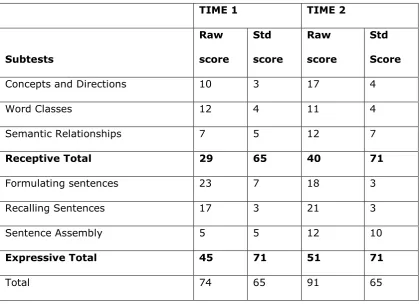
Difficulties Questionnaire (SDQ, Goodman 1997), indicating ratings within normal limits for all behavioural aspects, and no abnormal indicators of hyperactivity. The scores for his performance on the CELF-3(UK) are shown in Table 1.
Specific Language Impairment. It also confirmed that George did not consistently under-perform in formal test situations. George was receiving language therapy within the language resource base of a mainstream school.
It was observed at the time that George formulated long, poorly constructed and imprecise sentences. For example, when asked to produce a sentence containing the word ‘because’, George produced ‘The two boys and the dog wanted to cross. They had to wait because the man had to direct first then the two man and the dog
could get across’.
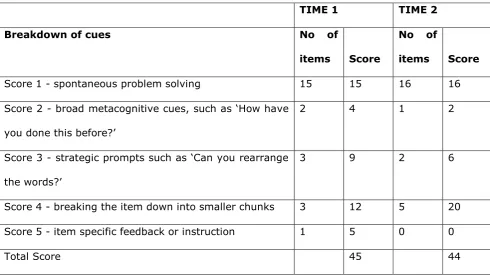
Fifteen items were solved correctly spontaneously. Mediation of the remaining items enabled George to attend to strategic sentence construction and focus on the detail of placement of grammatical items such as articles and pronouns. The number of items requiring additional cues of different levels is shown in Table 2, which also illustrates the calculation of a total score.
The low score (below 60) on the DA suggested good learning potential, as George responded to low level prompts. Furthermore, there was evidence of transfer of learning during the test, such as the strategy of question formation which was initially mediated and subsequently used spontaneously. Similarly, in items which contained dative constructions, having been prompted to arrange the elements into a correct sequence, George was able to rearrange semantically equivalent elements into a second sentence with fewer cues.
E.g. Item 5a: ‘The brother and the sister fed the baby a bottle’ required cue level 5, specific feedback and instruction, but George was immediately able to formulate
‘The sister and the brother fed the baby a bottle’ prompted only at level 3 by ‘Can
you rearrange the words?’ Further, he was able to formulate Item 6a ‘The man sent
the lady a card and a present’ with a level 3 strategic prompt, and reversed the
elements for Item 6b spontaneously, without any cues at all.
that he needed to reverse words in the sentence, but struggled to explain this. For example, after switching semantically reversible subjects ‘The dad was riding the
bike and the mum was driving the car’, George explained ‘I swapped it the doing
around’.
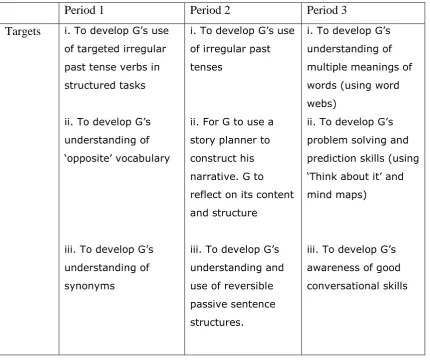
This information about metalinguistic ability, and other data obtained from the DASS was not provided to George’s SLT at this stage. The SLT was asked to describe her ongoing intervention (designated ‘period 1’) with George. This information is summarised in Table 3.
The intervention was largely skills based at word-level, although some metalinguistic scaffolding, using shape coding, was employed. Some good progress towards the targets was made in this therapy over the course of one school term, after which George was reassessed. The reassessment at Time 2, is presented in the next section.
Time 2 Assessment
The CELF-3(UK) was repeated. The results are shown in Table 1 alongside Time 1 scores for comparison purposes.
[TABLE 1 about here]
items in Concepts and Directions, although his score was still so low for his age that he obtained a standard score of 4. Considerable gain was shown in the Sentence Assembly subtest which benefits from practice and the feedback given during the DA procedure, and this, together with the SR gain, suggest good learning skills.
It was noted, however, that the score in Formulating Sentences fell by 5 points, which may reflect an incomplete grasp of the features of the target word. For example, at Time 1, given the word ‘instead’ George produced the sentence,
‘The boys hated the books and he asked for the dinosaur book instead’, which was
given a score of 2 as the use of ‘instead’ was apparently correct. At Time 2, however, he produced ‘Instead the boy wanted encyclopaedias, he wanted a
dinosaur book’, which was given a score of 0 for incorrect use of the target term.
Although it would seem that George knew the meaning of the word, his grasp of the syntactic constraints for its use was incomplete. The standardised scoring is not sensitive to this distinction.
The DASS was then carried out again, using a parallel form. Sixteen items were spontaneously solved correctly (level 1). The total number of cues that George required to complete all the sentences was 44. The number of items requiring further cues is shown in Table 2, with the Time 1 results. .
[TABLE 2 about here]
The repeated DASS suggested that George had retained skills and strategies mediated to him during the first administration of the test. No further prompting was required for George to see when a question form was required, and dative constructions required less prompting. Some difficulty was encountered with the final three items, particularly with the combination of a number of different pronouns in a sentence, (‘He can put his keys on the rack’) and the use of the subordinating temporal conjunction ‘after’. George had solved these anagrams more easily at Time 1 and his performance suggested either a fragile grasp of these constructions that was not stable with different examples (as exemplified in the parallel forms of the test), or a loss of concentration towards the end of the session.
the assessor during the assessment. Some recommendations for intervention arising out of the assessment were made, although specific targets were not devised.
The frequency and duration of George’s therapy sessions were unchanged in the second intervention period, but the targets were changed to more syntactic ones, as shown in Table 3.
[Table 3 about here]
Observation of the intervention revealed the use of largely paper and pencil based tasks with George providing written as well as spoken responses in a session lasting approximately 20 minutes. Several activities were used to consolidate George’s grasp of target structures (see Appendix II).
The outcomes of therapy after these changes were implemented were measured by repeated administration of the CELF-3 (Time 3, start of the summer term, in May).
Results
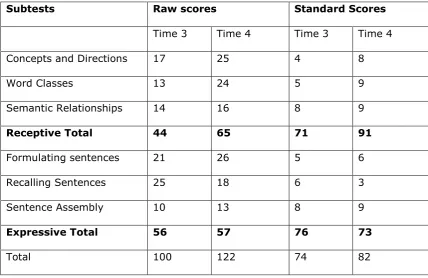
Gains at Time 3 and Time 4, after two further school terms of therapy, by which time George had climbed 12 percentile points on the CELF-3(UK), are shown in Table 4.
[Table 4 about here].
Strategies such as problem solving that were addressed in language therapy, and careful planning of responses that was mediated to George during the repeated administrations of the DASS, enabled George to make better use of the implicit linguistic knowledge that he had.
Some progress towards functional improvement of expression, in terms of information selected, was noted. For example, the redundant sentence ‘Whenever when the children sit on their desk they have to wait two minutes until their teacher
arrive at 12 o’clock’ (Time 1) was improved to ‘Whenever its 12 o’clock the teacher
comes in’ (Time 4).
Performance on the DASS
unable to complete without help. Retention and transfer of learning were confirmed as strengths for George.
Discussion
The purpose of the current study was to find out whether additional information about George’s language elicited by the DASS, and used to plan successive terms of language therapy, elicited improved outcomes from intervention. The case study used repeated baseline measures so that the participant served as his own control, as recommended by Vance and Clegg (2012), and the dependent variable, namely performance on the standardised language test was collected at four time points.
Despite George having received support via SLT and a language resource base at his school, at the start of the study, a norm referenced, standardised test showed him to be achieving on the first percentile for language. Children with language impairments do not always perform reliably on static tests, but at the same time, George demonstrated non-verbal skills in the 95th percentile, suggesting that he is
During the year in which the study was carried out, George’s overall performance on the CELF improved up to a Total standard score of 82, which represents performance on the 12th percentile, and a substantial improvement during the year. The gains were, however, predicted by the DASS in which George obtained a low score, indicating good potential for learning. Strengths such as transfer of learning, and good awareness of the demands of the task were noted, and retention of learning was demonstrated in the repeated DASS at Time 2. These factors suggested that George should be a good candidate for intervention and be able to benefit from directed teaching, and indeed this was shown to be the case. Information of this type is not obtained from a static test, and is the unique benefit of the dynamic assessment paradigm.
In addition to the evaluation of learning potential, it was seen that targets for the subsequent periods of therapy were focussed on more metalinguistic awareness of narrative construction, passive sentence structures, multiple meanings for words, and problem solving. Few standardised tests for metalinguistic knowledge, other than of phonological awareness, are currently available. Assessments of metalinguistic awareness are usually linked to reading assessments or judgements of grammaticality, and studies investigating metalinguistic ability in clinical populations have not used normative data.
probe not only the item, but related knowledge (metalinguistic) and strategy use (metacognitive). The additional probing questions and responses obtained in the clinical interview were not included in the scoring as they were carried out after the item had been solved and the cue level recorded. They would not therefore have interfered with the basic procedure and the reliability of scoring. The benefits of the additional information for increasing understanding of the children’s performances, and adding to targets and strategies for intervention were thought to be considerable, and the clinical interview was considered an essential additional component of the DASS (Hasson 2011).
Nevertheless, it is recognized that the interview process was subjective and dependent on the assessor, and that there would be little consistency between examiners. In accordance with the recommendations made by Peña, recordings of the sessions and notes made during the session would be retained for inspection by others involved in the management of the child.
rules and strategies are made explicit to the learner, and it unsurprising that given information regarding George’s metalinguistic and metacognitive skills, these aspects were incorporated into therapy. The study provides some support for the role of metalinguistic interventions, as advocated by Ebbels (2008), and discussed by Law et al (2008). Children such as George, whose metalinguistic skills appear to be weak, in the presence of good nonverbal cognitive skills, good strategies for problem solving, and high levels of motivation, may well benefit from a more strategic problem solving approach to language. Furthermore, intervention that makes linguistic rules explicit, would enable him to reason in linguistic terms and access higher order language structures.
The present case study lends support to the notion of detailed profiling of ability prior to the planning of intervention for language, and also at intervals throughout the episode of care. Whilst the information to be gained about an individual child is not unique to the DA, and may in fact be self evident to teachers and SLTs who have worked with the child, the time taken to elicit the information is substantially reduced. Unlike some DA procedures, additional assessment time was not required and the investment of time in assessment was justified by the quality of information obtained from the assessment, and the outcomes of the intervention..
the individual SLT, and inevitably individual preferences come into play. Further research could define the parameters of the intervention, prescribing targets and methods that are adaptable within circumscribed limits for the individual child, according to their profile of abilities. Nevertheless, there is clear indication that children who make limited progress in intervention may benefit from alternative, more detailed assessments, and the trial of a different approach to intervention in order to improve outcomes.
Acknowledgements
The author wishes to thank Nicola Botting for her guidance throughout the development of procedures used in this study; the SLT whose work is reported in this study, ‘George’ and all the children, families, schools and SLTs who participated in the original project.
References
Camilleri B and Botting N (2013) Beyond static assessment of children’s receptive vocabulary: the dynamic assessment of word learning (DAWL). International
Journal of Language and Communication Disorders. 48(5): 565-581.
Camilleri B and Law J (2007) Assessing children referred to speech and language therapy: Static and dynamic assessment of receptive vocabulary. International
Journal of Speech-Language Pathology, 9(4): 312-322.
Campione JC and Brown AL (1987) Linking dynamic assessment with school achievement. In: CS Lidz (Ed) Dynamic Assessment. An Interactional Approach to
Evaluating Learning Potential. New York: Guilford Press, pp. 82-115.
Clark MK and Kamhi AG (2013) Language Disorders (Child Language Disorders). In: Stone JH and Blouin M (Eds) International Encyclopedia of Rehabilitation. Available online: http://cirrie.buffalo.edu/encyclopedia/en/article/31/
Ebbels S (2008) Improving grammatical skill in children with specific language impairment. In: Norbury CF, Tomblin JB and Bishop DVM (Eds) Understanding
Developmental Language Disorders. From Theory to Practice. UK: Psychology Press,
pp. 149-174.
Gillam R. and McFadden TU (1994) Redefining assessment as a holistic discovery process. Communication Disorders Quarterly 16(1): 36-40.
Goodman R (1997) The Strengths and Difficulties Questionnaire: A Research Note.
Journal of Child Psychology and Psychiatry 38: 581-586.
Grigorenko EL and Sternberg RJ (1998) Dynamic assessment. Psychological bulletin,
124: 75-111.
Hasson N (2011) Dynamic Assessment and Informed Intervention for Children with
Language Impairment. Phd Thesis, City University London, UK.
Hasson N, Dodd B and Botting N (2012) Dynamic Assessment of Sentence Structure (DASS): Design and evaluation of a novel procedure for assessment of syntax in children with language impairments. International Journal of Speech
Language and Communication Disorders 47(3): 285-299
Haywood HC and Lidz CS (2007) Dynamic Assessment in Practice. Clinical and
Educational Applications. New York: Cambridge University Press.
Hessels MGP Berger JL and Bosson M (2008) Group Assessment of Learning
Potential of Pupils in Mainstream Primary Education and Special Education Classes.
Journal of Cognitive Education and Psychology, 7(1): 43-69.
Laing SP and Kamhi A (2003) Alternative assessment of language and literacy in culturally and linguistically diverse populations. Language Speech and Hearing
Services in Schools, 34(1): 44-55.
Law J, Campbell C, Roulstone S, Adams C and Boyle J (2008) Mapping practice onto theory: the speech and language practitioner's construction of receptive language impairment. International Journal of Language & Communication Disorders 43(3): 245-263.
Lidz CS (1991) Practitioner's guide to dynamic assessment. New York: The Guilford Press.
Lloyd JW and Blandford BJ (1991) Assessment for instruction. In: Swanson HL (Ed)
Handbook on the Assessment of Learning Disabilities. Texas: Pro-Ed, pp. 45-58.
Meltzer L and Reid DK (1994) New directions in the assessment of students with special needs: The shift toward a constructivist perspective. The Journal of Special
Education 28(3): 338-355.
Olswang L, Bain B and Johnson G (1992) Using dynamic assessment with children with language disorders. In: Warren S and Reichle J (Eds) Causes and effects in
communication and language intervention. Baltimore: Paul H Brookes, pp187-215
Peña ED (2001) Assessment of semantic knowledge: Use of feedback and clinical interviewing. Seminars in speech and language, 22(1): 51-63.
Peña ED and Gillam RB (2000) Dynamic Assessment of Children referred for Speech and Language Evaluations. In: Lidz CS and Elliott J (Eds) Dynamic Assessment:
Prevailing Models and Applications. Amsterdam:Elsevier science, pp. 543-575.
Seeff-Gabriel B, Chiat S, and Pring T (2012) Intervention for co-occurring speech and language difficulties: Addressing the relationship between the two domains.
Child Language Teaching and Therapy 28(1): 123-135
Semel E, Wiig EH and Secord WA (1987) Clinical Evaluation of Language
Fundamentals. 3rd Edition(UK). UK: The Psychological Corporation.
Vance M and Clegg J (2012) Use of single case study research in child speech, language and communication interventions. Child Language Teaching and Therapy
Appendix I. Report provided to ‘George’s’ Speech and Language Therapist
Findings of Dynamic assessment
Name… ‘George’ Date: February
1. Detail of language structures that the child has difficulty with, that is additional
to that obtained from the standardised tests
Some difficulty formulating indirect and direct object
Used possessive –s without recognizing possessive – identified as plural –s Some confusion between pronouns ‘he’ and ‘his’
Sometimes struggles with selection of articles and pronouns Difficulty formulating sentence with conjunction ‘after’
2. the effect of amount of content and nature of semantic content on the child’s
construction of linguistic structures
No difficulty with increased sentence length
Good awareness of semantic constraints and recognizes humour in inappropriate sentences
3. the child’s ability to transfer, or generalise learning or strategies ie. item - to
item transfer
Transfer of OdOi structure across items
4. the child’s metalinguistic knowledge, ability to label, explain and manipulate linguistic concepts
Good task awareness, though unable to formulate explanation – ‘have to mix it up’ and later ‘make a sentence’
Aware that he formulated a question.
Attempts to describe linguistic manipulation - ‘changed these 3 words , left the rest the same’ – not well formulated or accurate ie has metalinguistic awareness but not expression
Attempts to justify construction – ‘its right because..’ - but explanation is rambling and unclear and although it has some appropriate elements, such as starting with ‘is’, does not actually explain his meaning.
Identified aux ‘is’ as ‘helping for doing’ aware of functional use, also aware that it is used in question formation, though struggled to explain
Aware of reversible elements in sentence
Grasped explanation of possessive quickly and able to apply
Able to explain that ‘isn’t’ = is not, and can be used in same way as ‘is’ Attempts to identify aux ‘can’ as ‘what doing’
5. the child’s metacognitive ability ie awareness of the processes and strategies
that are used to solve the given task
Spontaneously identified – ‘now I’ll swop it around’
Responsive to mediation of checking behaviour and attention to detail Difficulty summarizing – recalls individual examples rather than principles
Behavioural Factors:
George maintained attention very well throughout the session, with little input from tester.
• motivation / attitude to learning / interest / response to input, while engaged in
the presented task
George seemed motivated to complete the task, wanting to solve the individual problem items. He was very responsive to input, and contributed ideas and explanations spontaneously
• use of strategies, including reliance on others for help
George attempted to use strategies to complete the items, was aware that he had manipulated the words in definite ways, although he was not really able to explain what he was doing. He was responsive to help, but did not actively seek input nor did he rely on the tester, but continued to work at the items himself.
Summary:
• learning needs, ie whether the individual requires metacognitive monitoring, strategy training or item specific application of knowledge
• the individual’s learning needs in terms of amount of input required from examiner
George attempted to impose order on his responses and explain or justify what he had produced, however these explanations were imprecise and George did not seem to have the vocabulary and concepts to explain himself. His metalinguistic knowledge is implicit, he indicated that he was aware of the manipulations, but was unable to express them clearly. There is a need for George to increase his
metalinguistic vocabulary alongside syntactic expression to reason linguistically and develop higher level language structures. George has a good semantic
understanding and appreciates absurdity and humour, although the structural details are not grasped.
In the first CELF-3 test in October, George’s expressive language score was higher than his receptive language, and although this may be an artefact of testing, George’s attention to detail and careful gathering of information may be impaired so that he does not fully process incoming language. He has difficulty following instructions and checking that he has planned his responses carefully. His teacher identified several functional difficulties related to attending to and processing verbal information, instructions and rules.
In summary, it would appear that George’s typical performance does not reflect the extent of his knowledge. He would benefit from improvement of his cognitive
Appendix II Methods and activities used by SLT during consecutive terms of therapy with George.
Period 1 Period 2 Methods / Activities i. G was required to match
present tense with verbs with their past tense forms (Regular/irregular pairs)
ii. Comprehension task, G was required to identify pairs of words with the same meaning, and opposite meanings
iii. G was required to describe a sequence of 6 picture cards using shape coding to scaffold his responses.
i. Sorting present and past tense verb forms. Generating an irregular verb from a present tense form. Practice using irregular verbs at sentence level.
ii. A story planner focusing on: Who? What doing? Where?, Beginning, middle and end, was used to help G construct a more coherent narrative.
iii. Discussion regarding reversible passive sentence structures, with examples. G constructed reversible
Table 1. Results of the CELF-3(UK) for George at Time 1 and Time 2.
TIME 1 TIME 2
Subtests
Raw
score
Std
score
Raw
score
Std
Score
Concepts and Directions 10 3 17 4 Word Classes 12 4 11 4 Semantic Relationships 7 5 12 7
Receptive Total 29 65 40 71
Formulating sentences 23 7 18 3 Recalling Sentences 17 3 21 3 Sentence Assembly 5 5 12 10
Expressive Total 45 71 51 71
Table 2: Cue levels, and the breakdown of scoring on the DASS for George at Time 1 and Time 2
TIME 1 TIME 2
Breakdown of cues No of
items Score
No of
items Score
Score 1 - spontaneous problem solving 15 15 16 16 Score 2 - broad metacognitive cues, such as ‘How have
you done this before?’
2 4 1 2
Score 3 - strategic prompts such as ‘Can you rearrange the words?’
3 9 2 6
Score 4 - breaking the item down into smaller chunks 3 12 5 20 Score 5 - item specific feedback or instruction 1 5 0 0
Table 3. Targets of Intervention for George in consecutive blocks of therapy.
Period 1
Period 2
Period 3
Targets
i. To develop G’s useof targeted irregular past tense verbs in structured tasks
ii. To develop G’s understanding of ‘opposite’ vocabulary
iii. To develop G’s understanding of synonyms
i. To develop G’s use of irregular past tenses
ii. For G to use a story planner to construct his narrative. G to reflect on its content and structure
iii. To develop G’s understanding and use of reversible passive sentence structures.
i. To develop G’s understanding of multiple meanings of words (using word webs)
ii. To develop G’s problem solving and prediction skills (using ‘Think about it’ and mind maps)
Table 4. Results of the CELF-3(UK) for George at Time 3 and Time 4.
Subtests Raw scores Standard Scores
Time 3 Time 4 Time 3 Time 4 Concepts and Directions 17 25 4 8 Word Classes 13 24 5 9 Semantic Relationships 14 16 8 9
Receptive Total 44 65 71 91
Formulating sentences 21 26 5 6 Recalling Sentences 25 18 6 3 Sentence Assembly 10 13 8 9
Expressive Total 56 57 76 73