City, University of London Institutional Repository
Citation
:
Defever, F., Heid, B. and Larch, M. (2015). Spatial exporters. Journal of
International Economics, 95(1), pp. 145-156. doi: 10.1016/j.jinteco.2014.11.006
This is the supplemental version of the paper.
This version of the publication may differ from the final published
version.
Permanent repository link:
http://openaccess.city.ac.uk/16008/
Link to published version
:
http://dx.doi.org/10.1016/j.jinteco.2014.11.006
Copyright and reuse:
City Research Online aims to make research
outputs of City, University of London available to a wider audience.
Copyright and Moral Rights remain with the author(s) and/or copyright
holders. URLs from City Research Online may be freely distributed and
linked to.
City Research Online:
http://openaccess.city.ac.uk/
[email protected]
Online Appendix for
“Spatial Exporters”
Fabrice Defever
∗
, Benedikt Heid
†
, Mario Larch
‡
Forthcoming at the
Journal of International Economics
Abstract
This document presents supplemental material for the paper
“Spatial Exporters”. It contains further descriptive evidence for
firm-specific heterogeneity in export destinations, detailed first stage
re-gression results, further dynamic panel estimates using only a
one-period lag, an additional external instrument as well as results using
the difference-GMM estimator by Arellano and Bond (1991), further
multi-product firm regressions, miscellaneous robustness checks, all
re-gressions from the main text including country-specific time trends,
dynamic panel results for a sample including firms which entered
MFA-restricted countries between 2000 and 2004, as well as the empirical
probabilities of exporting to a country and descriptive statistics of the
samples used in the main text.
∗
University of Nottingham, GEP and CEP/LSE,
[email protected]
†
University of Bayreuth,
[email protected]
‡
University
of
Bayreuth,
ifo
Institute,
CESifo
and
GEP,
Appendix
A
Evidence for firm-specific heterogeneity in
export destinations
In order to shed light on the entry of firms into different markets in our sample
of firms, we follow Eaton et al. (2011) and first assume that firms follow a
common hierarchy, meaning that a firm that sells to the
k
+ 1st most popular
export destination necessarily sells to the
k
th most popular destinations as
well. We present the top seven export destinations of the Chinese exporters in
our sample, excluding the MFA-restricted countries. In Table A.1 we report
the number of firms exporting to each of the seven most popular destinations,
as well as the unconditional empirical probability of Chinese exporters selling
there. We clearly see that common gravity variables, like distance and country
size, matter.
Again following Eaton et al. (2011), in Table A.2 we report strings of the
top-seven destinations that obey a hierarchical structure, alongside the
num-ber of firms selling to each string. For example, the export string JPN means
that the firm exports to Japan but to no other destination among the top 7
non-MFA destinations. Similarly, the string JPN-KOR means that the firm
exports to Japan and South Korea but no other destination among the top
7 non-MFA destinations, and so forth. Overall, 66 percent (861/1295) of all
firms in our sample adhere to the hierarchy given by the top seven non-MFA
export destinations. Hence, about a third of the firms export to a different
set of countries, implying a substantial amount of heterogeneity across firms
in terms of the set of export destinations they serve. The column labeled
“In-dependence” in Table A.2 reports, based on the unconditional probabilities
presented in Table A.1, the number of firms selling to each hierarchical string
assuming independence across destination choices of a firm. If a firm chose
export destinations independently, the number of firms sticking to the
Table A.1: Chinese Textile and Apparel Firms
Export-ing to the Seven Most Popular Non-MFA Destinations
in 2006
Export destination
Number of
exporters
Fraction of
exporters
Japan (JPN)
973
0.751
South Korea (KOR)
328
0.253
Singapore (SGP)
81
0.063
Australia (AUS)
70
0.054
Vietnam (VNM)
62
0.048
Thailand (THA)
57
0.044
Malaysia (MYS)
46
0.036
All Chinese exporters
∗1,295
Notes:∗in our sample. Table shows the seven most popular export desti-nations of the 1,295 textile and apparel firms in our sample excluding the 27 MFA/ATC restricted export destinations for the year 2006. The table follows closely Table I in Eaton et al. (2011). We describe the construction of the sample in detail in Section 2.1 of the main manuscript.
the common hierarchy, i.e. 12 percent more than what independence would
imply. Hence, in our empirical specification we will have to take into account
that export destinations within firms are clustered spatially, and that there is
considerable heterogeneity in export destinations across firms. We therefore
Table A.2:
Chinese Textile and Apparel Firms Exporting to
Strings of Top-Seven Non-MFA Destinations in 2006
Number of Exporters
Export String
aData
Independence
JPN
676
565
JPN-KOR
175
191
JPN-KOR-SGP
8
13
JPN-KOR-SGP-AUS
1
1
JPN-KOR-SGP-AUS-VNM
0
0
JPN-KOR-SGP-AUS-VNM-THA
0
0
JPN-KOR-SGP-AUS-VNM-THA-MYS
1
0
Total
861
770
Notes:aThe export string JPN means exporting to Japan but no other destination among
B
Detailed first stage regression results
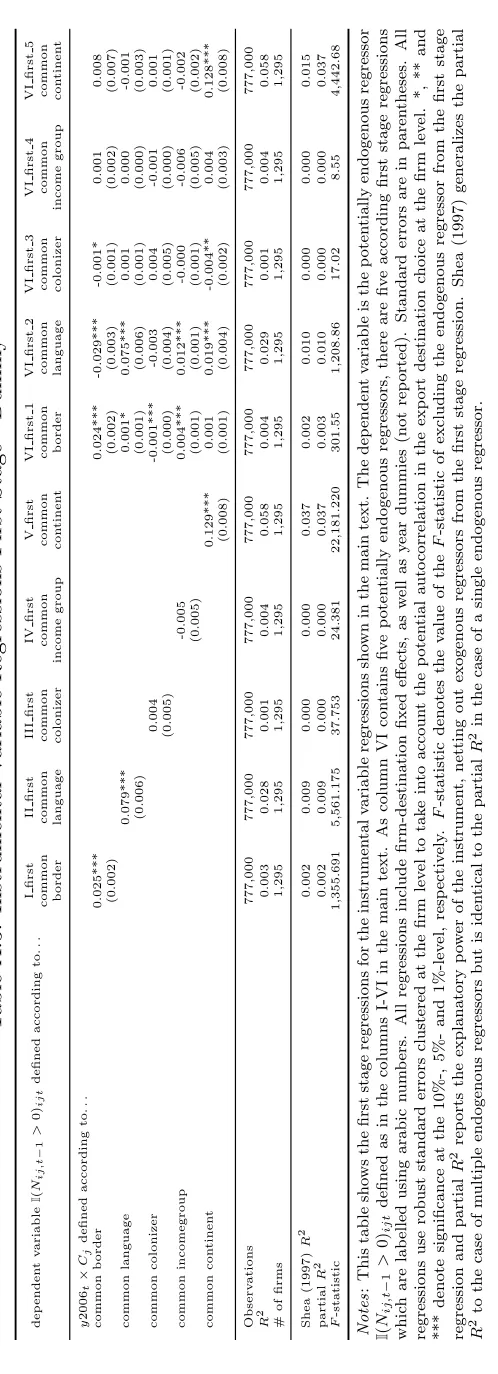
We present detailed results of the first stage regressions for the instrumental
panel regressions presented in Section 3.3 in the main manuscript in Tables
A.3 and A.4.
Weak instrument test statistics are derived under the assumption of
iid
errors. If errors are not
iid
, Baum et al. (2007) propose to still use these
statistics and compare them to the Stock and Yogo (2005) critical values or
the Staiger and Stock (1997) rule of thumb of a
F
-statistic for the excluded
instruments in the first stage regression to be larger than 10. In our case, all
the tests reject that we have a weak instrument problem.
We also provide the partial
R
2(i.e. the
R
2of the instrument in the first
stage regression, netting out the explanatory power of exogenous regressors).
It measures the explanatory power of our instruments.
Admittedly, these
are very low. However, this has to be put in perspective: We use a discrete
choice panel of export decisions at the firm level.
R
2measures of demeaned
panel models such as ours (i.e. of within-models which remove the explanatory
power of the firm-destination fixed effects) for firm-level studies tend to be low,
even more so for discrete choice data sets of export destination choices, see
Albornoz et al. (2012). Therefore, even though low partial
R
2s are not exactly
good news, we would like to stress that a low partial
R
2is only a problem if we
had weak instruments which are not strictly exogenous. If one believes in our
instruments, then we get consistent estimates even if the explanatory power
of the instrument is weak. Also, please note that our instruments only vary at
the country level by construction; actually, this is the motivation behind our
C
Dynamic Panel Estimates Using Only
One-Period Lag with Country-Specific Time Trends
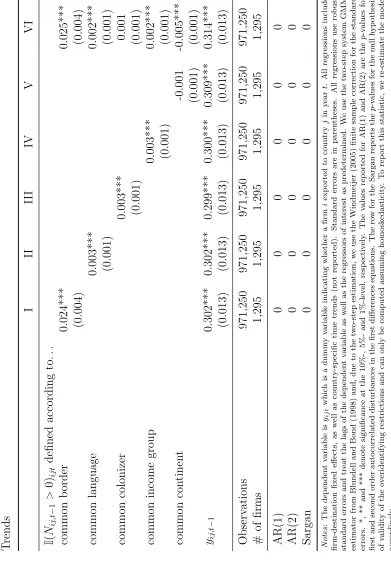
In Tables A.5 and A.6 we present results for System-GMM estimates of the
dynamic panel model using only one lag. As can be seen, while coefficient
estimates remain similar to our preferred specification, the specifications with
D
Dynamic Panel Estimates Using an
Addi-tional External Instrument
Dynamic panel models have been developed to provide consistent parameter
estimates when only internal instruments are available. However, they also
allow to include external instruments to receive additional moment conditions
for estimation. We present results where we include our proposed instruments
(
y
2006
t×
C
jand
y
2006
t×
N
j, respectively) from the instrumental variable
regressions from Section 3.3 in the main manuscript in Tables A.7 and A.8.
Qualitatively, results remain similar, but model specification tests perform
considerably better, as the Sargan test for the validity of our instruments
cannot be rejected for the majority of specifications in Table A.7. This provides
E
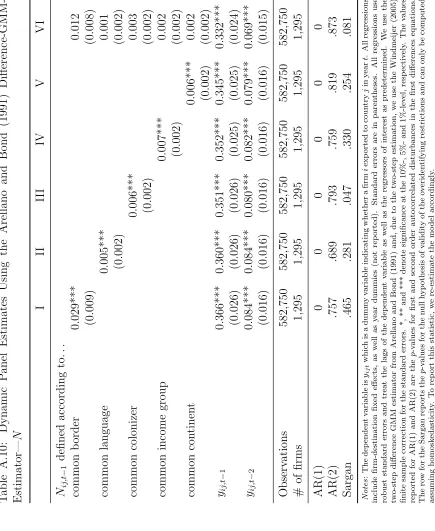
Dynamic Panel Estimates Using the
Arel-lano and Bond (1991) Difference-GMM-Estimator
In Tables A.9 and A.10 we use the Difference-GMM estimator from Arellano
and Bond (1991) instead of the System-GMM estimator from Blundell and
Bond (1998) used in the main manuscript. The Difference-GMM estimator
has the main advantage of being more robust in the sense that less restrictive
moment conditions are used for estimation. However, it may suffer from severe
finite sample bias if the persistence of the dependent variable is high. Note
that using the Difference-GMM estimator we lose an additional year of our
dataset for the estimation. Results stay very similar. In addition, the model
specification tests perform considerably better compared to the System-GMM
estimates as they do not reject the model in the majority of cases, including
F
Multi-Product Firms: Dynamic Panel Estimates—
N
In Table A.11 we present multi-product regressions with the number of
con-tiguous export destinations as an alternative regressor:
y
ijt=
φ
1y
ij,t−1+
φ
2y
ij,t−2+
δ
1N
ij,tsameproduct−1+
δ
2N
ij,totherproducts−1+
θ
ij+
θ
t+
ijt.
(1)
By and large, results are very similar when compared to Table 8 in the main
text. Common border for the same product has again the largest marginal
effect. We again do not find evidence for across product learning. Interestingly,
we now find a small but positive and significant effect of having exported to a
G
Miscellaneous robustness checks
Table A.12 presents the regression results for the first six robustness checks
discussed in Section 5 in the main manuscript concerning lagged export values,
competitors’ success, trading agents, state-owned firms, foreign-owned firms,
and processing trade.
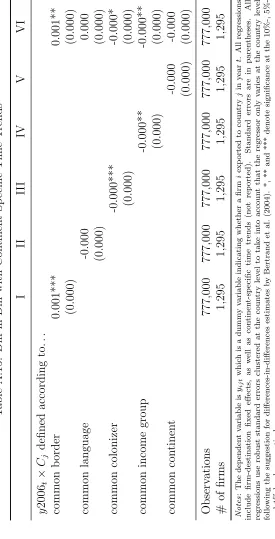
In Table A.13, we present results for the diff-in-diff specification excluding
T
able
A.13:
Diff-in-Diff
Excluding
Russia
I
II
II
I
IV
V
VI
y
2006
t
×
C
jdefined
according
to.
..
common
b
order
0.001***
0.001***
(0.000)
(0.000)
common
language
0.000
0.000
(0.000)
(0.000)
common
colonizer
-0.000
-0.000
(0.000)
(0.000)
common
income
group
-0.000
-0.000*
(0.000)
(0.000)
common
con
tinen
t
0.000***
0.000
(0.000)
(0.000)
Observ
ations
771,820
771,820
771,820
771,820
771,820
771,820
#
of
firms
1,295
1,295
1,295
1,295
1,295
1,295
Notes
:
The
dep
enden
t
v
ariable
is
yij
t
whic
h
is
a
dumm
y
v
ariable
indicating
whether
a
firm
i
exp
o
rted
to
coun
try
j
in
y
ear
t
.
All
regressions
include
firm-destination
fixed
e
ffects,
as
w
ell
as
y
ear
dummies
(not
rep
orted).
Standard
error
s
are
in
paren
theses.
All
regressions
use
robust
standar
d
errors
clustered
at
the
coun
try
lev
el
to
tak
e
in
to
accoun
t
that
the
regressor
only
v
aries
at
the
coun
try
lev
el
follo
wing
the
suggestion
for
diffe
re
nces-in-differences
estimates
b
y
Bertrand
et
al.
(2004).
*,
**
and
***
denote
significance
at
the
10%-,
5%-and
1%-lev
el,
resp
ectiv
ely
[image:22.612.167.443.141.674.2]H
Controlling for country-specific time trends
Tables A.14 to A.30 present all the tables from the main manuscript including
country-specific time trends as discussed in Section 5 in the main manuscript
under the heading “
Country-specific time trends
”.
H.1
Diff-in-Diff
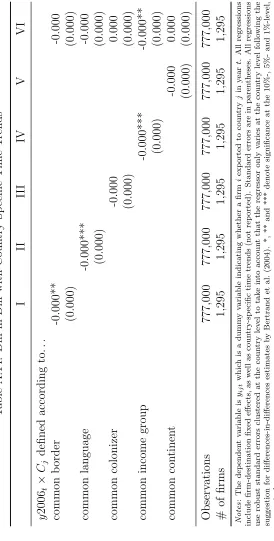
Table A.14 reports the difference in difference estimates. Clearly, we
can-not identify any significant effect of spatial exporters when including
country-specific time trends. This is not too surprising, however, as our treatment only
varies at the country-level and does not use any firm-specific information for
identification.
We therefore also tried out continent-specific time trends. As expected,
results lie in between the estimates without the time trends and the
country-specific time trends. Specifically, sharing a common border remains significant.
T
able
A.14:
Diff-in-Diff
with
Coun
try-Sp
ecific
Time
T
rends
I
II
II
I
IV
V
VI
y
2006
t
×
C
jdefined
according
to.
..
common
b
order
-0.000**
-0.000
(0.000)
(0
.000)
common
language
-0.000***
-0.000
(0.000)
(0.000)
common
colonizer
-0.000
0.000
(0.000)
(0
.000)
common
income
group
-0.000***
-0.000**
(0.000)
(0.000)
common
con
tinen
t
-0.000
0.000
(0.000)
(0.000)
Observ
at
ions
777,000
777,000
777,000
777,0
00
777,000
777,000
#
of
firms
1,295
1,295
1,295
1,295
1,295
1,295
Notes
:
The
dep
enden
t
v
ariable
is
yij
t
whic
h
is
a
dumm
y
v
ariable
indicating
whether
a
firm
i
exp
orted
to
coun
try
j
in
y
ear
t
.
All
regressions
include
firm-destination
fixed
effects,
as
w
ell
as
coun
try-sp
ecific
time
trends
(not
rep
orted).
Standard
errors
are
in
paren
theses.
All
regressions
use
robust
standard
err
ors
clustered
at
the
cou
n
try
lev
el
to
tak
e
in
to
accoun
t
that
the
regressor
only
v
aries
at
the
coun
try
lev
el
follo
wing
the
suggestion
for
differences-in-differences
estimates
b
y
Bertrand
et
al.
(2004).
*,
**
and
**
*
denote
significance
at
the
10%-,
5%-and
1%-lev
el,
resp
e
ctiv
ely
[image:24.612.167.441.132.673.2]T
able
A.15:
Diff-in-Diff
with
Con
tinen
t-Sp
ecific
Time
T
rends
I
II
II
I
IV
V
VI
y
2006
t
×
C
jdefined
according
to.
..
common
b
order
0.001***
0.001**
(0.000)
(0.00
0)
common
language
-0.000
0.000
(0.000)
(0.000)
common
colonizer
-0.000***
-0.000*
(0.000)
(0.000)
common
income
group
-0.000**
-0.000**
(0.000)
(0.000)
common
con
tinen
t
-0.000
-0.000
(0.000)
(0.000)
Observ
at
ions
7
77,000
777,000
777,000
777,000
777,000
777,000
#
of
firms
1,295
1,295
1,295
1,295
1,295
1,295
Notes
:
The
dep
enden
t
v
ariable
is
yij
t
whic
h
is
a
dumm
y
v
ariable
indicating
whether
a
firm
i
exp
orted
to
coun
try
j
in
y
ear
t
.
All
regressions
include
firm-destination
fixed
effects,
as
w
ell
as
con
tinen
t-sp
ecific
ti
me
trends
(not
rep
orted).
Standard
errors
ar
e
in
paren
the
ses.
All
regressions
use
robust
standard
errors
clustered
at
the
coun
try
lev
el
to
tak
e
in
to
accoun
t
that
the
regressor
only
v
aries
at
the
coun
try
lev
el
follo
wing
the
suggestion
for
differences-in-differences
estimates
b
y
Bertrand
et
a
l.
(2004).
*,
**
and
***
denote
significance
at
the
10%-,
5%-and
1%-lev
el,
resp
ectiv
ely
[image:25.612.167.442.136.675.2]H.2
Fixed effects regression taking into account
firm-level history
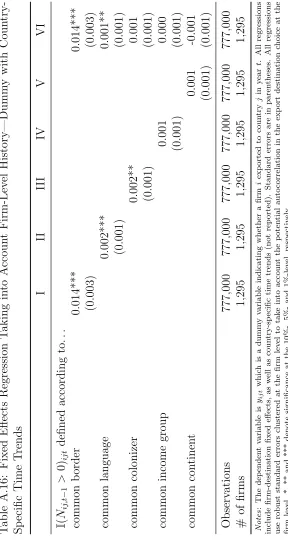
Tables A.16 and A.17 present the fixed effects regressions taking into account
firm-level history. In this specifications, results are robust and even become
T
able
A.16:
Fixed
Eff
ects
Regression
T
aking
in
to
Accoun
t
Firm-Lev
el
History—
Dumm
y
with
Coun
try-Sp
ecific
Time
T
rends
I
II
II
I
IV
V
VI
I
(
N
ij,t
−
1
>
0)
ij
t
defined
according
to.
..
common
b
order
0.014***
0.014***
(0.003)
(0.003)
common
language
0.002***
0.001**
(0.001)
(0.001)
common
colonizer
0.002**
0.001
(0.001)
(0.001)
common
income
group
0.001
0.000
(0.001)
(0.001)
common
con
tinen
t
0.001
-0.001
(0.001)
(0.001)
Observ
ations
777,000
777,000
777,000
777,000
777
,000
777,000
#
of
firms
1,295
1,295
1,295
1,295
1,295
1,295
Notes
:
The
dep
enden
t
v
ariable
is
yij
t
whic
h
is
a
dumm
y
v
ariable
indicating
whether
a
firm
i
exp
o
rted
to
coun
try
j
in
y
ear
t
.
All
regressions
include
firm-d
e
stination
fixed
effects,
as
w
ell
as
coun
try-sp
ecific
time
trends
(not
rep
orted).
Standard
errors
are
in
paren
theses.
Al
l
regressions
use
robust
standard
errors
clustered
at
the
firm
lev
el
to
tak
e
in
to
accoun
t
the
p
oten
tial
auto
correlation
in
the
exp
ort
destination
choice
at
the
firm
lev
el.
*,
**
and
***
denote
significance
at
the
10%-,
5%-and
1
%
-l
ev
el,
resp
ectiv
ely
[image:27.612.159.447.128.681.2]T
able
A.17:
Fixed
Effects
Regression
T
aking
in
to
Accoun
t
Firm-Lev
el
History—
N
with
Coun
try-Sp
ecific
Time
T
rends
I
II
II
I
IV
V
VI
N
ij,t
−
1
defined
according
to.
..
common
b
order
0.011***
0.010
***
(0.003)
(0.003)
common
language
0.001**
0.000
(0.001)
(0.000)
common
colonizer
0.003***
0.002**
(0.001)
(0.001)
common
income
group
0.002**
0.001
(0.001)
(0.001)
common
con
tinen
t
0.001
0.00
0
(0.001)
(0.001)
Observ
ations
777,000
777,000
777,000
777,000
777,000
777,0
00
#
of
firms
1,295
1,295
1,295
1,295
1,295
1,295
Notes
:
The
de
p
enden
t
v
ariable
is
yij
t
whic
h
is
a
dumm
y
v
ariable
indicating
whether
a
firm
i
exp
or
te
d
to
c
o
un
try
j
in
y
ear
t
.
All
regressions
include
firm-destination
fixed
effects,
as
w
ell
as
co
un
try-sp
ecific
time
trends
(not
rep
orted).
Standard
errors
are
in
paren
these
s.
All
regressions
use
robust
standard
e
rrors
clustered
at
the
firm
lev
el
to
tak
e
in
to
accoun
t
the
p
oten
tial
auto
correlation
in
the
exp
ort
destination
choice
at
the
firm
lev
el.
*,
**
a
nd
***
denote
significance
at
the
10%-,
5
%-and
1%-lev
el,
re
sp
ectiv
ely
H.3
Instrumental variable regressions
Tables A.18 to A.21 present instrumental variable regressions including
country-specific time trends alongside the accompanying first stage regression results.
Here, results seem not to be robust, with the majority of all estimated
co-efficients being negative and significant. The unrealistically large coefficient
estimates for column III in both Tables A.18 and A.20 hint at very high
mul-ticollinearity between the country-specific time trends and our regressors of
interest. Evidently, identifying coefficients becomes difficult.
We therefore also tried out continent-specific time trends. As expected,
results lie in between the estimates without the time trends and the
country-specific time trends. Specifically, sharing a common border remains significant.
T
able
A.20:
Instrumen
tal
V
ariable
Regressions—
N
with
Coun
try-Sp
ecific
Time
T
rends
I
II
II
I
IV
V
VI
N
ij,t
−
1
defined
according
to.
..
common
b
order
-0.032
-0.0
11
(0.035)
(0.076
)
common
language
-0.004**
*
0.001
(0.001)
(0.022)
common
colonizer
0.551
0.271
(0.750)
(1.008)
common
income
group
-0.006**
-0.006
(0.003)
(0.007)
common
con
tinen
t
-0.001
-0.001
(0.001)
(0.009)
Observ
ations
777,000
777,000
777,000
777,000
777,000
777,000
#
of
firms
1,295
1,295
1,295
1,295
1
,295
1,29
5
First
stage
F
-statistic
754.3
10,923
0
.316
8,485
5,357
(
)
First
stage
partial
R
2
0.001
0.018
0.000
0.014
0
.009
(
)
Notes
:
The
dep
enden
t
v
ariable
is
yij
t
whic
h
is
a
dumm
y
v
ariable
indicating
whether
a
firm
i
exp
or
te
d
to
coun
try
j
in
y
ear
t
.
All
regressions
include
firm-destination
fixed
effects,
as
w
ell
as
coun
try-sp
eci
fic
time
trends
(not
rep
orted).
W
e
use
the
tw
o-stage
least-squares
within
panel
instrumen
tal
v
ariables
estimator
where
w
e
instrumen
t
the
endogenous
regressor
b
y
y
2006
t
×
Nj
.
Stand
ard
errors
are
in
paren
theses.
All
regressions
use
robust
standard
errors
clustered
at
the
firm
lev
el
to
tak
e
in
to
accoun
t
the
p
oten
tial
auto
correlation
in
the
exp
ort
destination
cho
ice
at
the
firm
lev
el.
*,
**
and
**
*
denote
significance
at
the
10%-,
5%-and
1%-lev
el,
resp
ectiv
ely
.
First
stage
F
-statistic
denotes
the
v
alue
of
the
F
-statistic
of
excluding
the
endogenous
regressor
from
the
fir
st
stage
regression
and
first
stage
par
ti
a
l
R
2
rep
orts
the
explanatory
p
o
w
er
of
the
instrumen
t,
netting
out
exogenous
regressors
from
the
first
stage
regression.
(
):
The
fiv
e
first
stage
regressions
and
statistics
for
the
fiv
e
endogenous
v
ariables
for
column
VI
are
rep
orted
in
T
able
T
able
A.24:
Instrumen
tal
V
ariable
Regressions—
N
with
Con
tinen
t-Sp
ecific
Time
T
rends
I
II
II
I
IV
V
VI
N
ij,t
−
1
defined
according
to.
..
common
b
order
0.053*
0.074**
*
(0.029)
(0.028)
common
language
-0.001
0.000
(0.001)
(0.00
2)
common
colonizer
-0.060
-0.028
(1.057)
(0.139)
common
income
group
-0.004*
-0.005**
(0.002)
(0.002)
common
con
tinen
t
-0.001
-0.003
(0.001)
(0.002)
Observ
ations
777,000
777,000
777,000
777,000
777,000
777,000
#
of
firms
1,295
1,295
1,295
1,295
1,295
1,295
First
stage
F
-statistic
1,551
19,472
158
.0
15,974
5,358
(
)
First
stage
partial
R
2
0.003
0.032
0.000
0.027
0.009
(
)
Notes
:
The
dep
enden
t
v
a
ri
a
ble
is
yij
t
whic
h
is
a
dumm
y
v
ariable
indicating
whether
a
firm
i
exp
o
rted
to
coun
try
j
in
y
ear
t
.
All
regressions
include
firm-destination
fixed
effects,
as
w
ell
as
con
tinen
t-sp
ecific
time
trends
(not
rep
orted).
W
e
use
the
tw
o-stage
least-squares
within
panel
instrumen
tal
v
ariables
estim
a
tor
where
w
e
instrumen
t
the
endogenous
regressor
b
y
y
2006
t
×
Nj
.
Standard
e
rrors
are
in
paren
theses.
All
regressions
use
robust
standard
errors
clustered
at
the
firm
lev
el
to
tak
e
in
to
accoun
t
the
p
oten
tial
auto
correlation
in
the
exp
ort
destination
choice
at
the
firm
lev
el.
*,
**
and
***
denote
significance
at
the
10%-,
5%-and
1%-lev
el,
resp
ectiv
ely
.
First
stage
F
-statistic
denotes
the
v
alue
of
the
F
-statistic
of
excluding
the
endogenous
regressor
from
the
fir
st
stage
regression
and
first
stage
partial
R
2
rep
o
rts
the
explanatory
p
o
w
er
of
the
instrumen
t,
netting
out
exogenous
regressors
fro
m
the
first
sta
ge
regression.
(
):
The
fiv
e
first
stage
regressions
and
statistics
for
the
fiv
e
endogenous
v
ariables
for
column
VI
are
rep
orted
in
T
able
H.4
Dynamic panel results taking into account state
dependence
Tables A.26 and A.27 present dynamic panel estimates including
country-specific time trends. Results are very similar to the dynamic panel estimates
H.5
Multi-product firms
We present results for multi-product firm regressions including country-specific
time trends in Tables A.28 and A.29. Again, results remain similar to those
H.6
Miscellaneous robustness checks
In this Section, we present the results of including country-specific time trends
I
Different specification for fixed effects
re-gression taking into account firm-level
his-tory
We follow up on footnote 16 in the main manuscript of the paper and
in-troduce
N
ij,tM F A−1, the number of contiguous previous export destinations which
are MFA countries, and
N
ij,tnonM F A−1, the number of contiguous previous
ex-port destinations which are not MFA countries, instead of our default
re-gressor
N
ij,t−1, the total number of contiguous previous export destinations,
in our regressions from Section 3.2 from the main manuscript which present
fixed effects regressions which take into account firm-level history. Note that
N
ij,t−1=
N
ij,tM F A−1+
N
ij,tnonM F A−1. As always, we begin by presenting results where
we apply
I
(
N
ij,t−1>
0)
ijtto each definition of
N
ij,t−1. Obviously, evidence for
spatial exporters in our sample comes predominantly from entering in
previ-ously restricted MFA countries if we define our regressor of interest as sharing a
able
A.31:
Differen
t
Sp
ecification
for
Fixed
Effe
cts
Regression
T
aking
in
to
Accoun
t
Firm-Lev
el
History—
y
I
II
II
I
IV
V
VI
(
N
ij,t
−
1
>
0)
ijt
defined
according
to.
..
common
b
order
and
MF
A
mem
b
er
0.043***
0.042***
(0.014)
(0.014)
common
b
order
but
no
MF
A
mem
b
er
0.011***
0.011***
(0.004)
(0.003)
common
language
and
MF
A
mem
b
er
0.002*
0.001
(0.001)
(0.001)
common
language
but
no
MF
A
mem
b
er
0.002***
0.001**
(0.001)
(0.001)
common
colonizer
and
MF
A
mem
b
er
-0.028
-0.029
(0.032)
(0.031)
common
colonizer
but
no
MF
A
mem
b
er
0.002**
0.001
(0.001)
(0.001)
common
income
group
and
MF
A
mem
b
er
0.000
-0.001
(0.003)
(0.003)
common
income
group
but
no
MF
A
mem
b
er
0.001
0.001
(0.001)
(0.001)
common
con
tinen
t
and
MF
A
mem
b
er
0.003**
0.001
(0.001)
(0.001)
common
con
tinen
t
but
no
MF
A
mem
b
er
0.000
-0.002
(0.001)
(0.001)
Observ
at
ions
777,000
777,000
777,000
777,000
777,000
777,000
#
of
firms
1,295
1,295
1,295
1,295
1,295
1,295
:
The
dep
enden
t
v
ariable
is
yij
t
whic
h
is
a
du
m
m
y
v
ariable
indicating
whether
a
firm
i
exp
orted
to
coun
try
j
in
y
ear
t
.
All
regressions
include
fixed
effec
ts,
as
w
ell
as
y
ear
dummies
(not
rep
orted).
Standard
errors
a
re
in
paren
these
s.
All
regressions
use
robust
standard
errors
at
the
firm
lev
el
to
tak
e
in
to
accoun
t
the
p
oten
tial
auto
correlation
in
the
exp
ort
destination
choice
at
the
firm
lev
el.
*,
**
and
***
deno
te
at
the
1
0%-,
5%-and
1%-lev
el,
resp
ectiv
ely
[image:47.612.95.516.114.706.2]T
able
A.32:
Differen
t
S
p
ecificatio
n
for
Fixed
Effects
Regression
T
aking
in
to
Accoun
t
Firm-Lev
el
History—
N
I
II
II
I
IV
V
VI
N
ij,t
−
1
defined
according
to.
..
common
b
order
and
MF
A
mem
b
er
0.031**
0.027**
(0.013)
(0.01
1)
common
b
order
but
no
MF
A
mem
b
er
0.009***
0.008*
*
(0.003)
(0.00
3)
common
language
and
MF
A
mem
b
er
0.000
-0.000
(0.001)
(0.001)
common
language
but
no
MF
A
mem
b
er
0.002**
0.001
(0.001)
(0.001)
common
colonizer
and
MF
A
mem
b
er
-0.029
-0.031
(0.028)
(0.028)
common
colonizer
but
no
MF
A
mem
b
er
0.003***
0.002**
(0.001)
(0.001)
common
income
group
and
MF
A
mem
b
er
0.001
0.000
(0.002)
(0.002)
common
income
group
but
no
MF
A
mem
b
er
0.002**
0.001*
*
(0.001)
(0.001)
common
con
tinen
t
and
MF
A
mem
b
er
0.002*
0.001
(0.001)
(0.001)
common
con
tinen
t
but
no
MF
A
mem
b
er
0.001
-0.000
(0.001)
(0.001)
Observ
ations
777,000
777,000
777,000
777,000
777,000
777,00
0
#
of
firms
1,295
1,295
1,295
1,295
1,295
1,295
Notes
:
The
dep
enden
t
v
ariable
is
yij
t
whic
h
is
a
dumm
y
v
ariable
indicating
whether
a
firm
i
exp
or
te
d
to
coun
try
j
in
y
ear
t
.
All
regressions
include
firm-destination
fixed
effects,
as
w
ell
as
y
ear
dummies
(not
rep
orted).
Standard
errors
are
in
paren
theses.
All
regressions
use
robust
standard
errors
clustered
at
th
e
firm
lev
e
l
to
tak
e
in
to
accoun
t
the
p
oten
tial
auto
correlation
in
the
exp
ort
destination
choice
at
the
firm
lev
el.
*,
**
and
***
denote
significance
at
the
10
%
-,
5%-and
1%-lev
el
,
resp
ectiv
ely
[image:48.612.101.508.118.699.2]J
Dynamic Panel Estimates Including Firms
Which Entered MFA-Restricted Countries
between 2000 and 2004—
N
with
Country-Specific Time Trends
As in principle the dynamic panel regressions take account of the previous
export experience of a firm by the lagged dependent variable, we re-estimate
our model by including also those firms which entered in MFA-restricted
coun-tries between 2000 and 2004, i.e. those which did have an export license. We
present results in Tables A.33 to A.36. Estimated coefficients remain similar.
However, the model specification tests clearly reject all regressions, hinting at
the endogeneity bias introduced by not restricting the sample to firms who
K
Empirical probability of exports
Table A.37 presents the empirical probabilities of exporting to a country
which are used to interpret the size of the estimated coefficients in the main
manuscript. Note that the empirical probabilities given in Table A.37 are
slightly different to those reported in Table A.1 as we use all years in our
[image:54.612.106.516.285.486.2]regression data set to calculate the empirical probabilities.
Table A.37: Empirical Probability of Exports—Firm Level Sample
Rank Country Probability Rank Country Probability
1 Japan 0.75695 16 New Zealand 0.01853
2 South Korea 0.25367 17 Republic of South Africa 0.01718
3 Singapore 0.07008 18 Switzerland 0.01602
4 Australia 0.05367 19 Sri Lanka 0.01467
5 Vietnam 0.04691 20 Chile 0.01293
6 Thailand 0.04305 21 Panama 0.01236
7 Malaysia 0.03552 22 Egypt 0.01120
8 United Arab Emirates 0.03185 23 Cambodia 0.01062
9 Indonesia 0.03127 24 Mexico 0.00965
10 Philippines 0.02529 25 Pakistan 0.00907
11 Saudi Arabia 0.02201 26 Israel 0.00888
12 Russia 0.02162 27 Kuwait 0.00753
13 Bangladesh 0.02143 28 Brazil 0.00714
14 Myanmar 0.02124 29 Norway 0.00676
15 India 0.01873 30 Ukraine 0.00579
Turkey, Guatemala, Morocco, Madagascar, Jordan, Kenya, Algeria, Honduras, Venezuela, Romania, Ghana, El Salvador, Sudan, Mongolia, Togo, Peru, Nigeria, Mozambique, Lebanon, Nepal, Djibouti, Yemen, Tan-zania, Benin, Nicaragua, Jamaica, Croatia, Zimbabwe, Congo (Republic of), Sierra Leone, Argentina, Iran, Syria, Mauritius, Mauritania, Papua New Guinea, Colombia, Kazakstan, Bermuda, Bahrain, Tunisia, Ice-land, Angola, Fiji, Senegal, Mali, Uganda, Liberia, Ecuador, Serbia, Oman, Costa Rica, Azerbaijan, Guinea Bissau, Guinea, Gabon, Afghanistan, Gambia, Trinadad and Tabago, Ethiopia, Iraq, Laos, Congo (Demo-cratic Republic), Swaziland, Cameroon, Cˆote d’Ivoire, Cuba, Paraguay, Lesotho, Dominican Republic, Brunei, Puerto Rico, Niger, Rwanda, Bulgaria, Samoa, Guyana, Suriname, Uruguay, Central African Repub-lic, Botswana, Barbados, Bolivia, Zambia, Tajikistan, Comoros Islands, Libya, Micronesia (Federated States of), Antigua and Barbuda, Malawi, Albania, Eritrea, Chad, New Caledonia, Macedonia, Maldive Islands, Belize, Kiribati and Tuvalu, Moldova, S˜ao Tom´e and Principe, Grenada, Haiti, Palau, Bahamas, Vanuatu and New Hebrides, Burundi, Solomon Islands, Bhutan, Tonga, Burkina, Turkmenistan, Cape Verde Islands, Namibia, Marshall Islands, Georgia, Uzbekistan, Bosnia Herzegovina, Seychelles, Dominica, Armenia.