City, University of London Institutional Repository
Citation
:
Denisova, A. and Cairns, P. (2015). Adaptation in Digital Games: The Effect of
Challenge Adjustment on Player Performance and Experience. In: Proceedings of the 2015
Annual Symposium on Computer-Human Interaction in Play. (pp. 97-101). New York: ACM
Press. ISBN 9781450334662
This is the accepted version of the paper.
This version of the publication may differ from the final published
version.
Permanent repository link:
http://openaccess.city.ac.uk/21352/
Link to published version
:
http://dx.doi.org/10.1145/2793107.2793141
Copyright and reuse:
City Research Online aims to make research
outputs of City, University of London available to a wider audience.
Copyright and Moral Rights remain with the author(s) and/or copyright
holders. URLs from City Research Online may be freely distributed and
linked to.
City Research Online:
http://openaccess.city.ac.uk/
[email protected]
Adaptation in Digital Games: The Effect of Challenge
Adjustment on Player Performance and Experience
Alena Denisova
Department of Computer Science
University of York
York, YO10 5GH, UK
[email protected]
Paul Cairns
Department of Computer Science
University of York
York, YO10 5GH, UK
[email protected]
ABSTRACT
Good gaming experiences hinge on players being able to have a balance between challenge and skill. However, achieving that balance is challenging, so dynamic difficulty adjustment offers the opportunity to provide better gaming experiences through adapting the challenge in the game to suit an indi-vidual’s capabilities. The risk though is that in adapting the difficulty, players do not get a true sense of challenge, but rather some tailored, perhaps watered down experience. In this note, we report on a study, in which we used time manip-ulation as a method of simple adaptation in order to explore its effect on player experience (PX) and performance. Volun-teers played a game in which the timer was adjusted based on their performance in the game, however they were not aware of the feature. The results showed that players in the experi-mental group found the game more immersive. This provides empirical support that dynamic difficulty adjustment could be used to improve the PX.
Author Keywords
Digital games; Immersion; Player performance; Time manipulation; Adaptation.
ACM Classification Keywords
H.5.m. Information Interfaces and Presentation (e.g. HCI): Miscellaneous
INTRODUCTION
Digital games rely on techniques that are often lumped to-gether as artificial intelligence (AI) as a way to provide play-ers with a suitable challenge. Though the AI may respond appropriately to generate the action in a game by providing a challenge, the level of challenge is often dictated at design time by setting specific attributes of the in-game AI. This means that the challenge may be too high for some play-ers, leading to frustration [26] and reduced enjoyment [17], or even a decision to no longer play. Adaptive AI is a well-recognised concept in gaming communities, which refers to
Permission to make digital or hard copies of all or part of this work for personal or classroom use is granted without fee provided that copies are not made or distributed for profit or commercial advantage and that copies bear this notice and the full citation on the first page. Copyrights for components of this work owned by others than the author(s) must be honored. Abstracting with credit is permitted. To copy otherwise, or republish, to post on servers or to redistribute to lists, requires prior specific permission and/or a fee. Request permissions from [email protected].
CHI PLAY 2015, October 03 - 07, 2015, London, United Kingdom. Copyright is held by the owner/author(s). Publication rights licensed to ACM. ACM 978-1-4503-3466-2/15/10˙..$15.00.
http://dx.doi.org/10.1145/2793107.2793141
the ability of a digital game to match player’s actions in an intelligent and appropriate manner [23]. This involves modi-fying the challenge of the game based on player’s skills, typ-ically modifying behaviour of the non-player characters with accordance to the player’s behaviour. The concept is being widely explored in digital game industry to ensure playabil-ity for a wider range of players – many algorithms and models are being developed in order to learn from the player [5, 12].
Changing the level of challenge in a game makes it possible to balance game play to the skills of the player, potentially pro-viding better gaming experiences and prolonging the period of play. In the most extreme case of PX, a perfect match of skills and challenge is a major constituent of flow [9]. Match-ing in-game challenge to the players’ skill set has been widely discussed in PX literature, suggesting that it is an important factor for keeping the player satisfied [7, 24]. However, this idea is only backed up by theoretical literature about flow and its implications in various media [22], without much empiri-cal evidence for such claims.
Any changes to a game brings about potential threats to the PX. Some games are all about the high level of challenge – Super Meat Boy [18] is a notorious example. Reducing the level of challenge in such games could in principle destroy the point of the game. And even in games which are not all about the high challenge – a reduced challenge, however carefully reduced, may simply not be of consequence, because games are after all about being challenged. Interestingly, there is little research into the actual effects of difficulty adaptation on PX. In this note, we begin to address this by reporting on a study that looked at how adaptation influenced the level of immersion in a game, i.e. whether PX is affected by players’ perception of challenge. It seems that adaptation can indeed lead to increased immersion in the game.
ADAPTIVE GAMES
However, designing a game based on the requirements of a limited group of potential players can lead to the lack of ac-cessibility of the end product to a wider market. A less risky solution to the problem involves a dynamic modification of a video game to individual players by using player modelling techniques [12] and adaptive game technologies [5]. By ducing the dependency on collecting data about player re-quirements and the player demographics, digital game com-panies could instead focus on variations in learning and play-ing styles, correlate these with personality profiles to avoid problems created by stereotyping players on the basis of age and gender [16].
The hope is that adaptive game technology can be used to moderate the challenge levels for each person, help players avoid getting stuck, adapt gameplay more to one’s prefer-ences, or even detect players abusing the game design to their advantage [6]. In multiplayer games, where the difference in skill and experience between players can be large, adap-tive algorithms are used more frequently than they appear in single player games, where the main challenge is to beat the game AI. Difficulty adjustment [13], matchmaking, asym-metric roles, and skill and aim assistance [27] are amongst most common techniques, which are believed to improve PX. When a player feels that the game is responsive to them as an individual, they may feel more immersed in the game world, and they experience a heightened sense of enjoyment when the game matches their abilities [22].
One of the goals of adaptive AI design is to find a balance be-tween the player’s skill and the level of challenge of the game – to keep the player in the state of flow [19]. Feeling increas-ingly focused and cut off from the world around is thought to be an important aspect of a positive PX – players enter this state of flow when they find the balance between the difficulty of game play and their own skills while trying to achieve a goal. However, many gaming experiences fall short of the all or nothing experience of flow [3]. For this reason we focus on the commonly experienced but more prosaic outcome of immersion in the game [2]. Immersion is one of the most widely used terms used to describe a feeling of being highly involved in a digital game. Jennett et al. [14] developed a questionnaire to measure this experience, which can also be analysed into five components of cognitive and emotional in-volvement, real world dissociation, and perceived control and challenge. The questionnaire was statistically validated using a large scale survey and an experiment, and extensively vali-dated in many consecutive studies [4, 8, 10].
The goal then is to see the effect of dynamic difficulty adapta-tion on the immersive experience of single-player game play. Of course, if players become aware of the adaptation, this could work against the goals of the experiment either through players resenting the adaptation and so experiencing reduced immersion, or through confirmation bias [20] and so reporting (but not experiencing) increased immersion. To avoid this, we have focused on adapting an aspect of games that research consistently demonstrates that players struggle to perceive, namely the passage of time. Nordin [21], throughout his doc-toral work, demonstrated that across a range of situations and
with a range of psychological measures, players were very poor at tracking the passage of time and were not suscepti-ble to any in-game or contextual manipulation. We therefore used time adaptation as a way of adjusting the challenge of a game so that players would not have any awareness of the manipulation.
STUDY DESIGN
The aim of the designed experiment was to explore the expe-rience of playing a game, in which the challenge is altered to match to player’s skills. However, unlike the traditional meth-ods, which modify the challenge by adapting the behaviour of non-player characters, we modified the timer in order to increase or decrease the difficulty based on players’ perfor-mance and improve the experience of playing the same game for players with different levels of gaming experience. The general idea was to encourage less experienced players by subtly increasing the length of their session in order to allow for the completion of the same goal as other players, whilst providing more challenge for the people with more gaming experience by making the time ‘fly by.’ The hypothesis was that the people playing the game with altered time would feel more immersed in the game and generally perform consis-tently better than players with a standard timer.
The experiment to test this hypothesis was a between-subject design with experimental manipulation being the change in time, based on player’s performance in the game. The de-pendent variables were players’ immersion, measured using the immersive experience questionnaire (IEQ) [14], where the total immersion was the summary of the Likert-scale points [15], and players’ in-game scores used as a measurement of their performance.
[image:3.612.327.559.476.624.2]Overall, 42 participants (14 women and 28 men) with various backgrounds and varied levels of gaming experience took part in the study. The age range of the players was between 19 and 33 years, with a mean age of 24.05 (sd= 4.19).
Figure 1. Nightmares: a shooting game.
The game
cartoon-style boy, who is dreaming of his toys turning into zombies and attacking him (Figure 1). The general idea is that every time the character gets attacked by one of the toys, the player loses a certain number of points depending on the toy, or gains points if the player manages to kill it.
The goal set for all players was to score 300 points or more within 90 seconds time limit. This number was estimated from a pilot study as a suitable score, which can be realisti-cally obtained in 1.5 minutes. However, players were encour-aged to aim for the highest score they could get. The timer and the score were displayed on the screen at all times.
Two versions of the game were developed: one had a timer with each unit of time being equal to one second, and the other game had the time unit changing based on the scores participants got throughout the game. If participants were doing better than an average player, the timer would speed up by a factor of 1.4, and when the player was doing poorly at a certain period of time in the game, the timer would slow down by the same factor. This time alteration was done four times in the game, at each point checking whether the player’s performance was below or above certain requirements.
In order to estimate the potential average scores at various points in the game, 10 participants with varied levels of gam-ing experience were recruited for the pilot study. Their scores were recorded at five different points in the game and used to-gether with the maximum possible scores in order to estimate the scores required to achieve a realistic number of points (in this case 300) at the end of the game.
Procedure
Before playing the game with the goal in mind each player was allowed to try out the game in a trial session in order to familiarise themselves with the controls. There were no restrictions in time and the score was not recorded, and the players were allowed to stop whenever they thought they were ready for the proper gaming session.
Participants were split into two groups: 20 players in the con-trol group and 22 people playing in the experimental condi-tion. Depending on the condition assigned to the group, par-ticipants either played the game for 1.5 minutes or for what appeared to be 1.5 minutes. During the experiment partici-pants’ scores were compared to the recorded scores from the pilot, at four points in the game – every 20 seconds. If the player was performing better than the pilot players through-out the whole game, the time would be eventually reduced from 90 seconds up to 72 seconds. Alternatively, for those players, whose scores were below recorded values, the time would be extended up to 108 seconds. However, if the player was performing similarly to the average requirement to reach the goal, the timer stayed unchanged. After that, they filled in the IEQ questionnaire, then the demographics questionnaire, and after that each participant was fully debriefed.
RESULTS
We hypothesised that the variation in players’ scores would be more tightly positioned around the goal of 300 points when playing with adaptive timer, and that these players would feel
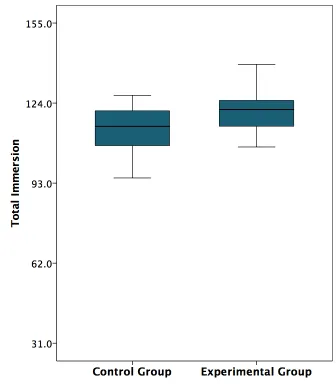
more immersed in the game in this condition. Both statements were supported by the results. The participants who played the game without any modifications to the timer were sig-nificantly less immersed, than those participants whose timer was changing based on their performance (Table 1), as deter-mined by one-way ANOVA (F(1,40) = 7.41, p = 0.010), with a medium effect size (η2
partial = 0.156). SDis within
[image:4.612.358.526.164.356.2]the acceptable range for assuming homogenous variance [1].
Figure 2. Total immersion with and without adaptive timer.
In terms of immersion components, the analysis is sum-marised in Table 1. Significant differences were seen in the cognitive involvement and control aspects of immersion with differences in emotional involvement approaching sig-nificance. There was no significant difference in the real world dissociation and challenge components, the difference in conditions showing very small effects in both components.
Out of the 22 participants in the experimental group, 9 peo-ple had a shorter gaming session and 10 participants played for longer than 90 seconds. However, due to the time manip-ulation, there were 3 more players, who played for exactly 90 seconds because their time was varying in both directions equally at certain points in the game.
There was no significant difference between the immersion scores obtained from participants playing shorter sessions and players with extended time: F(1,18) = 0.08, p = 0.781. Moreover, there was no correlation observed between the immersion scores and the length of the session (Pearson’s
r(21) =−0.09, p= 0.583).
Total Scores
Components Adaptable Timer Standard Timer F(1,38) p η2 partial
Mean Std.Dev. Mean Std.Dev.
Total Immersion 121.05 8.11 113.50 9.83 7.41 0.010 0.156
Cognitive Involvement 39.64 3.02 37.45 3.35 4.96 0.032 0.110
Emotional Involvement 21.55 3.74 19.60 3.17 3.28 0.078 0.076
Real World Dissociation 25.09 3.60 24.05 4.22 0.74 0.394 0.018
Challenge 14.18 1.65 13.50 1.93 1.52 0.225 0.037
[image:5.612.56.299.319.528.2]Control 20.59 2.56 18.90 2.45 4.77 0.035 0.107
Table 1. Average levels of immersion and its components in control and experimental groups.
significant difference between the scores of the two groups:
F(1,40) = 2.30, p= 0.138.
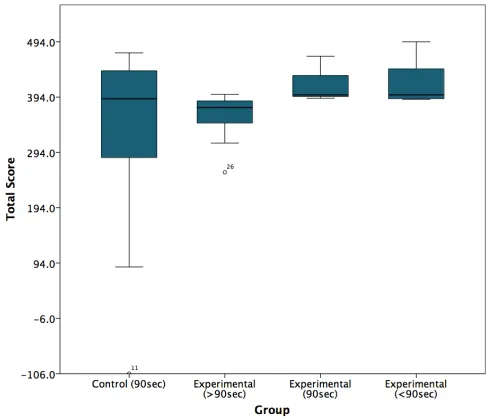
The scores obtained in the experimental group also differed between those participants who played for longer than 90 seconds and participants, whose gaming time was reduced. The average scores in the group with extra time was 357.6 (sd=43.59), while participants scored more when being un-der pressure – the group with reduced time managed to get 419.9 on average (sd= 37.71). The difference in the scores was significant: F(1,18) = 10.97, p = 0.004 (η2
partial =
0.392) (Figure 3).
Figure 3. Total scores obtained by each group with regards to the time in relation to 90 seconds threshold.
Players’ immersion was positively correlating with their per-formance in the game (Pearson’sr(21) = 0.34, p= 0.029).
DISCUSSION AND CONCLUSIONS
The results of the study demonstrated that even simple adap-tation of a timer, based on player’s performance, can affect their gaming experience. Although this manipulation was not as elaborate as some adaptive game, it still was able to affect PX by matching the goal to the player’s performance. Players felt more immersed in the game when the timer was changing according to their performance in the game. This may be why those in the experimental group experienced a greater sense of control, as measured in the IEQ, the game was more appro-priate for their ability to assume control in the game. Further,
as there was no correlation between level of immersion and time that they played, the difference in immersion could not simply be because some players got to play for longer than others.
No participants reported noticing the change in the speed of the timer, nor did the participants in the two conditions dif-fer in their level of perceived challenge. This suggests that their experience was purely based on their playing experience without being aware of the underlying causes of the experi-ence. Regardless of how much time players spent in the game, they were convinced they achieved their results within the re-quired amount of time. For those who had reduced time, they were performing well, but consequently had more pressure to continue to do so. For those with increased time, they were not performing so well, but therefore got more time that allowed them to achieve the target goal. This may sug-gest that different mechanisms are influencing the experience when games are adapting to players, particularly when there is a pre-specified goal against which players can monitor their progress.
Interestingly, players under time pressure and with shorter sessions achieved higher scores on average than some players in the control group, which is attributed to the fact that their performance was consistently good throughout the whole ses-sion. More skilled players were motivated to achieve the highest possible score, while players with less skill seem to have felt that reaching 300 in the game was challenging enough. As might be expected, players in the control group showed larger spread in scores, particularly below the target 300, but the overall difference in scores was not significant.
REFERENCES
1. Box, G. E. P. Some theorems on quadratic forms applied in the study of analysis of variance problems, i. effect of inequality of variance in the one-way classification.The Annals of Mathematical Statistics 25, 2 (1954),
290–302.
2. Brown, E., and Cairns, P. A grounded investigation of game immersion. InCHI’04 extended abstracts on Human factors in computing systems, ACM (2004), 1297–1300.
3. Cairns, P., Cox, A., and Nordin, A. I. Immersion in digital games: a review of gaming experience research. Handbook of digital games, MC Angelides and H. Agius, Eds. Wiley-Blackwell(2014), 339–361.
4. Cairns, P., Cox, A. L., Day, M., Martin, H., and Perryman, T. Who but not where: The effect of social play on immersion in digital games.International Journal of Human-Computer Studies 71, 11 (2013), 1069–1077.
5. Charles, D., and Black, M. Dynamic player modeling: A framework for player-centered digital games.Proc. of the International Conference on Computer Games: Artificial Intelligence, Design and Education(2004), 29–35.
6. Charles, D., Kerr, A., McNeill, M., McAlister, M., Black, M., Kcklich, J., Moore, A., and Stringer, K. Player-centred game design: Player modelling and adaptive digital games.Proceedings of the Digital Games Research Conference 285(2005).
7. Chen, J. Flow in games (and everything else). Communications of the ACM 50, 4 (2007), 31–34.
8. Cox, A., Cairns, P., Shah, P., and Carroll, M. Not doing but thinking: the role of challenge in the gaming experience. InProceedings of the SIGCHI Conference on Human Factors in Computing Systems, ACM (2012), 79–88.
9. Csikszentmihalyi, M.Flow: The Psychology of Optimal Experience. Harper Perennial Modern Classics, 2008.
10. Denisova, A., and Cairns, P. First person vs. third person perspective in digital games: Do player preferences affect immersion? InProceedings of the SIGCHI Conference on Human Factors in Computing Systems, ACM (2015), 145–148.
11. Gerling, K. M., Miller, M., Mandryk, R. L., Birk, M. V., and Smeddinck, J. D. Effects of balancing for physical abilities on player performance, experience and
self-esteem in exergames. InProceedings of the SIGCHI Conference on Human Factors in Computing Systems, ACM (2014), 2201–2210.
12. Houlette, R. Player modeling for adaptive games.AI game programming wisdom 2(2004), 557–566.
13. Hunicke, R. The case for dynamic difficulty adjustment in games. InProceedings of the 2005 ACM SIGCHI International Conference on Advances in computer entertainment technology, ACM (2005), 429–433.
14. Jennett, C., Cox, A. L., Cairns, P., Dhoparee, S., Epps, A., Tijs, T., and Walton, A. Measuring and defining the experience of immersion in games.International journal of human-computer studies 66, 9 (2008), 641–661.
15. Jennett, C. I.Is game immersion just another form of selective attention? An empirical investigation of real world dissociation in computer game immersion. PhD thesis, UCL (University College London), 2010.
16. Kerr, A. Girls/women just want to have fun - A study of adult female players of digital games.
17. Klimmt, C., and Hartmann, T. Effectance, self-efficacy, and the motivation to play video games.
18. McMillen, E., Refenes, T., and Team Meat. Super Meat Boy.http://supermeatboy.com/, 2010.
19. Nakamura, J., and Csikszentmihalyi, M. The concept of flow.Handbook of positive psychology(2002), 89–105.
20. Nickerson, R. S. Confirmation bias: A ubiquitous phenomenon in many guises.Review of general psychology 2, 2 (1998), 175.
21. Nordin, A.Immersion And Players’ Time Perception in Digital Games. PhD thesis, University of York, 2014.
22. Sherry, J. L. Flow and media enjoyment. Communication Theory 14, 4 (2004), 328–347.
23. Spronck, P. H. M.Adaptive game AI. UPM, Universitaire Pers Maastricht, 2005.
24. Sweetser, P., and Wyeth, P. Gameflow: a model for evaluating player enjoyment in games.Computers in Entertainment (CIE) 3, 3 (2005), 3–3.
25. Unity Technologies. Nightmares.http://unity3d.com/ learn/tutorials/projects/survival-shooter, 2014.
26. van den Hoogen, W., Poels, K., IJsselsteijn, W., and de Kort, Y. Between challenge and defeat: Repeated player-death and game enjoyment.Media Psychology 15, 4 (2012), 443–459.