City, University of London Institutional Repository
Citation
:
Endress, A. and Potter, M. (2014). Large capacity temporary visual memory.
Journal of Experimental Psychology: General, 143(2), pp. 548-565. doi: 10.1037/a0033934
This is the unspecified version of the paper.
This version of the publication may differ from the final published
version.
Permanent repository link:
http://openaccess.city.ac.uk/3765/
Link to published version
:
http://dx.doi.org/10.1037/a0033934
Copyright and reuse:
City Research Online aims to make research
outputs of City, University of London available to a wider audience.
Copyright and Moral Rights remain with the author(s) and/or copyright
holders. URLs from City Research Online may be freely distributed and
linked to.
City Research Online:
http://openaccess.city.ac.uk/
[email protected]
Ansgar D. Endress
Massachusetts Institute of Technology, Cambridge, MA, USA
Universitat Pompeu Fabra, Barcelona, Spain City University, London, UK
Mary C. Potter
Massachusetts Institute of Technology, Cambridge, MA, USA
Visual working memory (WM) capacity is thought to be limited to three or four items. However, many cognitive activities seem to require larger temporary memory stores. Here, we provide evidence for a temporary memory store with much larger capacity than past WM capacity estimates. Further, based on previous WM research, we show that a single factor — proactive interference — is sufficient to bring capacity estimates down to the range of previous WM capacity estimates. Participants saw a rapid serial visual presentation (RSVP) of 5 to 21 pictures of familiar objects or words presented at rates of 4/s or 8/s, respectively, and thus too fast for strategies such as rehearsal. Recognition memory was tested with a single probe item. When new items were used on all trials, no fixed memory capacities were observed, with estimates of up to 9.1 retained pictures for 21-item lists, and up to 30.0 retained pictures for 100-item lists, and no clear upper bound to how many items could be retained. Further, memory items were not stored in a temporally stable form of memory, but decayed almost completely after a few minutes. In contrast, when, as in most WM experiments, a small set of items was reused across all trials, thus creating proactive interference among items, capacity remained in the range reported in previous WM experiments. These results show that humans have a large-capacity temporary memory store in the absence of proactive interference, and raise the question of whether temporary memory in everyday cognitive processing is severely limited as in WM experiments, or has the much larger capacity found in the present experiments.
Introduction
Working memory (WM), that is, the ability to keep relevant information in mind over short periods of time while performing cognitive manipulations, is crucial to virtually all cognitive activities. Measures of WM cor-relate with many important measures of intelligence, language comprehension, reasoning, and educational achievement (e.g., Barrouillet, 1996; Daneman & Car-penter, 1980; Daneman & Green, 1986; Engle, Tuholski, Laughlin, & Conway, 1999; Engle, Carullo, & Collins, 1991; Engle, Cantor, & Carullo, 1992; Fukuda, Vogel,
This research was supported by NIH grant MH47432 and Marie Curie Incoming Fellowship 303163-COMINTENT. Further, we acknowledge support by grants CONSOLIDER-INGENIO-CDS-2007-00012 and PSI2012-3253 from the Spanish Ministerio de Econom´ıa y Competitividad and SGR-2009-1521 from the Catalan government. We are grateful to T. Brady, N. Cowan, N. Kanwisher, ´A. Kov´acs, A. Oliva, E. Vogel and B. Wyble for helpful comments on an earlier version of this manuscript. We also thank Brady, Konkle, Alvarez, and Oliva (2008) for making their stimuli available.
Mayr, & Awh, 2010; King & Just, 1991; Kyllonen & Christal, 1990), suggesting that WM is an important determinant of our cognitive abilities.
A wealth of experiments has revealed that there are stringent constraints on WM, such that people can member only up to four items simultaneously (for re-views, see e.g. Conway et al., 2005; Cowan, 1995, 2001, 2005). Such WM limitations are observed not only in laboratory tasks, but also in everyday life. For exam-ple, when trying to remember a telephone number, we are keenly aware that WM capacity is not as large as we might wish it to be. These limitations contribute to the difficulty of doing mental arithmetic (e.g., Hitch, 1978), and might plausibly be one of the root causes of the difficulty of many other cognitive activities such as manipulating algebraic expressions or reasoning about abstract problems.
supported by a temporary memory store that does not rely on active maintenance and has a much larger capac-ity than three or four items. In line with this view, when objects are embedded in meaningful scenes and when observers can at least partially rely on LTM, previous research has shown that memory capacity for objects is much larger than in typical WM experiments (e.g., Hollingworth, 2004, 2005; Hollingworth & Henderson, 2002).
While there have been important debates on the ques-tion of whether a WM capacity of 3 or 4 items is an overestimate, or whether people can really retain only a single item (e.g., Oberauer, 2002; Oztekin, Davachi, & McElree, 2010), here we ask whether people are equipped with a temporary memory mechanism with a much larger capacity, an ability that seems crucial for many practical purposes in everyday cognition. Further, we investigate the robustness of this memory store in the face of a factor that might play an important role in WM as well: proactive interference from previous trials.
Proactive interference in
working memory
Proactive interference seems to be a prevalent fea-ture of past WM experiments, to the extent that some authors have specifically argued that a crucial function of WM is to counteract the effects of such interference (Engle, 2002). This can be illustrated by one of the dominant paradigms used for investigating WM memory limitations: the change-detection paradigm pioneered by Luck and Vogel (1997). In such experiments, par-ticipants see an array of items (e.g., colored geometric figures), and have to detect whether a second array con-tains a changed item.
In these and other experiments, investigators at-tempted to rule out contributions of long-term memory (LTM) by using relatively small sets of materials and reusing the same items in many trials. This, in turn, forces participants to distinguish memory for the current trial from that of previous trials. For example, in Luck and Vogel’s (1997) Experiment 1, stimuli were drawn from just seven different colors; these stimuli were then reused throughout the experiment. Therefore, to avoid contamination from previous trials, participants must try to remember that a given test item was presented in the current trial rather than a prior trial. In other words, reusing the same limited set of items and features might lead to PI across trials.1
While such experimental paradigms seem to suggest that PI might be important for establishing WM limi-tations (Engle, 2002), the role of PI for WM is contro-versial, with some authors proposing that PI has only a limited effect on WM capacity estimates (Hartshorne, 2008; see also Lin & Luck, 2012; Makovski & Jiang, 2008). Those authors found little PI from items in im-mediately preceding trials, and concluded that PI made only a limited contribution to WM capacity limitations.
However, except in some of Hartshorne’s (2008) analy-ses, those experiments reused small sets of items in many trials, which might have resulted in a substantial level of background PI. Hence, the experiments compared high interference (from items in the immediately preceding trial) to slightly lower interference (from items appear-ing in earlier trials). In addition, in the studies cited, capacity estimates were mathematically limited to 4 or 5, as only 4 or 5 items were presented. These other con-straints on performance may have limited the observable size of the interference effect.
While the studies just cited did not find effects of proactive interference, there is a rich literature show-ing that proactive interference does constrain how many items can be retained. For example, Keppel and Un-derwood (1962) studied the retention of consonant tri-grams. They showed that, after a 3 s retention inter-val, recall performance dropped from about 80% for the first triplet to about 55% for the second one, with little change afterwards. This drop in performance was psumably due to proactive interference from having re-called a previous triplet (see also D. D. Wickens, Born, & Allen, 1963).2,3
Most relevant to the current purposes, Cowan, John-son, and Saults (2005) presented participants with lists of words, followed by a recognition test. Each list com-prised 3, 4, 6 or 8 words, and items were presented for 1.5 s each. Crucially, there were 12 blocks of 12 tri-als. The first four blocks had words drawn from
dif-1
Reusing the same material across trials might be con-sidered to lead to difficulties in recalling the items’ source; however, it is unknown whether source memory (Johnson, Hashtroudi, & Lindsay, 1993; Mitchell & Johnson, 2000) and the mechanisms counteracting PI are related.
2
Using complex span tasks, there is also evidence for a correlation between susceptibility to PI and memory span. For example, Rosen and Engle (1998) asked participants dif-ferent in their memory span to learn three lists of word pairs. In the low-interference condition, pairs in the three lists had the formEF,DC,AB; in the high-interference condition, in contrast, pairs in the three lists had the formAB,AC,AB. Hence, there was overlap in the pairs in the high-interference condition but not in the low-interference condition. Results showed that high-span individuals were better than low-span individuals in learning the second list in the high-interference condition; further, they were alsoslowerthan low-span indi-viduals on the third list, suggesting that participants might have had to disengage processes combating proactive inter-ference (see also Kane & Engle, 2000 for more evidence that active processes are recruited to counteract proactive inter-ference.)
3
ferent categories; the next 8 blocks had words drawn from the same category, thereby producing PI. Cowan et al. (2005) compared performance in the first 4 trials, serving as a low-interference condition, to performance in the last 4 trials, serving as a high-interference condi-tion. They found that performance was markedly better in the low-interference condition.
While these results show that PI has a marked effect on working memory performance, they raise two critical questions. First, if, as we will suggest below, temporary memory capacity is large in the absence of PI, the lim-ited set-sizes in Cowan et al.’s (2005) would not reveal such large capacities; in the experiments below, we will address this issue by using set-sizes of up to 100. Second, Cowan et al. (2005) used relatively long presentation durations of 1.5 s. This raises the question of whether items were encoded in a temporary form of memory, or rather in a stable form of memory such as long-term memory. Further, this relatively long presentation dura-tion might have allowed participants to rehearse items. In fact, Keppel and Underwood (1962) showed that al-lowing participants to rehearse items for just 2 s before a retention interval had a protective effect on memory, rising the question of what kind of memory storage was utilized by Cowan et al.’s (2005) participants. We will address this question in the experiments below as well.
The capacity of memory
To discuss the nature of memory limitations, it is useful to briefly introduce common terms used to dis-tinguish forms of memory: short-term memory (STM), WM and LTM.4 While these labels are used slightly
differently by different scholars, with some controversy about their definition, some scholars propose that the difference between LTM and STM might be that “only short-term memory [demonstrates] (1) temporal decay and (2) chunk capacity limits,” while WM might com-prise additional mechanisms that manipulate stored in-formation (e.g., Cowan, 2008). Other researchers, how-ever, question a distinction between STM and LTM (e.g., Brown, Neath, & Chater, 2007; Crowder, 1993; Nairne, 2002; Ranganath & Blumenfeld, 2005; Wickel-gren, 1973). Depending on the conditions of learning, a given item will vary in initial strength, and forgetting will vary correspondingly. Crucially, however, memory will not be limited to any specific number of items. Ac-cordingly, STM might in principle have a large capacity. In fact, LTM has a virtually unbounded memory ca-pacity. For example, Standing (1973) presented partic-ipants with up to 10,000 pictures or words presented for 5 seconds each, and tested for recognition two days later. Recognition performance was excellent. Likewise, Brady et al. (2008) showed that memory representations for pictures are remarkably precise. After seeing 2,500 categorically unique objects for 3 s each, participants did not only discriminate old objects from novel objects from different categories, but also from objects in the
same category, or the same objects in a different state; in each case, discrimination performance approached 90%. Hence, LTM capacity is large. If STM is simply a “weak” form of LTM that is readily forgotten, might it have a larger but still temporary capacity when conditions of acquisition are favorable?
Here, we are concerned with memory stores that tem-porarily register items. We thus adopt a functional def-inition of temporary memory: a set of mechanisms that allows people to retain meaningful information over a limited period of time. However, foreshadowing our re-sults, our data are consistent with a unitary account of STM, WM and LTM. Specifically, when items are viewed briefly, the resulting memories are fleeting and disappear over the course of a few minutes, functionally acting as a short-term memory store with a large ca-pacity. When proactive interference is added, one finds the memory limitations of previous visual memory ex-periments that have been considered limited by WM. Finally, if items are viewed repeatedly or for longer pe-riods of time, the memory representations become con-solidated in LTM and are forgotten only slowly. That said, in some cognitive situations (e.g., when perform-ing mental operations on numbers such as comparperform-ing them, adding them etc.), there appears to be an effortful and severely constrained form of memory that shows the limitations characteristic of previous WM experiments, that relies on active manipulation of memory items, and that might be limited to as little as a single item that can be placed in the focus of attention (e.g., Oberauer, 2002; Oztekin et al., 2010, but see e.g. Pylyshyn & Storm, 1988; Scholl & Pylyshyn, 1999 for evidence that this is not the case for all forms of attention). The items in this actively maintained system might constitute a separate memory store. Importantly, however, unless items need to be actively manipulated, temporary memory might have a much larger capacity than previously thought.
The current experiments
We assess temporary memory capacity estimates for meaningful everyday objects as well as words, asking whether capacity is always as severely limited as WM research would suggest. We use meaningful items be-cause cognitive processes presumably operate on mean-ingful items, and because memory capacity is known to be poor for items that cannot be interpreted in terms of meaningful categories (Olsson & Poom, 2005; see also Feigenson & Halberda, 2008 for evidence that concep-tual information enhances memory capacity even in in-fancy). In the General Discussion, we will come back to the issue of how the use of meaningful items might have affected our results.
4
Our experiments employ a rapid serial visual presen-tation (RSVP) procedure, where memory items are pre-sented one at a time for presentation durations of the order of a single eye fixation. This method is well suited to investigate the temporary memory store proposed above, for three reasons. First, the presentation time for each item can be controlled and made brief enough to avoid ceiling effects, while allowing participants to re-trieve or construct abstract conceptual representations of the items they see (Potter, Staub, & O’Connor, 2004), rather than only lower-level features such as those stored in iconic memory (Sperling, 1960). Encoding stimuli as meaningful items is crucial for them to be useful in a WM-like memory store, because, as mentioned above, cognitive processes presumably operate on conceptual representations as opposed to bundles of low-level fea-tures.
Second, observers encode rapidly presented sequences of pictures by non-verbal means. They cannot employ verbal strategies such as rehearsing, because the presen-tation rate is too high, and because pictures are pro-cessed by a fully non-verbal route in such paradigms (Endress & Potter, 2012).
Third, an RSVP procedure allows us to directly assess the effects of PI. Specifically, participants were randomly assigned to one of two conditions. In the unique con-dition, all pictures were unique, and were encountered only once in the experiment. In the repeatedcondition, pictures were selected from a set of 22 pictures; partic-ipants thus saw new combinations of the same pictures repeatedly across trials. As a result, we would expect substantial PI in the repeated condition, while PI in the unique condition should be minimal.
Experiment 1
In Experiment 1, we measured how many items could be remembered when the items were unique and when they were repeated, respectively, asking whether tempo-rary memory storage would be larger than in the WM literature at least when PI is minimized. In each trial, participants saw a sequence of 7, 12 or 17 pictures of familiar everyday objects, presented in sequence for 250 ms per picture, with no interval between pictures.
Participants were then shown a single test picture and had to decide whether it had been presented in the se-quence: on half the trials it had been. Crucially, par-ticipants were randomly assigned to one of two condi-tions. In theuniquecondition, all pictures were unique, and were encountered only once in the experiment. In therepeatedcondition, pictures were selected from a set of 22 pictures; participants thus saw the same pictures repeatedly across trials, but without repeats within a trial.
If we can store only a fixed number of items that is below the number of items in the sequence, capac-ity estimates should be constant in both conditions. In contrast, if we have a relatively large temporary storage
capacity, capacity estimates should be much larger in the unique condition, increasing when more items are presented — because, without interference from previ-ous trials, participants can remember more items when more items are presented. If PI limits memory capac-ity, capacity estimates should increase much less in the repeated condition, staying in the range of previously reported WM capacity estimates.
Materials and methods
Participants. Thirty-six participants (24 females, means age 25.2) from the MIT community took part in Experiment 1. They were randomly assigned to the unique and the repeated condition.
Apparatus. Stimuli were presented on a NEC Multi-Sync FE700+ 17” CRT (refresh rate: 75 Hz; resolution: 640 × 480), using the Matlab psychophysics toolbox (Version 3.0.8; Brainard, 1997; Pelli, 1997). Responses were collected from pre-marked “Yes” and “No” keys on the keyboard.
Materials. Stimuli were color photographs of familiar everyday objects taken from Brady et al. (2008). Stim-uli were randomly selected for each participant from a set of 2,400 pictures. They were presented subtending a visual angle of 12.7 ×12.7 degrees.
Procedure. Participants completed 60 trials per set-size. They started each trial by a key-press and then viewed instructions to look at the pictures for 1000 ms, followed by a fixation cross for 300 ms and a 200 ms blank screen, followed by the sample pictures presented at a duration of 250 ms per picture. Then, they saw a question mark for 800 ms, followed by a blank screen for 900 ms and the test picture presented for 800 ms. “Old” test items (those that occurred in the sample sequence) were randomly sampled from two initial positions (serial positions 2, 3), two final positions (antepenultimate and penultimate) and two middle positions that depended on the set-size (with the exception of set-size 7, where we used only one serial position for medial and 2 serial positions each for initial and final positions). Impor-tantly, the very first and last pictures in the sequence were never tested.
“New” test items, which were presented on 50% of the trials, were entirely new items in the unique condition; in the repeated condition, they were drawn randomly from the set of 22 pictures, excluding those that had been presented in that trial. Trials were presented in random order, with the constraints that not more than three trials could occur in a row that shared the set-size, the correct response (yes/no) or the serial position of “old” test pictures.
the pictures were presented 10 times, with presentation durations decreasing from 2000 to 250 ms. Participants in the unique condition were also familiarized with 22 pictures in the same manner, but these pictures were different from those used in the main experiment.
Analysis. We will report the results below using two main measures: memory capacity estimates and the per-centage of correct responses. As we will discuss below, the percentage of correct responses is linearly related to the probability of remembering an item; hence, the analyses of the percentage of correct responses hold also for probability of remembering.
WM capacity estimates are typically obtained using the two-high-threshold formula K = N ×(H −FA), where K is the capacity, N the number of items, and H andFA the hit rate and the false alarm rate, respec-tively (e.g., Cowan, 2001; Rouder et al., 2008). This formula assumes that observers report that they recog-nize an item when the item’s familiarity crosses a certain (memory) threshold, and that they have a second, low, threshold below which they report that the items are new; in between these two thresholds, observers guess (see e.g. Cowan, 2001; Rouder et al., 2008 for discus-sion). According to this formula, pretained = H −FA
is the probability that an item is retained in memory; multiplying by the number of presented items gives the estimated number of items in memory, K. In our case, with an equal number of “old” and “new” test pictures, pretained is simply pretained = 2×pcor−1, where pcor is
the proportion of correct responses (combining hits and correct rejections). For each participant and set-size, we computed capacity estimates separately.
We present the data in terms of capacity estimates for comparison purposes with the previous literature. However, the K measure only makes sense if indeed ob-servers have a fixed capacity that, once it is reached, prevents any further items from being encoded. As will become clear, our data do not conform to this assump-tion. Hence, we also analyze our results in terms of the proportion of correct responses as a function of the number of items presented. As mentioned above, these analyses are equivalent to those using the proportion of retained items as a dependent measure.
Results
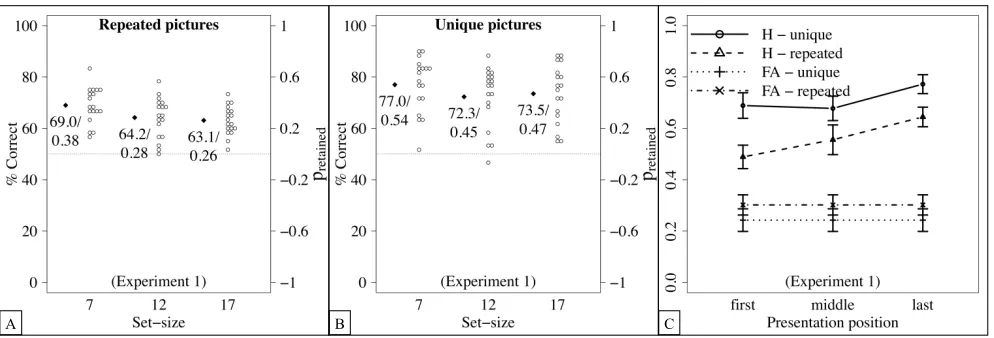
Capacity estimates. Figure 1(A) shows the results of Experiment 1 in terms of capacity estimates. In the unique condition, capacity estimates increased from 3.8 to 8.0 between set-sizes 7 and 17. In contrast, in the repeated condition, capacity estimates were relatively constant, increasing from 2.7 to 4.4 between set-sizes 7 and 17. An ANOVA with set-size as within-subject factor and condition as between-subjects factor yielded main effects of condition, F(1,34) = 11.45, p = .002, η2
p = .252, as well as of set-size, F(2,68) = 32.02, p <
.0001, η2p = .449. Critically, an interaction, F(2,68) =
5.35, p = .007, η2
p = .075, indicated that capacity
es-timates increased more with list length in the unique condition,F(2,34) = 25.01,p <.0001,η2p = .595, than
in the repeated condition, F(2,34) = 7.69, p = .002, η2
p = .311.
Percentage of correct responses. In the unique condi-tion of Experiment 1, we did not observe a fixed capacity limit; instead, estimated capacity increased with set size. To measure the extent of this increase, we analyzed the results in terms of the percentage of correct responses. These results are shown in Figure 2(A) and (B) as a function of set size and condition. (As mentioned above, the analyses for the percentage of correct responses are identical to those for the proportion of items retained, which we show on the right-hand axis of Figure 2.) Par-ticipants performed better in the unique condition than in the repeated condition, and performance decreased for larger set-sizes. An ANOVA with the within-subject factor set-size and the between-subjects factor condition yielded main effects of set-size, F(2,68) = 8.45, p = .0005, η2
p = .197, and of condition, F(1,34) = 10.75,
p = .002, η2p = .24, but no interaction between these
factors,F(2,68) = .52,p= .595,η2
p = .0122, ns.
Serial position effects. When presented with the larger set-sizes of Experment 1, participants might sim-ply remember the last few items. To address this pos-sibility, we investigated serial position effects for the largest set-size, i.e., 17 items. As mentioned above, “old” items were taken from two initial, medial and final po-sitions each (while the very first and the very last posi-tion were never tested). As shown in Figure 2(C), hit rates increased for later presentation positions, yielding a recency effect. This was confirmed by an ANOVA with condition as a between-subjects factor and presen-tation position as a within-subjects factor, yielding main effects of presentation position, F(2,68) = 7.68, p = .001, η2p = .180, and of condition, F(1,34) = 7.58, p=
.009, η2
p = .182, but no interaction between these
fac-tors, F(2,68) = .93,p = .401, η2
p = .022. Importantly,
hit rates differed from false alarm rates for all presenta-tion posipresenta-tions (first: t(35) = 8.48, p < .0001, Cohen’s d = 1.4; middle: t(35) = 8.99,p <.0001, Cohen’sd = 1.5; last: t(35) = 15.42,p <.0001, Cohen’s d = 2.6), suggesting that each serial position contributed to item memory.
Discussion
A B C
Figure 1. Results of Experiment 1 (A), 2 (B) and 3 (C).The blue solid lines represent the unique conditions, and the red dotted lines the repeated conditions. Error bars represent SEM. In the unique condition, memory capacity estimates were relatively large. They were higher, and increased more, than in the repeated condition.
A B C
Figure 2. Detailed results of Experiment 1. Dots represent the means of individual participants, diamonds the sample averages, and error bars standard errors from the mean. (A,B) Percentage of correct responses and proportion of retained items in the repeated condition (A) and the unique condition (B). (C) Hit rates for set-size 17 as a function of presentation positions in the repeated and the unique condition, respectively. False alarm rates are calculated for all “new” trials for set-size 17.
capacity.
However, these results also show that the data from the unique condition violate the assumption of the ca-pacity estimate formula, which is that caca-pacity is fixed and will not increase once that capacity has been ex-ceeded. In fact, if participants had a capacity of 8 items (as the 17-item condition suggests), they should be at ceiling in the 7-item condition, which was clearly not the case. Hence, it may be more illuminating to look at the data in terms of the percentage of correct responses, as shown in Figure 2. As one can see, the proportion of correct responses declines somewhat as the number presented increases, but it is relatively stable, compared to the same results expressed as capacity. The reason for the apparent capacity increase is, therefore, that,
[image:7.612.57.554.303.472.2]impossi-ble to predict, as a sequence unfolded, when the middle or end of the sequence would occur. Further, within each list length, the critical position of the tested item was randomized. Second, and crucially, if participants strategically attended to certain serial positions, they should preferentially encode the items that appear in serial positions that were tested most regularly. Given that we probed serial positions 2 and 3 in all list length conditions, performance for these positions should be best, leading to a primacy effect. In contrast to this pre-diction, we observed small but reliable recency effects at each length of list. Hence, we can exclude the possibility that participants strategically attended to specific serial positions.
Experiment 2
In Experiment 2, we tested the generality of the re-sults of Experiment 1 by replicating the experiment us-ing different experimental parameters. Specifically, we kept a total set of 22 items in the repeated condition, but used different set-sizes (5, 11, or 21 items). Further, to test whether the pre-familiarization in Experiment 1 was required for the contrast between the repeated and the unique condition, participants were not pre-familiarized with any pictures.
Materials and methods
Participants. Twenty-four participants (13 females, means age 25.2) from the MIT community were paid for taking part in Experiment 2; none had participated in Experiment 1. They were randomly assigned to the unique and the repeated condition.
Procedure. The procedure was identical to that in Ex-periment 1, with two exceptions. First, we used differ-ent set-sizes of 5, 11, and 21 items, respectively. Second, participants were not pre-familiarized with any pictures.
Results
Capacity estimates. As in Experiment 1, we start by presenting the results of Experiment 2 in terms of esti-mated memory capacities; while Experiment 1 showed that the capacity estimates did not conform to the hy-pothesis that estimated capacity remains constant once the number of presented items exceeds estimated capac-ity, one of the objectives of this research was to provide evidence for this very point. As a result, we present the results in terms of capacity estimates for Experiment 2 as well.
The results of Experiment 2 are shown in Figure 1(B). In the unique condition, memory capacity estimates in-creased from 3.2 to 9.1 between set-sizes 5 and 21. In contrast, in the repeated condition, capacity estimates remained close to the range reported in previous WM ex-periments, increasing from 2.3 to 4.8 between set-sizes 5 and 21. An ANOVA with set-size as within-subject factor and condition as between-subjects factor yielded
main effects of condition, F(1,22) = 7.50, p = .012, η2
p = .254, and of set-size, F(2,44) = 40.78,p <.0001,
η2
p = .576. Critically, an interaction, F(2,44) = 8.03,
p = .001,η2p = .113, indicated that capacity estimates increased more with set-size in the unique condition, F(2,22) = 140.6,p<.0001,η2
p= .927, compared to the
repeated condition,F(2,22) = 4.16,p= .029,η2
p= .274.
Hence, both in the unique and in the repeated condition, the results of Experiments 1 and 2 were very similar.
Percentage of correct responses. The results in terms of the percentage of correct responses and of the pro-portion of retained items are shown in Figure 3(A) and (B). Participants performed better in the unique condi-tion than in the repeated condicondi-tion, and performance de-creased for larger set-sizes. An ANOVA with the within-subject factor set-size and the between-within-subject factor condition yielded main effects of set-size, F(2,44) = 34.96,p<.0001,η2
p= .595, and of condition,F(1,22) =
6.72, p = .017, η2
p = .234, but no interaction between
these factors,F(2,44) = 1.75,p = .185,η2p = .03.
Serial position effects. As in Experiment 1, we inves-tigated the effect of the presentation position on the hit rate for the largest set-size (i.e., 21 items). As shown in Figure 3(C), hit rates increased for later pre-sentation positions, yielding a recency effect. This was confirmed by an ANOVA with condition as a between-subjects factor and presentation position as a within-subject factor, yielding a main effect of presentation po-sition, F(2,44) = 11.99, p < .0001, η2
p = .345, but no
other main effects or interactions. Importantly, how-ever, hit rates differed from false alarm rates for all pre-sentation positions (first: t(23) = 5.6, p < .0001, Co-hen’sd= 1.1; middle: t(23) = 6.77,p<.0001, Cohen’s d= 1.4; last: t(23) = 10.47,p= .001, Cohen’sd= 2.1), suggesting that each serial position contributed to the memory capacity.
Discussion
The results of Experiments 1 and 2 suggest that tem-porary memory for everyday objects does not have the fixed capacity that past WM experiments seem to sug-gest, and that participants can temporally retain many more items than previously thought. As mentioned above, the capacity estimates in the unique condition are not meaningful; if participants truly had a fixed ca-pacity of about 9, they should be at ceiling for all set-sizes below this limit, which was clearly not the case. Rather, our crucial result is that, in the unique con-dition, the proportion of correct responses (equivalent to the estimated proportion of retained items) changes only relatively little as a function of the set-size.
A B C
Figure 3. Detailed results of Experiment 2. Dots represent the means of individual participants, diamonds the sample averages, and error bars standard errors from the mean. (A,B) Percentage of correct responses and proportion of retained items in the repeated condition (A) and the unique condition (B). (C) Hit rates for set-size 21 as a function of presentation positions in the repeated and the unique condition, respectively. False alarm rates are calculated for all “new” trials for set-size 21.
to verbal memory encoding of the pictures, both because the presentation rate is too fast for processes such as re-hearsal, and because linguistic processes are remarkably independent from those used to memorize the pictures (Endress & Potter, 2012).
Experiment 3
In Experiment 3, we further explored the memory ca-pacity limits in the unique condition. Experiment 3 was similar to the unique condition of Experiment 2, except that we used set-sizes of 25, 50 and 100.
Materials and methods
Participants. Twenty participants (12 females, means age 21.5) from the MIT community took part in Exper-iment 3; none had participated in the earlier experi-ments.
Procedure. Experiment 3 was similar to Experiment 2, with four exceptions. First, the experiment contained only a unique but not repeated condition. Second, we used the set-sizes 25, 50 and 100. Third, participants viewed a progress bar between the last sample picture and the test picture lasting for 1 s.5 Fourth, with 2,400
pictures, we could construct only 12 trials per set-size, for a total of 36 trials.
Results
Capacity estimates. As in the Experiments above, we start by presenting the data in terms of capacity esti-mates. As shown in Figure 1(C), a one-way ANOVA with set-size as within-subject factor revealed that ca-pacity estimates increased between set-sizes 25 and 100,
F(2,38) = 5.5,p= .008,η2
p= .223, reaching a maximum
of 30.0 for set-size 100.
Percentage of correct responses. The results in terms of the percentage of correct responses and, equivalently the proportion of retained items are shown in Fig-ure 4(A). In an ANOVA with the within-subject factor set-size, the main effect of set-size was not significant, F(2,38) = 1.2,p= .305,ηp2 = .061, failing to reject the hypothesis that the percentage of correct responses dif-fered across set-sizes, and consistent with the hypothesis that it might be relatively constant irrespective of how many items are presented.
Serial position effects. As in Experiments 1 and 2, we investigated the effect of the presentation position on the hit rate for the largest set-size (i.e., 100 items). As shown in Figure 4(C), hit rates did not differ statis-tically across presentation positions,F(2,38) = 1.8,p= .182,η2
p= .086, failing to reject the null hypothesis that
the hit rate was the same across serial positions.
Discussion
The unique conditions of Experiments 1 to 3 revealed large capacity estimates. As pointed out above, the large capacity estimates do not reflect fixed memory capacities, but rather indicate that the probability of recognizing an item changes little as a function of how many items are presented, at least up to at least 100
5
A
B
Figure 4. Detailed results of Experiment 3. Dots represent the means of individual participants, diamonds the sample averages, and error bars standard errors from the mean. (A) Percentage of correct responses and proportion of retained items. (B) Hit rates for set-size 100. False alarm rates are calculated for all “new” trials for set-size 100.
items. This raises the question of what kind of memory system stores the unique items. Plausibly, they might be stored in long-term memory (LTM). After all, par-ticipants could, at least in principle, perform their task by deciding whether or not they have ever seen a test stimulus before; if they have, it was in the sequence from the current trial.
At least after consolidation, LTM is relatively stable over time. For example, in an experiment testing LTM for the same pictures as those used here, each of 2500 pictures was presented for 3000 ms. Under these condi-tions, participants’ recognition performance was excel-lent after 5.5 h (Brady et al., 2008). Hence, if the unique items that are remembered are stored in a consolidated form of LTM, we would expect the corresponding mem-ory to be relatively stable over time.
In contrast, if memory items are stored in a tem-porary form of memory, the resulting representations should be fleeting, and should not show the temporal stability of consolidated LTM representations. That is, even if the memory representations are fleeting, they might still be stored in an unconsolidated form of LTM that might be fleeting. For the current purposes, how-ever, we just aim to show that the temporary memory store is indeed temporary, rather than to exclude a con-tribution from LTM.
In Experiment 4, we explored the temporal stabil-ity of the memory store. Experiment 4 was similar to Experiments 1 and 2, with two crucial changes. First,
Experiment 4
Materials and methods
Participants. Twenty-four participants (20 females, means age 23.5) from the MIT community took part in Experiment 4; none had participated in previous experi-ments. They were randomly assigned to the unique and the repeated condition.
Procedure. Experiment 4 was similar to Experiment 2, with three crucial exceptions. First, we used just two set-sizes, 6 and 17, presented for a total of 192 trials. Second, we introduced variable delays between the end of the sample sequence and the test item. As before, participants started each trial by a key-press, viewed in-structions to look at the pictures for 1000 ms, followed by a fixation cross for 300 ms and a 200 ms blank screen, followed by the sample pictures presented at a duration of 250 ms per picture. Then, they saw a blank screen for 200 ms, following by a progress bar of either 1 s or 7 s, followed by a fixation cross for 300 ms, and the test picture presented for 800 ms. In total, the delay between the last picture of the sample sequence and the test pic-ture was 1.5 or 7.5 s (compared to a total delay of 1.7 s in Experiments 1 and 2). Third, after they had completed these trials, participants were tested on their long-term retention of the pictures they had seen. For each pic-ture, they had to indicate whether or not they had seen it before in the experiment. Pictures were presented with the constraint of not having more than three “old” items or foils in a row. In the unique condition, the 96 “old” pictures tested for long-term retention each came from one of the 96 trials that had been tested with a new picture, counterbalanced over set-sizes and three serial positions (early, middle, or late). The 96 “new” pictures in the final test were intermixed with the old pictures. The old pictures were presented in the order in which they had appeared during the temporary memory part of the experiment. In the repeated condition, partici-pants were shown all 22 pictures they had seen, mixed with 22 foils, presented one at a time. The pictures were presented in random order. The long-term retention test started immediately after the RSVP phase of the exper-iment; as the RSVP phase lasted about 30 min and the long-term retention test took no more than 5 min (less in the repeated condition), the LTM retention interval was between 30 and 35 min.
Results
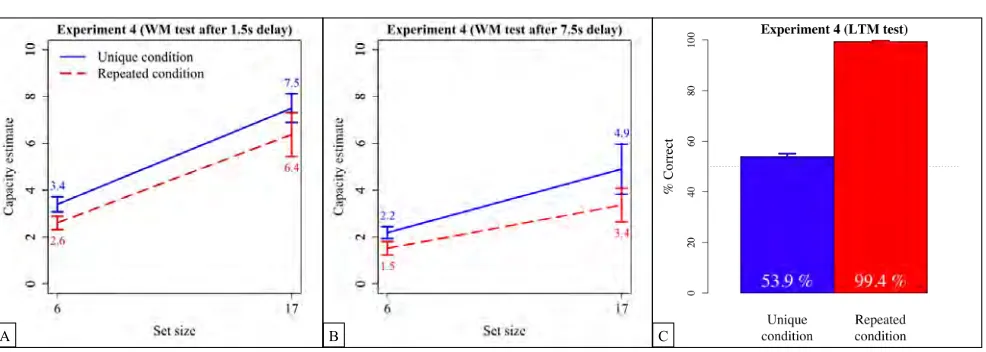
Capacity estimates. The results of Experiment 4 with 1.5 s and 7.5 s delays are shown in Figure 5(A) and (B). In the unique condition, capacity estimates increased from 3.4 to 7.5 between set-sizes 6 and 17 in the short delay condition, and from 2.2 to 4.9 in the long delay condition. In the repeated condition, capacity estimates increased from 2.6 to 6.4 between set-sizes 6 and 17 in the short delay condition, and from 1.5 to 3.4 in the long
delay condition. An ANOVA with set-size and delay as within-subject factors and group as between-subjects factor yielded main effects of delay,F(1,22) = 28.9,p< .0001, η2
p = .567, as well as of set-size, F(1,22) = 62.0,
p<.0001,ηp2= .733. The main effect of group failed to
reach significance, F(1,22) = 2.7, p = .114,η2
p = .109.
We also observed an interaction between delay and set-size, F(1,22) = 5.4, p = .03,η2
p = .195, suggesting the
effect of set-size was more pronounced for short delays, F(1,22) = 64.2, p < .0001, η2
p = .744, than for long
delays, F(1,22) = 15.9, p = .0006, ηp2 = .414. There
were no other significant interactions.6
The results of the long-term retention test are shown in Figure 5(C). In the long-term retention test of the unique condition, participants performed significantly but only slightly above chance (M = 53.9%, SD = 4.0%), t(11) = 3.4,p = .006, Cohen’sd = .97,CI.95 =
51.4%, 56.5%. In the repeated condition, participants were virtually perfect (percentage of correct responses:
6
While the results after the short delay in the unique condition are reasonably similar to those of the unique con-dition of Experiment 1, capacity estimates in the repeated condition seem to increase much more between set-sizes in the short-delay condition of Experiment 4 than in Exper-iment 1. (These results cannot be compared statistically, because the set-sizes differed across the experiments due to practical considerations.) Hence, the repeated condition in Experiment 4 does not replicate the findings of the repeated conditions in Experiments 1 and 2, where the increase in ca-pacity across set-sizes was relatively limited. A possible ex-planation for this discrepancy is provided by previous results showing that increasing the time between trials reduces PI (Kincaid & Wickens, 1970; Loess & Waugh, 1967; Peterson & Gentile, 1965). Due to the long-delay condition, inter-trial intervals in Experiment 4 were on average about 3 s longer than in Experiments 1 and 2; this, in turn, might have reduced the PI among items. We addressed this issue by replicating the repeated condition of Experiment 4 — but with a short delay on all trials. Results (N=12) showed that capacity estimates increased from 2.8 for set-size 6 to 5.5 for set-size 17. An ANOVA with set-size as within-subject factor revealed a main effect, F(1,11) = 35.4, p < .0001,
ηp2 = .763. Compared to the short-delay condition of the
unique condition of Experiment 4, this control experiment revealed a main effect of experiment, F(1,22) = 6.2, p <
.021, ηp2 = .221, and set-size, F(1,22) = 89.3, p < .0001,
η2
p = .774, as well as a marginal interaction between
set-size and experiment, F(1,22) = 4.1, p = .054, ηp2 = .036,
suggesting that the effect of set-size was less pronounced in this control experiment than for short delays in the unique condition of Experiment 4. Hence, decreasing the inter-trial interval increased PI among items, and reestablished the dif-ference between the unique and the repeated conditions. As in the repeated condition of Experiment 4, participants were almost perfect on the long-term retention test (M = 99.4%,
SD = 1.4%), t(11) = 121.2, p < .0001, Cohen’s d = 35,
A B C
Figure 5. Results of Experiment 4. (A) Memory capacity estimates with a 1.5 s interval between the end of the sample sequence and the test image. (B) Memory capacity estimates with a 7.5 s interval between the end of the sample sequence and the test image. (C) Retention performance during the surprise memory test at the end of the experiment. The blue solid lines represent the unique conditions, and the red dotted lines the repeated conditions. Error bars represent SEM.
M = 99.4%, SD = 1.0%), t(11) = 166.6, p < .0001, Cohen’sd = 48.0,CI.95= 98.8%, 100.1%.
Percentage of correct responses. The results in terms of the percentage of correct responses are shown in Fig-ure 6(A) and (B). Participants performed better after the short delay than after the long delay, and perfor-mance decreased for larger set-sizes. An ANOVA with the within-subject factors set-size and delay, and the between-subjects factor condition yielded main effects of set-size,F(1,22) = 12.6,p= .002,η2
p= 0.355, and
de-lay,F(1,22) = 39.2,p<.0001,ηp2 = .641, but no effect
of condition,F(1,22) = 3.6,p = 0.073,η2
p = 0.139, ns.
There were no other main effects or interactions.
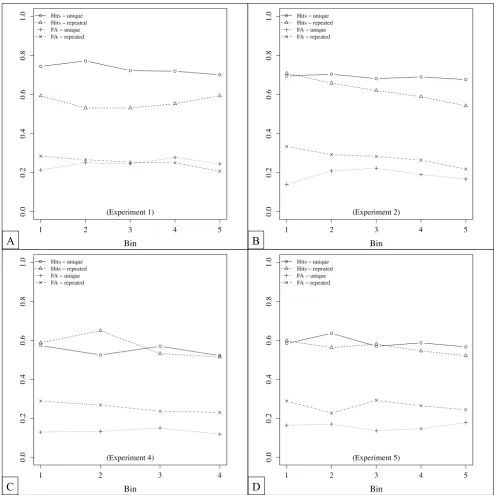
Serial position effects. As in Experiment 1, we inves-tigated the effect of the presentation position on the hit rate for the largest set-size (i.e., 17 items). As shown in Figure 6(C) and (D), hit rates increased for later pre-sentation position, yielding a recency effect. This was confirmed by an ANOVA with condition as a between-subjects factor, and presentation position and delay as within-subjects factors. We observed main effects of presentation position,F(2,44) = 13.75,p<.0001,η2p = 0.382, and delay,F(1,22) = 43.48,p<.0001,η2
p= 0.639,
but not of condition, F(1,22) = 1.26,p = 0.274,η2p =
0.054. We observed no other interactions. Importantly, hit rates differed from false alarm rates for all presenta-tion posipresenta-tions and delay condipresenta-tions, suggesting that each serial position contributed to the memory capacity.
Discussion
Experiment 4 investigated the temporal stability of the memory mechanism underlying participants’ perfor-mance in Experiments 1 to 3. In the repeated
condi-tion, long-term retention performance was almost per-fect. This result is rather unsurprising, given that par-ticipants saw each item frequently not only in the se-quences, but also as test items during the first phase of the experiment and, therefore, for presentation dura-tions long enough to yield long-term retention.
The unique condition, in contrast, revealed two cru-cial results. First, long-term retention of the pictures was almost at chance, suggesting that participants did not encode items in a stable form of long-term mem-ory. Second, in the test after each sequence, participants performed worse after the longer delay, suggesting again that they did not encode the items they had just seen in a stable form of memory.7 That being said, given
that forgetting curves tend to be negatively accelerated (e.g., Jost, 1897; Rubin & Wenzel, 1996; T. D. Wick-ens, 1998), it is possible that the main forgetting takes place in the first few seconds; even in this case, however, a stable LTM representation should not all but disap-pear in half an hour. In the General Discussion, we will come back to potential relations between this tempo-rary memory store and LTM. Specifically, drawing on recent research casting doubt on a clear dissociation be-tween short-term memory and LTM (for a review, see e.g. Ranganath & Blumenfeld, 2005), we will suggest
7
A
B
[image:13.612.59.550.123.623.2]D
C
that our large-capacity, temporary memory store reflects early and unconsolidated LTM traces that decay over time.
The results so far suggest that we have a temporary visual memory store for meaningful stimuli with no fixed storage capacity, and that PI associated with repeated items can reduce capacity estimates to the typical range of WM experiments. However, some previous results using verbal stimuli have found an advantage for lists of repeated items. Specifically, participants were pre-sented with a list of words, and had to repeat them back in order. Performance was better when the words were sampled from a limited set of items on all trials compared to when new words were used on all trials (Coltheart, 1993; Conrad, 1963; Roodenrys & Quinlan, 2000).8 At first sight, these experiments seem to
contra-dict the findings presented here. However, these experi-ments used words as stimuli, and there is extensive evi-dence that verbal memory has different properties from other forms of memory (e.g., Fougnie & Marois, 2006; Baddeley, 1996, 2003). Phonological encoding permits words to be rehearsed, and increased familiarity with words might make it easier to encode them in a phono-logical format and to rehearse them more efficiently.
To address this issue, we replicated Experiment 2, but using words as stimuli and, importantly, presenting them at a rate too fast to permit rehearsal. Experi-ment 5 was similar to ExperiExperi-ment 2 except that visually presented words were used as stimuli instead of pictures, the duration of each word was 120 ms, and participants in the repeated condition were pre-familiarized with the words.
Experiment 5
Materials and methods
Participants. Thirty-two participants (17 females, means age 24.5) from the MIT community took part in Experiment 5; none had participated in the previ-ous experiments. They were randomly assigned to the unique and the repeated condition.
Materials. We selected 2381 nouns from the CELEX database (a frequency database for English words) with the constraints that each noun (i) had between 4 and 10 letters; (ii) had one or two syllables; (iii) had a mini-mum frequency of 100 of out 17.9 million words; (iv) was unique in the final list (e.g., words that differed only in plural markers were removed); (v) was not specific to British English; (vi) was not a proper noun; (vii) was not a swear word or otherwise offensive. Words were presented in a font size of 22 inCourierlower-case font.
Procedure. The procedure was identical to Exper-iment 2, with three exceptions. First, participants were presented with written words instead of pictures. Second, as in Experiment 1, participants were pre-familiarized with the words they would see during the
actual experiment (in the repeated condition), or with words that would not appear during the actual experi-ment (in the unique condition). Third, words were pre-sented at a rate of 120 ms per word. We chose this rate because pilot testing revealed that participants would be likely to be at ceiling for slower presentation rates, and at chance for faster presentation rates.
Results and discussion
Capacity estimates. As in the experiments above, we start by presenting the data in terms of capacity es-timates. In the unique condition of Experiment 5, as shown in Figure 7, capacity estimates increased from 2.6 to 7.6 between set-sizes 5 and 21. In contrast, in the re-peated condition, capacity estimates increased from 2.2 to 4.8 between sizes 5 and 21. An ANOVA with set-size as within-subject factor and condition as between-subjects factor yielded main effects of the condition, F(1,30) = 8.9,p = 0.006,ηp2 = 0.229, as well as of
set-size, F(2,60) = 39.4,p <.0001,η2
p = 0.538. Critically,
an interaction, F(2,60) = 3.7, p = 0.029, η2
p = 0.051,
indicated that capacity estimates increased more in the unique condition,F(2,30) = 39.5,p<.0001,η2
p= 0.725,
compared to the repeated condition,F(2,30) = 8.68,p= 0.001,η2
p = 0.367. Hence, irrespective of whether words
or pictures are used as stimuli, humans seem to have a temporary memory store for meaningful information with a relatively large capacity, and PI from repeated items is sufficient to reduce memory capacity to levels reported in previous WM experiments.
While the main effect of condition was highly sig-nificant, the interaction between condition and set-size was only marginally significant (p = .029). To assess whether the interaction was weaker than in Experiment 2, we performed a joint analysis of Experiments 2 and 5 with set-size as the within-subject factor and condi-tion and experiment as between-subject factors. We ob-served main effects of set-size, F(2,104) = 78.88, p < .0001, ηp2 = 0.553 and condition,F(1,52) = 16.43,p =
0.0002, η2
p = 0.233, as well as an interaction between
these factors,F(2,104) = 10.0,p= 0.0001,η2
p= 0.0702,
but no other main effects or interactions. The partici-pants’ behavior is, therefore, qualitatively the same in Experiments 2 and 5.9
8In contrast, memory for just the serial order of a given set
of items is better when items are new on all trials compared to when they are repeated across trials (Nairne, Whiteman, & Kelley, 1999).
9The numerically weaker interaction in Experiment 5 is
A B C
Figure 8. Detailed results of Experiment 5. Dots represent the means of individual participants, diamonds the sample averages, and error bars standard errors from the mean. (A,B) Percentage of correct responses and proportion of retained items in the repeated condition (A) and the unique condition (B). (C) Hit rates for set-size 21 as a function of presentation positions in the repeated and the unique condition, respectively. False alarm rates are calculated for all “new” trials for set-size 21.
0
2
4
6
8
10
Experiment 5 (with words)
Set size
Capacity estimate
5 11 21
2.6
4.4
7.6
0
2
4
6
8
10
2.2 2.6
4.8
Unique condition Repeated condition
Figure 7. Results of Experiment 5. The blue solid line represents the unique condition, and the red dotted line the repeated condition. Error bars represent SEM.
Percentage of correct responses. The results in terms of the percentage of correct responses and the proportion of retained items are shown in Figure 8(A) and (B). Par-ticipants performed better in the unique condition than in the repeated condition, and performance decreased for larger set-sizes. An ANOVA with the within-subject factor set-size and the between-subjects factor condition
yielded main effects of set-size, F(2,60) = 27.7, p < .0001,η2
p = 0.471, and of condition,F(1,30) = 8.3,p=
0.007,ηp2= 0.216, but no interaction between these fac-tors,F(2,60) = 1.1,p = 0.35,η2
p = 0.0182, ns.
Serial position effects. As in Experiment 1, we inves-tigated the effect of the presentation position on the hit rate for the largest set-size (i.e., 21 items). As shown in Figure 8(D), hit rates increased for later presentation position, yielding a recency effect. This was confirmed by an ANOVA with condition as a between-subjects factor and presentation position as a within-subjects factor, yielding a main effect of presentation position, F(2,60) = 4.1, p = 0.021, η2
p = 0.114, but no other
main effects or interactions. Importantly, hit rates dif-fered from false alarm rates for all presentation positions (first: t(31) = 6.9,p <.0001, Cohen’sd = 1.2; middle: t(31) = 5.9, p< .0001, Cohen’sd = 1.0; last: t(31) = 7.8, p <.0001, Cohen’s d = 1.4), suggesting that each serial position contributed to the memory capacity.
General discussion
In the experiments presented here, we start to ad-dress two conflicting intuitions about the memory ca-pacity available to cognitive processes. While many WM experiments have revealed striking capacity limitations that correlate with important cognitive abilities, many other everyday situations seem to call for a much larger memory for temporary storage.
[image:15.612.60.282.334.565.2]experiments, and whether memory capacity limitations would depend on the presence of proactive interference (PI) among items. Half of the participants saw each item only once throughout the experiment; the remain-ing participants were shown items from a limited set of 22 items, leading to PI among pictures or words. For the unique group, results of Experiments 1, 2, and 5 re-vealed large capacity estimates of up to 9.1, and capacity estimates increased when more items were presented, up to an average of 30.0 pictures out of 100 in Experiment 3. In other words, when participants were given the op-portunity to memorize more items, they did so. These results should not be taken to imply that participants have an actual capacity of, say, 30 items. As mentioned above, if they had such a capacity, they should be at ceiling for all set-sizes below 30, which was clearly not the case. Rather, these results show that the proportion of retained items depends only mildly on the set-size. Even in this case, however, observers can temporarily store many more items than past capacity limits seem to suggest.
In contrast, PI clearly limited memory capacity; when items were reused across trials, capacity estimates were reduced, remained in the higher range of estimates reported in previous WM experiments, and increased much less as a function of the set-size. Further, Ex-periment 4 showed that participants did not store the briefly presented items in a temporally stable form of memory, but rather in a form of memory that began to decay over the course of a few seconds, and disappeared almost completely after a few minutes.
Together, these results suggest that temporary stor-age for meaningful items has a much larger capacity than in typical WM experiments, and that PI is sufficient to reduce capacity estimate to the range observed in pre-vious WM experiments.
Meaningfulness of the items
One reason for the relatively large capacity estimates we found in the unique condition might have been that we used meaningful as opposed to meaningless items or simple visual features. In fact, there is substantial evidence that prior knowledge allows observers to en-code more items in WM (see Brady, Konkle, & Alvarez, 2011 for a review and references therein), an observa-tion that has been made even in the earliest discussions of memory capacity limitations (Miller, 1956). In fact, familiarity of items or conceptual information seems to increase capacity estimates (e.g., Feigenson & Halberda, 2008; Jackson & Raymond, 2008).
However, memory capacity limitations have not only been observed with meaningless features such as those used in change-detection experiments following Luck and Vogel (1997). In fact, the earliest discussion of ca-pacity limitations involved memory for meaningful stim-uli such as words (e.g., Miller, 1956; Baddeley, 1996; see also Cowan, 1995, for a review). Further, working
memory limitations are routinely observed with mean-ingful non-verbal stimuli such as faces and agents (e.g., Curby & Gauthier, 2007; Curby, Glazek, & Gauthier, 2009; Wood, 2008, 2009; Wong, Peterson, & Thompson, 2008). Hence, the large capacity estimates in the unique condition are not a mere by-product of using meaningful stimuli as opposed to simple features.
That being said, we would not expect the results from the unique conditions to hold up for meaningless sim-ple features such as colors or shapes, for two related reasons. First, memory for items that are not readily categorized is known to be extremely poor (Olsson & Poom, 2005), and there clearly is a limit to how many meaningless items can be categorized. For example, we cannot encode thousands of color hues categorically, as would be required for our experiments. Second, and re-latedly, given that a large number of meaningless items is unlikely to be encoded categorically, many of the items will appear extremely similar to each other, and it is well known that confusability severely impairs memory per-formance (e.g., Baddeley, 1966; Conrad, 1963; Conrad & Hull, 1964; Viswanathan, Perl, Visscher, Kahana, & Sekuler, 2010).
Hence, while we would not expect our results to hold up for meaningless items due to how these items are encoded in the first place, previous reports of work-ing memory limitations with meanwork-ingful stimuli clearly show that large capacity estimates for temporary mem-ory are not a mere side effects of using meaningful items as stimuli.
Previous estimates of WM capacity
however, our results suggest that, in other cognitive sit-uations, we might not face such stringent memory limi-tations, and have essentially unbounded capacity avail-able to temporarily store meaningful information, lim-ited only by the rate of decay of the items or the in-evitable interference that even unrelated items exert in memory.
Relatedly, we do not have a theory of why capacity estimates in previous experiments often lie between 3 and 4 items; we just refer to previous proposals that the specific limitations coincide with limitations of vi-sual attention (see Cowan, 1995, for a review), but our results do not speak to this issue.
A unitary memory store?
What, then, is the basis for the large-capacity but temporary memory shown here? At first sight, the re-sults seem to fit with many models holding that items in WM are simply the subset of LTM that is currently active and (mentally) attended (e.g., Cowan, 2005; Con-way & Engle, 1994; Oberauer, 2002; Oztekin et al., 2010). For example, in tasks where participants have to memorize lists of digits, all digits clearly have entries in LTM, and, within a few trials, all will be activated from LTM. In such models, WM limitations might arise from limited-capacity attentional processes that are required to represent the items on the current list in a form that shields them from interference from other recently acti-vated digits (e.g., Cowan, 2005; Conway & Engle, 1994; Oberauer, 2002; Oztekin et al., 2010). If so, capacity estimates might become much larger when items do not need to be attended and rehearsed to avoid PI.
However, there are other considerations suggesting that our results do not necessarily reflect the same con-struct as WM. First, WM supposedly relies on active maintenance, and there is no evidence in our experi-ments for active maintenance or selective attention to a subset of items. For example, complex span tasks such as the sentence span task (e.g., Daneman & Carpenter, 1980), where participants read a sequence of sentences and have to remember the last word of each, clearly require active maintenance of the memory items (e.g., Kane & Engle, 2000). For other WM tasks, however, the evidence for active maintenance is less clear. For example, Fougnie and Marois (2006) asked participants to memorize an array of colors. Before being tested on their memory for the colors, they had either to com-plete a task that is known to tax attention (i.e., to track multiple objects moving around a display; Pylyshyn & Storm, 1988; Scholl & Pylyshyn, 1999), or to memorize a second array. Memory performance for the first array was much more impaired by memorizing a second ar-ray than by a multiple object tracking task, suggesting that attentional capacity and WM capacity are at least partially independent. It thus seems fair to conclude that the evidence for active maintenance is stronger for some WM tasks than for others, and that it is not clear
whether and where in this spectrum the (presumably) passive maintenance in our experiments falls.
Second, while the aforementioned models assume that WM items are also represented in LTM, the results of Experiment 4 show that the memory items in the unique condition are not encoded in a temporally stable form of memory. Indeed, LTM is generally assumed to be stable over time (see e.g., Brady et al., 2011; Cowan, 2008; Luck, 2007; Sternberg, 2009; see also Craik & Lockhart, 1972, for a compilation of traditional differ-ences between long-term memory and short-term mem-ory), and should not show decay within a few seconds or minutes. Hence, our results suggest that the mem-ory items reside in a form of memmem-ory that is distinct from LTM as commonly conceived. Another possibility, however, is that LTM traces vary in strength and can be very short-lived. The latter hypothesis is in line with re-cent studies casting doubt on a clear-cut distinction be-tween STM and LTM (for a review, see e.g. Ranganath & Blumenfeld, 2005), and is also consistent with ear-lier proposals that STM and LTM might be closely re-lated (e.g., Brown et al., 2007; Craik & Lockhart, 1972; Crowder, 1993; Nairne, 2002; Ranganath & Blumenfeld, 2005; Wickelgren, 1972, 1973), and might show common forgetting functions (e.g., Rubin & Wenzel, 1996; T. D. Wickens, 1998; Wixted & Ebbesen, 1991).
For example, some evidence for continuity between STM and LTM comes from another set of experiments using a method similar to the unique condition of Exper-iment 4, in which participants were first tested on their immediate retention of items presented in a RSVP se-quence, and subsequently on their long-term retention of the items they had seen. Crucially, however, some of the rapidly presented pictures were intermittently repeated across trials, but were not tested until the end of the experiment. As in Experiment 4, participants showed almost no long-term retention for items presented once. However, memory for the repeated pictures gradually in-creased as the number of repetitions inin-creased, so that later long-term recognition performance for a picture presented just eight times was as good as recognition performance in the immediate test (Endress & Potter, under review). These results show that fleeting memo-ries can be gradually consolidated into stable LTM rep-resentations, indicating that there is continuity between STM and LTM.
is it might, the experiments reviewed above show that presenting items more often clearly results in memory representations that are too stable to be in the STM domain although a single presentation does not result in a stable memory representation.
We surmise that memory in the unique condition re-lies on a short-lived and unconsolidated form of LTM that functions as a temporary memory store. If so, our results would be consistent with the following model. Memory for items viewed briefly is fleeting and disap-pears over the course of a few minutes, but the capacity of this temporary memory store is large. Adding proac-tive interference results in the memory limitations of previous WM experiments. Finally, if items are viewed repeatedly or for longer periods of time, the memory rep-resentations become consolidated in LTM. In addition to this large capacity temporary memory store, there ap-pears to be an effortful and severely constrained form of memory that shows the limitations characteristic of pre-vious WM experiments, and that relies on active manip-ulation of memory items. It is presumably this limited-capacity WM that shows the individual differences in WM that have been associated with measures of intelli-gence and life success. How this capacity-limited, active form of WM works in tandem with the large-capacity but more passive temporary memory seen in the present experiment has yet to be explored.
Whatever the case, the present results demonstrate that meaningful items can be stored in a form of mem-ory that does not show the temporal stability associated with LTM and yet has a much larger capacity than past WM capacity estimates. Some important cognitive ac-tivities such as logic and mental arithmetic or even just remembering a phone number might involve the interfer-ence associated with changing combinations of a small set of items (e.g., numbers) that limits capacity. How-ever, this might not be the case for many other everyday cognitive activities, such as foraging, decision making, following a conversation, or even understanding a lec-ture. A memory capacity of three or four items might well be insufficient in many of these cases, calling for a form of temporary memory that operates on meaning-ful items, that does not rely on active maintenance, and that has a relatively large capacity limit. The present results suggest that we have just such a form of mem-ory.
References
Baddeley, A. D. (1966). Short-term memory for word se-quences as a function of acoustic, semantic and formal similarity. The Quarterly Journal of Experimental Psy-chology,18(4), 362–365.
Baddeley, A. D. (1996). The fractionation of working mem-ory. Proceedings of the National Academy of Sciences of the United States of America,93(24), 13468-72.
Baddeley, A. D. (2003). Working memory: looking back and looking forward. Nature Reviews Neuroscience, 4(10), 829–839.
Barrouillet, P. (1996). Transitive inferences from set-inclusion relations and working memory. Journal of Ex-perimental Psychology: Learning, Memory, and Cogni-tion,22(6), 1408 - 1422.
Brady, T. F., Konkle, T., & Alvarez, G. A. (2011). A re-view of visual memory capacity: Beyond individual items and toward structured representations.Journal of Vision,
11(5), 4.
Brady, T. F., Konkle, T., Alvarez, G. A., & Oliva, A.(2008). Visual long-term memory has a massive storage capacity for object details.Proceedings of the National Academy of Sciences of the United States of America,105(38), 14325– 14329.
Brainard, D. (1997). The psychophysics toolbox. Spatial Vision,10(4), 433–436.
Brown, G. D. A., Neath, I., & Chater, N.(2007). A temporal ratio model of memory. Psychological Review, 114(3), 539–576.
Coltheart, V. (1993). Effects of phonological similarity and concurrent irrelevant articulation on short-term-memory recall of repeated and novel word lists. Memory and Cog-nition,21(4), 539–545.
Conrad, R. (1963). Acoustic confusions and memory span for words. Nature,197, 1029–1030.
Conrad, R., & Hull, A. J. (1964). Information, acoustic con-fusion and memory span. British Journal of Psychology,
55, 429–432.
Conway, A. R., & Engle, R. W.(1994). Working memory and retrieval: a resource-dependent inhibition model. Journal of Experimental Psychology. General,123(4), 354–373. Conway, A. R., Kane, M., Bunting, M., Hambrick, D.,
Wil-helm, O., & Engle, R. (2005). Working memory span tasks: A methodological review and user’s guide. Psy-chonomic Bulletin and Review,12, 769-786.
Cowan, N. (1995). Attention and memory: An integrated framework. Oxford, UK: Oxford University Press. Cowan, N. (2001). The magical number 4 in short-term
memory: a reconsideration of mental storage capacity.
Behavioral and Brain Sciences,24(1), 87–114; discussion 114-85.
Cowan, N. (2005). Working memory capacity. Hove, UK: Psychology Press.
Cowan, N. (2008). What are the differences between long-term, short-long-term, and working memory? Progress in Brain Research,169, 323–338.
Cowan, N., Johnson, T. D., & Saults, J. S. (2005). Capacity limits in list item recognition: evidence from proactive interference. Memory,13(3-4), 293–299.
Craik, F. I., & Lockhart, R. S. (1972). Levels of process-ing: A framework for memory research. Journal of verbal learning and verbal behavior,11(6), 671–684.
Craik, F. I., & Watkins, M. J. (1973). The role of rehearsal in short-term memory. Journal of Verbal Learning and Verbal Behavior,12(6), 599 - 607.
Crowder, R. G. (1993). Short-term memory: where do we stand? Memory and Cognition,21(2), 142–145.
Curby, K. M., & Gauthier, I. (2007). A visual short-term memory advantage for faces. Psychonomic Bulletin and Review,14(4), 620–628.
Curby, K. M., Glazek, K., & Gauthier, I. (2009). A visual short-term memory advantage for objects of expertise.