JOURNALOFVIROLOGY, June 1975,p.1297-1301
Copyright@1975 American Society forMicrobiology Printed inVol. 15, No. 6U.SA.
Temperature-Sensitive Mutants
of
Simian
Virus
40
Selected
by Transforming Ability
NOBUO YAMAGUCHI* AND TAKAKO KUCHINOThe Institute of Medical Science, The University of Tokyo,P.0.Takanawa, Tokyo, Japan108
Received forpublication2January1975
Eight temperature-sensitive mutants of simian virus 40 which transform rat
cells at32.5 C butnot at 38.5C have been isolated. All the mutants were also
temperature sensitive for replication in African green monkey kidney cells and
five of them were classified into a single complementation group. No mutant
incapable of transformingrat cellsateithertemperature wasisolated.
Simian virus
40(SV40)
experiencesproduc-tive infection in permissive monkey
cells and
brings about transformation
of certain nonper-missivecells.
Several temperature-sensitive
(ts) mutants ofSV40
have been isolated
(1, 2, 6, 8-10, 13, 18-21),and
someof them proved
tobe
temperature sensitive for
transformation
ofcells
(6,
9, 14,19). All
ofthese
wereisolated
asconditional-lethal
ts mutants inproductive
in-fection.
Although the
size ofSV40
genome,about
3.6 x 10⁶daltons (17),
issmall,
it is not yetclear whether all the
function(s)required
for transformation ofcells
arenecessary forreplica-tion
of
the
virus.Transforming
functions of avian tumor virus(3,
7,24)
are notrequired
for virusreplication.
Therefore,
toanalyze further the mechanism
of
transformation,
wehave tried
toisolate
mutants of
SV40 (i) which
are temperature sensitive intheir
ability
totransform
nonper-missive ratcells without
priorselection for their
temperature
sensitivity in
replication
inpermis-sive
monkey cells, and (ii) which
aredefective
in
the transformation
atpermissive
tempera-ture for virusreplication. The
present commu-nicationdescribes the isolation and
someofthe
characteristics
ofthe
mutants.MATERIALS AND METHODS
Cellculture. Secondary cultures of African green monkey kidney(AGMK)cells and GC7cells,aclonal line ofanAGMK cell which wasestablished byus, were usedforpropagation,plaque assay, andcloning
ofSV40.TheplaquingefficiencyofSV40inGC7 cells was similar to that in AGMK cells. The GC7 cells showed nodetectable mycoplasma contamination in
direct culture(kindly performed byHiroshiChosaof ourInstitute). Rat cellswereprepared
by
the methodofYamamoto(23) frombabyratbrain tissue.Briefly, the braintissuesofbabyrats(Donryu) wereminced
and placed into culture bottles with growth medium. Afterincubation at 37 C for several days, the masses of minced tissue were washed off by changing the medium, leaving the cells which had grown out from the masses on the glass. The confluent monolayers formedby further incubation were used for transfor-mation assay. Culture media used were reinforced Eagle minimal essential medium (containing a two-fold concentration of amino acids and vitamins) without serum (for growth of SV40 in AGMK cells), or supplemented with 10% (for growth of AGMK and GC7 cells) or 2% calf serum (for growth of SV40 in GC7 cells), and Ham F12 medium supple-mented with 10% calf serum (for ratbrain cells).
Virus.SV40strain 777waspurifiedbytwo succes-sive single plaque isolations at 39.5C. The resulting parental clone formed plaques of small size and has been used as wild-type(WT)virus.Ts 911 is a mutant defective inreplicating abilityinAGMK cells which was isolated by the method similar to that of Suzuki and Shimojo (16) and used as a control ts mutant which has unimpaired ability to transform cells. Virus stocks werepreparedby inoculating dilute suspension ofvirus (22) at 37C for WT virusand at 32.5C for the mutants. Medium and cells were frozen and thawed twice and sonically treated for6 min at maximum power, using aKubota sonicator (Kubota Seisakusho Inc., Tokyo) when the cultures showed marked cyto-pathiceffect. Aftercentrifugationat3,000 rpm for15
min, the supernatantswerestoredat -80C. Plaqueassayof infectious virus.AGMKorGC7 monolayersweregrownin6-cmpetridishes. The virus inoculum of0.2ml perplatewasallowedtoadsorb for
2h at 37C. The plateswerethenoverlaid with 4 ml of
0.9%agar in reinforcedEaglemediumsupplemented with 10% tryptose phosphate broth and 5% calf serum, and incubated at the indicated
tempera-ture. A recond agar overlay was carried out at the middleofincubation with4ml of thesamemedium but containing1%calfserum.Plaqueswerecounted
on day 17 (32.5C), 13 (35C), 10 (38.5C), and 12
(40.5C). A third agar overlay of 4 ml containing neutral red (1:33,000) wasadded theday before the counting.
1297
on November 10, 2019 by guest
http://jvi.asm.org/
Transformation of cells.Primary monolayer cul-tures of rat brain cells were dispersed by trypsiniza-tion. The cells were suspended in Eagle medium containing 10% calf serum, butcontaining no bicar-bonate, and buffered at pH 7.2 with 0.01 M Tris-hydrochloride buffer and inoculated with serially diluted virus in polyallomer tubes. Virus was ad-sorbed for 1 h at 37C by shaking the tubes at intervals of 15 min. Thecells were seeded into petri dishes (105 cells per 6-cm dish) and transformed foci were counted after 16 days at 38.5 C and 24 days at 32.5C. The medium was changed at intervals of 4
days. Thetransformationefficiencyofthe cellsby WT virus varied slightly among the batches of primary cultures and of virus stocks, but was reproducibly higher at 38.5 than 32.5C. One transforming unit
corresponded from 106to 1.5 x 10⁷PFUat38.5C.A dose response curve of the transformation assay by WT virus is shown in Fig. 1. The number of
trans-formed foci was proportional to virus concentration
over a range ofupto 2,400 PFU/cell; the curve then leveled off. Clonesfromnine foci inthedishes, which produced only two or three foci at 38.5C, were
examined for SV40-specific T antigen by immuno-fluorescence (11).Allthe clones contained T antigen-positivecells (more than50% ofthe stainedcells), and thecells grewinsoftagarmedium, suggesting that the foci were formed with transformed cells and the transformationwas causedby SV40.
Mutagenesis.UVlight (16) andhydroxylamine(5) wereused as mutagens. WT virus stocks were irradi-ated with UVlightfrom agermicidallamp(Toshiba ElectricCo., 10 W) at a distanceof24cm for21min,
ortreated with 2 M hydroxylamine at 37 C for48h. The survivalaftereithertreatment was 0.1%.
Screening for mutants. Appropriate dilutions of
the mutagenized virus were sonically treated and plated on confluent cultures ofAGMK cells. Clones were isolated from the plaques after 3 to4 weeksof
incubation at 32.5C. The clones were propagated in AGMK cellsat 32.5C and testedfortheir transform-ingability at38.5C.Clones, which produced noora very small number of foci, were then examined for their transforming ability both at 32.5 and 38.5 C. Thosewhich formed no orasmall number of foci at
38.5C (less than one-fifth of the number of foci at
32.5C)wereselected as ts mutants, and those which did not produce discrete foci at either temperature were also looked for. For further studies eachmutant wasrecloned by plaque purification and virus stocks were prepared in GC7 cells at 32.5 C and stored at
-80C.
Complementation. Complementation at 40.5C wasmeasured by infecting tube cultures of GC7 cells
with a pair ofmutants, each at about 10 PFU/cell. Singly infected control cultures received the same multiplicity of each mutant. After adsorption, wash-ing, and incubation at 40.5 C for 48 h, the samples werefrozen, thawed, and titrated on GC7monolayers
at 35 and 40.5 C. Complementation indexes were calculated asthe ratio (X + Y)86 c - (X +
)40.
C/ (X)36C +(Y)S6
C, where X and Yareyields
oftwomutantsgrown at 40.5 C andassayed at the
tempera-turesindicated inthe subscripts (21).
RESULTS
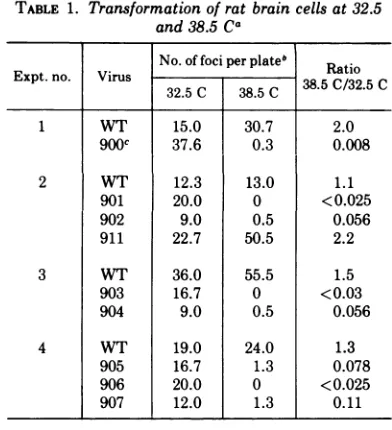
Isolation of mutants. Clones
(253)
of UV-irradiated virus and 505 clonessurviving
hy-droxylamine
treatment were tested for theirability
totransform ratcells,
andfive(ts
900tots
904)
fromUV-irradiated
and three(ts
905tots
907)
fromhydroxylamine-treated
clonesproved
to have temperature-sensitivetrans-forming ability
(Table 1).
WT virus and ts911,
which wastaken as a
transformation-plus
con-trolmutant, formed 1.1-to2.2-foldmorefociat 38.5 C than at 32.5
C,
whereaseight
transfor-mation-defective mutants formed 9-to 125-fold smaller number of foci at 38.5 C than that at32.5 C.
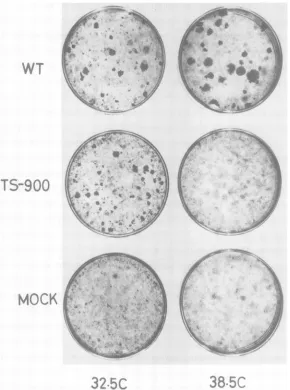
Although
most ofthe foci producedby
themutants at38.5 Cweresmallerorless dense than thoseby
WTvirus,
the size of the fociproduced
by
mutants at 32.5 C was similar tothat
produced
by
WT virus(Fig. 2).
Ts 911produced
fociindistinguishable
from WT. Nomutantincapable
oftransformingratcells at either 32.5 or 38.5 C has been isolated from the same mutagenized virus clones.Plaquing
andgrowth
characteristics of the mutants. All of the ts mutants except ts 901 failed tomake clearplaques
at40.5C,
whereas theefficiency
of plaque formation of the mu-tants was similar to that of WT virus at 35 C(Table 2).
Theefficiency
of plaquing ofts 901 waslowerat40.5 C thanthatat 35 C only byafactor of
102, indicating
ahigh
degree ofleaki-ness orreversiontoWT. Two of themutants,ts
50V
ct10
C 5
x
1
7200 2400 800 267
MULTIPLICITY OF INFECTION PPFU CELL
FIG. 1. Relationship between concentration of WT virus and focusformation. Symbols for number of foci mean + onestandard error, at 38.5 (A) and 32.5 C (0).
J.VIROL.
on November 10, 2019 by guest
http://jvi.asm.org/
[image:2.502.260.449.420.620.2]TRANSFORMATION-DEFECTIVEtsMUTANTSOF SV40 TABLE 1. Transformation of rat brain cells at 32.5
and 38.5Ca
No. of foci perplate,' Rai
Expt.no. Virus 38.5C/32.5C
32.5C 38.5C 38502.C
1 WT 15.0 30.7 2.0
900C 37.6 0.3 0.008
2 WT 12.3 13.0 1.1
901 20.0 0 <0.025
902 9.0 0.5 0.056
911 22.7 50.5 2.2
3 WT 36.0 55.5 1.5
903 16.7 0 <0.03
904 9.0 0.5 0.056
4 WT 19.0 24.0 1.3
905 16.7 1.3 0.078
906 20.0 0 <0.025
907 12.0 1.3 0.11
aTransformation was performed as described in
Materials and Methods. The input multiplicity of infection was 500 to 2,500PFU/cell. Nowell-defined fociweredetected in mock-infected control
plates.
bAverageoftwo tothreeplates.
cAblock of mutant numbers has been assigned by J.A. Robb (15).
903
and
906,formed plaques almost
equally well at 38.5and
32.5C, though they showed
atleast
a
30-fold
higher efficiency
of transformation at 32.5than
38.5C
(Table 1). Othertransforma-tion-defective
mutantsformed
minute,poorly
defined
plaques
at 38.5C. The
yields
of virusafter
asingle
cycle
ofgrowth
at 35and
40.5C
after
infection
at aninput
multiplicity
of 10PFU/cell
wereexamined (Table
2).The
yield
ofWT
virus wasonly threefold
lower at 40.5C
than
at35C. The
ratio ofthe
yield
at40.5C
tothat
at 35C
by
ts-903 wasonly twofold less than
that
by
WT virus after infection at aninput
multiplicity
of 10PFU/cell.
At aninputmulti-plicity of
1PFU/cell, however,
the ratio wasabout
10-3,showing multiplicity-dependent
leakiness. The other
mutantsproduced yields
which
were 16- to10,000-fold
lower at 40.5C
than
at 35C.
Complementation
studies
inproductive
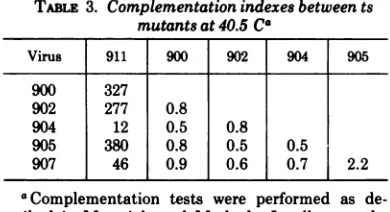
in-fection. Table
3lists the
complementation
tests between fivetransformation-defective
and onetransformation-plus
ts mutants inGC7 cells
at 40.5
C. Each
ofthetransformation-defective
mutants
clearly
complemented
transformation-plus
mutant911.Nocomplementation
between mutants 900, 902, 904, 905,and
907could
be detected under the sameexperimental
condi-tions,
providing
evidence that thesetransforma-tion-defective
mutants are defective inthe
samefunction.
Other transformation-defective
mu-tants, 901, 903, and 906, were too leaky in productive infection to test for the complemen-tation(Table
2).DISCUSSION
The
results we have presented in this papershowed
the following: (i) all the eight ts mu-tants selected for their inability to transform nonpermissive ratcells at 38.5 C were also tem-perature sensitive for replication in permissiveAGMK
or GC7 cells, and (ii) no mutantin-capable
of transforming rat cells but capable of replicating in permissive cells both at 38.5and
32.5C
was isolated. The results indicatethat
atleast
aviral
functionrequired
for theformation of dense
foci of rat cells is also necessary forthe replication ofSV40
in monkeycells. The
temperature sensitivity of the ts genefunction,
however,
wasdifferently expressed
inthe transformation and
inthe viral
replica-tion.For
example, the
efficiency of plaqueformation of
ts 903 in permissiveGC7
cells wasequal both
at 38.5and
32.5C (Table
2),whereas the
efficiency of transformation of the mutant was morethan 30-fold lower
at 38.5'C
than that
at 32.5C
(Table
1).Even
inthis
case,
the
same ts geneproduct
maybe
re-quired both
forthe transformation and
forthe
viral replication, because
the plaque-forming capacityof
ts 903 was 50%less than that
ofWT
virus at 38.5C,
and the mutantproduced
ayield
which
wasabout 1,000-fold lower
at 40.5than
35C
at alow input
multiplicity
ofinfec-tion
(Table 2). Tegtmeyer (19) observed that
some
of
his A
group ts mutants are morede-fective
intransformation than
inreplication
at 39
C. The difference
inthe
temperaturesensitivity
between the transformation and the
replication
mayreflect
adifference
inthe
amount of
the
ts geneproduct
inthe
per-missiveand the
nonpermissivecells
or mayreflect
adifference
in receptor sites forthe
ts gene
product
inthe
twodifferent kinds
ofcells.
A tscharacter
oftransformed
cells
in-fected
with
a ts mutantofRous
sarcomavirusalso
expressed
differently
in permissiveand
restrictive cells (4). In rat
cells,
restrictive for replication of Rous sarcomavirus,
37C
is a nonpermissivetemperature, whereasinpermis-sive
chicken
cells,
37C
isapermissive
and41C
is a
nonpermissive
temperature for the expres-sion oftransformed
phenotype
inducedby
thets mutant.In ourpresent
study
weused
atransformation assaywhich
monitorsmultilayered
foci.Re-1299
VOL.15, 1975
on November 10, 2019 by guest
http://jvi.asm.org/
411 ~ ~
..
_ H _ ~.~A:'
FIG. 2. Transformationofratbrain cells by WT andts900virus. The infectedcultureswerefixed with10%
[image:4.502.111.401.52.442.2]formalin solutionand stained with Giemsasolutionafter24daysat32.5C and after16daysat38.5C. TABLE 2. Efficiency ofplaque formation and virus yield in GC7 cells
Ratio ofplaquing efficiencya Ratio of virus yield (40.5 C/35C) Virus
38.5C/32.5C 40.5C/35 C MOI = 10c MOI=1
WT 2.5 9.3x 10⁻¹ 3.3x 10⁻¹ 2.2x
10-1
900 1.0x 10⁻⁵ 2.5x10⁻⁶ 1.0 x10⁻⁴
901 3.3x 10⁻² 7.3x 10⁻³ 1.1X 10⁻²
902 1.0x 10⁻² 6.7x
10-6
7.7 x10-'
903 1.1 3.4x 10⁻⁶ 1.7x 10⁻¹ 1.4x 10⁻³
904 1.3x 10⁻² 3.7 x 10-e 6.3 x 10⁻³
905 4.0x 10⁻¹ 1.8 x 10⁻⁶ 2.8 x 10⁻³
906 5.6x 10⁻¹ 1.6 x 10⁻⁶ 6.0x10⁻²
907 1.8 x10⁻² 1.6 x 10⁻⁶ 2.5 x
10--911 <6.6 x 10⁻⁴ 3.1 x 10⁻⁶ 1.8 x 10⁻⁴
aPlaqueswerecounted on day 17 (32.5 C), 13 (35 C), 10 (38.5 C),and 12 (40.5C).
bInfectedcultures were harvested after 70 h ofincubationat 35 C and after 48 h ofincubation at 40.5 C and
assayed forinfectious virus production at 35C.
cMOI, Multiplicityofinfection; PFU per cell.
1300
on November 10, 2019 by guest
http://jvi.asm.org/
TRANSFORMATION-DEFECTIVE tsMUTANTS OF SV40
TABLE 3. Complementation
indexes
betweents
mutants at 40.5 Ca
Virus 911 900 902 904 905
900 327
902 277 0.8
904 12 0.5 0.8
905 380 0.8 0.5 0.5
907 46 0.9 0.6 0.7 2.2
aComplementation tests were performed as
de-scribed in Materials and Methods. In all cases the frequency of reversion and recombination was less than 1%.
cently, Risser and Pollack (12) showed that
wide
variation in
transformed properties are
observed in 3T3 cells
infected with SV40,
sug-gesting
that the process of cellular
transforma-tion
by
SV40
is
the result of several complicated
interactions of
cellular and viral genes and not
simply the result of a single viral gene acting
directly to transform a cell. In their
transforma-tion
test, only 17% of the
transformed clones
made dense colonies, when clones were
first
morphologically scored. Their study indicates
that
our
transformation assay might score only
one of
several viral functions which affect
trans-formed
properties.
By
complementation
test, five
ofour mutants
were
grouped into one complementation group.
They were defective in virion (V) antigen and
viral
DNA
synthesis
but not in induction of
cellular
DNA
synthesis
inpermissive
GC7 cells
(unpublished data), and
the
number
of T
anti-gen-positive
GC7
cells in cultures infected with
the mutants is reduced
slightly
at40.5
C
com-pared
to
that at
35C (11;
unpublished
data).
These phenotypes of our mutants indicate that
the
complementation group of
oursmay
corre-spond
toTegtmeyer's
group A
(19). J. A. Robb
kifidly examined
synthesis
of
V, capsid,
and T
antigens
in
TC7 cells infected with
ts 900and
grouped
the mutant
intogroup A.
ACKNOWLEDGMENTS
WearegratefultoHirotoShimojo and Kinichiro Odafor theirhelpfuldiscussions and criticalreview ofthis
manu-script.Wewouldliketothank JamesA.Robbforexamining theantigenicphenotypesof ts 900.
The work waspartially supported by a grant from the Ministry of Education of Japan.
LITERATURE CITED
1. Chou, J.Y.,andR.G. Martin. 1974.Complementation analysis of simian virus 40 mutants. J. Virol. 13:1101-1109.
2. Dubbs,D.R.,M.Rachmeler,and S. Kit.1974. Recombi-nation between temperature-sensitive mutants of simianvirus 40.Virology57:161-174.
3. Golde,A. 1970.Radio-inducedmutants of the Schmidt-Ruppin strain of Rous sarcoma virus. Virology 40:1022-1029.
4. Graf,T., and R. R. Friis. 1973. Differential expression of transformation in rat and chicken cells infected with an avian sarcoma virus ts mutant. Virology 56:369-374. 5. Ishibashi, M. 1971. Temperature-sensitive conditional-lethal mutants of an avian adenovirus (CELO). I. Isolation and characterization. Virology 45:42-52. 6.Ishikawa, A., and T. Aizawa. 1973. Characterization of
temperature-sensitive mutants ofSV40.J.Gen. Virol. 21:227-237.
7. Kawai, S., C. E. Metroka, and H. Hanafusa. 1972. Complementation offunctionsrequiredforcell trans-formation by double infection with RSV mutants. Virology49:302-304.
8. Kimura,G., and R. Dulbecco. 1972. Isolation and charac-terization oftemperature-sensitive mutants of simian virus 40.Virology 49:394-403.
9. Kimura, G., and R. Dulbecco. 1973. A temperature-sensitive mutant of simian virus 40 affecting trans-formingability.Virology52:529-534.
10. Kit, S.,S.Tokuno, K. Nakajima, D. Trkula,and D. R. Dubbs. 1970. Temperature-sensitive simian virus 40 mutantdefective in a late function. J. Virol. 6:286-294. 11. Kuchino, T., and N.Yamaguchi.1975.Characterization
ofT antigen incellsinfectedwith a temperature-sensi-tive mutant of simian virus 40.J. Virol. 15:000-000. 12. Risser,R., and R. Pollack. 1974. Anonselective analysis
ofSV40 transformation of mouse 3T3cells.Virology 59:477-489.
13. Robb,J. A., and R. G. Martin. 1970. Genetic analysis of simian virus 40. I. Description of microtitration and replica-plating techniques for virus. Virology 41:751-760.
14. Robb,J. A., H.S. Smith, and C. D. Scher. 1972. Genetic analysisof simianvirus 40.IV.Inhibited transforma-tion of BALB/3T3 cells by a temperature-sensitive earlymutant.J.Virol9:969-972.
15. Robb, J. A., P. Tegtmeyer, R. G. Martin,and S. Kit. 1972.Proposal for a uniform nomenclature for simian virus 40 mutants.J. Virol.9:562-563.
16. Suzuki,E., and H.Shimojo. 1971.A temperature-sensi-tive mutant ofadenovirus31,defective inviral deoxyri-bonucleicacid replication.Virology 43:488-494. 17. Tai, H.T., C.A.Smith, P. A.Sharp, andJ.Vinograd.
1972. Sequence heterogeneity in closed simian virus 40deoxyribonucleic acid.Virol. 9:317-325.
18. Takemoto, K. K., R. L.Kirschstein, andK.Habel. 1966. Mutants of simian virus 40differing in plaquesize, oncogenicity, and heat sensitivity. J. Bacteriol.
92:990-994.
19. Tegtmeyer, P. 1972. Simian virus 40 deoxyribonucleic acidsynthesis:theviralreplicon.J.Virol.10:591-598. 20. Tegtmeyer, P., C. Dohan, Jr., and C. Reznikoff. 1970.
Inactivatingandmutageniceffects ofnitrosoguanidine on simian virus 40. Proc. Natl. Acad. Sci. U.S.A. 66:745-752.
21.Tegtmeyer, P.,and H. L.Ozer.1971. Temperature-sensi-tive mutants of simian virus40:infection ofpermissive cells.J. Virol.8:516-524.
22. Uchida, S., K.Yoshiike, S. Watanabe, andA. Furuno.
1968.Antigen-forming defectivevirusesof simianvirus 40.Virology 34:1-8.
23. Yamamoto, H. 1970. Inactivation of the transforming capacity of SV40 and theoncogenecityofadenovirus12
by ultraviolet irradiation. Jpn. J. Microbiol. 14:487-493.
24. Wyke, J. A. 1973. Complementation of transforming functions bytemperature-sensitive mutantsofavian sarcomavirus.Virology54:28-36.
1301
VOL.15,1975