City, University of London Institutional Repository
Citation
:
Guerard, K., Saint-Aubin, J., Poirier, M. and Demetriou, C. (2012). Assessing the Influence of Letter Position in Reading Normal and Transposed Texts Using a LetterDetection Task. Canadian Journal of Experimental Psychology, 66(4), pp. 227-238. doi: 10.1037/a0028494
This is the unspecified version of the paper.
This version of the publication may differ from the final published
version.
Permanent repository link:
http://openaccess.city.ac.uk/2518/Link to published version
:
http://dx.doi.org/10.1037/a0028494Copyright and reuse:
City Research Online aims to make research
outputs of City, University of London available to a wider audience.
Copyright and Moral Rights remain with the author(s) and/or copyright
holders. URLs from City Research Online may be freely distributed and
linked to.
Assessing the influence of letter position in reading normal and transposed texts using a letter
detection task
Katherine Guérard1, Jean Saint-Aubin1, Marie Poirier2, & Constantina Demetriou2 1
Université de Moncton, New Brunswick, Canada
2
City University, London, UK
RUNNING HEAD: Letter position effect in reading
Correspondence:
Katherine Guérard
École de psychologie
Université de Moncton
New Brunswick
E1A 3E9
Canada
Tel. +(506) 858-4551
Fax +(506) 858-4768
Abstract
During word recognition, some letters appear to play a more important role than others.
Although some studies have suggested that the first and last letters of a word have a privileged
status, there is no consensus with regards to the importance of the different letter positions when
reading connected text. In the current experiments, we used a simple letter search task to examine
the impact of letter position on word identification in connected text using a classic paper and
pencil procedure (Experiment 1) and an eye movement monitoring procedure (Experiment 2). In
Experiments 3 and 4, a condition with transposed letters was included. Our results show that the
first letter of a word is detected more easily than the other letters, and transposing letters in a
word revealed the importance of the final letter. It is concluded that both the initial and final
letters play a special role in word identification during reading, but that the underlying processes
might differ.
Word count: 153 words
Assessing the Influence of Letter Position in Reading Connected Texts Using a Letter
Detection Task
As the basic element of written words in alphabetic languages, the processing of letters
has always had a special status in the study of word recognition. A number of studies have shown
that the words exterior letters play an important role in word recognition (e.g., Humphreys, Evett,
& Quilan, 1990; Jordan, Patching, & Milner, 2000; Mason, 1975; McCusker, Gough, & Bias,
1981; Stevens & Grainger, 2003). However, these studies used paradigms in which words are
presented in isolation. As Jordan, Thomas, and Patching (2003) pointed out: "whereas evidence
of a privileged status for exterior letter pairs in processing single (foveal) word displays is
plentiful […] this evidence has not been matched in studies in which words are presented in
bodies of text" (p.900). Although there is evidence that both the first and the last letters of the
word play a more important role than interior letters when reading connected text (e.g., Jordan,
Thomas, Patching, & Scott-Brown, 2003) other studies have shown that only the first letter is
critical (e.g., Briihl & Inhoff, 1995). The objective of the present series is to examine the
importance of the words’ exterior letters during reading by using a letter detection task.
To investigate the contribution of individual letter positions in word processing during
reading, Briihl and Inhoff (1995) used an eye contingent paradigm and manipulated the
availability of letters in the target word when readers were fixating the previous word. They
found a preview benefit – that is, fixation duration on the target word decreased – when the first
letters of the target word were available in the parafovea compared to a condition where all letters
were replaced by Xs. The availability of the two exterior letters of the word did not lead to a
larger preview benefit than presenting only the first two letters, suggesting that the last letter does
connected text reading have also concluded that the peripheral availability of a word’s first letters
was more beneficial than the availability of ending letters—suggesting a more important role for
initial letters (Inhoff, 1989; Rayner, McConkie, & Zola, 1980; Rayner, Well, Pollatsek, &
Bertera, 1982).
In 2003, Jordan, Thomas, Patching and Scott-Brown measured eye movements while
participants were reading continuous text. The critical manipulation was the degradation of a few
letters in the text through digital filtering. The results indicated that degrading exterior letters
(first and last) slowed reading speed more than degrading interior letters or degrading only the
first two letters; hence, the findings suggest that a words’ last letter may be more important than
was suggested by Briihl and Inhoff (1995). The importance of the last letters of a word was also
demonstrated in studies using the transposed letters paradigm (e.g., see Johnson, Perea, &
Rayner, 2007; Rayner, White, Johnson, & Liversedge, 2006; White, Johnson, Liversedge, &
Rayner, 2008). For example, in a study by White et al., participants were asked to read
continuous text where target words had two adjacent letters transposed. They showed that
fixation duration on the critical words was longer when the beginning letters were transposed
(oculd instead of could) than when the ending letters were transposed (coudl) and that end
transpositions were associated to longer fixation duration than interior transpositions (cuold). The
two sets of studies described so far provide diverging evidence with regards to the importance of
a word’s ending letters. In order to shed light on this debate, we assessed the importance of letter
positions using a different procedure than that employed in previous studies namely, a letter
detection task.
A number of studies have investigated the importance of letter position using single words
displays. Evidence that the exterior letters of words have a privileged status was obtained using a
wide variety of tasks such as letter recognition paradigms (e.g., Jordan, 1990; Jordan et al., 2000),
word recognition paradigms (Humphreys et al., 1990; McCusker et al., 1981) and lexical decision
tasks (Humphreys et al., 1990). One task that has been widely used is letter detection where
participants are asked to indicate if a target letter is part of a word displayed on the screen (see
Acha & Perea, 2010; Krueger, 1970; Mason, 1975; Pitchford, Ledgway, & Masterson, 2008).
Such a task has enjoyed great popularity in the study of letter position effects. Indeed, in addition
to providing converging evidence with other paradigms, it is believed to reflect key processes
involved in word recognition and reading (e.g., see Acha & Perea, 2010; Pitchford et al., 2008).
Letter detection has also frequently been used to investigate the cognitive factors involved
in letter and word identification in reading (Healy, 1994) and has served to examine the role of
several factors, such as word frequency (e.g., Roy-Charland & Saint-Aubin, 2006), text repetition
(e.g., Saint-Aubin, Roy-Charland, & Klein, 2007) and word function (Koriat & Greenberg,
1991). In the classical letter detection task introduced by Corcoran (1966), participants are asked
to read a continuous text for comprehension while looking for a target letter. Typically, the
results show that readers cannot detect all occurrences of the target letter and they are more likely
to miss it when it is embedded in frequent function words (e.g., the) than in less frequent content
words (e.g., tie, toe) (see, e.g., Moravcsik & Healy, 1995; Saint-Aubin & Poirier, 1997).
Despite its great popularity in studying reading processes and the importance of the
different letter positions in single word displays, letter detection has been seldom used in order to
investigate the letter position effect during reading. Indeed, only two studies assessed the
Schneider & Healy, 1993), but this was a peripheral aim of those studies. As a consequence,
these studies lack sufficient control to allow strong conclusions about the importance of the
different letter positions during reading.
The letter detection task was used in the present study in order to examine the letter
position effect. Participants were asked to read a text for comprehension while searching for a
target letter. In Experiment 1, the classical paper and pencil procedure was used. In Experiment 2,
the importance of parafoveal processing in the letter position effect was examined by measuring
eye movements during the letter detection task. In Experiments 3 and 4, a transposed letters
condition was included in order to investigate the discrepancy observed between different
procedures.
Experiment 1
A paper and pencil procedure was used in Experiment 1 in order to examine the letter
position effect in reading connected text (in French). The target letter was embedded equally
frequently at each letter position in letter content words. Because there are not enough
five-letter function words containing the five-letter r in French, function words of any length were
included in the text solely in order to assess the presence of the classic missing-letter effect.
Participants were presented with a text in a booklet and asked to circle the letter r each time they
noticed it. They were instructed to read at their normal speed and to try to comprehend the text.
The text was followed by a series of eight questions to ensure that participants read for
Method
Participants. Sixty students from Université Laval, with French as their first language,
volunteered to take part in the experiment in exchange of a small honorarium. All reported
normal or corrected-to-normal vision.
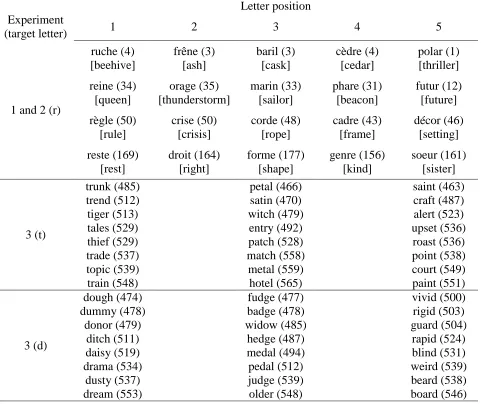
Materials. A total of 20 critical French words containing the letter r were used in the
experiment with four words for each letter position (see Table 1). The words for each letter
position were equated on frequency, with a mean of 61 occurrences per million. Throughout the
text, each word was repeated five times for a total of 100 critical words, in a French text
containing 1,564 words. The critical words were used either as nouns or adjectives. Great care
was taken to ensure that critical words were inserted in similar contexts throughout the text. For
instance, in all conditions, 14 to 16 critical words followed a determinant and 4 to 6 critical
words followed a noun or an adjective. In addition, in order to assess the presence of the classical
missing-letter effect, 20 function words containing the letter r were also included in the text. The
function words were prepositions and conjunctions that comprised between three and six letters
and the target letter was either embedded in the last or penultimate position. The function words
car [because], contre [against], sur [on], and pour [for] were used 1, 1, 6, and 12 times
respectively. The target letter was also embedded in 87 non-critical words. The text was
constructed with the restriction that there were at least four words without rs between two words
containing the target letter, whether they were critical or not. No critical words were inserted in
the first sentence of the text or at the beginning or end of a line (see Smith & Groat, 1979, for an
empirical justification). Finally, no critical word began with a capital letter or was preceded or
followed by a punctuation mark. The text was printed in times new roman 12 points and was two
In order to promote reading for comprehension, eight multiple choice comprehension questions
were developed and were inserted at the end of the booklet. For each question, participants had to
choose between four possible responses.
Procedure. Participants were tested individually. They were instructed to read the text for
comprehension and to circle all occurrences of the target letter r. They were warned not to slow
their reading speed and not to come back to circle a letter they had missed. They were also
informed that their comprehension would be tested with eight multiple-choice questions.
Results
The comprehension score was 58.3% (SD = 21.2). The proportion of omissions was first
analysed as a function of word syntactic role to verify the presence of the basic missing-letter
effect. To this end, for each participant, the proportion of omissions was computed by pooling
together the 100 occurrences of the critical content words, and by pooling together the 20
occurrences of function words. For all analyses, the .05 level of significance was adopted and the
Greenhouse-Geisser correction was applied when the sphericity criterion was not met. A
repeated-measures analysis of variance (ANOVA) indicated that the mean proportion of
omissions was much larger for function words (M = .66, SD = .23) than for the critical content
words (M = .15, SD = .10), F(1, 59) = 463.22, MSE = 0.01, η2p = .89.
The proportion of omissions among the critical content words was then assessed
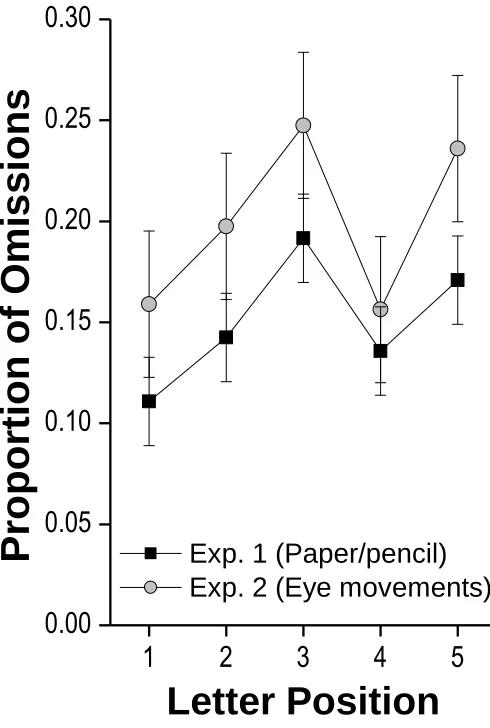
separately as a function of letter position. As shown in Figure 1, there are fewer omissions for the
first letter position, and more omissions for the third letter position. A repeated-measures
ANOVA showed that the main effect of letter position was significant, F(4, 236) = 8.02, MSE =
0.01, η2p = .12. Post hoc comparisons (Tukey, HSD) revealed that readers made significantly
and more omissions when the target letter was in the third than in the second or fourth position.
No other contrasts were significant. To ensure that this pattern was not due to the relatively low
comprehension scores, we removed the participants that had a comprehension score at chance
level (25%) or below from the analysis (n = 56). The same pattern of results was observed.
‘Insert Figure 1 about here’
A surprising finding is that the proportion of omissions in fourth position was very low
compared to other positions. One possibility is that the r in fourth position was detected more
often because in half of these critical words, it followed another consonant. Indeed, the letter r in
the critical word cèdre might be pronounced with more emphasis than in the word polar because
it is preceded by a consonant. In order to test this idea, we analysed the proportion of omissions
in position four for critical words where the letter r was preceded by a consonant (cèdre and
cadre) and where the letter r was preceded by a vowel (phare and genre). The analysis indicated
that the proportion of omissions was much lower when the target letter was preceded by a
consonant (M = .13, SD = .16) than by a vowel (M = .23, SD = .13), F(1, 59) = 24.99, MSE =
0.01, η2p = .30.
A final analysis was carried out in order to ensure that the repetition of each critical word
did not influence our pattern of results. Indeed, each critical word was repeated five times
throughout the text. For each letter position, we therefore calculated the proportion of omissions
for the first and last occurrences of the critical words in the text. A 5 (letter position; 1 to 5) x 2
(occurrence; first, last) repeated measures ANOVA confirmed that the effect of letter position
was significant, F(4, 236) = 4.32, MSE = 0.03, η2p = .07. Neither the main effect of occurrence,
nor the interaction between letter position and occurrence were significant (Fs < 1), suggesting
is in line with that of Saint-Aubin et al. (2007) showing that the pattern of omissions is unaffected
by text repetition.
Discussion
The present experiment replicated the classical missing-letter effect, that is, the target
letter was detected more often when it was embedded in content than in function words (e.g.,
Corcoran, 1966; Koriat & Greenberg, 1994; Moravcsik & Healy, 1995; Saint-Aubin & Poirier,
1997). Consistent with previous studies (Briihl & Inhoff, 1995), the results also indicated that
when the target letter occupied the first position of the word, it was detected more often than
when it occupied other positions. Importantly, when the target letter was in the last position, it
was not detected more often than the interior positions.
A surprising finding is that the proportion of omissions was particularly low in fourth
position. This finding might be due to the fact that the letter r in position four was sounder than in
other positions because in half of the critical words, it followed a consonant. This is supported by
the finding that when the letter r in fourth position followed a consonant, the proportion of
omissions was much lower than when it followed a vowel. It is important to note that for letter
positions 1, 3 and 5, the critical letter always followed a vowel and therefore, that this
particularity cannot explain the advantage for the first letter over the final letter.
Although the latter finding is in line with Briihl and Inhoff’s (1995) results, it is not
consistent with studies in which text was degraded (e.g., Jordan, Thomas, Patching, &
Scott-Brown, 2003) or letters were transposed (e.g., White et al., 2008). Inhoff, Radach, Eiter, and
Skelly (2003) suggested that the advantage for the last letter occurred mostly when foveal
processing is dominant. As in Jordan's et al. study, both foveal and parafoveal processing were
should have observed an advantage for the last letter. One possibility however, is that the
importance of the last letter depends on the amount of parafoveal processing given to a word: a
lower amount of parafoveal processing – leading to an increased reliance on foveal processing –
could lead to an advantage for the last letter. Another possible reason for the discrepancy between
our results and that of other studies is that our measure was not sensitive enough. Indeed, we
measured the proportion of omissions whereas other studies used time-related measures such as
fixation duration (e.g., see White et al., 2008) or reading time (e.g., Jordan, Thomas, Patching, &
Scott-Brown, 2003).
Experiment 2
In order to examine the role of parafoveal processing in producing the advantage for the
words’ last letter, eye movements were recorded while participants read the text presented on the
computer screen. Participants were required to mouse-click each time they detected the target
letter, which allowed measuring response latencies for detections. The proportion of omissions
and response latencies at each letter position were analysed as a function of the distance between
the critical word and the location of the closest fixation made prior to fixating the critical word
(e.g., see Briihl & Inhoff, 1995). If the advantage for the last letter occurs when foveal processing
is dominant, this advantage should be observed when the amount of parafoveal processing is
lower, that is, when the pre-target fixation lands further to the left of the critical words.
Method
Participants. Thirty students from Université de Moncton volunteered to take part in the
experiment. All reported normal or corrected-to-normal vision.
Apparatus and materials. The text was the same as that used in Experiment 1. The 1,564
began with a new sentence (no sentences were split to begin on one page and finish on the next
page). In order to preserve the same arrangement as in Experiment 1, the first sentence on each
page began at the top of the page, one space to the right of the last sentence’s period, at the same
horizontal location it would have if the two sentences were presented on the same screen. Eye
movements were recorded with the SR Research Ltd EyeLink II system. The system’s resolution and
sampling rate are < 0.5 degree and 500 Hz. The eye movements were captured by two cameras
mounted on a headband that allowed tracking of both eyes and head position for head-motion
compensation. In this experiment, only the pupil of the participant’s eye for which the most accurate
calibration was achieved was tracked.
Procedure. The experimental session began with a calibration phase where participants
were asked to fixate alternatively nine calibration dots. After calibration, the pages of text were
presented one after the other. When participants were done reading one page, they were
instructed to look at a small cross located at the right-bottom of the screen to indicate to the
experimenter that the next page could be displayed. In order to ensure eye movement recording
accuracy, before the presentation of each page, participants had to fixate a single calibration dot
located in the top left corner of the page, vertically aligned with the first line of text.
As in Experiment 1, participants were instructed to read for comprehension.
Simultaneously, they were told to press the left button of the mouse as fast as possible each time
they encountered the letter r. After reading the 28 pages, they were asked to answer eight
multiple-choice questions that were presented on paper.
Results
The comprehension score was 52.08% (SD = 19.99). Eye movements were analysed with
the EyeLink Data Viewer program which displays the participants’ eye movements superimposed
critical words), 0.28% were removed from the analysis due to large distortions in eye movement
recording. Moreover, when making a line return, the eyes did not always land on the first word of
the new line: on some occasions, the eyes landed on the critical word—which was never the first
word of a line—or immediately to its right. Those cases represent 3.72% of all observations and
were removed from the analyses. Also, several studies have shown that when the critical word is
skipped during reading, the proportion of omissions increases (e.g., see Roy-Charland,
Saint-Aubin, Klein, & Lawrence, 2007). A word was considered skipped when it was not fixated at all,
that is to say, neither during the first pass, nor after a regression. In our experiment, the
percentage of skips was not equivalent between the five letter positions: it was 11%, 11%, 9%,
4% and 7% for positions 1 to 5 respectively, a difference that was significant, F(4, 116) = 8.80,
MSE = 0.004, η2p = .23. As typically found in eye monitoring studies, function words (26%) were
also skipped significantly more often than the critical content words (8%), F(1, 29) = 24.64, MSE
= 0.02, η2p = .46 (see, e.g., Carpenter & Just, 1983; Greenberg, Inhoff, & Weger, 2006;
Saint-Aubin & Klein, 2001). In order to ensure that the differences observed are not due to the
percentage of skips, the following analyses are based on fixated words only, whether fixation
occurred through the first past, or after a regression. Moreover, the analyses on the proportion of
omissions and on response latencies yielded the same pattern of results irrespective of whether
they were performed on all subjects, or only on subjects that had a comprehension score above
chance level (n = 25). Therefore, only the former analyses are reported
Proportion of omissions. A repeated-measures ANOVA showed that the mean
proportion of omissions was again larger for function words (M = .65, SD = .27) than for the
critical content words (M = .20, SD = .15), F(1, 29) = 133.11, MSE = 0.02, η2p = .82. The
position. As shown in Figure 1, the pattern of omissions is very similar to that of Experiment 1:
there were fewer omissions for Position 1, but not for Position 5. A repeated-measures ANOVA
revealed that the main effect of letter position was significant, F(4, 116) = 5.33, MSE = 0.01, η2p
= .16. Post hoc comparisons (Tukey, HSD) revealed that readers made significantly fewer
omissions when the target letter was in first position than in the third or fifth position and fewer
omissions when the target letter was in fourth than in the third or fifth position. No other
contrasts were significant.
The proportion of omissions was then measured as a function of eccentricity. For each
target, we calculated the number of characters (including spaces and punctuation) between the
location of the closest fixation that preceded fixation on the critical word and the first letter of the
critical word1. When no regression was made from the previous word, the location of the closest fixation was also the location of the last fixation prior to fixation on the critical word. For each
participant, the proportion of omissions was assessed separately for pre-target fixations that were
located fewer than four characters to the left of the critical word’s first letter (near fixation; mean
closest fixation distance = 2.3 characters, SD = 0.1) and for pre-target fixations that were located
four characters or farther (far fixation; M = 7.6, SD = 0.9). These values were chosen as they
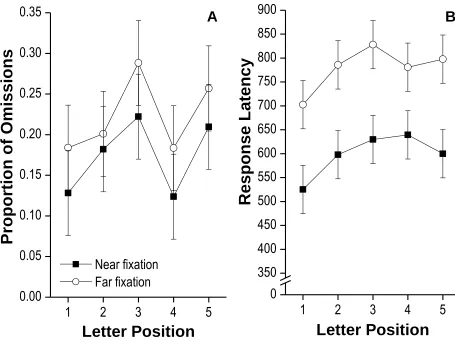
allow equal sample size. As shown in Figure 2A, the proportion of omissions for all letter
positions was higher for far than for near fixations, but the pattern of omissions across letter
positions was the same in both cases. This was confirmed by a 2 (eccentricity; far fixation, near
fixation) x 5 (letter position) repeated-measures ANOVA showing that the main effects of
eccentricity, F(1, 29) = 14.39, MSE = 0.01, η2p = .3, and of letter position, F(4, 116) = 5.12, MSE
= 0.001, η2p = .15, were significant, but not the interaction between eccentricity and letter
‘Insert Figure 2 about here’
Response latency. The time required to respond after a target letter was detected was
calculated from the time the eyes crossed the first letter of the critical word for the first time (e.g.,
see Roy-Charland et al., 2007). To be included in the analysis, the response had to be given
before the eyes crossed the first letter of another word containing the target letter. Response
latency for detected targets was first compared between critical function and content words. This
analysis was based on 25 participants since, as it is often the case, 5 participants detected no
function word (see, e.g., Roy-Charland et al., 2007; Roy-Charland, Saint-Aubin, Lawrence, &
Klein, 2009). A repeated-measures ANOVA showed that response latency was longer for
function words (M = 1009 ms, SD = 259 ms) than for the critical content words (M = 704 ms, SD
= 118 ms), F(1, 24) = 33.50, MSE = 35517.50, η2p = .58. Response latency for the critical content
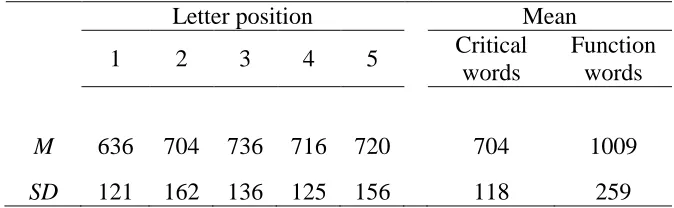
words was then assessed separately for the five letter positions. Table 2 shows that response time
was shorter for the first letter position than for the remaining letters. A repeated-measures
ANOVA confirmed that the main effect of letter position was significant, F(4, 116) = 5.99, MSE
= 7592.31, η2p = .17. Post hoc comparisons (Tukey, HSD) revealed that response latency was
shorter for the first letter position than for the four other positions which did not differ one from
the other.
‘Insert Table 2 about here’
Response latencies were then examined for far and near pre-target fixations. As for the
pattern of omissions, Figure 2B shows that although far fixations led to longer response latencies,
they did so for all letter positions. Two participants were removed from the analysis because they
detected no target letter in one condition. A 2 (eccentricity; far fixation, near fixation) x 5 (letter
162.59, MSE = 14033.34, η2p = .86, and of letter position, F(4, 108) = 7.61, MSE = 14326.68, η2p
= .22, were significant, but the interaction between eccentricity and letter position was not
significant (F < 1).
Eye movement data. Although eccentricity did not modulate the effect of letter position
on response latency and omissions, eccentricity increased response latency by 180 ms and the
proportion of omissions by 5%. In order to understand the effect of eccentricity on our measures,
we calculated gaze duration (the sum of all fixations on the critical word prior to a saccade to a
following word), total fixation time (the sum of all fixations on the critical word), skipping rate
(the percentage of critical words not fixated at all, neither during the first pass, nor after a
regression), and the percentage of regressions on target words (the proportion of target words on
which a fixation has been made after first pass reading) as a function of eccentricity (see Table
3). A repeated-measures ANOVA showed that gaze duration, F(1, 29) = 112.42, MSE = 1478.20,
η2
p = .80, and total fixation time on the critical words, F(1, 29) = 184.10, MSE = 1334.33, η2p =
.86, were longer for far compared to near fixations. Although the skip rate of the critical words
was higher for far fixations, F(1, 29) = 49.45, MSE = 70.96, η2p = .63, the percentage of
regressions on the critical words did not differ between far and near fixations, F < 1.
‘Insert Table 3 about here’
Discussion
Experiment 2 replicated the missing-letter effect by showing that the proportion of
omissions was smaller and response latency was shorter when the target letter was embedded in a
content word than in a function word (e.g., see Roy-Charland et al., 2007). As in Experiment 1,
we observed an advantage for the first letter position, but not for the last letter position. These
not the last letter, was detected faster than the interior letters. When analysed as a function of
eccentricity, the proportion of omissions and response latency for all letter positions decreased
for near pre-target fixations compared with far pre-target fixations. An analysis of eye movement
data showed that fixations on the critical words were longer for far pre-target fixations (~ 100
ms) and that skipping rate was higher for near fixations. The effect of eccentricity on response
latencies might therefore be due to the fact that for near fixations, the target letter could be
detected in parafovea.
Importantly, far pre-target fixations did not lead to an advantage for the last letter.
Therefore, our results suggest that neither the sensitivity of our measure, nor the amount of
parafoveal processing is responsible for the discrepancy between our results and those of other
studies (e.g., White et al., 2008). In order to examine the source of the differences between our
findings and those of previous studies, we combined the letter detection paradigm with a
manipulation of transposed letters (e.g., see White et al., 2008).
Experiment 3
In Experiment 3, we used a classical paper-and-pencil letter detection procedure as in
Experiment 1. A transposed letters condition was included for sake of comparability with
previous studies. If the transposed letters procedure is responsible for uncovering the importance
of the words’ last letter, the advantage for the initial letter compared to the ending letter should be
attenuated or abolished when transposed critical words are used. Moreover, in order to ensure
that the effect observed in the two previous experiments is not due to the use of the target letter r
or to the fact that the text was in French, two different texts were constructed in English: one in
which participants had to search for the letter t and one in which they had to search for the letter
Method
Participants. Sixty-six students from City University London volunteered to take part in
the experiment. All reported normal or corrected-to-normal vision.
Materials and Procedure. A total of 24 five-letter critical words containing the letter d
were selected for the experiment, 8 with the target letter in first position, 8 with the target letter in
third position and 8 with the target letter in fifth position. Another set of 24 five-letter critical
words containing the letter t was selected, 8 for each of the letter positions 1, 3, and 5. The words
for each letter position were equated on familiarity rating according to the MRC psycholinguistic
database (ranging from 100 to 700; Coltheart, 1981) with a mean familiarity rating of 516. Each
target word was presented once in the text. The critical words containing the letter d were
included in a text that comprised 671 words. The text also included 71 non-critical words
containing the letter d.
The critical words containing the letter t were included in a text that comprised 805
words. The text included 132 non-critical words containing the letter t. Each text ended with six
multiple-choice questions to assess their comprehension. Each participant read both texts. Half of
the participants began with the target letter d and half began with the target letter t. For each
critical word, a transposed word was created by reversing the target letter with the previous or
following letter. For middle transpositions, half of the transpositions were made by reversing the
letters 2 and 3 (fduge instead of fudge) and half were made by reversing the letters 3 and 4 (saitn
instead of satin). There were two versions of each text. In the first version, half of the critical
words were transposed (four for each letter position) and the other half was presented normally.
In the second version, the transposed words of the first version were presented normally whereas
target letter. The two versions were used equally often in first and second order. All texts also
included 12 transposed filler words in which the target letter was never embedded. In the d text,
the filler words were three function words containing three or four letters and nine content words
containing between 4 and 9 letters in which the beginning, middle or ending letters were
transposed. In the t text, the transposed filler words were three function words containing two,
three and four letters and nine content words containing between 4 and 9 letters. The transposed
filler words were the same in all versions of the text and the first transposed word in the text was
always a filler word. Instructions warned participants that some words in the text might have
transposed letters but to try to read at their normal speed without backtracking.
Results
D text. The comprehension score was 86.11% (SD = 18.62%). A repeated-measures
ANOVA showed that the mean proportion of omissions for non-transposed words was larger for
function words (M = .91, SD = .15) than for the critical content words (M = .18, SD = .15), F(1,
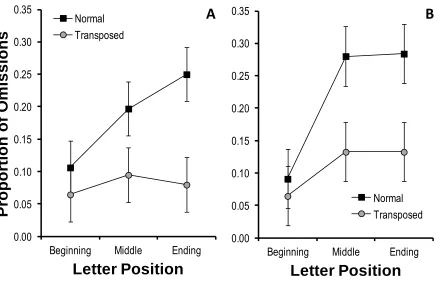
65) = 863.36, MSE = 0.02, η2p = .93. As shown in Figure 3A, the proportion of omissions tended
to increase as a function of letter position for normal words, but to be much flatter for the
transposed words, with a slightly reverse U-shaped function. A 2 (transposition; transposed,
normal) x 3 (letter position; beginning, middle, ending) repeated measures ANOVA showed that
the proportion of omissions was higher for the normal critical words than for transposed critical
words, F(1, 65) = 21.43, MSE = 0.05, η2p = .25. The effect of letter position was significant, F(2,
130) = 8.72, MSE = 0.03, η2p = .12, as well as the interaction between transposition and letter
position, F(2, 130) = 5.71, MSE = 0.02, η2p = .08. Simple main effects analysis showed that there
was a significant effect of letter position for normal critical words, F(2, 130) = 9.47, MSE = 0.04,
η2
comparisons (Tukey, HSD) revealed that for normal critical words, there were significantly fewer
omissions when the target letter was at the beginning than in the middle of the word, and that
fewer omissions when the target letter was in the middle than at the end of the word.
‘Insert Figure 3 about here’
T text. The comprehension score was 91.14% (SD = 13.15%). A repeated-measures
ANOVA showed that the mean proportion of omissions for non-transposed words was larger for
function words (M = .56, SD = .24) than for the critical content words (M = .22, SD = .19), F(1,
65) = 188.28, MSE = 0.02, η2p = .74. The effect of letter positions in the normal and transposed
conditions is presented in Figure 3B. A 2 (transposition; transposed, normal) x 3 (letter position;
beginning, middle, ending) repeated measures ANOVA showed that the proportion of omissions
was higher for the normal critical words than for transposed critical words, F(1, 65) = 24.76,
MSE = 0.05, η2p = .28. The effect of letter position was significant, F(2, 130) = 22.35, MSE =
0.03, η2p = .26. The interaction between transposition and letter position was also significant, F(2,
130) = 5.02, MSE = 0.04, η2p = .07, suggesting that the effect of transposition increased as a
function of letter position. Simple main effects analysis showed that there was a significant effect
of letter position for normal critical words, F(2, 130) = 17.72, MSE = 0.05, η2p = .21, as well as
for transposed critical words, F(2, 130) = 4.89, MSE = 0.02, η2p = .07. Post hoc comparisons
(Tukey, HSD) revealed that for both normal and transposed critical words, there were
significantly fewer omissions when the target letter was at the beginning than in the middle and
ending of the word, and that there was no difference between the two latter conditions.
Discussion
The results first replicated the robust effect of misspellings on omission rate. As
e.g., Healy & Drewnowski, 1983; Koriat & Greenberg, 1991; Proctor & Healy, 1985). In the
missing-letter effect literature, this effect has traditionally been interpreted by assuming that
letters are processed more extensively and for a longer amount of time when words are
misspelled, which translates into a lower omission rate (Healy, 1994). Most importantly for the
aim of the current study, the results of Experiments 1 and 2 were replicated since there were
fewer omissions for the words’ beginning letters, but not for the words’ ending letters,
confirming that this effect is not specific to a given target letter, text or language. In addition, the
advantage for the initial letter compared to the final letter was much lower when the critical
words were transposed, suggesting that the importance of the last letter is better captured by this
particular manipulation. An examination of Figure 3 suggests that the advantage of the word’s
initial letter over the final letter was abolished only in the d text and not in the t text. One
possibility is that the abolition of this effect in the d text is due to a floor effect. Indeed, it is
possible that a higher level of omissions would still yield an advantage for the initial letter.
However, we want to emphasize that even though an advantage for the initial letter may subsist in
the t text, it is strikingly reduced compared to a control condition in both texts.
One hypothesis accounting for the interaction between transposition and letter position,
might be that in words with transposed letters, the target letter is no longer presented in its
original position. Consequently, the different pattern of omissions between the normal and
transposed conditions may be due to the fact that the position in which the target letter was
presented differed between the normal and transposed conditions. For example, for the ending
letter position, the target letter was presented in Position 5 in the normal condition and in Position
4 in the transposed condition. The target letter might be easier to detect when presented in
Experiment 4
The text used in Experiment 4 was the same as that used in Experiment 1. This choice was
made to assess the impact of transposition on text comprehension by comparing the mean
comprehension score with that of Experiment 1 where there were no transpositions. Although not
central to the current demonstration, similar levels of comprehension for normal texts and for
texts with transpositions would further support the usefulness of the transposed letter paradigm
for investigating letter processing in connected texts. The hypothesis that the interaction between
transposition and letter position occurred because the target letter was transposed was tested by
including a group where the transpositions involved other letters than the target letter.
Method
Participants. One hundred and twenty students (two groups of sixty participants) from
Université de Moncton volunteered to take part in the experiment. All reported normal or
corrected-to-normal vision. None had participated in the previous experiments.
Materials and Procedure. The text was the same as that used in Experiment 1. In order
to equate the proportion of transposed words in the text to that of Experiment 3, only a subset of
the critical words used in Experiment 1 were manipulated in the present experiment. More
precisely, the 40 critical words with the target letter in second and fourth positions were not used.
From the remaining 60 critical words containing the letter r, 54 were selected, 18 with the target
letter in first position, 18 with the target letter in third position and 18 with the target letter in fifth
position. There were three versions of the text, each containing a different subset of 18 transposed
critical words (six for each letter position). In one group, (r transposed), the transposition always
involved the target letter r and the adjacent letter (e.g., urche for the critical word ruche). For
3 (e.g., mrain for the critical word marin) and three made by reversing the letters 3 and 4 (e.g.,
mairn for the critical word marin). In the other group, (r not transposed), the transposition
involved two letters that were adjacent to the target letter r (e.g., rcuhe for the critical word
ruche). For middle transpositions, each text included three transposed words made by reversing
the letters 1 and 2 (e.g., amrin for the critical word marin) and three made by reversing the letters
4 and 5 (e.g., marni for the critical word marin). All texts also included 12 transposed filler
words in which the target letter was never embedded (three function words containing two or
three letters and nine content words containing between 5 and 12 letters) in which the beginning,
middle or ending letters were transposed. The transposed filler words were the same in all
versions of the text and the first transposed word in the text was always a filler word.
Results
The mean comprehension score was 56.98% (SD = 23.86%), which did not differ from
that in Experiment 1 (M = 58.3%, SD = 21.2%), F < 1. A mixed ANOVA with letters transposed
(target letter, non-target letters) as a between-subjects factor and word function (content,
function) as a within subject factor showed that the mean proportion of omissions for
non-transposed words was larger for function words (M = .55, SD = .24) than for the critical content
words (M = .17, SD = .15), F(1, 118) = 506.44, MSE = 0.02, η2p = .81. Neither the effect of letters
transposed, nor the interaction between letters transposed and word function were significant, F <
1.
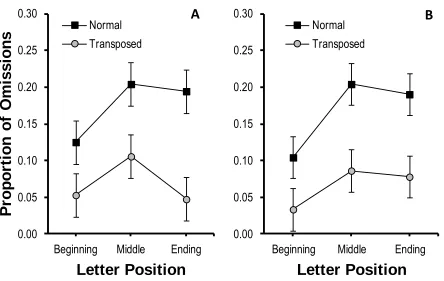
As shown in Figure 4, the patterns of omissions are very similar to that of Experiment 3:
The advantage for the initial letter in the normal condition appeared to be reduced in the
transposed letter condition. A mixed ANOVA with letters transposed (target letter, non-target
(beginning, middle, ending) as within subject factors was performed on the proportion of
omissions. The analysis showed that the proportion of omissions was higher for the normal
critical words, than for transposed critical words, F(1, 118) = 101.29, MSE = 0.02, η2p = .46. The
effect of letter position was significant, F(2, 236) = 20.46, MSE = 0.02, η2p = .15, as well as the
interaction between transposition and letter position, F(2, 236) = 6.33, MSE = 0.01, η2p = .05. The
effect of letter transposed was not significant, F < 1. No other interactions were significant.
Simple main effects analysis showed that there was a significant effect of letter position for
normal critical words, F(2, 238) = 21.33, MSE = 0.01, η2p = .15, as well as for transposed critical
words, F(2, 238) = 8.15, MSE = 0.01, η2p = .06. Post hoc comparisons (Tukey, HSD) revealed
that for normal critical words, there were significantly fewer omissions when the target letter was
at the beginning of the word than in the middle or ending, but that there was no difference
between the middle and ending conditions. For the transposed critical words, there were
significantly more omissions when the target letter was in the middle position than at the
beginning or ending of the word, but there was no difference between the beginning and ending
conditions.
‘Insert Figure 4 about here’
Additional analyses were performed in order to examine if the proportion of omissions in
the group where the target letter r was transposed is determined by the position of the letter after
it has been transposed, or its initial position in the unaltered word. Indeed, in this group, the
beginning transpositions involve presenting the target letter 1 in Position 2, and the ending
transpositions involve presenting the target letter 5 in Position 4. If, as we assumed so far, the
letter’s initial position in the unaltered word is critical, the proportion of omissions should be the
(mairn instead of marin). On the other hand, if the transposed position is critical, the proportion
of omissions should be the same whether the transposed letter in position 2 was initially located
in position 1 (urche instead of ruche) or in position 3 (mrain instead of marin), and it should be
the same whether the transposed letter in position 4 was initially located in position 3 (mairn
instead of marin) or in Position 5 (futru instead of futur). We therefore compared the beginning
and ending transpositions (exterior transpositions) with the middle transpositions where the
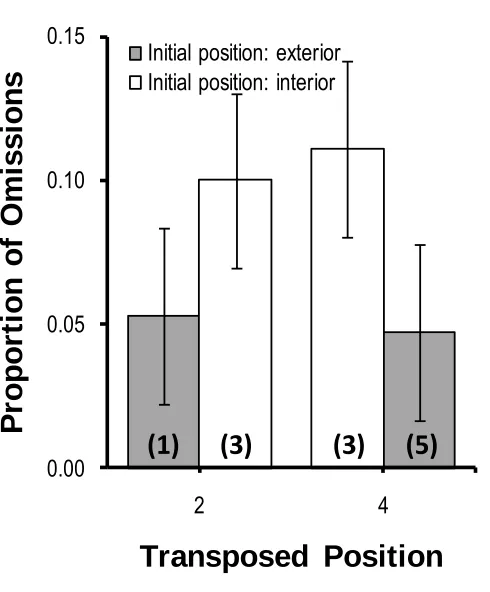
transposed target letter was presented in Position 2 and in Position 4. Figure 5 shows that the
proportion of omissions is higher for interior transpositions than for exterior transpositions.
However, the proportion of omissions is not modulated by whether the target letter is transposed
in Position 2 or in Position 4. This was confirmed by a 2 (transposed position; 2, 4) x 2 (initial
position; exterior, interior) repeated-measures ANOVA performed on the proportion of omissions
in the transposed condition, showing that the main effect of transposed position was not
significant, F < 1, but that the main effect of initial position was significant, F(1, 59) = 11.63,
MSE = 0.02, η2p = .17. The interaction between initial position and transposed position was not
significant, F < 1.
‘Insert Figure 5 about here’
Discussion
The results replicated those of Experiment 3 and showed that with unaltered words, there
is a striking advantage for the initial letter compared to the middle or ending letters. This
advantage was severely reduced when the critical words included transpositions, irrespective of
whether the transpositions involved the target letter or not. Indeed, in words with transpositions,
the ending letter was detected as often as the initial letter. Our results cannot be attributed to the
to that in Experiment 1 where there were no transpositions. Additional analyses confirmed that
the effect of letter transpositions does not occur because, when transposed, the last letter is
presented in fourth position, which is easier to detect.
Although the three-way interaction was not significant, inspection of Figure 4 suggests
that when the target letter was transposed (panel A), there were fewer omissions in ending than in
middle position. One possible explanation is that transposing the ending letter r affected the
phonological coding of the word. As suggested in the discussion of Experiment 1, the target letter
r might be easier to detect depending on the letter that precedes it. This suggests that
phonological processing is critical for letter detection and might also be modulated by
transpositions. Importantly however, even if the pattern of results in the transposed letter
condition might seem inconsistent in the two latter experiments, the advantage for the beginning
letter over the ending letter is always reduced with transposed words compared to normal words.
General Discussion
The objective of the present series of experiments was to examine the importance of word
letter positions when reading connected texts. In Experiment 1, a classic paper and pencil
procedure showed that the target letter was better detected when it occupied the first position in
the word than an interior position, but this advantage was not observed for the last letter position
(see Briihl & Inhoff, 1995). This pattern was replicated in Experiment 2 and corroborated by an
analysis of response latencies showing that the first letter was detected faster than the other
letters. An analysis of eye movements further indicated that the absence of advantage for the last
letter is not modulated by the pre-target fixation eccentricity. Experiment 3 replicated these
results in English with different target letters. Moreover, Experiments 3 and 4 showed that even
words, including transpositions in words reduced or even abolished the advantage for the initial
letter over the ending letter. This result was observed irrespective of whether the transpositions
involved the target letter or not.
When the critical words were unaltered, the words’ first letter was detected faster and
more often than the other positions. The initial letter of a word might benefit from enhanced
processing because it plays a central role in lexical access. Indeed, the words’ first letter would be
used to restrain the pool of possible lexical representations activated (e.g., see Lima & Inhoff,
1985). Its processing could start in parafovea, as suggested by several studies using eye
contingent paradigms, showing that the availability of the words’ beginning letters in periphery
was more beneficial than the availability of the words’ ending letters (Briilh, & Inhoff, 1995;
Inhoff, 1989; Rayner et al., 1980, 1982). The processing of the words’ first letter in parafovea
then would help speed lexical access once words are in fovea.
The current results also showed that the advantage of the first letter over other letter
positions does not vary as a function of the location of the closest fixation on the previous word.
One possibility is that readers try to extract information from the forthcoming word as it becomes
available in parafovea: As each letter becomes available to the reader, information starts to
accumulate about it, until the word is identified in fovea. This idea is consistent with studies
showing that the probability of identifying a letter declines as a function of its eccentricity (see
e.g., Klein, Berry, Briand, D’Entremont, & Farmer, 1990): Since the word’s first letter is the first
to be available in parafovea, it would be analysed before any other letter. Consequently, the
words’ first letter would be detected faster once the word is in fovea and the probability of
identifying it as a target would be higher. When the closest pre-target fixation is too far to allow
initial letter of the word. This finding is comparable with studies that have investigated letter
recognition in words presented in isolation (e.g., see Kwantes & Mewhort, 1999; Mulatti,
Peressotti, & Job, 2007). Indeed, such studies have suggested that letters are processed
sequentially from left to right during visual word recognition, leading to an advantage for the
initial letter of the word. Therefore, the same basic processes recruited during individual word
recognition would also operate during reading, and be apparent when parafoveal processing is
limited.
When the critical words included transpositions, we showed that the advantage for the
beginning compared to the ending letter was much reduced, and even abolished in some
conditions. This result is in line with studies using degraded texts (Jordan, Thomas, Patching, &
Scott-Brown, 2003) or the transposed letters paradigm (Johnson et al., 2007; White et al., 2008).
The discrepancy between normal and transposed words might suggest that both beginning and
ending letters play an important role in reading, but at different levels. One possibility is that the
recognition of the last letter is important in later stages of processing during reading whereas
initial letters are processed early. This idea is consistent with the findings of White et al. (2008)
showing that when the words’ ending letters are transposed, global measures (e.g., reading time)
but not local measures (e.g., initial fixation) are affected. White et al. suggested that a word’s
ending might be more important in later processing stages. For instance, Perea and Lupker (2003)
showed that the word’s ending might play an important role in activating the semantic
information associated to a word. In the present experiments, the proportion of omissions and
response latency for normal words might reflect early processes related to low level visual
analysis. For instance, letter detection might benefit from the processing of the visual features of
models of word recognition, the processing of letter identity is dissociated from the processing of
letter position (e.g., SERIOL, Whitney, 2001; Whitney & Lavidor, 2005; SOLAR, see Davis
2010), and therefore, it is not surprising that letter identification results in different letter position
effects than disrupting letter order. This finding however, might be specific to European
languages, since the order of letters is more critical in other languages such as Hebrew, where
several words share the same letters, but differ mostly relatively to their order (e.g., see Frost,
2011).
Another possibility explaining the finding that the first letter but not the last letter of a
word is detected more easily is that the words’ first letter is more separable from the rest of the
word compared with the last letter. The last letter could be part of a larger perceptual unit,
possibly including the word’s ending, which would make it difficult to detect individually (see
Jordan, Thomas, Patching, & Scott-Brown, 2003). This might suggest that the last letter is
difficult to separate from the other letters and that a manipulation that impacts the penultimate
letters of a word affects the processing of the final letter. According to this idea, the initial and
final letters of a word might be equally important, but the initial letter would be easier to detect
because it can be processed individually. The idea that the first letter of a word is easier to detach
from the rest of the word than the final letter nevertheless suggests that both letters contribute to
word recognition via different processes. Finally, it is also possible that transposing letters in
words slowed reading speed. The final letter might have been easier to detect in this condition
because the words were processed more carefully. This idea is supported by the fact that
transposing the target letter had the same effect on letter detection than transposing other letters
In conclusion, our results show that the initial letter is detected more easily than the other
letters, and that transposing some letters stresses the importance of the final letter. The finding
that the importance of the initial and final letters can be revealed using different procedures
suggests that although they may be equally important, initial and final letters might contribute to
word recognition during reading through different processes. For instance, the largest impact of
the first letter could result from early processes that come into play while the word is in parafovea
in order to speed lexical access, whereas final letters might be more important during later stages
References
Acha, J., & Perea, M. (2010). On the role of consonants and vowels in visual-word processing:
Evidence with a letter search paradigm. Language and Cognitive Processes, 25, 423-438.
doi: 10.1080/01690960903411666
Assink, E. M. H., & Knuijt, P. P. N. A. (2000). Reading development and attention to letters in
words. Contemporary Educational Psychology, 25, 347-362. doi:
310.1006/ceps.1999.1010.
Briihl, D., & Inhoff, A. W. (1995). Integrating information across fixations during reading: The
use of orthographic bodies and of exterior letters. Journal of Experimental Psychology:
Learning, Memory, and Cognition, 21, 55–67. doi: 10.1037/0278-7393.1021.1031.1055.
Carpenter P. A., & Just, M. A. (1983). What your eyes do while your mind in reading. In R.
Klein (Ed.), Eye movements in reading: Perceptual and language processes (pp. 275–
307). New York, NY: Academic Press.
Coltheart, M. (1981). The MRC psycholinguistic database quarterly. Journal of Experimental
Psychology,33A, 497-505.
Corcoran, D. W. J. (1966). An acoustic factor in letter cancellation, Nature, 210, 658. doi:
10.1038/210658a0
Davis, C. J. (2010). SOLAR versus SERIOL revisited. European Journal of Cognitive
Psychology, 22, 695-724. doi: 10.1080/09541440903155682.
Frost, R. (in press). Towards a universal model of reading. Behavioral and Brain Science.
Greenberg, S., Inhoff, A. W., & Weger, U. W. (2006). The impact of letter detection on eye
function of task. The Quarterly Journal of Experimental Psychology, 59, 987-995. doi:
910.1080/17470210600654776.
Healy, A. F. (1994). Letter detection: A window to unitization and other cognitive processes.
Psychonomic Bulletin & Review, 1, 333-344.
Healy, A. F., & Drewnowski, A. (1983). Investigating the boundaries of reading units: Letter
detection in misspelled words. Journal of Experimental Psychology: Human Perception
and Performance, 9, 413-426. doi: 10.1037/0096-1523.9.3.413.
Humphreys, G. W., Evett, L. J., & Quinlan, P. T. (1990). Orthographic processing in visual word
identification. Cognitive Psychology, 22, 517-560. doi: 10.1016/0010-0285(90)90012-S
Inhoff, A. W. (1989). Parafoveal processing of words and saccade computation during eye
fixations in reading. Journal of Experimental Psychology: Human Perception and
Performance, 15, 544-555. doi: 10.1037/0096-1523.15.3.544
Inhoff, A., Radach, R., Eiter, B., & Skelly, M. (2003). Exterior letters are not privileged in the
early stage of visual word recognition. Journal of Experimental Psychology. Learning,
Memory & Cognition, 29, 894-899. doi: 810.1037/0278-7393.1029.1035.1894.
Johnson, R. L., Perea, M., & Rayner, K. (2007). Transposed-letter effects in reading: Evidence
from eye movements and parafoveal preview. Journal of Experimental Psychology:
Human Perception & Performance, 33, 209–229. doi:
210.1037/0096-1523.1033.1031.1209.
Jordan, T. R. (1990). Presenting words without interior letters: Superiority over single letters and
influence of postmask boundaries. Journal of Experimental Psychology: Human
Jordan, T. R., Patching, G. R., & Milner, A. D. (2000). Lateralized word recognition: Assessing
the role of hemispheric specialization, modes of lexical access, and perceptual asymmetry.
Journal of Experimental Psychology: Human Perception and Performance, 26,
1192-1208. doi: 10.1037//0096-1523.26.3.1192.
Jordan, T. R., Thomas, S. M., & Patching, G. R. (2003). Assessing the importance of letter pairs
in reading-parafoveal processing is not the only view: Reply to Inhoff, Radach, Eiter, and
Skelly (2003). Journal of Experimental Psychology: Learning Memory and Cognition, 29,
900–903. doi: 910.1037/0278-7393.1029.1035.1900.
Jordan, T. R., Thomas, S. M., Patching, G. R., & Scott-Brown, K. C. (2003). Assessing the
importance of letter pairs in initial, exterior, and interior positions in reading. Journal of
Experimental Psychology: Learning Memory and Cognition, 29, 883–893. doi:
810.1037/0278-7393.1029.1035.1883.
Klein, R. M., Berry, G., Briand, K., D’Entremont, B., & Farmer, M. E. (1990). Letter
identification declines with increasing retinal eccentricity at the same rate for normal and
dyslexic readers. Perception & Psychophysics, 47, 601-606.
Koriat, A., & Greenberg, S. N. (1991). Syntactic control of letter detection: Evidence from
English and Hebrew nonwords. Journal of Experimental Psychology: Learning, Memory
and Cognition, 17, 1035-1050. doi: 1010.1037/0278-7393.1017.1036.1035.
Koriat, A., & Greenberg, S. N. (1994). The extraction of phrase structure during reading:
Evidence from letter detection errors. Psychonomic Bulletin & Review, 1, 345-356.
Krueger, L. E. (1970). Visual comparison in a redundant display. Cognitive Psychology, 1,
Kwantes, P. J., & Mewhort, D. J. K. (1999). Evidence for sequential processing in visual word
recognition. Journal of Experimental Psychology: Human Perception and Performance,
25, 376-381. doi:10.1037/0096-1523.25.2.376
Lima, S. D., & Inhoff, A. W. (1985). Lexical access during eye fixations in reading: Effects of
word-initial letter sequence. Journal of Experimental Psychology: Human Perception and
Performance, 11, 272-285.
Mason, M. (1975). Reading ability and letter search time: Effects of orthographic structure
defined by single-letter positional frequency. Journal of Experimental Psychology:
General, 104, 146-166. doi: 10.1037//0096-3445.104.2.146
McCusker, L. X., Gough, P. B., & Bias, R. G. (1981). Word recognition inside out and outside in.
Journal of Experimental Psychology: Human Perception and Performance, 7, 538-551.
doi: 10.1037//0096-1523.7.3.538
Moravcsik, J. E., & Healy, A. F. (1995). The effect of meaning on letter detection. Journal of
Experimental Psychology: Learning, Memory, and Cognition, 21, 82–95. doi:
10.1037/0278-7393.1021.1031.1082.
Mulatti, C., Peressotti, F., & Remo, J. (2007). Zeading and reazing: Which is faster? The position
of the diverging letter in a pseudoword determines reading time. The Quarterly Journal of
Experimental Psychology, 69, 1005–1014. doi:10.1080/17470210600847842
Perea, M., & Lupker, S. J. (2003). Does jugde activate court? Transposed-letter similarity effects
in masked associative priming. Memory & Cognition, 829-481. doi:10.3758/BF03196438
Pitchford, N. J., Ledgeway, T., & Masterson, J. (2008). Effect of orthographic processes on letter
position encoding. Journal of Research in Reading, 31, 97–116. doi:
Proctor, J. D., & Healy, A. F. (1985). A secondary-task analysis of a word familiarity effect.
Journal of Experimental Psychology: Human Perception and Performance, 11, 286-303.
doi: 10.1037/0096-1523.11.3.286.
Rayner, K. (1998). Eye movements in reading and information processing: 20 years of research.
Psychological Bulletin, 124, 372-422. doi: 10.1037/0033-2909.124.3.372.
Rayner, K., McConkie, G. W., & Zola, D. (1980). Integrating information across eye movements.
Cognitive Psychology, 12, 206-226. doi: 210.1016/0010-0285(1080)90009-90002.
Rayner, K., Well, A. D., Pollatsek, A., & Bertera, J. H. (1982). The availability of useful
information to the right of fixation in reading. Perception & Psychophysics, 31, 537-550.
Rayner, K., White, S. J., Johnson, R. L., & Liversedge, S. P. (2006). Raeding wrods with jubmled
lettres: There is a cost. Psychological Science, 17, 192-193. doi:
110.1111/j.1467-9280.2006.01684.x.
Roy-Charland, A., & Saint-Aubin, J. (2006). The interaction of word frequency and word class:
A test of the GO model’s account of the missing-letter effect. Quarterly Journal of
Experimental Psychology, 59, 38-45. doi: 10.1080/17470210500269428.
Roy-Charland, A., Saint-Aubin, J., Klein, R. M., & Lawrence, M. (2007). Eye movements as
direct tests of the GO model for the missing-letter effect. Perception & Psychophysics, 69,
311-323.
Roy-Charland, A., Saint-Aubin, J., Lawrence, M. A., & Klein, R. M. (2009). Solving the chicken
and egg problem of letter detection and fixation duration in reading. Attention,
Saint-Aubin, J., & Klein, R. M. (2001). The influence of parafoveal processing on the
Missing-letter effect. Journal of Experimental Psychology: Human Perception and Performance,
27, 318-334. doi: 10.1037/0096-1523.27.2.318.
Saint-Aubin, J., Roy-Charland, A., & Klein, R. M. (2007). The influence of multiple reading on
the missing-letter effect revisited. Memory and Cognition, 35, 1578-1587.
Saint-Aubin, J., & Poirier, M. (1997). The influence of word function in the missing-letter effect:
Further evidence from French. Memory & Cognition, 25, 666-676.
Schneider, V. I., & Healy, A. F. (1993). Detecting phonemes and letters in text: Interactions
between different types and levels of processes. Memory & Cognition, 21, 739-751.
Smith, P. T., & Groat, A. (1979). Spelling patterns, letter cancellation and the processing of text.
In P. A. Kolers, M. E. Wrolstad, & H. Bouma (Eds.), Processing of visible language (pp.
309-324). New York, NY: Plenum Press.
Stevens, M., & Grainger, J. (2003). Letter visibility and the viewing position effect in visual
word recognition. Perception & Psychophysics, 65, 133-151. doi: 10.3758/BF03194790
White, S. J., Johnson, R. L., Liversedge, S. P., & Rayner, K. (2008). Eye movements when
reading transposed text: The importance of word beginning letters. Journal of
Experimental Psychology: Human Perception and Performance, 34, 1261-1276. doi:
1210.1037/0096-1523.1234.1265.1261.
Whitney, C. (2001). How the brain encodes the order of letters in a printed word: The SERIOL
model and selective literature review. Psychonomic Bulletin & Review, 8, 221-243. doi:
10.3758/BF03196158
Whitney, C., & Lavidor, M. (2005). Facilitative orthographic neighborhood effects: The SERIOL
Author Note
This research was supported by a discovery grant from the Natural Sciences and
Engineering Research Council of Canada to Jean Saint-Aubin and a post-doctoral fellowship
from NSERC to Katherine Guérard. Special thanks are due to Sébastien Tremblay for generously
hosting the first experiment in his laboratory. Thanks are also due to Isabelle Cormier, Émilie
Chamard, Marie-Ève Saint-Louis, and Macha Roy for assistance in running the experiments.
Correspondence can be addressed to Katherine Guérard, École de psychologie, Université
de Moncton, Moncton, New Brunswick, E1A 3E9, Canada. Email can be sent to