1
Fiscal devolution and Scotland’s cities: ‘double
devolution’ and optimising urban investment
Prof Greg Clark, Jonathan Couturier, Emily Moir and Dr Tim Moonen
Abstract
Scotland’s cities are the powerhouses of the Scottish economy. To be successful and provide the employment, housing and social needs of their citizens, they require sustainable and sufficient resources to enable them to invest in the infrastructure – transport, environment, employment and skills – that supports success and adaptation. This article outlines examples, drawn from OECD countries’ experiences, that provide a wider canvass to think about future reforms for Scotland’s cities, than do the City Deals architecture of applied to English cities.
Key words: Cities, Scotland, fiscal devolution, OECD city reforms
1. Introduction - Scotland, cities, investment and prosperity
Cities around the world, including in Scotland, demonstrate a strong and enduring link between the rate of investment and urban prosperity. The scope of a city to invest in productive infrastructure, skills, land redevelopment, and R&D is essential to its ability not only to deliver services but also to shape and manage population and economic change. This challenge is especially important given the growing role of cities in national economies, including Scotland. The seven largest cities in Scotland currently generate around 60% of national GVA, 54% of the nation’s jobs, and post and continue to absorb the majority of population growth.
At key points in their development, cities are exposed to gaps between their investment needs and the capital they generate or attract. Cities all over the world have seen this gap grow in the aftermath of the global financial crisis. When an investment deficit like this persists over several cycles, cities can find themselves stuck in what we might call a ‘low-investment, low-return’ equilibrium that erodes quality of life and productivity, and can ‘lock in’ a negative path that is difficult to correct (think of Detroit, Rome, or Athens). This then further constrains resources available from revenues or transfers to invest either in the infrastructure that underpins long-term prosperity, or in the projects that bring about necessary change.1
One result of this investment deficit is the increasing attention given to creative fiscal reforms and financing solutions that enhance the self-funding capacity of cities, local governments and metropolitan areas. The OECD observes a strong correlation between fiscal decentralisation, prosperity and productivity, such that doubling the sub-national share of public spending is associated with an average 3% increase in GDP per capita. If sub-national authorities have more control over the finances, this increases the rate of return on that capital.
2
There is also mounting evidence that fiscal devolution - or financial empowerment of cities - large and small, rich and poor - creates an incentive framework that ultimately improves the economy, productivity and service standards.2 Lower tiers of government, it seems, work harder to improve their performance
[image:2.595.78.518.224.428.2]when they are more dependent on the resources that they generate directly. Across the world cities are negotiating with higher tiers of government for the reforms that will recognise their investment requirements and enable them to retain and capture more of the economic growth they generate.
Table 1:Fiscal empowerment of sub-national tiers of government in selected OECD countries3
Sub-Central Tax Revenue as % of total revenue*
Inter-governmental transfer revenue as % of total revenue**
Region / Local Tax revenue as % of total
revenue
Austria Region: 1.6%
Local: 3.2%
Region: 82.0% Local: 62.3%
Region: 46.5% Local: 66.0%
Belgium Region: 5.3%
Local: 5.0% Region: 64.5% Local: 47.2% Region: 15.5% Local: 31.4%
Denmark Local: 26.7% Local: 58.8% Local: 33.8%
Finland Local: 23.2% Local: 29.7% Local: 45.4%
Norway Local: 12.1% Local: 45.0% Local: 37.8%
United Kingdom Local: 4.8% Local: 68.1% Local: 13.3%
*2011 figures; ** 2014 figures; 2012 figures Source: OECD Fiscal Decentralisation Database.
This paper examines the potential benefits for Scotland’s cities of the Scottish Government pursuing an enhanced model of fiscal or ‘double devolution’ to Scotland’s cities as they enter a new cycle of globally-oriented development in a post-Brexit era. There are many examples and models from which they can draw inspiration and practical lessons.
One possibility is for Scotland’s cities and Scottish Parliament to look to England where a distinctive ‘earned autonomy’ model of devolution is unfolding through the City Deals process.
But, there is also a great deal to be learnt from the experience of cities elsewhere, especially in countries (more) similar in size to Scotland such as Belgium, Chile, Finland and New Zealand. In absorbing some of their important lessons, this paper places the current opportunity for Scotland’s cities in a broader context.
2. Scotland’s cities – fiscal or “double devolution”?
2http://people.uta.fi/~atmaso/verkkokirjasto/Second_tier_cities_policy.pdf;
www.slu.cz/opf/cz/informace/acta-academica-karviniensia/casopisy-aak/aak-rocnik-2015/docs-2-2015/Szarowska.pdf;
https://feb.kuleuven.be/drc/Economics/misc/eibtrans/files/federalism-infrastructure-presentacio-soleolle.pdf http://ftp.aefweb.net/WorkingPapers/w592.pdf; www.iadb.org/en/news/news-releases/2016-05-23/fiscal-decentralization-in-latin-america,11467.html; www.adb.org/sites/default/files/publication/28927/impact-fiscal-decentralization.pdf
3
From the perspective of external and comparative observers, it is clear that Scotland’s cities have achieved a great deal since the painful and protracted process of de-industrialisation and wider economic change triggered by globalisation began over 50 years ago. The extent of physical, economic, demographic and cultural change in Scotland’s cities is profound. In many cases the transformation has given confidence not only to the larger cities of Edinburgh and Glasgow, but also to Aberdeen, Dundee, Inverness, Perth and Stirling and others, to explore new opportunities, and now begin to advocate for new tools to manage their urban and metropolitan growth.4
It is worth recalling that there have been at least ten important dimensions to this transformation of Scotland’s cities from an ‘outside in’ perspective:
i. Renewal and modernisation of physical fabric. For more than 30 years Scotland’s cities have
successfully reclaimed and redeveloped land in and around their city centres in order to improve their commercial and tourist attractiveness. Physical regeneration has become a centrepiece of wider city strategies, and continues to account for at least £3 billion of investment across Dundee, Edinburgh and Glasgow alone.
One of the most important examples is, of course, the regeneration of the River Clyde corridor and Glasgow, which has seen the greatest concentration in urban investment in Scotland, ranging from major projects such as the Scottish Exhibition and Conference Centre (and SSE Hydro Arena), Glasgow Science Centre, BBC Scotland, STV to the Emirates Arena and athlete’s village for the 2014 Glasgow Commonwealth Games. In addition, the creation of Glasgow International Financial Services District (IFSD) at the Broomielaw is testament to the successful investment in new sectors to diversify the Glasgow economy.
Aberdeen, Dundee and Edinburgh, among others, continue to regenerate strategically located but under-used land, including waterfronts (with a £1bn project in Dundee), bus depots, brewery sites and gas works, that have all significantly improved the appetite for city centre living and working.5
ii. More diversified and innovative economies. Upgrade of the physical fabric has enabled Scotland’s cities to attract and nurture new sectors that are more productive and resilient. The International Financial Services District (IFSD) has helped Glasgow to provide the floor plates and Class A space necessary to attract and accommodate a range of financial companies, while spending on R&D activities in the city has more than doubled since 2009. In Dundee, District 10 now sustains creative industries in place of much of the previous maritime activities. Aberdeen’s professional, scientific and technical sectors have more than tripled their output since 1998 as they feed off the success of the oil and gas sector.
Across most of Scotland’s major cities, the share of output of ICT, professional and advanced services, business support, real estate, and life sciences have grown by 70%-200% over the past 20 years -
4http://strathprints.strath.ac.uk/56260/
5www.glasgow.gov.uk/CHttpHandler.ashx?id=17548&p=0; www.glasgowcanal.co.uk/about-the-canal;
www.glasgow.gov.uk/index.aspx?articleid=16166; http://strathprints.strath.ac.uk/56260/; www.bbc.co.uk/news/uk-scotland-scotland-business-37213627; www.theguardian.com/uk-news/2014/jul/20/commonwealth-games-glasgow-regeneration; www.ft.com/cms/s/0/ef11690e-3075-11e5-91ac-a5e17d9b4cff.html; www.dundeewaterfront.com/; www.Scotland’spolicynow.co.uk/article/dundee;
4
supported by outstanding universites. Scotland’s cities have launched over 310 ‘spin-out’ and 259 start-up companies since 2000, more than any other UK region, with especially high growth in Aberdeen. Overall, GVA growth in many of Scotland’s cities has outperformed that of their UK counterparts outwith of London.6
iii. New connective infrastructure. Neighbourhood revitalisation has been accompanied by
sustained infrastructure investment that has seen Edinburgh create its first tram line, the modernisation of the Glasgow Subway, and Aberdeen will benefit from near £1 billion investment in road, rail and education infrastructure in recent years. The European Investment Bank (EIB) has also been a major investor in Scotland’s cities, funding universities (eg The Technology & Innovation Centre (TIC) at the University of Strathclyde), energy infrastructure, and transport projects (e.g. a new deep water port in Aberdeen). Investment in smart cities and digital projects has also picked up, following the Scotland’s Government’s digital strategy.7
iv. Strong business and civic leadership networks. The wider system of leadership in Scotland’s
cities has evolved to become professional and effective advocates for their cities. Glasgow Economic Leadership has brought together leaders from the business, public and academic sectors and was instrumental in backing the city’s City Deal ambitions and sponsoring the city’s new Economic Strategy. The Edinburgh Business Forum (formerly Edinburgh Business Assembly), the Glasgow Chamber of Commerce and Aberdeen & Grampian Chamber of Commerce have become active partners in city governance.8 In 2011, the Scottish Cities Alliance
was set up as an investment coordination and promotion agency, collaborating with Scotland’s seven cities and the Scottish Government. This more distributed model of city governance has increased the speed and efficacy with which Scotland’s cities address their immediate and longer-run challenges.
v. Improved skills. The economic transition of Scotland’s cities has been accompanied by a sharp
increase in workforce skills. Between 2004 and 2014, Glasgow, Edinburgh and Aberdeen have seen between 10% and 13% increases in their working age population with qualifications at (S)NVQ 4 and above – faster than most UK’s core cities, save London. The past decade has also seen an impressive 15-18% increase in human capital working in science and technology sectors across Edinburgh, Aberdeen and Glasgow. The latter now has over 135,000 students, five higher education institutions and three super colleges, while Dundee has the highest student to population ratio in Scotland. Based on international rankings, the university system across Scotland’s leading seven cities is one of the strongest in any small nation in the world.9
6http://labs.lsecities.net/eumm/m/metromonitor#7/55.634/-3.214;
www.dundeewaterfront.com/zones/seabraes/district10; www.scottishcities.org.uk/site/assets/files/1221/foa_-_scotland_27s_economic_powerhouses_-_28-10-15_1.pdf; www.centreforcities.org/data-tool/
7http://news.scotland.gov.uk/News/-254-million-boost-to-Aberdeen-21f0.aspx; www.Scotland’scities.org/smartcities/;
www.eib.org/infocentre/press/releases/all/2016/2016-150-eib-agrees-new-investment-totalling-eur-7-4-billion-including-eur-3-billion-for-clean-transport-energy-smes-and-innovation-under-investment-plan-for-europe.htm;
www.spt.co.uk/subway/modernisation/; www.scdi.org.uk/policy/projects
8http://glasgoweconomicleadership.com/overview/glasgow-economic-commission/; http://investglasgow.com/;
www.marketingedinburgh.org/about-us/; www.ed.ac.uk/news/2016/eib-230216; www.edinburghbusinessforum.co.uk/ ; www.eib.org/infocentre/press/releases/all/2016/2016-049-eib-to-outline-new-innovation-financing-for-Scotland’s-companies-and-announce-record-university-investment.htm
9www.scottishcities.org.uk/site/assets/files/1223/city_key_facts_-_march_2016.pdf; Times Higher Education, Shanghai
5
vi. Increased business friendliness and business confidence. City indices data indicate that Scotland’s cities have become highly regarded for their investment openness, business friendliness and the strength of their foreign investment strategies since the financial crisis. Scotland’s three largest cities outperform their size to regularly appear in assessments of the top European cities for overall investment prospects. Aberdeen in particular has surged since 2011 to join the overall European top 25, while Edinburgh and Glasgow are noted for their support to businesses to set up and expand, and a ‘can-do’ leadership that regards business as a trusted partner.10
vii. New governance ethos, partnerships and alliances. Scotland’s cities have increased their propensity to work horizontally with other municipalities in their wider region, and with other parties such as infrastructure providers, universities and trade unions. Scotland’s city leaders have become more recognised for their vision and professionalism, while the formulation of longer-term, multi-sector and multi-cycle plans in cities such as Glasgow, Dundee and Edinburgh marks a step up in strategic thinking and partnership-building.11
viii. Proven hosting of catalytic events. Confirmed by Glasgow’s hosting of the Commonwealth Games in 2014, and the annual Edinburgh Festivals, Scotland’s cities are now established as strong event destinations in Europe. The most recent data shows that both Glasgow and Aberdeen have seen an increase in the number of rotating international meetings and events since 2012. Glasgow in particular has broken into the global top 50 and the Hydro Arena is now a Global Top 3 arena. And Edinburgh is now among the top 35 meetings destination cities in Europe.12
ix. Improved city promotion and visibility. The international recognition of Scotland’s cities has soared in recent years, with tourist growth comfortably outpacing that of English cities (bar London). Edinburgh hosted over 1m international visitors in 2015, for instance, an 11% increase on the previous year. Glasgow saw a nearly 16% increase – while Scotland’s cities make up three of the UK’s top 10 visitor destinations. Edinburgh is now in the global top 10 position on some reputation rankings. Overall since 1998, total nights spent by tourists in accommodation for the NUTS 2 regions of Scotland have soared by 600,000 in the Glasgow region, 1.4 million in the Edinburgh, Stirling and Perth region, and 1.4 million in the Aberdeen region.13
x. Higher quality of life. The cumulative effect of these changes has been a clear overall improvement in liveability. The EU’s survey on quality of life saw Glasgow’s overall resident satisfaction surge from 84% to 95% from 2009 to 2015 – while Scotland’s cities are regularly rated among the most liveable in the UK.14 This marks a significant change from the high point of
de-population, unemployment and disadvantage in the 1970s and 1980s.
10www.fdiintelligence.com/Rankings/European-Cities-and-Regions-of-the-Future-2016-17
11www.gov.scot/Publications/2016/03/3178
12www.iccaworld.com/newsarchives/archivedetails.cfm?id=5756
13www.dailyrecord.co.uk/news/Scotland’s-news/scotland-enjoying-tourism-boom-three-8123903
14http://ec.europa.eu/eurostat/data/database;
www.centreforcities.org/data-tool/#graph=map&city=show-all&indicator=working-age-population-with-a-qualification-at-nvq4-or-above\\actual\\2004--2014;
http://pwc.blogs.com/scotland/2013/11/Scotland’s-cities-amongst-the-uks-top-locations-in-which-to-live-and-work.html; http://ec.europa.eu/regional_policy/sources/docgener/studies/pdf/urban/survey2015_en.pdf;
6
Scotland’s cities have demonstrated beyond any question their capacity for sustained improvement and for professional and consistent management of assets, opportunities and resources.
3. A national Cities Policy in Scotland?
The multi-faceted evolution of Scotland’s cities has prompted new national approaches to the urban agenda. The Scottish Government recently launched its renewed Agenda for Cities, an update of its 2011 position that rests on four foundations: increasing internationalisation of the urban economy, boosting the investment rate, boosting innovation, and supporting inclusive growth.
In particular this strategy places a big focus on Scotland’s City Regions as the appropriate scale at which resources can be pooled, and functional economies harnessed.15 In the first years of its 2011 iteration, this
agenda successfully brought into being the Scottish Cities Alliance which helped to drive more effective collaboration between the cities, and advocacy at the national level. It also saw the development of a £10 billion investment prospectus for six of the seven city regions. It was during this period that Glasgow developed the Glasgow and the Clyde Valley City Deal, the first City Deal in Scotland. This was a bold initiative that drew in support from the Westminster and Holyrood governments, and that was announced prior to the Scottish independence referendum in September 2015.
The national cities agenda in Scotland promises greater government support for investment promotion at the level of the city region by running more investor events, attracting investment from sovereign wealth funds and streamlining the government’s interface with investors. It also aims to align city needs with wider national cross-sectoral investment strategies (rather than silo them), and looks at applying Tax Increment Financing (TIF) and other schemes. At the same time the Scottish Government is looking to improve business and city access to technology and big data to get smart city projects off the ground. All in all, there is a clear step change towards empowering the city regional scale and ensuring the Scotland’s government works more effectively for its major growth engines.
City Region Deals
A key part of the Scottish Government’s new agenda is its agreement to further City Region Deals, which began with Glasgow and then expanded to Aberdeen, Inverness and most recently Stirling. These Deals offer central government (Scottish and UK) funding for key projects that are collaboratively designed and agreed by the local authorities spanning each city region. Each deal is different:16
The Glasgow and Clyde Valley City Deal, signed in 2014, commits funding of £500m over 20
years from both the UK and Scottish governments to the City Deal that is managed by the area’s eight local authorities. It will support a £1.13bn infrastructure investment fund, and help leverage a further £3bn of private sector investment. In addition to 20 major infrastructure and employment projects, the Deal provides support to the local life sciences cluster, and business innovation – with decisions taken by a dedicated Glasgow City Region Cabinet.17
The Aberdeen City Deal is based on a 50:50 funding formula that will see the Scottish Government allocate 50% of funding on specific projects, with total support worth £250m over 10
15www.gov.scot/Resource/0049/00495349.pdf
16www.gov.scot/Topics/Built-Environment/Cities
7
years. The Deal explicitly facilitates further development of oil extraction in the North Sea, supports the Port of Aberdeen, and offers a further £254m in funding towards local infrastructure projects requested by local authorities. Projects are managed and determined by a Joint Committee made of up local authorities and business stakeholders.18
And the Inverness City Deal, signed in March 2016, commits £315m over a 10 year period – including support for improved transport links, digital connectivity, and skills. It is estimated that it will attract around £1bn in private sector investment, in addition to the public funds.19
In each case, these negotiated Deals could have an important impact in increasing urban productivity, and increasing the culture of partnership and innovation in these three city regions. These are the first steps towards a more ‘managed metropolis’, but many more steps remain.
4. The next 20 years - what will Scotland’s cities need?
As we can see from the range of initiatives and projects noted above, Scotland’s cities now find themselves in a new redevelopment path since de-industrialisation; this is especially true for Glasgow and Dundee. Their successful economic restructuring is one that is familiar to many globalising small and medium-sized cities around the world that are seeking to make a long-term transformation from industrial or single sector reliance to more a more diversified city economy. This path is first and foremost one of demographic and business re-urbanisation, the growth of the knowledge and innovation economy, the growing profile of cities as visitor, culture and entertainment destinations, and the need for cities to participate in re-organised global value chains.20
This redevelopment path overlaps with other needs and imperatives. In the first instance, Scotland’s cities have successfully navigated and delivered regeneration and physical improvements, and will need to press on with these and continue momentum. In a second, they have constructed more deliberate strategies for renewal and economic diversification – and they are now entering the third phase: building a managed metropolis as they capitalise on their initial success and increase the pace of their transformation.
In this next cycle, then, Scotland’s cities will need the tools to embrace their population growth, and the densification that will be needed as a result, so that they can manage and adapt to the externalities that come with growth and demand. But they will also require new ways to provide more support to the innovation and new modern engineering and manufacturing economies, to advanced traded urban services, as well as to solve outstanding governance issues across wider city regions, and develop smarter systems for growth and investment management.
Like other groups of cities around the world, Scotland’s cities will need to depend on an improved toolkit to allow them to move from physical management and enhancement of their cores, to co-ordinating and upgrading systems across their functional regions. In other words, they need to be empowered – with additional roles, funding and competencies, because they will need and are best-placed to identify their infrastructure investment requirements, especially in transport and housing. And they need these
18 www.aberdeencity.gov.uk/nmsruntime/saveasdialog.asp?lID=68726&sID=26262
1919www.bbc.co.uk/news/uk-scotland-highlands-islands-35833554
8
additional powers to enable them to deliver intelligent urban design and help create lively, attractive urban environments.
To do so they will require governance mechanisms that are capable of imagining and delivering integrated city systems, beyond traditional administrative boundaries and across departmental silos. They will also need greater coordination and cooperation between entrepreneurs and knowledge institutions such as universities, broadcasters and major hospitals, productive industries and the public sector across multiple jurisdictions, moving away from fragmented approaches to economic development. In short, Scotland’s cities will need ‘managed metropolitan areas’ that adapt and grow in ways that do not increase the negative externalities of growth, while delivering urban environments that the innovation and knowledge economies thrive within.
5. City devolution – the English model
When Scotland’s cities think about the next cycle of reforms and adjustments, they might take obvious inspiration from the English ‘earned autonomy’ model of devolution that has moved on apace in recent years. This approach was borne out of a recognition of the significant deficits in powers and resources faced by large English cities compared to other cities in the OECD, plus a cross-party political consensus on the positive impact of successive metropolitan government reforms in and devolution to London since 2000.
The result has been a bespoke mixture of bespoke arrangements, tools, and governance formats according to the needs and complexion of each city - a combination of City Deals, Earn Back Schemes, Combined Authorities, Metro Mayors, and other initiatives. English cities are effectively earning their autonomy by proving their capacity to collaborate and compromise, resulting in a range of different models in Manchester, Birmingham, Bristol, Sheffield, Leeds, Liverpool and others.
There are a number of distinctive elements to the English model:
City Deals followed by incremental devolution agreements. City Deals have now been
awarded to over 30 cities in England.21 The UK government has since sought to expand its
existing deal with the Greater Manchester Combined Authority, with the potential to grant the Mayor powers to raise a Community Infrastructure Levy. Manchester is arguably the biggest beneficiary of the ‘Deals’ arrangements so far: it has the power and resources to administer its own health and social care systems, and more recently criminal justice powers, with the option for further devolution in the future, and commensurate funding support.22
Earn Back schemes. Manchester is the first city in the UK to benefit from this model. It has
agreed with the Treasury the right to retain part of the increase in local tax yields, if these can be linked to the outcomes of local infrastructure investment.23
Combined Authorities and Metro Mayors. Previously fragmented regions are coming
together in more formalised governance arrangements in which they can pool resources and take collective decisions within a single metropolitan area. Greater Manchester has been
21www.gov.uk/government/policies/city-deals-and-growth-deals
22www.bbc.co.uk/news/uk-england-manchester-35824234
9
followed by the West Midlands Combined Authority, the Sheffield City Region, and the Liverpool City Region. Combined Authorities are being granted greater powers of infrastructure investment, housing, economic development and skills – alongside dedicated central government funding envelopes. Many of these combined authorities are incentivised to create a directly elected metropolitan mayor, given the power to increase levies for specific infrastructure projects by up to 2% (subject to agreement from the Local Enterprise Partnership). 24 Mayoral devolution is also being supported with funding pots dedicated to local
priorities, currently worth nearly £3 billion for the concerned group of cities.
At the same time,the UK government will now allow councils in England to keep 100% of their business
rates from 2020. This should give them control of a further £13bn of local revenue, as support grants from central government are phased out. Manchester, London and Liverpool will be able to retain the totality of their business rates during a pilot phase, ahead of the general 2020 deadline.25
The English experience also involves increasing collaboration between cities, whose most high profile manifestation is the “Northern Powerhouse”, where major infrastructure investments in digital and transport projects will be co-ordinated, and an integrated transport agency created. More recently, local authority leaders in Bristol, Cardiff and Newport have been developing plans for a Great Western Cities
powerhouse in order to pool regional resources.26
But despite the pace and variety of innovation in reforms to support English cities in the last five years, there remain substantial concerns that the outcomes may not sufficiently empower cities and city regions or alter the balance between the central government and the city regions, and that the initiatives themselves are incorrectly viewed as a magic bullet. This invites consideration of other models around the world that may be relevant to Scotland’s cities.
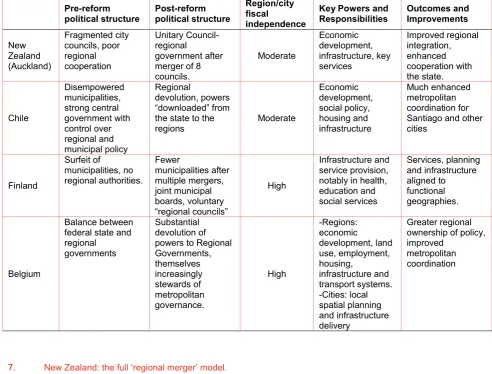
6. OECD examples of fiscal / other devolution models for Scotland’s cities?
Whilst it is understandable for Scottish cities to look to the English model of empowerment, especially as Scottish and English cities share the same UK framework, Scotland’s cities have plenty of reasons to look
beyond the limited experience of their English counterparts as they look to adjust to the next cycle of their development.
Scottish cities have important distinctions from their English neighbours in relation to their population sizes, economic functions, and geographies (especially the relative distances from London) which is such a major issue for English cities. They also have different and distinctive relationships with their wider regions and rural areas.
Given the scope that Scottish Government has to “share” or devolve powers to these cities, they may justifiably look to more ambitious models and approaches developed elsewhere in the world. Although the English model is a current example of progressive devolution, there are other options for Scottish cities to draw upon.
24www.birminghammail.co.uk/news/midlands-news/george-osborne-offers-birmingham-neighbours-10201575
25
www.civilserviceworld.com/articles/news/budget-2016-greater-manchester-liverpool-and-london-pave-way-business-rate-retention
26www.lepnetwork.net/resources/uploads/files/Spending_Review_Autumn-Statement-2015_-_Summary.pdf;
10 Table 2: Example models from around the world
Pre-reform political structure Post-reform political structure Region/city fiscal independence
Key Powers and Responsibilities Outcomes and Improvements New Zealand (Auckland) Fragmented city councils, poor regional cooperation Unitary Council- regional government after merger of 8 councils. Moderate Economic development, infrastructure, key services Improved regional integration, enhanced cooperation with the state. Chile Disempowered municipalities, strong central government with control over regional and municipal policy Regional devolution, powers “downloaded” from the state to the regions Moderate Economic development, social policy, housing and infrastructure Much enhanced metropolitan coordination for Santiago and other cities Finland Surfeit of municipalities, no regional authorities. Fewer municipalities after multiple mergers, joint municipal boards, voluntary “regional councils” High Infrastructure and service provision, notably in health, education and social services Services, planning and infrastructure aligned to functional geographies. Belgium Balance between federal state and regional
governments
Substantial devolution of powers to Regional Governments, themselves increasingly stewards of metropolitan governance. High -Regions: economic development, land use, employment, housing, infrastructure and transport systems. -Cities: local spatial planning and infrastructure delivery Greater regional ownership of policy, improved
metropolitan coordination
7. New Zealand: the full ‘regional merger’ model.
New Zealand
Population
(2014) GDP /cap (2014)
4.5m $31,500
Auckland
Population
(2014) GDP/cap (2014) City Budget
% of City Budget raised from Central Government transfers
1.6m $31,800 NZ$3.8bn 15%
Sources: Brookings Global Metro Monitor (2015), Clark and Moonen (2015), and IMF World Economic Outlook Database.27
27www.imf.org/external/pubs/ft/weo/2016/01/weodata/index.aspx; www.brookings.edu/research/global-metro-monitor/;
11
New Zealand has undertaken significant city regional governance reform in the past decade, particularly focused on its largest city Auckland. Until recently, Auckland endured significant governance fragmentation across eight separate councils, which did not successfully coordinate metropolitan growth. Auckland was viewed as a city of sprawl and motorways, poor public transport and a declining city centre. This fragmentation made collaboration with central government difficult, as it lacked a unified urban body with which to interact and coordinate investments.
Auckland’s successful bid to host the 2011 Rugby World Cup became a stimulus for much wider reform.28
A Royal Commission was set up to consider governance solutions and led to the creation of a new amalgamated city government within 18 months that replaced the councils with a unified city region and a directly elected mayor in 2010. The new Regional Council was complemented by a number of Council Controlled Organisations which manage key investment and infrastructure services under the Regional Council’s guidance. This reform gave Auckland the ability to harmonise day to day functionality issues across the region (e.g. waste management, roads), as well as the ability to coordinate strategic planning in infrastructure and economic development.29
As a result of the amalgamation, Auckland has increased its rate of investment as council assets and resources were pooled, and regional decision making and cooperation with central government were simplified. The merger saves £80m a year for the Council, and capital investment has been raised to £800m in 2016/2017 with significant progress in the pace of public transport development. A new harmonised rating system has been created, while the ability to negotiate with central government enables both bodies to better align their strategic priorities and funding streams. The benefits are particularly visible in housing, where a Housing Accord was agreed with central government to increase the supply of new homes. The amalgamated council has also drawn up a strategic plan for spatial and economic development (the Auckland Plan) which allows city leaders to “think regionally” about integrated development aims and to mobilise local and central resources towards a common objective.30
8. Chile: de-centralisation to empowered regional governments
Chile
Population (2014) GDP /cap (2014)
17.8m $23,000
Santiago Metropolitan Region
Population (2014) GDP/cap (2014) Investment Budget Regional % of budget raised from transfers
7.2m $24,000 $171m 48%
Sources: Brookings Global Metro Monitor (2015), Santiago Metropolitan Region, and IMF World Economic Outlook Database.31
28http://strathprints.strath.ac.uk/56260/;
http://anzrsai.org/assets/Uploads/PublicationChapter/186-Dollerysustainingregionsarticle.pdf
29www.knowledgeauckland.org.nz/assets/publications/Governance-of-Auckland-5-years-on-May-2016.pdf
30http://strathprints.strath.ac.uk/56260;
www.knowledgeauckland.org.nz/assets/publications/Governance-of-Auckland-5-years-on-May-2016.pdf; https://books.google.co.uk/books?id=xt4w5OCby14C&pg=PA416; http://localgovernmentmag.co.nz/amalgamation/nz-councils/
31www.imf.org/external/pubs/ft/weo/2016/01/weodata/index.aspx; www.brookings.edu/research/global-metro-monitor/;
12
Historically, it has been central government that took all major strategic investment and economic decisions across Chile’s cities. Mayors and regional governors were only established comparatively recently, and even democratisation at the local level had not been matched by a significant transfer in power: cities were local extensions of central government that by-passed the regions.32 But Chile is now
creating an empowered intermediary tier of government between local authorities and the state.
In 2015, in a bid to de-centralise decision making in Chile, a bill paved the way for the direct election of regional governors by 2017, and the transfer of greater fiscal resources, as well as new regional powers over economic development, social issues, housing and infrastructure. Elected governors will come first, and the transfer of powers and revenue will happen gradually thereafter. The regions are becoming responsible for three core areas: economic development; social provision; and infrastructure and transport with key civil servants, funds and powers “downloaded” directly from central government ministries to the regions.33
This reform will have notable repercussions in the capital, Santiago. 32 of its municipalities will now be more effectively coordinated and governed at the scale of an empowered province, effectively providing metropolitan government where before the state had to deal with each municipality on a case by case basis. This represents a radical step change from a highly centralised system.
9. Finland’s model of urban devolution
Finland
Population
(2014) GDP /cap (2014)
Inter-governmental transfer revenue as percentage of total revenue for each level
of government (2014)
Tax revenue as percentage of total revenue for each level of government (2012)
5.5m $40,300 Local: 29.7% Local: 45.4%
Helsinki
Population (2014)
GDP/cap
(2014) City Budget
% of budget raised from transfers
1.6m $47,500 $5.7bn 5%
Sources: Brookings Global Metro Monitor (2015), Helsingin kaupunki, and IMF World Economic Outlook Database.34
Finland’s municipalities work in a highly decentralised system and are strongly empowered: this is because there is no intermediate (regional) tier, only the state and municipalities. As a result, each municipality possesses strong powers over infrastructure and service provision, notably in health, education and social services. They are also very fiscally devolved with only 18% of their income coming from central government transfers and equalisation schemes; the remaining 82% is raised from local income tax, levies and user charges.35
32Pflieger, G. (2014). “Santiago de Chile Prototype of the neo-liberal city: between a strong state and privatised public
services” in Lorrain, D., Governing Megacities in emerging countries. London: Routledge.
33
http://chiledescentralizado.cl/diez-anos-podria-demorar-el-traspaso-de-las-atribuciones-de-los-actuales-intendentes-a-nuevo-gobernador-regional/;
www.oecd.org/officialdocuments/publicdisplaydocumentpdf/?cote=ECO/WKP(2016)13&docLanguage=En
34www.hel.fi/static/kanslia/ta2017/ta.html; www.imf.org/external/pubs/ft/weo/2016/01/weodata/index.aspx;
www.brookings.edu/research/global-metro-monitor/
35 https://books.google.co.uk/books?id=3iXjAwAAQBAJ&pg=PA103 ;
13
This strongly decentralised system has also helped create a culture of collaboration. Individual Finnish local governments often come together to deliver key services to achieve economies of scale – delivered by joint municipal boards set up to perform specific tasks. Thus Finland has “hospital regions” jointly administered by municipalities, for instance. In addition, municipalities congregate in “regional councils” which act as assemblies of municipal representatives which discuss regional development, planning and coordination issues. In the Helsinki Metropolitan Area, the largest urban area in Finland, municipalities are required to set up co-operative plans for land use, transport, housing and services that are coordinated and delivered across the metropolitan region.
The Finnish government has also been supporting the voluntary merger of municipalities. Already between 2005 and 2016, it had reduced the number of municipalities by more than a quarter. This reduction is largely to provide more effective metropolitan or regional forms of urban government, and to achieve further economies of scale in service delivery. In larger urban areas, the government has pushed for mergers so that municipal boundaries keep up with the functional urban regions. It has even been ready to impose mergers where it considers them financially necessary and will consider doing so after an initial voluntary phase expires in 2017. Importantly, the law provides for the protection of public service jobs following mergers, for a five year period.36
10. The Belgian devolution model
Belgium
Population
(2014) GDP /cap (2014)
Inter-governmental transfer revenue as percentage of total revenue for each level
of government (2014)
Tax revenue as percentage of total revenue for each level of government (2012)
11.2m $43,000 Region: 64.5% Local: 47.2% Region: 15.5% Local: 31.4%
Brussels Capital Region
Population (2014)
GDP/cap (2014)
Regional Budget
% of budget raised from transfers
1.2m $46,300* $4.43bn 13%
Sources: Brookings Global Metro Monitor (2015), Brussels Capital Region, and IMF World Economic Outlook Database.37
*Figure for Metropolitan area.
Belgium has a complex system of devolved government, owing to its linguistic and cultural diversity. It is a federal state, which oversees three regions: Flanders, Wallonia and the Brussels Capital Region. The cities themselves experienced a wave of amalgamations during the 1970s and 1980s, however, which after teething issues came to greatly improve regional coordination.
Belgian regions are examples of highly empowered devolved administrations, which grant their own cities autonomy on local spatial planning and infrastructure delivery, and offer them considerable infrastructure investment and coordination support at the wider metropolitan and regional levels. This model means that spatial plans are greatly facilitated, coordinated and part-funded by regional levels of government. The
36www.civitas.org.uk/content/files/DevolvedHealthcareinFinland.pdf;
www.kunnat.net/fi/palvelualueet/kuntaliitokset/ajankohtaistilanne/Sivut/default.aspx ; www.virtuaalikunta.net/fi/tietoa/kuntaliitokset/Sivut/default.aspx
37http://be.brussels/files-fr/a-propos-de-la-region/finances/budget-regional/2015/expose-general-du-budget-2015;
14
regions themselves are governed by their own parliaments and possess strong powers on economic development, land use, employment, housing, infrastructure and transport systems.38
The 2014 transfer of powers was one of the most significant in Belgian history. These consolidated regions’ powers over health, social, urban and spatial policy, and were accompanied by a transfer of a further €20bn in federal spending to regional control, and by greater fiscal autonomy worth approximately €12bn. The regions themselves can levy supplementary taxes on inheritance tax, road taxes and other taxes – and transfer some of them to the municipalities, which themselves levy a property tax.39 The
Belgian model has been highly effective for urban adjustment in many Belgian cities, although less so in Brussels whose own regional boundary does not span the metropolitan area.40
11. What could work for Scotland’s cities – and Scotland?
There is no absolute requirement for Scotland’s cities to follow an English model for devolution. The value of having the English cities in their current mode of devolution allows Scotland to learn from what has worked - and not worked so well.
More importantly, Scotland’s cities may want to look outside the UK to wider OECD experience and pursue options that have not been available in England. New Zealand’s more ambitious consolidations or Chile’s strong second tier city regional government, or Finland’s more devolved fiscal and service system might suit Scotland much better than the English model which is in part motivated by the need to embrace a very wide range of cities with rather different appetites for self-reliance.
Via the OECD and the World Bank a wide range of other models are available to Scotland. There is the opportunity to think not so much about what incremental agreements might be allowed by the UK Treasury but instead to ask: what does Scotland and Scotland’s cities need? In this regard there appear to be at least three priorities that any Scottish “cities devolution” package should embrace:
Fiscal devolution: It should provide sustained resources for cities to enable them to make major
investments in city-regional infrastructure and housing investment, for example via locally-levied revenues (e.g. residential and property tax, land tax, tourism levies etc.).
Integration of services: It should enable integrated approaches to public transport (road, rail, bus, tram and active travel), health, unemployment, care, adult skills, and employability, so that these budgets can be combined to achieve greater impact.
Incentivise cities to invest: It should produce resources sufficient to promote continuous reinvestment in the built environment and city management so that Scotland’s cites adjust successfully to the new disruptive technologies and the economies that they foster.
So, the question is less whether the English model is right one for Scotland and its city-regions, but rather whether it is the best model available across the OECD.
38www.belgium.be/fr/la_belgique/pouvoirs_publics/regions/competences; http://europe.uli.org/report/brussels-antwerp/
39http://europe.uli.org/report/brussels-antwerp/;
15
The debate might consider better how to take elements from distinctive reforms that have appeal in Scotland and to combine them in a mix that supports Scottish cities to flourish both as individual cities, and as a system of cities that work together to enhance investment and prosperity.
But how to make a start? There are three steps that might be taken straight away. First, the Scottish Government could initiate an invitation for the Scottish cities to submit proposals on reforms that go beyond or are different to those developed in England. Second, Scottish Cities should consider which reforms they wish to promote and how they would use them to raise productive investment and pursue greater prosperity for Scotland. Third, businesses, universities and other civic leaders should work with the cities to design key reforms and promote them to the Scottish Government. This basic model of ‘action talking’ has underpinned recent reforms in New Zealand, Finland, and Chile. It involves being open to reforms and testing them transparently through sound research and informed public debate.
Key Author details
Prof Greg Clark CBE, Visiting Professor,
International Public Policy Institute (IIPI), University of Strathclyde