City, University of London Institutional Repository
Citation:
Luffarelli, J., Gonçalves, D. and Stamatogiannakis, A. (2015). When Feedback Interventions Backfire: Why Higher Performance Feedback May Result in LowerSelf-Perceived Competence and Satisfaction with Performance. Human Resource Management, doi: 10.1002/hrm.21739
This is the submitted version of the paper.
This version of the publication may differ from the final published
version.
Permanent repository link:
http://openaccess.city.ac.uk/13943/Link to published version:
http://dx.doi.org/10.1002/hrm.21739Copyright and reuse: City Research Online aims to make research
outputs of City, University of London available to a wider audience.
Copyright and Moral Rights remain with the author(s) and/or copyright
holders. URLs from City Research Online may be freely distributed and
linked to.
City Research Online: http://openaccess.city.ac.uk/ [email protected]
[rh] When Feedback Interventions Backfire
When Feedback Interventions Backfire:
Why Higher Performance Feedback May Result in Lower Self-Perceived Competence and Satisfaction with Performance
Jonathan Luffarelli, Dilney Gonçalves, and Antonios Stamatogiannakis
Abstract
In relative performance evaluation systems, appraisers may choose to adopt stricter or laxer evaluation criteria. When laxer (stricter) criteria are used, higher absolute performance evaluations become easier (harder) to achieve. Thus, each appraisee’s absolute performance feedback and the mean of the distribution of absolute performance feedback are shifted upward (downward). Yet, relative performance remains constant. When evaluation outcomes depend solely on relative performance, can the adoption of laxer (stricter) criteria—leading to higher absolute performance feedback but no change in relative performance—influence appraisees’ satisfaction with
performance? Despite the ubiquity of such systems in organizations, research has not addressed this question. This article points to an important gap between practitioners’ beliefs and research
findings. We show that while most appraisers believe that higher absolute performance feedback will automatically result in more satisfaction with performance, the opposite may also happen. Specifically, we find that appraisees with a stronger (weaker) chronic or contextual need to engage in social comparison are more satisfied with lower (vs. higher) absolute performance feedback. Overall, we demonstrate why and how feedback interventions in relative performance evaluation systems may backfire, and suggest a set of practical guidelines for maximizing appraisees’ satisfaction with performance in such systems.
Keywords: feedback, forced rankings, performance assessment, performance management, satisfaction, social comparison
Introduction
A manager was reviewing the performance of her subordinates. In her company—as in
many others—employees were only evaluated according to the ranking of their performance ratings compared to those of the other employees in the department (i.e., curved performance evaluation
system). Since in such relative evaluation systems the absolute value of the ratings is
inconsequential to employees, the manager decided to adopt less stringent evaluation criteria to
shift the entire distribution of performance ratings upwards, without changing the relative
ranking—and thus the relative performance evaluation—of each employee. Her intuition was that if
anything, higher absolute performance feedback (keeping relative ranking constant) should increase
employees’ self-perception of their competence level, and so improve their satisfaction with
performance. Little did she expect that soon after handing out the appraisals, employees at all
performance-rating levels would start expressing their discontent. Puzzled by the unexpected
outcome of her generous, but also objectively inconsequential evaluation scheme, the manager
started wondering why her feedback strategy may have backfired.
In this paper, we provide an answer to her question and others like it. Specifically, under
what circumstances can similar, seemingly generous and inconsequential feedback interventions
backfire? When evaluation outcomes depend solely on relative feedback, could absolute feedback
have a tangible effect on self-perceived competence and satisfaction with performance? And,
despite the fact that, in this instance, relative performance did not change, what factors might
explain why and how higher absolute feedback led to lower satisfaction in a strictly relative
evaluation system? The answers to these questions could have numerous practical applications for
HR managers and important implications for a wide array of research areas.
Relative appraisal systems are ubiquitous in organizations (Backes-Gellner & Pull, 2013)
performance assessments (Brustein, 2013; Ovide & Feintzeig, 2013). Yet research on both absolute
and relative performance feedback has typically focused on non-relative evaluation settings (Harris
& Smith, 2005; Klein, 1997; Moore & Klein, 2008). Therefore, our knowledge of relative
performance appraisals is rather limited (Goffin, Jelley, Powell, & Johnston, 2009; Schleicher, Bull,
& Green, 2009), and the effects of feedback interventions—similar to those in the anecdote
above—are not well understood (Atwater, Brett, & Charles, 2007; Atwater, Waldman, & Brett,
2002; Kluger & DeNisi, 1996; 1998). It is still unknown whether individuals use absolute
performance information in settings in which evaluation is strictly relative (e.g., curve-based
evaluations), and whether self-perceived competence and satisfaction with performance are
sensitive to absolute performance feedback in such settings.
By improving our understanding of the effect of absolute performance feedback in relative
appraisal systems and by helping practitioners understand the circumstances under which feedback
interventions may backfire, our paper makes important contributions to the literature on
performance appraisals and feedback delivery (Biron, Farndale, & Paauwe, 2011;
Bracken,Timmreck, Fleenor, & Summers, 2001; Farndale & Kelliher, 2013; Miller, 2001; Pichler, 2012). Precisely, we expose a new and important gap between practitioners’ lay beliefs and
research findings (Rynes, Colbert, & Brown, 2002). We demonstrate how and why, contrary to the
commonly held belief of those making (i.e., appraisers) and those receiving (i.e., appraisees)
evaluations, higher (lower) absolute performance feedback can make appraisees who are evaluated
relative to each other feel less (more) satisfied with performance. Our results point toward the
important moderating role of social comparison orientation and the mediating role of self-perceived
competence in the relationship between absolute performance evaluation and satisfaction with
performance. Building on these results, we provide a set of practical guidelines for maximizing
The rest of this paper is structured as follows. First, we discuss the features of performance
feedback in relative appraisal systems, the relationship between performance feedback and
satisfaction with performance, and how this relationship may be moderated by social comparison
orientation and mediated by self-perceived competence. In the process, we develop of set of three
hypotheses. We then present four studies that establish appraisers’ and appraisees’ lay theories
about performance feedback in relative evaluation settings, and that examine whether and why,
contrary to those lay theories, higher (lower) feedback may result in employees’ lower (higher)
self-perceived competence and satisfaction with performance. We conclude by discussing the
theoretical and managerial contributions, as well as some limitations and future research directions.
Performance Feedback in Relative Performance Appraisal Systems
CEOs and other executives (Gong, Li, & Shin, 2011), lower-level managers (Goffin et al.,
2009), and even students (Goubeaud, 2010) are often evaluated in relative ways. When individuals
are evaluated relatively, each appraisee typically has access to three pieces of information: absolute performance feedback (i.e., individual performance), the distribution mean of everyone’s absolute performance feedback (i.e., average of everyone’s performance), and relative performance
feedback (i.e., standing compared to others). To illustrate using our introductory example,
employees under the manager’s supervision have access to their own performance rating (absolute
performance feedback, e.g., 8 out of 10), the average performance rating of the employees working
in the department (average of the absolute performance feedback of all the employees, e.g., 7 out of
10), and their quantile ranking (relative performance, e.g., 40th percentile). Importantly, the first two
pieces of information are absolute in nature (i.e., the employee’s score is 8/10; the department’s
average is 7/10); that is, they do not force a comparison with others. However, the third piece of
information is relative (i.e., the employee’s score is better than 60% of his/her peers) and does force
Interestingly, in relative performance appraisal settings, appraisers may choose to adopt
stricter or laxer evaluation criteria without affecting appraisees’ relative performance. Stricter
(laxer) evaluation criteria should make higher absolute performance evaluations harder (easier) to
achieve for everyone. Thus, when stricter (laxer) evaluation criteria are used, each individual’s
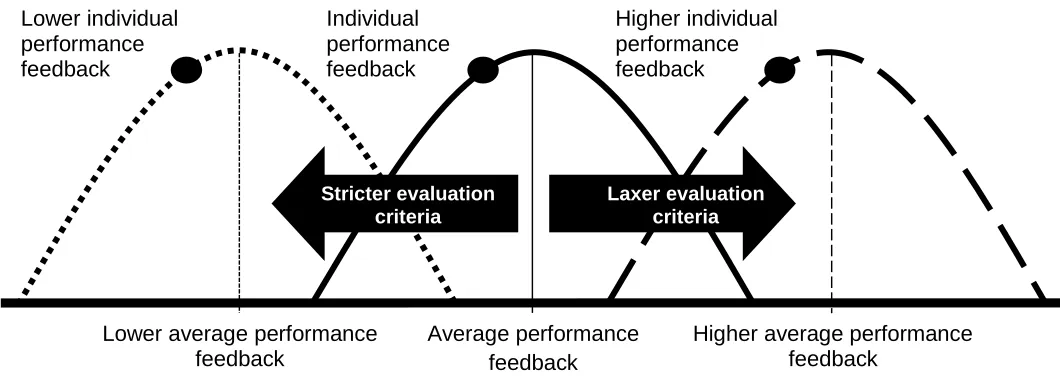
absolute performance feedback, and therefore the distribution mean of absolute performance feedback, should be shifted downward (upward). Yet, relative performance (i.e., standing) would remain constant (Figure 1). When only relative performance matters for the evaluation outcomes (e.g., pay, career progression, etc.), would using stricter versus laxer evaluation criteria, and thus
obtaining higher versus lower absolute performance evaluations alter (positively or negatively)
appraisees’ satisfaction with performance? We now review the relevant literature and develop
hypotheses that answer this question.
Insert figure 1 here
Absolute and Relative Performance Feedback
In 1954, Festinger hypothesized that “when an objective, non-social basis for the evaluation
of one’s ability or opinion is readily available, persons will not evaluate their opinions or abilities
by comparison with others.” Since then, research has examined the effects of absolute versus
relative performance feedback. While some studies have provided support for this hypothesis
(Harris & Smith, 2005), others have found that even when absolute information is available, people
tend to compare themselves to others and to be influenced by relative information (Klein, 1997;
Moore & Klein, 2008). For instance, in a between-participants experiment, Klein (1997; study 1)
manipulated the absolute and relative probability that participants would cause a car accident in
accident, and that this probability was either 20% lower or 20% higher than average. He found that
participants’ self-evaluation of driving ability was influenced by the relative, and not the absolute,
probability of causing an accident. Similarly, Moore and Klein (2008; studies 1 and 2) manipulated
individuals’ relative performances at a “weight guessing game.” In this game, participants were
shown 10 pictures of individuals. They were asked to guess the weight of each of the 10 within a
range of plus or minus five pounds. Participants were then presented with bogus feedback on their
performance. They were told that they had guessed the weight of two or eight individuals correctly,
and that this performance was either better than 23% or 77% of other participants. After receiving
this feedback, participants were invited to play again with a different set of 10 pictures. This time,
they were asked to bet an amount of money that they would achieve a given level of performance.
In spite of the presence of absolute performance feedback (two vs. eight correct guesses), results
showed that the amount participants were prepared to bet was sensitive to both absolute and relative
performance feedback.
These important findings were typically made by examining simultaneously absolute and
relative performance feedback and in settings for which the a priori importance of either type of performance feedback was unclear. For example, in Klein’s (1997) study, it is a priori unclear if driving ability should be judged according to the absolute or the relative probability of causing an
accident. We complement these findings by examining the effect of absolute feedback in settings
where relative evaluation is a priori of clear importance. For example, monetary winnings at a NASCAR race (Bothner, Kang, & Stuart, 2007), medals at the Olympics (Medvec, Madey, &
Gilovich, 1995), or employee compensation in many firms (Backes-Gellner & Pull, 2013) are
clearly and strictly based on rankings (i.e., relative performance). For settings in which relative
performance is clearly the only thing that matters for the evaluation outcomes, would appraisees’
feedback? And, if absolute performance feedback matters, when would lower or higher absolute
performance feedback result in lower or higher self-evaluation and satisfaction with performance?
We propose that even when only relative performance matters, absolute performance feedback still influences appraisees’ satisfaction with performance. In addition, we propose that
whether lower or higher absolute performance feedback causes lower or higher satisfaction with
performance depends on appraisee’s social comparison orientation, which determines the extent to
which our own performance versus the performance of others is used to judge self-competence. In
the next sections, we formally develop the reasoning behind these propositions and subsequently
test them empirically.
The Relationship Between Performance Feedback and Satisfaction
Is higher performance feedback associated with higher or lower satisfaction? First, research
argues that higher (actual or perceived) performance feedback may result in intrinsic rewards from
which individuals derive contentment (i.e., satisfaction with that level of performance) and thereby
potentially cause higher job satisfaction (Judge, Thoreson, Bono, & Patton, 2001). Second, research
about both the broader concept of job satisfaction and the narrower one of satisfaction with
performance supports this argument. Regarding job satisfaction, conventional wisdom, as well as
empirical evidence (Christen, Iyer, & Soberman, 2006; MacKenzie, Podsakoff, & Ahearne, 1998), suggests that higher (lower) performance or feedback might result in higher (lower) job satisfaction.
Regarding the specific relationship between performance feedback and satisfaction with
performance (which is the focus of this research), the limited existing evidence points in the same
direction. For instance, in a sample of U. S. Air Force mechanics, supervisors’ performance
feedback had a significant and positive effect on subordinates’ satisfaction with performance (Van
this evidence; that is, they will believe that higher (lower) absolute performance feedback will lead
to superior (inferior) satisfaction with performance. More formally:
Hypothesis 1: Appraisers (H1a) and appraisees (H1b) believe that giving and receiving (respectively) higher (lower) absolute performance feedback will lead to superior (inferior) satisfaction with performance.
On the other hand, the literature also suggests that self-evaluation and satisfaction may be
affected by the use of different reference points (Epstude & Roese, 2008; Jacowitz & Kahneman,
1995; Johnson, Ilies, & Boles, 2012; Mussweiler & Strack, 2000), such as expectations and goals
(Larrick, Heath, & Wu, 2009) or counterfactuals (Markman, McMullen, & Elizaga, 2008).
Interestingly, the evidence indicates that the use of certain reference points could lead individuals to
be less (more) satisfied with higher (lower) actual or false performance feedback (Alicke, Zell, &
Bloom, 2010). For example, Iyengar, Wells, and Schwartz (2006) found that although satisficers
tended to do objectively worse than maximizers in a job search, they were more satisfied with their
level of performance. They determined that this effect occurred because unlike satisficers,
maximizers sought and used the best possible job offer as the reference point to evaluate their
current job conditions. In the same way, Medvec et al. (1995) and Medvec & Savitsky (1997) found
that bronze medalists were more satisfied with their performances than silver medalists in sports
competitions as the salience of different reference points resulted in different counterfactual
thoughts. In particular, they determined that bronze medalists used the prospect of “not winning a
medal” as a reference while silver medalists used the prospect of “winning the gold medal”.
Building on social comparison theory, research suggests that the performance of others is an
additional and important reference point that people may use in their judgments (Garcia & Tor,
performance of others (vs. own performance) is used to judge self-competence will determine
whether lower or higher absolute performance feedback can cause higher satisfaction with
performance. We also propose that the use of either one of these two available absolute pieces of
information (i.e., others’ vs. own performance) depends on appraisees’ chronic or contextually
activated social comparison orientation. We next describe how the extent to which appraisees
engage in social comparison may affect the use of one’s own versus others’ average absolute
feedback for self-competence evaluation, leading to distinct effects on self-perceived competence
and satisfaction with performance.
When Superior Absolute Performance Feedback May Backfire
Social comparison refers to the tendency of individuals to define their self-concept in
relation to their social environment, including how they stand in comparison to others (Buunk &
Gibbons, 2007; Festinger, 1954; Suls, Martin, & Wheeler, 2002). Although everyone essentially
engages in social comparison, individuals with a high social comparison orientation feel a much
stronger drive to engage in relative self-appraisal than individuals with a low orientation (Gibbons
& Buunk, 1999). This drive can be the result of chronic traits (Bogart, Benotsch, & Pavlovic, 2004;
Locke & Nekich, 2000; Van der Zee, Oldersma, Buunk, & Bos, 1998), or influenced by contextual
factors (Goodman & Haisley, 2007; Greenberg, Ashton-James, & Ashkanasy, 2007; Mussweiler &
Epstude, 2009; Mussweiler, Rüter, & Epstude, 2004). According to social comparison theory,
individuals’ social comparison processes moderate the selection of information about others when
making self-evaluative and satisfaction judgments (Gibbons & Buunk, 1999; Mussweiler 2003).
Specifically, in the context of relative performance appraisals, the need to use information about
others should be of fairly low importance to appraisees who have a low social comparison
orientation. Thus, when making judgments about themselves, for example, how competent they are
in their jobs, appraisees low (high) in social comparison orientation should rely relatively more on
non-comparative (comparative) information.
In particular, when it comes to evaluating their level of self-competence (i.e., how good they
are at a given task), appraisees low in social comparison orientation should be relatively more likely
to use their own performance ratings (vs. the average performance rating of their peers) as an input.
In other words, because they have a fairly weak tendency to compare themselves to others, their
own performance level can be a sufficient indicator of how good they are. Given that high (low)
absolute performance feedback signals that one has performed well (poorly), appraisees with a
lower inclination toward social comparison should feel more (less) competent when everyone’s
absolute performance feedback—including their own—is higher (lower). Put differently, in relative
evaluation systems, appraisees who are more likely to use their own performance level to determine
their level of self-competence (i.e., those low in social comparison orientation) should feel more
competent when receiving an absolute performance rating of 8, rather than an absolute performance
rating of 7 (out of 10).
Conversely, for appraisees who have a tendency to compare themselves with others, their
own performance feedback may not be a sufficient indicator of self-competence. Instead, these
appraisees should be relatively more likely to use the performance level of a relevant group (e.g.,
colleagues or class members) as a reference point to assess how good they are. In other words,
because their self-competence is determined by how favorably their own performance compares
with the performance of their peers, they will use cues about others’ performance as comparison
standards. The less (more) favorable the comparison, the less (more) competent they will feel. Less
(more) favorable comparisons should occur when the average absolute performance feedback that
performance feedback also means higher (lower) individual performance feedback (Figure 1). As
an example, adopting laxer (vs. stricter) evaluation criteria may create a situation in which a given
appraisee receives an absolute performance rating of 9 (vs. 7) out of 10 and in which the average
performance rating is 8 (vs. 6). In both cases, appraisees with a strong social comparison orientation
will need to compare their own absolute performance with an external standard, thus focusing on
the average. However, since the average is 8 with laxer evaluation criteria, but only 6 with stricter
criteria, this comparison may be less favorable in the first case, as the comparison standard (i.e., the
average) is higher. As a result, a surprising effect may arise: appraisees with a stronger inclination
toward social comparison may feel more (less) competent when everyone’s absolute feedback—
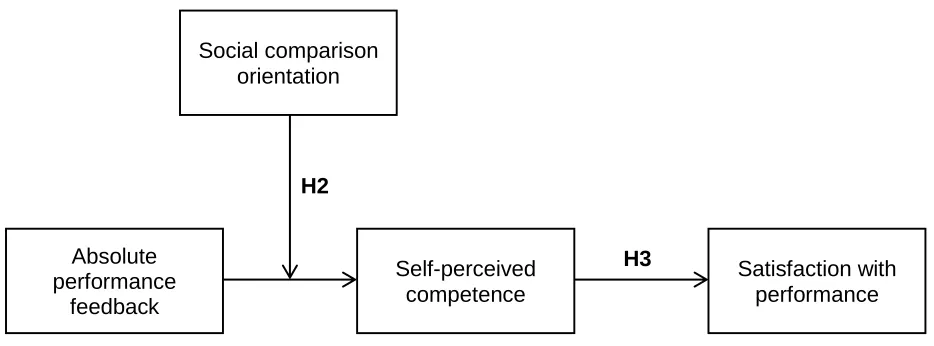
including their own—is lower (higher). Formally, we propose the following hypothesis (Figure 2):
Hypothesis 2: When appraisees’ tendency to engage in social comparison is high (low), they will feel more self-competent with lower (higher) absolute performance feedback.
Further, existing research in a wide array of domains has demonstrated that the
extent to which appraisees feel competent and self-efficacious can be a powerful
antecedent of job satisfaction (Judge & Bono, 2001). For example, research in
entrepreneurship (Bradley & Roberts 2004), psychology (Judge, Bono, Erez, & Locke,
2005), and educational psychology (Caprara, Barbaranelli, Steca, & Malone, 2006) has
respectively shown that entrepreneurs’, employees’ and teachers’ self-perceived level of
competence predicted satisfaction. Building on the aforementioned studies on job and
performance satisfaction, we propose the following hypothesis (Figure 2):
Insert figure 2 here
Overview of the Studies and Results
Our hypotheses are tested in four studies that combine a variety of methods. In all the
studies, it was made explicit that only relative performance mattered. In the pilot study, we directly
ask appraisers to indicate whether higher or lower absolute performance feedback would lead
appraisees to be more satisfied with performance. We find that appraisers have the intuition that
higher (lower) absolute performance feedback would translate into higher (lower) appraisee
satisfaction with performance (H1a). Experiment 1 consists of two parts. First, complementing the
pilot study, we directly ask appraisees (who are typically evaluated relatively) to indicate whether
higher or lower absolute performance feedback would make them more satisfied with performance.
Like appraisers, we find that they believe they would be more (less) satisfied with performance
with higher (lower) absolute performance feedback (H1b). However, contrary to this shared belief,
when the same appraisees are asked to estimate their satisfaction with performance in a domain
with which they are very familiar, they indicate greater satisfaction with lower (vs. higher) absolute
performance feedback (H3). Experiment 2 provides further evidence that lower (vs. higher)
absolute performance feedback may result in greater satisfaction with performance. First, we
directly measure social comparison orientation and find that appraisees with a high (low) chronic
tendency to engage in social comparison are more satisfied with their level of performance when
absolute performance feedback is low (high) (H3). Second, we demonstrate the generalizability and
robustness of these findings by examining alternative explanations, and by using different levels of
performance and evaluation settings (i.e., sports competition, loyalty program, and classroom).
Experiment 3 replicates our findings and lifts the veil on the psychological mechanism behind our
social comparison orientation moderates the relationship between absolute performance feedback
and self-perceived competence (H2), while self-perceived competence mediates the relationship
between absolute performance feedback and satisfaction with performance (H3). The studies are
described in detail below, and a concise overview is given in Table I.
Insert Table I here
Pilot Study: Appraisers’ Lay Beliefs About Satisfaction with Performance in Relative
Appraisal Systems
Method
Objective
Common wisdom holds that higher (lower) performance feedback will result in higher
(lower) satisfaction with performance. However, as we discussed previously, the evidence suggests
that there are contexts such as job hunting (Iyengar et al. 2006) or the Olympic Games (Medvec et
al. 1995; Medvec & Savitsky 1997) in which satisfaction is higher (lower) with lower (higher)
performance. Experienced appraisers may be aware of these findings, or may have personally
experienced patterns that differ greatly from what common knowledge suggests. Therefore, the
purpose of the pilot study was to examine whether experienced appraisers believed that appraisees
would experience more satisfaction with performance with higher (vs. lower) absolute performance
feedback, even when the feedback is objectively inconsequential for outcomes.
Participants
Due to their continuous involvement in performance evaluations, university professors were
used as expert appraisers. This pilot study was administered to two different samples. The first
body with a very international profile) in which all performance feedback is relative (i.e.,
determined by percentile ranks). The second sample was recruited from an international academic
society and consisted of 37 professors affiliated to diverse universities, schools, and departments.1
Twenty-two of them indicated that they systematically use curved grading, and 15 that they never,
rarely, or very rarely do so (“how frequently do you evaluate your students based on a curved
grading system?” 1 = never, 7 = always). Because these questionnaires were administered to a very
specific target population, we did not ask for information such as school affiliation, age, gender, or
nationality in order to guarantee anonymity.1 Due to their expertise in judgment and
decision-making, participants in the second sample provide a very conservative sample for the purposes of
this study. If anyone would make predictions that run counter to common wisdom, we would expect
this sample to do so.
Procedure
Participants in both samples were asked to imagine that they just had administered an exam
that would be scored using a described curved evaluation system. They were then asked to indicate
whether they believed that a student would be more satisfied with performance when obtaining a
score of 7 out of 10 when the average of the class is 8 or when obtaining a score of 4 out of 10
when the average of the class is 5, while ranking in the 40th percentile in both cases.
Results and Discussion
Because answers were not significantly different across the two samples or across appraisers
who were familiar or unfamiliar with relative performance feedback systems, we report the pooled
results. Results indicated that while only 15% (n = 13) of the appraisers in our sample believed that lower absolute performance feedback would result in higher satisfaction with performance, 85% (n = 74) believed that higher absolute performance feedback would result in higher satisfaction with
of appraisers’ familiarity with relative performance feedback systems, appraisers anticipate that
appraisees will be more (less) satisfied with higher (lower) absolute performance feedback.
In what follows, we show why and when these beliefs may be inaccurate. We report three
experiments that suggest that appraisers might unknowingly and systematically engage in behaviors
that do not maximize, or even reduce, appraisees’ satisfaction with performance.
Experiment 1: Higher (Lower) Absolute Performance Feedback Can Result in Lower
(Higher) Satisfaction with Performance
Method
Objective
The aim of the first experiment was twofold. First, we wanted to examine whether
appraisees who are used to being evaluated in a relative manner have accurate lay theories about the
level of absolute feedback that would make them more satisfied with performance; or if, like
experienced appraisers, they tend to believe that higher (lower) absolute feedback will result in
higher (lower) satisfaction with performance. Second, we wanted to demonstrate that in a relative
performance evaluation system, higher (lower) feedback can result in lower (higher) satisfaction
with performance.
Participants
The participants were 54 postgraduate students at a major business school in which the
outcomes of all evaluations are determined by rankings (the same business school as the 50
postgraduate professors in the first pilot study sample). They were offered class credit in exchange
for their participation. All were in their final academic term, and thus very familiar with relative
performance appraisal systems. By the time of the experiment, they had completed more than 20
participants to have a strong tendency to engage in social comparison, given that social comparison
orientation can be activated by context (Mussweiler & Epstude, 2009; Mussweiler et al., 2004), that
postgraduate business students tend to be competitive (McCabe, Butterfield, & Treviño, 2006;
McCabe & Treviño, 1995), and that closeness between organizational members can promote
relative comparisons (Heslin, 2005). In addition, they were in a class with an average age of 23 and
average work experience of one year. Finally, within about six months of the administration of this
study, 93% of them had jobs in a variety of sectors, positions, and geographical regions, indicating
that their profile was very similar to that of typical young professionals who end up working in
organizations that might use relative performance evaluation systems.
Procedure and Measures
There were two parts to experiment 1. In the first, we measured participants’ satisfaction
with performance with high versus low absolute performance feedback in a relative evaluation
setting. In the second, we asked participants to make a direct choice between obtaining either a high
or low absolute performance feedback. Whereas rating satisfaction with a given performance
outcome would reveal appraisees’ reaction to a situation, the choice between two potential
performance outcomes should reflect appraisees’ lay theories about how each of the two outcomes
would affect their satisfaction with performance. This two-part design allows us to probe whether
appraisees have accurate lay theories about which outcomes are likely to maximize their
satisfaction with performance, as well as what would actually maximize their satisfaction with
performance.
In the first part of this experiment, participants were randomly assigned to one of the two
experimental conditions of this single-factor experiment: high versus low absolute performance
feedback (individual and average absolute performance feedback). Participants were asked to assess
seven-point scale (1 = very dissatisfied, 7 = very satisfied with performance). Just like after a real
exam, participants were given three pieces of information: the score (i.e., absolute performance
feedback), their relative standing in the class (i.e., relative performance), and the average score of
the class (i.e., average absolute performance feedback). In the low absolute performance feedback
condition (n = 31), the score was 4 out of 10, and the average score of the class was 5 out of 10. In the high absolute performance feedback condition (n = 23), the score was 7 out of 10, and the average score of the class was 8. Relative ranking was kept constant across conditions (i.e., the
student was ranked in the 40th percentile).
Based on our theorizing (H3), we expected participants to give higher performance
satisfaction ratings for the low (vs. high) absolute performance feedback condition. Our pilot study
had already shown that this finding would be at odds with appraisers’ lay intuitions. In order to
investigate whether it would also be at odds with appraisees’ lay intuitions, we carried out a
follow-up survey that was administered to 70 postgraduate students drawn from the same population
(including the 54 who participated in the first part of experiment 1). Participants were asked to
make a direct choice between two absolute performance feedback situations: either obtaining a
score of 4 out of 10 when the average is 5, or of 7 out of 10 when the average is 8, while ranking in
the 40th percentile in both cases. This direct choice is the same that the professors in the pilot study
had to make.
Results and Discussion
Given our directional hypothesis (H3), we used one-tailed testing (Cho & Abe, 2013).
Consistent with our predictions, an independent-samples t-test indicated that participants (who were
familiar with relative performance appraisal systems, and presupposed to be high in social
comparison orientation) provided higher performance satisfaction ratings in the low absolute
feedback condition (M = 2.13, SD = 0.69: t(52) = 1.63, p = 0.054). However, in the follow-up survey when participants made a direct choice, 77% (n = 54) preferred receiving a high absolute performance feedback (X2(1, N = 70) = 20.63, p ≤ 0.001). Thus, the results of the first part of this experiment contrast with those of the second part. Specifically, when asked to make a direct choice
between a high versus a low absolute performance feedback score, participants seemed to focus
only on the magnitude of the two scores, and chose the higher one. Effectively, as the first result
shows, they are choosing the outcome that would make them (on average) less satisfied.
An informal debriefing with the participants of the follow-up survey showed that there were
two reasons why some of them indicated that, for the same level of relative performance, they
would prefer receiving lower (vs. higher) absolute performance feedback. First, they realized that
the two options from which they had to choose were objectively equal, and, therefore, a lower
absolute performance feedback was just as good as a higher absolute performance feedback.
Second, based on their prior experience, they anticipated that comparing their performance with a
very high average could make them unhappy, even if the former was high too.
Drawing conclusions from the pilot study and experiment 1, it appears that in relative
performance appraisal systems, appraisers and appraisees share a common belief that satisfaction
with performance is higher (lower) when receiving higher (lower) absolute performance feedback.
This supports hypotheses 1a and 1b. Yet, contrary to this belief and consistent with hypothesis 3,
we find that higher (lower) absolute performance feedback might actually result in lower (higher)
Experiment 2: The Moderating Role of Social Comparison Orientation
Method
Objectives
Experiment 2 generalizes our results in four ways. First, as experiment 1 showed the effect
of absolute performance feedback on performance satisfaction in a context where social comparison
orientation was naturally high, we examine the moderating role of social comparison orientation by
measuring it directly. Second, we focus on different contexts where individuals may possibly be
evaluated relatively. Third, we seek to replicate our effect using a set of participants that is
relatively representative of the U.S. population. Fourth, in order to control for potential alternative
explanations, we include cases where absolute performance feedback was above and below the
average absolute performance feedback score.
Participants and Procedure
One hundred and twenty-six participants (Mage = 34; 57% female) were recruited for monetary compensation from Amazon Mechanical Turk (Hereafter MTurk), a crowdsourcing
website (the benefits and limitations associated with the use of MTurk are discussed in the
limitation section of this article). Participants were randomly assigned to a 2 × 2 × 3
between-participants factorial design experiment. Fifteen were excluded for not following the instructions
(Oppenheimer, Meyvis, & Davidenko, 2009). We manipulated absolute performance feedback
(high vs. low individual and average absolute performance feedback), relative performance (above
vs. below average absolute performance feedback), and context replicates2 (classroom vs. sports
competition vs. loyalty program). A full presentation of the manipulations is provided in the
appendix. Similar to experiment 1, the high versus low absolute performance feedback
manipulation consisted of having one condition with low and another with high absolute
high [low] absolute performance feedback condition of the loyalty program context replicate). The
above versus below average relative performance conditions were created by adding or removing a
constant percentage from the average absolute performance feedback (e.g., plus/minus 25% of
points from the average of 16,300 [6,600] points in the high [low] absolute performance feedback
condition of the loyalty program context replicate). In every condition, participants were explicitly
told that only relative performance mattered in determining outcomes. For generalizability, we used
different ranking percentiles for each context replicate (respectively 55th and 45th, 60th and 40th, and
70th and 30th for the classroom, sports competition, and loyalty program replicates).
Measures
Satisfaction with performance was measured with two items, “How satisfied is [character’s
name] with his/her performance?” and “How happy is [character’s name] with his/her
performance?” (1 = not satisfied at all/very unhappy, 7 = very satisfied/very happy with
performance; α = 0.99) presented in counterbalanced order. We also measured social comparison
orientation using a validated 11-item scale (cf., Gibbons & Buunk, 1999). Each item was measured on a five-point scale (1 = I disagree strongly, 5 = I agree strongly).
Analysis
The dependent variable was standardized. There was no significant effect of question order.
The items of the comparison orientation scale were also averaged (α = 0.88) and also standardized.
Given the hypothesis (H3) of an interaction between a continuous variable (i.e., social comparison
orientation) and an experimental factor (i.e., absolute performance feedback), we performed a linear
regression (Aiken & West, 1991; Fitzsimons, 2008; Irwin & McClelland, 2001). Precisely, we
regressed satisfaction with performance on absolute feedback (low vs. high), social comparison
orientation, absolute feedback × social comparison orientation interaction, relative performance
Results and Discussion
We find that participants’ relative performance (above vs. below the mean) had a very
strong main effect on participants’ satisfaction with performance (B = 2.14; t(104) = 8.63; p ≤
0.001). This result is to be interpreted as a manipulation check, indicating that participants
understood that only relative performance mattered. We also find that the main effect of social
comparison orientation on satisfaction with performance was marginally significant (B = 0.33; t(104) = 1.73; p = 0.086) and that the main effect of absolute performance feedback was not
statistically significant (B = 0.02; t(104) = 0.08; p = 0.937). Finally, the context replicates dummies were statistically significant both for the sports scenario (B =−0.97; t(104) = −3.24; p ≤ 0.001) and for the classroom scenario (B = −1.60; t(104) = −5.30; p = 0.002). These effects simply indicate that different scenarios produced different satisfaction with performance ratings.
More interestingly, our analysis revealed a significant absolute performance feedback ×
social comparison orientation interaction (B = −0.60; t(104) = −2.37; p = 0.020). We tested the effect of low versus high absolute performance feedback at low and high levels of social
comparison orientation by a spotlight analysis (Aiken & West, 1991; Fitzsimons, 2008; Irwin &
McClelland, 2001) at two standard deviations above (high social comparison orientation) and below
(low social comparison orientation) the mean (e.g., Tepper, Duffy, Henle, & Lambert, 2006; Vess, Arndt, Cox, Routledge, & Goldenberg, 2009). Supporting hypothesis 3, we found that appraisees
high in social comparison orientation were less satisfied with their performance with high (vs. low)
absolute performance feedback (B = −1.19; t(104) = −2.11; p = 0.037). Conversely, appraisees low in social comparison orientation were more satisfied with their performance with high (vs. low)
Insert figure 3 here
Given our full-factorial experimental design, we tested an additional model to examine if
relative performance (above vs. below the average) interacted with either absolute feedback (high
vs. low) or social comparison orientation. Specifically, we estimated an alternative model adding
the following interaction terms to the model presented above: relative performance × absolute
performance feedback, relative performance × social comparison orientation, and relative
performance × absolute performance feedback × social comparison orientation. The results showed
no statistically significant relative performance × absolute performance interaction (B = −0.19; t(101) = −0.05; p = 0.702) or relative performance × social comparison orientation interaction (B = −0.18; t(101) = −0.08; p = 0.649) effects. The three-way interaction was not significant either (B =
0.16; t(101) = 0.01; p = 0.977). Finally, adding the relative performance interactions did not improve the model fit (R2−change = 0.003; F(3, 101) = 0.20; p = 0.895).
An alternative hypothesis could be that even when only relative performance matters for the
evaluation outcomes, appraisees with a high social comparison orientation would consider only
their relative standing compared to others, while appraisees with a low social comparison
orientation would consider only their absolute performance feedback. If this were the case, low
social comparison orientation appraisees should remain unaffected by their relative positions
around the average of everyone’s performance. Providing support for our hypotheses, the results
show that this is not the case. The fact that the significant absolute performance feedback × social
comparison orientation interaction is not affected by participants’ position (above or below) relative
to the average performance indicates that in relative evaluation systems, both high and low social
comparison orientation appraisees attend in a similar way to relative information (information
absolute performance feedback × social comparison orientation interaction also indicates that
appraisees do not attend to absolute performance information in a similar way. Specifically, while
appraisees with a low social comparison orientation seem to attend more to absolute cues relating to
their own individual performances, those with a high orientation seem to attend more to absolute
cues relating to others’ performances. Overall, these results provide additional support for our
predictions, and leave little room for alterative explanations. More precisely, the fact that relative
performance (below vs. above the mean) did not interact with any other variables makes our results
hard to reconcile with any alternative explanation based on an individual’s position relative to the
average. One such explanation could be that when participants find themselves below the average,
they are more satisfied with their performance when the average and their own absolute
performance feedback are both low, because this gives a convenient excuse for the bad absolute
performance feedback (e.g., the task was hard, so I did poorly).
Finally, a comparison of relative effect sizes shows that the effect size of being above versus
below the average is much bigger than the effect size of the absolute performance feedback × social
comparison orientation interaction. In other words, our data suggest that much of the observed
variance in participants’ satisfaction with performance can be attributed to their relative position
around the average absolute performance feedback. This is not surprising since our research takes
place in relative settings and we made it clear to participants that the final outcomes depended only
on relative performance. Yet, even after capturing the variance that should “normatively” affect
satisfaction with performance, the social comparison orientation × absolute performance feedback
interaction still remained significant. This indicates that for the same position around the average,
absolute performance feedback can significantly impact satisfaction with performance.
Experiment 3: The Mediating Role of Self-Perceived Competence
Objectives
Results from the experiments 1 and 2 demonstrate that for the same level of relative
performance, appraisees with a greater tendency to engage in social comparison are more (less)
satisfied with performance with lower (higher) absolute performance feedback. In experiment 3, we
lift the veil on the psychological mechanism that would explain why inferior (superior) absolute
performance feedback can lead to higher (lower) satisfaction with performance. In addition, we
complement previous findings by experimentally manipulating (rather than measuring) social
comparison orientation.
Participants and Procedure
Two hundred and fifty-six participants (Mage = 33; 54% female) were recruited for monetary compensation from MTurk. They were randomly assigned to a 2 × 2 between-participants factorial
design with absolute performance feedback (high vs. low) and social comparison orientation
(primed vs. control) as between-participants factors. Since in experiment 2 there was only a main
effect of relative performance (i.e., above vs. below average absolute performance feedback) but no
interactions, and since the participants in experiment 1 were all positioned below the average
absolute performance feedback, all participants in experiment 3 were positioned above the average
absolute performance feedback.
Manipulations
To manipulate social comparison orientation, we followed a procedural priming
manipulation adapted from Mussweiler and Epstude (2009). Participants were presented with a
picture and a verbal profile of an individual of the same gender. The verbal profile contained
geographic, demographic, psychographic, and behavioral information. Participants were asked
either to compare themselves with (social comparison priming condition) or simply describe
Subsequent to the priming manipulation, participants were asked to assess the satisfaction
with performance of a student with the grade obtained in a course. They were randomly assigned to
one of two absolute performance feedback conditions (high vs. low). In the high absolute
performance feedback condition (n = 131), the score of a target student was 7.5 out of 10, and the
average score of the class was 6.5. In the low absolute performance feedback condition (n = 125),
the score of a target student was 5, and the average score of the class was 4. Importantly, relative
ranking was kept constant across conditions (i.e., the student ranked in the 75th percentile).
Measures
Similar to experiment 2, satisfaction with performance was measured with two items (1 =
not satisfied at all/very unhappy, 7 = very satisfied/very happy with performance; α = 0.89)
presented in counterbalanced order. We also measured perceived competence (1 = very bad, 7 =
very good), perceived task difficulty (1 = very difficult, 7 = very easy), and performance feedback
expectations (percentage of appraisees who should have been outperformed based on absolute
performance level).
Results and Discussion
The dependent variable was standardized. First, we subjected our measure of satisfaction
with performance to a simple moderation analysis with absolute performance feedback (low vs.
high), social comparison orientation (control vs. primed), and their interaction as independent
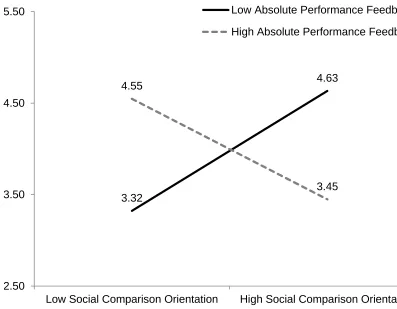
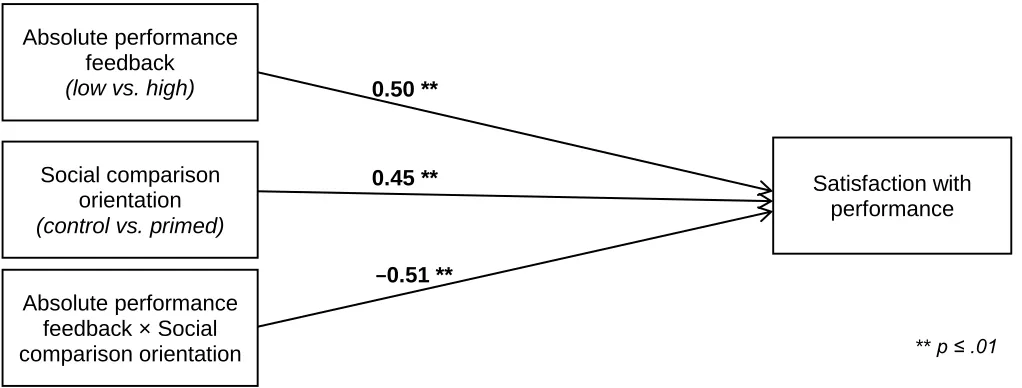
variables. This regression showed significant main effects of absolute performance feedback (B = 0.50; t(252) = 2.89; p = 0.004) and social comparison orientation (B = 0.45; t(252) = 2.88; p = 0.005) on satisfaction with performance. These main effects were also qualified by a significant and
performance when they were presented with higher (vs. lower) absolute performance feedback. The
results of this moderation analysis are reported graphically in Figure 4.
Insert figure 4 here
To test whether the observed performance feedback × social comparison orientation
interaction on satisfaction with performance was mediated by self-perceived competence, we
subjected our measure of satisfaction to a moderated mediation analysis (Preacher, Rucker, &
Hayes, 2007; Zhao, Lynch, & Chen, 2010) with absolute performance feedback (low vs. high),
social comparison orientation (control vs. primed), and their interaction as independent variables,
and standardized self-perceived competence as a mediator. Consistent with a moderated mediation,
our social comparison orientation manipulation significantly moderated the relationship between
absolute performance feedback and self-perceived competence. In turn, self-perceived competence
significantly mediated the relationship between absolute performance feedback and satisfaction
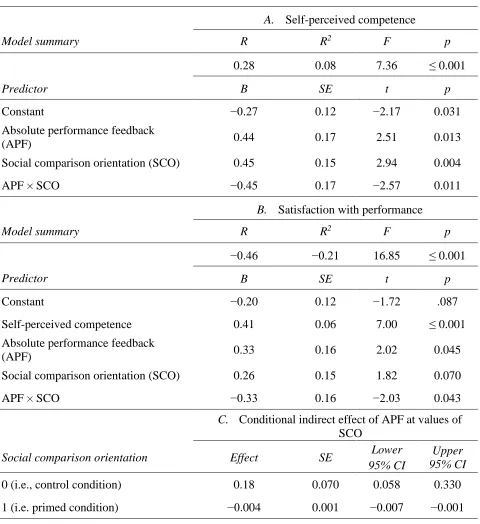
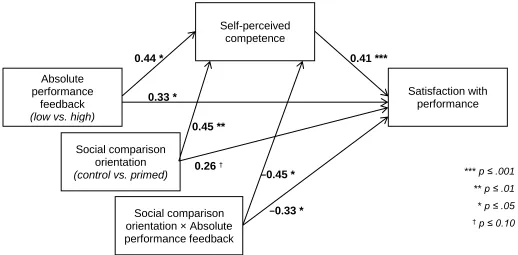
with performance. The results of this moderated mediation are reported in Table II and Figure 5.
Insert Table II and figure 5 here
Results show a significant main effect of absolute performance feedback (B = 0.44; t(252) = 2.51; p = 0.013; Table II.A), and a significant main effect of social comparison orientation (B = 0.45; t(252) = 2.94; p = 0.004; Table II.A). Both these main effects are qualified by a significant absolute performance feedback × social comparison orientation interaction (B = −0.45; t(252) = −02.57; p = 0.011; Table II.A) on our mediator, self-perceived competence. This interaction
more socially comparative reported significantly lower self-perceived competence with higher
absolute performance feedback. In turn, we found that higher self-perceived competence led to
higher satisfaction with performance (B = 0.41; t(251) = 7.00; p ≤ 0.001; Table II.B). The strength and significance of the indirect effects of absolute performance feedback were further assessed
using 5000 bootstrap samples (Preacher et al., 2007; Zhao et al., 2010). The conditional indirect
effect of absolute performance feedback on satisfaction with performance was significant and
negative for participants who were primed to engage in social comparison (95% CI of [−0.007,
−0.002]; Table II.C) but was significant and positive (95% CI of [0.058, 0.330]; Table II.C) for
participants in the control group. These conditional indirect effects indicate that participants who
were primed to be more socially comparative felt more dissatisfied with high (vs. low) absolute
performance feedback, while participants in the control condition felt more satisfied with high (vs.
low) absolute performance feedback. Finally, consistent with a partial moderated mediation, the
absolute performance feedback × social comparison orientation interaction (B = −0.33; t(251) = −2.03; p = 0.043; Table II.B) was also directly and significantly correlated with satisfaction with
performance.
With a view toward comprehensiveness, and since expectation (Ilgen, 1971) and perceived
task difficulty (Ewen, 1973) are important determinants of satisfaction, we tested alternative
moderated mediation models with these two variables as mediating variables. Neither performance
expectation nor perceived task difficulty was found to be a significant mediator, allowing little
General Discussion
Overview of the Findings
Comparative evaluation systems are common in organizations (Backes-Gellner & Pull,
2013; Goffin et al., 2009), universities and colleges (Goubeaud, 2010), sports competitions
(Medvec & Savitsky, 1997), and other occasions. Although in these settings it is often the
appraiser’s intention to base evaluations on relative standings only, we demonstrate that absolute
performance feedback also impacts appraisees’ satisfaction with performance. Specifically, we find
that contrary to common wisdom and practice, higher (lower) feedback may result in lower (higher)
self-perceived competence and satisfaction with performance in relative evaluation systems. More
precisely, we propose and demonstrate that chronic or contextual social comparison orientation
moderates the relationship between absolute performance feedback and self-perceived competence,
while self-perceived competence mediates the relationship between absolute performance feedback
and satisfaction with performance. We find that appraisees who have a low (high) social
comparison orientation feel more self-competent and satisfied with performance with higher
(lower) absolute performance feedback.
Theoretical Contributions
Understanding the gaps between practitioners’ beliefs and research findings is an important
inquiry in human resource management (Rynes et al., 2002). Our findings indicate that in relative
evaluation systems, both appraisers and appraisees believe that higher (lower) absolute performance
feedback will translate into superior (inferior) satisfaction with performance. Yet, our findings also
indicate that in such system, higher (lower) absolute performance feedback can often lead to
inferior (superior) satisfaction with performance. This unsubstantiated belief may have adverse
effects for organizations in industries where appraisees’ satisfaction is essential. For instance,
enrolment, and financial performance of higher education institutions (Alves & Raposo, 2007;
2009; Athiyaman, 1997; Carter, 2009; Henning-Thurau, Langer, & Hansen, 2001). More generally,
this unsubstantiated belief may have undesirable effects in organizations that evaluate employees
relatively, since satisfaction is linked to employees’ physical and mental health (Faragher, Cass, &
Cooper, 2005), as well as to individual (Riketta, 2008; Rodwell, Kienzle, & Shadur, 1998; Saari &
Judge, 2004), group (Whitman, Van Rooy, & Viswesvaran, 2010), and organizational performance
(Edmans, 2012; Zhou, Li, Zhou, & Su, 2008).
To date, only a handful of studies have shown that higher (lower) performance can result in
lower (higher) satisfaction. Although these studies have taken place in different contexts, they share
some theoretical underpinnings with our research. Specifically, in prior research higher (lower)
performance resulted in lower (higher) satisfaction with performance when certain reference points
such as counterfactuals (Medvec & Savitsky, 1997; Medvec et al., 1995) or ideals (Iyengar et al.,
2006) were used for the purpose of self-evaluation. The counterintuitive phenomenon we
demonstrate in our research stems from judging self-competence based on an individual’s own
performance versus that of others. We establish that appraisees who have a high social comparison
orientation (i.e., are more likely to use others’ performance as a reference) tend to feel more (less)
self-competent and satisfied with their level of performance when the mean of everyone’s absolute
performance feedback (and, thus, their own absolute performance—Figure 1) is low (high). We
also establish that this effect is reversed for appraisees who have a low social comparison
orientation (i.e., are more likely to judge self-competence based on their own performance), who
tend to feel more (less) self-competent and satisfied with their level of performance when the mean
of everyone’s absolute performance feedback (and, thus, their own absolute performance) is high
The crucial role that social comparison plays in this process places our study in a research
stream that has demonstrated the importance of social comparisons in organizational settings
(Brown, Ferris, Heller, & Keeping, 2007; Conner, 2003; Greenberg et al., 2007; Harris, Anseel, &
Lievens, 2008; Hu & Liden 2013). Precisely, we demonstrate that in contexts in which individuals
are evaluated relatively, social comparison orientation can be a dispositional and situational
moderator of predictors of satisfaction with performance. Yet, the performance-satisfaction
literature (Iaffaldano & Muchinsky, 1985; Judge et al., 2001; Petty, McGee & Cavender, 1984;
Saari & Judge, 2004; Schleicher, Watt, & Greguras, 2004) has ignored the potential role of social
comparison orientation. In light of our results, future performance-satisfaction studies might want
to measure or control for participants’ social comparison orientation.
Another important theoretical contribution of our paper lies in the examination of the effects
of absolute performance feedback on self-evaluation and satisfaction with performance. We
complement prior research by manipulating the effects of absolute performance feedback in
contexts for which only relative performance (which was kept constant in all of our studies but
experiment 2 in which it was manipulated but did not interact with other treatments) mattered for
the ultimate outcome. To the best of our knowledge, this is the first research to do this. Indeed, past
studies have usually manipulated both types of feedback concurrently (Harris & Smith, 2005;
Klein, 1997; Moore & Klein, 2008). Past studies have also not examined contexts in which the a priori importance of relative over absolute feedback is clearly greater to participants. As such, we provide some support for Festinger’s (1954) claim that individuals will tend to take into
consideration absolute information even when relative feedback is available. Indeed, the results of
our research show that in the presence of relative information, individuals still use absolute
performance information to make inferences about their competence. This is extremely surprising,
would be ill advised to ignore the potential role of absolute performance evaluation in relative
evaluation settings.
Finally, this paper also contributes to the literature on relative evaluation systems (Blume,
Rubin, & Baldwin, 2013; Garcia & Tor, 2007; Goffin et al., 2009; Schleicher et al., 2009; Scullen,
Bergey, & Aiman‐ Smith, 2005) and performance appraisals and feedback delivery (Biron,
Farndale, & Paauwe, 2011; Bracken et al., 2001; Farndale & Kelliher, 2013; Miller, 2001). Our results indicate that in addition to being potentially subjected to contextual influences (Ferris,
Munyon, Basik, & Buckley, 2008; Pichler, 2012) and to the features and characteristics of
performance evaluations systems (Brown, Hyatt, & Benson, 2010), appraisees’ reactions to relative
evaluation systems are subject to certain personality traits, such as social comparison orientation.
Importantly, our results also demonstrate the potential detrimental impact of relative performance
evaluation methods on satisfaction with performance if appraisees’ social comparison orientation
profiles are not taken into account. As such, they shed some needed light on the conditions under
which feedback interventions (Atwater et al., 2002; 2007; Kluger & DeNisi, 1996; 1998) in curved
grading settings produce positive and negative effects on appraisees’ self-perceived competence
and satisfaction with performance.
Managerial Implications
From a practical perspective, we have shown that when appraisees are evaluated relatively, a
fine balance—one that would make everyone happy—is hard to achieve. Indeed, appraisees with a
high social comparison orientation tend to be more satisfied with higher absolute performance
feedback, while those with a low orientation tend to be more satisfied with lower absolute
performance. As a strategic remedy, we propose that appraisers should consider the average social
comparison orientation profiles of appraisees being evaluated, as well as the contextual factors that
they should adopt more stringent or lenient evaluation criteria to maximize appraisees’ satisfaction
with performance. For instance, imagine a sales manager evaluating salespeople on a 100-point
scale, and then ranking these scores in order to determine bonus allocation. If those salespeople
tend to compare themselves with others a lot (little), obtaining one point should be made harder
(easier). For example, one point could correspond to $1,000 ($1,500) in sales. Without affecting the
actual rank-based outcome (i.e., bonus allocation) of the evaluation (Figure 1), the adoption of more
stringent (lenient) evaluation criteria should result in lower (higher) absolute performance feedback,
and thus higher satisfaction with performance for salespeople with high (low) social comparison
orientation. Obviously, and very importantly, the strategic adoption of stricter versus laxer
evaluation criteria must be both ethical and consistent with the current practices of the organization.
As such, it should probably be subject to the approval of senior managers and the ethics committee.
If the adoption of stricter versus laxer evaluation criteria is not feasible (for ethical or
organizational reasons), our work still offers recommendations for increasing satisfaction with
performance. First, as the satisfaction with performance of appraisees with a high social comparison
orientation critically depends on the average absolute performance feedback, organizations could
choose strategically whether or not to disclose this information. If the average is high, it would
reduce these appraisees’ satisfaction with performance, so the information should not be revealed.
If the average is low, it would increase their satisfaction with performance, so the information
should be revealed.3 Alternatively, appraisers can also use procedural priming techniques similar to
ours in order to induce appraisees to behave more comparatively when absolute performance
feedback is low and less comparatively when absolute performance feedback is high. The results of
our pilot study demonstrate that this set of guidelines for maximizing appraisees’ satisfaction with
performance in relative evaluation settings has yet to be communicated to most appraisers. Finally,
performance by shifting absolute performance feedback downward when appraising high social
comparison orientation individuals and upward when appraising low social comparison orientation
individuals (e.g., by removing or adding a constant from everyone’s absolute performance
feedback). Such a practice might be questionable and probably unethical. Thus engaging in it would
require consultation with higher management and/or the organization’s ethics board.4
Going back to our opening example, what could the manager have done differently to
increase her employees’ satisfaction? According to our data, she should have realized that due to
extensive exposure to relative performance appraisal systems, the employees she supervised tended
to engage in social comparison to a significant extent. Consequently, in order to increase
satisfaction with performance, she should have implemented one of the strategic remedies discussed
above. For instance, she could have adopted more stringent evaluation criteria in order to lower
appraisees’ individual and average absolute performance feedback. However, interesting
considerations arise about such feedback intervention. We found that an attempt to increase
satisfaction with performance with higher absolute performance feedback might result in a decrease
in satisfaction in appraisees with a high social comparison orientation. However, recent research
suggests that appraisees who receive inflated absolute performance feedback may be viewed more
positively in subsequent selection processes (e.g., job applications; Swift, Moore, Sharek, & Gino,
2013). So, in such cases, should a manager evaluate employees generously, leading to better career
prospects but lower satisfaction, or strictly, leading to worse career prospects but greater
satisfaction? Similar considerations arise for professors who evaluate students relatively.
Limitations and Generalizations to Other Organizational Settings
The consistency of our results with our hypotheses and across studies indicates a high
degree of internal validity. Nevertheless, the fact that some of our findings come from an
However, there are several reasons to be confident that the theoretical contributions and practical
implications discussed in the previous sections may extend to many organizations that employ
relative evaluation systems. First, although we use (among others) the performance evaluations of
students in some (but not all) of our experiments, the core phenomenon we demonstrate and the
theory behind it do not depend on some unique characteristics of classroom evaluations. Instead,
they are specific to curve-based appraisal systems, which are commonly found in organizations
(Backes-Gellner & Pull, 2013; Brustein, 2013; Ovide & Feintzeig, 2013). Second, the student
participants we used in experiment 1 joined the workforce of several organizations a few months
after the study was conducted. Thus, it is unlikely that immediately after graduation, they would
start processing performance feedback very differently from what our results show. Third, the
phenomenon we demonstrate is contingent on social comparison—a psychological process that is
common (to varying extents) to every individual (Gibbons & Buunk 1999) and in organizational
settings (Goodman & Haisley, 2007; Greenberg et al., 2007). Fourth, the effect we show in this
paper was replicated across many research conditions, including variations in samples (i.e., student
vs. not student) evaluation settings (i.e., classroom, sports competition, loyalty programs), positions
relative to the average, and so on. Unless specific factors in particular organizational settings are
demonstrated to interfere with the basic process on which we base our model, it seems natural to
assume that our findings would hold in the case of organizational evaluations, too.
Another potential threat to the external validity of our findings lies in the use of respondents
recruited from MTurk. Specifically, to what extent do participants recruited on MTurk differ
systematically from individuals working in organizations? Would treatment effects and parameter
estimates obtained from our sample of MTurk respondents differ from those that would be obtained
from different samples (e.g., a sample of front-line employees)? Research has indeed found that