Open Access
R E S E A R C H
Bio
Med
Central
© 2010 Chaipan et al; licensee BioMed Central Ltd. This is an Open Access article distributed under the terms of the Creative CommonsAttribution License (http://creativecommons.org/licenses/by/2.0), which permits unrestricted use, distribution, and reproduction inany medium, provided the original work is properly cited.
Research
Incorporation of podoplanin into HIV released
from HEK-293T cells, but not PBMC, is required for
efficient binding to the attachment factor CLEC-2
Chawaree Chaipan
†1,2, Imke Steffen
†3, Theodros Solomon Tsegaye
†3, Stephanie Bertram
3, Ilona Glowacka
3,
Yukinari Kato
4, Jan Schmökel
5, Jan Münch
5, Graham Simmons
6, Rita Gerardy-Schahn
7and Stefan Pöhlmann*
1,2,3Abstract
Background: Platelets are associated with HIV in the blood of infected individuals and might modulate viral
dissemination, particularly if the virus is directly transmitted into the bloodstream. The C-type lectin DC-SIGN and the novel HIV attachment factor CLEC-2 are expressed by platelets and facilitate HIV transmission from platelets to T-cells. Here, we studied the molecular mechanisms behind CLEC-2-mediated HIV-1 transmission.
Results: Binding studies with soluble proteins indicated that CLEC-2, in contrast to DC-SIGN, does not recognize the viral envelope protein, but a cellular factor expressed on kidney-derived 293T cells. Subsequent analyses revealed that the cellular mucin-like membranous glycoprotein podoplanin, a CLEC-2 ligand, was expressed on 293T cells and incorporated into virions released from these cells. Knock-down of podoplanin in 293T cells by shRNA showed that virion incorporation of podoplanin was required for efficient CLEC-2-dependent HIV-1 interactions with cell lines and platelets. Flow cytometry revealed no evidence for podoplanin expression on viable T-cells and peripheral blood mononuclear cells (PBMC). Podoplanin was also not detected on HIV-1 infected T-cells. However, apoptotic bystander cells in HIV-1 infected cultures reacted with anti-podoplanin antibodies, and similar results were obtained upon induction of apoptosis in a cell line and in PBMCs suggesting an unexpected link between apoptosis and podoplanin expression. Despite the absence of detectable podoplanin expression, HIV-1 produced in PBMC was transmitted to T-cells in a CLEC-2-dependent manner, indicating that T-T-cells might express an as yet unidentified CLEC-2 ligand.
Conclusions: Virion incorporation of podoplanin mediates CLEC-2 interactions of HIV-1 derived from 293T cells, while incorporation of a different cellular factor seems to be responsible for CLEC-2-dependent capture of PBMC-derived viruses. Furthermore, evidence was obtained that podoplanin expression is connected to apoptosis, a finding that deserves further investigation.
Background
The envelope protein (Env) of the human immunodefi-ciency virus (HIV), a heavily glycosylated type I trans-membrane protein, mediates infectious viral entry into target cells [1]. This process depends on the interactions of Env with proteins displayed at the surface of host cells. All primary HIV-1 isolates characterized to date engage the CD4 protein as receptor for infectious entry [2,3]. Upon binding to CD4, a coreceptor binding site is
gener-ated or exposed in Env, which allows engagement of the chemokine coreceptors CCR5 and CXCR4. The interac-tions of Env with CD4 and coreceptor are essential for infectious entry, and the interacting surfaces are key tar-gets for preventive and therapeutic approaches [2,3]. For instance, a small molecule inhibitor of Env binding to CCR5, maraviroc, blocks spread of CCR5-tropic HIV and is used as salvage therapy for patients who do not respond to conventional HIV therapy [4,5].
Receptor expression levels can limit HIV entry into host cells [6,7], and this limitation can be overcome by concentrating virions onto target cells by, for example, centrifugation or polybrene treatment [8]. A constantly
* Correspondence: [email protected]
1 Nikolaus-Fiebiger-Center for Molecular Medicine, University Hospital
Erlangen, 91054 Erlangen, Germany
† Contributed equally
accumulating body of evidence suggests that certain host cell factors can also promote viral attachment to cells and can thereby increase infection efficiency [9,10]. A striking example is the interaction of HIV with a semen-derived fragment of prostatic acidic phosphatase, termed SEVI (for Semen Enhancer of Virus Infection) [11]. SEVI, an amyloidogenic peptide, forms fibrils in human semen which capture HIV and concentrate virions onto target cells [11]. As a consequence, SEVI boosts viral infectivity and might increase the risk of acquiring HIV infection upon sexual intercourse. Incorporation of host cell fac-tors into the HIV envelope can also increase viral infec-tivity. The augmentation of infectivity is due to the interaction of the virion-incorporated factors with their cognate receptors on HIV target cells, as exemplified by the up to 100-fold increased infectivity of ICAM-1-bear-ing viruses for LFA-1 positive target cells [12,13]. Finally, attachment of HIV to dendritic cells can also promote HIV infection of adjacent T-cells [14,15], and this prop-erty has been associated with the expression of DC-SIGN [16], a calcium-dependent (C-type) lectin which recog-nizes mannose-rich carbohydrates on the HIV Env pro-tein [17-19]. Engineered expression of DC-SIGN on certain cell lines promotes receptor-dependent infection of these cells (termed infection in cis) [20] or of adjacent target cells (termed infection in trans, or transmission) [16], and it has been suggested that DC-SIGN might pro-mote HIV spread in and between individuals [16]. How-ever, this hypothesis is intensely debated [21-25]. In fact, several lines of evidence suggest that DC-SIGN might mainly function as a pathogen recognition receptor, which promotes HIV uptake for MHC presentation and thereby exerts a protective function against HIV infection [23-27].
We and others have previously shown that apart from dendritic cells, platelets also express DC-SIGN and that these cell fragments bind to HIV in a mainly DC-SIGN-dependent manner [28,29]. However, the HIV binding activity of platelets could be partially inhibited by antisera specific for the newly identified HIV attachment factor CLEC-2 [29], indicating that CLEC-2 contributes to HIV capture by platelets. CLEC-2 is a lectin-like protein, and its putative carbohydrate recognition sequence contains 17 amino acid residues highly conserved between C-type lectins [30]. Binding of the snake venom toxin rhodocytin to CLEC-2 triggers Syk-dependent signalling in platelets which causes platelet degranulation [31,32]. Residues in CLEC-2 which are required for binding to rhodocytin have been defined [33,34]. However, it is at present unclear how CLEC-2 interacts with HIV.
Here, we report that CLEC-2, unlike DC-SIGN, does not bind to the viral Env protein, but to a cellular factor incorporated into the viral envelope. For viruses pro-duced in the kidney-derived cell line 293T, this factor was
found to be podoplanin (also termed aggrus), a cellular mucin-like glycoprotein expressed by kidney podocytes (which are known to be susceptible to HIV infection [35]) and lymphatic endothelium [36-38]. Podoplanin expres-sion was not detected on viable, but on apoptotic T-cells and on apoptotic peripheral blood mononuclear cells (PBMCs). However, apoptosis of HIV infected T-cells was not associated with podoplanin expression. Nevertheless, CLEC-2 mediated trans-infection of HIV generated in PBMCs, indicating that these cells might express a so far unidentified ligand which can facilitate CLEC-2-dependent HIV capture.
Methods
Cell culture and transfection
293T, 293 T-REx [19], GP2 293 (Clontech, California, USA) and CHO cells were maintained in Dulbecco's modified Eagle medium (DMEM) supplemented with 10% fetal calf serum (FCS, Biochrom, Germany), penicil-lin and streptomycin. In addition, blasticidin and zeocin were used for selection of 293 T-REx cells expressing CLEC-2 upon induction with doxycycline (Sigma, Ger-many). CHO Lec1 and CHO Lec2 cells [39-41] were cul-tured in αMEM (PAA, Germany), supplemented with 10% FCS and antibiotics. THP, THP DC-SIGN, B-THP CLEC-2 (Raji B cells that were engineered to express DC-SIGN [42], CLEC-2 [29] or empty vector), C8166-SEAP cells [43] and CEM×174 5.25 M7 (abbreviated CEM×174 R5) cells [44], the latter expressing exogenous CCR5, were cultured in RPMI 1640 medium (PAA, Ger-many) in the presence of antibiotics and 10% FCS. All
cells were cultured at 37°C and 5% CO2. Highly purified
platelets were obtained from the "Transfusionsmedizinis-che und Hämostaseologis"Transfusionsmedizinis-che Abteilung" of the University Hospital Erlangen. Alternatively, platelets were prepared from whole blood by centrifugation at 1200 rpm at RT. The upper platelet-rich plasma was collected and centri-fuged at 4000 rpm for 20 min at RT. Subsequently, the supernatant was removed, and platelets were resus-pended in RPMI 1640 medium supplemented with 10% FCS and antibiotics. PBMCs were isolated from whole blood or leukocyte filters by centrifugation through a Ficoll gradient and either cultured in RMPI 1640 medium supplemented with 10% FCS and antibiotics or stimu-lated with PHA (Sigma) at a concentration of 5 μg/ml and IL-2 (Roche) at a concentration of 10 U/ml.
Plasmids
The NL4-3-based reporter virus bearing EGFP in place of
nef was generated by splice overlap extension (SOE) PCR.
Briefly, a NL4-3 env fragment was amplified using oligo-nucleotides pJM206 (binding upstream of the singular HpaI restriction site in env), and pJM394 (binding to the
EGFP) and pBRNL4-3 [45] as template. EGFP was ampli-fied from pEGFP-C1 (Clontech) using primers JM395 (binding to EGFP start sequences) and JM396 (introduc-ing a MluI site downstream of the EGFP stop codon). Both PCR fragments were fused by SOE PCR using prim-ers pJM206 and pJM396. The resulting env-EGFP frag-ment was cloned via HpaI and MluI into pBRNL4-3_nef+ Δ1Δ2 [46] resulting in the generation of pBRNL4-3-EGFP
in which nef was replaced by EGFP. Oligonucleotide
sequences (env sequences in bold; EGFP sequences in italics, MluI restriction site underlined): pJM206
5'-TGGAACTTCTGGGACGCAGG-3'; pJM394 5'-
GCT-CACCAT CTTATAGCAAAATCC;JM395 GCTATAA -GATGGTGAGCAAGGGCG-3';JM396 5'-CGTACGCG
TTACTTGTACAGC-3'. The gp120-Fc-IgG1 construct
[47] was generated by amplifying a codon-optimized gp120 (JRFL) [48] with primers gp120_BamHI
5'-GAGT-GGATCCCTTATCGTCGTCATCCTTGTAATCC-3'
(sense) and gp120_HindIII 5'-GTACGAAGCTT
GTGGA-GAAGCTGTGGGTGAC-3' (antisense), followed by insertion of the PCR fragment in the BamHI and HindIII
restriction sites of the Fc-IgG1 encoding plasmid pAB61
[49]. For generating the CLEC-2-Fc-IgG1 fusion
con-struct, sense primer 5'-GTACGAAGCTTTGCAGCCCC
TGTGACACAAAC-3'and antisense primer 5'-GAGT
G-GATCCAGGTAGTTTCCACCTTGG-3' were used for PCR amplification, and the product was cloned into pAB61 using the HindIII and BamHI restriction sites. CLEC-2 mutants bearing single amino acid changes were generated by overlap extension PCR. The
oligonucle-otides 5'-GCCGGATCC
ACCATGCAGGATGAAGATG-GATACATC-3' (sense) and GCCGAATTCTTAAGGTA
GTTGGTCCACCTTGG (antisense) were used as outer primers and combined with the following inner prim-ers:5'-GATGGAAAAGGAGCCATGAATTGTGC-3' (sense) and 5'-AGCACAATTCATGGCTCCTTTTC-CAT-3' (antisense) for generation of mutant CLEC-2 N192A, 5'-TTGAGTTTTTGGCCGATGGAAAAGG-3' (sense) and 5'-TCCTTTTCCATCGGCCAAAAACTCA-3' (antisense) for mutant CLEC-2 E187A, 5'-GTTTTTG-GAAGATGGAGCCGGAAATATGAATTGTG-3' (sense) and 5'-AATTCATATTTCCGGCTCCATCTTCCAAAA-3' (antisense) for mutant CLEC-2 K190A, 5'-GCAA-CATTG TGGAATATATTGCGGCGCGCACCCATCT-GATTC-3' (sense) and 5'-GCGCCGCAATATATT CCACAATG-3' (antisense) for mutant CLEC-2 K150A.
For generation of DC-SIGN-Fc-IgG1, primers
5'-GTAC-GAAGCTTGAACGCCTGTGCCACCCCTG-3' (sense)
and 5'-GAGTGGATCC
CGCAGGAGGGGGGTTTG-GGG-3' (antisense) were used. The resulting PCR frag-ment was cloned into pAB61, using the HindIII and BamHI restriction sites. A PCR fragment encoding the extracellular domain of podoplanin fused to the Fc
por-tion of human immunoglobulin was generated as
described above, employing primers 5'-GCCAAGCTT
-GCCAGCACAGGCCAGCCAGAAGATG-3' (sense) and 5'-GCGGGATCCTGTTGACAAACCATCTTTCT CAA C-3' (antisense) and inserted into the pAB61 plasmid via the HindIII and BamHI restriction sites (italics). The identity of all PCR amplified sequences was confirmed by sequencing with an ABI3700 genetic analyzer (Applied Biosystems) according to the manufacturer's instructions. The plasmid used for transient expression of podoplanin (podoplanin in pcDNA3) has been previously described [38].
Viruses and transmission analyses
Replication-competent HIV-1 NL4-3, NL4-3 luc [50] and NL4-3 EGFP were generated as described elsewhere [50]. Briefly, 293T cells were transfected with plasmids encod-ing proviral DNA, and culture medium was changed 12 h post transfection. Culture supernatants were harvested at 48 h post transfection and filtered through a 0.45 μm fil-ter, aliquoted and stored at -80°C. Transmission analyses were carried out as described [29]. Briefly, B-THP control cells, B-THP-DC-SIGN and B-THP-CLEC-2 cells [29,42] or platelets were incubated with virus for 3 h at 37°C, and unbound virus was removed by washing with fresh cul-ture medium. Cells were then incubated with CEM×174 R5 target cells and luciferase activities in cellular lysates were determined three days after the start of the coculti-vation by employing a commercially available system (Promega, Germany).
Binding studies with soluble proteins
For generating soluble Zaire Ebolavirus glycoprotein (ZEBOV-GP)-Fc- [51], DC-SIGN-Fc-, CLEC-2-Fc- and Podoplanin-Fc-fusion proteins, 293T cells were calcium phosphate-transfected with the respective plasmids or pAB61 control plasmid encoding only the Fc-portion of IgG1. For transfection of CHO and mutant cell lines, Lipofectamine 2000 transfection reagent (Invitrogen, Germany) was used according to the manufacturer's pro-tocol. The cells were washed with PBS and the culture medium was replaced by FCS-free medium at 12 h transfection and supernatants were harvested 48 h post-transfection. Subsequently, supernatants were concen-trated using Centricon Plus-20 size-exclusion centrifugal filters (Millipore, Germany; centrifugation at 4000 g for 15 minutes), aliquoted, and stored at -80°C. To employ comparable amounts of soluble proteins for binding stud-ies, Fc-fusion protein preparations were normalized by Western blot, employing an anti-human IgG-horseradish peroxidase conjugate for detection (Dianova, Germany).
To assess binding, 5 × 10⁵ cells were incubated with
buf-fer and stained with Cy5-conjugated anti-human IgG secondary antibody for 30 minutes at 4°C. Cell-staining was then analyzed by flow cytometry, employing a Cytomics FC500 flow cytometer (Beckman-Coulter, Flor-ida, USA), and data were analyzed with FCS Express FACS analysis software (De Novo Software, Los Angeles, USA).
Analysis of podoplanin surface expression
Analyses of podoplanin surface expression were per-formed by flow cytometry, using the podoplanin specific antibodies NZ-1 or 18H5 (Acris, Germany) in combina-tion with secondary anti rat/mouse antibody coupled to Cy5 (Dianova, Germany). Cells were incubated with 10 μg/ml antibody in PBS supplemented with 5% FCS for 30 minutes at 4°C. Subsequently, PBS supplemented with 5% FCS was added, and the cells were pelleted by centrifuga-tion (1200 rpm, 4°C for 5 minutes). Finally, cells were resuspended in fixans (1.5% paraformaldehyde) and incu-bated for 30 minutes at 4°C before staining was analyzed by flow cytometry. For all measurements 20,000 gated events were collected.
Knock-down of podoplanin expression by shRNA
For stable knock-down of podoplanin in 293T cells, shR-NAs were constructed by using shRNA Hairpin Oligonu-cleotide Sequence Designer Tool (Clontech, California, USA). The podoplanin specific shRNA 137 contained the target shRNA sequence, a hairpin loop region "TTCAA-GAGA" and an antisense shRNA sequence followed by a pol III terminator sequence. The shRNA was constructed
by annealing shRNA137sense_BamHI: 5'GATCC
GC-GAAGATGAT GTGGTGACTTTCAAGAGAAGT-CACC ACATCATCTTCGTTTTTTACGCGTG3' and
shRNA137antisense_EcoRI: 5'AATTCACGCGTAAAAA
ACGAAGATGATGTGGTGACTTCTCTTGAAAGTCA CCACATCATCTTCGCG3' followed by insertion of the double stranded fragment into the retroviral vector pSI-REN-IRES-EGFP-RetroQ [52], using restriction enzymes BamHI and EcoRI, respectively. This vector allows stable expression of small hairpin RNAs in transduced cells, which can be readily identified and selected due to vector encoded genes for puromycin resistance and EGFP (enhanced green fluorescence protein) expression. Retro-viral transduction was performed by transient expression of the shRNA constructs and VSV-G in the packaging cell line GP2-293 (Clontech, California, USA). At 48 h post transfection, cell supernatants were harvested, and viruses were concentrated by ultracentrifugation for 2 h at 4°C. Pelleted virions were resuspended in 2 ml medium containing 2 μg/ml polybrene (Sigma-Aldrich, Germany)
and were used for transduction of 1 × 10⁶ 293T cells. At
24 h post transduction, cells were washed and incubated for 3 days. Subsequently, transduced cells were selected in
medium containing 10 μg/ml puromycin (Sigma-Aldrich, Germany).
Apoptosis induction
For apoptosis induction cells were incubated with 1 μM staurosporine (New England Biolabs, Germany), 25 μg/ ml cycloheximide (Sigma-Aldrich, Germany) or 0.1% DMSO as a control in culture medium for 14 h unless otherwise stated. Cells were stained for apoptosis with PE-conjugated annexin V (R&D Systems, Minnesota, USA) and for necrosis with 7-aminoactinomycin D (7-AAD, Sigma, Germany). Specifically, cells were incubated with 5 μl annexin V or 7-AAD for 20 min at room tem-perature and then washed with PBS supplemented with 5% FCS. Subsequently, cells were fixed in 1.5% paraform-aldehyde for 30 minutes at 4°C. Staining was analyzed within 30 minutes after completion of fixation by flow cytometry. For all measurements 20,000 gated events were collected.
Inhibition of antibody binding by soluble podoplanin
The podoplanin specific antibodies 18H5 and NZ-1 (Acris, Germany) were pre-incubated with concentrated, soluble podoplanin-Fc fusion protein for 30 minutes at 4°C before staining of apoptotic cells for subsequent FACS analysis.
Statistical analyses
Statistical significance was determined by employing a two-tailed student's t-test for paired samples.
Results
Efficient binding of soluble CLEC-2 to 293T cells does not require expression of the HIV-1 envelope protein
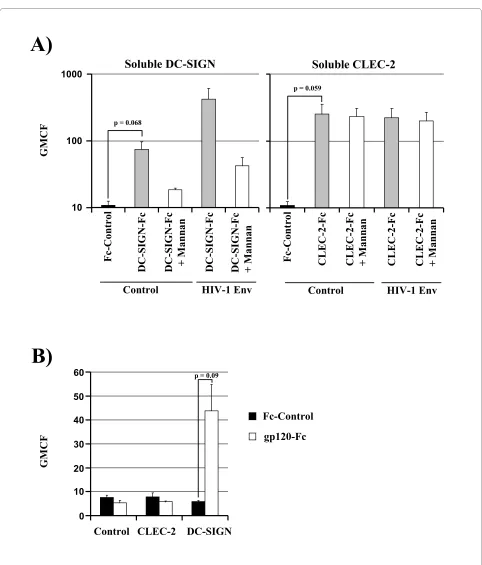
Figure 1 CLEC-2 does not recognize the viral Env protein. (A) 293T cells were either control transfected with empty vector or transfected with an HIV-1 NL4-3 Env expression plasmid. Subsequently, the cells were preincubated with PBS or mannan and then DC-SIGN-Fc (left panel) or CLEC-2-Fc (right panel) fusion proteins or an Fc-control protein (black bars) were added. Unbound proteins were removed by washing and bound proteins de-tected by flow cytometry. The results represent the average of the geometric mean channel fluorescence (GMCF) measured in four independent ex-periments. Error bars indicate standard error of the mean (SEM). (B) 293T cells were transfected with DC-SIGN, CLEC-2 or empty vector and incubated with soluble HIV-1 Env gp120-Fc fusion protein or control Fc-protein. Unbound proteins were removed by washing and bound proteins detected by flow cytometry. The results represent the average ± SEM of the GMCF measured in three independent experiments. GMCF: geometric mean channel fluorescence, SEM: standard error of the mean.
A)
B)
Fc-Control
DC-SIGN-Fc
DC-SIGN-Fc
+ M
a
nnan
DC-SIGN-Fc
DC-SIGN-Fc
+ M
a
nnan
Control
HIV-1 Env
Fc-Control
CLEC-2-Fc
CLEC-2-Fc
+ M
a
nnan
CLEC-2-Fc
CLEC-2-Fc
+ M
a
nnan
Control
HIV-1 Env
10 100
GMCF
1000
Soluble DC-SIGN
Soluble CLEC-2
0 10 20 30 40 50 60
Control CLEC-2
DC-SIGN
Fc-Control
gp120-Fc
GMCF
p = 0.09 p = 0.068
the results obtained with soluble DC-SIGN, the interac-tion was not inhibited by mannan and was not enhanced by expression of the viral Env protein. In agreement with these results, soluble HIV-1 Env protein bound specifi-cally to DC-SIGN but not to CLEC-2 expressing cells (Fig. 1B). We therefore concluded that CLEC-2, in contrast to DC-SIGN, does not capture HIV-1 Env. Instead, CLEC-2 seemed to recognize a cellular factor expressed on 293T cells, and binding to this factor did not depend on recog-nition of high-mannose carbohydrates.
Podoplanin, a recently identified CLEC-2 ligand, is expressed on 293T cells
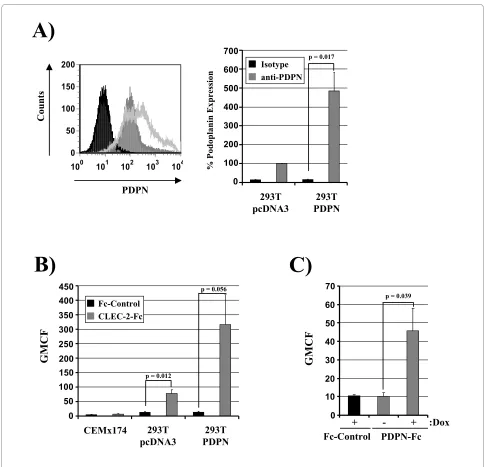
The cellular mucin podoplanin was recently shown to interact with CLEC-2 [53]. Podoplanin is endogenously expressed by kidney podocytes [37]. Therefore, we inves-tigated if the kidney-derived cell line 293T also expresses podoplanin. Flow cytometric analysis indeed revealed high levels of podoplanin on the surface of 293T cells (Fig. 2A). Expression was further enhanced upon trans-fection of 293T cells with a podoplanin expression plas-mid (Fig. 2A), and higher levels of podoplanin resulted in more efficient binding of soluble CLEC-2 (Fig. 2B). In contrast, no binding to the lymphoid cell line CEM×175 R5 was detected (Fig. 2B), which was podoplanin negative (see below). We then used soluble podoplanin to confirm the interaction with CLEC-2. For this, CLEC-2 expres-sion was induced on 293 T-REx CLEC-2 cells, and bind-ing of soluble podoplanin fused to the Fc-portion of human immunoglobulin was analyzed by flow cytometry. Efficient binding of soluble podoplanin was observed only upon induced expression of CLEC-2, and a control Fc protein did not bind to the CLEC-2 expressing cells (Fig. 2C and data not shown). Thus, 293T cells, which we and many others frequently use for production of HIV-1 stocks, express podoplanin; and podoplanin specifically interacts with CLEC-2.
Glycosylation of podoplanin is required for efficient binding to CLEC-2
We next sought to elucidate the determinants governing efficient interactions between podoplanin and CLEC-2. For instance, it is at present unclear if glycosylation of podoplanin is required for binding to CLEC-2. Watson and colleagues demonstrated that binding of CLEC-2 to the snake venom protein rhodocytin is glycosylation independent, and defined several amino acids in CLEC-2 which contributed to efficient rhodocytin binding [33,34]. Thus, mutations K150A, E187A, K190A and N192A decreased binding of CLEC-2 to rhodocytin in surface plasmon resonance binding studies [34]. We addressed if these residues were also required for binding to soluble podoplanin. Flow cytometric analysis showed that all changes, with the exception of K190A were
com-patible with efficient expression of CLEC-2 (Fig. 3A). Wild type CLEC-2 and all mutants, except K190A, bound to soluble podoplanin with similar efficiency, indicating that the CLEC-2 residues involved in rhodocytin binding were not important for binding to podoplanin.
Podopla-nin contains sialylated O-glycans [54], and we next
ana-lyzed if glycosylation of podoplanin is essential for binding to CLEC-2. For this, podoplanin-Fc fusion pro-teins were produced in wt CHO cells or CHO cells that
due to defects in either the medial Golgi localized N
-acetylglucosaminyltransferase I (CHO Lec1) or the trans Golgi localized CMP-sialic acid transporter (CHO Lec2)
have lost their abilities to produce complex N-glycans and
sialylated glycoconjugates, respectively [39-41]. Soluble proteins were concentrated from cellular supernatants by size-exclusion filtration, and Western blot analysis showed that the podoplanin-Fc preparations contained roughly comparable amounts of protein (Fig. 3B), while the Fc-control protein preparation was more concen-trated. When binding to CLEC-2 was analyzed in a FACS-based assay, podoplanin produced in Lec1 cells still bound to CLEC-2 with appreciable efficiency (Fig. 3C). In contrast, podoplanin produced in Lec2 cells and thus almost completely lacking sialoglycoconjugates did not show significant binding to CLEC-2 (Fig. 3C). The observed differences indicate that the presence of sialic acid is essential for binding to CLEC-2. Moreover,
because N-glycans are exclusively of the high-mannose
type if proteins are expressed in Lec1 cells, this finding
provides evidence that sialylated O-glycans are involved
in mediating the contact to CLEC-2. Based on the knowl-edge that EDTA influences binding properties of DC-SIGN [16], we next asked if also the interaction between CLEC-2 and podoplanin depends on divalent ions. As shown in Fig. 3D, treatment of DC-SIGN expressing cells with EDTA significantly reduced binding to soluble ZEBOV-GP-Fc, but had no effect on binding of soluble podoplanin to CLEC-2 (Fig. 3D), indicating that divalent ions are not required for the structural integrity of the podoplanin binding surface of CLEC-2.
Podoplanin is incorporated into virions produced in 293T cells and virion incorporation is essential for CLEC-2-dependent HIV-1 interactions with cell lines and platelets
efficiently reduced podoplanin expression in transiently transfected 293T cells (data not shown). Subsequently, this shRNA was stably introduced into 293T cells by employing a retroviral vector, which also contained an
[image:7.595.55.542.92.559.2]expression cassette for EGFP. As control, cells were trans-duced with a retroviral vector encoding a non-sense shRNA. After cultivation in selection antibiotics, all cells were positive for EGFP and thus harboured the vector
Figure 2 Podoplanin is expressed on 293T cells and binds to CLEC-2. (A) 293T cells were either control transfected with empty vector or trans-fected with a podoplanin expression construct. Cells were stained with anti-podoplanin antibody 18H5 and analyzed by flow cytometry (black filled area: control transfected cells stained with isotype antibody, grey filled area: control transfected cells stained with 18H5, grey line: cells transfected with podoplanin expression plasmid and stained with 18H5). The results of a representative experiment are shown on the left side, the average of four independent experiments is presented at the right side. Error bars indicate SEM. (B) The experiment was carried out as described for (A), but binding of soluble CLEC-2 to podoplanin or control transfected cells and to CEM×174 cells was analyzed. The results represent the average ± SEM of the GMCF measured in three (CEM×174) and four (293T, 293T-PDPN) independent experiments. (C) 293 T-REx CLEC-2 cells were doxycycline treated to induce CLEC-2 expression or PBS treated, and binding of soluble podoplanin-Fc or Fc-control protein was analyzed. The results represent the average ± SEM of the GMCF measured in three independent experiments. Dox: doxycycline, GMCF: geometric mean channel fluorescence, PDPN: podoplanin, SEM: standard error of the mean.
A)
Counts
100 101 102 103 104 0
50 100 150 200
PDPN 0
100 200 300 400 500 600 700
% Po
doplanin
Ex
pression
0 50 100 150 200 250 450
GMCF
0 10 20 30 40
Fc-Control PDPN-Fc
GMCF
300 350 400
p = 0.012
p = 0.056
50
293T pcDNA3
293T PDPN
293T pcDNA3
293T PDPN
B)
C)
+ - + :Dox
60 70
p = 0.039
CEMx174
Isotype anti-PDPN
Fc-Control CLEC-2-Fc
Figure 3 Binding of podoplanin to CLEC-2 requires adequate podoplanin glycosylation and is independent of divalent ions. (A) The indicat-ed CLEC-2 mutants were transiently expressindicat-ed on 293T cells and expression (white bars) and binding of podoplanin-Fc (black bars) analyzindicat-ed by flow cytometry. The results represent the average ± SEM of the GMCF measured in three independent experiments. (B) The Fc-control protein or the podo-planin-Fc fusion protein was transiently expressed in the indicated CHO cell lines. CHO Lec1 cells are defective in N-acetylglucosaminyltransferase (no complex N-glycans are generated), CHO Lec2 cells lack the CMP-sialic acid transporter (no sialylated glycoconjugates are generated). The superna-tants of the transfected cells were harvested, concentrated and analyzed by Western blot, using the podoplanin-specific D2-40 antibody [82] (top pan-el) or a Fc-specific antibody (bottom panpan-el). (C) The proteins generated in (B, control Fc-protein was 2-fold diluted) were incubated with CLEC-2 expressing 293 T-REx cells and bound protein was detected by FACS. The results represent the average ± SEM of the GMCF measured in three inde-pendent experiments. (D) Expression of DC-SIGN and CLEC-2 was induced on 293 T-REx cells by doxycycline treatment and the cells incubated with ZEBOV-GP-Fc or podoplanin-Fc, respectively, in the presence of PBS (dark bars) or 2 mM EDTA containing FACS buffer (white bars). Bound proteins were detected by flow cytometry. The results represent the average ± SEM of the GMCF measured in three independent experiments. GMCF: geo-metric mean channel fluorescence, PDPN: podoplanin, SEM: standard deviation of the mean.
A)
CLEC-2 Expression PDPN-Fc Binding
0 20 40 60 80 100 120 140
Control Wt K150A E187A K190A N192A
160
GMCF
B)
Fc-Control PDPN-FcWt Lec1 Lec2
kDa
Wt
130 100 70 55
anti-PDPN
130 100 70 55
anti-Fc
0 10 20 30 40 50 60
Wt Wt Lec1 Lec2
GMCF
C)
D)
p = 0.028
0 10 20 30 40 50 60
DC-SIGN CLEC-2
p = 0.0089
p = 0.147
GM
CF
PBS
p = 0.073
EDTA
p = 0.032
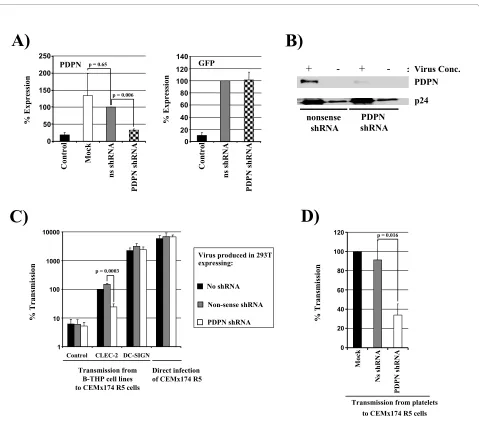
genome (Fig. 4A). Podoplanin expression was not appre-ciably altered in cells containing the vector encoding the control shRNA. In contrast, cells transduced with the vector encoding the podoplanin-specific shRNA showed
[image:9.595.59.538.151.576.2]substantially (~70%) reduced podoplanin expression (Fig. 4A), indicating that the shRNA was active. Next, we tested if podoplanin was incorporated into virions released from control cells and from the podoplanin
Figure 4 Podoplanin is incorporated into virions released from 293T cells, and incorporation is essential for efficient CLEC-2-dependent
HIV transmission. (A) 293T cells were transduced with retroviral vectors encoding EGFP and either a podoplanin-specific or a non-sense shRNA.
Transduced cells were puromycin-selected and podoplanin (left panel) and EGFP expression (right panel) was determined by flow cytometry (using antibody 18H5). The average ± SEM of five independent experiments, for which GMCF was determined, is presented. Podoplanin expression on cells expressing control shRNA was set as 100%. (B) An env-defective NL4-3 proviral genome was transiently expressed in 293T cells transduced with vector encoding either podoplanin-specific shRNA or non-sense shRNA; the supernatants were harvested, and either processed directly or concentrated by size-exclusion filtration. Subsequently, the supernatants were analyzed for podoplanin and p24-content by Western blot. (C) The cells described in (A) were transfected with HIV-1 NL4-3 proviral DNA; the supernatants were harvested and their p24-content determined. Equal volumes of virus stocks containing 10 ng of p24-antigen were then incubated with the indicated B-THP cell lines and bound viruses transmitted to CEM×174 R5 targets. In parallel, direct infection of targets was assessed. The results represent the average ± SEM of six independent experiments carried out in triplicates with two independent virus stocks. Transmission of HIV-1 produced in 293T cells not transduced with shRNA-encoding vector was set as 100%. Control indicates B-THP cells stably transduced with empty vector. (D) The experiment was conducted as described in (C). However, HIV-1 transmission by platelets was examined. The results represent the average ± SEM of five independent experiments carried out in triplicates. The same virus stocks as in (C) were used. Mock indicates viruses produced in 293T cells not transduced with shRNA-encoding vector. GMCF: geometric mean channel fluo-rescence, ns shRNA: none-sense shRNA, PDPN: podoplanin, SEM: standard error of the mean.
A)
B)
0 50 100 150 200 250
0 20 40 60 80 120 140
100
% Expression
Control Mock
ns shR
NA
PDPN shRNA
PDPN GFP
p = 0.006 p = 0.65
PDPN
% Expression
p24
+ -
+ -
: Virus Conc.nonsense shRNA
PDPN shRNA
Control
ns shR
NA
PDPN shRNA
D)
C)
10000
20 40 60 80 100 120
0 1
10 100 1000
Control CLEC-2 DC-SIGN
p = 0.0003
% Transmissio
n
No shRNA
Non-sense shRNA
PDPN shRNA
Mo
ck
Ns shRNA
PDPN s
h
RNA
p = 0.016
Virus produced in 293T expressing:
% Transmissio
n
Transmission from B-THP cell lines to CEMx174 R5 cells
Direct infection of CEMx174 R5
knock-down cells. For this, the cells were transfected with env-deficient HIV-1 proviral DNA (for augmented bio-safety), the supernatants concentrated by size-exclusion filtration and virions pelleted by centrifugation through a sucrose cushion. Alternatively, unconcentrated superna-tants were directly passed through a sucrose cushion. Western blot analysis of these virion preparations yielded a prominent podoplanin signal for virions generated in control cells and a faint signal for virions generated in podoplanin knock-down cells (Fig. 4B). These signals were only observed for concentrated virions, and assess-ment of p24 content showed that concentration of parti-cles was indeed effective (Fig. 4B). Finally, a markedly higher podoplanin signal was measured in the superna-tants of HIV transfected compared to mock transfected cells (data not shown), confirming that the podoplanin signal observed in Fig. 4B was mainly due to virion-asso-ciated protein. Thus, podoplanin is incorporated into particles generated from 293T cells and incorporation can be reduced by shRNA-mediated knock-down. We then asked if reduced podoplanin incorporation affects HIV-1 interactions with CLEC-2. For this, virions were generated in control and podoplanin knock-down cells, normalized for p24-content and analyzed in trans-infec-tion experiments. Reductrans-infec-tion of virion-incorporatrans-infec-tion of podoplanin had no effect on DC-SIGN-dependent HIV-1 transmission by B-THP cells [42] (Fig. 4C), and infection experiments confirmed that the viruses employed were of comparable infectivity for target cells (Fig. 4C) and did not infect the transmitting cells (data not shown). In con-trast, diminished podoplanin incorporation resulted in a pronounced reduction of viral transmission by CLEC-2 expressing B-THP cells and by platelets (Fig. 4C-D), dem-onstrating that podoplanin incorporation into virions produced in 293T cells is required for efficient interac-tion with CLEC-2.
Reactivity of apoptotic cells with podoplanin-specific antibodies
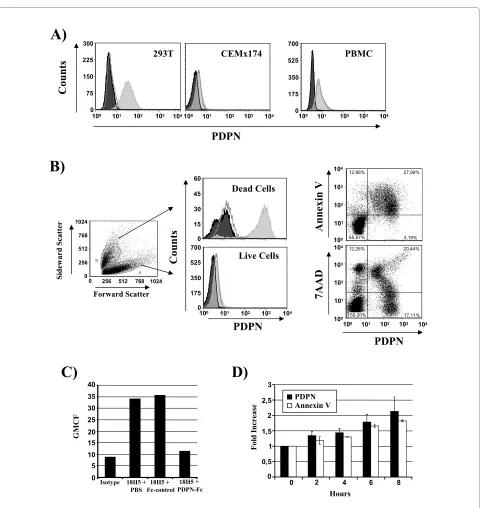
Podocytes, which are visceral epithelial cells of the kid-ney, express podoplanin and were found to be infected in HIV-1 patients and to proliferate in HIV-1 associated nephropathy [35]. We analyzed if major HIV-1 target cells also express podoplanin. Analysis of PHA/IL-2 stim-ulated PBMCs and the T/B-cell hybrid cell line CEM×174, which is permissive to HIV and SIV infection [55,56], yielded no evidence for podoplanin expression when cells were gated for viability (Fig. 5A). Unexpect-edly, however, CEM×174 cells and PBMCs defined as non-viable by our gating strategy efficiently bound the podoplanin antibody 18H5 but not an isotype-matched control antibody (Fig. 5B and Additional file 1); note that CEM×174 cells were serum starved to increase the per-centage of non-viable cells. Co-staining of CEM×174 cells
with the apoptosis marker annexin V and the necrosis marker 7-aminoactinomycin D (7-AAD) revealed that virtually all apoptotic cells and roughly half of the necrotic cells reacted with the podoplanin antibody (Fig. 5B). Comparable results were obtained with PBMCs (see Additional file 1), albeit only a portion of the apoptotic cells also expressed podoplanin. Apoptosis can result in surface expression of proteins which are not found on the surface of viable cells [57,58]. It is thus possible that podoplanin expression is up-regulated during apoptosis. However, apoptosis can also non-specifically change anti-body reactivity of cells [59]. To discern between these possibilities, we first asked if staining of non-viable cells was a specific feature of the particular antibody used for detection of podoplanin (clone 18H5). Notably, staining of apoptotic cells was also observed with a different podoplanin antibody (clone NZ-1 [60], data not shown), which was generated in a different species (rat) and binds to an epitope distinct from but overlapping with the one recognized by 18H5 [61]. In contrast, staining of apop-totic cells was not observed with several unrelated anti-bodies (see Additional file 2). Moreover, binding of both antibodies, 18H5 and NZ-1, to apoptotic cells could be inhibited by the pre-incubation of antibodies with soluble podoplanin before staining of cells whereas pre-incuba-tion with a control protein had no effect on antibody binding (Fig. 5C), indicating that antibody reactivity was dependent on the availability of the antigen binding site. So far, we had only analyzed cells naturally undergoing apoptosis in culture. Therefore, we next asked if reactivity against podoplanin antibodies could be induced by trig-gering of apoptosis with staurosporine, a relatively non-selective protein kinase inhibitor isolated from Strepto-myces staurospores [62]. Indeed, treatment of CEM×174 cells and PBMCs with staurosporine induced binding of annexin V and anti-podoplanin-specific antibodies 18H5 and NZ-1 (Fig. 5D and Additional file 1), underlining a potential link between apoptosis induction and podopla-nin expression.
Podoplanin is not expressed on HIV-1 infected T-cells
Figure 5 Evidence that apoptotic cells express podoplanin. (A) Podoplanin expression on the indicated cell lines was assessed by flow cytometry. Black filled histogram: unstained cells, grey line: cells stained with isotype control antibody, grey filled histogram: cells stained with 18H5. Similar results were obtained in two independent experiments. (B) Apoptotic and necrotic CEM×174 express podoplanin. Cultured CEM×174 cells were serum-starved and podoplanin expression on viable and apoptotic cells, as determined by forward and sideward scatter, analyzed by flow cytometry (left panel, the histograms were obtained by gating on dead or live cells, as indicated by the arrows in the scatter plot). Alternatively, the cells were co-stained with podoplanin-specific antibody and the apoptosis marker annexin V or the necrosis marker 7-AAD, and staining analyzed by flow cytometry including both, live and dead cells. Black filled histogram: unstained cells, grey line: cells stained with isotype control antibody, grey filled histogram: cells stained with 18H5. (C) The podoplanin-specific antibody 18H5 was pre-incubated with podoplanin-Fc fusion protein or Fc-control protein before addition to apoptotic cells, and antibody binding was subsequently analyzed by flow cytometry. The results of a representative experiment are shown. Similar results were obtained in three separate experiments. (D) Serum-starved CEM×174 cells were incubated with 1 μM staurosporine for the indi-cated times and then stained with anti-podoplanin antibody 18H5 and annexin V. Subsequently, podoplanin expression (black bars) and annexin V binding (white bars) were determined by flow cytometry. The results represent the average of two independent experiments and are shown relative to the podoplanin expression and annexin V binding at 0 hrs. The error bars indicate SEM. GMCF: geometric mean channel fluorescence, SEM: standard error of the mean.
A)
0 150
75 225 300
0 350
175 525 700
100 101 102 103 104100 101 102 103 104 100 101 102 103 104
293T CEMx174 PBMC
Counts
PDPN
B)
100 101 102 103 104
100
101
102
103
104
100
101
102
103
104
PDPN
Annexin V
7AAD
12,96% 27,99%
55,87% 3,19% 12,26% 20,44%
50,20% 17,11%
100 101 102 103 104
0 350
175 525 700 0 30
15 45 60
PDPN
Counts
Live CellsDead Cells
B
A
0 256 512 768 1024
0 256 512 768 1024
Forward Scatter
Si
deward
Scatter
0 0,5 1 1,5 2 2,5 3
0 2 4 6 8
Fol
d
Increase
Hours
C)
D)
0 5 10 15 20 25 30 35 40
Isotype 18H5 +
PBS 18H5 + Fc-control
18H5 + PDPN-Fc
GMCF
Likewise, infected cells did not bind the podoplanin-spe-cific antibody (Fig. 6, middle panel). In contrast, podopla-nin was readily detected on annexin V-positive cells (Fig. 6 right panel), which mainly represent uninfected bystander cells (Fig. 6, left panel). These observations suggest that podoplanin is not expressed on HIV-1 infected primary and immortalized T-cells and might thus play a limited role in cellular attachment of HIV-1 in infected patients.
Viruses generated in PBMCs are transmitted by CLEC-2
Our expression studies indicated that podoplanin is not expressed on stimulated, viable PBMCs and T-cell lines (Fig. 5), and that podoplanin expression is not induced in C8166 T-cells and PBMCs by HIV-1 infection (Fig. 5). These results raised the question if viruses generated in PBMCs are indeed transmitted in a CLEC-2-dependent
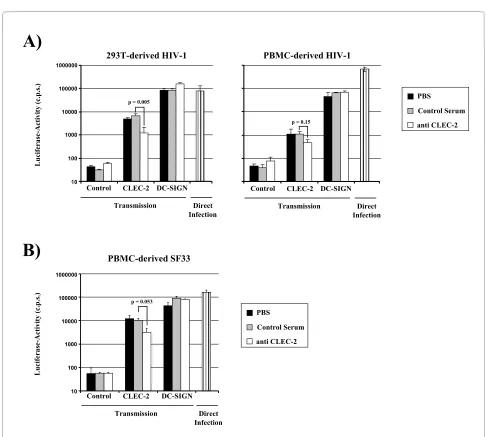
fashion. Notably, B-THP CLEC-2 cells promoted trans-infection of HIV-1 NL4-3 (X4-tropic) produced in 293T cells and PBMCs, and these processes could be reduced by CLEC-2-specific antiserum (Fig. 7A). Likewise, HIV-1 SF33 (X4-tropic) generated in PBMCs was transmitted to T-cells by B-THP CLEC-2 cells, and transmission was inhibited by CLEC-2 specific antiserum to an extent which closely approached statistical significance (Fig. 7B), suggesting that viruses generated in PBMCs harbour a cellular factor which mediates binding to CLEC-2, but is different from podoplanin.
Discussion
[image:12.595.57.542.94.467.2]Several cellular lectins interact with the highly glycosy-lated HIV Env protein [16,25,65-67], and virus capture by these factors has been suggested to impact HIV spread in and between individuals [15,16,68]. We have previously
Figure 6 Podoplanin is not expressed on HIV-infected T-cells. (A) C8166-SEAP cells were infected with an HIV-1 NL4-3 variant bearing the EGFP gene in place of nef. At 7 days post infection the infected cells were stained with podoplanin-specific antibody 18H5 and annexin V and analyzed by flow cytometry. Similar results were obtained in an independent experiment. (B) The experiment was conducted as described in (A). However, PHA stimulated PBMCs were infected and stained. The results were confirmed in two separate experiments.
A)
C8166 T cells
100 101 102 103 104
100
101
102
103
104
100
101
102
103
104
100 101 102 103 104 10 0
101
102
103
104
100 101 102 103 104 15.7
27
2.7 54.7 21.5
8.1 1.6
68.8
3.7 8.6
54.6 33.1
Annexin V
PDPN
PDPN
GFP
GFP
Annexin V
B)
PBMCs
0 2 3 4
GFP
GFP
PDPN
4
Annexin V
PDPN
19.6 0.95
74.3 5.2
12.8 1.15
80.5 5.57
3.41 11.5
58.3 26.9
100
101
102
103
104
100
101
102
103
104
100
101
102
103
104
100 101 102 103 104 100 101 102 103 104 100 101 102 103 104
reported that platelets, anucleated cell fragments which play an essential role in hemostasis, express the HIV attachment promoting proteins DC-SIGN and CLEC-2 [29]. Here, we show that DC-SIGN and CLEC-2 employ fundamentally different strategies to capture HIV. DC-SIGN binds to the HIV Env protein, while CLEC-2 recog-nizes (a) cellular factor(s) incorporated into HIV parti-cles. The cellular mucin-like glycoprotein podoplanin was identified as such a factor, at least for virions gener-ated in the widely used kidney-derived cell line 293T. Podoplanin was not expressed on viable T-cells, the
major HIV target cell, and might thus be of minor impor-tance for viral spread in vivo. Nevertheless, virions gener-ated in PBMCs, which were found to be podoplanin negative, were transmitted to T-cells in a CLEC-2-depen-dent fashion, suggesting that PBMC-derived particles might harbour a so far undiscovered CLEC-2 ligand. Finally, a potential link between podoplanin expression and apoptosis was discovered which merits further inves-tigation.
DC-SIGN recognizes mannose-rich carbohydrates on
[image:13.595.54.540.85.522.2]the surface of the HIV Env protein and requires Ca++ ions
Figure 7 HIV-1 produced in PBMCs is transmitted by CLEC-2. (A) Stocks of HIV-1 NL4-3 were generated in 293T cells (left panel) and in PBMCs (right panel) and used for transmission and direct infection, employing the indicated cell lines, as described for figure 4. The results of representative exper-iments performed in triplicate are shown, error bars indicate SD. Similar results were obtained in two independent experexper-iments (B) The experiment was carried out as described in (A) but transmission of HIV-1 SF33 generated in PBMC was analyzed. The results of a representative experiment per-formed in triplicate are presented and were confirmed in a separate experiment; error bars indicate SD. C.p.s.: counts per second, SD: standard devia-tion.
A)
293T-derived HIV-1 PBMC-derived HIV-1
10 100 1000 10000 100000 1000000
L
u
ciferas
e-A
ctivi
ty
(c.p.s.) PBS
Control Serum
anti CLEC-2 p = 0.005
Control CLEC-2 DC-SIGN
Transmission Direct Infection
Control CLEC-2 DC-SIGN
Transmission Direct Infection
L
u
ciferas
e-A
ctivi
ty
(c.p.s.)
B)
PBS
Control Serum
anti CLEC-2
10 100 1000 10000 100000 1000000
PBMC-derived SF33
Control CLEC-2 DC-SIGN
Transmission Direct Infection p = 0.053
for its structural integrity [16-19]. Consequently, DC-SIGN bound to soluble Env, binding of soluble DC-DC-SIGN to 293T cells was strongly enhanced by expression of HIV Env, and ligand binding to DC-SIGN was prevented by the mannose-polymer mannan and chelators like EDTA (Fig. 1). In contrast, CLEC-2 did not recognize soluble HIV Env, binding of soluble CLEC-2 to 293T cells was not augmented by expression of HIV Env, and mannan and EDTA did not interfere with ligand binding to CLEC-2 (Fig. 1). These findings confirm our previous results obtained with virus-particles [29] and suggest that CLEC-2 does not recognize Env, but a host cell factor which is expressed on 293T cells. They also indicate that CLEC-2 is neither mannose-specific nor calcium-dependent. Thus, DC-SIGN and CLEC-2 differ profoundly in their mechanisms of ligand binding and in their ligand speci-ficities.
The discovery of Suzuki-Inoue and colleagues [53] that podoplanin, a cellular mucin expressed on kidney podo-cytes [37], type I alveolar cells and lymphoid endothelial cells [36], binds to CLEC-2 and activates CLEC-2-depen-dent signalling, suggested that podoplanin might be the elusive CLEC-2 ligand on 293T cells. Indeed, FACS analy-sis revealed robust and homogenous podoplanin expres-sion on 293T cells (Fig. 2), in agreement with recently published reports [69,70], and binding studies with solu-ble proteins confirmed that CLEC-2 and podoplanin interact (Fig. 2). Watson and colleagues previously defined amino acids in CLEC-2, which are important for the interaction with the snake venom component rhodo-cytin, and suggested that CLEC-2 binding to ligands might be carbohydrate-independent [33,34]. Notably, none of the amino acid residues important for rhodocytin binding was critical for efficient binding to podoplanin, while the presence of sialylated glycotopes on podoplanin was indispensable (Fig. 3), in agreement with previous results [54,71]. Rhodocytin and podoplanin might there-fore engage CLEC-2 differentially, and a potential lectin-activity of CLEC-2 requires further investigation.
The endogenous expression of podoplanin on 293T cells and the specific interaction of podoplanin with CLEC-2 raised the questions if podoplanin was rated into virions produced in 293T cells, and if incorpo-ration of podoplanin was required for CLEC-2 binding of these virions. Western blot analysis and knock-down of podoplanin expression by shRNA provided affirmative answers to both questions: Podoplanin depletion reduced CLEC-2-, but not DC-SIGN-, dependent HIV-1 transmis-sion by B-THP cells, and diminished transmistransmis-sion by platelets by about 50% (Fig. 4). The latter finding is in agreement with our previous observation that CLEC-2-specific antiserum reduced HIV-1 transmission by plate-lets by about half [29]. Podoplanin therefore joins the list of host factors which can be incorporated into the HIV-1
envelope and impact HIV-1 infection by interacting with their cognate ligands [9,10]. A prominent example for such a factor is ICAM-1 which was found to be incorpo-rated into the viral membrane, and to facilitate HIV-1 infection by binding to its ligand LFA-1 on T-cells [12].
The potential relevance of podoplanin incorporation for HIV spread in infected individuals is critically deter-mined by the overlap of the podoplanin expression pat-tern with the cellular tropism of HIV. Analysis of T-cell lines and PBMCs for podoplanin expression yielded neg-ative results (Fig. 5), at least when viable cells were ana-lyzed (see below), indicating that HIV particles generated in patients might not harbour podoplanin. The exception might be viruses released from kidney podocytes which have been documented to express podoplanin [37] and to be susceptible to HIV infection [35]. However, the biolog-ical relevance of this process is questionable. In this con-text, it also needs to be noted that podoplanin expression is up-regulated in many tumours including Kaposi sar-coma [72,73]. Podoplanin/CLEC-2-dependent platelet stimulation by tumour cells promotes hematogenous tumour metastasis [71,74], possibly by inducing growth factor secretion by platelets and by promoting formation of a "platelet cap", which protects the tumour from mechanical forces. Thus, podoplanin might play a role in the development of the AIDS-associated Kaposi sarcoma, but is unlikely to modulate HIV spread in patients. Nev-ertheless, HIV-1 produced in PBMCs was transmitted to target cells in a CLEC-2-dependent fashion (Fig. 7), sug-gesting that primary T-cells might express a so far unrec-ognized CLEC-2 ligand (a hypothesis also raised by others [75]), which is incorporated into the viral envelope and which facilitates HIV transmission by CLEC-2. Our ongoing studies are devoted to the identification of this factor.
specific. Furthermore, nested RT-PCR detected podopla-nin message in CEM×174 cells (data not shown), suggest-ing low levels of podoplanin expression in these cells. Importantly, the podoplanin message did not appreciably increase upon apoptosis induction, and treatment with cycloheximide did not block specific staining of apoptotic cells with podoplanin antibodies (data not shown). Therefore, one must assume that podoplanin protein (or an antigenically related protein) is present within CEM×174 cells and other cell types, and that the protein becomes accessible to antibody staining only upon induc-tion of apoptosis. If the latter process is due to specific transport of podoplanin to the cell surface or to mem-brane disintegration during apoptosis could not be con-clusively determined. Regardless of the mechanism underlying reactivity of apoptotic cells with podoplanin-specific antibodies, podoplanin was not detected on HIV infected viable and apoptotic cells (Fig. 6), indicating that podoplanin expression is not altered in the context of HIV infection.
Collectively, our data help to understand how HIV interacts with CLEC-2, an HIV attachment factor on platelets. Several lines of evidence suggest that this inter-action could impact HIV spread in infected patients. For one, thrombocytopenia (reduced platelet count) is fre-quent in HIV/AIDS patients [77], and it is conceivable that CLEC-2-dependent binding of HIV to platelets results in platelet clearance and thus contributes to reduced platelet counts. In addition, the interaction of HIV with CLEC-2 on platelets might induce platelet acti-vation, which was found to be associated with HIV infec-tion [78]. Moreover, CLEC-2-dependent HIV binding to platelets might result in trans-infection or virus degrada-tion [28,29], and both processes could impact viral load and disease development. Finally, it is worth noting that liver sinusoidal endothelial cells and megakaryocytes also express CLEC-2 [66] and that both cell types are suscepti-ble to HIV infection [79-81], which might be modulated by CLEC-2. In summary, CLEC-2 is expressed on several cell types exposed to HIV in patients and thus has the potential to modulate viral spread.
Conclusions
Our results highlight that incorporation of cellular factors can alter HIV attachment to cells and cell to cell trans-mission. While podoplanin is unlikely to be incorporated into HIV particles produced in infected patients, our results indicate that HIV might incorporate a functional analogue of podoplanin in vivo, and that this process might promote virus binding to CLEC-2 positive cells. The identification of the respective factor and the clarifi-cation of the potential connection between podoplanin
expression and apoptosis are interesting tasks for future research.
Additional material
Competing interests
The authors declare that they have no competing interests.
Authors' contributions
CC analyzed binding of soluble CLEC-2 and soluble DC-SIGN to HIV Env, deter-mined podoplanin expression by 293T cells, generated and characterized podoplanin knock-down cells, compared transmission of HIV generated in podoplanin-knock-down and control cells, and analyzed CLEC-2-dependent transmission of HIV generated in 293T cells and PBMCs, IS analyzed podoplanin expression on apoptotic cells, determined inhibition of antibody binding to apoptotic cells by soluble podoplanin, analyzed podoplanin expression on uninfected cell lines and HIV infected C8166-SEAP cells, TST analyzed binding of soluble podoplanin to CLEC-2 mutants, determined the impact of glycosyla-tion and divalent ions on podoplanin binding to CLEC-2, analyzed podoplanin expression on cell lines and determined podoplanin incorporation into virions, SB and IG determined podoplanin RNA expression in apoptotic cells and ana-lyzed podoplanin expression by viable cells, JS anaana-lyzed podoplanin expres-sion on HIV infected PBMCs, YK provided critical reagents and contributed to the interpretation of experiments, JM, GS and RGS contributed to the design and the interpretation of experiments, SP planned and supervised the research and wrote the manuscript. All authors read and approved the final manuscript.
Acknowledgements
We would like to thank B. Fleckenstein, K. von der Mark and T.F. Schulz for sup-port. This work was supported by the DFG (grants GK 1071 and SFB466 to SP), BMBF (to SP), the MD/PhD program Molecular Medicine (to TST), and the Cen-ter for Infection Biology (to I.S.)
Author Details
1Nikolaus-Fiebiger-Center for Molecular Medicine, University Hospital Erlangen,
91054 Erlangen, Germany, 2Institute for Clinical and Molecular Virology,
University Hospital Erlangen, 91054 Erlangen, Germany, 3Institute of Virology,
Hannover Medical School, 30625 Hannover, Germany, 4The Global COE
Program for Medical Sciences, Japan Society for the Promotion of Science, The Additional file 1 Evidence that apoptotic PBMCs express podoplanin. (A) Apoptotic and necrotic PBMCs express podoplanin. Podoplanin expres-sion on viable and apoptotic PBMCs, as determined by forward and side-ward scatter, was analyzed by flow cytometry (left panel, the histograms were obtained by gating on dead or live cells, as indicated by the arrows in the scatter plot). Alternatively, the cells were co-stained with podoplanin-specific antibody and the apoptosis marker annexin V or the necrosis marker 7-AAD, and staining analyzed by flow cytometry including both, live and dead cells. Black filled histogram: unstained cells, grey line: cells stained with isotype control antibody, grey filled histogram: cells stained with 18H5. (B) PBMCs were incubated with 1 μM staurosporine for the indicated times and podoplanin expression (black bars) and annexin V binding (white bars) were determined by flow cytometry. The results were confirmed in two independent experiments.
Additional file 2 The podoplanin-specific antibody 18H5, but not
antibodies with other specificities recognize non-viable cells. (A)
Oncology Research Center, Research Institute for Advanced Molecular Epidemiology, Yamagata University, 2-2-2 Iida-nishi, Yamagata 990-9585, Japan , 5Institute of Molecular Virology, University Hospital Ulm, 89081 Ulm, Germany
, 6Blood Systems Research Institute and Department of Laboratory Medicine,
University of California, San Francisco, CA, USA and 7Cellular Chemistry, Center
for Biochemistry, Hannover Medical School, 30625 Hannover, Germany
References
1. Pöhlmann S, Reeves JD: Cellular entry of HIV: Evaluation of therapeutic targets. Curr Pharm Des 2006, 12:1963-1973.
2. Alkhatib G, Berger EA: HIV coreceptors: from discovery and designation to new paradigms and promise. Eur J Med Res 2007, 12:375-384. 3. Moore JP, Klasse PJ: HIV-1 pathogenesis: the complexities of the
CCR5-CCL3L1 complex. Cell Host Microbe 2007, 2:281-283.
4. Fatkenheuer G, Nelson M, Lazzarin A, Konourina I, Hoepelman AI, Lampiris H, Hirschel B, Tebas P, Raffi F, Trottier B, Bellos N, Saag M, Cooper DA, Westby M, Tawadrous M, Sullivan JF, Ridgway C, Dunne MW, Felstead S, Mayer H, van der Ryst E: Subgroup analyses of maraviroc in previously treated R5 HIV-1 infection. N Engl J Med 2008, 359:1442-1455. 5. Gulick RM, Lalezari J, Goodrich J, Clumeck N, DeJesus E, Horban A, Nadler
J, Clotet B, Karlsson A, Wohlfeiler M, Montana JB, McHale M, Sullivan J, Ridgway C, Felstead S, Dunne MW, van der Ryst E, Mayer H: Maraviroc for previously treated patients with R5 HIV-1 infection. N Engl J Med 2008,
359:1429-1441.
6. Bannert N, Schenten D, Craig S, Sodroski J: The level of CD4 expression limits infection of primary rhesus monkey macrophages by a T-tropic simian immunodeficiency virus and macrophagetropic human immunodeficiency viruses. J Virol 2000, 74:10984-10993.
7. Lee B, Sharron M, Montaner LJ, Weissman D, Doms RW: Quantification of CD4, CCR5, and CXCR4 levels on lymphocyte subsets, dendritic cells, and differentially conditioned monocyte-derived macrophages. Proc Natl Acad Sci USA 1999, 96:5215-5220.
8. O'Doherty U, Swiggard WJ, Malim MH: Human immunodeficiency virus type 1 spinoculation enhances infection through virus binding. J Virol
2000, 74:10074-10080.
9. Ugolini S, Mondor I, Sattentau QJ: HIV-1 attachment: another look.
Trends Microbiol 1999, 7:144-149.
10. Cantin R, Methot S, Tremblay MJ: Plunder and stowaways: incorporation of cellular proteins by enveloped viruses. J Virol 2005, 79:6577-6587. 11. Münch J, Rucker E, Ständker L, Adermann K, Goffinet C, Schindler M,
Wildum S, Chinnadurai R, Rajan D, Specht A, Gimenez-Gallego G, Sanchez PC, Fowler DM, Koulov A, Kelly JW, Mothes W, Grivel JC, Margolis L, Keppler OT, Forssmann WG, Kirchhoff F: Semen-derived amyloid fibrils drastically enhance HIV infection. Cell 2007, 131:1059-1071. 12. Fortin JF, Cantin R, Lamontagne G, Tremblay M: Host-derived ICAM-1
glycoproteins incorporated on human immunodeficiency virus type 1 are biologically active and enhance viral infectivity. J Virol 1997,
71:3588-3596.
13. Pöhlmann S, Tremblay M: Attachment of human immunodeficiency virus to cells and its inhibition. In Entry Inhibitors in HIV Therapy Edited by: Reeves JD, Derdeyn CA. Basel: Birkhäuser Verlag; 2007:31-47. 14. Cameron PU, Freudenthal PS, Barker JM, Gezelter S, Inaba K, Steinman RM:
Dendritic cells exposed to human immunodeficiency virus type-1 transmit a vigorous cytopathic infection to CD4+ T cells. Science 1992,
257:383-387.
15. Wu L, KewalRamani VN: Dendritic-cell interactions with HIV: infection and viral dissemination. Nat Rev Immunol 2006, 6:859-868.
16. Geijtenbeek TB, Kwon DS, Torensma R, Van Vliet, van SJ, Duijnhoven GC, Middel J, Cornelissen IL, Nottet HS, KewalRamani VN, Littman DR, Figdor CG, van Kooyk Y: DC-SIGN, a dendritic cell-specific HIV-1-binding protein that enhances trans-infection of T cells. Cell 2000, 100:587-597. 17. Appelmelk BJ, Van D I, Van Vliet SJ, Vandenbroucke-Grauls CM,
Geijtenbeek TB, van Kooyk Y: Cutting edge: carbohydrate profiling identifies new pathogens that interact with dendritic cell-specific ICAM-3-grabbing nonintegrin on dendritic cells. J Immunol 2003,
170:1635-1639.
18. Feinberg H, Mitchell DA, Drickamer K, Weis WI: Structural basis for selective recognition of oligosaccharides by DC-SIGN and DC-SIGNR.
Science 2001, 294:2163-2166.
19. Lin G, Simmons G, Pöhlmann S, Baribaud F, Ni H, Leslie GJ, Haggarty BS, Bates P, Weissman D, Hoxie JA, Doms RW: Differential N-linked glycosylation of human immunodeficiency virus and Ebola virus envelope glycoproteins modulates interactions with SIGN and DC-SIGNR. J Virol 2003, 77:1337-1346.
20. Lee B, Leslie G, Soilleux E, O'Doherty U, Baik S, Levroney E, Flummerfelt K, Swiggard W, Coleman N, Malim M, Doms RW: cis Expression of DC-SIGN allows for more efficient entry of human and simian
immunodeficiency viruses via CD4 and a coreceptor. J Virol 2001,
75:12028-12038.
21. Boggiano C, Manel N, Littman DR: Dendritic cell-mediated trans-enhancement of human immunodeficiency virus type 1 infectivity is independent of DC-SIGN. J Virol 2007, 81:2519-2523.
22. Gummuluru S, Rogel M, Stamatatos L, Emerman M: Binding of human immunodeficiency virus type 1 to immature dendritic cells can occur independently of DC-SIGN and mannose binding C-type lectin receptors via a cholesterol-dependent pathway. J Virol 2003,
77:12865-12874.
23. Martin MP, Lederman MM, Hutcheson HB, Goedert JJ, Nelson GW, van Kooyk Y, Detels R, Buchbinder S, Hoots K, Vlahov D, O'Brien SJ, Carrington M: Association of DC-SIGN promoter polymorphism with increased risk for parenteral, but not mucosal, acquisition of human
immunodeficiency virus type 1 infection. J Virol 2004, 78:14053-14056. 24. Moris A, Pajot A, Blanchet F, Guivel-Benhassine F, Salcedo M, Schwartz O:
Dendritic cells and HIV-specific CD4+ T cells: HIV antigen presentation, T-cell activation, and viral transfer. Blood 2006, 108:1643-1651. 25. Turville SG, Santos JJ, Frank I, Cameron PU, Wilkinson J, Miranda-Saksena
M, Dable J, Stossel H, Romani N, Piatak M Jr, Lifson JD, Pope M, Cunningham AL: Immunodeficiency virus uptake, turnover, and 2-phase transfer in human dendritic cells. Blood 2004, 103:2170-2179. 26. Moris A, Nobile C, Buseyne F, Porrot F, Abastado JP, Schwartz O: DC-SIGN
promotes exogenous MHC-I-restricted HIV-1 antigen presentation.
Blood 2004, 103:2648-2654.
27. Sakuntabhai A, Turbpaiboon C, Casademont I, Chuansumrit A, Lowhnoo T, Kajaste-Rudnitski A, Kalayanarooj SM, Tangnararatchakit K,
Tangthawornchaikul N, Vasanawathana S, Chaiyaratana W, Yenchitsomanus PT, Suriyaphol P, Avirutnan P, Chokephaibulkit K, Matsuda F, Yoksan S, Jacob Y, Lathrop GM, Malasit P, Despres P, Julier C: A variant in the CD209 promoter is associated with severity of dengue disease. Nat Genet 2005, 37:507-513.
28. Boukour S, Masse JM, Benit L, Dubart-Kupperschmitt A, Cramer EM:
Lentivirus degradation and DC-SIGN expression by human platelets and megakaryocytes. J Thromb Haemost 2006, 4:426-435.
29. Chaipan C, Soilleux EJ, Simpson P, Hofmann H, Gramberg T, Marzi A, Geier M, Stewart EA, Eisemann J, Steinkasserer A, Suzuki-Inoue K, Fuller GL, Pearce AC, Watson SP, Hoxie JA, Baribaud F, Pöhlmann S: DC-SIGN and CLEC-2 mediate human immunodeficiency virus type 1 capture by platelets. J Virol 2006, 80:8951-8960.
30. Colonna M, Samaridis J, Angman L: Molecular characterization of two novel C-type lectin-like receptors, one of which is selectively expressed in human dendritic cells. Eur J Immunol 2000, 30:697-704.
31. Suzuki-Inoue K, Fuller GL, Garcia A, Eble JA, Pöhlmann S, Inoue O, Gartner TK, Hughan SC, Pearce AC, Laing GD, Theakston RD, Schweighoffer E, Zitzmann N, Morita T, Tybulewicz VL, Ozaki Y, Watson SP: A novel Syk-dependent mechanism of platelet activation by the C-type lectin receptor CLEC-2. Blood 2006, 107:542-549.
32. Fuller GL, Williams JA, Tomlinson MG, Eble JA, Hanna SL, Pöhlmann S, Suzuki-Inoue K, Ozaki Y, Watson SP, Pearce AC: The C-type lectin receptors CLEC-2 and Dectin-1, but not DC-SIGN, signal via a novel YXXL-dependent signaling cascade. J Biol Chem 2007, 282:12397-12409. 33. Watson AA, O'Callaghan CA: Crystallization and X-ray diffraction analysis of human CLEC-2. Acta Crystallogr Sect F Struct Biol Cryst Commun 2005,
61:1094-1096.
34. Watson AA, Brown J, Harlos K, Eble JA, Walter TS, O'Callaghan CA: The crystal structure and mutational binding analysis of the extracellular domain of the platelet-activating receptor CLEC-2. J Biol Chem 2007,
282:3165-3172.
35. Lu TC, He JC, Klotman PE: Podocytes in HIV-associated nephropathy.
Nephron Clin Pract 2007, 106:c67-c71.
36. Zimmer G, Oeffner F, Von MV, Tschernig T, Groness HJ, Klenk HD, Herrler G:
Cloning and characterization of gp36, a human mucin-type Received: 11 December 2009 Accepted: 19 May 2010
Published: 19 May 2010
This article is available from: http://www.retrovirology.com/content/7/1/47 © 2010 Chaipan et al; licensee BioMed Central Ltd.