Rochester Institute of Technology
RIT Scholar Works
Theses
Thesis/Dissertation Collections
2004
The Deceit of internet hate speech: A Study of the
narrative and visual methods used by hate groups
on the Internet
Gina M. Albano
Follow this and additional works at:
http://scholarworks.rit.edu/theses
This Thesis is brought to you for free and open access by the Thesis/Dissertation Collections at RIT Scholar Works. It has been accepted for inclusion
in Theses by an authorized administrator of RIT Scholar Works. For more information, please contact
Recommended Citation
Internet Hate Speech
1
Running
Head:
INTERNET
HATE SPEECH
The Deceit
of
Internet Hate Speech:
A
Study
of
the
Narrative
and
Visual Methods
Used
by
Hate Groups
on
the
Internet.
By
Gina
M.
Albano
Paper
presentedin Partial
Fulfillment
oftheMaster
of
Science Degree in
Communication
&
Media
Technologies
Internet Hate Speech 2
The following members of the thesis committee approve the thesis of
Gina M. Albano
Bruce Austin
Dr. Bruce Austin
Department of Communication Chair
Susan B. Barnes
Dr. Susan Barnes
Department of Communication Thesis Advisor
Steven Jacobs
Dr. Steven Jacobs
Golisano College of Computing and Information
Sciences
Rudy Pugliese
Dr. Rudy Pugliese
Internet Hate
Speech
3
Carin,
thank
youfor
the
moralsupport,
the technical
help
andthe
laughter
through this
grueling
process,
I
could nothave done
this
without you.Having
someoneto
sharethe
disappointments
andthe
successes madethis
experience all worthit. We did it!
Billy,
without yourunderstanding
andsupport,
I
would nothave
goneback
to
schoolto
finish
my
master'sdegree.
You
are aninspiration
to
me andI
amthe
personI
have
become because
of you.It
is because
ofyour patience andunwavering
commitmentthat
I
wasableto
completethis
endeavor.Thank
youandI
love
you.Mom
andDad,
thank
youfor
alwaysbelieving
in
me andhaving
the
patienceto
know
that
I
could accomplishmy
dreams. You have
given me more opportunitiesthan
anyonecould ask
for
and you areboth
the
reasonfor
my
success as an adult.Thank
youandI
Internet Hate Speech 4
Permission From Author Required
The Deceit ofInternet Hate Speech:
A study of the narrative and visual methods used by hate groups on the Internet
I, Gina M. Albano, prefer to be contacted each time a request for reproduction is made. If
permission is granted, any reproduction will not be for commercial use or profit. Please
contact the Rochester Institute of Technology's Department of Communication for my
updated contact information:
Rochester Institute of Technology
Department of Communication
(College of Liberal Arts)
(George Eastman Building)
(Office 01-3006)
One Lomb Memorial Drive
Rochester, NY 14623-5604
Telephone: (585) 475-6649
Web site: http://www.rit.eduJ-698www/cmt/
Gina M. Albano
Internet Hate
Speech
5
Table
ofContents
Abstract
6
Introduction
andStatement
ofTopic
7
Research
Questions
9
Rationale
1 1
Review
ofLiterature
13
Method
24
Analysis
andSummary
ofData
3 1
Discussion
41
Summary
andConclusions
68
References
70
Bibliographies
75
Appendices
andTables
Appendix A: Sources Searched
73
Appendix B:
Content Code
Book
76
Appendix C:
Visual
Symbol
Directory
77
Table
1
:Percentage
and number of racist symbols present79
on
blatant
vs.disguised hate
sitesTable
2: Percentage
and number of photographs present81
on
blatant
vs.disguised hate
sitesTable 3: Percentage
and number ofdifferent background
colors present82
onblatant
vs.disguised hate
sitesTable 4: Percentage
and number oftext/graphic
intensity
combinations83
present on
blatant
vs.disguised hate
sitesTable 5:
Percentage
and number offont
sizes present84
onblatant
vs.disguised
hate
sitesTable 6:
Percentage
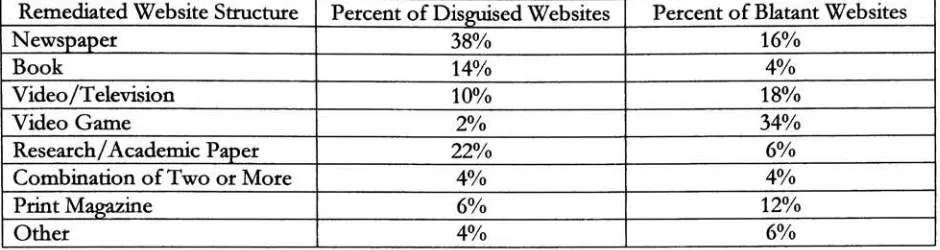
andnumber ofRemediated
structures present85
on
blatant
vs.disguised
hate
sitesTable 7:
Percentage
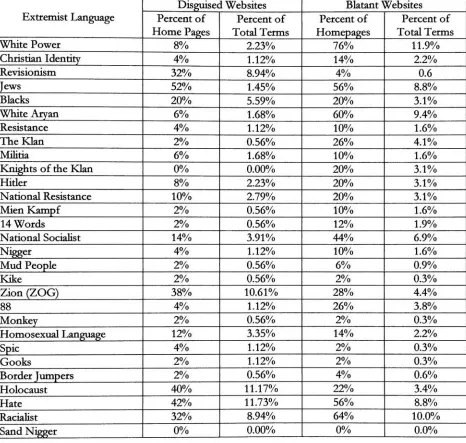
and number of extremistlanguage
present86
on
blatant
vs.disguised
hate
sitesTable 8: Percentage
and number ofthird
level domain
names present87
onblatant
vs.disguised hate
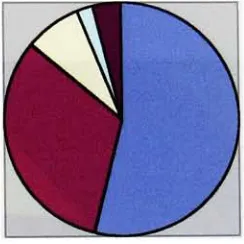
sitesFigure
1:
Pie
graphofpercentage ofThird
Level
domain
nameson88
disguised hate
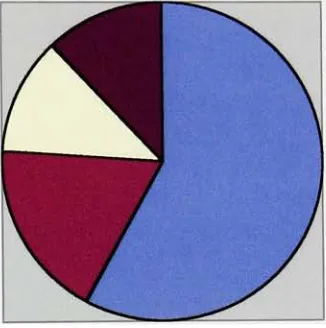
sites.Figure
2:
Pie
graph ofpercentageofThird Level
domain
names on89
Internet Hate Speech
6
Abstract
Intentional
misinformationis
a problemthat
has been
documented
in
avariety
of shapesand
forms for
thousands
of years and continuesto
plaguethe
American
landscape. The
advent and
increasing
usage oftheInternet has
created an additional venuethrough
which
intentional
misinformationis
disseminated,
andmany
groups aretaking
full
advantage of
this
new communication medium.Because
the
Internet
allows anyone withweb
publishing
skillsto
disseminate
misinformation,
it is
oftendifficult for
usersto
judge
the
credibility
ofthe
information.
Hate
groups understandthis
phenomenon and aretaking
full
advantage oftheInternet
by
publishing
hate
sitesthat
promotetheir
extremistideologies
by
using
language
and symbolismthat
makesthe
true
messagedifficult
to
decipher. This
study
willinvestigate
the
methods employedby
hate
groupsto
disseminate
Internet
Hate
Speech
7
The Deceit
ofInternet Hate Speech:
A
Study
ofthe
Narrative
andVisual Methods Used
by
Hate Groups
onthe
Internet.
Hate
speech,
althoughgreatly
frowned
uponby
amajority
ofpeople,
continuesto
plague
the
American
society (Simon
Wiesenthal
Center,
Anti-Defamation
League, Leets,
2000, Rajagopal,
2002). The issue
ofhate
canbe
traced
back
to the
days
ofAristotle
whospoke of
it
by
saying,
"it
is
moreencompassing
than
lesser
emotions such asanger,
whichis
directed
atindividuals"(quoted in
Whillock, Slayden, 1995,
p. xv).Aristotle
implies
that
hate is
a pure emotiondevoid
of reason andsensibility
that
employsthe
useofvisualpersuasion
(Barry,
1997).
Since
the
1960's
there
has been
a major shiftin
publictolerance
ofhate
speech asequality
has become
acentral goal ofAmerican society
andhate based
ondemographic
characteristicshas
been
viewed asirrational
andfanatic.
This
shifthas forced hate
groupsto
usemediain innovative
waysto
promotetheir
ideologies.
According
to
Shafer
(2002),
"Groups
have
used radio(AM
orshortwave)
ortelevision
(public
accesschannels)
to
presenttheir
ideological beliefs
or used printmediums
[sic]
to educate,
inform,
enrage andentice"
(p.
71).
The efficacy
oftraditional
communicationmethods
is
oftenlimited in its
ability
to
reach audiences.Broadcast
media are
limited
in
their
geographicrange and are constrainedby
the
amount ofmoney
and equipment needed
to
air messages and programs(Shafer,
2002). Printed
materials arelimited because
they
canonly be
producedin finite
amounts at ahigh
cost.The
development
ofthe
Internet
creates a powerful new outletfor
the
propagation ofhate
with more reach and at a
lower
costthan traditional
media.As
aresult,
hate
groups areInternet Hate Speech
8
difficulty
offinding
available sitesif
they
are not advertised andthe
requirement ofsome
technical ability, the
Internet is
opento
anyone who can post a web site.Along
withthe
growth ofthe
Web,
there
has been
an explosionofhate
speechonthe
Internet
overthe
last
eight years andit
continuesto
show substantial growth.Leets
(2001)
has
documented
the
explosion ofInternet
hate
speech,
"In 1995
atthe time
ofthe
Oklahoma
City bombing,
there
wasonly
onehate
site,
but
today
over2,800
hate
siteshave been
documented"(p. 287).
These
hate
sitesinclude White
Supremacist
sites whichare
the
focus
ofthis
study.Prior
to the
advent ofthe
Internet,
hate
groups were resignedto
recruiting
through
the
use of obvioussymbols, tactics
and mediato
maketheir
existence andbeliefs
known.
Hate
had
aface,
a set ofsymbols,
and adiscourse
structurethat
allowedfor
theidentification
of members.However,
it
has become
increasingly
difficult for
these
groupsto
attract new recruitsby
using
extremist symbols andterms.
In
recentyears,
many
hate
groups
have
changedthe
methods usedfor
thepromotion ofhate,
andthis
shifthas
been
attributed
to
the
adventofthe
Internet
as a communicationsmedium.A study
conductedby
the
Simon Wiesenthal Center
confirmsthis
transitionanddescribes
the
newhate
tactics:
Changes
in
the tacticsof extremists andespecially in utilizing
newdigital
marketing
opportunitieshave had
aprofoundimpact
onhate in
America.
Much
has
changed sinceDavid Duke
tradedin his Klan hood
for
athree-piecesuit.To
attractcitizens notcomfortable with crossburnings
and racialslurs,professionalbigots
oftendrop
theirracistlabel
and now promotethemselves as
"nationalists"
Internet Hate Speech
9
endangeredrightsofthewhite race(Simon Wiesenthal
Center, 2001,
p.1).
Web
sitescontaining
hate
speech rangefrom
those
that
areblatant
in
the
presentation oftheirmessage
by
including
familiar
White Supremacist
symbols onthe
homepage
to those that
intentionally
misleadthe
userby
presenting information in
aneducational
format.
The
presentstudy
focuses
onthe
latter
type
ofhate
speechWeb
sitesand
investigates how information
presentedin
aneducationally-orientedformat is
verbally
andvisually
deceptive. Because
ofthe
naivete ofyoung
Americans,
hate
Web
sites
that
utilizean educational structuremay
be
effectivein
persuading
andrecruiting
ayoung
audience."Realizing
the
appeal ofthe
technology
to youth,
andthat
information
can
be
accesseddirectly
and notfiltered
through parents,
educators or otheradults,
extremists
have flocked
to the
Internet"(Simon
Wiesenthal
Center, 2001,
p.13).
The credibility
of a messageis based
ona number offactors. The
tactics
utilizedby
somehate
groupsonthe
Internet
seemto
employ
a visual structure similarto those
found
onscholastic,
news and researchdatabase
Web
sites(Radford, Barnes,
&
Barr,
2002).
By
avoiding
the
usageofflagrantly derogatory
racialterms
andblatant
symbols,
the
message mustbe judged based
on contentalone.Prior
to
the
advent oftheInternet,
hate
speech was recognizablethrough the
use of obvious symbols andterminology
stereotypically
associated withthe
message(see
Appendix
C).
As
the tactics
employedby
hate
groups changeto
utilizethe
full
capabilities oftheInternet,
usersmay
become
more vulnerable
to
persuasionbecause
ofthe
misleading
educationalcontextinstead
ofthe
hate
speech content.Research
Questions
Internet Hate
Speech 10
How
do
hate Web
sitesemploying
traditional tactics
use visualsymbols,
visualstructure,
extremistterminology
andURL
addressesdiffer from
hate
Web
sitesdisguised
as
educational, research,
and/or news sites?(For
the traditional
tactics
usedonWeb
sitessee
Radford, Barnes,
&
Barr
(2002)
andAppendix
C
for
visual symbolsused.)
What
arethe
visual symbols used onhate
Web
sitesthat
aredisguised
aseducational
research,
and/or news sites?Visual
symbols are all non-textual elements ofa
Web
siteincluding
banners,
graphics, photographs,
symbols andstreaming
video.Hate
Web
sitesthat
aredisguised
aseducational,
research and/or news sites are presented witha professional and progressivestyle
that
makeidentification
ofthe
hate discourse difficult
(Rajagopal,
2002). The
Web
site will resemblethe
structure andtextual
format
ofresearch
databases
andeducational resource sites.What
is
the
visual structure used onhate
Web
sitesthat
aredisguised
aseducational
research,
and/or newssites?The
visual structure refersto the
way
the textual
and visual
imagery
are compiledto
createthe
form
ofthe
Web
site.Elements
caninclude
the
immediacy, hypermediacy
and remediation onthe
site(Bolter,
Grusin,
1999). These
elements,
asdefined in
the
book
Remediation,
aredefined
asfollows:
"Immediacy-A
style of visual representation whose goal
is
to
makethe
viewerforget
the
presenceofthe
medium and
believe
that
he is in
the
presenceofthe
objects ofrepresentation"
(1999,
p.272-3),
"hypermediacy-A
styleof visual representation whose goalis
to
remindthe
viewer of
the
medium"(1999,
p.272),
"remediation-The
formal
logic
by
which newmediarefashionprior media
forms.
Along
withimmediacy
andhypermediacy,
remediation
is
one ofthe three traits
of ourgenealogy
ofnewmedia"
(Bolter
&
Grusin,
Internet Hate Speech 1
1
What
is
thefrequency
with whichtraditional
extremistlanguage
is
usedin
the
text
ofhate
Web
sitesthat
aredisguised
aseducational, research,
and/or news sites?Traditional
extremistlanguage includes
all ofthose terms that
areracist, sexist,
orreligiously
offensive.What
arethe
third-level
domain
names usedin
the
URL
addresses ofhate
Web
sitesthatare
disguised
aseducational,
research,
and/or news sites?The
elements ofURL
addresses
that
areto
be
studied arethe
actual names ofthe
sites such asmartinlutherking.org
andStormfront.org
andthe third
level domain
name classificationused,
such asorganization, commerce,
or government(Sandvig,
2000).
Rationale
This
researchis
of great socialimportance
because
ofthe
negative consequencesof
the
Internet
that
areemerging
as usageincreases.
The World Wide Web
is
anideal
tool
for
learning,
but
the
lack
ofgatekeepers combined withthe
unrestricted nature ofthis
medium allows
for
misinformationto
be
aseasily
accessed asfactual information.
Hate
speech on
the
Internet
is
one source of misinformation availableto surfers,
andthis
research can raise awareness of
its
existence.Because
hate
sitesemploy
visual elementswith new rhetorical methods
to
deceive
users,
society may
be
moreinfluenced.
This
study
attemptsto
identify
the tactics
usedby
hate
groups sothat
deceptive
messages willbe easily
recognized.By
understanding
andhaving
the
ability
to
identify
this
newhate
speech outlet and
the
tactics used, the
effectivenessandinfluence
canbe
counteredby
individual
efforts.Because
the
Internet is
such a new communicationsmedium,
researchinto
the
Internet
Hate Speech 12
elements,
it
appearsthat
hate
groupshave
compiled a new and unfamiliar messagestructure.
Due
to the
potential socialharm
associatedwithhate
speech,
it is imperative
that these
messagesbe better
understoodin
terms
ofthe
communication methods usedin
order
to
offsettheir
impact.
Current
research onhate
speech onthe
Internet
has
addresseda number of
issues
such asthe
use ofimplicit
versus explicit messages andtheir
influence
onadolescents
(Lee &
Leets, 2002),
the
foot-in-the-door
techniques
usedby
hate
groupsto
attractInternet
users andthe
application of academic andtechno-ethos to
increase
persuasion
(Borrowman, 1999)
andcredibility
ofhate
sites(McDonald,
1999).
To
date,
there
has
notbeen
a research projectthat
addressesthe
visual andrhetorical elements of
hate
sitesthat
attemptto
misinform usersby
using
a combinationof visual structure and rhetoric.
Although
this
projectis
focusing
solely
ondefining
the
tactics
used on varioushate
sites,
it
may
provide a roughframework for further
researchinto
the
areasofinfluence
andcredibility
ofthe
identified
visualdesign
structures.Because
the
Internet
is
sucha newmedium,
extensive research mustbe done
onthe
visual and verbal patterns utilized
in
misinforrning
the
public.This
topic
is
of personalimportance because
ofthe
lack
of coverage andeducationabout
the
existence ofWeb
sites withthe
main purpose offooling
Internet
users
into
reading
questionable material.When
doing
some personal research onMartin
Luther
King
Jr.,
I
cameacross aWeb
sitethat
wasvirtually
identical
to the
one sponsoredby
the
foundation
establishedin his
name.I
was astoundedto
find
the
content ofthe
sitewas
promoting
aconspiracy
theory
claiming
that this
greatfigure
wasahoax
constructedby
the
government.The
wording
and visual structure ofthe
sitedid
not supporttheInternet Hate Speech 13
because
ofmy
knowledge
andunderstanding
ofthe
reallife
ofthis
great man.The
subtlety
ofthe
racism andthe
apparentcredibility
ofthe
structure couldeasily
fool
achild or adult who
did
nothave
previousknowledge
ofKing's life.
This
issue
cannotbe
ignored
because
ofthe
impact
and sheer number of sitescontaining
similartactics.
Literature
Review
Misinformation
includes
both intentional
and unintentionalinaccuracy
in
amessage.
Misinformation
canbe
documented
asfar
back
asthe
American Revolution
with
the
racist propaganda usedto
support slavery.In
Slavery, Propaganda,
andthe
American
Revolution,
Bradley (1999)
discussed
thewidespread use ofpropagandato
persuade citizens
to
acceptthe
virtues of slavery.According
to
Bradley,
all availablemedia were used
to
disseminate
racist propaganda.This
is
only
one example of apatternof misinformation
that
has
persistedfor
years andis
especially
heightened
during
times
of conflict.
Misinformation
during
times
of conflictis
not restrictedto
false
messagesconcocted
by
the citizenry; the
government also plays a major rolein
the
dissemination
ofthe
false information.
The
most prevalent occurrence ofthisis
the
useof spies andfalse
documents
to
misleadthe
enemy regarding
intelligence information.
In How Real Is
Real?,
Watzlawick
(1976)
describes deception
by
both
the
British
and
American
intelligence
agencies.One
ofthecentralthemes
ofintelligence
workis its
duality: "Intelligence
departments' workis
generally
consideredto
be
twofold: to
getinformation
aboutthe
enemy
(espionage)
andto
preventthe
enemy
from
getting
information
(counter-espionage)"(Watzlawick, 1976,
p.118).
During
World War
II
the
U.S.
government wentto
painstaking
effortsto
produceInternet Hate Speech
14
One
ofthe
mostinfamous
examples ofthe
lengths
that the
government willtake to
deceive
the
enemy
was assignedthe
codename"operation
mincemeat."In
aneffortto
misinform
the
Axis
powers aboutthe
intended
attacktarget
in
the
Mediterranean,
the
Allied
forces
staged a massivehoax
and succeededin
the
deception
because
ofthe
persuasive
tactics
usedto
convincethe
enemy
(Watzlawick,
1976).
Espionage
andcounter-espionage are common and widespread
tactics
usedby
governmentsduring
wartime
that
useconvincing,
albeitdeceptive,
materialto
accomplishthe
overallobjective of
winning
the
conflict.Government
sponsored misinformationin
the
United
States
wasprevalentduring
the
coldwar,
but
it
wasnotlimited
to
intelligence
work.It
alsofocused
ondeceiving
andmisguiding
the
American
people.Cone
(1998-1999)
outlinesthe
deceit
perpetrated onthe
American
peopleby
the
CIA
through
thedenial
oftheir
involvement
with radio stations.The
CIA
fully
funded
the
Radio Free Europe
andRadio
Liberty
stations while atthe
same
time
allowing
the
formation
ofthe
Crusade
for
Freedom,
an organizationthat
askedfor
public supportfor
the
anti-communisteffortsin
the
form
ofdonations.
Cone
(1998-1999)
contends,
"While
notexactly
sinister, the
Crusade
for
Freedom
wasunquestionably
deceitful.
For
over almosttwenty
years,
it
repeatedly
took
advantage ofAmerican
goodwill,
expanding from
asmall,
obscure programinto
a monstrous propagandasubterfuge"
(p.
149). This deceit
continuedfor many
years whilethe
newsmediafailed
to
disclose
the
relationship
to the
public.The
deception
perpetrated onthe
American
peoplemay
be
viewed as acceptable
because it
wasdone
withthe
intention
offighting
communism,
but
Internet
Hate Speech 15
Unintentional
misinformation,
although prevalentin
the
history
ofcommunication
through
suchthings
as rumors andhonest
mistakes,
is
notthe
focus
ofthis
study
and willbe
setaside.With
the
development
andincreasing
use oftheInternet,
there
is
evidencethat the
prevalence ofintentional
misinformationhas increased
to the
point which scholars are
paying
attention(Piper,
2002).
Intentional
misinformation onthe
Internet
canbe broken
up
into
a number ofcategories as
identified
by
Piper
(2002).
The
various categoriesthat
misinformation onInternet
web sitesfall into
arecounterfeit, malicious, product,
fictitious,
parodies/spoofs/entertainment,
hacks,
anddisinformation
(Piper,
2002). Piper
cautionsthat these
categories are notmutually
exclusive and somehate
speech websitesfall into
more
than
onecategory
depending
upontheir
content andpresentation styles.The
prevalence ofintentional
misinformation onthe
Internet
has been
realizedby
a number of scholars and continues
to
be
a major problem.According
to
Cannon
(2001)
"the
realcomputervirusis
misinformation anddespite
years ofwarnings, this
malady
keeps
creeping
its
way
into
the
newsprintand ontothe
airwaves of mainstream newsoutlets"
(p.
29). The
authoridentifies
the
use ofInternet
misinformationin
such arenasas
politics,
journalism,
andin
the
academicforum. The
concernover misinformation onthe
Internet
is
notisolated
to
onediscipline.
Fitzgerald
(1997)
documents
the
large
amountofinaccurate information
onthe
World Wide Web
and contendsthat
because
this
phenomenonis
expectedto
increase,
users need
to
sharpen criticalthinking
skillsin
orderto
combat massive amountofdeception.
However,
the
prevalence ofthis
occurrencehas
notbeen identified
andthe
Internet Hate Speech 16
misinformation
in
communicationmediais
not a newphenomenon,
the
Internet
aggravates
the
problemfor
anumber of reasonsincluding
hardware
and softwareproblems, Internet
architectureproblems,
lack
of centralauthority,
data
malleability,
human
error, misconduct,
removal ofinformation from
context andbias
(Fitzgerald,
1997). The
reasonsfor
misinformation onthe
Internet
asidentified
by
Fitzgerald
create aconundrum
because
the
aspects ofthe
Internet
that
makeit
great also makeit
vulnerableto
the
dissemination
of misinformation.In Electric
Rhetoric,
Welch
(1999)
arguesthat
the
Internet,
by
its
nature as aremediated communication
form,
has
created a newtype
ofliteracy
among
usersthat
combines
traditional
rhetoricaltheory
with visualrhetoricto
arrive at a new persuasiveform.
"Our
students,
living
their
lives in
the
hegemony
ofthe television
screen andspeaker and
the
computer screen andspeaker,
are nowliterate in
ways neverimagined
two
generations ago"(Welch, 1999,
p.4). This
newliteracy
contributesto the
formation
of a newrhetorical
theory
that
attemptsto
examinethe
constructand usage ofthe
nonlinearcommunication
form
ofthe
Internet. Welch
(1999)
examinesthe
impact
ofthe
new
technology
andthe
waysin
whichthis
new mediumis
usedby
Web
surfers.The
rhetoric ofelectronic communicationmedia
is
strongly
groundedin
the
persuasiveability
of
the
visuals usedin
conjunctionwiththe text.
Suh
(1999)
has
examinedthe
persuasiveability
ofthe
visual message and arguesthat
"most
persuasivemessages-whichmainly
means
advertising, propaganda, and,
in
fact
rhetoric ofalmostany
kind-make extensiveuse of various
forms
ofvisuals"
(p. 3). The
authorarguesthat
in
many
casesthe
visualmessage
is
moreimportant
than the textual
messagefor
purposesof persuasion.The
Internet
Hate Speech 17
continued occurrence of
intentional
misinformationcreates a unique environment onthe
Internet.
As previously
stated,
hate
speech canbe dated back
to the
days
ofAristotle,
andthere
has been
an abundance of research conducted onthis
subject.The Internet
has had
asubstantial
impact
onthis
type
ofexpressionbecause
ofthe
wide audience availablefor
the
dissemination
ofhate
and misinformation ofthe
extremist view.The Simon
Wiesenthal
Center
investigates hate
speech and concentrates much ofits
efforts onthe
problemsof
bate
speech onthe
Internet.
Unlike cheap
pamphlets and undergroundradioshows, the
Internet
giveshate
groupscredibility
because
oftheopportunity
for
slickpresentation.
The
characteristicsin
aWeb
site such asthe
visualsandthe
downplay
ofblatant hate
symbolshelp
a viewerto
acceptthe
propaganda asthe truth
(Simon
Wiesenthal
Center,
1996).
The credibility
inherent
in
websites creates aninteresting
difficulty
whenausertries to
decipher
accurateinformation from
misinformation.The
latest
reportby
the
Simon Wiesenthal Center
(2002)
addressesthemany
issues
ofInternet
useby
hate
groups onthe
Internet.
Presented in CD
form,
this
reporttracks troublesome
sites andincludes
samplepagesfor
viewing
by
the
user.A
majorissue is
the
manipulationofinformation
onthe
Internet
by
hate
groups.One
sitethat
is
particularly misleading
is
www.mlking.orgbecause
it
usesmany
deceptive
elements.The
report states:
When
initially
posted, this
site wasvisually
aduplication
oftheMartin
Luther
King
Family
Foundation
site.However,
far from celebrating
theInternet Hate Speech
18
denigrates
Dr.
King
andis
replete withslander,
misinformation anddistortions.
The
reason,
MLKing.org
is
the
creation ofStormfront,
which promoteswhite
supremacy
and racism(Simon Wiesenthal
Center, 2002)
This is just
one example ofthe
many
sitesthat
use similartactics to
misleadand confuseInternet
users.Although
the
Simon
Wiesenthal
Center
is
a majorforce in
the
tracking
andidentification
ofhate
speech onthe
Internet,
the
researchis limited
to
tracking
troublesome
sites.The
issue
ofhate
speech onthe
Internet
wasaddressedby
Guisnel (1997). He
argues
that
"the
presence of neo-Nazi and other extremists onthe
Internet
is
a realproblem"
(p.
172).
Although
there
have
been
attemptsin
some countriesto
outlawthe
presence of
hate
speech onservers,
many Web
surfershave found
ways aroundthe
attempt.
"In France
by
law
no server candisseminate
racistpropaganda ordenials
ofthe
holocaust
ashistorical
fact,
but in
this
interconnected
world ofours,
nothing
couldbe
easier
than
for
aFrench
web surferto
connectto
aU.S.
orScandinavian
Nazi
server"(Guisnel, 1997,
p.172). Because
ofthe
different
laws
and regulationsin
countries such asthe
U.S.,
foreign
attemptsto
ban
the
contentfrom
serversis
afutile
practice.Hate
groupshave become
particularly
proficientin
using
the
Internet
to
influence
and gain acceptanceof
the
extremeideology.
Guisnel
(1977)
adds,
"Extremist
groupshave learned
to
usethe
Net,
allowing
them
accessto
a much greater part ofthe
worldand although mostInternet
Internet Hate Speech
19
chances are of
attracting
newclients"(p. 1997). Hate
groupshave
been
especially
ableto
usethe
Internet
to
attract"new
clients"through
the
use of persuasive electronicrhetoric.
Communication
scholarshave
just recently begun
to
study
the
effects ofInternet
hate
speech andthese
findings
arevery
insightful.
Lee
andLeets
(2002)
investigate
the
efficacy
ofhate
messages onadolescents
by
using
two
different
types
of methods: explicit messagesand
implicit
messages."Explicit
messages or persuasive attempts arestatementsor persuasion
in
whichthe
contentis
consistent withthe
speaker's
intention
andonly
onemeaning is
conveyed.Implicit
messagesor persuasive attempts are statements
in
whichthe
speaker'sintention
andthe
messagecontent are attimes
inconsistent"(p.
933)
With
the
use ofInternet
surveys, this
study
measuredthe
immediate
persuasiveability
ofboth
types
of messages andthe
persistent persuasiveability
ofthe
messages onadolescents after atwo-weekperiod.
The
results ofthe
study
uncovereda pattern ofsusceptibility
and persuasivenessthat
suggestimplicit
messagesare more persuasiveimmediately
afterviewing
andthat
explicit messages are more persuasive after atwo-week period.
"Although implicit
messages appear more effectivein
influencing
individuals
immediately
aftermessageexposure, these
effects are short-lived comparedto
the
persuasive effects of explicitmessages"
(Lee &
Leets, 2002,
p.950). Whether implicit
or
explicit,
narrativehate
messageshave
a persuasive effect on adolescents.Although
the
narrative methods used on
hate
sites areintegral
to
understanding
the
persuasiveability
ofInternet Hate Speech 20
for
their
persuasive effects.The
combination of visual and narrative methods usedby
hate
groupsto
persuade usersis extremely
important because
both
elements worktogether
to
influence Internet
users.Using
contentanalysis,
McDonald
(1999)
analyzedhate
sitesbased
onthe techniques
usedto
gainthe
attention ofbrowsers.
The
techniques
usedinclude
warnings,
disclaimers,
objectives/purposes,
socialapproaches,
and sophisticatedcounterargument strategies.
The
visual structure as well asthe
narration are usedto
define
each ofthe
five
possibletactics.
The
results show thatthe
most prevalenttechniques
usedemployed
straightforward,
neutral methods or"moderating
symbols"that
attemptto
change
the
surfers mind.Graphic
elements on aWeb
site areextremely
important
to the
intent
and persuasiveness ofthemessage.McDonald
(1999)
states:Roughly
half
oftheWeb
sites use graphic elementsto
help
create aparasocial atmosphere.
These data
suggest aheavy
emotional appeal usedby
web site creators as an effortto
make contact with net surfers.This
canbe
comparedto the
salesperson'stechnique
ofshaking
one'shand
andconversing
in
anextremely
friendly
manner(p.
156-157).
This study
uses elements ofboth
visual and narrativeelementsto
classify
the types
oftechniquesused
by
hate Web
sitesto
persuade andinfluence
the
opinions ofWeb
surfers.
McDonald
usedthe
rhetorical principle of ethosto
analyzethe
narrative andvisual aspects employed on
hate
Web
sitesto
increase
credibility.Borrowman
(1999)
divides
the
principle of ethosinto
two
parts: academic ethosand
techno-ethos.
This study
found
that
many
oftherevisionists'Internet Hate Speech 21
Internet
combined elements ofboth
academic andtechno-ethos to
increase
the
credibility
and persuasiveness ofthe message.The
academic ethos of aWeb
sitemay
be
enhanced
by
using
a credible sourceto
supportthe message'sclaimBorrowman
(1999)
cites
the
infamous
holocaust
revisionistDr. Arthur
Butz
to
apply
the
academic ethosprinciple.
On
the
Web,
Dr.
Butz
relies onthe
academicstrategy
to
constructhis
ethos.
His
siteis
simple and unadorned.Beneath
his
name,
andbefore
the
copyright,
Butz
identifies himself
as an"Associate Professor
ofElectrical
and
Computer
Engineering"and namesthe
university
at whichhe
works.With
nofanfare,
Butz
statesthat
he is
the
author of abook
on"Holocaust
revisionism."
The
referenceto
his
published work andto
his
professionserve
to
constructButz's
ethos onthe
Web;
he
reliesontradition,
familiar
means
(p. 46).
The
tactics
described in
the
above quotelend
credibility
to the
author ofthehate
message and support assertions
in
anacademic guise.A study
conductedby
the
Anti-Defamatory
League
(2001)
found
similar results.According
to
"Poisoning
the
Web:
Hatred
Online,""Holocaust
deniers'thousands
of pages of propaganda onthe
Web,
presented as academic
fact
orin
the
guise offree
and open'debate,'
take
particularadvantage of
many
Web
users'difficulty distinguishing
between
reputable anddisreputable
Web
sites"(p.
26).
The
use of academic ethos createscredibility
based
onthe
reputation ofthemessage creator.
Techno-ethos,
in
contrast,
usesthe
many
strengths andInternet
Hate Speech 22
Borrowman
(1999)
supplies an example of successful usage oftechno-ethoswith
CODOH,
the
Committee for Open Discussion
oftheHolocaust Story.
CODOH's
siteis filled
withcolor,
in
the
background
andthe text.
It is
both easy
to
read andvisually
appealing.Various
sizes offont
areused,
someof
them
three-dimensional.
Frames
break
the
pageup,
andhelpful
menus are everywhere.
Pictures
are alsoheavily
used: abald
eagleatthe
top
ofthe page,
Samuel
Johnson,
andBradley
Smith
(the
director
ofCODOH)
himself.
On
the
first
pagethat
a surfersees,
a counter reportsthat
morethan
500,000
peoplehave
accessedCODOH's homepage.
CODOH
understandsthe
possibilities ofthe
Web,
andthe
group
makesuse ofthem
(p.
48).
The theory
oftechno-ethos
appliesto
hate
sitesthat
understandthe
power oftheInternet
to
demonstrate
credibility
by
useofthe
technology
in
additionto
academicaspects
to
increase
the
impression
of academic research ratherthan
misinformation.The
Anti-Defamation League study
supportsthis
applicationoftechno-ethos,
"Smith's savvy
marketing
technique
wastailor-made
for
students,
many
of whom are comfortable withthe
Internet,
predisposedagainstauthority,
andwilling
to
challenge receivedwisdom"(2001,
p.28).
Credibility
ofInternet
web sitesis
notbased
solely
ontheacademic-andtechno-ethos as addressed
above;
ratherthe
theory
of remediation can also explainthe
power of aInternet Hate Speech 23
remediates more
traditional
mediain
form
and structure."The
computeris
imitating
not an external
reality
but
rather anothermedium"
(Bolter
&
Grusin, 1999,
p.28).
The
idea
that
the
Internet
remediates other mediais
one explanation ofthe
implied
credibility
affordedto
web sitesusing
structuresresembling
a newspaper or academicpaper.
According
to
Bolter
andGrusin
(1999),
borrowing
of one mediumto
define
the
representationof another
is
the
most powerfulelement, "We
callthe
representation of onemedium
in
anotherremediation,
and we will arguethat
remediationis
adefining
characteristicof
the
newdigital
media"
(p.
45).
One
illustration
ofthis
theory
is
the
fact
that the
Internet,
atits
current stage ofdevelopment does
not represent acompletely
new and uninfluencedmedium,
ratherit
exists on a continuum of
displaying
elements of one mediumto
a combination ofmany
other elementsof
many
other media.More
traditional
media seemto
be
repurposed onthe
Internet
withoutthe
influence
ofmultiple remediation structures.The
authorsarticulatethis
by
saying,
"There
have been
and remainmany
websitesthat
highlight
other mediawithout
any
apparent critique.This
respectfulattitudeis
most commonin
remediations ofmore venerable media:
the
printedbook,
staticgraphics, paintings,
andphotographs"
(Bolter
&
Grusin,
1999,
p.200).
Remediation
is
extremely
important in
understanding the
motivesfor
the
structuresemployed on
the
Internet. As
the
capabilities ofthe
Internet
increase
to
include
animation,
and
digital
video andaudio,
many
web sites areutilizing
vast amounts ofprint.The
Internet Hate Speech 24
the
personalletter,
the
book,
andthe
magazine,
but
nowit
alsorefashionsand reformsCD-ROM
orDVD
multimedia, radio,
film
andtelevision"(Bolter &
Grusin,
1999,
p.200).The
importance
ofthis
theory
lies in
understanding
thewaysin
which web sites can anddo
usethe
structure oftraditional
mediato
emulate other media onthe
Internet. It
is
possible
to
mislead and misinformthe
userby
taking
onthe
credibility
oftraditional
media,
such astraditional
newspaper and news media(Bolter
&
Grusin,
1999).
All
ofthe
studies conductedthat
analyzeInternet
hate
speech methodsacknowledge
the
importance
ofboth
narrative and visual elementsin
the
persuasivenessofa message.
These
elements combineto
givecredibility
to the
hate
messagesbeing
disseminated.
The
combination of visualandnarrative elements servesto
disseminate
intentional
misinformation viathe
Internet. The
present researchwillcontributeto the
existing
findings
by
examining
the
specific visualsymbols,
visual structureelements,
terminology
andtactics
used onthese
sites.Method
The
populationstudiedwashate
sitesthat aredisguised
aseducational, research,
and/or news sites as well as
hate
sitesthat
useblatant
tactics to
disseminate hate
speech.In
orderto
investigate
the
differences in
the tactics
usedby
these two
classifications ofWeb
sites,
both
categorieswereexaminedusing
identical
coding
techniques.
By
using
the
exhaustive
lists
compiledby
Hate Watch
ofhate
Web
sitescurrently
operationalto
represent
the population,
allWeb
siteshad
an equal chance ofbeing
selectedfor
investigation
thereby
resulting
in
a representative sample.The
Hate Watch database
canInternet Hate Speech 25
can
be
usedin
anhtml format
or afile.
The
list
compilesjust
over2,000 hate
sites,
1,800
of whicharein English. Because
ofthe
lack
ofresourcesfor
translation,
only
English
language
websites wereincluded in
the
random sampling.According
to the
Simon Wiesenthal
Center
(2001),
"we
are nowtracking
some2,500
problematic sitesonline"(p. 2).
Although
requested, the
Simon
Wiesenthal Center
was unable
to
furnish
the
researchers with alist
ofthe
problematicWeb
sitesthat
arementioned above.
Because
the
sites onthe
Hate Watch
database fall
short ofthe
2,500
sites mentioned as problematic
by
the
Simon Wiesenthal
Center,
coupled withthefact
that
it is
virtually
impossible
to
compile an exhaustivelist
ofInternet
sitesbecause
ofthe
speed with which sites are
launched
andremoved, the
sampledrawn
for
the
study may
be
considered a convenience sample.
The
sample waschosenfrom
the
populationby
using
a stratification method.Prior
to the
random selection ofsitesto
be
included,
all sites were placedin
one oftwo
categories:
1
. web sitesdisguised
aseducational,
news and/or research sites and2.
websites
using blatant
tactics
for
the
dissemination
ofhate
discourse. The
web sites werestratified
based only
onvisual elements.Using
the
hate
symbolsdatabase located
onthe
Anti-Defamation League
website,
hate
sites were separatedbased
onthe
use ofhatesymbols on
the
homepage.
Two
coderswere supplied with all symbols onthe
database
and separated
the
sitesbased
onthe
inclusion
ofhatesymbols onthe
homepage. The
symbols used
for
the
classificationareincluded in
Appendix
C. The
two
coders weretrained to
identify
the
symbolismby
browsing
the
homepage
andclassifying
the
sitebased
onthe
graphics used.Although
it
seemsasthough
this
process wouldhave
resultedInternet Hate Speech 26
symbolism
in
the contentanalysis, this
was notthe
case.In
the
course ofresearch,
hate
sites
in
the
disguised group did
containsymbols,
but
the
representation was manipulatedor
hidden
so wellthat
the stratification processdid
not excludethem
from inclusion in
this
group.Once
the
two
groups wereestablished,
50
sites wererandomly
selectedfrom
each
group
resulting in
a sample of100
Web
sitesfor investigation
andanalysis.Random
selection wascarried out
by
assigning
a numberto
each web site andusing
a randomnumber generator
to
determine
the
sitesto
be
analyzed.This
process ensuredthat
every
web site
had
the
same chance ofbeing
selectedfor inclusion
andthe
results ofthe
study
would
be
more valid.The
selectedsample wasinvestigated
and coded over atwo-week
periodduring
the
last
two
weeks ofMarch
2003.
The
information
gatheredin
thistime
frame
served asthe
data
for
the analysis,
regardless ofany later
changesin
the
content and/or presentationof
the
material.The
date
andtime
ofthe
data
collectionfor
each site was recordedto
reflect
the time
periodin
whichthe
Web
sitedemonstrated
the elements observed.By
limiting
the
data
collectionto
atwo-week time period, the
contentandthe
presentation ofthe
structuresonthe
Web
sitesinvestigated
are comparable.The
visualandtextualelements ofhate
sites arebroken
down into four broad
categories: visual
symbols,
visualstructure,
extremistlanguage,
andInternet
addressclassification.
Visual
symbolsarefurther
organizedinto
racistsymbols,
photographs,
cartoon graphics and
Web banners.
There
were59
types
of racist symbols.They
werecoded
based
onthe
presenceof one or moretype(s)
onthe
Web
site.For
classificationInternet
Hate Speech 27
denoted
the
absence of asymbol.The
symbols analyzed wereonly
those
present onthe
homepage. Because
the
Web
sites studiedcontainedhundreds
ofpages,
using
only
the
homepage for
this
study
allowedfor
manageableinvestigation.
Photographs
onthe
web sites were codedusing
the
number assignedto them
If
more
than
one ofthedescriptive
elementswere presentin
aphotograph,
all applicablenumbers were coded
for
an accurate representation ofthephotographdepicted.
Only
photographs on
the
homepage
were usedfor coding
andincluded in
this
study.Photographs
werestudiedcarefully
to
decipher
whether or notthey
had
been
digitally
manipulated.
The detection
of manipulation was crucialbecause
ofthelarge
amount ofrevisionist materials
included
onhate
sites andthe
inclusion
of manipulated materialto
support
the
false historical
information.
Because
ofthedifficulty
ofidentifying
allforms
of
manipulation,
only
those
which wereblatantly
obvious were recorded.An
overwhelming majority
of web sites contained six orfewer
photographs onthehomepage
supporting
the
reasoning
for coding
only
thefirst
six photosdepicted
onthe
site.Each
ofthe
photographsinvestigated
were codedaccording
to
what wasdepicted. The
eightpossible
depictions
included
social activistsfor
equality,
activistsfor
whitesupremacy,
historical
scenes,
current newsphotos,
violentscenes,
manipulatedHolocaust
photos,
accurate
Holocaust
photos and an"other"category.Cartoon
graphicsandWeb
banners
utilizedthe
same classification system andwere coded
based
onthe
homepage.
These
two
elementscouldbe
applicableto
both
visual symbolism as well as visual
structure, the
nextcategory.The
visual structurecategory
containedthe
elements ofbackgroundcolor, text
and graphicsintensity
onthe
Internet Hate Speech 28
Background
color was codedin
one of eightcategoriesthat
were chosenbased
on
the
common usage ofthe
included
colors.For
a colorthat
was notincluded,
the
background
wascodedin
the
"other"category
with a note onthe color,
andif
morethan
three
percent ofthe specifiedcategory
occurred,
then
an additional classification wasassigned.
The
background
color ofthe
web siteis
very
important
to the
visual structurebecause
it
tends to
influences
the
overall mood ofthesite.For
example,
whitebackgrounds
are often used on newspaper sites.Text
and graphicintensity
onthe
homepage
wasjudged
on a seven-point scalewithone
representing
alltext
and no graphicsto
eightrepresenting
all graphics and notext.
The
middlelevels
aredescribed in detail
to
reducethe
subjectivity
oftheclassification,
andthe
coding
ofthiscategory
will remain consistentamong
all web sitesin
the
sample.The
textual/graphical
mix on web siteshelped
to
decipher
the
visualstructure and
intended
messagedelivery
strategy.This
coupled withthe
font
sizehelped
to
communicatethe
intentions
ofthe
webdesign,
whetherit
was academicmodeling
or agraphical reliance.
The
remediatedweb site structure classificationis based
onthetheories
ofremediation,
hypermediacy
andimmediacy
in
"Remediation"(Bolter
&
Grusin,
1999).
The
authors contendthat
all media remediates moretraditional
mediain
form
andstructure
(1999). The
mediumwhichis
remediatedfor
Internet
contentfalls into
eightbroad
categories:newspapers,
books,
video/television,
videogames,
research/academicpapers,
printmagazines,
a combination oftwo
or moremedia,
and an"other"category
to
Internet Hate Speech 29
The
newspapercategory
was assignedto
a site which resembled atraditional
newspaper with a
headline,
alisting
offeature
articles,
text
organizedin
columns,
a white orgray
background,
and photographsto
supportthe
accompanying
story.The book
category
and academic/research papercategory
are similarin
presentationbut
encompassed specific
differences for distinction.
A
remediatedbook
form has
awhite,
gray
or neutralbackground
withthe
absenceof graphics.The
text
is
organizedfrom
left
to
right
withnodisruption in
flow,
similarto that
seenin
a wordprocessing
program.In
contrast,
academic/research paper style resembles wordprocessing
structure,
may
ormay
not contain
graphics,
andhas
citations and a reference section at the end ofthe
document.
Video/television
remediation style encompasseddigital
photography
elementswith movement of graphics and
text.
The
motion on ahomepage
givesthe
impression
ofwatching
television.
This
classification encompassed graphicsthat
were unanimated andrealistic
in
appearance.This
is in
sharp
contrastto the
remediation of video gamesbecause
ofthe
highly
animated nature requiredfor
a video game classification.The
inclusion
of a game onthe
websitedid
notautomatically
constitutethe
assignment ofthis classification; rather, the
prominent remediatedform
wascoded.included
colorful presentation withthe
inclusion
ofsharp
photographsandinconsistent
text
sizes.These
websitesincluded
alarge
number ofadvertisements and promotionsthat
resemblethose
in
printmagazines.Because
many
sites were notdominated
by
a single remediatedform,
the
combination oftwo
or more media wasincluded. Web
sitesthat
remediate morethan
onemediumwereplaced under
this
category
andthe
forms
were specifiedfor
the
addition of categoriesbased
onthe
findings.
The
"other"Internet Hate Speech 30
remediatedform
was notclearly
identifiable.
It
was not expectedthat the
"other"category
wouldbe
requiredfor many
casesbecause
ofthe
similarity
of web sitesto
traditional
mediaforms.
The
ariimated graphicsandtext
category
were codedusing
a"1"for
the
presenceof one or
both
and a"0"for
the
exclusion ofthiselement onthe
web site.This
classification aided
in
the
coding
oftheremediation structure.The
elementsincluded in
the
visualstructurecategory
encompassedinformation
that
enablesthe
look
andfeel
ofthe
examined web sitesto
be
articulatedin
understandableterms.
The
extremistlanguage
category
encompassed29
descriptors
that
helped decipher
the
candid content ofthemessage onthe
homepage
ofthesite.An
avoidance ofthe terms
outlined
may
have been
anindication
oftheintended
misinformation ofthemessage onthe
site.While conducting
the analysis,
it
was assumedthat
moreterms
would emerge asa
descriptor
of racistterminology,
andadditionalterms
werecoded and addedto the
preliminary
list
ofterms.The
final
category,
Internet
addressclassification,
encompassedtwo
parts:the
actual name oftheweb site addressand
the
classificationin
one offive
categoriesincluding
commerce(.com),
organization(.org),
network(.net),
education(.edu),
and"other."
The Web
site address was codedbased
onwhether or notthe
URL
name wasdescriptive
ofthecontentofthesite.Many
hate
siteshave
anInternet
addressthat
is
the
name oftheorganization
sponsoring
the
site andthat
wouldbe
awarded a"1
Web
sitesthat
useddeceptive
ormisleading
Internet
address names were assigned a"2"
and
Internet Hate Speech 31
other
third-level
domain
nameclassifications,
but for
the
purposes ofthis
paperonly
the
oneslisted
above were used.Upon
completion ofthe
coding,
Web
sites were placedin
categoriesbased
onthe
results of
the
study.The
categories were established upon completionbecause
ofthe
high
number ofpossible combinations of
the
elementsbeing
investigated.
It
was expectedthat
a patternwould emerge
between
similar web sites and similarities wereidentified
andplaced
in
categoriesthat
describe
the
content as well asthe
structure ofthe
page.All coding
wasdone
by
the
author and one additional coder who receivedfive
hours
oftraining.
An
intercoder
reliability
test
was conductedusing 10
sampleWeb
sitesrandomly
selected.Any
discrepancies
in
coding
wereidentified
and corrected priorto the
beginning
ofthe
study.This
reducedthe
possibility
of consistentbias
throughoutthe
study.
By
conducting
the
outlinedmethodology
to
investigate
thevisualand rhetoricaltactics
usedto
disseminate
hate
speech onthe
Internet,
a classificationsystemhas
emerged and will
be
applicableto
othermisleading
websites.Results
The study
sampleconsistedof100 Web
sitesfor
analysisthat
espoused racistand/orextremist
ideology. The
samplewaschosenfrom
alist
compiling 1,800 Web
sitesprovided
by
www.hatewatch.
org,representing 5.5%
ofallEnglish
language hate
sites.Because
ofthe
fluid
natureofthe
Internet,
the
populationfrom
whichthe
sample wasdrawn
may
not representthe total
numberof currentEnglish language
hate
sitesInternet Hate Speech 32
amount ofpossible
symbols,
if
all appeared onevery
homepage,
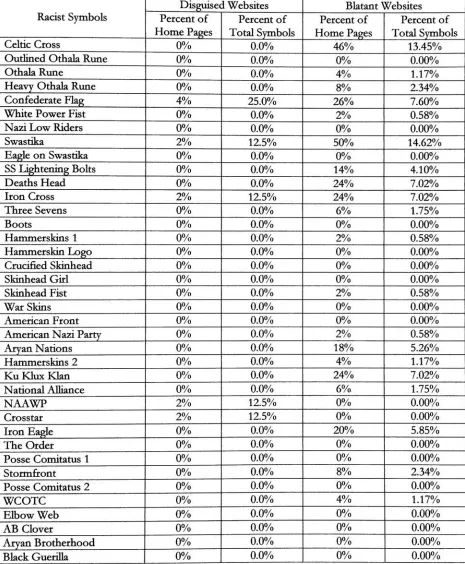
equals2,950.
The
symbols present on
the
homepages
ofdisguised
Web
sites consisted of sixdifferent
types
with eight observations
resulting
in
.27%of all possiblevisuals.Of
the
59
possiblesymbols,
Web
sitesdisguised
aseducational,
news and/or research materialdisplayed
sixdifferent
symbols atotal
of eighttimes.
The
confederateflag
wasonly
present on4%
ofthe
50
Web
sites examined and accountsfor 25%
of all symbols presentin
this
class ofweb sites.
Of
the
sixdifferent
symbol categories present onthe
homepages
ofthis class ofweb
sites, the
swastika symbol appeared on2%
ofthe
50
homepages
codedaccounting
for 12.5%
ofthe total
symbols observedin
thiscategory.The remaining
four hate
symbols
in
this
category
include
oneiron
cross,
onelogo for
the
National Association
for
the
Advancement
ofWhite People
(NAAWP),
oneCrosstar
andtwo
symbols which areclassified
in
the
"other"category.The
percentages ofthese
symbols are asfollows: iron
cross on
2%
ofhomepages
and12.5%
oftotal symbols,
logo
for
the
NAAWP
is
on2%
ofhomepages
and12.5%
oftotal,
Crosstar
is
on2%
ofhomepages
and equals12.5%
oftotal
symbols and"other"
depiction is
on2%
ofhomepages
and accountsfor 25%
oftotal
symbols.
The
number of symbolsused onblatant hate
sites equal171
out of a possible2,950 resulting in
a percentage of5.8%
oftotal
possible symbols.These
171
symbols arebroken
up
into 27 different
categoriesincluding:
Celtic
cross on46%
ofhomepages
accounting for 13.45%
of allsymbolsused,
othala rune on4%
ofhomepages
equaling
1.17%
allsymbols,
heavy
othala rune on8%
ofhomepages
resulting
in 2.34%
oftotal
confederate
flag
on26%
ofhomepages
accounting
for 7.6%
oftotal
symbolism,
whiteInternet Hate Speech 33
ofhomepages
accounting
for 14.62%
total symbols,
SS
bolts
appearedon14%
ofhomepages accounting for 4.1%
total
symbolism,
death's head depicted
on24%
ofhomepages
accounting for 7.02%
oftotal
symbols,
iron
cross appeared on24%
ofhomepages equaling 7.02%
oftotal symbols, the
observationsofthree
sevens onhomepages
equals6%
accounting
for 1.75%
oftotal symbols,
hammerskins logo
1
wasobserved on
2%
ofhomepages
accounting
for
.58%of all symbolsused