RESEARCH
Evaluation of a push–pull system consisting
of transfluthrin-treated eave ribbons
and odour-baited traps for control of indoor-
and outdoor-biting malaria vectors
Arnold S. Mmbando
1*, Elis P. A. Batista
2, Masoud Kilalangongono
1, Marceline F. Finda
1,3,
Emmanuel P. Mwanga
1, Emmanuel W. Kaindoa
1,3, Khamis Kifungo
1, Rukiyah M. Njalambaha
1,
Halfan S. Ngowo
1,4, Alvaro E. Eiras
2and Fredros O. Okumu
1,3,4Abstract
Background: Push–pull strategies have been proposed as options to complement primary malaria prevention tools,
indoor residual spraying (IRS) and long-lasting insecticide-treated nets (LLINs), by targeting particularly early-night biting and outdoor-biting mosquitoes. This study evaluated different configurations of a push–pull system consisting
of spatial repellents [transfluthrin-treated eave ribbons (0.25 g/m2 ai)] and odour-baited traps (CO
2-baited BG-Malaria
traps), against indoor-biting and outdoor-biting malaria vectors inside large semi-field systems.
Methods: Two experimental huts were used to evaluate protective efficacy of the spatial repellents (push-only),
traps (pull-only) or their combinations (push–pull), relative to controls. Adult volunteers sat outdoors (1830 h–2200 h) catching mosquitoes attempting to bite them (outdoor-biting risk), and then went indoors (2200 h–0630 h) to sleep under bed nets beside which CDC-light traps caught host-seeking mosquitoes (indoor-biting risk). Number of traps
and their distance from huts were varied to optimize protection, and 500 laboratory-reared Anopheles arabiensis
released nightly inside the semi-field chambers over 122 experimentation nights.
Results: Push-pull offered higher protection than traps alone against indoor-biting (83.4% vs. 35.0%) and
outdoor-biting (79% vs. 31%), but its advantage over repellents alone was non-existent against indoor-outdoor-biting (83.4% vs. 81%) and modest for outdoor-biting (79% vs. 63%). Using two traps (1 per hut) offered higher protection than either one trap (0.5 per hut) or four traps (2 per hut). Compared to original distance (5 m from huts), efficacy of push–pull against indoor-biting peaked when traps were 15 m away, while efficacy against outdoor-biting peaked when traps were 30 m away.
Conclusion: The best configuration of push–pull comprised transfluthrin-treated eave ribbons plus two traps, each
at least 15 m from huts. Efficacy of push–pull was mainly due to the spatial repellent component. Adding odour-baited traps slightly improved personal protection indoors, but excessive trap densities increased exposure near users outdoors. Given the marginal efficacy gains over spatial repellents alone and complexity of push–pull, it may be prudent to promote just spatial repellents alongside existing interventions, e.g. LLINs or non-pyrethroid IRS. However, since both transfluthrin and traps also kill mosquitoes, and because transfluthrin can inhibit blood-feeding, field stud-ies should be done to assess potential community-level benefits that push–pull or its components may offer to users and non-users.
© The Author(s) 2019. This article is distributed under the terms of the Creative Commons Attribution 4.0 International License (http://creat iveco mmons .org/licen ses/by/4.0/), which permits unrestricted use, distribution, and reproduction in any medium, provided you give appropriate credit to the original author(s) and the source, provide a link to the Creative Commons license, and indicate if changes were made. The Creative Commons Public Domain Dedication waiver (http://creat iveco mmons .org/ publi cdoma in/zero/1.0/) applies to the data made available in this article, unless otherwise stated.
Open Access
*Correspondence: [email protected]
1 Environmental Health and Ecological Sciences Department, Ifakara Health Institute, Ifakara, Tanzania
Background
The latest World Malaria Report indicates that global efforts are dangerously off-track [1] and will not meet the important targets of the Global Technical Strat-egy 2016–2030 to reduce mortality and case incidence by at least 40% by 2020 relative to the 2015 levels [2]. Achieving the overall goals of elimination and eventual eradication will require major revitalization of proven strategies, but also introduction of new tools capable of complementing LLINs and IRS, and addressing gaps associated with challenges such as insecticide resist-ance [3, 4], increased outdoor biting [5, 6], sub-optimal user compliance [7, 8] and high costs. Expanding the vector control toolbox is an important component of this new agenda, and various new options have been proposed in recent years [9].
The use of spatial repellents [10, 11] or odour-baited mosquito traps [12, 13] have been proposed for consid-eration either singly, or in combination in the form of push–pull strategies [14, 15]. The underlying assump-tion of push–pull is that the stimulo-diversionary effects on mosquitoes will ensure that host-seeking vec-tors repelled from their human targets can be trapped and killed, thereby preventing diversion to unprotected persons, and potentially improving communal protec-tion by removing large densities of mosquitoes from circulation. Indeed, research on personal protection with topical repellents, such as DEET, has demon-strated that mosquitoes can move from protected to unprotected individuals [16]. Even where repellents offer effective protection, poor compliance among users can significantly reduce this protection [7, 8]. This is particularly a challenge with topical repellents, such as picaridin, for which despite high reported accept-ance, actual daily user compliance was as low as 8% in a trial in Cambodia [8, 17]. Because of the sub-optimal use even in areas with high access rates, the repellents in this study did not lead to any further reduction in malaria burden [18].
Using spatial repellents may address these compli-ance challenges, more so with improved delivery for-mats such as transfluthrin-treated eave ribbons [11,
19], which do not require retreatment for months and can be kept at safe distances from infants. However, even these do not fully address possible diversion to non-users under conditions of incomplete coverage [20]. On the contrary, push–pull strategies, where host-seeking mosquitoes are repelled from their intended
hosts and lured towards traps or other lethal sites [21], could potentially address the compliance issues while also targeting outdoor-biting and insecticide-resistance mosquitoes. Indeed, push–pull has been successfully implemented against agricultural insect pests [21, 22] and has previously demonstrated 95% efficacy against malaria vectors under controlled conditions [15]. If baited with effective lures, traps function as pseudo-hosts and can attract and kill large densities of poten-tially infectious mosquitoes from an ecosystem [23, 24]. Recently, a small-scale field study conducted in Kil-ombero valley implementing a non-optimized push– pull system, offered a marginal protection of 30% against wild populations of malaria vectors, with most of the benefits accrued in early evening hours when people are usually outdoors [14]. The low efficacy was attributed to sub-optimal efficiency of the odour-baited device used in the study, and inconsistent levels of the lure, i.e. CO2 gas from yeast-molasses fermentation.
However, most importantly, that push–pull system was not optimized; type and number of traps, distance of the traps from huts, dose of the spatial repellent treat-ments, or directional orientation of the subunits were all assigned without any prior optimization, thereby not guaranteeing maximum protection against mosquito bites [14].
This current study was, therefore, designed with two objectives, essential for eventual application of push– pull as a complementary tool for malaria prevention. First was to test different configurations of the push– pull system sub-units, i.e. repellents (push sub-unit) and traps (pull sub-units). The model system consisted of long-lasting spatial repellents (the recently devel-oped transfluthrin-treated eave-ribbons technology [19] and odour-baited traps (inverted version of the commonly used BG-Sentinel trap, recently evaluated for trapping malaria mosquitoes [24, 25]. The study used a fixed dose of transfluthrin treatment on the eave ribbons, i.e. 0.25 g/m2 ai, previously demonstrated to
offer ~ 75% protection [19], and also a fixed trap type, i.e. BG-Malaria [26, 27], but the number of traps per hut, distance between the traps and huts, and use of the CO2 gas as lure were varied to determine the optimum.
The second objective of the study was to compare efficacies of complete push–pull system versus either the traps alone or spatial repellents alone, for personal and household protection against indoor-biting and outdoor-biting malaria vectors.
Keywords: Early-night biting, Outdoor-biting, Semi-field chamber, Push–pull, Transfluthrin treated eave-ribbons, CO2
Methods
The semi‑field environment
The studies were conducted inside large screened cages at the Ifakara branch of Ifakara Health Institute (IHI), in south-eastern Tanzania, between August 2016 to April 2018. All tests, except those that compare distances of traps from huts were done inside a 200 m2 screen house
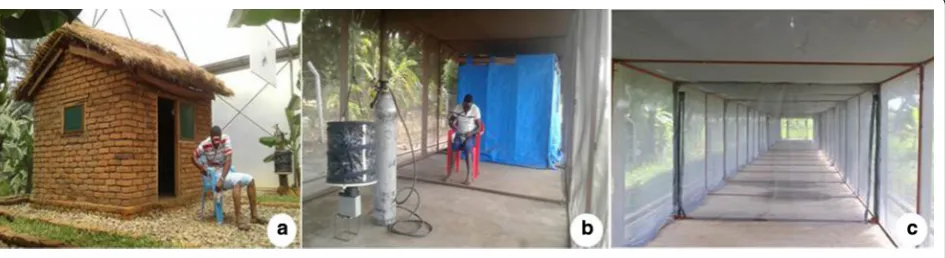
chamber, in which there were two experimental huts mimicking local households in nearby villages and vari-ous types of vegetation to mimic local ecosystem. These systems were originally described by Okumu et al. [28], but details of the chamber used in this study, includ-ing size, structure and microclimatic conditions have recently been described in Mmbando et al. [19]. On the other hand, the experiments to assess optimal distances between the push and pull subunits were conducted inside a 110 m long tunnel (2 m width and 2.5 m height), located at IHI’s Mosquito City facility, ~ 5 km north of Ifakara town [11]. This tunnel also had an experimen-tal hut constructed inside for experimentation. The two semi-field systems are shown in Fig. 1.
Mosquitoes
Five hundred insectary-reared nulliparous female Anoph-eles arabiensis mosquitoes, aged between 4 and 8 days, were released each evening at 1800 h and left for 30 min before experiments were initiated. The mosquito rear-ing process has been previously described [29]. In tests conducted inside the 200 m2 chamber, all the 500
mos-quitoes were released at the centre, equidistant from the two huts, while in tests conducted in the 110 m tunnel, the mosquitoes were divided into three cages (contain-ing ~ 167; 167; 166 mosquitoes) and released from three
different points to ensure equal distribution of mosqui-toes in the tunnel.
Push–pull subunits: odour‑baited traps and transfluthrin‑treated eave‑ribbons
The pull component consisted of BG-Malaria trap, baited with CO2 gas released at 500 ml/min from a
pressur-ized cylinder via a flow meter and powered by a 12-volt lithium ion battery. The trap, first used in Brazil for trap-ping Anopheles darlingi [26] was selected after initial trials demonstrated its superiority over the common BG-Sentinel trap in tests with Anopheles in Tanzania [24, 25]. In the basic plan, the traps were suspended 40 cm above ground, at a distance of 5 metres from each experimen-tal hut. However, these distances were varied in tests conducted inside the tunnel, to either 15 m or 30 m from the huts to assess effects of distances on efficacy of push–pull.
The push component on the other hand consisted of transfluthrin-treated eave ribbons, an innovative new approach recently demonstrated to provide effective pro-tection against both outdoor-biting and indoor-biting malaria vectors in Tanzania [19]. The eave-ribbons were made of hessian fabric and treated with 0.25 g/m2 (Bayer
Environmental Sciences), which had provided ~ 75% pro-tection in earlier tests [19]. Doses higher than 0.25 g/m2
had resulted in 100% protection, thereby excluding any possibility to test push–pull [19]. The eave ribbons were installed around the eaves of huts without completely covering the spaces (Fig. 1). Full details of the design, treatment and installation of the eave ribbons have been presented elsewhere [10, 19].
Fig. 1 Pictorial illustration of the semi-field chambers and the mosquito tunnel. The semi-field chambers were used to evaluate the different
configuration of push-and-pull subunits (a). The 110 m long mosquito tunnel was used to evaluate the optimal distances between the
[image:3.595.66.539.534.663.2]Study procedures
Experiments were conducted nightly from 1830 to 0630 h over a 9-month period with breaks in between. In both control and treatment settings, adult male volunteers (one volunteer per hut) sat outdoors from 1830 to 2200 h wearing short pants and caught all mosquitoes attempt-ing to bite them, and thereafter moved inside the huts to sleep under untreated bed-nets from 2200 to 0630 h, during which period a CDC-light trap set beside the bed net collected host-seeking mosquitoes. This was done to mimic the natural night-time behaviour of people in the study villages, where they spend early night-hours out-doors and go inout-doors to sleep mostly after 2200 h [29]. The primary indicator for all experiments was therefore number of mosquitoes caught attempting to bite volun-teers sitting outdoors (outdoor-biting risk; assessed by HLC) or sleeping indoors (indoor-biting risk; assessed by CDC light traps).
Tests conducted included: (1) baseline assessment of biting risk indoors and outdoors before adding either push or pull sub-units; (2) testing efficacy of CO2-baited
BG-Malaria traps (pull sub-unit) only; (3) testing efficacy of transfluthrin-treated eave ribbons (push sub-unit) only; (4) testing effects of distances of traps from the huts (i.e. distance between push and pull sub-units; (5) test-ing effects of numbers of traps on efficacy of push–pull; and (6) testing efficacy of complete push–pull relative to either traps alone or spatial repellent eave ribbons alone. Each test lasted a minimum of 15 nights, including 10 nights with intervention and 5 nights with no interven-tion (i.e. controls). The controls consisted of untreated bed nets used between 2200 and 0630 h, as the only inter-vention in place. The huts were cleaned and left unused for at least 72 h (3 days) between tests to minimize any residual effects of transfluthrin.
Testing effects of traps alone (pull only) on outdoor‑biting and indoor‑biting risk
The experiment was conducted for 15 consecutive nights, starting with five nights of control followed by ten test nights, during which the CO2-baited BG-Malaria traps
[25] were set outdoors, at a distance of 5 m from the huts (1 trap per hut, each on the right side of the huts). Mos-quito collections outdoors and indoors were conducted as described above, and biting risk indoors and outdoors compared to the controls.
Testing effects of spatial repellents (transfluthrin‑treated eave ribbons) alone (push only) on outdoor‑biting and indoor‑biting risk
This experiment also lasted 15 consecutive nights, start-ing with five nights of control followed by ten test nights during which the treated eave ribbons were wrapped
along the eave spaces of the two experimental huts. Indoor and outdoor mosquito collections were per-formed as described and the outcome indicators com-pared between control and intervention nights.
Testing effects of spatial repellents and traps combined (push–pull) on outdoor‑biting and indoor‑biting risk
Here, both transfluthrin-treated eave-ribbons and the CO2-baited BG-Malaria trap were used concurrently
inside the same semi-field-chamber and their effects assessed against biting risk indoors and outdoors. This experiment began with five nights of control (no eave rib-bons, and no traps), followed by ten nights for testing the push–pull. Again, mosquito collections done as above.
Testing effects of number of traps on efficacy of push–pull against outdoor‑biting and indoor‑biting risk
Since varying densities of odour-baited traps (pseudo-hosts) relative to other humans (vertebrate (pseudo-hosts) could influence overall efficacy of such interventions [30], an optimal number of traps should be determined for field applications. Therefore, the transfluthrin-treated eave ribbons were fixed onto the huts and different trap num-bers added two achieve the following unique push–pull combinations follows: (1) spatial repellent ribbons plus one trap located at the centre of the semi-field chamber, i.e. 0.5 traps/hut; (2) spatial repellent ribbons plus two traps placed 5 m beside each hut, i.e. 1 trap/hut; and (3) spatial repellent ribbons plus four traps, two were situ-ated beside each hut, i.e. 2 huts/hut. Each combination was tested for 15 nights, starting with five nights of con-trol followed by ten nights of intervention. Mosquito collections were done as described before, and outcome parameters compared between intervention and control settings.
Testing effects of distance between traps and huts on outdoor‑biting and indoor‑biting risk
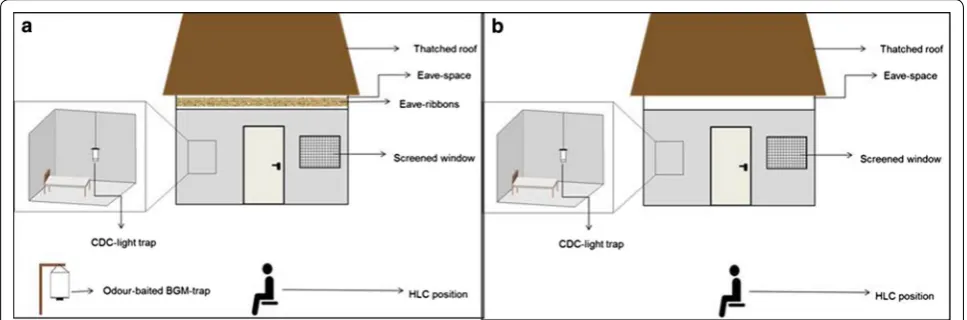
the hut without completely closing the eave spaces as described earlier (Figs. 1 and 2). To complete the push– pull system, a single CO2-baited BG-Malaria trap was
installed at either 5 m, 15 m and 30 m distance away from the hut. By assessing different distances between the traps and volunteer-occupied hut, the test also enabled assessment of different distances between the push and pull sub-units, since the spatial repellent was always fixed onto the hut.
Additional tests were conducted in the tunnel with only the transfluthrin-treated eave ribbons, but no traps for 8 nights. Randomization without replacement of the aforementioned trap positions or no trap was used to assign the distance to be evaluated each night (i.e. no trap added, trap added at 5 m, trap added at 15 m or trap added at 30 m from hut).
Data analysis
Data analysis was done using open source statistical soft-ware, R version 3.5.0 [30]. Mosquito count data were modelled in Generalized Linear Mixed Models (GLMMs) following a negative binomial distribution using lme4 package [32]. Treatments such as presence of absence of the sub-units, number of traps, distance between traps and huts, and location (indoor/outdoor) were modelled as fixed factors, while experimental day and hut ID were included in the models as random terms to account for pseudo replication and variation in microclimate between days, i.e. temperature, humidity and winds.
The protective efficacies were computed using relative risk (RR) from a null model following (Control − Treat-ment)/Control. The significance of the fixed factors
where considered significant when P-value was less than 0.05. Graphs were created using an R graphics package (ggplot2) [33]. Means, relative risks and respective 95% confidence intervals (CI) were reported.
Results
Effects of traps alone (pull only), spatial repellents alone (push only) or combinations of traps and spatial repellents (push–pull)
Full details of findings are given in Table 1 and Fig. 3. Mosquito trapping alone (1 trap/hut) offered only mod-est protection of 35% indoors and 31% outdoors. How-ever, when the spatial repellent (transfluthrin-treated eave ribbons) were used alone, they significantly reduced biting indoors (% protective efficacy = 81.2%; RR = 0.16 (0.09–0.20); P < 0.01) and outdoors (% protective effi-cacy = 63%; RR = 0.4 (0.31–0.51); P < 0.001). When the complete push-pull system (consisting of both the spatial repellent and the traps) was tested, it also significantly reduced indoor-biting (% protective efficacy = 83%; RR = 0.16 (0.07–0.32); P < 0.01) and outdoor-biting (% pro-tective efficacy = 79%; RR = 0.15 (0.21–0.19); P < 0.001).
Effects of varying the number of traps on efficacy of push– pull against outdoor‑biting and indoor‑biting risk
Findings for these tests are summarized in Table 2 and also Fig. 3. Push–pull with two traps (1 trap/hut) offered 90% protection (RR = 0.1 (0.04–0.20); P < 0.01), the one with four traps (2 traps/hut) offered 69% protection (RR = 0.3 (0.2–0.7); P < 0.01), and the one with a single pull-subunit (0.5 traps/hut) offered only 19% protec-tion (RR = 0.8 (0.4–1.8); P > 0.05) against indoor-biting
Fig. 2 Illustration of the experimental setup for evaluating push–pull inside semi-field chamber. Adult male volunteers (one volunteer/hut)
[image:5.595.57.541.498.658.2]Table
1
Summar
y of
findings in
tests f
or
eff
ec
ts of
tr
aps alone (pull only), spa
tial r
ep
ellen
ts alone (push only) or
combina
tions of
tr
aps and
spa
tial r
ep
ellen
ts
(push–pull) on the biting risk of
A
nopheles a
rabiensis
indo
ors and out
do
ors
In
ter
ven
tion
N
Indoor biting risk (assessed using CDC
‑ligh
t tr
ap
)
O
ut
door biting risk (assessed using human landing ca
tch)
M
osquit
oes tr
apped
M
ean (95% CL)
RR (95% CI)
% P
rot
ec
tion
p‑
value
M
ean (95% CL)
RR (95% CI)
% P
rot
ec
tion
p‑
value
M
ean (95% CL)
Contr
ol
15
16.3 (12.9–19.8)
1
N/A
N/A
124.5 (101.6–152.5)
1
N/A
N/A
N/A
Pull alone (traps)
10
10.0 (7.6–12.4)
0.7 (0.3–1.3)
35.0
0.351
85.5 (71.6–102)
0.7 (0.5–0.9)
31
<
0.01
44.0 (35.5–52.6)
Push alone (spatial r
epellents)
10
2.7 (1.5–4.0)
0.2 (0.1–0.2)
81.2
0.006
46 (35.7–59.4)
0.4 (0.3–0.5)
63
<
0.01
Na
Push–pull
10
3.4 (0.5–6.4)
0.2 (0.1–0.3)
83.4
0.002
26.3 (21.9–31.6)
0.2 (0.2–0.3)
79
<
0.01
[image:6.595.248.352.92.716.2]malaria vectors, compared to the control. On the other hand, in outdoor settings, push–pull with two traps (1 trap/hut) offered 80% protection (RR = 0.2 (0.1–0.2); P < 0.01), the one with four traps (2 traps/hut) offered no protection at all, i.e. 0.0% (RR = 1.0 (0.7–1.4); P > 0.05), and that with a single trap (0.5 traps/hut) offered an insignificant 10% protection (RR = 0.9 (0.7–1.3); P > 0.05). In all cases, there was an overlap of the 95% confi-dence intervals between the three different trapping approaches, indicating they were statistically similar (Table 2), i.e. 45.5 (22.5–91.9) when one trap was used, 54.4 (27.1–109.0) when two traps were used and 50.3 (45.2–55.5) when four traps were used. When the differ-ent trapping approaches were compared to one trap (0.5 trap/hut), it was observed that doubling trap densities to
1 trap/hut increased indoor protection by 89.6% and out-door protection by 83.2%. Interestingly, quadrupling the trap densities to 2 traps/hut increased indoor protection by slightly lower margin, 60.7%, while lowering outdoor protection by 10%.
Effects of varying distances between traps and huts on outdoor‑biting and indoor‑biting risk observed in the evaluation of push–pull
Findings for these tests are summarized in Table 3. Bite prevention indoors was greater than 80%, regardless of distances at which the traps were placed, and was equally high in settings with spatial repellents alone without any traps (Table 3). In these tests, conducted in the 110 m long tunnel rather than the 200 m2 semi-field chamber
Fig. 3 Charts representing mean numbers of mosquitoes caught per night per hut both indoors and outdoors when either push or pull was tested
[image:7.595.58.541.87.463.2]Table
2
Summar
y findings of
tests f
or
eff
ec
ts of
var
ying the
numb
er of
tr
aps on
effic
ac
y of
push–pull against
A
nopheles a
rabiensis
biting risk out
do
ors
and indo
ors
No
. tr
aps
N
Indoor biting risk (assessed using CDC
‑ligh
t tr
ap
)
O
ut
door biting risk (assessed using human landing ca
tch)
M
osquit
oes tr
apped
M
ean (95% CL)
RR (95% CI)
% P
rot
ec
tion
p‑
value
M
ean (95% CL)
RR (95% CI)
% P
rot
ec
tion
p‑
value
M
ean (95% CL)
Contr
ol
15
27.6 (16.9–44.9)
1
N/A
N/A
239.1 (194.9–293.4)
1
N/A
N/A
N/A
One trap (0.5/hut)
10
22.4 (12.3–41)
0.8 (0.4–1.8)
19
0.463
219.7 (170.9–282.4)
0.9 (0.7–1.3)
10
0.172
45.5 (22.5–91.9)
Tw
o traps (1/hut)
10
2.8 (1.3–5.8)
0.1 (0.04–0.2)
90
<
0.001
37.0 (28.3–48.4)
0.2 (0.1–0.2)
80
<
0.001
54.4 (27.1–109.0)
Four traps (2/hut)
10
8.9 (4.8–16.7)
0.3 (0.2–0.7)
69
<
0.001
235.6 (183.3–302.6)
1.0 (0.7–1.4)
0
0.713
[image:8.595.259.352.94.725.2]where the first experiments were conducted, outdoor protection was marginal, regardless of trap position or even when there was no trap. In the analyses where the lowest distance of 5 m was set as reference category, indoor protection increased by 44% when distance was increased to 15 m, and by 31% when the distance was increased to 30 m. On the other hand, outdoor protec-tion did not increase upon changing trap locaprotec-tion to 15 m away from the huts, but was increased by 17.9% when the trap was moved to 30 m away. Given the higher outdoor biting densities by An. arabiensis as observed in all the experiments, these modest improvements of 17.9% trans-lates into significant magnitude of protection compared to indoors. In all cases, the outdoor traps at 5 m and 15 m caught approximately the same number of mosquitoes per night, i.e. 48.8 (43.6–54.7) mosquitoes/night at 5 m from hut and 50.3 (45.0–56.3) mosquitoes/nigh at 15 m, while the trap at 30 m caught slightly fewer mosquitoes, i.e. 42.2 (37.3–47.7) mosquitoes/night.
Discussion
As the race to expand the malaria vector control tool box accelerates, additional evidence is required on new alter-native tools to ascertain their suitability for use in various settings. This study evaluated the benefits of using push– pull as opposed to either the push component (spatial repellents) alone or the pull component (odour-baited mosquito traps) alone. The components were selected based on previous data, which had demonstrated high efficacies of both the transfluthrin-treated eave ribbons [19] and the BG-Malaria trap [23] against malaria vectors in Tanzania.
Spatial repellents and odour baited traps have both separately been proposed as potential new tools for expanding the malaria control tool box, though there is not yet adequate data to justify their large-scale applica-tion [9]. For spatial repellents, current focus areas include developing strategies for delivery of active ingredients in ways that ensure long-term efficacy and safety [34] and also improving user compliance, which has previously impaired field effectiveness [17]. On the other hand, for odour-baited traps, focus areas include developing highly effective attractants [23] and improved trapping devices [23], but also on how the technologies can best be com-bined with existing interventions [28, 31]. Though these two techniques on their own may complement LLINs and IRS [28, 35], they both have unique challenges that have until now limited their individual appeal, especially under sub-optimal coverage [20]. Indeed, a major reason for proposing push–pull instead of either traps only or repellents only is to counter the potential negative effects such as diversion of mosquitoes to non-users and to pre-vent excessive risk when traps are baited with attractants
that increase mosquito densities in an environment. This study therefore also examined a range of configura-tions under which push–pull would be most effective in communities.
The dose of transfluthrin used here, i.e. 0.25 g/m2 was
selected because it had yielded protection below 100% in earlier studies and, therefore, allowed further evaluation of push–pull instead of push alone. A major finding was that push–pull achieved greater protective efficacy than either component alone, with clear superiority superior over traps alone, but its advantage over spatial repel-lents alone was only marginal. Indeed, most of the gains obtained from push–pull in these experiments can be attributable to the push-component alone.
It had been expected that adding traps would help trap out mosquitoes repelled by the eave ribbons and there-fore increase overall protection. However, this was not directly observable here, most likely because the current study assessed only personal and household-level protec-tion, but not community-level protection. It is likely that given the high protective efficacies of the spatial repel-lents in this system, any additional benefits would only become apparent in community-level trials where both users and non-users are observed. Indeed, in studies my Menger et al. [38], the value of push–pull was much more apparent when the personal protection data was incorpo-rated into mathematical simulations of community-level impact. Future studies should therefore consider such assessments in both user and non-user households, and should also include tests on multiple Anopheles species which may have different behaviours. Another possible reason for the marginal additional value of push–pull over spatial repellents alone could be that the mosquitoes were not only repelled but also killed by the transfluthrin. Indeed, in earlier trials where pyrethroid-susceptible An. arabiensis were exposed inside the huts with trans-fluthrin-treated eave ribbons, these mosquitoes were consistently killed, suggesting multiple modes of action of transfluthrin [19]. Such substantial killing-effect of transfluthrin would limit the diversionary effects without the need for trapping.
products, especially if the repellent active ingredients also have a killing-effect on the mosquitoes.
An important aspect for consideration here is that the spatial repellent used here was a pyrethroid, trans-fluthrin. The study therefore does not recommend that the transfluthrin-treated eave ribbons are used for resistance management but rather to offer additional protection against mosquitoes that bite outdoors or indoors at times when people are not using their LLINs. This is a key limitation of this approach and suggests that the search for new active ingredients, particularly those that are non-pyrethroids should continue. The concept of spatial repellents for resistance management could then be applicable if other active ingredients are used. Nonetheless, it was interesting that in a previous study [19], pyrethroid-resistant An. arabiensis were suf-ficiently repelled by transfluthrin-treated eave ribbons. Moreover, when inside huts with 0.02% transfluthrin-treated ribbons, the mosquitoes also died in very high proportions (mortality of 99.5%). This indicates provid-ing both repellent and killprovid-ing activity could be highly effective against resistant An. arabiensis. However, the same study also found that pyrethroid-resistant An. funestus, which dominate malaria transmission in rural south-eastern Tanzania were only modestly affected by the transfluthrin-treated eave ribbons [19]. This sug-gests indeed that the efficacy of transfluthrin-based products would be limited in certain settings. There-fore, to sustain effectiveness and enable resistance management efforts, it is recommended that trans-fluthrin-treated eave ribbons should be combined with non-pyrethroid interventions, for example organophos-phate-based or carbamate-based IRS indoors.
It was hypothesized at the start of the study that increasing trap densities could improve protection, by mass-trapping host-seeking mosquitoes. However, this study determined that while doubling trap densities from 0.5 to 1 trap/hut was beneficial, further increase to 2 traps/hut was detrimental. Probably, this is because the traps increased the concentration of the odour lures (CO2) in the environment and kept the mosquitoes active
enough to increase rather than decrease biting. Obvi-ously even if the study had determined that increasing trap densities would be beneficial, the economic cost would likely be exorbitant. Future developments in ping technology could potentially lead to higher trap-ping efficiencies and exclusion of the need for industrial CO2 gas as used in these experiments, a development
that could greatly improve the appeal of host-seeking mosquito traps for control. In this study, presence of CO2—baited traps at the peri-domestic areas seemed
to increase proportions of mosquitoes biting outside and slightly reduced indoor mosquito-biting risks. The
pull-subunits may indeed increase mosquito biting risks to people engaged in various outdoor activities such as story-telling, cooking, dish-washing and drinking [29,
36]. Overall, thesefindings should however not be inter-preted to mean that traps have no value, as assessments here were mostly of personal protection. It is possible that adding traps into the systems would indeed address potential diversion problems while also trapping and kill-ing large number of mosquitoes, thereby contributkill-ing to mass community-level benefits for users and non-users. Thus, additional studies are required in field settings to more accurately measure such community-level out-comes including any potential diversion from users to non-users, and distances over which such diversion can occur. One concern with thetrapping systems used here was the difficulty in standardization, possibly as a result of differential airflow in the systems, which resulted in discordant trap efficacies between studies in the first tests versus those done in the tunnel. For example, in the first test, one trap for two houses had no significant impact, whereas two traps for two houses had a significant effect, (Fig. 4). However, in the tunnel tests, one trap had no sig-nificant impact with just one hut in the system, whatever the distance. In future tests, these differences could be avoided by conducting all studies in similar setting and by improving standardization and airflow in the experi-mental systems.
was probably due to repellent effect or the feeding-inhi-bition effect of transfluthrin [37]. Such effects probably also reduced the number of mosquitoes, which might be trapped by the baited-trap at the peri-domestic areas.
The addition of odour-baited traps to the eave-ribbons, to form push pull showed modest improvements on per-sonal protection, unlike in previous studies, where pres-ence of baited-traps outdoor undermined the efficacy of push–pull system [38]. The study by Menger et al. indi-cated no additional effect of having push and pull subunits at the peri-domestic areas. They however also concluded that mosquito biting protection was mainly offered by the push-subunits, which is similar to the findings of this current study [38]. Additionally, during a recent small-scale field evaluations of push–pull, it was determined that presence of the system at the peri-domestic areas
undermined the effects of the odor-baited mosquito land-ing box (MLB) [14]. However, testing both push-and-pull subunits in this current study did not affect the indoor mosquito biting protection, as this was mainly offered by the push-subunits alone. The study suggested the neces-sity of optimization studies on the number and the dis-tance of pull subunits needed to offer maximal protection against mosquito bites. The distance between the pull and the human volunteer needed to be optimized to prevent the mosquito attraction competition as reported previ-ously [12, 19]. These aforementioned challenges have now been tackled in the series of push–pull optimization experiments reported in this current study.
During evaluation of the optimal distances between the push and pull subunits, when the baited trap wassituated at either 5 m or 15 m away from the treated ribbons, the trap caught a higher average number ofmosquitoes com-pared to other distances tested. Although, the lower bit-ing protection conferred by the pull-subunit situated at either 5 m or 15 m away from the push-subunit was best for offering communalprotection, the best configuration of push–pull was that with traps located at least 15 m away from the huts.Since outdoor biting was greater than indoor-biting, and because traps placed at 30 m away from hutsresulted in the greatest reduction in outdoor bites, it can be argued that where outdoor-biting An. arabiensisare the main vectors, then the traps should be placed at least 30 m from the huts, (Fig. 5).
Mosquito trapping in these experiments was done by human volunteers outdoors and CDC light traps indoors. Overall, as shown in Tables 1, 2 and 3 and Fig. 3, more mos-quitoes were caught outdoors than indoors, which may cre-ate an impression that there was lower biting risk indoors. This is mostly because in these experiments, a fixed number of mosquitoes were released each night and outdoor trap-ping preceded indoor traptrap-ping. Though these findings do not invalidate the percentage protection values calculated, there are still many settings across Africa where substantial proportions of malaria transmission events actually occur indoors as opposed to outdoors, in which cases prioritiza-tion of indoor protecprioritiza-tion remains a key. Interpretaprioritiza-tion of the data should therefore consider the fact that different trapping methods were used indoors and outdoors.
One limitation of this study is that it lacks the field data assess other factors which might influence the efficacy of the push–pull system. These factors may include airflow (wind), which was limited in the semi-field system com-pared to field settings. Another is the use of pyrethroid susceptible An. arabiensis as the only test organism. Further studies are, therefore, needed to assess impact against resistant mosquitoes, and also against other spe-cies such as An. funestus, where it is the dominant vec-tor. Lastly, these current studies also used untreated nets
Fig. 4 Number of Anopheles arabiensis caught at each hut nightly
[image:11.595.61.290.87.454.2]Table
3
Summar
y findings of
tests f or eff ec ts of var ying distanc es b et w een tr aps and
huts (with or
without tr ansfluthrin-tr ea ted ea ve ribb ons) on A nopheles ar abiensis out do or-biting and indo
or-biting risk obser
ved in the e valua tion of push–pull D istanc e N
Indoor biting risk (assessed using CDC
‑ligh t tr ap ) O ut
door biting risk (assessed using human landing ca
tch) M osquit oes tr apped M
ean (95% CL)
RR (95% CI)
% P rot ec tion p‑ value M
ean (95% CL)
RR (95% CI)
% P rot ec tion p‑ value M
ean (95% CL)
Contr
ol (no traps & no
ea ve r ibbons) 12 42.7 (36.2–42.1) 1 N/A N/A 274.3 (256.6–292.1) 1 N/A N/A N/A Ea ve -r
ibbons & no traps
6 7.1 (5.4–8.8) 0.2 (0.1–0.2) 83 0.005 278.8 (266.8–290.7) 1.0 (0.9–1.2) 0 0.291 N/A
Trap at 5
m fr om hut 6 6.0 (4.9–7.1) 0.1 (0.1–0.2) 86 0.003 248.5 (215.8–281.2) 0.9 (0.8–1.0) 10 0.093 48.8 (41.5–56.2)
Trap at 15
m fr om hut 6 3.3 (2.0–4.6) 0.1 (0.1–0.1) 93 0.008 240.3 (213.6–267.1) 0.9 (0.8–1.0) 13 0.361 50.3 (45.2–55.5)
Trap at 30
[image:12.595.248.366.101.727.2]inside the study chambers, which may not represent actual situation in field settings. Future field tests should, therefore, consider using LLINs as primary intervention.
Conclusion
The best configuration of push–pull comprised trans-fluthrin-treated eave ribbons, plus two traps (1/hut), each at 15 m or 30 m from huts. Efficacy of push–pull was mainly due to the spatial repellent component. Add-ing odour-baited traps could marginally improve pro-tection, but excessive trap densities may increase biting exposure for near users outdoors. The combination of the push–pull subunits slightly increased the outdoor-biting protection, compared to when the two units were
separately tested. Given the marginal efficacy gains over spatial repellents alone and the complexity of push–pull, it may be prudent to promote just the spatial repellents alongside existing interventions such as LLINs or non-pyrethroid IRS. Since both transfluthrin and traps also kill mosquitoes, and because transfluthrin can inhibit blood-feeding, field studies should be done to assess potential community-level benefits that push–pull or its components may offer to users and non-users. Such stud-ies could also assess potential of the technology against other vector species in different study sites.
Abbreviations
LLINs: long-lasting insecticide-treated bed nets; IRS: indoor-residual spraying; BG: bio-gent; CO2 gas: carbon dioxide gas; MLB: mosquito-landing box; CDC: Centre for Disease Control; RR: relative-risk ratio; GLLM’s: generalized linear mixed mod-els; CL: confidence level; CI: confidence intervals; HLC: human landing catch.
Authors’ contributions
ASM and FOO conceived the study and developed the study protocol. ASM, MK, RM, EM and HK conducted the experiments, logistic support and supervised data collection. ASM, HSN and FOO analysed the data. ASM and FOO wrote the manuscript. ASM, HSN, EPAB, EWK, AEE and FOO reviewed the manuscript. All authors read and approved the final manuscript.
Author details
1 Environmental Health and Ecological Sciences Department, Ifakara Health Institute, Ifakara, Tanzania. 2 Laboratory of Technological Innovation of Vector Control, Department of Parasitology, Biological Science Institue, Federal University of Minas Gerais, Belo Horizonte, Brazil. 3 School of Public Health, Faculty of Health Sciences, University of the Witwatersrand, Parktown, Repub-lic of South Africa. 4 Institute of Biodiversity, Animal Health and Comparative Medicine, University of Glasgow, Glasgow, UK.
Acknowledgements
A special thanks to Mr. Stephen Kipande and Mr. Ramji Seleman who volun-teered to collect mosquitoes during the study.
Competing interests
The authors declare that they have no competing interests.
Availability of data and materials
The dataset obtained from this study is available from the corresponding author upon request.
Consent for publication Not applicable.
Ethics approval and consent to participate
Volunteers who participated in this study were adequately informed about the study objectives, potential benefits and potential risks, after which writ-ten informed consent was obtained. Since infection-free laboratory-reared mosquitoes were used in the study, the volunteers were not at risks of being infected with malaria parasites during the experiments. Still, volunteers were provided with free diagnosis and treatment according to Tanzania National Treatment Guidelines in case they fell ill. Ethical approval was obtained from institutional review board of Ifakara Health Institute (IHI/IRB/EXT/09-2017) and the Medical Research Coordinating Council at Tanzanian National Institute of Medical Research (NIMR/HQ/R.8c/Vol. II/838). This manuscript has been approved for publication by the National Institute of Medical Research refer-ence number (NIMR/HQP/P.12VOL XXVI/28).
Funding
ASM was funded by Wellcome Trust Masters Fellowship in Public Health and the Association of Physicians of Great Britain and Ireland which fund this research (Grant Number 106356/Z/14/Z). EPAB was funded by the
Fig. 5 Number of Anopheles arabiensis caught per hut per night
[image:13.595.59.292.87.470.2]Coordenação de Aperfeiçoamento de Pessoal de Nível Superior (CAPES) (Grant 88881.133584/2016-01) and AEE funded by the Conselho Nacional de Desenvolvimento Científico e Tecnológico of the Ministério da Ciência, Tecno-logia e Inovação (CNPq/MCTI) (Grant 310205/2014-0) and Fundação de Amp-aro à Pesquisa do Estado de Minas Gerais (FAPEMIG) (Grant PPM-00502-15). FOO was also supported by a Wellcome Trust Intermediate Research Fellow-ship (Grant Number: WT102350/Z/13/Z), a Howard Hughes Medical Institute (HHMI)—Gates International Research Scholarship (Grant No. OPP1175877) and a Bill & Melinda Gates Foundation Grant (Grant No. OPP1177156).
Publisher’s Note
Springer Nature remains neutral with regard to jurisdictional claims in pub-lished maps and institutional affiliations.
Received: 11 December 2018 Accepted: 8 March 2019
References
1. WHO. World Malaria Report 2017. Geneva: World Health Organization; 2017. 2. World Health Organization. Global Malaria Programme Global technical
strategy for malaria, 2016–2030. Geneva: World Health Organization; 2015. 3. Rabinovich RN, Drakeley C, Djimde AA, Hall BF, Hay SI, Hemingway J, et al.
malERA: an updated research agenda for malaria elimination and eradica-tion. PLoS Med. 2017;14:e1002456.
4. Ranson H. N’guessan R, Lines J, Moiroux N, Nkuni Z, Corbel V Pyrethroid resistance in African anopheline mosquitoes: what are the implications for malaria control? Trends Parasitol. 2011;27:91–8.
5. Russell TL, Govella NJ, Azizi S, Drakeley CJ, Kachur SP, Killeen GF. Increased proportions of outdoor feeding among residual malaria vector popula-tions following increased use of insecticide-treated nets in rural Tanzania. Malar J. 2011;10:80.
6. Durnez L, Coosemans M. Residual transmission of malaria: an old issue for new approaches. In Anopheles mosquitoes: new insights into malaria vectors. Manguin S, ed. 2013, p. 671–704.
7. Moore SJ. A new perspective on the application of mosquito repellents. Lancet Infect Dis. 2016;16:1093–4.
8. Gryseels C, Uk S, Sluydts V, Durnez L, Phoeuk P, Suon S, et al. Factors influ-encing the use of topical repellents: implications for the effectiveness of malaria elimination strategies. Sci Rep. 2015;5:16847.
9. Williams YA, Tusting LS, Hocini S, Graves PM, Killeen GF, Kleinschmidt I, et al. Expanding the vector control toolbox for malaria elimination: a systematic review of the evidence. Adv Parasitol. 2018;99:345–79. 10. Ogoma SB, Mmando AS, Swai JK, Horstmann S, Malone D, Killeen GF. A low technology emanator treated with the volatile pyrethroid transfluthrin confers long term protection against outdoor biting vec-tors of lymphatic filariasis, arboviruses and malaria. PLoS Negl Trop Dis. 2017;11:e0005455.
11. Ogoma SB, Ngonyani H, Simfukwe ET, Mseka A, Moore J, Killeen GF. Spa-tial repellency of transfluthrin-treated hessian strips against laboratory-reared Anopheles arabiensis mosquitoes in a semi-field tunnel cage. Parasit Vectors. 2012;5:54.
12. Matowo NS, Moore J, Mapua S, Madumla EP, Moshi IR, Kaindoa EW, et al. Using a new odour-baited device to explore options for luring and killing outdoor-biting malaria vectors: a report on design and field evaluation of the Mosquito Landing Box. Parasit Vectors. 2013;6:137.
13. Mmbando AS, Okumu FO, Mgando JP, Sumaye RD, Matowo NS, Madumla E, et al. Effects of a new outdoor mosquito control device, the mosquito landing box, on densities and survival of the malaria vector, Anopheles arabiensis, inside controlled semi-field settings. Malar J. 2015;14:494. 14. Mmbando AS, Ngowo HS, Kilalangongono M, Abbas S, Matowo NS, Moore SJ, Okumu FO. Small-scale field evaluation of push-pull system against early-and outdoor-biting malaria mosquitoes in an area of high pyrethroid resistance in Tanzania. Wellcome Open Res. 2017;2:112. 15. Menger DJ, Otieno B, Marjolein de Rijk W, van Loon JJ, Takken W. A
push-pull system to reduce house entry of malaria mosquitoes. Parasit Vectors. 2014;12:18.
16. Maia MF, Onyango SP, Thele M, Simfukwe ET, Turner EL, Moore SJ. Do topical repellents divert mosquitoes within a community? Health equity
implications of topical repellents as a mosquito bite prevention tool. PLoS ONE. 2013;8:e84875.
17. Heng S, Sluydts V, Durnez L, Mean V, Polo K, Tho S, Coosemans M, van Griensven J. Safety of a topical insect repellent (picaridin) during community mass use for malaria control in rural Cambodia. PLoS ONE. 2017;12:e0172566.
18. Sluydts V, Durnez L, Heng S, Gryseels C, Canier L, Kim S, Van Roey K, Kerk-hof K, Khim N, Mao S. Efficacy of topical mosquito repellent (picaridin) plus long-lasting insecticidal nets versus long-lasting insecticidal nets alone for control of malaria: a cluster randomised controlled trial. Lancet Infect Dis. 2016;16:1169–77.
19. Mmbando AS, Ngowo H, Limwagu A, Kilalangongono M, Kifungo K, Okumu FO. Eave ribbons treated with the spatial repellent, transfluthrin, can effectively protect against indoor-biting and outdoor-biting malaria mosquitoes. Malar J. 2018;17:368.
20. Maia MF, Kreppel K, Mbeyela E, Roman D, Mayagaya V, Lobo NF, et al. A crossover study to evaluate the diversion of malaria vectors in a com-munity with incomplete coverage of spatial repellents in the Kilombero Valley, Tanzania. Parasit Vectors. 2016;9:451.
21. Cook SM, Khan ZR, Pickett JA. The use of push-pull strategies in inte-grated pest management. Ann Rev Entomol. 2007;52:375–400. 22. Hassanali A, Herren H, Khan ZR, Pickett JA, Woodcock CM. Integrated pest
management: the push–pull approach for controlling insect pests and weeds of cereals, and its potential for other agricultural systems including animal husbandry. Philos Trans R Soc Lond B Biol Sci. 2008;363:611–21. 23. Okumu FO, Killeen GF, Ogoma S, Biswaro L, Smallegange RC, Mbeyela E,
et al. Development and field evaluation of a synthetic mosquito lure that is more attractive than humans. PLoS ONE. 2010;5:e8951.
24. Okumu FO, Madumla EP, John AN, Lwetoijera DW, Sumaye RD. Attracting, trapping and killing disease-transmitting mosquitoes using odor-baited stations-the Ifakara Odor-Baited Stations. Parasit Vectors. 2010;3:12. 25. Batista EP, Ngowo H, Opiyo M, Shubis GK, Meza FC, Siria DJ, et al. Field
evaluation of the BG-Malaria trap for monitoring malaria vectors in rural Tanzanian villages. PLoS ONE. 2018;13:e0205358.
26. Gama RA, Silva IM, Geier M, Eiras AE. Development of the BG-Malaria trap as an alternative to human-landing catches for the capture of Anopheles darlingi. Mem Inst Oswaldo Cruz. 2013;108:763–71.
27. Ferguson HM, Ng’habi KR, Walder T, Kadungula D, Moore SJ, Lyimo I, et al. Establishment of a large semi-field system for experimental study of Afri-can malaria vector ecology and control in Tanzania. Malar J. 2008;7:158. 28. Okumu FO, Chipwaza B, Madumla EP, Mbeyela E, Lingamba G, Moore J, et al. Implications of bio-efficacy and persistence of insecticides when indoor residual spraying and long-lasting insecticide nets are combined for malaria prevention. Malar J. 2012;11:378.
29. Moshi IR, Ngowo H, Dillip A, Msellemu D, Madumla EP, Okumu FO, et al. Community perceptions on outdoor malaria transmission in Kilombero Valley, Southern Tanzania. Malar J. 2017;16:274.
30. R-core Team. R: A language and environment for statistical computing. 2013. 31. Okumu FO, Govella NJ, Moore SJ, Chitnis N, Killeen GF. Potential benefits, limitations and target product-profiles of odor-baited mosquito traps for malaria control in Africa. PLoS ONE. 2010;5:e11573.
32. Bates D, Maechler M, Bolker B, Walker S. Fitting linear mixed-effects mod-els using lme4. J Stat Softw. 2015;67:1–48.
33. Wickham H. ggplot2: elegant graphics for data analysis. J Stat Softw. 2017;77:1–3.
34. Achee NL, Bangs MJ, Farlow R, Killeen GF, Lindsay S, Logan JG, et al. Spatial repellents: from discovery and development to evidence-based validation. Malar J. 2012;11:164.
35. Killeen GF, Smith TA. Exploring the contributions of bed nets, cattle, insec-ticides and excitorepellency to malaria control: a deterministic model of mosquito host-seeking behaviour and mortality. Trans R Soc Trop Med Hyg. 2007;101:867–80.
36. Monroe A, Asamoah O, Lam Y, Koenker H, Psychas P, Lynch M, et al. Outdoor-sleeping and other night-time activities in northern Ghana: implications for residual transmission and malaria prevention. Malar J. 2015;14:35. 37. Ogoma SB, Ngonyani H, Simfukwe ET, Mseka A, Moore J, Maia MF, et al.
The mode of action of spatial repellents and their impact on vectorial capacity of Anopheles gambiae sensu stricto. PLoS ONE. 2014;9:e110433. 38. Menger DJ, Omusula P, Holdinga M, Homan T, Carreira AS, Vandendaele P,