Open Access
Research
Higher transactivation activity associated with LTR and Tat
elements from HIV-1 BF intersubtype recombinant variants
Gabriela Turk
†, Mauricio Carobene
†, Ana Monczor, Andrea Elena Rubio,
Manuel Gómez-Carrillo and Horacio Salomón*
Address: National Reference Center for AIDS, Department of Microbiology, School of Medicine, University of Buenos Aires, Buenos Aires, Argentina
Email: Gabriela Turk - [email protected]; Mauricio Carobene - [email protected]; Ana Monczor - [email protected]; Andrea Elena Rubio - [email protected]; Manuel Gómez-Carrillo - [email protected]; Horacio Salomón* - [email protected] * Corresponding author †Equal contributors
Abstract
Background: HIV-1 is characterized by its rapid genetic evolution and high diversity as a consequence of its error-prone reverse transcriptase and genetic recombination. This latter mechanism is responsible for the creation of circulating recombinant forms (CRFs) found in nature. Previous studies from our lab group have shown that the epidemic in Argentina is characterized by one highly prevalent circulating recombinant form, CRF12_BF, and many related BF recombinant forms. Since transcriptional transactivation of the HIV-1 long terminal repeat (LTR) promoter element requires the essential viral Tat protein, since these genetic structures underwent recombination in variants widely spread in South America, the aim of this work was to study transcriptional activity associated with the recombinant LTR and Tat elements.
Results: Differential transcriptional activity was measured for the BF recombinant LTR/Tat complex that is present in widely spread viral variants was demonstrated. This analysis demonstrated a higher activity for the BF complex when compared to its B subtype counterpart.
Conclusion: This study indicates structural and functional consequences of recombination events within the LTR promoter and Tat transactivator protein of a naturally occurring HIV-1 recombinant form.
Background
Human immunodeficiency virus type 1 (HIV-1) is a dip-loid retrovirus whose genome consists of two RNA mole-cules per virion. This viral RNA serves as the template for proviral DNA synthesis by the virus-encoded reverse tran-scriptase (RT) enzyme.
HIV-1 is characterized by its rapid genetic evolution and high diversity, as demonstrated by the large number of
different HIV-1 strains isolated around the world. This rapid genetic variation provides the virus with maximum adaptation efficiency and presents serious challenges for chemotherapy and vaccine development against HIV-1 infection.
Major mechanisms that contribute to HIV-1 genetic varia-tion include: a high mutavaria-tion rate as a consequence of its error-prone reverse transcriptase, and recombination
Published: 16 February 2006
Retrovirology 2006, 3:14 doi:10.1186/1742-4690-3-14
Received: 07 December 2005 Accepted: 16 February 2006
This article is available from: http://www.retrovirology.com/content/3/1/14
© 2006 Turk et al; licensee BioMed Central Ltd.
[1,2]. Genetic recombination plays an important role in the evolution of HIV-1 [3]. Since two RNA molecules are packaged into each virion, RT can use portions of each RNA as template during reverse transcription to generate a recombinant viral DNA, redistributing the genetic infor-mation. Therefore, rapid recombination of the HIV-1 genome creates a vast advantage for viral evolution and an enormous difficulty for the host to control the infection.
Accumulating evidence has confirmed the existence of recombinant HIV-1 in nature [4]. Some of these recom-binant viruses have become fixed in the human popula-tion and are referred to as circulating recombinant forms (CRFs), and in a few cases CRFs have become the predom-inant strain in specific geographic areas [5,6].
Previous studies from our lab group have shown that the epidemic in Argentina is characterized by a circulating recombinant form, CRF12_BF, and many related BF recombinant forms [7-9]. The analysis also showed that HIV-1 BF recombinant viruses have diverse mosaic struc-tures that are phylogenetically related in their F and selected B fragments to the F1 subtype and with BF recom-binant viruses from Brazil, respectively [9,10].
After HIV-1 gains entry to its target cell, the virus integrates into its host genome. Once integrated, the provirus serves as a template for transcription of viral genes. Regulation of early events in viral transcription is mediated by direct interaction between cellular transcription factors and cis-acting elements located in the HIV promoter or LTR (Long
Tat variants from BF recombinant forms obtained from 23 Argentinean patients
Figure 1
Terminal Repeat) region. At this early phase, the HIV-1 promoter is under control of local chromatin environ-ment, which determines the basal transcriptional activity (reviewed in [11]). As the viral Tat protein accumulates in the nucleus, it dramatically increases transcriptional rate by modifying chromatin conformation at the integration site, adjusting the activity (initiation and elongation) of RNA polymerase II and promoting NF-κB activation [12-15]. Other mechanisms of Tat-mediated activation of viral transcription have been described [14,16-18].
As both viral elements mainly involved in HIV-1 tran-scriptional transactivation (Tat protein and the LTR pro-moter) underwent intersubtype genomic recombination in variants widely spread in South America, the following questions can be addressed: What are the implications of intersubtype recombination on both the Tat protein and LTR promoter sequences and their activities? How may these modifications in transcriptional properties influ-ence viral infectivity? The aim of this work was to reveal possible transcriptional variation due to the LTR and Tat recombinant structures. In this study we report not only structural but also functional consequences of recombina-tion events in the LTR promoter and transactivarecombina-tion pro-tein of the BF recombinant form.
(The research performed by Gabriela Turk was in partial fulfilment of her Ph.D. degree, School of Medicine, Uni-versity of Buenos Aires, Buenos Aires, Argentina).
Results
Structural analysis of Tat protein and LTR promoter from BF samples
Primary structure of tat variants from HIV-1 BF intersubtype recombinant forms
As it has been reported, BF recombinant forms show dif-ferent mosaic patterns at the pol region [10]. When analyz-ing the tat coding region of previously reported full length sequences corresponding to BF intersubtype recombinant forms, 4 different structures, named Tat1, Tat2, Tat3 and Tat4, were found (Figure 1A). Tat1, the most prevalent variant, was observed in CRF12_BF prototypic strains (ARMA159, ARMA185, URTR23 and URTR35) and in other 14 sequences. In these samples, the tat coding region is predominantly F subtype with a B segment in the second half of the first exon. Tat2 and Tat3 are each repre-sented by only 2 sequences (ARCH014, AF408632 and ARMA070, AF408628, respectively). In samples showing the second Tat variant, each exon clustered with a different subtype. Tat3 shares the same BF recombinant exon 1 with Tat1, whereas exon 2 is pure B subtype. Tat4 was only found in ARMA062 and it clustered entirely with the B subtype, showing no recombination breakpoints.
As regards the polymorphisms observed in our samples, we firstly focused on target residues for post-translational modifications (See Figure 1B for primary sequence details). Tat undergoes multiple post-translational modi-fications, such as acetylation, ubiquitination and methyl-ation, which are responsible for the regulation of its interaction either with RNA and/or cellular factors such as cyclinT1, p300/CBP and PCAF [19]. Our analysis revealed that most of these target sites are conserved among BF viral variants circulating in our country. For instance, K28, K50 and K51 have been widely described as targets for PCAF and p300 acetyltransferases and they are crucial for transcriptional activation. These residues are highly con-served in all the sequences analyzed here, pointing out the importance of these residues for optimal Tat activity. K71, a residue whose ubiquitination results in a non-proteo-lytic mechanism controlling Tat activity [20], is also highly conserved among all our samples but 3 (ARMA036, AF408628 and AY037280), which showed substitutions to either arginine (R) or glutamic acid (E). Finally, Tat is also substrate for arginine methylation at its basic domain. This domain spans residues 49 to 57, it is composed of 6 Rs and includes K50 and K51. Residues at positions 49 and 55 are conserved in all the analyzed sam-ples meanwhile R52, R53, R56 and R57 are conserved in all but 1, 2, 1 and 5 samples, respectively. It is worth not-ing that all these substitutions are shown in different sam-ples, i.e. none of the samples have more than one simultaneous R substitution at the R rich motif. Another interesting feature is that the most polymorphic residue at the basic domain is R57 which is the most distant residue from K50. It may be hypothesized that residues closer to K50 are important for Tat biological activity while the oth-ers are more dispensable.
Another noteworthy polymorphism was found at K29. Substitutions in this position were present in 19 out of 23 analyzed samples, mostly to R or glutamine (Q). Eleven out of 19 samples showed a simultaneous change at posi-tion 24 (N to K) while the remaining 8 showed an N to R change.
Phylogenetic analysis of 24 LTR sequences from Argentinean samples
Figure 2
The C-terminal domain (aa 73–101), encoded by the sec-ond exon of the gene, shows a considerable variability among different viral strains and only a few biological activities have been attributed to it. The first functional motif identified in this domain was the RGD motif which is involved in integrin-mediated cell adhesion [22]. Only 7 of the samples examined here-in preserved this motif intact where most of them showed mutations to RGN. It was also observed that motif ESKKKVESKA is strikingly conserved among Argentinean sequences, although the functional significance of such motif has not been exam-ined in detail yet. This amino acid sequence is present in the F subtype Tat but is not present in the B clade Tat.
LTR sequences from BF recombinant variants
DNA samples previously characterized as BF intersubtype
recombinant forms at the vpu locus (F02 to F121),
obtained from newly infected individuals between 2003 and 2004, were used as template for LTR amplification (HXB2 nt -327 to 179). Direct sequencing was performed on the PCR products, and subtyping was performed by aligning with reference sequences from different subtypes. The population-based phylogenetic analysis showed that 11 out of 24 samples clustered together with B subtype references, and the remaining 13 clustered with F subtype references, confirming its BF recombinant nature (Figure 2). Distance scanning and bootscanning analysis were performed for all samples. This analysis further confirmed the information given by the phylogenetic tree, even for samples ARCH003, F2, F34, F55, F72 and F108 that
seemed to be less phylogenetically related to their corre-sponding clusters (data not shown).
To investigate the presence of transcription factor bind-ings sites (TFBS) in these recombinant LTRs, sequences were analyzed using the TFSEARCH program (available at http://www.cbrc.jp/research/db/TFSEARCH.html). Major TFBS were included in this analysis, i.e. USF, TATA box, RBEIII, SP1, AP1 and NFκB (Figure 3). Sample ARMA 159, prototype of the CRF12_BF, showed an additional TATAA box located at position -136. Also sample F121 turned out to have the additional TATAA sequence. It is remarkable that both sequences, F121 and ARMA 159, clustered closely in the phylogenetic tree (see figure 2). This addi-tional TATAA sequence has also been reported for subtype E LTR and it has been shown as functionally inactive in this subtype [23]. van Opijnen et al have also shown that a CATAA box is the actual regulatory sequence at the LTR promoter, and it was present in all the samples analyzed here [23].
RBEIII is a cis-acting element known to be binding site for RBF-2, the Ras response element binding factor 2, recently described as the USF1/USF2 heterodimer [24]. This site was found in duplicate in only 1 of the 24 samples studied (F14). Even though this duplication has been described previously [25,26] and it is one of the most frequently occurring polymorphism of the HIV-1 LTR, its clinical implications are still not clear. Estable et al suggested that this polymorphism would be selected in vivo because it
LTR maps for transcription binding sites
Figure 3
could down-regulate the HIV-1 transcription during monocyte to macrophage differentiation or T-cell activa-tion [25]. On the other hand, no significant differences were found in number and structure of USF, SP1, AP1, and NFκB sequences.
The TAR RNA element is positioned immediately after the transcription start site (nt +1 to +59) while forming a sta-ble hairpin structure, and having a wide natural variation that has been described previously [27]. This element was analyzed and changes in relevant nucleotide positions in the loop region were found (Figure 4). Nucleotides in this loop have been shown to be essential in the Tat-CyclinT1/ CDK9 interaction for activating transcription elongation from HIV-1 LTR. Changes in this region (nucleotides 30– 35) have been related to variations in the interaction with CyclinT1 while changes at positions 23–24 (bulge region) have been shown to affect the interaction with Tat [28]. Four of the analyzed samples (F27, F55, F67 and F92) pre-sented changes in the highly conserved 6-nucleotides sequence (CUGGGA) and changes located at positions 23–24 that form another loop in the TAR stem. Changes were found at positions 31 (U31), 32 (G32) and 33 (G33). Nucleotide positions 32 and 34 in the loop region are essential for CycT1-Tat interactions with TAR RNA. The identity of nucleotides U31 and G33 is not critical,
but they contribute to the stabilization of the RNA-protein complex.
Functional analysis of of Tat protein and LTR promoter from BF samples
GFP transactivation in GHOST cells
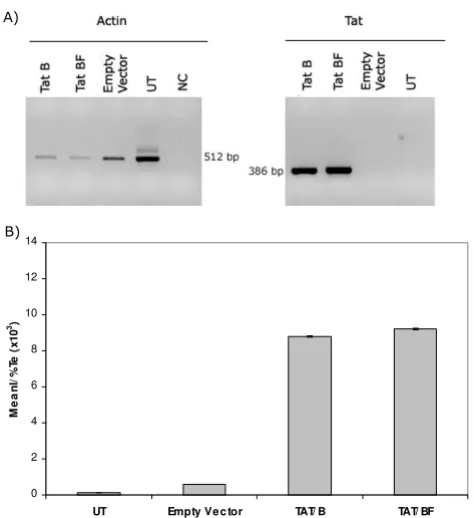
With the purpose of evaluating both protein expression and activity of our full length tat-coding constructs, GHOST cells were transiently transfected with pTATBF(ARMA159) and pTATB(NL4-3). Forty-eight hours post-transfection tat mRNA was detected by using a qualitative RT-PCR (Figure 5A). As regards Tat biological activity, it was invariably found (after four independent assays, each one in triplicate) that there is no significant difference between TatB(NL4-3) and TatBF(ARMA159) to transactivate the expression of an HIV-2 LTR-driven reporter gene (Figure 5B).
Tat capability to restore viral transactivation in HLM1 cells In order to evaluate if Tat derived from a pure HIV-1 sub-type or a prototypic recombinant form share the same ability to transactivate viral production, HLM1 cells were either pTATBF(ARMA159) or pTATB(NL4-3) transfected. Viral production was evaluated at several time points after transfection in cell culture supernatants. Qualitative RT-PCR showed that tat mRNA was readily detected as early as 6 hs post transfection (Figure 6A). However, viral pro-duction was not evident until 12 hs post-transfection (not shown). Up to 36 hs post-transfection, TatB(NL4-3) – and TatBF(ARMA159) – driven viral transactivation reached simi-lar levels (Figure 6B). However, at this time point, it was consistently seen that TatB(NL4-3) tended to show higher transactivation levels (although non-significant). In agreement with this observation, 48 hs post-transfection it was observed that TatB(NL4-3) showed a significantly improved capacity to drive viral production (p = 0.004).
Transcriptional levels of BF recombinant LTRs
Previous study has shown that LTRs from different sub-types have slightly different transcriptional capacities [29,30]. By co-transfecting 293T cells with plasmids con-taining either the LTRB(NL4-3) or LTRBF(ARMA159), and plas-mids pTatB(NL4-3) or pTatBF(ARMA159) their transcriptional activities were tested and compared. FACS analysis, per-formed 48 hs after transfections, showed an increased transcriptional level associated to the BF recombinant LTR when compared to the subtype B LTR (p = 0.02). This dif-ference was evident when pLTRBF(ARMA159) plasmid was co-transfected with pTatBF(ARMA159) (LTRBF(ARMA159) / TatBF(ARMA159) vs. LTRB(NL4-3)/TatB(NL4-3) and LTRBF(ARMA159) /TatB(NL4-3) vs. LTRBF(ARMA159) /TatBF(ARMA159)). Slightly but not significant differences in transcriptional levels were observed when LTRs were co-transfected with a Tat of dif-ferent subtype (LTRBF(ARMA159) /TatB(NL4-3) vs. LTRB(NL4-3)/ TatBF(ARMA159)) (Figure 7).
TAR structure of BF recombinant variants
Figure 4
ARCH003 and ARCH005 are samples obtained from ver-tically infected children whose genetic structure suggested the circulation of the BF recombinant forms since the mid-1980's [31]. ARCH003 has a B subtype LTR and a BF recombinant structure in the tat coding region while ARCH005 has a BF-like LTR and Tat structures. When LTR transcriptional activity from ARCH003 sample was ana-lyzed it turned out to be higher when it was transactivated by the B subtype Tat protein than when its own BF Tat pro-tein (pTatARCH003) was used (p = 0.001). ARCH005 LTR was only evaluated using the B subtype Tat and it did not show significant differences when compared to the LTRB(NL4-3)/TatB(NL4-3) complex. Unfortunately, the tat region from this sample could not be amplified.
Discussion
This study characterizes the genetic structure of LTRs sequences and Tat proteins from BF recombinant variants
and, also, analyzes the transcriptional activity associated with these recombinant variants.
LTR diversity among different HIV-1 subtypes may affect the binding of both cellular and viral transcription factors, thus influencing the transcription level. This effect, in turn, may have biological consequence for the different HIV-1 clades. Although studies on LTR transcriptional activity of different HIV-1 subtypes have been previously performed [23,29,30], the consequences of intersubtype recombination on HIV-1 transcriptional activity has not been analyzed in much detail. Moreover, most studies that involved the analysis of LTRs from different subtypes always used the B subtype Tat protein as transactivator, which hampers the proper evaluation of the results in terms of transcriptional advantages, due to sequence changes in Tat protein activity due to recombination events. In this in vitro study, a differential transcriptional activity associated to the BF recombinant LTR/Tat com-plex found in widely spread viral variants in Argentina was shown. This analysis demonstrated a higher activity for the LTRBF(ARMA159) /TatBF(ARMA159) complex when com-pared to its B subtype counterpart. It also showed that LTR and Tat proteins from different subtypes (B vs. BF) ren-dered a lower activity when Tat and LTR did not match in their subtype, i.e. LTRB(NL4-3)/TatBF(ARMA159) and LTRBF(ARMA159) /TatB(NL4-3). Phylogenetic analysis of LTR sequences from the prototypic CRF12_BF sample (ARMA159) demonstrated that it clustered together with F reference sequences. The improved transcriptional levels measured for BF recombinant LTRs are consistent with previously reported high activity of the F subtype LTR [29].
Several substitutions were found in the tat gene and in the LTR sequence from BF samples when compared to their B subtype counterparts, which may account for the improved transcriptional potential observed here. When the Tat sequence was analyzed in detail, it was found that previously reported elements considered to be crucial for Tat activity were conserved among BF viral variants thus stressing the key role of K28, K50, K51 and the basic and core domains in transactivation. These 2 regions are par-ticularly important for Tat function as they are involved in cyclin T1 binding, nuclear localization, Tat-mediated pro-apoptotic-effects and interaction with a wide subset of transcriptional coactivators and modifying enzymes [16-18]. More recently, it was found that Tat is also able to abrogate RNA silencing by inhibiting the ability of DICER to process precursor double-stranded RNAs into siRNAs. Authors demonstrate that K51 is a key residue for Tat sup-pressor of RNA silencing activity [32].
Previous publications describing HIV-1 gene expression driven by clade-specific Tat proteins found that Tat
[image:7.612.57.294.86.345.2]pro-Transactivation of GFP expression in GHOST cells
Figure 5
Transactivation of GFP expression in GHOST cells.
A) tat mRNA was detected in pTat transfected cells, but not in untransfected cells or cells transfected with empty vector, by RT-PCR (right panel). Amplification of actin mRNA was also evaluated as an internal control (left panel). B) Tat expressing vectors were capable to transactivate the expres-sion of the gfp gene placed downstream the LTR from HIV-2. No statistical difference was found between TatB(NL4-3) and
TATBF(ARMA159). UT: Untransfected cells, NC: Negative
con-trol, MeanI: Mean Fluorescence Intensity, Te: Transfection efficiency. Data presented here is representative of 4 inde-pendent assays.
0 2 4 6 8 10 12 14
UT Empty Vector TAT/ B TAT/ BF
M
e
a
nI
/%T
e
(
x10
3) B)
teins from E and C subtypes are the most active in trans-activation [33,34]. Higher transtrans-activation potential of subtype E Tat was attributed to its longer half-life, which in turn, was postulated to be dependent on its ubiquitina-tion pattern [33]. Since the E subtype Tat protein contains more lysine residues acting as ubiquitin acceptor, ubiqui-tination could occur more readily and contribute to its extended half-life. Most BF Tat variants (14 out of 23), including CRF12_BF prototypic strains have a lysine at position 24 instead of the asparagine residues that charac-terize B subtype isolates. K24 is a shared feature with the E subtype Tat and, although speculative, this may partially account for the higher activity observed for Tat BF.
In order to assess the transactivating capacity of TatB(NL4-3) vs. TatBF(ARMA159) proteins we used GHOST cells as a reporter system and also HLM1 cells to observe restora-tion of viral producrestora-tion. In GHOST cells, we were not able
to observe differences between TatB(NL4-3) and
TatBF(ARMA159). As reporter gene expression in these cells is driven by the LTR promoter from HIV-2, it is possible that both proteins, although structurally distinct, share the
same mechanism to modulate transcription in this sys-tem. In HLM1 cells, TatB(NL4-3) showed an improved abil-ity to rescue viral production from the Tat-defective provirus (which harbours a B-matched LTR). This is con-sistent with the results obtained from the co-transfection assays where the LTRB(NL4-3)/TatBF(ARMA159) combination had the lowest transcriptional potential. A naturally occurring LTRB(NL4-3)/TatBF(ARMA159) combination was observed in sample named ARCH003. Transmission of this viral variant can be tracked back to the year 1986. It was isolated from a vertically infected child with no evi-dence of reinfection. In vitro co-transfection assays showed that the LTRARCH003/TatARCH003 complex had sig-nificantly lower transactivation potential when compared to other LTR/Tat combinations but when LTRARCH003 was co-transfected with Tat B, higher expression of the reporter gene was obtained. According to the extensive molecular epidemiology data in our region, we suggest that early BF recombinant forms had a recombination breakpoint at the Vpu/Tat region but conserved the LTR of B subtype. This would render the emerging variants less competent for transcriptional activation, and natural selection would have forced the gaining of an F-like LTR. In other words, it is possible to speculate that F subtype sequences present in the BF recombinant would be advantageous for the virus since these changes would increase its fitness, in terms of transcription. Nevertheless it is not clear yet if this advantage correlates with what is observed in the field of the epidemiology.
The LTR analysis showed moderate diversity between the sequences analyzed. An extra TATA box was found in CRF12_BF sample and in other patient isolate (F121). Although this extra sequence is postulated to be inactive in other HIV subtype, i.e. E subtype, in vitro studies on this issue are currently in progress. Nucleotide changes were also found in the TAR region. This region is important for the Tat/TAR/cellular factor interactions implicated in the activation of transcription. Base changes at positions 31, 32 and 33 of the loop may affect the interaction with pro-teins Cyclin T1 and CDK9. Major TFBS appeared to be conserved between samples with the exception of RBEIII, which was found in duplicate in one sample. This factor is important for transcriptional silencing in resting infected cells and this is the most common polymorphism in clin-ical isolates. These changes could be, at least in part, related to the differential transcriptional activities observed in the BF recombinant variants.
Conclusion
In summary, data presented here shows transcriptional differences linked to the LTR and tat coding region of BF recombinants circulating in Argentina. Transcriptional improvement may be a consequence of the recombina-tion process between 2 different HIV-1 subtypes and
[image:8.612.57.292.86.345.2]selec-Restoration of viral production in HLM1 cells
Figure 6
Restoration of viral production in HLM1 cells. A) tat
mRNA was detected in pTAT transfected cells as early as 6 hours post-transfection (right panels). Amplification of actin mRNA was used as an internal control (left panels). B) Kinetic of p24 production after cell transfection with Tat encoding vectors. UT: Untransfected cells, NC: Negative control, Hs pt: Hours post-transfection. Data presented here is representative of 3 independent assays.
0 0,1 0,2 0,3 0,4 0,5 0,6 0,7 0,8 0,9 1
0 12 24 36 48 60
Hours post-tra nsfection
p2
4 a
n
tige
n
(
p
g/
m
l, x
10
6)
Ta t/ B Ta t/ BF
Em p ty vecto r UT
A)
tion forces favouring the spreading of these recombinant forms. The fitness of BF primary isolates is currently being evaluated in our laboratory. Preliminary results indicate a certain replicative advantage of BF over B isolates, in dual infection-competition assays (Rubio AE et al, manuscript in preparation). The correlation between these in vitro data and the patients' clinical outcome is still not clear due to the lack of follow-up studies in BF infected patients. Studies on viral load set-point, disease progres-sion as well as transmissibility of BF variants will be help-ful to estimate the impact of emerging recombinant HIV-1 genotypes on the spreading epidemic.
Methods
DNA samples and amplification
Extensive HIV-1 genotyping studies have been conducted by our group. Genomic DNA from HIV-1 infected patients involved in these studies was used to amplify the LTR region and tat full coding sequence. Samples previously characterized as BF intersubtype recombinant forms at the
vpu locus (F02 to F121) were obtained from newly
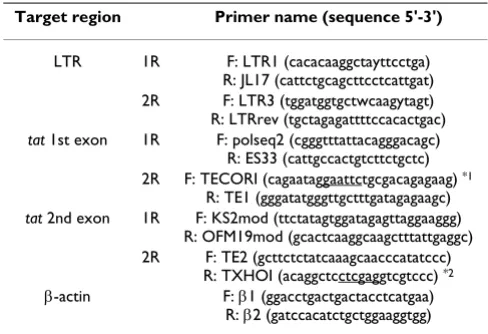
infected individuals between 2003 and 2004. ARMA159 is the prototypic strain for CRF12_BF (GenBank accession N° AF385936; [9]), ARCH003 and ARCH005 (GenBank accession N° AY037267 and N° AF454487, respectively) were obtained from children born to HIV-1 infected mothers. Full length and partial sequences of ARCH003 and ARCH005 samples are available, respectively. Both samples show recombination between B and F subtypes although ARCH005 seems to be closely related to CRF12_BF [31]. HIV-1 molecular clone pNL4-3 was used as B subtype template. LTR region (HXB2 nt -327 to 179) and first and second Tat exons were amplified by nested PCR. All reactions were conducted using the proof-read-ing Vent DNA polymerase (New England Biolabs, USA). Primers are listed in Table 1. Pasting of tat exons was per-formed in one further PCR round using primers TECORI and TXHOI. This allowed us to place both exons together in frame in one final amplicon.
Cloning and sequencing
Constructs named pLTRB(NL4-3), pLTRBF(ARMA159),
pLTRARCH003 and pLTRARCH005 were generated by cloning the LTR amplicons into the pGLOW reporter vector (Inv-itrogen, USA), upstream of the GFP reporter gene. Full length tat amplicons were cloned into the commercial expression vector pTARGET (Promega, USA) generating pTATB(NL4-3), pTATBF(ARMA159) and pTATARCH003. Colony screening was performed by colony-PCR and restriction analysis. Minipreps of positive clones were obtained (QIAprep Miniprep kit, QIAgen INC, USA) and sequenced using the Big Dye Terminator sequencing kit (Amersham, Sweden) on an automatic sequencer (Applied Biosystems DNA sequencer 3100). Nucleotide sequences were analyzed and manually adjusted using Sequencher 4.0.5 software (Gene Codes Co, USA). Selected constructs were large-scale prepared using the HighSpeed Midiprep kit (QIAgen INC) and quantified in agarose gels.
Cells and DNA transfection assays
HLM1, GHOST and 293T cell lines were used in this study. HML1 cells are HeLaT4+ cells stably transduced with a tat-defective HIV-1 molecular clone and were obtained through the AIDS Research and Reference Rea-gent Program, Division of AIDS, NIAID, NIH: HLM30 cells from Dr Reza Sadaie [35]. HLM1 cells are negative for virus particle production but they can be induced to
Transactivation of B and BF LTRs by clade B and BF specific Tat proteins (A: CRF12_BF; B: ARCH003 and ARCH005)
Figure 7
Transactivation of B and BF LTRs by clade B and BF specific Tat proteins (A: CRF12_BF; B: ARCH003 and ARCH005). 293T cells were transfected with GFP reporter constructs containing HIV-1 clade-specific LTRs in absence or presence of expression plasmids encoding Tat B(NL4-3) or
TatBF(ARMA159). Relative transactivation is expressed as mean
fluorescence obtained by FACS analysis. Cells transfected only with LTRs constructs were used as negative controls. Error bars indicate standard errors.
0 10 20 30 40 50 LTR B + T
at B
LTR B + Ta
t BF
LTR BF + Ta
t B
LTR BF +
Tat B F
LTR B
LTR BF
M ean Fl uor es ce nce 0 10 20 30 40 LTR B+ T
at B
LTR B (A
RCH 003) + Ta
t B
LTR B (A
RCH003) + Tat B
F (AR CH003
)
LTR BF (A
RCH 005) + T
express high levels of non-infectious HIV-1 and syncytial cells after transfection or coculture with tat-expressing clones. GHOST is a human osteosarcoma (HOS) derived cell line stably transduced with MV7neo-T4 retroviral vec-tor and stably co-transfected with the HIV-2 LTR driving GFP construct (Kewalramani VN, unpublished data). 293T is a highly transfectable kidney-derived epithelial cell line.
Cells were grown at 37°C and 5% CO2 in a humidified incubator. 293T cells were cultured in Dulbecco's modi-fied Eagle's medium (DMEM, Gibco BRL, USA) supple-mented with 10% fetal bovine serum (FBS, Gibco BRL), 2 mM L-glutamine (Gibco BRL), 100 U/ml penicillin (Gibco BRL) and 100 mg/ml streptomycin (Gibco BRL). GHOST cells were grown in the same medium plus 400
µg/ml geneticin (Gibco BRL). HML1 cells were cultured in DMEM supplemented with 10 µg/ml gentamicin (Gibco, BRL) and 10% FBS.
HLM1, GHOST and 293T cells transient transfections were carried out using Lipofectamine2000 (Invitrogen), following manufacturer instructions. For single transfec-tions experiments confluent cells grown in 60 mm Petri dishes were transfected with 8 µg of the corresponding pTAT construct. For 293T co-transfections, 5 µg of pLTR and 0.5 µg of pTAT were used. Untransfected cells as well as cells transfected with empty vectors were always used as negative controls. Also, empty vectors were used to keep DNA amount constant in dual transfection experiments.
RT-PCR
Total cellular RNA was extracted from 107 cells using Tri-zol reagent (Gibco BRL). Three µg of RNA were reverse transcribed using MMLV reverse transcriptase (Invitrogen) and an oligo-dT primer. The mix was supplemented with RNAse inhibitors (Invitrogen) in a final volume of 20 µl. Two µl of cDNA were used for tat PCR amplification using TECOI and TXHOI primers. Amplification of β-actin was used as RNA quality control. Actin PCR was also per-formed on 2 µl of the RT reaction using primers β1 and
β2-actin (Table 1).
GFP transactivation in GHOST cells
The use of the green fluorescent protein (GFP) gene as a reporter molecule has been widely used to study the tran-scriptional activity of the HIV LTRs from different isolates. The fluorescence intensity of GFP is a direct measurement of the transcriptional activity of the promoter that directs the expression of the protein. Upon infection or transfec-tion of cultured cells with a Tat coding plasmid, GFP expression can be measured using a fluorescence activated cell sorter. One of the main advantages in using this sys-tem is that it is possible to simultaneously measure trans-fection efficiency and fluorescence intensity of the
transfected live cells without the need of co-transfection of a reference plasmid [36,37].
Tat constructs were used for single transfections of GHOST cells. Expression of the reporter gene was ana-lyzed by flow cytometry (FACS Coulter Epics XL, Becton Dickinson, USA) in cells harvested 48 hs post-transfec-tion. Living cells were gated by forward angle and side-scatter light. A minimum of 10,000 events were collected for each histogram. Analytical gates were set such that 1% or fewer of negative control cells fell within the positive regions. Data analysis was carried out using System II soft-ware (Beckman Coulter INC, USA). Four independent assays were conducted, each in triplicate. Data was expressed as the Mean Fluorescence Intensity (MeanI)/% of GFP positive cells ratio.
Restoration of transactivation in HLM1 cells
Tat constructs were used for single transfections of HLM1 cells. Cell culture supernatants were collected 6, 12, 24, 36 and 48 hs post-transfection in order to evaluate viral pro-duction. p24 titers were subsequently determined through a commercial ELISA assay (Murex, Abbott, USA) including a calibration curve. Three independent assays were conducted, each in triplicate.
Subtype-specific LTR transactivation assays
293T were double transfected with different pLTR and pTat constructs. Expression of the reporter gene driven by the interaction between Tat and the corresponding LTR sequence was analyzed by flow cytometry as described above.
Statistical analysis
All data was expressed as mean ± SD unless, otherwise stated. Significance (p < 0.05) between means of two experimental groups was evaluated using the Student's t test for independent samples (through the Primer of Biostatistics version 4.02 software).
Phylogenetic and TFBS analysis
sub-regions of the alignment were re-analyzed by neighbor-joining with bootstrapping to confirm the subtype assign-ment. Reference sequences included in the analysis were those recommended by the Los Alamos HIV sequence database http://hiv-web.lanl.gov.
LTR sequences were also analyzed in search of transcrip-tion factors binding sites (TFBS) using a web-based method (TFSEARCH Data Base, http://www.cbrc.jp/ research/db/TFSEARCH.html).
Competing interests
The authors declare that they have no competing interests.
Authors' contributions
GT and MC contributed equally to this work designing and performing the experiments and during the manu-script preparation. AM provided help with LTR amplifica-tion and cloning. AER participated during the experimental design and provided technical help. MGC helped with phylogenetic analysis and data interpreta-tion. HS supervised experimental design and writing of the manuscript. All authors read and approved the final manuscript.
Acknowledgements
We thank Dario Dilernia for providing DNA samples from BF infected patients as well as Mariel Bibini and Monica Saracco for their excellent tech-nical assistance on flow cytometry.
Gabriela Turk and Mauricio Carobene were supported by the Argentinean National Research Council (CONICET) and Fogarty International Center/ NIH grant through the AIDS International Training and Research Program at Mount Sinai School of Medicine-Argentina Program (Grant # 5D43 TW0010137), respectively. This research has been also partially funded by the Argentinean Agency for the Promotion of Science and Technology (ANPCYT, Grant N° 14104).
We would also like to thank Mr. Sergio Mazzini for assistance during the preparation of the manuscript for publication.
References
1. Jones JS, Allan RW, Temin HM: One retroviral RNA is sufficient for synthesis of viral DNA. J Virol 1994, 68(1):207-216. 2. Mansky LM, Temin HM: Lower in vivo mutation rate of human
immunodeficiency virus type 1 than that predicted from the fidelity of purified reverse transcriptase. J Virol 1995,
69(8):5087-5094.
3. Robertson DL, Sharp PM, McCutchan FE, Hahn BH: Recombination in HIV-1. Nature 1995, 374(6518):124-126.
4. Robertson DLGFHBHSM: Intersubtype recombinant HIV-1 sequences. In Human retroviruses and AIDS: a compilation and analysis of nucleic acid and amino acid sequences Edited by: Korber BHBFB-MJWLLMGMCFKC. Los Alamos, NM , Los Alamos National Labora-tory; 1997:III-25 - III-30.
5. Gao F, Robertson DL, Morrison SG, Hui H, Craig S, Decker J, Fultz PN, Girard M, Shaw GM, Hahn BH, Sharp PM: The heterosexual human immunodeficiency virus type 1 epidemic in Thailand is caused by an intersubtype (A/E) recombinant of African origin. J Virol 1996, 70(10):7013-7029.
6. Renjifo B, Chaplin B, Mwakagile D, Shah P, Vannberg F, Msamanga G, Hunter D, Fawzi W, Essex M: Epidemic expansion of HIV type 1 subtype C and recombinant genotypes in Tanzania. AIDS Res Hum Retroviruses 1998, 14(7):635-638.
7. Avila MM, Pando MA, Carrion G, Peralta LM, Salomon H, Carrillo MG, Sanchez J, Maulen S, Hierholzer J, Marinello M, Negrete M, Rus-sell KL, Carr JK: Two HIV-1 epidemics in Argentina: different genetic subtypes associated with different risk groups. J Acquir Immune Defic Syndr 2002, 29(4):422-426.
8. Carobene MG, Rubio AE, Carrillo MG, Maligne GE, Kijak GH, Quarl-eri JF, Salomon H: Differences in frequencies of drug resist-ance-associated mutations in the HIV-1 pol gene of B subtype and BF intersubtype recombinant samples. J Acquir Immune Defic Syndr 2004, 35(2):207-209.
9. Carr JK, Avila M, Gomez Carrillo M, Salomon H, Hierholzer J, Watan-aveeradej V, Pando MA, Negrete M, Russell KL, Sanchez J, Birx DL, Andrade R, Vinoles J, McCutchan FE: Diverse BF recombinants have spread widely since the introduction of HIV-1 into South America. Aids 2001, 15(15):F41-7.
10. Quarleri JF, Rubio A, Carobene M, Turk G, Vignoles M, Harrigan RP, Montaner JS, Salomon H, Gomez-Carrillo M: HIV type 1 BF recombinant strains exhibit different pol gene mosaic pat-terns: descriptive analysis from 284 patients under treat-ment failure. AIDS Res Hum Retroviruses 2004, 20(10):1100-1107. 11. Wu Y: HIV-1 gene expression: lessons from provirus and
non-integrated DNA. Retrovirology 2004, 1(1):13.
12. Barboric M, Peterlin BM: A new paradigm in eukaryotic biology: HIV Tat and the control of transcriptional elongation. PLoS Biol 2005, 3(2):e76.
13. Brady J, Kashanchi F: Tat gets the "green" light on transcription initiation. Retrovirology 2005, 2:69.
14. Li L, Li HS, Pauza CD, Bukrinsky M, Zhao RY: Roles of HIV-1 aux-iliary proteins in viral pathogenesis and host-pathogen inter-actions. Cell Res 2005, 15(11-12):923-934.
15. Raha T, Cheng SW, Green MR: HIV-1 Tat stimulates transcrip-tion complex assembly through recruitment of TBP in the absence of TAFs. PLoS Biol 2005, 3(2):e44.
16. Brigati C, Giacca M, Noonan DM, Albini A: HIV Tat, its TARgets and the control of viral gene expression. FEMS Microbiol Lett 2003, 220(1):57-65.
17. Huigen MC, Kamp W, Nottet HS: Multiple effects of HIV-1 trans-activator protein on the pathogenesis of HIV-1 infection. Eur J Clin Invest 2004, 34(1):57-66.
18. Marcello A, Lusic M, Pegoraro G, Pellegrini V, Beltram F, Giacca M:
Nuclear organization and the control of HIV-1 transcription.
Gene 2004, 326:1-11.
19. Hetzer C, Dormeyer W, Schnolzer M, Ott M: Decoding Tat: the biology of HIV Tat posttranslational modifications. Microbes Infect 2005, 7(13):1364-1369.
20. Bres V, Kiernan RE, Linares LK, Chable-Bessia C, Plechakova O, Tre-and C, Emiliani S, Peloponese JM, Jeang KT, Coux O, Scheffner M, Benkirane M: A non-proteolytic role for ubiquitin in Tat-medi-Table 1: List of primers used for PCR amplification
Target region Primer name (sequence 5'-3')
LTR 1R F: LTR1 (cacacaaggctayttcctga) R: JL17 (cattctgcagcttcctcattgat) 2R F: LTR3 (tggatggtgctwcaagytagt) R: LTRrev (tgctagagattttccacactgac)
tat 1st exon 1R F: polseq2 (cgggtttattacagggacagc) R: ES33 (cattgccactgtcttctgctc) 2R F: TECORI (cagaataggaattctgcgacagagaag) *1
R: TE1 (gggatatgggttgctttgatagagaagc)
tat 2nd exon 1R F: KS2mod (ttctatagtggatagagttaggaaggg) R: OFM19mod (gcactcaaggcaagctttattgaggc) 2R F: TE2 (gcttctctatcaaagcaacccatatccc)
R: TXHOI (acaggctcctcgaggtcgtccc) *2
β-actin F: β1 (ggacctgactgactacctcatgaa) R: β2 (gatccacatctgctggaaggtgg)
1R = 1st round, 2R = 2nd round. Introduced EcoRI (*1) and XhoI (*2)
[image:11.612.53.297.100.267.2]Publish with BioMed Central and every scientist can read your work free of charge "BioMed Central will be the most significant development for disseminating the results of biomedical researc h in our lifetime."
Sir Paul Nurse, Cancer Research UK
Your research papers will be:
available free of charge to the entire biomedical community
peer reviewed and published immediately upon acceptance
cited in PubMed and archived on PubMed Central
yours — you keep the copyright
Submit your manuscript here:
http://www.biomedcentral.com/info/publishing_adv.asp
BioMedcentral
ated transactivation of the HIV-1 promoter. Nat Cell Biol 2003,
5(8):754-761.
21. Kuppuswamy M, Subramanian T, Srinivasan A, Chinnadurai G: Multi-ple functional domains of Tat, the trans-activator of HIV-1, defined by mutational analysis. Nucleic Acids Res 1989,
17(9):3551-3561.
22. Brake DA, Debouck C, Biesecker G: Identification of an Arg-Gly-Asp (RGD) cell adhesion site in human immunodeficiency virus type 1 transactivation protein, tat. J Cell Biol 1990,
111(3):1275-1281.
23. van Opijnen T, Kamoschinski J, Jeeninga RE, Berkhout B: The human immunodeficiency virus type 1 promoter contains a CATA box instead of a TATA box for optimal transcription and replication. J Virol 2004, 78(13):6883-6890.
24. Chen J, Malcolm T, Estable MC, Roeder RG, Sadowski I: TFII-I reg-ulates induction of chromosomally integrated human immu-nodeficiency virus type 1 long terminal repeat in cooperation with USF. J Virol 2005, 79(7):4396-4406.
25. Estable MC, Bell B, Hirst M, Sadowski I: Naturally occurring human immunodeficiency virus type 1 long terminal repeats have a frequently observed duplication that binds RBF-2 and represses transcription. J Virol 1998, 72(8):6465-6474.
26. Koken SE, van Wamel JL, Goudsmit J, Berkhout B, Geelen JL: Natu-ral variants of the HIV-1 long terminal repeat: analysis of promoters with duplicated DNA regulatory motifs. Virology 1992, 191(2):968-972.
27. Berkhout B: Structural features in TAR RNA of human and simian immunodeficiency viruses: a phylogenetic analysis.
Nucleic Acids Res 1992, 20(1):27-31.
28. Lund LH, Wahren B, Garcia-Blanco MA: A functional genetic approach suggests a novel interaction between the human immunodeficiency virus type 1 (1) Tat protein and HIV-1 TAR RNA in vivo. J Gen Virol 2003, 84(Pt 3):603-606. 29. Jeeninga RE, Hoogenkamp M, Armand-Ugon M, de Baar M, Verhoef
K, Berkhout B: Functional differences between the long termi-nal repeat transcriptiotermi-nal promoters of human immunodefi-ciency virus type 1 subtypes A through G. J Virol 2000,
74(8):3740-3751.
30. van Opijnen T, Jeeninga RE, Boerlijst MC, Pollakis GP, Zetterberg V, Salminen M, Berkhout B: Human immunodeficiency virus type 1 subtypes have a distinct long terminal repeat that deter-mines the replication rate in a host-cell-specific manner. J Virol 2004, 78(7):3675-3683.
31. Gomez Carrillo M, Avila M, Hierholzer J, Pando M, Martinez PL, McCutchan FE, Carr JK: Mother-to-child HIV type 1 transmis-sion in Argentina: BF recombinants have predominated in infected children since the mid-1980s. AIDS Res Hum Retrovi-ruses 2002, 18(7):477-483.
32. Bennasser Y, Le SY, Benkirane M, Jeang KT: Evidence that HIV-1 encodes an siRNA and a suppressor of RNA silencing. Immu-nity 2005, 22(5):607-619.
33. Desfosses Y, Solis M, Sun Q, Grandvaux N, Van Lint C, Burny A, Gatignol A, Wainberg MA, Lin R, Hiscott J: Regulation of human immunodeficiency virus type 1 gene expression by clade-spe-cific Tat proteins. J Virol 2005, 79(14):9180-9191.
34. Kurosu T, Mukai T, Komoto S, Ibrahim MS, Li YG, Kobayashi T, Tsuji S, Ikuta K: Human immunodeficiency virus type 1 subtype C exhibits higher transactivation activity of Tat than subtypes B and E. Microbiol Immunol 2002, 46(11):787-799.
35. Sadaie MR, Tschachler E, Valerie K, Rosenberg M, Felber BK, Pavlakis GN, Klotman ME, Wong-Staal F: Activation of tat-defective human immunodeficiency virus by ultraviolet light. New Biol 1990, 2(5):479-486.
36. Daelemans D, De Clercq E, Vandamme AM: A quantitative GFP-based bioassay for the detection of HIV-1 Tat transactivation inhibitors. J Virol Methods 2001, 96(2):183-188.