City, University of London Institutional Repository
Citation
:
Sadeh, Tamar (2010). A model of scientists' information seeking and a user-interface design. (Unpublished Doctoral thesis, City University London)This is the unspecified version of the paper.
This version of the publication may differ from the final published
version.
Permanent repository link:
http://openaccess.city.ac.uk/1170/Link to published version
:
Copyright and reuse:
City Research Online aims to make research
outputs of City, University of London available to a wider audience.
Copyright and Moral Rights remain with the author(s) and/or copyright
holders. URLs from City Research Online may be freely distributed and
linked to.
City Research Online: http://openaccess.city.ac.uk/ [email protected]
A Model of Scientists’
Information Seeking
and a
User-Interface Design
Tamar Sadeh
A Thesis Submitted in Fulfilment of the Requirements for the Degree of Doctor of Philosophy
City University London
School of Informatics Information Science
Supervisors
Dr. Andrew MacFarlane Prof. Stephen Robertson
Tamar Sadeh, Cape Cod, November 2008
The real voyage of discovery consists not in seeking new landscapes, but in having new eyes.
Contents
List of Figures... xi
Acknowledgements ... xv
Abstract...xvii
Chapter 1 Introduction ...1
1.1 Motivation...4
1.2 Research Hypothesis ...4
1.3 Aims and Objectives...4
1.4 Contribution ...6
1.5 Case Study ...6
1.6 Research ...7
1.6.1 Interviews ...8
1.6.2 Survey Analysis...8
1.6.3 Personas ...9
1.6.4 Research and Work Experience ...9
1.6.5 Information-Seeking Model ...9
1.6.6 User-Interface Design ... 10
1.7 Design and Evaluation Processes... 11
1.8 Structure of the Thesis ... 12
1.9 Previous Publications by This Author ... 13
Chapter 2 Literature Review ... 15
2.1 Introduction ... 15
2.2 Information Seeking and Retrieval: Terminology and Models ... 17
2.2.1 Terminology... 18
2.2.1.1 Information Behaviour ... 18
2.2.1.2 Information Need... 19
2.2.1.3 Information-Seeking Behaviour ... 19
2.2.1.4 Information-Searching Behaviour ... 20
2.2.1.5 Information-Use Behaviour... 20
2.2.2 Models ... 21
2.2.2.1 Wilson’s Models of Information Behaviour and Information-Seeking Behaviour ... 22
2.2.2.2 Dervin’s Sense-Making Model... 24
2.2.2.4 Kuhlthau’s Process Model ... 27
2.2.2.5 Bates’s Models... 29
2.2.2.6 Belkin’s Modes of Interaction ... 33
2.2.2.7 The Information-Seeking Process According to Marchionini... 35
2.3 User Studies ... 35
2.4 User-Interface Design... 49
2.5 Personas ... 53
2.6 Information Systems and Scholarly Communication in the High-Energy Physics Community ... 54
Chapter 3 Information-Seeking Behaviour in the High-Energy Physics Community ... 57
3.1 Introduction ... 57
3.2 HEP Community-Based Information Systems ... 58
3.3 HEP-Related Research for This Thesis ... 61
3.4 Methodology ... 61
3.5 Researchers’ Preferred Information Systems ... 64
3.6 Researchers’ Information-Seeking Process... 67
3.7 Researchers’ Evaluation of Information Systems... 69
3.7.1 Coverage Offered by an Information System ... 69
3.7.2 Means of Finding the Information... 75
3.7.3 Effort Required to Find and Obtain Information ... 76
3.7.4 User Friendliness of an Information System... 79
3.7.5 Related Services Offered by an Information System... 81
3.8 Characteristics of the User Community... 81
3.9 Information Systems as Community Tools ... 85
3.9.1 Comments Related to SPIRES and arXiv as Community-Developed and Community-Maintained Resources... 85
3.9.2 Comments about SPIRES and arXiv as Open, Free Tools... 86
3.10 Discussion ... 87
3.10.1 Creation of, Cultivation of, and Reliance on Collaborative Information Systems... 87
3.10.2 Loyalty to and Trust in the Community’s Information Providers ... 88
3.10.3 Open-Access Philosophy ... 88
3.10.4 Preference for a High-Quality, Focused Information Corpus ... 88
3.10.6 Use of Several Information Systems to Satisfy All Information
Needs ... 89
3.10.7 Perceived Need for Better Interdisciplinary Coverage by the Existing Information Systems... 89
3.10.8 Need to Keep Abreast of New Materials ... 89
3.10.9 Use of Several Techniques Besides Searching to Satisfy Information Needs ... 90
3.10.10 Online Reading Used Almost Exclusively ... 90
3.10.11 Differing Information-Seeking Patterns According to Experience in the Field ... 90
3.11 Conclusions... 90
Chapter 4 Personas ... 93
4.1 What Are Personas, and Why Use Them?... 93
4.2 Creating Personas ... 96
4.3 HEP Personas ... 100
4.3.1 Persona A: Ed ... 100
4.3.2 Persona B: Laura ... 101
4.3.3 Persona C: Kevin ... 103
4.3.4 Persona D: Guy ... 104
4.3.5 Persona E: Hiro ... 106
4.3.6 Persona F: George ... 107
4.4 Evaluation of the Personas ... 108
4.5 Conclusions... 110
Chapter 5 Information-Seeking Model of HEP Researchers ... 111
5.1 The Scholarly Materials ... 111
5.2 The User... 115
5.3 Existing Models Applied to HEP ... 115
5.4 HEP Information-Seeking Model ... 128
5.5 HEP Information-Searching Model ... 133
5.6 Testing the Model via the Personas... 139
5.6.1 Scenario 1 ... 141
5.6.2 Scenario 2 ... 144
5.6.3 Scenario 3 ... 147
5.6.4 Scenario 4 ... 151
5.6.5 Scenario 5 ... 157
5.6.7 Scenario 7 ... 161
5.7 Conclusions... 164
Chapter 6 User-Interface Design Derived from an Information-Seeking Model. ... 167
6.1 Introduction ... 167
6.2 The Need for a New User-Interface Design ... 167
6.3 Overall Approach to an Actual User-Interface Design... 168
6.4 General Recommendations ... 169
6.4.1 Opening Up the Search Scope ... 169
6.4.2 Setting Researcher Profiles ... 170
6.5 Requirements for HEP User Interface ... 171
6.6 Computing Requirements ... 173
6.7 Accessibility ... 173
6.8 General Layout ... 174
6.8.1 Entities to Be Searched ... 177
6.8.1.1 Scholarly Materials ... 177
6.8.1.2 People ... 177
6.8.1.3 Conferences ... 178
6.8.1.4 Institutions ... 178
6.8.2 Search Interface... 178
6.8.3 Query ... 179
6.8.4 Result List and Full-Record Display... 181
6.9 Navigation from a Selected Item ... 183
6.9.1 Metadata Fields ... 183
6.9.2 References ... 183
6.9.3 Citations... 184
6.9.4 Tags ... 184
6.9.5 Suggestions... 184
6.10 Navigation Options Not Related to Searches... 184
6.11 Services ... 185
6.12 Community Tools ... 185
6.12.1 Reviews and Ratings... 186
6.12.2 Tagging ... 186
6.12.3 Recommendations ... 186
6.13 Researcher Preferences ... 186
6.14.1 Entering the System ... 187
6.14.2 Querying... 188
6.14.3 Faceted Browsing ... 189
6.14.4 Focusing on an Item ... 193
6.14.5 Navigating... 193
6.15 How the Proposed User Interface Concretizes the Information-Seeking Model ... 195
6.16 Evaluation of the Suggested User Interface... 204
6.17 Long-Term Monitoring of the New User Interface ... 209
6.17.1 Log Files ... 210
6.17.1.1 Sessions... 210
6.17.1.2 Queries ... 211
6.17.1.3 Facets ... 211
6.17.1.4 Search Results ... 212
6.17.1.5 Services ... 212
6.17.1.6 Tiles ... 212
6.17.1.7 Full-text availability... 212
6.17.1.8 User Settings ... 213
6.17.2 Survey... 213
6.17.3 User Feedback ... 213
6.17.4 Interviews... 213
6.18 Conclusions... 214
Chapter 7 Conclusions and Future Research Directions ... 215
Appendix A: Interviews with High-Energy Physics (HEP) Researchers ... 225
1. Alan... 226
2. Benjamin ... 228
3. Colin ... 230
4. David ... 232
5. Elena ... 233
6. Fred... 235
7. Gordon... 236
Appendix B: List of Publications... 237
List of Figures
Figure 1: Process and products of this research ...8
Figure 2: Design and evaluation ... 11
Figure 3: Context of this study... 16
Figure 4: Dervin's situation-gap-use model ... 24
Figure 5: Kuhlthau's information search process (ISP)... 28
Figure 6: Wilson's comparison of Ellis's and Kuhlthau's frameworks. ... 29
Figure 7: The classic information-retrieval model. ... 29
Figure 8: The Bates berrypicking model, with an evolving search. ... 31
Figure 9: Modes of information seeking proposed by Bates... 32
Figure 10: Belkin et al.’s modes of interaction. ... 34
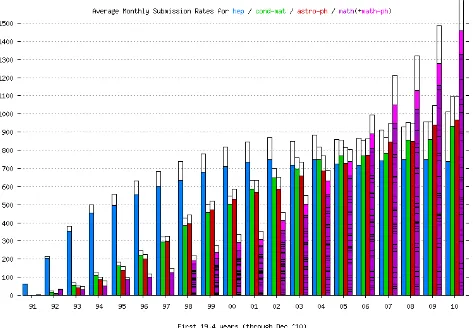
Figure 11: Average monthly submission rate to arXiv, by discipline, 1990-2009.60 Figure 12: HEP information systems used most by HEP community members. .. 65
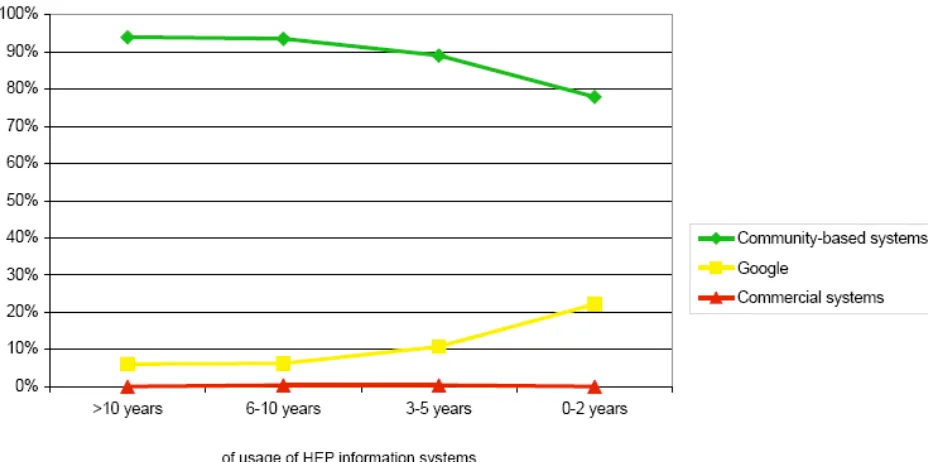
Figure 13: Percentage of HEP community using HEP information systems... 66
Figure 14: Breakdown of HEP scientists’ favourite information systems. ... 68
Figure 15: HEP-related information landscape. ... 70
Figure 16: Comments on content coverage of information systems. ... 72
Figure 17: The appeal of the search interface of SPIRES. ... 77
Figure 18: The appeal of the ease of use of SPIRES. ... 80
Figure 19: Distribution of survey respondents per country. ... 82
Figure 20: Distribution of survey responses by number of years of experience. . 83
Figure 21: Frequency of HEP information system use by theorists and experimentalists ... 84
Figure 22: A representation of scholarly materials as linked objects... 114
Figure 23: The Bates model applied to HEP ... 116
Figure 24: The four dimensions of the action of searching for content in SPIRES. ... 118
Figure 25: The four dimensions of browsing through new arXiv submissions. .. 119
Figure 26: Wilson's information behaviour model. ... 120
Figure 27: Wilson’s information-seeking behaviour model. ... 122
Figure 28: Wilson's 1996 model of information behaviour. ... 123
Figure 29: Wilson’s sequence of Ellis's feature set of information-seeking behaviour. ... 124
Figure 31: Ellis's feature set adapted to HEP practices ... 126
Figure 32: Marchionini's information-seeking model. ... 127
Figure 33: Information-seeking model of HEP researchers... 129
Figure 34: A page of new submissions... 131
Figure 35: A metadata record displayed in SPIRES... 132
Figure 36: Reference list in SRIRES ... 133
Figure 37: A model of information searching ... 134
Figure 38: Legend for figures 39 through 62 ... 140
Figure 39: The information-seeking model applied to scenario 1, step I ... 141
Figure 40: The information-seeking model applied to scenario 1, step II ... 142
Figure 41: The information-searching model applied to scenario 1, step III .... 143
Figure 42: The information-searching model applied to scenario 2, step I... 144
Figure 43: The information-searching model applied to scenario 2, step II... 145
Figure 44: The information-searching model applied to scenario 2, step III .... 146
Figure 45: The information-searching model applied to scenario 3, step I... 147
Figure 46: The information-searching model applied to scenario 3, step II... 148
Figure 47: The information-seeking model applied to scenario 3, step III ... 149
Figure 48: The information-seeking model applied to scenario 3, step IV... 150
Figure 49: The information-searching model applied to scenario 4, step I... 151
Figure 50: The information-seeking model applied to scenario 4, step II ... 152
Figure 51: The information-searching model applied to scenario 4, step III .... 153
Figure 52: The information-searching model applied to scenario 4, step IV... 154
Figure 53: The information-searching model applied to scenario 4, step V ... 155
Figure 54: The information-seeking model applied to scenario 4, step VI... 156
Figure 55: The information-searching model applied to scenario 5... 157
Figure 56: The information-seeking model applied to scenario 6, step I ... 158
Figure 57: The information-searching model applied to scenario 6, step II... 159
Figure 58: The information-searching model applied to scenario 6, step III .... 160
Figure 59: The information-searching model applies to scenario 7, step I ... 161
Figure 60: The information-searching model applied to scenario 7, step II... 162
Figure 61: The information-searching model applied to scenario 7, step III .... 163
Figure 62: The information-searching model applied to scenario 7, step IV... 164
Figure 63: An iGoogle tile-based screen ... 175
Figure 64: The general layout of the proposed INSPIRE screen ... 176
Figure 65: Main entry point to the INSPIRE Web interface... 187
Figure 68: Result list narrowed down by the selection of a facet value. ... 192
Figure 69: The researcher selecting an item to focus on (the orange rectangle). ... 192
Figure 70: Display of items related to the item in focus ... 193
Figure 71: Item in focus... 194
Figure 72: A refreshed screen. ... 194
Figure 73: Entry points to the information-seeking process. ... 196
Figure 74: Browsing through lists of automated updates ... 196
Figure 75: Focusing on an item of interest ... 197
Figure 76: Searching by entering search terms and setting search preferences 198 Figure 77: Reformulating the query ... 199
Figure 78: Narrowing down the list by adding query terms... 200
Figure 79: Narrowing down the list by using the system’s options ... 200
Figure 80: Faceted browsing... 201
Figure 81: Result list that is narrowed down... 201
Figure 82: Focusing on an item ... 202
Figure 83: Lists of related items ... 202
Figure 84: Navigating to related items ... 203
Figure 85: New item becoming the item in focus... 203
Figure 86: Matrix showing the likelihood of a persona to use a proposed feature, part 1... 205
Figure 87: Matrix showing the likelihood of a persona to use a proposed feature, part 2... 206
Acknowledgements
I wish to thank Dr. Andrew MacFarlane and Professor Stephen Robertson, my supervisors, for their support, encouragement, and invaluable suggestions throughout my PhD studies. I especially appreciate the wealth of knowledge in the area of information seeking and retrieval that they shared with me and their willingness to support me from afar. A special thank-you goes to Dr. MacFarlane for his interest and attentiveness and for navigating all the administrative hurdles on my behalf.
I extend my sincere thanks to the high-energy physics (HEP) information specialists—Anne Gentil-Beccot, Annette Holtkamp, Jens Vigen, and Salvatore Mele from CERN; Travis Brooks from SLAC; and Heath O’Connell from Fermilab— who shared with me the raw results of the HEP survey and their vision of the INSPIRE information system and who provided me with constructive comments on the manuscript of my first publication on the information-seeking practices of the high-energy physics community. I also wish to thank this team for inviting me to their meetings and giving me the opportunity to play a modest role in the development of the new HEP information system.
To Professor Yosef Nir, dean of the physics faculty at the Weizmann Institute of Science, who introduced me to the high-energy physics arena and, through a long series of conversations and e-mail exchanges, helped me understand the special character of the scientists and their information-seeking behaviour, I am
extremely grateful. My thanks go also to the other HEP scientists who shared with me their perceptions and practices related to information seeking.
I thank Matti Shem Tov, president and CEO of Ex Libris, and Nancy Dushkin, corporate vice president, who supported my wish to study, facilitated the time that I needed to achieve my goal, and showed their appreciation of my efforts.
I thank Ricka S. Rak, a great friend and mentor, who was there for me all along with her wise advice and who over the years has enthusiastically shared with me her many tips of the craft of writing.
I am deeply and forever indebted to my beloved parents, Miriam and Prof. Yochanan Ramon, whose wide horizons, endless curiosity, and striving for excellence have been my guiding light.
Very special thanks go to my beloved husband, Kai, and sons, Jonathan and Michael, who were supportive and proud of me throughout my studies and were willing to sacrifice time with me so that I could devote my energies to the thesis.
Abstract
Information systems that are available today do not optimally address the information-seeking behaviour of scholars, particularly those who belong to scientific communities; as a result, scholarly discovery is often cumbersome and incomplete. The hypothesis of this study is that an information-seeking system that is designed to address the nature of scholarly materials and the information-seeking behaviour of scholars, particularly the members of one scientific
community, will increase the effectiveness of the scholars’ searches and enable them to find and obtain relevant materials with greater ease and precision than current practices do.
The information-seeking behaviour and search practices deployed by high-energy physics (HEP) researchers are explored through a series of interviews and
observations. More than 2,100 responses obtained from a HEP survey are also examined; in particular, the participants’ open-ended responses are analysed. On the basis of qualitative and quantitative research regarding the characteristics of HEP scientists and their information-seeking practices, a set of six personas, representing typical members of the HEP community, is constructed.
An original model is developed that leverages existing models of information behaviour, information seeking, and information searching and reflects the full spectrum of active information-seeking and information-searching practices of HEP scholars and the nature of the data that these researchers seek. The model is then evaluated by means of seven scenarios involving the personas constructed earlier.
research—and research of other scholarly communities that share some of the HEP community’s characteristics—by shortening the search process and improving the findability of quality materials.
This thesis contributes to the body of information-science knowledge in the novel modelling of information-seeking behaviour of a well-defined scientific
Chapter 1
Introduction
Scholarly materials have always been the basis for academic research, and in the past, a major differentiator of research institutions was the size and quality of their library’s physical collections. The electronic era, and later the invention of the Internet, introduced a new reality, where physical limitations of location and space were eliminated and access to materials could be granted from anywhere and at any time.
The first information systems to be provided electronically were library
catalogues, enabling users to search for carefully described physical materials; yet the provision of the materials themselves—books, manuscripts, maps, music scores, audio and video recordings, and more—was still physical. Hence, users were limited to a library that they could access in person, or else they had to wait for materials that were brought to their library from other locations.
Providers of abstracting and indexing collections started digitizing their collections in the mid-1980s, first offering the digitized versions to users on physical devices that were available only at a library and, more recently, providing access to the collections through the Internet. Such materials are typically licensed and are thus available only to users affiliated with institutions that can afford to pay a subscription fee.
The next step was the electronic publishing of the materials themselves—first articles, and later, conference proceedings, reports, books, and other scholarly materials. Today, most articles and many books are published electronically; in some disciplines (primarily science, technology, and medicine), almost all recent research materials are available electronically, and researchers tend to seek out these electronic versions. However, the majority of the materials are licensed, and hence access is regulated.
Theoretically, users can access all electronic materials no matter where the users are or what day of the week or time of day it is. However, in practice, users face several obstacles when they seek scholarly materials. The first, already
by the researcher’s institution, but gaining access is not always a straightforward process, especially when the researcher is not physically present at the
institution. Furthermore, because materials are typically available from several providers and several Web sites, hypertext links that facilitate the access to such materials do not always link users to the copy of the material that is licensed by their institution (referred to in the library world as the ‘appropriate’ copy). Various technologies address these challenges, including proxy servers and OpenURL link resolvers.1
The actual locating of the desired materials is the other—and even greater— challenge for users. A variety of information systems is available today: some are very general, all-purpose systems, such as Web search engines; others are general academic systems, such as library catalogues, multidisciplinary databases, and emerging discovery services offering materials in local library collections as well as electronically published materials; and still others are very specific, targeted systems, such as subject-specific databases. As a result, a researcher is confronted with various user interfaces, search mechanisms, and levels of quality of the retrieved materials. Furthermore, the exponential growth of the number of publications poses the challenge of how to review a long list of search results that all have some relevance to a specific topic.
Surveys monitoring the changing behaviour of library users show a clear tendency towards the use of Web search engines and other Web resources instead of
library catalogues and other library resources (OCLC 2005, 2006, 2007; Markey 2007a; CIBER/UCL 2008; Connaway and Dickey 2010). The publication of the OCLC Online Computer Library Center survey Perceptions of Libraries and
Information Resources: A Report to the OCLC Membership in late 2005 (OCLC
2005), followed by a report focusing only on college students who participated in that survey (OCLC 2006), confirms what libraries already knew: that the
behaviour of library users, particularly students, has changed since the
emergence of Web search engines, online bookstores, and other Web-based services that enable many users to satisfy their information needs without the help of the library. According to the 2006 OCLC report, 89% of the undergraduate and graduate students surveyed start their search for information with Web search engines, and only 2% start at their library Web site (OCLC 2006). A later OCLC survey, published in 2007, reveals that while respondents had taken advantage of Web services such as Web search engines, blogs, and online bookstores even more intensively in the two years since the 2005 survey, one Web service that was included in the survey exhibited decreased usage during that period—library Web sites (OCLC 2007).
Other statistical data support this trend, even though the picture portrayed by such data is not as grave. For example, statistics compiled by the Association of Research Libraries (ARL), whose membership spans North America, indicate a significant decrease in reference transactions (33%) and circulation transactions (6%) at ARL institutions between 2000 and 2006, despite an increase of about 12% in the number of students enrolled in the member institutions at that time (see http://www.arl.org/stats/annualsurveys/arlstats/statxls.shtml).
The findings described thus far address the behaviour of the general body of library users. When the behaviour of researchers is examined, the findings are slightly different (Brown 1999; Murphy 2003; RIN 2006; Hemminger et al. 2007; Jamali and Nicholas 2008; Gentil-Beccot et al. 2008; Haines et al. 2010).
However, it is clear that even in research communities, users are drawn to the simplicity and ease of use of Web search engines. Because most scholarly
materials are discoverable through multiple interfaces, users may well be able to obtain the same materials through Web search engines and academic systems— without facing the challenges posed by the latter. However, Web search engines come with their own drawbacks, particularly the limited searching and filtering options available to users and a search scope that comprises a universe of materials of unequal quality. Furthermore, library-driven services such as bibliographic tools and citation analyses are not available through Web search engines. Hence, most researchers rely on more than one type of information system and typically use both library-oriented systems and Web search engines. This dual information-seeking behaviour that characterises the academic
1.1
Motivation
Overwhelmed by complex human-machine interfaces, users today are drawn to software solutions that require little expertise and minimal effort. However, as academic users are surely aware, such systems may not be as reliable and trustworthy as systems that libraries and information providers offer.
Furthermore, systems that are simple to use do not provide the means for users to conduct sophisticated searches and discover the exact materials that are needed; hence, users are often frustrated and end up settling for results that are just ‘good enough’. This thesis addresses the challenge of providing scholars with systems that are easy to use and yet offer tools that help the scholars find and obtain the materials that they need.
An information-seeking model that is defined on the basis of the practices and expectations of today’s users, as is the model that is proposed in this study, should inspire designers of search interfaces and provide value to the academic community: a user interface like the one that the author has created according to the principles of such a model will shorten the search process, improve the
findability of quality materials, and thus support academic research.
1.2
Research Hypothesis
An information-seeking system that is designed to address the nature of scholarly materials and the information-seeking behaviour of scholars, particularly the members of one scientific community, will increase the effectiveness of the
scholars’ searches and enable them to easily find and obtain the precise materials that they need.
1.3
Aims and Objectives
The aim of this study is to propose an innovative model of an information-seeking process conducted by researchers. Addressing the characteristics and the needs of a specific scientific community for the first time, this model can enable
The high-energy physics (HEP) community is the target research community of the study. However, the model and the interface design derived from this model may serve other scientific communities as well.
To achieve its aim, the study adopts the following objectives:
• Examine information-seeking behaviour and search practices of HEP
researchers. In particular, observe and interview researchers to ascertain the ways in which they use HEP-specific and other information systems for scholarly research.
• Examine the more than 2,000 responses obtained from a HEP survey that
took place in the summer of 2007; analyse the open-ended responses; and generate a set of criteria that describe the search-related behaviour of HEP scientists.
• Develop a set of personas that represent typical members of the HEP
community.
• Design a general model that describes information-seeking practices by
HEP scholars, and use the personas to evaluate the model.
• Use the proposed model as the basis for designing a software user
interface that can be deployed as the interface of the future HEP SPIRES information system (called INSPIRE) now under development.
• Evaluate the proposed user interface by means of the information-seeking
model.
• Use the personas and follow-up interviews with HEP community members
to corroborate the interface design.
• Develop a set of measurements to evaluate the effects of the new
1.4
Contribution
The contribution of this thesis to the body of information-science knowledge consists of the definition of an information-seeking model that, for the first time, addresses a specific scientific community that is highly focused on research and has distinct information-seeking patterns. The model is created using an
innovative approach—the development of personas that represent scholars of the target community and the application of the personas in the theoretical context of the model; such personas are usually applied in practical contexts. In addition, the concretization of an information-seeking model into a new user-interface design that can be feasibly implemented provides a novel means of evaluating the theoretical model empirically and of supporting a specific scientific community with its well-defined information needs.
1.5
Case Study
This research focuses on the high-energy physics (HEP) community.
The HEP community is relatively well defined and is highly focused on scholarly communication; hence, the community is a natural candidate for this research. Innovative methods for the exchange of and access to publications have been developed by community members to address their special needs, and a team of information specialists from HEP centres has been working for more than 35 years to provide access to scholarly materials in an easy and reliable way. The team invests much effort in gathering scholarly materials and in developing communication channels.
A survey that the team launched in summer 2007 reveals the perceptions of community members about the HEP information systems. These perceptions demonstrate the importance that the community members attribute to information seeking and their reliance on community resources and tools.
understand the ‘magic’ that attracts the HEP researchers, the author decided to investigate the information-seeking behaviour of HEP community members and assist the HEP information specialists in their effort to gain a better understanding of their users and to optimally address the evolving community’s needs within the existing information framework.
The survey responses, some of which the author analysed for the HEP information specialists, along with interviews that the author conducted with community members, provided both quantitative and qualitative measures for understanding and modelling the information-seeking behaviour of the community members. In addition, the author was involved in an ongoing process to redesign the SPIRES information system’s user interface, a process that began in 2008.
Although this case study addresses the high-energy physics community, the fruits of this research may be relevant to the scholarly population as a whole, as can be inferred from other scientific communities’ adoption of the arXiv e-print service, originally a tool for HEP members. By ascertaining the commonalities between the HEP community and other scientific communities, this research can serve to create better information-seeking interfaces for scholars in other fields.
1.6
Research
Although the author originally set out to examine the information-seeking
behaviour of scholars in various disciplines, she decided to focus only on the HEP community because of her greater holistic understanding of its needs, its
materials and resources, and the perceptions of its members.
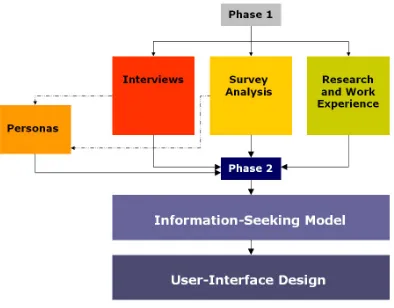
Figure 1: Process and products of this research
1.6.1
Interviews
The author interviewed seven HEP scientists ranging from PhD candidates to the dean of the physics faculty; two are experimental physicists, and five, theoretical physicists. The interviews took place in the scientists’ offices at the Weizmann Institute of Science (in Rehovot, Israel). Information from the interviews helped the author understand the information-seeking behaviour of these scientists and the aspects of their daily routines that involve the seeking, gathering, and exchange of information. Numerous additional interviews were conducted as the author advanced in her research and as she modelled the information-seeking behaviour of the researchers and designed the proposed user interface.
1.6.2
Survey Analysis
(see Chapter 3) and requested an analysis of the open-ended responses. The survey results, including this author’s analysis, yielded quantitative measures for assessing the information behaviour and, in particular, the information-seeking behaviour of the community members.
1.6.3
Personas
The information obtained from the interviews and the survey analysis served for defining six personas that represent six groups of ‘typical’ HEP scholars. The HEP information specialists approved the representations and arranged these personas in order of the degree to which they consume scholarly materials. This order also represents the perception of the information specialists regarding the effort that one needs to invest to support the groups of scholars represented by each persona.
The use of personas in a theoretical study constitutes a novel approach to modelling information-seeking behaviour.
1.6.4
Research and Work Experience
For more than two decades, the author has been involved with software
development for information systems. In particular, for the last 12 years she has been working for an international software company that develops solutions for libraries and information centres, where she was responsible for the design of the user interfaces of two flagship products. This work included the building of a conceptual model of the interface, partnering with user-interface experts to design the interface, working with the development team to develop the
interface, and collaborating with focus groups and development partners to obtain feedback and conduct usability studies, both of which contributed to the further development of the products. During that time, this author published 17 papers addressing various aspects of information systems in the library (see Appendix B).
1.6.5
Information-Seeking Model
model of the information-seeking behaviour of the HEP community scientists in the context of their work-related information behaviour and used the personas to evaluate the model.
The new information-seeking model contributes to information-seeking research in the focus on a specific scientific community that has distinct and well-defined information-seeking patterns. To the author’s knowledge, this is the first time that an information-seeking model has been based on a specific community of scholars. Furthermore, the model addresses the full spectrum of active
information-seeking of the community.
1.6.6
User-Interface Design
The model that the author constructed served as a basis for the author’s design of a new user interface for SPIRES, the HEP database of scholarly publications of community members. The author presented this design to the HEP information specialists in writing and verbally, in a meeting that took place at the European Organization for Nuclear Research (CERN) in Geneva. Because of limited human resources, the team adopted only a few of the author’s recommendations for their initial version of the successor of SPIRES, called INSPIRE, but the implementation of more of these recommendations has already been planned. As of this writing, the INSPIRE database is in beta testing, and the author continues to advise the information specialists about specific issues that come up.
1.7
Design and Evaluation Processes
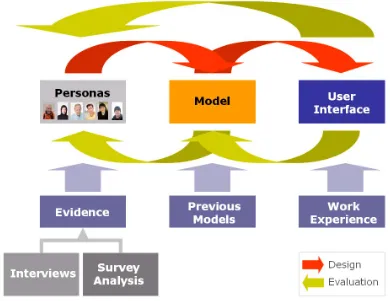
[image:30.595.115.505.161.462.2]This research consists of a series of steps, each providing the basis for the next step (Figure 2).
Figure 2: Design and evaluation
The purpose of the first steps—interviews with researchers and the analysis of the HEP survey—is the gathering of evidence, which then serves as a basis for the definition of personas. The personas, in turn, along with a survey of existing models, serve as the basis for the design of the information-seeking model, including its subcomponent, the searching model. The information-seeking model is evaluated with the aid of the personas.
1.8
Structure of the Thesis
This thesis is divided into seven chapters. Following the introduction (Chapter 1), a literature overview in Chapter 2 traces the evolution of information search-and-retrieval models that emphasise human information-seeking behaviour. The models are described in light of the development of research in this area, and their relevance to this study is explained.
Chapter 3 describes the high-energy physics community and its information-seeking behaviour and search practices as ascertained by observations of, and interviews with, HEP researchers. An analysis of HEP scientists’ open-ended responses to a survey of their information-seeking practices is provided, and a set of criteria that describe those practices is formulated.
Chapter 4 explains how the findings from the interviews and survey responses were leveraged to create a set of six personas that represent typical members of the HEP community. These personas later serve in the evaluation of an
information-seeking model proposed by the author and a user-interface design that the author derives from this model.
In Chapter 5, an original model that aims to represent the information-seeking practices by HEP scholars is presented. The personas that are defined in Chapter 4 are used to evaluate the information-seeking model.
Chapter 6 explains how the information-seeking model is used to derive a software user-interface design. Aspects of the user interface are discussed in terms of the components and workflows making up the model, and the model is then used to evaluate the user-interface design. The design is also corroborated through the use of personas and additional interviews with HEP community members. Finally, a set of measures is defined to provide an informed evaluation of the interface’s effects on the information-seeking behaviour of HEP scientists who use it.
Appendix A contains summaries of the interviews that the author conducted with the HEP researchers in 2008 and the beginning of 2009.
Appendix B lists the author’s publications.
1.9
Previous Publications by This Author
Parts of this thesis are drawn from previous publications, as follows:
• Parts of Chapter 3 appear in Sadeh 2008a.
• The discussion about clustering and faceted browsing (Chapter 6) was
presented in Sadeh 2008a.
• Discussions about users’ expectations and behaviour in the library domain are discussed in several publications (Sadeh 2007a, 2007b, 2007c, 2008c). Some background information is taken from Sadeh 2007b.
Chapter 2
Literature Review
2.1
Introduction
The research for this thesis spans several scholarly areas. The topic of users’ information-seeking behaviour is examined through user studies, on the one hand, and through literature related to information seeking and retrieval, on the other hand. While literature about information seeking and retrieval models has contributed to establishing the theoretical background for describing user
behaviour in this thesis, user studies provide evidence regarding the actual use of information systems. Both the theoretical understanding and the practical findings were instrumental in the author’s design of the information-seeking model and, later, in the user-interface design.
Once the high-energy physics (HEP) community was selected as the target of this research, literature about the community and its information systems provided insights about the distinct information behaviour of the community members. This literature contributed to the author’s understanding and interpretation of the members’ information-seeking behaviour in the specific context of HEP research. User studies that focus on this community have been of great value to the discussions in this thesis, but user studies that relate to similar communities or more general scientific communities are also relevant as measures for comparison between the behaviour of the HEP researchers and other scientists.
Information gathered in the area of user-interface design was helpful in
translating the abstract model into a proposal for an actual information system. The use of personas as part of the whole research process was also supported by evidence from relevant literature.
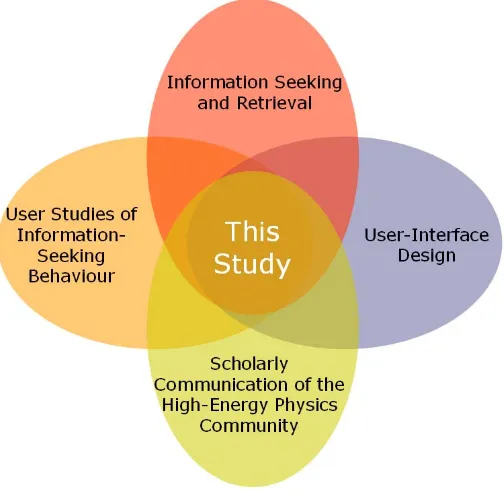
This thesis is therefore positioned at the intersection of several research areas (Figure 3):
o Information seeking and retrieval and models of information behaviour
o User studies focusing on academic communities’ information-seeking
perceptions and practices
o User-interface design
o Information systems and scholarly communication practices of the
[image:35.595.167.419.185.432.2]high-energy physics community
Figure 3: Context of this study
2.2
Information Seeking and Retrieval:
Terminology and Models
In 1979, the philosopher Jean-François Lyotard coined the term ‘postmodernism’, giving a name to a school of thought that influenced the second half of the
twentieth century, gaining momentum at the end of the 1960s. Postmodernism— a reaction against the rationalism, scientism, and objectivity of modernism— signifies a shift of human philosophical perceptions toward the acceptance of pluralism, decentralization, dissemination, and networked knowledge.
Representing scepticism toward universal and authoritative views, postmodernism acknowledges the notion of relative truth and the human interpretation of reality within a specific context.
When one projects postmodernist notions on information systems, it becomes clear that human diversity is such that the user’s context is crucial to the success or failure of technological solutions that aim at satisfying information needs. Therefore, it is no wonder that research in the area of information seeking and retrieval, which initially focused on a system-oriented view, has shifted toward a user-centric approach. Furthermore, while information systems in their early years were scarce and struggled to provide basic functionality, by the mid-1980s these systems formed a robust infrastructure that could allow information
researchers to turn their eyes—and thoughts—to the user. Not surprisingly, this trend has been accompanied by a shift from quantitative methods of investigation to qualitative methods that enable researchers to gain an in-depth understanding of individuals and their information needs. Bates describes the shift to qualitative research as follows: ‘Whereas the scientific perspective was driven by a
fundamental assumption that we can be easily fooled by our own perceptions, and so we had to place intervening controls between ourselves and the thing observed, the qualitative approach revels in the ingenuity and uniqueness of insight of the individual who is doing the research’ (Bates 2002).
2.2.1
Terminology
To ensure a common understanding of terminology, this section proposes definitions of the terms information behaviour, information need,
information-seeking behaviour, information-searching behaviour, and information use.
2.2.1.1 Information Behaviour
Ingwersen and Järvelin (2005) define information behaviour as the ‘human behavior dealing with generation, communication, use and other activities
concerned with information, such as, information seeking behavior and interactive IR [information retrieval]’ (Ingwersen and Järvelin 2005, 21).
Wilson (2000) proposes a slightly different definition of information behaviour: ‘the totality of human behavior in relation to sources and channels of information, including both active and passive information seeking, and information use. Thus, it [information behaviour] includes face-to-face communication with others, as well as the passive reception of information as in, for example, watching TV advertisements, without any intention to act on the information given’ (Wilson 2000, 49).
2.2.1.2 Information Need
The definition of an information need is far from straightforward, although many consider the term self-explanatory. Dervin and Nilan (1986) discuss at length the shift in the definition of information need from a focus on the system—what it is in the information system that the user needs—to a focus on the user—what it is that the user needs. An information need, in their view, is a situation ‘in which the individual’s internal sense “runs out.” The person must create a new sense’ (Dervin and Nilan 1986, 21). The person needs to bridge a gap to return to a state of possessing internal sense.
Ingwersen and Järvelin (2005) provide a definition that acknowledges the same gap: for them, information need ‘signifies a consciously identified gap in the
knowledge available to an actor. Information needs may lead to information seeking and formulation of requests for information’ (Ingwersen and Järvelin
2005, 385).
This work differentiates between information seeking and information searching and therefore adopts the definition of information need from Ingwersen and Järvelin, with a slight modification: a consciously identified gap in the knowledge available to a user that may lead to information searching.
2.2.1.3 Information-Seeking Behaviour
Wilson (2000) defines information-seeking behaviour as ‘the purposive seeking for information as a consequence of a need to satisfy some goal. In the course of seeking, the individual may interact with manual information systems (such as a newspaper or a library), or with computer-based systems (such as the World Wide Web)’ (Wilson 2000, 49).
According to Ingwersen and Järvelin (2005), information-seeking behaviour is ‘human information behavior dealing with searching or seeking information by means of information sources and (interactive) information retrieval systems’ (Ingwersen and Järvelin 2005, 21).
tasks. This study views information-seeking behaviour as information behaviour that consists of an active pursuit of information through the use of information systems, by the members of a research community. By not referring to a specific need, this definition is applicable to both directed and undirected searching (see Bates’s modes of information seeking in 2.2.2.5).
2.2.1.4 Information-Searching Behaviour
Information-searching behaviour, according to Wilson (2000), ‘is the “micro-level” of behavior employed by the searcher in interacting with information systems of all kinds. It consists of all the interactions with the system, whether at the level of human computer interaction (for example, use of the mouse and clicks on links) or at the intellectual level (for example, adopting a Boolean search strategy or determining the criteria for deciding which of two books selected from adjacent places on a library shelf is most useful), which will also involve mental acts, such as judging the relevance of data or information retrieved’ (Wilson 2000, 49).
In some studies, searching and seeking are regarded as synonyms. Ingwersen and Järvelin (2005), for example, do not differentiate between information seeking and searching (see 2.2.1.3 for their definition of information seeking).
This thesis follows Wilson’s approach, with his distinction between information seeking and information searching. Information-searching behaviour is, then, the aspect of information-seeking behaviour that deals especially with active, directed searching in information systems for data that can be specified to some degree.
2.2.1.5 Information-Use Behaviour
According to Wilson (2000), information-use behaviour ‘consists of the physical and mental acts involved in incorporating the information found into the person's existing knowledge base. It may involve, therefore, physical acts such as marking sections in a text to note their importance or significance, as well as mental acts that involve, for example, comparison of new information with existing
behaviour as follows: the physical and mental acts involved in extending a person’s existing knowledge base with new information.
2.2.2
Models
Until the 1990s, research in the area of user needs, information needs, and information-seeking behaviour did not support the accumulation of a body of theory and empirical findings that could serve for further research. Wilson (1999) states a number of reasons for this situation. First, the quantitative research methods used could not provide insights that could support the development of a theory or practice in this area. Second, researchers focused on information science and did not adopt theoretical models of human behaviour from other fields. Third, general models of user behaviour started to emerge only in the mid-1980s.
In another retrospective review of earlier research, Dervin and Nilan (1986) observe that ‘almost without exception “information needs” have not been defined as what users think they need but rather in terms that designate what it is in the information system that is needed. The definitions have not focused on what is missing for users (i.e., what gaps they face) but rather on what the system possesses’ (Dervin and Nilan 1986, 17).
With the adoption of qualitative research methods and the acceptance of theories and models originating in the social sciences, the situation has changed. New models have emerged and have served as a basis for further research, such as the research conducted as part of the present study. These models include those proposed by Wilson (1981, 1999); Dervin—in her paper ‘An overview of Sense-Making research: Concepts, methods, and results to date’, presented at the annual meeting of the International Communication Association, Dallas, TX, in May 1983 (cited by Dervin and Nilan 1986); Ellis—in the paper ‘A behavioural approach to information retrieval design’, published in the Journal of
Documentation in 1989 (as described by Wilson [1999] and Ingwersen and
Järvelin [2005], among others); Bates (1989, 2002); Kuhlthau (1991); Ellis
Theories and models that are of the greatest significance to this thesis are briefly presented in this chapter and discussed in more detail in Chapter 5.
2.2.2.1 Wilson’s Models of Information Behaviour and Information-Seeking Behaviour
Wilson’s 1981 paper, which includes definitions of concepts and models of information behaviour and information-seeking behaviour, has significantly influenced information research since then. By defining basic concepts and offering a new approach to the motivation underlying information-seeking behaviour, Wilson aims to reduce the confusion related to user studies and the perception of information needs. As noted by Bawden (2006), ‘by 1980, the field [of user studies] was burgeoning in interest and publication, but lacking clear foundations of method and conceptual framework. Wilson’s article must be seen against that background’ (Bawden 2006, 672). After discussing the challenges involved in the use of the term ‘information’, Wilson presents a model of
information behaviour (discussed in Chapter 5 of this thesis) as ‘a way of thinking of the field “user studies”; its aim is not to “model” information-seeking behaviour but to draw attention to the interrelationships among concepts used in the field’ (Wilson 1981).
Wilson then explores the concept of information needs and shows the complex relationships between a user in a specific context and an information source. Addressing the context of an individual, Wilson asserts that ‘the “user's life world” can be defined as the totality of experiences centred upon the individual as an information user. Within this life-world one important sub-world will be the world of work, within which will exist various “reference groups” with which the user identifies: fellow professionals, the peer group within an organization and so on’ (Wilson 1981).
resulting knowledge may have practical applications, there is no necessity that it should’ (Wilson 1981).
Through a further exploration of the concept of ‘information needs’, Wilson
presents a model of information-seeking behaviour (discussed in Chapter 5 of this thesis) and proposes ‘to remove the term “information needs” from our
professional vocabulary and to speak instead of information-seeking towards the satisfaction of needs’ (Wilson 1981).
Wilson goes on to discuss the context of the user and the influence that this context has on the user’s information-seeking behaviour, suggesting that ‘the search for determining factors related to needs and information-seeking
behaviour must be broadened to include aspects of the environment within which the work-role is performed’ (Wilson 1981). One of the consequences of
broadening one’s understanding of the user’s context that Wilson points out is that ‘if we wish to uncover the determining factors of behaviour we must do so by first undertaking in-depth studies of well-defined categories of persons,
developing explanatory concepts and then testing these concepts in related but different settings’ (Wilson 1981).
Wilson predicts a shift in the focus of research—from looking at information sources and systems to ‘an exploration of the role of information in the user's everyday life in his work organization or social setting’ (Wilson 1981)—and foresees three consequences. The first is the reliance on qualitative research, instead of or in addition to quantitative research methods. The second is the attempt to determine the behaviour’s underlying factors by in-depth studies of well-defined groups, and the third is the examination of user behaviour in a wider perspective of psychological and sociological studies.
The applicability of Wilson’s models to the HEP information-seeking practices is described in Chapter 5.
2.2.2.2 Dervin’s Sense-Making Model
The sense-making approach ‘consists of a set of conceptual and theoretical premises and a set of related methodologies for assessing how people make sense of their worlds and how they use information and other resources in the process’ (Dervin and Nilan 1986, 20).
To describe the behaviour of the information-seeker, or sense maker, Dervin proposes a ‘situation-gap-use’ model in her 1983 paper An overview of
Sense-Making research: Concepts, methods, and results to date, presented at the
annual meeting of the International Communication Association, Dallas, TX (cited in Dervin and Nilan 1986). The elements that make up the model are a situation (in time and space), which defines the context; a desired situation; a gap
between the contextual situation and the desired situation, and a bridge that closes this gap (Figure 4). According to this model, the sense maker is stopped at a situation because of some kind of gap and needs to make use of a ‘bridge’ across the gap to resume the situation of sense making.
In his review of this model, Wilson (1999) sees the strength of Dervin’s approach in its methodological effects. When applied to information behaviour, this
approach can provide a framework for investigating the nature of the situation, the degree to which the gap can be bridged by information, and the nature of the outcomes following the use of information. Such questioning can serve as a trigger to obtaining insights that may help the designers of information services.
Ingwersen and Järvelin (2005) see the sense-making approach as an important
advancement in the research on information seeking. According to them, the sense-making approach ‘draws attention to individual sense-making (problem solving) in varying situations, and focuses on the actor [the information seeker] and process viewpoints rather than a systems (or traditional assumptions’) viewpoint’ (Ingwersen and Järvelin 2005, 62).
2.2.2.3 Ellis’s Feature Set
Ellis (1989, as described by Wilson [1999] and Ingwersen and Järvelin [2005],
among others) identifies eight features of information-seeking behaviour that characterize both academic and non-academic searchers in various fields and professions.
The eight features that Ellis identifies are the following:
o Starting: performing activities that characterize the initial stages of a
search process, such as looking for review literature or asking the help of a colleague
o Chaining: following leads in known materials to other materials—for
example, following references at the end of an article
o Browsing: conducting semi-directed searches, such as identifying articles
in a journal’s table of contents
o Differentiating: using differences in the examined information as filters o Monitoring: maintaining an awareness of the current developments in the
field
o Extracting: systematically identifying relevant materials o Verifying: checking information for accuracy
The way in which these eight features interrelate to form an individual information-seeking pattern depends on the specific context. Ellis (1993)
demonstrates that variations of these features and of the way in which they relate to each other emerge when the information-seeking behaviour of individuals belonging to different communities (social sciences, economics and social history, physics, chemistry, and English literature) is examined.
Referring specifically to the physicists, Ellis (1993) notes:
The study of the physicists employed slightly different terminology and derived a model that differed in detail from that derived from the interviews with the social scientists. Five main categories were identified: initial familiarization—activities undertaken at the earliest stages of information seeking; chasing—following up citation links between materials; source prioritization—ranking sources based on perceptions of their relative importance; maintaining awareness— activities involved in keeping up-to-date; and locating—activities engaged in to actually find the information. (Ellis 1993, 482)
However, as Ellis (1993) points out, ‘although the models differ in terminology and detail, when the features and characteristics of the models are compared they can be seen to be representing fundamentally the same activities' (Ellis 1993, 483).
Wilson (1999) divides Ellis’s set of features into several types:
Browsing, chaining and monitoring are search procedures, whereas differentiating is a filtering process and extracting may be seen as an action performed on the information sources.
The remaining behaviours do not necessarily take place in a specific sequence and may be initiated in different sequences at different times in the overall search process. Ellis's account, therefore, in terms of the different kinds of features it embodies, appears to sit between the micro-analysis of search behaviour (starting, chaining, extracting, verifying, ending) and a more macroanalysis of
information behaviour generally (browsing, monitoring, differentiating). (Wilson 1999, 7)
information-seeking model (1981), he explores the possible inclusion of these features in his model. Further discussion is provided in Chapter 5 of this study.
2.2.2.4 Kuhlthau’s Process Model
Kuhlthau (1991) presents the process of information searching from the user’s perspective as a ‘series of encounters with information within a space of time’ (Kuhlthau 1991, 361). In the context of her research, this information search process (ISP) ‘is the user’s constructive activity of finding meaning from information in order to extend his or her state of knowledge on a particular problem or topic’ (Kuhlthau 1991, 361).
Following Dervin’s sense-making approach (see 2.2.2.2), Kuhlthau (1991)
explains:
Information seeking is viewed as a process of sense-making in which a person is forming a personal point of view… The individual is actively involved in finding meaning which fits in with what he or she already knows, which is not necessarily the same answer for all, but sense-making within a personal frame of reference.
Information from various sources is assimilated into what is already known through a series of choices. Formal organized sources from information systems interact with informal sources from everyday life experiences. The ISP culminates in a new understanding or a solution which may be presented and shared. Evidence of the transformation of information into meaning is present in the
products or presentations in which users share their new knowledge with others. (Kuhlthau 1991, 361)
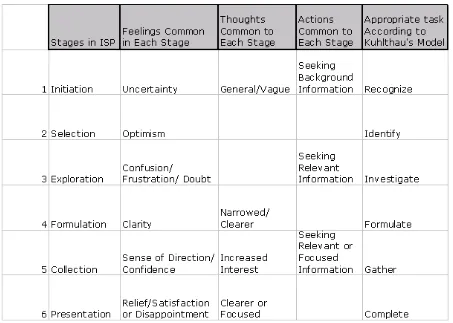
Kuhlthau (1991) defines six stages, or encounters, of the information search process—initiation (the user is becoming aware of a need for information),
selection (identifying the topic for searching), exploration (seeking information on
the topic), focus formulation (structuring and fixing the problem at hand),
collection (gathering relevant information), and presentation (using the results of
Figure 5: Kuhlthau's information search process (ISP). Modified from Kuhlthau (1991), Table 2.
Wilson (1999) notes that ‘in effect, what Kuhlthau postulates here (and confirms by empirical research) is a process of the gradual refinement of the problem area, with information searching of one kind or another going on while that refinement takes place’ (Wilson 1999, 8). Wilson draws similarities between Kuhlthau’s model and Ellis’s feature list (2.2.2.3)—although he finds Kuhlthau's model more general than Ellis’s feature list because the former draws attention to the feelings that are associated with each stage—and tries to bring them together by mapping Ellis’s categories to Kuhlthau’s stages (Figure 6). Wilson (1999) concludes as follows:
Through this merger of the two models, we can see strong similarities and the major difference appears to be that Ellis specifies the modes of exploration or investigation. The point must be reiterated, however, that Ellis does not present his
stages on the basis of her analysis of behaviour, while Ellis suggests that the sequences of behavioural characteristics may vary.’ (Wilson 1999, 9)
Figure 6: Wilson's comparison of Ellis's and Kuhlthau's frameworks. Modified from Wilson (1999), Figure 6.
2.2.2.5 Bates’s Models
In her discussion of searching, Bates (1989) puts an emphasis on the evolving nature of a search process, as is evidenced from the observation of manual information-seeking behaviour of individuals, and introduces a model that describes this process.
Bates (1989) first challenges the classic model of information retrieval (Figure 7) on several grounds. She argues that the model is not inclusive regarding the type of searches it represents and that it has many limitations ‘as a realistic
representation of actual searches’ (Bates 1989). Furthermore, the model limits the ‘creativity in developing IR systems that really meet user needs and
preferences’ (Bates 1989).
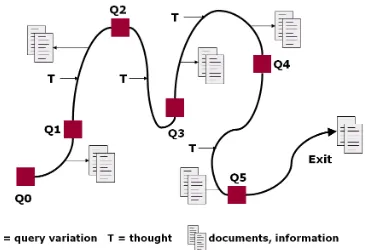
The berrypicking model (Figure 8) that Bates (1989) proposes suggests a
different perspective on the nature of the query and the search process, embeds the search process in an information territory, and applies to a range of search techniques.
According to Bates (1989),
users may begin with just one feature of a broader topic, or just one relevant reference, and move through a variety of sources. Each new piece of information they encounter gives them new ideas and directions to follow and, consequently, a new conception of the query. At each stage they are not just modifying the search terms used in order to get a better match for a single query. Rather the query itself (as well as the search terms used) is continually shifting, in part or whole….
Furthermore, at each stage, with each different conception of the query, the user may identify useful information and references. In other words, the query is satisfied not by a single final retrieved set, but by a series of selections of individual references and bits of information at each stage of the ever-modifying search. A bit-at-a-time retrieval of this sort is here called berrypicking. This term is used by analogy to picking huckleberries or blueberries in the forest. The berries are scattered on the bushes; they do not come in bunches. One must pick them one at a time. One could do
Figure 8: The Bates berrypicking model, with an evolving search. Modified from Bates (1989), Figure 2.
Bates (1989) also emphasizes that the search is taking place in the context of a ‘universe of interest’, which is within the larger context of the ‘universe of
knowledge’ (Bates 1989). The behaviour of the searcher is the focus of attention in this model, and ‘the continuity represented by the line of the arrow is the continuity of a single human being moving through many actions toward a general goal of a satisfactory completion of research related to an information need. The changes in direction of the arrow illustrate the changes of an evolving search as the individual follows up various leads and shifts in thinking’ (Bates 1989).
such as the one that Bates (1989) describes—comprised of multiple information sources—is supported by current technologies that enable a searcher to move from one system to another. However, most search techniques that Bates
discusses are not considered in this study as ‘searching’; rather, they are viewed as linking or navigating. This distinction is discussed further in Chapter 5.
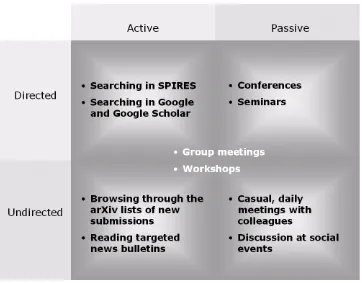
Acknowledging the partial role of active searching in the knowledge acquisition process of humans (according to Bates (2002), ‘it is not unreasonable to guess that we absorb perhaps 80 percent of all our knowledge through simply being aware, being conscious and sentient in our social context and physical
environment [Bates 2002, 3]). Bates (2002) proposes a matrix, which describes modes of information seeking, as a way to integrate information seeking and information searching (Figure 9).
Figure 9: Modes of information seeking proposed by Bates. Modified from Bates (2002), Figure 3.
As explained in Chapter 5 of this study, the modes of information seeking suggested by Bates (2002) cohere with information-seeking practices of HEP researchers. See Chapter 5 for a detailed discussion of these modes in the context of the HEP community
2.2.2.6 Belkin’s Modes of Interaction
Belkin et al. (1995) emphasize the interactive nature of the information-seeking process and join with Bates (1989) in arguing that such a process consists of multiple interactions with an information system and that ‘people’s conceptions of their information problems change through their interactions with the IR system’ (Belkin et al. 1994). Furthermore, each type of information need requires a different kind of interaction with the information system.
Belkin et al. (1995) go on to describe ‘a multidimensional space of information-seeking strategies (ISSs)’ (Belkin et al. 1995) that are the basis of an
information-seeking behaviour model. An ISS is a specific behaviour employed by a person who interacts with a ‘knowledge resource’ (Belkin et al. 1995) when searching for information. Each such behaviour—or ISS—is derived from a certain context (the person’s information-seeking goals and the knowledge that is
available to the person before starting the process, such as a specification of the information needed). The ISSs constitute interactions between the person and an information system, and several such interactions form an ‘episode’ (Belkin et al. 1995). Furthermore, the searcher’s knowledge and goals evolve through the information-seeking episode, changing the specific values of the ISSs.
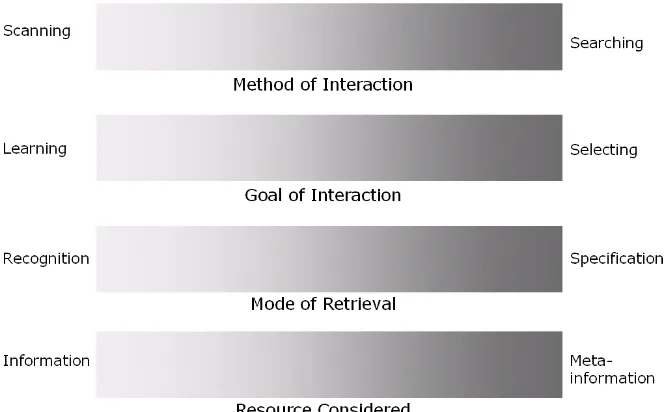
The Belkin et al. (1995) model suggests that ‘any single information-seeking interaction is a complex activity, which can be characterized according to its values on a relatively small set of factors, or dimensions’ (Belkin et al. 1995). Four modes2 of interaction are proposed: method of interaction, goal of
interaction, mode of retrieval, and resource considered (Figure 10).
2 Although Belkin et al. (1995) refer to modes of interaction, perhaps more suitable