City, University of London Institutional Repository
Citation
:
Howe, M. L. and Derbish, M. H. (2010). On the susceptibility of adaptive memory to false memory illusions. Cognition, 115(2), pp. 252-267. doi:10.1016/j.cognition.2009.12.016
This is the accepted version of the paper.
This version of the publication may differ from the final published
version.
Permanent repository link:
http://openaccess.city.ac.uk/4208/Link to published version
:
http://dx.doi.org/10.1016/j.cognition.2009.12.016Copyright and reuse:
City Research Online aims to make research
outputs of City, University of London available to a wider audience.
Copyright and Moral Rights remain with the author(s) and/or copyright
holders. URLs from City Research Online may be freely distributed and
linked to.
City Research Online: http://openaccess.city.ac.uk/ [email protected]
RUNNING HEAD: False Memory Illusions in Adaptive Memory
On the Susceptibility of Adaptive Memory to False Memory Illusions
Mark L. Howe and Mary H. Derbish Lancaster University
Address correspondence to: Professor Mark L. Howe Department of Psychology Lancaster University Lancaster UK LA1 4YF Phone: +44 1524 594336
e-mail: [email protected]
Abstract
Previous research has shown that survival-related processing of word lists enhances retention for that material. However, the claim that survival-related memories are more accurate has only been examined when true recall and recognition of neutral material has been measured. In the current experiments, we examined the adaptive memory superiority effect for different types of
processing and material, measuring accuracy more directly by comparing true and false recollection rates. Survival-related information and processing was examined using word lists containing backward associates of neutral, negative, and survival-related critical lures and type of processing (pleasantness, moving, survival) was varied using an incidental memory paradigm. Across four experiments, results showed that survival-related words were more susceptible than negative and neutral words to the false memory illusion and that processing information in terms of its relevance to survival independently increased this susceptibility to the false memory
illusion. Overall, although survival-related processing and survival-related information resulted in poorer, not more accurate, memory, such inaccuracies may have adaptive significance. These findings are discussed in the context of false memory research and recent theories concerning the importance of survival processing and the nature of adaptive memory.
On the Susceptibility of Adaptive Memory to False Memory Illusions
Recently, a number of researchers have shown that words specifically processed for their importance to survival are remembered better than words processed in other contexts (e.g., Kang, McDermott, & Cohen, 2008; Nairne, Thompson, & Pandeirada, 2007; Nairne, Pandeirada, & Thompson, 2008; Weinstein, Bugg, & Roediger, 2008). That is, memory for lists of words (e.g., items from categories such as fruit, vegetable, four-footed animals) is better when participants are asked to rate them for their importance to survival (e.g., usefulness on a desert island) than when they engage in other forms of semantic processing (e.g., pleasantness or self-reference ratings) and this effect is thought to be independent of depth-of-processing (Nairne et al., 2008). This memory benefit is said to arise because human memory systems are primed to remember survival-related information better than other types of information due to its greater adaptive value (Nairne et al., 2007, 2008).
Previous studies of this adaptive memory effect by Nairne and his colleagues (Nairne et al., 2007, 2008; Nairne & Pandeirada, 2008), as well as by others (e.g., Kang et al., 2008; Weinstein et al., 2008), have focused almost exclusively on the amount of information that is correctly remembered. It is well known that because memory is reconstructive, errors can also occur when people try to recollect things that were processed. That is, people can forget
information that they have experienced (errors of omission) and “remember” information that they have not experienced (errors of commission). These latter errors, or false memories, have yet to be examined in the context of adaptive memory.
It turns out that this is an important issue because if it is true that human memory benefits from survival processing (i.e., adaptive memory is more accurate), this benefit must include both better true recollection of information actually present in the environment (i.e., fewer errors of omission), but also a reduced susceptibility to false memory illusions (i.e., reduced errors of commission). For example, if survival information is more distinctive and is processed at an item-specific contextual level, then false memory rates should be low. However, if survival-related processing of information primes networks of strongly interrelated concepts, then once activation spreads to these highly interconnected concepts, they should become active and serve as the basis of false memory illusions (e.g., Collins & Loftus, 1975; Karpicke, McCabe, & Roediger, 2008; Roediger, Balota, & Watson, 2001). Therefore, if survival processing of information promotes more relational than item-specific processing, then false memory rates should be higher for items processed for their survival value than those same items processed for non-survival purposes.
Because recall and recognition rates tend to be higher for information processed for their survival value than processed for, say, pleasantness, it would seem that there is clear evidence that such survival processing reduces errors of omission (Kang et al., 2008; Nairne et al., 2007, 2008; Weinstein et al., 2008). However, there are some findings that suggest that errors of commission may be higher in survival than other processing conditions. For example, Nairne et al. (2007, Experiment 1) found significantly higher rates of semantic intrusions when randomized lists of neutral words were processed for their survival relevance than when processed for their
Although categorized materials do give rise to errors of commission, there is considerable evidence that networks whose relations are associative give rise to higher intrusion rates (e.g., Howe, Wimmer, & Blease, 2009b; Howe, Wimmer, Gagnon, & Plumpton, 2009c; Park, Shobe, & Kihlstrom, 2005). This may be because members of categorical lists are linked in a superordinate (i.e., vertical) manner whereas members of lists of associates are linked within the same, basic level (i.e., horizontally) (see Howe et al., 2009c; Park et al., 2005). Regardless, it is clear that items related to survival do not simply exhibit insular categorical relations (e.g., food, weapons) but relations that cross category boundaries, linking one to the other in thematically mediated associative networks (e.g., watering hole [a place to satisfy thirst or a place for cooling] (
vegetation [a place to hide or a source of food] ( other animals [a source of food or something to be feared such as a predator] ( a sharp rock [to use as a tool to create something else or to be used as a weapon). Such associative networks (see Figure 1) are common in modeling human thought (e.g., Anderson, 1976, 1983; Reder, Park, & Kieffaber, 2009) and involve a variety of semantic relationships (e.g., temporal continguity, spatial proximity, feature overlap, shared perceptual properties, category membership, antonymity, synonymy) (e.g., Wu & Barsalou, 2009). Although it is often difficult to discriminate associative strength and semantic overlap (see Hutchison, 2003), the use of associatively related lists (e.g., as in the Deese/Roediger-McDermott [DRM] paradigm; Deese, 1959; Roediger & McDermott, 1995) has become the sine qua non for researchers interested in the study of memory accuracy (i.e., the relationship between rates of correct recollection and error rates). Indeed, the use of the DRM paradigm to study memory accuracy is appropriate because these lists contain many of the semantic relations found in human thought, not just taxonomic (categorical) relations (see Brainerd, Yang, Reyna, Howe, & Mills, 2008b; Howe et al., 2009b, 2009c; Park et al., 2005).
We hypothesize that it is not only the processing of information for survival purposes that results in differences in accuracy, but also the presentation of survival related materials
themselves. That is, survival-related concepts (e.g., injury, death, struggled, virus, battle) should be remembered differently than concepts that are not directly related to survival, regardless of whether they are explicitly processed for their survival value. Specifically, if adaptive memory prioritizes survival information, then whether this survival priority is invoked by the type of processing or type of material being processed may not matter.
To answer these questions about the type of processing at encoding as well as the type of material being processed, we present a series of four experiments in this article. In the first experiment, we examined both type of processing (pleasantness vs. survival) and type of material (neutral, negative, and survival related concepts) in a fully crossed design. We did this in order to examine the independent, as well as the combined, effects of processing and material on
recollection accuracy.
In the subsequent three experiments we focused on the effect of type of material on memory performance. To do this, we examined the hypothesis that increased true and false recognition on survival relevant lists was due to the number and ease with which participants could generate integrating themes. Because fewer themes should be related to higher levels of false recollection (i.e., as each list item is more likely to activate a single integrating theme)1, in
with lists that had fewer themes.
Finally, because levels-of-processing tasks such as those used in the adaptive memory literature and in Experiments 1, 2a, and 2b here only provide a test of incidental memory, we were interested in determining whether similar materials effects existed in the absence of an encoding task and when intentional, not incidental, memory tests were employed. Therefore, in Experiment 3 we examined materials effects in a standard DRM paradigm without an encoding manipulation and using intentional memory instructions. Together, these experiments show that both survival processing and survival-relevant materials give rise to higher rates of true and false recollection and, therefore, result in lower rates of net accuracy for survival processing and survival-related concepts. Perhaps somewhat counterintuitively, we argue that such findings are consistent with current models of false memory and represent a phenomenon that is really very adaptive.
Experiment 1
In order to examine the accuracy (both true and false recollection) of adaptive memories, whether survival is induced via processing instructions, the materials themselves, or both
processing and materials, we modified Nairne et al.’s (2007, 2008) procedure using DRM-like materials rather than categorized lists (e.g., Nairne & Pandeirada, 2008). In addition, because survival-related words are likely to be more emotionally charged than neutral words, we added some non-survival-related words that are also emotionally (negatively) charged (see Howe, 2007). We did this in order to eliminate the possibility that any effect for survival-related materials would simply be attributed to valence or arousal. Thus, in the first experiment, we conducted an incidental memory task like that used by Nairne and Pandeirada (2008), manipulating not only the type of information processing (pleasantness or survival ratings of items) but also the type of information being processed (neutral, negative, or survival-related) and measured recognition accuracy.
Method
Participants
Thirty-four participants took part in the experiment (11 male, 23 female).
Materials, Design, and Procedure
The experiment was a 3(list: neutral, negative, survival) x 2(processing task: pleasantness, survival) mixed design where list type was manipulated within-participant and rating task was manipulated between-participants. Fifteen lists of 12 items each were selected from the word association norms of Nelson et al. (1998): five lists consisting of the high associates of neutral critical lures (mountain, school, fruit, bread, and money), five lists consisting of the high
associates of negative critical lures (sad, bad, fat, cry, and anger), and five lists consisting of the high associates of critical lures that were related to survival2 (death, hurt, sick, war, and fight) (see
Appendix A for the full lists and critical lures for Experiment 1). The 10 words with the greatest backward associative strength to the critical lures were presented at study (the 11th and 12th words
from each list were used as unpresented associates on the recognition test). The items in all three list-types were equated on level of backward associative strength, semantic density, word
2007).
The rating task consisted of all 150 items (the top 10 from each of the 15 DRM-like lists) compiled into a single list and presented in random order. The primarily reason the list items were presented in a mixed list format (all lists combined) was to faithfully replicate Nairne et al.’s (2007) original paradigm in which he presented categorized neutral lists (e.g., hammer, nail, rope,
chair, table, stool) in a mixed list random order design. In addition, because the lists in this
experiment consisted of the highest associates to the critical lures, presenting them in blocked format would make the critical theme too salient and may have led participants to focus on the theme of the lists rather than on the ongoing (processing) task. Importantly, previous research (e.g., Hicks & Starns, 2006) has found that a mixed list format still produces significant rates of false remembering, albeit they tend to be lower than pure list formats traditionally used in the DRM paradigm. Consequently, because we used a mixed list procedure, any false remembering effects may provide more conservative estimates of false memory rates than those obtained using more traditional, pure list DRM procedures.
Participants were instructed that they would be rating words for a particular quality. Upon arrival, half of the participants were randomly assigned to either the pleasantness rating condition and the other half to the survival rating condition. Participants in the survival condition were given the following instructions: “We would like you to imagine that you have been stranded in the grasslands of a foreign land. You are completely alone and have no supplies or basic survival materials, so over the next couple of weeks you will need to find steady supplies of food and water and protect yourself from predators. We are going to show you a list of words and we would like you to rate them for how relevant each word would be for your survival in this scenario.” The survival scale ranged from 1 (least relevant) to 7 (most relevant). Participants in the pleasantness condition were given the following instructions: “We are going to show you a list of words and we would like you to rate each word for how pleasant you find that word.” The pleasantness scale ranged from 1 (least pleasant) to 7 (most pleasant). Regardless of rating task, the 7-point rating scale appeared to the right of each word.
After completing the rating task, all participants were given one minute to complete as many simple mathematical equations (numerical problems) as they could. After the one-minute distractor task was finished, participants received a recognition test consisting of 240 items (arranged randomly) and asked to indicate whether an item had appeared on the list (marking “yes”) or had not (marking “no”). The list was comprised of: the 15 critical lures, 8 words of varying associative strength that were studied from each list (120 items), the unpresented 11th- and
12th-associates from each list (30 items), and 75 unrelated distracter items (30 neutral, 15
negative, 15 positive, and 15 survival-related).
Results and Discussion
We begin by analyzing differences in true and false recognition as a function of processing task and list type. We follow this by examining false positives for other semantically related intrusions by analyzing acceptance rates for related distractors (neutral, negative, and survival related) on recognition tests as a function of processing task. Finally, we examine an overall accuracy statistic [accuracy = true recognition/(true recognition + false recognition of critical lures)], one that has been used in the DRM literature to evaluate overall trends in net recollection performance (see Brainerd, Reyna, & Ceci, 2008a).
True and False Recognition
(ANOVA). Correct recognition rates for the pleasantness and survival rating tasks although high, were below ceiling. There was a main effect for processing task on correct recognition, F(1, 32) = 4.26, p < .05, (p2 = .117, where participants in the survival condition (M = .87) correctly
remembered more words than participants in the pleasantness condition (M = .79). In addition, there was a significant main effect of list on correct recognition, F(2, 64) = 17.31, p < .001, (p2 =
.34. Post-hoc tests revealed that survival (M = .84) and neutral (M = .86) words produced higher correct recognition than negative (M = .78) lists (highest p < .01). There was no significant interaction. Consistent with Nairne and his colleagues (e.g., Nairne et al., 2007, 2008), true recognition rates were higher regardless of type of material when it was processed for its survival value than when it was rated for pleasantness.
As with the correct recognition data, the proportion of critical lures falsely recognized was calculated and submitted to a 2(processing task) x 3(list) mixed ANOVA. There was a significant main effect of processing task on false recognition, F(1, 32) = 18.87, p < .001, (p2 = .37, such that
the participants in the survival condition (M = .52) had higher rates of false recognition than the participants in the pleasantness condition (M = .26). The main effect of list was not significant but there was a Processing task x List interaction, F(2, 64) = 3.21, p < .05, (p2 = .091. As can be
seen in Figure 2, and was confirmed by post-hoc tests (p < .05), although survival processing always led to more false memories than pleasantness processing, and survival lists had the highest false recognition rate regardless of processing task (pleasantness or survival), negative lists had higher false recognition rates when participants rated those words for survival than for
pleasantness. These findings are quite unique and demonstrate that survival processing not only leads to better true recognition (hence fewer errors of omission), but also to higher rates of false recognition (errors of commission) for items that provide a semantic link across concepts on a list (whether those concepts are neutral, negative, or survival relevant). The question remains, does this greater susceptibility to errors of commission extend to other unpresented but semantically related concepts?
Related Distractors3
In this section, we answer the question of whether false recognition rates also differed for related distractors and not just critical lures. Because Nairne and colleagues (Nairne et al., 2007; Nairne & Pandeirada, 2008) have found differences in the rates of related intrusions as a function of processing task (specifically, pleasantness vs. survival), we examined these same differences in this experiment. We calculated the number of false positives for related distractors and analyzed them using a 2(processing task: pleasantness vs. survival) x 3(list: neutral, negative, survival) mixed ANOVA. The results were as follows: a marginally significant effect for processing task,
F(1, 32) = 4.01, p = .051, (p2 = .114, where there were more related intrusions for survival
processing (M = .15) than pleasantness processing (M = .09), and a main effect for list, F(1, 32) = 16.24, p < .001, (p2 = .337, where post-hoc tests (p < .001) showed more related intrusions for
survival lists (M = .19) than neutral (M = .07) and negative (M = .09) lists, and the latter two did not differ. There was no interaction. Like Nairne et al.’s (2007; Nairne & Pandeirada, 2008) findings, processing information for survival value led to higher false positives for related items than when that same information was rated for pleasantness. Perhaps of greater interest is the finding that survival-relevant concepts also exhibited this pattern – that is, there were more false positives for survival concepts than neutral or negative ones.
Accuracy
than other memories, we computed composite accuracy scores using both true and false (critical lure) recognition measures. The results of the 2(processing task) x 3(list) mixed ANOVA were as follows: a main effect for processing task, F(1, 32) = 11.96, p = .002, (p2 = .272, where accuracy
was lower for survival (M = .65) than for pleasantness (M = .78) processing, and a Processing task x List interaction, F(2, 64) = 3.88, p = .026, (p2 = .11. As can be seen in Figure 3, and was
confirmed by post-hoc tests (p < .05), this interaction shows that although survival processing always leads to lower accuracy levels than pleasantness processing, survival lists were also lower in accuracy when rated for pleasantness. Overall, then, survival processing and survival-relevant concepts exhibited low levels of net accuracy.
Together, the results of Experiment 1 are generally consistent with the findings from Nairne et al.’s (2007; Nairne & Pandeirada, 2008) experiments using neutral, categorical materials. Specifically, survival processing resulted in higher rates of correct recognition than pleasantness processing. Moreover, there were higher rates of semantic intrusions for material processed for survival than for pleasantness, although these effects were marginal.
Importantly, this experiment produced two hitherto unreported effects. First, when associative (or DRM) lists were used, ones that may better mimic semantic relations used in human thought than simply using categorical relations, both survival processing and survival materials made independent contributions to recognition performance using an incidental memory paradigm. That is, not only was there better true recognition for concepts processed for their survival value as well as survival-relevant concepts themselves, but also there were higher rates of false recognition. Second, when viewed in terms of net accuracy, survival items and items
processed for their survival value had lower rates of accuracy than items processed for
pleasantness or items that were not survival-relevant. Indeed, when participants rated negative items for their survival value, false recognition increased and accuracy decreased to levels similar to that observed for survival items. However, processing information for its survival value and the use of survival-relevant materials both increased true and false recognition and these increases resulted in an overall decline in memory accuracy. Before we discuss the ramifications of these findings for theories of false memory and adaptive memory more generally, we present three additional experiments that flesh out these newly discovered effects more completely.
Experiments 2a and 2b
Although the effect of processing task on true recollection and semantic intrusions has been observed by Nairne and his colleagues earlier, the increases in false recollection of critical lures observed here has not been previously reported. This effect may be due to the change in materials, namely the use of associatively related (DRM) lists rather than categorical lists. As noted earlier, categorical lists are less likely than associative lists to give rise to false memories (for a review, see Gallo, 2006). We were interested in the increase in false recollection across processing task and materials because these increments were observed alongside increases in true recollection, a phenomenon not always seen in the false memory literature. Indeed, oftentimes true and false recollection rates have opposite trajectories and some theories (e.g., fuzzy-trace theory, FTT; for a review, see Brainerd & Reyna, 2005) are well suited to account for such dissociations.
responsible for, changes in false memory rates (e.g., Brainerd et al., 2008b)?
We speculate that the answer to this lies in the availability of a unique integrating theme. That is, associative lists whose potential themes are few will tend to give rise to false recollection more easily than lists with more potential themes as each list member provides activation for a smaller set of potential themes (see Figure 4 for an illustration). Recall that because these lists are associative and there are many potential integrating themes (e.g., relations can be varied and include temporal continguity, spatial proximity, feature overlap, shared perceptual properties, category membership, antonymity, synonymy; see Wu & Barsalou, 2009), lists with fewer themes (e.g., DEATH, Figure 4) stand a greater chance of activating a single theme more quickly, one whose overall activation may be greater than lists with more themes (e.g., BREAD, Figure 4; also see Arndt & Reder, 2003; Reder et al., 2009) (also see Footnote 1). Thus, it may be this greater activation, not just BAS, that increases false memory rates. Intuitively, it seemed that survival lists have fewer potential themes than negative or neutral lists (see Appendix A).
In order to test this, we recruited a separate group of participants who were asked to generate as many themes as possible for each of the lists used in Experiment 1. The results showed that survival-related lists produced reliably fewer themes than negative lists (t[10] = 2.38,
p = .04) and neutral lists (t[10] = 2.83, p = .02), where negative and neutral lists did not differ
(t[10] = .89, p = .40). In order to test the role of theme availability on false memory rates, we conducted two additional experiments, one in which number of themes was equated across list type (Experiment 2a) and one in which theme numbers differed maximally across list type (Experiment 2b). Like Experiment 1, all other lists characteristics were held constant, including BAS. If theme availability (as indexed by number of themes) is critical to false memory
generation, in addition to BAS, then list differences in false recollection rates should be
eliminated in Experiment 2a and heightened in Experiment 2b. Moreover, to the extent that true and false memory rates are correlated, as they were in Experiment 1, differences in correct recognition should vanish across types of material in Experiment 2a and be maximized in Experiment 2b as a function of list type.
Finally, because the effects of list type on true and false recollection may interact with processing task, we again used an incidental memory paradigm and had participants rate items for their pleasantness or relevance to survival. In order to increase the generalizability of the impact of processing task on true and false recollection, we added a moving scenario. This scenario has been used previously and represents a processing task that does not differ from survival
processing in semantic intrusion rates (Nairne et al., 2007).
Experiment 2a: Equating Theme Availability
Participants
A new sample of 18 undergraduates (6 males, 12 females) took part in this experiment.
Materials, Design, and Procedure
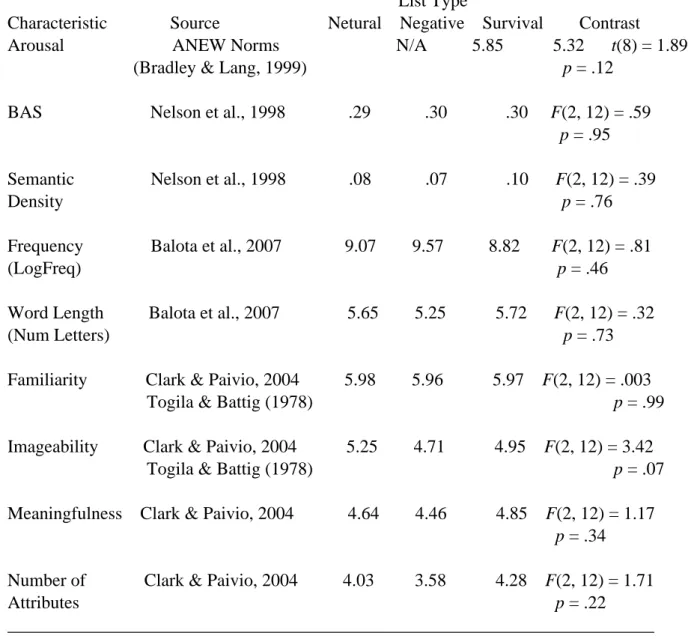
the number of alternative themes (besides the critical lure) for each list in Appendix A. From these theme norms we selected 6 lists (2 neutral, 2 negative, 2 survival; see Appendix B) that had the same number of alternative themes (M = 9.5). In addition to being equated for the number of alternative themes, the three list-types were equated on level of BAS, semantic density, word frequency, word length, and familiarity (see Table 2 for means and contrasts). As in Experiment 1, the critical lures were also equated for frequency and familiarity (highest F = 1.30, p = .39).
The same grasslands and pleasantness scenarios that were used in Experiment 1 were used here. In addition, we used a moving scenario in which we told participants that, "We want you to imagine you are in the process of moving house, but there is no one around to help you so you must arrange the move by yourself. While imagining this scenario, your job will be to rate the following words on a scale from 1-7 for how relevant the meaning of that word would be for you successfully moving house on your own."
The rating task consisted of 60 items (10 items from each of the 6 DRM-like lists) compiled into a single list and presented in random order eight words to a page. To the right of each word was a standard 7-point scale on which participants could rate the item for its relevance to a scenario or its pleasantness. The relevance scales in all conditions ranged from 1 (extremely irrelevant) to 7 (extremely relevant), while the pleasantness scale ranged from 1 (extremely unpleasant) to 7 (extremely pleasant). Upon arrival, participants were assigned to one of three processing conditions (pleasantness, moving, grasslands). Once participants finished the rating task they were given five minutes to work on a standard word search (created online) where they were looking for the names of 30 British cities.
After five minutes, all participants were given the same recognition test consisting of 114 items (arranged randomly) and asked to indicate whether an item had appeared on the list
(marking “yes”) or had not (marking “no”). The list was comprised of: the six critical lures, eight studied items from each list (48 items), two unpresented but related items from each list (12 items), and 48 unrelated (12 neutral, 12 negative, 12 positive, and 12 survival related) items.
Results and Discussion
As before, we present true and false recognition data first followed by semantic intrusions and net accuracy.
True and False Recognition
The proportion of words correctly recognized was calculated and analyzed using a 3(list: neutral, negative, survival) x 3(processing task: pleasantness, moving, survival) mixed ANOVA. Although there were more words correctly recognized in the survival processing condition (M = .92) than the moving (M = .89) and pleasantness (M = .87) conditions, these differences were not significant. Consistent with our speculation concerning the importance of theme availability to true recognition (when correlated with false recognition rates), the analyses also revealed no main effect for list and no interaction involving processing task and list.
The proportion of critical lures falsely recognized was calculated and submitted to a 3(processing task) x 3(list) mixed ANOVA. There was a significant main effect of processing task on false recognition, F(2, 15) = 5.47, p = .016, (p2 = .422. Post-hoc tests showed that
Related Distractors
To examine whether theme availability has similar effects on semantic intrusions, we calculated the number of false positives for related distractors and analyzed them using a
3(processing task) x 3(list) mixed ANOVA. The results showed that there were no main effects and no interaction. Thus, like true and false recognition rates, the number of false positive for semantically related information does not differ when theme availability is held constant.
Accuracy
Finally, we computed net accuracy scores using both true and false (critical lure)
recognition measures and found a main effect for processing task, F(2, 15) = 3.95, p < .05, (p2 =
.345, where post-hoc tests (p < .05) showed that accuracy was lower for survival (M = .74) than for moving (M = .80) and pleasantness (M = .83) processing, and the latter two did not differ. As predicted, there was no effect for list and no List x Processing task interaction. Overall, when the number of themes was equated across list type, there was no effect of material on true or false recollection or on accuracy rates as there were in Experiment 1. However, as anticipated, the effects of survival processing remained – that is, processing concepts for their survival value increased rates of false recognition and lowered levels of net accuracy.
Together, these findings show that when the number of themes was equated across list type, differences in rates of true and false (critical lures or semantic intrusions) recollection
disappeared and there were no changes in net accuracy due to materials. However, the differences observed in Experiment 1 due to processing type remained. That is, survival processing, but not moving or pleasantness processing, resulted in higher false recognition rates and lower net
accuracy. Before elaborating on these findings, we present Experiment 2b in which we maximize the between-list differences in number of themes in order to see whether we can reinstate the materials effect using the same three processing tasks, survival, moving, and pleasantness.
Experiment 2b: Maximizing Different Numbers of Themes
In this experiment, we again used the norms collected earlier. This time, however, we used them to construct lists that maximized differences between the number of themes associated with different materials. Ideally, one would manipulate number of themes and list type (neutral, negative, survival) orthogonally. However, because there exists a “natural” correlation between number of themes and list type, such an experiment is not feasible. Instead, we picked lists that maximized these natural differences such that survival lists had significantly fewer themes than negative lists, which in turn, had significantly fewer themes than neutral lists.
Participants
A new sample of 18 undergraduates (7 males, 11 females) took part in this experiment.
Materials, Design, and Procedure
strength, semantic density, word frequency, word length, and familiarity (see Table 3 for means and contrasts). The critical lures were again equated for frequency and familiarity (largest F < 1.0).
The rating task consisted of 60 items (10 items from each of the 6 DRM-like lists) compiled into a single list and presented in random order eight words to a page. To the right of each word was a standard 7-point scale on which participants could rate the item for its relevance to a scenario or its pleasantness. As before, the relevance scales ranged from 1 (extremely irrelevant) to 7 (extremely relevant), while the pleasantness scale ranged from 1 (extremely unpleasant) to 7 (extremely pleasant). Upon arrival, participants were assigned to one of the three conditions (pleasantness, moving, grasslands). Once participants finished the rating task they were given five minutes to work on a standard word search (created online) where they were looking for the names of 30 British cities.
After five minutes, all participants were given the same recognition test consisting of 114 items (arranged randomly) and asked to indicate whether an item had appeared on the list
(marking “yes”) or had not (marking “no”). The list was comprised of: the 6 critical lures, 8 studied items from each list (48 items), two unpresented but related items from each list (12 items), and 48 unrelated (12 neutral, 12 negative, 12 positive, and 12 survival related) items.
Results and Discussion
True and False Recognition
The proportion of words correctly recognized was calculated and analyzed using a 3(list: neutral, negative, survival) x 3(processing task: pleasantness, moving, survival) mixed ANOVA. As in Experiment 2a, there were more words correctly recognized in the survival processing condition (M = .90) than the moving (M = .83) and pleasantness (M = .85) conditions, although these differences were not significant. As predicted, there was a main effect for list, F(2, 30) = 7.71, p = .002, (p2 = .339. Post-hoc tests (p = .001) revealed that survival lists (M = .90) evinced
higher correct recognition rates than negative (M = .84) and neutral (M = .86) lists, and the latter two lists did not differ reliably. There was no significant processing effect or materials by processing interaction.
When the proportion of critical lures falsely recognized was calculated and submitted to a 2(processing task) x 3(list) mixed ANOVA, there was a significant main effect of processing task,
F(2, 15) = 7.14, p = .007, (p2 = .488, where post-hoc tests (p < .05) showed that participants in the
survival condition (M = .35) had higher rates of false recognition than the participants in the moving (M = .25) and pleasantness condition (M = .17), and the latter two conditions did not differ reliably. There was also a main effect for list, F(2, 30) = 12.71, p < .001, (p2 = .459, where
post-hoc tests (p < .001) showed that survival lists (M = .39) had more false memories than negative (M = .18) and neutral lists (M = .19), and the latter two conditions did not differ. There was no interaction between materials and processing.
Related Distractors
When we analyzed the number of false positives for related distractors using a
3(processing task) x 3(list) mixed ANOVA, the results revealeda marginally significant effect for processing task, F(2, 15) = 3.67, p = .051, (p2 = .328. Post-hoc tests showed that there were more
related intrusions for survival processing (M = .26) than for moving (M = .11) and pleasantness processing (M = .11; ps < .05), and the latter two conditions did not differ. There was also a main effect for list, F(2, 30) = 3.94, p = .03, (p2 = .208, where post-hoc tests (p < .05) showed more
Accuracy
Finally, when net accuracy scores were analyzed, the results of the 3(processing task) x 3(list) mixed ANOVA were as follows: a main effect for processing task, F(2, 15) = 5.26, p < .02, (p2 = .412, where post-hoc tests (p < .005) showed that accuracy was lower for survival (M = .73)
than for moving (M = .82) and pleasantness (M = .86) processing, and the latter two conditions did not differ. There was also a main effect for list, F(2, 30) = 6.48, p = .005, (p2 = .302, where
post-hoc tests (p < .05) showed that survival lists (M = .72) had lower accuracy rates than negative (M = .84) and neutral lists (M = .83), and the latter two lists did not differ. Overall, then, when differences in the number of themes were maximized, survival processing and survival-relevant concepts exhibited low levels of net accuracy.
In contrast to Experiment 2a, Experiment 2b revealed that when differences in number of available themes are maximized rather than minimized, true and false recognition rates increase as number of themes decrease. Although the link between true and false recognition rates and theme availability is not a linear one, it is a (negative) monotonic one. That is, as the number of
available themes decreased (i.e., from neutral to survival lists), the rate of true and false memory production increased. As well, declines in net accuracy were also monotonically (positively) related to theme availability – that is, as the number of themes decreased, so too did net accuracy.
Discussion of Experiments 2a and 2b
When theme availability was systematically varied, true and false memory rates and rates of false positives to related distractors varied predictably in a monotonic fashion. Specifically, when the number of themes was kept constant across lists (Experiment 2a), we were able to eliminate list-based differences in true recognition and in false memory rates for critical lures and related distractors. When the number of themes differed maximally across lists (Experiment 2b), we increased across list differences in true recognition and false memory rates for critical lures and related distractors. Because other between-list differences were controlled, these changes in true recollection and false alarm rates cannot be attributed to factors other than our manipulation of theme availability. In particular, because we controlled variables known to influence true recollection (e.g., meaningfulness, frequency, familiarity; see Tables 2 and 3), the observed change in true recognition is most likely the result of changes in theme availability. Similarly, because we controlled BAS across lists, the observed changes in false memory rates cannot be attributed to differences in the strength of backward associations, the usual source of differences when using the DRM paradigm (e.g., Brainerd et al., 2008b). Indeed, as can be seen in Figure 4, we, like Reder et al. (2009; Arndt & Reder, 2003), suggest that lists that activate fewer themes are more likely to give rise to false memories than lists whose members activate more themes. Before we outline the theoretical advantages of this additional factor when considering false memory production, we present a fourth experiment in which we use the more traditional, intentional memory paradigm used to study false memories.
Experiment 3
information (critical lures and related distractors) increase as the number of list themes decrease. These effects were clearly demonstrated across these three experiments in which we used a modified version of Nairne et al.’s (2007, 2008; Nairne & Pandeirada, 2008) procedure that included (a) the use of associative (DRM) materials rather than categorized lists, (b) controlling for a variety of between-list factors that could affect true and false memory performance, and (c) controlling for both valence (negative) and arousal. Together the results of these experiments showed that adaptive (survival) memories are remembered less, not more, accurately than other memories when (a) rates of true and false responding are considered jointly and (b) other variables that are known to affect accuracy (e.g., arousal, semantic density, word frequency) are controlled.
In this last experiment, we address one additional question, namely, to what extent do these findings generalize to other memory situations in which participants are instructed to
intentionally remember survival-relevant information and not simply required to process
information incidentally and then later try to remember that information on a “surprise”
recognition test. Although we followed Nairne et al.’s (2007, 2008) original design as closely as possible for the sake of comparability, the use of incidental memory instructions might have minimized the use of intentional memorization strategies (including the availability of source monitoring information during retrieval). The consequence of that might have been an inflation of false recollection rates, hence reduced accuracy, although we attempted to minimize the inflation of false memories by implementing a mixed list design. However, it is still possible that some inflation may have occurred as there is some evidence that levels-of-processing instructions can increase both false recall and recognition rates (e.g., Rhodes & Anastasi, 2000; Thapar &
McDermott, 2001; Toglia, Neuschatz, & Goodwin, 1999). In order to extend the generalizability of our findings, in this last experiment we removed these potential confounds by conducting an intentional memory study in which participants were instructed to memorize neutral, negative, and survival-relevant information in a more traditional pure-list DRM format.
Method
Participants
Twenty-five undergraduates (10 male, 15 female) participated in this experiment.
Materials, Design, and Procedure
Twelve lists of 11 items each were selected from the same norms used in our previous experiments (see Appendix D). Four lists were constructed from neutral critical lures (fruit,
window, music, and bread), four from critical lures that were emotionally negative (sad, cry, lie,
and bad), and four from critical lures that were determined to be related to survival (fight, sick,
death, and pain). Only the 10 words with the greatest BAS were presented at study (the 11th word
from each list was used as an unpresented associate in the recognition test).
survival-related). Semantic density (F (2, 9) = 1.65, p = .25), word frequency (F(2, 9) = 1.38, p = .30), word length (F(2, 9) = .89, p = .44), and familiarity (F(2, 9) = 1.33, p = .31) yielded no significant differences. Overall, then, all three list-types were equated on BAS, semantic density, word frequency, word length, and familiarity. The two emotionally charged list-types were also
equated on valence and arousal. Additionally, as in the previous three experiments we equated the critical lures on the dimensions of frequency and familiarity (largest F = 1.23, p = .29).
The lists were recorded as audio files and played for participants using the i-tunes software and standard earphones. The lists were presented one word at a time with two seconds between each word. All list items were read in order of associative strength, from the strongest to the weakest. List type (neutral, negative, survival-related) was manipulated within subject so that each participant received 4 of each type of list. Using the standard DRM procedure, list types were presented in blocks by list type (4 survival lists, 4 neutral lists, then 4 negative lists) and the order of blocks was counterbalanced across subjects. Unlike the previous three experiments, we used a blocked list presentation consistent with prior intentional memory DRM studies. As a corollary, this should lead participants to be more aware of the underlying themes behind each list and we would expect a slight inflation in false memory production. The important point is that because we were interested in generalizing our findings to more typical DRM studies in the literature, we constructed Experiment 3 to replicate prior research involving the standard DRM paradigm.
Upon arrival, participants were instructed that they would hear 12 lists of words and that their task was to listen and try to remember as many words as possible. Each list took
approximately 30 seconds to present. After each list was presented, participants were given a short distractor task (circling random letter pairs in randomized alphabet strings) for 30 seconds. Participants were then given a free-recall sheet with 15 blank lines and asked to write down as many words as they could remember from the previous list. Participants were given up to 2 minutes to complete this task. This procedure was then repeated for all 12 lists.
Following recall, participants received a recognition test consisting of a sheet of paper containing 96 items (arranged randomly) and asked to indicate whether an item had appeared on the list (marking “yes”) or had not (marking “no”). The list was comprised of: the 12 critical lures, 4 words of varying associative strength that were studied from each list (48 items), the unpresented, related associate (11th item) from each list (12 items), and 24 unrelated (neutral and
negatively-valenced) items. All participants were tested individually. Results and Discussion
Because there were no effects due to gender or blocking, and there were no theoretical predictions concerning these variables, they were removed from the analyses reported here. We begin by reporting the findings for recall followed by those for recognition.
Recall
The proportion of targets correctly recalled and critical lures falsely recalled were
calculated and analyzed in separate one-way (list: neutral, negative, survival) ANOVAs. For true recall, there was a significant main effect of list, F (2, 48) = 32.01, p < .001, (p2 = .547, where
post-hoc tests showed that items on neutral lists (M = .76) were recalled better than items on negative lists (M = .62; p < .001) and items on survival lists (M = .67; p < .001). Finally, items on survival lists were recalled significantly better than items on negative lists (p = .016). For false recall, although negative (M = .20) and survival (M = .20) lists produced more false recollection than neutral (M = .16) lists, these differences were not significant.
Like the analysis of the recall data, the proportion of items correctly and falsely recognized was analyzed in separate one-way ANOVAs. The results for correct recognition revealed a
significant main effect of list type, F (2, 48) = 5.23, p < .01, (p2 = .179. Post-hoc tests showed that
fewer negative items (M = .81) were correctly recognized than neutral (M = .91; p < .001) and survival items (M = .89; p = .05), the latter two did not differ (p = .14).
The results for false recognition revealed a significant main effect of list type, F (2, 48) = 6.05, p < .01, (p2 = .201. Post-hoc tests revealed that more survival critical lures (M = .45) were
falsely recognized than negative critical lures (M = .29; p < .001) or neutral critical lures (M = .25;
p < .001). False recognition rates were not significantly different between negative and neutral
critical lures (p > .40).
Related Distractors
Finally, when we analyzed the number of false positives for related distractors the
ANOVA revealed a main effect for list, F(2, 48) = 5.49, p = .007, (p2 = .186, where post-hoc tests
(p < .05) showed more related intrusions for survival lists (M = .25) than neutral (M = .10) and negative (M = .14) lists, and the latter two did not differ.
Accuracy
When we examined accuracy the ANOVA revealed a main effect of list, F (2, 48) = 5.10,
p = .01, (p2 = .175, where post-hoc tests showed that accuracy rates for survival lists (M = .69)
were significantly lower than those for neutral (M = .79; p < .01) and negative (M = .78; p < .01) lists, and the latter lists did not differ. Of course, because near-ceiling effects were observed for true recognition of survival items, caution needs to be exercised when interpreting these accuracy findings. However, because similar trends were observed for recognition accuracy in previous experiments, it may be that ceiling effects are not of particular concern.
Overall, then, the results of the recognition portion of this experiment are consistent with the findings of our other three experiments using an incidental memory paradigm. The true recall rates were not as consistent with our predictions as we would have liked, but this may simply be due to the fact that the tasks are reflecting different processes: recall tasks require more
reconstructive processing whereas recognition tasks may rely more on judgments of familiarity (for a more detailed consideration of differences between recall and recognition, see Brainerd, Reyna, & Howe, 2009). Indeed, it is not unusual to find differences of this sort between recall and recognition tasks for lists varying in valence (e.g., Howe, 2007; Howe, Candel, Otgaar, Malone, & Wimmer, in press). That is, neutral lists have frequently been found to be better recalled than negatively-valenced lists and this has been attributed to the relative ease with which neutral as opposed to negative information can be reconstructed in memory, both for children and adults (e.g., Howe et al., in press).
Again, survival lists produced more false recognition than neutral or negative lists resulting in lower net accuracy. That false recognition rates were highest for survival lists
General Discussion
We began this article by asking three questions about the adaptive memory effect (i.e., better recollection when concepts are initially processed at encoding for their survival relevance than for other, non-survival properties). Specifically, we wanted to know
whether this effect extended beyond survival processing of neutral, categorically organized information to information that is organized in associative networks. Second, we were interested in whether these effects extended beyond concepts that are essentially neutral in valence and would include information that is negative in valence or that is related to survival itself. Finally, we wanted to know whether these effects extended beyond incidental memory paradigms and were also present when researchers used an intentional memory task.
Together, the four experiments in this article provide a consistent answer to these questions. First, survival processing resulted in higher rates of true recognition regardless of the type of material being processed. What was surprising was that when associatively related information served as the materials to be processed, survival-related encoding also increased false recognition rates for critical lures (list themes) and for semantically related distractors. This outcome (i.e., positively correlated increases in true and false recognition rates) is anticipated in associative models of false recollection (e.g., Associative-activation theory, or AAT, see Howe et al., 2009c; or Activation-monitoring theory, or AMT, see Roediger et al., 2001).
Second, survival-related materials, like survival-related processing, resulted in more true and false recollection than other neutral and negative materials. This despite the fact that material, regardless of type, was equated on extraneous variables known to increase both true (e.g., familiarity, semantic density) and false (e.g., BAS) recollection. Third, the results for survival related materials were just as robust when we used an intentional memory paradigm as when we used an incidental memory task. Thus, across four experiments, three (Experiments 1, 2a, and 2b) using an incidental memory paradigm and one (Experiment 3) using an intentional memory paradigm, survival processing and survival relevant concepts resulted in more true and false recollection. When taken together and net accuracy was calculated, adaptive memory was less accurate, not more accurate.
In order to explain these novel and robust materials effects, we hypothesized that lists with fewer themes are more likely to activate that theme than lists that have multiple themes (see Figure 4). If true recognition is partially determined by list coherence (the extent to which items are related, consistent with research on semantic density; see Talmi, Luk, McGarry, &
Moscovitch, 2007), and the coherence of a list is dependent on the ease with which participants are able to identify an integrating theme, then lists with fewer themes should give rise to greater correct recollection. This is exactly what we found even when we controlled for semantic density. Similarly, if false memory production is not only contingent on the backward associative strength of list items to the critical lure but also on how many competing themes are activated in memory, then lists with fewer possible themes are more likely to produce a specific false memory than lists with multiple themes. This too is what we found even when we controlled for backward
associative strength.
theme nodes are activated every time a related concept is encountered and if their activation levels exceed a specific threshold, they can activate other, unpresented concepts that are theme-relevant. If we assume that lists with fewer themes are more likely to activate the relevant theme node more frequently, we should see higher activation levels, ones that are above threshold, earlier and more frequently in these lists than in lists with greater numbers of themes. Because such activation increases not only true memories but also memory for unpresented but related information (false memories), lists with fewer themes may exhibit higher rates of true and false recognition, and hence lower overall rates of accuracy (just as we saw in the four experiments here).
These speculations lead to the question of whether our data inform current theories of false memory? Although these experiments were designed to examine adaptive memory effects and not theories of false memory, the results may have important implications for our understanding of the development of false memory illusions. The finding that both true and false recognition rates increased with survival information is consistent with models that rely on spreading activation across related items in memory networks (e.g., AMT – Roediger et al., 2001; AAT – Howe et al., 2009c). In both of these models, often what increases true memories (spread of activation throughout well-integrated networks) also increases false memories because this spread extends to unpresented but related items. When theme nodes are included in the network (e.g., Arndt & Reder, 2003), these models can also account for the material-based differences in false memory effects observed in the current experiments, even when backward associative strength (and other between-list memory factors) are well controlled.
FTT (Brainerd et al., 2008a) predicts a dissociation between true and false recollection due to the different roles verbatim and gist memory processes play in recognition. True recognition is often mediated by verbatim traces and false recollection occurs due to reconstructive processes inherent in gist traces. Because of the opposing roles played by gist and verbatim traces, materials that affect one type of trace generally have the opposite effect on the other type of trace. If the material being processed biases participants toward a greater reliance on gist at recollection, then FTT would predict more false, and less true, memory. On the other hand, if the material being processed biases participants toward greater reliance on verbatim traces, then FTT would predict more true, and less false, memory. This is an admittedly simplified version of FTT and a more exhaustive exegesis of FTT’s detailed assumptions will most certainly provide an account of the outcomes observed here, including the finding that manipulations designed to increase true recollection also increased false recollection.
Regardless of which theory of false memory best accounts for the outcome of the current experiments, the main question addressed in this article is how the outcome of these experiments can be interpreted in the context of adaptive memory theory. On the one hand, it would not seem to be particularly adaptive for survival memories to be less accurate than other types of memories or that they should be more prone to false recollections of experiences, especially if those
environment that might save their life (for a similar perspective on the role of stress and the development of hyper-vigilance in maltreated individual’s attention, see Howe, Toth, & Cicchetti, 2006). Thus, it may not be that false memories per se are adaptive, but rather, the rapid and automatic activation of related information in memory that primes attention to allow the individual to scan the environment for other stimuli relevant to the survival-related situation. Indeed, if one is faced with threat from a predator, it may be adaptive to prime attention to quickly scan the environment for places to hide, weapons for defence, allies to assist, and so forth. That the byproduct of this may be a false recollection of the experience may be a small price to pay for one’s survival.
Alternatively, false memories themselves may turn out to be useful in related problem-solving tasks. For example, we have recently demonstrated the utility of generating false memories by examining their potential benefits (e.g., priming) on subsequent performance on a different task (Howe, Garner, Dewhurst, & Ball, 2009a). We gave participants a series of compound remote associate tasks (CRATs) where the goal was to come up a single word (e.g.,
tree) that serves to integrate the meaning of a triplet of presented words (e.g., apple, family,
house). For half of the problems, participants first saw a DRM list whose critical lure was also the
solution to one of the problems. For the other half of the problems, no such list was presented. The results showed that for those problems where the critical lure had been falsely remembered, CRAT solutions were not only more likely but participants arrived at these solutions more rapidly than when attempting to solve them without prior exposure to a DRM list or to CRATs that had been primed by a list but where no critical lure had been falsely remembered.
Indeed, false recollections of survival-related information itself may turn out to be quite adaptive. For example, it may be adaptive to misremember the presence of a predator at a specific location (e.g., a watering hole) given the existence of only a few signs that the predator had visited there at some earlier time (e.g., predator tracks, feces).5 The individual who is more likely to
survive a future trip to that location may be the one who behaves more warily having
misremembered the presence of the predator than the one who accurately remembered that only the signs of the predator, not the predator itself, had been at that location. In other words, the tendency to misremember may not only serve to cue one about additional hazards currently in the environment, but also about those that can threaten one’s survival in the future. This idea is consistent with other recent research showing that one of long-term memory’s most important adaptive functions is to store information about the past in the service of planning for the future (Klein, Robertson, & Delton, 2010).
Regardless of which interpretation turns out to be correct, the current experiments provide the first data to examine the accuracy (both true and false recollection) of survival-related
eventually be shown that adaptive memory effects are simply a special case of more general memory principals as suggested here, the current findings add a critical caveat to any
False Memory Illusions in Adaptive Memory
References
Anderson, J. R. (1976). Language, memory, and thought. Hillsdale, NJ: Erlbaum. Anderson, J. R. (1983). A spreading activation theory of memory. Journal of Verbal
Learning and Verbal Behavior, 22, 261-295.
Arndt, J., & Reder, L. M. (2003). The effect of distinctive visual information on false recognition. Journal of Memory and Language, 48, 1-15.
Balota, D. A., Yap, M. J., Cortese, M. J., Hutchison, K. A., Kessler, B., Loftis, B., Neely, J. H., Nelson, D. L., Simpson, G. B., & Treiman, R. (2007). The English lexicon project. Behavior Research Methods, 39, 445-459.
Bjorklund, D. F. (2004). Children’s thinking: Developmental and individual
differences (4th edition). Belmont, CA: Wadsworth/Thompson.
Bjorklund, D. F., & Jacobs, J. W. (1985). Associative and categorical processes in children’s memory: The role of automaticity in the development of organization in free recall.
Journal of Experimental Child Psychology, 39, 599-617.
Bradley, M. M., & Lang, P. J. (1999). Affective norms for English words (ANEW): Instruction manual and affective ratings. Technical Report C-1, The Center for Research in Psychophysiology, University of Florida, Gainsville, FL. Brainerd, C. J., Reyna, V. F., & Ceci, S. J. (2008a). Developmental reversals in false
memory: A review of data and theory. Psychological Bulletin, 134, 343-382. Brainerd, C. J., Reyna, V. F., & Howe, M. L. (2009). Trichotomous processes in early
memory development, aging, and neurocognitive impairment: A unified theory.
Psychological Review, 116, 783-832.
Brainerd, C. J., Yang, Y., Reyna, V. F., Howe, M. L., & Mills, B. A. (2008b). Semantic processing in “associative” false memory. Psychonomic Bulletin & Review, 15, 1035-1053.
Clark, J. M., & Paivio, A. (2004). Extensions of the Paivio, Yuille, and Madigan (1968) norms. Behavior Research Methods, Instruments, & Computers, 36, 371-383. Collins, A. M., & Loftus, E. F. (1975). Spreading-activation theory of semantic memory.
Psychological Review, 82, 407-428.
Deese, J. (1959). On the prediction of occurrence of particular verbal intrusions on immediate recall. Journal of Experimental Psychology, 58, 17-22.
Hicks, J. L., & Starns, J. J. (2006). The roles of associative strength and source memorability in the contextualization of false memory. Journal of Memory and Language, 54, 39– 53
Howe, M. L. (2007). Children’s emotional false memories. Psychological Science, 18, 856-860.
Howe, M. L., Candel, I., Otgaar, H., Malone, C., & Wimmer, M. C. (in press). Valence and the development of immediate and long-term false memory illusions. Memory. Howe, M. L., Garner, S., Dewhurst, S. A., & Ball, L. (2009a). Can false memories prime
problem solutions? Manuscript submitted for publication.
Howe, M. L., Toth, S. L., & Cicchetti, D. (2006). Memory and developmental psychopathology. In D. Cicchetti & D. Cohen (Eds.), Developmental
62
False Memory Illusions in Adaptive Memory
New York: Wiley.
Howe, M. L., Wimmer, M. C., & Blease, K. (2009b). The role of associative strength in children’s false memory illusions. Memory, 17, 8-16.
Howe, M. L., Wimmer, M. C., Gagnon, N., & Plumpton, S. (2009c). An associative-activation theory of children’s and adults’ memory illusions. Journal of Memory and Language, 60, 229-251.
Hutchison, K. A. (2003). Is semantic priming due to associative strength or feature overlap? A microanalytic review. Psychonomic Bulletin & Review, 10, 785-813.
Kang, S. H. K., McDermott, K. B., & Cohen, S. M. (2008). The mnemonic advantage of processing fitness-relevant information. Memory & Cognition, 36, 1151-1156. Karpicke, J. D., McCabe, D. P., & Roediger, H. L., III (2008). False memories are not
surprising: The subjective experience of an associative memory illusion. Journal
of Memory and Language, 58, 1065-1079.
Klein, S. B., Robertson, T. E., & Delton, A. W. (2010). Facing the future: Memory as an evolved system for planning future acts. Memory & Cognition, 38, 13-22.
Marche, T. A., Brainerd, C. J., Lane, D. G., & Loehr, J. D. (2005). Item method directed forgetting diminishes false memory. Memory, 13, 749-758.
Nairne, J. S., & Pandeirada, J. N. S. (2008). Adaptive memory: Is survival processing special? Journal of Memory and Language, 59, 377-385.
Nairne, J. S., Pandeirada, J. N. S., & Thompson, S. R. (2008). Adaptive memory: The comparative value of survival processing. Psychological Science, 19, 176-180. Nairne, J. S., Thompson, S. R., & Pandeirada, J. N. S. (2007). Adaptive memory:
Survival processing enhances retention. Journal of Experimental Psychology: Learning, Memory, and Cognition, 33, 263-273.
Nelson, D. L., McEvoy, C. L., & Schreiber, T. A. (1998). The University of South Florida word association, rhyme, and word fragment norms. Available: http://www.usf.edu/FreeAssociation/.
Park, L., Shobe, K. K., & Kihlstrom, J. F. (2005). Associative and categorical relations in the associative memory illusion. Psychological Science, 16, 792-797.
Reder, L. M., Park, H., & Kieffaber, P. D. (2009). Memory systems do not divide on consciousness: Reinterpreting memory in terms of activation and binding.
Psychological Bulletin, 135, 23-49.
Rhodes, M. G., & Anastasi, J. S. (2000). The effects of a levels-of-processing manipulation on false recall. Psychonomic Bulletin & Review, 7, 158-162.
Roediger, H. L., III, & McDermott, K. B. (1995). Creating false memories: remembering
words not presented in lists. Journal of Experimental Psychology: Learning, Memory, &
Cognition, 21, 803-814.
Roediger, H. L., III, Balota, D. A., & Watson, J. M. (2001). Spreading activation and arousal of false memories. In H. L. Roediger III, J. S. Nairne, I. Neath, & A. M.
Surprenant (Eds.), The nature of remembering: Essays in honor of Robert G. Crowder (pp. 95-115). Washington DC: American Psychological Association.
Talmi, D., Luk, B. T. C., McGarry, L. M., & Moscovitch, M. (2007). The contribution of
63
False Memory Illusions in Adaptive Memory
Language, 56, 555-574.
Thapar, A., & McDermott, K. B. (2001). False recall and false recognition induced by presentation of associated words: Effects of retention interval and level of processing. Memory & Cognition, 29, 424-432.
Toglia M. P., Battig W. F. (1978). Handbook of semantic word norms. Hillsdale, NJ: Erlbaum.
Toglia, M. P., Neuschatz, J. S., & Goodwin, K. A. (1999). Recall accuracy and illusory memories: When more is less. Memory, 7, 233-256.
Weinstein, Y., Bugg, J. M., & Roediger, H. L., III (2008). Can the survival recall advantage be explained by basic memory processes? Memory & Cognition, 36, 913-919.
62
False Memory Illusions in Adaptive Memory
Appendix A: Neutral, Negative, and Survival Lists used in Experiment 1
I. Neutral Lists
MONEY MOUNTAIN BREAD FRUIT SCHOOL job climber baker berry campus
63
False Memory Illusions in Adaptive Memory
II. Negative Lists
62
False Memory Illusions in Adaptive Memory
III. Survival Lists
FIGHT DEATH SICK HURT WAR
arguing burial disease harm revolution battle casket fever pain veteran
conflict cemetery flu injury peace
debate funeral healthy ouch nuclear disagreement grave hospital offend missile
63
False Memory Illusions in Adaptive Memory
Appendix B: Neutral, Negative, and Survival Lists used in Experiment 2a Neutral Lists Negative Lists Survival Lists
BREAD SWEET SAD ANGER HURT WAR honey job blues rage harm revolution bitter bill depressed hostility pain veteran sugar income despair fury injury peace sour salary frown enrage ouch nuclear candy debt grief frustration offend soldier
tart earn happiness temper sore missile tangy pay happy revenge wound tank
62
False Memory Illusions in Adaptive Memory
Appendix C: Neutral, Negative, and Survival Lists used in Experiment 2b Neutral Lists Negative Lists Survival Lists
MOUNTAIN SCHOOL SAD ANGER FIGHT DEATH climber campus blues rage arguing burial
63
False Memory Illusions in Adaptive Memory
Appendix D: Neutral, Negative, and Survival Lists used in Experiment 3
I. Neutral Lists
BREAD WINDOW MUSIC FRUIT baker blinds band berry bun curtain concert cherry butter door harmony citrus crust drapes jazz kiwi dough glass orchestra pear garlic ledge radio plum loaf pane rhythm
produce
62
False Memory Illusions in Adaptive Memory
II. Negative Lists
63
False Memory Illusions in Adaptive Memory
III. Survival Lists
FIGHT PAIN SICK DEATH arguing ache disease
burial
battle aspirin fever casket conflict cramp flu cemetary debate headache healthy
funeral
62
False Memory Illusions in Adaptive Memory
Authors’ Note