City, University of London Institutional Repository
Citation
:
Jones, K. (1980). Computer assisted application of stochastic structuring techniques in musical composition and control of digital sound synthesis systems. (Unpublished Doctoral thesis, City University London)This is the accepted version of the paper.
This version of the publication may differ from the final published
version.
Permanent repository link:
http://openaccess.city.ac.uk/7463/Link to published version
:
Copyright and reuse:
City Research Online aims to make research
outputs of City, University of London available to a wider audience.
Copyright and Moral Rights remain with the author(s) and/or copyright
holders. URLs from City Research Online may be freely distributed and
linked to.
City Research Online: http://openaccess.city.ac.uk/ [email protected]
Computer assisted application of stochastic
structuring techniques in musical composition
and control of digital sound synthesis systems
by
Kevin Jones
A thesis submitted for the degree of Doctor of Philosophy
in the music section of the Centre for Arts and Related
C 0 N I E N I S.
List of figures 8
Acknowledgements ...13
Declaration ...14
Abstract...15
Symbols and abbreviations ...17
Chapter One: Introduction ...23
1.1 Relation to other work ...23
1.2 New findings and propositions ...26
1.3 Sources, methods and techniques ...27
1.4 Structure of the thesis ...28
Chapter Two: Composing Strategy - A Linguistic Model ...29
2.1 Semantic component ...30
2.2 Syntactic component ...32
2.3 Phonetic/Sonic component ...33
Chapter Three: Generative Systems of Syntactic Control ...37
3.1 The need for generative systems ...37
3.2 Deterministic processes ...42
3.3 Serial manipulation ...46
3.4 Descriptive grammars ...48
3.5 Stochastic processes ...50
Chapter Four: Stochastic Pattern Generation (I) - Simple Probability Distributions . . . . 52
4.1 Preliminaries ...52
4.2 Equally likely outcomes ...54
4.4 Probability Distribution defined by . analysis ...64
4.5 Probability Distribution defined by a function ...68
4.6 Probability Distribution defined at random ...75
4.7 Difference Distributions ...81
Chapter Five: Application in Composition (I) - FIRELAKE .... . 83
5.1 Composing semantics ...83
5.2 The Random Decaying Function ...85
5.3 Application of the Distribution ...87
5.4 Conclusions ...92
Chapter Six: Stochastic Pattern Generation (II) - Markov Chains . 94 6.1 Matrix of Transition Probabilities ...95
6.2 Classifying events ...104
6.2.1 Accessible and Communicating events ...104
6.2.2 Recurrent and Transient events ...107
6.2.3 Periodic and Aperiodic events ...109
6.2.4 Absorbing events ...110
6.3 Classifying Markov Chains ...113
6.3.1 Equivalence Classes of events ...113
6.3.2 Irreducible Markov Chains ...120
6.3.3 Ergodic Markov Chains ...126
6.3.4 Stationary Markov Chains ...128
6.4 Some patterns of Markov Chains ...130
6.4.1 The Random Walk ...130
6.4.2 Difference distributions and Markov Chains ...135
6.4.3 Alternating events ...137
6.4.4 An expanding range of events ...146
6.4.5 A contracting range of events ...147
6.5 Extensions of Markov chains ...152
6.5.1 Multi-dimensional Markov Chains . 152
6.5.2 Events defined as Markov Chains ...153
6.5.3 Markov Chains with event vectors ...154
6.5.4 Time-variant probabilities ...157
Chapter Seven: Application in Composition (II) - M4CRICISUM . . . 159
7.1 Composing Strategy ...160
7.1.1 Semantic level - Form planning ...160
7.1.2 Syntactic level - use of SAIL programs ...161
7.1.3 Sonic level - Mapping into a MUSIC 10 data file . . 162
7.2 Study One: SONATANOS
...
1667.2.1 Sectional Organisation ...166
7.2.2 Transitional Sections: the GRAND program ...168
7.2.3 Main Subjects: the GSTOK program ...174
7.3 Study Two: LAITR4PARTIAL
...
1847.3.1 Sound-mass specification (micro-structuring) . . . . 184
7.3.2 Dynamic macro-structuring ...187
7.3.3 The GRANP program ...188
7.4 Study Three: SYJRTRIKS . . . ... 193
7.4.1 Rhythmic Organisation and macro-structuring . . . . 193
7.4.2 The use of three-dimensional stochastic matrices . . 194
7.4,3 Sonic mapping and effects , . . . . , . . . 196
7.4.4 TheGRHYprogram ..., ...197
7.5 Study Four: DIRGEGRID . . . . . ... 201
7.5.1 Sectional Organisation . . . . ... 201
7.5.2 Frequency Modulated Pulsating Sound Clusters . . . •20l 7.5.3 Multiple Glissandi , . . . . . . . . 206
Chapter Eight: Stochastic Pattern Generation (III) - Stochastic
Grammars . 221
8.1 Definition of a string grammar
...
2228.2 Types of string grammars
...
2298.2.1 Chomsky Type 3, Finite State Grammar ...
.
2298.2.2 Chomsky Type 2, Context Free Grammar ...
.
2338.2.3 Chomsky Type 1, Context Sensitive Grammar ....
.
2388.2.4 Chomsky Type 0, Unrestricted Grammar ...
.
2398.3 Web Grammars
...
2418.4 Stochastic Grammars
...
2498.4.1 Definition of a Stochastic Grammar ...
.
2498.4.2 Problem of Consistency
...
2528.4.3 Defining a working grammar
...
2568.4.4 A Generative Study
...
2618.4.4.1 A Splitting Grammar Defined ...
.
2618.4.4.2 The SPC1 program for printed output ...
.
2678.4.4.3 The SPLT program for sound data output . . . . 269
8.4.5 Extension into more dimensions
...
2768.5 A Note on Heuristic or Self-Regulating Grammars ....
.
284Chapter Nine: Applications and Extensions
...
2879.1 A Summary of the uses of Stochastic Generative Systems . 287 9.2 Possibilities for expansion and further research . . . . 289
Appendices
...
293Appendix A. FIRELA4KE (Score)
...
294Appendix B. TEXT YEARS (Score)
...
302Appendix C. Text Analysis and Synthesis Program ...
.
315Appendix D. Composing Programs used in M4CRICISUM ...317
AppendixDl. GRAND
...
317Appendix D3. GRANP . 319
Appendix D4. GREW
...
321AppendixD5. GFM
...
323Appendix D6. GGLIS
...
324Appendix E. Programs and output for application of
Splitting Grammars ....
.
325 Appendix El. The SPC1 program for generating shadedrectangles . . . 325
Appendix E2. The SPLT program for generating MUSIC 5
sound data . . . 327
Appendix E3. MUSIC 5 sound data generated by SPLT . . . . 328
References
...
329Bibliography
...
335LIST OF FIGuRES
1. A basic linguistic model of composing strategy 2. An extended linguistic model of composing strategy
3. A further extension of the linguistic model of composing strategy
4. A musical fragment with the MUSIC 5 data to define it
5. A contracting rhythmic process
6. A pitch expansion process
7. A contracting rhythmic process and pitch expansion process combined
8. A randomly generated sequence
9. A melodic sequence generated from simple probability distributions
10. An event space for a simple pianb composition
11. An event sequence formed by the application of a simple probability assignment over the event space of figure 10
12. The beginning of the
Firat Chromatic invention
fromMicrokosmos
Book 6, Bartok
13. A pitch event space
14. A synthetic 'Chromatic
Invention'
basedon
the probabilities derived from Bartok's originalin
figure 1215. A regular triangular-shaped distribution
16. A melodic sequence derived using a triangular-shaped distribution
17. The basic shape of the binomial distribution
18. Alternative form of the binomial distribution
19. The basic shape of the Poisson distribution
20. A skew distribution
21. A two-peaked distribution
22. An event space for a violin piece
23. Two probability assignments for a violin piece
36. 37.
38. 39.
24. Short violin piece formed by the application of the probability assignments of figure 23 over the event space of figure 22
25. Basic conceptual structure of FIRELAKFJ
26. The random decaying function
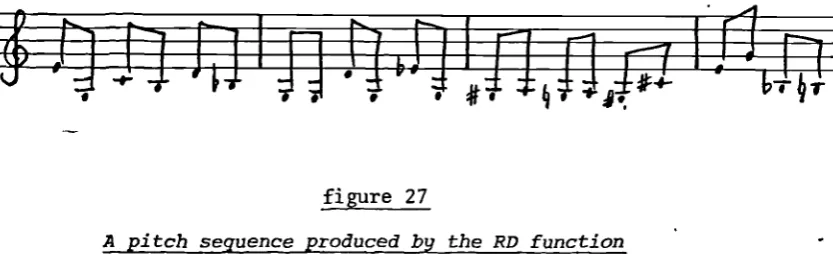
27. A pitch sequence produced by the RD function
28. A rhythmic sequence produced by the RD function
29. Woodwind instrumentation scheme for FIRELAKE
30. A rhythmic fragment produced with a different method of applying the RD function
31. An event space and event sequence formed by the application of a Markov Chain
32. An event sequence formed by applying a different Markov chain to the same event sequence as figure 31
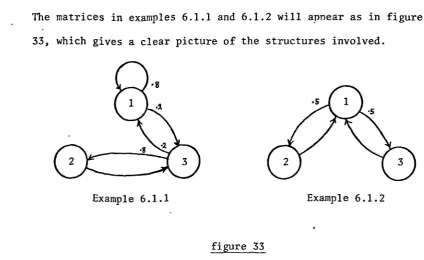
33. Event relation diagram of two simple Markov Chains
34. Flow chart explaining the basic operation of the TEXT YEARS program
35. Event-relation diagram of a simple Markov Chain with accessible and inaccessible events
A Markov chain with absorbing events
An event space and two possible event sequences formed by applying the Markov Chain of figure 36
Class-relation diagram of the Markov Chain of figure 35
Event-relation sub-diagram of events in equivalence class C 1 of figure 38
40. Event-relation diagram of a Markov chain of order eight consisting of transient classes and a recurrent class
41. Class-relation diagram of the Markov chain in figure 40
42. An event space for a simple clarinet piece
43. Five possible event sequences formed by the application of the Markov Chain of figure 40 over the event space of figure 42
44. Representation of an event sequence generated by a Markov Chain with absorbing barriers
45. Musical transcription of figure 44
47. Musical transcription of figure 46
48. General form of the matrix representing a Markov Chain with one alternating event
49. Simplified form of the matrix representing a Markov Chain with one alternating event
50. Event relation diagram of the general simple alternating Markov Chain
51. General form of the matrix representing a Markov Chain with two alternating classes of events
52. Event relation diagram of the general two-class alternating Markov Chain
53. Event space with a sequence generated with a two-class alternating Markov Chain
54. General form of the matrix representing an m-class alternating Markov Chain
55. The event relation diagram of a general rn-class alternating Markov Chain
56, General form of the matrix of a Markov chain with an expanöinci range of events
57. A representation of a typical event sequence formed from a Markov Chain with an expanding range of events
58, General form of the thatrix of a Markov Chain with a quasi-contracting
range of events
59, Representation of a typical event sequence formed from a flarkov Chain of the type shown in figure 58
60, The sequence of figure 59 with events re-arranged
61. An event sequence formed from a Markov Chain with a bias towards expansion
62. A Markov Chain of order three
63. A musical sequence generated by applying the Markov Chain of figure 62 over three event-parameter spaces
64. Sound discontinuity in the stereo space found in parts of MA4CRICISUM
65, The overall structural design of SONATIINOS 66. Two envelope functions used in SONATANOS
67. Two sets of harmonic spectra used in SONATANOS
68. Representation of a structure formed by applying the same two-event Markov Chain to nine different event-parameter spaces
69. Representation of the movement through adjacent partials of a number of strands of sound, firstly without bias, secondly with an upward bias, and thirdly with a downward bias
70. The micro-event envelope function used in LAITRAPARTIAL
71. Rhythmic pairs and the associated rhythmic value by which each is most likely to be followed
72. Rhythmic sequence formed using the eventualities of figure 71
73. Inverse eventualities to figure 71
74. A rhythmic sequence formed using the eventualities of figure 73
75. The overall structural design of DIRGEGRID
76. Representation of the result of linking pitch and note lengths in the FM sections of DIRGEGRID
77. The function relating pitch and note duration in the FM sections of DIRGEGRID
78. The harmonic spectra used in the GLIS sections of DIRGEGRID 79. The envelope functions used in the GLIS sections of DIRGEGRID 80. The slope functions used in the GLIS sections of DIRGEGRID
81. Clustered objects
-82. Objects constrained within general limits
83. Periodically structured objects
84. Networks, clusters and pulses
85. Tree diagram of a grammar derivation
86. Musical transcription of the terminal string of figure 85
87. The tree diagram of a set of finite-state grammar derivations
88. A set of musical terminals
89. The tree diagram of the derivation of a terminal string formed by applying a grammar over the terminal set of figure 88
90, Musical transcriptions of terminal event sequences generated by the same grammar as is illustrated in figure 89
92. A set of terminal events
93. Two possible sequences formed by applying a web grammar over the event space of figure 92
94. The hierarchical relationships between types of string and web grammars
95. A representation of a terminal structure defined in three dimensions
96. The hierarchical relationships between stochastic, web and string grammars
97. Stages in a sequence of generations when applying a stochastic web grammar to divide up the plane
98. Dividing the plane by a simple stochastic web grammar with a slight bias towards vertical divisions
99. Dividing the plane by a simple stochastic web grammar with a slight bias towards horizontal divisions
100. Computer generated structures from the SPC1 program
101. A pitch/time score of sound generated by the SPLT program using a stochastic web grammar
102. Dividing a block using a three-dimensional stochastic web grammar
103. A block and its inverse generated from a three-dimensional stochastic web grammar
104. A partial musical transcription of the block in figure 103
105. Cooling fins on a motorbike engine
106, Trial and response network for composition with heuristic grammars
ACKNOWLEDGEMENTS
My thanks go to my supervisors, both of whom have had to follow unfamiliar paths into foreign territory; to Dr. Malcolm Troup for his encouragement and musical vision, and to Dr. Jean Scott for her steady guidance and patient correction of technical details. I am also grateful to Stanley Haynes whose pioneering work in establishing computer sound synthesis facilities in this country greatly assisted my research in its initial stages, and whose invitation made it possible for me to work for a short time at IRCAM. I am also grateful to Jean Claude Risset for this
opportunity, and to Gottfried Michael Koenig for the chance to work at the Institute of Sonology, Utrecht. My thanks are also due to David Jenkins who obtained funds for me to support these visits, and to the Worshipful Company of Musicians who ponsored the Electronic Music Studentship which I held whilst carrying out most of the research. I must also give grateful acknowledgement to Curt Roads who first drew my attention to the implications of the use of formal grammars and thus gave me a methodical framework in which to interpret and develop hitherto rather abstract ideas; also to Steve Holtzman who pointed out to me the equivalence of Markov Chains with finite-state grammars; and to Dr. Orin Smith who helped to guide me through some of the more tricky aspects of Markov Chain theory. I must thank the members of the New English
Orchestra and the City University Singers who, with patience, perseverance and enthusiasm, have performed some of the works described in the thesis. Finally, I must express my gratitude to Dr. Craeme Bailey for his
DECLARATION
Powers of discretion are granted to the University Librarian to allow this thesis to be copied in whole or in part without further reference to the author. This permission covers only single copies made for study purposes, subject to normal conditions of acknowledgement.
A B S I R A C 1.
Although many sophisticated computer sound synthesis systems have recently
been developed, their use remains significantly under-exploited by
composers. This is due to a large extent to the cumbersome and detailed
programming invariably necessary in order to produce even the simplest of
sounds. So, for effective and efficient useof computer sound synthesis
techniques in musical composition, certain generative methods of forming
and controlling data structures can be a powerful aid. This thesis
proposes and develops such methods.
Techniques of pattern formation are described which have been developed
and used in the original compositions of the author. These are based on
stochastic generative schemes. The examples cited develop across the
spectrum of complexity, ranging from the application of simple
probability distributions through to intricate structures of
inter-related stochastic constraints under the control of a general grammatical
schema. In some cases the computer output has been designed so that it
can be transcribed for performance by conventional musical forces. In
other cases the output data has been used for direct control of digital
sound synthesis programs and equipment. In addition to the limited
practical resources existent at the City University, the author has been
able to work with facilities made available on practical research visits
to other institutions in Europe.
The structuringtechniques employed by the author are compared with
recent advances in the development of certain formal grammars for the
description of musical structures.
Methods of general application of the techniques are suggested, and in
particular, in the light of the development of alternative methods of
non-standard synthesis, the use of stochastic web grammars is proposed
not only for the macro-structuring of notes or sound objects, but also
in the definition of sound complexes and timbres. The techniques
explored have an explicit use as a practical tool for composers and may
be incorporated into, of form the basis of, computer controlled
compositional aids of wide ranging application.
SY1BOLS AND
AB B R E V I A T I 0 N S
Chaper Two
IRCAM Institute de Recherche et Coordination Acoustique/ç Mus ique
VOSIM VOice SIMulation
Chap ter Four
E
e.
1
Ejt
Edur
Epitch
p
(, ,...)
p (e.)
(e.)
event space
-an ordered set of objects
an ordered set of n events e 1 ,
e
2 , ,e
event with index i (the i-th event in an ordered set)
order of the event space
intensity event space
duration event space
pitch event space
probability assignment over an event space
an ordered set of values
the probability of event e. occuring
less than or equal to
the sum of probabilities for events e 1 to
e
POD
rnd(n)
II
DS
DS
POisson Distribution
random function generating an integer between 1 and n
a sequence of random real numbers between 0 and
an array consisting of random numbers ••
Difference Space
probability assignment over a difference space
Chapter Five
RD function random decaying function
Chapter Six
p.. = the probability of event ej occuring next given that event e. has just occured
P( Em+1 j
I
E=i)-I
P stochastic matrix of probabilities
ALGOL 60 ALGOrithmic Language defined in the year 1960
i
^
j
eventj
is accessible from event iimplies
i --^
j
events i andj
communicateC an equivalence class of events
€ belongs to
does not belong to
the probability that event i will be followed by event
5
after n steps(n) . .
matrix of Pjj probabilities
p the limiting value of as n approaches infinity
p*
matrix of p probabilities
II the limiting distribution, an array equivalent to
each row of P
the entries in It (w = p 1 = P2; = p)
probability matrix associated with equivalence class C
mean recurrence time of event e.
> greater than
not equal to
M sub-stochastic matrix associated with an alternating
class
M.. sub-stochastic matrix in the i-th row and j-th column
1J
of a stochastic matrix lattice partitioned into alternating classes
v. number of non-zero entries in the i-th row of a matrix
A and
Chapter Seven
SAIL Stanford Artificial Intelligence Language
GRAND Generates RAND data file
GSTOK Generates STOK data file
GRANP Generates RANP data file
GRI-JY Generates RHY data file
GFM Generates FM data file
GGLIS Generates GLIS data file
decimal exponent (standard in SAIL)
FORTRAN P1 SEG SYNTh V[ ] RAN(Ø) FM
FORmula TRANslation language
the i-th item in a note definition
SEGments
SYNThesize
event parameter vector
a random real number between 0 and
frequency modulation
Chapter Eight
G = KVN,VT,P,S) a grammar
VN VT P S n
0
A U L ci * { ,I...) aa set of variables or non-terminals
a set of terminals
a set of production rules
replace what is on the left of the arrow by what is on the right
starting symbol
set intersection
the null set
alphabet of a grammar
set union
the set of all possible strings generated by a grammar
the language generated by a grammar, the set of all permissable terminal strings
is contained in or equal to
the set of all possible terminal strings
an unordered set
any string from A*
U (reading down) contains
/ operator indicating a split in a different dimension
n
G
s
=KVN, VT , P,S,V>
web-diagram marker indicating that and y occur simultaneously
indexed operator indicating a split in the n-th dimension
a stochastic grammar
P an ordered set of production rules
V a probability assignment over P
M fist-moment matrix
in.. entries of M. Each in.. is equal to the sum of all the
probabilities associat3 d with each production rule where V. is replaced by V. multiplied by the number of times1 V. occurs in the 4eplacement string in each case
I identity matrix
eigenvalues or characteristic roots formed by setting the determinant of M-AI equal to zero
A principal eigenvalue
IA! absolute value of A
0
the null stringCHAPTER ONE
INTRODUCTION
1.1 Relation to other work
Very little material concerning the subject of computer music has been published in the United Kingdom. The Ph.D. thesis by Peter Manning of Durham University 1 is the most substantial contribution, which -essentially contains a survey of the area and concentrates in particular on the hardware applications and related aspects of sound generation. There are a number of smaller articles of a general nature, 2 and others concerning applications in computer analysis, 3 but these are of little significance.
With the ready availability of large and sometimes even extravagant resources, a great amount of research has taken place in the United States which has generally been concerned with the establisThuent of digital sound synthesis systems. In particular, much effort has been directed into the analysis and computerized reproduction of natural
instrument tones. Little work has been done to investigate compositional techniques using a computer. Some composers engaged in research, notably' Xenakis, Brlln, Koenig and Truax, have made use of stochastic techniques
models for music as early as the mid-fiftie, 4 but even though the basic
idea has been used by Xenakis and others, no other detailed development
or analysis of the pattern structures which may be used has appeared of
which the author is aware.
The author has already completed a thesis for a Master of Philosophy
degree at the Computer Centre of the University of Aston in Birmingham
entitled "A practical study of the application of Computer Techniques
in processes of musical composition" . In addition to containing a
fairly thorough survey of the historical situation, it is particularly
concerned with various compositional applications of a certain group of
limited techniques. The present thesis expands the field in the context
of more general systems, examines the theoretical basis more rigorously,
and extends into the application of stochastic structuring techniques
to digital sound synthesis systems and in the definition of tiinbral
complexes.
Descriptions of research in closely related areas have recently appeared
by C. Roads of Berkeley, California, and S. Holtzman of the
Computing Department at the University of Edinburgh. Their work is
described briefly in two articles 6 but is expanded in more detail in
two unpublished documents.7 ' 8 The systems they propose are grammatical
structures for the description of music sound data. These are designed
to be carefully defined by the composer and allow him to organize and
control his ideas more efficiently. The function of these systems is
rather different from that of the stochastic systems proposed in this
thesis, which are designed to be self-generative structures, in which the
composer is interested primarily in the end result and not necessarily in
the processes which lead to it.
The distinction is between a
desciptive
environment in which the composeruses a formal grammatical framework in which to control and manipulate
the structural definition of sound data combinations, and a
generative
environment in which the composer sets up parameter boundaries for the
structures he wishes to generate, which may be vague or imprecise if that
is expedient in the context of the composer's requirements, and in which
situation he may be unaware of the actual grammatical model employed
within the system.
Holtzmann, Berg and Koenig have described and experimented with techniques
of non-standard synthesis which sometimes have elements of stochastic
control involved.
At appropriate points in the thesis, reference is made to the research
1.2 New findings and propositions
All of the compositional applications described in the thesis are unique.
The application of extended stochastic techniques to generate
compositional structures and produce control data for digital sound synthesis systems is thought to be without similar precedent. There are instances (Koenig, Truax) where work of a related nature has been
described. Again these are identified and compared in the thesis (see 3.3) and the distinction of the work of the author is made explicit.
The extended musical application of Markov Chains is considered for the first time in this thesis, where an original, intuitive approach to the mathematical theory has been developed, appropriate for this particular context. As a generalization extending from that, the application of Stochastic Web grarimars is described, both for generating musical structures and for the creation of complex sound textures and musical timbres. This and a further extension into higher dimensions of
structural definition and integration, is a completely original conception.
The practical suitability of Stochastic Web grammars a composing tools, or as part of a general composing system is suggested.
3_Sourcesethodsandtechnigu
In almost all cases the author has intuitively developed structures and
techniques to solve particular practical needs. Subsequently, reference
has been made to the literature and amongst colleagues to establish links
and comparisons with potentially similar research elsewhere; and further,
the author has attempted to establish a sound theoretical basis for the
work by investigating the mathematical models and theory of the structures
which have been used. Reference has been made to standard texts on
probability theory, stochastic processes, and formal grammars.
The author has had the opportunity to work at, and use the extensive
practical computing and sound synthesis resources available at the
Insitut de Recherche et Co-ordination Acoustique Musique in Paris during
August 1977, and at the Institute of Sonology of the University of
Utrecht in the Netherlands in August 1978. These occasions proved to be
--of great practical value, and the difference in the basic philosophy and
approach to computer music of the two institutions was very stimulating.
Participation in the UNESCO symposium on computer music at Aarhus,
Denmark was also of considerable benefit.
Most of the ideas contained in the thesis have been worked out in actual
1.4 Structure of the thesis
After a general breakdown of the basic components of compositional
strategy in order to establish a background framework for description,
the thesis proceeds to develop a new theory of stochastic processes in
composition. Starting with a consideration of simple probability
distributions it leads on to an analysis of various types of Markov
Chain. In each case, having established the theoretical foundations,
the structure of the compositions FIRELAKE and MA4CRICISUM are considered
in detail, as examples of the techniques applied in practice.
Following these examples, the method is extended in a wider theoretical
context, and leads into a consideration of stochastic web s grammars.
Experiments with these grammars are analysed and finally applications
are described and assessed.
An appendix contains scores of some of the compositions considered, and
listings of computer programs which have been developed and used in
composition and experiment.
CHAPTER TWO
COMPOSING STRATEGY - A LINGUISTIC MODEL
It is useful in breaking down and analysing general compositional
method, to pursue a linguistic analogy. Three components of creative
linguistic activity can be isolated: the semantic, syntactic and
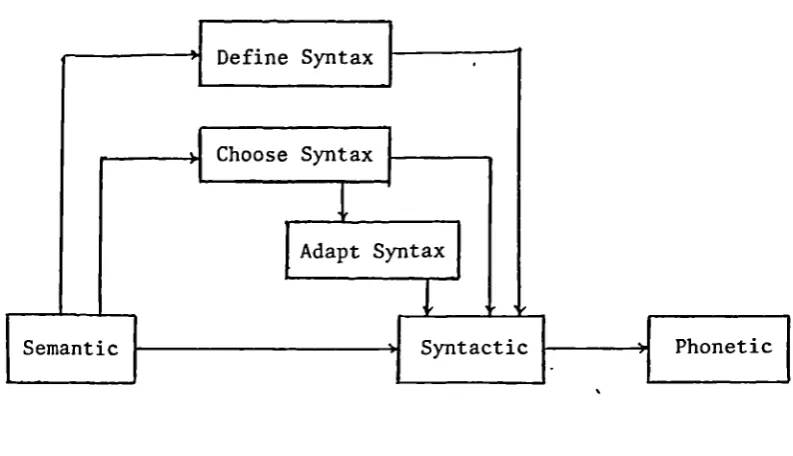
phonetic. 1 Their basic relationship can be represented as in figure 1.
figure 1
A basic linguistic model of composing strateo'!J
At the level of natural language, the
semantic
component refers to themental activity of sorting out the meaning of what is to be said, the
syntactic
component refers to the process of mapping the meaning intothe grammar and words of a commonly accepted language, and the
phonetic
component is the action of translating the words into audible speech and
sound. Each of these activities is dependent on the others, and the
boundaries of distinction are not necessarily well defined. Nevertheless
it is a convenient and usable model of categorization.
This model has been developed in a musical context in the writings of
2.1 Semantic component
In the context of musical composition, the semantic component covers
the creative act of sorting out the initial ideas for a musical
composition, developing an overall structural plan or deciding what is
to be said.
For example, figure 25 (page 84) shows an overall structural scheme,
which represents general patterns and shapes, and not absolute, final
relationships, for the piece FIRELAKE. Deriving this initial, conceptual plan forms a part of the semantic aspect of the compositional activity.
Decisions made at a semantic level may also determine precisely what
syntactic form is to be used or how it is to be used. Inparticular, in some of the types of computer music composition under consideration,
semantic decisions may involve the actual definition of a syntactic
structure, or a special adaptation of a given structure.
Again, this was the case with the same example, where a particular
syntactic system (using the Random Decaying Function - see section 5.2)
was defined.
It is therefore more accurate to adapt the figure above and re-draw it
as in figure 2 below.
figure 2
2.2 S
yntactic comnonent
So having determined what is to be said at the semantic level, the
subsequent syntactic decisions determine how it is to be said, or what
language is to be employed.
All composers have always worked within the framework of a familiar
syntactic system, where an accepted language explicitly or implicitly
defined by an agreed set of rules or grammar is employed. Modern
composers have a wide range of syntactic systems from which to choose,
which offer various degrees of rigidity. Such systems include
conventional tonality, polytonality and modal systems, mi•crotonality,
serialism, total serialism which has very strict rules, and indeterminacy
which has few. Very often composers have made use of their own specially
defined syntactic systems, and even if not explicitly developed as such,
distinctive composers t styles can be analysed in syntactic terms.3
The syntactic systems described and developed in this thesis can be used
to model most of the composing styles listed above, and are consequently
much more general in their scope.
It is the syntactic part of the composing process which is the main
subject of this thesis, and its nature and application in computer music
systems is considered in the next chapter and those following.
2.3 Phonetic / Sonic component
When considered in a musical context, the term phonetic is not really
appropriate, and so the term sonic used by Laskek is more suitable.
The sonic component refers to the action of defining exactly which
sorts of sounds are to be used, that is mapping the notes or symbols
resulting from the syntactic activity into an audible form. At the
level of conventional composition technique this is equivalent to the
process of orchestration.
Again, the areas of activity as defined in the original diagram are
rather blurred. The nature of the sonic mapping is frequently
determined by decisions taken at the semantic level, and in computer
music, systems can be defined using syntactic techniques. The final
version of the diagram of composing strategy will thus emerge as in
figure 3 (page 34).
In the past, most of the work in computer music research has been done
at the sonic level. In order to communicate with the machine, the
systems which have been developed have necessarily used basic syntactic
structures for sound definition, but these are by their nature quite
different to the generative grammars proposed later in the thesis.
The first widely used program for defining sound data was MUSIC V
developed by Max Matthews at Bell Telephone Laboratories. 5 This uses as
a.model themodulesof the traditional electronic music synthesiser which
may be combined and built up in as complex an arrangement as desired.
figure 3
P frthe extersion of the 1ngust.Lc model of composing strategy
include MUSIC IVB, MUSIC IVBF 6 , MUSIC 30, MUSIC XI , and MUSIC 10
which was used at IRCAN by the author to realise the composition
M4CRICISUM and is considered further in section 7.1.3
A popular technique which can be realised on such systems is frequency
modulation. Its use as a powerful tool in computer sound synthesis was
first seriously proposed and investigated by John Chowning of Stanford
University 8 and has proved to be so successful that many hardware
systems have been designed snecifically for FM generation. The technique
was used in M4CRICISUM and is described in section 6.5.2
Another alternative source of interesting sounds is supplied by the VOSIM
generator developed by Kaegi at Utrecht. 9 This was used to create the
taped sounds for DUTCH COURAGE realised by the author at Utrecht.
All of the above techniques are based on traditional approaches to sound
synthesis which are essentially built upon Fourier theory. Certain
alternative methods of synthesis have recently been proposed and are
usually referred to as "non-standard". Most of this work has emerged
from research taking place at Utrecht by Berg, Koenig and Holtzmann.
"Standard" synthesis is based on top-down techniques where an acoustic
model is used to derive samples defining a sound pressure wave. By
contrast, the "bottom-up" techniques of non-standard synthesis specify
sound samples by some syntactic method without reference to traditional
acoustic theory.
In each of these programs, an abstract pattern of numbers, related only
changes as a basic initial number pattern is repeated a large number of
times. Berg's PILE 2 describes a fairly sophisticated syntax for
defining and manipulating lists of numbers. Koenig's SSP 12 has a
simpler structure which includes options for stochastically defining
sequences and repeating groups of values. SSP is very similar to an
earlier program of Koenig's: PROJECT 2, which was developed for defining
compositional structures at note level. Holtzmann's "automated digital
sound synthesis instrument" 13 uses a generative grammar to define
sequences of machine instructions. Brun's SAWDUST 1 program, as well
as having basic block manipulation functions, has provision for using
polynomials to define strings of values corresponding to a curve linking
specific start and end points.
The advantage of these approaches is that they are not bound by the
limitations of an imperfect acoustic theory, and some rather extraordinary;
hitherto unimaginable sounds have been generated in this way. Many of
these sounds, however, are sostrange that to most ears they appear harsh
and unintelligible. Nevertheless these methods do have a significant
potential for development.
The author's own work has used generative techniques at the sonic level,
to control data expressed by "standard" synthesis methods, as for example
in the second movement of MACRICISUM, entitled LAITR4PARTIAL, which is described in section 6.3 below.
CHAPTER THREE
GENERATIVE SYSTEMS OF SYNTACTIC CONTROL
3.1 The need for generative systems
The computer sound synthesis systems in general use are almost all based
on the model set up by Max Matthew's MUSIC 5 program. They require
large amounts of data to first of all define "instruments" and then to
specify lists of notes which will be "played" on the instruments.
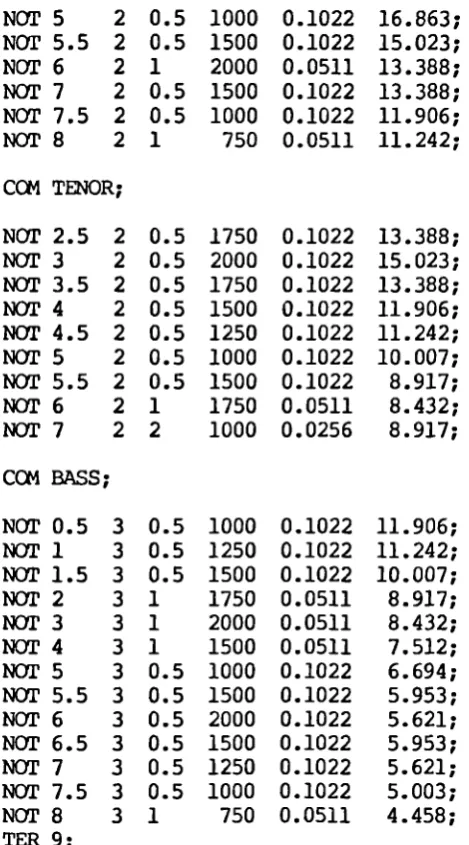
Example 3.1 (page 3) lists the MUSIC 5 data necessary to define an
instrument and play the notes of the short musical fragment shown.
Now this is a rather trivial example which will merely sound like a
rather poor electronic organ, for even with such large amounts of data,
relatively static and unchanging sound quality will be Droduced.
Various techniques such as frequency modulation are possible to produce
interesting time-variant timbres which escape from an artificially
consistent "electronic" sound quality, but even then large lists of
notes are still required.
Max Matthews, recognising this fact, made provision for the MUSIC 5
user to write what he terms PLF routines 1 which can perform elementary
operations on groups of notes. But this facility is essentially just a
method for repeating notes in various ways. Other formal systems for
note organization have been used and proposed, and these are considered
figure 4
4 musical fragment with the MUSIC 5 data to define it
SV2 0 3; C4 NO CONVT;
S13 0 10;Cal DISC OUTP1T WITH REPORT;
SIA 0 4 10000; CCI4 SAMPLING RATE 10000;
CQI INSTRU4E DEFINITK;
INS 0 1;
OSC P5 P6 B2 F3 P30;
OSC B2 P7 82 P6 P29;
0(71' B2,B1;
END;
INS 0 2;
OSC P5 P6 B2 P4 P28;
OSC B2 P7 B2 P6 P27;
0(71' 82 Bi;
END;
INS 0 3;
OSC P5 P6 82 F5 P26;
OSC B2 P7 B2 F6 P25;
OUT
B2 Bi;
END;
GEN 0 13 0 0 .99 20 .99 4910 511;
GEN 0 14 00 .99 20 0 511;
GEN 0 15 0 0 .99 20 .75 40 .75 4910 511;
GEN 0 1 6 0 0 .99 50 .99 205 -.99 306 -.99 461 0 511;
C4 SOPRANO;
NOT 0
1 1
750 0.0511 30.047;
NOr 1 1 1.5 1259 0.0341 26.776;
NOT 2.5 1 0.5 1750 0.1022 22.484;
NOT 3.0 1 0.5 2000 0.1022 23.813;
NOT 3.5 1 0.5 1750 0.1022 22.484;
NOT
4.0 1 0.5 1500 0.1022 20.031;
NOT 4.5 1 0.5 1250 0.1022 17.834;
NOT 5
1 1
1000 0.0341 22.484;
NOT 6
1 0.5 2000 0.1022 13.388;
NOT 6.5 1 0.5 1500 0.1022 15.023;
NOT 7
1 2
1000 0.0256 17.834;
CCXI ALTO;
NcYT5
2 0.5
NOT 5.5 2 0.5
NcYT6
2 1
N0r7
2 0.5
NOT 7.5 2 0.5
NOT8
2 1
cai TENOR;
1000 0.1022 16.863;
1500 0.1022 15.023;
2000 0.0511 13.388;
1500 0.1022 13.388;
1000 0.1022 11.906;
750 0.0511 11.242;
NOT 2.5 2 0.5 1750 0.1022 13.388;
Nr 3 2 0.5 2000 0.1022 15.023;
NOT 3.5 2 0.5 1750 0.1022 13.388;
NOT 4
2 0.5 1500 0.1022 11.906;
NcYT
4.5 2 0.5 1250 0.1022 11.242;
NOT 5
2 0.5 1000 0.1022 10.007;
NOT 5.5 2 0.5 1500 0.1022 8.917;
NOT 6
2 1
1750 0.0511 8.432;
NOT
7
2 2
1000 0.0256 8.917;
CCXI BASS;
NOT 0.5 3
NOT 1
3
NOT 1.5 3
NOT 2 3
NOT
3
3
NOT 4 3
NOT 5 3
NOT 5.5 3
NOT 6 3
NOT 6.5 3
NOT 7
3
NCYT
7.5 3
NOT
8
3
TER 9;
0.5 1000 0.1022
0.5 1250 0.1022
0.5 1500 0.1022
1
1750 0.0511
1
2000 0.0511
1 1500 0.0511
0.5 1000 0.1022
0.5 1500 0.1022
0.5 2000 0.1022
0.5 1500 0.1022
0.5 1250 0.1022
0.5 1000 0.1022
1
750 0.0511
[image:40.595.79.314.157.580.2]11. 906;
11. 242;
10. 007;
8.917;
8.432;
7.512;
6.694;
5.953;
5.621;
5.953;
5.621;
5.003;
4.458;
Techniques which can merely repeat groups of notes are not very powerful,
and in order to build complex and interesting structures, it is necessary
to find a method of generating large amounts of variable data.
Many composers have tended to shy away from computer music systems.
Those who have been bold enough to tackle the difficulties and have
taken the trouble to learn how to use the systems, have discovered that
it takes a great amount of time and energy to produce even the simplest
of sound structures. It is possible to spend days prenaring lists of
data to define sounds lasting a few seconds only. Many of those composers
who have made use of computers have barely scratched the surface of the
rich resources available, and have merely used the computer to reproduce
compositions essentially instrumental in conception and in a strongly
note-based idiom. There is no reason why systems should nt be used in
that way, when advantage may be taken of very accurate capabilities for
control of pitch, rhythm and intensity which instrumental players are
unable to achieve, but the possibilities which com puter music generation
have to offer are far richer and more interesting than such a restricted
use might suggest.
At the recent UNESCO symposium on computer music at Aarhus, it was
generally agreed that much of the current usage of computer music systems
was trivial and that there was an urgent need at the present time to
encourage more composers to make use of the available systems and to
develop compositional techniques appropriate to the resources.
In the United States in particular, the development of hardware and
sound synthesis software has reached a sophisticated level, but the
sometimes extravagant systems are not being fully exploited.
Unfortunately, such a favourable situation with respect to resources
does not exist within the United Kingdom!
Generative systems, then, have much to offer in the field of computer
music composition. In addition to helping to define large, interesting
and varied data structures, generative techniques are able to spur the
imagination of the composer, and may sometimes suggest possibilities
which would not otherwise have been anticipated. Furthermore, such
systems can be intrinsically valuable methods of organising sound
structures in their own right.
William Buxton has made a distinction between "composing programs" and
"computer-aided composition". 2 Koenig has pointed out in a recent
lecture that such a distinction merely identifies two extremes, and they
do not form distinct entities. 3 There are programs and systems which
fall between the two, and there are some which may be both at once!
Ideally, a program which can function as the most general composing aid
should offer a full range of possibilities from complete user control to
almost total control by the program. The structures under consideration
can be used at any point on this scale.
Although the main purpose of this thesis is to investigate stochastic
-3.2 Deterministic Processes
The simplest type of generative system, or composing routine is a
deterministic process in which the composer defines a rule which can be
repeatedly applied to a set of notes. Once the process is begun it may
continue to run indefinitely. Such processes usually involve defining
a basic pattern of some sort and then repeating it, but making incremental
changes on each repetition.
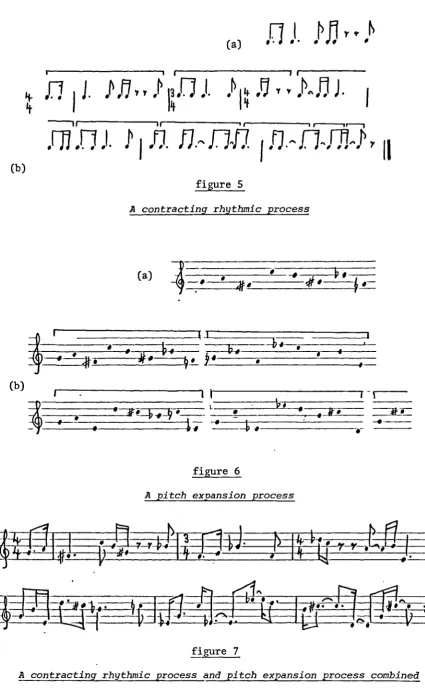
Example 3.1 A 'musical chairs' process.
A short rhythmic fragment is defined (see figure 5(a), page 43).
A rhythmic sequence can be generated by repeating the fragment,
but removing the last note or rest on each repetition (figure 5(b)).
Example 3.2 An expansion process.
A group of pitches is defined (see figure 6(a), nage 43). A nitch
sequence can be generated by repeating the group, and pushing each
note up or down a semitone either side of a tonal centre with each
repetition (figure 6(b)).
The above examples may be combined to produce the result of figure 7.
Notice that the base fragments of examples 3.1 and 3.2 are of different
lengths. By repeatedly using the same rhythmic pattern, and expanding
the pitch pattern further and also applying it repeatedly, a sequence may
be produced which will continue for a long time , before it begins to
repeat itself.
rj
I
(a) ••
I 1 C It
en
j
J.
•
t' ,i,r
3
j dpi.f
tf •V j. rij.
k
l't
1 I
-•rjj fl
.1.
p
n
fi
flAU ri
flt T
I
•
1•
• ..
II.. [image:44.595.71.497.70.759.2](b)
figure 5
A contracting rhythmic process
(a)
i4-iii.
.
C-#
1?,
__________________ ______________ -
—
j________
4'
___
-.
1.
•1C
!- •
-C-(b) __________________________ ___________________________ ______
I •
C
________________ - C •_J-•
- , • C
-—.
[image:44.595.87.465.85.275.2]4.
C-—.
figure 6
A pitch expansion process
figure 7
Another type of generative process is the system of change ringing,
where slight alterations are made in the order in which a group of bells
is rung on each repetition.
Example 3.3
On a group of six bells, the rule that the central pair changes
order, then the two middle pairs, then the outer pairs, with the
process repeated indefinitely, will produce the following
-sequence:
1 2 3 4 5 6
1 2 4 3 5 6
1 4 2 5 3 6
4 1 2 5 6 3
4 1 5 2 6 3
4 5 1 6 2 3
5 4 1 6 3 2
5 4 6 1 3 2
5 6 4 3 1 2
6 5 4 3 2 1
6 5 3 4 2 1
6 3 5 2 4 1
3 6 5 2 1 4
3 6 2 5 1 4
etc.
Some beautiful symmetries emerge in these patterns, which have
inspired a number of mathematical studies of change ringing and
may be modelled using group theory techniques. At least one of
these studies has been carried out with the aid of a computer.4
Change ringing processes have been used to generate material in
some of Lejaren Hiller's computer music compositions.5
Generative processes of the type described have been used by many recent
composers. The music of Steve Reich is almost entirely dedicated to
exploring and making use of such processes. 6 But other composers have
made effective use of process techniques in more familiar concert works.
Messiaen, for example, has made use of an intervallic expansion process
similar to that described in example 3.2 in many of his works.7
Although some composers have found that such deterministic composing
processes can be very useful in specific instances, in general they are
generatively rather weak structures compared to the stochastic systems
to be considered below, which are of much wider application and offer
3.3 Serial manipulation
In order to assist with data generation in many early attempts at
composition with computer music systems, use was made of serial
composition techniques, by means of which, the standard permutations
and transpositions of a twelve-note series could be systematically
exploited.
An early use in England was made in 1963 by the computer scientist
Stanley Gill in response to a request for background music for a T.V.
program. 8 He used a computer to generate versions of a twelve note row,
which were tested against a few other compositional rules, and used to
produce a short piece for string trio.
At Utrecht, Koenig has developed a composing program PROJECT ONE which
is designed as an extension of serial techniques:
"PROJECT ONE is intended to carry on from serial compositional technique, and to describe a study model which, practically independently, produces any number of variants of a basic structure."
This was designed to produce an output which could be transcribed for
whatever instrumental resources the user required. Koenig has recently
renewed the program so that it can be used to generate electronic sounds
directly. The author has made use of the nrogram in this form.
The greatest use of serial techniques, however, has been in the United
States. The post-serial combinatorial techniques of composition favoured
by Milton Babbit and his pupils have found a ready and convenient outlet
in computer sound synthesis systems. Barry Vercoe 10 and John 4e1by
are amongst those composers who have used systems in this way.
A twelve-note serial facility is not uncommon in computer music
installations in the States. For example, Donald Byrd has described
the program MUSC which is available at Indiana. 12 A number of studies
have appeared concerned with combinatorial problems which may arise in
the systematic application of serial techniques. An article by Kobin
and Ashford, for example, discusses certain harmonic difficulties which
have been encountered.13
Some composers find that working with such techniques can be satisfying
and rewarding, but nevertheless, the writer is of the opinion that again,
they are rather limiting and lacking in generality. In fact. Koenig points
out that serial composition can be considered to be a snecial case of
-aleatoric compositional technique where the twelve notes have to occur
with equal frequency. Koenig's intention in using the term "aleatoric"
is essentially to mean the same as the more explicit term "stochastic".
3.4 Descriptive grammars
So far, the systems described have all been generative systems where a
starting structure and a simple increnental or permutational algorithm
are defined and used to produce a completely controllable and predictable
result. In addition to these techniques, more formal descriptive systems
have been developed which give the user of computer music synthesis
systems more flexibility in organising sound data. These range from
basic methods for automatically repeating chunks of data, which avoid
unnecessary re-writing of lists of note definitions, to sophisticated
data control systems where groups of related structures may be defined
and various structural manipulations applied. Although not necessarily
explicitly described as such, all these approaches can be termed types
of descriptive grammars.
Examples of these are the SCORE program of Leland Smith, in use at
Stanford and IRCAM, 15 and the facilities available as part of the
Structured Sound Synthesis Project (SSSP) under development by William
Buxton and others at Toronto.16
Recently, two sophisticated studies of a musical descriptive grammar
have anpeared which, based on the effective use of formal language theory,
appear to offer the most powerful and efficient means of describing
musical structures so far developed, though both have yet to be applied
in a working system.7 lB It has already been stated that this study
is more concerned with generative, rather than descriptive systems; but
formal grammatical techniques, applied in the context of the
auto-generative stochastic systems being considered, rather than exclusively
as a medium in which to express a precise structural definition, have an
enormous potential. .Such a use of formal grammars is taken up and
a computer, a composer is forced to specify , every last aspect of a sound,
and may unexpectedly find that he needs to control all sorts of Darameters
which were previously taken for granted. If these parameters are left
unchanged, the result can be boring and lifeless; if an attempt is made
to control every last subtlety of sound production individually, the
task becOmes hopeless; stochastic techniques can provide useful solutions
to such difficulties at every level of composition.
Pioneering work with some types of stochastic control has been a feature
of some of the early compositions of Xenakis 19 and Hiller. 20 Koenig has
written composing programs involving stochastic choices, where the user
is able to define an outline of a compositional structure for which the
computer will fill in the details. 21 Some of Koenig's techniques have
been developed and incorporated in Truax's P.O.D. programs.22
The purpose of the following sections is to explain the nature and
operation of stochastic techniques in composition. The text begins by
describing simple structures, and with the aid of examnies builds un to
a more complex and sophisticated level whe the benefits of stochastic
CHAPTER FO.L'R
STOCHASTIC PATTERN GENERATION (i) SIMPLE PROBABILITY DISTRIBUTIONS
4.1 Preliminaries
Before using any sort of stochastic patterning system, it is necessary
to identify which compositional p arameters are to be controlled, and the
range of values which each can assume. The range of values will be
referred to as the Bet of events which constitute the event space. For
most musical purposes the set of events will be discrete. The stochastic
modelling of processes with continuous event spaces is rather more
complicated; the present discussion will in general be limited to discrete
event spaces.
The event space must be an ordered space, that is with the events in
some natural or clearly defined sequence. The following notation will
be used:
E=
where E is the event space, the ordered set of events
and e 1 , e2 , ,. are the individual events
and i is the index of event e
I
El is the order of the event space and is equal to n , thenumber of events.
Example 4.1.1
An event space can be defined for the intensity parameter as below:
Ej.t = (pp,pp,p,mD,mf,f,ff,fff)
here, e1 = ppp , e , = inp , etc. IE. J = 8
int
Example 4.1.2
An event space for the duration parameter may be:
(1,),
>
E= dur
and in this case, lEduri =
It is not necessary to define an event space by listing its elements, a
description will suffice.
Example 4.1.3
An event space for the pitch parameter:
itch = the major scale of C )
here, it h' =
The techniques discussed below set out methods of selecting events to
dur. 2 10 2 3 7 11 mt. 8 2 5 1 1 7 pitch 9 16 2 3 19 17 note 1 note 2 note 3 note 4 note 5 note 6 timbre 3 1 3 3 2 1
4.2 Equally
likely outcomes
The simplest situation is where each event is equally likely to occur.
This corresponds to the aleatoric process described above where the
outcome is totally at random.
Example
The following four parameter event spaces may be defined:
itch = ( the scale of chromatic notes from C to G' )
Edur
= < ) to in semiquavers )
= to fff )
Etib = ( flute, oboe , violin )
IEpjtchI - 20 lEd! = 16
tEi n t i = 8 l Et i mbre l= 3
A random choice is made from each parameter space. So, for example,
the following matrix identifies an event by its index, for each
parameter, in defining each note:
A E D D F# E fff pp mf ppp ppT) ff 'p c1"J J)
I, is
violin flute violin violin oboe flute note 1 note 2 note 3 note 4 note 5 note 6
Or in terms of actual events:
When transcribed into traditional musical notation, this will
appear as in figure 8.
Uie oboe YiotV% -3 .---.----; ---_: ___ _________ 4JJ fl,p figure 8
A randomly generated sequence
It is a simple matter to use the random number generating facility
available in most computer languages to control the choice of states.
In the BASIC language, a call of the function RND(N) will deliver a
random number generator is not available, a simple subroutine or
procedure may be written. The author has described a technique used in
some earlier work, and there are many descriptions and discussions of
random number generators in the literature.1
The material used at the opening of the tape niece MACRICISUM was
generated by making a simple random cioice from within the limits of the
event space specified for each parameter (see section 6.2.3).
With many parameters being controlled, and with careful definition of
each event space, the resulting sound, over short periods, will sound far
from chaotic, and may produce pleasing and original patterned sequences.
Such a strict random distribution of events, with equally likely outcomes
does not, however, corres pond to any natural nhenomena. It is usual for
certain events to be weighted so that they are more likely to occur than
others. Techniques for adjusting the likelihood of p articular outcomes
can be very useful in stochastic composition, and these will now be
considered.
4.3 Probability distribution define.d a priori
The weighting of various events can be specified by defining a
probability asBignment or vector over the event space. The number of
entries, or order of the probability assignment must obviously equal the
order of the event space.
Example 4.3.1
A composer could decide that he wants to produce a sequence of
pitches which contains many A's, a few D's, hardly any F#'s, G#'s
or B's, and nothing of anything else. He will first of all define
a pitch event space:
Epitch = ( A,BID,F#,G#)
and a corresponding probability assignment:
P1 = (0.6,0.05,0.25,0.05,0.05)
or if listed side by side:
A 06
B 005
D 025
F# 0.05
0•05
p(e) is the probability of event i occuring, so
p(e) = p(A) = 06
This means that A will occur with a probability of 06 , that
is 60% of the time; B will occur with a probability of O•05
Each event nrobability must be less than or equal to one: p(e)
1 for
all ± .
The
total sum of probabilities must equal one, or in the usualmathematical notation:
p(e1) = 1
This
distribution can then be used to generate a sequence which stayswithin the required bounds.
A probability assignment may be used in a computer program to generate
a sequence in the following way. First of all, starting at the beginning
of the assignment and working through it, each probability is replaced
by the sum of the probabilities up to that point, thus producing a
cumulative array. So if p'(e 1 ) represents the value associated with
event e in the new cumulative array P', then:
p'(e) i- (e) i = 1, ...
For each event required, a random real number between 0 and 1 is
generated. The values in the array are compared one by one with the
random number until a value greater that the random number is found.
The position in the array where this occurs is used to index the required
event from the event space. This procedure may be repeated for as many
events as are required and will, as the total number of events generated
increases, produce a sequence whose overall distribution of events becomes
progressively closer to that defined in the original assignment.
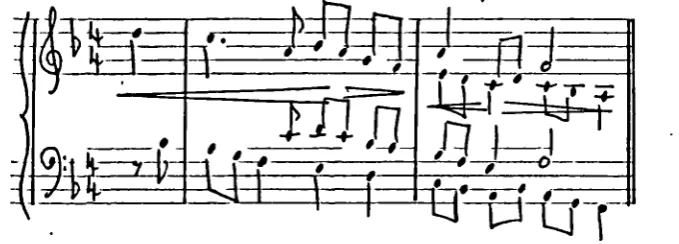
When these sequences for pitch and rhythm are combined, the resulting
sequence of figure 9 is formed:
figure 9
A melodic sequence generated from simple probability distributions
Note that there is no need for events in the event space to consist of
single elements. In the rhythmic event space of the example above:
e 1 =
Each event may be whatever the composer wants to specify, and may be as
complex as he wishes. A set of pre-recorded concrete sounds may be used
for an event space, or a group of electronically synthesized sound
complexes. The following simple example has each event in the event
space consisting of a pre-composed group of notes.
Example 4.3.3
Using the same probability measure as above (4.3.1) a different
event space of order 5 may be chosen with the five events e 1 ,.. .,e5
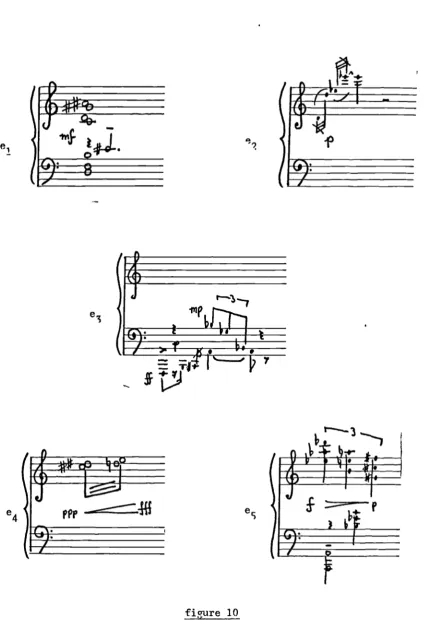
defined in figure 10 (page 6l). An event sequence such as the
-following:
e1 e1 e5 e1 e3 e2 e1 e3 e1 e1 e1 e5 e3 e1 e1 e1 e1 e3 e1 e1
e1
e
1
e £pP
e4
[image:62.595.70.495.85.711.2]•1
figure 10
will then transcribe into the form of figure 11 (page 63).
It is possible for each event to be itself defined stochastically. This
idea is taken up later (section 6.5.2) and is the case with many of the
examples in chapter 7. Such generality gives this stochastic approach
a considerable power.
E =<
4.4 Probability distribution defined by analysis
It is possible to produce a probability assignment by analysing a given
sequence. This is done by counting the number of occurences of each
event and assigning probabilities proportionately.
Example 4.4.1
A probability assignment will be constructed for the extract shown
in figure 12 from the first Chromatic Invention in Bartok's
Microkosmos Book VI.2
p I
-figure 12
The beginning of the 'irst Chromatic Inventicn from Mikrokosmos Book 6, Bartok
First of all, the event space of figure 13 may be defined. (This
is only one of many which could be used.)
-->
figure 13
A pitch event space
IEI = 13 -.