Untrusted Servers
Changyu Dong, Giovanni Russello, and Naranker Dulay Department of Computing, Imperial College London
180 Queen’s Gate, London, SW7 2AZ, UK {changyu.dong,g.russello,n.dulay}@imperial.ac.uk
Abstract. Current security mechanisms pose a risk for organisations that outsource their data management to untrusted servers. Encrypting and decrypting sensitive data at the client side is the normal approach in this situation but has high communication and computation overheads if only a subset of the data is required, for example, selecting records in a database table based on a keyword search. New cryptographic schemes have been proposed that support encrypted queries over encrypted data but all depend on a single set of secret keys, which implies single user access or sharing keys among multiple users, with key revocation requir-ing costly data re-encryption. In this paper, we propose an encryption scheme where each authorised user in the system has his own keys to encrypt and decrypt data. The scheme supports keyword search which enables the server to return only the encrypted data that satisfies an encrypted query without decrypting it. We provide two constructions of the scheme giving formal proofs of their security. We also report on the results of a prototype implementation.
1
Introduction
Data growth is inevitable for nearly all organisations. According to Forrester Research, enterprise storage needs grow at 52 percent per year [1]. To reduce the increasing costs of storage management, many organisations choose to out-source their data storage to third party service providers. Recent research from TheInfoPro shows that nearly 20% of Fortune 1000 organisations outsource at least some portion of their storage management activities [2].
One of the biggest challenges raised by data storage outsourcing is security and trust. Business data is a valuable asset for many companies. While compa-nies may trust a Storage Service Provider’s (SSP) reliability, availability, fault-tolerance and performance, they cannot trust that an SSP is not going to use the data for other purposes, especially when the value of the data is high. Traditional access controls which are used to provide confidentiality are mostly designed for in-house services and depend greatly on the system itself to enforce authorisation This research was supported by the UK’s EPSRC research grant EP/C537181/1. The
authors would like to thank the members of the Policy Research Group at Imperial College for their support.
V. Atluri (Ed.): DAS 2008, LNCS 5094, pp. 127–143, 2008. c
policies, effectively relying on a trusted infrastructure. In the absence of trust, traditional security models are no longer valid. Another common approach to provide data confidentiality is cryptography. Server side encryption is not appro-priate when the server is not trusted. The client must encrypt the data before sending it to the SSP and later the encrypted data can be retrieved and de-crypted by the client. This could ease a company’s concern about data leakage, but introduces a new problem. Because the encrypted data is not meaningful to the servers, many useful data management functionalities are not possible. For example, if a client wants to retrieve documents or records containing certain keywords, how can this request be processed? Can we keep the data incompre-hensible to servers and their administrators while efficiently retrieving the data? Consider the following scenarios:
Scenario 1. Company A is considering outsourcing its data processing centre to a service provider B. This will cut its annual IT cost by up to 25%. But the CIO is concerned about data security. The company’s databases contain valuable production data and customer information. It would be unacceptable if competitors got hold of the data. Administrative controls such as formal contracts, confidential agreements and continuous auditing provide a certain level of assurance, but the CIO would also like to encrypt the sensitive data and have fast searches over it.
Scenario 2. Bob subscribes to a Personal Health Record service from company C. The service allows Bob to maintain his electronic medical records and share them with his doctors through a web interface. Bob wants to encrypt his records, ensuring the staff of company C will not be able to know what is inside.
A trivial solution is to download all the data to the client’s computer and de-crypt it locally. This does not scale to large datasets. Recently, several innovative schemes have been proposed to address the above problems. The basic idea is to divide the cryptographic component between the client and server. The client performs the data encryption/decryption and manages the keys. The server pro-cesses search queries by carrying out some computation on the encrypted data. The server knows nothing about the keys or the plaintexts of the data nor the queries, but is still able to return the correct results.
In this paper, we propose a scheme for multi-user searchable data encryption. Our scheme does not require a fully trusted server. The server can search an encrypted keyword on the encrypted data. More importantly each authorised user in the system has his own unique keys which simplifies key revocation and avoids data re-encryption. All the authorised users can insert encrypted data, decrypt the data inserted by other users and search encrypted data without knowing the other users’ keys. The keys of one user can easily be revoked without affecting other users or the encrypted data at the server.
2
Related Work
Song et al. [3] introduced the first practical scheme for searching on encrypted data. The scheme enables clients to perform searches on encrypted text with-out disclosing any information abwith-out the plaintext to the untrusted server. The untrusted server cannot learn the plaintext given only the ciphertext, it cannot search without the user’s authorisation, and it learns nothing more than the encrypted search results. The basic idea is to generate a keyed hash for the key-words and store this information inside the ciphertext. The server can search the keywords by recalculating and matching the hash value. Yang et al. [4] proposed an elegant scheme for performing queries on encrypted data and also provided a secure index to speed up queries by two-step mapping. Goh’s scheme [5] enables searches on encrypted data by constructing secure indexes based on bloom filter. In thebucketization approach for searching encrypted databases [6,7,8,9], an attribute domain is partitioned into a set of buckets each of which is identified by a tag. These bucket tags are maintained as an index and are utilised by the server to process the queries. Bucketization has relatively small performance overhead and enables more complex queries such as range queries and comparison queries at the cost of revealing more information about the encrypted data.
3
Multi-user Searchable Data Encryption Scheme: Basic
Construction
In this section, we introduce the basic construction of the multi-user search-able data encryption scheme which is built uponproxy encryption. The scheme does not require sharing keys among the users. We also formalise the notions of security and provide proofs later in this section.
3.1 An RSA-Based Proxy Encryption Scheme
[image:4.513.128.303.289.382.2]The notion of proxy encryption was first introduced in [12]. In a proxy encryp-tion scheme, a ciphertext encrypted by one key can be transformed by a proxy function into the corresponding ciphertext for another key without revealing any information about the keys and the plaintext. Proxy encryption schemes can be built on top of different cryptosystems such as El Gamal [13] and RSA [14]. Applications of proxy encryption include: secure email lists [15], access control systems [16] and attribute based publishing of data [17]. A comprehensive study on proxy cryptography can be found in [18].
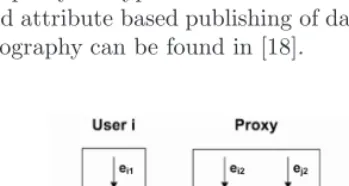
Fig. 1.Encryption/Decryption in Our RSA-based Proxy Encryption Scheme
Our scheme uses an RSA-based proxy encryption scheme. Let’s useE= (IGen, U Gen, U Enc,U Dec, P Enc, P Dec) to denote the proxy encryption scheme. Fig. 1 shows the encryption/decryption process in the proxy encryption scheme.
– IGen is the master key generation algorithm which is identical to the key generation algorithm in the standard RSA. It takes a security parameter k and generates (p, q, n, φ(n), e, d).IGen needs only to be run once at the beginning of the system setup. All the outputs exceptnmust be kept secret. In the rest of the paper, we assume all arithmetic to bemod nunless stated otherwise.
– U Gen is the algorithm for generating the key pairs for the users and the proxy. For each useri,U Gentakes the output ofIGenand findsei1, ei2, di1,
di2 such that ei1ei2 ≡ e mod φ(n) and di1di2 ≡ d mod φ(n). This can be
efficiently done. Take the ei1, ei2 pair for example, we can pickei1 < φ(n)
ei1x≡ 1 mod φ(n) always has a solution, then ei2 ≡ ex mod φ(n) always
satisfiesei1ei2 ≡e mod φ(n). Note that knowing onlya is not sufficient for
solving the two variable equationax≡y modn. Therefore by knowing only ei1 or ei2, one cannot compute its counterpart (ei2 orei1 respectively) and
e. The user’s key pair is (Kuei, Kudi) = (ei1, di1). The proxy’s corresponding
key pair for the user i is (Kpei, Kpdi) = (ei2, di2). The lower bound of the
number of valid key pairs isφ(φ(n))>φ(n).
– U Encis the algorithm for user encryption. For a messagem, useriencrypts it using his encryption keyKuei=ei1. The resulting ciphertext isc=mei1.
– P Enc is the algorithm for proxy encryption. When the proxy receives a ciphertextcfrom useri, it re-encrypts it using the corresponding encryption keyKpei=ei2as c∗=cei2.
– P Dncis the algorithm for proxy decryption. Before sending the ciphertext to user j, the proxy decrypts it using the corresponding decryption key Kpdj=dj2 as c= (c∗)dj2.
– U Decis the algorithm for user decryption. When a userj receives a cipher-text c from the proxy, he decrypts it using his decryption keyKudj =dj1.
He will be able to recover the plaintextm= (c)dj1.
Note that in the system, for any user i and any user j, ei1ei2 ≡ ej1ej2 ≡
e mod φ(n) anddi1di2≡dj1dj2≡d mod φ(n). Thereforec∗=cei2 =mei1ei2 =
me,c= (c∗)dj2 =medj2and the userjcan correctly decryptcbecause (c)dj1 =
medj2dj1 =med=m.
In our system, we use a trusted key management server (KMS) controlled by the data owner to manage the keys. First, the KMS runsIGen to generate a master key pair (e, d) and publishes the only public parametern. When a new user is enrolled into the system, the KMS runsU Gento generate a unique tuple ((ei1, di1),(ei2, di2)) and sends (ei1, di1) to the user and (ei2, di2) to the data
server through secure channels. If the user is removed from the system at a later stage, the KMS can send a instruction to the data server to remove the key pair (ei2, di2) at the server side. We will see in the following sections, without the
server side key pairs, the user cannot search and decrypt the data.
Although requiring a trusted KMS seems at odds with using an untrusted data storage service, we can argue that the KMS requires less resources and less management effort. Securing the KMS is much easier since a very limited amount of data needs to be protected and the KMS can be kept offline most of time.
3.2 Data Encryption
In our system, each data itemDxis associated with a set of searching keywords
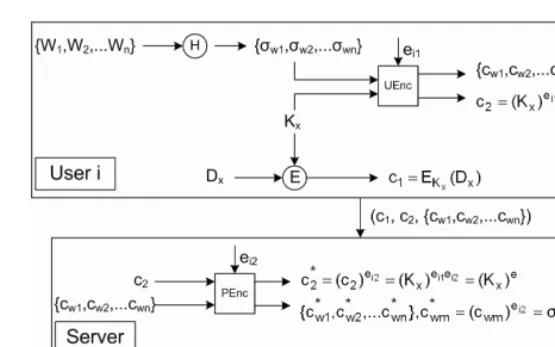
{W1, W2, ..., Wn}x. The encryption algorithm is shown in Fig. 2. The data item
could be a document, an email, or a data cell in a database etc..
Fig. 2.Basic Data Encryption Scheme
key which generates a ciphertext c1 =EKx(Dx). Kx is then encrypted by the
user’s piece of RSA encryption key asc2= (Kx)ei1.
For each search keywordWm, the client uses a hash functionH to compute σwm=H(Wm) and computescwm= (σwm)ei1. The client then sends the tuple
(c1, c2,{cw1, cw2, ..., cwn}) to the server.
After receiving the tuple, the server first computes c∗2 = ce2i2. For each
en-crypted keywordcwm, the server computes c∗wm=cei2
wm. The final cipher stored
on the server is a tuple (c1, c∗2,{cw∗1, c∗w2, ...c∗wm}).
3.3 Keyword Search
A userj may want to retrieve all the documents on the server which contain a keywordW. To do so,jfirst computes the hash value of the keywordσ=H(W). Thenj encryptsσasQ=σej1 and sendsQto the server.
The server re-encryptsQasQ∗=Qej2. Then it tests each ciphertext: in the
encrypted keywords set{c∗w1, ..., c∗wm}x, if there exists ac∗wmsuch thatc∗wm=Q∗, then adds this ciphertext into the result set.
Recall that ei1ei2 ≡ ej1ej2 ≡ e mod φ(n), so Q∗ = (H(W))e and c∗wm =
(H(Wm))e are equal if and only if W = W
m. If the server cannot find the
corresponding key for the user j, it cannot correctly compute the searching keyword. Therefore an unauthorised user cannot perform searching on the data.
3.4 Data Decryption
If an authorised userjwants to retrieveDx, the server gets the tuple (c1, c∗2,{c∗w1,
c∗w2, ...c∗wm}) from the data storage, computes c2 = (c∗2)dj2 and sends c1, c
2 to
j. The user j then computes (c2)dj1 = (c∗
2)d = (Kx)ed = Kx and can decrypt
the data item Dx = EK−1
3.5 Attack Model
We focus the scope of our scheme on protecting data confidentiality, therefore we will not consider attacks on data integrity and availability which can be handled by other mechanisms. For the scheme, we assume that the KMS and the authorised users are fully trusted. We also assume they can properly protect their secrets, for example, the key pairs and the parameters for generating keys. The server is modelled as “honest-but-curious”, i.e. we trust it to correctly execute the instructions from the clients, but do not want it to access the plain data. An adversaryAdv is an attacker (or a software agent) that gains privileged access to the data storage: either an outsider or a untrustworthy employee in the data centre. The adversary can also intercept the communications between clients and the server, but it is computationally bounded. In addition, the adversary is restricted to only perform passive attacks, i.e. attacks are based upon observed data. This restriction is reasonable because: (1) in most casesAdv is physically isolated from the users; (2) most communications between the clients and the server are one-round and initialised by the client, i.e. query-reply. The goal of the adversary is to gather direct or indirect information about the stored data.
3.6 Security Analysis
We now give the formal notions of security and proof of security for our system. Note that in the basic construction, the ciphertexts are encrypted by two differ-ent schemes. In such situations, the security of the whole system depends on the individual scheme. We assume that the symmetric key scheme is semantically secure, and will prove our proxy encryption scheme is One-Way secure.
Readers who are familiar with RSA may have concerns because there are sev-eral known attacks on RSA, e.g. common modulus attack [20,21], which enables an attacker to recover the plaintext. Because our proxy encryption scheme is RSA-based, readers may be curious about how secure it is. We will prove in lemma 1 that if an attacker can recover a plaintext encrypted under our proxy encryption scheme, then he can recover any message encrypted by any arbitrary RSA key by knowing only the ciphertext and the modulusn. This contradicts the RSA assumption, therefore our scheme should be secure against all such attacks.
Definition 1. Let E = (IGen, U Gen, U Enc,U Dec,P Enc, P Dec)be the proxy encryption scheme. E is said to be One-Way secure against any PPT attacker AifSuccA,E is negligible.SuccA,E is defined as follows:
SuccA,E =P rm=m
(p, q, n, φ(n), e, d)←IGen(1k),
(Ku,Kp)←U Gen(φ(n), e, d), m← A(Kp, n, mε), ε∈ Ku
but without knowing any key pairs in the authorised user key pair set Ku, no PPT adversary can find the corresponding plaintext.
Lemma 1. Under the RSA assumption, the proxy encryption scheme is One-Way secure againstAdv.
Proof. We will show that if Adv can break the proxy encryption scheme, i.e. SuccA,E is not negligible, then there is an attacker B who can solve the RSA problem with non-negligible probability.
Given an RSA ciphertextc=mewhere the corresponding key pair is (e, d), the goal ofBis to decrypt it, i.e. to findm.Bcan pickxpairs of random primes
n
2 < (eB, dB)i < n −2
161. The primes are relatively prime to φ(n) because
φ(n)
2 <(eB, dB)i< φ(n).B then sendsc, n,(eB, dB)i, i= 1, ..., xtoAdv.
Adv can computes c1 =ceB1, c2 = cd1B1. Next we will show that c, c1, c2, n,
(eB, dB)i, i= 1, ..., xcan correctly simulateadv’s knowledge in the proxy encryp-tion scheme. First we will show thatc, c1, c2are valid ciphertexts for the proxy
en-cryption scheme. The ciphertexts are valid if there exists adsuch thated2=m, i.e. eeB1dB1d ≡1 modφ(n). Because eB1, dB1 are relatively prime to φ(n), we
can always findy such that eB1dB1y ≡1 modφ(n). Therefore there always
ex-ists d ≡ dymodφ(n) such that eeB1dB1d ≡ eeB1dB1dy ≡ (ed)(eB1dB1y) ≡
1 modφ(n). We also need to show that (eB, dB)i, i= 1, ..., xare valid server side key pairs, this can be easily proved using the similar method as above therefore is omitted.
Now with the message from B, Adv can find m with probability SuccA,E and returns the result to B. This means B can solve the RSA problem with non-negligible probabilitySuccA,E, which contradicts the RSA assumption.
Theorem 1. The basic construction is One-Way secure againstAdv.
This is quite straightforward. The ciphertext is encrypted disjointedly by two encryption schemes. The symmetric encryption scheme is semantically secure, i.e. ciphertext indistinguishable, which implies it is One-Way secure againstAdv. Since the proxy encryption scheme has been proved to be One-Way secure, over-all, the basic construction is One-Way secure againstAdv.
One-Way secure is sufficient to protect a data item, since an adversary cannot recover the symmetric key and then decrypt the data item. But it does leak some information about the keywords. Because the proxy encryption is deterministic, the ciphertexts of keywords are not indistinguishable. All the occurrences of the same keyword generate the same ciphertext. The adversary can make inferences from the keyword distribution by observing the encrypted data service.
In the following section, we will show a enhanced scheme which is semantically secure and makes the above attack impossible.
4
Enhanced Construction
can solve the problem, but then the encrypted keywords are no longer search-able. In this section, we will show a enhanced construction with a new keyword encryption scheme which is both semantically secure and searchable.
4.1 Keyword Encryption Scheme
In the new construction, to avoid the problem discussed in section 3.6, the key-words are no longer encrypted under the proxy encryption scheme. Instead, we encrypt each keyword as a non-interactive zero-knowledge proof style witness. An additional key pair is generated for encrypting the keywords and in the queries. The new keyword encryption scheme is based on Discrete Logarithms.
Let E = (IGen,U Gen,U Enc,P Enc) denote the keyword encryption scheme.
– IGenis the algorithm for generating the public parameters and the master key. It takes a security parameter k and generates {p, q, g, x, h, a, gaha}. p and q are two large prime numbers such that q divides p−1. g is a generator ofGq, the unique order-q subgroup ofZp∗.h≡gxmod p where xis chosen uniformly randomly from Zq.a is also a random number from zq.p, q, g, h, gaha are publicised andx, amust be kept secret. The reason why we publishgaha instead ofga is that ifga is available to the adversary,
then it can generate search queries of any chosen keywords.
– U Gen is the algorithm for generating the key pairs for the users and the proxy. For a useri, it findsai1ai2≡a mod q. The user’s keyword encryption
key is ai1, and the proxy’s share isai2. The number of key pairs is at least
φ(q) =q−1.
– U Enc is the client-side encryption algorithm.
– P Enc is the server-side encryption algorithm.
Note that there is no decryption algorithm for this keyword encryption scheme. This is because the ciphertexts of the keywords are only used for testing whether there is a match and do not need to be decrypted.
4.2 Data Encryption/Decryption
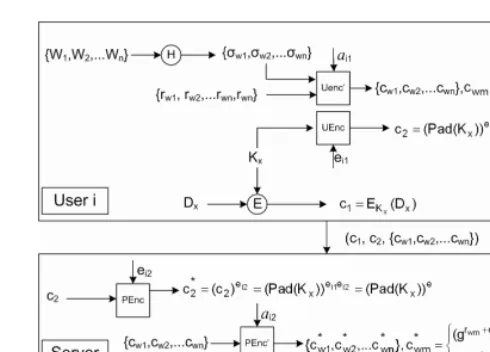
Fig. 3.Data Encryption Algorithm 2
asc2 = (P ad(Kx))ei1. The server side proxy encryption/decryption algorithms
remain the same, i.e. modular exponentiation.
The keywords are now processed as follows: for each keywordWm, the user i computes σwm = H(Wm) using a hash function H. The user also picks a random numberrwm∈Zq and computescwm,1= (grwm+σwmhrwm)ai1 mod p,
cwm,2=H((gaha)rwm), whereg, h, gaha, p are public parameters in the system
and ai1 is the user’s keyword encryption key. The user then sends the tuple
(c1, c2,{cw1, cw2, ..., cwn}) to the server, wherecwmis the tuple (cwm,1, cwm,2).
The server re-encrypts the data encryption key as in the basic construction. Then it processes the keywords information. For eachcwm, the server computes c∗wm,1 = cawmi21 = (grwm
+σwmhrwm)ai1ai2 = (grwm+σwmhrwm)a mod p, c∗
wm,2 =
cwm,2. The final cipher stored is a tuple (c1, c∗2,{c∗w1, c∗w2, ...c∗wm}), wherec∗wm=
(c∗wm,1, c∗wm,2).
4.3 Keyword Search
To search for a keyword W, the user j computes σ = H(W). The user then computes the encrypted queryQ=g(−σ)aj1 mod p and sends it to the server.
The server computes Q = Qaj2 mod p = g(−σ)a mod p. For each c∗ wm, the
server computes:
y1 =c∗wm,1Q= (grwm+σwmhrwm)ag(−σ)a= (garwm+aσwmharwm)g(−aσ)mod p y2 =H((y1))
We can see that if aσwm−aσ = 0, i.e.,Wm=W, theny1 = (garwmharwm) =
(gaha)rwmmod pand thereforey2=H((gaha)rwm) =c∗
wm,2. Then by comparing
4.4 Security Analysis
We first prove that the keyword encryption is semantically secure. Semantic secu-rity means that the ciphertexts are indistinguishable to the adversary, therefore the adversary learns nothing by looking at the ciphertext.
Lemma 2. Let the keyword encryption KE = (P ub para, Sec para,Ku,Kp, Enc) where P ub para is the public parameter set, Sec para is the secret pa-rameter set, Ku,Kp are the user and proxy key sets respectively, Enc, Dec are the encryption/decryption algorithms. It is semantically secure against any PPT attacker (i.e.SuccA,KE is negligible) where
SuccA,KE =P rb=b
m0, m1∈ {0,1}l,
b← {0R ,1},
b← A(P ub para,Kp, Enck(mb)), k∈ Ku
−1
2
Proof. The ciphertext of a keywordmbin the form ofcmb = ((grmb+σmbhrmb)ai1,
H((gaha)rmb)). It’s easy to see that if rmb is selected uniformly randomly from Zq, then grmb+σmbhrmb is distributed uniformly in G
q. We will show that if
SuccA,KEis non-negligible, then there is an attackerBwho can win the following game with a non-negligible probabilitySuccB,C, which contradicts the fact that ris random.
SuccB,C=P rb=b
m0, m1∈ {0,1}l,
b← {R 0,1}, r←R Zq, σmb=H(mb)
b← A(p, q, g, h, H, gr+σmbhr)
−1
2
B first sends m0, m1 to the encryption oracle and receives gr+σmbhr. Then
it chooses a random number a ∈ Zq and generates n pairs of (ai1, ai2) such
thatai1ai2≡amodp. It also computesσm0 =H(m0) andθ=gr+σmbhrg−σm0,
it is clear that P r[θ = grhr] = 12. Then B sends (m0, m1, p, q, g, h, gaha,
(gr+σmbhr)a11, (gr+σmbhr)a, H(θa), a
12, ..., an2) to A. If θ = grhr, then A can
outputb =bwith probabilitySuccA,KE. Therefore the probability ofBwinning the game isSuccB,C =SuccA,KE/2, which is non-negligible.
subset of Δ, i.e.D ∈ P(Δ), and eachDi is a document.W ={w1, ..., wd}is a
dictionary which contains all the possible words can be used in the queries. Each document inD is associated with a local unique identifierid(Di), and a set of keywordskw(Di) which is a subset ofW. The result set of a search querywon a document set is denoted byrs(w), which is the set of document identifiers of all the documents inDthat contain the keyword, i.e.{id(D)|D∈ D ∧w∈kw(D)}. Ahistory is defined in terms of a sequence of queries made on a document set.
Definition 2 (History).A historyHq ∈ P(Δ)×Wq is an interaction between a
client and a server overqqueries on a document setD, i.e.Hq= (D, w1, ..., wq).
During the interaction, the adversary cannot directly see the history because the documents, keywords and queries are encrypted. What the adversary can see is a view, i.e. the encrypted version of the history. LetE be the symmetric key encryption scheme,E be the proxy encryption scheme and KE be the keyword encryption scheme,Qi be an encrypted query, the view of the adversary is then defined as:
Definition 3 (View).Given a document setDwithndocuments and a history overqqueriesHq= (D, w1, ..., wq), an adversary’s view ofHq is defined as:
V(Hq) = (id(D1), ..., id(Dn), Ek1(D1), ..., Ekn(Dn),E(k1), ...,E(kn), KE(kw(D1)), ...,
KE(kw(Dn)), Q1, ..., Qq).
As we have stated above, searching leaks information. The maximum information we have to leak is captured bytrace. In our settings, a trace contains information from three sources: the encrypted file stored on the server, e.g. the id, length and number of keywords of each document, the result set and the query pattern.
Definition 4 (Trace).Given a document setDwithndocuments and a history overqqueriesHq, the trace of Hq is defined as:
T r(Hq) =(id(D1),..., id(Dn),|D1|,...,|Dn|,|kw(D1)|,...,|kw(Dn)|, rs(w1),..., rs(wq), Πq). Πq is the search pattern over the history which is a symmetric binary matrix whereΠq[i, j] = 1 ifwi=wj, andΠq[i, j] = 0otherwise, for1≤i, j≤q.
The security definition is then based on the idea that the scheme is secure if no more information is leaked beyond what the adversary can get from the traces. This intuition is formalised by defining a game where the adversary has to distinguish two histories, possibly on two different document sets, which have the same trace. Since the traces are identical, the adversary cannot distinguish the two histories by the traces, i.e. the knowledge he already has. He must extract additional knowledge from what he can see during the interactions, i.e. the views. The negligible probability of the adversary successfully distinguishing the two histories implies that he cannot get extra knowledge and in consequence the scheme is secure.
Definition 5 (Non-Adaptive Semantic Security).Our searchable data en-cryption is Non-Adaptive Semantically Secure if for allq ∈N, for all (H0, H1)
which are histories overq queries and T r(H0) =T r(H1), and any PPT
SuccA=P r
b=b
P ub para, Sec para,Ku,Kp←SET U P(1k), H0, H1∈ P(Δ)× Wq,
b← {0R ,1},
b← A(P ub para,Kp, V(Hb))
−1 2
Theorem 2. The enhanced construction is non-adaptive semantically secure.
Proof. Let’s examine each part of the view.
Document identifiers id(D1), ..., id(Dn): Because T r(H0) = T r(H1), this
part of the view must be identical for the two histories. So the adversary cannot distinguish the two histories by the document identifiers.
Encrypted documentsEk1(D1), ..., Ekn(Dn): The adversary cannot
distin-guish becauseE is semantically secure.
Encrypted symmetric keys E(k1), ...,E(kn): E is based on RSA-OAEP
which is IND-CCA2 secure. Therefore is also indistinguishable.
Encrypted keywords KE(kw(D1)), ...,KE(kw(Dn)): We have proved they
are indistinguishable to the adversary in lemma 2.
Encrypted queriesQ1, ..., Qq: BecauseT r(H0) =T r(H1), we don’t need to
consider the query pattern and can reduce the problem to distinguish any two se-quences of distinct queries: (Q01, ..., Q0m),(Q11, ..., Q1m), m≤q. For eachQij, i∈
0,1,1 ≤ j ≤ m, it is a pseudorandom numberga1H(wij)modp. Therefore the
queries are not distinguishable as long as the discrete logarithm problem is hard.
5
Other Considerations
Access to encrypted data involves both client-side and server-side keys. So re-voking a user’s access is quite simple. The KMS can send an instruction to the server to let it remove the user’s corresponding keys on the server side. After the keys have been removed, the user cannot access the data unless the KMS generates new keys for him. Even a revoked user can masquerade as an autho-rised user, his requests cannot be processed correctly if he does not know the authorised user’s keys.
Each authorised user has his own RSA key pair (ei1, di1) and the server holds
the corresponding key pair (ei2, di2). Because ei1di1ei2di2 ≡ ed≡1 modφ(n),
k1=ei1di1andk2=ei2di2form another RSA key pair. This key pair can be used
for public key based mutual authentication and to establish a secure channel e.g. SSL. This adds another layer of protection against unauthorised users.
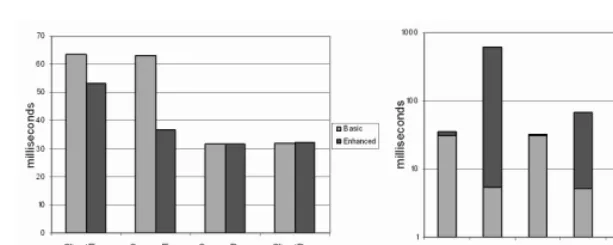
Fig. 4.Performance of the Operations
We can also split the master keys into multiple shares and introduce additional servers, making collusion more difficult. Monitoring and auditing to detect col-lusion can also help to mitigate the risk.
6
Implementation and Performance
We implemented a prototype in Java using the packages provided in the standard Java 1.5 distribution. We use our encryption scheme to encrypt a single table database. We chose AES as the symmetric cipher which encrypts the actual data and SHA-1 as the hash function. For the RSA-based proxy encryption scheme, we used 1024-bit keys. For the keyword encryption scheme,q was 160-bit and p was 1024-bit. The tests were executed on a Intel Pentium IV 3.2 GHz (dual core) with 1 GB of RAM.
The first evaluation consists of measuring for each scheme the execution time of the following operations: (1)Client Encryption: that consists of encrypting a data item using the symmetric cipher, encrypting the symmetric key and en-crypting the keywords; (2)Server Encryption: re-encryption of the symmetric key and the keywords using the server side keys; (3)Server Decryption: pre-decryption of the symmetric key; (4) Client Decryption: decryption of the symmetric key and the data item.
part of both constructions are almost the same, so we can see from the figure that the two constructions have nearly the same performance in decryption.
We also measured the time for processing a search query on the server side in both constructions, the result is shown in Fig. 4-(b). Processing a search query involves two operations: query re-encryption (Query Encr) and matching (Match). The graph shows the time (in milliseconds) for a search operation (the time scale is logarithmic) executed on several databases with different sizes in both constructions. We used three databases containing 100, 1,000 and 10,000 keywords each. The graph shows that for the basic construction, the query en-cryption dominates the overall searching time. This is easy to understand since the matching operation in the basic construction is simply string comparison. Therefore the size of the database has little effect on the searching time in the basic construction. In contrast, the time spent on the matching operation is much more significant in the enhanced construction. And when the database becomes large, the time increases linearly. As a result, the basic construction has better performance than the enhanced construction when searching large databases.
7
Conclusion and Future Work
In this paper, we presented a new data encryption scheme that does not require a trusted data server. In the scheme the server can perform searches and updates on the encrypted data without knowing the plaintext or the decryption keys. Unlike previous searchable data encryption schemes that require a shared key for multi-user access, each user in our system has a unique set of keys. The data encrypted by one user can be correctly decrypted by all the authorised users in the system. Moreover the keys can be easily revoked without any overhead, i.e. without having to re-encrypt the stored data. We provided two constructions for the scheme built on top of proxy encryption schemes. For each construction, we gave the formal definitions and proofs of security. We also implemented them in Java and compared the performance.
One aspect of our future work is to investigate and integrate our scheme with Private Information Retrieval (PIR) schemes. PIR schemes [24,25,26] allow a user to retrieve some items from a database without revealing to the database which items were queried. A weakness of our scheme is that it allows statistical attacks on the queries. By combining PIR techniques, we could potentially make our scheme more secure. Secure indexes [4,5] is another promising technique that is used to improve the performance and decrease the storage overhead of searchable encryption schemes. We will investigate current schemes and develop a new index scheme for the multi-user system.
References
1. Blackwood, J.: Is storage outsourcing a viable alternative?http://techupdate. zdnet.com/techupdate/stories/main/0,14179,2851289,00.html
3. Song, D.X., Wagner, D., Perrig, A.: Practical techniques for searches on encrypted data. In: IEEE Symposium on Security and Privacy, pp. 44–55 (2000)
4. Yang, Z., Zhong, S., Wright, R.N.: Privacy-Preserving Queries on Encrypted Data. In: Gollmann, D., Meier, J., Sabelfeld, A. (eds.) ESORICS 2006. LNCS, vol. 4189, pp. 479–495. Springer, Heidelberg (2006)
5. Goh, E.J.: Secure indexes. Cryptology ePrint Archive, Report 2003/216 (2003),
http://eprint.iacr.org/2003/216/
6. Hacig¨um¨us, H., Iyer, B.R., Li, C., Mehrotra, S.: Executing sql over encrypted data in the database-service-provider model. In: SIGMOD Conference, pp. 216– 227 (2002)
7. Damiani, E., di Vimercati, S.D.C., Jajodia, S., Paraboschi, S., Samarati, P.: Bal-ancing confidentiality and efficiency in untrusted relational dbmss. In: ACM Con-ference on Computer and Communications Security, pp. 93–102 (2003)
8. Agrawal, R., Kiernan, J., Srikant, R., Xu, Y.: Order-preserving encryption for numeric data. In: SIGMOD Conference, pp. 563–574 (2004)
9. Hore, B., Mehrotra, S., Tsudik, G.: A privacy-preserving index for range queries. In: VLDB, pp. 720–731 (2004)
10. Boneh, D., Crescenzo, G.D., Ostrovsky, R., Persiano, G.: Public Key Encryption with Keyword Search. In: Cachin, C., Camenisch, J.L. (eds.) EUROCRYPT 2004. LNCS, vol. 3027, pp. 506–522. Springer, Heidelberg (2004)
11. Curtmola, R., Garay, J.A., Kamara, S., Ostrovsky, R.: Searchable symmetric en-cryption: improved definitions and efficient constructions. In: ACM Conference on Computer and Communications Security, pp. 79–88 (2006)
12. Blaze, M., Bleumer, G., Strauss, M.: Divertible Protocols and Atomic Proxy Cryp-tography. In: Nyberg, K. (ed.) EUROCRYPT 1998. LNCS, vol. 1403, pp. 127–144. Springer, Heidelberg (1998)
13. Elgamal, T.: A public key cryptosystem and a signature scheme based on discrete logarithms. IEEE Transactions on Information Theory 31(4), 469–472 (1985) 14. Rivest, R.L., Shamir, A., Adleman, L.M.: A method for obtaining digital signatures
and public-key cryptosystems. Commun. ACM 21(2), 120–126 (1978)
15. Khurana, H., Slagell, A.J., Bonilla, R.: Sels: a secure e-mail list service. In: SAC, pp. 306–313 (2005)
16. Ateniese, G., Fu, K., Green, M., Hohenberger, S.: Improved proxy re-encryption schemes with applications to secure distributed storage. In: NDSS (2005)
17. Kapadia, A., Tsang, P.P., Smith, S.W.: Attribute-based publishing with hidden credentials and hidden policies. In: NDSS (2007)
18. Ivan, A.A., Dodis, Y.: Proxy cryptography revisited. In: NDSS (2003)
19. Goldreich, O.: Foundations of Cryptography: Basic Applications, vol. II. Cam-bridge University Press, CamCam-bridge (2004)
20. Simmons, G.J.: A “weak” privacy protocol using the rsa crypto algorithm. Cryp-tologia 7(2), 180–182 (1983)
21. Delaurentis, J.M.: A further weakness in the common modulus protocol for the rsa cryptoalgorithm. Cryptologia 8(3), 253–259 (1984)
22. Bellare, M., Rogaway, P.: Optimal Asymmetric Encryption. In: De Santis, A. (ed.) EUROCRYPT 1994. LNCS, vol. 950, pp. 92–111. Springer, Heidelberg (1995) 23. Fujisaki, E., Okamoto, T., Pointcheval, D., Stern, J.: RSA-OAEP Is Secure under
24. Chor, B., Goldreich, O., Kushilevitz, E., Sudan, M.: Private information retrieval. In: FOCS, pp. 41–50 (1995)
25. Cachin, C., Micali, S., Stadler, M.: Computationally Private Information Retrieval with Polylogarithmic Communication. In: Stern, J. (ed.) EUROCRYPT 1999. LNCS, vol. 1592, pp. 402–414. Springer, Heidelberg (1999)