
City, University of London Institutional Repository
Citation
: Chalashkanov, N. M., Kolev, N., Dodd, S. J. and Fothergill, J. (2008). PD pattern
recognition using ANFIS. Annual Report - Conference on Electrical Insulation and Dielectric
Phenomena, CEIDP, pp. 417-420. doi: 10.1109/CEIDP.2008.4772865
This is the accepted version of the paper.
This version of the publication may differ from the final published
version.
Permanent repository link:
http://openaccess.city.ac.uk/13245/
Link to published version
: http://dx.doi.org/10.1109/CEIDP.2008.4772865
Copyright and reuse:
City Research Online aims to make research
outputs of City, University of London available to a wider audience.
Copyright and Moral Rights remain with the author(s) and/or copyright
holders. URLs from City Research Online may be freely distributed and
linked to.
City Research Online:
http://openaccess.city.ac.uk/
[email protected]
PD Pattern Recognition Using ANFIS
N. Chalashkanov
1), N. Kolev
2), S. Dodd
1), J.C. Fothergill
1)1) Department of Engineering, University of Leicester, University Road, Leicester, LE1 7RH, UK 2) Technical University of Sofia, 8 Kl. Ohridski St., Sofia – 1000, Bulgaria
Abstract- An application of an adaptive neuro-fuzzy inference system (ANFIS) has been investigated for partial discharge (PD) pattern recognition. The proposed classifier was used to discriminate between PD patterns occurring in internal voids. Three different void shapes were considered in this work, namely flat, square and narrow. Initially, the input feature vector used for classification was based on 15 statistical parameters. The discrimination capabilities of each feature were assessed by applying discriminant analysis. This analysis suggested that some of the features possess much higher discriminatory power than the others. As a result, a simplified classifier with reduced feature vector has been obtained. The results demonstrate the importance in identifying and removing redundancy in the input feature vector for reliable PD identification.
I. INTRODUCTION
Partial discharges (PD), which can lead to both chemical and physical deterioration of the insulation systems, may occur in voids or gaps at interfaces within insulation subjected to high voltage stresses [1-3]. When discharges are detected and their magnitude measured, it is of considerable practical interest for reliable identification of insulation defects to be able to identify the source of the discharge, its shape, and location and also to be able to discriminate its pulse pattern from that of any external noise or other interference pulses. Therefore, discharge detection is important for the reliable evaluation of insulation systems and in recognizing defects in these components. Therefore, the trend towards automating detection and recognition in tests of cables, transformers and other insulating devices is evident: one of the undoubted advantages of a computer-aided measuring system is the ability to process a large amount of information and transform this information into an understandable output [4].
Three different types of PD data patterns can be acquired from digital PD measurement systems during tests. They are: phase-resolved data, time-resolved data and data without phase or time information [15, 16]. The phase resolved data consists of a 3D discharge pattern: discharge magnitude ~ phase angle~ discharge rate (
~
q
~
n
) at a specified test voltage. The time-resolved data constitutes the individual discharge pulse magnitudes over some interval of time, i.e. q ~ t data pattern. The last type of data consists of variations in discharge pulse magnitudes versus the amplitude of the test voltage V, i.e. q ~ V data pattern.Generally, there are two essential components of all algorithms for pattern classification [5]. The first one is formation of so called Feature Vector or Fingerprint and the second one is pattern recognition phase (classification algorithm) itself. Over the last 15-20 years, several PD classification algorithms have been proposed and tested,
including statistical tools, signal processing tools, image processing techniques, time-series analysis, fuzzy logic, artificial neural networks (ANN) and hybrid approaches, for both extraction of feature vector and classification [6-10]. In this paper, a novel method for recognition of the discharge source by means of an adaptive neuro-fuzzy inference system (ANFIS) is presented. The ANFIS uses a discharge fingerprint comprising 15 statistical parameters to discriminate between internal PD pulses. It is able to classify the PD pulses with respect to geometric parameters of the discharge source.
Furthermore, the contribution of each feature to the classification is analyzed by discriminant analysis [11]. It shows that not all of the features have one and the same discriminatory power. In other words, some of the features can be neglected without a loss of accuracy and thus an ANFIS classifier with a simplified structure can be obtained. In this way, the total number of input features after the discriminant analysis was reduced to 6. Finally, the performance of the two classifiers is assessed.
II. DEFECT GEOMETRY AND TEST CONDITIONS
Three defects are studied, namely square, flat and narrow voids. These defects are gaseous inclusions in the electrical insulation. The differences between them are their geometric shape and size (see Table 1).
TABLE I
VOID GEOMETRIES AND THEIR TEST CONDITIONS
Void type Diameter [mm]
Height [mm] Square 1 1
Flat 5 1 Narrow 1 5
The electrode configuration is shown in Fig. 1 for samples with voids.
Void
Oil
Discharge analyzer d
h PVC
Fig. 1 Test set-up for samples with voids
III. STATISTICAL PARAMETERS DESCRIBING PARTIAL
DISCHARGE DISTRIBUTIONS
Ninety samples were investigated and PD pulses were measured and recorded for all of them (30 samples for each type of the defects). The measurement data are phase-resolved, which means that discharge magnitudes and discharge rates are recorded as a function of the phase angle of the test voltage. Two distributions are used to describe the PD pulses namely, mean pulse height distribution Hqn(φ) and pulse count distribution Hn(φ). On their basis, 15 statistical parameters are calculated for each sample under investigation in accordance with [12]. These parameters are:
Sk (Hqn+), Sk (Hqn-) is the skewness of the mean pulse height distribution Hqn(φ) for the positive and negative halves of the voltage cycle, respectively
Sk (Hn+), Sk (Hn-) - skewness of the pulse count distribution Hn(φ) for the positive and negative halves of the voltage cycle, respectively
Ku (Hqn+), Ku (Hqn-) - kurtosis of the mean pulse height distribution Hqn(φ) for the positive and negative halves of the voltage cycle, respectively
Ku (Hn+), Ku (Hn-) - kurtosis of the pulse count distribution Hn(φ) for the positive and negative halves of the voltage cycle, respectively
Q – discharge asymmetry,
q s q sN
Q
N
Q
Q
/
/
,where
Q
s is the sum of the discharge magnitudes in thepositive or negative half of the voltage cycle, and
N
q is thenumber of discharges in the positive or in the negative half of the voltage cycle
cc – cross correlation factor,
n y y n x x n y x y x cc i i i i i i i i 2 2 2 2where
x
i is the mean discharge magnitude in a phase windowin the positive half of the voltage cycle;
y
i is the meandischarge magnitude in the corresponding phase window in the negative half of the voltage cycle and n is the number of phase positions per half cycle
mcc – modified cross-correlation factor,
mcc
Q
.
cc
Pe (Hqn+), Pe (Hqn-) – number of peaks of the mean pulseheight distribution Hqn(φ) for the positive and negative halves of the voltage cycle, respectively
Pe (Hn+), Pe (Hn-) - number of peaks of the pulse count distribution Hn(φ) for the positive and negative halves of the voltage cycle, respectively.
IV. ANFIS CLASSIFIER
A. Initial Feature Vector
The initial input feature vector contains those statistical parameters described above. In order to create a classifier and
to test the results obtained by it, the measurement data are split into two parts. The first one containing 22 samples per defect was used for generation of the ANFIS. The rest of the data (8 samples per defect) were used to verify the performance of the corresponding ANFIS classifier. All calculations were performed using MATLAB.
A first order Sugeno-type system is implemented in the proposed model. The fuzzy inference system for the classifier is automatically generated using the subtractive clustering method [13, 14]. Clustering algorithm parameters are: range of influence, quash factor, accept ratio and reject ratio. The first parameter specifies the cluster center’s range of influence in each of the data dimensions, assuming that data belongs to a unit hyper-box. The second parameter is used to multiply the range of influence values that determine the neighborhood of a cluster center, so as to quash the potential for outlying points to be considered as part of that cluster. The next parameter determines the potential, as a fraction of the potential of the first cluster center, above which another data point will be accepted as a cluster center. The last parameter sets the potential, as a fraction of the potential of the first cluster, below which a data point will be rejected as a cluster center. The corresponding values of the above mentioned parameters are: 0.95, 1.25, 0.5 and 0.15, respectively.
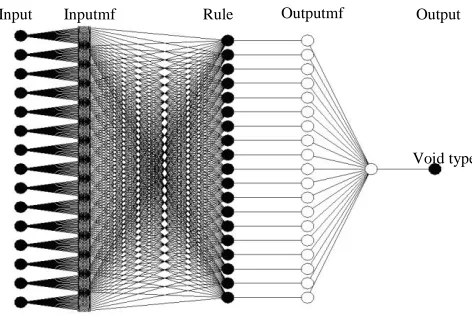
The structure of ANFIS classifier is shown in Figure 2. There are 15 input neurons, corresponding to the 15 statistical parameters comprising the feature vector. The result of the classification process is presented by a single neuron in the output layer. In order to be obtained a crisp output, a weighted average method is used for defuzzification.
The assessment of the classifier is made on the basis of measurement data that has not been used for ANFIS training. 24 samples (8 from each type of defect) were used to test the classifier. Only two samples (sample No. 20 and 24) were misclassified (See Table 2). In Table 2, the void types are coded as follows: 1 – square cavity, 2 – flat cavity, 3 – narrow cavity. The results show 91.7% classification accuracy. The conclusion that ANFIS classifier possesses very good classification capabilities can be drawn. Nevertheless, the structure of the classifier is quite complex and means for its simplification should be sought.
TABLE II ANFIS CLASSIFIER RESULTS Sample No.
Defect type
ANFIS
results Sample No. Defect
type
ANFIS results
1 1 1 13 2 2
2 1 1 14 2 2
3 1 1 15 2 2
4 1 1 16 2 2
5 1 1 17 3 3
6 1 1 18 3 3
7 1 1 19 3 3
8 1 1 20 3 2
9 2 2 21 3 3
10 2 2 22 3 3
11 2 2 23 3 3
Fig. 2 Structure of the initial ANFIS classifier - 15 features input vector
B. Application of Discriminant Analysis
The most common application of discriminant function analysis is to include many measures in the study, in order to determine the ones that discriminate between the groups. In the present study, it is applied to assess the discriminatory power of each feature. Computationally, discriminant function analysis is very similar to analysis of variance. The basic idea underlying discriminant function analysis is to determine whether groups differ with regard to the mean of a variable, and then to use that variable to predict group membership (e.g., of new cases).
In Table 3 is shown which variables were left in the model as a result of the discriminant function analysis. Wilks’ Lambda criterion is used to assess which features possess highest discriminatory power. The values of Wilks’ Lambda of the variables included in the new simplified model are given in Table 3 and the corresponding values of the variables not included in the model are given in Table 4. The value of Wilks’ Lambda is for the overall model that will result after removing the respective variable. It can assume values in the range of 0 (perfect discrimination) to 1 (no discrimination). The value of Partial Lambda is associated with the unique contribution of the respective variable to the discriminatory power of the model. F-to enter/remove values are associated with the respective partial Wilks’ Lambda.
TABLE III
VARIABLES INCLUDED IN THE MODEL Wilks'
Lambda
Partial
Lambda F-remove SkHqn+ 0.046655 0.793016 10.70133
SkHqn- 0.056922 0.649985 22.07842
SkHn+ 0.052897 0.699441 17.61822
SkHn- 0.049993 0.740067 14.40036
KuHn+ 0.049603 0.745892 13.96773
Pe Hqn - 0.058129 0.636491 23.41572
The results of the discriminant function analysis suggest that there are some correlations between the features of the initial features vector. One obvious correlation is between modified cross-correlation factor (mcc) and discharge asymmetry (Q) and the cross-correlation factor (cc), because mcc is product of the other two. The presence of correlated input variables
introduces redundancy of information and therefore increases the noise into the data. Primary task then is to eliminate all features which are not independent. The optimal classifier should possess only independent features into its input vector.
TABLE IV
VARIABLES NOT INCLUDED IN THE MODEL Wilks'
Lambda
Partial
Lambda F-enter PeHqn + 0.035942 0.971460 1.189810
PeHn + 0.035675 0.964230 1.502445
mcc 0.033573 0.907427 4.131689
Q 0.035950 0.971662 1.181149
KuHqn+ 0.033880 0.915725 3.727255
KuHqn- 0.033631 0.908991 4.054883
cc 0.031610 0.854368 6.903462
PeHn - 0.032032 0.865776 6.278834
KuHn- 0.030180 0.815706 9.150215
On the basis of the above discussion a new ANFIS classifier was created, containing only the features, which were left after the discriminant analysis (see Table III). The same clustering algorithm was used to produce the ANFIS structure with the same values of the clustering algorithm parameters. The structure of this improved classifier is shown in Figure 3. It has 6 input neurons corresponding to the remaining 6 statistical parameters in the discriminant function model (SkHqn+, SkHqn-, SkHn+, SkHn-, KuHn+, PeHqn -). In the second layer, there are 18 neurons, which correspond to 18 Gaussian membership functions. The next layer contains only 3 neurons equivalent to 3 fuzzy “if-then” rules. These rules represent 3 linear membership functions. The result of the classification process is presented by a single neuron in the output layer. In order to be obtained a crisp output, weighted average method is used for defuzzification.
[image:4.612.321.559.458.599.2]Fig. 3. Structure of the improved ANFIS classifier - 6 features input vector
The assessment of the classifier is performed in a similar way as the previous one. The same 24 samples were used to test the classifier. This time only one sample (sample No. 16) was misclassified (See Table 5). In Table 5 the void types are coded as follows: 1 – square cavity, 2 – flat cavity, 3 – narrow cavity. The results show 95.8% classification accuracy, which is better than the previous case of a classifier having 15 input
Rule Inputmf
Input Outputmf Output
Void type
Rule Inputmf
Input Outputmf Output
Void type Sk Hqn +
features. The new classifier has not only a simplified structure but also possess better classification capabilities. The improved classification capability is due to the fact that the redundant information was removed.
TABLE V
RESULTS FOR THE IMPROVED ANFIS CLASSIFIER Sample No.
Defect type
ANFIS
results Sample No. Defect
type
ANFIS results
1 1 1 13 2 2
2 1 1 14 2 2
3 1 1 15 2 2
4 1 1 16 2 1
5 1 1 17 3 3
6 1 1 18 3 3
7 1 1 19 3 3
8 1 1 20 3 3
9 2 2 21 3 3
10 2 2 22 3 3
11 2 2 23 3 3
12 2 2 24 3 3
IV. CONCLUSIONS
The following conclusions can be drawn:
• The adaptive neuro-fuzzy inference system (ANFIS) can be used successfully to discriminate between PD pulses in voids with different geometries.
• Statistical parameters related to the PD patterns can be used as input features in such a classifier. However, care must be taken to ensure statistical independence of the features being used and any identified correlations between the different features, and hence the redundancy should be removed. Further research will be done to study the exact relations that may exist between these statistical parameters.
• Classifier performance can be improved and its structure can be simplified by discarding the redundant data.
The results demonstrate the importance in identifying and removing redundancy in the input feature vector for reliable PD identification.
REFERENCES
[1] R.J.V. Brunt, “Physcis and Chemistry of Partial Discharge and Corona. Recent Advances and Future Challenges”, IEEE Trans. Dielectrics and Electrical Insulation, Vol. 1, No. 5, 1994, pp. 761-784.
[2] J.C. Devins, “The Physics of Partial Discharges in Solid Dielectrics”,
IEEE Trans. Electrical Insulation, Vol. 19, No. 5, 1984, pp. 475-495. [3] Tanaka T., “Internal Partial Discharge and Material Degradation”,
IEEE Trans. Electrical Insulation, Vol. 21, No. 6, 1986, pp. 899-905. [4] N. C. Sahoo, M.M.A. Salama, R. Bartnikas. “Trends in partial
discharge pattern classification: A survey”, IEEE Trans. Dielectrics and Electrical Insulation, Vol. 12, No. 2, 2005, pp. 248-264.
[5] J. T. Tou, R. C. Gonzalez, Pattern Recognition Principles, Addison-Wesley, 1974
[6] M.M.A. Salama, R. Bartnikas, “Determination of Neural-Network Topology for Partial Discharge Pulse Pattern Recognition”, IEEE Trans. Neural Networks, Vol. 13, No. 2, 2002, pp.446-456.
[7] A. Mazroua, R. Bartnikas, M.M.A. Salama, “Discrimination between PD Pulse Shapes using Different Neural Network Paradigms”, IEEE Trans. Dielectrics and Electrical Insulation, Vol. 1, No. 6, 1994, pp. 1119-1131.
[8] M. Conti, A. Cavallini, G.C. Montanari, F. Guastavino, “Identification of Electrical Tree Growth in Insulation Systems by Fuzzy Logic Techniques Based on Partial Discharge Acquisition”, Proc. International Conference on Solid Dielectrics, Toulouse, France, July 5-9, 2004, pp. 661-664.
[9] Carminati E., L. Cristaldi, M. Lazzaroni, A. Monti, “A Neuro-Fuzzy Approach for the Detection of Partial Discharge”, IEEE Trans. Instrumentation and Measurement, Vol. 50, No. 5, 2001, pp.1413-1417.
[10] E. Gulski , F.H. Kreuger, Computer-aided recognition of Discharge Sources, IEEE Trans. Electrical Insulation, Vol. 27, No.1, 1992, pp. 82-92.
[11] G.J. McLachlan, Discriminant analysis and statistical pattern recognition, Wiley-Interscience, 2004.
[12] E. Gulski. Computer-aided recognition of partial discharges using statistical tools, Ph.D. thesis, Delft University Press, 1991
[13] J.-S. R. Jang, C.-T. Sun, E. Mizutani, Neuro-fuzzy and soft computing: A computational approach to learning and machine intelligence, Prentice Hall, 1997.
[14] R. Yager, D. Filev, “Generation of fuzzy rules by mountain clustering”,
Journal of Intelligent & Fuzzy Systems, vol. 2, No. 3, 1994, pp. 209-219.
[15] R. Bartnikas, “Partial Discharges: their mechanism, Detection and Measurement”, IEEE Trans.Dielectrics and Electrical Insulation, Vol. 9, 2002, pp. 763-808.
![TABLE V C[2] [3] J.C. Devins, “The Physics of Partial Discharges in Solid Dielectrics”, IAIEEE Trans](https://thumb-us.123doks.com/thumbv2/123dok_us/1628712.116086/5.612.45.289.111.306/table-devins-physics-partial-discharges-solid-dielectrics-iaieee.webp)