City, University of London Institutional Repository
Citation
:
Burton, Peter John (1990). A model of the engineering design process. (Unpublished Doctoral thesis, The City University)This is the accepted version of the paper.
This version of the publication may differ from the final published
version.
Permanent repository link:
http://openaccess.city.ac.uk/19744/Link to published version
:
Copyright and reuse:
City Research Online aims to make research
outputs of City, University of London available to a wider audience.
Copyright and Moral Rights remain with the author(s) and/or copyright
holders. URLs from City Research Online may be freely distributed and
linked to.
City Research Online: http://openaccess.city.ac.uk/ [email protected]
A MODEL OF THE ENGINEERING DESIGN PROCESS
AUTHOR:- PETER JOHN BURTON
THESIS SUBMITTED IN PARTIAL COMPLETION OF THE DEGREE OF Ph.D
THE CITY UNIVERSITY
SCHOOL OF ENGINEERING
DESIGN THEORY AND METHODS GROUP
CONTENTS
Title Page
Contents
Acknowledgements
Abstract
Page Number
4 6
,. Introduction 7
,. , Aims 9
, .2 Purpose 12
1 .3 Method 13
1. 4 Structure 15
2. Literary sources 18
2. 1 Introduction 18
2.2 General Design Methodologies 20
2.3 Design Eduction 22
2.4 Systems Science and Systems Engineering 32
2.5 Creativity 46
2.6 Management and Organisation 63
2.7 Decision Theory 73
2.8 Summary of Chapter Two 79
3. The Model 87
3.1 The Initiation of Design Activity 94
3.2 Requirement Specification 98
3.3 The Generation of Candidate Designs 108
3.3.1. Abstraction and Functional Decomposition 110
3.3.2. Decomposition 113
CONTENTS 3.3.4. 3.3.5. 3.3.6. 3.4. 3.4. ,. 3.5 3.6. 3.6.1. 3.6.2. 3.6.3. 3.6.4. 4. 5. 5. , 5.2 5.3 5.4 5.5. 5.5.1. 5.5.2.
The Composition of a Candidate Design
The Generation of Design Concepts and the Blackboard Model
Conclusion
Analysis
summary of Analysis
Evaluation and Decision
The Blackboard Concept
Introduction
The Contribution of the Blackboard Concept to the Model of the Design Process
The Operation of the Blackboard Model
Page N~ber
128 129 130 131 144 146 162 162 167
within the Design Process 172
Summary 174
Summary of Chapter Three 176
Aids to Design 183
Aids to Design and the Blackboard Model 186
Aids to the Generation of Requirement specification
Concept Generation
Composition of a System by the Composition of Component Concepts
Analysis of Candidate Designs
Aids to Design Representation
Knowledge Sources
CONTENTS
5.6
5.7
6.
7.
FIGURES
Fig.
Fig. 2
Fig. 2a
Fig. 3
Fig. 4
Fig. 5
Evaluation and Decision
Drawing as an Aid to Design
Final Summary of Thesis
Bibliography
Page Number
203 204 208
212
40 67
88
95a
ACKNOWLEDGEMENTS
I would like to express my gratitude for their help and
support to the following people. To Professor L. Finkelstein, my supervisor, I wish to express my deepest thanks for his guidance, and
especially his patience in helping me produce this thesis. To my
parents for their constant support and encouragement. Finally, I would
also like to thank those members of the City University staff with whom
I have consulted over the last few years for their time and helpfulness.
My grateful thanks also to the S.E.R.C. for their funding during the
Permission is granted that at the discretion of the
Universi ty Librarian this Thesis may be copied in whole or in part
without further reference to the author. This permission covers only
single copies made for study purposes, and is subject to the normal
conditions of acknowledge.
Abstract
The subject of this Thesis is that of engineering design. The primary objective of the Thesis is to produce a model of the engineering design process. This model represents the way engineering design takes place regardless of the scale of the design project or the type of object which is being designed.
The model is consensus based and has been produced through an ext ens i ve rev iew and analys is of literature, (the 11 tera ture rev iew being completed in 1987) taken both from the field of engineering design and from disciplines concerned with related issues. In addition to the review and analysis of literature, a large number of interviews and consultations were undertaken with design experts and designers.
The Thesis is divided into three main sections. The first section is concerned with a discussion of the evidence gained through the processes of literature review and interview/consultation. The second with a description of the model and its origin. The third is concerned with a description of the means by which design takes place.
The model is essentially sequential, but has also
incorporated the major elements of process type models of design. By demonstrating that an accommodation is possible between these two design theory approaches, an advance has been made into the understanding of the way in which design takes place.
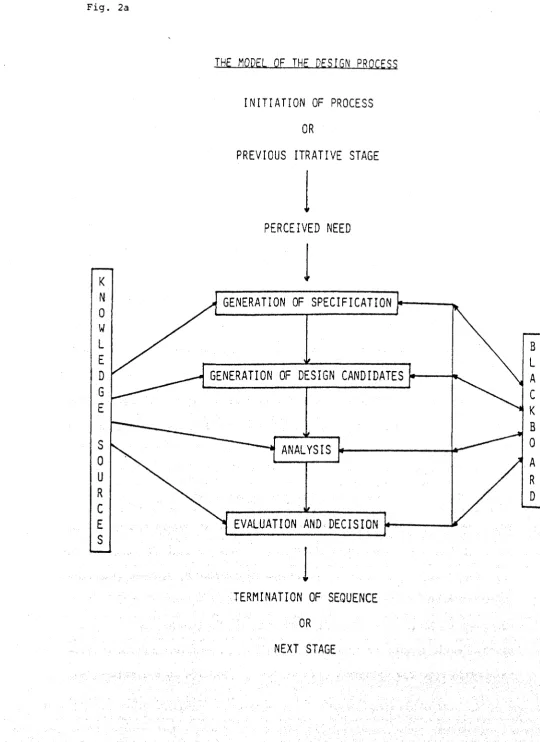
The model consists of sequential stages each of which characterises a major type of activity wi thin the process and which describe the design process from the initial perception of need through to the production of the finalised design configuration. Designs are developed by passing iteratively through these stages. Solutions and partial solutions, along with other design information are stored within the Blackboard.
1. Introduction
Des igners are faced with the challenges of ever increas ing
complexity in planning and designing such items as integrated circuits,
mechanical systems, chemical compounds. production processes. control
and measurement systems and large buildings. Desp i te the demanding
nature of this type of design work, most designers still approach these
problems intuitively without rigorous methods for generating or
evaluating designs. It is the aim of this thesis to demonstrate that
there exists a fundamental structure common to all design and wi thin
this to concentrate special attention on to one particular area, that of
generating design concepts. The specific aims and approach which will
be used in this study are dealt with in detail in another section,
(1.1.) at this point however it would appear useful to offer a very
brief introduction to the overall area of design and relate this to the
work undertaken in this study.
Design is the creative process by which one moves from
perceived need to realised solution. It is a process which moves from
the abstract to the concrete. It is as such also a dynamic process
which concerns itself with the collection, manipulation synthesis, and
representation of knowledge. It will be argued that all these elements
are present in all types of deSign, regardless of the form, scale and
complexi ty of that which is to be deSigned and regardless of the
formality with which the task is undertaken. Further to this it will be
argued that all engineering deSign is governed by a fundamental set of
principles and imperatives. A framework which is the basis for all
design activity will be put forward. From this framework one particular
-area will be taken and examined in depth. The reasons for the adoption
of this approach are given in greater detail in section (3).
When one considers that all man-made articles must in some
sense be designed and that man has been making things for a quite
considerable length of time, the study of the process of design and the
area of design in general have until comparatively recently been
neglected. Now however that the study of the design process has been
taken up, one of the main problems encountered has been that much of the
knowledge of the design process is embodied wi thin human experts, who
are often unaware of their own cognitive processes. In addition to
this, traditionally, the massive complexity of real design problems have
been successfully dealt with by human experts using a heuristic
approach. Thus considerable. work has been needed to extract, organise
and apply this knowledge.
Advances in the study of the design process have however
taken place. These advances have occurred in part due to the
constraining and limiting of design space and in part due to a
convergence of ideals and methodologies that have given structure to
previously indifferent problems. Little work however has been done to
explore whether these advances are confined to a particular discipline
or whether they can be generalised through analogy to other fields. One
of the major aims of this thesis is an attempt to demonstrate, by
analysis and synthesis of existing design theories and methodologies,
that a model of engineering design Is possible based upon fundamental
1.1. Aims
Within this section a description of the aims of the thesis
will be given. In outline these aims are,
to produce a model of engineering design
through a process of analysis and synthesis of
literature relevant to the field of engineering
design
to define and relate the use of design aids to
the design process
to demonstrate the relationship between design
theory. (the model). and means to design.
(design aids)
to explore in depth the methodologies and
problems of concept generation,
By the production of a model of the engineering design
process it will be demonstrated that fundamental principles exist which
are applicable to all forms of engineering design. It will be argued
that a structure exists which is applicable as a formalised methodology,
and thus a crucial element of designer support in large scale or complex
design, and that this structure will also serve as a vehicle for the
understanding of the cognitive elements which operate within the
designer. Thus the model is seen as providing support for the
structuring, organisation and control of design when design takes place
-in any formalised manner and as a theoretical framework for the
comprehension of informal design. These statements raise certain
questions about the purpose and usefulness of both design models and
design methodologies, as well as the relationship between the two.
These issues are acknowledged and are discussed in detail wi thin the
section related to model. (3).
A second purpose which the model is to serve is to allow for
an in depth analysis into the kernel of design, the generation of design
concepts. By this phrase what is meant is that the core of every design
is the idea or concept which it is hoped will prove the solution to the
design problem. The generation of such concepts is the most essential
element to the entire design process. However before it is possible to
accurately discuss the methods, approaches and constraints which are
involved in this process it is extremely important to understand fully,
its relationship with the rest of the design process.
The definition of the relationship between design aids and
the engineering design process is important in two ways. Firstly. it is
only possible to fully comprehend the way in which finalised designs
come about by taking a holistic view of all the elements which
contribute to them. Secondly, by defining this relationship it becomes
possible to integrate and thus optimize the way in which they both
contribute to the process as a whole.
They are those things which assist the designer to formulate, manipulate
and represent his ideas. Such a definition includes such physical items
as pencils, C.A.D. systems, graphs, literature etc., but it also
includes, or allows for the possibility of, methodologies and procedures
etc., which may well be considered non-physical aids.
The design process is the structured relationship of
information which exist separately to design aids but to which they
contribute by assisting with the supply of this information. Design
aids thus exist to help the designer to generate and manipulate
information, the process of design determines the flow of this
information.
The generation of-design concepts is the most central element
in the design process. The importance and place within the overall
process can only be fully understood when it is presented within the
context of that process, and this is gone into in considerable depth
later in thesis. However it is possible to highlight its major
characteristics and their relevance to design.
Design is a process which has as its initial starting pOint
this perception of need. Before however this need can be satisfied it
must to some extent be given definition. Once a need has been clearly
defined it is then possible to attempt to create possible solutions. It
is the generation of these possible solutions which requires the
generation of deSign concepts. DeSign concepts can fulfil either minor
elements of the design requirement Or sub-functions and whole functions,
and in the case of some design may well fulfil the entire need. It is
-the way in which -these concepts are generated that will occupy one of
the main subject areas of the thesis. Without the generation of design
concepts no design can take place and as such they occupy an extremely
important position within the process.
1.2. Purpose
In this section the overall motivation behind the subject
area will be explained. In the previous section what will be undertaken
wi thin the thesis was explained, in this section I shall explain why
these aims were chosen. The purpose of this thesis is to demonstrate
through the production of a consensus based model of the deSign process
and an in depth analysiS of the major element. Within that process, the
generation of design concepts, the way in which all design takes place.
Thus a model of the design process will be developed which outlines the
framework and main characteristic of design process, and which also
describes the way in which these elements inter-relate. As a result of
this it is hoped that a greater understanding of the process will be
aChieved. This in turn it is hoped will lead to benefit in such areas as,
- DeSign Education,
- The introduction and improvement of design automation,
- The optimum structuring of organisations
- The greater understanding of information flow
The greater understanding of the problems
relating to concept generation
1.3. Method
The method by which the information contained in this thesis
has been gathered is through an extensive study of related literature,
(this study was completed in 1987) backed up by interviews and
consultations with experts in the field of design. Through this work a
consensus model of the design process has been built up.
The production of any consensus model does however raise
certain methodological problems. By attempting to concentrate on these
•
elements which are agreed upon within any broad area of literature one
must take a fairly broad view of that which is being said. Obviously
when one asserts that similar basic points are being made, but being put
forward in a different manner, such assertions are always open to the
cri ticisms of misinterpretation or misrepresentation. It is however
hoped that when attempting to demonstrate basic similarities between
different literature it is demonstrated that the essence of the
arguments put forward wi thin the 11 terature does not contradict the
conclusions drawn from it. This problem is common to all forms of study
which base their assertions on analysis of a wide variety of 11 terate
sources. By careful argument and sensitive analysis it is believed that
these problems can to the greater part be overcome.
to all consensus based studies, there are in addition problems which
specifically relate to the area of design.
The purposes for which literature of design is written differ
qui te considerably, these differences however can be broadly speaking
put under two headings, description and prescription. Literature which
is written from a descriptive perspective seeks to state what in fact
does happen in the design process. Alternatively prescriptive
literature seeks to recommend what should happen in design. Though
these two approaches differ they are not mutual exclusive groups.
Literature in the former approach is usually contained in academic
works, where as the other approach tends to dominate works, which fall
under the category of educational literature. Any argument that these two approaches are in some way incompatible and cannot be synthesised
into one coherent consensus model of the design process is however
erroneous. First the two approaches share a great deal of common ground
in terms of beliefs about the structure of design and the relationships
of the elements which comprise the structure. Secondly although some
literature seeks to describe the process and others seek to state how
the process should be conducted, a majority of the 11 terature uses a mixture of both approaches. In the majority of cases the differences
between the two approaches are not about the fundamental characteristics
of the process, but rather the way in which i t can be fine tuned to produce better design by two application of more rigorous procedures and methodologies. This pOint is argued in direct reference to the literary sources within sections (2) and (3).
which is particular to design is that the majority of literature is
based upon participant observation. By this what is meant is that the
authors of such literature base their assertions upon personal,
observation, experience and interpretations of the events around them.
The main criticism of this form of study is that it is subjectively
based, and because of this lacks the objective authority of
experimentally based studies. In response to this line of argument a
number of replies can however be made. Firstly the appropriating of the
use of experimentally based studies into the area of the design process
can be brought into question. The use of experimental methods in
relation to large scale human interactive activity and creative activity
in particular is extremely restricted in terms of the difficulty they
present in devising appropriate tests. Secondly it is important to
remember that one of the main aims of this thesis is the production of a
model of the design process. When producing a theoretical framework it
is not always a necessary pre-condition to draw upon experimental work.
Finally if one is to construct a framework based upon a consensus of
opinion one must as such draw upon that opinion. The majority of work
in the area of design is of a participant observational nature and since
these tend to be the observations of experts with considerable
experience in the tackling of design problems it would appear to be a
methodological sound approach to attempt to draw upon their knowledge.
1.4. Structure
In this section an outline will be given of the way in which
15.-the topic areas of 15.-the 15.-thesis will be constructed in relation to one
another and a brief explanation given for the reasons for doing so.
The initial area which will be dealt with is that of the
model. This is seen as being both an important area in its own right as
well as providing the theoretical backdrop for the detailed discussions
for specific areas wi thin the design process. The production of a
validated model of the design process is thus seen both as a means of
describing the process as whole and as a vehicle through which such
activities and sub-processes as, concept generation, the Blackboard
control mechanism and design aids, can be more fully discussed. The
model as such is thus seen as a key element in the construction of this
thesis.
•
Having produced a model of the design process it is then
proposed to examine the means, through which design takes place. The
means to design is seen as those items and techniques through which the
designer produces design. These design aids cover such areas as
e.A.D.
systems, the pencil, the symbolic means of representing design, the
manipulation storage and transfer of information, etc. A description
and definition of these means will be undertaken.
These two elements of design, the theoretical and the actual
will then be integrated to produce a full description of the process and
its accompanying elements.
informational resources essential to design. The control element
defines the relationships between the stages of the process, i t also
ultimately controls the selection, manipulation and synthesis of
informational resources into finalised design.
The final area which will be discussed will be the generation
of design concepts. Design concepts are the key element in the entire
process. Without the creative generation of possible concepts capable
of fulfilling the requirements no design solution is possible. Ways in
which it is possible to assist this creative activity will be examined
and a psychological perspective taken in terms of the nature of the
process as a whole.
2. Literary Sources
This section deals with the literary sources which form the
basis upon which the model of design is formed.
2.1. Introduction
The model of the design process which is presented in this
thesis is a consensus model. It has been produced by a survey and
analysis of a wide variety of design related research. This section
deals with the sources which have been drawn upon and discusses the way
in which they have influenced the production of the model.
In the production of the model an attempt has been made to
identify the major areas of agreement within the majority of the
literature, these will be highlighted and discussed within the following
sections which deal with particular topic areas. As such a large number
of sources have been drawn upon, the discussion of them has been divided
up in to topic areas. These areas contain literature which address
similar design topics and as such within each area a number of different
approaches can be identified. It will however be argued that there
exists sufficient areas of agreement to allow certain generalisations to
be made and common features identified.
Although there is a great deal of variety in the types of
non-the-Iess possible to divide the literature into two broad
classifications of approach. These consist of prescriptive design
literature and descriptive design literature. Prescripti ve 11 terature
attempts to state the way in which design should be undertaken.
Descriptive literature, though often no less judgemental, attempts to
state what in fact takes place during design. These two approaches are
often seen as being fundamentally opposed in that the differences are
such as to make the interchange of information between the two invalid.
The division of the two approaches is however often far from absolute.
Writers on the subject of design, it will be argued, often fail to make
a clear distinction between the two approaches and often move back and
forth between them during the course of their works. Also it will be
argued that the prescription literature is based upon the experience of
a deSigner, usually the author himself rather than an experimentally
collected empirical data. It will be argued that both prescriptive and
descriptive approaches can be used to form a consensus model as the
differences between the two approaches are largely ones of detail.
Large areas of agreement exist in terms of what is perceived as actually
taking place with divergence taking place of how these things can be
best undertaken.
The above it is hoped will outline the major points which
will be looked at in relation to the literature discussed below.
-2.2. General Design Methodologies
The terms method and methodology are widely used in design
and will be used frequently in the discussions of design 11 terature.
They apply to some extent to all design, in spite of this the terms
themselves are not in any real sense given a precise definition.
Every design process may be structured into a more or less
complex partial process, phase and design step with the help of a
general procedural model. The resulting procedural elements are also
processes within which information is exchanged. Each element has a
goal which may be identified wi thin the overall process. If these
processes are to progress in a planned and methodical manner towards
their goals, rules of behav\our and methodical directions must exist.
These are either contained in specific methods, or in working
principles. At this point two issues must be addressed. The first is
that it is argued that not all design takes place within a methodology.
It is true that not all design takes place within a defined
methodological structure. However as this section will argue, method
will be present to some extent in all design, even if only in a fairly
informal manner. Secondly it is argued methodological constraints
hamper creativity. Within the arguments presented this possibility will
be acknowledged, but only when the methodology deals too rigorously with
the creative aspects of design. It will also be argued that the
creative aspects of design can be enhanced by the use of methodological
procedures. When considering methods, the relationship between
technical knowledge and methodical procedure must be emphasised. Even
knowledge and expertise.
activi ty.
Methods are merely one dimension in design
The use of the term method to designate a particular path to
reach a desired goal is not uniform in science and especially not in
practical life. On the one hand, the term is applied to complicated
systems of procedure which deserve the name methodology, such as value
analysis or mathematical modelling. The term also applies to simple
rules of behaviour such as systematic search.
For the purpose of this thesis design method will be defined
as any system of methodical rules and directives that aim to determine
the designer I s manner of proceeding to perl'orm a particular design
acti vi ty and regulate the il'lteraction of the designer with available
technical means, or aids.
If a general method exists, then a particular procedural plan
can be set up to determine the designer conduct in a design activity for
a particular case. A method may be the starting point for a number of
procedural plans and these can be modified to suit different problems.
-2.3. Design Education
This section will be used to discuss research which has been
conducted into the area of design education. The majority of research
within this area has tended to firstly attempt to outline the design
process, whilst at the same time offer insight into ways in which the
design might better deal with the problems inherent within that process.
The general method used by researcher within this field is that of
participant observation, largely taking the form of introspection and
observation by experienced designers.
The foremost feature of research in this area which should be
noted is that there is total agreement that design is in fact a
structured process. Intuition and imagination though excepted as
elements contained within the process are not viewed as constituting the
process as a whole. Though the descriptions of the process that are put
forward differ in detail, all contain fundamentally similar traits.
A large amount of the research in this area emphasises the
morphology of the process. Glegg (1969) describes the process as moving
from reality to abstract symbolic and then as the design is formed
returning once more to reality. Asimov (1962) also puts forward this
theme of design moving from initial perception of need, to an
abstraction of the problem as a search for potential solutions is made
and then the process returning to the 'real' or physical as actual
finalised design solutions are formed. For Asimov (1962) this
morphology of design is determined by logical steps, each predeterming
sequential nature of the process is more fully examined. It is however
important to note that even from the simplest and most generalised
statements put forward by the researchers in this area there exists the
notion of sequential movement through a process. French (1985)
reiterates the theme in a more defined manner by stating that design
consists of clearly identifiable stages. These stages are characterised
by the activities which take place within them and consist of generation
of specification, generation of design concepts, the evaluation of these
concepts and finally the production of the finalised design. Alger and
Hays (1964) though placing greater emphasiS on the roles of experience
and reflection by the designer 1n the design process than other
researchers in the area, also stress that design is a process that moves
from need, through a phase mainly characterised by abstraction, towards
the final realisation and im~lementation of design. Indeed they state
that a design process does exist, just as a work-flow process seems to
exist for many kinds of works, (pp 10). Again Alger and Hays also see
these phases which constitute the process as being definable into stages
each of which fulfils a particular purpose within the over-all process
and which follow each other in a sequential manner.
Though there is general agreement that design is a process
and that it does have a definable sequential structure, there are
considerable differences in the way in which this structure operates,
its component parts and the degree of definition which is applicable to
these parts. Glegg (1969) for example offers a set of broad phases as a
description of the process, stating the generation of what will take
place within each. Pahl and Beitz (1984) in contrast detail the
sub-components or sub-activities within clearly defined phases stating
-the way in which design progresses within each of -the phases and stating
the way in which they interact with each other and the overall process.
The work of these last two authors can be used to highlight a problem
which exists when attempting to discuss the sequential stages which
constitute the design process. When describing the design process the
description of the activity often becomes blended with prescriptive
advice, on how best to improve designer performance. The distinction
between what does happen and what should happen is thus not always
totally clear. Cain (1969) recognizes this problem and firstly offers a
generalised description of the process and then 'advocates from
experience' (pp 7) the use of methodology as a way of clarifying the
process and increasing the likelihood of a successful design. Cain
(1969) argues similarly to Asimov that design is a logical process, and
from this point of view goes on to assert that for the best design
resul ts the process should be formalised into a method. Pahl and
Bietz( 1984) take this theme slightly further by expressing the design
process through formalised decomposition, offering a systematic method
to help the design over come the problems which present themselves at
each stage and sub-stage. Asimov similarly though to a lesser extent
blends description and methodological advice, as does Gosling (1959).
Beakley and Chilton (1974) also offer description and advice. For these
two authors design is a sequential process which is described as one
which moves from the general to the specific and which proceeds through
the stages of. feasibility study, preliminary design and detail deSign,
the latter resulting in the final design configuration.
process are extremely similar. Before moving on to examine in more
detail the way in which the descriptions and methods presented in this area differ in their detail a number of points can be made.
Design is a process consisting of identifiable stages. The
stages exist in a sequential relationship. These stages can be decomposed in such a manner so as to allow for the implementation of
some form of method. The use of methodologies is seen as assisting with
the production of a successful final design. The design process can be
typically described as starting from the point at which a need is
perceived and actions are undertaken to try to fulfil that need. The
design process moves from the initial perception of need through a phase
or set of phases which can be characterised by abstraction and search. From the activities which take place within this phase a final design
configuration emerges.
Though the research overwhelmingly agrees with the above
points there is substantial divergence in the actual detail as to how
the actual process is constructed. J. C. Jones (1963) for instance
though agreeing wi th the basiC components of the process as outlined above, places great emphasis upon the degree of complexity in the
design. Complexity in design for Jones is not purely a technical consideration but rather gains the greater part of this characteristic
by its relationship with the external environment within which it is to exist. Jones states, (and this is reiterated by Stevenson (1973», that there are four levels to the complexity of a design. These can be
categories by the deSigns relationship with, component Product, System
each of these four different levels which creates the degree of
complexity of a design.
Buhl (1960) and French (1985) alternatively are amongst those
for whom the creative aspects of design constitute the major element in
design as a whole. Though arguing that design is a sequential process
with identifiable stages, these authors concentrate upon what is
basically the core of the design process, the generation of candidate
designs. Though most authors offer some guidance as to possible methods
through which greater success in this stage may be obtained few do so in
such detail. Pitts (1973) for example though emphasising technique as
being an essential aspect of design, deals comparatively briefly with
methods of generating partial or whole solutions in a systematic manner.
Krick (1965) similarly though explaining both the deSign process and
methods which can be used to advantage within it, all be i t in a
simplified manner again emphasises the importance of both the creative
stage in the design process and the use of techniques to improve results
at this stage. The aim of this particular area within the discussion of
the literature is to make general similarities in the findings and
conclusions drawn by the examined authors. For the purpose therefore of
this discussion it is not felt necessary to fully outline the types of
method and techniques advocated by the author. This conclusion is based
firstly on the need for clarity and secondly as these techniques are
fully discussed within their own section Which deals specifically with
the types of method which can be used to aid creatiVity during concept
generation, within the section on design aids.
authors appear to build on the work of previous authors. Woodson (1966)
for example appears to draw heavily upon the work of Asimov (1962). Due
to this fact I now propose, as i t is impossible to give detailed
accounts of all the authors in this area to discuss in somewhat more
detail a number of authors who represent broadly similar sets of work.
A great deal of the work in the area of design education were
written as introductory texts. Asimov (1962) who is one of the earliest
advocates of design method and who appears to have greatly influenced
many latter authors, offers a fairly structured view of the design
process. For Asimov the first division which can be made in design is
that of the type of design which is taking place. These types of design
are classified in terms of whether a design is an evolution of a
previous design solution, or whether it requires innovation. Within
•
these two types of design Asimov asserts that the same factors will
determine the outcome of the process. These factors are considered to
be, available money, possible profit, time allowed, laws and standards
which set the parameters of the design envelope and social feature, such
as pollution, noise etc. Within these parameters however all designs
follow a set of basic rules which it is claimed are determined by a
natural logic.
The process of design is viewed as sequential consisting of
two phases which can be sub-divided into a total of seven sub-stage. It
is noted that the use of defined phases composed of sub-division is
common technique used in most design literature which though a useful
device for the explanation of phenomena within the design process does
not always reflect the real! ty of the process. When discussing these
stages the precise division used may not actually occur wi thin the
process and overlap may be the case.
Asimov's two phases consist of primary design, which is the
initial phase and the production/consumption phase which is the
implementation of the first. It is Asimov' s initial phase which I
propose to discuss as though important, the production phase with its
emphasis on marketing, production and distribution, does not deal with
the generative aspects of design which are the primary interest within
the context of this thesis.
The initial phase is sub-divided into three sequential
stages. These stages consist of the feasibility study, the preliminary
design and the detailed design. The feasibility study consists of the
definition of the design need, the identification of design problems in
fulfilling this need and a study of possible id.eas and concepts which
could be combined to fulfil these needs. The results of the feasibility
study determine the course of action within the second sub-stage, that
of the preliminary design. The preliminary design concepts. These are
concepts which are produced as possible solutions to each of the aspects
which constitute the design requirement. The concepts are then
constructed into archetypes. The archetype stage consists basically of
forming groups of design concepts into possible design solutions.
Analysis is the next stage during which the archetypes are tested
against the previously defined requirements. Finally optimization takes
place during which designs are modified and their various
The final stage consists of the Detail design phases. During
this stage the design is embodied and given exactly defined
characteristics. Firstly sub-systems are constructed. This is done
through the decomposition of the preliminary designs into sub-uni ts
usually defined by function. The subsystems are then produced and
constructed into components. These components are then brought together
to form whole assembled systems and finally the complete design is
realized. Finally analysis is once again undertaken to assess
performance and enable the designer to predict likely areas which will
require modification in the finished product.
The above description of Asimov's ideas on design have been
produced for a number of reasons. Firstly as previously stated the
author is highly representative both of the general ideas put forward by
•
a number of authors and of the general approach to design by the
majority of the authors in this area. Secondly the description provides
a useful point of reference in terms of other works in this field. Pahl
and Bietz (1984) for instance though writing nearly twenty years after
Asimov have striking similari ties in their approach. Though offering
greater detail in the way in which they advocate the use of systematic
method in their approach, the sequential division used in their
defini tion of design stages and the sub-phases wi thin those appear to
coincide with Asimov's thoughts in this area.
For Pahl and Bietz the design process commences with the
clarification of the task. Similarly to Asimov (1962) Pahl and Bietz
view the initial problem of design being that of the correct
clarification of the actual problem. The actual requirements which are
-produced from this stage will ultimately determine the design and though
it is always possible to modify requirements the importance of having a
clearly defined and accurate specification requirement is emphasised.
The next stage of the process is that of the conceptual design. Here
design concepts are generated which could possibly fulfil the
requirements. The process of concept generation is viewed as being
greatly enhanced by the use of systematic method. Methods of
decomposition search, synthesis and recomposition are advocated and
described in some detail. Like Asimovs Preliminary design stage,
Concept Generation is viewed as being the key aspect of design, However
unlike Asimov's second stage Pahl and Bietz do not view embodiment as
taking place within this stage. The pOint could be made that through
using the same phrase, that of embodiment Asimov and Pahl and Bietz
refer to slightly different aspect of the process. For Pahl and Bietz
embodiment consists of the process which follows that of concept
generation when the initial conceptual solutions are given a lose form.
Asimov however sees this process as taking part within the product of
archetypes, a phase which roughly corresponds with that of the
production of candidate designs. In the Pahl and Bietz model however
the production of candidate designs comes as the end of the conceptual
design phase.
The detail design phase is Pahl and Bietz's final stage where
precise detail is given to the previously developed systems and
subsystems, Interestingly the Pahl and Bietz model incorporates the
analysis element within each of the final three stages rather than as
many models do, having it exist as a separate stage w1thinC
produced from this stage will ultimately determine the design and though
it is always possible to modify requirements the importance of having a
clearly defined and accurate specification requirement is emphasised.
The next stage of the process is that of the conceptual design. Here
design concepts are generated which could possibly fulfil the
requirements. The process of concept generation is viewed as being
greatly enhanced by the use of systematic method. Methods of
decomposition search, synthesis and recomposition are advocated and
described in some detail. Like Asimovs Preliminary design stage,
Concept Generation is viewed as being the key aspect of design. However
unlike Asimov's second stage Pahl and Bietz do not view embodiment as
taking place within this stage. The point could be made that through
using the same phrase, that of embodiment Asimov and Pahl and Bietz
refer to slightly different aspect of the process. For Pahl and Bietz
embodiment consists of the process which follows that of concept
generation when the initial conceptual solutions are given a lose form.
Asimov however sees this process as taking part within the product of
archetypes, a phase which roughly corresponds with that of the
production of candidate designs. In the Pahl and Bietz model however
the production of candidate designs comes as the end of the conceptual
design phase.
The detail design phase is Pahl and Bietz's final stage where
preCise detail is given to the previously developed systems and
subsystems. Interestingly the Pahl and Bietz model incorporates the
analysis element within each of the final three stages rather than as
many models do, having it exist as a separate stage within the model •
The notable difference between these two models would appear
to be in the emphasis placed upon the use of method t rather than any
2.4 Systems Science and Systems Engineering
Systems science and systems engineering have had a major
influence upon design thinking and the way in which the entire design
process is perceived. As such the literature relating systems theory to
design is very considerable. In this section it is proposed therefore
to discuss both systems theory in general and specifically the way in
which it has contributed to the understanding of design as a whole,
There is no precise date at which it is possible to state
that systems theories first appeared, though there appears to be general
agreement that it is a comparatively recent paradigm. The Radio
Co-operation of America, (amongst others) recognised in the 1930's the
need fora systems approach in the development of a television
broadcasting service. During and since the Second World War many
Operations Research groups contributed both philosophy and techniques.
The Rand Corporation created in 1946 by the U.S.A.F., developed an
important set of techniques which it called, 'systems analysis'.
Schlager (1956) found that 'the Bell Telephone Laboratories, Inc., were
probably the first organisation to use the term systems engineering'.
If this is true, the use of the term with roughly the present meaning
began in the early 1940' s. The meaning of systems engineering though
probably not amenable to a clear, sharp, one sentence definition can
best be characterised by Hsting its facets. These broadly generated
are:-A holistic approach, viewing the problem in its
totality and within ltscorrect context.
The decomposition of the problem into its basic
functional characteristics.
The expression of the relationship between the
various decomposed elements in a formalised
manner.
The above stated general characteristics could in fact be
made of most of the types of systems theory. Where approaches tend to
differ is in the types of techniques which might be brought to bear upon
a specific problem area rather than any fundamental difference in
general approach. All the areas which together form the systems
approach or systems theory consist of sets of concepts and techniques
which provide the means by which complex events or items can be
described and analysed and from which it is believed useful information
about the true relationship between the constituent parts of that item
or event may be gained. By this means it is possible to model
situations or mechanical problems and predict the effects of changes and
detect the significancs of areas within a system which may previously
have gone unnoticed.
The essence of systems theory lies in its ability to describe
in abstract a Situation, event or item and from this description analyse
and produce possible scenarios. It is types of techniques which can be
A system is decomposed and abstracted to its most basic functioned units and sub-units. The relationship between these
functional entities may then be described in terms of inputs and outputs
of such items as signals, materials, force and information. The
Input-Ouput principle forms much of what might be considered to be at
the centre of a systems approach. This principle removes the
limitations of a problem defined in purely technical terms and extends
the definition of input, output and constraints, to include the whole
situation, men, money, materials, machines and methods. It thereby
provides an overall view and allows the designer to arrive at a more
comprehensive, unified and long - lasting solution than any approach
which considers each of the components of a system individually and in
isolation from the system as a whole.
Thus, in applying a systems approach, say to a problem
involving the manufacture of a chemical, the designer would not be
limi ted to the technicality of the process, choice of materials of
construction, design and performance of mechanical and electrical
equipment and methods of measurement and control. The designer would in addition be concerned with,
The problems of processing and handling of raw materials.
The methods of transport.
The use and disposal of finished products.
-The recruitment, training requirement and
working conditions of the management and
workers needed to run the plant.
The effects of the product and its manufacture
on the local environment - the noise, smell,
smoke and residual pollution produced.
The more complex a design problem and the greater its
potential impact on people, the more appropriate a systems approach
becomes.
Though there is a very large amount of literature concerned
with the systems approach most of the fundamental development of the
discipline has been carried out by a comparatively small number of
authors. It is to these authors that I shall now turn. Most authors
agree on a number of basiC issues. Firstly the general characteristics
of the approach described above and secondly that the approach is a
sequential one, whereby a problem is dealt a stage at a time, though the
degree to which these stages are divided is an issue about which there
are differences. Jenkins (1969) suggests that there are four main
stages in the systems approach: analysis, synthesis, implementation and
operation.
Analysis
Synthesis
What is the nature of the primary system in which the
problem is embedded and the wider environment in which it,
in turn is contained?
What are the objectives of these respective levels in the
systems hierarchy? Are they stated clearly and are they
consistent with each other?
Has all relevant information been collected?
Have all constraints been identified (and all 'false
constraints eliminated)?
What are the expected changes in the system under
consideration?
How accurate are the forecasts likely to be?
What models can be built of part or the whole of the
situation describing behaviour t processes t operating
conditions etc.?
What can be done to ensure that the best system is
Implementation
Operation
Is the final design fully understood?
Is its implementation adequately planned and its
integration into the wider system properly organised?
Have operation and maintenance procedures been prepared
and put into use?
Is there a continuing feedback of operating experience to
designers and are worthwhile improvements introduced?
Is ultimate obsolescence and replacement catered for?
Techniques of use in such a comprehensive approach are
numerous. Moore (1966) lists over thirty, including Critical
Examination, to get the problem right, Critical Path scheduling to plan
and time the project, Management by objectives to define the aims of the
entire venture and Modelling and Simulation, Risk AnalYSiS, Reliability
Studies and Control systems to aid design.
in the area, emphasises that all design should be viewed as taking place
within its social context. Within this social context it is the
sub-area of socio-economic relationships which Chestnut sees as exerting
the greatest influence. The socio-economic area is that which concerns
itself with the effects upon design of such items as marketing,
distribution, sales, national and international standards and relevant
legislation etc. The above mentioned factors all combine together to
set limitations upon the possible design solutions prior to the design
initiating the first steps • . The design preliminary activities are seen
as being extremely important by Chestnut. In forming an initial design
specification Chestnut argues that the first areas of concern should be
those of value and need. These factors are determined by the
socio-economic context within which a design is to take place. The aim
of this activity is the formulation of a value model. A value model is
an abstract construct designed to express the degree of desirability
that any of the characteristics of a design might have. In almost all
design an exact matching of a design to the value model will not be
either possible or alternatively will not feasible. Because of this the
value model will need to be both flexible and open to modification. It
is often the case that the differing values placed upon the elements
which together constitute a design will have to be placed off against
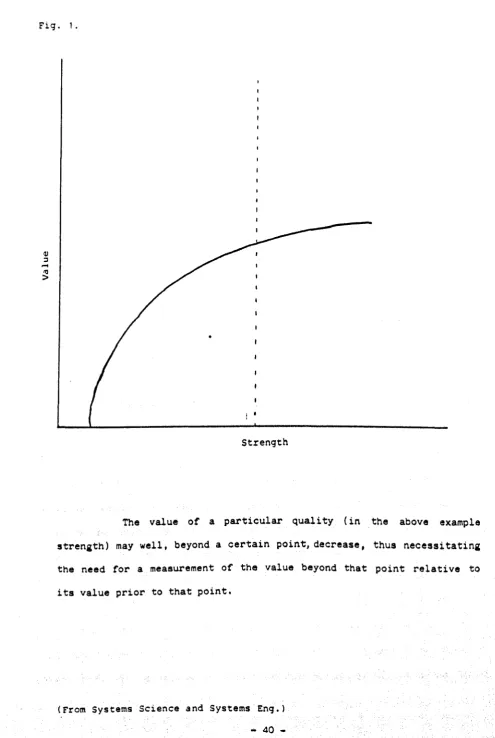
one another. See fig (,). The way in which such decisions are
undertaken is covered at some depth in the section dealing with decision
theory (2.7.). Chestnut, as do many other systems orientated design
theorists sees design as comprising of a four stage sequential process.
These stages basically consist of, Formulation, Production of structure,
Testing and production of Finalised solution. ChUrchman et al (1957)
though actually listing six phases for the design process demonstrates
more similarities than differences to Chestnuts view.
phases are as
follows:-1. Formulating the problem
2. Constructing a mathematical model
3.
Deriving a solution from the modelChurchman's
4. Testing the model and the solution derived from it.
5.
Establishing controls over the modelFig. 1.
Strength
The value of a particular quality (in the above example
strength) may well, beyond a certain point, decrease, thus necessitating
the need for a measurement of the value beyond that point relative to
its value prior to that point.
(From Systems Science and Systems Eng.)
[image:43.572.58.553.88.826.2]-In the Chestnut process model it is the structure phase during which the
greatest part of the design activity takes place. During this stage the
structure of the problem is outlined. Goals, sub-goals and objectives
form the basis by which the design problem is to be dealt with.
Chestnut (1965) sees the main concern of the designer being that of the
construction of valid models firstly of the design problem and then of
the possible ways in which a solution can be achieved. He asserts that
all design models will consist of variables and that i t is these
variables which will determine the outcome of the designer activity. A
major feature of this work by Chestnut is the emphasis that he places
upon both optimisation and probability as methods by which the designer
can determine the relative values and needs of all the design problems
constituent variables.
•
Wymore (1967), another leading researcher in the area, also
places great emphasis upon the construction of systems models as a means
to successfully accomplish a design. Wymores major concern is with ways
in which a system can be described. Basically he views all systems as
belonging to one of two types, the Input-Output type of system described
earlier in this section and the Homomorphous. The difference between
the two types of system, sometimes also referred to as hard and soft
systems, as that one can be adequately described by reference to the
interaction of components in terms of mathematical models and the other,
soft systems cannot. The latter consist predominantly of human activity
systems and all systems where there exist difficulties of description
and measurement. Though homomorphous systems effect the design process
and the system wi thin which the design will take place they exercise
of the design process still remaining amenable to Input-Output type
systems description. Wymore describes ways in which is possible to
couple together both different systems and different types of system.
Wymores approach is typical of the systems approach in general towards
the production of design. Systems should be decomposed into sub-system
components and these sub-systems should in turn be further sub-divided
into groups and sub-groups until the system is completely defined.
Finally to complete this definition discreet systems which may exist
within the system should be looked for. Discreet systems are those
systems whose relationships between system elements are not always
obvious, as in their effect upon a system. Beyond the difference in
treatment and an emphasise upon the use of mathematical modelling
techniques, in theory and approach Wymore differs little from the other
leading researchers in this field.
Gosling another prominent and frequently referred to
researcher in the area of systems also states that deSign will be best
performed when it takes place in a structured sequential manner,
(Gosling 1962, 1959). For Gosling the process of sequential design
fundamentally has three major phases. These consist of generating the
specification, conducting studies of feasibility and finally realisation
of the completed design. Sim1larily to the majority of research in this
area Gosling places great importance upon the way in which the
description of the system and its components takes place. Importance is
attached to the methods of representation which can be . used and the
general production of a systems modeL Methods of generating deSign
solutions are also examined. Firstly for specification Gosling
advocates a description of the basic system which will be required,
followed by the establishment of a value model and finally a description
of the systems inputs and outputs. In addition to this an examination
and statement of the general parameter within which the system will have
to be made. This basically comprises of an examination of the way in
which the environment within which the system will have to operate will
effect that system. The generation of specification completed the
feasibility phase is now undertaken. This phase is characterised by the
construction of possible design solutions as systems models and
comparing their performance against the requirement specification.
Again, much importance can be attached to the methods and techniques
which are available to the designer to assist him when making difficult
evaluatory decisions.
Goode and Machol are also influential researchers who have
their work frequently referred to. Goode and Machol (1957) emphasis the
way in which systems descriptions often appear to be idealised and how
important it is that redundancy, congestion and overloads be identified
both wi thin actual systems and in the design of systems prior to
implementations. The holistic approach towards design is again put
forward by these researchers as a main aspect of the systems approach
which can assist the designer, Hall (1962) though writing predominantly
as an education rather than purely a theoretision. is none-the .. less a
respected and often referred to author in this area. For Hall design is
a structured process which requires the decomposition of the design
problem before any attempt can be made towards the generation of a
design solution. Typically the emphasis of his work lies; in the