Aspects of Applied Biology 79, 2006 What will organic farming deliver? COR 2006
Nitrogen transfer between clover and wheat in an
intercropping experiment
By V A PAPPA1,2 R M REES1 & C A WATSON3
1Crop and Soil Systems Research Group, SAC, Edinburgh, EH9 3JG, UK 2School of GeoSciences, The University of Edinburgh, EH9 3JN, UK 3Crop and Soil Systems Research Group, SAC, Aberdeen, AB21 9YA, UK
Summary
A novel approach to the problem of improving nitrogen supply in organic farming is to use intercropping of cereals with a legume to provide nitrogen transfer within a season and/or to following crops. The affects of intercropping were studied in a column experiment using mixtures of winter wheat (Triticum aestivum cv. Claire), with white clover (w.c.) (Trifolium repens cv. Barblanca) and with red clover (r.c.) (Trifolium pratense cv. Britta). The effects of cutting and removal above ground clover material with and without additional soil disturbance were compared to leaving clover plants in situ and intercropped with wheat in a split root design. Wheat and clover plants, as monocultures, were used for the controls. 15N ammonium nitrate solution was applied. The wheat seeds were sown into the column without nitrogen. We found that the cutting treatment produced the highest yield of wheat. Available ammonium-N in the soil was greatest in the clover control treatment for the column with only red clover roots and in the cutting+soil disturbance treatment for the column with only white clover roots. Available nitrate-N was greatest in the soil disturbance treatment in the column with clover and wheat roots for both red and white clover. The cutting treatment produced the highest yield of wheat.
Key words: Intercropping; winter wheat; red clover; white clover; N fi xation; 15N-labelling
Introduction
conventional farms (Nieberg & Schultze, 1996). The N concentrations in organically grown wheat have also been found to be signifi cantly lower than those in conventional systems (high N input) (Gooding et al., 1999). This suggests that the yield reduction may be a consequence of restricted N supply (Berry et al., 2002), with the availability of nitrogen be different at different developmental stages.
However, a number of studies have shown that organic farming systems regularly result in a positive N balance (i.e. that the input is greater than the output) (Watson et al., 2002), which leads to the suggestion that the problem is the timing of N supply rather than the amount. Moreover, the mechanism by which the nitrogen transfer between legumes and non- fi xing plants taking place is still poorly understood. The overall aims of this study were to quantify transfer of nitrogen from clover to wheat and to examine the relative contributions of shoots and roots to N transfer.
Materials and Methods
Plant culture
The experiment was set up in a greenhouse at the Bush Estate in Edinburgh (lat. 55o 51’N, long. 3o 12’ W). Mixtures of winter wheat (Triticum aestivum cv. Claire), with white clover (w.c.) (Trifolium repens cv. Barblanca) and with red clover (r.c.) (Trifolium pratense cv. Britta) were used. The seeds of the clover cultivars were surface sterilised, germinated at room temperature for 24 h and sown in terragreen. After 15 days, the roots had been cut to 3 cm and only the top-two branches remained on each plant, so as to enhance the growth of the two branches and then split them one in each column. The plants were transplanted to glass tubes fi lled with terragreen and left for another 25 days. During this period, the temperature was 20oC and the photoperiod was 24 h per day.
Experimental design
The plants were transplanted to PVC columns (400 mL) and fi lled with approximately 3 kg of a sandy loam soil. The columns were about 30 cm high, 5 cm in diameter and each was placed in a plastic tray. All the columns were manually irrigated with the minus-N Long Ashton nutrient solution (Hewitt & Smith, 1975) and were maintained with a constant level of liquid at the base. Each experimental unit was made up of a pair of adjacent columns. The soil used was sieved (9.525 mm) to remove any roots, plants, and stones. The total number of units was 32 (16 per variety).
Results
[image:3.595.136.480.43.223.2]The wheat plants grown in the cutting treatment with the red clover donor and the cutting+soil disturbance treatment had the tallest and heaviest shoots, and heaviest roots. The non-cutting treatment was signifi cantly different from the other treatments and had the weakest and lightest wheat plants. In the columns containing clover roots, highest ammonium-N concentrations were observed in the soil of the control with red clover and the soil disturbance treatment for white clover. The non-cutting treatment had the highest amount of ammonium-N in the soil in the
[image:3.595.67.528.464.574.2]Fig. 1. The four treatments at the end of the fi rst month (LH column pair), second month (centre column pair) and third month (RH column pair) of the experiment.
Table 1. Ammonium-N levels in the soil DM comparing the columns growing only red (Trifolium pratense cv.Britta) or white (Trifolium repens cv. Barblanca) clover roots with the
columns growing wheat and clover roots (n=8) Growing columns
Treatments
Red Clover Red clover
and wheat White Clover
White clover and wheat
Controls 1.76 ± 0.08 0.63 ± 0.07 1.06 ± 0.24 0.75 ± 0.03 Non Cutting 1.15 ± 0.12 1.45 ± 0.05 1.23 ± 0.16 1.40 ± 0.04
Cutting 0.79 ± 0.14 0.76 ± 0.11 1.35 ± 0.18 0.71 ± 0.09
Cutting and Soil Disturbance 0.75 ± 0.09 0.62 ± 0.06 1.50 ± 0.75 0.79 ± 0.16
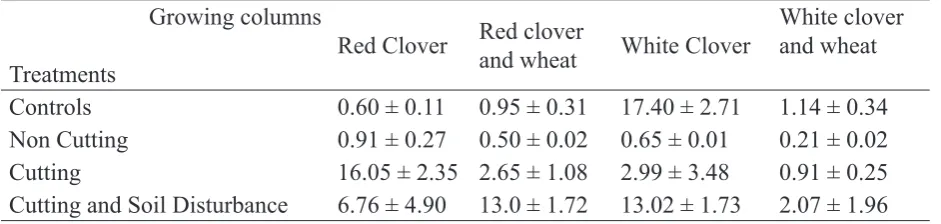
Table 2. Nitrate-N levels in the soil DM comparing the columns growing only red (Trifolium pratense cv.Britta) or white (Trifolium repens cv. Barblanca) clover roots with the columns
growing wheat and clover roots (n=8). Growing columns
Treatments
Red Clover Red clover
and wheat White Clover
White clover and wheat
Controls 0.60 ± 0.11 0.95 ± 0.31 17.40 ± 2.71 1.14 ± 0.34 Non Cutting 0.91 ± 0.27 0.50 ± 0.02 0.65 ± 0.01 0.21 ± 0.02
Cutting 16.05 ± 2.35 2.65 ± 1.08 2.99 ± 3.48 0.91 ± 0.25
(1) Control treatments
N added
(2) No Cutting treatment
N added
(3) Cutting treatment
N added
[image:3.595.64.535.666.778.2]column containing clover and wheat roots (Table 1). There were signifi cant differences in nitrate-N between the treatments and the columns containing wheat or clover (Table 2).
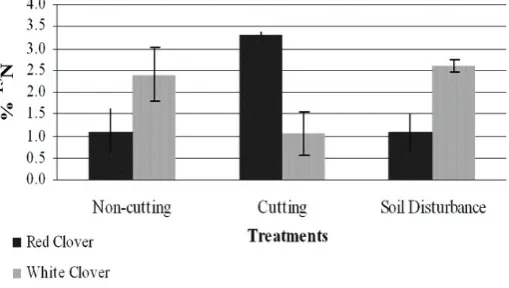
In the wheat shoots and roots, the highest amounts of total N were measured in the cutting treatment intercropping with red clover and the cutting+soil disturbance treatment intercropping with white clover (FigS 2 & 3). In the wheat plants, the excess of 15N and the transfer of 15N were measured by mass spectrometry and were highest in the cutting treatment intercropping with red clover and cutting+soil disturbance treatment intercropping with white clover, but the values were low (Fig. 4). The clover plants in the non-cutting treatment were signifi cantly different between
clover types and had the highest amount of 15N excess and showed the highest levels of 15N transfer.
Discussion
Direct transfer of N between plant species has long been of interest to ecologists and agronomists as a mechanism of nutrient fl ow within systems (Paynel et al., 2001; Paynel & Cliquet, 2003). Thorsted et al. (2005) found that intercropping winter wheat with clover resulted in wheat grain yield decreases of 10–25% compared with wheat only. This was likely to have been caused by interspecifi c competition for light and N during vegetative growth and for soil water during grain fi lling.
[image:4.595.83.297.191.349.2]In this experiment, the cutting only treatment produced the highest yield of wheat. It seems
[image:4.595.90.507.193.349.2]Fig. 2. The amount of total N in the wheat shoots grown alone (control) or with red or white clover plants.
Fig. 3. The amount of total N in the wheat roots grown alone (control) or with red or white clover plants.
[image:4.595.164.419.413.557.2]that this treatment provided the ideal environment for N mineralisation. The lower yield in the cutting+soil disturbance treatment is possibly due to greater immobilisation (since the disturbance of the soil could encourage soil organic matter decomposition and then immobilisation). Moreover, the clover plants were able to effi ciently recover the applied 15N. Rates of transfer were low, and the soil disturbance and cutting treatments did not lead to a consistent increase in transfer of N. Further work is needed to determine the mechanism by which N is transferred and to establish if the quantities of N transferred change over longer periods of growth. These results have potential practical applications in low input systems. It is possible that drilling cereals into a cut clover crop or cutting strips of clover grown between strips of cereals may enhance the crop’s nutrition and cereal growth and increase yield. Finally, the main advantage is the development of a more fertile soil with improved structure, aeration and more organic matter.
Acknowledgements
Valentini Pappa would like to express her gratitude to the Greek State Scholarships Foundation for the fi nancial support.
References
Altier M A. 1994. Biodiversity and pest management in agroecosystems. New York: Hayworth Press.
Berry P M, Sylvester-Bradley R, Philipps L, Hatch D J, Cuttle S, Raynes F. 2002. Tactical management of nitrogen. Soil Use and Management 18:1–8.
Bergkvist P. 2003. Swedish experience of chemical substitution. Presentation to the Pesticide Challenge conference, November 2003.
Gooding M J, Cannon N D, Thompson A J, Davies W P. 1999. Quality and value of organic grain from contrasting bread making wheat varieties and near isogenic lines differing in dwarfi ng genes. Biological Agriculture and Horticulture 16:335–350.
Hewitt E J, Smith T A. 1975. Plant Mineral Nutrition. London: The English Universities Press Ltd.
Nieberg H, Schulze Pals L. 1996. Profi tability of Farms Converting to Organic Farming in Germany - Empirical Results of 107 Farms. Farm Management 9:218–227.
Paynel F, Cliquet J B. 2003. N transfer from white clover to perennial ryegrass, via exudation of nitrogenous compounds. Agronomie 23:503–510.
Paynel Murray P J, Cliquet J B. 2001. Root exudates: a pathway for short-term N transfer from clover and ryegrass. Plant and Soil 229:235–243.
Watson C A, Atkinson D, Gosling P, Jackson L R, Rayns F. 2002. “Managing soil fertility in organic farming systems”. Soil Use and Management 18:239–247.
Sanders I R. 2003. Preference, specifi city and cheating in the arbuscular mycorrhizal symbiosis. Trends in Plant Science 8:143–145.