CORE Organic Project Series Report
Proceedings
Providing organic school food for youths in Europe –
Policy strategies, certification and supply chain management in
Denmark, Finland, Italy and Norway
Proceedings of the iPOPY seminar held at the BioFach February
20th 2009 in Nuremberg, Germany
Benjamin Nölting, Berlin Institute of Technology
(Editor)
CORE Organic project no. 1881
February, 2009
iP
O
P
Organic Certification in the iPOPY Countries and Germany –
Current Status and Future Challenges
Carola Strassner1), Rainer Roehl2)
1)University of Applied Sciences Muenster, Homes Economics and Nutritional Science, Germany.
2)a’verdis – Sustainable FoodService Solutions, Muenster, Germany. [email protected]
1.
Introduction
The study of innovative Public Organic food Procurement for Youth (iPOPY) is the subject of one of eight CORE Organic research projects (Coordination of European Transnational Research in Organic Food and Farming). Within a number of European countries, namely Italy, Denmark, Finland and Norway, attention is being given to the ways in which an increased consumption of organic food may be achieved by the implementation of relevant strategies and instruments linked to food-serving outlets for young people. As one of a number of specific aspects the procedures for organic certification of serving outlets is being examined, using Germany as a reference case.
All iPOPY countries are subject to the Council Regulation (EC) No 834/2007 of 28 June 2007 on organic production and labelling of organic products since it came into effect on January 1st 2009. This regulation repeals the hitherto valid Council Regulation (EEC) No 2092/91 of 24 June 1991 on organic production of agricultural products and indications referring thereto on agricultural products and foodstuffs, and its amendments. With respect to organic certification Member States are required to set up an inspection system operated by one more designated inspection authorities and/or approved private inspection bodies for the verification of organic quality.
The revised regulation differs from its predecessor with respect to foodservice in one important aspect: it specifically excludes so-called mass catering operations. However, Member States may apply national rules or private standards insofar as these comply with community law. The implementing rules make no further reference to mass catering operations (Commission Rgulation (EC) No 889/2008 of 5 September 2008 laying down detailed rules for the implementation of Council Regulation (EC) No 834/2007 on organic production and labelling of organic products with regard to organic production, labelling and control).
Currently and for a period of time just prior to the new regulation taking effect, the iPOPY countries have slightly diverging verification systems in general and specifically with respect to certification of out of home (foodservice) operations. Denmark and Finland employ a system of designated public inspection bodies while Italy, Norway and Germany have a system of approved private inspection bodies. Of these Germany and Norway consider out of home operations claiming organic status as necessitating verification and have similar systems whereas Denmark and Finland offer operators defined categories of organic use. Though Italy is the forerunner of organic use in schools there appears to be no national or other verification system in operation (Strassner/ Løes 2009). In part the application of the EU Regulation is a grey area, members of inspection authorities voice opinions only, which remain unsubstantiated and unsupported. In order to explore how iPOPY countries deal with out of home operations claiming organic status, inspection bodies are interviewed as to their practical dealings with such operations.
2.
Materials and Methods
Using the reference case Germany, which has clear guidelines for the inspection and certification of out of home operations using organic produce (Strassner et al. 2008), a questionnaire was devised to analyse the status quo of foodservice certification.
The sample comprises all 23 inspection bodies which are approved at the level of the Länder (federal states) and may have their activity limited to certain specified Länder. At each inspection body one person was interviewed, irrespective of the number of offices the body may have throughout Germany. Fieldwork was undertaken in January and February 2009. Participation was voluntary and non-compensated.
The questionnaire was sent to the management of the inspection body. It was attached to an email explaining the proposed study to be answered by management or delegated to the responsible employee(s). The email was followed up by a telephone call with a request for a telephone interview appointment. An interviewer called the inspection body at the appointed time and day to proceed with a telephone interview with employee responsible or delegated for this task. This allowed the interviewee at the inspection body the time to check on some data pertinent to the questions before the interview. The interviewer recorded the answers in an own questionnaire. The methodology chosen was thus more personal than a self-administered questionnaire and was useful for generating data which is deemed by some to be slightly sensitive.
3.
Results
Of the 23 inspection bodies contacted, 5 did not participate in the telephone interview. Reasons given were either that they have no foodservice operations in their clientele (n=3) or that they did not want to disclose any data (n=2). Due to their extensive travelling commitments, delegated interviewees at 6 bodies could not be reached in time.
The function of the persons interviewed at the inspection bodies was given as “management” (n=5), “head of department” (n=3), “auditor” (n=2) or “consultant” (n=2). Of the 12 inspection bodies interviewed 6 have an employee that is responsible for out of home operators while 6 do not. Inspection bodies numbered their out of home clients (companies or organisations) between 5 and 250, which together add up to a number of individual outlets between 5 and 600. For most of the bodies (n=8), out of home operations made up less than 5 % of the total amount of operations audited (irrespective of type); for two bodies these operations make up more than a fifth of all audited operations. Types of individual out of home outlets subjected to inspections included the full foodservice spectrum, in descending order: institutional catering, restaurants, hotels, professional foodservice, other.
In Germany foodservice operations are considered "transformers" with respect to the EU Organic Regulation. Two of the inspection bodies indicated that the number of out of home operators in their clientele was increasing in comparison to other transformers such as food manufacturers, 4 saw no difference to other sectors while 6 saw a relatively weaker increase.
Tab. 1: Ranking of the types of organic products offered in out of home operations (n=9)
Rank given by inspection bodies complete replacement of “conventional” by organic ingredients (i)
use of single organic meal components e.g.
side dish (ii)
a complete organic menu or
an organic line (iii)
a combination of these (i, ii, iii)
all food in organic quality,
fully organic
1 1 5 4 0 1
2 3 0 5 2 0
3 2 1 1 3 2
4 2 4 0 3 1
5 2 0 0 2 6
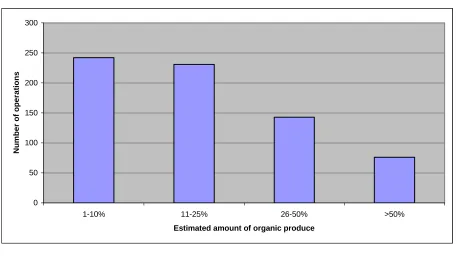
[image:4.595.59.517.337.594.2]Of those out of home operators inspected, the percentage of organic produce as compared to non-organic produce is estimated by interviewees as presented in Fig. 1 below. Four inspection bodies gave no answer.
Fig. 1: Estimation of the amount of organic produce used by out of home operators according to inspectors
0 50 100 150 200 250 300
1-10% 11-25% 26-50% >50%
Estimated amount of organic produce
N u m b e r o f o p e ra ti o n s
4.
Discussion
Inspection bodies with own persons responsible for the out of home sector does not seem to be a function of size, neither in terms of the absolute (or relative) amount of foodservice operations nor in terms of the overall size of the inspection body. Some added as an explanation that out of home operators belonged to the category “transformers” and hence had no specially allocated contact person.
All inspection bodies audit across the full spectrum of foodservice operations though most operations can be classified as catering operations. Furthermore, only 3 bodies had the same amount of operators as they had operations; all other inspection bodies had operators with a number of operations (outlets). Possibly such customers are more attractive for inspection bodies as multiple operations may be covered by one negotiation and contract.
In Germany labelling of organic produce in a catering or restaurant setting is clearly described. According to this survey the labelling least used (i.e. the lowest rank given by most bodies) was “fully organic”. The most used labels (i.e. the highest rank given by most bodies) were “organic menu” (ranked 1 by n=5 and 2 by n=4 bodies) followed by “organic components” (ranked 1 by n=5). “Ingredients” were ranked equally high and low. In a recent survey in Italy (Bocchi and Spigarolo, 2009) caterers indicated that they would prefer to certify the meal and/or the ingredients while the producers indicated that they would prefer to certify the catering and the ingredients – all of which are possible in the German system. Considering that most operations use a small amount of organic produce per operation, most operations using less than 25 % organic produce, the flexibility afforded the operators by the labelling options seems quite important.
A number of limitations need to be borne in mind in the analysis of the above data. It proved difficult to gather some of the data as it was deemed too sensitive by the inspection bodies. Grounds were not given but may include concern that individual bodies can be identified even from anonymous data and/or because inspection bodies are in competition with one another in the German system. It proved difficult to examine some aspects in depth as there is no differentiation within the data on foodservice operations; such statistics are not gathered by the inspection bodies.
5.
Conclusions
In a next step the fieldwork will be extended to the other iPOPY countries i.e. the questionnaires and interviews will be administered in Denmark (eleven Danish inspection bodies), Finland (eighteen Finnish inspection bodies), Italy (sixteen Italian, four German and one Austrian inspection bodies) and Norway (one Norwegian inspection body) according to the List of Bodies or public authorities in charge of inspection provided for in Article 15 of Council Regulation (EEC) No 2092/91 (2008/C 13/03).
Acknowledgements
The authors express their gratitude to the iPOPY team and all German inspection bodies that took part in this survey.
6.
References
Council Regulation (EEC) No 2092/91 of 24 June 1991 on organic production of agricultural products and indications referring thereto on agricultural products and foodstuffs [http://eur-lex.europa.eu/LexUriServ/site/en/consleg/1991/R/01991R2092-20070101-en.pdf]
Council Regulation (EC) No 834/2007 of 28 June 2007 on organic production and labelling of organic products
[http://eur-lex.europa.eu/LexUriServ/LexUriServ.do?uri=OJ:L:2007:189:0001:0023:EN:PDF]
Commission Regulation (EC) No 889/2008 of 5 September 2008 laying down detailed rules for the implementation of Council Regulation (EC) No 834/2007 on organic production and labelling of organic products with regard to organic production, labelling and control
[http://eur-lex.europa.eu/LexUriServ/LexUriServ.do?uri=OJ:L:2008:250:0001:0084:EN:PDF]
Strassner C & Løes A-K (2009) Is there any certification of public organic procurement in iPOPY countries (DK, FI, IT, NO and DE)? p 57-61 in Strassner C, Løes A-K, Kristensen NH and Spigarolo R (Eds.) (2009) Proceedings of the Workshop on Organic Public Catering at the 16th IFOAM Organic World Congress, 19th June 2008 in Modena, Italy. Proceedings 16th IFOAM Organic World Congress, Modena, Italy, June 19, 2008. 190 p Core Organic Project Report Series. ICROFS, Denmark.
Strassner, C./ Roehl, R. E. and Neuendorff, J. (2008): Easy Steps to Organic Certification. A Manual for Canteens, Restaurants and Foodservice Operators. 22 p
Bocchi, S./ Spigarolo, R./ Sarti, V. and Franceschi, A. (2009): Survey about the opinions of organic producers and caterers on the main constraints in Public organic food procurement for school catering in Italy. p 67-75 in Strassner C, Løes A-K, Kristensen NH and Spigarolo R [Eds.] (2009) Proceedings of the Workshop on Organic Public Catering at the 16th IFOAM Organic World Congress, 19th June 2008 in Modena, Italy. Proceedings 16th IFOAM Organic World Congress, Modena, Italy, June 19, 2008. 190 p Core Organic Project Report Series. ICROFS, Denmark.