For Peer Review
Bayesian analysis of the linear reaction norm model with unknown covariate
Journal: Journal of Animal Science
Manuscript ID: E-2005-517
Manuscript Type: Animal Genetics
Date Submitted by the
Author: 14-Sep-2005
Complete List of Authors: Su, Guosheng; Danish institute of Agricultural Sciences, Genetics and biotechnology
Madsen, Per; Danish institute of Agricultural Sciences, Genetics and biotechnology
Lund, Mogens; Danish Institute of Agricultural Sciences, Genetics and Biotechnology
Sorensen, Daniel; Danish INstitute of Agricultural Sciences, Genetics & Biotechnology
Korsgaard, Inge Riis; Danish Institute of Agricultural Sciences, Genetics and Biotechnology
Jensen, Just; Danish Institute of Agricultural Sciences, Genetics and Biotechnology
Key Words: G x E interaction, Environmental sensitivity, Reaction norm model, Environmental value, Gibbs sampler, Genetic parameters
For Peer Review
Reaction norm model, unknown covariate
(Section: Animal Genetics -- Quantitative Genetics)
Bayesian analysis of the linear reaction norm model
with unknown covariate
1G. Su2, P. Madsen, M. S. Lund, D. Sorensen , I. R. Korsgaard, J. Jensen
Danish Institute of Agricultural Sciences, Department of Genetics and Biotechnology, DK-8830, Tjele, Denmark
1The research was supported by the Research Project DARCOF II: Research in organic farming 2000-2005 -Organic
dairy production systems.
2
For Peer Review
ABSTRACT The reaction norm model is becoming a popular approach for the analysis of G x E 1
interactions. In a classical reaction norm model, the expression of a genotype in different 2
environments is described as a linear function (a reaction norm) of an environmental gradient or 3
value. A common environmental value is defined as the mean performance of all genotypes in the 4
environment, which is typically unknown. One approximation is to estimate the mean phenotypic 5
performance in each environment, and then treat these estimates as known covariates in the model. 6
However, a more satisfactory alternative is to infer environmental values simultaneously with the 7
other parameters of the model. This study describes a method and its Bayesian MCMC 8
implementation that makes this possible. Frequentist properties of the proposed method are tested in 9
a simulation study. Estimates of parameters of interest agree well with the true values. Further, 10
inferences about genetic parameters from the proposed method are similar to those derived from a 11
reaction norm model using true environmental values. On the other hand, using phenotypic means 12
as proxies for environmental values results in poor inferences. 13
14
Keywords: G x E interaction, Environmental sensitivity, Reaction norm model, Environmental 15
value, Gibbs sampler, Genetic parameters. 16
17
Introduction
18
The reaction norm model (Falconer and Mackay, 1996) is attractive to describe genotype by 19
environment interactions (G × E) partly because it can accommodate a very large number of 20
environmental levels with few parameters. In its standard version, it requires that covariates are 21
known (e.g., Karan et al., 1999; Ravagnolo and Misztal, 2000, Kingsolver, et al., 2004). However, 22
in animal breeding applications one may postulate a linear relationship between the phenotypic 23
expression of a given genotype and a particular environmental effect (e.g., herd effect). In this setup 24
the covariate (i.e., herd effect) is unknown. One approximation reported in the literature is to 25
For Peer Review
estimate in lieu of the unknown covariate in the model (e.g., Calus et al, 2002; Kolmodin et al, 27
2002; Calus and Veerkamp, 2003). 28
Including a function of the data as a covariable in the sampling model for the data is clearly 29
unsatisfactory. Apart from the understatement of uncertainty due to treating phenotypic means as 30
known parameters, one can imagine situations that would lead to misleading representations of 31
environmental values using this approach. An example would be the presence of genetic trend. 32
Since in the reaction norm model a breeding value is defined as a function of the environmental 33
gradient, biased estimates of environmental values may result in incorrect ranking based on 34
predicted genetic values. 35
It is therefore important to find more appropriate methods to account for unknown covariates in 36
a reaction norm model. An alternative is to infer the environmental values simultaneously with the 37
other parameters of the model. The objectives of this study are (1) to describe a method and its 38
Bayesian MCMC implementation that makes this possible, and (2) using a simulation study, to test 39
the expectation that the proposed method leads to more satisfactory inferences about genetic 40
parameters than the approximate method mentioned above. 41
42
Model and methods
43
Model
44
When both genetic and non-genetic environmental sensitivities are taken into consideration, a 45
reaction norm model can be written as 46
e a H a Z u H u Z Eh Xb
y= + + u 0 + u h + a 0 + a h + (1)
47
where y is the data vector (order n), b is the vector of fixed effects (order nb), h is the vector of
48
environmental values (order nh), u0 is the vector of intercepts (order nu), uh is the vector of slopes of
49
reaction norms for non-genetic random effects (e.g., permanent effects, of order nu), a0 is the vector
50
of intercepts (order ng), ah is the vector of slopes of additive genetic reaction norms (order ng), and e
51
is the vector of residual effects (order n). X, E, Zu, Hu, Za and Ha are the incidence matrices. The ith
For Peer Review
row of the matricesX, E, Zu, andZahas exactly one element equal to one, and the remaining
53
elements equal to zero. When the covariate associated to the reaction norm is treated as unknown, 54
the ith row of the matricesHu and Ha has exactly one element equal to the effect of the environment
55
(hj or a function of hj) where the observation is recorded, and the others equal to zero.
56
In principle h can be treated as a fixed or a random vector. Here it is treated as random in order 57
to better meet identifiability requirements. In the present model identifiability is a complex topic. 58
We limit ourselves to making the statement that the functions of the parameters that are estimated 59
and reported below are identifiable. 60
The conditional distribution of y is assumed to be normal having the form 61
) (
N Xb Eh Z u H u Z a H a ,R ~
R , a , a u , u h, b, |
y 0 h 0 h + + u 0 + u h + a 0 + a h ,
62
where R is the matrix (order n) of random residual covariances. Without loss of generality, it is 63
assumed that residuals are homoscedastic and independent of each other so that R = I e2, where I is
64
the identity matrix and e2 is the residual variance.
65 66
Prior distribution of location parameters
67
The prior distribution of vectorbis assumed to be improper uniform with density 68
p(b) constant. (2) 69
The random vectorsh, (u0, uh) and (a0, ah) are assumed to have normal, mutually independent
70
prior distributions. The prior density function of hgiven h2is
71
= 2 2 2
2 exp )
2 ( ) (
h n
h h
p h| 2 h'h
h (3)
72
where h2 is the variance of hi, and it is assumed that Var(h)=I h2.
For Peer Review
Let = h 0 u uu , and let =
2 , , 2 0 0 0 0 h h h u u u u u u
U be the covariance matrix of
i
u0 and
i h
u . Then, with 75 I U u u0 = 0 h
Var , the prior joint density function ofu0 and uh given U0 is
76 = 2 exp | | ) 2 ( ) | ( 2 0 I)u (U u' U U u -1 0 0 u u n n
p . (4)
77
Similarly, let =
h 0
a a
g , =
2 , , 2 0 0 0 0 h h h a a a a a a
G , and G A a
a0 = 0
h
Var , where A is the numerator 78
relationship matrix among ng individuals. Then the prior density function of g, given G0 and A is
79 = 2 exp | | | | ) 2 ( ) |
( 2 2
0 )g A (G g' A G G g -1 -1 0 0 g g g k n n p (5) 80
where kg=2 is the dimension of G0.
81 82
Prior distribution of dispersion parameters
83
The prior distributions of h2 and e2 are assumed to be scaled inverse Chi-square distributions
84 with density 85 + 2 2 ) 1 2 ( 2 2 2 exp ) ( ) ( h h h h h s p h , (6) 86 and 87 + 2 2 ) 1 2 ( 2 2 2 exp ) ( ) ( e e e e e s p e , (7) 88
where I is the degree of freedom, and si2 is a scale parameter, i = h, e. These reduce to improper
89
uniform distributions if i = -2 and si2= 0.
90
The prior distributions of G0 and U0are assumed to be inverse Wishart distributions, with
91 density 92 )) ( 2 1 exp( | | ) , |
(G0 Vg = G0 ( + +1)/2 tr G0 1Vg-1
p g kg
g (8)
For Peer Review
and 94 )) ( 2 1 exp( | | ) , |(U0 Vu =U0 ( + +1)/2 tr U0 1Vu-1
p u ku
u (9)
95
where ki is the dimension ofG0orU0, Vi is the scale matrix and i is the degree of freedom, i = u,
96
g. SettingVi=0 and i = -(ki+1), retrieves an improper uniform distribution.
97 98
Joint posterior distribution of all the parameters
99
Let be the vector of all location parameters except h, i.e., = (b’, u0’, uh’, a0’, ah’). The joint
100
posterior distribution of all the parameters is 101 ) ( ) ( ) ( ) ( ) ( ) | ( ) ( ) ( ) | , , , ( 2 2 2 2 0 2 e h h e h p p p p p p p p p 0 h 0 0 0 h 0 0 2 e 0 G | a , a G U | u , u U h h, , | y y G , U h, (10) 102 103
Fully conditional posterior distribution of the location parameters
104
The fully conditional posterior distribution of can be directly derived from (10) by extracting 105
terms involving . This results in 106 ) ( ) ( ) ( ) , ( 2 0 h 0 0 h 0 2 e 0 0 2 h G | a , a U | u , u h, , | y G , U , h, y, | p p p p e (11) 107 108
Further, assuminghknown, define 109 e a H a Z u H u Z Xb Eh y
y = = + u 0 + u h+ a 0 + a h + (12) 110
Correspondingly, let W =(X :Zu :Hu :Za :Ha ), r =W ' y / e2, and 111 = 1 -0 1 -0 A) (G 0 0 0 I) (U 0 0 0 0
, C =W 'W 2 +
/ e .
112
Then the mixed model equations associated with (12) can be written as 113
r
C ˆ= . (13)
For Peer Review
Sincep(y| ,h, 2e)= p(y | , e2), the fully conditional posterior distribution of is 115 ) ( ) ( ) ( ) , ( ) ,
( 2 2
0 h 0 0 h 0 2 e 0 0 0 0 2 h G | a , a U | u , u , | y G , U , y | G , U , h, y, | p p p p
p e = e
116 + + = 2 1 2 1 2 ) ( )' ( 2 1 exp e h e h e a a A) )(G ' a , ' (a u u I) )(U ' u , ' (u W y W y 0 0 h 0 0 0 h 0 (14) 117 118
Using results in Lindley and Smith (1972) and Gianola and Fernando (1986), it is easy to show that 119
the posterior distribution of location parameters, given dispersion parameters, is multivariate 120
normal. That is, 121 ) , ˆ ( ~ ,
|U0 G0, e2,y N C 1 . 122
123
Let i denote an arbitrary element (or set of elements) of ,and let -i denote the vector with
124
i excluded, and partition the vectorr and the matrix C appropriately, such that
125 ) ' , ' (
'= i i ,
(
)
i
i r
r
r '= ' , ' , =
(-i,-i) (-i,i) (i,-i) (i,i) C C C C C . 126
From standard multivariate normal theory, it can readily be established that if the distribution of 127
y , , G U , 0 e2
| 0 is normal, then that of i | i,U0,G0, e2,y is also normal, with conditional 128
mean and variance given by (Sorensen and Gianola, 2002) 129 ) ( ) , | (, ) 1 ) , (
0 ii i i i
i
i i
E( ,U G0, e2,y =C r C ,
130
1 ) , (
0, )
| i = ii
i
Var( ,U G0, e2,y C . 131
Consequently the fully conditional posterior distribution of iis
132 ) ), ( ( ~ ,
| i 0 (1i,i) (i, i) i (1i,i)
i ,U G , ,y N C ri C C
2 e
0 .
133 134
Fully conditional posterior distribution of h
For Peer Review
From (10), the density of the fully conditional posterior distribution of h is 136 ) ( ) ( ) ,
( 2 h2
2 e 0
0 2
h,U ,G y| ,h, h|
, y, |
h p p
p e (15)
137
Based on (1), an observation y can be described as 138 e h a u a u e h a a h u u h y h h h h + + + + + + = + + + + + + = ) 1 ( 0 0 0 0 b x' b x' 139
Therefore, an alternative formulation of the reaction-norm model (1) is 140 e a Z u Z h E Xb
y= ++ * + u 0 + a 0 + (16)
141
where E* is the coefficient matrix obtained by replacing the non-zero element in the ith row of 142
matrix E with (1+ zui'uh + zai'ah).
143
Assuming known, define 144 e h E a Z u Z Xb y y * 0 a 0
u = +
=
h (17)
145
Further, let * * 2 2 1
) ( /
' +
= E E e I h
Ch , and write the mixed model equations associated with (17) 146 as 147 h h *
hh E y r
C = 2 =
/ ˆ
e
' , (18)
148
Then, with p(y| ,h, e2)= p(yh |h, e2), the fully conditional posterior distribution of h is
149 + = ) ) (( 2 1 exp ) ( ) ( ) , ( ) , ( 2 2 2 2 2 h e e e e ' p p p p h h' h E (y h) E y | h h, | y , y | h G , U , , y, | h * h * h 2 h 2 e h 2 h h 0 0 2 h (19) 150 Therefore, 151 ) , ˆ ( ~
| h2, ,yh N hCh1
h 2
e
152
and for the ith element, 153 154 ). ), ( ( ~ ,
| (1,) 2 2 e i i i h h i i N 1 h(i,i) h(i,-i) h h 2
e,y C r C h C
, h h i 155 156
Fully conditional posterior distribution of dispersion parameters
For Peer Review
The fully conditional posterior distribution of dispersion parameters is deduced from (10). Let 158
be the vector of all the location parameters, and W = (X: E,: Zu: Hu: Za,:Ha). For the residual
159
variance one obtains 160
[
+]
+ + 2 e e 1 2 n 2 e 2 e 0 0 2 W y W y exp , | y y , G , U , , e ) ( ) ( |( 2 2 2
2 e e h e s ) ( )' ( ) ( p p ) p (20) 161
which is recognized as a scaled inverse Chi-square distribution with degrees of freedom e+ n and
162
scale parameter
[
( )'( ) s]
/( e n)2 e + + e W y W y . 163
The fully conditional posterior distribution of the variance of environmental values is 164 + + + 2 h h 1) 2 ( 2 h 0 0 2 h h' | h y , G , U , h ) ( ) ( ) ( |
( 2 2 2 2
2 h n h h e h s exp ) ( p p ) p h (21) 165
which is a scaled inverse Chi-square distribution with degrees of freedom h+nh and scale parameter
166
(h’h+ hsh2)/( h+nh).
167
The fully conditional posterior distribution of the covariance matrix of the reaction norm of the 168
non-genetic random effect is 169 + + + 2 exp ) ( 2 1 exp( | | ) ( ) ( ) ( 2 / ) 1 ( 0 I)u (U u' V U U U | u , u U y , , G , , | U 1 -0 1 u 1 0 0 h 0 0 2 e 0 2 h 0 tr p P p u u u k n
(22) 170 Let = h h h 0 0 h 0 0 2 u u ' u u ' u u ' u u ' u
S , and note that u'(U0-1 I)u=tr(U01Su2). Consequently, 171 + + + + )) ( 2 1 exp | | ) , ( 2 / ) 1 ( 2 u 1 u 1 0 0 2 e 0 2 h 0 S V U U y , G , , | U ( tr p u u u k n
(23) 172
This is an inverse Wishart distribution of dimension ku=2, with degrees of freedom u+nu and scale
173
matrix (Su2+Vu-1)-1.
174
The fully conditional posterior distribution of the covariance matrix of the additive genetic 175
For Peer Review
+ + + 2 exp ) ( 2 1 exp | | ) ( ) ( ) ( 2 / ) 1 ( 0 )g A (G g' V G G G | a , a G y , , U , , | G 1 -1 -0 1 g 1 0 0 h 0 0 2 e 0 2 h 0 tr p P p g gg k n (24)
177 Let = h 1 h h 1 0 0 1 h 0 1 0 2 g a A ' a a A ' a a A ' a a A ' a
S , and again note that 178
179
) ( 01 g2
-1 -1
0 A )g G S
(G
g' =tr .
180 181
Therefore, the fully conditional posterior distribution has density 182 + + + + )) ( 2 1 exp | | ) ( 2 / ) 1 ( 2 g 1 g 1 0 0 2 e 0 2 h 0 S V G G y , , U , , | G ( tr p u u
g k n (25)
183
which is an inverse Wishart distribution of dimension kg=2 with degrees of freedom g+ngand scale
184
matrix (Sg2+Vg-1)-1.
185 186
Implementation of the Gibbs sampler
187
The Gibbs sampler is a Monte Carlo method for obtaining samples from joint or marginal 188
posterior distributions of all parameters in the model, by repeated sampling from fully conditional 189
posterior distributions. The algorithm for the proposed model is as follows: 190
1. Construct the mixed model equations (14 and 19). 191
2. Set initial values for all the parameters. 192
3. Sample a new hi and replace the old hi: a) calculate yh, E*, Ch and rh based on the current
193
samples of and variances; b) draw hi from ( (1,)( ), ) 1 h(i,i) h(i,-i)
hi C h C
r
Chii i
N ; c) use the new hi to
194
replace the old hi.
For Peer Review
4. Sample the new i and replace the old i: a) calculate y ,C and r using the current samples of
196
h and variances; b) draw i from ( ( ), ) 1
) , ( )
, ( 1
) ,
(ii i i i i ii
N C r C C ; c) replace the old i with the
197
new i.
198
5. Sample a new h2 fromInv X2
(
h +nh,(h'h+ hsh2)/( h +nh))
.199
6. Sample a new G0 fromInv W
(
(
+)
, g +ng)
12
1 g 2
g V
S . Vg can be determined by using the
200
expectation of the prior inverse Wishart distribution of G0.
201
7. Sample a new U0 fromInv W
(
(
+)
, u +nu)
12
1 u 2
u V
S .
202
8. Sample a new e2 from
[
,(
)
/( )]
2n s
) (
)' (
n X
Inv e+ y W y W + e e2 e+ .
203
9. Replace the old variances with the new variances. 204
10. Repeat (3) – (9) until enough samples are available to meet the accuracy of various Monte 205
Carlo computations. 206
A Gibbs sampling algorithm has been implemented in the DMU-package (Madsen and Jensen, 207
2004). In the actual implementation, the “iteration on data” technique is applied in order to avoid 208
storingC and Ch.
209 210
Simulation studies
211
Data generation
212
The proposed method was evaluated using a simulation study. Observations were generated 213
using the model 214
e Ha Za Eh 1
y= µ+ + 0 + h + , 215
where hwas the vector of environment values (herd-year effects), a0was the vector of levels and
216
ahwas the vector of slopes of additive genetic reaction norms, ewas the vector of random residuals.
217
Vectors h, (a0, ah) and e were assumed to be mutually independent and were sampled from
218
) , ( ~N 0 I h2
h , ~ ( , )
2 2
0 0 0
A 0
a a
h 0
h h
h
a a a
a a a
N , and e~N(0,I e2).
For Peer Review
Five generations (five years) of data were simulated and distributed over 50 herds. In each 220
generation, 50 sires were mated to 1000 dams and each dam produced 5 offspring with records. 221
Both sires and dams were chosen randomly. Sires were used across herds and each sire was mated 222
to 20 dams from 5 herds. Dams were used within herds. Consequently there were 100 individuals 223
from 5 sires and 20 dams in each herd each generation. 224
The parameters used in the simulation were: h2 =80, a20 =100, ah2 =1,ra0,ah =0.5, and 225
300
2 =
e . This corresponds to a G x E variance
( )
. 80 22 =
= ah h hh
a
Var and a marginal variance 226
of a datum (phenotypic variance across herd-years) P2 = h2 + ao2 + ah2 h2 + e2 =560.
227 228
Statistical analysis
229
The simulated data were analyzed using the following models: 230
1) M1: The model with unknown covariate of the reaction norm, treating herd-years as random 231
effects (the proposed approach), 232
e Ha Za Eh 1
y= µ+ + 0 + h+ (M1)
233
2) M2: The model using true herd-year effects as covariate (Ht) of the reaction norm and including 234
herd-years as fixed effects, 235
e a H Za Xh 1
y h
t
0 + +
+ +
= µ (M2)
236
3) M3: The model using phenotypic means of herd-years as proxies for the unknown covariates 237
(Hm) of the reaction norm and including herd-years as fixed effects, 238
e a H Za Xh 1
y m h
0 + +
+ +
= µ (M3)
239
Note that in models M2 and M3, the covariates of the reaction norm (Ht, Hm) are not necessarily 240
equivalent to the corresponding elements of h, while in M1, the non-zero elements of H are 241
equivalent with those of h. 242
The additive genetic variance ( a2) and heritability (ha2) in a particular herd-year were calculated
243
as a a a h a ahh
h 0
2 2 2 2
2
0 + +
= and
)
( 2 2
2 2
e a a a
h
+
For Peer Review
genetic and phenotypic variances, for ease of comparison of heritabilities among models, the 245
covariate was expressed in units of the appropriate standard deviation (h*=h/ h). Thus
246
h h
h
h aa
a a
a 0 2 0
2 2 2
2 = + +
= a ahh h aahh h * 2
2 * 2 2
0
0 + +2 , where
2
h was the empirical variance of
247
the estimated herd-year effect using M1, the variance of true herd-year effect using M2, and the 248
variance of herd-year average using M3. 249
250
Results
251
Shown in Table 1 are correlations between the true and herd-year effects estimated with the 252
proposed method and estimated using phenotypic means. The correlation between true value of 253
herd-year effects and herd-year averages was significantly lower than 1 (0.901 averaged over 20 254
replicates). On the other hand, the proposed method resulted in a correlation between estimated 255
herd-year effects and the true values of 0.970, averaged over the 20 replicates. Thus the phenotypic 256
mean was a poorer estimator of herd-year effects than the estimates derived from the proposed 257
method. In the simulation study the variation of herd-year averages included variation of breeding 258
values across herd-years. Therefore the variance of herd-year averages was larger than the variance 259
of true herd-year effects (by 35%). 260
As shown in Table 2, the proposed method (M1) yields estimates of variance components with 261
no detectable bias, while using herd-year averages as proxies for herd-year effects (M3) resulted in 262
biased estimates. Averaged over the 20 replicates, the variance components estimated from the 263
proposed method and from the model using true herd-year effects as covariates in the reaction norm 264
(M2) resulted in similar inferences. These estimates agreed well with the true values. On the other 265
hand using herd-year averages as covariates in the reaction norm resulted in an overestimation of 266
the variance component associated with “level” ( 2
0
a ) and an underestimation of the variance
267
component associated with the “slope” ( 2
h
a ). These biases were significant. The sampling standard
268
deviation of the estimates of 2
h
a is largest using M1, lowest using M2, and intermediate using M3,
For Peer Review
while the standard deviation of the estimates of 2
0
a was largest using M3. Mean squared errors
270
favored M1 to M3 in all cases. 271
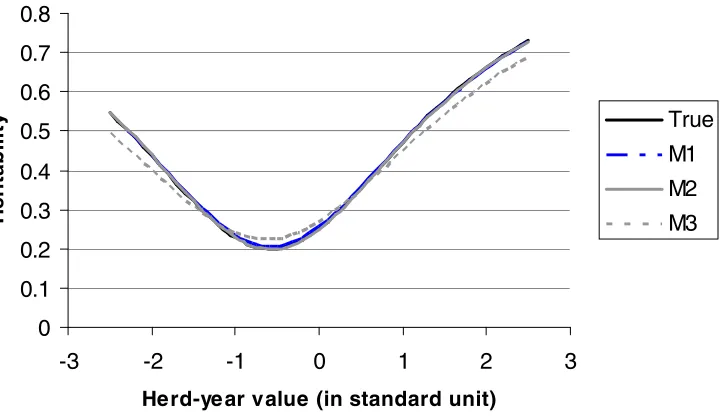
Estimates of within herd-year heritabilities over different herd-year levels were unbiased for M1 272
and M2, but biased for M3 (Figure 1). Averaged over the 20 replicates, the estimates from the 273
proposed approach (M1) or from a model using true herd-year effects as covariates of reaction norm 274
(M2) agreed well with the true heritabilities in all levels of herd-years. When herd-year averages 275
were used as covariates (M3), the estimate of total additive genetic variance was biased but the bias 276
was less serious than that for 2
h
a . The effect of underestimation of 2
h on the total additive genetic
277
variance was partly compensated by the larger variation of herd-year averages (relative to the 278
variance of true herd-year effects). Despite this, the bias was still considerable. As can be seen from 279
Figure 1, estimates of heritabilities derived from M3 were different from the true heritabilities in 280
both quantity and pattern. 281
282
Discussion
283
In the present work we describe a method to infer unknown environmental values 284
simultaneously with other parameters in a reaction norm model. Using computer simulation, this 285
method is compared with an approximation traditionally implemented in the literature, whereby the 286
unknown environmental value is replaced by the average of the observations in the appropriate 287
environment. It is shown that the proposed method leads to better inferences than those derived 288
from the approximate method. 289
The variance between herd-year phenotypic means includes a genetic component. As a result, 290
this variance was 35% larger than that of true herd-year effects, and the correlation between the 291
herd-year means and true herd-year effects was 0.901. Taking the herd-year average as a covariate 292
in the reaction norm model resulted also in biased estimation of variance components. The variance 293
component associated with the “slope” ( ah2 ) was underestimated by 42% and that associated with 294
“level” ( a20) was overestimated by 11%.
For Peer Review
The amount and sign of the bias depend on the data and the statistical model. An additional 296
study was carried out with data simulated from the same sampling model as reported above, but 297
with the difference that from generation 1 onwards individuals were selected on the basis of their 298
predicted additive genetic values for “level”. The results showed that the correlation between herd-299
year averages and true herd-year effects was approximately 0.80 and the variance of herd-year 300
averages was approximately 5 times larger than the variance of the true herd-year effects. Using the 301
herd-year average as a covariate of the reaction norm, 2
0
a was overestimated by 50%, while 2
h a
302
was underestimated by 88%. 303
Many approximations and ad-hoc procedures have been reported in previous studies to account 304
for unknown covariates in reaction norm models. In a study of production and fertility traits in dairy 305
cattle, Kolmodin et al. (2002) estimated herd-year values using herd-year means computed from 306
data that had been pre-adjusted for fixed effects other than herd-years. In addition, herd-year values 307
were estimated using herd-year means that were computed from data including animals with 308
records in the appropriate herd-year, while dispersion parameters and breeding values were inferred 309
from data that only included individuals whose sires were to be evaluated. The adequacy of this 310
approximation could not be tested because it was applied using real (as opposed to simulated) data, 311
but Kolmodin et al. (2002) made a plea in their conclusion for the development of alternative 312
procedures that avoid using functions of the data in the sampling model. Calus et al. (2004) 313
proposed to estimate environment values via an iterative procedure whereby the estimated 314
environmental effect in a given iteration replaces the value of the covariate in the next. Using 315
computer simulation, the authors observed a negligible reduction in bias of estimates of variance 316
components using this approach when compared with the standard use of replacing covariates by 317
phenotypic averages. They suggested replacing environment values by estimates of herd effects 318
obtained from a large number of animals per herd, instead of from herd-years, at the cost of losing 319
For Peer Review
The overall picture that emerges is that the conventional approximations do not always produce 321
reliable results, and it is difficult to decide a priori how they behave in any given dataset/modeling 322
scenario. In contrast, the method that we propose here avoids ad-hoc constructs, it is theoretically 323
coherent, easy to implement, and leads to adequate inferences. An important caveat associated with 324
the reaction norm model with unknown covariates is that of identifiability of parameters in the 325
likelihood. This is a technically elaborate problem which is presently under investigation and 326
hopefully will be reported elsewhere. 327
328
Implications
329
The reaction norm model is becoming a popular approach for the analysis of G x E interactions 330
because it can deal with a very large number of environmental levels with few parameters. The 331
unknown effects of environments (environmental values) are commonly used as an environmental 332
gradient in reaction norm models. They are typically estimated using the phenotypic means of the 333
environments and subsequently used in lieu of the true, unknown covariates when fitting the model. 334
This approach leads to biased inferences. The present study provides a method to infer parameters 335
in a reaction norm model with unknown environmental values. The proposed method estimates 336
environmental values simultaneously with the other parameters in the reaction norm model. The 337
method was tested using simulated data and it is shown to lead to estimates of parameters with no 338
detectable bias and with smaller mean squared errors than those obtained using the conventional 339
approximations. 340
For Peer Review
343
Literatures Cited
344
Calus, M. P. L., A. F. Groen, and G. de Jong. 2002. Genotype × environment interaction for protein 345
yield in Dutch dairy cattle as quantified by different models. J. Dairy Sci. 85:3115-3123. 346
Calus, M. P. L., and R. F. Veerkamp. 2003. Estimation of environmental sensitivity of genetic merit 347
for milk production traits using a random regression model. J. Dairy Sci. 86:3756-3764. 348
Calus M. P. L., P. Bijma, and R. F. Veerkamp. 2004. Effects of data structure on the estimation of 349
covariance functions to describe genotype by environment interaction in a reaction norm 350
model. Genet. Sel. Evol. 36:489-507. 351
Falconer, D. S., and T. F. C. Mackay. 1996. Introduction to quantitative genetics, 4th ed. Longman 352
Group, Essex. 353
Gianola, D., and R. F. Fernando. 1986. Bayesian methods in animal breeding. J. Anim. Sci. 63:217-354
244. 355
Karan,D, B. Moreteau, and J. R. David. 1999. Growth temperature and reaction norms of 356
morphometrical traits in a tropical drosophilid: Zaprionus indianus. Heredity, 83: 398-407 357
Kingsolver, J. R., G. J. Ragland, and J. G. Shlichta. 2004. Quantitative genetics of continuous 358
reaction norms: thermal sensitivity of caterpillar growth rates. Evolution. 58:1521-1529. 359
Kolmodin, R., E. Strandberg, P. Madsen, J. Jensen, and H. Jorjani. 2002. Genotype by environment 360
interaction in Nordic dairy cattle studied using reaction norms. Acta Agric. Scand., Sect. A 361
Animal Sci. 52:11-24. 362
Lindley, D., V. and A. F., M. Smith. 1972. Bayes estimates for the linear model. J. R. Stat. Soc. 363
Sect. B 34:1-41. 364
Madsen, P., and J. Jensen. 2004. A user’s Guide to DMU, version 6, release 4.5, Danish Institute of 365
Agricultural Sciences, Denmark. 366
Ravagnolo O., and I. Misztal. 2000. Genetic components of heat stress in dairy cattle, parameter 367
For Peer Review
Sorensen, D. and D. Gianola. 2002. Likelihood, Bayesian, and MCMC Methods in Quantitative 369
For Peer Review
Table 1. Correlations between true herd-year effects and herd-year phenotypic means, r(h, hm), and
between true herd-year effects and herd-year effects estimated from the proposed method r(h, hE), averaged over 20 replicate simulations.
Correlation mean Range
r(h, hm) 0.901 0.861 – 0.940
For Peer Review
Table 2.Mean and standard error of estimates of variance components (over 20 replicate simulations) ( 2
0
a =variance of the level and 2
h
a = variance of the slope of additive genetic reaction
norm,
h a
a0, = covariance between the level and the slope, and 2
e=residual variance).
Model 2
0
a
2
h
a a0,ah
2 e
Realized* 100.4±0.04 1.01±0.00 5.11±0.06 298.3±0.00 M1 101.7±1.10 1.02±0.03 5.04±0.11 297.1±0.87 M2 99.3±1.05 1.01±0.00 5.00±0.08 298.5±0.87 M3 111.5±1.44 0.58±0.00 3.68±0.11 305.5±0.70
*Realized: the variance components were calculated from the realized values of the simulation.
M1: model with unknown covariate of reaction norm (the proposed approach).
M2: model using true herd-year effect as covariate of reaction norm.
For Peer Review
00.1 0.2 0.3 0.4 0.5 0.6 0.7 0.8
-3 -2 -1 0 1 2 3
Herd-year value (in standard unit)
H
e
ri
ta
b
il
it
y True
M1
M2
[image:22.595.79.441.114.322.2]M3
Figure 1.Heritability as a function of herd-year value (covariate of the reaction norm) in unit of
standard deviation, based on the true variances (True) and the variances estimated from the model
with unknown covariate of reaction norm (M1, the proposed approach), the model using true
herd-year effect as covariate of reaction norm (M2), and the model using phenotypic mean of herd-herd-year