Abstract
The Designers’ Workbench is a system, developed to support designers in large organizations, such as Rolls-Royce, by making sure that the design is consistent with the specification for the particular design as well as with the company’s design rule book(s). Currently, to capture the constraint infor-mation, a domain expert (design engineer) has to work with a knowledge engineer to identify the constraints, and it is then the task of the knowledge engineer to encode these into the Workbench’s knowledge base (KB). This is an error prone and time consuming task. It is highly desirable to re-lieve the knowledge engineer of this task, and so we have developed a tool, ConEditor+ that enables domain experts themselves to capture and maintain these constraints. The tool allows the user to com-bine selected entities from the domain ontology with keywords and operators of a constraint lan-guage to form a constraint expression. Further, we hypothesize that to apply constraints appropriately, it is necessary to understand the context in which each constraint is applicable. We refer to this as “application conditions”. We show that an explicit representation of application conditions, in a ma-chine interpretable format, along with the con-straints and the domain ontology can be used to support the verification and maintenance of con-straints.
1 Introduction
The context for the system reported here, ConEditor+ [Ajit et al., 2005], is the Designers’ Workbench [Fowler et al., 2004] which has been developed to enable a group of de-signers to produce cooperatively a component which con-forms to the component’s overall specifications and the company’s design rule book(s). Sections 1.1 and 1.1.1 pro-vide an introduction to the Workbench, a description of the problem(s) faced and the need for ConEditor+. Section 2 gives a brief overview of our system ConEditor+. Section 3 then focuses on the maintenance aspects of constraints. The issues faced in KB maintenance were first raised by the XCON configuration system at Digital Equipment
Cor-poration [Barker and O'Connor, 1989; Soloway et al., 1987]. Initially it was assumed that knowledge-based sys-tems could be maintained by simply adding new elements or replacing existing elements. However this “simplicity” proved to be illusory as indicated by the experience of R1/XCON [Coenen, 1992].
The engineering design process has an evolutionary and iterative nature as designed artifacts often develop through a series of changes before a final solution is achieved. A common problem encountered during the design process is that of constraint evolution, which may involve the identifi-cation of new constraints or the modifiidentifi-cation or deletion of existing constraints. The reasons for such changes include development in the technology, changes to improve per-formance, changes to reduce development time and costs. In order to reduce/overcome the various maintenance prob-lems, systems that capture and represent the rationales asso-ciated with design knowledge have been developed. Design rationales [Burge and Brown, 2003; Regli et al., 2000] cap-ture the following types of information:
a) the reasons why a design decision was taken b) the design alternatives considered with reasons for
acceptance/rejection
c) how certain design actions are performed
However, we are interested in capturing information about when a particular design constraint is applicable. We believe it is important to know the context in which a par-ticular constraint or a rule can be applied. We refer to this as the application conditions associated with a constraint. In this paper, we present an approach that involves the explicit representation of application conditions in a machine inter-pretable format, along with the constraint itself. This infor-mation is used along with the appropriate domain ontology to support the verification and maintenance of constraints. Section 3 gives a description of our approach and its imple-mentation for the domain of kite design. We discuss our evaluation and results in section 4. The conclusions and plans for future work follow in section 5.
1.1 Introduction to the Designers’ Workbench
Designers in Rolls-Royce, as in many large organizations, work in teams. Thus it is important when a group of
design-ConEditor+: Capture and Maintenance of Constraints in Engineering Design
Suraj Ajit
1, Derek Sleeman
1, David W. Fowler
1, David Knott
2and Kit Hui
1 1Department of Computing Science, University of Aberdeen, Scotland, UK
Email: {sajit, sleeman, dfowler, khui} @ csd.abdn.ac.uk
2
ers are working on aspects of a common project, that the subcomponent designed by one engineer is consistent with the overall specification, and with those designed by other members of the team. Additionally, all designs have to be consistent with the company’s design rule book(s). Making sure that these various constraints are complied with is a complicated process, and so we have developed the Design-ers’ Workbench which seeks to support these activities.
Figure 1: Screenshot of the Designers’ Workbench
The Designers’ Workbench (figure 1) uses an ontology [Gruber, 1995] to describe elements in a configuration task. The system supports human designers by checking that their configurations satisfy both physical and organizational con-straints. Configurations are composed of features, which can be geometric or non-geometric, physical or abstract. A graphical display enables the designer to easily add new features, set property values, and perform constraint checks. If a constraint is violated, the affected features are high-lighted and a report is generated. The report gives the de-signer a short description of the constraint that is violated, the features affected by that violation, and a link to the source document. The designer can resolve the violations by adjusting the property values of the affected features. On selecting the affected feature from the ontology tree, a table is listed with the corresponding properties and values. These property values can then be adjusted to resolve the con-straint violations. More details about this system can be found in [Fowler et al., 2004].
1.1.1 The problem addressed
As noted above, the Designers’ Workbench needs access to the various constraints, including those inherent in the com-pany’s design rule book(s). Currently, to capture this infor-mation, a design engineer (domain expert) works with a knowledge engineer to identify the constraints, and it is then the task of the knowledge engineer to encode these into the Workbench’s knowledge base (KB). This is an error prone and time consuming task. As constraints are explained very briefly in design rule book(s), a non-expert in the field can
find it very difficult to understand the context and formulate constraints directly from the design rule book(s), and so a design engineer has to help the knowledge engineer in this process. An example of a constraint as expressed in rule book(s) is shown in figure 2. Adding a new constraint into the Designers’ Workbench’s KB currently requires coding a query in RDF Query Language [HP], and a predicate in Sic-stus Prolog [SICStus].
It would be useful if a new constraint can be formulated in an intuitive way, by selecting classes and properties from the ontology, and somehow combining them using a prede-fined set of operators. This would help engineers to input all the constraints themselves and relieve the programmer of that task. This would also enable designers to have greater control over the definition and refinement of constraints, and presumably, to have greater trust in the results of con-straint checks. This led to the development of a system, known as ConEditor+, which enables a domain expert to input and maintain constraints. ConEditor+ is explained further in the next section.
Figure 2: Constraint as expressed in rule book
2 ConEditor+
[image:2.595.312.551.291.496.2]constrain each f in Concrete Feature to have max_operating_temp(has_material(f))
>= operating_temp(f)
The above constraint states that for every instance of the class Concrete Feature, the value of the maximum operating temperature of its material must be greater than or equal to the environmental operating temperature.
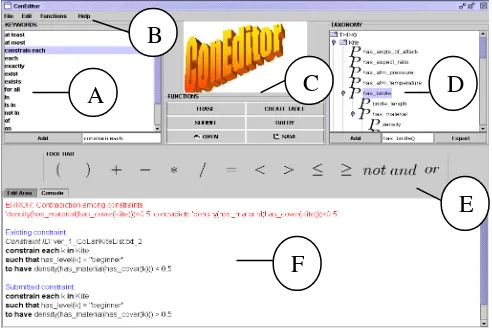
[image:3.595.45.291.315.479.2]ConEditor+’s GUI essentially consists of six compo-nents, namely: (A) Keywords Panel, (B) Menu Bar, (C) Taxonomy Panel, (D) Functions Panel, (E) Tool Bar and (F) Result Panel (see figure 3). These components provide the user with entities required to form a constraint expression. The user can then choose the appropriate entities by clicking the mouse and so form a constraint expression. More details about the GUI can be found in [Ajit et al., 2004]. An analy-sis of the Rolls-Royce’s design rule book(s) showed that a number of constraints are expressed in tables and so ConEditor+ provides a mechanism for inputting tables. ConEditor+ can store different versions of a constraint and provides facilities to retrieve constraints using keyword-based searches.
Figure 3: Screenshot of ConEditor+
3 Maintenance of constraints
Due to restricted availability of designers’ time and for sim-plicity, we have used a kite domain [Eden, 1998; Streeter, 1980; Yolen, 1976] for our study. Consider the following constraint along with its associated rationale and application condition:
Constraint – “The strength of the kite line needs to be greater than 90 daN1 units.”
Associated rationale – “This provides the required stability for the kite to fly.”
Application condition – “This is applicable to stunt kites of standard size in strong winds only.”
1 Symbol for deca Newton, a common metric unit of force.
The difference between a rationale and an application condition is evident from the example considered above; the rationale states the reason for a constraint (why), whereas the application condition states the context in which it is applicable (when).
In order to tackle the various maintenance is-sues/problems, our proposed solution is summarized as fol-lows:
• Capture the “context” of a constraint, in a machine interpretable form, as an application condition • Use the application condition together with the
constraint and the appropriate domain ontology to perform the several constraint maintenance tasks described in section 3
We intend to capture the “context” of each constraint i.e. the information pertaining to when a constraint is applicable, referred to as its application conditions. Often, such infor-mation is implicit to the person who formulates the con-straint. We believe that it is important to make the applica-tion condiapplica-tions explicit so that it can be used for both verifi-cation and maintenance. The assumptions/conditions on which a constraint is based may no longer be true/applicable and in such cases, it becomes necessary to deactivate or remove those constraints from the KB. Further, an applica-tion condiapplica-tion may not be relevant to a particular design task.
ConEditor+ captures both the constraints and the applica-tion condiapplica-tions in the same language, CoLan. Both the con-straints and the application conditions are then automatically converted into a standard machine interpretable format known as Constraint Interchange Format (CIF) [Gray et al., 2001]. Representation of a sample constraint with its appli-cation condition in CoLan is as shown below:
constrain each k in Kite
such that has_type(k) = “Flat”
and has_shape(k) = “Diamond”
to have tail_length(has_tail(k)) = 7 * spine_length(has_spine(k))
In the above constraint, the application condition(in italics) is introduced by the clause “such that”. This constraint states that the length of a tail of a kite needs to be seven times the length of the spine of the kite; this constraint is applicable for flat, diamond shaped kites only.
There are a number of ways in which we can use the information of application conditions to enable the verifica-tion and maintenance of constraints. Some examples are described below:
1. Subsumption
a)constrain each s in Sled_kite
such that has_size(s) = “standard”
to have kite_line_strength(has_kite_line(s))
>= 15
A
E
D
F
B
b)constrain each c in Conventional_sled_kite
such that has_size(c) = “standard”
to have kite_line_strength(has_kite_line(c))
>= 15
Conventional_sled_kite is a subclass of Sled_kite in the domain ontology. It can be inferred that the constraint in a) subsumes the constraint in b). The domain expert is notified of this fact and allowed to remove, shelve or deactivate the constraint in b). Similarly, subsumption among application conditions occurs, when we have:
c)constrain each s in Sled_kite
such that has_size(s) = “standard” or
has_size(s) = “large”
to have kite_line_strength(has_kite_line(s))
>= 15
d)constrain each s in Sled_kite
such that has_size(s) = “standard”
to have kite_line_strength(has_kite_line(s))
>= 15
Again, it can be inferred that the constraint in c) sub-sumes the constraint in d). The domain expert is notified of this fact and allowed to remove, shelve or deactivate the constraint in d).
2. Contradiction
e)constrain each k in Kite
such that has_type(k) = “stunt”
to have kite_line_strength(has_kite_line(k))
> 30
f)constrain each k in Kite
such that has_type(k) = “stunt”
to have kite_line_strength(has_kite_line(k))
< 30
Comparing the above two constraints, it can be in-ferred that the constraint in e) contradicts the constraint in f). The domain expert is notified of this fact and allowed to take the appropriate action (modify/delete).
3. Redundancy
g)constrain each c in Conventional_sled_kite
such that has_level(c) = “beginner”
to have density(has_material(has_cover(c))) < 0.5
h)constrain each t in Traditional_sled_kite
such that has_class(t) = “beginner”
to have density(has_material(has_cover(t))) < 0.5
Coventional_sled_kite is an equivalent class to Tradi-tional_sled_kite in the domain ontology. Also has_level is an equivalent property to has_class. It can be inferred that the constraint in g) or h) is redundant. The domain expert is notified of this fact and allowed to take appropriate action to eliminate redundancy.
4. Fusion
i)constrain each c in Conventional_sled_kite
such that has_wind_condition(c) = “moderate”
to have has_bridle_attachment_angle(c) < 40
j)constrain each m in Modern_sled_kite
such that has_wind_condition(m) = “moderate”
to have has_bridle_attachment_angle(m) < 40
Conventional_sled_kite and Modern_sled_kite are the only two subclasses of Sled_kite in the domain ontology. The constraints in i) and j) can be fused together and re-placed by k) as follows:
k)constrain each s in Sled_kite
such that has_wind_condition(s) = “moderate”
to have has_bridle_attachment_angle(s) < 40
Also two or more application conditions or constraints can be fused together using “or” and “and” respectively. For example:
l)constrain each j in Japanese_kite
such that has_wind_condition(j) = “strong”
to have has_bridle_point_distance(j) > 3 * surface_area(has_cover(j))
m)constrain each j in Japanese_kite
such that has_type(j) = “stunt”
to have has_bridle_point_distance(j) > 3 * surface_area(has_cover(j))
l) and m) can be fused together and replaced by n) as follows:
n)constrain each j in Japanese_kite
such that has_wind_condition(j) = “strong” or has_type(j) = “stunt”
to have has_bridle_point_distance(j) > 3 * surface_area(has_cover(j)
In this case, ConEditor+ suggests to the domain expert that several constraints be fused.
In all the examples above, we have considered univer-sally quantified constraints involving a single variable that are common in our knowledge base. However, more com-plex first-order logic expressions involving existential quan-tifiers or a combination of both existential and universal quantifiers can also be expressed in CoLan/CIF [Gray et al., 2001] by ConEditor+.
subsumptions) the knowledge base, as described earlier. The domain expert could then resolve these inconsistencies and/or refine the knowledge base by using the appropriate functions of ConEditor+ to delete/modify/shelve constraints.
4 Evaluation and Results
Before implementing the maintenance features, we per-formed a preliminary evaluation of our system. A demon-stration was given to the design engineers at Rolls-Royce. The demonstration involved the following three phases: i) Presenting the constraint as in the rule book i.e. as a mixture of textual and graphical information (figure 2) ii) Express-ing the constraint in CoLan iii) InputtExpress-ing the constraint us-ing ConEditor+. The design engineers were able to follow all the three phases. They found the GUI simple, user-friendly and fairly intuitive to use. However they felt they would need some training before they could do the steps in the last two phases [(ii) and (iii)] unsupported. They also made the general point that they have a Design Standards group that has the responsibility for creating and maintain-ing the company-wide rule book(s). They would expect this group to use systems such as ConEditor+ to input con-straints. The designers would then subsequently use the in-formation either in the current form or in the Designers’ Workbench-like environment.
After implementing the maintenance features, we con-ducted two experiments.
Experiment 1: We studied the domain of kite design and captured constraints along with their application conditions. We ran an experiment with ConEditor+ using: (a) set con-taining 15 constraints along with their application condi-tions, (b) set containing the same constraints without appli-cation conditions.
Results: For dataset in (a), ConEditor+ detected 3 subsump-tions, 0 contradicsubsump-tions, 3 redundancies and 2 cases of fusion between pairs of constraints. For dataset in (b), ConEditor+ detected 1 subsumption, 5 contradictions, 2 redundancies and 4 cases of fusion between pairs of constraints. For data-set in (b), it is evident that the absence of application condi-tions caused a number of inconsistencies (5 contradiccondi-tions), and also, ConEditor+ suggested a number of inappropriate refinements.
Experiment 2: We gave a demonstration of all the features of ConEditor+ to five subjects (two mechanical engineering research students, two computer science research students and one computer science research fellow). Each subject was then given the task of inputting a set of constraints in CoLan using ConEditor+. The subjects were asked to use ConEditor+ to resolve inconsistencies (contradictions) and also follow any suggestion(s) given by ConEditor+ to refine (fuse, eliminate redundancies and subsumptions) the knowl-edge base. A questionnaire about the usability of ConEdi-tor+ and its maintenance features was given to the subjects, who were asked to use a 5 point rating scale (1 being poor and 5 being excellent).
Results: All the subjects found ConEditor+ fairly easy to use and helpful for the verification and maintenance of con-straints. The average overall rating given by the subjects, for both the usability and maintenance features of ConEditor+ was 4. Additionally, some subjects gave helpful suggestions to improve the usability of ConEditor+.
5 Conclusions and Future Work
[image:5.595.308.552.326.537.2]This paper describes a methodology to enable domain ex-perts to capture and maintain constraints in an engineering design environment. The context is a system known as the Designers’ Workbench that has been developed to automati-cally check if all the constraints have been satisfied and if not, enable the designers to resolve them. The Designers’ Workbench is faced with the task of accumulating the con-straints associated with the domain. This needs a knowledge engineer to study the design rule book(s), consult the design engineer (domain expert) and encode all the constraints into the Designers’ Workbench’s KB. We describe the tool ConEditor+ that has been developed to help domain experts themselves capture and maintain engineering design con-straints.
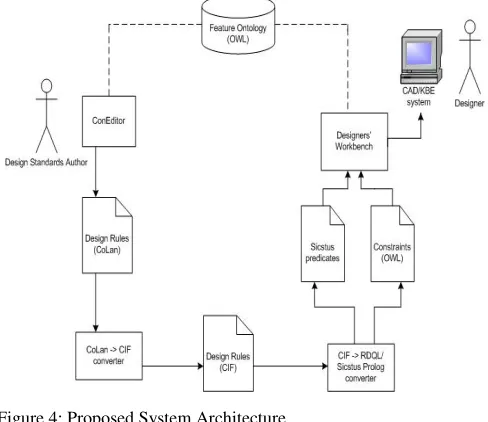
Figure 4: Proposed System Architecture
We hypothesize that in order to apply constraints appro-priately, it is necessary to capture the contexts (application conditions) associated with the constraints and that these would be beneficial for verification and maintenance. On the basis of our studies and experiments done in the domain of kite design, we find the above hypothesis to be true, and also find ConEditor+ to be a useful tool for design engineers to capture and maintain constraints.
(fig-ure 4) that shows how ConEditor+ fits into the whole frame-work. A Design Standards author initially inputs all the de-sign rules (constraints) into ConEditor+. The dede-sign constraints are then automatically converted into a standard machine interpretable format (CIF) and processed by the Designers’ Workbench. As can be seen from figure 4, it is planned to interface the Designers’ Workbench to a more sophisticated CAD/KBE system.
Acknowledgements
This work is supported by the EPSRC Sponsored Advanced Knowledge Technologies project, GR/NI5764, which is an Interdisciplinary Research Collaboration involving the Uni-versity of Aberdeen, the UniUni-versity of Edinburgh, the Open University, the University of Sheffield and the University of Southampton. We would like to acknowledge the assistance of engineers and designers in the Transmissions and Struc-tures division of Rolls-Royce plc, Derby, UK.
References
[Ajit et al., 2004] Suraj Ajit, Derek Sleeman, David W. Fowler and David Knott. ConEditor: Tool to Input and Maintain Constraints. In Proceedings of the 14th International Conference on Engineering Knowledge in the Age of the Semantic Web, EKAW 2004, 466 - 468, Whittlebury Hall, Northampton, UK, 2004.
[Ajit et al., 2005] Suraj Ajit, Derek Sleeman, David W. Fowler, David Knott and Kit Hui. Acquisition and Maintenance of Constraints in Engineering Design. In Proceedings of the 3rd International Conference on Knowledge Capture, KCAP 2005, 173-174, Banff, Canada, 2005.
[Barker and O'Connor, 1989] V. E. Barker and D. E. O'Connor. Expert Systems for Configuration at Digital: XCON and Beyond. Communications of the ACM, 32 (3): 298-318, 1989.
[Bassiliades and Gray, 1995] N. Bassiliades and P. Gray. CoLan: A Functional Constraint Language and Its Implementation. Data and Knowledge Engineer-ing, 14 (3): 203-249, 1995.
[Burge and Brown, 2003] Janet Burge and David C. Brown. Rationale Support for Maintenance of Large Scale Systems. In Workshop on Evolution of Large-Scale Industrial Software Applications (ELISA), ICSM '03, Amsterdam, NL, 2003. [Coenen, 1992] F. P. Coenen. A Methodology for the
Maintenance of Knowledge based Systems. In Niku-Lari, A. (Ed), EXPERSYS-92 (Proceedings), IITT-International, 171-176, France, 1992. [Eden, 1998] Maxwell Eden. The Magnificient Book of
Kites: Explorations in Design, Construction, En-joyment and Flight. Black Dog & Levanthal Pub-lishers, New York, 1998.
[Fowler et al., 2004] D. W. Fowler, D. Sleeman, G. Wills, T. Lyon and D. Knott. Designers' Workbench. In Proceedings of the Twenty-fourth SGAI Interna-tional Conference on Innovative Techniques and Applications of Artificial Intelligence, Cambridge, UK, 2004.
[Gray et al., 2001] Peter Gray, Kit Hui and Alun Preece. An Expressive Constraint Language for Semantic Web Applications. In E-Business and the Intelli-gent Web: Papers from the IJCAI-01 Workshop, 46-53, Seattle, USA, 2001. AAAI Press. [Gruber, 1995] T. R. Gruber. Towards Principles for the
Design of Ontologies Used for for Knowledge Sharing. International Journal of Human-Computer Studies, 43 (5-6): 907-928, 1995. [HP] A semantic web framework for Java. [online].
Available from:
http://jena.sourceforge.net/index.html [Accessed 21 June 2006].
[Noy et al., 2000] N. F. Noy, R. W. Fergerson and M. A. Musen. The knowledge model of Protege-2000: Combining interoperability and flexibility. In In-ternational Conference on Knowledge Engineering and Knowledge Management (EKAW' 2000), Juan-les-Pins, France, 2000.
[OWL] Web Ontology Language. [online]. Available from: http://www.w3.org/TR/owl-features/ [Accessed 21 June 2006].
[Regli et al., 2000] W. C. Regli, X. Hu, M. Atwood and W. Sun. A Survey of Design Rationale Systems: Ap-proaches, Representation, Capture and Retrieval. Engineering with Computers: An Int'l Journal for Simulation-Based Engineering, special issue on Computer Aided Engineering in Honor of Profes-sor Steven J. Fenves, 16: 209-235, 2000. [SICStus] Version 3.10.0, Swedish Institute of Computer
Science. [online]. Available from:
http://www.sics.se/sicstus/ [Accessed 21 June 2006].
[Soloway et al., 1987] E. Soloway, J. Bachant and K. Jen-sen. Assessing the Maintainability of XCON-in-RIME: Coping with Problems of a Very Large Rule-Base. In Proceedings of AAAI-87, 824-829, Seattle, USA, 1987.
[Streeter, 1980] Tal Streeter. The Art of the Japanese Kite. Charles E Tuttle Company Inc, Tokyo, 1980. [Yolen, 1976] Will Yolen. The Complete Book of Kites and