1
DISSERTATION ON
A STUDY TO ASSESS THE EFFECTIVENESS OF VIDEO
ASSISTED TEACHING ON KNOWLEDGE REGARDING ILL
EFFECTS OF PLASTIC USAGE AMONG HOMEMAKERS AT
KP.PARK ,CHENNAI-03.
M.Sc (NURSING) DEGREE EXAMINATION
BRANCH – IV COMMUNITY HEALTH NURSING
COLLEGE OF NURSING
MADRAS MEDICAL COLLEGE, CHENNAI – 03
A Dissertation submitted to
THE TAMILNADU DR M.G.R. MEDICAL UNIVERSITY,
CHENNAI – 600 032
In partial fulfillment of requirements for the award of degree of
MASTER OF SCIENCE IN NURSING
2
CERTIFICATE
This is to certify that his dissertation titled “A STUDY TO ASSESS THE EFFECTIVENESS OF VIDEO ASSISTED TEACHING ON KNOWLEDGE REGARDING ILL EFFECTS OF PLASTIC USAGE AMONG HOMEMAKERS AT KP.PARK, CHENNAI” is a bonafide work done by NISHA.P, M.SC (NURSING) II YEAR, College of Nursing, Madras Medical College, Chennai – 600 003, submitted to The Tamilnadu Dr M.G.R. Medical University, Chennai – 32, partial fulfillment of the requirement for the award of Degree of Master of Science in Nursing, Branch – IV, Community Health Nursing under our guidance and supervision during the academic period 2015 – 2017
Dr.V.Kumari, M.Sc (N)., Ph.D., Dr.R.Narayanababu, MD, DCH.,
Principal, Dean,
College of Nursing, Madras Medical College,
3
“A STUDY TO ASSESS THE EFFECTIVENESS OF VIDEO
ASSISTED TEACHING ON KNOWLEDGE REGARDING ILL
EFFECTS OF PLASTIC USAGE AMONG HOMEMAKERS AT
KP.PARK ,CHENNAI”
Approved by the Dissertation Committee on 12.07.2016
Research Guide
Dr.V.KUMARI.,M.Sc (N).,Ph.D., _________________
Principal
College of Nursing, Madras Medical collge Chennai – 03.
Clinical Specialty Guide
Mrs.L.SHANTHI.,M.Sc(N)., _________________
Reader, HOD
Department of Community Health Nursing College of Nursing, Madras Medical College Chennai – 03.
Medical Expert
Dr.JOY PATRICIA PUSHPARANI, M.D., _________________
Professor,
Institute of Community Medicine, Madras Medical College, Chennai – 03.
A Dissertation submitted to
THE TAMILNADU DR M.G.R. MEDICAL UNIVERSITY,
CHENNAI – 600 032
In partial fulfillment of requirements for the award of degree of
MASTER OF SCIENCE IN NURSING
4
ACKNOWLEDGEMENT
The power of god is with you at all times; through the activities of mind,
senses, breathing and emotions; and is constantly doing all the work using
you as a mere Instrument.”
– Bhagavad Gita
First of all I praise and thank my God for his abundant blessings & graces all throughout my study. Great and mighty is our God, to whom all thanks and praise for all wisdom, knowledge, guidance and strength throughout this work.
I wish to express my sincere thanks to Prof.Dr.R.NARAYANABABU, M.D, DCH, Dean, Madras Medical College, and Chennai -03 for providing necessary facilities and extending support to conduct this study.
I am more privileged to thanks DR.SUDHA SESHAYYAN ,MD.,Vice principal, Institutional Ethics committee, Madras Medical college,Chennai-03 for expert guidance and encouragement of this study I express my heartfelt thanks to Dr.V.KUMARI, M.Sc(N)., Ph.D,. Principal, College of Nursing, Madras Medical college, Chennai who tugs and pushes and leads me to the next plateau, sometimes pocking me with a sharp stick called truth’s thank her for the perfect direction and valuable guidance offered to complete this study.
5
I thank Dr. JOY PATRICIA PUSHPARANI, M.D, Professor, Institute of Community medicine, Madras Medical College, and Chennai - for the support and assistance given by them according to their possible manner to complete this study.
I wish to express my special heartfelt thanks and sincere gratitude to Dr.N.P.SENTHILNATHAN.,MBBS.,DPH.Chennai for granting permission to conduct the study in Selected Urban Health Centre.
I also express my sincere my gratitude to Miss B.Lingeshwari., M.Sc (N), Lecturer, and Mrs N.Sathayanarayanii.,M.Sc (N), Lecturer,College of Nursing, Madras Medical College, Chennai for her elegant decision and suggestion to conduct this study.
I wish to express my gratitude to all Lecturers and Faculty Members of College of Nursing, Madras Medical College for their valuable guidance in conducting this study.
I extend my thanks to Mr.Ravi., B.A, B.L.I.Sc., Librarian, College of Nursing, Madras Medical College, Chenna i – 03 for his co-operation and assistance which built the sound knowledge for this study. My heartfelt thanks to all Homemakers participating in this study, s in K.P.Park, Chennai for the fullest co -operation.
6
I render my deep sense of gratitude to My heartly thanks to my beloved Mother Mrs.P.Gunasundari , my aunty Mrs. R.Velvizhi and my family members for their immense love ,support, prayers and encouragement that inspired me to reach this point in my life.
I express my deep sense of gratitude to my father Mr.S.Punniyakotti (Late) for his Blessings and mercies which enable me reach this step and complete my study without any inrerruptions.
7
ABSTRACT
Title
“A study to assess the effectiveness of video assisted teaching on knowledge regarding ill effects of plastic usage among homemaker s at Kp.park, Chennai”
The global environment is changing day by day and now it has become challenge to living life forms due to very ugly fact that every nation is trying to develop their countries without taking into environmental impact of degradation. People are using plastic bag which are environmentally dangerous products and harmful to health..
Need for the study
The impact of plastics in their numerous desirable properties made diverse material properties of plastic such as resistance to chemicals and, ease of shaping and molding, has contributed to the development of high-volume manufacturing facilities enable of producing millions of tons of plastic products per year. Plastic waste in India is about 4.5 million tons a year and It take 500-1000 years to degrade.. In future, there is already a strong global movement to ban plastic as it can cause damage, not just to the environment but also human beings.
Objectives
To assess the pretest and posttest level of knowledge regarding ill effects of plastic usage among women homemakers at KP.Park.
8
To find out the association between post test knowledge level and selected demographic variables on knowledge regarding ill effe cts of plastic usage among homeworkers at KP.Park.
Key Words: ill effects of plastics, video assisted teaching, Homemakers
Methodology
Research approach : Quantitative research approach
Study Design : Pre experimental one group pre-test post-test design
Study setting : Urban area KP .Park, Chennai. Study Duration : 4 Weeks (18.11.16 – 20.12.16)
Target population : The target population of the study were homemakers in KP .Park, Chennai. Accessible population : The accessible population of the study
were homemakers belongs to age group 20-50 years
Sample size : The sample consist of 100 homemakers at urban area (K.P.Park) at Chennai. Sampling technique : Non probability convienient sampling
technique
Data collection procedure
9
assisted teaching program to the participants regarding ill effects of plastic usage. After 7 days post-test was conducted..
Data analysis
After the data collection the collected data was organized, tabulated, summarized and analysed, The data was analysed according to objectives of the study by descriptive statistics like Mean,Mode, Median,Standard deviation and inferential statistics like chi-square and paired t -test.
Results
The finding of the study revealed that video had improved the knowledge of homemakers regarding ill effects of plastic usa ge .Paired t- test; P value is 0.005.There is statistical significance in knowledge attainment on plastic shows effectiveness of the video assisted teaching.
Discussion
Hypothesis was proved by a statistical significance occurs in video assisted teaching programme. The chi square test shows that there is association between posttest knowledge and selected demographic variables.
Recommendations
Comparative study may be conducted to find out the similarities or differences between the knowledge and practices of urban and rural people.
Video Assisted Teaching programme on plastic use can be compared with other teaching Strategies.
A similar study can be done by using various teaching methods.
Conclusion
10
TABLE OF CONTENTS
Chapter Title Page No
I INTRODUCTION
1.1 Need for the study
1.2 Statement of the Problem 1.3 Objectives
1.4 Operational Definition 1.5 Assumption
1.6 Hypothesis 1.7 Delimitations
1 3 5 5 5 6 6 6 II REVIEW OF LITERATURE
2.1 Review of literature related to study 2.2 Conceptual frame work
7 19 III METHODOLOGY
3.1 Research approach 3.2 Research design 3.3 Study setting
3.4 Study duration 3.5 Study population 3.6 Sample size
3.7 Sampling criterion 3.7.1 Inclusion criteria 3.7.2 Exclusion criteria 3.8 Sampling technique 3.9 Research variable
3.10 Development and Description of tool 3.10.1 Development of the tool
3.10.2 Description of the tool 3.10.3 Score interpretation 3.10.4 Intervention control 3.11 Ethical consideration 3.12 content validitity
11
Chapter Title Page No
3.13 Reliability of tool 3.14 Pilot Study
3.15 Data collection procedure 3.16 Data entry and analysis
26 27 27 28 IV DATA ANALYSIS AND INTERPRETATION 30
V SUMMARY 51
VI DISCUSSION 53
VII CONCLUSION AND RECOMMENDATIONS 7.1 Implication of the study
7.2 Recommendations 7.3 Limitations
7.3 conclusion
56 58 59 59 REFERENCES
12
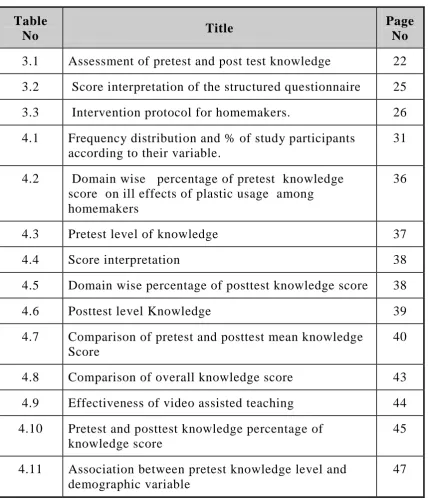
[image:12.595.86.515.111.613.2]LIST OF TABLES
Table
No Title
Page No 3.1 Assessment of pretest and post test knowledge 22 3.2 Score interpretation of the structured questionnaire 25 3.3 Intervention protocol for homemakers. 26 4.1 Frequency distribution and % of study participants
according to their variable.
31
4.2 Domain wise percentage of pretest knowledge score on ill effects of plastic usage among homemakers
36
4.3 Pretest level of knowledge 37
4.4 Score interpretation 38
4.5 Domain wise percentage of posttest knowledge score 38
4.6 Posttest level Knowledge 39
4.7 Comparison of pretest and posttest mean knowledge Score
40
4.8 Comparison of overall knowledge score 43 4.9 Effectiveness of video assisted teaching 44 4.10 Pretest and posttest knowledge percentage of
knowledge score
45
4.11 Association between pretest knowledge level and demographic variable
13
LIST OF FIGURES
Table
No Title
2.1 Conceptual frame work – J.w Kenny’s open system model 3.1 Schematic presentation of research design
4.1 Age wise distribution of study participants
4.2 Education wise distribution of study participants 4.3 Family Type wise distribution of study participants 4.4 Family income distribution of study participants 4.5 Religion wise distribution of study participants 4.6. Method of waste disposal wise distribution of study
participants
4.7 Pretest level of knowledge among homemakers 4.8 Posttest level knowledge
4.9 Pretest and posttest knowledge score 4.10 Effectiveness of video assisted teaching
4.11 Pretest and posttest percentage of knowledgr score
4.12 Association between posttest level of knowledge and age group
14
LIST OF APPENDICES
S. No Particulars
I Approval letter from Institutional Ethics committee II Permission Letter from City Health Officer
III Certificate of Content Validity IV Certificate of English Editing
V Certificate of Tamil Editing VI Consent Form
English Tamil
VII Tools for data collection
VIII Summary of planned teaching programme 1. English
2.Tamil
15
LIST OF ABBREVIATIONS
Abbreviations Expansion
CI Confidence Interval
DF Degrees of freedom
Fig Figure
H1 and H2 Research hypothesis
M.Sc (N) Master of science in nursing
SD Standard deviation
VAT Video assisted teaching
1
CHAPTER-I
INTRODUCTION
“Collect All Plastic You Ever Use and Take It to Your Grave And
Let Future Generations to Understand the Meaning of Heaven’
– Anonymous
Plastics are used on a daily basis throughout the world. The global environment is changing day by day and now it has become challenge to living life forms due to very ugly fact that every nation is trying to develop their countries without taking into environmental impact of degradation. The word plastic is a common term that is used for many materials of a synthetic or semi-synthetic nature1.The term was derived from the Greek Plastikos, which means “fit for molding.” "Plastics" derived their name from their properties to be molded, cast, extruded or processed into a variety of forms, including solid objects, films and filaments. These properties arise from their molecular structure. Plastics are polymers, very long chain molecules that consist of subunits (monomers) linked together by chemical bonds. The monomers of petrochemical plastics are inor ganic materials (such as styrene) and are not biodegradable1.
People are using plastic bag which are environmentally dangerous products and harmful to health. They are mainly used for their daily needs mainly for shopping purposes, and therefore environment and agricultural lands are thereby being polluted2.
2
much of what we have today would not be possible without plastics. The central government has recently passed a ruling under the provisions of the Environment Protection Act 1986, restricting the sale of some products in plastic carry bags. The Ministry of Environment, Forests and Climate Change has banned the manufacture and use of plastic carry bags less than 8inches x 12 inches in size and 40 micron7 in width. The ministry has also directed state
governments to register all plastic manufacturing3.
The Global Dimension
The Global production of 320 million ton of plastic is produced world-wide in 2015 -2016,representing 4 percent increase over 2014 and by 2020 Global production would reach 375 billionof plastics production(4). Though plastics have opened the way for new inventions and devices it has also ended up clogging the drains and becoming a health hazard. Recovery and recycling remains insufficient and million tons of plastics accumulate in land fill and ocean leads to hazards to human being. Approximately22-43% of plastics disposed in landfill and 10-20 million ton of plastics ends in ocean4.
While plastics are yet to be considered a significant disposal problem in much of the first world (largely because these materials are land filled--out of sight, out of mind), organizations in the global south have demonstrated considerable concern in regards to the detrimental effects of plastic products, notably the terminal waste generated by their disposal. Direct disposal (littering or dumping) and incineration (burning) of these wastes is a common practice in the global south. This is harmful to the health of people and the environment. Because dumping in rivers, streams and even urban drainage systems pollutes water courses and causes flooding. When these waters are unsanitary, they carry disease into the household5.
3
problems (cancer, asthma, etc.). Although land filling and recycling programs "vanish" the waste problem, each has considerably negative consequences: landfills leak and often contaminate the ground water with toxic liquids and residues. The recycling of plastic is often accomplished by exporting waste materials to Asian countries where recycling facilities are often likened to "sweatshops" where by laborers prepaid little for dangerous work. The increased push for unfettered trade and neo-liberal policy has scudded in intensifying these problems2.
1.1 Need for the Study
The impact of plastics in their numerous desirable properties made diverse material properties of plastic such as resistance to chemicals and, ease of shaping and molding, has contributed to the development of high-volume manufacturing facilities enable of producing millions of tons of plastic products per year. Plastic bags are an environmental disaster; The per capita consumption of plastic in the country stood at 6 kg now and is expected to go up to 12 kg by 2011, by 2012; India is also projected to be the third largest consumer market for plastic goods with a consumption of 12.5 million tons per annum, behind US and China6.
4
A study conducted by the National Environmental Engineering Research Institute for the Brihan Mumbai Municipal Corporation, refers that 5,500 metric tons MSW per day showed that plastic waste is 0.75 %.The rest is made up of organic materials (33%),paper and paperboards (30%), glass and metals (16%) and others (13%) It has also been observed that some of industries even recycle the plastic waste/scrap which is totally unhygienic and, has health hazard for persons house items made from such plastics and even used at times for packaging of foodstuff8.
Current research indicates that backyard-burning of waste is far more harmful to our health than previously thought. It can increase the risk of heart disease, aggravate respiratory ailments such as asthma and emphysema, and cause rashes, nausea, or headaches, damages in the nervous system, kidney or liver, in the reproductive and development system. The burning of polystyrene polymers -such as foam cups, meat trays, egg containers, yogurt and deli containers -releases styrene. Styrene gas can readily be absorbed through the skin and lungs..Long term exposure to styrene can affect the central nervous system, causing headaches, fatigue, weakness, and depression9.
Plastic waste in India is about 4.5 million tons a year and It take 500 – 1000 years to degrade.. In future, there is already a strong global
5
1.2. Statement of the problem
A study to assess the effectiveness of video assisted Teaching on knowledge regarding ill effects of plastic usage am ong women homemakers at KP.Park, in Chennai.”
1.3. Objectives of the study
To assess the pretest and posttest level of knowledge regarding ill effects of plastic usage among women homemakers at KP.Park.
To determine the effectiveness of the video assisted teaching on knowledge regarding ill effects of plastic usage among homemakers at KP.Park.
To find out the association between post test knowledge level and selected demographic variables on knowledge regarding ill effe cts of plastic usage among homeworkers at KP.Park.
1.4. Operational definitions
1) Assess refers to measuring the knowledge of home maker regarding ill effects of plastic usage.
2) Effectiveness refers to the knowledge gain after the Video assisted teaching on ill -effects of plastic usage among homemakers at KP.Park.
3) Ill effects of plastics refers to the hazardous effects over the health because of the usage of plastics in daily life.
4) Knowledge refers to the awareness and response on ill effects of the plastic usage measured in terms of structured k nowledge questionnaire.
6
6) Homemakers A woman who manages her own household as her main occupation between the age group of 20-50years
1.5. Assumptions
Home makers in community may have inadequate knowledge ill effects of plastic usage.
Video assisted teaching may improve the knowledge regarding ill effects of plastic usage among home makers.
Structured knowledge questions will be able to answer a s gain knowledge regarding ill effects of plastic usage.
1.5. Hypothesis
H1-There will be a significant difference between the pre-test and post-Test level of knowledge, regarding ill effects of plastics usage on Health among women homemakers at KP.Park.
H2- There will be a significant association between the post-test Knowledge and selected demographic variables of homemakers.
1.6. Delimitations
The study is delimited to the urban area KP.Park,Choolai.
The study is delimited to the 100 samples.
7
CHAPTER-II
REVIEW OF LITERATURE
The review of literature in a research report is a summary of current knowledge about a particular problem and includes what is known and not known about the problem. The literature is reviewe d to summarize knowledge for use in practice or to provide a basis for conducting a study. This chapter is divided into two parts
2.1.Part-I: Review of Literature Related to Study 2.2 PART-II: Conceptual framework
2.1 Part-I: Review of literature related to study
2.1.1 Environmental hazards due to plastics 2.1.2 Health issues due to plastics2.1.3 Literature related to plastic waste management.
2.1.4 Literature related to Use of alternatives for plastic use:
2.1.5Video Assisted Teaching
2.1.1 Environmental hazards due to plastics
8
Lither D, Larson ,et al., (2011) Conducted a cross sectional study on environmental and health hazard ranking and assessment of plast ic polymers based on chemical composition. Plastics constitute a large material group with a global annual production that has doubled in 15 years (245 million tons in 2008). The knowledge of human and environmental hazards and risks from chemicals associa ted with the diversity of plastic products is very limited. study has identified hazardous substances used in polymer production for which the risks should be evaluated for decisions on the need for risk reduction measures, substitution, or even phase out12.
Legesse Adane and Diriba Muleta., (2011) conducted a study to educate the public serious environmental pollution and health problems due to plastic products. The objective of this survey was to assess usage of plastic bags and their environmental impac ts in . A semi-structured questionnaire was used to collect data from 230 randomly selected respondents. The results indicated that the larger proportion (176, 76.52%) of the respondents used plastic bags more frequently than any other plastic products. The findings of the present study also indicated that the trend of utilization of plastic bags was Decreased and deal of awareness has improved knowledge of the residents about the ad verse effects of these products13.
9
Gray, Hill, Feet., (2009) conducted a descriptive study work in use of random plastic bags for shopping purpose and its eventual riddance into the dust bins. This paper proposes a timely lega l intervention by the respective governments of different countries to stop the production and the dominant use of plastic bags. It also proposes that the plastic bags which have already been manufactured and burnt to reduce its damaging impact on agricultural growth because of its non-biodegradable and toxic properties and harmful effects. However, we need to encourage the usage of alternatives to plastic bag, such a s, jute bags and paper bags etc15.
Rhian Tough, (2007) conducted a comparative approach to investigate the environmental impacts of plastic shopping bags and consumption patterns, in relation..The mixed comparative approach used in this research was a combination of the philosophies underlying cost benefit analysis, case studies and policy ana lysis. However, due to strong public pressure for government intervention, and potential implications for future climate change and sustainability initiatives16.
Yuan-Tien Su., (2006) conducted a comparative study between environmental hazards due to plastic uses and respiratory health in young children in Dec 2006 the study period covered 11 years (1996 -2006).640 documents were recovered from the United States accounted for 23.5% of articles. The factor most widely studied was air pollution the outdoor air pollution is (50%) and then indoor air pollution is (40%) predominated in children 3 years of age the study concluded environmental hazards is fundamental in the management and prevention of respiratory problems in childhood17.
10
production associated with these materials. Plastic bag waste appears in very high proportion in the municipal solid waste stream in and was causing environmental problems.The results indicated that the problem was a consequence of externalities in production and consumption; ineffective by-laws on littering and illegal dumping; failure of garbage collection and disposal systems; and low public awareness and poor life-cycle considerations18.
Thiel, et al., (2003) conducted a cross sectional study disposed plastic bags have now found their way to everywhere including the remote areas. It is very unfortunate that although the plastic bags have been seen to have reduced the agricultural production worldwide, there has been no significant lobbying to undertake a proper, effective and concrete proactive action and no scientific serious invest igation has been made by the international organizations and international community to reduce the ever increasing consumption of the plastic bags19.
Karliner, et al., (1997) conducted a cross sectional study damaging impacts of plastic bags on the environ ment and agriculture and its consumption pattern implicated therein. The research also looks for developing plastic bag alternatives, such as, jute bags, paper bags, etc., which are convenient for shopping purposes as well as not costly and above all not environmentally damaging. are able to supply adequate quantity of raw jutes to produce alternative jute bags. Hence, these countries are in a much better position to lobby for the much sought global alternatives of plastic bags20.
2.1.2 Health issues due to plastic
11
in adolescent and young adults and to detect the relationship between serum level of bisphenol A, Mean SD of bisphenol A is 1.72 .After controlling the confounding factors Linear regression analysis show bisphenol sA has significantly associated with cardiovascular disease (atherosclerosis) P= 0.001 .High serum of concentration of bisphenolA were associated with increased cardiovascular disease among adolescent and adult21.
Wang J, Li.L, Lu.Y., (2014) conducted a cross sectional survey to investigate main influence factors affect health of chil dren in plastic recycling among 9-17 years using questionnaire .by random household. The result is increased rate of respiratory symptoms (cough, nasal, congestion, and sore throat(78.4%) and digestive disease (14.8%) and in the waste processing area were significantly higher than those in the control area p=0.05 is analyzed22.
Nithin Joseph., (2013) conducted a cross sectional study in Mangalore and objective is to find out the awareness of health hazards associated with usage of plastics bags The resul ts states that Mean age of 250 participants was 32-10.8 years. Awareness was significantly more among females P=0.027 .Among participants 216 (86.4%) P= 0.006 aware of health hazards in plastic bags awareness has improved knowledge of usage of plastics bags23.
12
Calafat. AM ,et al.,(2012) conducted a study to assess the exposure to Biphenyl plastic used iin plastic manufacture affect health measured by urinary concentration .Bisphenol = 92.6% mean is significantly lower in (P= 0.000) and were not statistically different (P=0.21) .Female had statistically higher than male (P= 0.043) .Children had higher concentration than adolescent, Biphenyl is different from race ,age and income25.
Brophy JT, Keith, MM.,(2012) conducted a study to find mortality pattern among workers exposed to styrene in the reinforced plastic dot building industry revealed over all,860 deaths (standardized mortality ration (SMR)1.09, confidence interval 1.02 -1.17). The excess mortality was accounted for esophageal cancer (n=12, smr 2.30, cl -1.19-4.02), and prostate cancer (n=24.SMR-1.71, CL-1.09-2.54) Accidents (N=94 smrl.26, CL 1.02-1.53). Among 2.062 highly exposed workers urinary tract cancer increased with duration of employment26.
D Mello, Pamela.c., (2012) conducted a descriptive study on inefficient way of waste management causes severe health problem. It has been observed that due to an inefficient and faulty waste collection and transit system, a large amount of plastic waste fails to reach landfills or incinerators. Instead they are left behind to find the ir way into the soil, the sewage system and the water bodies. They choke the gutters and drains and during the monsoons flood streets causing severe health problems 27.
13
exposed to high levels of respirable PVC particles in the workplace, the lung cancer OR increases by 20% for each extra year of work (OR = 1.2003; 95% CI 1.0772 to 1.3469; p = 0.0010), when the influence of age and smoking habits is controlled. By this result, researcher concluded that in the VCM/PVC industry, an increased risk of lung cancer associated with exposure to PVC dust28.
Rofl U, Halden., (2010)conducted a descriptive study on worldwide annual production of plastics will surpass 300 million tons. Plastics are indispensable materials in modern society, and many products manufactured from plastics are a boon to public health (egg., disposable syringes, intravenous bags). However, plastics also pose health risks. Of principal concern are endocrine -disrupting properties, as triggered for example by biphenyl A and di-(2-ethylhexyl)phthalate . This literature review summarizes information from more than 120 peer -reviewed publications on health effects of plastics and plasticizers in lab animals and humans29.
14
HanaokaT,et al., (2006) conducted a cross sectional study and objective is to assess the occupational exposure to high level of plastic phthalate and polyvinyl chloride leads to decreased serum testosterone .The result is compared to unexposed workers and exposed workers has significantly decreased testosterone level P= 0.019 .Regression analyses shows decreases significantly and negatively correlated r= -0.19 .he observed significant reduction of serum testosterone in workers in high exposure to plastic phthalate31.
Swan. SH, et al., (2005) conducted a study to assess phthalate exposure impair testicular function. A standard measure significantly co-related with testicular impairment P= 0.02 .The association between male genital exposure and phthalate score (P= 0.001).The study analyzed by urinary concentration and support hypothesis that prenatal phthalate exposure adversely affect male reproductive developme nt .The median concentration phthalate metabolism associ ated with testicular impairment32.
Lovekamp-swm T,Davis .BJ., (2003) conducted a study to find extraction of diethylhexyl phthalate (DEHP) from total protein nutrient (TPN) solution polyvinyl chloride bags showed a range 0.39/ml (depending on lipid concentration and storage condition) of DEHP (content of plastic) leaking from TPN is smaller than DEHP, leaking from PVC tubing during hemodialysis. DEHP toxicity in human reaches from blood transfusion and leads to pulmonary insufficient and pulmonary edema33.
2.1.3. Plastic waste management
15
them in incinerators or by littering them. In the case of littering, plastic wastes fail to reach landfills or incinerators. It is the improper way of disposing plastics and is identified as the cause of manifold ecological problems. Incineration is a process in which plastic and other wastes are burnt and the energy produced, as a result, is tapped34.
Dr.Parveshbhawan (2012) conducted a study on Guidelines for recycling of plastics by the National Environmental Engineering Research Institute (NEERI) for the Brihan Mumbai Municipal Corporation, which handles more than 5,500 metric tons MSW per day shows that plastic waste is 0.75 %. The rest is made up o f organic materials (33%), paper and paperboards (30%), glass and metals (16%) and others (13%).The methods of recycling and the technology used for the same at present are quite outmoded and are in need of up gradation 35.
Aline Marques Rolim, Luis Felip,Nascimento., (2010) conducted a descriptive study on post-consumer plastic recycling technological The cases being studied were post-consumer plastic recycling companies and companies that manufacture end-use products from recycled plastics. This article describes their recycling technology and some market aspects. They have suggested on their study that post - consumer plastic recycling can be sustainable development tool which help to solve the problems of solid waste. “Postconsumer recycling was a technological trend that recovers the economic value from objects discarded by consumers (e.g. bottles and packaging)36.
16
reuse. It was, therefore, envisaged that if market value could be created in plastic waste, scavengers would start picking them as well. It was concluded that itinerant waste buyers would start moving from house to house to buy plastic waste.37
Rann PM, HILL., (2005) conducted a study on plastic waste management in India, 60% of the plastic-waste collected and segregated gets recycled back into materials for further processing into consumer products, while the balance is left unutilized and new perspectives in plastic biodegradation, recycling has practically failed to provide a safe solution for disposal of plastic waste (only 5% out of 1 trillion plastic bags, annually produced are being recycled). Since the most utilized plastic is polyethylene (PE; ca. 140 million tons/year), any reduction in the accumulation of PE waste alone would have a major impact on the overall reduction of the plastic waste in the environment38.
Reiss.A., (2005) conducted a descriptive study at 62 Zehrs shopping centre at Ontario to assess the knowledge of people of all groups regarding reuse of plastic bags .It is evident that majority of people knowledge using reusable bags. Hence efforts made to decrease or eliminate the behavior .and have to encourage the pu blic foe using reusable bags. the study reveal that 100 subjects 64 % had poor knowledge and 36% had average knowledge .post test revealed 34% of good knowledge 18% with excellence knowledg39.
17
from municipal commercial and industrial resources are managed by recycling program 40.
Shah, Priya., (2001) conducted a study “The Plastic Devil: Ecological Menace” that, the rate of recycling in India is extremely high. About 40 percent of the total plastics manufactured are sorted, collected and recycled as opposed to only 10-15 percent in developed countries. Of the types of plastics recycled in India, PVC (polyvinylchloride) accounts for 45 percent, LDPE (low density polyethylene) for 25 percent, HDPE (high density polyethylene) for 20 percent, PP (polypropylene) for 7.6 percent and other polymers such as PS (polystyrene) for 2.4 percent. According to manufacturers, almost all these types of waste can be recycled up to four or five times. However, the quality of the recyclate deteriorates as additives and virgin material are added to give it strength41.
2.1.4. Use of alternatives for plastic use
Amrutha Pretty (2014) conducted a study in An article by Times of India, October, reported that The Delhi High Court tightened norms for regulating use and recycling of plastic bags in the Capital to check their indiscriminate use as they pose a serious health hazard and pollute the environment. They stated that 100 -room hotels, 100-bed hospitals, shopping malls, liquor shops and 50-seat restaurants and milk booths can use biodegradable bags and the other establ ishments can use non-biodegradable and recycled plastic bags. It also mentioned that there will be big fines on those who are against to the law 42.
18
Italy, Bangladesh, and parts of India like Himachal Pradesh, Mizoram, Pondicherry, GOA, Tripura, Delhi, Kanyakumari, Jaipur, Ahmadabad, and Punjab43.
2.1.4Video Assisted Teaching
Sheetal udaykar, Markarand Udayka,. (2015) conducted a quasi experimental study to assess the knowledge on swine flu among students. The result is Average knowledge (13-22) and their frequency is 31 where 9 samples belong to good knowledge .The post mean score of video assisted teaching programme 26.13 was higher than the pretest mean score 13,the paired t test value 14.591.so video assisted teaching was highly knowledge in increasing the knowledge regarding prevention of swine flu 44.
Pushpakala K.J, Abraham Chako (2015) conducted a study to assess the effectiveness of video assisted teaching on knowle dge regarding plastic hazards .The results shows that mean posttest score 8.50 was higher than mean pretest score .There is significant association with posttest score at 0.01 level and moderately positive co relation between Knowledge and demographic var iable. so video assisted teaching was highly knowledge in increasing the knowledge regarding impact of plastic usage 45.
19
PART – II
CONCEPTUAL FRAMEWORK
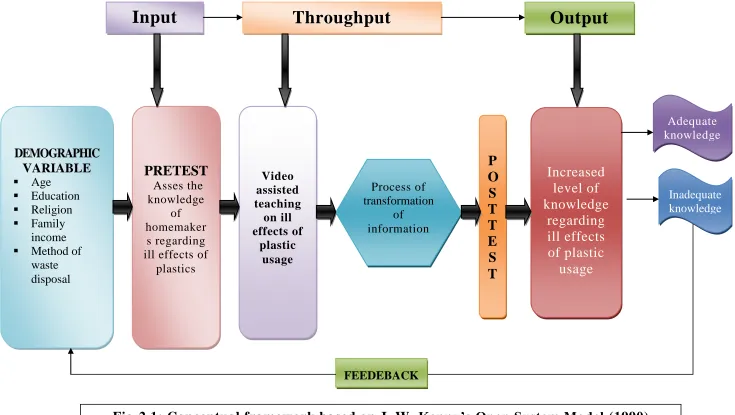
The present study is based on the concept of J.W. Kenny‟s open system model(1990) .According to J.W. Kenny‟s all living system are open, they are in a continuous exchange of matter, energy and information ,which results in varying degree of interaction with the environment from which the system receives input and gives output in the form of matter, energy and information.
Input
Input can be matter, energy and information from the environment .In the present study the environment refers to community set up (K.P.Park) and input refers to the collection of demographic data from samples and assessing the level of knowledge on ill effects of plastic s usage among homemakers by using questionnaire.
Throughput
The matter, energy and information are continuously processed through the system which is also called complex transformation ,known as throughput process is used for input (ie) energy and informat ion for the maintenance of homeostasis of the system .In the present study it refers to video assisted teaching regarding ill effects of plastic usage among homemakers.
Output
20
regarding ill effects of plastic usage among homemakers is considered as output and measured by posttest.
Feedback
21
Input
Throughput
Output
DEMOGRAPHIC VARIABLE Age Education Religion Family income Method of
waste disposal
PRETEST
Asses the knowledge of homemaker s regarding ill effects of [image:36.842.55.790.83.498.2]plastics Video assisted teaching on ill effects of plastic usage
P
O
S
T
T
E
S
T
Increased
level of
knowledge
regarding
ill effects
of plastic
usage
Process of transformation of information Adequate knowledge Inadequate knowledge22
CHAPTER-III
METHODOLOGY
This chapter deals Methodology to” assess the effectiveness of video assisted teaching on knowledge regarding ill effects of plastic usage among home makers”.
3.1. Research approach
The research approach adopted for this study is a quantitative approach.
3.2Research design
[image:37.595.96.514.433.486.2]The research design selected for the present study was pre experimental one group pretest post test design. The design may dramatically represent as below.
Table 3.1Assessment of pretest and post test knowledge
Group Pretest Intervention Posttest
Pre experimental group O1 X O2
Table 3.1 showsAssessment of pretest and post test knowledge O1= pretest assessment of knowledge of group
X = Administration of Video Assisted Teaching on the ill effects of plastics usage among homemakers.
O2 = Post test to evaluate the level of knowledge about the ill effects of plastics usage among homemakers.
3.3 Study setting
23
3.4. Study Duration
4 Weeks (18.11.16 – 21.12.16)
3.5 Study population
3.5.1 Target population : The target population of the study were homemakers in KP .Park, Chennai.
3.5.2 Accessible population: The accessible population of the study were homemakers belongs to age group 20 -40 years who are
3.6 Sample size
The sample consist of 100 homemakers at urban area (K.P.Park) at Chennai.
3.7 Sampling criterion
3.7.1 Inclusion criteria1) The homemakers who are residing in K.P.Park..
2) The homemakers who are belong to age group 20-50 years.
3) The homemakers who are able to understand Tamil and or English 3.7.2 Exclusion criteria
1) The homemakers who are not willing to participate.
2) The homemakers who are not available at the time of data collection.
3.8 Sampling technique
24
3.9 Research variable
Independent Variables – It refers to Video assisted teaching improving knowledge regarding ill effects of plastics usage among homemakers.
Dependent Variable – It refers to Knowledge of homemakers residing at K.P.Park, chennai.
3.10 Development and description of tool
3.10.1 Development Of The ToolAppropriate structured Questionnaire tool has been developed after extensive review of literature and obtained opinion, content validity from medical , Nursing expert and statistical experts. Construction and presenting of tool was done during pilot study. Direct assessment of study participants was performed during data collec tion. 3.10.2 Description of the Tool
The structured questionnaire has two sections I and II
Section I- Demographic data of home makers which include age, education, religion, Monthly family income and method of waste disposal.
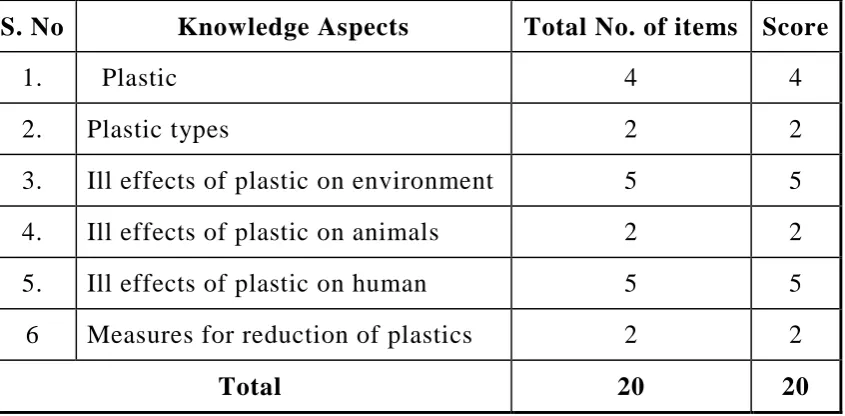
Section II - Structured Questionnaire. It consists of 20 structured questionnaires to assess the knowledge on ill effects of plastics usage. Each correct answer was given a score of one (1) and wrong answer was scored as zero (0). The total scores were 20.
Subsections are 1) Plastic
2) Plastic types
25
4) Ill effects of plastic on animals 5) Ill effects of plastic on human 6) Measures for reduction of plastics. 3.10.3 Score Interpretation
[image:40.595.90.513.285.493.2]A structured questionnaire was used to assess the knowledge of homemakers regarding ill effects of plastic usage. It consists 20 multiple choice questions with 6 subdivisions.
Table-3.2 Score interpretation of the structured questionnaire
S. No Knowledge Aspects Total No. of items Score
1. Plastic 4 4
2. Plastic types 2 2
3. Ill effects of plastic on environment 5 5 4. Ill effects of plastic on animals 2 2 5. Ill effects of plastic on human 5 5 6 Measures for reduction of plastics 2 2
Total 20 20
The score is given as follows
For correct answer - 1
For wrong answer - 2
Based on the score the level of knowledge on ill effects of plastic usage among homemakers interpreted as follows
Inadequate Knowledge - <50%
Moderate adequate knowledge - 51-75%
26
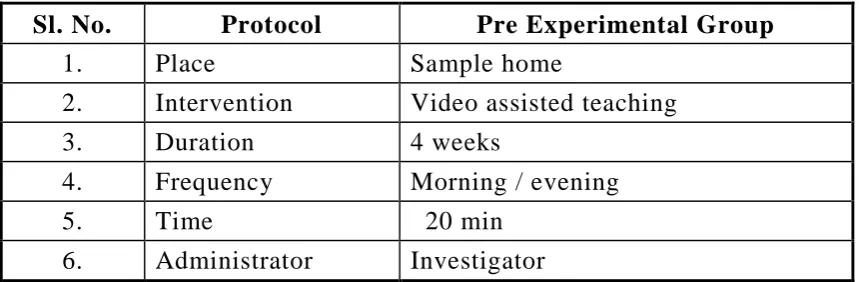
3.10.4 Intervention ProtocolTable-3.3 Intervention protocol for homemakers.
Sl. No. Protocol Pre Experimental Group 1. Place Sample home
2. Intervention Video assisted teaching 3. Duration 4 weeks
4. Frequency Morning / evening
5. Time 20 min
6. Administrator Investigator
3.11 Ethical considerations
The study was proposed and submitted to the ethics committee, Madras Medical College and the committee approved the study. All respondents were carefully informed about the purpose of the study and their part during the study. Informed consent for the study was obtained from all participants. Confidentiality of the subject‟s information was maintained. Thus the investigator followed the ethical guidelines, which were issued by the research committee. Necessary permission to conduct the study was requested and obtained from the City Health Officer of Chennai Corporation, Department head of Community Health nursing, college of nursing, Madras Medical College. The study was done without any violation of human rights.
3.12.Content validity
Content validity of the tool was assessed by obtaining an opinion in the field of community medicine, community health nursing and statistical experts. The experts were an Associate professor and Reader respectively. There was uniform agreement to the tool adopted for conducting the study. Hence, the investigator proceeds with the same tool.
3.13. Reliability of the tool
27
0.83. This correlation is very high and it is good tool for assessing the effectiveness of video assisted teaching about ill effects of plastic usage among the homemakers residing at selected urban area, K.P.Park
3.14. Pilot Study
The pilot study is a trial run for the main study to test thee reliability, practicability, appropriateness and flexibility of the tool for the study. A formal permission to conduct the study in the K.P.Park. Community area, Chennai was obtained from City Health officer of Chennai corporation. A pilot study was done for a period of 6 days. Samples were selected from K.P.Park. area. The purpose of the study was informed to the samples. Confidentiality of the information was assured. The consent was obtained from the samples. Samples were selected using Non probability convenient Sampling technique. Pretest,video assisted conducted and after that posttest was conducted. Analysis of the finding showed high consistency and feasibility of the study and after which the plan for the actual study was mad e. I excluded these samples in main study.
3.15. Data collection procedure
The data collection procedure for the study is as follows:
Permission has obtained from the Institutional Ethics Com mittee, Formal permission was obtained from the City Health Officer, Corporation of Chennai.
28
Data collection procedure was done for a period of four weeks and the time taken for each subject was 10-15 minutes. Pre assessment was done using structured questionnaire, Subsequently Video Assisted Teaching was given on same day for 20 minutes. In between study subjects doubts were clarified.
On the seventh day post assessment was conducted using same structured questionnaire.
Based on the criteria 8-10 subjects were selected each day. The subjects were assured of confidentiality of data collected.
3.16 Data Entry and Analysis
Data Entry: Entered the data in the excel sheet and coding the data
Analysis: Collected data were analyzed by using descriptive and inferential statistics.
1. Descriptive analysis
Frequency and percentage analysis were used to describe demographic characteristic of homemakers.
Range, Mean and standard deviation were used to assess the knowledge of homemakers.
2. Inferential analysis
Paired t-test were used to test to compare the pre-test and post-test knowledge.
Chi-square analysis were used to find out the association between the pre-test knowledge scores and demographic variable.
29
Fig-3.1: SCHEMATIC REPRESENTATION OF THE STUDY
Research Design
Pre-Experimental One group Pretest-Post test design
Study setting – Urban Area ,K.P.Park
Target population – Homemakers residing at K.P.Park
Sampling technique
Non-Probability Convenient Sampling
Sample size – 100 Homemakers
Description of the tool
Demographic data, structured questionnaire
Pretest Assessment of knowledge on ill effects of plastic usage
Plan of intervention- Video assisted teaching on ill effects of plastic usage
Post test knowledge
Data analysis-Descriptive and Inferential Statistics
30
CHAPTER – IV
DATA ANALYSIS AND INTERPRETATION
This chapter deals with the analysis and interpretation of the study were based on the data collected through structures multiple choice question to assess the knowledge regarding ill effects of plastics usage.
The collected data were tabulated and presented according to the objectives under the following headings.
Organization of data
Section–A : Distribution of Demographic variables of study participants.
Section – B : Pretest level of knowledge among homemakers regarding ill effects of plastic usage
Section – C : Post test level of knowledge among homemakers regarding ill effects of plastic usage
Section – D : Comparison of pretest and posttest level of knowledges
Section - E : Effectiveness of Video Assisted treaching .
31
[image:46.595.84.513.143.597.2]Section – A: Distribution of Demographic variables of study
participants.
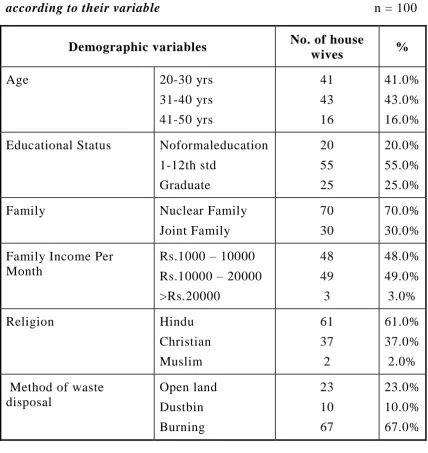
TABLE 4.1: Frequency distribution and % of study participa nts
according to their variable n = 100
Demographic variables No. of house
wives %
Age 20-30 yrs
31-40 yrs 41-50 yrs 41 43 16 41.0% 43.0% 16.0% Educational Status Noformaleducation
1-12th std Graduate 20 55 25 20.0% 55.0% 25.0% Family Nuclear Family
Joint Family
70 30
70.0% 30.0% Family Income Per
Month
Rs.1000 – 10000 Rs.10000 – 20000 >Rs.20000 48 49 3 48.0% 49.0% 3.0%
Religion Hindu
Christian Muslim 61 37 2 61.0% 37.0% 2.0% Method of waste
disposal Open land Dustbin Burning 23 10 67 23.0% 10.0% 67.0%
The above table reveals that age of study group of 16% of homemakers were in the age group of 41-50 yrs, 43% of homemakers were in the age group of 31-40 yrs and 41% of homemakers were in the age group of 20 -30 yrs.
32
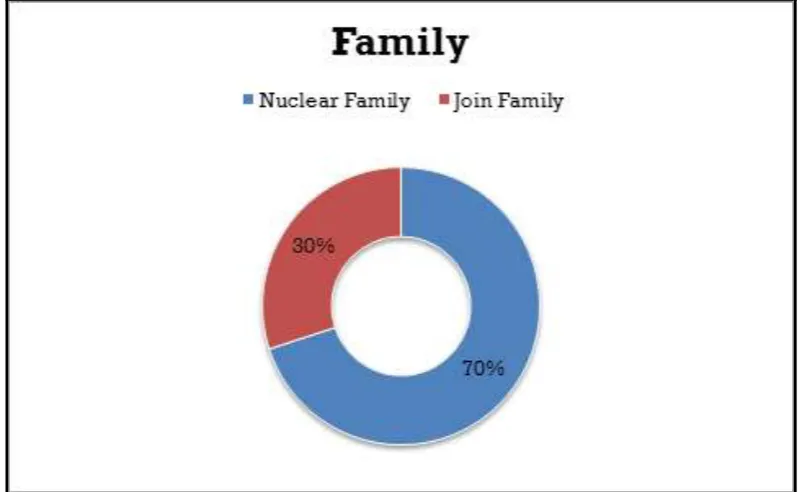
Type of family of the study group reveals that 30% of them are in joint family and 70% of them are in nuclear family.
Monthly income of study group reveal that 48% of homemakers were in Rs.1000-10000 income, 49% were Rs.10000-20000 income and 3% of homemakers were >Rs.20000.
Religion most of the study group (ie). 61% of them were Hindus,37% were Christian and 2% of them were other type of religion
33
Fig – 4.1: Age wise distribution of study participants
[image:48.595.119.483.381.701.2]34
Fig- 4.3:Types of family wise distribution of study participants
[image:49.595.94.503.387.630.2]35
Fig-4.5Religion wise distribution of study participants
[image:50.595.97.498.392.644.2]36
Section -B- Pretest knowledge among homemakers regarding ill
effects of plastics usage
Table-4.2: Domain wise percentage of pretest knowledge score on ill effects of plastic usage among homemakers
Knowledge On Ill effects of plastic usage
No. of questions
Min-Max score
Pretest score Mean
score SD % General aspects
onill effects of plastic usage
Plastic 4 0-4 1.9 0.7 47.5% Plastic types 2 0-2 0.6 0.4 30%
Other ill effects of plastic usage
Environment 5 0-5 2.1 0.8 42% Animals 2 0-2 0.6 0.5 30% Human 5 0-5 2.2 1.1 44% Measures
forReduction of plastics
2 0-2 1.0 0.5 50%
Total 20 0-20 8.5 4.0 42..5%
37
Table-4.3: Pretest Level of KnowledgeKnowledge Level No of homemakers %
Inadequate (0 - 9) 70 70.0%
Moderate(10-14) 30 30.0%
Adequate (15-20) 0 0
Total 100 100%
[image:52.595.88.506.353.594.2]Table 4.3 shows the pretest knowledge about the ill effects of plastics usage among the homemakers.In pretest 70% of the homemakers are having low level of knowledge and 30 % of them are having moderate knowledge and 0% of them having adequate knowledge.
38
Table 4.4: Score InterpretationKnowledge Level Percentage
Inadequate (0 - 9) <50%
Moderate(10 - 14) 51-75%
Adequate(120 - 9) 76- 100
This table shows the score interpretation used to assess the level of knowledge among the homemakers who were participating in the study.
[image:53.595.84.514.366.618.2]Section –C: Post test level of knowledge among homemakers
regarding ill effects of plastics usage.
Table-4.5: Domain wise percentage of posttest knowledge score
Knowledge On Ill effects of plastic usage No. of questions Min-Max score Posttest score Mean
score SD % General aspects
onill effects of plastic usage
Plastic 4 0-4 3.8 0.5 95% Plastic types 2 0-2 1.8 0.5 90% Other ill effects
of plastic usage
Environment 5 0-5 4.3 0.7 86% Animals 2 0-2 1.6 0.5 80% Human 5 0-5 4.6 0.6 92% Measures
forReduction of plastics
2 0-2 2.0 0.2 100%
Total 20 0-20 18.1 3.0 90.5%
39
Table-4.6: Posttest Level of KnowledgeKnowledge Level No %
Inadequate (0 - 9) O 0.0%
Moderate(10-14) 2 2.0%
Adequate (15-20) 98 98.0%
Total 100 100%
[image:54.595.118.483.355.609.2]Table 4.6 shows the post test knowledge about the ill effects of plastics usage among homemakers.In posttest none of the homemakers are having inadequate knowledge ,2% of them are having moderate knowledge and 98% of them are having adequate knowledge.
40
[image:55.595.84.519.141.523.2]Section – D: Comparison of pretest and posttest level of
knowledge
Table-4.7: Comparison of pretest and posttest mean knowledge Score
Knowledge On
Ill effects of plastic usage Pretest Score (N=100) Posttest Score (N=100) Student paired t-test Mean S.D Mean S.D
General aspects onill effects of plastic usage
Plastic
1.9 0.7 3.8 0.5 t = 9.35 P=0.001*** Plastic types
0.6 0.4 1.8 0.5 t = 13.56 P=0.001*** Other ill
effects of plastic usage
Environment
2.1 0.8 4.3 0.7 t = 9.56 P=0.001*** Animals
0.6 0.5 1.6 0.5 t = 14.15 P=0.001*** Human
2.2 1.1 4.6 0.6 t = 13.40 P =0.001*** Measures
forReduction of plastics
1.0 0.5 2.0 0.2 t = 8.34 P =0.001***
*significant at P≤0.05 **highly significant at P≤0.01 ***very high significant at P≤0.001
Table 4.7 compares pretest and posttest mean knowledge score
41
In pretest homemakers had 0.6 score where as in posttest they had 1.8 score regarding plastic types ,so the mean difference is 1.2 . There is a statistical significant difference between pretest and posttest
In pretest homemakers had 2.1score ,where as in posttest they had 4.3 score regarding ill effects of plastic on environment ,so the mean difference is 2.2. There is a statistical significant difference between pretest and posttest.
In pretest homemakers had 0.6 score, where as in posttest they had 1,6 score ,so the mean difference is 1.0 regarding. ill effects of plastic on animals.There is a statistical significant difference between pretest and posttest.
In pretest homemakers had 2.2 score ,where as in posttest they had 4.6 score ,so the mean difference is 2.4 reagrding ill effects of plastic on human. There is a statistical significant difference between pretest and posttest
42
43
Table-4.8 : Comparison of overall knowledge score
Maximum Score
Mean knowledge
score
Mean difference in knowledge
with 95% confidence
interval
Percentage of Knowledge gain
with 95% confidence
interval
Pretest 20 8.5
9.4 (8.89 -10.24)
48% (44.2 – 50.01) Posttest 20 18.1
TABLE 4.8 Comparison of overall knowledge gain Score between pretest and posttest.
44
[image:59.595.89.512.137.273.2]Section- E - Effectiveness of Video assisted teaching
Table-4.9 : Effectiveness of Video Assisted TeachingPre Test Score
Post Test Score
Increase (Post – Pre
Score)
Students paired t-
test
No‟s 100 100 100
*** 48.5 P=0.001
Mean 8.7 18.1 9.4
SD 2.1 1.6 1.9
Table 4.9 shows effectiveness of video assisted teaching between pretest and posttest knowledge .
Overall, In pretest homemakers had 8.7 mean score and in post test homemakers had 18.1 mean score . The difference is 9.4 score .Ther is a stastical significant difference between pretest and posttest . Difference between pretest and posttest score was analyzed using paired t-test.
45
[image:60.595.86.509.376.617.2]Fig-4.10:Effectiveness of video assissted teaching Table 4.10 Pretest and posttest percentage of knowledge gain
Domain Pretest
Knowledge
Posttest Knowledge
Percentage of Knowledge
Gain
Plastic 47.5% 95% 47.5%
Plastic Types 30% 90% 60%
Environment 42% 86% 44%
Animals 30% 80% 50%
Human 44% 92% 48%
Reduction of plastics 64% 100% 35%
Total 42.5% 90.5% 48%
Table 4.10 shows each domain Pretest and posttest percentage of knowledge gain
46
47
Section – E: Association of post test knowledge with selected
demographic variable
Table-4.11: Association Between Posttest Knowledge Level and Demographic Variable
Demographic variable
Post test knowledge
Total χ2 Df
Significant Moderate High
n:2 % n:98 % No % Age 20-30 yrs
31-40 yrs 41- 50 yrs
- - 2 - - 12.5 41 43 14 100.0 97.0 87.5 41 43 16 100 100 100
10.7 2 P=0.05*
Educational Status No formal education 1-12th std Degree 2 - - 10.0 - - 18 55 25 90.0 100.0 100.0 20 55 25 100 100 100
8.2 2 P=0.05*
Family Nuclear Family Joint Family 1 1 1.4 3.3 69 29 98.6 96.7 70 30 100
100 0.4 1
P = 0.50 Family
Income Per Month
1000 – 10000 10000 – 20000 >20000 - 2 - - 4.1 - 48 47 3 100.0 95.9 100.0 48 49 3 100 100 100
2.1 2
P = 0.68
Religion Hindu Christian Muslim 1 1 - 1.6 2.7 - 60 36 3 98.4 97.3 100.0 61 37 2 100 100 100
0.2 2
P = 0.40
Method of waste disposal Open land Burning Dustbin 1 - 1 4.3 - 1.5 22 10 66 95.7 100.0 98.5 23 10 67 100 100 100
0.9 2
P = 0.54
*significant at P≤0.05 **highly significant at P≤0.01 ***very high significant at P≤0.001
48
1. Association between level of knowledge and homemakers age,it reveals that none of them had inadequate knowledge and moderate knowledge and 100% had adequate knowledge among the age group between 21-30 years.About none of them had inadequate knowledge,3.0 %had moderate knowledge and 97% had adequate knowledge among the age group 31-40 years.And none of them had inadequate knowledge,12.5% had moderate knowledge and 87.5 % had adequate knowledge among the age group 41-50 years
2. Association between the level of knowledge and homemakers education With respect to educational status none of them had inadequate knowledge ,10% had moderate knowledge and 90% had adequate knowledge among no formal education. About none of them had inadequate knowledge, and moderate knowledge and 100% had adequate knowledge among 1-1-12th std.And none of them had inadequate knowledge and moderate knowledge and 100 % had adequate knowledge among Graduate. Chi aquare value is 8.2 .
3.With respect to Family type none of them had inadequate knowledge and 1.4% moderate knowledge and about 98.6% had adequate knowledge among the Nuclear family .About none of them had inadequate knowledge,3.3% had moderate knowled ge and 96.7% had adequate knowledge among Joint family. Chi aquare value is 0.4.
49
5.With respect to Religion none of them had inadequate knowledge and 1.6% moderate knowledge and about 98.4 % had adequate knowledge among Hindu .About none of them had inadequate knowledge,2.7% had moderate knowledge and 97.3% h ad adequate knowledge among chirstian. And none of them had inadequate knowledge and moderate knowledge and 100 % had adequate knowledge among Muslim. Chi aquare value is 0.1.
6.With respect to Method of waste disposal none of them had inadequate knowledge and4.3% moderate knowledge and about 95.7% had adequate knowledge among openland method .About none of them had inadequate knowledgeand moderate knowledge and 95.9% had adequate knowledge among family income of Rs 1000-10000. And none of them had inadequate knowledge and moderate knowledge and 100 % had adequate knowledge among>20000. Chi aquare value is 0.9.
50
Fig-4.12:Association between level of knowledge and homemakers age
[image:65.595.92.505.402.674.2]51
CHAPTER V
SUMMARY
5. Summary of the study results
This chapter deals with the summary of the study. The study was conducted to ascertain the effectiveness of video assist ed teaching about the ill effects of plastics usage among the homemakers residing in selected urban area at K.P.Park. in Chennai.
5.1. Based in demographic data findings
43% of homemakers were in the age group 31 -40 years.
Majority of homemakers (55%) had education upto 1-12thstd.
Maximum homemakers (70%) were at nuclear family .
Maximum homemakers (49%) were at Rs 10000-20000 income
Regarding religion most of the study group (ie). 61% of them were Hindus.
Majority of method of waste disposal of the study group illustrates that 67% were in disposing in open land.
5.2. Based on knowledge score on homemakers before and after
Video assisted teaching
In assessing the pre-test level of knowledge 70.0% of the homemakers had inadequate knowledge, 30.0% of them had moderate knowledge and 0% of them had adequate knowledge.
52
On an average, After VAT, homemakers are gained 48% of the knowle