University of Southern Queensland
Faculty of Engineering and Surveying
Application of an Urban Runoff Model
Using Surface Specific Parameters
A dissertation submitted by
Kieren Peter Davis
In fulfilment of the requirements of
Courses ENG4111 and ENG 4112 Research Project
towards the degree of
Bachelor of Engineering (Environmental)
University of Southern Queensland
Faculty of Engineering and Surveying
ENG4111 Research Project Part 1 &
ENG4112 Research Project Part 2
Limitations of Use
The Council of the University of Southern Queensland, its Faculty of Engineering and Surveying, and the staff of the University of Southern Queensland, do not accept any responsibility for the truth, accuracy or completeness of material contained within or associated with this dissertation.
Persons using all or any part of this material do so at their own risk, and not at the risk of the Council of the University of Southern Queensland, its Faculty of Engineering and Surveying or the staff of the University of Southern Queensland.
This dissertation reports an educational exercise and has no purpose or validity beyond this exercise. The sole purpose of the course "Project and Dissertation" is to contribute to the overall education within the student’s chosen degree programme. This document, the associated hardware, software, drawings, and other material set out in the associated appendices should not be used for any other purpose: if they are so used, it is entirely at the risk of the user.
Professor Frank Bullen
Dean
iii
ABSTRACT
Catchment urbanisation has led to a dramatic decline waterway health. The high
percentage of impervious surfaces prevalent in urban areas can affect the ecological,
economic and social function of our creeks, rivers and bays. Current engineering
practice aims to limit this decline using the principles of water sensitive urban design
(WSUD). An essential component of this design process is the estimation of stormwater
pollutant loads based on catchment characteristics. Current practice involves the
estimation of pollutant loads based on land use type. As WSUD seeks to emphasise ‘at
source’ controls there is a need to estimate for finer scale catchments. It is anticipated
that the use of surface type rather than land use type to determine catchment pollutant
loads will prove more accurate at a finer scale. A mass balance model developed by
Brodie (2006) utilises surface type to determine pollutant loads.
This dissertation applies Brodie’s mass balance model to a small catchment in Brisbane,
QLD to determine the ability of the mass balance model to predict suspended solid
loads. This dissertation compares the measured and predicted event mean
concentrations of suspended solids over a number of storm events. The result was a
poor correlation between predicted and measured data sets due to large inaccuracies in
the measured rainfall and use of previously calibrated particle accumulation and
washoff parameters not specific to the catchment. A major outcome involves providing
comments on the further application of the mass balance model and conducting an error
analysis to determine highly sensitive model parameters. The outcome is applicable to
Certification
I certify that the ideas, designs and experimental work, results, analyses and
conclusions set out in this dissertation are entirely my own effort, except where
otherwise indicated and acknowledged
I further certify that the work is original and has not been previously submitted for
assessment in any other course or institution, except where specifically stated
Kieren Peter Davis
Student Number: Q1222280
Signature
iv
TABLE OF CONTENTS
DISCLAIMER i
ABSTRACT ii
CERTIFICATION iii
TABLE OF CONTENTS iv
LISTOF FIGURES vii
LIST OF TABLES ix
LIST OF ABBREVIATIONS x
CHAPTER 1 1
INDRODUCTION 2
1.1 PROJECT OUTLINE AND OBJECTIVES 3
CHAPTER 2 6
BACKGROUND 7
2.1 CLIMATE AND GEOGRAPHY OF BALD HILLS 7
2.2 HOYLAND STREET CATCHMENT 11
2.2.1 Bioretention System 11
2.2.2 Catchment characteristics 14
2.2.3 Monitoring Data 15
2.2.4 Rainfall Data 17
CHAPTER 3 19
LITERATURE REVIEW 20
3.1 IMPERVIOUS AND PERVIOUS AREAS 20
3.2 URBAN DRAINAGE SYSTEMS 21
3.3 SUSPENDED SOLIDS 24
3.4 SUSPENDED SOLIDS AND URBAN AREAS 26
3.5 URBAN STORMWATER DRAINAGE MODELS 30
CHAPTER 4 35
DATA COLLECTION AND ANALYSIS 36
4.1 DRAINAGE SYSTEM 36
4.2 CATCHMENT CHARACTERISTICS 39
4.3 RAINFALL DATA 42
4.3.1 Storm 1 45
4.3.2 Storm 2 46
4.3.3 Storm 3 46
4.3.4 Storm 4 47
4.3.5 Storm 5 47
4.3.6 Storm 6 48
4.3.8 Storm 8 48
4.3.9 Storm 9 49
4.3.10 Storm 10 49
4.3.11 Storm 11 49
4.4 MOINTORED TSS DATA 50
CHAPTER 5 53
MODEL CALIBRATION AND APPLICATION 54
5.1 DRAINS MODEL 54
5.1.1 Model Structure 54
5.1.2 Sensitivity Analysis 54
5.1.3 Calibration and Testing 60
5.1.4 Modelled Runoff and Pollutant Loads 62
5.2 MASS BALANCE MODEL 63
5.2.1 Model Application 63
5.2.2 Modelled Event Mean Concentration and Runoff 66
5.2.3 Error Analysis 71
CHAPTER 6 74
DISCUSSION 75
6.1 DISCUSSION 75
6.2 FURTHER APPLICATION OF THE MASS BALANCE MODEL 77
CHAPTER 7 80
CONCLUSION AND RECOMMENDATIONS 81
6.1 CONCLUSION 81
6.2 RECOMMENDATIONS 82
CHAPTER 8 84
BIBLIOGRAPHY 85
APPENDICES
A PROJECT SPECIFICATION
B RAINFALL RUNOFF ANALYSIS GRAPHS
C HOYLAND STREET CONNECTION DRAWINGS
D AMMEDED DRAINAGE INFRASTRUCTURE
E HOYLAND STREET SUBCATCHMENTS
F DRAINS PIPE AND CATCHMENT OUTPUT
G DRAINS MODEL
H DRAINS SURFACES
I SENSITIVITY ANALYSIS SUMMARY
vi
K HYETOGRAPHS FFOR RAINFALL EVENTS USED TO TEST MASS
BALANCE MODEL
L MASS BALANCE MODEL SPREADSHEET OUTPUT
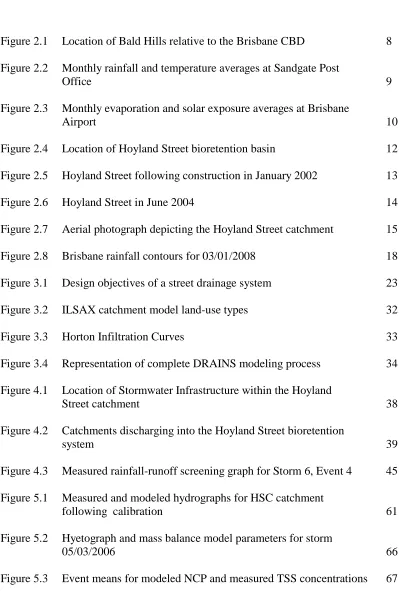
LIST OF FIGURES
[image:8.595.87.486.132.729.2]Figure 2.1 Location of Bald Hills relative to the Brisbane CBD 8
Figure 2.2 Monthly rainfall and temperature averages at Sandgate Post
Office 9
Figure 2.3 Monthly evaporation and solar exposure averages at Brisbane
Airport 10
Figure 2.4 Location of Hoyland Street bioretention basin 12
Figure 2.5 Hoyland Street following construction in January 2002 13
Figure 2.6 Hoyland Street in June 2004 14
Figure 2.7 Aerial photograph depicting the Hoyland Street catchment 15
Figure 2.8 Brisbane rainfall contours for 03/01/2008 18
Figure 3.1 Design objectives of a street drainage system 23
Figure 3.2 ILSAX catchment model land-use types 32
Figure 3.3 Horton Infiltration Curves 33
Figure 3.4 Representation of complete DRAINS modeling process 34
Figure 4.1 Location of Stormwater Infrastructure within the Hoyland
Street catchment 38
Figure 4.2 Catchments discharging into the Hoyland Street bioretention
system 39
Figure 4.3 Measured rainfall-runoff screening graph for Storm 6, Event 4 45
Figure 5.1 Measured and modeled hydrographs for HSC catchment
following calibration 61
Figure 5.2 Hyetograph and mass balance model parameters for storm
05/03/2006 66
viii
Figure 5.4 Event means for runoff produced by the mass balance model and
the DRAINS model 68
Figure 5.5 Event means for modeled NCP and measured/modeled TSS loads 69
LIST OF TABLES
Table 4.1 Hoyland Street catchment hydrological characteristics 41
Table 4.2 Pluviometers within 7km of the bioretention system 43
Table 4.3 Hoyland Street bioretention system sampling locations and
Characteristics 50
Table 4.4 Hoyland Street TSS inflow Concentrations 51
Table 4.5 Monitored rainfall event and TSS event mean concentration 52
Table 5.1 DRAINS parameters for catchment HSC 56
Table 5.2 Measured TSS concentrations combined with modeled runoff
to calculate TSS load 63
Table 5.3 Surface characteristics of the Hoyland Street catchment for
x
ABBREVIATIONS
ABBREVIATION MEANING
WSUD Water Sensitive Urban Design
SQID Stormwater Quality Improvement Devices
NCP Non-Coarse Particles
TSS Total Suspended Solids
BCC Brisbane City Council
Brisbane CBD Brisbane Central Business District
BOM Bureau of Meteorology
ENSO EL Nino-Southern Oscillation
SOI Southern Oscillation Index
HSA Hoyland Street A inlet
HSB Hoyland Street B inlet
HSC Hoyland Street C inlet
HSL Hoyland Street Level Sensor
HSO Hoyland Street Outlet
HSOa Hoyland Street Outlet a
HSOb Hoyland Street Outlet b
VSS Volatile Suspended Solids
TP Total Phosphorous
TN Total Nitrogen
DCIA Directly Connected Impervious Area
ICIA Indirectly Connected Impervious Area
US United States
USGS Unites States Geological Survey
SSC Suspended Sediment Concentration
RDI Rainfall Detachment Index
ADP Antecedent Dry Period
SRM Statistical Rational Method
AMC Antecedent Moisture Condition
USQ University of Southern Queensland
RCP Reinforced Concrete Pipe
1
CHAPTER 1
1.0 INTRODUCTION
“We’re all downstream”
Margaret and Jim Drescher, Nova Scotia
Extensive catchment urbanisation has led to a dramatic change in the natural
hydrology and ecology of many urban catchments. The high percentage of
impervious area prevalent in major cities and towns has produced an increase in
runoff volumes and a decrease in stormwater quality. The end result is a modification
of stream flow processes causing erosion and habitat degradation. It is now widely
accepted that a notable relationship exists between stream degradation and
impervious area.
The effects of catchment urbanisation on stormwater discharge has gained
considerable awareness within the community over the past 20 years, resulting in a
shift in traditional engineering approach and application to stormwater. Local
governments have been placing increasing emphasis on the treatment of urban
stormwater through stormwater quality improvement devices (SQIDs). More
recently, the focus has moved from the broad scale application of end-of-pipe
solutions to source controls such as stormwater retention and infiltration
(O’Loughlin, 2007). This reflects the emergence of water sensitive urban design
(WSUD), which seeks to combine all elements of the water cycle.
An essential aspect of stormwater management practice involves estimating
stormwater pollutant loads based on catchment characteristics. Current engineering
practice is to estimate stormwater pollutant loads from urban catchments based on
land use parameters. These land use parameters are often divided based on the zoning
3
reasonably accurate for larger catchments, however for smaller catchments it has
been considered that stormwater loads determined from a specific land surface (eg.
roofs, gassed areas) are more effective. As current practice seeks to emphasise “at
source” controls, the need for accurate information on smaller catchments is
increasing. This necessitates a need for accurate modelling of these smaller
catchments to assist in design and planning.
A recent University of Southern Queensland research project (Brodie, 2006) has
developed a simple empirically based model to estimate suspended solid loads in
stormwater runoff from various urban surfaces. Non-coarse Particles (NCP) as
opposed to Total Suspended Solids (TSS) were used to measure the suspended solids
in the analysis. Data for the model was obtained utilising runoff samples from 40
storm events from December 2004 to January 2006 within the inner city of
Toowoomba, Australia. Runoff samples were obtained using an innovative flow
splitting device for 5 surface types; galvanised roof, grass, bare soil, commercial
carpark and road. According to Brodie, the model was able to provide reasonable
estimates (R2 = 0.74 to 0.97) when compared to the measured loads. The model also
performed well in comparison to three models used in current engineering practice;
the Arithmetic Mean, Logarithmic Mean and Stochastic EMC methods.
1.1 Project Outline and Objectives
The purpose of this dissertation is to assess the effectiveness of Brodie’s mass
balance model in predicting the stormwater loads of total suspended solids from
a small urban catchment. This catchment is located at Hoyland Street in Northern
Brisbane, Australia and drains into a bioretention basin before discharging into
part of the WSUD monitoring program instituted by Brisbane City Council
(BCC).
The catchment is significantly different in terms of climatic conditions and
surface characteristics to the catchments sampled by Brodie. It is expected that
significant variation in predicted and measured suspended solids will be evident
over a number of storm events. The effectiveness of the mass balance model will
be determined by direct comparison with the measured and modelled data,
following the application of modelled runoff and measured rainfall data. The
comparison will also focus on determining the extent of any relationship between
the accuracy of the model and any rainfall event or catchment characteristics.
This will aid in determining any major contributing factor to either the accuracy
or inaccuracy of the modelled data.
Due to the nature and design of the bioretention system and monitoring
arrangement, large inconsistencies in the recorded inflow data are evident.
During rainfall events ponding within the system can cause backflow effects.
This effectively slows the flow rate and thus causes a delay in the measured
runoff hydrograph. In larger events negative inflows have been recorded due to
the water level within the system being at a higher elevation than the monitoring
equipment. This phenomenon has been investigated by Deletic and Fletcher
(2006) and it was confirmed that backwater effects do occur at two of the three
monitored inlet pipes. Despite the inconsistencies in discharge data, event
specific suspended solid concentrations are available for the bioretention system
and are consistent with expected results.
It was initially considered that the results of the mass balance model could be
5
possible and it has been necessary to model the sub-catchment event discharge in
order to apply it to both the measured data and the mass balance model to
determine event suspended solids loads. The sub-catchment discharges were
modelled using DRAINS hydrologic and hydraulic modelling software. The total
event discharge was then compared to the measured discharge for storms where
no backwater effects occurred in order to calibrate the model and aid in selecting
appropriate input variables.
The outline of this study is to achieve the following broad aims:
1. Conduct a literature review on the prediction of stormwater pollutant
loads using urban surface characteristics, restricted to suspended solids.
2. Determine the physical characteristics of the catchment.
3. Gather rainfall, runoff and suspended solids data for the Hoyland Street
catchment and select appropriate rainfall events.
4. Develop and calibrate DRAINS model.
5. Test mass balance model.
6. Compare and verify model results with measured suspended solid loads.
7. Write and submit a dissertation on the application and effectiveness of the
CHAPTER 2
7
2.0 BACKGROUND
2.1 Climate and Geography of Bald Hills
The city of Brisbane is located in the south-east corner of Queensland, on the
Brisbane River adjacent to a large shallow bay known as Moreton Bay. Bald
Hills is the northernmost suburb in Brisbane (Figure 2.1) and shares its northern
and western borders with the Moreton Bay Regional Council. Largely a
residential suburb, Bald Hills has undergone significant development within the
last 30 years with many rural allotments being subdivided and gradually taken
over as a low-density residential area.
Bald Hills is situated at the confluence of the South and North Pine Rivers which
subsequently flow into Moreton Bay. As a result the suburb drains into the South
Pine River to it’s west and Bald Hills Creek to it’s east. Bald Hills Creek
discharges into the environmentally sensitive Tinchi Tamba Wetlands Reserve
Figure 2.1 Location of Bald Hills Relative to the Brisbane CBD (Source: Brisbane City Council)
Brisbane experiences a subtropical climate with four distinct yet temperate
seasons. Average temperatures range from 9.5°C to 20.9°C in the winter, and
20.6°C to 29.1°C in the summer (BOM, 2000), with maximum and minimum
recorded temperatures of 39.6°C and 0.6°C respectively. Cool, clear nights are
prevalent in the winter months while cloud cover is nearly twice as common in
summer. Rainfall is also much greater in the summer months as is the prevalence
of high intensity storms with a short duration.
Bald Hills has a typical Brisbane Climate. Figure 2.2 below displays the rainfall
and temperature patterns at Sandgate Post Office, approximately 5.5 km east of
Bald Hills. It can be seen that rainfall within the catchment is subject to a high
9
0 100 200 300
J
a
n
u
a
ry
F
e
b
ru
a
ry
M
a
rc
h
A
p
ri
l
M
a
y
J
u
n
e
J
u
ly
A
u
g
u
s
t
S
e
p
te
m
b
e
r
O
c
to
b
e
r
N
o
v
e
m
b
e
r
D
e
c
e
m
b
e
r
Month
R
a
in
fa
ll
(m
m
)
0 5 10 15 20 25 30
T
e
m
p
e
ra
tu
re
(
°C
)
Average Rainfall Average Maximum Temp Average Minimum Temp
Figure 2.2 Monthly Rainfall and Temperature Averages at Sandgate Post Office (Bureau of
Meteorology)
As well as the increased summer rainfall, evaporation is dramatically increased
in the summer months, particularly from October to March. As seen in Figure
2.3, this is largely dependant on an associated increase in solar energy associated
with seasonal variation leading to increased summer temperatures. Increased
wind speeds in the warmer months create an additional transport mechanism
[image:21.595.160.484.136.344.2]0 10 20 30 40 50 J a n u a ry F e b ru a ry M a rc h A p ri l M a y J u n e J u ly A u g u s t S e p te m b e r O c to b e r N o v e m b e r D e c e m b e r Month M e a n D a il y S o la r E x p o s u re ( M J /m ^ 2 ) 0 2 4 6 8 10 M e a n D a il y E v a p o ra ti o n ( m m )
Mean Daily Solar Exposure Evaporation
Figure 2.3 Monthly Evaporation and Solar Exposure Averages at Brisbane Airport (Bureau of
Meteorology)
Distinct inter-annual rainfall variation occurs along the East Coast of Australia as
a result of a phenomenon known as El Nino-Southern Oscillation (ENSO). This
phenomenon is influenced by ocean temperature, ocean currents as well as the
atmospheric pressure over Darwin and Tahiti. The result of an ENSO event is a
large decrease in annual rainfall, which can follow a two to seven year cycle,
however is extremely variable.
For Brisbane, including Bald Hills, this event results in dry winters, occasionally
with no rain at all for the entire winter months. A prolonged El Nino event has
recently occurred for the past five to six years resulting in a prolonged drought.
Trends in the Southern Oscillation Index (SOI) indicate that this event ended in
late 2007, however accurate predictions of this poorly understood phenomenon
[image:22.595.179.476.122.331.2]11
2.2
Hoyland Street Catchment
As previously explained, a bioretention system is located at Hoyland Street, Bald
Hills and has been monitored as part of a WSUD monitoring program by the
Brisbane City Council. The catchment area draining into this system is
approximately 1.8ha and is located 20km North of the Brisbane CBD within the
wider Bald Hills Creek catchment (BCC, 2006). Three sub-catchments drain into
the system through separate inlets at the upstream end of the bioretention system.
2.2.1 Bioretention System
The Hoyland Street bioretention system is located at the intersection of Hoyland
and Parer Streets, an Arterial Route connecting the Gympie Arterial Road with
the Gateway Motorway (Figure 2.4). The system was constructed in late 2001 as
a demonstration project for Water Sensitive Urban Design (WSUD) during a
major road upgrade with a view to monitor the site for pollutant removal
Figure 2.4 Location of Hoyland Street Bioretention Basin
A bioretention system is a vegetated area where runoff is filtered through a filter
media layer as it percolates through the ground (2006, Healthy Waterways).
Perforated under-drains collect the filtered stormwater before discharging into
the receiving environment. Essentially runoff is treated by mechanical filtration
as it passes through the filter media and dense vegetation, and also by adsorption
onto the filter media as well as biological uptake by the vegetation. Bioretention
basins also limit peak discharge downstream by providing significant flow
attenuation.
The three sub-catchments previously described, drain into separate pipes, which
in turn flow into the bioretention system. Figure 2.5 illustrates this, and clearly
shows the three inlet pipes, known as HSA, HSB and HSC respectively. A row
of six 150 mm slotted PVC agricultural pipes at three metre centres convey the
[image:24.595.147.496.116.352.2]13
maintenance pipe is also located within the basin to enable cleaning of the slotted
PVC pipes.
Figure 2.5 Hoyland Street following construction in January 2002 (BCC, 2006)
In addition to the perforated under-drains, a high flow bypass pit with two 675
mm outlet pipes known as HSO1 and HSO2 drain any surface water that has not
infiltrated through the soil into nearby Bald Hills Creek. The pit is set 0.5 m
higher than the surrounding basin allowing considerable extended detention. This
configuration allows the basin to act as a fully on-line system, conveying runoff
from major rainfall events directly through the basin before exiting the system
through the high-flow bypass.
Planted vegetation within the system was confined to a single tree species and
two ground cover species. Melaleuca quinquenervia (Broad-leaved paperbark)
and Lomandra longifolia (Spiny-headed mat-rush) were planted within the basin
[image:25.595.165.482.177.385.2]densities on the batters. Figure 2.6 shows the extent of vegetative cover just two
years after installation.
Figure 2.6 Hoyland Street in June 2004 (BCC, 2006)
2.2.2 Catchment Characteristics
The total catchment boundary of the bioretention system is detailed in Figure 2.7.
It can be seen that the vast majority of the catchment is formed by Hoyland Street
itself. Fractions of eight allotments between 500 and 800 m2 also drain into the
bioretention system as does a portion of steep grassed embankment in the upper
part of the catchment and a significant portion of grassed area. Some of this
grassed area drains directly into the bioretention system by overland sheet flow;
however the rest of the catchment is directly connected to the bioretention by
stormwater infrastructure. The bioretention basin itself comprises around 4% of
[image:26.595.188.457.179.359.2]15
Figure 2.7 Aerial photograph depicting the Hoyland Street catchment
The upper road catchment connecting to the Gympie Road overpass is a
moderately steep ramp of around 6%. This grade gradually lessens approaching
the bioretention system to just over 1%. The short distance to gully pits,
moderate ramp grade and distinct lack of any overland flow path indicate a
relatively short time of concentration for the catchment.
This coupled with the high percentage of directly connected impervious area
result in inflows to the bioretention system during even small rainfall events.
2.2.3 Monitoring Data
Water quality data has been monitored at the Hoyland Street bioretention
system since 2002 as part of Brisbane City Council’s WSUD monitoring
program in order to test the pollutant removal efficiency of the system. Recent
and reduces the mean TSS concentrations by 71% ranging from 32% to 88%
(BCC, 2007). According to City Design (2006) samples were tested for a
range of pollutants including:
Total suspended solids (TSS),
Volatile suspended solids (VSS),
Total phosphorous (TP),
Total nitrogen (TN),
Ammonia,
NOx,
Ortho-P, and
Heavy metals (zinc, lead, nickel, cadmium, chromium, copper).
Analysis of nutrient species (Ortho-P, NOx and Ammonia) was only conducted
for five events between 2003 and 2006, however all other parameters were
consistently tested. Testing of nutrient species required immediate chilling prior
to sample collection, which could not be established in all cases.
Flow volumes were also measured at each of the three inlet pipes and outlet pipe
using flow meters. In addition, a water level sensor (HSL) was located within the
system close to the outlet to measure the ponded level during events. This
provided an indication as to when the infiltration capacity of the soil was
exceeded and subsequently when the maximum ponded level was exceeded and
runoff was exiting the system via the high flow bypass pit.
As previously discussed, several deficiencies exist with the monitoring data at
Hoyland Street. More specifically, errors associated with the measurement of
inflow and outflow discharge as well as level and velocity. This phenomenon
17
establish pollutant loads for the majority of runoff events. These problems
include:
Outlet flow volume occasionally greater than inlet flow volume,
The backing up of water in the inlet pipes causing inaccurate and
sometimes negative flows to be recorded,
The assumption that equal flow occurs in both outlet pipes was found
to be false,
High tailwater levels from Bald Hills Creek causing inaccuracies in the
outflow measurements.
Deletic and Fletcher (2006) assessed the existing monitoring configuration as
well as available data and recommended the calculation of pollutant loads
using a catchment weighting. A major conclusion of this assessment was that
the inflow and outflow data could not be reliably used to estimate pollutant
loads entering or being discharged from the system. As a result, the
calculation of loads using the catchment area as a weighted average was
recommended.
2.2.4 Rainfall Data
Information on rainfall events within the BCC local government area is available
for a large number of locations due to a widespread network of pluviometers and
stream height gauges. With respect to the bioretention system, rainfall data is
available from 6 pluviometers, all within 7km of the system. These pluviometers
are tipping buckets with a 1mm resolution. This means that once 1mm of rain has
been recorded the bucket tips and the interval between tips is recorded.
Unfortunately, the closest rainfall gauge (BDR712) has not collected data for the
In addition to direct rainfall data, Rainfall contour maps are available for
individual events of a specified duration. These contour maps provide an
indication as to the spatial variation in rainfall during events by interpolating the
rainfall at points between the rainfall gauges. Figure 2.8 below displays an
example of this for a rainfall event on the 03/01/2008. These maps can prove an
indispensable tool in selecting rainfall events that do not exhibit a large spatial
variation between the rainfall gauge and the monitoring site.
[image:30.595.199.460.277.549.2]19
CHAPTER 3
3.0 LITERATURE REVIEW
3.1
Impervious and Pervious Areas
Urban catchments comprise of two distinct, hydrologically important areas that
contribute to stormwater runoff through different mechanisms; impervious and
pervious areas. Pervious areas allow infiltration and usually provide a greater
degree of initial storage of runoff while impervious areas do not allow infiltration
and usually have a small initial storage. As a result, impervious areas such as
roads and roofs contribute runoff quicker and at a higher rate, whereas pervious
areas such as parks and lawns require higher intensity or more prolonged rainfall
to contribute similar amounts of runoff. (Boyd et al., 1993).
The connected nature of impervious area is of vital importance when describing
rainfall, runoff and pollutant relationships. Directly connected impervious area
(DCIA) refers to impervious areas with a dedicated connection to the drainage
system such as roof runoff when conveyed directly to the street or underground
drainage systems. Conversely, indirectly connected impervious area (ICIA)
refers to impervious area not directly connected to the drainage system and either
stored (such as with a rainwater tank) or conveyed to an additional pervious area.
Impervious and pervious areas also differ in their contribution of pollutants to
receiving environments following rainfall events. The processes of accumulation
and wash-off occur more frequently and easily from impervious areas.
Automobiles also regularly frequent impervious areas such as roads, and
21
pollutants. By contrast, pervious areas generally infiltrate a large portion of the
total rainfall, removing pollutants in the process. This phenomenon is particularly
noticeable in small rainfall events, however it has been confirmed to still occur in
events up to 75 mm when comparing forested and developed catchments
(Christopher et al., 1997).
In addition to runoff quality, numerous studies have established a direct
relationship between the amount of impervious surface within a watershed and
pollution of its surface waters (Civco and Sleavinl, 2000). The degradation is
largely due to a combination of increased runoff volumes and decreased water
quality (Arnold and Gibbons, 1996). However, this change in catchment
hydrology can be combined with the clearing of riparian vegetation and the
straightening and formalising of drainage channels to result in severely degraded
receiving environments.
3.2
Urban Drainage Systems
Drainage systems in urban areas are primarily designed for the effective
conveyance of runoff into a receiving environment. Receiving environments vary
from dry gullies, overland flow paths, creeks, rivers, groundwater storages, lakes
and oceans. In addition to runoff conveyance, urban drainage systems can also be
designed to provide retention, treatment and/or reuse of stormwater and also
provide surcharge from sewerage systems. Components of an urban drainage
system typically comprise of:
• Property drainage,
• Street drainage,
• Trunk drainage,
• WSUD elements.
Individual allotments comprise of portions of pervious and impervious area both
of which are connected to the drainage system either directly or indirectly.
Pervious area generally consists of surfaces such as lawns, gardens, grassed road
reserve and parks. Impervious area includes roofs, driveways, tennis courts,
sheds, sealed roads and footpaths. Roofs usually comprise the largest impervious
area within individual allotments. Impervious area is either DCIA in the case of
roof guttering conveying runoff directly to the street, or ICIA in the case of
gutters connected to rainwater tanks or backyard ‘bubbler style’ outlets that
discharge onto the lawn.
Property drainage subsequently flows into a street drainage system where the
cumulative effect of the discharge from individual causes flows to be increased.
Streets are usually drained by a combination of gutters, inlet pits, manholes and
pipes, or using surface drainage through the use of swales and other WSUD
measures. The use and application of these drainage elements is closely linked to
the street and property design. Design of street drainage systems in Australia
generally requires the capture of small, regular rain events (1 to 5 year) within
the gutter and underground drainage system, and the conveyance of large,
23
Figure 3.1 Design objectives of a street drainage system (USQ, 2003)
Trunk drainage in the form of underground pipes, open channels or a
combination of both, convey the runoff from street drainage systems into the
receiving environment. As with street drainage, the cumulative effects of a
number of sub-areas contributing increases the size of the flowrates and thus the
drainage infrastructure required.
Detention systems, otherwise known as detention basins or retarding basins are
designed to store runoff volumes from a catchment for a pre-determined period
of time. Detention basins are not to be confused with retention basins which are
design to permanently hold water. These basins then release the runoff at a
controlled rate that acts to limit the peak runoff in the downstream drainage
system. The use of detention basins can be effective in areas where flooding
immunity is a problem and can limit the size of trunk drainage required
now widely regarded as an ineffective use of urban space, and additional
outcomes can be achieved while integrating community, open space, biodiversity
and water quality objectives using the design principles associated with WSUD.
WSUD elements are secondary design elements integrated into the four
components of urban drainage systems previously mentioned. The principles of
WSUD are most successfully applied at the property drainage level as the
cumulative effect of increased flowrates and pollutant loads further down the
drainage system limits the opportunity for its effective use. As a result,
applications of WSUD are typically divided into lot scale measures when
referring to property drainage and ‘end of pipe’ measures when referring to street
and trunk drainage (Healthy Waterways, 2006). WSUD elements generally
involve a combination of retention, detention, infiltration and reuse and can
include:
• Swales and buffer strips,
• Bioretention systems,
• Sediment basins,
• Wetlands,
• Infiltration measures,
• Storage and reuse.
3.3
Suspended Solids
Runoff from urban areas carries a wide variety of pollutants, including sediment,
nutrients, organic matter, bacteria, oil and grease, toxic substances and heavy
metals (NCDWQ, 2007). Suspended solids are small particulates present in water
that remain in suspension due to colloidal mixing or the motion of the liquid and
25
measurement. Some pollutants such as phosphorous and heavy metals readily
attach themselves to particulates, allowing suspended solids to act as a mobile
substrate for other pollutants. TSS is not a good indictor of highly soluble
pollutants from atmospheric sources such as nitrogen, which are of significant
importance in urban areas.
The use of suspended solid loads as an estimate of pollution has been
corroborated by numerous studies and has resulted in TSS being used as a
widespread indicator of stormwater quality (Sartor et al., 1974; IEAust, 2003).
However the ability of TSS to adequately measure suspended solid loads has
been questioned (de Ridder et al., 2002; Brodie, 2006). The United States
Geological Survey and the US Federal Highway Administration also mirror this
view and have issued a policy establishing the suspended sediment concentration
(SSC) as the preferred technique for runoff analysis (USGS, 2000).
This preference is largely due to the standardised nature of the SSC test and the
fact that it limits bias. The TSS method involves the extraction of a sample from
a container and subsequently passing the contents through a glass fibre filter that
retains the solids. The mass of the retained solids is then weighed and
extrapolated to the total volume to calculate the concentration. The SSC test
involves calculating the mass of the entire sample negating the need for
extrapolation (ASTM, 1999). This testing of the whole sample provides more
accurate results especially if larger particles and fine sands are present. The
presence of these particles can introduce bias if the TSS sub-sample is taken in
such a way that discounts these particles, commonly through insufficient mixing
times. This is particularly important if particle size distribution is an important
In order to determine pollutant loads, suspended solid concentrations obtained
through either method can be multiplied by runoff. The simplest method for
obtaining stormwater loads is through the use of the event mean concentration
(EMC). The event mean concentration is defined as the total mass discharged
divided by the total runoff volume for a defined event. This allows the mass
loading to be calculated using the measured concentrations and runoff volume for
individual storm events or on any defined time period.
3.4
Suspended Solids and Urban Areas
As with the majority of stormwater pollutants, suspended solid loads in receiving
environments result from the accumulation and removal of particles on
impervious surfaces such as streets, roofs and parking lots as well as localised
soil erosion on pervious areas. As a result, the relationship between stormwater
pollutants and urban areas is also applicable to suspended solid loads. Suspended
solid loads are often highly correlated with the activities undertaken on the
particular surface.
Suspended solids on urban surfaces undergo a cyclical process of accumulation
and removal that is dependant on a number of variables. The process kinetics of
accumulation and removal are often highly site specific and involve complex
relationships that can be difficult to model in a changing urban environment
(Ayoko, 2004). Simplified, accumulation generally occurs during periods of dry
weather, and these accumulated particles are removed in periods of wet weather.
Major sources of accumulation include atmospheric fallout, surface wear, soil
27
It has been corroborated by numerous studies that the process of accumulation is
not highly time dependent and occurs within a few days of wet weather (Vaze
and Chiew, 2002; Deletic and Maskismovic, 1998). Brodie (2006) also
discovered a ‘rapid post-storm recovery’ of particles on impervious surfaces and
considered that the build-up of free particles reaches an equilibrium that is
dependant on supply and removal process. These processes can include wind as
well as activities involving cleaning surfaces such as roof, driveway and street
cleaning. Numerous studies have conceded that either vehicle generated or
external wind has a very significant effect on pollutant accumulation (Ball et al.,
2002; Pitt et al., 2004; Vaze and Chiew, 2002). It is important to note that a
number of other studies have found a relationship between the antecedent dry
period (ADP) or time since last rainfall and particle load, suggesting a slower
post-storm recovery (Ball et al., 1998). It has been noted by Pitt (2004) that an
equilibrium accumulation condition depends on a number of environmental
factors specific to the location. This suggests that post-storm recovery may occur
fast or slow depending on the prevailing environmental conditions.
Accumulation has a tendency to reach an upper limit that is often dependant on
the location and type of surface. This phenomenon has been noticed in a wide
range of empirically based studies, which are generally highly specific to the
particular environment. A typical study on the mass accumulation of TSS on
eight highway sites in Southern California discovered a build-up of 0.544 g/m3
per day (Jeong et al., 2006). Spatial variation has also been found when studying
road surfaces, with over 90% of particles found within 30 cm of the kerb (Pitt et
al., 2004)
As with accumulation of particles, the removal process of particles from
impervious area is also quite complex. Removal is dependant on the available
of runoff to mobilise particles and the surface characteristics (Pitt et al., 2004;
Ayoko et al., 2004). Brodie (2006) also discovered that the use of a rainfall
detachment index (RDI) improved the relationship with suspended solid loads.
Runoff from surfaces frequented by vehicles has often been the major focus of a
large number of studies on surface water quality. Although road surfaces
generally comprise only 30% of the DCIA of an urban catchment they represent
a major source of suspended solid loads (Ball, 2002). This stems from the view
that a large portion of stormwater pollutants are generated through vehicular
motion and other activities associated with the use of roads. In addition, small
rainfall events generate sufficient depth of flow to mobilise particles on roads
that are efficiently conveyed into the drainage system.
Several studies have attempted to develop indicators to describe and predict the
relationship between vehicular use and runoff quality. Borroum et al. (2003)
concluded that there is a link between annual average daily traffic and highway
runoff constituents. However, it was noted that the influences of accumulation
and removal as well as catchment characteristics outweighed any potential direct
correlation between increases in traffic volumes and resultant increases in TSS
concentration. These findings were mirrored by Tomlinson et al (1999) who
could not find any direct relationship between TSS concentration and factors
such as traffic volume, despite large difference in median concentrations (60 to
1925 mg/L). This variability is complicated by the transport of particles, with
over 95% of the sediment on any given highway originating from sources other
than the vehicles themselves (Shaheen, 1975).
Parking lots and driveways are also a surface frequented by vehicles, however
29
solid loads can be high. Rabanal and Gizzard (2000) monitored runoff from
several commercial sites and discovered that while loads were variable, the
highest were encountered at service stations when compared to restaurants and
office parking lots. Results from Neary et al (2002) also proved that loads were
extremely variable with smaller catchments providing the most irregularity.
Roofs comprise a significant portion of the impervious area of urban catchments
however sediment concentrations are generally lower than roads due to differing
processes of accumulation and removal. The majority of particles in roof runoff
are fallout from atmospheric build-up and as a result the ambient concentration
of atmospheric particles has a major influence, as does the roof surface. Brodie
(2006) measured event mean concentrations of TSS at approximately 15 times
smaller than road runoff. In a review of worldwide literature Duncan (1995)
found TSS concentrations in urban areas approximately 10 times smaller for
roofs than road runoff respectively.
Despite the large number of studies focussing on road runoff, pervious surfaces
can contribute large volumes of sediment and are generally regarded as the
largest source of sediment in waterways. This is highly dependant on vegetative
cover and is largely due to localised soil erosion (Ball, 2002). Brodie (2006)
discovered that for areas of bare soil, TSS concentrations were similar to that of
road surfaces however runoff was less due to the pervious nature of the surface.
This is due to the fact that bare soil detaches easily from a surface when
subjected to rainfall, a characteristic that has been confirmed by numerous
studies (Kinnel, 1997). Other studies have found a closer correlation between soil
erosion and runoff compared to soil erosion and rainfall (Linhong, 2007).
Grassed areas typically have the lowest sediment load due to the ability of the
fact, grassed surfaces in the form of swales are commonly used as a stormwater
treatment system to reduce sediment concentration to background levels.
3.5
Urban Stormwater Drainage Models
A variety of models exist for the prediction of the stormwater runoff from both a
quality and quantity perspective. This review has been restricted to models that
are used in the analysis of urban drainage systems and in particular the DRAINS
modelling software that will be used in this project.
A variety of urban drainage computer models are used for the design and
investigation of drainage systems both in Australia and internationally. A review
undertaken by Dayaratne (2000) determined that the most popular computer
models used for drainage design include:
• ILSAX / DRAINS (Watercom, 2000),
• RAFTS (WP Software, 1991),
• RAT-HGL (WP Software, 1992),
• CIVILCAD (Surveying and Engineering Software, 1997),
• RORB (Laurenson and Mein, 1990),
• SWMM (U.S. EPA, 1992),
• WBNM (Boyd et al., 2000),
• HEC-RAS (Hydraulic Engineering Centre, 2000),
Many of these computer models use hydrologic and hydraulic calculations
involving loss modelling, and interchangeable pipe and overland flow routing.
These models differ in their time structure and can be described as either
event-based or continuous. Continuous models calculate losses through continual soil
31
required to be constructed for a specific event, and generally do not take into
account the effects of evaporation. Soil moisture accounting in event-based
models is also limited, with inputs usually requiring some degree of user
subjectiveness.
In addition to computer models, a procedure known as the statistical rational
method (SRM) has widespread usage for the determination of peak discharge in
simple situations. The SRM is known to incorrectly determine discharge in
catchments where different land uses, irregular shaped catchments and
inconsistent topography complicate calculations. This method also relies on a
number of major assumptions that can limit its application.
DRAINS is a rainfall-runoff simulation program with uses in designing and
analysing urban drainage systems. DRAINS combines hydrological and
hydraulic calculations including routing in an event-based format. DRAINS can
utilise either a modified version of the SRM that incorporates continuing soil
losses during rainfall events or the ILSAX hydrologic model for calculation of
discharge. In the ILSAX model a catchment is divided into a number of
sub-catchments which are further subdivided into three sub-areas (Figure 3.2); a
paved area directly connected to the drainage system (DCIA), pervious area, and
a supplementary impervious area not directly connected to the drainage system
(ICIA). This approach allows separate hydrological parameters to be applied to
each surface with the resultant hydrograph from each sub-catchment a sum of the
Figure 3.2 ILSAX catchment model land-use types (O’Loughlin and Stack, 2008)
To apply infiltration losses, the ILSAX model utilises an initial and continuing
loss approach using Horton infiltration curves. The initial losses are specified by
the modeller for each sub-area while the continuing losses for pervious area are
calculated from the infiltration curves. These curves are based on a starting
antecedent moisture condition (AMC) that is determined from the amount of
rainfall in the past five days. The infiltration capacity is then a function of the
time after the start of the rainfall event (Figure 3.3). The Horton curves have
been developed by the U.S. Department of Agriculture and tested widely in
North America. The determination of soil type is the subjective choice of the
modeller and it has been suggested that the use of U.S. soil classifications to
33
Figure 3.3 Horton Infiltration Curves (O’Loughlin and Stack, 2008)
The summing and routing of individual sub-areas is then combined with
hydraulic computations from which lag times are determined and the discharge at
individual nodes calculated (Figure 3.4). The routing through pit and pipe
systems occurs in conjunction with surface overflows and additional input from
adjacent sub-areas. These complex interactions can result in very different results
when comparing storms with different durations and rainfall intensities. DRAINS
also incorporates a link with HEC-RAS software to model flow relationships
through open channel systems before discharging into the receiving environment.
[image:45.595.189.456.110.410.2]Figure 3.4 Representation of complete DRAINS modelling process (O’Loughlin and Stack,
CHAPTER 4
4.0 DATA COLLECTION AND ANALYSIS
4.1
Drainage System
Data available to describe the drainage system has been collected from BCC spatial information software known as iBimap, ‘as constructed’ plans as well as on-site site visits. Information was obtained from iBimap and compared with available plans before a number of site visits were conducted to confirm the accuracy of this data. Council iBimap records along with plans were found to be in error and measurements were taken to correct the information.
Given the size of the Hoyland Street catchment, the drainage is not overly complex and typical of a pit and pipe drainage system. On-grade and sag inlets capture runoff which is conveyed in pipes through a series of pits that
subsequently discharge into the bioretention system. Overland flow paths from each catchment area do not discharge into the bioretention system when pit capacities are reached. The entire drainage system has been constructed in 2002 as part of the aforementioned Hoyland Street connection linking Gympie Road and Bracken Ridge Road.
37
this shortcoming, metadata includes a variety of information, however data pertaining directly to drainage system analysis includes:
• Eastings and Northings of pits and chambers,
• Surface levels and invert levels of pits and chambers, • Chamber and pit sizes and types,
• Pipe lengths,
• Downstream and upstream pipe invert levels, • Pipe sizes and types, and
• Number of pipe barrels
As constructed plans of the Hoyland Street connection include detailed drainage construction plans that have been amended following construction. Surface and piped drainage plans as well as catchment plans are available in Appendix C. A review of these plans identified the discrepancy between the orientation of gully pits and connecting pipes with iBimap. This was evident in the upper portion of HSA catchment where two on-grade inlets at the corner of Coriander and Kluver Street were displayed as being directed in opposing directions. A number of pipe and pit invert levels as shown in iBimap were inconsistent with the detailed plans.
Figure 4.1 below, indicates the location of all amended stormwater infrastructure within and external to the Hoyland Street catchment (Appendix D). Manholes are represented by circles, gully pits are represented by squares and the extent of the catchment area is represented by the blue line. It can be seen that the majority of the catchment runoff is captured by gully pits on and adjacent to Hoyland Street and conveyed into a branched trunk drainage system before discharging into the bioretention system through HSA. HSB collects a small portion of the road runoff downstream of the HSA network while HSC collects a large portion of the road runoff south of the bioretention system through a single gully pit.
[image:50.595.131.498.320.562.2]39
4.2
Catchment Characteristics
The vast majority of the Hoyland Street catchment is comprised of road runoff which discharges through piped drainage directly into the Hoyland Street system. A portion of rainfall also enters the bioretention system directly as well as sheet flow runoff from the grassed area surrounding the bioretention system. Figure 4.2 depicts the HSA, HSB and HSC catchments discharging into the Hoyland Street bioretention system (reproduced in Appendix E).
Figure 4.2 Catchments discharging into the Hoyland Street bioretention system
of directly connected roof area, supplementary area as well as other lot based connections. Initial rough catchments were defined using high-resolution 2005 aerial photography and 0.5 m contours. These catchments were subsequently refined to determine hydrological characteristics for DRAINS and surface characteristics for the mass balance model. This was achieved with the use of detail plans as well as ALS data. ALS data has been obtained from scanning conducted from 15 to 20 June 2002 and surface levels to a 1 mm resolution (±200 mm) are directly available at 1 m intervals. The use of this data proved necessary in the delineation of the boundary between catchments on very flat ground adjacent to the bioretention system and to the south of the catchment. The detailed ‘as constructed’ plans provided valuable information on the road grading and location of crowns. The 2002 and 2005 data sets have been assumed as applicable to the catchment conditions over the entire monitoring period.
41
Table 4.1 Hoyland Street catchment hydrological characteristics
DCIA Pervious Supplementary TOTAL
Area Area Area Total Area
ha ha ha ha
0.564 0.440 0.030 1.034
54.56 % 42.55 % 2.89 %
0.147 0.074 0.006 0.228
64.60 % 32.64 % 2.76 %
0.102 0.150 0.045 0.297
34.35 % 50.41 % 15.24 %
0.000 0.249 0.009 0.258
0.00 % 96.39 % 3.61 %
0.813 0.912 0.091 1.816
44.76 % 50.24 % 5.00 %
Catchment
HSB
HSC
HSO
TOTAL HSA
HSB catchment represents the smallest catchment at 0.228 ha with the largest portion of impervious area. DCIA, pervious and supplementary areas comprise approximately 64%, 33% and 3% respectively. The high imperviousness of the catchment and proximity to the bioretention basin results in a fast runoff response. In the majority of consistent runoff events, HSB recorded the earliest response time and time to peak runoff. The relatively uniform, rectangular catchment shape as well as the high imperviousness also tended to result in a faster, almost linear falling limb of the hydrograph.
additional lag time. The flat grade may also be the contributing factor behind the comparatively slow response times evident in measured hydrographs despite the proximity of the catchment to the bioretention system and the very short length of connecting pipe.
4.3
Rainfall Data
Hyetographs for rainfall events within the BCC local government area are available for locations citywide due to an extensive network of pluviometers combined with a real-time data management system. As previously explained, rainfall data is available from 6 pluviometers that are within 7 km of the Hoyland Street bioretention system (Table 4.2). Unfortunately data is not available for the entire monitoring period at all pluviometer locations.
43
Table 4.2 Pluviometers within 7km of the Bioretention System (Brisbane City Council)
From To
Bald Hills Ck at Bracken Ridge
Rd, Bracken Ridge BDR712 1152 7/06/1994 21/11/2003
Bracken Ridge Reservoir, Jude
St Bracken Ridge BDR839 1772 21/02/2005 Present
Moreton Bay at Brighton Bowls
Club MBR752 4761 1/12/1999 Present
Albany Ck at Pinnaroo
Cemetery, A_R842 4102 22/03/2005 Present
Cabbage Tree Ck at Braun St,
Deagon C _R560 4642 11/06/1994 Present
Little Cabbage Tree Ck at
Aspley Reservoir, Aspley LCR566 6264 22/06/1994 Present
Collection Period Distance to Site
(km) Pluviometer
Location
Given the size of the catchment and the distance of rainfall gauges from the centroid of the catchment, difficulties arise in the applicability of the measured rainfall data to the modelling of runoff. Ideally a pluviometer should be located as close as possible to the centroid of a catchment to enable meaningful correlation with the timing and volume of runoff. This is largely due to the spatial variation in rainfall events and the relatively small size of the catchment.
Events suitable for the modelling and calibration of the DRAINS model should exhibit a high degree of correlation with the timing and intensity of rainfall. In order to maintain data integrity and it was necessary to analyse the rainfall patterns and available runoff hydrographs for each specific event. This process involved the graphical representation of discharge (L/min) and rainfall (mm) for storms and individual burst events. Hydrographs for HAS, HSB and HSC inlet pipes as well as HSOa and HSOb outlet pipes were plotted from the start of the rainfall to the final recession of the longest recorded hydrograph. This intensive screening process provided the ability to select events that indicated a direct and quantifiable correlation with measured runoff. Additional data collected to improve event selection and subsequent DRAINS analysis included the:
• Time period, • Total precipitation,
• Precipitation in past five days,
• Precipitation in past twelve hours, and • AMC condition.
45
peak hydrograph for most events indicating a definite lag between the pervious and impervious area contribution times.
Storm 6 - Burst 4
-200 -100 0 100 200 300 400 500 600
0 50 100 150 200 250 300
Time (minutes)
F
lo
w
ra
te
(
L
/m
in
)
0 1 2 3 4 5 6 7 8
R
a
in
fa
ll
(
m
m
)
RAINFALL HSA HSB HSC HSOa
HSOb Rainfall in Past 5 Days Rainfall in Past 12 Hours
7 mm 6 mm
AMC Condition
2 - Rather Dry
Time Period
20:16 hours
Total Precipitation
14 mm
Comments
Event Is not suitable for use in calibration with DRAINS model. Runoff does not correlate well with rainfall. Suitable hydrographs were recorded for HSC, HSOa and HSOb which may be used to aid in the understanding of the runoff and infiltration processes.
Figure 4.3 Measured rainfall-runoff screening graph for Storm 6, Event 4.
For application of the mass balance model a larger number of events proved acceptable, since event averages are required as opposed to whole of event relationships. A good correlation between measured rainfall volume and runoff volume should be evident for the specific storm event. Since the specific hydrograph response is not as important a total of 11 events (Appendix B) were suitable for application to the mass balance model.
4.3.1 Storm 1
[image:57.595.111.524.180.418.2]with DRAINS model. A correlation with the rainfall is evident however the timing indicates gauge and monitoring data inconsistencies. Hydrograph shapes are consistent with an expected response however the relative magnitude of each response is inconsistent with catchment characteristics. The measured runoff shows a response in HSC catchment in excess of the contribution in HSA and HSB, which is unlikely to be correct.
4.3.2 Storm 2
Storm 2 occurred from 1:44am 23/03/2006 to 10:21pm 24/03/2006 and consisted of a total of 4 events with a single suitable modelling event observed. Event 1 is not suitable for use in calibration of DRAINS model. This is due to the low runoff response that that would be expected from a dry catchment. The data also features negative flowrates for HSB and HSA. Event 2 is suitable for use in calibration with DRAINS model. A high correlation between rainfall and runoff is evident. Suitable hydrographs were recorded for HSC, HSOa and HSOb. The data also features negative flowrates for HSA and HSB. Event 3 is not suitable for use in calibration with DRAINS model. Correlation between rainfall and runoff is evident however not consistent. Event 4 is not suitable for use in calibration with DRAINS model. A high rainfall-runoff correlation is apparent, however wildly exaggerated hydrographs and negative flowrates are also features of this data.
4.3.3 Storm 3
47
however wildly exaggerated hydrographs and negative flowrates are also features of this data.
4.3.4 Storm 4
Storm 4 occurred from 6:00pm on 04/04/2006 to 4:18am on 06/04/2006 and consisted of 2 burst events, both of which were not suitable for calibration of the DRAINS model. Event 1 is not suitable for use in calibration with DRAINS model however can provide insight into the time of concentration for low flows. Although HSB is exaggerated, HSA appears relatively accurate and exhibits a high degree of correlation with the rainfall. Event 2 is not suitable for calibration. Flowrates are only available for HSA and are obviously inaccurate.
4.3.5 Storm 5
4.3.6 Storm 6
Storm 6 occurred from 4:25pm on 09/06/2006 to 11:41pm 11/06/2006 and consisted of 4 burst events, none of which were not suitable for calibration of the DRAINS model. Events 1 and 2 are not suitable for use in calibration with DRAINS model. Runoff correlates very poorly with rainfall. Event 3 is not suitable for use in calibration with DRAINS model. Runoff appears to occur before the rainfall is registered suggesting a poor correlation. Hydrographs for HSC and HSOa appear to be consistent with an expected response. Event 4 is not suitable for use in calibration with DRAINS model. Runoff does not correlate well with rainfall. Suitable hydrographs were recorded for HSC, HSOa and HSOb, which may be used to aid in the understanding of the runoff and infiltration processes.
4.3.7 Storm 7
Storm 7 occurred from 1:13pm to 11:17 pm on 26/06/2006 and consisted of a single burst event. This event is not suitable for use in calibration with DRAINS model. A very poor correlation between rainfall and runoff is evident
4.3.8 Storm 8
49
4.3.9 Storm 9
Storm 9 occurred from 1:50am to 6:42am on 4:25pm on 16/07/2006 and consisted of a single burst event. This event is not suitable for use in calibration with DRAINS model. Poor correlation with rainfall is evident and wildly varying negative and positive flowrates indicate instrument error.