lication in the following source:
Saghatforoush, Ehsan, Trigunarsyah, Bambang, Too, Eric G., & Heravi-torbati, Amirhossein (2011) Extending constructability concept to include operation and maintenance issues. In Proceedings of 1st International Construction Business & Management Symposium, Universiti Teknologi Malaysia, Kuala Lumpur. (In Press)
This file was downloaded from: http://eprints.qut.edu.au/41571/
c
Copyright 2011 [please consult the authors]
EXTENDING CONSTRUCTABILITY CONCEPT TO INCLUDE
OPERATION AND MAINTENANCE ISSUES
Ehsan Saghatforoush *, Bambang Trigunarsyah *, Eric Too *, Amirhossein Heravitorbati *
* Faculty of Built Environment and Engineering, Queensland University of Technology, Brisbane, Australia Email: [email protected]
ABSTRACT
The concept of constructability uses integration art of individual functions through a valuable and timely construction inputs into planning and design development stages. It results in significant savings in cost and time needed to finalize infrastructure projects. However, available constructability principles, developed by CII Australia (1993), do not cover Operation and Maintenance (O&M) phases of projects, whilst major cost and time in multifaceted infrastructure projects are spent in post-occupancy stages. This paper discusses the need to extend the constructability concept by examining current O&M issues in the provision of multifaceted building projects. It highlights available O&M problems and shortcomings of building projects, as well as their causes and reasons in different categories. This initial categorization is an efficient start point for testing probable present O&M issues in various cases of complex infrastructure building projects. This preliminary categorization serve as a benchmark to develop an extended constructability model that considers the whole project life cycle phases rather than a specific phase. It anticipates that the development of an extended constructability model can reduce significant number of reworks, mistakes, extra costs and time wasted during delivery stages of multifaceted building projects.
Keywords: Constructability, Operation and Maintenance Issues, Multifaceted Projects
1. INTRODUCTION
Infrastructures have always been a centre for financial activities of societies, and their services are significant to facilitate the development of humanity, economical advancements and productivity in the nation. Governments around the world are investing in infrastructure provisions for the development of their countries. Among different types of infrastructure projects, those which are more multifaceted need more attention. More money is going to be spent on them, so a sustainable multifaceted infrastructure project should be planned, designed and constructed for an effective use and efficient maintenance process (Trigunarsyah & Skitmore, 2010). By making such an improvement to operability and maintainability of construction projects, achieving significant amount of savings are highly expected. This can be achieved by taking advantage of the entire project team's experience and knowledge in the definition of success for the project as well as value-added gain and establishing up front the customer/supplier needs for the whole project as well as for each skill interface (Geile, 1996).
projects like health centres, because more O&M costs are spent in these types of infrastructure projects, compared with others.
2. EXTENSION OF CONSTRUCTABILITY PRINCIPLES
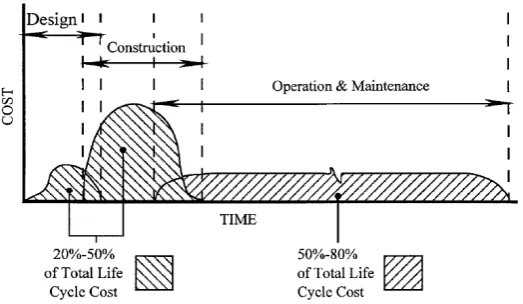
Research has found the importance of early decision making benefits for adopting constructability during the early stage for multifaceted infrastructure projects (Saghatforoush et al., 2009a, 2009b). Specifically, the importance of post construction phases’ consideration in early decision making process of managerial group is more considerable. For example, Griffin (1993) shows that more than half of project life cycle cost is spent on O&M of properties (See Fig. 1). Many of these costs relates to reworks and wastes of money during these phases. However, many of the more recent articles written on the topic of constructability have been reported with less attention to post-occupancy issues and problems.
[image:3.595.167.429.254.406.2]Source: (Griffin, 1993)
Figure 1: Life Cycle Costing Profile
It is therefore, necessary to examine how the concept of constructability can be extended to include the operation and maintenance issues. An extension of the constructability concept to include O&M can bring all project stakeholders ideas together during the design phase to prevent whole project life cycle mistakes. Geile (1996) argues that by early identifying and understanding the needs of the people who are responsible for check-out, start-up, operations, and maintenance, time and money on each project is being saved. To develop an extended constructability model, it is necessary to identify the issues and challenges confronting the O&M of infrastructure projects.
3. CURRENT O&M ISSUES AND PROBLEMS
The main aim of an efficient operation and an effective maintenance is to keep the building in its initial shape and quality. Complex designs and services have always been a major opponent for O&M people (Al-Zubaidi, 1997), and “requires correspondingly high standards on the part of maintenance and production personnel” (Christer & Whitelaw, 1983). Designing projects with so many complexities causes many difficulties for measuring the maintenance jobs (Duffuaa et al., 2001). Complexity is an important technical issue (Shen, 1997) that has major impacts on “buildings, their finishes, fittings, contents and services” (Al-Zubaidi, 1997). Ali (2008) stated that in multifaceted building projects like health centers, diverse network and wide range of functions are more complicated compared with other building types. Lateef (2009) states that a proper planning, managing and systematizing is highly needed in order to overcome this critical issue. Many of other literature have also indicated complexity of buildings, equipments, services and modern facilities as a major problem in building projects, specifically in health centers (Al-Momani et al., 2006; Al-Zubaidi & Christer, 1997; Allen, 1993; Birmingham et al., 1997; Lam, 2007; Lavy & Shohet, 2004; Paz & Leigh, 1993; Shohet, 2003; Williams & Clark, 1989).
building services life prediction (Flores-Colen & Brito, 2010) and low reliability of components’ quality (Arditi & Nawakorawit, 1999; Duffuaa et al., 2001; Flores-Colen & Brito, 2010; Kalamees, 2002; Lam, 2007; Lateef, 2009; Pintelon & Gelders, 1992; Uhlik & Hinze, 1998; Williams & Clark, 1989). Uhlik and Hinze (1998) also clearly illustrated that replacement of many systems like HVAC, as well as other aging equipments are caused based on their significantly low reliability levels.
Poor availability and poor accessibility are other two problems that O&M staffs are facing every day. Poor availability issue includes shortage of plant (Christer & Whitelaw, 1983), data (Al-Zubaidi, 1997; Al-Zubaidi & Christer, 1997) and spares (Al-Momani et al., 2006; Al-Zubaidi, 1997; Williams & Clark, 1989). Poor accessibility shows low possibility of reaching to work point in a short time (Al-Arjani, 1995). Many research have proven this problem among O&M workers for a long period of time (Arditi & Nawakorawit, 1999; Assaf et al., 1996; Azlan Shah et al., 2010; El-Haram & Horner, 2002; Lam, 2007; Lavy & Shohet, 2009; Uhlik & Hinze, 1998).
Insufficient functionality of facilities is another significant problem in health care building projects (Azlan Shah et al., 2010; Flores-Colen & Brito, 2010; Kalamees, 2002; Lam, 2007; Lam et al., 2010; Lateef, 2009). There are many other issues that are stated among literatures randomly like: Low labor productivity (Paz & Leigh, 1993), insufficient durability of materials (Duling et al., 2006; Flores-Colen & Brito, 2010; Lam, 2007), poor Cleanability (Arditi & Nawakorawit, 1999; Duling et al., 2006), lack of flexibility (Lam, 2007; Paz & Leigh, 1993; Shen, 1997), criticality assigning problems, sudden breakdowns, no compatibility among maintenance tasks (Paz & Leigh, 1993), personality conflicts (Uhlik & Hinze, 1998), poor profitability of services (Lam, 2007) and also uncertainty in the nature of maintenance jobs (Duffuaa et al., 2001).
There are many and varied reasons causing these O&M issues and problems. Next section categorizes all these defects’ causes and reasons.
4. O&M DEFECTS’ CAUSES AND REASONS
As noted earlier, there are many reworks and difficulties existed for O&M staffs during post-occupancy phases of building projects. This results in extra spending during O&M phases of infrastructure projects. These problems are all consequences of different causes. There are some literature which have gone through these causes. Some of them have created categorization models for these causes, but not all categorization models match each other. All the available causes entered into NVivo software page, then the researcher grouped them in a way that the causes with the same nature went through the same category. Finally, the causes for the many O&M issues, identified in the previous section, grouped into five different categories and the following names appointed for each category which clearly defines their sub-categories’ nature:
Technical defects
Managerial defects
Political and legal defects
Environmental and biological defects
Social and cultural defects
4.1 Technical Defects
Technical defects have always been one of the main causes of O&M problems. Available literature suggested the following causes:
Building characteristics defects: It includes defects relevant to building age, area, available status,
Construction related defects: There are many problems causes by contractors’ staffs (Assaf et al., 1996), a faulty construction implementation process (Al-Hammad et al., 1997; Assaf et al., 1996; Flores-Colen & Brito, 2010; Souponitski et al., 2001) and also lack of sufficient tests after construction stage.
Design problems: This issue is among the top supported main causes of O&M problems which
consists of building design inefficiencies (Arditi & Nawakorawit, 1999), consultant staffs’ defects, faulty architectural design Hammad et al., 1997; Assaf et al., 1996), faulty design process (Al-Hammad et al., 1997; Allen, 1993; Assaf et al., 1996; Christer & Whitelaw, 1983; Duling et al., 2006; Flores-Colen & Brito, 2010; Josephson & Hammarlund, 1999; Kalamees, 2002; Lam, 2007; Lateef, 2009; Souponitski et al., 2001), redundancies in design (Lam, 2007; Williams & Clark, 1989) and lastly untested designs (Shen, 1997).
Maintenance related defects: This issue is divided to the main two categories of improper
maintenance planning (Al-Zubaidi, 1997; Allen, 1993; Azlan Shah et al., 2010; Christer & Whitelaw, 1983; Duffuaa et al., 2001; El-Haram & Horner, 2002; Paz & Leigh, 1993) and wrong maintenance policies (Allen, 1993; Flores-Colen & Brito, 2010; Josephson & Hammarlund, 1999; Lam, 2007; Lateef, 2009; Lavy & Shohet, 2004). There are also some other maintenance related issues which are mentioned for few times by other researchers like conflicts between maintenance jobs, wrong location of the maintenance staffs (Paz & Leigh, 1993), faulty maintenance (Assaf et al., 1996; Flores-Colen & Brito, 2010; Souponitski et al., 2001), hard maintenance output measurement (Duffuaa et al., 2001), lack of motivation for maintenance people (Josephson & Hammarlund, 1999), many demands to O&M people (Al-Zubaidi & Christer, 1997), late maintenance issues consideration (Shen, 1997), maintenance delays (Azlan Shah et al., 2010; El-Haram & Horner, 2002), O&M people sicknesses and holidays (Al-Zubaidi & Christer, 1997), Staffs’ weak knowledge and trainings (Azlan Shah et al., 2010; El-Haram & Horner, 2002; Josephson & Hammarlund, 1999) and outsourcing or in-house provision of O&M people (Lai & Yik, 2007; Shohet, 2003; Shohet et al., 2010).
High occupancy level (Lam et al., 2010; Lavy & Shohet, 2004; Shen, 1997; Shohet, 2003; Shohet et
al., 2002; Williams & Clark, 1989).
Fast technological advance (Lavy & Shohet, 2004; Pintelon & Gelders, 1992).
4.2 Managerial Defects
Problems related to managerial issues can be further divided into three main categories namely project management defects, economical and financial defects, and resource management defects:
Project management defects
Incomplete construction documents (Uhlik & Hinze, 1998).
Interdepartmental boundaries (El-Haram & Horner, 2002).
Late sustainability issues consideration (Lam, 2007).
Organizational constraints (Al-Zubaidi, 1997).
Poor relationship and communication (Al-Hammad et al., 1997; Al-Zubaidi, 1997; Josephson &
Hammarlund, 1999).
Site management problems (Josephson & Hammarlund, 1999).
Unclear decision making process (El-Haram & Horner, 2002; Shen, 1997).
Lack of time: It includes uncertainty in needed time (Al-Zubaidi, 1997; Duffuaa et al., 2001),
time pressures (Josephson & Hammarlund, 1999; Uhlik & Hinze, 1998), and repair time distribution defects (Al-Zubaidi & Christer, 1997).
Economical and financial defects
Low budget: There are many supports which strongly admits low capital costs provided for
1989). Some other literature admits existence of upward trending maintenance costs (Christer & Whitelaw, 1983; Lam et al., 2010), low maintenance cost estimating (Al-Zubaidi, 1997) and cost implication of delaying repairs (Shen, 1997).
Unsustainable market condition (Arditi & Nawakorawit, 1999).
Resource management defects
Equipments and materials defects (Assaf et al., 1996; Azlan Shah et al., 2010; Flores-Colen &
Brito, 2010; Josephson & Hammarlund, 1999).
Human resources problems including poor workmanship (Al-Zubaidi, 1997; Assaf et al., 1996;
Azlan Shah et al., 2010; Duling et al., 2006; El-Haram & Horner, 2002; Flores-Colen & Brito, 2010; Josephson & Hammarlund, 1999; Lam et al., 2010; Lateef, 2009), manpower requirements failures (Al-Zubaidi & Christer, 1997; Christer & Whitelaw, 1983; Duffuaa et al., 2001; Lam et al., 2010), low work execution level (Kalamees, 2002) and human aspects’ failures (El-Haram & Horner, 2002).
Resources and materials limitations (Al-Zubaidi & Christer, 1997; Allen, 1993; Duffuaa et al.,
2001; Duling et al., 2006; Lai & Yik, 2007; Lam et al., 2010; Lateef, 2009; Lavy & Shohet, 2004; Shen, 1997; Shohet, 2003; Shohet et al., 2002, 2010).
4.3. Political and Legal Defects
Political and legal constraints cause some barriers in implementation of an effective and efficient project management process. Some literature have reported their influences on O&M problems as below:
Political and governmental restrictions and standards: There are number of political and
governmental issues which cause O&M problems. They include government intervention (El-Haram & Horner, 2002; Josephson & Hammarlund, 1999; Lateef, 2009), lack of political consistency, legislations (Shen, 1997), legal constraints (Al-Zubaidi, 1997), political restrictions (Azlan Shah et al., 2010; El-Haram & Horner, 2002; Lavy & Shohet, 2009) and lastly variety of standards (Al-Hammad et al., 1997; Christer & Whitelaw, 1983; Lam, 2007; Lateef, 2009; Uhlik & Hinze, 1998).
Contracting defects: Missing contracting requirements (Shen, 1997) and also turning the type of
selected contract to turnkey model (Ivory et al., 2001) are the main two defects in this subcategory. Both can make some problems for O&M people and their work implementation process.
4.4. Environmental and Biological Defects
Biological problems and environmental considerations are two other reasons which cause many limitations in operating and maintaining building projects, specifically when the project is a complex health center:
Biological defects: Being familiar with building location, the type of plants and existing insects in
the work area is a must for designers and planners. Treatment solutions and considerations should be used in order to prevent any biological defect in the final project (Al-Hammad et al., 1997).
Environmental defects: It includes three main categories - degradation which covers both physical
and environmental aspects (Duling et al., 2006), environmental friendliness constraints (Lam et al., 2010) which limits the projects to consider pollutions and emissions around the work place (Williams & Clark, 1989) as well as energy consumption level (Lam, 2007), and lastly indoor and outdoor environmental changes (ISO 15686-1 2000., 2000) which their negative effects on O&M processes are confirmed by many researchers (Al-Hammad et al., 1997; Allen, 1993; Assaf et al., 1996; Duling et al., 2006; Flores-Colen & Brito, 2010; Josephson & Hammarlund, 1999; Kalamees, 2002).
Social and cultural issues have always affected project life cycle implementation process. Humans are always in charge of making and using the project, and their social and cultural effects on O&M procedures are significantly important. Current literature represents the following relevant defects:
Cultural problems: Social attributes and corporate culture have a significant impact on O&M works
(Al-Arjani, 1995; Lai & Yik, 2007).
Safety constraints: Health and safety issues should always be obeyed by O&M staffs (Shen, 1997).
There are many research which shows current limitations for operational and maintenance advancement, caused by safety regulations (Al-Zubaidi, 1997; Allen, 1993; Arditi & Nawakorawit, 1999; Azlan Shah et al., 2010; Christer & Whitelaw, 1983; Lam, 2007; Lam et al., 2010; Lavy & Shohet, 2004; Pintelon & Gelders, 1992; Shohet et al., 2002, 2010).
Security constraints: Negative impacts of security consideration on O&M processes are mentioned
by few researchers (Al-Zubaidi, 1997; Arditi & Nawakorawit, 1999; Lavy & Shohet, 2004; Shen, 1997).
Third party vandalism: It has always been a big problem in high-rise buildings and has ranked as
one of the top significantly affective issues on building maintenance (El-Haram & Horner, 2002).
User related defects: Faulty use is one of the O&M defects’ causes (Flores-Colen & Brito, 2010). It results in delays in reporting problems (Azlan Shah et al., 2010; El-Haram & Horner, 2002), unclear current and future usage (Shen, 1997), and disturbs for other users and clients (Al-Zubaidi, 1997; Josephson & Hammarlund, 1999; Lam et al., 2010; Paz & Leigh, 1993; Shohet et al., 2002; Uhlik & Hinze, 1998). Achieving some of users’ high expectations is another obstacle for O&M people (Al-Momani et al., 2006; Allen, 1993; Arditi & Nawakorawit, 1999; Assaf et al., 1996; Azlan Shah et al., 2010; El-Haram & Horner, 2002; Josephson & Hammarlund, 1999; Lai & Yik, 2007; Lateef, 2009; Lavy & Shohet, 2009; Shohet et al., 2010; Williams & Clark, 1989), which is more critical when they need to satisfy female users’ expectations (Lateef, 2009).
5. SUMMARY
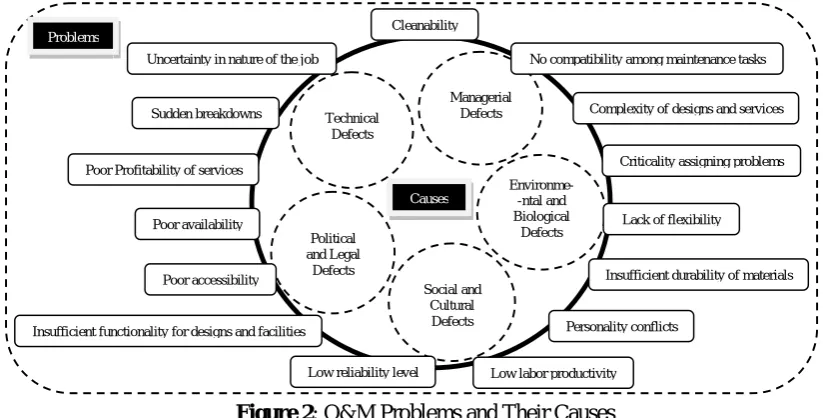
Having a look on sections three and four illustrates that available O&M issues and their causes can be correlated to each other directly or indirectly. It should be noted that the problems can occur as the result of each type of grouped defects, and there is no specific evidence that relate any of available issues with only a unique cause or reason. It is something that should be discovered in the next levels of current research project. The current O&M issues and their causes are briefly shown in fig. 2. According to this figure, each of the causes and reasons which are in the inner part of circle can result in each of the problems and issues, which are located around it.
[image:7.595.85.497.518.727.2]
Figure 2: O&M Problems and Their Causes
Technical Defects Managerial Defects Political and Legal Defects Social and Cultural Defects Environme- -ntal and Biological Defects Cleanability
No compatibility among maintenance tasks
Complexity of designs and services Uncertainty in nature of the job
Sudden breakdowns
Criticality assigning problems
Lack of flexibility
Insufficient durability of materials
Insufficient functionality for designs and facilities
Low labor productivity Poor Profitability of services
Poor availability
Poor accessibility
Personality conflicts
Low reliability level
6. CONCLUSION
This paper identified the O&M issues and their causes in the provision of infrastructure projects. It examined how to extend the constructability concept by using infrastructure project O&M issues. In another word, this study, in continues of an ongoing research project in Queensland University of Technology, elaborates the available O&M problems and mistakes in multifaceted building projects and finds their potential causes and reasons.
Wide range of O&M defects’ causes shows how much critical this matter is and also states the need to test their originality and reality by direct interviews with O&M people. The final extended constructability model will be based on the professionals’ comments about current found O&M issues and causes. It will improve effectiveness and efficiency of post-occupancy phases, as much as the constructability principles have done it in pre-occupancy stages.
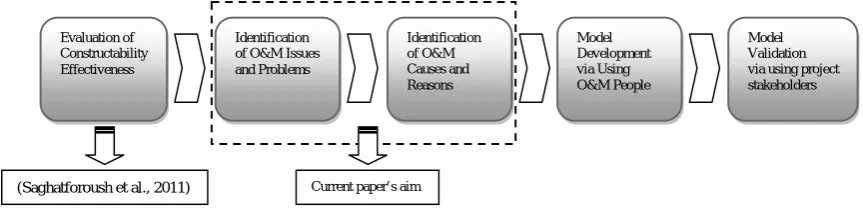
[image:8.595.74.506.303.408.2]At the next stage, the current data will be used as a basement for interviews with O&M professionals in building projects. Amendments will be performed on them and probable solutions will be found. Then, an initial extended model will be developed based on that. Lastly, other building stakeholders will validate the designed extended model (See Fig. 3).
Figure 3: Current Research Project Stages
REFERENCES
Al-Arjani, A. H. (1995). Impact of cultural issues on the scheduling of housing maintenance in a Saudi Arabian urban project. International Journal of Project Management, 13(6), 373-382.
Al-Hammad, A., Assaf, S., & al-Shihah, M. (1997). The effect of faulty design on building maintenance. Journal of Quality in Maintenance Engineering, 3(1), 29-39.
Al-Momani, K. R., Al-Tahat, M. D., & Joradat, E. T. (2006). Performance measures for improvement of maintenance effectiveness. Paper presented at the International Conference of Service Systems and Service Management, Troyes.
Al-Zubaidi, H. (1997). Assessing the demand for building maintenance in a major hospital complex. Journal of Property Management, 15(3), 173-183.
Al-Zubaidi, H., & Christer, A. H. (1997). Maintenance manpower modeling for a hospital building complex. European Journal of Operational Research, 999, 603-618.
Ali, M., Mohamad, W. M. N. B. W., & Bamgbopa, I. A. (2008). Audit assessment of the facility maintenance management in a public hospital an appraisal of the stakeholders performance. Paper presented at the The International Seminar on Asset Management for Developing World, Ho Chi Minh, Vietnam.
Allen, D. (1993). What is building maintenance? Journal of Facilities, 11(3), 7-12.
Arditi, D., & Nawakorawit, M. (1999). Issues in building maintenance property managers perspective. Journal of Architectural Engineering, 5(4), 117-132.
Assaf, S., Al-Hammad, A.-M., & Al-Shihah, M. (1996). Effects of faulty design and construction on building maintenance. Journal of Performance of Constructed Facilities, 10(4), 171-174.
Azlan Shah, A., Kamaruzzaman, S.-N., Sulaiman, R., & Peng, Y. C. (2010). Factors affecting housing maintenance cost in Malaysia. Journal of Facilities Management, 8(4), 285-298.
Evaluation of Constructability Effectiveness
Identification of O&M Issues and Problems
Identification of O&M Causes and Reasons
Model Development via Using O&M People
Model Validation via using project stakeholders
Birmingham, R., Cleland, G., Driver, R., & Maffin, D. (1997). Understanding engineering design: context, theory and practice. London: Prentice-Hall.
Christer, A. H., & Whitelaw, J. (1983). An operational research approach to breakdown maintenance problem recognition. The Journal of the Operational Research Society, 34(11), 1041-1052. CIIA. (1993). Constructability principles files. Adelaide, Australia.
Construction Industry Institute. (1987). Constructability concepts file (Vol. 3-3). Austin, TX.
Duffuaa, S. O., Ben-Daya, M., Al-Sultan, K. S., & Andijani, A. A. (2001). A generic conceptual simulation model for maintenance systems. Journal of Quality is Maintenance, 7(3), 207-219. Duling, J. J. M., Cloete, C. E., & Horak, E. (2006). The application of Neuro-Fuzzy methodology to
maintenance of buildings. The ICEC Cost Management Journal.
El-Haram, M. A., & Horner, M. W. (2002). Factors affecting housing maintenance costs. Journal of Quality in Maintenance Engineering, 8(2), 115-123.
Flores-Colen, I., & Brito, J. d. (2010). A systematic approach for maintenance budgeting of buildings façades based on predictive and preventive strategies. Journal of Construction and Building Materials, 24, 1718-1729.
Geile, R. J. (1996). Constructability "The Strech Version": Transaction of AACE International.
Griffin, J. J. (1993). Life cycle cost analysis: a decision aid. London: Blackie Academic and Professional. ISO 15686-1 2000. (2000). Building and constructed assets-Service life planning Part 1: General
principles (pp. 41).
Ivory, C. J., Thwaited, A., & Vaughan, R. (2001). Design for maintainability: the innovation process in long term engineering projects. Paper presented at the The Future of Innovation Studies, Eindhoven, Netherland.
Josephson, P. E., & Hammarlund, Y. (1999). The causes and costs of defects in construction a study of seven building projects. Automation in Construction, 8, 681-687.
Kalamees, T. (2002). Failure analysis of 10 year used wooden building. Engineering Failure Analysis, 9, 635-643.
Lai, J. H. K., & Yik, F. W. H. (2007). Monitoring building operation and maintenance contracts. Journal of Facilities, 25(5/6), 238-251.
Lam. (2007). Design for maintenance from the viewpoint of sustainable hospital buildings. The Australian Hospital Engineer, 30(1), 30-34.
Lam, Chan, A. P. C., & Chan, D. W. M. (2010). Benchmarking success of building maintenance projects. Journal of Facilities, 28(5/6), 290-305.
Lateef, O. A. (2009). Cases for alternative approach to building maintenance management of public universities. Journal of Building Appraisal, 5(3), 201-212.
Lavy, S., & Shohet, I. M. (2004). Integrated maintenance management of hospital buildings a case study. Journal of Construction Management and Economics, 22(1), 25-34.
Lavy, S., & Shohet, I. M. (2009). Integrated healthcare facilities maintenance management model case studies. Journal of Facilities, 27(3/4), 107-119.
Paz, N. M., & Leigh, W. (1993). Maintenance scheduling issues, results and research needs. International Journal of Operations & Production Management, 14(8), 47-69.
Pintelon, L. M., & Gelders, L. F. (1992). Maintenance management decision making. European Journal of Operational Research, 58, 301-317.
Saghatforoush, E., Hassim, S., Jaafar, M. S., & Abdul-Kadir, M. R. (2009a). Constructability implementation among Malaysian building contractors. European Journal of Scientific Research, 29(4), 518-532.
Saghatforoush, E., Hassim, S., Jaafar, M. S., & Abdul-Kadir, M. R. (2009b). Assessment of critical constructability activities among Malaysian building contractors. American Journal of Scientific Research(3), 15-25.
Shen, Q. (1997). A comparative study of priority setting methods for planned maintenance of public buildings. Journal of Facilities, 15(12/13), 331-339.
Shohet, I. M. (2003). Key performance indicators for maintenance of health-care facilities. Journal of Facilities, 21(1/2), 5-12.
Shohet, I. M., Lavy-Leibovich, S., & Bar-On, D. (2002). Integrated maintenance management of hospital buildings in Israel. Paper presented at the 17th International Symposium of the International Federation of Hospital Engineering, Bergen.
Shohet, I. M., Lavy-Leibovich, S., & Bar-On, D. (2010). Integrated maintenance monitoring of hospital buidlings. Journal of Construction Management and Economics, 21(2), 219-228.
Souponitski, S. Z., Sniatvok, S. V., & Grigoriev, S. E. (2001). Early reinforced concrete constructions in Russia specific faults and causes of failure. Engineering Failure Analysis, 8, 201-212.
Trigunarsyah, B., & Skitmore, M. (2010). Chapter 21: The key to successful implementation: project management of sustainable infrastructure provision Sustainable urban and regional infrastructure development. Hershey . New York: Information Science Reference Publication.
Uhlik, F. T., & Hinze, J. (1998). Trends in the construction needs of hospital facilities. Journal of Architectural Engineering, 4(4), 132-134.