Research Report
No 297
For Me or Not for Me?
- That is the Question
A Study of Mature Students’ Decision Making
and Higher Education
Pat Davies, University of Sheffield
Mike Osborne, University of Stirling
Jenny Williams, University of Wolverhampton
The views expressed in this report are the authors' and do not necessarily reflect those of the Department for Education and Employment.
© Queen’s Printer 2002. Published with the permission of DfES on behalf of the Controller of Her Majesty's Stationery Office. Applications for reproduction should be made in writing to The Crown Copyright Unit, Her Majesty's Stationery Office, St Clements House, 2-16 Colegate, Norwich NR3 1BQ.
ISBN 1 84185 620 7
Acknowledgements
Pat Davies was at City University while this project was in progress and she wishes to acknowledge the contribution of staff and colleagues there who supported the work and the research team at that time.
The authors wish to acknowledge the work of the researchers who contributed to this report and who carried out much of the fieldwork in the case study institutions on which it is based: Bernd Brink, Lesley Doyle, Lynne Graham Matheson, Tamsin Heycock, Catherine Matheson, Jeannie Millichamp and Eileen Turner.
We also wish to thank Gillian Raab and Helen Storkey of Napier University for the use of their analysis of Scottish Qualifications Authority (SQA) data for Scotland.
Contents
1 Research rationale, themes and methods ...1
2 Patterns of participation...7
3 Institutional views and perspectives ...13
4 Adult voices: the nature of the samples...25
5 Labour market and employment factors ...29
6 Individual and personal factors...37
7 Institutional factors...45
8 National policy factors...51
9 Scotland...61
10 Becoming a student: fragility and risk ...73
11 Summary and issues to be addressed ...81
References...89
Annexes: 1. Summary of statistical background ...91
2. Research methods...92
1 RESEARCH RATIONALE, THEMES AND METHODS
Summary
This chapter:
♦ Summarises the statistical background which motivated the research; the decline in mature student entry to HE between 1995/6-1998/9
♦ Provides an explanation of and rationale for the conceptual approach which highlights national, labour market, institutional and personal factors as motivators for HE entry
♦ Details the research questions which stem from this conceptual approach ♦ Outlines the research methods employed
1.1 Rationale for the project
This research project arose following concerns about the fall in mature student enrolments to higher education (HE), identified in the original research specification from the then DfEE as a decline of 12% between 1997/8 and 1998/9. Evidence was also presented by the then Committee of Vice Chancellors and Principals (CVCP) in a briefing note on Widening Participation (CVCP 1999a), which reported a 9% decrease in full-time mature applicants in May 1999, using data supplied by the Universities Central Admissions Service (UCAS). As a follow-up to that report, further work was undertaken by the Higher Education Statistics Agency (HESA) and UCAS for CVCP to explore this decline and to determine ‘whether this was part of a longer term trend and whether participation by certain groups of mature students, or those in specific geographical regions, had declined more significantly than others’. The work analysed mature student participation in HE between 1994/5 and 1998/9 and was circulated to CVCP members as an Information Note (CVCP 1999b). The key statistical findings of that study showed that:
♦ the decline in mature entrants was greatest amongst white males, both for full-time and part-time courses and for first degree and Higher National Diploma (HND) courses
♦ the decline related to most mature age groups
♦ there was a particularly high percentage decrease in direct mature entrants as opposed to those who apply through UCAS.
of mature students in HE and of the decline in the numbers of such entrants (see 1.5 below and annexe 2). These are not fully representative of all mature entrants (see figure 4, para 4.1 for a comparison) and care should be taken to avoid drawing conclusions on that basis.
1.2 The statistical background
Initial analysis of more comprehensive data (HESA 1999) for the period 1997/8 to 1998/9 added to the CVCP findings and suggested a number of other significant trends (annexe 1). Firstly, while there was a decline in full-time enrolments, there was an increase in part-time numbers, a trend that has been developing over several years (Davies 1999). Although this was from a low base for first degree courses, it was from a higher base for other undergraduate courses. Secondly, there were gender differences: the largest decline being among full-time men on other undergraduate courses and the largest rise among women on part-time first degrees. Thirdly, there were differences between subject areas: a decline in enrolments in traditional ‘male’ subject areas on full-time first degrees but also in business and administrative studies on other undergraduate courses. Fourthly, the largest percentage changes and the biggest differences between the two years were between age groups. Full-time enrolments showed the most significant changes: on first degree courses the percentage reduction increased with age to 14% for the 25+ year old age group; and on other undergraduate courses was -12% for the 21-24 year old age group. Although on part-time courses there was an increase in enrolments for both first degrees and other undergraduate courses, the increase was smaller for mature entrants than for the under 21 age group.
The CVCP analysis that informed the research specification also showed significant differences between regions. Other analysis of the data for Scotland (see for example Osborne 1999, Bamford and Schuller 1999) also showed differences in the pattern of enrolments between part-time and full-time students; and a high and growing percentage of new entrants enrolled for higher education in the further education (FE) sector. However, the most recent data for England (FEFC 1999) suggested that student enrolments for HE level study in FE had fallen.
The trends in participation that characterised the late 1980s and early 1990s have clearly changed in the late 1990s. Patterns of participation in higher education study are becoming more complex, on the supply side as the institutional base and the curriculum offer diversify, and on the demand side as the needs, expectations and aspirations of mature students change. This research project sought to explore the complexity of these patterns drawing on supply side data and also used a variety of methods to explore the demand side in depth. The main focus of this work was the range of structural, institutional, financial and personal factors which might interact and impact on the individual decision making process of mature learners.
1.3 Conceptual
background
jobs available, changes in work-based learning and employer provided training opportunities. For many mature students the local and regional labour market may have greater significance but national and international trends may also influence their decisions. Institutional factors focus on mission and policy in relation to mature students (Davies et al 1994), partnership arrangements (e.g. compacts and franchising affiliations), growth of HE level study in FE colleges (Osborne 1999), growth of part-time and more flexible modes of delivery (Davies 1999), changes in HE curriculum offer (e.g. nurse education now in HE), and the range of subject areas and types of qualification available and admissions practice (e.g. selective growth in GNVQ admissions).
Individual factors include personal and social characteristics, financial circumstances and attitudes to debt, educational background and qualifications, domestic situation and location, occupational status, perceptions of labour market opportunities and value of HE qualifications, career aspirations, support (if any) from employers, friends and family members.
All these factors interact and impact on individual decisions in different ways, depending on individual backgrounds and circumstances. Furthermore, making a decision to enter HE is not a simple single event for most mature students; it is a process where differing factors have salience at different times (Williams 1997). Neither does the process lead continuously in the same direction: those on qualifying courses may not apply to HE; those who apply may not accept a place; those who accept may not enrol. It was therefore important to aim to capture at least one whole applications cycle, particularly in relation to those who choose not to enter HE. This research project therefore sought to include all of these factors by including entrants and acceptors who did/did not enrol at the start of the 1999-2000 academic year and those who were potential entrants to the 2000-2001 year.
Academic theorisations concerning individual decision making around entry to HE tend to focus on the range of social factors but such research had not explored the relative importance of different factors or the interaction between them. More qualitative studies, whilst acknowledging social categorisations, theorise the return to HE in terms of identity shifts (Green and Webb 1997, Britten and Baxter 1999) looking at the personal meaning of becoming an adult learner. Such studies provide a range of important insights but rarely include personal financial decisions as a significant element. There is also growing evidence of the mismatch between the expectations of graduates in terms of employment (Purcell, Pitcher and Simm 1999) and the recruitment strategies of employers (Purcell and Hogarth 1999), which may be impacting in as yet unexplored ways on the entry decisions of adult learners.
The research described in this report was designed to inform an understanding of these patterns in more detail and to explore these explanations in greater depth, through the study of groups of qualified and qualifying potential entrants and a sample of recent entrants in case study institutions located across the UK. Through the use of key case study HE institutions (HEIs) and selected ‘critical case’ subject areas within them, insights generated by previous quantitative and qualitative studies were built upon and the impact of more recent policy developments were explored.
1.4 Research
questions
policy. Whilst the methodologies used allowed for open ended questioning so that responses were not constrained by expectations of the research team, the following particular research questions were developed and investigated.
1) What influence on application and entry to HE do financial factors (e.g. fees, loans, access funds, benefits, New Deal) have? Is there a cumulative effect in the perceived costs or a critical point at which the cost or the debt overtakes the perceived benefits? How important is loan repayment in long term planning? How do potential entrants assess the relative cost of full-time and part-time study? Do they make rational economic decisions of this kind? To what extent do they understand the financial implications and consequences?
2) Does employment status – past and/or present experience and future aspirations – make a difference to the way in which the financial factors are judged? How do perceptions of local or national labour market opportunities impinge on the decision to enter? Can such factors explain regional differences in adult participation? How do potential mature entrants perceive the debates about public/private investment in lifelong learning in relation to their individual career/employment planning?
3) How has the policy and practice of the FE colleges and HE institutions (the curriculum offer, mode of delivery, compacts, franchising etc) acted as a motivator to entry or to a specific form of participation? How does the increased availability of part-time provision affect decisions?
4) How do individuals make the decision to apply or enter or not to apply or enter a particular institution to study at higher education level? How does the social background and educational/work experience of potential entrants influence their decision? How do identity, career aspiration, financial considerations and other factors interact to motivate or inhibit entry? Do a number of factors accumulate to a critical turning on/off point? How can the gender and age group differences in mature entry be explained? Does flexibility in provision ‘warm up’ adults but the consequent length of time to achieve qualifications have a ‘cooling off’ effect?
1.5 Research
methods
An outline of the research methods is set out here. Further details of the methodology are provided in annexe 2 and details of the data obtained are set out in chapter 2.
questionnaires and interviewed are reported in percentage terms in order to indicate the scale of the response among the specific groups targeted for study.
The research funded by the then DfEE drew on case studies in 9 HEIs: 7 in England, 1 in Wales and 1 in Scotland and the selection of these is described in chapter 2. The main body of this report is based on these 9 case studies. Chapter 9 presents a summary of the findings for Scotland including 3 additional case studies funded by the Scottish Executive.
In each of the case study HEIs, interviews were conducted with key personnel to elicit changes in policy and practice and in patterns of mature student recruitment, regional/local economic or other issues, perceptions and understandings of the reasons for trends in mature student participation. Also in each of the case study HEIs, 3 subject areas were identified where there had been significant change (usually a downturn) in the recruitment of mature students. The ‘entrants questionnaire’ was distributed to a sample of new mature entrants to the case study HEIs in 1999, in the selected subject areas. A total of 866 responses were received and further information on this sample is set out in chapter 2.
The ‘potential entrants questionnaire’ was distributed to mature applicants for 1999 entry who had been offered and accepted a place but did not enrol. It was also distributed to potential entrants in 2000 who were unable or unwilling to be interviewed (see interviews below). A total of 79 valid responses were received.
For each of the selected subject areas (3) in each of the case study HEIs (9), a qualifying route was identified – a total of 27 qualifying routes. These included a range of different kinds of provision: in-house and FE based Access courses, A levels, year 0/foundation courses, non-advanced and advanced vocational courses and community based programmes.
In each of the qualifying routes, a focus group was conducted, with a total of 220 participants.
In addition, 187 interviews were conducted with individuals identified through the case study HEIs and the qualifying routes. They included:
♦ current and past participants on qualifying routes ♦ those who had left qualifying routes prior to completion
♦ direct applicants to the case study HEIs
2 PATTERNS OF PARTICIPATION
Summary
This chapter:
♦ Sets out the patterns of participation of new mature entrants to HE in the period 1995/6 to 1998/9
♦ Shows a decline in mature entry to full-time first degree and DipHE/HND/HNC programmes when nursing is excluded
♦ Shows a more varied and variable pattern in mature entry to part-time first degree and DipHE/HND/HNC programmes with some indication that in most regions the trend appeared to be upwards in the more recent years
♦ Presents the data for new mature entrants in the 9 case study HEIs showing similar patterns
2.1 National and regional trends
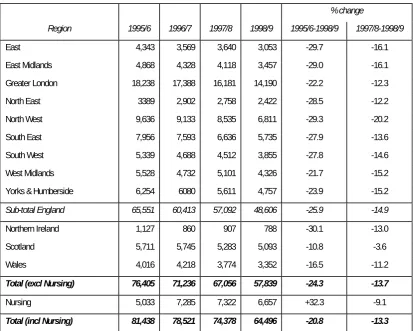
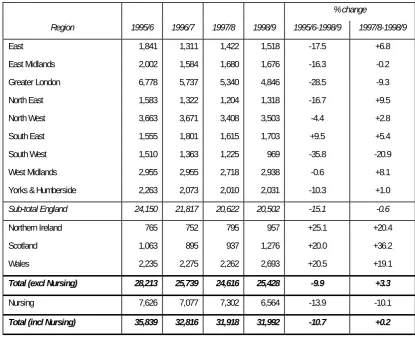
The starting point for this research was an investigation of the trends in mature student participation by region, in order to identify 9 case study HEIs. To do this we used the HESA December returns from institutions. The main advantage of this data (rather than that based on the July returns) was that it was available more quickly: the data on entrants to the academic year 1998/9 was available at the start of our project (December 1999). Although the December returns tend to be less accurate than the July returns because they are completed so early in the academic year, the differences were not great for new mature entrants to full-time courses. There were more significant differences for new mature entrants to part-time courses, especially in those HEIs that recruit in the second semester. However, since we were able to identify these we were able to allow for it. The academic year 1994/5 was the first year for which HESA collected data and in a number of respects is not comparable with subsequent years – we therefore took 1995/6 as the starting point for our analysis. In addition, over the period 1995/6 to 1998/9, nursing was incorporated into HE, but into different institutions in different academic years. Time series data are therefore difficult to read, since the underlying trends are obscured, particularly as nursing is predominantly female. In order to overcome this problem, we excluded nursing from our analysis. The resulting data is set out in table 1 for full-time and table 2 for part-time, new mature entrants, by region, for the UK.
a smaller decline than most other regions was the biggest region in terms of numbers. In Wales, there was a decline each year from 1996/7 onwards and in Scotland there was a similar pattern of decline but by a smaller percentage. In Northern Ireland the pattern was rather more erratic year on year, but nevertheless over the whole period there was a significant decline.
Table 1
Mature, UK domiciled, new entrants to HE, 1995/6 to 1998/9, Full-time, First degree and DipHE/HND/HNC, excluding nursing, regions
% change
Region 1995/6 1996/7 1997/8 1998/9 1995/6-1998/9 1997/8-1998/9
East 4,343 3,569 3,640 3,053 -29.7 -16.1
East Midlands 4,868 4,328 4,118 3,457 -29.0 -16.1
Greater London 18,238 17,388 16,181 14,190 -22.2 -12.3
North East 3389 2,902 2,758 2,422 -28.5 -12.2
North West 9,636 9,133 8,535 6,811 -29.3 -20.2
South East 7,956 7,593 6,636 5,735 -27.9 -13.6
South West 5,339 4,688 4,512 3,855 -27.8 -14.6
West Midlands 5,528 4,732 5,101 4,326 -21.7 -15.2
Yorks & Humberside 6,254 6080 5,611 4,757 -23.9 -15.2
Sub-total England 65,551 60,413 57,092 48,606 -25.9 -14.9
Northern Ireland 1,127 860 907 788 -30.1 -13.0
Scotland 5,711 5,745 5,283 5,093 -10.8 -3.6
Wales 4,016 4,218 3,774 3,352 -16.5 -11.2
Total (excl Nursing) 76,405 71,236 67,056 57,839 -24.3 -13.7
Nursing 5,033 7,285 7,322 6,657 +32.3 -9.1
Total (incl Nursing) 81,438 78,521 74,378 64,496 -20.8 -13.3
Table 2
Mature, UK domiciled, new entrants to HE, 1995/6 to 1998/9, Part-time, First degree and DipHE/HND/HNC, excluding nursing, regions
% change
Region 1995/6 1996/7 1997/8 1998/9 1995/6-1998/9 1997/8-1998/9
East 1,841 1,311 1,422 1,518 -17.5 +6.8
East Midlands 2,002 1,584 1,680 1,676 -16.3 -0.2
Greater London 6,778 5,737 5,340 4,846 -28.5 -9.3
North East 1,583 1,322 1,204 1,318 -16.7 +9.5
North West 3,663 3,671 3,408 3,503 -4.4 +2.8
South East 1,555 1,801 1,615 1,703 +9.5 +5.4
South West 1,510 1,363 1,225 969 -35.8 -20.9
West Midlands 2,955 2,955 2,718 2,938 -0.6 +8.1
Yorks & Humberside 2,263 2,073 2,010 2,031 -10.3 +1.0
Sub-total England 24,150 21,817 20,622 20,502 -15.1 -0.6
Northern Ireland 765 752 795 957 +25.1 +20.4
Scotland 1,063 895 937 1,276 +20.0 +36.2
Wales 2,235 2,275 2,262 2,693 +20.5 +19.1
Total (excl Nursing) 28,213 25,739 24,616 25,428 -9.9 +3.3
Nursing 7,626 7,077 7,302 6,564 -13.9 -10.1
Total (incl Nursing) 35,839 32,816 31,918 31,992 -10.7 +0.2
Source: HESA December individualised student returns for 1995/6, 1996/7, 1997/8, 1998/9
Table 2 shows that for mature new entrants to part-time study over the same period, the pattern was very different – both more varied and more variable between regions and from one year to another. In most regions of England over the period as a whole there was a decline but this disguises an increase between 1997/8 and 1998/9. The exceptions were in the East Midlands, where the number was almost the same in the two years, and in Greater London and the South West where the decline continued and indeed grew between 1997/8 and 1998/9. In Northern Ireland, Wales and Scotland there was a general upward trend particularly strong in Scotland in the last year of the period (although the numbers were relatively small).
2.2 Nine case study HEIs
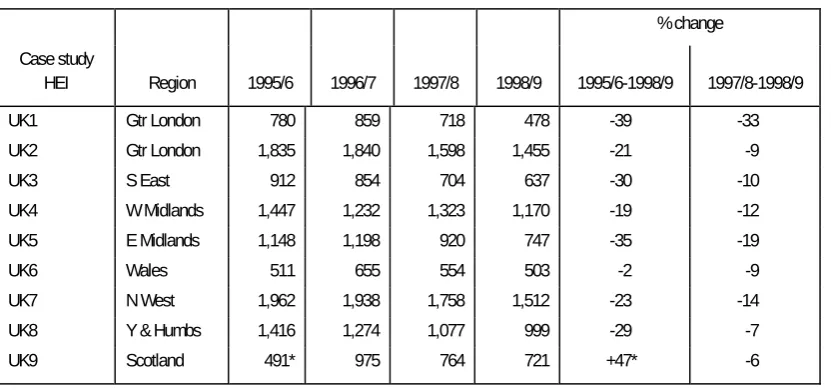
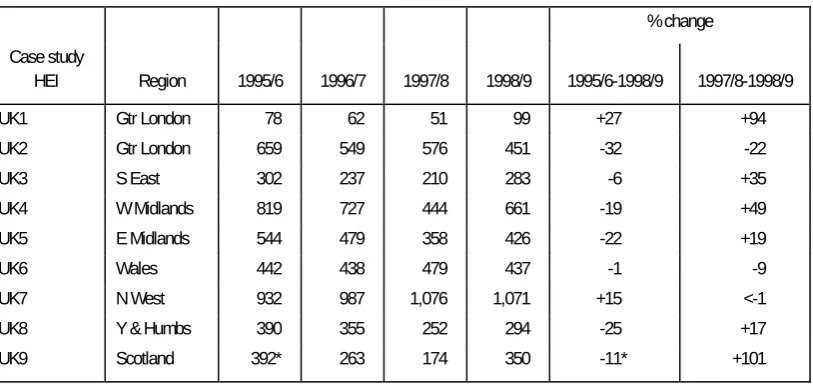
[image:15.595.93.509.315.510.2]The analysis set out above informed the selection of case study HEIs and suggested the geographical distribution of the institutions. Further, in order to take account of institutional factors and to access a sufficient number of mature new entrants for the questionnaires, we needed to select HEIs that had experienced a decline in mature entrants in recent years but that nevertheless still had significant numbers in a range of subject areas, modes of study and qualification aims. The approach taken when selecting the individual case study HEIs was therefore a pragmatic one, with the aim of concentrating fieldwork efforts on those areas where we were most likely to pick up evidence on the types of factors at play; it was not intended that this would be a representative sample of all potential or new mature students.The patterns of participation in the 9 HEIs selected on this basis are set out in tables 3 and 4 below.
Table 3
Mature, UK domiciled, new entrants to HE, 1995/6 to 1998/9, Full-time, First degree and DipHE/HND/HNC, excluding nursing, 9 case study HEIs
% change
Case study
HEI Region 1995/6 1996/7 1997/8 1998/9 1995/6-1998/9 1997/8-1998/9
UK1 Gtr London 780 859 718 478 -39 -33
UK2 Gtr London 1,835 1,840 1,598 1,455 -21 -9
UK3 S East 912 854 704 637 -30 -10
UK4 W Midlands 1,447 1,232 1,323 1,170 -19 -12
UK5 E Midlands 1,148 1,198 920 747 -35 -19
UK6 Wales 511 655 554 503 -2 -9
UK7 N West 1,962 1,938 1,758 1,512 -23 -14
UK8 Y & Humbs 1,416 1,274 1,077 999 -29 -7
UK9 Scotland 491* 975 764 721 +47* -6
Source: HESA December individualised student returns for 1995/6, 1996/7, 1997/8, 1998/9
Table 4
Mature, UK domiciled, new entrants to HE, 1995/6 to 1998/9, Part-time, First degree and DipHE/HND/HNC, excluding nursing, 9 case study HEIs
% change
Case study
HEI Region 1995/6 1996/7 1997/8 1998/9 1995/6-1998/9 1997/8-1998/9
UK1 Gtr London 78 62 51 99 +27 +94
UK2 Gtr London 659 549 576 451 -32 -22
UK3 S East 302 237 210 283 -6 +35
UK4 W Midlands 819 727 444 661 -19 +49
UK5 E Midlands 544 479 358 426 -22 +19
UK6 Wales 442 438 479 437 -1 -9
UK7 N West 932 987 1,076 1,071 +15 <-1
UK8 Y & Humbs 390 355 252 294 -25 +17
UK9 Scotland 392* 263 174 350 -11* +101
Source: HESA December individualised student returns for 1995/6, 1996/7, 1997/8, 1998/9
Note*: The 1995/6 figure for the Scottish HEI was not considered to be valid so that despite the increase over the whole period shown in table 3, there was a clear decline between 1996/7 and 1998/9
In the 9 case study HEIs there was a clear and persistent decline in the number of mature new entrants to full-time study and a more variable pattern with a recent upward trend in part-time study in some institutions.
3 INSTITUTIONAL VIEWS AND PERSPECTIVES
Summary
This chapter:
♦ Outlines the rationale for and nature of the institutional interviews undertaken. ♦ Reports the variety of informant responses to an understanding of mature student
recruitment in terms of: national trends and policies, labour market and employment factors, personal and individual factors and institutional factors
♦ Summarises the institutional perspectives and agendas showing that there are differences both between and within HEIs
♦ In general, for HEI management the concept of their market was crucial. Mature students were sometimes seen as central to the extent that they had been mainstreamed; at the other end of the spectrum one HEI was seeking to focus almost entirely on young students as part of a positioning strategy in the hierarchy of universities.
♦ For subject leaders and tutors the local labour market and employers’ policy and practice in supporting their employees was seen as very important in vocational areas.
♦ Subject tutors also saw student finance as an important factor in the decline of mature student entry. This was expressed particularly strongly by those in non-vocational subject areas.
3.1 The
respondents
On several occasions staff outside HE suggested contacts inside HE that key informants had not named. Thus the views reported here are illustrative of staff at differing levels of responsibility within institutions; they do not, and were not intended to, provide a systematic account of the complete range of views within any one institution or across the nine case studies. They do however, reflect the different ways HEIs are organised and the different emphases placed on provision for mature students as a framework for making sense of the learners voices which we report in the following chapters.
3.2 National trends and policy factors
3.2.1 Changes in the structure of the further and higher education sectors
Higher education in the UK has undergone considerable change over the last 20 years, moving from an elite system to mass provision with participation rates doubling between 1981 and 1995. Some expansion in HE provision has occurred in FE colleges, particularly in Scotland, with adults benefiting. Attention was often drawn by both KIs and KTs to the complex articulation arrangements that exist between FE colleges and HEIs: franchising of one or more years of university study to colleges; entry via HNC or HND to year 2 or 3 of a degree (i.e. analogous to the American '2 + 2 degree'); the creation of a 'top-up' third year of an HND programme to provide a degree validated by a university. The boundaries between sectors have therefore become blurred, in some cases as a result of institutional policy. However, as some HEIs also pointed out, there was also growing competition for students, both young and mature, from the FE sector, where familiarity and closer geographical location may well make them the first choice for mature students. It was argued that this may explain some of the decline in mature entry to universities.
3.2.2 Demographic trends
Most respondents made no mention of demographic trends as a factor in their recruitment strategies. However, there was a suggestion from one HEI that, since the numbers of school leavers have been declining, there was a need to recruit a higher proportion of young people and more mature students if expansion targets were to be met. Further, in Scotland, it was suggested that while in the past
‘
mature entrants were often ‘second chance’ learners,
aged 30 or more – Access students are now younger’
(Access co-ordinator). Similarly, in one of the English HEIs, the KI believed that the average ageof mature studentswas declining:
‘
there are more younger people, in their early
20s, on courses than five years ago, and also more men’.
Some speculated that after years of mature student recruitment the pool of potential students had shrunk. Data from qualifying routes on this issue was varied. Where time series data were available (in an FE college linked to UK6), Access recruitment had actually increased since 1996-7, and although fewer students completed their courses, numbers progressing to HE had changed little. However, one Open College Network provided data showing a small decline in level 3 recruitment, a shift to vocational courses, a larger non-completion rate and fewer of those with certificates going on to HE; and one HEI reported that despite maintaining numbers in Year 0 Science the mature student proportion had declined since 1997 with larger decreases in 1999-2000.3.2.3 National policies on widening participation
Widening Participation Report (HEFCE, 1997) or its Scottish equivalent (SHEFC, 1999) indicated the need to attract people from other under-represented groups, rather than just mature entrants:
‘Widening Participation is seen in general terms – not
just targeting mature students’
. When senior managers talked of positioningtheir institutions in the HE market they saw themselves as responding to government wishes to increase the proportion of young people and to what they read as an increasing emphasis on widening participation in the younger age group. For some HEIs simply increasing numbers of young entrants meant drawing at least in part from under-represented groups without initiating special programmes:
‘we have extraordinarily qualified, excellent, ethnic
young students from school’
. As a consequence at management level in severalHEIs there was little attention paid to the mature market per se. Target groups were described in terms of other characteristics:
‘we have lots of ethnic minorities’
‘we are well known for being good at
accepting people with disabilities,
especially dyslexia’
‘we have a special open day for part-time
students’.
One KI reported that the university received
‘plenty of ethnic minority
students, mostly young and straight from local schools
and so there is no need to recruit mature students’
.Significantly, no KI highlighted specific funding incentives attached to mature students as instigating policy priorities, or influencing them to any great extent.
Most institutions were involved in some form of Widening Participation project (some more than one) for which specific funding had been made available but some were paving the way for the future by targeting young (14-16 year old) school pupils in disadvantaged areas. A spokesperson for the Scottish HEI reported that there had been a change over the last two years associated with Funding Council policy and so their focus had moved to other groups and to strategies to widen participation more generally rather than targeting mature students in particular (see figure 1).
Figure 1
The ‘Widening participation’ measures introduced by UK9
Summer school: designed to help students already offered places but who have diagnosed weaknesses.
Part-time access: in-house evening provision in science and technology. It is advertised, attracts direct applicants, different from FE colleges’ access programmes.
Community Based Provision: SHEFC funded, started 1998 in areas of multiple deprivation to give students a better view of HE.
SWAP: the Scottish Wider Access Programme used to recruit through FE colleges. There are several partnerships in most curricular areas and one major franchise.
Part-time provision: this HEI has large numbers of PT students, many of whom are mature. Maintaining part -time numbers is an important HEI objective. Popular courses include BA Social Sciences, a BA in Health Studies and a degree in Building and Surveying.
This HEI had set targets and recorded success or failure to achieve them in the university’s annual monitoring statement. All academic departments were expected to know which target groups to aim for and what support was available. They were expected to use central resources, but many additionally developed separate initiatives.
In one of the English HEIs, the KI reported the development of the concept of the ‘Moving Pavement’ access to HE.
We have the Introduction to HE course,
then Foundation Studies (both part-time),
then the degree. People hop on at the
point at which they are ready. The access
courses, like the ‘IHE’, are repeated
several times throughout the year.
The KT for Combined Studies in that HEI believed passionately that:
The delivery of access is so important. We
want people to show that they can succeed.
We want them to succeed. We think that
they can do it. That is our philosophy.
The KTs hoped to develop provision in nearby sparsely populated areas by delivering in new ways including distance learning (plus the Web, e-mail, CDRom and outreach). Staff at another institution reported that they ran a ‘recruitment bus’ to publicise the university and its courses in rural areas but admitted that it did not focus on mature students.
However, in some HEIs there were specific strategies aimed at the ‘mature market’. For example, in one a Mature Students’ Guide was published every autumn and followed up by presentations in colleges, tailor-made for their specific needs, covering such issues as fees and finance, flexibility, details of the institution, full-time and part-time options, career prospects. In another HEI there was an open evening for mature students during the first week of every month throughout the year.
In a whole range of ways therefore these institutions were responding to the widening participation agenda – some directly targeted at mature students but many not.
3.2.4 Financial support systems
current students had been on New Deal but two had to leave the scheme in order to continue to study. In another HEI, they reported difficulties experienced by those on Job Seekers Allowances. Other KIs thought that all students had
‘real money problems.
They compare their
weekly income on the maximum loan and on Job Seekers
Allowance and realise they can’t afford to do it’
. Elsewhere a KT (Humanities) reported that the mature student recruitment:is dying. The financial thing has skewed
mature recruitment to non-vocational
courses. I’d say the mature student market
in non-vocational courses was 50-60% down.
Tutors of non-vocational courses expressed the view that their courses were affected more than vocational courses since the employment prospects for their graduates were less obvious and thus the issue of loan repayment had a greater impact on the decision-making process of the potential entrants. The following indicates how one tutor had experienced this:
Its very depressing – last week I saw a
woman who was exactly the sort we are
trying to recruit – inner city, black,
single parent, woman, mid 30s, kid in
school, very lively, bright, done Access
course. We offered her an unconditional
place. She was delighted. Then she asked
about fees. We discussed her
circumstances. I told her she wouldn’t
have to pay fees and she was really
relieved. She said “that’s great. I was
worried about that. What about a grant?” I
told her there was no grant but a loan. I
put as positive a spin on it as possible.
I told her it was the cheapest money she’d
ever get etc. But she said, “so, in three
years time I’ll be £12-15000 in debt and
I’ll have a degree in English”. She won’t
be coming.
3.3 Labour market and employment factors
When the building industry is in decline
we get an increase in [full-time]
students; when it is buoyant the part-time
numbers
go up.
(KT - Built Environment)
Employment is up so recruitment is down.
The relationship is clear in creative
industries, especially performing arts,
graphics
(KT-CAD)
Some courses recruited almost exclusively mature students, often with close links with industry. For example:
The part-time degree in Construction
Management is almost entirely mature
students. […] We also provide a course in
Fire Risk Engineering for fire brigade
personnel because of the link with
building. It’s an accredited full-time
course, which is not advertised currently.
All the students are time served fire
fighters with employer support, so that is
100% mature.
(KT - Built Environment)
In the same HEI, the KT (Building Studies) reported that Building Control was popular with mature students, of whom nearly all
‘have been in the job for several years
’
and wish to improve their qualifications. Here, many part-time students had fees paid by employers who perceived benefits from doing so. Employers co-operated in a Liaison Group with HEI staff, helping to predict demand and HEI staff were trying to encourage more industrial sponsorship for first year students. In another HEI, although there were fairly large numbers of mature students on part-time and day-release courses in a large school comprising construction and related subjects mature students were not specially targeted, although they were seen as
‘
motivated students who do
well’
(KT). Instead, this department was targeting women and ethnic minorities as more severely under-represented groups.Elsewhere the numbers of mature (and young) students on courses in subjects allied to medicine had increased due to the purchase of places by health authorities as key employers. However, reliance on such students could also explain a sudden and dramatic decline in numbers should a contract be lost (KI).
One informant pointed out that changes in local employment did not always have a direct impact in the way one might expect but sometimes generated or suppressed demand in other subject areas:
is available so applications to education
have gone down.
(KTEducation)
In one HEI, several reasons related to the economic health of companies were suggested for reduced mature student numbers in several subject areas (see figure 2).
Figure 2
Views of Key Tutors at UK3 about links with economy
The recession led employers to provide training ‘in-house’ – not sponsoring employees on HE qualifications.
Employers are ‘down-sizing’ so there is a smaller pool to draw on. Training budgets have been cut or disappeared, so there is no day release.
Professional exams. required by e.g. banking, insurance, chartered secretaries have mostly been replaced by in-house NVQs.
Programmes for local authorities (e.g. HNC in public administration) have mostly gone -now it's NVQs Some (e.g. IPD) go straight to post-graduate courses.
NVQs qualify for tax relief for individuals; HE courses do not.
Adult vocational returners from cultural industries often go directly into post-graduate programmes, by-passing undergraduate provision altogether.
Adverse conditions in an employment sector were sometimes an opportunity to recruit. For example, a KT (Education) referred to
‘spot advertising in Birmingham after the
Rover announcement’
to recruit redundant engineering workers as trainee secondaryteachers in shortage subjects.
In engineering, some accounted for recruitment trends in terms of action by the professional bodies, for example, the Engineering Council’s rule changes on Chartered Status. Nevertheless, some HEIs were making strenuous efforts to attract mature students. In one, Mechanical Engineering and Computer Aided Manufacture were popular courses and two major companies were sending staff to the part-time programme, mostly on a day release basis. Difficulties with dealing with part-timers in this way were admitted but the students were characterised as
‘very motivated and better in
almost every way than full-time’
. Nevertheless, many of them‘feel
isolated and find it difficult to get together for group
project work’
. These tutors confidently expected part-time engineering provision to expand.The emphasis that all students, but particularly mature entrants, were now placing on vocational courses meant that computing, nursing and business studies were all perceived as growing while non-vocational courses were declining. Law was also seen as an employment area with good prospects in one HEI, but in another law applications had declined with
‘Clearing used for the
first time in 1999-00’
(KT-Law). Although only one fifth of full-time students on thisNevertheless, there were no special plans to recruit more mature students and nothing special was done to support them (KT-Law).
Business studies was another buoyant area and this was seen as related to the labour market. In one HEI, it was the largest course with 700 undergraduates, about 10% of whom were mature.
The part-time market (mainly mature students) had held up despite competition from two local colleges who had upgraded their own provision while maintaining partnership links with the university. Part-time students were again rated highly in terms of their work ethos, commitment and involvement.
In general therefore, while some respondents pointed to trends which were more widespread, most understood labour market and employment issues as local or regional, relating to specific employers or a sector of industry that was significant in the geographical area. Recruitment to courses was seen as a function of the willingness of employers to support and enable mature students to gain vocationally relevant qualifications in specific subject areas.
3.4 Personal and individual factors influencing decisions to enter HE
In general, managers and tutors saw mature students as more hardworking, more committed and often more confident than young students. Their motivations were seen as either employment related:
‘
the majority interviewed want a more satisfying job
’
, or todo with proving themselves:
‘
Also there is the personal motivation
thing to prove that they can do it’
. Overwhelmingly however, subject tutors in HE and qualifying route tutors (QRT) explained the decline in mature student recruitment in terms of student finance and concerns about money and debt and they reported these in some detail (see figure 3).These financial issues were specifically seen as contributing to a decline in recruitment to qualifying routes, which then had a knock-on effect on recruitment to HE. For example, one QRT reported a 14% drop in recruitment to an Access to Teaching course since tuition fees were introduced and staff at the HEI reported a drop of 16% in mature entrants, even though many did not pay fees. The changing age composition of qualifying route entrants, linked primarily by these respondents to changing student finance, was seen to be a crucial factor in understanding HE progression patterns.
Figure 3
What staff in HE and FE said about student finance
♦ Applicants raise money worries continuously (KT- Education)
♦ It has altered the social composition of mature students – more middle class women (KT- Art & Design)
♦ Students emphasise loans and fees (KT- Social Science)
♦ Loans are unpopular because older working class people do not want to go into debt (KT)
3.5 Institutional factors relating to mature student recruitment to HE
Some KIs were surprised to learn of a decline in mature student entry:
‘I have no knowledge of the trends’
‘even after so much effort, so many
initiatives, over 10 years’.
However, most tutors were aware and explained the trends largely in terms of local employment and employer policies and/or student finance as we have described above. However, some decline was attributed to institutional policies and structural changes.
In the search for greater efficiency and effectiveness, some HEIs had changed the organisation and management of recruitment and admissions. The centralisation of policy and practice on recruitment had sometimes been designed to overcome the perceived elitism of particular departments or to foster a consistent prioritisation of A levels, both of which have impacted on mature student recruitment, albeit in opposite directions. In one HEI, a KT reported that increased centralisation of admissions had constrained flexibility on entry requirements for mature students. In another, it had removed discretion from departments except for
‘alternative’ students’
(KI).A continuum of different stances emerged. At one end were HEIs where policy was moving away from recruiting mature students.
Universities in the top third of the
hierarchy do not have part-time
undergraduate programmes or flexible entry
routes such as Associate Student Schemes
or sub-degree provision.
(KI)
Other HEIs, were pro-active and welcomed mature students:
to extend our role in providing Lifelong
Learning opportunities through innovative,
student-centred flexible programmes.
(University Mission Statement).
The University must deliver in all sorts
of ways. Last year we taught Summer School
during the day and also in the evenings on
the same days. We three delivered it and
were on our knees but it was successful.
We need multiple deliveries at different
times to reflect different lifestyles.(KT)
Some HEIs had used recruitment priorities as part of a strategy to reposition themselves, attempting to
‘
raise the quality of academic profiles’, with a key
thrust
‘
that the growth of the previous decade should be
replaced by a focus on distinctive excellence’ (KI). Elsewhere,
particular departments, rather than whole institutions, sought to raise A Level point scores and reduce HND provision, leading to a decline in mature entrants although, when recruiting from ‘widening participation’ groups, these revised grade targets for admission were not always applied. Other departments wished to recruit‘
alternative students’
: disabled, mature with dependants, or ethnic minorities to particular shortage areas such as secondary teaching. Two HEIs, however, had decided to prioritise the younger candidates from these groups. The KT recruiting for a Physiotherapy course had little interest in mature students because‘we can ask for 3 Bs at A Level. We insist
on Biology A (Level) because this
increases students’ chances of doing well
on the course and reduces the number we
have to consider’
(KT-Health)
Similar views were expressed at another HEI in relation to Business Studies.
The level of resources committed to the recruitment, support and retention of mature students varied considerably. Some had developed services such as a town centre ‘shop’ well before targeted funding became available. Others were imaginative in their use of recent Funding Council earmarked funds whilst others failed to maintain initiatives once the three year allocation of funds ended.
Course provision was another issue pursued by some respondents. One of the factors in the decline of mature entrants who were often attracted to Combined Studies, related to the decreasing number of such courses, often as a result of HEI policy. For example, one HEI had decided to
‘push
single degrees’
because‘single degrees are better’
(KT-Socialthe KI in another HEI, and at yet another, with large numbers of mature combined honours students, a recent decline was attributed to
‘structural changes’
but the situation was expected toreverse. (KI-Combined Studies).
New courses targeted at mature students were often pitched below degree level or at undergraduate level but not necessarily leading to a degree or diploma. For example, one HEI reported a management programme for football administrators. These students would register for Level 1 credits but as such would not be counted as new entrants to degree or HND programmes (KT Business School). New courses had also been designed to cope with changes such as new vocational A levels, further down the educational ladder and a new foundation course had been established:
‘It’s a
four-year engineering course to give them A Level maths and
physics’
(KT-Engineering). The brief for this research project was to investigate the decline inrecruitment to first degree and HND/HNC programmes but it may be that there is a increase in mature student participation in other forms of study at HE level that are not reflected in these statistics.
One KI reported that some summer school provision aimed at helping mature students into HE had lost FEFC funding and in the same HEI franchising had also been reduced (KI & KT- Engineering). There was evidence that Access course numbers in some FE colleges were declining because HEIs had introduced Foundation Studies courses which
‘poached’
students (QRT). Elsewhere, however,little decline in numbers joining Access courses was reported, despite shifts into more vocationally orientated subjects. So, no one pattern prevailed across the HEIs and associated colleges.
KTs for several subjects (e.g. Education, CAD) reported that applications were healthy so they did not target mature students. In some subjects there was no sense of decline in mature numbers:
‘law is a safe occupational area’ (KT-Law)
‘good, part-time recruitment’
(KT-Biomedical Science)
In one HEI, that had a large proportion of mature students in all subjects at all levels, mature recruitment per se was embedded in the institutional policy agenda:
‘mature students have been
mainstreamed – they are no longer specifically targeted’
(KI).
One KT in another HEI actively discouraged mature students:
it’s a very harsh environment because
students are so young so it is difficult
for mature students to live on campus
(noise etc.) and off campus it is not a
university experience.
(KT-Engineering)
Unsurprisingly mature students comprised less than 5% of the students on that course. A colleague in another faculty in the same HEI evinced a different attitude. Mature students were actively recruited from colleges, women’s groups and via advertising; A Levels were not a necessary pre-requisite.
show they know how to learn and are
self-critical. […] mature students bring a
wealth of understanding that A level
students don’t. [...] They are among our
best students.
(KT-Arts)
Elsewhere too there were more proactive approaches. In one HEI, greater flexibility was being introduced to in-house access provision in an attempt to be more accommodating and to attract more
students.
‘We are trying to break the mould of saying there is
only one start to the academic year’
(KT-Combined Studies). In another,monthly open evenings specifically for mature students were held at one HEI with APEL arrangements that led to the award of university credits and progression routes into degree programmes. Another HEI ran a special mature students’ induction programme and established schemes to target and to support mature students. However, among teaching staff it was often thought that the attention of university senior managers does not remain fixed for long. As one KT reported:
commitment to Access varies according to
whatever else is happening […]. Last year
Access was a ‘good thing’, bringing
in more people […] This year [it’s]
full-time degrees with traditional students.
3.6 Institutional
agendas
Drawing upon the views reported above, the following factors would need to be considered in any systematic attempt to link the supply and demand aspects of mature student recruitment and to unravel institutional differences.
♦ External policy and funding arrangements, whether initiated by government directly, by the funding councils or bodies such as the Quality Assurance Agency (QAA), set an overall context for recruitment. The key elements in relation to mature student recruitment include the funding premium attached to adults, widening participation initiatives and the institutionalisation of performance indicators and quality measures. Little consistency or stability was perceived across these agendas and, importantly, they were seldom referred to as particularly relevant to the recruitment of mature students in the context of this research. The focus of the government’s agenda for ‘widening participation’ was frequently perceived to have shifted to other groups, particularly disadvantaged young people.
qualifications and the provision of the kind of courses that would meet their needs would damage the national positioning of their institution in the ranking of universities.
♦ The formal mission of the institutions reflected these market positions but the acceptance and delivery of the mission objectives was not consistent internally. Different subject areas had their own markets which did not always coincide with the formal position of the HEI. In addition the variation within institutions in the competitive position of subjects led to differing recruitment strategies, depending partly upon the buoyancy of the young A level (or in Scotland SHC) application rates.
♦ The knowledge of enrolment trends and, more importantly, the building of this awareness into institutional review and planning also varied considerably. Some KIs appeared completely unaware of the trends in recruitment presented in this research, whilst others could list numerous initiatives addressing particular concerns.
♦ Institutional investment in practices encouraging flexibility and accessibility, in terms of modes of course delivery, teaching and learning approaches and specific support and guidance services provisions did not neatly fit with the patterns of mature student recruitment. Some HEIs that had invested considerable resources and planning seemed to be experiencing as great a decline in mature recruitment as those less committed and felt they were
‘running hard
to stand still’
.♦ The implementation of policies on admissions and admission criteria ranged from those imposed by a centralised bureaucracy to dispersed autonomy. Both models sometimes operated in favour of mature student recruitment and sometimes against it.
♦ Widening participation agendas varied considerably in the importance placed upon them, the target groups prioritised, the resources allocated, the monitoring undertaken and their spread across departments. At times there appeared to be a ‘competition’ between differing prioritised groups.
♦ Both the state of the local labour market and specific employer links were seen as very important in the provision of mature student routes and the recruitment of mature students on to them.
♦ Student finance was seen by subject leaders and tutors as the key to understanding current trends, particularly in non-vocational or less directly vocational programmes. However, services to help cope with the situation were often limited. Some institutions provided trained staff to give information and advice in feeder institutions or from a town centre ‘shop’. The majority of the research respondents interviewed had little detailed knowledge of student financial provision themselves.
4 ADULT VOICES: THE NATURE OF THE SAMPLES
Summary
This chapter:
♦ Identifies the two key groups of adults who were targeted in different ways as respondents.
♦ Provides the key characteristics of the 866 new mature entrants who answered the entrants questionnaire and compares them with the total population of new mature entrants to First degrees and HNC/D/DipHE.
♦ Provides the key characteristics of the potential entrants: 79 who responded to a questionnaire, 220 who participated in focus groups, and 187 who were interviewed.
There were two key groups of adults who were targeted in this research: new mature entrants and potential mature entrants to the nine case study HE institutions
4.1 New mature entrants
This group was contacted through the entrants questionnaire. A total of 2,726 questionnaires were sent to mature new entrants (UK domiciled) on first degree and HND/HNC/DipHE courses across a range of vocational and non-vocational subject areas in the 9 case study HEIs. Full details of the 866 responses and response rates are set out in annexe 3, tables 1-3. In summary:
Figure 4
Profile of new entrant respondents compared with all new home mature entrants to first degree/ HNC/D/DipHE in GB 1999-2000
Respondents All mature new entrants1
64% women 59% women
64% full-time 64% full-time 82% on first degrees programmes 74% first degree
81% white 83% white2
8% from minority ethnic groups 17% from ethnic minority groups 11% unknown
31% were aged 21-24 34% aged 21-24 21% were aged 25-29 21% aged 25-29 30% were aged 30-39 29% aged 30-39 13% were aged 40-49 13% aged 40-49 3% were 50 or over 4% aged 50 or over 2% not known
1Source: HESA, July returns from institutions for 1999-2000
The key differences here are: the overrepresentation of women and first degree entrants and the under representation of entrants from ethnic minority groups among the respondents
Figure 5
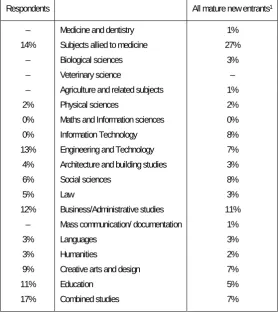
Subject area of new entrant respondents compared with all new home mature entrants to first degree/ HNC/D/DipHE in GB 1999-2000
Respondents All mature new entrants1
– Medicine and dentistry 1%
14% Subjects allied to medicine 27%
– Biological sciences 3%
– Veterinary science –
– Agriculture and related subjects 1%
2% Physical sciences 2%
0% Maths and Information sciences 0%
0% Information Technology 8%
13% Engineering and Technology 7% 4% Architecture and building studies 3%
6% Social sciences 8%
5% Law 3%
12% Business/Administrative studies 11% – Mass communication/ documentation 1%
3% Languages 3%
3% Humanities 2%
9% Creative arts and design 7%
11% Education 5%
17% Combined studies 7%
1Source: HESA, July returns from institutions for 1999-2000
The key differences here are: the underrepresentation of entrants to Subjects allied to medicine and Information technology, and the overrepresentation of entrants to Engineering and technology, Education and Combined studies. These differences were largely due to the research design which targeted those subjects where there appeared to have been the greatest decline in numbers in recent years.
4.2 Potential
mature
entrants
4.2.1 Focus groups
A total of 27 qualifying routes were identified, associated with or potentially leading to the selected subject areas in the 9 case study HEIs. The qualifying routes included Access Courses, A levels, year 0 courses, non-advanced and advanced vocational courses and community-based programmes – some delivered on campus and some outreach. A focus group (details in annexe 2) was conducted with participants on each of these qualifying routes with a total of 220 people participating.
4.2.2 Interviews
Interviewees were identified through the focus groups, qualifying route tutors, open evening and special events for mature students, admissions, and advice and guidance offices.
187 interviews were conducted:
♦ 29% were men and 70% were women ♦ 75% were over 25 years old
♦ 51% had children living in their household
Their applicant status was:
♦ 120 (64%) were current applicants (i.e. applying for entry in 2000). Of these: ♦ 66% were applying for the first time
♦ 9% were re-applicants (previously applied but not entered)
♦ 21% were ‘re-entry’ applicants (previously entered but left very soon) ♦ 4% did not reply.
♦ 54 (29%) were current deciders (thinking of entering but not sure). Of these:
♦ 50% had never applied before
♦ 44% were ‘delayed deciders’ (previously applied but not entered) ♦ 4% were ‘re-entry deciders’ (previously entered but left very soon) ♦ 2% did not reply
♦ 6 (3%) were non-entrants (definitely not applying in the near future); of these 4 had never applied previously and 2 had applied but not entered
♦ 7 (4%) were not willing to say
4.2.3 The potential entrant questionnaire
to obtain information from potential entrants in any of the settings for the fieldwork, who were either unable or unwilling to participate in a focus group or to be interviewed.
Since the HE data that was used as the starting point for the distribution of the questionnaire was revealed as unreliable and it was then used in this pragmatic fashion to capture voices that would otherwise be excluded, the response rate is not relevant here.
The number of respondents is also small so that this data should be understood as supplementing that collected from potential entrants by other means.
A total of 79 valid responses were analysed:
♦ 64% were women
♦ 42% had been offered a place in HE in the past and had either not taken it up or had left very early before they were counted as an entrant
♦ 62% intended to apply for a place in 2000/1 and 15% at some time in the future
5 LABOUR MARKET AND EMPLOYMENT FACTORS
Summary
This chapter:
♦ Focuses upon employment factors as crucial to an understanding of mature student motivation to enter HE
♦ Provides details of the importance attached to professional advancement factors: ‘to enhance career prospects’, ‘to improve qualifications’ and ‘to improve long term financial situation’ were among the five factors ranked as the most important motivations for entering HE
♦ Shows that for entrants and potential entrants studying non-vocational subjects, these factors were still important but less likely to be ranked as the top priority.
♦ Shows that for both entrants and potential entrants, employment constituted both pull factors (pulling towards a change of career or occupation) and a push factor (away from dissatisfaction with current and/or previous job)
♦ Illustrates how employment also acts as a problem – of time, money and employer support – that has to be overcome before potential entrants can become entrants.
♦
Locates these motivations in wider understandings, largely optimistic, of the local and national labour market and graduate prospects within itIn this chapter we explore the views, motivations and barriers in relation to labour market and employment factors as experienced by the adult respondents in our study. As indicated earlier, we have integrated the findings from different data sources but retained a distinction between the new entrants (those who entered HE for the first time in 1999) and the potential entrants (those not yet participating in higher education system).
5.1 New
entrants
5.1.1 The labour market as motivator
‘To enhance career prospects’ was the most important motivating factor overall, ranked as 1 (the most important) by 27% and somewhere between 1 and 5 by 79% of all respondents.
♦ A slightly higher proportion of men (31%) than women (25%) and by rather more part-time students (30%) than full-time students (26%) ranked it as the most important.
♦ It was the highest ranking motivating factor in all age groups except the 40-49 year olds who nevertheless put it in 4th position.
♦ It was the highest ranking factor among entrants in 6 of the 12 subject areas, particularly in architecture and building studies (43%), business and admin studies (38%) and engineering (36%). In most other subject areas it was the second or third most frequently ranked 1; the exception was languages where only 4% ranked it 1 and for that group it was at the bottom of the list of priorities.
‘A desire to improve my qualifications’ was the third most frequently identified as the most important motivating factor: ranked as 1 by 18% and somewhere between 1 and 5 by 71% of all respondents.
♦ A slightly higher proportion of women (19%) than men (16%) ranked it as the most important ♦ This factor was more important for part-time students (22%) for whom it was the second most
frequently ranked 1, than for full-time students (15%) for whom it was the fourth.
♦ There were also differences between the age groups: it was ranked 1 by 24% of 40-49 year olds (making it the top priority for this group) and 17% of 50+ year olds (second in order of priority). This compared to 17% – third, 16% – third, and 17% – fourth, for the 21-24, 25-29 and 30-39 year old groups respectively.
♦ There were significant differences on this factor among students in different subject areas. It was very important for business and admin studies (29% – second), education (27% – first) and engineering students (20% – second) but among languages students no-one ranked it as the most important factor.
Clearly qualifications were linked to employment opportunities as shown by the greater importance attached to this factor by those studying vocational qualifications compared to the little or no significance for those studying non-vocational subjects. The higher priority given to this factor by older age groups may therefore relate to the competitive advantage that qualifications provide in the labour market, particularly relative to younger age groups.
‘To improve long term financial situation’ was the fifth most frequently ranked 1 overall: ranked as 1 by 10% and as between 1 and 5 by 50% of all respondents.
♦ Slightly more men (11%) ranked it as the most important than women (9%); and double the proportion of full-time students (12%) compared with part-time students (6%) did so
♦ It was more important for younger age groups (under 40s) than for older ones.
♦ There were considerable differences between students in different subject areas: 14% of engineering students ranked it as 1 while among languages students no-one did so.
♦ ‘To escape unemployment’ was ranked 1 (the most important factor) by 3% of respondents overall and by 12% as somewhere between 1 and 5.
♦ ‘Because it is necessary for my job/required by my employer’ was ranked 1 by 3% and 11% ranked it somewhere between 1 and 5.
5.1.2 HE study and future career prospects
[image:37.595.84.508.257.427.2]Further questions were posed about the expected impact of HE study on future employment and career prospects and the responses are set out in table 5 below.
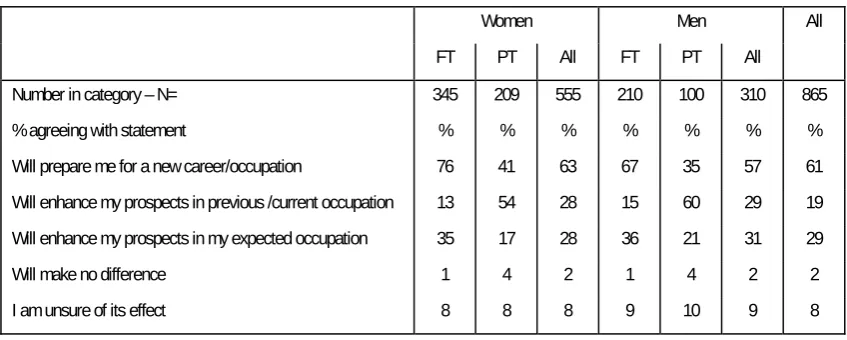
Table 5
Expectations of impact of HE on future employment prospects, all respondents, gender, mode of study
Women Men All
FT PT All FT PT All
Number in category – N= 345 209 555 210 100 310 865
% agreeing with statement % % % % % % %
Will prepare me for a new career/occupation 76 41 63 67 35 57 61 Will enhance my prospects in previous /current occupation 13 54 28 15 60 29 19 Will enhance my prospects in my expected occupation 35 17 28 36 21 31 29
Will make no difference 1 4 2 1 4 2 2
I am unsure of its effect 8 8 8 9 10 9 8
Note: Respondents could tick more than one category
Overall, the new entrants clearly saw HE as preparing them for a change in their career or occupation rather than enhancing their prospects in their previous or current occupation. There was little difference between men and women in this regard but there was a significant difference between part-time students and full-time students. Rather as might be expected, a far higher percentage of full-time than part-time students expected their HE studies to prepare them for a new career or occupation and conversely a far higher percentage of part-time students than full-time students expected their HE studies to enhance their prospects in their previous or current occupation. However, there was a significant minority of part-time students (35% of the men and 41% of the women) who were using HE to change their career or occupation.
5.1.3 Perceptions of labour market opportunities
Table 6
Assessment of current employment prospects – all respondents
Rating
Graduates in the region
%
Intended occupation in the region
%
Graduates nationally %
Intended occupation nationally
%
Excellent 7 10 5 14
Very Good 21 27 29 35
Good 53 44 55 43
Poor 17 17 11 7
Very Poor 2 2 <1 1
Total 100 100 100 100
N= 805 799 806 793
Respondents tended to rate the current employment situation in their intended occupation higher than for graduates generally:
♦ 37% rated prospects in their region for their intended occupation excellent or very good compared to 28% giving a similar rating for graduates generally;
♦ 49% rated the prospects nationally for their intended occupation excellent or very good compared to 34% for graduates generally
Respondents tended to rate the current employment situation nationally higher than those in the region:
♦ 81% rated the prospects for graduates in the region at good or better compared to 89% for graduates nationally
♦ 81% rated the prospects for their intended occupation in the region at good or better compared to 92% nationally
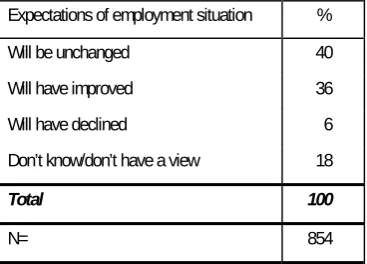
Similarly, their expectations of the employment situation in their intended occupation by the time they had completed the course were fairly optimistic, as set out in table 7 overleaf.
Table 7
Expectations of employment situation in intended occupation by time course completed
Expectations of employment situation %
Will be unchanged 40
Will have improved 36
Will have declined 6
Don’t know/don’t have a view 18
Total 100
Interestingly here the percentage responses to each category were exactly the same for men as for women.
In general therefore, it seems that the decision to apply for and enter HE was based more on a positive view of the labour market, especially in their chosen occupation, than a negative one. The purposes and expectations were related to engaging with a relatively buoyant labour market rather than to escaping a depressed labour market.
5.1.4 Employment as a barrier
Respondents were also asked what barriers had previously prevented them from applying to higher education. Interestingly, an employment related factor – ‘job responsibilities’ was the fourth most frequently ranked 1 among the barriers identified, ranked as 1 (most important) by 9% and somewhere between 1 and 5 by 36% of all respondents.
♦ More men (14%) ranked it 1 compared to women (7%)
♦ Although the same proportion (9%) of part-timers as full-timers ranked this factor as the most important, 47% of part-timers put it in the top f