Framework for Prioritizing Conservation and Research
across Multiple Scales
Bryan P. Wallace1,2,3*, Andrew D. DiMatteo1,4, Brendan J. Hurley1,2, Elena M. Finkbeiner1,3, Alan B. Bolten1,5, Milani Y. Chaloupka1,6, Brian J. Hutchinson1,2, F. Alberto Abreu-Grobois1,7, Diego
Amorocho1,8, Karen A. Bjorndal1,5, Jerome Bourjea1,9, Brian W. Bowen1,10, Raquel Brisen˜o Duen˜as1,11, Paolo Casale1,12,13, B. C. Choudhury1,14, Alice Costa1,15, Peter H. Dutton1,16, Alejandro Fallabrino1,17, Alexandre Girard1,18, Marc Girondot1,19, Matthew H. Godfrey1,20, Mark Hamann1,21, Milagros Lo´pez-Mendilaharsu1,22,23, Maria Angela Marcovaldi1,22, Jeanne A. Mortimer1,24, John A. Musick1,25, Ronel Nel1,26, Nicolas J. Pilcher1,27, Jeffrey A. Seminoff1,28, Sebastian Troe¨ng1,2,29,30, Blair Witherington1,31, Roderic B. Mast1,2
1International Union for Conservation of Nature (IUCN)/SSC Marine Turtle Specialist Group – Burning Issues Working Group, Arlington, Virginia, United States of America, 2Global Marine Division, Conservation International, Arlington, Virginia, United States of America,3Center for Marine Conservation, Duke University, Beaufort, North Carolina, United States of America,4Marine Geospatial Ecology Laboratory, Duke University, Durham, North Carolina, United States of America,5Department of Biology, Archie Carr Center for Sea Turtle Research, University of Florida, Gainesville, Florida, United States of America,6Ecological Modelling Services, Pty Ltd, University of Queensland, Brisbane, Australia,7Unidad Acade´mica Mazatla´n, Instituto de Ciencias del Mar y Limnologı´a, Universidad Nacional Auto´noma de Me´xico, Mazatla´n, Sinaloa, Me´xico,8Centro de Investigacio´n para el Medio Ambiente y Desarrollo, Cali, Colombia,9Laboratoire Ressources Halieutiques, IFREMER, Ile Reunion, France,10Hawaii Institute of Marine Biology, Kaneohe, Hawaii, United States of America,11Banco de Informacio´n sobre Tortugas Marinas (BITMAR), Unidad Mazatla´n, Instituto de Ciencias del Mar y Limnologı´a, Universidad Nacional Auto´noma de Me´xico, Mazatla´n, Sinaloa, Me´xico,12Department of Biology and Biotechnology ‘‘Charles Darwin,’’ University of Rome ‘‘La Sapienza,’’ Rome, Italy,13World Wildlife Fund (WWF) Mediterranean Turtle Programme, World Wildlife Fund-Italy, Rome, Italy,14Department of Endangered Species Management, Wildlife Institute of India, Dehradun, Uttarakhand, India,15World Wildlife Fund-Mozambique, Maputo, Mozambique,16Southwest Fisheries Science Center, National Marine Fisheries Service, National Oceanic and Atmospheric Administration (NOAA), La Jolla, California, United States of America,17Karumbe´, Montevideo, Uruguay,18Association RENATURA, Albens, France, and Pointe-Noire, Congo,19Laboratoire d’Ecologie, Syste´matique et Evolution, Universite´ Paris-Sud, Orsay, France,20North Carolina Wildlife Resources Commission, Beaufort, North Carolina, United States of America,21School of Earth and Environmental Sciences, James Cook University, Townsville, Australia,22Projeto Tamar-ICMBio/Fundac¸a˜o Pro Tamar, Salvador, Bahı´a, Brazil,23Department of Ecology, Institute of Biology, Universidade do Estado do Rio de Janeiro, Rio de Janeiro, Brazil,24Department of Biology, University of Florida, Gainesville, Florida, United States of America,25Virginia Institute of Marine Sciences, College of William and Mary, Gloucester Point, Virginia, United States of America,26School of Environmental Sciences, Nelson Mandela Metropolitan University, Summerstrand Campus, South Africa,27Marine Research Foundation, Sabah, Malaysia,28Marine Turtle Ecology and Assessment Program, Southwest Fisheries Science Center, NOAA-National Marine Fisheries Service, La Jolla, California, United States of America,29Department of Animal Ecology, Lund University, Lund, Sweden,30Scientific Advisory Committee, Sea Turtle Conservancy, Gainesville, Florida, United States of America,31Florida Fish and Wildlife Conservation Commission, Melbourne Beach, Florida, United States of America
Abstract
Background:Resolving threats to widely distributed marine megafauna requires definition of the geographic distributions of both the threats as well as the population unit(s) of interest. In turn, because individual threats can operate on varying spatial scales, their impacts can affect different segments of a population of the same species. Therefore, integration of multiple tools and techniques — including site-based monitoring, genetic analyses, mark-recapture studies and telemetry — can facilitate robust definitions of population segments at multiple biological and spatial scales to address different management and research challenges.
Methodology/Principal Findings:To address these issues for marine turtles, we collated all available studies on marine turtle biogeography, including nesting sites, population abundances and trends, population genetics, and satellite telemetry. We georeferenced this information to generate separate layers for nesting sites, genetic stocks, and core distributions of population segments of all marine turtle species. We then spatially integrated this information from fine- to coarse-spatial scales to develop nested envelope models, or Regional Management Units (RMUs), for marine turtles globally.
Citation:Wallace BP, DiMatteo AD, Hurley BJ, Finkbeiner EM, Bolten AB, et al. (2010) Regional Management Units for Marine Turtles: A Novel Framework for Prioritizing Conservation and Research across Multiple Scales. PLoS ONE 5(12): e15465. doi:10.1371/journal.pone.0015465
Editor:Steven J. Bograd, NOAA/NMFS/SWFSC, United States of America
ReceivedAugust 2, 2010;AcceptedOctober 1, 2010;PublishedDecember 17, 2010
This is an open-access article distributed under the terms of the Creative Commons Public Domain declaration which stipulates that, once placed in the public domain, this work may be freely reproduced, distributed, transmitted, modified, built upon, or otherwise used by anyone for any lawful purpose.
Funding:This study was funded by the National Fish and Wildlife Foundation and the Offield Family Foundation. These funders had no role in study design, data collection and analysis, decision to publish, or preparation of the manuscript. MYC is employed by a commercial company that provides ecological modelling services, and his involvement in this study was partially supported by this company. However, this support in no way biased his contributions to all aspects of this study, the overall process or resulting products generated by this study.
Competing Interests:The authors have declared that no competing interests exist.
* E-mail: [email protected]
Introduction
Geospatial characterization of commercially important or conservation-dependent marine species provides crucial input for resource management in multi-use situations, as is currently described by ecosystem-based marine spatial planning [1]. In particular, linking impacts of various threats to widely distributed marine megafauna populations (e.g. mammals, birds, turtles, sharks) requires description of overlaps between threats and the population segment of interest. Furthermore, widespread marine species often exhibit inter-population variation in life history traits and population dynamics that warrant population-specific man-agement schemes [2,3].
However, resolution of population units for conservation is not always straightforward, and requires clear understanding of conservation objectives, as well as the natural history of – and threats to – the species of interest [4]. For example, evolutionarily significant units (ESUs) were first described to include sufficient genetic diversity to retain evolutionary potential, and thus address long-term conservation issues as well as historical population trends [5,6]. In contrast, population segments or management units (MUs) are functionally independent (i.e. exhibit distinct demographic processes), can be characterized using various tools or indicators, such as genetic markers, life history traits, behavior, or morphology, and are appropriate short-term targets for conservation [5]. A major challenge to prioritization schemes arises when multiple population segments meet the criteria of a MU, each deserving specially designed conservation strategies.
Six of the seven marine turtle species are categorized as Vulnerable, Endangered, or Critically Endangered globally by the IUCN Red List of Threatened Species[7], but threats on regional scales can differentially affect life-stages of the same populations. Similar to other long-lived marine vertebrates, marine turtles occupy broad geographic ranges including separate breeding and feeding areas utilized by adults, and in some cases geographically distinct ontogenetic habitats for immature life stages, with different levels of population overlap at each stage [8]. Furthermore, marine turtles have complex population structures characterized by female nesting site fidelity, male-mediated gene flow, and population overlap during migrations and in developmental habitats, with the degree of genetic population structuring increasing with life stages (see [9] for review). Understanding the complex relationships among various nesting sites, nurseries, and foraging areas, particularly in the context of variation in environmental conditions, is crucial to quantifying population-level impacts of anthropogenic threats, as well as to designing effective conservation responses to these threats [10–12]. Howev-er, these complexities in population structures, habitat use, environmental factors, and life-stage-specific threats have con-founded the definition of marine turtle MUs.
Molecular genetic analyses are often used to describe population structures and, by extension, to define MUs [4,5,13]. Due to complex population structure and life history of marine turtles, different molecular analyses can be applied to determine genetic stock structure for different demographic segments of a popula-tion. Maternally inherited mitochondrial DNA (mtDNA) is useful for resolving nest site fidelity and homing behavior [14,15]. In addition to defining nesting populations (i.e. one level of MUs), this genetic marker is also useful for resolving maternal origin of both males and females at various life stages and feeding habitats [9].
Nesting females typically demonstrate philopatry to nesting areas, and both males and females can be philopatric to breeding areas adjacent to a nesting beach [16]. However, males do not restrict mating efforts to their ancestral breeding area, and apparently copulate with females in coastal feeding habitat or migratory corridors as well, where they encounter females from other regional nesting populations. The result, registered in biparentally-inherited nuclear DNA (nDNA), is that regional nesting colonies are connected by this male-mediated gene flow [2,17–18]. Because nDNA reflects contributions of both males and females, analyses of nDNA markers (e.g. microsatellites) can resolve breeding or reproductive stocks that encompass multiple mtDNA-defined nesting stocks [9,19].
Genetic analyses clearly contribute to the resolution of MUs, but are not always sufficient for this purpose; such analyses can indicate that genetic population structure exists, but usually cannot resolve the boundaries of that structure [4,20]. Unique identifier tags applied to marine turtles at various life stages and in various habitats via mark-recapture monitoring programs can illuminate migration routes and connectivity of individual animals between habitats [21–23]. Furthermore, the advent of electronic tracking technology, specifically satellite telemetry and remote sensing, has facilitated an exponential increase in understanding of marine turtle movements, behaviors, biology, and conservation concerns (see [24] for review). Therefore, integration of multiple tools and techniques, including site-based monitoring (e.g. nesting beaches, foraging areas), genetic analyses, mark-recapture studies, and telemetry, especially when supplemented with information on threats and influence of environmental conditions [25], can facilitate robust definitions of MUs for marine turtles at multiple scales to address different management and research challenges.
identifying high diversity areas, highlighting data gaps, and assessing conservation status of marine turtles.
Methods
The IUCN’s Marine Turtle Specialist Group convened the Burning Issues Working Group (MTSG-BI) for two meetings (August 2008 and September 2009) of marine turtle experts from around the world who represented government agencies, non-governmental organizations, and academic institutions. The primary objective of these meetings was to develop a process for evaluating and prioritizing the conservation status of marine turtle populations worldwide. In this context, the MTSG-BI developed Regional Management Units (RMUs) as the framework for this evaluation and prioritization process.
To generate RMUs for marine turtles, we collated and georeferenced available data from more than 1,200 papers, reports, abstracts, and other sources (available for download at http://tinyurl.com/29w4kbf), extracting information on nesting sites, population genetics, tag returns, and satellite telemetry, as well as other relevant natural history and biogeography. We then spatially integrated this information in ArcMap 9.3 (ESRI, Redlands, CA USA) from fine (i.e. points with geographic coordinates for nesting sites) to coarse (i.e. polygon shapefiles for distributions) spatial scales. We constructed separate layers according to distinct biological/spatial scales, including a layer for nesting sites (i.e. individual nesting beaches), and two layers for genetic stocks (i.e. a layer each for maternally inherited mtDNA and biparentally inherited nDNA, respectively). Finally, all finer-scale levels were nested within the known core geographic distributions of these population units, according to satellite telemetry and tag return data. In this way, all nesting sites that were sampled and analyzed for genetic studies were represented within genetic stock layers, and defined genetic stocks were represented within RMU layers, such that information shared across scales was retained in each relevant layer. We also compiled available information on population sizes (i.e. annual numbers of nesting females) and trends (i.e. change in annual numbers of nesting females over time) at each spatial/biological scale. Although considerable uncertainty exists in estimates of population sizes and trends for marine turtles among sites globally, we did not attempt to standardize or improve estimates; we urge caution in interpretation of these metadata. This ‘‘nested envelope’’ ap-proach allowed for metadata to be arranged within and across biologically defined spatial scales.
Nesting Sites
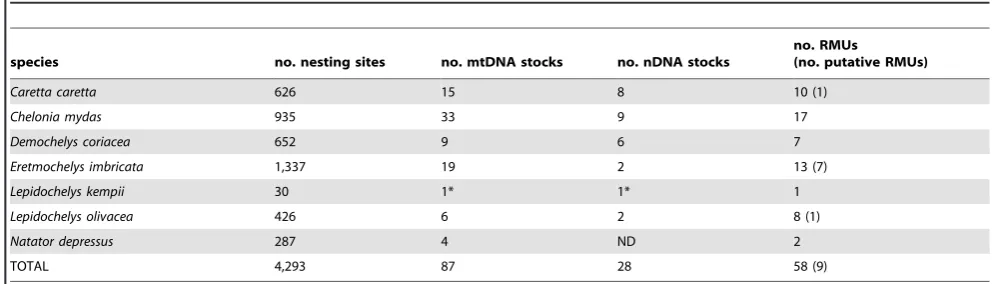
We defined a nesting site as a beach or beaches with confirmed marine turtle nesting activity monitored or analyzed as a singular site by the groups or individuals providing or publishing the nesting data. To compile and georeference nesting sites globally for all species, we used the State of the World’s Sea Turtles – SWOT (www.seaturtlestatus.org) database, which relies on a global network of researchers who voluntarily contribute annual nesting data. We augmented the SWOT database with published information. We filtered all nesting sites to distinguish sites with confirmed, quantified nesting activity (i.e. counts) from those without quantified counts since 2000. Across species globally, we compiled more than 4,200 nesting sites, ranging from 30 for Kemp’s ridleys (Lepidochelys kempii) to 1,337 for hawksbill turtles (Eretmochelys imbricata) (Table 1; Figs. 1, 2, 3, 4, 5, 6, 7, panel A). In accordance with data sharing protocols, metadata for SWOT nesting sites are not provided here. However, all SWOT nesting data can be viewed at http://seamap.env.duke.edu/swot, and a complete list of SWOT data providers is provided in Appendix S1.
Genetic Stocks
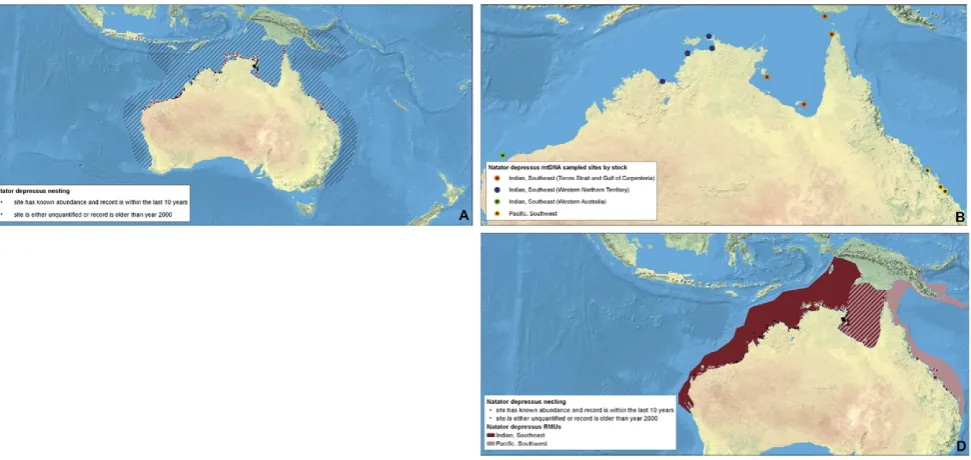
We compiled and georeferenced genetic stock information from available mtDNA and nDNA studies by constructing shapefiles that included all individual nesting sites upon which the genetic sampling and analyses were based. We identified 87 distinct mtDNA and 28 nDNA reported genetic stocks globally across marine turtle species (Table 1; Figs. 1, 2, 3, 4, 5, 6, 7, panels B and C; Appendix S2). While recognizing the diversity of analytical techniques – particularly the number and types of genetic markers, sample sizes, and statistical approaches – used to determine genetic stocks of marine turtles, we accepted genetic stock definitions as described by the original sources, rather than attempting to standardize or prioritize methodologies or interpre-tations. However, in cases where more recent studies clarified or contradicted earlier studies, we based our dataset on the results of the updated studies.
Regional Management Units
[image:3.612.59.559.561.703.2]We generated polygons representing RMUs for all species of marine turtles, or geographically explicit population segments based on geographic boundaries to distributions derived from studies on genetics, tag returns, satellite telemetry, and other data (Figs. 1, 2, 3, 4, 5, 6, 7, panel D; Table S1; Appendix S2). RMUs were meant to encompass multiple nesting sites, mtDNA-defined
Table 1.Summary of number of nesting sites, genetic stocks, and RMUs identified for all marine turtle species.
species no. nesting sites no. mtDNA stocks no. nDNA stocks
no. RMUs
(no. putative RMUs)
Caretta caretta 626 15 8 10 (1)
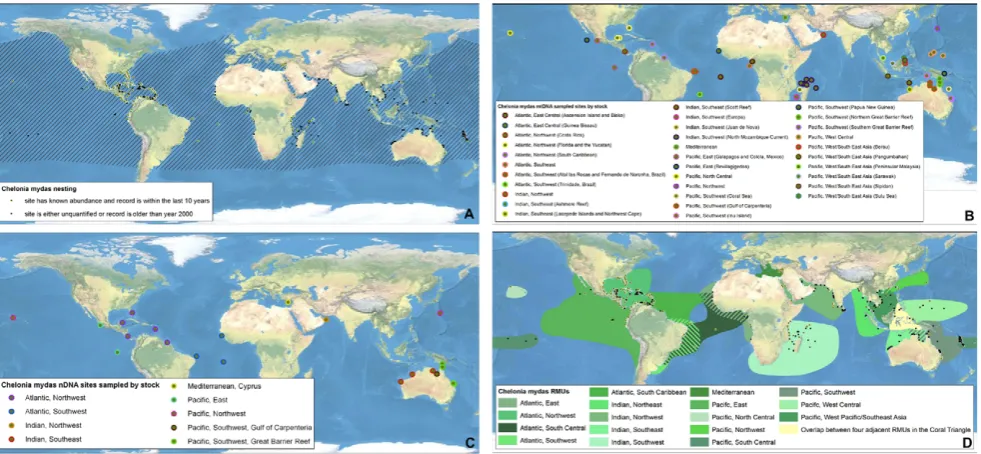
Chelonia mydas 935 33 9 17
Demochelys coriacea 652 9 6 7
Eretmochelys imbricata 1,337 19 2 13 (7)
Lepidochelys kempii 30 1* 1* 1
Lepidochelys olivacea 426 6 2 8 (1)
Natator depressus 287 4 ND 2
TOTAL 4,293 87 28 58 (9)
ND: no data. Putative RMUs were described for regions with available nesting data but no associated data on genetics or distributions. (
Figure 2. Multi-scale Regional Management Units for green turtlesChelonia mydas.Individual maps are presented for A) global nesting sites and in-water distributions (global distributions for each species represented by hatching); B) mitochondrial (mtDNA) genetic stocks; C) nuclear genetic (nDNA) stocks; and D) Regional Management Units (shown with nesting sites). Nesting sites that were unquantified or have no count values reported since 2000 are represented by black squares, whereas nesting sites for which count data are available are represented by a colored circle. For genetic stock maps (Figs. 2B and C), each symbol represents a different site that was sampled for genetic analyses, while each color represents a distinct genetic stock. Data shown are contained in metadata tables (Appendix S2).
[image:4.612.63.554.430.657.2]doi:10.1371/journal.pone.0015465.g002
Figure 1. Multi-scale Regional Management Units for loggerhead turtlesCaretta caretta.Individual maps are presented for A) global nesting sites and in-water distributions (global distributions for each species represented by hatching); B) mitochondrial (mtDNA) genetic stocks; C) nuclear genetic (nDNA) stocks; and D) Regional Management Units (shown with nesting sites). Nesting sites that were unquantified or have no count values reported since 2000 are represented by black squares, whereas nesting sites for which count data are available are represented by a colored circle. For genetic stock maps (Figs. 1B and C), each symbol represents a different site that was sampled for genetic analyses, while each color represents a distinct genetic stock. Putative RMUs (see text for description) are noted by asterisks in the figure legends, and are colorless. Data shown are contained in metadata tables (Appendix S2).
Figure 4. Multi-scale Regional Management Units for hawksbill turtlesEretmochelys imbricata.Individual maps are presented for A) global nesting sites and in-water distributions (global distributions for each species represented by hatching); B) mitochondrial (mtDNA) genetic stocks; C) nuclear genetic (nDNA) stocks; and D) Regional Management Units (shown with nesting sites). Nesting sites that were unquantified or have no count values reported since 2000 are represented by black squares, whereas nesting sites for which count data are available are represented by a colored circle. For genetic stock maps (Figs. 4B and C), each symbol represents a different site that was sampled for genetic analyses, while each color represents a distinct genetic stock. Putative RMUs (see text for description) are noted by asterisks in the figure legends, and are colorless. Data shown are contained in metadata tables (Appendix S2).
[image:5.612.62.553.420.650.2]doi:10.1371/journal.pone.0015465.g004
Figure 3. Multi-scale Regional Management Units for leatherback turtlesDermochelys coriacea.Individual maps are presented for A) global nesting sites and in-water distributions (global distributions for each species represented by hatching); B) mitochondrial (mtDNA) genetic stocks; C) nuclear genetic (nDNA) stocks; and D) Regional Management Units (shown with nesting sites). Nesting sites that were unquantified or have no count values reported since 2000 are represented by black squares, whereas nesting sites for which count data are available are represented by a colored circle. For genetic stock maps (Figs. 3B and C), each symbol represents a different site that was sampled for genetic analyses, while each color represents a distinct genetic stock. Data shown are contained in metadata tables (Appendix S2).
Figure 5. Multi-scale Regional Management Units for olive ridley turtlesLepidochelys olivacea.Individual maps are presented for A) global nesting sites and in-water distributions (global distributions for each species represented by hatching); B) mitochondrial (mtDNA) genetic stocks; C) nuclear genetic (nDNA) stocks; and D) Regional Management Units (shown with nesting sites). Nesting sites that were unquantified or have no count values reported since 2000 are represented by black squares, whereas nesting sites for which count data are available are represented by a colored circle. For genetic stock maps (Figs. 5B and C), each symbol represents a different site that was sampled for genetic analyses, while each color represents a distinct genetic stock. Putative RMUs (see text for description) are noted by asterisks in the figure legends, and are colorless. Data shown are contained in metadata tables (Appendix S2).
doi:10.1371/journal.pone.0015465.g005
Figure 6. Multi-scale Regional Management Units for Kemp’s ridley turtlesLepidochelys kempii.Individual maps are presented for A) global nesting sites and in-water distributions (global distributions for each species represented by hatching); and D) Regional Management Units (shown with nesting sites). Nesting sites that were unquantified or have no count values reported since 2000 are represented by black squares, whereas nesting sites for which count data are available are represented by a colored circle. Putative RMUs (see text for description) are noted by asterisks in the figure legends, and are colorless. Note: There are no genetics maps (Panels B or C) forL. kempiibecause all individuals are presumed to belong to same stock and RMU. Data shown are contained in metadata tables (Appendix S2).
[image:6.612.58.553.424.660.2]nesting populations, and nDNA-defined breeding populations to reflect shared geographic distribution among conspecific marine turtles in the same region. Thus, RMUs do not represent complete geographic distributions of species on global or regional scales, but rather distributions that are anchored to landmasses by known nesting site(s) and/or genetic stock origins and defined by biogeographical information.
Specifically, we defined the boundaries of RMU polygons by generating termini directly from published satellite tracks, tag returns, or other data sources. These polygons were then digitized or imported into ArcGIS 9.3 either using the georeference tool in the ArcMap Toolbox, or based on text descriptions. In the absence of sufficient information, boundaries were further refined by MTSG experts. To allow clear distinctions between RMUs and complete global distributions, we also generated global distribution polygons for all species (Figs. 1, 2, 3, 4, 5, 6, 7, panel A; Appendix S2). These global distributions are coarse geographical represen-tations of documented occurrence patterns – bounded by maximum extents – for each species. This process was generally similar to that used to generate species range maps for other taxonomic groups, such as those produced by the IUCNRed List of Threatened Species (http://www.iucnredlist.org/technical-docu-ments/spatial-data). We acknowledge that this distinction means that RMU designations might not address threats occurring outside RMU boundaries but within the distribution of a species, but RMUs nonetheless encompass known core habitats and life stages. However, the important point is that whereas global distributions simply display broad geographic ranges for each species (including RMUs), the RMUs themselves provide refined spatial guidance for conservation strategies.
Olive ridley turtles (Lepidochelys olivacea) (along with their congener, Kemp’s ridleys), are unique among marine turtles for their polymorphic nesting behavior; i.e. synchronous mass nesting at particular beaches (termedarribadas) and disperse, asynchronous
or solitary nesting at the rest of the species’ nesting beaches. Therefore, we established separate RMUs forarribadasand solitary nesters in regions where both behaviors occur (i.e. East Pacific Ocean, East Indian Ocean). Although the geographic boundaries of these RMUs are identical within a region, this dichotomy accurately reflects differences in population abundances and trends between the two behaviors [26].
In regions where nesting sites were known for certain species, but no other biological information (e.g. genetics or distributions) was available, we developed ‘putative RMUs’ so that no region-species combination was excluded. As with all RMUs, these putative RMUs will require modification as new information becomes available, but in the meantime, they represent obvious research and reporting priorities.
Results and Discussion
[image:7.612.67.553.61.291.2]We identified 58 RMUs among the seven marine turtle species worldwide, ranging from a single RMU for Kemp’s ridleys to 17 RMUs for green turtles (Chelonia mydas) (Figs. 1, 2, 3, 4, 5, 6, 7; Table S1, Appendix S2). The RMU framework is essentially a set of nested envelope models intended for multiple research and management applications. However, the efficacy of applications using RMUs depends on the accuracy and quality of the data contained in the files; data exist that we were unable to acquire and incorporate, and current designations of genetic stocks and geographic distributions are subject to change with new and improved analyses. For example, genetic analyses using new markers, larger sample sizes, and broader geographic sampling could reveal new or more nuanced stock structures, especially because insufficient sampling is always a major detractor to explanatory power of these analyses [20,27,28]. Furthermore, because RMU boundaries are sometimes based on reports that contain relatively few localizations, some of which might be species
misidentifications [29], improved data quality will help to resolve the geographic extents of RMUs.
Along these lines, because the metadata we compiled is derived from publicly available sources, the RMUs themselves will change with new, refined data. To facilitate iterative improvement of RMUs, we have made all map files (Figs. 1, 2, 3, 4, 5, 6, 7) and metadata associated with each layer (Appendix S2) available for comments and suggested edits, as well as download and analysis (in accordance with relevant data sharing protocols) by users within the OBIS-SEAMAP framework (Ocean Biogeographic Informa-tion System-Spatial Ecological Analysis of Megavertebrate Popu-lations [30]; http://seamap.env.duke.edu/swot). Thus, the appli-cability of RMUs to marine turtle conservation and research will be user-dependent, relying on collaboration among users in the community to maintain up-to-date, accurate files.
An important caveat inherent in the RMUs is that we are largely unable to differentiate between true absences (i.e. a species is not identified or is no longer present in an area despite thorough search effort) and absence due to lack of monitoring or reporting. Clearly, distributions of nesting sites and other types of information are biased by areas of high monitoring effort and reporting (e.g. Wider Caribbean region; [31]). In this vein, the maps and RMUs generally could be used in gap analyses to identify areas toward which enhanced census efforts should be directed in order to improve inter-regional comparisons of marine turtle distribution patterns. For example, the distribution of putative RMUs illustrates gaps in scientific understanding of marine turtle biogeography in much of the Indian Ocean, and biogeography of hawksbill turtles in particular (Figs. 1, 2, 3, 4, 5, 6, 7).
In addition to identifying data gaps, a major advantage of the RMU approach is the potential to connect impacts of particular threats to biologically relevant units and their associated demographic characteristics. For example, because marine turtle populations occur in terrestrial and marine habitats, the RMU tool provides the ability to overlay the geographic extent of not only nesting beach threats along a particular coastline (e.g. coastal development) to the particular marine turtle nesting sites and stocks that would be impacted, but also threats across a wider ocean area (e.g. fisheries bycatch) that could impact several nesting stocks and broader population units simultaneously [12]. Further-more, this system allows identification of spatial overlaps among RMUs – within and among species – which are important areas for conservation because threats impacting multiple RMUs might warrant different management attention than threats acting on a single RMU. Ultimately, although RMUs will not be equally valuable to conservation efforts in all regions, this framework is intended for setting conservation priorities at different levels of spatial and biological organization for marine turtles on a global scale. Below, we outline other potential applications of RMUs to marine turtle conservation and research.
Potential applications of RMUs
Identification essential habitats for marine turtles. Characterization of heavily-utilized areas for marine turtles at different spatial scales is fundamental for creating effective conservation strategies [12,32–34]. One straightforward application of RMUs is to identifying important geographic areas for marine turtle populations in terms of determination of presence, density, and richness. For example, geographic regions that host high densities of nesting sites, possibly of multiple species and/or genetic stocks, could merit investment of conservation resources. Demographic information included in the RMU
metadata could also be incorporated in these evaluations to account for abundance and trends among sites and regions.
Likewise, areas of overlap among genetic stocks or geographic distributions, as well as regional variation in population trends at various spatial or biological scales could also be identified using RMUs. Although reproduction areas are relatively discrete geographically and genetically, foraging areas for marine turtles of all life stages host con-specific individuals from multiple stocks and geographic locations [2,10,28,35–38]. Therefore, character-izing the connectivity among multiple nesting sites and multiple foraging areas – i.e. ‘many-to-many’ relationships [10] – is necessary for holistically assessing demographic trends and conservation effectiveness [38,39].
With this in mind, one next step for refining RMUs would be to expand on the genetic stocks based on nesting sites by spatially characterizing at-sea mixed-stock foraging or developmental areas [9,10,28,40,41]. Moreover, weighting distribution layers according to a relative measure of proportional habitat use (e.g. kernel densities, home ranges) – incorporating both spatial and temporal information – to distinguish among high-use areas and fringe habitats would be another useful extension of the RMU framework. Although incorporating and mapping this information would be challenging given data currently available in published research studies, this step would dramatically improve the ability of RMUs to facilitate identification of marine turtle habitats in relation to other georeferenced information of threats or environmental factors.
Improved definition of genetic stock distributions. Despite the emphasis on genetic resolution of MUs, reliance on population structure derived from such analyses can be inadequate for management [4,42]. Failure to detect population units with genetic markers does not necessarily mean that no management-relevant structuring exists. For example, a newly colonized nesting beach might host turtles that are genetically indistinguishable from the parent (source) population, yet the new nesting cohort is geographically isolated from the parent population. These limitations highlight the need for alternative types of information to make informed MU designations [20].
Along these lines, several studies have proposed or identified geographic or environmental barriers to migration of marine turtles among nesting sites or foraging areas that appear to result in significant population (but not necessarily genetic) differentia-tion. The distance between nesting sites that results in isolated nesting stocks appears to vary within [2,43] and among species [13,44]. Based on identification of 17 distinct green turtle genetic stocks among 27 nesting sites sampled in Australasia, Dethmers et al. [13] proposed that nesting sites separated by more than 500 km are likely to host isolated nesting populations; in contrast, undifferentiated leatherback (Dermochelys coriacea) genetic stocks span thousands of kilometers of coastlines within geographic regions [44]. Furthermore, recent studies have described spatial distributions of genetic stocks in foraging and developmental areas at-sea based on local and regional ocean current patterns in the Wider Caribbean [28,37], Atlantic Ocean [40], Mediterranean Sea [45], and Pacific Ocean [46,47].
population segments would allow more flexibility in defining MUs than those derived solely from quantitative analyses of genetic differentiation, and would also provide clear objectives for further analyses.
Conservation status assessments. Evaluation of species or population status, including population sizes and trends, as well as threats and relevant biological information, is a prerequisite for prioritizing conservation resources. However, because defining the relevant biological or geographic scale at which to conduct assessments and make recommendations is always a fundamental question in these processes, RMUs are a valuable resource to guide how populations of marine turtle species are assessed.
For example, theIUCN Red List of Threatened Speciesrepresents the only globally accepted system for evaluating extinction risk for species, but the IUCN/SSC Marine Turtle Specialist Group (MTSG) has debated the utility and validity of a global classification system for marine turtles, and has advocated for regional assessments (see [48] for review). A survey of MTSG members from 23 countries revealed that nearly 90% of respondents believed that regional assessments should use either ‘new MTSG criteria’ or ‘flexible, non-standardized criteria’ [48]. However, there was less consensus among members about the appropriate population segment upon which to base regional assessments, with nearly 50% of respondents stating ‘‘by geographic region,’’ ,30% stating ‘‘by genetic stocks,’’ and ,20% stating ‘‘by nesting sites,’’ illustrating the challenges inherent in defining management units for marine turtles. Utilizing the RMU framework – which contains information at each of those spatial and biological scales – within or in conjunction with the Red List assessment process could address some of the controversy within the MTSG regarding the application of a single global listing for geographically variable marine turtle species by providing regional units for assessment [48,49].
Another example of incorporating population differences in conservation status assessments is the listing process under the U.S. Endangered Species Act (ESA). The ESA provides for designation and listing of Distinct Population Segments (DPS) of a species based on ‘discreteness’ and ‘significance’ of that segment [50,51]. In a recent Biological Review of loggerhead turtles (Caretta caretta) for purposes of evaluating the species’ current Threatened listing status on ESA, nine DPSs were defined, with distinct recommen-dations for each DPS [52]. Not surprisingly, the process by which DPSs are defined is very similar to that used to define RMUs, as both depend on biogeographical information from genetics, distribution, movements, and demographics. There was nearly complete agreement between the loggerhead DPSs and our RMU designations; the two schemes essentially differed only in how putative RMUs are handled [52] (Table 1). This result provides further support for the validity of the RMU framework for intra-specific conservation assessments.
It is important to note that in geographic regions where there are existing systems for effectively identifying marine turtle population segments to which to target conservation efforts, such as well-defined breeding populations in eastern Australia [13,16,18,21–23], RMUs will be of limited utility. In contrast, RMUs will be most appropriately applied to areas hosting several populations or stocks, possibly of multiple species, especially in regions with relatively little available information. Thus, RMUs are designed to be coarse yet flexible enough to be applicable anywhere in the world, rather than being restricted to areas with the best available information, but can be refined in the future when new information becomes available.
Marine spatial planning and applications to similar species with complex life histories. To optimize ecosystem function, especially in areas where multiple activities by multiple nations occur, ecosystem-based marine management approaches should be designed to preserve marine biodiversity, keystone species, and biological connectivity among marine habitats [1,53]. Thus, detailed characterizations of distributions and natural histories of key species (e.g. keystones, top predators, ecosystem engineers) are instrumental to guiding exercises in marine spatial planning [54].
RMUs provide explicit, ecologically based spatial and demo-graphic information about geodemo-graphic distributions of marine turtle populations that could be integrated with other georefer-enced layers, including human activities subject to management (e.g. fisheries operations, hydrocarbon extraction, coastal devel-opment, shipping, etc.). Furthermore, the RMU concept could be applied easily to multi-scale biogeographical characterization of other marine megafauna species with similar life history traits and broad, complex distributions. As with marine turtles, identification of high-use habitats, connectivity between breeding and feeding areas, as well as overlapping distributions of distinct populations is extremely important for designing appropriate management schemes for these species [55–58].
Conclusions. The novel RMU framework synthesizes available biogeographical information on globally distributed and imperiled marine turtles into a multi-scaled, geospatial tool for which we envision numerous pertinent applications for marine turtle conservation and research. For example, the MTSG Burning Issues Working Group is utilizing RMUs as the basis for status assessments in a developing process of global conservation priority setting for marine turtles. The RMU classification system is consistent with endangered species laws in the United States and elsewhere, and could provide the IUCN-MTSG with a way forward for regional evaluations of extinction risk.
Although species are predominantly used as the currency for evaluating and prioritizing conservation efforts (e.g.IUCN Red List, Alliance for Zero Extinction, Conservation ‘Hotspots’), in the case of globally distributed species like marine turtles, regional population segments occupy distinct ecological roles and thus merit conservation attention, because extinction of an RMU would represent the loss of the species’ ecological role within an entire region and ecosystems therein [59]. By defining populations according to ecological characteristics, the RMU approach implies the inherent importance of each RMU as an independent conservation unit, which species-focused conservation approaches might fail to recognize.
Supporting Information
Table S1 Summary of Regional Management Units (RMUs) for marine turtles worldwide, including number of nesting sites and genetic stocks contained within each RMU.
(DOC)
Appendix S1 Complete list of SWOT – The State of the World’s Sea Turtles data providers.
(XLS)
Appendix S2 Metadata associated with each layer synthesized to generate Regional Management Units.
(XLS)
Acknowledgments
This work resulted from meetings of the IUCN/SSC Marine Turtle Specialists Group’s Burning Issues Working Group, which consisted of
representatives of governmental agencies, NGOs, and academia from around the world. Special recognition goes to SWOT Team members and partners who contributed information to the SWOT database and to this initiative. We thank MTSG members and others who contributed valuable comments, including GC Hays and an anonymous reviewer.
Author Contributions
Conceived and designed the experiments: BPW ADD BJH EMF ABB MYC BJH FAAG DA KAB JB BWB RBD PC BCC AC PHD AF AG MG MHG MH MLM MAM JAM JAM RN NJP JAS ST BW RBM. Performed the experiments: BPW ADD BJH EMF. Analyzed the data: BPW ADD BJH EMF. Contributed reagents/materials/analysis tools: BPW ADD BJH EMF ABB MYC BJH FAAG DA KAB JB BWB RBD PC BCC AC PHD AF AG MG MHG MH MLM MAM JAM JAM RN NJP JAS ST BW RBM. Wrote the paper: BPW ADD BJH EMF ABB MYC BJH FAAG DA KAB JB BWB RBD PC BCC AC PHD AF AG MG MHG MH MLM MAM JAM JAM RN NJP JAS ST BW RBM.
References
1. Foley MM, Halpern BS, Micheli F, Armsby MH, Caldwell MR, et al. (2010) Guiding ecological principles for marine spatial planning. Mar Pol 34: 955–966. 2. Bowen BW, Bass AL, Soares L, Toonen RJ (2005) Conservation implications of complex population structure: lessons from the loggerhead turtle (Caretta caretta). Mol Ecol 14: 2389–2402.
3. Suryan RM, Saba VS, Wallace BP, Hatch SA, Frederiksen M, et al. (2009) Environmental forcing on life history strategies: Multi-trophic level response at ocean basin scales. Prog Oceanogr 81: 214–218.
4. Taylor BL, Dizon AE (1999) First policy then science: why a management unit based solely on genetic criteria cannot work. Mol Ecol 8: S11–S16. 5. Moritz C (1994) Defining ‘evolutionary significant units’ for conservation.
Trends in Ecology & Evolution 9: 373–375.
6. Ashley MV, Willson MF, Pergams ORW, O’Dowd DJ, Gende SM, et al. (2003) Evolutionarily enlightened management. Biol Conserv 111: 1150–123. 7. IUCN (2010) IUCN Red List of Threatened Species. Version 2010.1. www.
iucnredlist.org. Downloaded on 11 April 2010.
8. Musick JA, Limpus CJ (1997) Habitat utilization and migration in juvenile sea turtles. In: Lutz PL, Musick JA, eds. The Biology of Sea Turtles. Boca RatonFL: CRC Press. pp 137–164.
9. Bowen BW, Karl SA (2007) Population genetics and phylogeography of sea turtles. Mol Ecol 16: 4886–4907.
10. Bolker BM, Okuyama T, Bjorndal KA, Bolten AB (2007) Incorporating multiple mixed stocks in mixed stock analysis: ‘many-to-many’ analyses. Mol Ecol 16: 68–695.
11. Wallace BP, Saba VS (2009) Environmental and anthropogenic impacts on intra-specific variation in leatherback turtles: opportunities for targeted research and conservation Endangered Species Research 7: 1–11.
12. Hamann M, Godfrey MH, Seminoff JA, Arthur K, Barata PCR, et al. (2010) Global research priorities for sea turtles: informing management and conservation in the 21st century. Endangered Species Research 11: 245–269. 13. Dethmers KEM, Broderick D, Moritz C, FitzSimmons NN, Limpus CJ, et al.
(2006) The genetic structure of Australasian green turtles (Chelonia mydas): exploring the geographical scale of genetic exchange. Mol Ecol 15: 3931–3946. 14. Meylan AB, Bowen BW, Avise JC (1990) A genetic test of the natal homing versus social facilitation models for green turtle migration. Science 248: 724–727.
15. Bowen BW, Bass AL, Chow S-M, Bostrom M, Bjorndal KA, et al. (2004) Natal homing in juvenile loggerhead turtles (Caretta caretta). Mol Ecol 13: 3797–3808. 16. FitzSimmons NN, Limpus CJ, Norman JA, Goldizen AR, Miller JD, et al. (1997a) Philopatry of male marine turtles inferred from mitochondrial DNA markers. Proc Nat Acad Sci 94: 8912–8917.
17. Karl SA, Bowen BW, Avise JC (1992) Global population genetic structure and male-mediated gene flow in the green turtle (Chelonia mydas): RFLP analyses of anonymous nuclear loci. Genetics 131: 163–173.
18. FitzSimmons NN, Moritz C, Limpus CJ, Pope L, Prince R (1997b) Geographic structure of mitochondrial and nuclear gene polymorphisms in Australian green turtle populations and male-biased gene flow. Genetics 147: 1843–1854. 19. Carreras C, Pascual M, Cardona LM, Aguilar A, Margaritoulis D, et al. (2007)
The genetic structure of the loggerhead sea turtle (Caretta caretta) in the Mediterranean as revealed by nuclear and mitochondrial DNA and its conservation implications. Cons Gen 8: 761–775.
20. Martien KK, Taylor BT (2003) Limitations of hypothesis-testing in defining management units for continuously distributed species. J Cet Res Manag 5: 213–218.
21. Limpus CJ, Miller JD, Parmenter CJ, Reimer D, McLachlan N, et al. (1992) Migration of green (Chelonia mydas) and loggerhead (Caretta caretta) turtles to and from eastern Australian rookeries. Wildlife Res 19: 347–358.
22. Limpus CJ, Miller JD, Parmenter CJ, Limpus DJ (2003) The green turtle, Chelonia mydas, population of Raine Island and the Northern Great Barrier Reef: 1843-2001. Memoirs Queensland Museum 49: 349–440.
23. Limpus CJ (2008) A biological review of Australian Marine turtles: Green turtle Chelonia mydas(Linnaeus), Queensland Environmental Protection Agency, 96. 24. Godley BJ, Blumenthal JM, Broderick AC, Coyne MS, Godfrey MH, et al.
(2008) Satellite tracking of sea turtles: Where have we been and where do we go next? Endangered Species Research 4: 3–22.
25. Godley BJ, Barbosa C, Bruford M, Broderick AC, Catry P, et al. (2010) Unravelling migratory connectivity in marine turtles using multiple methods. J Appl Ecol;doi: 10.1111/j.1365-2664.2010.01817.x.
26. Abreu-Grobois FA, Plotkin PT (2007) IUCN Red List Status Assessment of the olive ridley sea turtle (Lepidochelys olivacea). IUCN/SSC-Marine Turtle Specialist Group, 39.
27. Formia A, Broderick AC, Glen F, Godley BJ, Hays GC, et al. (2007) Genetic composition of the Ascension Island green turtle rookery based on mitochondrial DNA: implications for sampling and diversity. Endangered Species Research 3: 145–158.
28. Blumenthal JM, Abreu-Grobois FA, Austin TJ, Broderick AC, Bruford MW, et al. (2009) Turtle groups or turtle soup: dispersal patterns of hawksbill turtles in the Caribbean. Mol Ecol 18: 4841–4853.
29. Frazier J (1985) Misidentifications of sea turtles in the East Pacific:Caretta caretta andLepidochelys olivacea. J Herp 19: 1–11.
30. Halpin PN, Read AJ, Fujioka E, Best BD, Donnelly B, et al. (2009) OBIS-SEAMAP The World Data Center for Marine Mammal, Sea Bird, and Sea Turtle Distributions. Oceanography 22: 104–115.
31. Dow W, Eckert KL, Palmer M, Kramer P (2007) An Atlas of Sea Turtle Nesting Habitat for the Wider Caribbean Region. The Wider Caribbean Sea Turtle Conservation Network and The Nature Conservancy. WIDECAST Technical Report No. 6, Beaufort, NC, USA, 267.
32. Dryden J, Grech A, Moloney J, Hamann M (2008) Re-zoning of the Great Barrier Reef World Heritage Area: does it afford greater protection for marine turtles? Wildlife Res 35: 477–485.
33. Witt MJ, Broderick AC, Coyne MS, Formia A, Ngouessono S, et al. (2008) Satellite tracking highlights difficulties in the design of effective protected areas for Critically Endangered leatherback turtlesDermochelys coriaceaduring the inter-nesting period. Oryx 42: 296–300.
34. Shillinger GL, Palacios DM, Bailey H, Bograd SJ, Swithenbank AM, et al. (2008) Persistent leatherback turtle migrations present opportunities for conservation. PLoS Biol 6: e171.
35. Bolten AB, Bjorndal KA, Martins HR, Dellinger T, Biscoito MJ, et al. (1998) Transatlantic development migrations of loggerhead sea turtles demonstrated by mtDNA sequence analysis. Ecol App 8: 1–7.
36. Lahanas PN, Bjorndal K, Bolten A, Encalada SE, Miyamoto MM, et al. (1998) Genetic composition of a green turtle (Chelonia mydas) feeding ground population: evidence for multiple origins. Mar Biol 130: 345–352.
37. Bass AL, Epperly SP, Braun-McNeill J (2006) Green turtle (Chelonia mydas) foraging and nesting aggregations in the Caribbean and Atlantic: impact of currents and behavior on dispersal. J Hered 97: 346–354.
39. Bjorndal KA, Bolten AB, Troeng S (2005) Population structure and genetic diversity in green turtles nesting at Tortuguero, Costa Rica, based on mitochondrial DNA control region sequences. Mar Biol 147: 1449–1457. 40. Monzon-Arguello C, Lopez-Jurado L, Rico C, Marco A, Lopez P, Hays G, Lee P
(2010) Evidence from gnetic and Lagrangian drifter data for transatlantic transport of small juvenile green turtles. J Biogeogr 37: 1752–1766. 41. Bass AL, Epperly S, Braun-McNeill J (2004) Multi-year analysis of stock
composition of a loggerhead turtle (Caretta caretta) foraging habitat using maximum likelihood and Bayesian methods. Cons Gen 5: 783–796. 42. Waples RS, Punt AE, Cope JM (2008) Integrating genetic data into
management of marine resources: how can we do better? Fish and Fisheries 9: 423–449.
43. Lahanas PN, Miyamoto MM, Bjorndal KA, Bolten AB (1994) Molecular evolution and population genetics of Greater Caribbean green turtles (Chelonia mydas) as inferred from mitochondrial DNA control region sequences. Genetica 94: 57–67.
44. Dutton PH, Bowen BW, Owens DW, Barragan A, Davis SK (1999) Global phylogeography of the leatherback turtle (Dermochelys coriacea). J Zool (Lond) 248: 397–409.
45. Carreras C, Pont S, Maffucci F, Pascual M, Barcelo´ A, et al. (2006) Genetic structuring of immature loggerhead sea turtles (Caretta caretta) in the Mediterranean Sea reflects water circulation patterns. Mar Biol 149: 1269–1279. 46. Bowen BW, Abreu-Grobois FA, Balazs GH, Kamezaki N, Limpus CJ, et al. (1995) Trans-Pacific migrations of the loggerhead turtle (Caretta caretta) demonstrated with mitochondrial DNA markers. Proc Nat Acad Sci 92: 3371–3734.
47. Boyle MC, Fitzsimmons NN, Limpus CJ, Kelez S, Velez-Zuazo X, et al. (2009) Evidence for transoceanic migrations by loggerhead turtles in the southern Pacific Ocean. Proc Roy Soc B 276: 1993–1999.
48. Seminoff JA, Shanker K (2008) Marine turtles and IUCN Red Listing: A review of the process, the pitfalls, and novel assessment approaches. J Exp Mar Biol Ecol 356: 52–68.
49. Mrosovsky N (2003)Predicting Extinction: Fundamental Flaws In IUCN’s Red List System, Exemplified By The Case Of Sea Turtles. http://members.seaturtle.org/ mrosovsky/.
50. Waples RS (1995) Evolutionary significant units and the conservation of biological diversity under the Endangered Species Act.Evolution and the Aquatic Ecosystem: Defining Unique Units in Population Conservation(ed. JL Nielsen), pp. 8-27. American Fisheries Society Symposium 17, American Fisheries Society, Bethesda, MD.
51. U.S. Fish and Wildlife Service and National Marine Fisheries Service (1996) Policy regarding the recognition of distinct vertebrate population segments under the Endangered Species Act. Federal Register 61(26): 4722–4725. February 7, 1996.
52. Conant TA, Dutton PH, Eguchi T, Epperly SP, Fahy CC, et al. (2009) Loggerhead sea turtle (Caretta caretta) 2009 status review under the U.S. Endangered Species Act. Report of the Loggerhead Biological Review Team to the National Marine Fisheries Service, August 2009. 222 p.
53. Bowen BW (1999) Preserving genes, ecosystems, or species? Healing the fractured foundations of conservation policy. Mol Ecol 8: S5–S10.
54. Crowder LB, Norse E (2008) Essential ecological insights for marine ecosystem-based management and marine spatial planning. Mar Pol 32: 772–778. 55. Block BA, Teo SLH, Walli A, Boustany A, Stokesbury MJW, et al. (2005)
Electronic tagging and population structure of Atlantic bluefin tuna. Nature 434: 1121–1127.
56. Foote AD, Simila¨ T, Vı´kingsson GA, Stevick PT (2009) Movement, site fidelity and connectivity in a top marine predator, the killer whale. Evol Ecol;DOI: 10.1007/s10682-009-9337-x.
57. Yorio P (2009) Marine protected areas, spatial scales, and governance: implications for the conservation of breeding seabirds. Cons Lett 2: 171–178. 58. Jorgensen SJ, Reeb CA, Chapple TK, Anderson S, Perle C, et al. (2010)
Philopatry and migration of Pacific white sharks. Proc of the Roy Soc B 277: 679–688.