Children’s Social Care Innovation Programme Evaluation Report 42
Evaluation of
Multisystemic Therapy
for adolescent
problematic sexual
behaviour
Research report
July 2017
2
Contents
List of tables 4
Executive Summary 5
Overview of project 8
Intended outcomes 8
Research context 9
Changes to the project’s intended outcomes or activities 11
Innovation context 11
Overview of the evaluation 13
Evaluation questions 13
Implementation 13
Comparison to MAU 13
Research fidelity 13
Summary of methodology 13
Questionnaires 16
Changes to evaluation methodology 18
Key Findings 19
Participant characteristics 21
Primary Outcome 23
Secondary Outcomes 23
Qualitative research 28
Staff interviews 29
Limitations of the outcomes 31
Impact on the Innovation Programme’s objectives and areas of focus 31
Barriers 32
Facilitators 33
Limitations of the evaluation and future evaluation 34
Appropriateness of evaluative approach for this innovation 35 Capacity built for future evaluation and the sustainability of the evaluation 35
3
Implications and Recommendations for Policy and Practice 37 Evaluative evidence, or lack of, for capacity and sustainability of the innovation 37 Conditions necessary for this innovation to be embedded 38 Consideration of future development of the innovation and wider application 38
4
List of tables
Table 1: Participants’ characteristics 21
Table 2: Out of home placements 23
Table 3: Pre-post treatment comparisons for selected secondary outcomes 24
5
Executive Summary
The Services for Teens Engaging in Problem Sexual Behaviour (STEPS-B) trial aimed to assess the feasibility of implementation of MST-PSB, a family-based intervention for problematic sexual behaviour. We sought to determine whether Multisystemic Therapy – Problem Sexual Behaviour (MST-PSB) could be implemented fully and at a scale that would warrant a full trial.
Multisystemic Therapy (MST) is an intensive clinical treatment programme which aims to involve all environmental factors which affect juvenile offending, including family, school, and the community. MST-PSB is an adaptation of MST aimed at adolescents who have engaged in problematic sexual behaviours and often demonstrated other problem
behaviours. It is an intensive family- and home-based intervention uniquely developed to address the multiple determinants of problematic sexual behaviour in adolescents. MST-PSB is designed to reduce problematic sexual behaviours; antisocial behaviours, and out-of-home placements. Supplementary to MST, MST-PSB has a greater focus on safety planning, individual factors (for example, impulsivity, social anxiety) related to problematic sexual behaviours (PSBs), and interventions specific to problem sexual behaviour, such as offence clarification sessions aimed at increasing accountability and safety, and the promotion of normative sexual behaviour. Furthermore, family therapy techniques, such as structural and strategic family therapy interventions, are utilized to a greater extent than in standard MST. In addition, the impact of the young person’s own victimization and experience of abuse is assessed. For the purpose of the present trial, PSB is defined as any sexual behaviour which is harmful, either to the victims of the young person’s behaviour, or the young person themselves.
The primary aim of the STEPS-B trial was determining whether MST-PSB reduces the incidence of out-of-home placement compared to management as usual (MAU). A range of secondary outcomes assessed as part of the trial included sexual and non-sexual offending rates and antisocial behaviours; participant well-being; family functioning, and total service and criminal justice sector costs. The quantitative data, collected at baseline
(beginning of treatment), and at 8, 14, and 20 month follow-up points, measured problematic sexual behaviour; associated mental health problems and disorders;
emotional and behavioural functioning, as well as domains central to the mechanisms by which MST-PSB is supposed to work: quality of parent-adolescent relationship; parenting skills and parental mental health.
6
uptake of participants, such as a relatively low pool of adolescents showing problematic sexual behaviour to start with, poor and unintegrated systems for identifying and helping young people showing PSBs, court delays and ongoing police involvement that
complicated and prohibited involvement, and the stigma and shame associated with disclosure by young people and their carers.
The primary outcome of out-of-home placement was seen in only 4 cases, 2 in each group and therefore was not meaningful as a potential between-group difference. The general trend from analyses of secondary outcomes was that both groups improved over time, which may reflect spontaneous recovery over time in moving from a crisis or
intensely difficult period associated with detection and disclosure. Examining the effect sizes of the pre-post analyses of the secondary outcomes suggests that MST would likely have shown significant improvements in parental involvement and the degree to which family members felt connected to each other and supported when compared to MAU.
The results of qualitative interviews revealed that young people had strong negative feelings about themselves, were embarrassed or ashamed of the behaviour which led to their engagement with MST-PSB, and had fears about being stigmatised by their family, friends, peers, and society at large. Most parents did not report ongoing problematic behaviour from their child, but experienced the allegations of PSB as unexpected and shocking, and as something which caused them to lose confidence in themselves as parents, and to lose confidence in their child. Parents had similar concerns about
stigmatisation, but also felt they needed to protect their child. Overall, both young people and parents felt that they had benefited from MST-PSB. Young people felt that they had an improved attitude towards themselves and improved behavioural regulation, while parents did not report any recurrence of PSB and felt that their relationship with their adolescent had improved, as had their adolescent’s behaviour at home and/or at school. Finally, parents felt confident that they would be able to continue using the skills they learned during the programme but also identified residual feelings of guilt and residual behaviour problems.
There are strong, positive statements from MST staff that MST-PSB was an exciting and workable framework for working with young people presenting with complex needs: in this case those young people showing PSB. It was clear that MST-PSB was an
intervention delivered with strong commitments from MST personnel dedicated to
7
degree to which the model and working practices were applicable to the heterogeneity seen in young people (and families) showing PSB, and the degree to which any 1 professional can deal with the complex treatment needs of such a population.
Specifically, there was some question as to the degree to which families where trauma was part of the clinical picture with young people and/or their carers would be adequately served within the general 5-7month time frame, and, in this respect, the degree to which all therapists possessed the skills for working with trauma, even with the support
8
Overview of project
Intended outcomes
Despite the social, psychological, and economic costs of juvenile sexual offending, few empirically validated interventions aimed at young people with PSB exist (Borduin et al., 2011). Historically, sexual offenders were offered either non-specific treatments, such as behavioural therapy or group therapy, or nothing at all. Current programmes available to sexual offenders in the UK, such as the Northumbria Sex Offenders Group Programme or Becoming New Me, tend to emphasise helping offenders understand their behaviour, and increasing awareness of victim harm (Ministry of Justice, 2017). The only evidence-based interventions available to young people with PSB are Cognitive Behavioural Therapy (CBT) and MST-PSB. The Brandon Centre first began offering MST-PSB in the UK in 2009.
The MST-PSB intervention was developed as an adaptation of MST, originally aimed at young offenders in the United States. Using well-validated treatment strategies derived from pragmatic family therapies, behavioural parent training, and cognitive-behavioural therapy, MST directly addresses intrapersonal (for example, cognitive problem solving), familial (for example, inconsistent discipline, low monitoring, family conflict), and
community (for example, association with deviant peers, school difficulties) factors that are associated with youth serious antisocial behaviour, including sexual offending. Because different contributing factors are relevant for different youth and families, MST interventions are individualized and flexible, and based on 9 treatment principles, such as working together with families, focusing on the present and involving family strengths, therapists exerting continuous effort in trying to help the family, and investing in the caregivers’ abilities to develop skills that can address problems once the intervention is over (Hengeller et al. 2002). The 9 principles are applied in the context of using well-validated treatment strategies derived from pragmatic family therapies, behavioural parent training, and cognitive-behavioural therapy.
To address the clinical issues specific to juveniles who have sexually offended and their families, MST for juvenile sexual offenders is identical to standard MST in its broad and individualized focus on the risk factors associated with juvenile offending generally, but enhances standard MST by addressing aspects of the social ecology that are functionally related to the youth’s sexual delinquency. The 3 main adaptations to MST are that
9
The STEPS-B trial aimed to assess the feasibility of implementation of this family-oriented intervention and the barriers to implementing it, given the intense stigma and blame attached to young people who display problem sexual behaviour (Zimring, 2009), as well as the well-documented challenges to effectively identifying, assessing and intervening with this clinical population in the UK (HM Inspectorate of Probation).
The aim of the trial was to determine whether MST-PSB could be implemented fully and at a scale that would warrant a full trial, as well as evaluating the effectiveness of MST-PSB in a UK context. This feasibility trial followed rigorous randomised clinical trial (RCT) guidelines and therefore part of the evaluation was to discern whether a stringent RCT was realisable, as there have been no previous RCTs of interventions addressing adolescent problem sexual behaviour in the UK.
The primary outcome of the study was to determine whether MST-PSB could contribute to a reduction in the incidence of out-of-home placements for young people who are at risk of being removed from their homes, primarily because of problem sexual behaviour. To address this, data was collected to determine the proportion of cases assigned to a long term (≥3 months) out-of-home placement in specialist residential provision at 20 month follow up.
In addition, the study addressed several secondary outcomes, including:
• elimination or reduction in the levels of sexual and non-sexual offending • elimination or reduction in problem sexual behaviours
• reduction in anti-social behaviour • less time spent in custodial institutions • improved educational outcomes
• improved family functioning
Finally, the project was designed to establish the cost of MST-PSB relative to
management as usual (MAU), and the cost-effectiveness of providing this intensive form of intervention against the background of costs incurred in the 20-month period following randomisation.
Research context
10
their parents can experience stigma, hostility and rejection from their community
(Zimring, 2009). Despite the evolving knowledge base concerning juvenile sex offenders, much less progress has been made in developing effective interventions. In a recent systematic review of interventions designed to prevent reoffending among known sex offenders and individuals at risk of sexually abusing children, Langstrom and colleagues (2013) were able to identify only 8 intervention studies that fulfilled their criteria, including 5 prospective observational studies and 3 randomised controlled trials (RCTs); none of these studies had been conducted in the UK.
The authors concluded that an implementation of multisystemic therapy (MST) tailored to problematic sexual behaviours (MST-PSB) (Borduin, Schaeffer, & Heiblum, 2009)
showed limited evidence for helping to reduce sexual reoffending in adolescent sexual offenders. However, in a meta-analysis of adolescent and adult treatment programs of sexual offenders, Hanson and colleagues pointed to the benefits of MST-PSB for
reducing adolescent problem sexual behaviour, and highlighted MST as a rare example of an intervention that is consistent with the risk, need, and responsivity principles for effective offender treatment (Andrews & Bonta, 2010). Importantly, one of the lessons learned from the adult treatment of sexual offenders is that adult sexual offenders who attend, and co-operate with, treatment programmes are less likely to reoffend than those who reject interventions (Hanson & Bussiere, 1998).
MST-PSB is therefore one of the few evidence-based interventions currently available for adolescents showing problem sexual behaviour. However, despite some initial positive findings, the effectiveness of MST-PSB needs to be carefully assessed in the UK mental health and juvenile justice context. The pattern of results found in transportability RCT evaluations of standard MST in Canada and Europe suggest that the effectiveness of MST-PSB needs to be demonstrated outside the USA. Specifically, the magnitude of the associations between standard MST and treatment outcomes are substantially higher in trials that involved the developers of the intervention (effect size = 0.81) than in studies conducted without their close involvement (effect size = 0.27) (Curtis, Ronan, & Borduin, 2004).
This pattern of results leaves open the possibilities of developer effects and that the relative success of standard MST may be due to the relatively lower quality of usual services for managing antisocial behaviour in the USA compared with usual services in other countries. MST may produce better outcomes only when usual services produce weak, null or even negative effects. Thus, the superiority of MST-PSB needs to be demonstrated outside the USA in studies where the therapists delivering MST are independent of those who were involved in the development of MST-PSB (as
11
and where the sentencing policy within the justice system does not result in comparison with alternatives, such as custodial sentences.
Further to the implementation context, given the different ways in which young people displaying sexually harmful behaviour are referred in the United Kingdom, it is possible that participants in the UK trial will differ from their counterparts in the United States in the nature and severity of their problem sexual behaviour, as well as in their co-occurring mental health disorders and problems. For example, mental health systems for
identifying and treating young people showing problematic sexual behaviours are
underdeveloped in the U.K. and therefore, it is possible that young people showing both problematic sexual behaviours and conduct problems may not be identified to the same degree as those in the United States (Hackett, Mason & Phillips, 2005)
Changes to the project’s intended outcomes or activities
No major changes were made to the project’s methodology or outcomes, with the exception of the costing analysis. Although there was an initial intention to conduct an analysis to compare the economic costs of MST-PSB and MAU, it was not feasible to carry this out at this early stage in the intervention. The youth offending data was not available at the time of writing, and out-of-home placement, the primary focus of the study, was very limited. Importantly, the service-use data was collected as a secondary outcome from the parent and YP, and so these numbers are low, and increasingly so at successive follow-up points. With very limited data, consultation with our health economic team suggests that variation is likely to be high in the service-use and offending data and influenced by a few high-cost individuals. As the issue around offending data has now been resolved, the health economic team is in the process of reviewing the data to determine what can reliably be done. We do know that the average cost of an MST-PSB case is approximately £10-£12,000.As will be discussed later in the report, the number of participants randomized to each of the respective conditions, MST=21; MAU=19, was much lower than anticipated, with some attrition across the follow-up period. Consequently, meaningful statistical analyses were very limited, although, as part of the report, we carried out pre-post analyses on secondary outcomes.
Innovation context
12
showing variable rates of PSB offending in conjunction with a needs analysis, indicated that PSB referrals would also need to come from multiple boroughs. A pilot of the MST-PSB intervention, before running the trial, also suggested this. Thus recruitment of cases for MST-PSB would require referrals from multiple boroughs. The service was therefore publicised and expanded across many London boroughs, for example as far afield as Dagenham and Redbridge in east London, Barnet in north London, Southwark in south London and Ealing in west London.
13
Overview of the evaluation
Evaluation questions
The primary aim of this study was to conduct a rigorous, community-based feasibility trial in which MST-PSB was compared with the range of services that are typically provided to adolescent sexual offenders in the UK (that is, MAU). The specific research questions addressed were as follows:
Implementation
• can MST-PSB be implemented with fidelity to the group of young people displaying sexually harmful behaviour in the UK?
• what are professional views concerning MST as an appropriate treatment, and towards conducting research in this area?
• what are the views of young people and their carers toward the appropriateness and usefulness of MST-PSB?
Comparison to MAU
• is it feasible to evaluate MST-PSB in comparison with the usual services offered to the population of young people displaying problematic sexual behaviour and is a larger scale, national trial warranted?
• is MST-PSB more effective than MAU in reducing out-of-home placements and sexual and non-sexual offending?
• is MST-PSB more effective than MAU in improving emotional health and well-being, family and peer relationships, and educational outcomes for young people? • what key aspects of programmes are associated with outcomes across the 2
intervention conditions?
Research fidelity
• what are the views of young people and their carers toward the research strategy and measures currently part of our MST-PSB research protocol?
Summary of methodology
14
study in 5 phases from April 2012 to January 2016. In total, 162 referrals were received; 23% have been randomised to MST-PSB or the management as usual (MAU) available in the referring borough. 52% of cases did not meet criteria and only 1% declined
because of the research evaluation. There were many reasons why cases did not meet criteria, including many referrals where the problematic sexual behaviour occurred more than 2 years prior to the referral, or was not serious enough to warrant MST involvement (for example, excessive masturbation), situations where the case was still under
investigation by the police or the young person was placed in custody; or cases where young people had mental health issues such as Autistic Spectrum Disorder that were exclusion criteria.
Of the total 40 families accepted into the trial, 57% were referred by social care, 40% by YOS, and 3% by CAMHS. Young people were randomised to MST-PSB or MAU,
controlling for the age difference between victim and perpetrator, to ensure even
allocation across both groups. Of these, 21 were randomised into MST-PSB, and 19 to MAU. Assessments were made at baseline, and at 8, 14, and 20 month follow-up. At the time of writing, 40 families had completed baseline assessments, 34 had completed 8-month follow-up, 32 had completed 14-8-month follow-up, and 29 had completed 20-8-month follow-up. The most common reasons for attrition were (in descending order) refusal, failed attempts, and drop-out. Participants who refused to complete measures (but did not drop out) frequently cited not wanting to be reminded of the traumatic event that led to their involvement with the study. Refusals from the MAU condition also often focused on the frustrations of receiving little or no actual treatment, and therefore participants did not feel motivated to take part in research. “Failed attempts” refers to families who had verbally acquiesced to data collection, but repeatedly avoided scheduling a visit with the research assistant.
Assessments were conducted by research assistants within the family home, where possible. The list of questionnaires used for the assessment can be found below. In addition, feasibility questionnaires were completed by staff and managers at each of the 13 NHS sites referring into the trial, completed between the 14- and 20-month follow-up periods. Semi-structured CYPRESS interviews with the clinical and management teams were also conducted during this period. Finally, qualitative interviews with young people and parents were conducted within 3 months of programme completion, as part of an additional research project.
15
The primary outcome was the proportion of cases assigned to long-term (3 months or longer) out-of-home placements in specialist residential provision, including placement into Local Authority care, incarceration, long-term hospitalisation or residential schooling, at 20 months following randomisation. This information was obtained from caregivers and documented information from social care services. The results should indicate how many young people assigned to MST-PSB versus those assigned to MAU required specialist residential provision during the follow-up period after intervention.
Secondary outcomes were collected at baseline and at 8, 14 and 20 month follow-ups, using multiple methods (for example, objective offending indices, semi-structured interviews, standardised questionnaires) and completed by different people or “informants” (for example, young people, carers, or teachers). Apart from the young person, each of the adults who completed questionnaires knew the young person and held a significant position of authority in key areas of their lives.
Sexual and non-sexual offending behaviour was collected from police computer records (Police National Computer, Young Offender Information System database).The data received covered the period from 6 months prior to randomisation, to up to 20 months post randomisation. This data included: any cautions or convictions received by the young person; dates of offence start and end; date of court appointment; category of offence (for example, “drug offence”, “sexual offence”); category of sentence (for
example, “immediate custody”, “community penalty”); duration of sentence (if applicable); and description of offence.
Additional questionnaire data (see “Questionnaires” section below) was collected to characterise families on traits relevant to the study’s outcomes, namely: young people’s non-normative sexual interests; adolescent well-being; family functioning; young people’s associations with deviant peers; and caregivers’ parenting skills. Young people’s PSB has been shown to decrease with increased supportiveness and decreased conflict between parents (Mann, 1990; Henggeler et al., 1986). Decreases in young people’s antisocial behaviour, deviant sexual interests and sexual risk behaviours have also been associated with caregivers’ ability to follow through with disciplinary practices and having decreased concern over whether or not their adolescents continue to associate with antisocial peers (Henggeler et al., 2009).
Treatment fidelity was assessed using the Treatment Adherence Measure (TAMS), following MST treatment guidelines at regular intervals throughout treatment. Some research supports the positive association between adherence to the MST manual by therapists and improved treatment outcomes, including better family functioning, which in turn decreases delinquent behaviour (Huey, Henggeler, Brondino & Pickrel, 2000).
Children and Young People – Resources, Evaluation, and Systems Schedule
16
service fidelity measure, was designed to characterise care pathways for antisocial youths in the UK context. The measure was administered in an interview format to MST-PSB managers and therapists, to elicit care-pathway-relevant information in 3 main domains: ethos and service characteristics; team operations; and the range of
interventions available to young people and their families. The use of CYPRESS helped in the identification of key facilitators and barriers to programme outcomes. Conducting identical CYPRESS with MAU professionals also allowed for further comparisons between the services in the future.
Questionnaires
The following questionnaires were used in the assessment:
Questionnaires completed by parents/caregivers
• FACES IV is a self-report questionnaire assessing family functioning, adapted from the Family Assessment Device (Olson, 2011). It consists of 62 items, scored on a 5-point Likert scale. A high score indicates high levels of family cohesion and family flexibility
• General Health Questionnaire (GHQ-28; Goldberg & Williams, 2000) is a self-assessment of parental psychopathology and well-being over the past few weeks. It is scored on a 4-point Likert scale (for example, “no more than usual”, “rather more than usual”)
• The Revised Conflict Tactics Scales (CTS2; Straus, Hamby, Boney-McCoy & Sugarman, 1996) was designed to qualify the tactics used in conflict resolution within the parent’s relationship with their partner (if applicable), including verbal and physical aggression. It consists of 20 items, scored on a scale of 0 (“this has never happened”) to 7 (“more than 20 times in the past year”)
• Conners (Conners, 1997) is a 20-item assessment of the young person’s hyperactivity and impulsivity, scored on a 4-point scale
Questionnaires completed by young people
• Health Questionnaire (EQ-5D; Barrett, Byford, Chitsabesan & Kenning, 2006), a quality of life assessment, including mobility, self-care, usual activities (work, study, housework, leisure), pain/discomfort, and anxiety/depression. The questionnaire is scored on a 3-point scale, and includes a 0-100 “thermometer” scale to help the young person indicate their current health state
17
• Inventory of Callous-Unemotional Traits (ICU; Essau, Sasagawa & Frick, 2006), a 24-item questionnaire designed to assess young person’s behaviour in 3 domains: callous, uncaring, and unemotional
• Multidimensional Inventory of Development, Sex, and Aggression (MIDSA Clinical Manual, 2008)
• Antisocial Beliefs and Attitudes Scale (ABAS; Butler, Leschied & Fearon, 2007), an assessment of non-compliance and antisocial behaviour, including the young person’s perceptions of law-abiding behaviour
• the Inventory of Parent and Peer Attachment (IPPA-R, short version; Gullone & Robinson, 2005) is a 28-item assessment of the quality of the relationship between the young person and their parent(s)
• Wechsler Abbreviated Scale of Intelligence (WASI), a standardised IQ measure • Child Attachment Interview (Shmueli−Goetz, Target, Fonagy, & Datta, 2008), a
semi-structured interview designed to assess the young person’s attachment to their caregiver. The interview is coded to produce a classification within the 4 attachment categories, similar to the Adult Attachment Interview or the Strange Situation Procedure
Questionnaires completed by both parent and young person
The following questionnaires are completed independently by both the young person and the parent/caregiver.
• Child and Adolescence Service Use Schedule (CASUS) is a health-economic measure used to assess and cost the other services used by the family. The measure includes a broad range of potential financial impacts, including mental, physical, educational, and offending services
• the Strength and Difficulties Questionnaire (SDQ; Goodman & Scott, 1999) is a 25 item questionnaire scored on a 3-point scale, assessing emotional difficulties, conduct problems, inattention and hyperactivity, quality of peer relationships, and pro-social behaviour
• Loeber Caregiver Questionnaire (1991), a 5-point scale addressing the relationship between the parent and young person, and the parenting style
• Development and Well-Being Assessment (Goodman, Ford, Richards, Gatward & Meltzer, 2000), a measure of psychiatric disorders
18
Changes to evaluation methodology
There have been no significant changes to the methodology used. However, due to the small number of participants recruited, we were unable to perform some of the intended statistical analyses, such as between-group differences at 18 month follow-up on
19
Key Findings
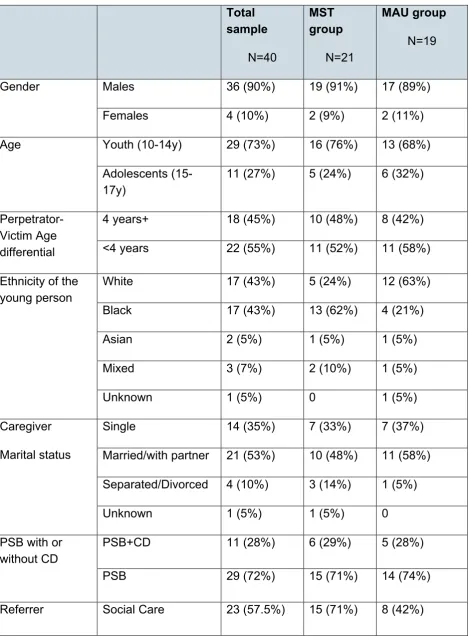
The tables below describe the participant characteristics and outline the composition of the 2 groups: MST and MAU. As can be seen, the young people in the study were almost entirely male, predominantly of White and Black ethnicity, with most young people living in families with 2 parents followed by single-parent families. Given the small numbers, the randomisation did not evenly balance all of the characteristics, with the most frequent ethnicity in the MST group being black, and the most frequent ethnicity in the MAU group being White.
The majority of young people were referred into the trial showing primarily problematic sexual behaviour, with a substantial subgroup also having significant conduct problems. The problematic sexual behaviour is categorized in TABLE 1. Approximately three-quarters (72.5%) of the sample were perpetrating sexually assaultive behaviours, followed by sexualised behaviour (12.5%) and engaging a child in showing sexualised behaviour (10%). The proportions of young people in each of these categories were very similar between the groups. The referral behaviours were categorised by youth justice and social care records and reports. Twenty of the young people engaged in intra-familial abuse, 15 involved peers, and 5 involved other young people at school. In the majority of cases relationships between victim(s) and perpetrator were heterosexual (N=31), with 7 being homosexual, and 2 cases with both male and female victims. Only a few children engaged in both intra-familial and extra-familial abuse. Additionally, 80% of the victims were female, with an almost equal distribution between those young people whose problematic sexual behaviour was against victims more than 4 years younger than
themselves (55%) and with less than 4 years difference in their ages (45%). About half of the young people had been charged with an offence. Finally, MST-PSB is an intervention that identifies when young people and/or carers are in denial at the start of the
intervention, and therapists only carry out the full intervention if the participants have been able to shift the denial early on. Practically speaking, some of the young people may still have been denying the offence or the seriousness of it, and, in these cases, what is needed is the enagagement of the parents and some (even if limited) recognition that something has taken place from parent or carer. Parental and/or young person denial was seen in about half of the cases.
Semi-structured interviews designed to identify child mental disorders, and standardised checklists looking at emotional and behavioural symptoms were both administered at baseline, therefore it is possible to delineate the mental health characteristics of the sample. Many young people had needs that went beyond their problematic sexual
behaviour. For instance, on standardised checklists, YP and parent scores both indicated that young people had vulnerabilities in the area of peer relationships, while Conners questionnaires suggested the presence of significant Attention Deficit Hyperactivity
20
The results of the semi-structured interviews were consistent with a picture of a sample of young people where subgroups showed significant emotional and/or behaviour problems alongside their problematic sexual behaviour. There was 28% of the sample who were identified with diagnoses of conduct disorder at baseline, and 20% with ADHD, while about 8% also showed anxiety disorders and 8% major depression. Taken
together, the semi-structured interviews and checklists suggest substantial co-occurring emotional and behavioural problems in this sample, and therefore young people with complex needs.
Alongside the mental health needs of this sample of young people displaying problematic sexual behaviour, we were able to characterise their involvement with mental health, social service and criminal justice services. In the year prior to their randomisation onto the MST-PSB trial, 77% of the young people had at least one session with a social worker, 15% with a CAMHS professional, and 8% had seen a psychiatrist. The relatively low proportion of young people who reported mental health contacts suggest very substantial unmet treatment need, given the high levels of co-occurring mental health problems documented above. Additionally, almost half of the young people had involvement with the police and youth offending teams, highly consistent with the data that about half of them had been charged with an offence.
One aspect of the implementation of the trial was that there needed to be a credible option in the MAU condition before a participant was randomised. At 12 months post-randomization slightly over 50% of the participants received the Assessment,
Intervention, Moving on (AIM) programme as the alternative treatment, a widespread intervention for sexual problematic behaviour in the U.K. Additionally, another 27% were seen by CAMHS, where, presumably, their problematic sexual behaviour and associated mental needs were assessed and addressed. Although we are unable to currently report on the quality of the MAU, this provisional data suggest reasonable comparison
21
Participant characteristics
Table 1: Participants’ characteristics
Total sample
N=40
MST group
N=21
MAU group
N=19
Gender Males 36 (90%) 19 (91%) 17 (89%)
Females 4 (10%) 2 (9%) 2 (11%)
Age Youth (10-14y) 29 (73%) 16 (76%) 13 (68%)
Adolescents
(15-17y) 11 (27%) 5 (24%) 6 (32%)
Perpetrator-Victim Age differential
4 years+ 18 (45%) 10 (48%) 8 (42%)
<4 years 22 (55%) 11 (52%) 11 (58%)
Ethnicity of the young person
White 17 (43%) 5 (24%) 12 (63%)
Black 17 (43%) 13 (62%) 4 (21%)
Asian 2 (5%) 1 (5%) 1 (5%)
Mixed 3 (7%) 2 (10%) 1 (5%)
Unknown 1 (5%) 0 1 (5%)
Caregiver
Marital status
Single 14 (35%) 7 (33%) 7 (37%)
Married/with partner 21 (53%) 10 (48%) 11 (58%)
Separated/Divorced 4 (10%) 3 (14%) 1 (5%)
Unknown 1 (5%) 1 (5%) 0
PSB with or without CD
PSB+CD 11 (28%) 6 (29%) 5 (28%)
PSB 29 (72%) 15 (71%) 14 (74%)
22 Total sample
N=40
MST group
N=21
MAU group
N=19
YOS 16 (40%) 6 (29%) 10 (53%)
CAMHS 1 (2.5%) 0 1 (5%)
Problematic Sexual
Behaviour (PSB)
sexual assault 29 (72.5%) 16 (76%) 13 (68%)
sexualised behaviour 5 (12.5%) 3 (14%) 2 (10%)
inciting a child 4 (10%) 2 (10%) 2 (10%)
possession of illegal
pornography images 1 (2.5%) 0 1 (5%)
23
Primary Outcome
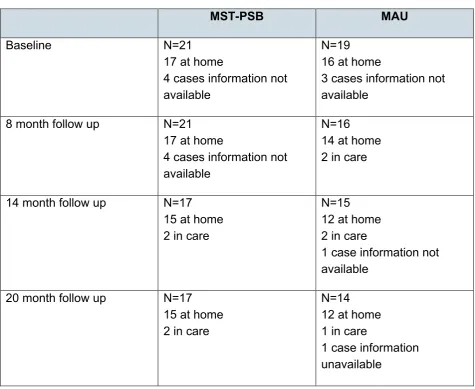
[image:23.595.51.527.160.549.2]The primary outcome for the trial was out-of-home placement for a duration of at least 3 months. As can be seen from Table 2, there were very few out-of-home placements, with only 2 people in care from each condition at 14 months follow-up.
Table 2: Out of home placements
MST-PSB MAU
Baseline N=21
17 at home
4 cases information not available
N=19 16 at home
3 cases information not available
8 month follow up N=21 17 at home
4 cases information not available
N=16 14 at home 2 in care
14 month follow up N=17 15 at home 2 in care
N=15 12 at home 2 in care
1 case information not available
20 month follow up N=17 15 at home 2 in care
N=14 12 at home 1 in care
1 case information unavailable
Secondary Outcomes
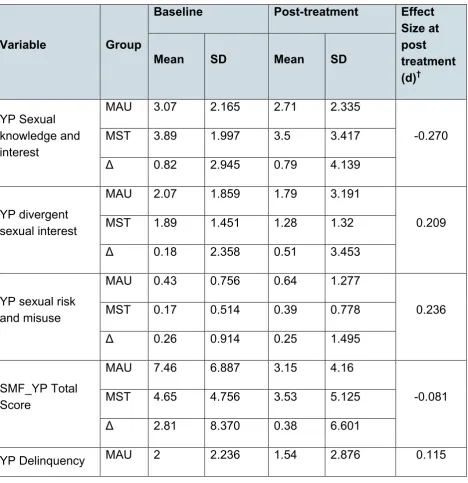
We systematically conducted pre-post secondary analyses on young people’s and parents’ views of the young person’s problematic sexual behaviour; emotional and behavioural functioning, family and peer functioning. Given the low numbers in each of the treatment conditions for these variables (majority of these analyses; MST=18; MAU=14) the results of these analyses must be viewed cautiously. The pattern of these analyses of secondary outcomes consistently revealed effects of time but not a
24
[image:24.595.57.526.250.734.2]The Table below shows the mean and standard deviations for each group, pre and post on all of the respective measures analysed. The effect sizes have been calculated as Cohen’s d and again must be interpreted cautiously due to the small sample. As can be seen from the Table 3, there are a few variables that approximate medium effect sizes (that is, Cohen’s d≥0.3), Loeber Parental Involvement and FACES-Family Cohesion that may have been significant with a larger sample size. That MST successfully improved parental involvement, and a measure of the degree to which family members feel connected and supported by each other, is consistent with one of the foci of the intervention, namely improving involvement and affection between parent and adolescent.
Table 3: Pre-post treatment comparisons for selected secondary outcomes
Variable Group
Baseline Post-treatment Effect Size at post treatment (d)†
Mean SD Mean SD
YP Sexual knowledge and interest
MAU 3.07 2.165 2.71 2.335
-0.270
MST 3.89 1.997 3.5 3.417
Δ 0.82 2.945 0.79 4.139
YP divergent sexual interest
MAU 2.07 1.859 1.79 3.191
0.209
MST 1.89 1.451 1.28 1.32
Δ 0.18 2.358 0.51 3.453
YP sexual risk and misuse
MAU 0.43 0.756 0.64 1.277
0.236
MST 0.17 0.514 0.39 0.778
Δ 0.26 0.914 0.25 1.495
SMF_YP Total Score
MAU 7.46 6.887 3.15 4.16
-0.081
MST 4.65 4.756 3.53 5.125
Δ 2.81 8.370 0.38 6.601
25 Variable Group
Baseline Post-treatment Effect Size at post treatment (d)†
Mean SD Mean SD
including siblings MST 2.18 1.976 1.24 2.306
Δ 0.18 2.984 0.3 3.686
BAS Total
MAU 55.46 12.067 42.69 31.111
-0.136 MST 59.56 8.773 46.78 29.031
Δ 4.1 14.919 4.09 42.552
SDQ Emotional Symptoms
MAU 2.33 2.582 1.87 2.1
0.382
MST 2.36 2.818 1.14 1.703
Δ 0.03 3.822 0.73 2.704
SDQ Conduct Problems
MAU 2.2 1.935 2.07 2.086
-0.340
MST 2.86 1.875 2.79 1.477
Δ 0.66 2.694 0.72 2.556
Loeber: Parent Involvement
MAU 16.31 1.251 9.92 8.2
-0.444 MST 16.28 2.347 13.17 6.327
Δ 0.03 2.660 3.25 10.357
IPPA Total Score
MAU 91 8.954 59.83 44.623
-0.396 MST 89.71 14.137 76.29 38.374
Δ 1.29 16.734 16.46 58.854
Faces IV: Family Cohesion Scale
MAU 31.08 2.691 18.08 15.025
-0.544 MST 27.22 5.208 25.67 12.797
26
Δ = difference between MAU and MST. The difference in effect size indicates the
difference between groups at post-treatment.
† Effect sizes of d≤|0.1| are considered “small”, |0.1|≤d≤|0.3| are “medium”, and d≥|0.5|
are “large”
Offending data was collected from the Police National Computer database, including cautions and offences (both sexual and non-sexual) in the 6 months prior to
randomisation, and up to 20 months post randomisation (although for some participants the full 20 months has not yet elapsed).
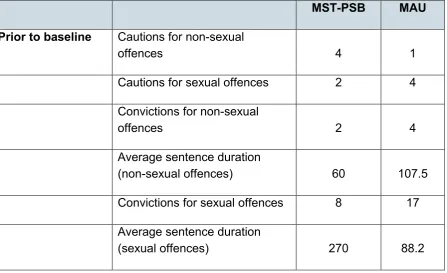
One of the participants randomised to the MST-PSB arm was an outlier, with significantly more offences on record than average (one caution pre baseline, 3 convictions between randomisation and 8-month follow-up, and 10 convictions after 8-month follow up – all non-sexual). The participant’s data is included in Table 4, but has the effect of
significantly skewing the frequencies for non-sexual offending in the MST-PSB arm and hence for between-group comparisons for non-sexual offending.
[image:26.595.59.507.464.737.2]Descriptively, MAU offending decreased from pre-baseline to post-treatment, with only 1 conviction for a sexual offence between 8 and 20-month follow-up in the entire sample. In the MST-PSB group, the total number of offences was slightly higher post treatment compared to pre-treatment, but none of the offences were sexual.
Table 4: Offending frequencies
MST-PSB MAU
Prior to baseline Cautions for non-sexual
offences 4 1
Cautions for sexual offences 2 4
Convictions for non-sexual
offences 2 4
Average sentence duration
(non-sexual offences) 60 107.5
Convictions for sexual offences 8 17
Average sentence duration
27
MST-PSB MAU
Total cautions & convictions 16 26
Baseline to 8 mo
(During MST-PSB) Cautions for non-sexual offences 1 0
Cautions for sexual offences 0 0
Convictions for non-sexual
offences 5 0
Average sentence duration (non
sexual offences) 54 0
Convictions for sexual offences 0 0
Average sentence duration
(sexual offences) 0 0
Total cautions & convictions 6 0
8 mo to 20 mo Cautions for non-sexual
offences 4 3
Cautions for sexual offences 0 0
Convictions for non-sexual
offences 15 1
Average sentence duration (non
sexual offences) 34.8 90
Convictions for sexual offences 0 1
Average sentence duration
(sexual offences) 0 360
28
Qualitative research
Families in the MST-PSB arm were invited to participate in an optional qualitative research project designed to assess families’ experiences of the intervention. Ten parents/carers and 8 young people agreed to take part in semi-structured interviews, which were then analysed using thematic analysis.
There were some differences in the ways that young people and parents experienced the intervention: however, most of the emergent themes could be classified under 3 domains: experiences prior to MST-PSB; factors which facilitated engagement and making
positive changes in their lives, and participants’ perceptions of their outcomes as a result of MST-PSB.
Young people had strong negative feelings about themselves and were embarrassed or ashamed of the behaviour which led to their engagement with MST-PSB, feeling “like a rapist” (YP1) or “some kind of psycho sort of evil person” (YP2). Many had fears about being stigmatised by their family, friends, peers, and society at large, feeling like “they’re gonna hang you or something” (YP2) or fears about people “hating on me” (YP5) Most parents did not report ongoing problematic behaviour from their child, but experienced the allegations of PSB as unexpected: “I was shocked I didn’t want to believe it” (CG1), and as something which caused them to lose confidence in themselves as parents, feeling “angry with myself... because [...] I have failed him somewhere” (CG1), and losing trust in their child. Parents had similar concerns about stigmatisation, but also felt like they needed to protect their child.
Young people spoke positively about their relationship with the MST-PSB therapist, who (over time) made them feel comfortable enough to discuss their problems honestly, even though they were difficult to talk about. For example, 1 young person described their therapist as “really supportive [...] not just on a sort of professional level but sort of a personal level” (YP2). Young people felt that they had gained a better understanding of “what’s good and what’s bad” (YP6) and learned techniques to help them manage their behaviour in the future. Young people spoke about preferring the activities used by the therapists (such as card sort games), rather than talking therapy, because they saw it as a more fun and engaging way to work through their thoughts and feelings with less emotional vulnerability.
Parents also felt relieved about the involvement of MST-PSB, and spoke positively about receiving support from the therapist, who had helped them to manage their emotional response to the situation; understand the situation itself better, and repair their
29
natural cos it’s, it’s, hurt, it’s hate, it’s, it’s, a multi… ball of emotions that need to come out.” (CG8).
Overall, both young people and parents felt that they had benefitted from the intervention (with the exception of 1 young person). Young people felt that they had an improved attitude towards themselves, improved behavioural regulation (“I think about stuff before I do it”, YP2), and improved relationships with their parent(s). They spoke positively about the bond they were able to build with the therapist, which allowed them the confidence to speak about their problems openly and honestly, which in turn “sort of helped me sort of how to ... word it, and say it to my parents” (YP2). Several of the young people also felt good about the practical advice and the opportunity to practise situation-based strategies: “so, if you are in this situation what do you do” (YP2) and thus: “know how I’d react to that scenario” (YP8).
Parents also felt positively about the improvements as a result of MST-PSB, but had more mixed feelings about the future, including feelings of guilt and residual behavioural problems. “I still think about this is my fault” (CG6). However, none of the parents
reported a recurrence of PSB, and all felt that their relationship with their child had improved, at least to some extent, as well as their behaviour at home and/or at school. Many parents felt that MST-PSB helped them to break down their barriers in
understanding their child's behaviour: “I learned a bit of, you know how he ticks, sort of how his, his, thought process was” (CG7). They also felt that they had received practical advice they could use for parenting in general, not just with regards to PSB: “[...] they don’t just guide me through the sexual behaviour, they guide me through parentage, they guide me through everything” (CG9). Finally, parents felt confident that they would be able to continue using the skills they learned during the programme. “[I managed to] get my confidence back as a parent” (CG4); “I don't shout, and he listens more now and we talk” (CG3).
Staff interviews
The 2 MST supervisors and 2 MST staff were interviewed using the semi-structured CYPRESS interview that has been developed to evaluate service characteristics and functions, which includes topics such as teams’ ethos or approach to young people and families; quality of supervision and team functioning; use of outcome measures and the type and range of interventions. We have used CYPRESS in several evaluations
30
outcome tools with families; the quality and frequency of supervision and consultation in keeping the team on target and working with fidelity to the model, are all very positively rated. This is an intervention delivered with strong commitments from staff and MST personnel dedicated to achieving positive outcomes with families.
At the same time, there were some shortcomings or potential limitations identified by staff. These included the degree to which the model was applicable to all young people and carers referred for PSB, in terms of the scope and flexibility of the model.
Specifically, there were some questions as to the degree to which families where trauma was part of the clinical picture with young people and/or their carers would be adequately served within the 6-8 month time frame, and, in this respect, the degree to which all therapists possessed the skills for working with trauma, even with the support provided. While it was perceived that MST provided excellent training and on-going support, there does seem to be an issue of the degree to which any 1 professional can deal with the complex treatment needs of such a population. While it was acknowledged that the model is not supposed to fix all problems, and that sustainability plans involve giving young people and carers the tools to address on-going concerns, there was still some scepticism that all of the relevant drivers could be addressed satisfactorily, and some dissatisfaction that this could not be accomplished by the therapist who had invested so much with the family. Ultimately, MST-PSB is designed as an intense, but relatively short-term, programme, which means that more complex, long-term, interpersonal problems cannot always be solved over the course of the intervention duration.
A related area was whether sometimes the young person needed greater attention or that the sheer complexity of the needs of families overshadowed their capacity to fully benefit from the intervention. An example was families where PSB was accompanied by serious conduct problems, and many of the typical risks, such as family instability and fragmentation, including violence. In this type of case, it was suggested that the
clarification work could not begin for months. In terms of greater attention to the young person, it may be that, for some young people, greater clarification of diagnostic issues in areas such as Autistic Spectrum Disorder traits or behaviours, would be useful, and, as noted, where there is significant trauma.
31
teams did not feed into any developments having to do with this intervention: for example, in addressing limitations such as those noted above.
Limitations of the outcomes
We were unable to carry out an effectiveness study comparing MST-PSB to MAU due to serious challenges in recruiting participants. We have learned a great deal about
implementing an RCT with this population of young people and the systematic context of which they are a part (see below). While we have documented specific reasons why cases did not meet criteria for the study, there may be additional reasons why the number of eventual participants were so low. For instance, PSB is a very serious and important mental health concern; young people exhibiting PSB are low in numbers, and therefore we were starting out with a limited pool. Secondly, we became aware that there was very limited awareness of this client group and of their mental health needs,
compounded by under-developed systems for identifying them.
Out-of-home placement was a very rare occurrence and therefore consideration should be given as to whether this is an appropriate primary outcome for a U.K. sample. We were able to conduct a sufficient number of qualitative interviews to understand the experiences of a significant subsample of young people’s and their carers’ experience of the intervention. Also, the low rates of attrition once participants were randomised, and discussion with participants, suggested that the research protocol was acceptable. Discussions with MST-PSB staff, using a semi-structured interview developed for
complex interventions with young people, enable us to complement our understanding of the effect of MST-PSB on young people and families with the views of MST-PSB
practitioners. We also carried out our secondary analyses as planned but the very small sample size suggests that these should be viewed cautiously. Moreover, the fact that both groups improved with time may reflect spontaneous recovery from their state of crisis at referral, where self-report ratings would be highest, followed the documented tendency for subsequent scores to be closer to average.
Impact on the Innovation Programme’s objectives and areas
of focus
32
The impact of the service soon became clear in so far as it was addressing unmet needs of young people who had engaged in PSB. The involvement of the Brandon Centre PSB service in many boroughs led to greater thought being given by commissioners to the needs of PSB young people and their families, for example in finding relevant and appropriate support for control cases. Further evidence of the effects was the interest shown by numerous enquiries about referring to the trial and the wish of boroughs to commission MST-PSB for cases that could not be referred to the trial because they did not meet the trial's criteria: for example due to the length of time that had passed since the offence or due to ongoing police investigation. This further supports evidence that significant barriers exist in the organisation of social care being offered to young people with PSB, and that the framework through which these young people are identified and referred to services is currently in need of improvement.
Interest was also shown in the intervention because MST-PSB offered a home-based service which could take on cases of young PSB people who had been in care for a short period of time. Referral of PSB young people where there was no identifiable victim also suggests broader scope for MST-PSB than could be accommodated by the trial. We believe the MST-PSB approach has influenced social services and youth offending team thinking and practice; in particular, it stands out as a programme which is home based and holistic, and addresses the young person’s needs from the perspective of the family and school, as well as the individual. The positive response to this approach from both families and professionals suggest that this is a promising approach within the context of young people with PSB.
Barriers
Based on the outcomes of the quantitative and qualitative components of the trial, as well as the research team’s experiences with the MST-PSB clinical team, and steering
33
Extremes might include, on the one hand, the use of a caution with no further support for the young person around PSB, and, on the other hand, an approach which led to custody or being placed in care with no intention of re-integrating the young person to the family. Another version of this inconsistent approach would be the young person going on the sex offender register but receiving minimal treatment.
We have identified several barriers to implementing an effectiveness trial with
adolescents who have engaged in PSB. First, there seems to be a very under-developed system for identifying, assessing and treating problematic sexual behaviour in young people across the relevant systems involved such as CAMHS, Social Care, Youth
Offending and Education. The absence of adequately developed systems of identification occurs alongside limited training to educate and skill-up staff for working with young people showing problematic sexual behaviour. Second, there were barriers from the criminal justice system in the form of long delays for processing these cases, and
uncertainty about whether further police investigation would be forthcoming. These were important, as long delays influenced how significant and live the PSB and related issues were for the family and thus their motivation for treatment. In addition, young people and carers would be unable to complete questionnaires and interviews related to offending behaviour while a police investigation was ongoing or potentially still open.
Findings from the qualitative research identified several barriers to engagement for both the parent and the young person. Analyses of the interviews suggest that when the parent is in denial about their child’s behaviour, this prevents meaningful engagement and change. By contrast, accepting what has happened has allowed families to move on and make positive changes, consistent with the MST-PSB treatment model. For young people, the perceived stigma around the offence also acted as a barrier to
acknowledging their behaviour, which was also a barrier to engagement.
Facilitators
34
Findings from the qualitative research suggest that psycho-education around consent was beneficial to young people and helped to bring about change to their beliefs and behaviour. Young people have said that they preferred activities and exercises which were “fun”, as opposed to talking therapy. Both young people and parents stressed the importance of a good working relationship with a therapist who was friendly,
collaborative, and non-judgmental.
Limitations of the evaluation and future evaluation
The major limitation to the evaluation was the small number of participants recruited, limiting our ability to determine to what degree MST-PSB is an effective intervention in the U.K. The number of out-of-home placements, our primary outcome, was very low and equivalent across conditions. The most reasonable conclusion for our analysis of
secondary outcomes, in areas such as problematic sexual behaviour, self-reporting offending, and emotional and behavioural difficulties, was that both groups improved from pre-to-post intervention. There are several reasons why this may be the case. For
instance, it may be that the improvement in both groups reflects spontaneous recovery where they were seen in a crisis, after the PSB had been identified and made public, and, in this crisis, YP and parents identified a substantial number of difficulties on the various questionnaires at baseline. Time, in conjunction with therapeutic support, resulted in lower ratings at follow-up. Another possibility is regression toward the mean, wherein an initial measurement that is more extreme will be closer to the average when another measurement is taken, an issue that has been raised in previous MST trials (Leschied & Cunningham, 2002).
In qualitative interviews, young people and carers identified distressing stigma and
shame associated with PSB, and the discovery by parents that their child had engaged in such behaviour, had detrimental effects on their confidence as parents and relationship with the young person. The accounts from young people and parents suggest that MST-PSB is perceived as a very supportive intervention, enabling discussion and greater honesty about what had occurred, which, in turn, led to skill building around dealing with PSB and difficulties within the young person and family. There were some concerns voiced by some young people and carers that the sessions could be too stressful and draining.
We also confirmed what has been identified previously, namely under-developed systems for identifying, assessing and treating young people showing PSB in the UK, and limitations in training and integration of the systems with most involvement with these young people, including CAMHS, youth offending, education and social services. In considering barriers, and identifying our highest performing site, it was evident that a non-stigmatising approach to PSBs; well-trained staff, and a joined up inter-agency
35
provide for those needs, and to create a foundation for any sophisticated empirical evaluation.
In reviewing the implementation of MST-PSB with supervisors and staff, there are also areas to consider in continuing to apply this intervention to young people displaying PSB. MST-PSB is family focused and identifies the caregiver as the primary agent of change. Ideally, individual strengths and needs of the young person are identified and will be followed up either by the therapist or through referral to an appropriate service, if needed. From the practitioner viewpoint, there were suggestions that, for some young people, a greater individual focus may be needed: for example, around greater initial assessment to help understand their strengths and vulnerabilities, and the extent of their mental health needs. For example, for some young people and/or their carers, there may be significant trauma, which may be cumbersome to treat alongside the family and parenting factors associated with PSB within the time-frame of the intervention. This view from practitioners is consistent with our baseline assessment of young people, combining semi-structured psychiatric interviews and standardised checklists, which demonstrated high levels of emotional and behavioural co-morbidity alongside their problematic sexual behaviour.
Appropriateness of evaluative approach for this innovation
The evaluative approach was appropriate for this innovation, combining quantitative and qualitative methods while attempting to address some feasibility issues. We alsoconducted semi-structured interviews with MST-Staff to gain some understanding of how the innovation was experienced in practice and what they perceived to be the major strengths and limitations of the intervention. At the same time, one of our findings is that there are still considerable systemic and social barriers to identifying and recruiting young people with PSB, so, at this stage, conducting a larger scale RCT of MST-PSB is likely to be premature. Issues include complications arising from court delays and ongoing
involvement or potential re-involvement of the police in some cases.
Capacity built for future evaluation and the sustainability of
the evaluation
36
knowledge; psycho-education and training with the larger network of agencies and stakeholders serving this population of young people; and quantitative evaluation.
Our qualitative interviews with staff suggest that consideration should be given to the degree to which the intervention can flexibility accommodate the varied needs of young people and families showing problematic sexual behaviour. For instance, in the case of young people and/or their carers showing trauma as a result of prior sexual abuse, one of the most reliable differences between young offenders and young sexual offenders (Seto & Lalumière, 2010), there needs to be consideration given to how these, and other factors, can be assessed and treated to evidence-based standards (that is, adolescent and adult trauma have strong evidenced-based models that are individually oriented and themselves require significant resources and support) while addressing the young
person’s problematic sexual behaviour within the MST model. While MST has
established guidelines for treating trauma and provides strong supervision from MST, it may be extremely challenging for 1 therapist to manage the multiple treatment needs of some families. There are other examples, both at the individual and family level, where complexity of need, in relation to the model and time-frame of the intervention may need adjustment. If the intervention is not intended, or not equipped, to deal with this
complexity, then perhaps an ecology that more actively aligns appropriate services to treat risk and need should be integrated over time, without overwhelming the family. We realise that this involves a balancing act in making complicated clinical decisions while not undermining the clear strength that MST-PSB shows in engaging families and helping them to address PSB, and, in many instances, other antisocial behaviour. However, the under-emphasis on the heterogeneity and complexity of treatment need, and specifically limitations in customising the intervention to the young person’s individual needs and risks, is a theme that has cut across our interviews with young people and carers for several of our MST trials.
Secondly, the under-developed systems for identifying and treating young people
37
Plans for further evaluation
As noted above, there are no current plans for the evaluators to remain involved in evaluating MST-PSB. In terms of a specific trial evaluation, the results of the study suggest that much greater progress needs to be made in providing services to this population, and in organizing coherent systems of service delivery, before mounting another RCT for MST-PSB. Related to our point above, it may be useful to refine the MST-PSB model itself for the UK, and to collect greater quantitative data at the local level across teams (for example, London, Cambridge) that demonstrate effectiveness over time.
In terms of evaluation and use of specific measures by MST-PSB teams, it is noteworthy that MST-PSB teams currently record their outcomes relating to antisocial behaviour, education, and the degree to which the goals of the family have been met. There is also the use of routine outcome reviews of goal and the main behaviours targeted by the intervention. At this point, we would recommend for MST-PSB teams to consider to routine use of standardized measures to complement these outcomes that would not be too burdensome for the family. It would be useful for the MST-PSB teams to decide to what degree they want to be involved in explicitly evaluating changes in problematic sexual behaviour in a more standardized way (beyond offending) and to what degree systematic qualitative evaluations of the clients, and the wider system, would be useful, as these are areas not routinely assessed. It may also be helpful to better define the population in relation to co-occurring mental health conditions that may characterize a substantial subgroup of young people (for example, trauma), and, in doing so, determine the degree of relevance. Finally, it may be useful to record, and begin to think about, characteristics of offences based on the literature that is part of this research, such as age differential between perpetrator and victim.
We would suggest greater measurement in the area of problematic sexual behaviour and self-reported delinquency, with some attention to the internalizing symptoms that may characterise subgroups of this population, such as sexual abuse trauma. These
measures could be collected at baseline, post-intervention and a later follow-up if feasible and useful for the teams.
Implications and Recommendations for Policy and Practice
Evaluative evidence, or lack of, for capacity and sustainability of the
innovation
As noted above, the MST-PSB intervention is a very well-received and valued
38
with a low number of participants that must be viewed cautiously, suggest that post-intervention, both MST-PSB and MAU were helpful in reducing problematic sexual behaviour.
The sustainability of this intervention will depend on the development of better systems for identifying young people displaying PSB and greater inter-agency co-operation within Local Authorities in doing so. We also suggest that greater consideration be given to modifying MST-PSB treatment practices to better accommodate the heterogeneity seen with this population.
Conditions necessary for this innovation to be embedded
Our experience confirmed that embedding MST-PSB was most likely to happen where:
• there was a joined-up approach to identifying the needs of a wide range of behaviour in vulnerable children
• staff on the ground were well trained
• there was a non-stigmatising approach to PSB despite the criminal age of responsibility being 10 years old
Commissioning involved joint work between social care, CAMHS and youth offending teams. These features were best exemplified by the Southwark model.
Consideration of future development of the innovation and wider
application
We have addressed this question in our comments above. It would seem premature to consider wider application before the necessary systems changes detailed above in working generally with young people displaying PSB have been implemented, and the empirical effectiveness of MST-PSB demonstrated, within a more appropriate mental health and social context for mounting an RCT.
An important recommendation from the study would be that Local Authorities are
encouraged to develop more effective systems for identifying the needs of young people with PSB in their local area, in partnership with the police, education and health
colleagues and the Southwark multi-agency panel system provides a model for this, which could be disseminated further through the DfE Innovation Programme.
Currently, MST-PSB is available in Cambridgeshire in several Local Authorities, but the service at the Brandon Centre in London as recently been discontinued. From the commissioning side, one of the difficulties is that MST-PSB falls between youth justice, the Local Authority and health and so it becomes unclear who is responsible for
39
need is far lower than that for young people displaying more general antisocial
behaviours, and the current economic situation limits availability. It may be that the work between Local Authorities on a regional, or sub-regional, basis may be a potential