R E S E A R C H A R T I C L E
Open Access
A systematic review of studies evaluating
Australian indigenous community
development projects: the extent of
community participation, their
methodological quality and their outcomes
Mieke Snijder
1*, Anthony Shakeshaft
1, Annemarie Wagemakers
2, Anne Stephens
3and Bianca Calabria
4Abstract
Background:Community development is a health promotion approach identified as having great potential to improve Indigenous health, because of its potential for extensive community participation. There has been no systematic examination of the extent of community participation in community development projects and little analysis of their effectiveness. This systematic review aims to identify the extent of community participation in community development projects implemented in Australian Indigenous communities, critically appraise the qualitative and quantitative methods used in their evaluation, and summarise their outcomes.
Methods:Ten electronic peer-reviewed databases and two electronic grey literature databases were searched for relevant studies published between 1990 and 2015. The level of community participation and the methodological quality of the qualitative and quantitative components of the studies were assessed against standardised criteria.
Results:Thirty one evaluation studies of community development projects were identified. Community participation varied between different phases of project development, generally high during project implementation, but low during the evaluation phase. For the majority of studies, methodological quality was low and the methods were poorly described. Although positive qualitative or quantitative outcomes were reported in all studies, only two studies reported statistically significant outcomes.
Discussion: Partnerships between researchers, community members and service providers have great potential to improve methodological quality and community participation when research skills and community knowledge are integrated to design, implement and evaluate community development projects.
Conclusion:The methodological quality of studies evaluating Australian Indigenous community development projects is currently too weak to confidently determine the cost-effectiveness of community development projects in improving the health and wellbeing of Indigenous Australians. Higher quality studies evaluating
community development projects would strengthen the evidence base.
Keywords:Community development, Indigenous, Aboriginal, Torres Strait Islander, Health promotion, Community participation, Empowerment, Methodological quality, Qualitative, Quantitative
* Correspondence:[email protected] 1
National Drug and Alcohol Research Centre (NDARC), UNSW, Randwick, NSW 2052 Sydney, Australia
Full list of author information is available at the end of the article
Background
The health gap between Indigenous and non-Indigenous Australians has been well documented [1–3]. Systematic literature reviews, however, have consistently concluded that evaluations of interventions aimed at reducing this health gap lack methodological rigour [4–12]. In addition to improving the methodological quality of the evidence-base, the need for greater community participation in, and control of, Indigenous health promotion research have been advocated [13–15].
Community participation has long been argued as being an essential factor in successful health promotion initiatives [16–18]. A recent meta-analysis concluded that community participation is effective when used in health promotion projects because it engenders greater community motivation and increases the sustainability of projects [19]. Although the review did not include Indigenous communities, the principle of community participation is highly relevant to Indigenous Australians and has great potential to improve Indigenous health. The history of dispossession and disempowerment expe-rienced by Indigenous people highlights the importance of the full and active participation of community mem-bers to develop plausible solutions to the problems they themselves have identified [9, 20–25]. The community development approach strives to empower Indigenous communities to develop and utilise skills that will enable them to more directly address the risk factors that deter-mine their health status [26].
Despite the potential of community development approaches for improving Indigenous health outcomes, there has been no systematic examination of the extent to which they have engendered community participation and little analysis of their effectiveness. The only existing systematic review of Indigenous community develop-ment, published in 2007, evaluated 17 projects imple-mented in Indigenous communities in Australia, Canada, New Zealand and the United States [9]. This review emphasised that high levels of community participation were a critical factor in the success with which community development projects were imple-mented, however, it did not assess the level of com-munity participation nor systematically assessed the methodological qualities of the studies. This lack of project evaluation has made it difficult to confidently estimate the extent to which community development projects have improved the health and life expectancy of Indigenous People.
This systematic review aims to identify the extent of community participation in community development projects implemented in Australian Indigenous commu-nities, critically appraise the qualitative and quantitative methods used in their evaluation, and summarise their outcomes.
Methods
Identification of publications
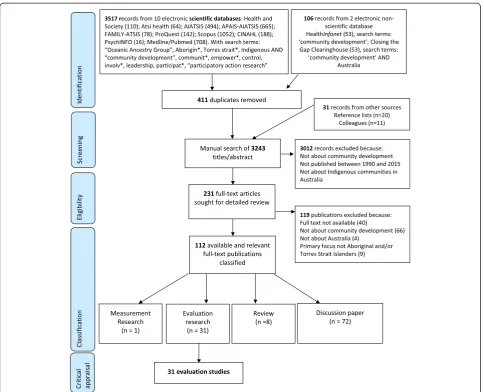
The peer-reviewed and grey literature were searched to identify studies evaluating Indigenous community devel-opment projects in Australia, published between 1990 and 2015. Twenty-five years of community development projects was judged to be sufficient to provide an over-view of the most recent projects. Figure 1 summarises the databases searched, the search terms used, the eligi-bility criteria and the classification process based on the PRISMA flow diagram [27].
Ten peer-reviewed databases were searched: Health and Society, Aboriginal and Torres Strait Islander Health Bibliography (ATSIHealth), AIATSIS, APAIS-AIATSIS, FAMILY-ATSIS, ProQuest, Scopus, CINAHL, PsychINFO, and Medline/Pubmed. Two grey literature databases were searched: HealthInfonet and Closing the Gap Clearing-house. The electronic database search identified 3623 pub-lications and 411 duplicates were removed. Reference lists of the identified publications were scanned which identi-fied an additional 20 publications. Another 11 publications were received from researchers in the field. The resulting 3243 publications were organised in Reference Manager Endnote [28].
Screening and eligibility
The titles and abstracts of the identified 3243 publica-tions were read to determine their eligibility for inclu-sion against three criteria: 1) relevance to a community development project, including: projects focusing on community ownership, empowerment, local leadership and decision making, adopting a long-term strategy, having a focus on sustainability or having a bottom up approach (i.e. starting from the community) [29, 30]; 2) published between 1990 and 2015; and 3) a primary focus on Indigenous communities in Australia. A total of 231 publications met all three criteria. The full text versions of these 231 publications were sought for detailed review, of which 112 were available and relevant to this review.
Classification
Extent of community participation
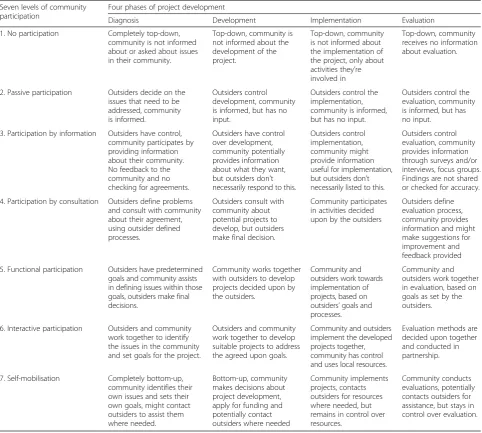
Replicating previous analyses [32, 33], the extent of community participation was assessed using Pretty’s participation typology, which describes seven levels of community participation ranging from no participa-tion to self-mobilisaparticipa-tion (i.e. completely top-down to completely bottom-up) [32, 34]. Given community participation can vary during the lifetime of a pro-ject, the extent of participation was assessed separ-ately for four phases of project development: diagnosis (identifying a community’s priorities); development (of ap-propriate strategies to address the priorities); implementa-tion (of the strategies); and evaluaimplementa-tion (of the effectiveness of the project) [32, 35, 36]. The level of community par-ticipation in the 31 studies were assigned a score between 1 and 7 for each phase of project development. Detailed descriptions of different levels of community participation in relation to scores 1 to 7, and with respect to all four
[image:3.595.57.542.87.479.2]score allocated by the third reviewer was the same as the score allocated by one of the first two reviewers and so that score was used, increasing the agreement rate to 84 % for 26 of the 31 studies. For the five studies where there was no agreement, the scores allocated by the first author (MS) were used.
Critical appraisal of methodology Qualitative methods
The methodological quality of the qualitative study com-ponents was assessed by adapting Long and Godfrey’s qualitative study evaluation tool, which was developed to appraise evaluations of health and social care interven-tions [37]. This tool has 4 secinterven-tions: 1) phenomenon
[image:4.595.57.540.100.533.2]studied and context; 2) ethics; 3) data collection, analysis and potential research bias; and 4) policy and practical implications. The latter two were used in this review be-cause they relate specifically to evaluation issues. Data collection includes the need for clear descriptions of the data collection process (e.g. recruitment strategies, data collection procedures, specifying the interview questions, methods of recording data and the extent to which the data collection process was tailored to specific commu-nities). Data analysis includes the description of the data analysis, the provision of adequate evidence to support the analysis (including data extracts, triangulations and descriptions of reliability) and whether the findings are interpreted in line with existing theories and literature.
Table 1Definitions of the seven levels of community participation in the four phases of project development
Seven levels of community participation
Four phases of project development
Diagnosis Development Implementation Evaluation
1. No participation Completely top-down,
community is not informed about or asked about issues in their community.
Top-down, community is not informed about the development of the project.
Top-down, community is not informed about the implementation of the project, only about activities they’re involved in
Top-down, community receives no information about evaluation.
2. Passive participation Outsiders decide on the issues that need to be addressed, community is informed.
Outsiders control development, community is informed, but has no input.
Outsiders control the implementation, community is informed, but has no input.
Outsiders control the evaluation, community is informed, but has no input.
3. Participation by information Outsiders have control, community participates by providing information about their community. No feedback to the community and no checking for agreements.
Outsiders have control over development, community potentially provides information about what they want, but outsiders don’t necessarily respond to this.
Outsiders control implementation, community might provide information useful for implementation, but outsiders don’t necessarily listed to this.
Outsiders control evaluation, community provides information through surveys and/or interviews, focus groups. Findings are not shared or checked for accuracy.
4. Participation by consultation Outsiders define problems and consult with community about their agreement, using outsider defined processes.
Outsiders consult with community about potential projects to develop, but outsiders make final decision.
Community participates in activities decided upon by the outsiders
Outsiders define evaluation process, community provides information and might make suggestions for improvement and feedback provided
5. Functional participation Outsiders have predetermined goals and community assists in defining issues within those goals, outsiders make final decisions.
Community works together with outsiders to develop projects decided upon by the outsiders.
Community and outsiders work towards implementation of projects, based on outsiders’goals and processes.
Community and outsiders work together in evaluation, based on goals as set by the outsiders.
6. Interactive participation Outsiders and community work together to identify the issues in the community and set goals for the project.
Outsiders and community work together to develop suitable projects to address the agreed upon goals.
Community and outsiders implement the developed projects together, community has control and uses local resources.
Evaluation methods are decided upon together and conducted in partnership.
7. Self-mobilisation Completely bottom-up,
community identifies their own issues and sets their own goals, might contact outsiders to assist them where needed.
Bottom-up, community makes decisions about project development, apply for funding and potentially contact outsiders where needed
Community implements projects, contacts outsiders for resources where needed, but remains in control over resources.
Community conducts evaluations, potentially contacts outsiders for assistance, but stays in control over evaluation.
Potential researchers’ bias assesses whether the position of the researcher is outlined in the study and its poten-tial influence on the data collection and analysis. The policy and practical implications include an analysis of the populations and settings to which the findings are generalisable, the implications for policy or practice, and the extent to which the methods justify the conclusions.
Quantitative methods
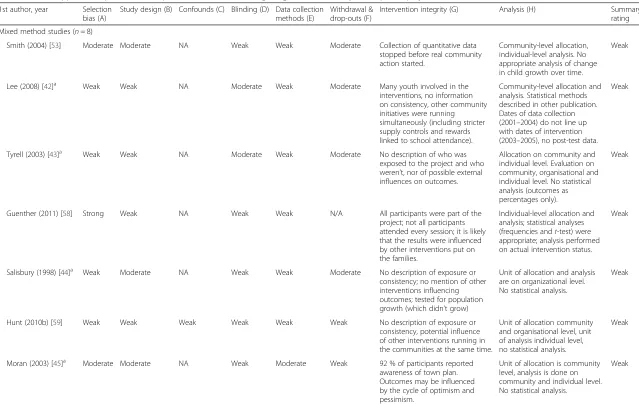
The methodological quality of the quantitative study components was appraised using the Dictionary for Effective Public Health Practice Project Quality Assessment tool for Quantitative studies [38], which was developed to review public health studies and has been used in other systematic reviews in the Australian Indigenous health field [4, 10]. Sections A-F (A - selection bias, B - study design, C - confounders, D - blinding, E - data collection methods, F - withdrawals and drop-out) are rated categorically as strong, moderate or weak. Sections G (intervention integrity) and H (analysis appropriateness) comprise summaries of the relevant information rather than categorical ratings. In addition to sections A-H, this tool advocates a summary rating defined as weak (two or more weak scores are given), moderate (1 weak score is given) or strong (no weak scores are given).
Scoring for critical appraisal of methodology
Scores against both the qualitative and quantitative evaluation criteria were allocated by author MS. A random selection of 25 % of studies were assessed by a blinded coder (ASt). There was agreement for 70 % of these studies. Disagreements were resolved in consult-ation between the two coders.
Outcomes of the studies
The outcomes of the studies evaluating Indigenous community development projects are summarised.
Results
Thirty-one studies evaluating Indigenous community development projects in Australia were identified. Ten (32 %) were published in the peer reviewed literature [39–48].
Extent of community participation
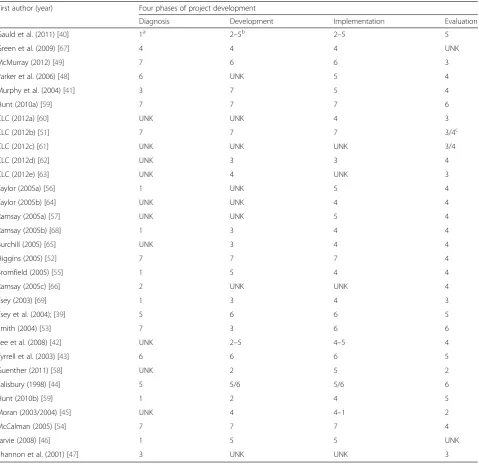
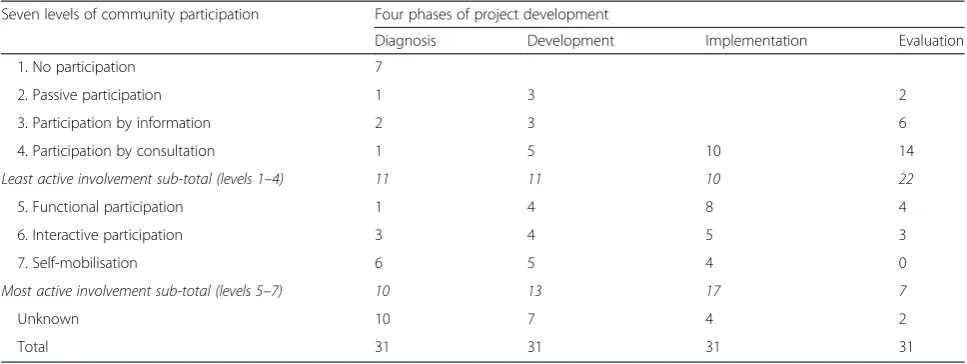
Table 2 summarises the level of community participation across the four phases of project development for each study. Table 3 summarises the number of studies rele-vant to each of the seven levels of community participa-tion, separately for the four phases of project development. The highest levels of participation (level 5 to level 7), were found in the Diagnosis phase for ten studies (32 %) [39, 43, 44, 48–54], in the Development
phase for 13 studies (42 %) [39–44, 46, 49–52, 54, 55], in the Implementation phase for 17 studies (55 %) [39–44, 46, 48–54, 56–58] and in the Evaluation phase for 7 studies (22 %) [39, 40, 43, 44, 50, 53, 59]. Four studies (13 %) had at least level 5 participation in all phases of the project [39, 43, 44, 50]. The participa-tion of the community was described with insufficient detail to be assessed (unknown category) for ten studies in the Diagnosis phase (32 %) [42, 45, 57, 58, 60–65], seven in the Development phase (23 %) [47, 48, 57, 60, 61, 64, 66], four (12.9 %) in the Implementation phase [47, 61, 63, 66] and two (7 %) in the Evaluation phase [46, 67].
Methods used in studies
Twenty-one studies (67 %) used qualitative methods only [39–41, 48, 49, 51, 52, 55–57, 59–69], two (7 %) used quantitative methods only [46, 47], and eight (26 %) used mixed methods [42–45, 53, 54, 58, 59]. Qualitative data were collected using semi-structured in-terviews in 24 studies [39, 40, 42, 43, 45, 49–53, 55–58, 60–69], document analysis (n= 15 [42, 49, 51, 52, 55–57, 60–66, 68]), focus groups (n= 9 [39, 40, 43, 45, 48–50, 53, 58]), participant observation (n= 6 [42, 43, 53, 54, 58, 69]) and photovoice [70] (n= 2 [50, 53]). Quantita-tive data collection methods included surveys in three studies [45, 48, 58], hospital/clinical records (n= 4 [43, 44, 47, 53]), school records (n= 2 [42, 58]), police records (n= 1 [42]), store records (n= 1 [43]) and ABS census data (n= 1 [46]).
Methodological quality of studies with a qualitative component
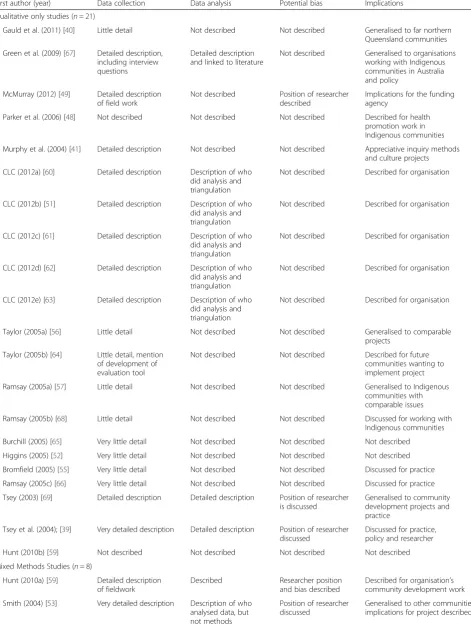
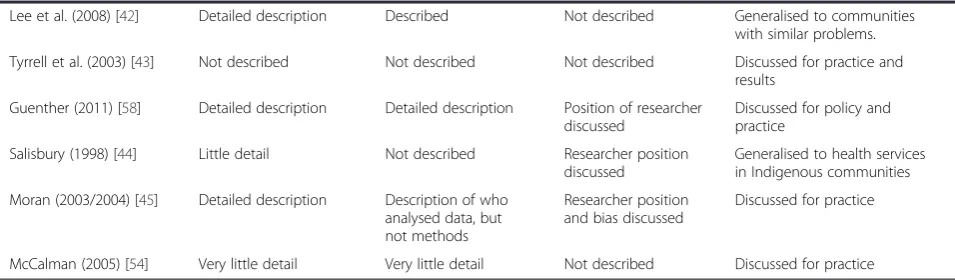
All 29 studies with a qualitative component (including mixed methods studies) provided some description of the evaluation methods used (Table 4). Twelve studies (41 %) gave detailed descriptions of the data collection process, including participant recruitment, focus group procedures and a clear description of which data were recorded [39, 41, 49–51, 53, 58, 60–63, 67]. Four of these twelve studies (14 %) provided the interview ques-tions [51, 58, 60, 67] and one study (4 %) described in detail how the data collection methods were tailored to ensure their cultural appropriateness [49]. The data ana-lysis methods were described in detail in seven studies (24 %) [39, 42, 50, 54, 58, 67, 69]. The potential for researcher bias was described in seven studies (24 %) [39, 44, 45, 49, 53, 58, 69]. Three studies (10 %) did not discuss the implications of their findings [52, 59, 65].
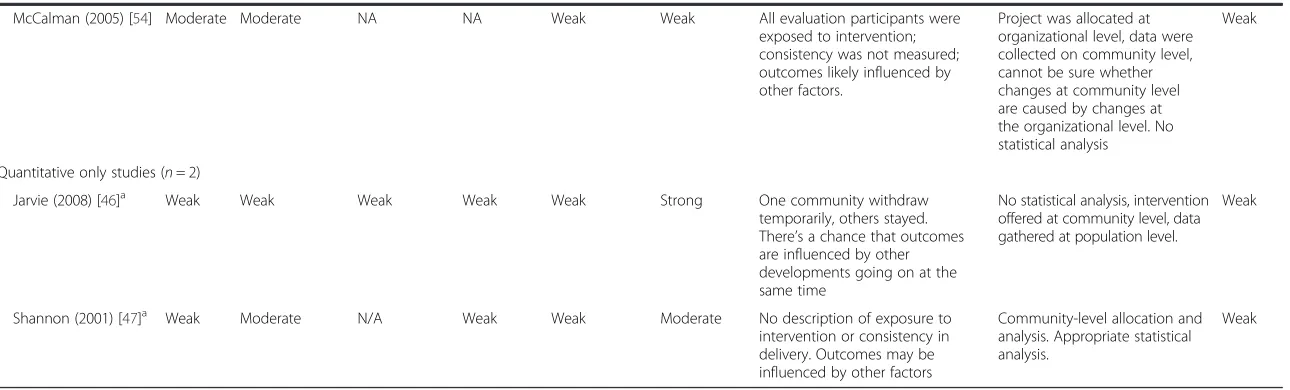
Methodological quality of studies with a quantitative component
likely extent of selection bias was unclear for six studies (60 %) because description of the participant and com-munity selection procedures was absent or insufficiently detailed [42–44, 46, 47, 59]. Five studies (50 %) used a cohort design without a control group [43–45, 53, 54], one study (10 %) used a time series design [47] and the evaluation design of the remaining four studies (40 %) was unclear [42, 46, 58, 59]. No study adequately controlled for confounding variables. None of the studies used blinding procedures. Two studies (20 %) used
validated outcome measures [45, 58]. No study discussed the validity or reliability of their outcome measures.
[image:6.595.60.540.99.564.2]One study (10 %) described withdrawals and drop outs at the community level [46]. One study (10 %) described withdrawals and drop outs at the participant level [53]. Drop outs at the participant level were not applicable for the six studies (60 %) that used either routinely collected data or a one-off survey [42–44, 47, 54, 58]. Two studies (20 %) did not report drop outs [45, 59]. No study de-scribed the fidelity of the project. Three studies (30 %)
Table 2Level of community participation in each phase of project development for each study
First author (year) Four phases of project development
Diagnosis Development Implementation Evaluation
Gauld et al. (2011) [40] 1a 2
–5b 2
–5 5
Green et al. (2009) [67] 4 4 4 UNK
McMurray (2012) [49] 7 6 6 3
Parker et al. (2006) [48] 6 UNK 5 4
Murphy et al. (2004) [41] 3 7 5 4
Hunt (2010a) [59] 7 7 7 6
CLC (2012a) [60] UNK UNK 4 3
CLC (2012b) [51] 7 7 7 3/4c
CLC (2012c) [61] UNK UNK UNK 3/4
CLC (2012d) [62] UNK 3 3 4
CLC (2012e) [63] UNK 4 UNK 3
Taylor (2005a) [56] 1 UNK 5 4
Taylor (2005b) [64] UNK UNK 4 4
Ramsay (2005a) [57] UNK UNK 5 4
Ramsay (2005b) [68] 1 3 4 4
Burchill (2005) [65] UNK 3 4 4
Higgins (2005) [52] 7 7 7 4
Bromfield (2005) [55] 1 5 4 4
Ramsay (2005c) [66] 2 UNK UNK 4
Tsey (2003) [69] 1 3 4 3
Tsey et al. (2004); [39] 5 6 6 5
Smith (2004) [53] 7 3 6 6
Lee et al. (2008) [42] UNK 2–5 4–5 4
Tyrrell et al. (2003) [43] 6 6 6 5
Guenther (2011) [58] UNK 2 5 2
Salisbury (1998) [44] 5 5/6 5/6 6
Hunt (2010b) [59] 1 2 4 5
Moran (2003/2004) [45] UNK 4 4–1 2
McCalman (2005) [54] 7 7 7 4
Jarvie (2008) [46] 1 5 5 UNK
Shannon et al. (2001) [47] 3 UNK UNK 3
a
Possible scores range from 1 to 7: 1 = no participation; 2 = passive participation; 3 = participation by information; 4 = participation by consultation; 5 = functional participation; 6 = interactive participation; 7 = self-mobilisation, UNK = unknown [32,34]
b
Participation varied within the phase
c
reported on the exposure of participants to the project [45, 54, 58]. Inferential statistical analyses were reported by four studies (40 %) [42, 47, 53, 58].
Outcomes
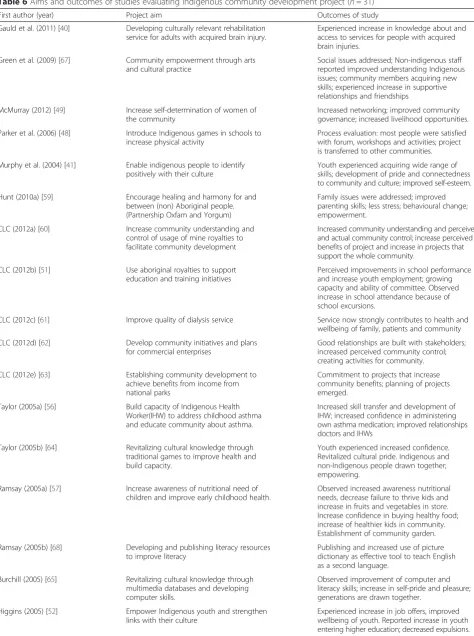
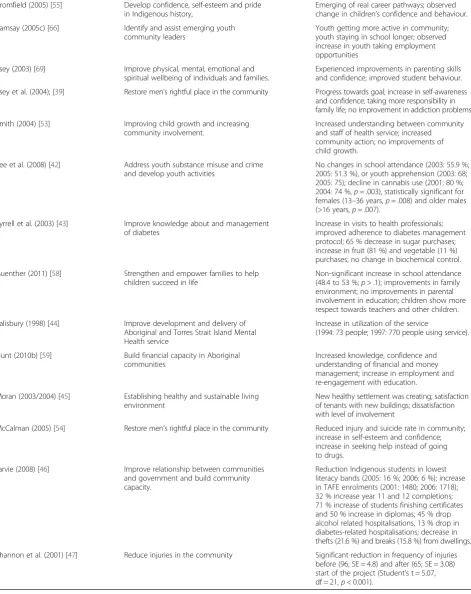
A summary of the aims and key outcomes for each study is provided in Table 6. All studies using qualitative methods concluded that community members reported positive project impacts for their community. Two studies (7 %) reported quantitative outcomes that were statisti-cally significant: a reduction in injuries [47] and a reduc-tion in cannabis use among females aged 13–36 and males aged over 16 years [42].
Discussion
This study systematically reviewed the peer-reviewed and grey literature on community development projects in Australian Indigenous communities. One hundred and twelve relevant and available publications were iden-tified, 31(28 %) studies were evaluations, 21of these evaluation studies (68 %) were published in grey litera-ture. There were no marked differences observed between evaluations published in the grey and peer-reviewed literature in terms of the detailed descriptions of the qualitative methods used, the quality of the quan-titative methods or the reported levels of community participation. This high comparability reflects the gener-ally low quality of all the evaluations published in both the peer-review and the grey literature. It would be an asset to the community development field to increase the publication rate of higher-quality evaluation studies in the
peer reviewed literature, especially in open access journals, to utilise peer review as a quality assurance mechanism and to optimise the transparency of study results.
Community participation in community development projects
Community participation was assessed as moderate in most of the studies evaluating Indigenous community development projects (87 %). The wide variation in community participation between projects and project phases, and within project phases, in these Australian Indigenous studies is reflected in the international litera-ture [32, 36]. For half of the studies included in this re-view, the intent for community participation was clearly described, but the actual level of participation was not reported for at least one of the phases of project devel-opment. Documenting the community participation strategies and processes used, including details about how the community was engaged and who in the com-munity participated, would allow the more successful community participation strategies to be identified and replicated in subsequent projects [36].
Although the unique characteristics of each commu-nity will lead to variation in their capacity to participate in each phase of a project [36, 71], the extent and nature of community participation can be optimised by careful planning and the utilisation of appropriate frameworks to guide the development, implementation and evalu-ation of community-based projects. An approach like participatory action research provides practical guide-lines to achieve this [72, 73].
Table 3Number of studies across the levels of community participation and phases of project development
Seven levels of community participation Four phases of project development
Diagnosis Development Implementation Evaluation
1. No participation 7
2. Passive participation 1 3 2
3. Participation by information 2 3 6
4. Participation by consultation 1 5 10 14
Least active involvement sub-total (levels 1–4) 11 11 10 22
5. Functional participation 1 4 8 4
6. Interactive participation 3 4 5 3
7. Self-mobilisation 6 5 4 0
Most active involvement sub-total (levels 5–7) 10 13 17 7
Unknown 10 7 4 2
Total 31 31 31 31
Note:No participation = community did not participate
Passive participation = the community was only informed about the project
Participation by information = information was collected from the community without their participation and without providing feedback. Participation by consultation = information was collected from the community, feedback was given and further inclusion of community was sought
Functional participation = community collaboration on outsider’s terms Interactive participation = collaboration on mutually defined terms
Table 4Critical appraisal of qualitative components of studies evaluating Indigenous community development projects (n= 29)
First author (year) Data collection Data analysis Potential bias Implications
Qualitative only studies (n= 21)
Gauld et al. (2011) [40] Little detail Not described Not described Generalised to far northern
Queensland communities
Green et al. (2009) [67] Detailed description, including interview questions
Detailed description and linked to literature
Not described Generalised to organisations
working with Indigenous communities in Australia and policy
McMurray (2012) [49] Detailed description of field work
Not described Position of researcher
described
Implications for the funding agency
Parker et al. (2006) [48] Not described Not described Not described Described for health
promotion work in Indigenous communities
Murphy et al. (2004) [41] Detailed description Not described Not described Appreciative inquiry methods
and culture projects
CLC (2012a) [60] Detailed description Description of who
did analysis and triangulation
Not described Described for organisation
CLC (2012b) [51] Detailed description Description of who
did analysis and triangulation
Not described Described for organisation
CLC (2012c) [61] Detailed description Description of who
did analysis and triangulation
Not described Described for organisation
CLC (2012d) [62] Detailed description Description of who
did analysis and triangulation
Not described Described for organisation
CLC (2012e) [63] Detailed description Description of who
did analysis and triangulation
Not described Described for organisation
Taylor (2005a) [56] Little detail Not described Not described Generalised to comparable
projects
Taylor (2005b) [64] Little detail, mention of development of evaluation tool
Not described Not described Described for future
communities wanting to implement project
Ramsay (2005a) [57] Little detail Not described Not described Generalised to Indigenous
communities with comparable issues
Ramsay (2005b) [68] Little detail Not described Not described Discussed for working with
Indigenous communities
Burchill (2005) [65] Very little detail Not described Not described Not described
Higgins (2005) [52] Very little detail Not described Not described Not described
Bromfield (2005) [55] Very little detail Not described Not described Discussed for practice
Ramsay (2005c) [66] Very little detail Not described Not described Discussed for practice
Tsey (2003) [69] Detailed description Detailed description Position of researcher is discussed
Generalised to community development projects and practice
Tsey et al. (2004); [39] Very detailed description Detailed description Position of researcher discussed
Discussed for practice, policy and researcher
Hunt (2010b) [59] Not described Not described Not described Not described
Mixed Methods Studies (n= 8)
Hunt (2010a) [59] Detailed description of fieldwork
Described Researcher position
and bias described
Described for organisation’s community development work
Smith (2004) [53] Very detailed description Description of who analysed data, but not methods
Position of researcher discussed
Quality of evaluation methodology
In line with previous research [4–12], the methodo-logical quality of the studies identified in this review are poor, or they are difficult to assess because their methods are inadequately described. It is acknowledged that issues specific to Indigenous community-based re-search can impact on the rere-search quality, including time needed to engage with the community, difficulties with recruiting enough participants, high staff turn-over at service providers and culturally-specific delays (e.g. ceremonies or celebrations) [14]. Careful and flexible planning is therefore needed in community development projects to address these issues to reduce their impact on the quality of the research. The complex interven-tions framework, for example, provides one mechanism to carefully plan projects to maintain methodological rigour [74, 75]. The methodological quality of qualitative studies could also be improved by using appropriate ana-lysis methods, multiple coders, and describing the extent of potential bias attributable to the researcher [37].
The methodological rigour of both the qualitative and the quantitative studies could further be improved by using measures with demonstrated reliability and valid-ity: only two studies identified by this review reported that they had used such measures [45, 58]. Using reliable and valid measures increases confidence in the accuracy of the study outcomes [76]. Such measures should be validated specifically for the Indigenous population, be-cause of their holistic concept of health and wellbeing [77]. Existing studies show that it is possible to develop reliable and valid measures that are culturally appropri-ate and acceptable to Indigenous Australians [78–83], but the lack of measurement studies specifically related to community projects identified in this review (one study, see Fig. 1) clearly indicates that more of this measurement research is urgently needed [80].
Only three studies (10 %) reported on intervention integrity, which includes the level of exposure to the
project, and the consistency and frequency with which project components were delivered in practice. Studies evaluating community development projects would be improved by routinely including process measures, to allow an examination of the extent to which outcomes are a consequence of the project components, as op-posed to reflecting the extent to which the project components were implemented [74].
Eight studies (26 %) evaluated a community develop-ment project using a mixed methods design. Increasing the use of mixed methods is likely to optimally improve the effectiveness of future community-based evaluations because they provide a greater range of relevant data [11, 84]: quantitative analysis can provide rigorous methods to evaluate the effectiveness and costs of projects, while qualitative data can capture community members’ experi-ences [85] and help identify the project elements that are most acceptable to community members [11].
The critical appraisal also identified a lack of detailed reporting of the methodologies used, especially in rela-tion to the qualitative evaluarela-tions. Only 41 % of the qualitative studies reported on their data collection process, for example, and only 24 % reported the data analysis methods that were used. Future Indigenous community development evaluations would benefit from more detailed reporting using established guidelines, such as the COREQ criteria for qualitative research [86] or the guidelines recommended by the Equator Network [87]. In addition to improving reporting standards, using these guidelines in the development, implementation and evaluation phases of community development projects would most likely improve the quality of the interventions and their evaluation [37, 38].
Outcomes of indigenous community development projects
[image:9.595.60.538.113.253.2]There is currently insufficient evidence about the impact of community development projects on health and well-being outcomes for Indigenous Australians. Although all Table 4Critical appraisal of qualitative components of studies evaluating Indigenous community development projects (n= 29) (Continued)
Lee et al. (2008) [42] Detailed description Described Not described Generalised to communities
with similar problems.
Tyrrell et al. (2003) [43] Not described Not described Not described Discussed for practice and
results
Guenther (2011) [58] Detailed description Detailed description Position of researcher discussed
Discussed for policy and practice
Salisbury (1998) [44] Little detail Not described Researcher position
discussed
Generalised to health services in Indigenous communities
Moran (2003/2004) [45] Detailed description Description of who analysed data, but not methods
Researcher position and bias discussed
Discussed for practice
Smith (2004) [53] Moderate Moderate NA Weak Weak Moderate Collection of quantitative data stopped before real community action started.
Community-level allocation, individual-level analysis. No appropriate analysis of change in child growth over time.
Weak
Lee (2008) [42]a Weak Weak NA Moderate Weak Moderate Many youth involved in the interventions, no information on consistency, other community initiatives were running simultaneously (including stricter supply controls and rewards linked to school attendance).
Community-level allocation and analysis. Statistical methods described in other publication. Dates of data collection (2001–2004) do not line up with dates of intervention (2003–2005), no post-test data.
Weak
Tyrell (2003) [43]a Weak Weak NA Moderate Weak Moderate No description of who was exposed to the project and who weren’t, nor of possible external influences on outcomes.
Allocation on community and individual level. Evaluation on community, organisational and individual level. No statistical analysis (outcomes as percentages only).
Weak
Guenther (2011) [58] Strong Weak NA Weak Weak N/A All participants were part of the project; not all participants attended every session; it is likely that the results were influenced by other interventions put on the families.
Individual-level allocation and analysis; statistical analyses (frequencies andt-test) were appropriate; analysis performed on actual intervention status.
Weak
Salisbury (1998) [44]a Weak Moderate NA Weak Weak Moderate No description of exposure or consistency; no mention of other interventions influencing outcomes; tested for population growth (which didn’t grow)
Unit of allocation and analysis are on organizational level. No statistical analysis.
Weak
Hunt (2010b) [59] Weak Weak Weak Weak Weak Weak No description of exposure or
consistency, potential influence of other interventions running in the communities at the same time.
Unit of allocation community and organisational level, unit of analysis individual level, no statistical analysis.
Weak
Moran (2003) [45]a Moderate Moderate NA Weak Moderate Weak 92 % of participants reported
awareness of town plan. Outcomes may be influenced by the cycle of optimism and pessimism.
Unit of allocation is community level, analysis is done on community and individual level. No statistical analysis.
Weak
Public
Health
(2015) 15:1154
Page
10
of
[image:10.794.63.702.65.469.2]outcomes likely influenced by other factors.
cannot be sure whether changes at community level are caused by changes at the organizational level. No statistical analysis
Quantitative only studies (n= 2)
Jarvie (2008) [46]a Weak Weak Weak Weak Weak Strong One community withdraw
temporarily, others stayed. There’s a chance that outcomes are influenced by other developments going on at the same time
No statistical analysis, intervention offered at community level, data gathered at population level.
Weak
Shannon (2001) [47]a Weak Moderate N/A Weak Weak Moderate No description of exposure to
intervention or consistency in delivery. Outcomes may be influenced by other factors
Community-level allocation and analysis. Appropriate statistical analysis.
Weak
Note:Appraised using the Dictionary for Effective Public Health Practice Project Quality Assessment tool [38] a
Published in peer-reviewed literature
Public
Health
(2015) 15:1154
Page
11
of
[image:11.794.63.708.68.263.2]Table 6Aims and outcomes of studies evaluating Indigenous community development project (n= 31)
First author (year) Project aim Outcomes of study
Gauld et al. (2011) [40] Developing culturally relevant rehabilitation service for adults with acquired brain injury.
Experienced increase in knowledge about and access to services for people with acquired brain injuries.
Green et al. (2009) [67] Community empowerment through arts
and cultural practice
Social issues addressed; Non-indigenous staff reported improved understanding Indigenous issues; community members acquiring new skills; experienced increase in supportive relationships and friendships
McMurray (2012) [49] Increase self-determination of women of the community
Increased networking; improved community governance; increased livelihood opportunities.
Parker et al. (2006) [48] Introduce Indigenous games in schools to increase physical activity
Process evaluation: most people were satisfied with forum, workshops and activities; project is transferred to other communities.
Murphy et al. (2004) [41] Enable indigenous people to identify positively with their culture
Youth experienced acquiring wide range of skills; development of pride and connectedness to community and culture; improved self-esteem.
Hunt (2010a) [59] Encourage healing and harmony for and
between (non) Aboriginal people. (Partnership Oxfam and Yorgum)
Family issues were addressed; improved parenting skills; less stress; behavioural change; empowerment.
CLC (2012a) [60] Increase community understanding and
control of usage of mine royalties to facilitate community development
Increased community understanding and perceived and actual community control; increase perceived benefits of project and increase in projects that support the whole community.
CLC (2012b) [51] Use aboriginal royalties to support
education and training initiatives
Perceived improvements in school performance and increase youth employment; growing capacity and ability of committee. Observed increase in school attendance because of school excursions.
CLC (2012c) [61] Improve quality of dialysis service Service now strongly contributes to health and
wellbeing of family, patients and community
CLC (2012d) [62] Develop community initiatives and plans
for commercial enterprises
Good relationships are built with stakeholders; increased perceived community control; creating activities for community.
CLC (2012e) [63] Establishing community development to
achieve benefits from income from national parks
Commitment to projects that increase community benefits; planning of projects emerged.
Taylor (2005a) [56] Build capacity of Indigenous Health
Worker(IHW) to address childhood asthma and educate community about asthma.
Increased skill transfer and development of IHW; increased confidence in administering own asthma medication; improved relationships doctors and IHWs
Taylor (2005b) [64] Revitalizing cultural knowledge through
traditional games to improve health and build capacity.
Youth experienced increased confidence. Revitalized cultural pride. Indigenous and non-Indigenous people drawn together; empowering.
Ramsay (2005a) [57] Increase awareness of nutritional need of children and improve early childhood health.
Observed increased awareness nutritional needs, decrease failure to thrive kids and increase in fruits and vegetables in store. Increase confidence in buying healthy food; increase of healthier kids in community. Establishment of community garden.
Ramsay (2005b) [68] Developing and publishing literacy resources to improve literacy
Publishing and increased use of picture dictionary as effective tool to teach English as a second language.
Burchill (2005) [65] Revitalizing cultural knowledge through multimedia databases and developing computer skills.
Observed improvement of computer and literacy skills; increase in self-pride and pleasure; generations are drawn together.
Higgins (2005) [52] Empower Indigenous youth and strengthen
links with their culture
Table 6Aims and outcomes of studies evaluating Indigenous community development project (n= 31)(Continued)
Bromfield (2005) [55] Develop confidence, self-esteem and pride in Indigenous history,
Emerging of real career pathways; observed change in children’s confidence and behaviour.
Ramsay (2005c) [66] Identify and assist emerging youth
community leaders
Youth getting more active in community; youth staying in school longer; observed increase in youth taking employment opportunities
Tsey (2003) [69] Improve physical, mental, emotional and
spiritual wellbeing of individuals and families.
Experienced improvements in parenting skills and confidence; improved student behaviour.
Tsey et al. (2004); [39] Restore men’s rightful place in the community Progress towards goal; increase in self-awareness and confidence; taking more responsibility in family life; no improvement in addiction problems.
Smith (2004) [53] Improving child growth and increasing
community involvement.
Increased understanding between community and staff of health service; increased community action; no improvements of child growth.
Lee et al. (2008) [42] Address youth substance misuse and crime and develop youth activities
No changes in school attendance (2003: 55.9 %; 2005: 51.3 %), or youth apprehension (2003: 68; 2005: 75); decline in cannabis use (2001: 80 %; 2004: 74 %,p= .003), statistically significant for females (13–36 years,p= .008) and older males (>16 years,p= .007).
Tyrrell et al. (2003) [43] Improve knowledge about and management of diabetes
Increase in visits to health professionals; improved adherence to diabetes management protocol; 65 % decrease in sugar purchases; increase in fruit (81 %) and vegetable (11 %) purchases; no change in biochemical control.
Guenther (2011) [58] Strengthen and empower families to help
children succeed in life
Non-significant increase in school attendance (48.4 to 53 %;p> .1); improvements in family environment; no improvements in parental involvement in education; children show more respect towards teachers and other children.
Salisbury (1998) [44] Improve development and delivery of
Aboriginal and Torres Strait Island Mental Health service
Increase in utilization of the service
(1994: 73 people; 1997: 770 people using service).
Hunt (2010b) [59] Build financial capacity in Aboriginal
communities
Increased knowledge, confidence and understanding of financial and money management; increase in employment and re-engagement with education.
Moran (2003/2004) [45] Establishing healthy and sustainable living environment
New healthy settlement was creating; satisfaction of tenants with new buildings; dissatisfaction with level of involvement
McCalman (2005) [54] Restore men’s rightful place in the community Reduced injury and suicide rate in community; increase in self-esteem and confidence; increase in seeking help instead of going to drugs.
Jarvie (2008) [46] Improve relationship between communities
and government and build community capacity.
Reduction Indigenous students in lowest literacy bands (2005: 16 %; 2006: 6 %); increase in TAFE enrolments (2001: 1480; 2006: 1718); 32 % increase year 11 and 12 completions; 71 % increase of students finishing certificates and 50 % increase in diplomas; 45 % drop alcohol related hospitalisations, 13 % drop in diabetes-related hospitalisations; decrease in thefts (21.6 %) and breaks (15.8 %) from dwellings.
Shannon et al. (2001) [47] Reduce injuries in the community Significant reduction in frequency of injuries
reviewed studies reported positive outcomes for the communities, they are not methodologically rigorous enough to support clear conclusions about their cost-effectiveness, and no studies have undertaken an economic analysis to weigh the benefits of community development against its costs. This finding is highly con-sistent with the conclusions of similar reviews of inter-national Indigenous community development studies, where generally positive outcomes are difficult to interpret because of the relatively poor quality of their evaluation designs and reporting [9, 19, 88]. Published results of community-based evaluations with greater methodological quality are required to provide evidence of cost-effective community development projects [9, 74]. Ideally, future studies would use rigorous evaluation designs, reliable, valid and culturally appropriate measures, economic analysis and a complex intervention framework to balance standardisation and tailoring.
Strengths and limitations
To ensure that qualitative and quantitative study compo-nents were assessed against appropriate criteria the Dictionary for Effective Public Health Practice Project Quality Assessment tool [38] was used to assess the methodological quality of quantitative components and an adaptation of the qualitative study appraisal tool, developed by Long and Godfrey [37] was used for the qualitative study components. The methodological qual-ity of the studies and extent of communqual-ity participation may have been misclassified, however the high level of agreement between blinded coders suggest not. Of the 231 full-text articles sought for detailed review, 40 (17 %) were excluded because the full text version of these papers were unable to be accessed. Excluding these 40 papers is unlikely to have compromised the compre-hensiveness of this review for three reasons: 1) they only represent 17 % of the full-text articles; 2) the majority were older studies or reports that were not publically available; and 3) the references lists of identified pub-lications were hand searched and researchers in the field were consulted to identify publications not found by the electronic database search.
Conclusion
This systematic review identified that levels of commu-nity participation fluctuate across commucommu-nity develop-ment project phases: moderate in the Diagnosis and Development phases, high in the Implementation phase, but low in the Evaluation phase. It also identified that the methodological quality of studies evaluating Australian Indigenous community development projects is too weak to confidently determine the cost-effectiveness of these projects in improving the health and wellbeing of Indigenous Australians. Studies of greater methodological
quality are required to accurately assess the impact of community development projects. Partnerships combin-ing researchers’expertise and community members’skills and knowledge have great potential to improve methodo-logical quality and community participation in Indigenous community development projects [9, 11, 89].
Competing interests None reported.
Authors’contributions
MS conducted the literature review and drafted the paper. AS, AW and BC supervised MS in conducting the review and reviewed drafts of the paper. AW assisted in the assessment of the level of community participation. ASt assisted in the appraisal of the quality of methodologies used and the level of community participation, helped design the literature review, consulted on the initial searches and revised drafts of the paper. All authors gave approval for the paper to be published.
Acknowledgements
The authors gratefully acknowledge the NDARC Education Trustees for funding the PhD candidature of MS. We thank New South Wales Health for funding the Maldahnalanga project, of which this review is a part. We also gratefully acknowledge the Post-Doctoral Research funding from the Northern Research Futures Collaborative Research Network of ASt. We also gratefully acknowledge the input from the Aboriginal community-based partners who are part of the Maldahnalanga project.
Author details
1National Drug and Alcohol Research Centre (NDARC), UNSW, Randwick,
NSW 2052 Sydney, Australia.2Public Health and Society, Department of Social Sciences, Wageningen University and Research Centre (WUR), Wageningen, The Netherlands.3The Northern Research Futures Collaborative Research Network, The Cairns Institute, James Cook University (JCU), Cairns, Australia.4National Centre for Epidemiology and Population Health, Research School of Population Health, College of Medicine, Biology and Environment, Australian National University, Canberra, Australia.
Received: 28 April 2015 Accepted: 17 November 2015
References
1. Vos T, Barker B, Begg S, Stanley L, Lopez A. Burden of disease and injury in Aboriginal and Torres Strait Islander Peoples: the Indigenous health gap. Int J Epidemiol. 2009;38(2):470–7.
2. Steering Committee for the Review of Government Service Provision.
Overcoming indigenous disadvantage. Key indicators. Melbourne: Commonwealth of Australia; 2011.
3. ABS (Australian Bureau of Statistics).The health and welfare of Australia’s Aboriginal and Torres Strait Islander peoples, 2010, incat. no. 4704.0. Canberra: ABS; 2010.
4. Calabria B, Clifford A, Shakeshaft AP, Doran CM. A systematic review of family-based interventions targeting alcohol misuse and their potential to reduce alcohol-related harm in indigenous communities. J Stud Alcohol Drugs. 2012;73(3):477–88.
5. Clifford A, Pulver LJ, Richmond R, Shakeshaft A, Ivers R. Smoking, nutrition, alcohol and physical activity interventions targeting Indigenous australians: Rigorous evaluations and new directions needed. Aust N Z J Public Health. 2011;35(1):38–46.
6. Power J, Grealy C, Rintoul D. Tobacco interventions for Indigenous Australians: a review of current evidence. Health Promot J Austr. 2009;20(3):186–94.
7. McCalman J, Tsey K, Clifford A, Earles W, Shakeshaft A, Brainbridge R. Applying what works: a systematic search of the transfer and implementation of promising Indigenous Australian health services and programs. BMC Public Health. 2012;12:600–7.
9. Campbell D, Pyett P, McCarthy L. Community development interventions to improve aboriginal health: building an evidence base. Health Sociol Rev. 2007;16(3–4):304–14.
10. Clifford A, Doran C, Tsey K. A systematic review of suicide prevention interventions targeting indigenous peoples in Australia, United States, Canada and New Zealand. BMC Public Health. 2013;13(1):463. 11. Mikhailovich K, Morrison P, Arabena K. Evaluating Australian Indigenous
community health promotion initiatives: a selective review. Rural Remote Health. 2007;7(2):746.
12. Morris PS. Randomised controlled trials addressing Australian Aboriginal health needs: A systematic review of the literature. J Paediatr Child Health. 1999;35(2):130–5.
13. National Health & Medical Research Council.Values and ethics: guidelines for ethical conduct in Aboriginal and Torres Strait Islander health research. 14. Jamieson LM, Paradies YC, Eades S, Chong A, Maple-Brown L, Morris P, et al.
Ten principles relevant to health research among Indigenous Australian populations. Med J Aust. 2012;197(1):16.
15. Aboriginal Health and Medical Research Council Ethics Committee.
AH&MRC Guidelines for Research into Aboriginal Health: Key principles. Sydney: Aboriginal Health and Medical Research Council of New South Wales; 2013.
16. WHO.Preamble to the Constitution of the World Health Organization, in
International Health Conference. 1948: New York: World Health Organisation. 17. WHO.Ottawa Charter for Health Promotion. inFirst International Conference
on Health Promotion. 1986. Ottawa: World Health Organisation. 18. World Health Organization.Evaluation in Health Promotion: Principles and
Perspectives. WHO Regional Publications European Series, vol. 92. Denmark: World Health Organisation; 2001.
19. O’Mara-Eves A, Brunton G, McDaid S, Oliver S, Kavanagh J, Jamal F, et al. The effectiveness of community engagement in public health interventions for disadvantaged groups: a meta-analysis. BMC Public Health. 2015;15(1): 129.
20. Haswell-Elkins M, Lyndon R, Fagan R, Ypinazar V, Hunter E, Tsey K, et al. Listening, sharing understanding and facilitating consumer, family and community empowerment through a priority driven partnership in Far North Queensland. Australas Psychiatry. 2009;17 Suppl 1:S54–8. 21. Hunt J, Smith D, Garling S, Sanders W. Contested governance: culture,
power and institutions in Indigenous Australia.inCAEPR research monograph. Canberra: ANU E Press; 2008.
22. Schnarch B. Ownership, control, access, and possession (OCAP) or self-determination applied to research. J Aborig Health. 2004;1(1):80–95. 23. Hunt J.Engagement with Indigenous Australia - exploring conditions for
effective relationships with Aboriginal and Torres Strait Islander communities. In: Clearinghouse CTG, editor.Issues paper. Canberra: Australian Institute for Health and Welfare; Australian Institute for Family Studies; 2013. 24. Burchill M, Higgins D, Ramsamy L, Taylor S.‘Workin’together’: Indigenous
perspectives on community development/Marlene Burchill, Daryl Higgins, et. al., D.J. Higgins, Editor. 2006.
25. Sherwood J.What is community development/by Jaunita Sherwood. 1999. 26. Lea DAM, Wolfe JS.Community development planning and Aboriginal
community control. Casuarina: Australian National University, North Australia Research Unit; 1993.
27. Liberati A, Altman DG, Tetzlaff J, Mulrow C, Gøtzsche PC, Ioannidis JPA, et al. The PRISMA statement for reporting systematic reviews and meta-analyses of studies that evaluate health care interventions: explanation and elaboration. PLoS Med. 2009;6(7):e1000100.
28. Thomson Reuter,EndNote. 2014.
29. Ife J. Community Development: community-based alternatives in an age of globalisation. French Forest NSW: Pearson Education Australia Pty Limited; 2002.
30. Hunt J.Strengthening indigenous community governance for sustainability: Using indigenous principles in a community development approach, in
community development and ecology: Engaging ecological sustainability through community development. Melbourne: Deakin University; 2008. 31. Sanson-Fisher RW, Campbell EM, Perkins JJ, Blunde, SV, Davis BB. Indigenous
health research: A critical review of outputs over time. Med J Aust. 2006;184(8):502. 32. Wagemakers A, Corstjens R, Koelen M, Vaandrager L, van't Riet H, Dijkshoorn
H. Participatory approaches to promote healthy lifestyles among Turkish and Moroccan women in Amsterdam. Promot Educ. 2008;15(4):17–23. 33. Wagemakers A, van Husen G, Barrett JB, Koelen MA.Amsterdam’s STI/HIV
programme: An innovative strategy to achieve and enhance the participation
of migrant community-based organisations.Health Education Journal. 2014; 74(4): p. 0017896914542665.
34. Pretty JN. Participatory learning for sustrainable agriculture. World Dev. 1995;23(8):1247–63.
35. Butterfoss FD. Process evaluation for community participation. Annu Rev Public Health. 2006;27:323–40.
36. Nitsch M, Waldherr K, Denk E, Griebler U, Marent B, and Forster R. Participation by different stakeholders in participatory evaluation of health promotion: A literature review. Eval Program Plann. 2013;40:42–54. 37. Long AF, Godfrey M. An evaluation tool to assess the quality of qualitative
research studies. Int J Soc Res Methodol. 2004;7(2):181–96. 38. Effective Public Health Practice Project.Quality Assessment Tool for
Quantitative Studies Dictionary. 2009. Available from: http://www.ephpp.ca/ PDF/QADictionary_dec2009.pdf. accessed: 21/11/2015.
39. Tsey K, Wenitong M, McCalman J, Whiteside M, Baird L, Patterson D, et al. A participatory action research process with a rural Indigenous men’s group: monitoring and reinforcing change. Aust J Prim Health. 2004;10(3):130–6. 40. Gauld S, Smith S, Kendall MB. Using participatory action research in
community-based rehabilitation for people with acquired brain injury: from service provision to partnership with Aboriginal communities. Disabil Rehabil. 2011;33(19–20):1901–11.
41. Murphy L, Kordyl P, Thorne M. Appreciative inquiry: a method for measuring the impact of a project on the well-being of an Indigenous community. Health Promot J Austr. 2004;15(3):211–4.
42. Lee KS, Conigrave KM, Clough AR, Wallace C, Silins E, Rawles J. Evaluation of a community-driven preventive youth initative in Arnhem Land, Northern Territory. Australia Drug and Alcohol Review. 2008;27(1):75–82. 43. Tyrrell M, Grundy J, Lynch P, Wakerman J.Laramba Diabetes Project: an
evaluation of a participatory project in a remote Northern Territory community. 2003. p. 48–53.
44. Salisbury C.A health service and community partnership utilising action research for the development of Aboriginal and Torres Strait Islander services.1997. 45. Moran MF. An evaluation of participatory planning at Mapoon aboriginal
community: Opportunities for inclusive local governance. Aust Aborig Stud. 2003;2:72–84.
46. Jarvie W. Working differently to make a difference to Indigenous communities. Public Administration Today. 2008;14:5–13. 47. Shannon C, Canuto C, Young E, Craig D, Schluter P, Kenny G, et al. Injury
prevention in indigenous communities: results of a two-year community development project. Health Promot J Austr. 2001;12(3):233–7.
48. Parker E, Meiklejohn B, Patterson C, Edwards K, Preece C, Shuter P, et al. Our games our health: a cultural asset for promoting health in Indigenous communities. Health Promot J Austr. 2006;17(2):103–8.
49. McMurray L.The Women’s Development Project: Indigenous Australia Program: evaluation report.2012: p. 109.
50. Hunt J.Casestudy 1: The partners - Oxfam Australia and Yorgum Aboriginal Operation. In: Hunt J, editor.Partnerships for indigenous development: Internation development NGOs, aboriginal organisations and communities. Canberra: Centre for Aboriginal Economic Policy Research; 2010. 51. Central Land Council.The warlpiri education and training trust (WETT). In:
Kelly L, editor.2011 report on the central land council community development program. Alice Springs: Central Land Council; 2012. 52. Higgins D.Jarjum youth group. In: Higgins D, editor.Early learnings Telstra
foundation research report volume 2: Indigenous community development projects and early learnings. Melbourne: Telstra Foundation; 2005. 53. Smith D.Community action to promote child growth in Gapuwiyak: final
report on a participatory action research project/Danielle Smith. Casuarina: Cooperative Research Centre for Aboriginal Health; 2004.
54. McCalman J, Tsey K, Wenitong M, Patterson D, Baird B, Warta D, et al.“No more bandaid solution”: Yaba bimbie indigenous Men’s support group evaluation report: January 2004-june 2005. Cairns: James Cook University; 2005. 55. Bromfield L, Burchill M.Soaring: Kurruru indigenous youth performing arts. In:
Higgins D, editor.Early learnings Telstra foundation research report volume 2: Indigenous community development projects and early learnings. Melbourne: Telstra Foundation; 2005.
56. Taylor S.Torres strait paediatric asthma education. In: Higgins D, editor.
Early learnings Telstra foundation research report volume 2: Indigenous community development projects and early learnings. Melbourne: Telstra Foundation; 2005.
57. Ramsay L.Keeping kids health makes a better world. In: Higgins D, editor.
community development projects and early learnings. Melbourne: Telstra Foundation; 2005.
58. Guenther J.Evaluation of FAST Galiwin’ku program. Ulverstone: Cat Conatus; 2011.
59. Hunt J.Casestudy 2: ThePartners - caritas Australia and centacare WIlcannia-forbes. In: Hunt J, editor.Partnerships for indigenous development: Internation development NGOs, ABoriginal organisations and communities. Canberra: Centre for ABoriginal Economic Policy Research; 2010.
60. Central Land Council.The granites mine affected areas aboriginal corporation project (GMAAAC). In: Kelly L, editor.Report on the central land council community development program. Alice Springs: Central Land Council; 2012.
61. Central Land Council.The Tanami dialysis project. In: Kelly L, editor.2011 report on the central land council community development program. Alice Springs: Central Land Council; 2012.
62. Central Land Council.The Uluru-Kata Tjuta Rent Money Project (URM). In: Kelly L, editor.2011 report on the central land council community development program. Alice Springs: Central Land Council; 2012.
63. Central Land Council.Northern territory parks rent money project. In: Kelly L, editor.2011 report on the central land council community development program. Alice Springs: Central Land Council; 2012.
64. Taylor S.Traditional indigenous games. In: Higgins D, editor.Early learnings Telstra foundation research report volume 2: Indigenous community development projects and early learnings. Melbourne: Telstra Foundation; 2005.
65. Burchill M, Bromfield L, Higgins D.Ara Irititja Archival Project: knowing the past to strengthen our future. In: Higgins D, editor.Early learnings Telstra foundation research report volume 2: Indigenous community development projects and early learnings. Melbourne: Telstra Foundation; 2005. 66. Ramsay L.Cape york youth network. In: Higgins D, editor.Early
learnings Telstra foundation research report volume 2: Indigenous community development projects and early learnings. Melbourne: Telstra Foundation; 2005.
67. Green MJ, Sonn C. In: Sonn CC, editor.Drawing out community empowerment through arts and cultural practice: final report. Perth: Community Arts Network WA; 2009.
68. Ramsay L.Children’s picture dictionairies. In: Higgins D, editor.Early learnings Telstra foundation research report volume 2: Indigenous community development projects and early learnings. Melbourne: Telstra Foundation; 2005.
69. Tsey K, Deemal A, Whiteside M, Gibson T.“It’s an eye-opener for people to see you can change things”: an evaluation of a‘family wellbeing’personal and community development pilot project in two Cape York communities.2003. 70. Wang C, Burris MA. Photovoice: Concept, methodology, and use for
participatory needs assessment. Health Educ Behav. 1997;24(3):369–87. 71. Israel BA, Schultz AJ, Parker EA, Becker AA, Allen AJ, Guzman JR.Critical issues in developing and following CPBR Principles, inCommunity-Based Participatory Research for Health 2nd edition, M. Minkler and N. Wallerstein, Editors., Jossey-Bass: San Fransisco: 2008.
72. Esler DM. Participatory action research in indigenous health. Aust Fam Physician. 2008;37(6):457–9.
73. Whyte WF. Participatory action research. Thousand Oaks: Sage; 1991. 74. Craig P, Dieppe P, Macintyre S, Michie S, Nazareth I, Petticrew M.
Developing and evaluating complex interventions: The new medical research council guidance. BMJ. 2008;337:a1665.
75. Bonell CP, Hargreaves J, Cousens S, Ross D, Hayes R, Petticrew M, et al. Alternatives to randomisation in the evaluation of public health interventions: design challenges and solutions. J Epidemiol Community Health. 2011;65(7):582–7.
76. Bowling A, Ebrahim S.Handbook of research methods in health: Investigation, measurement and analysis. Milton Keynes: Open University Press; 2005. 77. Lock M.Aboriginal holistic health: A critical review, incooperative research
centre for aboriginal health discussion paper series. Casuarina: Cooperative Research Centre for Aboriginal Health; 2007.
78. Deady M.A review of screening, assessment and outcome measures for drug and alcohol settings. Sydney: Network of Alcohol and other Drug Agencies (NADA); 2009.
79. Calabria BCA, Shakeshaft A, Conigrave KM, Simpson L, Bliss D, Allan J. Identifying Aboriginal-specific AUDIT-C and AUDIT-3 cut off scores for at risk, high risk and likely dependent drinkers using measures of agreement with the 10-item AUDIT. Addict Sci Clin Pract. 2014;9:17.
80. Stephens A, Graham D, Clough AR. Screening and assessment instruments for use in Indigenous-specific alcohol and drug treatment rehabilitation. Journal of Tropical Psychology. 2013;3:e2.
81. Haswell MR, Kavanagh D, Tsey K, Reilly L, Cadet-James Y, Laliberte A, et al. Psychometric validation of the Growth and Empowerment Measure (GEM) applied with Indigenous Australians. Aust N Z J Psychiatry. 2010;44(9):791–9. 82. Schlesinger CM, Ober C, McCarthy MM, Watson JD, Seinen A. The
development and validation of the Indigenous Risk Impact Screen (IRIS): A 13-item screening instrument for alcohol and drug and mental health risk. Drug Alcohol Rev. 2007;26:109–17.
83. Thomas A, Cairney S, Gunthorpe W, Paradies Y, Sayers S. Strong Souls: development and validation of a culturally appropriate tool for assessment of social and emotional well-being in Indigenous youth. Aust N Z J Psychiatry. 2010;44(1):40–8.
84. Campbell M, Fitzpatrick R, Haines A, Kinmonth AL, Sandercock P, Spiegelhalter D, et al.Framework for design and evaluation of complex interventions to improve health. 321. 2000. 694–696.
85. Davies H, Nutley SM.Healthcare: Evidence to the fore. In: Daves H, Nutley SM, Smith PC, editors.What works?Bristol: Policy Press; 2004.
86. Tong A, Sainsbury P, Craig J. Consolidated criteria for reporting qualitative research (COREQ): a 32-item checklist for interviews and focus groups. Int J Qual Health Care. 2007;19(6):349–57.
87. The EQUATOR network.Enhancing the QUAlity and Transparency Of Health Research.2015 [cited 2015 23 October]; Available from: http://www.equator-network.org/. accessed 21/11/2015.
88. Milton B, Attree P, French B, Povall S, Whitehead M, Popay J. The impact of community engagement on health and social outcomes: a systematic review. Community Development Journal. 2012;47(3):316–34. 89. Roussos ST, Fawcett SB. A review of collaborative partnerships as a strategy for improving communit health. Annu Rev Public Health. 2000;21:369–402.
• We accept pre-submission inquiries
• Our selector tool helps you to find the most relevant journal • We provide round the clock customer support
• Convenient online submission • Thorough peer review
• Inclusion in PubMed and all major indexing services • Maximum visibility for your research
Submit your manuscript at www.biomedcentral.com/submit