University of Southern Queensland
Faculty of Health, Engineering and Sciences
LiDAR Data for DEM
Generation and
Flood Plain Mapping
A dissertation submitted by
Michael James Topp
In fulfilment of the requirements of
Courses ENG4111 and ENG4112 Research Project
Towards the degree of
Bachelor of Spatial Science (Surveying)
Submitted:
0061019385 i
Abstract
On Monday 10 January 2011, a 1 in 100 year storm cell quickly developed
over the Toowoomba city dumping intensive rain in a short period of time in
the Gowrie Creek catchment (ICA, 2011). This caused extensive flash
flooding over the entire catchment including West Creek before destroying
the central business district and causing loss of life. To ensure that damage is
reduced and lives are saved in the future, areas requiring mitigation need to
be identified. To identify these areas characteristic analysis, slope analysis,
flood plain mapping and hydrological modelling can be utilised. To complete
this highly accurate Digital Elevation Models (DEM) generated from
Airborne Light Detection and Ranging (LiDAR) data can be utilised. LiDAR
is a surveying technology that can collect large amounts of accurate data
compared to traditional survey methods. Stream networks and catchment
boundaries were generated utilising Arc Hydro at multiple different
thresholds. Slope analysis was also completed highlighting the flood plain
and the possible effects of urbanisation. Hydrological modelling using the
Storm Water Management Model (SWMM) also showed extensive velocities
and volumes with assumptions. These results showed that West Creek had
extensive problems with urbanisation throughout the catchment. It also
highlighted the issues with West Creek and East Creek meeting and the
inability of the system to handle both creeks flood waters once they merge.
To proactively mitigate floods analysis should be completed before floods
0061019385 ii
Disclaimer
University of Southern Queensland
Faculty of Health, Engineering and Sciences
ENG4111 and ENG4112 Research Project
Limitations of Use
The Council of the University of Southern Queensland, its Faculty of Health, Engineering & Sciences, and the staff of the University of Southern Queensland, do not accept any responsibility for the truth, accuracy or completeness of material contained within or associated with this dissertation.
Persons using all or any part of this material do so at their own risk, and not at the risk of the Council of the University of Southern Queensland, its Faculty of Health, Engineering & Sciences or the staff of the University of Southern Queensland.
This dissertation reports an educational exercise and has no purpose or validity beyond this exercise. The sole purpose of the course pair entitled “Research Project” is to contribute to the overall education within the student’s chosen degree program. This document, the associated hardware, software, drawings, and other material set out in the associated appendices should not be used for any other purpose: if they are so used, it is entirely at the risk of the user.
Dean,
0061019385 iii
Certification
I certify that the ideas, designs and experimental work, results, analyses and
conclusions set out in this dissertation are entirely my own effort, except where otherwise indicated and acknowledged.
I further certify that the work is original and has not been previously
submitted for assessment in any other course or institution, except where
specifically stated.
Michael James Topp
Student Number: 0061019385
0061019385 iv
Acknowledgements
I would first like to acknowledge my supervisor for this project, Dr Xiaoye
Liu. Her expertise in this field is unquestionable and without which, I would
not have been able to complete this research project.
I would also like to acknowledge and thank the Toowoomba Regional
Council. The Toowoomba council provided the LiDAR data that was utilised
in the analysis without which, there would be no results.
I would also like to acknowledge Mr Alex Darton for all of his computer
expertise. Without Alex I would not have been able to successfully install the
Arc Hydro extension onto my computer and for this is I am forever grateful
Finally I would like to acknowledge and thank my friends, family and
girlfriend for supporting and helping me get through this tough final period
0061019385 v
Table of Contents
Abstract ... iDisclaimer ... ii
Certification ... iii
Acknowledgements ... iv
Table of Figures ... ix
List of Tables ... xvi
Chapter 1 Introduction ... 1
1.1 Introduction ... 1
1.2 Research Aim and Objectives ... 4
1.2.1 Objective 1 ... 4
1.2.2 Objective 2: ... 4
1.2.3 Objective 3: ... 5
1.2.4 Objective 4: ... 5
1.2.5 Objective 5: ... 5
1.3 Justification ... 6
1.4 Dissertation Overview ... 6
1.5 Conclusion ... 7
Chapter 2 Literature Review ... 8
2.1 Introduction ... 8
2.2 Airborne LiDAR ... 8
0061019385 vi
2.2.2 Airborne LiDAR System ... 10
2.2.3 Airborne LiDAR Accuracy ... 11
2.2 Digital Elevation Models ... 12
2.2.1 Data Source for Digital Elevation Models ... 12
2.2.2 Digital Elevation Model Generation and Output ... 15
2.2.3 DEM Accuracy ... 17
2.3 Hydrological Modelling ... 18
2.3.1 Hydrological Modelling Software ... 19
2.3.2 MUSIC and SWMM ... 20
2.3.3 Meteorological Data ... 22
2.4 Conclusion ... 23
Chapter 3 Methodology ... 24
3.1 Introduction ... 24
3.2 Study Area ... 24
3.2.1 West Creek Location ... 24
3.2.2 West Creek Urbanisation ... 25
3.3 Airborne LiDAR Data ... 29
3.3.1 Data Collection ... 29
3.3.2 Data Validation ... 30
3.4 Digital Elevation Model Generation ... 31
3.4.1 Inverse Distance Weighted Interpolation Technique... 31
3.4.2 Topo to Raster Interpolation Technique ... 33
3.5 Hydrological Analysis ... 34
0061019385 vii
3.5.2 Slope Analysis ... 39
3.6 Hydrological Modelling ... 40
3.6.1 Rain Gages ... 40
3.6.2 Storage Units and Junctions ... 42
3.6.3 Conduits ... 45
3.6.4 Sub Catchments ... 46
3.7 Conclusion ... 49
Chapter 4 Results and Discussion ... 50
4.1 Introduction ... 50
4.2 Digital Elevation Model Generation ... 50
4.3 Hydrological Analysis ... 54
4.3.1 Arc Hydro Results ... 54
4.3.2 Arc Hydro Validation ... 57
4.3.3 Slope Analysis and Flood Plain Map ... 59
4.3.4 Flood Plain Validation ... 64
4.4 Hydrological Modelling ... 66
4.4.1 Water Elevation ... 66
4.4.2 Water Velocities ... 68
4.4.3 Water Volume ... 72
4.5 Conclusion ... 76
Chapter 5 Conclusion ... 78
5.1 Introduction ... 78
5.2 Conclusions ... 78
0061019385 viii
5.4 Conclusion ... 82
References ... 83
Appendices ... 91
Appendix A - Project Specification ... 91
Appendix B - Resource Analysis, Project Timeline and Consequential Effects ... 93
B.1 Resource Analysis ... 93
B.2 Project Timeline ... 94
B.3 Consequential Effects of the Project ... 95
Appendix C - Risk Assessment ... 98
Additional controls: ... 102
Appendix D - LiDAR Report for: Toowoomba Regional Council 2010 LiDAR Capture Project ... 107
Appendix E - West Creek Photos ... 115
Appendix F - Arc Hydro Maps ... 121
0061019385 ix
Table of Figures
Figure 1: The floodwaters running through the Toowoomba central business
district on the afternoon of the flash flooding event (Cook, Frew & Wen,
2011). ... 2
Figure 2: An Airborne LiDAR system highlighting the scanner, GPS and
IMU unit (Ohio Department of Transportation, 2014). ... 11
Figure 3: The model adopted within MUSIC for modelling catchment
hydrology (Chiew et al., 1997). ... 21
Figure 4: The location of the Gowrie Creek catchment within Queensland
(left) and the approximate locations of the creeks within Toowoomba
(right) (Liu, McDougall & Zhang, 2011). ... 25
Figure 5: The bridge crossing over West Creek along Stenner Street in South
Toowoomba as of August 2014. ... 26
Figure 6: Concrete lining on the lowest part of West Creek in between Spring
Street and Stenner Street in South Toowoomba as of August 2104. .... 27
Figure 7: The types of trees and shrubbery along West Creek as of August
2014. ... 28
Figure 8: The Inverse Distance Weighted sample location used when
0061019385 x Figure 9: The multiple inputs for each of the stream definitions during
pre-processing of the 2 m DEM. ... 37
Figure 10: The multiple inputs for each of the stream definitions during
pre-processing of the 5 m DEM. ... 38
Figure 11: The way the cells are worked within a slope analysis (ESRI(b),
2014). ... 39
Figure 12: The location of the rain gages on the study area within the model.
... 41
Figure 13: The format of the rainfall data file that is used in the rain gages for
the simulation. ... 42
Figure 14: The southern half of the treatment train showing the storage units,
conduits and junctions. ... 43
Figure 15: The northern half of the treatment train showing the conduits,
junctions and outlet. ... 44
Figure 16: The transect view of the wider conduit utilised in the treatment
train before South Street. ... 45
Figure 17: The transect view of the smaller conduit utilised in the treatment
train after South Street. ... 46
Figure 18: The sub catchments within the model highlighting their location
0061019385 xi Figure 19: The values input for the required properties of the first sub
catchment. ... 48
Figure 20: The DEM generated using the Topo to Raster technique at a 2 m
resolution. ... 51
Figure 21: The DEM generated using the Topo to Raster technique at a
resolution of 5 m. ... 53
Figure 22: The results of the Arc Hydro analysis on the 5 m DEM at a
threshold value of 0.3m ... 55
Figure 23: The map generated by the ICA hydrology Panel in reaction to the
flooding event in 2011 (ICA, 2011)... 58
Figure 24: The change in elevation over the length of West Creek starting in
the south and running northeast. ... 60
Figure 25: The map generated from the slope analysis tool showing the
different slopes and flood plain. ... 62
Figure 26: The approximate extent of the flooding that occurred in 2011 over
the Gowrie Creek catchment (ICA, 2011) ... 65
Figure 27: The water elevation profile from beginning to end of the model
showing water depth at the end of the simulation time. ... 67
Figure 28: The velocities of the first six conduits between the junctions of the
0061019385 xii Figure 29: The velocities of the last five conduits between the junctions of the
model. ... 70
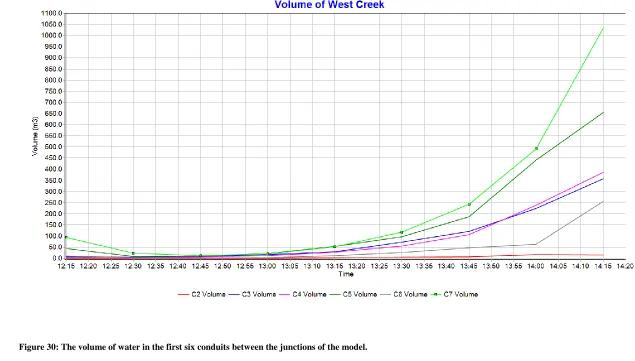
Figure 30: The volume of water in the first six conduits between the junctions
of the model. ... 73
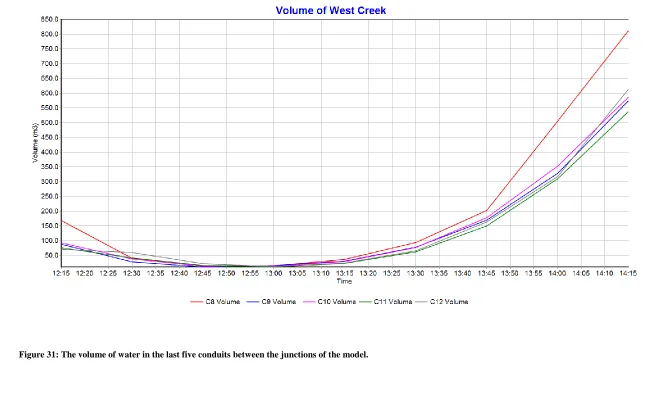
Figure 31: The volume of water in the last five conduits between the junctions
of the model. ... 74
Figure 32: The timeline for the project covering both semesters... 94
Figure 33: A detention basin located along West Creek in between Spring
Street and Stenner Street taken in August 2014. ... 115
Figure 34: A major power line running along West Creek with the power pole
situated directly next to the creek taken in August 2014. ... 116
Figure 35: Concrete footpaths built along West Creek for recreational use
affecting the natural flow of the creek taken in August 2014. ... 117
Figure 36: A toilet block built within the catchment of West Creek used for
recreational purposes taken in August 2014. ... 118
Figure 37: A public shade structure and barbeque built next to West Creek
near Stenner Street taken in August 2014. ... 118
Figure 38: Housing built approximately 30 metres from West Creek affecting
the natural flow of the water into the catchment and in danger of flooding
0061019385 xiii Figure 39: The piped drainage system used under the Spring Street road
crossing funnelling the water in and out again taken in August 2014.
... 119
Figure 40: An example of the types of tress situated along West Creek taken
in August 2014. ... 120
Figure 41: An example of some of the shrubbery along West Creek taken in
August 2014. ... 120
Figure 42: The results of the Arc Hydro analysis on the 2 m DEM showing
the stream, catchment and drainage points utilising the minimum
threshold... 122
Figure 43: The results of the Arc Hydro analysis on the 2 m DEM showing
the stream, catchment and drainage points utilising a threshold of 0.3.
... 123
Figure 44: The results of the Arc Hydro analysis on the 2 m DEM showing
the stream, catchment and drainage points utilising a threshold of 0.5.
... 124
Figure 45: The results of the Arc Hydro analysis on the 2 m DEM showing
the stream, catchment and drainage points utilising a threshold of 0.75.
... 125
Figure 46: The results of the Arc Hydro analysis on the 2 m DEM showing
0061019385 xiv Figure 47: The results of the Arc Hydro analysis on the 5 m DEM showing
the stream, catchment and drainage points utilising the minimum
threshold... 127
Figure 48: The results of the Arc Hydro analysis on the 5 m DEM showing
the stream, catchment and drainage points utilising a threshold of 0.5.
... 128
Figure 49: The results of the Arc Hydro analysis on the 5 m DEM showing
the stream, catchment and drainage points utilising a threshold of 0.75.
... 129
Figure 50: The results of the Arc Hydro analysis on the 5 m DEM showing
the stream, catchment and drainage points utilising a threshold of 1. 130
Figure 51: The Gowrie creek catchment showing the area which was affected
by rainfall categorised at Q>100 intensity and the location of the rain
gages (ICA, 2011). ... 132
Figure 52: The rain gage files utilised within the hydrological model showing
the amount of rainfall every 15 minutes. ... 133
Figure 53: The parameters utilised in each of the sub catchments within the
hydrological model. ... 134
Figure 54: The summary report generated by the software SWMM after
0061019385 xv Figure 55: The flow rate of water in the first six conduits between the
junctions of the model... 137
Figure 56: The flow rate of water in the last five conduits between the
0061019385 xvi
List of Tables
Table 1: The applications defined by the participants of the workshop and the
accuracies required (Apan et al., 2008). ... 17
Table 2: The Meta data of the survey completed for the Toowoomba Regional
0061019385 1
Chapter 1 Introduction
1.1 Introduction
Living in Queensland presents many risks and dangers when it comes to
weather. One of these risks that can affect nearly everyone in some way is
flash flooding. Flash flooding is the result of a sudden and unexpected amount
of intense rainfall falling over a small area, generally with steep terrain in a
short period of time (ICA, 2011). However living approximately 700 metres
above sea level in the city of Toowoomba would allow complacency when it
comes to flooding. Yet on Monday, 10 January 2011 a 1 in 100 year storm
cell quickly developed over the city dumping intensive rain in a short period
of time over the Gowrie Creek catchment area (ICA, 2011). This in
combination with long term drenching rain that had been previously falling
in the weeks leading up to the event, lead to one of the most devastating floods
in recent time (ICA, 2011).
The Gowrie Creek catchment is a combination of Gowrie, East, West and
Black Gully Creeks. East and West Creeks contain much of the cities
rainwater catchment and converge just before the central business district
(CBD). The catchment is heavily urbanised with multiple manmade features
located within and along the waters flow path.
The intense rainfall that occurred over only a few short hours created flash
flooding that caused damage throughout the creeks and destroyed the CBD
0061019385 2 dollars worth of damage occurred to the infrastructure within the central
business district. The floodwaters then went down the Toowoomba Range
and hit the un-expecting town of Grantham, where the entire town sustained
heavy damage and more lives were lost. The floodwaters then continued
down the system to join with other floodwaters in the Brisbane River before
leaving to sea (SKM, 2011). An efficient and accurate flooding mitigation
system would have reduced the severity of what was lost within this event,
and any other flooding event. Figure 1 highlights the type of water that was
flowing through the central business district of Toowoomba causing loss of
life and infrastructure damage.
Figure 1: The floodwaters running through the Toowoomba central business district on the afternoon of the flash flooding event (Cook, Frew & Wen, 2011).
In this case the flooding occurred so rapidly that the warning systems were
[image:19.595.114.491.370.623.2]0061019385 3 like this flood mitigation requires implementation before an extreme event
such as this is to occur. This would reduce the severity of the flood giving
people more time to prepare, saving money and lives (ICA, 2011). To perform
such a task highly accurate spatial data on the catchment area is vital for the
mitigation of such events (SKM, 2011). Spatial data of such accuracy and size
cannot be collected by traditional survey methods, instead requiring a
different modern type of surveying.
Airborne Light Detection and Ranging (LiDAR) is a rapidly developing piece
of technology that can collect large amounts of spatial data in a short period
of time (Sangster, 2002). This data can be collected faster than traditional
surveying methods whilst still providing accurate results (Kraus and Pfeifer,
1998). The collection of such dense spatial data in a short period of time
allows the generation of high-resolution Digital Elevation Models (DEM).
The DEM is a useful spatial data output that can be utilised in several types
of analysis. Some of these analysis methods include flood plain mapping,
characteristic analysis and hydrological modelling. The DEM can be utilised
within software packages such as ArcGIS and other modelling software
packages for characteristic analysis and modelling (Coleman et al., 2002;
Sithole and Vosselman, 2003). These software tools allow for analysis that
can be used in future flood forecasting and mitigation, which may save lives
and millions of dollars’ worth of damages. This project looks to utilise the
airborne LiDAR data to generate a high quality DEM for a characteristic
0061019385 4 hydrological modelling making judgements on the catchments capabilities to
deal with rainfall events.
1.2 Research Aim and Objectives
The aim of this project is to utilise LiDAR data to generate a high quality
DEM for characteristic analysis of the West Creek catchment and
hydrological modelling to assist in future flash flood mitigation. Within this
research topic there are multiple objectives based on this aim.
1.2.1 Objective 1
Identify information and methods related to Airborne LiDAR data,
hydrological analysis, modelling and flood plain mapping.
There is a broad range of information on LiDAR data including its history,
data types, collection methods and possible uses. Each of these needs to be
analysed to ensure there is a broad understanding of the topic, with an
emphasis on the hydrological applications of the data. A broad understanding
will allow correct and in-depth analysis in the later stages of the project.
Therefore it is an objective of this project to gain as much information and
knowledge as possible on LiDAR data and its application to waterways.
1.2.2 Objective 2:
Create a Digital Elevation Model.
In order to perform characteristic and hydrological analysis on the LiDAR
0061019385 5 producing such a map will be required. Once the map is generated a
characteristic analysis can be performed highlighting any areas of interest.
1.2.3 Objective 3:
Utilise the Digital Elevation Model in Hydrological Analysis.
Once the DEM is created hydrological analysis can be performed and a flood
plain map generated. The use of appropriate software such as Arc GIS will
allow a hydrological analysis of the mapped plain. This objective will lead
towards the final goal of identifying areas that require flood mitigation.
1.2.4 Objective 4:
Perform Hydrological Modelling
To further strengthen the analysis and provide more useful information
hydrological modelling is to be completed. Through the use of appropriate
software information such as expected flow rates, velocities and volumes may
be generated when incorporating appropriate meteorological data. This will
help highlight any areas of interest that may not be highlighted in other
analysis.
1.2.5 Objective 5:
Analyse results to determine areas requiring flood mitigation.
Once all of the mapping and modelling is completed all of the collected data
requires analysis. This analysis will aim to determine characteristics or
0061019385 6
1.3 Justification
This project has many benefits that may arise from its completion. The first
and foremost benefit of utilising airborne LiDAR data for flood plain
mapping, analysis and hydrological modelling is flood mitigation. Flooding
in Australia affects nearly everyone in some form and its mitigation to reduce
damage and save lives is of utmost importance. Having the information and
techniques available to take a proactive approach to mitigation is extremely
important in future work. This project will also help highlight the capabilities
of airborne LiDAR data and its appropriate software. Highlighting its
application to such an important task will help promote airborne LiDAR data
as a high quality and useful survey technology and technique.
1.4 Dissertation Overview
This dissertation contains multiple chapters relevant to the work completed.
There are five main chapters in total and each is given a brief overview below.
Chapter 1 Introduction - This chapter gives an introduction to the topic.
There is background information relevant to the project being undertaken
with the need for the project highlighted. This chapter also states the aim and
objectives of the project to be met throughout.
Chapter 2 Literature Review – This chapter goes over relevant literature to
the project. It covers airborne LiDAR, DEMs, and hydrological modelling.
Chapter 3 Methodology – This chapter highlights the methods utilised to
0061019385 7 area, the data collection, the generation of the DEMs, the characteristic
analysis and the hydrological modelling.
Chapter 4 Results and Discussion – This chapter highlights the results of
the methodology. It also goes into detail about each of the results and their
relevance to the objectives of the project.
Chapter 5 Conclusions – This chapter concludes the project summing up all
of the information found and makes recommendations for the future.
There is also an extra chapter at the end which contains multiple appendices
relevant to the information within the dissertation.
1.5 Conclusion
This chapter has provided an extensive background into the project. It has
highlighted flooding as a common occurrence within Australia and that it
needs to be dealt with proactively. Through the use of LiDAR data, analysis
can be completed on the catchment to obtain any important information
regarding its hydrological behaviour. Mitigation may then be implemented to
ensure that such an event does not happen again in the future. The justification
of completing this project has been described with mitigation highlighted as
the key outcome. The objectives of the project have also been detailed and
the dissertation outline has been provided. The following chapter will detail
0061019385 8
Chapter 2 Literature Review
2.1 Introduction
To gain a full understanding on all of the information related to this topic and
the objectives stated in the previous chapter, a literature review was
completed. Several areas were identified as key to the topic and were
thoroughly researched. These areas are airborne LiDAR, DEMs, and
hydrological modelling. This review looks to give an extensive insight into
each of these key areas reviewing previous research and studies.
2.2 Airborne LiDAR
Airborne Light Detecting and Ranging (LiDAR) also referred to as LiDAR,
Laser Altimetry or Airborne Laser Scanning (ALS) is an active remote
sensing technique originally designed to measure the topography of the
earth’s surface (Hollaus, Kraus & Wagner, 2005).
2.2.1 Airborne LiDAR History
The history of LiDAR is extensive with the technologies involved being
studied for an extended period of time. Flood (2001) states that LiDAR data
and the technologies involved around it have been studied since the 1960s.
For multiple years to come there were multiple experiments involving the
advancement of the laser and its usage. Multiple results were returned, both
positive and negative. The first major advancement occurred in the 1980s
when research and design of Airborne LiDAR for topographic data collection
0061019385 9 et al. (1991) who both reviewed the advancements in the technology at their
time of arrival. This research and design then came into fruition in the 1990s
when commercial LiDAR systems became operational and available for any
surveyor wishing to utilise them, at a high price. Since then LiDAR has come
to the forefront of surveying technology becoming a recognised and well used
method of geographical data collection. This type of technology and its many
uses is an area that will continue to be active in research and development in
the future (Pfeifer and Briese, 2007; Flood, 2001).
Many of the improvements with LiDAR in the modern age involve the
sensors, data processing aspects, increased accuracy, a wider spectrum range
and extraction of object properties (Pfeifer and Briese, 2007). One of the
major modern advances in the technology revolves around the continued
improvement of the laser pulse repetition rate. Flood (2001) states that the
maximum pulse repetition rate previously available for commercial systems
was 50 kHz. However Lemmens (2007) who compared multiple Airborne
LiDAR systems only six years later states that the maximum repetition rate
for commercial systems was around or even higher than 250 kHz. Now seven
years later again there are commercial systems available with repetition rates
above 500 kHz for commercial use (Leica, 2014). This dramatic improvement
in a short period of time shows that LiDAR has and will continue to improve
as more modern technology continues to be developed, providing access to
fast, cheap and dense spatial data. These advances in technology have
presented many modern applications for LiDAR data including hydrological
0061019385 10
2.2.2 Airborne LiDAR System
An airborne LiDAR system is typically composed of three main components
that work together to collect the spatial data. These three components are the
laser scanner, the Global Positioning System (GPS) receiver and the Inertial
Measurement Unit (IMU) (Hollaus, Kraus & Wagner, 2005; Pfeifer & Briese,
2007). Figure 2 shows how the systems work together along with the aircraft
to collect spatial data. The laser scanner consists of a pulse generator and a
receiver to gather the information of the reflected pulses from the terrain. The
laser works by emitting short infrared pulses towards the earth’s surface.
These pulses can be sent at rates of up to 500 kHz in modern systems with a
faster pulse generation rate resulting in more data in a shorter period of time
(Leica, 2014). A photodiode within the scanner then measures the backscatter
echoes from the pulse generator. The echoes received by the photodiode are
dependent on the objects within the travel path of the laser pulse. The distance
between sensor and the object that it meets can then be determined by
multiplying the time it took for the light to transmit and return by the speed
of light (Watkins, 2005). Therefore laser scanners measure the round trip of
multiple echoes from one laser pulse generated from the scanner (Hollaus,
Kraus & Wagner, 2005; Pfeifer & Briese, 2007). An airborne LiDAR survey
requires the knowledge of where the plane is, so the GPS receiver is used to
record the aircrafts trajectory. The receiver in conjunction with a base receiver
on a known position gives a real time position of the plane as it flies. In
general flight, aircrafts do not stay straight and level, so the IMU unit within
0061019385 11 possible directions depending on conditions including roll, pitch and yaw.
The IMU measures the roll, pitch and yaw of the plane to allow adjustments
to the collected data if necessary (Dias & Webster, 2006). Each of these types
of plane movement is highlighted in figure 2.
Figure 2: An Airborne LiDAR system highlighting the scanner, GPS and IMU unit (Ohio Department of Transportation, 2014).
2.2.3 Airborne LiDAR Accuracy
The accuracy of the LiDAR data collected is reliant on the accuracy
capabilities of the GPS and IMU units. According to BC-CARNS (2006)
airborne GPS units are capable of accuracies of approximately 5 cm
horizontally and 10 cm vertically. It also states that the IMU units are capable
[image:28.595.113.383.207.509.2]0061019385 12 be able to achieve accuracies of approximately 15 cm root mean square
(RMSE) in vertical and 20 cm RMSE in horizontal. This accuracy over a mass
scale in dense data is more than enough for the purpose of flood plain
mapping and analysis. These accuracies are beneficial for many surveying
applications and can be best represented in a DEM.
2.2 Digital Elevation Models
Airborne LiDAR data has multiple possible uses throughout the surveying
world. However the main use for the technology in modern surveying is
spatial analysis. There has been a significant increase in the use of LiDAR
data for DEM generation as more reliable and accurate LiDAR systems are
developed (Sithole and Vosselman, 2003).
2.2.1 Data Source for Digital Elevation Models
Within the surveying profession there are several different ways to collect
spatial data depending on the requirement of the client. Traditional survey
methods of terrain data collection such as field surveying using total station,
GPS and photogrammetry are capable of yielding high accuracy terrain data.
These methods can however be extremely labour and time intensive when it
comes to collecting highly accurate spatial data over a large-scale area. This
extra labour and time makes them inefficient and costly to surveying
businesses, making large-scale spatial data collection difficult. Traditional
methods also provide many data collection issues in areas such as forests
where data cannot be easily collected due to vision problems (Liu, 2008). The
0061019385 13 can fill in the gap of efficient terrain data collection. Airborne LiDAR can
collect dense data quickly and accurately penetrating through forest areas,
overcoming traditional methods of terrain data collection (Liu, 2008). Kraus
and Pfeifer (1998) demonstrated that this was the case by confirming that
DEMs generated by LiDAR in forests achieved the same accuracy as
photogrammetry in open areas.
Modern LiDAR data capture methods and technology allow for mass
collection of high-density data resulting in an accurate representation of the
earth’s terrain. This however presents other issues with data such as storage
capacity, processing power and manipulation capabilities. Sangster (2002)
highlights that there are several factors, which contribute to the density of the
airborne LiDAR data. These were the pulse rate of the laser, the altitude of
the platform (flying height), the width of the swath, the speed of the aircraft
and the amount of overlap. Each of these needs to be considered when
collecting spatial data and the effects they may have on the processing stage
after collection.
The study completed by Liu (2008) looks to overcome the issues of storage,
capacity and manipulation of airborne LIDAR data by focusing on LiDAR
data filters, interpolation methods and LiDAR data reduction. The section
important to this study is the LiDAR data reduction and the problems that can
occur with it. The main point deduced from Liu (2008) is that it is crucial to
filter or extract the bare earth points from the LiDAR data. However many of
0061019385 14 A major advantage of airborne LiDAR data is that it has the capability of
presenting objects in a three-dimensional object space immediately after
collection (Al-Ruzoug et al., 2005). After collection the LiDAR points are
initially represented with latitude, longitude and ellipsoidal height based on
the World Geodetic System 1984 (WGS84) reference ellipsoid. These
coordinates on the ellipsoid can be transformed to a national or regional
coordinate system depending on the required use, accuracy and size of the
survey. If the survey is small and only for limited use, the data can be
converted using a regional datum. However if the data collection area is large
and has beneficial use for the state or country, a national system should be
used. Elevations can also be converted from ellipsoidal heights to orthometric
heights based on a national or regional height datum by using a geoid model.
These heights can then be used within the DEM as terrain heights (Dias &
Webster, 2006; Chandra et al., 2007).
The scanner in an airborne LiDAR survey can measure the backscatter signal
from any surface that the beam makes contact with. These non-ground
surfaces can include man-made objects, vegetation or wildlife that are under
the laser at time of collection (Barber & Shortrudge, 2004; Gesch et al., 2006).
Multiple returns of the one pulse occur when the laser pulse meets a target
that does not completely block the path of the pulse, allowing the remained
of the pulse to continue on to a lower target (Anderson, McGaughey &
Reutebuch, 2005). These non-ground points have multiple applications but as
Liu (2008) highlights the separation of these from the ground points is a vital
0061019385 15 Another type of data that is collected in an airborne LiDAR survey, which
contributes to the improvement of DEM quality, is the intensity of the
backscatter laser pulse. The backscatter signal is a function of multiple
variables including the laser power, beamwidth, range, atmospheric
transmission and target cross section (Briese et al., 2004). The intensity is
created by the optical signal received at the sensor being converted to an
electrical signal by a photo detector. This electrical signal is then quantised
to a digital number by the system, which is the intensity value. This can then
be interpolated to a geo-referenced intensity image, which can assist in
surface classification of DEM’s (Briese et al., 2004; Han et al., 2002)
2.2.2 Digital Elevation Model Generation and Output
To complete the generation of a flood plain map there are several types of
outputs that may be generated. These outputs include, but are not limited to
topographic surface models, thematic land cover maps and two-dimensional
hydraulic surface flow models (Hollaus, Kraus & Wagner, 2005). The DEM
plays a major role in their production due to the DEMs slope, aspect and
drainage networks all being key parameters. The accuracy of these parameters
within the DEM plays a major role in further modelling (Hollaus, Kraus &
Wagner, 2005).
The study completed by Liu (2008) highlights that the Inverse Distance
Weighted (IDW) interpolation method is a suitable interpreter of high density
LiDAR data. The IDW interpolation method assumes that each collected
0061019385 16 with dense evenly distributed data but does not work as effectively if the
points are sparse or uneven (Childs, 2004). In Liu, McDougall and Zhang
(2011) they generate a high quality DEM from LiDAR data for characteristic
analysis utilising the IDW interpolation method within ArcGIS 10 software.
Liu (2008) also highlights that to improve efficiency and maintain accuracy
the extraction and inclusion of terrain elements such as break lines with the
DEM is an important step. Finally Liu (2008) also states that the DEM
resolution must match the LiDAR density, be able to reflect the changes over
the terrain surface and represent the terrain features. Each of these is vital in
generating a DEM that is capable of flood modelling.
A study completed by Liu and Zhang (2010) looked into the automated
delineation of drainage networks from high resolution DEMs. The study was
completed as the drainage networks are highlighted as one of the main factors
in flood analysis and prediction. The area used for the study covered the entire
Toowoomba City. The extraction of the drainage networks was completed
utilising the Arc Hydro extension of ArcGIS software. The study highlights
that the use of a threshold within the software is important in providing a
detailed drainage network from the DEM. The choice of threshold was shown
to have a direct influence on the detail of the stream network generation. The
study found that a high resolution DEM can provide a detailed delineation of
the drainage network and the catchment if the correct threshold is chosen.
The aforementioned study was furthered by Liu, McDougall and Zhang
(2011) who completed a characteristic analysis of a flood plain utilising
0061019385 17 within ArcGIS 10 software was utilised. They further extended on the
software’s use highlighting that it can be utilised to perform several forms of
analysis after performing multiple steps. The major steps involve sink filling,
identification of the direction of flow, determination of the flow accumulation
and definition of the stream. It concluded that many different outputs are
available for flood modelling from LiDAR generated DEMs including
longitudinal profiles, shape indices, and hypsometric curves. Each of these
outputs is beneficial in flood plain analysis and will be of use in this study.
2.2.3 DEM Accuracy
Apan et al. (2008) completed a study on the accuracy requirements of a DEM
for use with catchment management. To perform this study a catchment area
over the Condamine River was utilised to generate a DEM from airborne
LiDAR data. The broad requirements and key needs for a catchment DEM
from both an operational and strategic perspective were determined through
the use of a workshop. There were eighteen participants in the workshop who
represented multiple different stakeholders within Queensland. The result of
this workshop can be seen in table 1.
0061019385 18 It can be seen in table 1 that the areas relevant to this study are the
hydrological modelling, Disaster planning and management (flood and fire)
and insurance and risk assessment. These areas have a required accuracy of
±1 m, <0.5 m and <0.5 m respectively. This study concluded that to produce
such results extreme care has to be taken when collecting the LiDAR data to
generate the DEM. The methods utilised to reduce it are also critical ensuring
that the ground points are accurately represented in the model.
2.3 Hydrological Modelling
As modern technology continues to improve there are always improvements
in software that make once difficult tasks, far easier. Much can be said about
this in the area of hydrological modelling with the development of many
software packages capable of modelling floodwaters. To perform
0061019385 19 (Elliot and Trowsdale, 2006). The accuracy of the inputted data is vital for
the overall accuracy of the model. Hollaus et al. (2005) performed an analysis
of airborne LiDAR and its usefulness for hydrological modelling. The study
utilised an object based land cover classification to perform the analysis. It
was found that the accuracy of the DEM is crucial in minimising the
uncertainties that can result in flood modelling.
2.3.1 Hydrological Modelling Software
Elliot and Trowsdale (2006) performed a comparison of multiple urban
stormwater management software’s. They completed this study by comparing
multiple software’s against identified attributes including intended use,
temporal use and scale, catchment and drainage network representation,
runoff generation, contaminants in the models, devices and technologies
included, user interface and cost. The three most important attributes to this
study are the catchment and drainage network representation, runoff
generation and cost. The study found that the Model for Urban Stormwater
Improvement Conceptualisation (MUSIC), MOUSE, Storm Water
Management Model (SWMM) and P8-UCM were best when representing a
catchment and drainage network. Each software utilising a spatially
distributed link-node drainage network causes this. This works by
representing each element within the catchment as a node and connecting
them together. Each node can then have flow control devices or treatments
placed on them to give a true representation of how they are in the field. This
study also found that MOUSE, SWMM and MUSIC were greater at
0061019385 20 initial and continuing loss (MOUSE) and a Green-Ampt infiltration
(SWMM). It is highlighted that there is no one method that is better than any
of the others when generating runoff which each being beneficial to the
modelling. Finally the study showed that of the three mentioned software
models SWMM is the only one that is available free for download and use.
From this study it can be seen that MOUSE, SWMM and MUSIC are three
software models that are quite capable of being used for the hydrological
modelling of a stormwater management system. However due to availability
MUSIC and SWMM will be the two software models researched and
compared.
2.3.2 MUSIC and SWMM
Coleman et al. (2002) identify MUSIC as a powerful modelling tool. The
software was created as many designers were designing stormwater
management strategies ineffectively trying to achieve cost effective
outcomes. Coleman et al. (2002) highlights multiple capabilities of MUSIC
including:
- Determining the water quality from specific catchments.
- Predicting the performance of specific stormwater treatment
measures.
- Designing integrated stormwater management plans for each
catchment.
0061019385 21 It is noted that MUSIC is a tool to be used as decision support and not as
design software. The software’s main use lies in testing stormwater
management techniques, not designing them (Coleman et al., 2002). Coleman
et al. (2002) highlights that MUSIC utilises the algorithm developed by
Chiew et al. (1997). This algorithm works off the concept that stormwater
runoff is generated from impervious surfaces. The model is based on the
definition of the impervious area and the two moisture storages (deep and
shallow) highlighted in figure 3.
Figure 3: The model adopted within MUSIC for modelling catchment hydrology (Chiew et al., 1997).
There are several stormwater treatment nodes within the both software’s as
0061019385 22 correct use of each of these treatment nodes is vital in the modelling process.
Both SWMM and MUSIC use treatment nodes such as these in their treatment
train when developing a drainage network (Peterson & Wicks, 2006).
Dickinson and Huber (1992) defined SWMM as a numerical model software
obtainable from the Environmental Protection Agency. The software is
designed for the simulation of flow quality and quantity of urban runoff. As
a result the quality and quantity are a representation of the urban stormwater
runoff and sewer overflow phenomena.
Peterson & Wicks (2006) completed a study into the importance of conduit
geometry and physical parameters utilising SWMM as the software. Within
this study there was a comparison of SWMM to other modelling techniques.
It was deduced that in the studies case, it was good software for the
application and it provided valuable information about the local flow of the
system. This is extremely beneficial to the requirements of this project.
This information shows that both SWMM and MUSIC are both similar
software packages which are suitable for the modelling of urban stormwater.
2.3.3 Meteorological Data
The selection of appropriate rainfall data is a vital step in any sort of
hydrological modelling. The intensity-frequency-duration (IFD) is the
commonly used tool when performing rainfall analysis (Koutsoyiannis,
Kozonis & Manetas, 1998). It can take the form of Q1, Q5, Q10, Q20, Q50
and Q100 depending on the scale of the rain event. A Q1 event is common
0061019385 23 (Bureau of Meteorology, 2014). This data is available from the Bureau of
Meteorology (2013) who has recently updated all of their IFD data to provide
more accurate rainfall data. Normal rainfall data showing the amount of
rainfall that fell in a certain area can also be obtained from the Bureau if
required.
2.4 Conclusion
This chapter has provided an extensive insight into the literature available
regarding important aspects of this project and its objectives. The chapter has
gone into detail about airborne LiDAR including its history, systems and
accuracy capabilities. The data collected from these airborne surveys was
then discussed and its capabilities to be used in DEMs shown. The use of the
DEMs for characteristic analysis was also highlighted with examples of other
research using similar techniques shown. Finally some of the available
hydrological software packages available including SWMM and MUSIC
were shown, broken down and compared. The application of meteorological
data within these hydrological modelling software packages was also
emphasised. The information and knowledge gained from the research
undertaken in this chapter will now be applied. This will be shown in the
methodology undertaken to meet the objectives of the project in the following
0061019385 24
Chapter 3 Methodology
3.1 Introduction
After gaining a large amount of theoretical information and analysing past
works, a methodology had to be determined to meet the objectives. A study
area had to be selected and LiDAR data over the study area required
collection. After the data had been collected a DEM was generated from the
ground points of the study area. Slope analysis was then performed on the
DEM to highlight any areas of interest within the study area and to deduce
the flood plain. Hydrological processing was also completed to identify
catchments and streams within the area. Hydrological modelling was then
performed utilising SWMM to highlight areas where mitigation may be
implemented around the catchment and stream network.
3.2 Study Area
3.2.1 West Creek Location
The study area is West Creek, which forms part of the Gowrie Creek
catchment. West Creek starts within southern Toowoomba, running north
through Toowoomba meeting with East Creek near the CBD. The two creeks
then merge to become one creek carrying on through Toowoomba in a
northern direction. The layout of the creeks within the Gowrie Creek
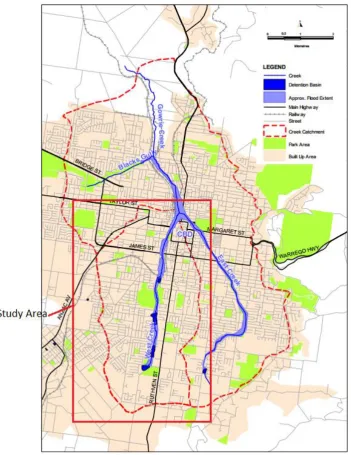
0061019385 25
Figure 4: The location of the Gowrie Creek catchment within Queensland (left) and the approximate locations of the creeks within Toowoomba (right) (Liu, McDougall & Zhang, 2011).
West Creek played a major role in the floods that occurred in 2011 and is
therefore an area of major interest (SKM, 2011). It is the largest creek within
the catchment containing an area of water of approximately 16.2 km2 (ICA,
2011). This makes it one of the most important catchments when it comes to
determining a flood plain.
3.2.2 West Creek Urbanisation
All of the creeks within the Gowrie Creek catchment, including West Creek
have been subject to heavy urbanisation due to constant expanding of
Toowoomba (ICA, 2011). This has resulted in structures such as bridge
crossings and housing right up to the edge of the creek, affecting the
catchment. These bridge crossings restrict the flow of the water by funnelling
0061019385 26 debris. An example of a bridge crossing can be seen in figure 5. Refer to
Appendix E for other pictures related to the urbanisation of West Creek.
These pictures are being used as a representation of the urbanisation and may
not be a 100 % accurate representation of what West Creek was like in
January 2011 before the flooding event occurred.
Figure 5: The bridge crossing over West Creek along Stenner Street in South Toowoomba as of August 2014.
West Creek has been heavily modified with the inclusion of concrete lined
channels, detention basins, piped drainage systems and various other
structures to manage stormwater. These have been included to help manage
the damage around the bridges running over the creek. Other man-made
structures such as concrete footpaths, shade structures and recreational
structures have also been recently included for the use of the public. These
0061019385 27 different surface for it to run over and altering its path. An example of
concrete lining being used in West Creek can be seen in figure 6.
Figure 6: Concrete lining on the lowest part of West Creek in between Spring Street and Stenner Street in South Toowoomba as of August 2104.
West Creek also contains a combination of varying grass types, shrubs and
trees at moderate grade changes. The trees and shrubs within the catchment
0061019385 28 the catchment has a strong effect on the water the water flows within the
catchment. It can help slow the flow of water and hold the ground together.
However these trees and shrub can also become debris to block the pipe ways
and road crossings. An example of the type of nature within West Creek can
be seen in figure 7.
Figure 7: The types of trees and shrubbery along West Creek as of August 2014.
This study area is an excellent example of a watercourse located within an
urbanised area that contains many varying factors including ground cover,
trees, grade and manmade features. Each of these factors contributes and
affects the way the water flows and meets with the rest of the catchment
further downstream.
The study area, particularly near the CBD has undergone heavy man-made
0061019385 29 Regional Council for their flood mitigation program. Due to this the creek is
not as it was in some areas when the data was collected at the end of 2010.
However for the purpose of this research project West Creek will be treated
as close as possible to how it was in 2010.
3.3 Airborne LiDAR Data
3.3.1 Data Collection
It was decided that collecting new LiDAR data would be majorly time
consuming and too expensive for the purpose of this project. Also as the
flooding event occurred over four years ago, new data over West Creek would
not be a good representation of the flood plain. Instead LiDAR data was found
of the Toowoomba area from another source.
The LiDAR data was sourced from the Toowoomba Regional Council who
had Schlencker Mapping Pty Ltd conduct a Toowoomba wide airborne
LiDAR survey covering 2760 km in 2010. The data collection was undertaken
utilising an ALTM Gemini ALS scanner on a fixed wing aircraft. The Meta
data for the LiDAR survey can be seen in table 2 below. The entire report can
0061019385 30
Table 2: The Meta data of the survey completed for the Toowoomba Regional Council (Schlencker Mapping Pty Ltd, 2010).
It can be seen from table 2 that the survey was completed late June and early
July placing it approximately six months before the flooding event occurred.
The plane flew at a height of 1200 m completing two hundred and forty two
runs in total. The swath width of the laser scanner was 1000 m and there was
a 30 % overlap for the survey. Of note within the Meta data is the average
point separation, which is 1 m. This shows that the LiDAR data collected is
of extremely high density allowing greater accuracy. The metadata also
shows that the horizontal accuracy of the data is 0.15 m and the vertical
accuracy is 0.22 m, both at the first standard deviation. These accuracies are
within an expected range for an airborne LiDAR survey making the data
suitable for analysis (BC-CARNS, 2006).
3.3.2 Data Validation
The same surveying company, through the use of a vehicle mounted GPS
0061019385 31 GNSS receivers collecting data at 50 m intervals. The survey covered a total
of 218 km along bitumen and gravel roads collecting six thousand three
hundred and thirty two points at an accuracy of ± 0.05 m. This GPS survey
highlighted that 94 % of the LiDAR points collected are within 0.15 m of
their true points.
The data provided had the ground points and non-ground points already
separated in a binary LAS file format. There was no mention of the technique
utilised to separate the ground and non-ground points.
3.4 Digital Elevation Model Generation
The generation of the DEM required the use of ArcGIS 10.2 software. Liu
(2008) highlights that one of the most critical aspects of DEM generation with
LiDAR data is the separation of ground and non-ground points. However in
this case the LiDAR data had been provided already separated, taking out this
step of the process. Thirty-five text files were utilised which were each
approximately 1 km2 in size. These files stretched far enough to give an
accurate representation of the catchment area.
3.4.1 Inverse Distance Weighted Interpolation Technique
The generation of the DEM could be completed utilising multiple different
tools. In the study completed by Liu, McDougall and Zhang (2011) the DEM
was generated by the IDW interpolation technique. The technique is
mathematical that uses a linearly weighted combination of points to determine
0061019385 32 mapped decreases as its distance from the sample location grows (Phillip &
Watson, 1985). This is highlighted in figure 8.
Figure 8: The Inverse Distance Weighted sample location used when processing the points whilst generating a DEM (ESRI(a), 2014).
The range of values used to interpolate limits the output of a cell using this
technique. Due to the results being a weighted distance average, sudden rises
or falls cannot be generated unless they already have data collected over them.
To get the best results from the method dense data sampling is required, if not
the results may not be a true representation of the surface (Phillip & Watson,
1985). In the case of the data over West Creek there are no sudden rises or
falls with consistent grade changes throughout. The data has also been
densely collected as mentioned in section 3.3.1 at a ground separation
distance of 1 m. As a result the IDW technique would present an accurate
0061019385 33
3.4.2 Topo to Raster Interpolation Technique
Another technique that may be utilised to generate a DEM is the Topo to
Raster interpolation tool. The Topo to Raster tool is one that has been
designed for the generation of DEMs that are correct in a hydrological sense.
This tool is based on the ANUDEM program, which was developed by
Michael Hutchinson (Hutchinson, 1988). The technique imposes constraints
while it interpolates the elevation values of a raster surface to ensure that the
final outcome has a true representation of drainage, ridges and streams. The
interpolation technique used within this method is an interactive finite
difference technique. It utilises the knowledge of landscapes having multiple
hilltops and minimal sinks to generate a connected drainage pattern. The
drainage conditions that are imposed upon the surface help generate an output
that is best for hydrological work and requires little to no post processing
(ESRI(c), 2014).
A choice had to be made between the two techniques as to which should be
utilised. The Topo to Raster interpolation tool was chosen to generate the
DEM. The IDW tool requires one surface to be input, which can then be
created into a DEM. This means that other tools such as the merge tool would
be required to generate the DEM, increasing the chances of error. Whereas
the Topo to Raster tool allows multiple input files and generates the surface
from each individual input. This technique is also specifically made to
generate DEMs that are hydrologically accurate, making it the clear choice
0061019385 34 To generate the DEMs the Topo to Raster interpolation technique was
utilised. The text files had to be displayed with the appropriate Map Grid
Australia 1994 (MGA1994) projection. In Toowoomba the correct map grid
correction is zone fifty-six. Each tile once displayed was then exported into a
shape file to allow generation of the DEM.
To generate the DEM the individual shape files were inputted and the output
cell size was set at two. This generated a DEM with a resolution of 2 m. A
second DEM was also generated with the same input shape files with an
output cell size of five. This allowed for the generation of a DEM with a
resolution of 5 m. The two different resolutions were chosen to observe the
differences in the generation of the stream networks and catchment size in
later modelling.
3.5 Hydrological Analysis
Once the DEMs were generated the hydrological analysis was completed. The
initial steps of the analysis were completed in Arc Hydro to perform
hydrological analysis of the catchments and drains. Following the
hydrological analysis a slope map was generated to determine the flood plain.
Liu, McDougall and Zhang (2011) and Liu & Zhang (2010) completed a
characteristic analysis and extracted drainage networks from DEMs
previously. Both studies showed that that the extraction of drainage networks
is based on the widely used D8 algorithm. Within this algorithm the correct
choice of threshold values is vital to the accuracy of the stream network. To
0061019385 35 ArcGIS 10.2 software was utilised. This extension of the software can be
utilised to perform several forms of analysis after performing multiple steps.
3.5.1 Arc Hydro Pre Processing
The steps involved in the pre-processing for Arc Hydro are extremely
important and must be completed in the correct order for the processing to
work. The first step involves reconditioning the DEM by imposing linear
features onto it. This step is an optional one and does not need to be
completed. The second step involves filling all of the sinks within the DEM.
If there is a cell in the DEM that has multiple high cells around it, the water
will not flow causing issues in the modelling. This step fills those cells to
ensure that this does not occur (ESRI, 2011).
Once filled the direction of flow for each cell is determined from the steepest
descent values within the cells. The next step involves determining the flow
accumulation. The flow accumulation creates a grid showing the number of
cells, upstream of a cell. Following the flow accumulation the stream must
then be defined. Within this step there is a stream threshold that must be input.
It originally displays 1 % of the maximum flow accumulation, but this may
be changed. The result is a grid that shows all of the cells from the input flow
accumulation that has a value greater than the threshold entered (ESRI, 2011).
The next step is stream segmentation where each steam is given a unique
identifier. Following the segmentation the catchment grid delineation is
created. This step creates a grid where each cell carries a value that is an
0061019385 36 steps may be completed to generate the polygon lines for the stream and the
catchment, making a better representation. The adjoining catchments can also
be generated which show any catchment that is not a head catchment. Finally
the drainage points can be generated which shows the point where water
would be expected to drain from each stream. Once these have been
determined further analysis can be completed including determination of
surface area, shape indices and the creek profile (ESRI, 2011).
The Arc Hydro pre-processing analysis was completed on both the 2 m DEM
and the 5 m DEM. The pre-processing for each of the DEMs followed the
same steps except for the input of the threshold value in the stream definition
step. The 2 m DEM had thresholds of 0.1970 that is the minimum 1 %, 0.3,
0.5, 0.75 and 1. Each of these and the corresponding number of cells can be
0061019385 37
Figure 9: The multiple inputs for each of the stream definitions during pre-processing of the 2 m DEM.
The same process was followed with the 5 m DEM. The threshold inputs for
the 5 m DEM were 0.1975 which was the minimum 1 %, 0.3, 0.5, 0.7 and 1.
The threshold inputs and their corresponding number of cells can be seen in
0061019385 38
Figure 10: The multiple inputs for each of the stream definitions during pre-processing of the 5 m DEM.
Once the streams and catchments were generated analysis was completed on
each of the maps to identify the stream networks and the size and shape of the
0061019385 39
3.5.2 Slope Analysis
The slope tool works by identifying the gradient or rate of maximum change
in the z value of each individual cell compared to its neighbours. The steepest
downhill descent for the cell is then determined by finding the maximum
change in elevation between the eight surrounding cells and the cell itself. If
there is no data within a cell then it is left as having no data within it
(Burrough & McDonnell, 1998). An example of how the cells works can be
seen in figure 11.
Figure 11: The way the cells are worked within a slope analysis (ESRI(b), 2014).
The generation of the slope analysis surface was completed on the 5 m DEM
created through the Topo to Raster technique. The generation of slope
analysis on both the 2 m and 5 m DEM was deemed meaningless and was not
completed, as the results were almost identical. The surface was generated
with a percentage representation instead of a degree representation. The Z
factor for both slope surfaces was kept as default which was 1. Once
generated the surfaces were reclassified to 0 - 2 %, 2 - 5 %, 5 - 10 %, 10 - 20
0061019385 40 representation of the slopes within the creek highlighting the areas which may
be the flood plain. The resulting slope map was then analysed with the areas
that fell within the 0 - 2 % and 2 - 5 % deemed a chance of being a flood
plain.
3.6 Hydrological Modelling
To perform the hydrological modelling software had to be chosen. The choice
was between MUSIC and SWMM. It was decided that since both software
packages offer similar analysis, SWMM would be utilised for the analysis.
SWMMs ability for free download and use with online guides and tutorials
compared to MUSICs restrictive access and paid tutorials made it the obvious
choice.
To begin the analysis the treatment train had to be drawn over the study area.
SWMM has multiple different forms of hydrological components that can be
utilised to represent the system on the ground. These components can be
generally broken into nodes or links. Within each of these, the main