social action could help to
tackle some of our most
pressing social problems…”
SERVICE NATION 2020
Jonathan Birdwell
Ralph Scott
20 years at the centre of the policy debate, with an overarching mission to bring politics closer to people.
Demos is now exploring some of the most persistent frictions within modern politics, especially in those areas where there is a significant gap between the intuitions of the ordinary voter and political leaders. Can a liberal politics also be a popular politics? How can policy address widespread anxieties over social issues such as welfare, diversity and family life? How can a dynamic and open economy also produce good jobs, empower consumers and connect companies to the communities in which they operate?
Our worldview is reflected in the methods we employ: we recognise that the public often have insights that the experts do not. We pride ourselves in working together with the people who are the focus of our research. Alongside quantitative research, Demos pioneers new forms of deliberative work, from citizens’ juries and ethnography to social media analysis.
Demos is an independent, educational charity. In keeping with our mission, all our work is available to download for free under an open access licence and all our funders are listed in our yearly accounts.
the copyright. We therefore have an open access policy which enables anyone to access our content online without charge.
Anyone can download, save, perform or distribute this work in any format, including translation, without written permission. This is subject to the terms of the Demos licence found at the back of this publication. Its main conditions are: · Demos and the author(s) are credited
· This summary and the address www.demos.co.uk are displayed · The text is not altered and is used in full
· The work is not resold
· A copy of the work or link to its use online is sent to Demos
You are welcome to ask for permission to use this work for purposes other than those covered by the licence. Demos gratefully acknowledges the work of Creative Commons in inspiring our approach to copyright. To find out more go to
1
2
3
Acknowledgements
Executive summary
The value of youth social action:
evidence on double benefit
Service nation 2015: where we are now
Service nation 2020: recommendations
Notes
References
9
11
25
55
67
81
Acknowledgements
First and foremost, we would like to thank Generation Change for supporting this work. In particular, we would like to thank Sonia Sodha and David Reed for their support and feedback during the course of the research.
We are grateful to the members of the Generation Change partnership organisations who attended the two Steering Group meetings we held and offered valuable feedback on early drafts of the report. We would also like to thank all the stake-holders who participated in the research from the following organisations: Ashoka, Association of Colleges, Big Lottery, CBI, Envision, Esmée Fairbairn, Fixers, Free the Children, Girlguiding, GwirVol, The Key, NCS Trust, Ofsted, The Scout Association, Universities UK, Volunteer Now (Northern Ireland), Volunteer Scotland and Youth United Foundation.
At Demos we are very grateful to Charlotte Tosti who contributed valuable research support during her work experience placement. We would also like to thank Duncan O’Leary for his feedback on early drafts of the report, as well as Daniela Puska for her assistance in managing the publication process.
Any errors or omissions are our own.
Executive summary
It’s my hope – and my mission – that when people look back at this five, ten-year-period from 2010, they’ll say:
‘In Britain they didn’t just pay down the deficit, they didn’t just balance the books, they didn’t just get the economy moving again, they did something really exciting in their society.
Whether it is in building affordable housing, tackling youth unemployment, inviting charities to deliver public services: the people in Britain worked out the answer to the big social problems.’
David Cameron, 20101
The revitalisation of civil society has always been a passion of the prime minister’s and, in turn, his Government. While the term ‘Big Society’ fell out of favour, the principle behind it has endured and is manifested in the prime minister’s support for youth social action, and in particular, the Step Up To Serve’s #iwill campaign and the work of the organisa-tions that are part of Generation Change.
Step Up To Serve was established in November 2013, with the support of the major political parties and the Prince of Wales as the Royal Patron. The aim of its #iwill campaign is to get over 60 per cent of young people from all back-grounds to take part in high quality social action by 2020.
· be challenging
· be led by young people themselves
· have a positive and measurable impact on society · include reflection
· be progressive towards other opportunities
· be embedded across the lifecycle of a young person
The ambitious and compelling vision that the prime minis-ter outlined in 2010 has at its core the belief that high quality social action has a ‘double benefit’: benefits to the individuals taking part through their new skills and personal wellbeing, and to society by benefitting a cause, community or social problem, such as loneliness in old age, social care, educational underachievement, youth unem-ployment and social cohesion.
The evidence for this double benefit continues to expand and strengthen, highlighting the potential for a substantial return on investment. As we argue in this report, if properly harnessed, the unique contribution of young people taking part in social action could help to tackle some of our most pressing social problems: help to create collaborative and relational public services in health and social care, build more integrated communities, and enable young people to develop character capabilities, employabil-ity skills and a robust concern for civic activism and helping others in society.
The last five years has seen youth social action in the UK develop into a cohesive movement, with a common focus and ambitious aims. But there is still a significant amount of work to do over the next five years to ensure that the #iwill campaign meets its target by 2020. A renewed commitment from the Government is vital to realising the full potential of youth social action and achieving the prime minister’s ambitious vision for a flourishing service nation of civic activism.
In chapter 1, we present the most compelling evidence to date about the double benefit impact of youth social action, drawing on impact evaluations including the recent 2015 Behavioural Insights Team interim report Evaluating
Youth Social Action,2 and five years’ worth of evaluations of National Citizen Service (NCS). We also draw on robust evidence from the US, including evaluations of AmeriCorps and the 2013 Columbia University report The Economic Value
of National Service.3
In chapter 2, we describe the successes and the accom-plishments of youth social action so far, as well as some of the enduring challenges facing the sector. As part of this research we conducted 20 structured interviews with a wide range of key stakeholders, including chief executives from youth social action providers, funding organisations, business leaders and education experts. We interviewed stakeholders from the following organisations: Ashoka, Association of Colleges, Big Lottery, CBI, Envision, Esmée Fairbairn, Fixers, Free the Children, Girlguiding, GwirVol (Wales), The Key, NCS Trust, Ofsted, The Scout Association, Universities UK, Volunteer Now (Northern Ireland), Volunteer Scotland and Youth United Foundation. Our recommendations for government – presented in chapter 3 – are based on the points of
consen-sus that emerged from our interviews with these stakeholders. Our key findings and recommendations are
summarised below.
Education: character and attainment
· Using randomised control trials with three social action providers (The Citizenship Foundation, Envision and Voluntary Action Within Kent/IMAGO Social Action Initiatives), the Behavioural Insights Team found strong positive correlations between social action and character attributes like empathy, problem solving, cooperation, grit and resilience, and sense of community.
· While the results from the full range of Cabinet Office Journey Fund projects will not be published until later this year, evaluation of Youth United’s project found significant increases in the following character skills among participants compared against a control group: communication (13 per cent increase), creativity (11 per cent), empathy (10 per cent), resilience (9 per cent) and agency (8 per cent).5
· Additional positive findings are presented from Duke of Edinburgh’s, UK Youth, vInspired, Student Hubs, City Year and many other organisations at level 2 standards of evidence.
· Research from the US, DfE, Ofsted and NCS suggests that social action can improve motivation in school and lead to higher attainment.
Employment: skills and networks
There is compelling research on the relationship between employability and full-time ‘service year’ models of social action, particularly from the US, where the AmeriCorps programme has been running for over 20 years:
· A ten-year study by the US Corporation for National & Community Service found that volunteers in programmes like AmeriCorps had a 27 per cent higher likelihood of finding a job than those who had not participated in the programme.8
· Research on AmeriCorps’ impact also shows that social action can lead to higher wages and increased job satisfaction.9
· While full-time ‘service year’ programmes have not received anything near the same level of investment in the UK as in the US, evaluations of the programmes that do operate in the UK – such as programmes run by City Year, Volunteering Matters (formerly CSV) and vInspired – suggest they have similar positive outcomes on employability.
· Evaluations of NCS show participants develop useful skills for the future, realise they are more capable than they previously thought and become more confident about securing a job in the future.10
· Programmes like London Youth’s Build-It, among other programmes, suggest that social action can help young people who are NEET move into employment or training.11
Mental health: confidence and wellbeing
· A 2014 survey of youth social action found that people who had taken part in youth social action rated 8.6 out of 10 for life satisfaction, while those who had not rated 8 out of 10.15
· The Citizenship Foundation Programme interim evaluation found that participants in the Citizenship Foundation
Programme had a more positive outlook, with levels of anxiety 22 per cent lower than those in the control group.16
· A 2014 study by Join In found that participants in sport volunteering programmes had 10 per cent higher levels of self-esteem, emotional wellbeing and resilience than non-volunteers, and were 15 per cent less likely to worry or feel anxious.17
Big Society: community responsibility
Creating a ‘Big Society’ of empowered and active citizens remains a priority for the prime minister and the Government. Developing the civic capabilities of young people through social action can bring lasting benefits to society through their sense of responsibility towards local communities, manifested in an increased likelihood of volunteering in the future and their career choice. For example, social action programmes can encourage more young people to consider a career in social care through programmes like Volunteering Matters’ full-time young persons volunteering programme or Student Hubs projects. This is vital as the social care sector is increasingly suffering from skill shortages and there will be a huge growth in demand for skills in coming decades
The 2015 interim Behavioural Insights Team report
Similar effects were seen in increased community engagement and responsibility for programmes like City Year, Join In sports volunteering, NCS, Free the Children and uniformed organisations, among others.
Student Hubs has found that 71 per cent of students who participated in their programmes and services at ten universities felt that choosing a career in the social sector was a more attractive possibility than they had thought previously, and that 49 per cent of volunteers changed career plans as a result of their engagement. This effect appears even stronger for young people who take part in full-time ‘service year’ programmes that last for longer periods of time:
· 79 per cent of people on the Community Service Volunteers Full-Time Volunteering At Home programme stated that they would volunteer again.
· A longitudinal analysis of City Year participants found that three years after completing the programme, City Year alumni were still more likely to volunteer than members of the comparison group, at 70 per cent against 57 per cent.19
The UK has a larger gap in voter turnout between younger and older voters than any other country in the OECD. There is evidence that youth social action can raise young people’s engagement in voting:
· A longitudinal analysis of City Year participants in the US found that 41 per cent voted in the state and local elections, against 33 per cent in the comparison group, and that in 2006, this gap had grown to 59 per cent of participants against 40 per cent in the comparison group.
Communities: isolation and integration
The Social Integration Commission has calculated that segregation in the UK across a range of factors, including ethnicity, social class and age, costs the economy £6 billion a year.21 Integration is a vital priority for this government, not least because of its concern over extremism and promoting ‘British values’ in schools. Youth social action programmes, especially those with a specific focus on social mixing, could help to achieve the government’s aims:
· The 2014 evaluation of NCS found that 8 in 10 participants in the summer and autumn programmes (84 per cent and 81 per cent respectively) felt more positive towards people from different backgrounds than previously after taking part in NCS.22
· The 2009 Impact of Volunteering on Social Capital and Community Cohesion report found that 45 per cent of volunteers felt that volunteering had changed opinions they previously held of other types of people, and 51 per cent said that they started to socialise with people who were somehow different to them as a result of volunteering.23
Public services: improved and more human
Following scandals in social care and in the NHS, such as failures of Mid-Staffordshire NHS Foundation Trust at Stafford Hospital, there is an increasing focus by govern-ment to make public services more relational, or more ‘human’. This sentiment is echoed by figures on the left,· In healthcare, the volunteering programme of King’s College Hospital in London has been held up to demonstrate best practice and leads to improved patient satisfaction, while the King’s Fund estimated the return on investment of volunteers in the health service was £11 for every £1 invested.25
· In education, City Year’s Corps members provided 155,000 hours of school-based service and supported more than 600 pupils individually. Evaluation suggests that this leads to accelerated levels of progress for students, with an average point score progress of 5.2 for English and 4.4 for maths over the course of the year, compared with the average expected progress of 3.26
Return on investment in youth social action
A range of cost-benefit analyses based on many of the double benefit impacts outlined above further underline the potential that is within reach:
· The 2014 evaluation of NCS found that per pound of expenditure on the summer programme, there were £1.70–6.10 of benefits.27
· Research from Columbia University into the economic value of three AmeriCorps programmes found that benefits were likely to be four times greater than the annual cost: the total cost, including tax burdens, match-funding and federal funding, was $1.7 billion annually while the benefit, including programme outputs and longer-term human and social capital gains, was $6.5 billion.28
· Research by Join In UK suggests that for every £36 invested in recruiting sport volunteers, the potential realised economic value per volunteer is £16,032.29
Recommendations
There have been some notable accomplishments in youth social action in the past five years. But without further action and investment, the goals for a youth social action revolution by 2020 will not be realised. To make sure we reach this objective, we make the following recommendations.
Recommendation 1
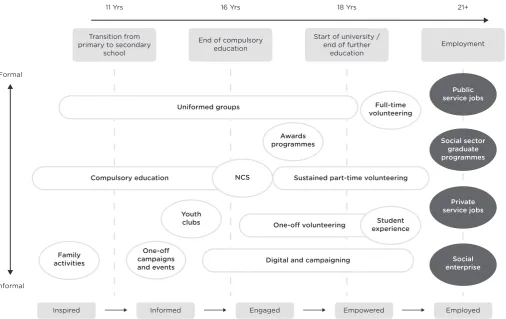
The Office for Civil Society should develop a comprehensive, cross-departmental national strategy for youth social action that builds on the success of NCS and ensures there are opportunities to take part in social action across the lifecycle: pre-NCS for young people between the ages of 10 and 14 years old, and post-NCS for young people between the ages of 16 and 25. While the Cabinet Office should lead the development of the strategy, it should be strongly linked with the policy priorities of the DfE, the Department for Business, Innovation and Skills, the Department for Communities and Local Government, the Department of Health, the Department for Work and Pensions and the Ministry of Defence.
Recommendation 2
The Government should establish an independent social action coordinating body to implement this strategy. A range of existing organisations could be expanded – or could join together – to undertake this function. The role of this body would be:
· to coordinate and administer a youth social action fund that would include contributions from government, trusts and foundations, private businesses, and other donors
· to provide competitive strategic grants to social action providers to scale up social action programming across the youth lifecycle
· to coordinate with local authorities, schools and other public service providers (like hospitals and care homes) to identify opportunities for youth social action to contribute towards policy objectives
Recommendation 3
Social action should be embedded in schools:
· There should be a new social action component that students could choose to take alongside the English Baccalaureate. This ‘GiveBacc’ could be accredited by the sector and would signal to universities and employers that students had completed 50 hours of good quality social action.
· Give pupils a right to take part in high quality social action through their schools if they want to. Social action activities could be offered as supplementary to work experience placements and marketed as pre-NCS taster sessions.
· Ofsted should assess whether schools provide these opportunities and the quality of the provision as part of schools’ requirement to promote ‘British values’.30
· The Government should monitor participation in social action activities through the School Census and include these data in the National Pupil Database.
Recommendation 4
Develop full-time social action service year placements as an alternative school-leaver pathway:
· For 18–24-year-olds, the Government should introduce a discrete employment category and legal status for young people who are taking part in a full-time service year to provide clarity around issues like access to benefits. This should include exploring partnerships with social action providers in order to deliver the Government’s new ‘earn or learn’ approach.
· The social action coordinating body should work with universi-ties and students unions to identify and promote social action opportunities across the higher education sector. In some cases, this should include social action counting towards course credits; as an example, Sheffield Hallam incorporates social action into its law degree by requiring students to volunteer in local law clinics.
· Social action providers should develop systems that encourage participants to log their activities and personal development, which will help them to articulate their experiences in interviews for employment or university.
Recommendation 5
Support a quality mark for social action provision:
· A quality mark should be developed by the youth social action sector, to be used to identify organisations that focus on measuring their impact, and help improve their services to have the best impact.
1
The value of youth
social action: evidence
on double benefit
Youth social action is already contributing positively to many of the social problems we are facing – from youth unemployment to integration to health and social care. But its full potential is not yet being realised. There is now strong and compelling evidence – which we outline in this chapter – showing the double benefit impact that youth social action could have on social problems that the Government is grappling with.
The British economy is currently outpacing G7 countries, but there remain significant economic challenges facing Britain over the next five years. One of these is the youth unemployment rate: the latest figures show that for 16–24-year-olds it was 16 per cent, 2.3 percentage points down from the previous year, but nonetheless stubbornly high.31 As high-lighted in the most recent 2014 Confederation of British Industry (CBI) education and skills survey – Gateway to Growth – ‘improved education and skills are needed to secure these
positive developments’ for young people in the wider econo-my.32 While young people were hit especially hard by the 2008 recession, the rise of youth unemployment began before the recession and is a product of long-term structural changes in the labour market. For example, research from the Resolution Foundation suggests the hollowing out of middle-skilled, ‘routine’ jobs (which are most at risk to technological
develop-ment) has a particularly detrimental effect on young people.33 Just under a million (963,000) young people are NEET.34 This is a challenge for both core skills – like English and maths – and ‘soft skills’ or employability skills.
This is particularly true of young people from poor socio-economic backgrounds. In 2013/14, some two-thirds (63 per cent) of students on free school meals compared with only one-third (35 per cent) of pupils not on free school meals did not achieve five A*–C grades in their GCSEs.35 While the pupil premium has attempted to address this persistent attainment gap, the National Audit Office has recently found that its impact was mitigated by spending cuts in other areas and poor decisions on how pupil premium funding was spent. In particular, schools are overspending on teaching assistants, a ‘high-cost approach’ that did not appear to lead to improve-ments in academic outcomes.36 As we argue below, youth social action programmes that include mentoring models in schools could offer an alternative, lower cost approach that could help to make an impact.
Character skills and attributes – a subset of which includes employability or ‘soft skills’ – are also increasingly important for success in the labour market. In the past 20 years there has been a huge decrease in semi-skilled, craft-based jobs in manufacturing industries and an increase in the service and professional sector. Jobs in these sectors require transferable skills, like being able to communicate well, being able to work in a team, being able to lead when needed, and strong management skills. Employers and organisations like the CBI continually highlight the need for these skills – and the limitations of the formal education system in developing them. As we argue below, there is a growing evidence base that youth social action can develop the character skills and attributes that young people need to succeed.
solely due to the isolation of older people.37 The evidence base outlined below demonstrates that social action can be a powerful tool in knitting society together across these perceived barriers – with benefits to individuals and society at large. It can also be a powerful generator of political efficacy – encouraging individuals and communities to exercise power and effect change.
The benefit to health and social care goes beyond that generated by a closer-knit society, increasing intergenera-tional contact and relationships that could lead to improve-ments in wellbeing for both young people and the elderly people they interact with. Direct involvement in the provi-sion of services by those undertaking youth social action can help to improve those services, rendering them ‘more human’ and resulting in higher user satisfaction. Social care is one of the most pressing social issues; many are concerned about the quality of care given by social care services, the ageing population, and increasing isolation and loneliness among elderly citizens in our society. A social action approach has been advocated by Health Secretary Jeremy Hunt in a recent speech: ‘Yes, the health and social care system must do a much better job at looking after them. But so must all of us citizens as well.’38
Youth social action helps to address these issues not only in the short term, by developing models where young people provide additional support, but also in the long term, by encouraging more young people to consider a career in the care sector or other parts of the public sector. Moreover, the evidence suggests that there is something unique about social action – which could be termed ‘non-formal learning’ – as it develops skills that are otherwise not always developed by formal education.
the results of the interim Behavioural Insights Team evaluation were published in March 2015, and are discussed below, many evaluations (including those run by EEF, as well as evaluations from the Youth Social Action and Journey Funds) will report later in the year.
While our evidence review draws on a range of sources, we present the evidence of the double benefit impact for social action below in order of the research’s scale and robustness: we present findings at level 3 or higher first (including the use of control groups, or a randomised control trial) followed by evidence at level 2 (including pre- and post-intervention quantitative analysis).
Box 1 Examples of youth social action programmes run across
the lifecycle: Generation Change members
· Fixers supports vulnerable young people to create social action
campaigns about issues close to their hearts across the entire UK including Northern Ireland, Wales and Scotland
· The Challenge is the leading provider of National Citizen
Service, offering the scheme right across the UK
· Free the Children works with schools across the UK
encouraging pupils to take part in social action projects and bringing participants together at its annual ‘We Day’
· Envision runs extra-curricular clubs in schools to support
young people to design their own local community projects tackling issues from street crime to climate change in Birmingham, Bristol and London
· UnLtd provides young social entrepreneurs with cash grants,
training and support to get their social innovations off the ground right across the UK
· City Year offers a full-time structured ‘service year’ opportunity
· vInspired supports thousands of 14–15 year olds with
opportuni-ties to volunteer in their local community, right across the UK
· British Youth Council empowers young people through
representation and campaigns to have their voices heard on important issues to them
· Student Hubs support university students to lead social action
projects, volunteering and social enterprises in the communities in which they are studying in Bristol, Southampton, Oxford, London and Winchester
· The Scouts Association supports young people to deliver
community action projects via the Scouts network right across the UK
· UpRising delivers a social action youth leadership programme
for 19–25 year olds from diverse backgrounds to equip them to transform their communities in Birmingham, Manchester, London, Liverpool, Stoke-on-Trent and Bedford
· The Diana Award recognises young people who make an
extraordinary difference to their community, and runs anti-bullying and mentoring programmes in schools across the UK
· Citizenship Foundation provides resources to curriculum
materials on social action and citizenship in over 80 per cent of UK secondary schools, and its flagship programmes Giving Nation and Go-Givers are delivered in secondary and primary schools right across the UK
· Year Here is a postgraduate programme placing talented
graduates in frontline services including schools, care homes and homeless centres in London
· Ashoka works with schools across the UK as part of its
Benefits to young people: building character,
raising attainment and boosting employability
The next generation is facing a series of complicated and difficult challenges in an uncertain, rapidly changing and highly competitive labour market. They are being asked to demonstrate skills that schools are too often not developing. The rise of social media in this competitive environment may be driving new risks in relation to depression and mental health issues.While many young people are passionate about having a positive impact on their society, they are increasingly losing faith in traditional politics. The UK now has the biggest gap in voter turnout between the youngest and oldest citizens (30 percentage point difference) out of all OECD countries. At the same time, young people in the next generation are extraordinarily talented, creative, energetic and passionate about social change.39 Opportunities to take part in social action can help to harness and channel their energy and enthusiasm, while at the same time giving them the skills they need to be successful, confident and
compassionate citizens.
There is a growing body of evidence highlighting the benefits to young people of taking part in social action, and how high quality social action can help address some of the current limitations of our education system, including its capacity to adequately prepare young people for the challenges of the 21st century labour market. High quality social action can lead to improved:
· character attributes like empathy, cooperation and grit, which leads to improved educational outcomes, employability skills and employment outcomes
Good character and good grades
The priorities of the DfE are clear: close the attainment gap and embed character education into the way schools operate. Despite the introduction of the pupil premium, there remains a substantial and worrying gap in educational attainment linked to socio-economic
background. In 2013/14, 35 per cent of pupils from middle and upper socio-economic brackets failed to achieve five A*–C grades at GCSE, compared with a shocking 63 per cent of students from lower socio-economic brackets (as measured by eligibility for free school meals).40
The Government has recently drawn attention to what could be described as the long tail of underachievement in schools in England. According to Education Secretary Nicky Morgan, ‘excellence in the system is all too often confined to urban areas. Pockets of under-performance persist in coastal and rural areas, and even in some of our leafy suburbs schools who have the capability to be really excellent are coasting along at “just good enough”.’41
While the Government is continuing with the pupil premium, and is now introducing further legislation to turn underperforming schools into academies, a focus on character development is also a key priority. In the words of the education secretary: ‘just as important to the next generation’s future as getting a sound academic grounding, is ensuring they have the resilience and grit to deal with the challenges that life will throw at them’.
Defining character
The term ‘character’ is defined as ‘a set of personal traits that produce specific moral emotions, inform motivation and guide conduct’. The Jubilee Centre for Character and Virtues outlines four categories of character virtues:
· moral virtues such as courage, honesty, humility and gratitude · civic virtues such as service and volunteering – the moral
virtues acting in society at large
· intellectual virtues such as curiosity and critical thinking · performance virtues such as resilience, application and
self-regulation42
The DfE has outlined the following character traits:
· perseverance, resilience and grit · confidence and optimism · motivation, drive and ambition · neighbourliness and community spirit · tolerance and respect
· honesty, integrity and dignity
· conscientiousness, curiosity and focus43
Other organisations refer to these attributes as social and emotional skills or ‘non-cognitive skills’.
and trust) are just as important as IQ to educational attain-ment and labour market success.45
Moreover, they found that service learning programmes in the US – where meaningful community service and reflection are integrated into teaching and learning strategies for students in order to enrich the learning experience and teach civic responsibility – can boost academic attainment and the development of character attributes like social skills, self-perceptions and motivation.46
In other words, character attributes are not fixed or inherited, but instead can be developed through the right interventions. There is an increasingly strong body of research – including in the UK – that shows that taking part in youth
social action programmes can help to develop good character skills and attributes.
Evidence on the relationship between social action and character development
The most recent and compelling study comes from the 2015 interim evaluation of the Behavioural Insights Team,
Evaluating Youth Social Action, which used used randomised control trials with three social action providers: the Citizenship Foundation, Envision and Voluntary Action Within Kent/IMAGO Social Action Initiatives.47
Across all three programmes, the Behavioural Insights Team found positive correlations between social action and character attributes like empathy, problem solving,
cooperation, grit and resilience, and sense of community:
· Envision’s social action projects, which deliver and support ten-month-long programmes created by young people to address local concerns, demonstrated statistically significant improvement on every attribute. It was found to lead to higher levels of empathy and cooperation among participants (each 11 per cent higher than those in the control group), and participants benefited from between 6 and 11 per cent higher levels of grit and problem solving ability.
· The social action projects of Voluntary Action Within Kent/ IMAGO Social Action Initiatives, which use social action to support young people, people with disabilities and the elderly in Kent, were found to lead to higher levels of empathy and cooperation (8 per cent and 9 per cent more than the control group respectively).
The evaluation of Youth United’s Journey Fund project, which will be published in July 2015, engaged 1,200 young people in high quality social action provided by their mem-bers (including The Scout Association, Girlguiding and St John Ambulance), and found significant increases among participants across many attributes considered to be impor-tant for good character, including communication (13 per cent increase), creativity (11 per cent), empathy (10 per cent), resilience (9 per cent) and agency (8 per cent).48
There is also evidence from ‘non-formal learning’ social action programmes that suggests they lead to positive
character development. Research from over 1,800 participants in the Duke of Edinburgh’s Award found 84 per cent of young people and 92 per cent of leaders said the award increased resilience and led to participants becoming more responsible.49 Research with young girls who had taken part in Girl Guides found that 82–83 per cent said their confidence and leadership skills had increased as a result of taking part.50
determination and resilience, 70 per cent reported an average of 18 per cent positive change across all social and emotional capabilities, and 58 per cent reported an average 25 per cent increase in self-confidence.51
Moreover, these positive findings are not only relevant to young people at school age. As highlighted above, employ-ers often cite a lack of character skills among graduates. Social action organisations that work with university students – for example, Student Hubs – are also vital, and evidence suggests they can help to develop character attributes. The vInspired report Bursting the Bubble found that 68 per cent of volunteers in higher education felt greater motivation and self-discipline as a result of volunteering.52
Many social action programmes – such as City Year – use mentoring, which can facilitate character development. The EEF’s report The Impact of Non-Cognitive Skills on Outcomes
for Young People found that school-based mentoring pro-grammes where the mentor receives good training and supervision, and where the mentoring relationship is long lasting, could ‘promote non-cognitive skills among young people’.53 Similarly, a study of 200 school-based programmes in the US found that students, teachers and mentors develop-ing positive relationships that they would not have otherwise have had a strong impact on positive outcomes and the development of character skills among students.54
Research also suggests that – unlike in many schools – social action providers specifically focus on developing
character skills and attributes. A large majority (87 per cent) of youth social action providers interviewed for the Jubilee Centre for Character & Virtues report Building Character
Through Youth Social Action said that young people’s character is fundamental to their organisation’s work, and over half said it is their top priority.55
Evidence on social action improving educational outcomes The EEF, the Cabinet Office and a team of academics from Durham University are currently undertaking an effectiveness trial into whether youth social action activities have an impact on engagement and attainment of pupils in year 9.56 The evaluation is structured as a randomised control trial involving over 80 schools, and is due to be published in 2016. The findings from this research will significantly improve our understanding about the link between youth social action and educational outcomes.
In lieu of these findings, past research from the Department of Education and Ofsted – as well as robust research from the US – suggests that youth social action can help to narrow the attainment gap by improving young people’s attitudes towards school, and motivating them to study and attain better grades.
A 2012 DfE study found that better emotional, behav-ioural and social wellbeing was associated with higher levels of educational engagement and academic achievement.57 A 2011 Ofsted study into voluntary projects in colleges and secondary schools found that well-managed programmes have the potential to enhance young people’s learning experience significantly.58
In the US, Durlack et al’s 2011 analysis of 213 US primary schools found that good social and emotional skills, attitudes and behaviour – developed through mentoring schemes – were associated with an 11 per cent increase in academic achievement.59 Moreover, the 2014 evaluation of NCS found increases in participants’ plans for undertaking further education (5 and 6 percentage point increases, respectively, compared against a control group) for both summer and autumn programme participants.60
identified as consistently underachieving. For these schools, youth social action is vital not only in delivering the
employability skills that employers want, but also in helping them boost attainment.
Developing skills critical to workplace success
Young people face an incredibly difficult labour market that is rapidly changing. According to some experts, almost half (47 per cent) of all employment will be ‘potentially automat-able’ and thus in a high risk category for likelihood of disap-pearing, with impacts felt strongest in low and middle skilled and waged jobs.61 These future trends are already building on shifts over the past 20 years, where there has been growth in the top and bottom end of the skills and wage distribution, and a squeeze in the middle. Craft-based manufacturing jobs have been replaced by service sector, professional jobs such as consulting, media, advertising and office management. Jobs in these sectors require a different skill set from that needed 30 years ago, including strong communication skills, and the ability to work in a team, solve problems and manage projects. But as continually highlighted by the CBI and others, schools and universities are failing to deliver sufficient levels of these skills. In a survey of approximately 3,000 businesses, the British Chamber of Commerce’s 2014 Workforce Survey found that 88 per cent of respondents felt that school leavers and 54 per cent felt that graduates were not sufficiently prepared for work. Of these businesses, 57 per cent felt that a lack of soft skills, such as communication, team-working and resilience, was a key reason for this lack of preparedness.62There is a growing evidence base showing that high quality youth social action can help young people to develop the skills that employers need and give them a leg up in navigating the labour market. There is also evidence that – while more work is needed to raise the profile of social action
people they recruited who participated in the Scouts ‘showed confidence and leadership ability’ and ‘had strong team-working skills’, and 41 per cent reported that participation in non-formal learning programmes like the Scouts ‘would be a positive influence on their decision to hire new employees’.63
Evidence on the link between
social action and employment outcomes
The most compelling research on the relationship between employability and social action comes from the US, and is based on a full-time ‘service year’ model of social action.
One of the longest studies to date is a ten-year study by the US Corporation for National & Community Service, which found that volunteers in programmes like AmeriCorps had a 27 per cent higher likelihood of finding a job after being out of work than non-volunteers, and the effect was nearly twice as strong for those without school qualifications or from rural communities.64
Research on AmeriCorps’ impact also shows that social action can lead to higher wages and increased job satisfac-tion, particularly for young people. Academics from Columbia University who analysed the economic value of AmeriCorps programmes found that the incomes of people aged 16–24 are approximately 12 per cent higher for volun-teers than non-volunvolun-teers, an effect comparable to having an additional year of post-secondary education.65 A study of former AmeriCorps participants by Rand Corporation, based on 700 semi-structured interviews, showed that AmeriCorps volunteers went on to have a greater than average job satisfaction.66
found that the percentage of participants who felt that they ‘have the skills I need to do the job I want to do’ rose from
33 per cent to 88 per cent during their placement.67 Similarly, Community Service Volunteers runs a full-time volunteering programme for young people involving placements on social care projects; a 2013 evaluation found that 93 per cent of young volunteers went on to education, employment, training or further volunteering.68
Similar outcomes were reported from students in higher education, according to vInspired’s report Bursting the Bubble:
· 62 per cent of participants reported greater readiness for employment.
· 57 per cent felt that volunteering had increased their chances of gaining employment.
· 78 per cent reported talking about volunteering in an interview. · 48 per cent of volunteers felt that volunteering gave them
greater clarity around future career options.69
It is just as vital that social action that takes place in school, or as young people are leaving school – for example, by taking part in NCS – can have a critical impact on motivation and skills development at this crucial point in young people’s lives. For example, according to the 2013 evaluation of NCS:
· 92 per cent of participants in the summer programme and 91 per cent of participants in the autumn programme felt that NCS had helped them develop useful skills for the future.
· 83 per cent of participants felt that they were more capable than they had realised before completing the programme.
· Three-quarters (76 per cent of those on the summer pro-gramme and 72 per cent of those on the autumn propro-gramme) felt that they were more confident about getting
Social action and young people not in education, employment or training
One of the most intractable problems facing this government and local authorities up and down the country is the high number of young people who are NEET. The Government is committed to getting all of these young people into some type of positive activity through their introduction of requirements to take part in paid employment or community projects if young people are NEET for six months or more. There is already a wide range of youth social action pro-grammes that work with young people who are NEET or at risk of becoming NEET, and evaluations of these programmes shows potential for youth social action to deliver the Government’s objectives.
For example, vInspired’s Talent Programme is a structured volunteering and social action programme aimed at young people not in education or employment. Evaluation of the Talent Programme found that 90 per cent of the participants who completed their placement progressed into sustained employment, education or training after completing the programme.71
Social action and expanding networks
Some of the positive impact that social action opportunities can have on employability is related to expanding social and professional networks, which is particularly important for young people from disadvantaged backgrounds.
vInspired’s report on students in higher education,
Bursting the Bubble, found that through taking part in social action and volunteering, 74 per cent of participants felt that they had built a wider variety of friendships, and 51 per cent reported forming contacts and networks that proved useful in later years.73
Similarly, the 2009 Re:action and De Montfort University report The Impact of Volunteering on Social Capital
and Community Cohesion surveyed 920 young volunteers within the Youth Action Network’s member organisations. The report found that 66 per cent of young people with experience of volunteering in national or international settings, and 44 per cent of young people volunteering in neighbourhood projects, felt that their education and employability had benefited through meeting new people as part of their volunteering.74
Drawing on the evidence, we suggest that the
Government consider youth social action as part of its toolbox for tackling issues related to youth unemployment and young people who are NEET. In chapter 3 we suggest ways in which this effect can be magnified.
In recent years there has been an increasing focus on the importance of wellbeing when analysing the impact of policy measures (rather than just economic measures) and in counter-ing the rise of mental health problems. High levels of wellbe-ing are associated with several factors such as higher life expectancy and better mental health, and the Office of National Statistics now produces regular statistical reviews of national wellbeing.76
David Cameron has argued that national wellbeing should be more of a focus in policy making and tasked the independent chief statistician, Jil Matheson, with developing a wellbeing measure to rival GDP.77 This sentiment was echoed recently in a report by Lord O’Donnell, the former head of the Civil Service, Richard Layard and others.78 Evidence suggests that youth social action can contribute positively to this agenda by having a measurable impact on young people’s self-confidence and wellbeing. This is extremely important given recent research suggesting that young people are increasingly concerned about mental health matters.79
Evidence on link between youth social action and mental health In the 2013 Demos report Service Nation we found that the vast majority (consistently around 80 per cent) of participants in social action programmes reported that they gained in self-confidence, sense of direction and sense of confidence from their activities.80
Findings from the large-scale, government-run Citizenship Survey underscore the positive impact of volunteering. For example, the 2008/09 UK Citizenship Survey found that 35 per cent of young people involved in regular, formal volunteering said it gave them a sense of personal achievement, 30 per cent said it broadened their life experience and 22 per cent said it gave them more
confidence.81 More recently, the 2014 survey Youth Social Action
There have also been some key findings from highly rigorous studies into the impact of youth social action on mental health. The Behavioural Insights Team interim evaluation found that participants in the Citizenship Foundation Programme had a more positive outlook, with levels of anxiety 22 per cent lower than those in the control group.83
Similarly, a study in 2014 by Join In, based on surveys of the public and volunteers (with a combined sample size of 2,700) and using measures of emotional wellbeing based on New Philanthropy Capital’s Emotional Wellbeing Framework, found that participants in sport volunteering programmes had 10 per cent higher levels of self-esteem, emotional wellbeing and resilience than non-volunteers, and were 15 per cent less likely to worry or feel anxious.84
These findings cannot be ignored given the worrying rise of mental health issues in young people. The Government has pledged to give mental health the same priority as physical health. Youth social action presents an opportunity outside the NHS to have a measurable impact on mental health issues, potentially saving the Government huge amounts of money in the long run by reducing the various costs of issues associated with poor mental health.
Big society of positive civic actors
Creating a ‘Big Society’ of empowered and active citizens remains a priority for the prime minister and the Government. But ensuring that the next generation is up to the challenge requires lighting a passion for civic activism early on. This includes a desire for young people to engage in traditional politics. Demos research in the report Introducing Generation
turnout between younger voters (between 18 and 24 years) and older voters (over the age of 55), the largest gap of all OECD countries. Many argue that this is because politics is not taught in schools, and the citizenship curriculum has been downgraded. These areas are vitally important, and research suggests that taking part in social action can be a highly effective aspect of delivering a strong citizenship curriculum that helps young people develop the knowledge and civic capabilities they need to be effective citizens.
Evidence of a link between social action and desire for civic activism
Of course, when citizens are encouraged to volunteer then the whole of society benefits. But as we highlight above, so do the individual volunteers through their enhanced wellbeing and skills development. And there is a growing body of evidence showing that youth social action helps to spark a desire for these benefits and create a habit of volunteering, while also giving citizens the ability to feel empowered and defend their rights.
The 2015 interim Behavioural Insights Team report
Evaluating Youth Social Action found that participants in the Envision programme were 20 per cent more likely to express a willingness to volunteer in the future than the control group.86 vInspired’s report Bursting the Bubble found that 67 per cent of participants felt that volunteering at university had increased their willingness to volunteer in the future. A 2014 evaluation of the youth social action programme Think Big by Durham University found that 39 per cent of participants felt that it had a substantive impact on their likelihood of future volunteering.87 The 2015 evaluation of Youth United’s Journey Fund project also found significant impacts on volunteering attitudes and behaviour:
volunteering in the previous 12 months increased
significantly from 51 per cent at the pre-participation stage to 66 per cent following the project; 81 per cent of
This effect appears even stronger for young people who take part in full-time ‘service year’ programmes. For example, 79 per cent of people on the Community Service Volunteers full-time programme Volunteering At Home stated that they would volunteer again. A 2007 Policy Studies Associates report undertook a longitudinal study following a random sample of 107 young people who participated in the 2002/03 City Year programme, and examined their civic engagement, leadership and social capital over a period of four years, compared with a group of 85 young people who applied for the same City Year cohort, were accepted on the programme, but ultimately did not take up the offer. Conducting interviews in 2004 and 2006, the report found the following:
· In 2004, 41 per cent of City Year participants voted in the state and local elections, against 33 per cent in the comparison group; in 2006, this gap had grown to 59 per cent of
participants against 40 per cent in the comparison group.
· In 2006, City Year alumni were still more likely (70 per cent) to volunteer than members of the comparison group (57 per cent).
· In 2006, despite a slight closing of the gap from 2004, City Year alumni still scored five points higher than the comparison group on the Political Efficacy Index.89
In highlighting the benefits to young people from youth social action, it is clear that providing opportunities can help to transform people’s lives by giving them more confidence, more optimism, more power to effect change, more skills and better networks, and a greater sense of self-worth. Every organisation mentioned above – and a large number of social action providers and organisations working with young people – have thousands of moving and compelling stories of personal
social action can deliver. Boosting educational attainment and employability not only helps one young person get a job, but also reduces unemployment and the negative impacts that entails. In the next section we outline in more detail the other side of the double benefit calculation – the benefit of social action to communities and society as a whole.
Benefits to society of youth social action:
community responsibility, social integration and
improved public services
The benefit of youth social action to young people themselves is only half of the story; youth social action also has significant positive social and economic impacts on wider society. As outlined above, participation in youth social action makes a person much more likely to be an active citizen in later life, developing individual and community political efficacy. Furthermore, there is evidence that youth social action in-creases social mixing and social cohesion, as well as increasing young people’s feelings of belonging in their local community. Much of the evidence for this is based on pre and post surveys, often complemented by the use of a control group.
There is also evidence from the US and the UK that investment in youth social action can improve public services while reducing the overall burden on them. When this happens, there is the potential for long-term savings in social spending and increased levels of participation in the labour market. This results from both the individual benefits laid out above (wellbeing and employability), and broader societal benefits (improved public services and a more cohesive society). Most of this evidence is based on survey data and economic modelling.
to undertake volunteering and feel a sense of responsibility towards their local communities. This even extends as far as career choice, with social action participants often being moti-vated to choose career paths which include an element of service. In this way, the principles behind the ‘Big Society’ of bolstering a sense of community responsibility and activism are still a key priority. The evidence suggests that investment in youth social action can help to develop these attitudes and behaviours.
Social action increases community feeling among participants. The 2015 interim Behaviourial Insights Team report found that participants in youth social action through Envision programmes had a sense of community that was 16 per cent higher than that of their counterparts in the control group, and those participating in Voluntary Action Within Kent/IMAGO programmes had a 15 per cent higher sense of community involvement than the control group. Youth United’s 2015 evaluation of the Journey Fund project found that a significant majority (81 per cent) of participants wanted to make a difference in their community, while 70 per cent felt they were more involved in their community and a similar proportion (71 per cent) felt that they had given something back to their community as a result of participating.90
A 2014 report from Join In found that those who had volunteered were three times more likely than people who had never volunteered in sport to agree that ‘it’s important to be part of my community’, five times more likely to say they put a lot of time and effort into being part of their community, and eight times more likely to agree that they have an influence over what their community is like.91 The 2014 evaluation of
the vInspired Talent Programme found that the percentage of participants who agreed that they were ‘part of my local community’ rose from 53 per cent to 87 per cent during their placement,92 while the 2013 evaluation of NCS found that 61 per cent and 64 per cent respectively felt a greater
responsibility for their local community.93 Finally, The Impact
Participation in social action also increases feelings of efficacy, making young people more likely to take action in their communities. The 2013 NCS evaluation found that 72 per cent of summer and 76 per cent of autumn programme participants felt that they were more likely to help out locally,95 while the Youth Social Action Survey in 2014 found that 71 per cent of young people who took part in meaning-ful social action reported that they enjoyed helping others through their activities.96 A 2011 survey and focus-group-based assessment of Free the Children’s US programmes found that 90 per cent of respondents believed that they were responsible for addressing social issues, 73 per cent of respondents felt that their involvement with Free the Children resulted in increased community engagement, and 79 per cent of respondents who were of voting age reported voting in the most recent national election, which was double the rate of peers in their age category.97
There is also evidence to suggest that increased sense of communal responsibility through social action can increase aspirations to choose a career in the social sector and based on service, as well as a desire to work for organisations that have a strong sense of corporate social responsibility. While organisations like Teach First and Frontline may not qualify as social action providers, they are helping to increase desire and access to careers in the social sector, such as teaching and social work.
Social action providers also aim to do this by giving young people access to and developing skills that can help them set up social enterprises or work in careers based around service of others, such as social care, healthcare and teaching; these are areas of the labour market where there are expected to be increasing demands for skilled labour, but which are currently experiencing shortages. Student Hubs has measured that 71 per cent of students who participated in their
engagement. Evaluation of City Year participants, undertaken by the Institute for Volunteering Research, found that 83 per cent said it was likely that their choice of career or work would involve service to others and that they were likely to volunteer or be involved in social action in the next few years.98
Social integration and feelings of belonging
Integration and social mixing among people from different ethnic and socio-economic backgrounds is a key priority for this government. Recent research by the Social Integration Commission has highlighted the extent of social segregation in the UK across a range of factors including ethnicity, social class and age. This has a number of economic impacts, including £1.5 billion lost to the national economy as a result of long-term unemployment and £700 million lost through blocked opportunities in the labour market and
underemployment.99
The evidence suggests that social action can have a significant impact on integration. Social mixing is one of the key objectives of NCS, and research from its evalua-tion suggests that it can help to achieve cohesion and feelings of belonging. The 2014 evaluation of NCS found that 8 in 10 participants in the summer and autumn pro-grammes, (84 per cent and 81 per cent respectively), felt more positive towards people from different backgrounds after taking part in NCS. Other studies have made similar findings: The Impact of Volunteering on Social Capital and
Improved public services
There is an increasing concern about the need for public services to become more relational or more ‘human’. This found its apotheosis in the report into practices at Stafford Hospital, which described ‘a lack of care, compassion and humanity’ and a ‘system which put corporate self-interest ahead of patient safety’.102 As David Robinson of Community Links has described it: ‘Public services are being reduced to a set of transactions when the real need is for a more personal relationship, for common sense and human kindness.’103
This idea has its proponents across the political spectrum: on the left, it has been articulated by Maurice Glasman, Hilary Cottam and Jon Wilson among others, while on the right, David Cameron’s former adviser, Steve Hilton, recently published More Human, in which he described how distant public institutions feel:
The schools we send our children to; the hospitals that care for us when we’re sick; the very food we eat – we’ve allowed these intimate things, that matter so much, to be provided by anonymous, distant, industrialised machines.104
Participants in social action, when working in partnership with public services, not only have a direct impact in addressing social issues but also provide an additional element of humanity that public service professionals struggle to provide in the course of performing their many duties. Young people can also bring high levels of enthusiasm and energy to social action, which can act as a strong complement to the experience and wisdom of professionals.
the next three years, while the return on investment was estimated to be £11 for every £1 invested in volunteers.105 King’s College Hospital provides a case study of how this works, beginning the programme of volunteering by asking staff what they would do if they had more time. This often takes the form of volunteers undertaking everyday acts of compassion that do not require professional training, like performing small errands or talking to patients who are isolated.106
The contribution that youth social action can have towards public services can also apply to the education system, with City Year’s work in schools being a good example. During the 2012/13 academic year, City Year’s Corps members
provided 155,000 hours of school-based service and supported more than 600 pupils on a one-to-one basis. Through their service, they supplement the learning and support that pupils receive from teachers, and in doing so contribute to a more supportive school environment and accelerated levels of progress, with an average point score progress of 5.2 for English and 4.4 for maths over the course of the year, compared with the average expected progress of 3.107
However, this is only the tip of the iceberg: there is huge potential for participants in social action to improve public services and tackle social issues in so doing. Youth social action can address social isolation and other public health challenges, the attainment gap and other barriers to social mobility, and local and global environmental issues.
Social action’s return on investment
The Conservative Government has pledged further cuts to public services and austerity measures in order to reduce Britain’s deficit and ensure a strong economy. Research suggests that investment in youth social action can generate significant returns on investment in the medium to long term, potentially representing an ‘invest-to-save’ approach.
the summer programme, there were £1.70–6.10 of benefits, and £1.27–6.09 of benefits for the autumn programme. These cost benefits are derived from many outcomes, including increased participation in further education and a knock-on effect on lifetime income, the cost of the volunteering activities valued at the minimum wage for young people, the increased likelihood of future volunteering, the impact of leadership development, and the health impact of NCS, including reduction in smoking and drinking levels. While the report cautioned that the method used was imperfect and data were short term, it also stated that ‘even under the most pessimistic scenarios, the scheme is estimated to have delivered greater social benefit than the costs involved’, and that it had not included monetary measures of wellbeing impact, leading to potentially understated returns on investment.108
Furthermore, the 2014 report People Helping People by Tooley Street Research estimated that the value of regular social action in and alongside public services in England was around £34 billion, the equivalent of 5 per cent of total government expenditure or 2.2 per cent of GDP, measured solely as economic output of social action and not tax-payer savings; £22 billion was gained though formal volunteering, £10 billion resulted from informal volunteering, and £2 billion came through community action.109 A 2014 report from Join In entitled ‘Hidden diamonds’ found that it cost £36 to recruit a volunteer, but every volunteer has the ability to deliver a return on investment worth £16,032, estimated by calculating the value of their time, the wellbeing and mental health benefits to the volunteer, and the participation of others in sport that each volunteer enables.110
of two dollars for every one invested.111
This evidence, collected in one place, makes a compelling case for the ‘double benefit’ of youth social action across diverse policy areas. It also demonstrates how this double benefit can in particular circumstances produce value for money for government, through the logic of invest-to-save.
2
Service nation 2015:
where we are now
Volunteering is an established and essential part of British society and has been a policy priority for at least a decade. The publication of the Russell Commission in 2005 and the subsequent establishment of vInspire to coordinate youth volunteering highlight the priority that youth volunteering had before 2010.
In the last five years the scale of ambition around youth social action has escalated. The creation of the Generation Change coalition and the launch of the Step Up To Serve
#iwill campaign have led to a common strategy for youth social action with cross-party support. There is consensus around a definition of youth social action and widespread use of the term in the voluntary sector and beyond. The creation and extraordinary growth of National Citizen Service (NCS) has lent profile to youth social action, and its evaluations have helped to demonstrate the impact that youth social action can have. The evidence base on youth social action continues to grow and strengthen the case for its importance, as outlined in the previous chapter. The figures below underline achievements over the past few years:
· Approximately 3 million young people – 40 per cent of 10–20-year-olds in the UK – took part in meaningful social action between September 2013 and September 2014.112 · 220,000 adult volunteers supported youth social action
between November 2013 and October 2014.113
· Just over £20 million has been invested in youth social action opportunities in the last 12 months.114
But work on youth social action has only just begun if th