The Scottish Economy
Economic Indicators
OVERTIME AND SHORT-TERM WORKING
O v e r t i m e i n t h e f o u r t h q u a r t e r of 1982 i n c r e a s e d by 4 0 . 8 t h o u s a n d h o u r s o v e r t h e p r e v i o u s q u a r t e r t o 9 2 7 . 3 t h o u s a n d h o u r s . F o r t h e y e a r 1 9 8 2 , t o t a l h o u r s o v e r -t i m e w o r k e d i n c r e a s e d by 2.5% o v e r 1 9 8 1 . H o w e v e r w h e n t h e f i g u r e s a r e c r u d e l y c o r r e c t e d f o r s e a s o n a l v a r i a t i o n by t a k i n g a f o u r q u a r t e r moving a v e r a g e i t i s c l e a r t h a t t h e u p w a r d t r e n d i n t o t a l o v e r t i m e h o u r s a p p a r e n t i n t h e l a t t e r h a l f of 1981 and e a r l y 1 9 8 2 h a s n o t b e e n s u s t a i n e d . Data on t h e number of o p e r a t i v e s w o r k i n g o v e r t i m e , when s i m i l a r l y a d j u s t e d , r e v e a l s t h e s a m e p a t t e r n . The b e h a v i o u r of b o t h s e r i e s i s c o n s i s t e n t w i t h t h e s h o r t l i v e d r e c o v e r y i n o u t p u t w h i c h seemed t o be d e v e l o p i n g i n t h e m i d d l e o f l a s t y e a r a n d c o n f i r m s t h e i m p r e s s i o n t h a t i n c r e a s e d a c t i v i t y , a t l e a s t i n t h e s h o r t - r u n , i s l i a b l e t o m a n i f e s t i t s e l f m o r e i n t h e u t i l i s a t i o n of e x i s t i n g e m p l o y e e s t h a n i n new h i r i n g s .
For t h e f o u r t h q u a r t e r of 1 9 8 2 , s h o r t - t i m e w o r k i n g i n t e r m s of t o t a l h o u r s l o s t ( 0 0 0 ' s ) s t o o d a t 1 6 8 . 4 . A g a i n c o r r e c t i n g f o r s e a s o n a l v a r i a t i o n by t a k i n g a f o u r q u a r t e r moving a v e r a g e , t h e m o s t r e c e n t o b s e r v a t i o n r e p r e s e n t s a r e v e r s a l o f t h e d o w n w a r d t r e n d i n t h e t o t a l h o u r s l o s t a p p a r e n t s i n c e e a r l y 1 9 8 1 . I t i s p o s s i b l e t o i n t e r p r e t t h i s m o s t r e c e n t o b s e r v a t i o n a s m a r k i n g an i n c r e a s e d t e n d e n c y on t h e p a r t of e m p l o y e r s t o p u t p e o p l e on s h o r t - t i m e w o r k i n g r a t h e r t h a n t o m a k e t h e m r e d u n d a n t . H o w e v e r , t h i s i n t e r p r e t a t i o n w o u l d r u n c o u n t e r t o o u t p u t t r e n d s i n t h e f i n a l q u a r t e r of l a s t y e a r a n d w o u l d r e q u i r e e x p l a n a t i o n i n t e r m s of i n c r e a s e d o p t i m i s m on t h e p a r t of t h e c o r p o r a t e s e c t o r . Such an i n t e r p r e t a t i o n w o u l d , h o w e v e r , b e c o n s i s t e n t w i t h t h o s e o t h e r i n d i c a t o r s w h i c h a p p e a r t o s i g n a l a m o r e b u o y a n t o u t l o o k .
CBI SURVEY
t h o u g h i n c o n t r a s t t o o t h e r i n d i c e s t h e g e n e r a l b a r o m e t e r of b u s i n e s s
c o n f i d e n c e i s now more h e a l t h y t h a n i t h a s been f o r some t i m e .
Two p o s s i b l e i n t e r p r e t a t i o n s of t h i s c o n t r a s t w i t h t h e UK a r e p o s s i b l e .
F i r s t , i t i s p o s s i b l e t h a t i f a r e c o v e r y i n o u t p u t i s on t h e way S c o t l a n d
w i l l l a g behind o t h e r r e g i o n s . While t h i s has been t h e e x p e r i e n c e of the
S c o t t i s h economy in p r e v i o u s d e c a d e s , t h e s t r u c t u r a l c h a r a c t e r i s t i c s which
l i e b e h i n d w e a k e r p e r f o r m a n c e a r e n o t now so a p p a r e n t a s once t h e y w e r e .
A l t e r n a t i v e l y , i t i s p o s s i b l e t h a t t h e CBI r e t u r n s f o r S c o t l a n d i n t h i s
q u a r t e r a r e a t y p i c a l . Only t h e t e s t of t i m e w i l l r e v e a l which of t h e s e
e x p l a n a t i o n s i s more n e a r l y c o r r e c t , and t h e p o s s i b i l i t y s h o u l d n o t be
p r e c l u d e d t h a t any r e c o v e r y w i l l t u r n out to be s h o r t l i v e d .
COMPANY FORMATIONS
For t h e f i r s t q u a r t e r of 1983 t h e r e w e r e 1,184 c o m p a n i e s i n c o r p o r a t e d i n
S c o t l a n d and 386 d i s s o l v e d . The i n c o r p o r a t i o n s f i g u r e i s , o n c e a g a i n ,
l a r g e by h i s t o r i c a l s t a n d a r d s w h i l e t h e d i s s o l u t i o n s f i g u r e i s l o w e r t h a n
t h o s e which have been r e c o r d e d in r e c e n t y e a r s . The c a v e a t s e x p r e s s e d in
e a r l i e r Commentaries c o n c e r n i n g i n t e r p r e t a t i o n of t h e s e f i g u r e s remain in
f o r c e .
CONSTRUCTION
The v a l u e of new o r d e r s r e c e i v e d by c o n t r a c t o r s r o s e i n t h e f i n a l q u a r t e r of
1982 t o £285.09m, an i n c r e a s e of n e a r l y £60m on t h e p r e v i o u s q u a r t e r .
T o t a l o r d e r s f o r 1982 t o t a l l e d £1,094.56m w h i c h , even a l l o w i n g f o r p r i c e
i n f l a t i o n , r e p r e s e n t s a s u b s t a n t i a l growth on t h e p r e v i o u s y e a r ' s f i g u r e of
£917.47. While both p r i v a t e and p u b l i c s e c t o r c o n s t r u c t i o n o r d e r s r e f l e c t
t h i s g r o w t h , t h e l a t t e r e x h i b i t s a more m o d e s t r e c o v e r y . With t h e
e x c e p t i o n of p u b l i c s e c t o r h o u s i n g , which e x p e r i e n c e d a 70% growth over t h e
period t h e s e c t o r a l d i s t r i b u t i o n of t h e i n c r e a s e d o r d e r s i s very even.
TOTAL HOURS OVERTIME WORKED IN SCOTLAND (OOO's) 1600 4 PERICD MOVING AVERAGE
1450
1300
1150
1000
850
— i 1 — 2 3 1977
h 1
~l r~
2 3
1978 1979 1980 1981
1 2 3 1982
m
445 _
365
285
205
125
45
TOTAL HOURS LOST THROUGH SHORT-TIME WORKING IN SCOTLAND (OOO's) 4 PERICD MOVING AVERAGE
1977 1978 1979
r - — i 1 i 1 1 1 r 1980 1981
3 i* 1982
The Labour Market
EMPLOYMENT AND UNEMPLOYMENT
The most r e c e n t d a t a on employment r e f e r to September 1982. As a r e s u l t
of t h e September 1981 Census of Employment, the Department of Employment has
r e v i s e d t h e q u a r t e r l y e s t i m a t e s s u b s e q u e n t t o t h a t d a t e . T a b l e 1 below
r e c o r d s o n l y t h o s e q u a r t e r s f o r w h i c h t h e r e v i s i o n s a p p e a r t o have been
completed.
SCOTLAND
[image:4.513.45.464.226.428.2]Sept 1981
June 1982
Sept 1982
TABLE 1
TOTAL
1 ,970
1 ,957
1 ,929
EMPLOYEES IN EMPLOYMENT IN SCOTLAND
AND ENGLAND AND WALES (000*S)
MALES
1 ,109
1,093
1 ,085
FEMALES
860
864
844
FEMALE/
MALE
RATIO
0.78
0.79
0.78
SCOTTISH EMPLOYMENT
AS A % OF GB
EMPLOYMENT
9.32
9.47
9.40
ENGLAND AND WALES
Sept 1981
June 1982
Sept 1982
19,178 18,706 18,593
11,026
10,658
10,615
8,153
8,049
7,978
0.74
0.76
0.75
Source: Department of Employment G a z e t t e
T o t a l e m p l o y m e n t i n S c o t l a n d i s now e s t i m a t e d t o h a v e f a l l e n by 4 1 , 0 0 0 or
2.1% i n t h e y e a r t o S e p t e m b e r 1982, compared w i t h a f a l l of 5 8 5 , 0 0 0 or 3.1%
in E n g l a n d and W a l e s . Thus S c o t t i s h employment a s a p e r c e n t a g e of t o t a l
e m p l o y m e n t i n G r e a t B r i t a i n r o s e from 9.32% i n S e p t e m b e r 1981 t o 9.40% i n
S e p t e m b e r 1982. However, f o r t h e f i r s t t i m e i n o v e r a d e c a d e , t o t a l
employment in S c o t l a n d has f a l l e n below 2 m i l l i o n f o r two c o n s e c u t i v e y e a r s .
At the sectoral level, Table 2 shows that in Scotland job losses for the year to September 1982 were confined to the manufacturing and construction sectors. Within manufacturing, the largest proportional contractions in employment have been in metal manufacturing (-11.5?) and in coal, petroleum and chemical products (-9.7?). Engineering and allied industries sustained the largest absolute contraction with a net loss of 11,000 jobs over the same period.
TABLE 2 EMPLOYMENT BY SECTOR IN SCOTLAND AND IN ENGLAND AND WALES, SEPTEMBER 1982
SCOTLAND
Agriculture, Forestry and Fishing
Manufacturing
Construction, Mining and Utilities
Services
NO OF
EMPLOYED (000's)
1
44 456
199 ,231
% OF TOTAL
2.3 23.6
10.3 63.8
CHANGE IN NOS EMPLOYED JUNE 1982- SEPT 1981-SEPT 1982 1981-SEPT 1982
(000's)
TOTAL 1 ,929 100.0
- 7
- 1
- 19
- 28
29
10
41
ENGLAND AND WALES
Agriculture, Forestry and Fishing
Manufacturing
Construction, Mining and Utilities
Services
321 5,145
1 ,465 11 ,661
1.7 27.7
7.9 62.7
+ 20 - 47
- 2 - 85
TOTAL 18,593 100.0 •113
- 6 -294
- 88 -199
-585
Source: Department of Employment Gazette
In England and Wales, employment in all sectors declined between September 1981 and September 1982, with construction, mining and utilities suffering the greatest relative decline. In construction alone a net 70,000 jobs were lost.
Total registered unemployment in Scotland in April 1983 was 337,301, a fall of 4,201 from the March total. Included in this figure are 18,874 unemployed school leavers, 1,597 fewer than in March. School leavers registered as unemployed represented 5.6? of total unemployment in April, compared to 4.8? in April 1982.
Excluding school leavers, the seasonally adjusted figure of 319,700 (14.2?), is 1,400 up on the previous month's total. Thus, with the exception of a fall in seasonally adjusted unemployment in February 1983, the underlying trend in unemployment over the year to April 1983 has been unmistakably
upwards. Under the provisions of the 1983 Budget men 60 and over are not required to sign on at an Unemployment Benefit Office from April of this year onwards in order to secure National Insurance Credits. The number of men thus excluded from the Scottish unemployment total was 2,200 in April. Their exclusion has the effect of artificially reducing registered, but not actual, unemployment to 317,500 or 14.2% of the Scottish labour force.
TABLE 3 REGIONAL UNEMPLOYMENT AND VACANCIES IN THE UK IN APRIL, 1983
(1) (2) (1) (2)
UNEMPLOYED VACANCIES UNEMPLOYMENT/ (000's) (000's) VACANCIES RATIO
1983 1983 1983 JANUARY APRIL JANUARY APRIL JANUARY APRIL
South-East East Anglia South-West West Midlands
East Midlands Yorks & Humber North-West North Wales Scotland Great Britain Northern Ireland United Kingdom 693.9 77.1 187.6 346.4 185.5 279.9 419.0 216.4 166.6 317.3 2,874.7 109.4 2,984.1 706.5 77.3 185.7 349.9 186.5 281 .1 424.9 216.9 166.7 317.5 2,909.5 111 .7 3,021 .2 43.6 4.6 11 .2 7.6 7.4 8.2 11 .8 5.4 6.1 15.2 120.8 1.2 122.0 46.6 4.8 11 .5 9.8 8.4 8.8 14.5 6.5 6.7 16.1 133.4 1 .1 134.5 15.9 16.8 16.8 45.6 25.1 34.1 35.2 40.1 27.3 20.9 23.8 91.2 24.5 15.2 16.1 16.1 35.7 22.2 31.9 29.3 33.3 24.9 19.7 21.8 101.5 22.5
1) Seasonally adjusted excluding school leavers 2) Seasonally adjusted excluding vacancies
noti-fied to careers offices.
Source: Department of Employment Press Notices
It can be seen from Table 3 that the general pattern over the first quarter of 1983 has been one of rising unemployment coincident with increases in the number of unfilled vacancies notified to Job Centres in practically all regions of the UK. The exceptions were the South-West where seasonally adjusted unemployment fell and Northern Ireland where the number of vacancies declined.
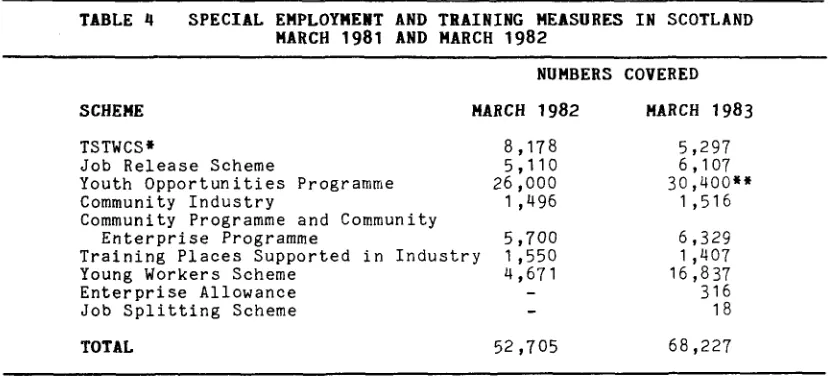
TABLE 4 SPECIAL EMPLOYMENT AND TRAINING MEASURES IN SCOTLAND MARCH 1981 AND MARCH 1982
NUMBERS COVERED
SCHEME
TSTWCS*
Job Release Scheme
Youth Opportunities Programme Community Industry
Community Programme and Community Enterprise Programme
MARCH 1982
Training Places Supported in Industry Young Workers Scheme
Enterprise Allowance Job Splitting Scheme
TOTAL
8,178 5,110 26,000 1 ,496
5,700 1 ,550 4,671
-52,705
MARCH 1983
5,297 6,107 30,400**
1 ,516
6,329 1 ,407 16,837
316 18
68,227
•Temporary Short-time Working Compensation Scheme •"Includes 2,000 adults on YOP
Month by month, unemployment (by any method of calculation) continues at abnormally high levels. Were it not for the operation of the government's special employment and training schemes, registered unemployment would be considerably higher. Initially introduced as short-term policy measures, many schemes have been extended and new ones introduced. Table 4 shows the range and scale of these measures. The main vehicle for assisting unemployed young people has been the Youth Opportunities Programme, which officially ended in March. It has been replaced by the Youth Training Scheme, the main aim of which is to provide young people, employed and unemployed, with some form of off-the-job training. The Job-Splitting Scheme introduced this year represents the acceptance of work sharing by the government as a means of tackling the unemployment problem. In common with other proposals to share out more widely the available work, for example through a reduction of overtime hours, the extent to which job-splitting is adopted in a recession will largely depend on the readiness of those presently in work to accept a redistribution of part of their income towards those presently unemployed. There is no indication that such a pre-disposition exists and little evidence to suggest that it will be fostered to any extent by measures such as the job splitting scheme.
INDUSTRIAL RELATIONS
For Scotland, the two main industrial relations events so far in 1983 have been the sit-in at the Timex factory in Dundee and the strike at the East Kilbride factory of the British Printing and Communications Company. At Dundee, the Timex company, faced with a fall in demand for mechanical watches and the loss of sub-contract work on the assembly of the three-dimensional camera, decided to cut its work force by 1,900. Although 1,700 people were willing to take voluntary redundancy, some were faced with compulsory redundancy. As a reaction to this, and in an attempt to keep watch-making in Dundee, a sit-in began on 9 April.
Industrial Performance
The surplus of UK grains was estimated to amount to 3.9 million tonnes of barley and 2.5 million tonnes of wheat AGRICULTURE at mid-February. Over 90% of the latter has been disposed of via intervention sales and exports. 65% of surplus barley has been absorbed by intervention sales (0.9 million tonnes) and exports (1.6 million tonnes).
The S M M B are endeavouring to find new export outlets for Scottish dairy products. There have been exports from Scotland for many years, and in 1982 about 8% of SMMB production was exported in various forms. A strategy of product diversification has been adopted to generate interest in Scottish produce.
Beef supplies, along with other meats, are currently at high levels in Scotland. The number of cattle at auction in Scotland at the beginning of 1983 was 12.5% higher than in 1982, and more modest increases are expected for the rest of the year. Cattle prices have been low enough to require the payment of the maximum variable premium from mid-January onwards, and this is likely to continue, given the low levels of demand relative to supply.
Total landings of fish in Scotland, by UK vessels, in 1982 were 498,200 tonnes, valued at £148.7m. These FISHING annual results imply an increase of 12.2% in volume over
1981 and an increase in value of 16.6%. Landings of most of the main species increased in 1982, with haddock and herring catches up by 33% and 28% respectively, while there was a slight fall in that of whiting.
Concern over stock depletion in mackerel fisheries off the Scottish west coast and in the Irish Sea may result in cuts in fishing quotas which would be damaging to the Scottish deep sea fleet in the short run. The total allowable catch of 370,000 tonnes set for mackerel by the EEC appears to owe more to political than to conservation considerations. There is a possibility that a protective box may be set up in the Irish Sea to prevent further depletion of immature stocks.
UK crude oil production in the three months to February 1983 was 27.6 million tonnes, 4.5 million tonnes more OIL AND GAS t h a n in the e q u i v a l e n t p e r i o d a y e a r e a r l i e r .
Indigenous natural gas supplies to the public system in the first quarter of 1983 totalled 4.89 billion therms, an increase of 3.9% on the corresponding 1982 figure. Total oil production in the fiscal year 1982/83 was 103.3m tonnes, valued at £14.3 billion. Government oil tax and royalties receipts in the same period amounted to £7.8 billion.
In March OPEC m i n i s t e r s a g r e e d a $5pb p r i c e c u t i n o i l t o $29pb f o r t h e
r e f e r e n c e A r a b i a n l i g h t c r u d e . To s u p p o r t t h e new p r i c e s t r u c t u r e ,
m i n i s t e r s a l s o a g r e e d t o an OPEC p r o d u c t i o n c e i l i n g of 17.5 tnbpd f o r t h e
r e m a i n d e r of 1983. F o l l o w i n g t h e OPEC d e c i s i o n , BNOC announced a new
r e f e r e n c e p r i c e of $30pb f o r N o r t h Sea c r u d e , w h i c h i s r e g a r d e d a s
c o m p a t i b l e w i t h OPEC's p r i c e s t r u c t u r e . For t h e f i r s t t i m e , B r e n t c r u d e
r a t h e r t h a n F o r t i e s c r u d e was used a s t h e r e f e r e n c e , t h e l a t t e r now b e i n g
p r i c e d a t $ 2 9 . 7 5 p b . For f i n a n c i a l and p o l i t i c a l r e a s o n s , most OPEC
c o u n t r i e s w i l l w i s h t o p r o d u c e a t , or n e a r , t h e i r p r o d u c t i o n l i m i t s .
However, t h i s may be d i f f i c u l t s i n c e world demand for o i l remains depressed
w h i l e non-OPEC s u p p l y c o n t i n u e s t o i n c r e a s e . For e x a m p l e , t h e North Sea
p r o d u c i n g c o u n t r i e s s u p p l i e d a r e c o r d 3mbpd t o w o r l d m a r k e t s i n F e b r u a r y
t h i s y e a r and t h e S o v i e t Union h a v e r e c e n t l y been e x p o r t i n g up t o 1.5mbpd
( n e t ) a t p r i c e s a s low as $27pb. In such c i r c u m s t a n c e s t h e r e may be
f u r t h e r downward p r e s s u r e on p r i c e s in t h e next few months. A key f a c t o r
w i l l be whether the o i l companies moderate the d e p l e t i o n of t h e i r crude o i l
s t o c k s , which t h e y were r u n n i n g down a t r e c o r d r a t e s of 4.5m-5mbpd d u r i n g
t h e f i r s t q u a r t e r of 1983.
On t h e domestic f r o n t , s i g n i f i c a n t changes in t h e s t r u c t u r e of t a x a t i o n of
North Sea o i l were announced in the March budget. E s s e n t i a l l y , companies
a l r e a d y p r o d u c i n g o i l w i l l be a l l o w e d t o o f f s e t a l l new e x p l o r a t i o n and
a p p r a i s a l c o s t s a g a i n s t petroleum revenue t a x . This should provide a boost
t o e x p l o r a t i o n a c t i v i t y and m a j o r s such as S h e l l and Esso have a l r e a d y
i n d i c a t e d t h a t t h e y a r e r e - a c t i v a t i n g p r o j e c t s s h e l v e d under t h e p r e v i o u s
tax regime. Though the tax changes have g e n e r a l l y been welcomed by the o i l
i n d u s t r y , not a l l w i l l b e n e f i t for two r e a s o n s : f i r s t l y , companies involved
in e x p l o r a t i o n b u t n o t in p r o d u c t i o n have no PRT a g a i n s t which t o o f f s e t
c o s t s . S e c o n d l y , f i e l d s which a r e f u l l y d e v e l o p e d b u t n o t y e t p r o d u c i n g
(of which t h e r e a r e a b o u t e i g h t i n t h e North Sea) have been e x c l u d e d from
the tax c o n c e s s i o n s .
In March, a new onshore e x p l o r a t i o n l i c e n c e was g r a n t e d for 465 square m i l e s
i n S t r a t h c l y d e , L o t h i a n and C e n t r a l r e g i o n s . O f f s h o r e , B r i t o i l began
t e s t i n g o i l p r o d u c t i o n in t h e small West T h i s t l e f i e l d and Hamilton B r o t h e r s
made a new o i l d i s c o v e r y in b l o c k 3 0 / 2 4 , 7.5 m i l e s n o r t h of t h e i r A r g y l l
f i e l d , w h i l e Conoco has announced an ' e n c o u r a g i n g ' gas f i n d in t h e s o u t h e r n
s e c t o r of t h e N o r t h S e a . Texaco h a s , h o w e v e r , h a l v e d i t s e s t i m a t e s of
r e c o v e r a b l e r e s e r v e s in and around t h e Tartan f i e l d .
F o l l o w i n g a s m a l l i n c r e a s e in t h e previous q u a r t e r , Scottish output f e l l in t h e t h i r d q u a r t e r of 1982 by 4%, to an index l e v e l of 94. Output in the UK as a whole was unchanged over t h e same p e r i o d . In t h e year t o September 1982, no change was r e c o r d e d f o r S c o t t i s h production from the r e l a t i v e l y low l e v e l s of t h e p r e c e d i n g t w e l v e m o n t h s ; UK p r o d u c t i o n r o s e by 1% over t h e same period.
In the A p r i l 1983 CBI s u r v e y , a balance of 5$ of r e s p o n d e n t s were l e s s o p t i m i s t i c about t h e i r g e n e r a l b u s i n e s s s i t u a t i o n than four months p r e v i o u s l y . There was a d e t e r i o r a t i o n in the volume of o u t p u t a t the beginning of the year, with the r e s u l t t h a t 68$ of respondents are working below s a t i s f a c t o r y capacity, and numbers in employment f e l l . The volume of export o r d e r s f e l l between January and A p r i l , but by l e s s than had been a n t i c i p a t e d in the previous survey; nevertheless a gloomy outlook p e r s i s t s . However, orders and output are expected to pick up in the next four months, with improvements in domestic demand compensating for the decline in export o r d e r s .
B e l l s h i l l in Lanarkshire i s the chosen location for a 'food park1, the f i r s t
in B r i t a i n . A r a n g e of f a c t o r i e s which a r e d e s i g n e d f o r t h e food p r o c e s s i n g i n d u s t r y w i l l be b u i l t , and more than ten v e n t u r e s a r e a l r e a d y under c o n s i d e r a t i o n for the park. The p r o j e c t w i l l cost £10m and forms part of the r e v i t a l i s a t i o n plans of the Motherwell Project.
M a r s h a l l ' s Chickens have reopened a f a c t o r y a t Cambuslang to undertake production of convenience foods, a growth area for the company. Investment of up t o £1.6m i s planned for the next two y e a r s , 40$ of which w i l l be funded by government g r a n t s . At p r e s e n t the f a c t o r y employs 170 p e o p l e , and i t i s hoped t h a t 100 more staff w i l l be taken on over the year.
Whisky p r o d u c t i o n in t h e f o u r t h q u a r t e r of 1982 was 70,226 thousand l i t r e s (pure a l c h o h o l ) , a r e d u c t i o n of WHISKY 12% from the same quarter a year e a r l i e r . Total figures for 1982 show t h a t production of whisky has d e c l i n e d by 40$ in the space of two y e a r s . I t seems l i k e l y t h a t low l e v e l s of production w i l l continue for some time because of the high l e v e l of stock accumulation.
Exports of whisky in 1982 were 251.5 million l i t r e s (pure alcohol), valued at £871.6m. In volume terms exports increased marginally over 1980 l e v e l s , while t h e i r value rose by 16.7$. Exports to Europe and the United S t a t e s rose, while t h e r e was a decline in exports to Japan and South America.
DCL announced the c l o s u r e of twelve d i s t i l l e r i e s and a blending p l a n t in February, with t h e r e s u l t a n t l o s s of over 700 j o b s to take place s h o r t l y . These c l o s u r e s w i l l reduce t o t a l i n d u s t r y c a p a c i t y by 6.5$ in malt and by
11.11 in grains, and were made necessary by excessive stock holdings relative to anticipated future sales.
Bells have bought a distillery at Bladnoch, Wigtown, to supply them with lowland malt for blending. It is hoped that modernisation will be completed in September and that a workforce of around thirteen will be employed.
METAL MANUFACTURE
115,
35.
„ jDffiSrs&fcfcsw
%
80 81 82 83During the latter part of 1982 demand for steel remained depressed and a fall of 19% was recorded in the index of metal production for the third quarter of 1982. However, more recent figures from other s o u r c e s s u g g e s t a s l i g h t l y m o r e optimistic outlook. UK steel production during the first quarter of 1983 rose, and imports fell to their lowest level for two years.
The CBI April 1983 Survey confirms this trend. Export order books continue to i m p r o v e ; stocks of finished g o o d s have f a l l e n ; and over 401 of respondents reported a rise in the volume of new orders and output over the past four months compared with 80? who reported a fall over the previous four months in January. However, there was no sign of a change in general optimism about the current situation in the industry or in expectations for the next four months.
In Scotland the main discussion continues to centre around the future of Ravenscraig, in spite of the recent cabinet decision that integrated steel production should remain at five sites including Ravenscraig for at least three years (see Economic Perspective section). Prior to submitting a corporate plan to the government later this month British Steel's retiring Chairman Ian MacGregor has been considering a number of options. His confidential, but nonetheless well publicised, plan for a joint venture between Ravenscraig and US Steel's Fairless plant, thereby enabling British slab steel to gain entry to the American market, has not attracted great support.
Production at Ravenscraig has increased during 1983 and orders have increased substantially. Industry sources suggest that further new investment is being considered. The closure of Craigneuk and the slab mill at Ravenscraig have been anticipated for some time. However the recent transfer of the British Steel Plates Division HQ from Glasgow to Sheffield has brought fears for the future of the plates division in Scotland.
ENGINEERING AND ALLIED INDUSTRIES
E n g i n e e r i n g o u t p u t r o s e s l i g h t l y d u r i n g
t h e t h i r d q u a r t e r of 1982. E l e c t r i c a l
e n g i n e e r i n g r e c o r d e d a 7% i n c r e a s e and
t h e i n d e x r e t u r n e d t o t h e l e v e l r e a c h e d
in t h e f i r s t q u a r t e r of l a s t y e a r .
The CBI A p r i l 1983 Survey r e c o r d s no
i n c r e a s e in t h e numbers r e p o r t i n g g r e a t e r
o p t i m i s m a b o u t t h e i n d u s t r y ' s p r o s p e c t s
b u t t h e r e h a s been a s h a r p d e c l i n e i n
t h o s e d e c l a r i n g t h a t t h e y w e r e m o r e
p e s s i m i s t i c - from 26% in January to only 2% in A p r i l . Stocks of f i n i s h e d
goods a r e f a l l i n g and r e s p o n s e s r e f l e c t an upward t r e n d in r e c e n t o r d e r s and
o u t p u t .
As d i s c u s s e d i n t h e p r e v i o u s Commentary t h e s t a g n a n t home m a r k e t f o r
mechanical e n g i n e e r i n g p r o d u c t s means t h a t s u r v i v a l for S c o t t i s h companies
l a r g e l y depends on t h e i n c r e a s i n g l y c o m p e t i t i v e e x p o r t m a r k e t s . Members of
the S c o t t i s h E n g i n e e r i n g Employers A s s o c i a t i o n employed over 100,000 t h r e e
y e a r s a g o . T h i s h a s now f a l l e n t o 6 0 , 0 0 0 and c o m p a n i e s a r e s t i l l
announcing c u t b a c k s . However, t h e r e have been some encouraging s i g n s w i t h
John Brown, f o r e x a m p l e , s e c u r i n g a £60m o r d e r t o s u p p l y a power s t a t i o n ,
i n c l u d i n g t h r e e g a s t u r b i n e s and e q u i p m e n t , f o r a p r o j e c t i n t h e Far E a s t
and Rolls-Royce a t H i l l i n g t o n winning a t u r b i n e c o n t r a c t in T h a i l a n d .
In t h e e l e c t r i c a l and e l e c t r o n i c i n d u s t r i e s Dundee has again been a d v e r s e l y
a f f e c t e d . The Crompton-Parkinson b a t t e r y making p l a n t i s t o c l o s e w i t h the
l o s s of 244 j o b s . There has been c o n s i d e r a b l e i n d u s t r i a l u n r e s t a t Timex
a f t e r t h e a n n o u n c e m e n t t h a t t h e w o r k f o r c e i s t o be c u t by 2 , 0 0 0 . A ' s i t
-i n ' was -i n t r o d u c e d a t t h e M -i l t o n p l a n t -in p r o t e s t a g a -i n s t 197 c o m p u l s o r y
r e d u n d a n c i e s i n v o l v e d i n t h e proposed c l o s u r e of t h e watch making p r o c e s s .
There i s now u n c e r t a i n t y about t h e f u t u r e of new p r o j e c t s , such as t h e f l a t
s c r e e n t e l e v i s i o n development, as S i n c l a i r E l e c t r o n i c s have t h r e a t e n e d t o
w i t h d r a w p r o d u c t i o n u n l e s s t h e d i s p u t e s a r e s e t t l e d . R e c e n t l y a f u r t h e r
300 r e d u n d a n c i e s w e r e a n n o u n c e d . However on a more p o s i t i v e n o t e a £10m
i n v e s t m e n t by A p p l i e d Computer T e c h n i q u e s of Birmingham i s t o be made i n
G l e n r o t h e s . They a r e t o b u i l d p e r s o n a l c o m p u t e r s and i n t e n d t h a t
employment should r i s e t o 400 over the next two y e a r s .
CHEMICALS, COAL AND PETROLEUM PRODUCTS
P r o d u c t i o n i n t h e t h i r d q u a r t e r of 1982
was 12% h i g h e r in S c o t l a n d t h a n t h r e e
months p r e v i o u s l y , an i n c r e a s e in o u t p u t
n o t e x p e r i e n c e d by t h e UK a s a w h o l e ,
where t h e r i s e was o n l y 2%. S c o t t i s h
o u t p u t i n t h e y e a r t o S e p t e m b e r was 3%
above t h a t of t h e p r e v i o u s y e a r , w h i l e
t h e r e was a m a r g i n a l i n c r e a s e in t o t a l UK
p r o d u c t i o n .
The o v e r a l l o u t l o o k of t h e i n d u s t r y i s improving a c c o r d i n g t o t h e A p r i l 1983
CBI Survey. E x p o r t s a r e the main hope w i t h a b a l a n c e of 71% of r e s p o n d e n t s
e x p r e s s i n g o p t i m i s m f o r e x p o r t p r o s p e c t s in t h e n e x t y e a r . On b a l a n c e , 15%
120
9 5 "
'i 'i l'ff I"'I
79 80 81 82
tP
noted falls in the volume of domestic orders between January and April, while a net 47J recorded an increase in export orders. The expectation is that export orders will be sustained at current levels over the summer and that an upward trend in domestic orders will materialise. However, further labour shedding was experienced in the last four months and this is expected to recur in the next four months.
BP Chemicals will convert the Grangemouth petrochemical plant from naphtha to ethane feedstock, allowing the plant to produce two-thirds of its products from the relatively cheaper ethane. Supplies of the feedstock will come from the mixed gases of the Forties and Magnus Fields, via the newly-approved pipeline from Mossmorran to Grangemouth.
Two Ayrshire mines have been closed recently by the NCB, as part of its programme to close loss-making collieries. Most of the workforce of the two collieries, at Sorn and Highhouse, have been transferred to nearby Killoch and Barony collieries, while some staff have been retained to carry out salvage operations at the closed pits. The closure of Cardowan colliery near Glasgow has also recently been announced.
British Shipbuilders' gloomy November report did not overstate the crisis facing the shipbuilding industry. SHIPBUILDING Worldwide, new orders are running at 30% below the previous year and there are no signs of an end to the depression. British Shipbuilders have just returned a trading loss of £70m for the year ending March 1983.
In March British Shipbuilders' management outlined the nature of the crisis to union representatives, and warned that even immediate orders would not prevent the loss of 9,000 jobs during 1983. They are at present putting forward their survival plan for government approval. The plan includes moth-balling yards and increasing productivity in return for extra financial assistance. Government assistance would be conditional on union acceptance of further redundancies and a wage freeze. However, shipbuilding unions have decided that, if the principle of no compulsory redundancies is not followed, they will be ready to occupy the yards. The test may well come in Scotland at the Henry Robb yard in Leith. Some observers suggest that the jobs of up to a third of the 63,000 workforce in the industry could be at risk.
In Scotland, apart from the Robb yard which is threatened with closure, a number of other yards are running critically short of orders and it is feared that 4,000 of the 9,000 redundancies could take place north of the border. Govan is running out of steel work and 1,000 could be laid off by the summer. Scott Lithgow, where losses amounted to £50m last year, is considered to be under the greatest threat in the medium term. With the closure of their Cartsburn yard they are likely to lose 1,500-2,000 jobs by the summer. Redundancies are also expected soon at Barclay Curie and John Kincaid.
to remain busy until the summer, given the lack of orders. The major
contracts for the North Alwyn platforms are not expected until later in the
year, and most of the work available in the meantime is on smaller jackets
and modules for gas fields in the southern North Sea and Morecambe Bay.
TEXTILES, LEATHER AND CLOTHING
115
S c o t t i s h p r o d u c t i o n in t h e t h i r d q u a r t e r
of 1982 d i d n o t r e c o v e r from i t s low
l e v e l of the p r e v i o u s q u a r t e r , remaining
a t an i n d e x of 8 4 , w h i l e t h e UK s e c t o r
e x p e r i e n c e d a m a r g i n a l f a l l i n o u t p u t
o v e r t h e same p e r i o d . P r o d u c t i o n i n
S c o t l a n d i n t h e t w e l v e m o n t h s t o
S e p t e m b e r 1982 was 3% below t h a t of t h e
p r e c e d i n g p e r i o d , w h i l e UK o u t p u t f e l l by
4%.
Responses t o t h e A p r i l 1983 CBI Survey r e v e a l an o p t i m i s t i c o u t l o o k in t h e
i n d u s t r y . On b a l a n c e 54% of r e s p o n d e n t s a r e more o p t i m i s t i c about g e n e r a l
b u s i n e s s c o n d i t i o n s i n t h e i r i n d u s t r y t h a n f o u r m o n t h s a g o . E x p o r t
p r o s p e c t s a r e h e l d t o be i m p r o v i n g , a l t h o u g h t h i s may n o t be e v i d e n t
i m m e d i a t e l y . 52% of r e s p o n d e n t s r e p o r t t h a t t h e y a r e now w o r k i n g a t
s a t i s f a c t o r y c a p a c i t y l e v e l s , w e l l a b o v e t h e a v e r a g e f o r S c o t t i s h
m a n u f a c t u r i n g i n d u s t r y r e c o r d e d i n t h e s u r v e y . W h i l e t h e r e was a n e t
r e d u c t i o n in t h e volume of new o r d e r s r e c e i v e d between January and A p r i l , a
s i g n i f i c a n t improvement i s expected in d o m e s t i c o r d e r s which would r e v e r s e
t h a t t r e n d in coming months.
The BMK C a r p e t s company, which went i n t o r e c e i v e r s h i p in October 1981, has
been r e s t o r e d t o p r o f i t a b i l i t y by i t s new owner. The p l a n t a t Kilmarnock
h a s u n d e r g o n e c o n s i d e r a b l e r a t i o n a l i s a t i o n and now e m p l o y s 350 o u t of an
o r i g i n a l s t a f f of 1,500. S a l e s a r e e x p e c t e d t o r i s e f u r t h e r t h i s y e a r
p a r t i c u l a r l y in t h e a r e a of c o n t r a c t s from l a r g e o r g a n i s a t i o n s .
An I s r a e l i c l o t h i n g f i r m , D e l t a T e x t i l e s , h a s t a k e n on 22 w o r k e r s a t i t s
f a c t o r y in Lesmahagow. The company hope t o i n c r e a s e the workforce t o 200
by t h e end of t h e y e a r .
BRICKS, POTTERY, GLASS AND CEMENT
S c o t t i s h p r o d u c t i o n d e c l i n e d by 2% in t h e t h i r d q u a r t e r
of 1982, t o an i n d e x l e v e l of 7 2 . In c o n t r a s t , o u t p u t
in t h e UK s e c t o r r o s e by 2% i n t h e same p e r i o d . W h i l e
t h e r e was a 3% d e c l i n e in UK p r o d u c t i o n over t h e year t o
September, t h e r e was no change i n t h e l e v e l of o u t p u t in
t h e S c o t t i s h s e c t o r in the same p e r i o d .
PAPER, PRINTING AND PUBLISHING
Regional Review
SCOTTISH UNEMPLOYMENT LEVELS
The overall level of Scottish unemployment on an adjusted basis for April 1983 was 337,301. This represents a fall of 15,456 over the last quarter. The unemployment rate in April was 15.1% compared to 16.2% in January of this year.
[image:15.512.49.460.342.567.2]An increase in employment with a consequent fall in unemployment is a normal feature of economic activity at this time of year as construction related and tourist oriented employment expand again after the winter. However, the seasonal upturn in employment has been small. The underlying trend in unemployment remains upwards, notwithstanding the fact that something like 2,200 men aged 60 and over are this month excluded from the overall Scottish figure (the estimated reduction for Britain in April was 26,400). Men in this category no longer have to register at benefit offices in order to secure national insurance credits . This new measure will further decrease the level of registered unemployment in coming months, and is likely to reduce the Scottish total by some 8-10,000 in May.
TABLE 1 UNEMPLOYMENT AND VACANCIES NOTIFIED BY SCOTTISH REGIONS, APRIL 1983 (THOUSANDS)
TOTAL UNEMPLOYMENT UNEMPLOYMENT RATE % VACANCIES
Borders Central Dumfries & Galloway Fife Grampian Highlands Lothian Strathclyde Tayside Western Isles Orkney Shetland SCOTLAND 3,905 18,515 7,534 17,895 16,741 10,957 42,931 189,632 25,600 1,939 795 857 337,301 ( 4,109) ( 19,644) ( 8,252) ( 19,278) ( 17,670) ( 12,108) ( 45,078) (196,896) ( 25,754) ( 2,256) ( 838) ( 874) (352,757) 10.0 15.5 13.7 13.2 9.0 14.2 12.4 17.4 14.6 22.5 12.5 8.3 15.1 (10.5) (16.4) (15.0) (14.2) ( 9.5) (15.7) (13.0) (18.0) (14.7) (26.2) (13.2) ( 7.5) (16.2) 2 2 5 1 17 399 892 412 994 ,455 815 ,338 ,856 ,265 40 39 60 ,380* ( 1 ( 1 (5 (12 226) 674) 277) 592) ,929) 668) ,677) ,519) 604) 79) 18) 63) ,326)
*This figure includes 1815 Community Programme vacancies not inluded in the regional breakdown.
Figures for January 1983 are in brackets. Unemployment totals and rates include school leavers, and are not seasonally adjusted. Vacancies, which are not adjusted, include both those notified at careers offices and the Employment Services Division. Double-counting occurs, consequently the figures are likely to be over-estimated .
S p e c i a l employment and t r a i n i n g m e a s u r e s abs a s a w h o l e . 3 0 , 4 0 0 , o r c l o s e on h a l f of T r a i n i n g Scheme and i t s p r e d e c e s s o r t h e Youth a f u r t h e r 17,000 a r e employed under t h e Young t h e l a r g e n u m b e r s of young p e o p l e a b s o r b unemployment amongst s c h o o l l e a v e r s r e m a i n s r e g i o n a l d i s t r i b u t i o n of t h i s c a t e g o r y of un t h a t of S c o t t i s h u n e m p l o y m e n t a s a w h o l e w markedly h i g h e r s h a r e of s c h o o l l e a v e r s t h a n
[image:16.512.53.470.162.376.2]orbed 68,227 p e o p l e in S c o t l a n d t h e t o t a l , a r e on t h e Youth O p p o r t u n i t i e s Programme, w h i l e Workers* Scheme. In s p i t e of ed by s u c h s p e c i a l m e a s u r e s , h i g h . Table 2 shows t h a t t h e employed i s b r o a d l y s i m i l a r t o i t h o n l y S t r a t h c l y d e h a v i n g a of t o t a l unemployment.
TABLE 2 UNEMPLOYED SCHOOL LEAVERS: BY REGION
TOTAL % OF REGION'S UNEMPLOYMENT
Borders Central Dumfries & Galloway Fife Grampian Highlands Lothians Strathclyde Tayside
Western Isles Orkney
Shetland
SCOTLAND
Source:
133 1 ,216
367 926 540 376 2,469 11 ,490 1,255
55 41 6
18,874
Manpower
3 . 4 6 . 6
5.6
Manpower Services Commission
Figures must be treated with care as they are subject to considerable seasonal variation. Thus within the next few months the overall and percentage figures will climb considerably as a new batch of school leavers enter the labour market.
The number of vacancies is considerably up on the last quarter, and the underlying trend provides grounds for some limited optimism. Even so both the Western Isles and Shetland experienced a slight fall-off in the number of unfilled vacancies compared to the January level.
Regional Earnings
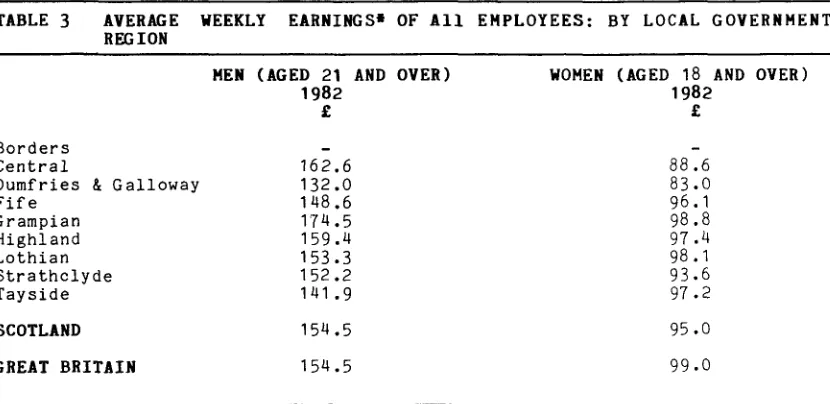
Male weekly earnings for employees in Scotland aged 21 and over rose from 95.4% of the British total in 1971, to 100? of the British by April 1982. Average male earnings (men 21 and over) stood at £154.50 in April 1982.
Such figures are, of course, in line with the relative improvement in
Scotland's overall economic performance vis-a-vis the rest of Britain
throughout the 1970s. However, the actual earnings difference is
attri-butable, for the most part, to higher average overtime hours worked. In
1982 average weekly hours of overtime worked in Scotland were 5.3, compared
to 4.9 for Britain as a whole.
Female employees did less well. In 1971, women aged 18 and over in the
'all employees' category earned 95.1% of the British average. By 1982 the
figure had risen to 99?. Female workers in the manual sector saw their
relative position improve from 97.4? to 98.9? of the British total. Women
engaged in manual work in Scotland earned a weekly average of £79.20 while
the 'all employee' female average was £95.00.
The overall improvement in weekly earnings in Scotland masks considerable
regional differences. Whilst average weekly earnings for males in Dumfries
and Galloway stood at 85.4? of the Scottish average in 1982, the figure for
Grampian was 112.9%. One consequence of the recession has been that whilst
Grampian has remained reasonably buoyant compared to the rest of Scotland,
Central's position has slipped. In 1979 Central's figure for male
employees as a percentage of the Scottish figure was 108.5?, top of the
league. By 1982 the equivalent figure was 105.2?, second behind Grampian.
More surprisingly perhaps, is the fact that Grampian does not lead the table
for women (18 and over) in the 'all employees' sector. Rather it is
Lothian which comes first. This is likely to be a consequence of the
concentration of tertiary sector female employment in Edinburgh.
[image:17.513.52.467.418.620.2]Whereas only three regions equal national average earnings for men, no less
than five manage to do so for women; Fife, Grampian, Highland, Lothian and
Tayside.
TABLE 3
B o r d e r s C e n t r a l D u m f r i e s F i f e G r a m p i a n H i g h l a n d L o t h i a n
AVERAGE WEEKLY EARNINGS* REGION
HEN
& G a l l o w a y
S t r a t h c l y d e T a y s i d e
SCOTLAND
(AGED 21 AND 1982
£
_
1 6 2 . 6 1 3 2 . 0 1 4 8 . 6 1 7 4 . 5 1 5 9 . 4 1 5 3 . 3 1 5 2 . 2 141 .9 1 5 4 . 5
OF A l l
OVER)
EMPLOYEES:
WOMEN
BY LOCAL GOVERNMENT
(AGED 18 AND OVER) 1982
£
_ 8 8 . 6 8 3 . 0 9 6 . 1 9 8 . 8 9 7 . 4 9 8 . 1 9 3 . 6 9 7 . 2 9 5 . 0
GREAT BRITAIN
154.5
99.0
TABLE 1 AVERAGE WEEKLY EARNINGS* OF All EMPLOYEES: REGIONS AS % OF SCOTLAND
MEN
Borders Central
Dumfries & Galloway Fife
Grampian Highland Lothian Strathclyde Tayside
(AGED 21 AND 1982
t
_
105.2 85.4 96.2 112.9 103.2 99.2 98.5 91.8
OVER) WOMEN (AGED 18 AND OVER) 1982
t
_
93.3 87.4 101.2 104.0 102.5 103.3 98.5 102.3
•Average Weekly Earnings before deductions for tax and National Insurance, full-time employees whose pay was not affected by absence.
Source: New Earnings Survey
Finally, a comment on the earnings of male manual employees by sector (see Table 3 ) . As can be readily observed from the following table, mining and quarrying is by far and away the sector with the highest average weekly earnings. This sector includes natural gas and petroleum extraction and development and determines Grampian's dominance in the earnings league. Given recent optimism about the future development of more marginal fields in the North Sea it is likely that Grampian's position at the top of the earnings league will be highly secure.
TABLE 5 AVERAGE WEEKLY EARNINGS OF MALE (21 AND OVER) MANUAL EMPLOYEES: BY INDUSTRY
INDUSTRIAL SECTOR SCOTLAND, 1982
£
SCOTLAND AS t OF GB
Agriculture, forestry & fishing Mining & quarrying
Manufacturing Construction
Gas, electricity & water Transport & communication Distributive trades
Professional & scientific services Miscellaneous services
Public administration
Total all industries and services
102.2 182.2 144.4 136.3 157.2 144.2 106.9 120.5 109.7 113.3
136.9
98, 104, 104, 103, 102, 100.1
93, 105, 100, 98,
102.3
Outlook and Appraisal
To k e e p m a t t e r s i n p e r s p e c t i v e , c o n s i d e r w h a t h a p p e n e d i n t h e w o r l d economy d u r i n g t h e p e r i o d u n d e r r e v i e w . We u s e t r e n d s i n t h e a g g r e g a t e of OECD member c o u n t r i e s a s a p r o x y . I t ' s n o t a p e r f e c t one a s e c o n o m i c c y c l e s a r e n o t c o m p l e t e l y s y n c h r o n i s e d a c r o s s c o u n t r i e s .
A f t e r a h a l t i n g and i n c o m p l e t e r e c o v e r y from t h e o i l p r i c e r i s e of 1 9 7 3 / 4 , u n e m p l o y m e n t b e g a n t o i n c r e a s e s h a r p l y i n 1 9 7 9 . T h e s t a n d a r d i s e d u n e m p l o y m e n t r a t e f o r t h e w h o l e OECD a r e a r o s e f r o m 5 . 0 ? i n t h e s e c o n d q u a r t e r of 1 9 7 9 t o 8 . 9 ? i n D e c e m b e r 1 9 8 2 , s o m e w h a t s h o r t of d o u b l i n g . I n t e r n a t i o n a l c o m p a r i s o n s o f u n e m p l o y m e n t r a t e s a r e f a r f r o m s t r a i g h t f o r w a r d , b u t t h e OECD c a l c u l a t e t h a t t h e c o m p a r a b l e r a t e f o r t h e U n i t e d Kingdom more t h a n d o u b l e d , g o i n g from 5.7? of t h e l a b o u r f o r c e i n t h e s e c o n d q u a r t e r of 1979 t o 1 3 . 1 ? i n D e c e m b e r 1982 and t o 1 3 . 5 ? by F e b r u a r y 1 9 8 3 .
Economic Performance 1979-1983
Manufacturing Output
- Scotland - GB
1979 Q2
100.8 107.4
1982 Q3
93.2 88.0
Index 1975 = 100
Manufacturing Employment - Scotland - GB
613.0 7,053.0
456.0 5,601 .0
•000s unadjusted
Total Employment - Scotland - GB
2,077.0 22,593.0
1 ,929.0 20,497.0
T o t a l
Unemployment
- S c o t l a n d
- GB1979 May
165.4 1 , 1 6 1 . 0
1983 April
337.3
3 , 0 5 4 . 0
'000s u n a d j u s t e d
ii ii iiUnemployed Excl, School leavers and Students
- S c o t l a n d
- GB
166.7
1,196.0
317.5
2 , 9 1 0 . 0 *
'000s s e a s , a d j u s t e d
ii II II
Unemployment relative Scotland/GB
146.0
Ratio of unemployment 114.0 rates (seasonally
adjusted)
Average weekly earnings-males - Scotland
1979 April
101 .2
1982 April
154.5
£'s
Average weekly earnings-females - Scotland
60.4 95.0
£'s
Retail prices
1979 May
215.9
1983 March
327.9 UK Index Jan 1974=100
* calculated on old basis
** allowing for effect of men 60 and over not having to sign on
T r e n d s i n e m p l o y m e n t r e f l e c t t h o s e i n o u t p u t . T o t a l e m p l o y m e n t i n t h e OECD a r e a i s s t i l l h o l d i n g a t i t s 1979 l e v e l . Even i n OECD E u r o p e t h e f a l l i n t o t a l e m p l o y m e n t o v e r t h e p e r i o d s i n c e 1979 w a s o n l y 4% by t h e end of 1 9 8 2 . B u t i n t h e U n i t e d K i n g d o m , t o t a l e m p l o y m e n t f e l l by o v e r 8? over t h e same p e r i o d .
Only on i n f l a t i o n i s t h e t h e p e r f o r m a n c e of t h e UK economy b e t t e r t h a n t h a t of t h e OECD. C o n s i d e r t h e i n f l a t i o n m e a s u r e w i t h t h e h i g h e s t p r o f i l e f i r s t . C o n s u m e r p r i c e i n f l a t i o n i n 1 9 7 9 was 1 3 . 4 ? i n t h e UK a n d 9.8% i n t h e OECD f o r t h e y e a r a s a w h o l e . F o r 1982 t h e c o m p a r a b l e f i g u r e s w e r e 8.6% and 7 . 8 ? r e s p e c t i v e l y . B u t c o n s u m e r p r i c e i n d i c e s a r e n o t t h e b e s t m e a s u r e of i n f l a t i o n i f t h e p u r p o s e i s t o m a k e i n t e r n a t i o n a l c o m p a r i s o n s a s t h e y a r e d i s t o r t e d by d o m e s t i c e x p e n d i t u r e t a x e s and s u b s i d i e s . The i m p l i c i t d e f l a t o r of GDP i s a m o r e a p p r o p r i a t e m e a s u r e . Here t h e s u c c e s s of t h e UK g o v e r n m e n t i n r e d u c i n g i n f l a t i o n i s much more m a r k e d . B e t w e e n 1979 and 1982, t h e a n n u a l c h a n g e i n t h i s m e a s u r e f e l l f r o m 1 5 . 1 % t o 7.6% i n t h e UK, and f r o m 9.4% t o 7.5% i n t h e w h o l e OECD a r e a .
W i t h o u t i n a n y way d i s m i s s i n g t h e s u c c e s s of t h e o u t g o i n g g o v e r n m e n t i n r e d u c i n g UK i n f l a t i o n , ( h a v i n g c a u s e d i t t o a c c e l e r a t e m a r k e d l y i n t h e i r f i r s t y e a r i n o f f i c e ) , t h e f a c t r e m a i n s t h a t t h e B r i t i s h r e c e s s i o n h a s been much d e e p e r t h a n t h a t i n t h e OECD, w i t h s i g n i f i c a n t l y l a r g e r f a l l s i n o u t p u t a n d e m p l o y m e n t a n d m a r k e d l y g r e a t e r i n c r e a s e s i n t h e i n c i d e n c e o f u n e m p l o y m e n t t h a n t h o s e e x p e r i e n c e d by t h e a g g r e g a t e of OECD m e m b e r s . T h i s i s t h e b a c k g r o u n d a g a i n s t w h i c h t h e e v o l u t i o n of t h e S c o t t i s h economy must be a s s e s s e d .
The t a b l e a b o v e r e p l i c a t e s t h a t e m p l o y e d i n a s s e s s i n g t h e S c o t t i s h economy u n d e r t h e p r e v i o u s g o v e r n m e n t . The s t a t i s t i c s g i v e t h e i m p r e s s i o n t h a t S c o t l a n d h a s w e a t h e r e d t h e r e c e s s i o n s o m e w h a t b e t t e r t h a n t h e UK a s a w h o l e . Or t o b e m o r e c o r r e c t , i t h a d d o n e s o up t o t h e t h i r d q u a r t e r of l a s t y e a r . I n p a r t i c u l a r , t h e f a l l i n m a n u f a c t u r i n g o u t p u t i n S c o t l a n d w a s m a r k e d l y s m a l l e r t h a n t h a t i n t h e UK, t h o u g h e m p l o y m e n t i n t h i s s e c t o r i n S c o t l a n d f e l l by a f a r g r e a t e r p r o p o r t i o n t h a n i n t h e e c o n o m y a s a w h o l e . H o w e v e r t h e a p p a r e n t i m p r o v e m e n t i n t h e r e l a t i v e p o s i t i o n o f t h e S c o t t i s h e c o n o m y c o m p a r e d t o t h e r e s t of t h e UK i s m o r e a r e f l e c t i o n o f t h e d e p r e s s e d s t a t e of t h e o t h e r r e g i o n s t h a n of any i n h e r e n t b u o y a n c y i n t h e S c o t t i s h economy. Nor c a n i t b e a t t r i b u t e d t o an a c t i v e r e g i o n a l p o l i c y on t h e p a r t of t h e g o v e r n m e n t . Under t h e o u t g o i n g a d m i n i s t r a t i o n r e g i o n a l i n c e n t i v e s h a v e been much r e d u c e d and t h e r o l e of t h e S c o t t i s h D e v e l o p m e n t Agency d o w n g r a d e d . The s h i f t t o w a r d s a non i n t e r v e n t i o n i s t s t a n c e f o r e s h a d o w e d i n o u r Commentary of May 1979 h a s m a t e r i a l i s e d d u r i n g t h e l i f e of t h e p r e s e n t g o v e r n m e n t .
QUARTERLY ECONOMIC FORECASTS
Quarter
1983 1984
2 3 4
1
2
Manufacturing Output Scotland
(1975 = 100)
95 95 96 97 97
Manufacturing Employment
Scotland (000's)
445 440 441 435 432
Unemployment Scotland
(OOO's)
340 339 348 356 352FRASER Of ALLANDER INSTITUTE
FORECASTING SERVICE
FAI
FORECASTING
FRASER Of ALLANDER INSTITUTE
FORECASTING SERVICE
•i T w i c e y e a r l y f o r e c a s t s o f t h e UK and S c o t t i s h economies f o r up
1 t o t e n y e a r s ahead.
Q D e t a i l e d f o r e c a s t s o f S c o t t i s h i n d u s t r i a l o u t p u t by s e c t o r , ^ d i s a g g r e g a t e d consumers e x p e n d i t u r e , s e c t o r a l i n v e s t m e n t and
t r a d e f l o w s , N o r t h Sea e x p e n d i t u r e and s e c t o r a l employment.
2 S i m u l a t i o n and e v a l u a t i o n of a l t e r n a t i v e s c e n a r i o s .
A S p e c i a l runs o f t h e I n s t i t u t e ' s f o r e c a s t i n g m o d e l .
PZ Access t o t h e I n s t i t u t e ' s d a t a bases.
O C o n s u l t i n g and a d v i s o r y s e r v i c e s f r o m t h e I n s t i t u t e ' s s e n i o r O s t a f f