This paper was produced in the context of the MEDPRO (Mediterranean Prospects) project, a three-year project funded under the Socio-economic Sciences & Humanities Programme of DG Research of the European Commission’s Seventh Framework Research Programme. MEDPRO Technical Reports give an indication of work being conducted within MEDPRO thematic Work Packages (WPs) and aim at stimulating reactions from other experts and academics in the field.
Unless otherwise indicated, the views expressed are attributable only to the author in a personal capacity and not to any institution with which he is associated.
ISBN-13: 978-94-6138-173-6
Available for free downloading from the MEDPRO (www.medpro-foresight.eu) and CEPS (www.ceps.eu) websites
© Copyright 2012, Sübidey Togan
The EU-Turkey Customs Union:
A Model for Future Euro-Med Integration
Sübidey Togan
MEDPRO Technical Report No. 9/March 2012
Abstract
Contents
Introduction ... 1
1. Customs Union ... 1
2. Customs Reform ... 4
Modernisation Project... 4
Customs Code ... 6
Customs Procedures ... 6
3. Technical Barriers to Trade ... 7
4. Competition Policy ... 10
5. Industrial Property Rights ... 12
Enforcement and Implementation of Industrial Property Rights ... 14
6. Administrative Procedures ... 15
Contingency Trade Remedies ... 15
Import Surveillance and Administration of Quotas ... 16
7. Public Procurement ... 17
8. Administrative Costs of Implementing the Customs Union... 18
9. Trade Performance, Foreign Direct Investment and Criticism of the Customs Union ... 19
Foreign Direct Investment ... 20
Criticism of the Customs Union ... 21
10. Conclusions ... 21
| 1
The EU-Turkey Customs Union:
A Model for Future Euro-Med Integration
Sübidey Togan
*MEDPRO Technical Report No. 9/March 2012
Introduction
After pursuing inward-oriented development strategies for 50 years, Turkey switched over to outward-oriented policies in 1980. The policy of further opening up the economy was pursued with the aim of integrating into the world economy through close association with the European Union. Turkey applied for associate membership in the EU – then the European Economic Community (EEC) – as early as 1959. The application ultimately resulted in the signing of the Association (Ankara) Agreement in 1963. The Additional Protocol to the Ankara Agreement was signed in 1970, and became effective in 1973. The basic aim of the Additional Protocol is the establishment of a customs union (CU). In 1995, it was agreed at the Association Council meeting that Turkey would create a CU between Turkey and the EU starting 1 January 1996. This paper, whose purpose is to study the EU-Turkey CU, is structured as follows. After discussing issues related to trade in industrial goods in section 1, section 2 covers customs reform, section 3 technical barriers to trade (TBTs), section 4 competition policy, section 5 intellectual property rights, section 6 administrative procedures and section 7 government procurement. While section 8 reports estimates of the administrative costs of adopting and implementing the CU to Turkey, section 9 discusses trade performance, developments in foreign direct investment (FDI) and problems faced by Turkey during the implementation of the CU. The final section offers conclusions.
1.
Customs Union
A customs union (CU) is usually defined as a form of trade agreement under which certain countries preferentially grant tariff-free market access to each other’s imports and agree to apply a common set of external tariffs to imports from the rest of the world. In a CU, four sets of issues have to be settled between the parties: coverage of the CU, determination of the common customs tariff (CCT), collection of CCT revenue and allocation of CCT revenue. In the case of the Turkey-EU CU, the parties agreed from the onset that the CU should be restricted to industrial goods, that Turkey should accept the external tariff of the EU, that the CCT revenue would be collected by each party at the initial port of entry and that the CCT revenue would accrue as income to the party collecting that revenue.
The Turkey-EU Customs Union Decision (CUD) of 1995 required Turkey to eliminate all customs duties, quantitative restrictions, all charges having equivalent effect to customs duties and all measures having equivalent effect to quantitative restrictions in trade of industrial goods with the EU as of 1 January 1996. In addition, Turkey was required to adopt the CCT of the European Community (EC) against third-country imports by 1 January 1996 and also adopt all of the preferential agreements the EU has concluded and will conclude with third countries. As a result of these requirements, all industrial goods (except for products of the European Coal and Steel Community (ECSC)) complying with EC norms could circulate freely between
Turkey and the EU as of 1 January 1996. For ECSC products, Turkey signed a free trade agreement (FTA) with the EU in July 1996, and, as a result, ECSC products have received duty-free treatment between the parties since 1999.1 When adopting the CCT of the EU, the ‘sensitive products’ were initially excluded from the alignment. With the alignment of Turkish duty rates on ‘sensitive products’ with the CCT in 2001, Turkey has completed the alignment with the CCT. Furthermore, over time, Turkey has signed FTAs with the European Free Trade Association (EFTA) countries, Israel, Macedonia, Croatia, Bosnia-Herzegovina, the Palestinian Authority, Tunisia, Morocco, Serbia, Syria, Egypt, Albania, Georgia, Montenegro, Jordan and Chile covering industrial goods.2 Finally, under Turkey’s Generalised System of Preferences (GSP), based on the EC’s, preferences are granted to selected non-agricultural goods, including raw materials and semi-finished goods.
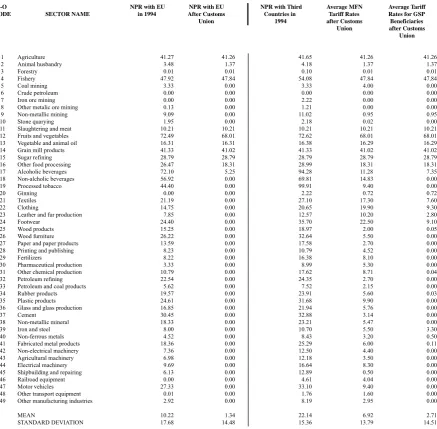
Table 1 shows the nominal protection rates (NPR) that have prevailed during 1994 and 2001. The table reveals that prior to the formation of the CU the economy wide NPR during 1994 in trade with the EU has amounted to 10.2% when weighted by the sectoral import values. Among the 49 tradable goods industries of the 1990 Turkish input-output table there were three industries that had an NPR higher than 50% in trade with the EU, and 33 industries had an NPR less than 20%. In trade with the EU the highest NPRs were in the sectors of ‘fruits and vegetables’ (72.5%), ‘alcoholic beverages’ (72.1%) and ‘non-alcoholic beverages’ (56.9%). In the case of trade with third countries the average NPR has amounted to 22.1% when weighted by the sectoral import values. There were five industries which had an NPR higher than 50% in trade with third countries and 28 industries had an NPR less than 20%. During 1994 the highest NPRs in trade with third countries were in the sectors of ‘processed tobacco’ (99.9%), ‘alcoholic beverages’ (94.3%) and ‘fruits and vegetables’ (72.6%).
The table further reveals that with the formation of the CU the NPRs have decreased substantially in almost all sectors. The economy-wide NPR during 2001 in trade with the EU amounted to 1.3%. There was one industry (fruits and vegetables) that had an NPR higher than 50%, nine industries had positive NPRs less than 50%, and for 39 industries the NPR was 0% in trade with the EU. In trade with the EU, the highest NPRs were in the sectors of ‘fruits and vegetables’ (68%), ‘fishery’ (47.8%) and ‘agriculture’ (41.3%). On the other hand, in the case of trade with third countries the average NPR has amounted to 6.9%. There was one industry (fruits and vegetables) which had an NPR higher than 50%, 13 industries had NPRs less than 50 but more than 10%, and for three industries the NPR was 0% in trade with third countries. During 2001, the highest NPRs in trade with third countries were in the sectors of ‘fruit and vegetables’ (68%), ‘fishery’ (47.8%) and ‘agriculture’ (41.3%).
While for the EU the average NPR has decreased from 10.2% in 1994 to 1.3% in 2001 with the formation of the CU, the average NPR for Israel and Central and Eastern European (CEE) countries decreased from 22.1% to 1.3%. For developing countries having GSP treatment the average NPR decreased from 22.1% in 1994 to 2.7% in 2001. Finally, for countries like the US, Japan and Canada, for which the EU applies the CCT, the average NPR has decreased from 22.1% in 1994 to 6.9% in 2001. Thus, regarding access to Turkish market, we note that as a result of the formation of the CU almost all countries in the world have benefited from the reductions in NPRs in Turkey.
1 The CU does not deal with agriculture and services, but according to CUD processed agricultural products are subject to special tariff arrangements.
Regarding access of Turkish goods to the EU market, note that the EU had abolished the nominal tariff rates on imports of industrial goods from Turkey on 1 September 1971. However, at that time certain exceptions were made. The Community had retained the right to charge import duties on some oil products over a fixed quota and to implement a phased reduction of duties on imports of particular textile products. Trade of products within the province of the ECSC have been protected by the Community through the application of non-tariff barriers and in particular anti-dumping measures.
[image:5.595.82.520.96.525.2]The primary effect of a CU customs union is the expansion of trade flows among member countries, often at the expense of trade with non-members. This expansion is usually decomposed into trade creation and trade diversion. When trade diversion dominates trade creation, CUs tend to be welfare reducing. In the case of Turkey the CU has offered the opportunity to adopt a more liberal trade regime since the CCT is lower than pre-CU tariff. Thus, there was less potential for switching suppliers. As a result, the potential for trade diversion had been reversed. While domestic producers faced more competition from non-members, the effect was offset by consumer gains resulting from lower prices and by tariff revenues collected on imports from non-members.
Table 1: Nominal Protection Rates before and after the Customs Union with EU
I-O NPR with EU NPR with EU NPR with Third Average MFN Average Tariff CODE SECTOR NAME in 1994 After Customs Countries in Tariff Rates Rates for GSP Union 1994 after Customs Beneficiaries Union after Customs
Union
1 Agriculture 41.27 41.26 41.65 41.26 41.26
2 Animal husbandry 3.48 1.37 4.18 1.37 1.37
3 Forestry 0.01 0.01 0.10 0.01 0.01
4 Fishery 47.92 47.84 54.08 47.84 47.84
5 Coal mining 3.33 0.00 3.33 4.00 0.00
6 Crude petroleum 0.00 0.00 0.00 0.00 0.00
7 Iron ore mining 0.00 0.00 2.22 0.00 0.00
8 Other metalic ore mining 0.13 0.00 1.21 0.00 0.00
9 Non-metallic mining 9.09 0.00 11.02 0.95 0.95
10 Stone quarying 1.95 0.00 2.18 0.02 0.00
11 Slaughtering and meat 10.21 10.21 10.21 10.21 10.21
12 Fruits and vegetables 72.49 68.01 72.62 68.01 68.01
13 Vegetable and animal oil 16.31 16.31 16.38 16.29 16.29
14 Grain mill products 41.33 41.02 41.33 41.02 41.02
15 Sugar refining 28.79 28.79 28.79 28.79 28.79
16 Other food processing 26.47 18.31 28.99 18.31 18.31
17 Alcoholic beverages 72.10 5.25 94.28 11.28 7.35
18 Non-alcholic beverages 56.92 0.00 69.81 14.83 0.00
19 Processed tobacco 44.40 0.00 99.91 9.40 0.00
20 Ginning 0.00 0.00 2.22 0.72 0.72
21 Textiles 21.19 0.00 27.10 17.30 7.60
22 Clothing 14.75 0.00 20.65 19.90 9.30
23 Leather and fur production 7.85 0.00 12.57 10.20 2.80
24 Footwear 24.40 0.00 35.70 22.50 9.10
25 Wood products 15.25 0.00 18.97 2.00 0.05
26 Wood furniture 26.22 0.00 32.64 5.50 0.00
27 Paper and paper products 13.59 0.00 17.58 2.70 0.00
28 Printing and publishing 8.23 0.00 10.79 4.52 0.00
29 Fertilizers 8.22 0.00 16.38 8.10 0.00
30 Pharmaceutical production 3.33 0.00 8.99 5.30 0.00
31 Other chemical production 10.79 0.00 17.62 8.71 0.04
32 Petroleum refining 22.54 0.00 24.35 2.70 0.00
33 Petroleum and coal products 5.62 0.00 7.52 2.15 0.00
34 Rubber products 19.57 0.00 23.91 5.60 0.03
35 Plastic products 24.61 0.00 31.68 9.90 0.00
36 Glass and glass production 16.85 0.00 21.94 5.76 0.00
37 Cement 30.45 0.00 32.88 3.14 0.00
38 Non-metallic mineral 18.33 0.00 23.21 5.47 0.00
39 Iron and steel 8.00 0.00 10.70 5.50 3.30
40 Non-ferrous metals 4.52 0.00 8.43 3.20 0.50
41 Fabricated metal products 18.36 0.00 25.29 6.00 0.11
42 Non-electrical machinery 7.36 0.00 12.50 4.40 0.00
43 Agricultural machinery 6.98 0.00 12.18 3.50 0.00
44 Electrical machinery 9.69 0.00 16.64 8.30 0.00
45 Shipbuilding and repairing 6.13 0.00 12.89 0.50 0.00
46 Railroad equipment 0.00 0.00 4.61 4.04 0.00
47 Motor vehicles 27.33 0.00 33.10 9.40 0.00
48 Other transport equipment 0.01 0.00 1.76 1.60 0.00
49 Other manufacturing industries 2.92 0.00 8.19 2.95 0.00
MEAN 10.22 1.34 22.14 6.92 2.71
STANDARD DEVIATION 17.68 14.48 15.36 13.79 14.51
The CUD covering trade in industrial goods extends also to rules and disciplines on various regulatory border and behind-the-border policies.
2.
Customs Reform
3The CUD requires Turkey to adopt EU customs provisions in the fields of i) origin of goods, ii) customs value of goods, iii) introduction of goods into the territory of the CU, iv) customs declarations, v) release for free circulation, vi) suspensive arrangements and customs procedures with economic impact, vii) movement of goods, viii) customs debt and ix) right of appeal. The Community’s Customs Code and its implementing provisions consist of the Combined Nomenclature, Common Customs Tariff and provisions on tariff classification, customs duty relief, duty suspensions and certain tariff quotas; and other provisions such as those on customs control of counterfeit and pirated goods, drugs precursors and cultural goods, mutual administrative assistance in customs matters, and Community agreements in the areas concerned including transit. Member states of the CU must ensure that the necessary implementing and enforcement capacities, including links to the relevant EU computerised customs systems, are in place. The customs services must also ensure adequate capacities to implement and enforce special rules laid down in related areas of the acquis, such as external trade.
Modernisation Project
4Efforts to establish a modern administrative structure in Turkey started prior to the CUD, but the main impetus has been the CUD. Prior to the formation of CU Turkey had quite a complicated import regime. The Turkish Customs Administration (TCA) was a traditional paper based customs organisation, and declarants had to go to customs offices to register declarations. Since at the customs almost all shipments had to be physically inspected, the process at the customs was very intrusive and time consuming. It often led traders to pay substantial facilitation money to speed up the process or to gain favour with customs officials in charge of their inspections. In 1995 Turkey signed a loan agreement with the World Bank in order to carry out a variety of institutional reforms to strengthen public financial management within the Government. The Modernisation of Turkish Customs is one of the components of this ‘Public Financial Management Project’. Besides, Turkey signed a technical assistance agreement with International Monetary Fund to provide international advisors to work in Turkey on a long-term basis with Turkish Customs.5 The aim of the Modernisation of Turkish Customs project was to speed up the release of goods, to collect customs duties and related charges in an effective way, to rationalise the clearance process and to simplify the procedures while enhancing customs control and creating and transferring statistical data in a timely and reliable manner. As a result the focus of the project was on i) modification of customs legislation according to the requirements of the CUD as well as to the requirements of international standards on customs developed by organisations such as the World Customs Organisation (WCO), ii) development and implementation of computer systems and iii) reorganisation of customs administration by creating a balance between customs control and trade facilitation and in harmony with other international agreements and conventions that Turkey was part of.6
3 I am grateful to Rıza Mehmet Korkmaz of the Under-Secretariat of Customs for his contribution to the paper.
4 This sub-section is based partly on Togan (2010).
5 During the period 2003-2009 Turkey received an additional total of €55.4 million from the EU for the modernisation of customs administration (see Togan (2010)).
The first phase of the automation project, the pilot implementation of BİLGE system, which is a system of custom formalities, started at Atatürk Airport in Istanbul, in August 1998. One year later in August 1999, traders at Atatürk Airport began using electronic data interchange (EDI) software supporting BİLGE. To date, almost all of the customs offices have been automated, and a very large percentage of all customs transactions are carried out electronically.
In 2001 the project GÜMSİS (Security Systems for Customs Checkpoints) was launched with the objective of establishing watch and evaluation systems in customs collection district in order to prevent effectively illegal trafficking of goods, vehicles and people; to prevent false declaration of quantity and values of goods; and to facilitate legal trade. Under this project, X-ray scanners and nuclear radiation detectors have been installed at several locations within the country. In 2003 a security system for customs borders was started with the aim of improving transit traffic based on a vehicle tracking system using license plate scanning. During subsequent years Turkey increased its use of X-ray devices, Closed Circuit TV systems, License Plate Scanners and Vehicle Tracking Systems, considerably helping to detect more drugs and smuggled goods over time. In 2004 a new project started on customs information technology (IT) systems the objective of which is the establishment of connection of BILGE with the Common Communication Network and Common System Interface (CCN/CSI) systems, National Customs Transit System (NCTS), Integrated Tariff of the European Communities (TARIC) and other related tariff systems with a view to harmonising the IT systems of TCA with the EU systems.
The introduction of new technology changed the content of work in customs administrations. It reduced the need for the personal supervision of daily operations and resulted in a flatter organisation structure. As a result 120 customs offices with low efficiency were either merged or closed down. In addition, the total number of Regional Directorates in Turkish Customs was reduced from 36 to 18, and the functions of Regional Directorate of Customs and Directorate of Customs Enforcement have been merged in order to increase service efficiency in five Regional Directorates. Finally, greater authority was delegated to regional and local offices.
One goal of the modernisation program was to refurbish and upgrade the physical condition of customs offices. Existing buildings needed to be adapted to meet work flow requirements and the use of information and communications technology (ICT). In a joint effort by the TCA and chambers of commerce and industry, the construction of modernised premises for the Kayseri, Gemlik and Konya customs offices was completed in 2001–2002. The Association of International Transporters built the customs facilities in Gürbulak, a border post with Iran, on the basis of a build-operate-transfer (BOT) model. On the other hand the Customs & Tourism Enterprises Co. Inc. (CTEC) of the Union of Chambers and Commodity Exchanges of Turkey built five border posts on the basis of again BOT model. The facilities are providing 24 hour service, and at the border gates with Iran and Syria customs procedures of both countries are undertaken jointly. The objective is to eliminate the redundancies of formalities. With the improvement of physical standards, border waiting times have decreased by 60-70%. As of 2010 the CTEC is planning to modernise an additional seven customs posts.
Modernisation of the TCA has been a challenging task. Initially, the TCA prepared a four-year action plan that presented in chronological order the various activities that it intended to undertake. A Reform Steering Committee, chaired by the deputy undersecretary of the TCA, was established to implement the program. But since committee members because of their daily duties and responsibilities could not pay full attention to the project, problems developed. In 1997 a project unit staffed with customs employees was established to manage the reform and accelerate the decision making process. The deputy undersecretary was designated as the project coordinator who had the power and authority to make the changes required by the reform. Along with the project unit, a project team was formed to work on a full time basis. Thereafter, the project realised as foreseen in the time plan.
One of the important challenges faced during the implementation of the project has been with ‘communication’. Since uncertainty created by the reform increases the probability of resistance among the stakeholders who have an interest in either the process or the outcome, the administration found out that the reasons for the change as well as the benefits of the change needed to be communicated clearly to the stakeholders. In this regard, TCA prepared a “Strategic Statement” indicating the reasons and objectives of modernisation of the customs and passed this information to the stakeholders through a variety of ways ranging from written communications to small group meetings and large briefing sessions. Moreover, establishing a permanent Customs Consultative Committee involving different representatives from customs brokers and transport companies proved to be very helpful in providing participation to the modernisation project.7
Customs Code
Since the formation of the CU, Turkey has applied customs rules similar in substance to those contained in the EC’s Customs Code. The new Turkish Customs Law No 4458 replaced in February 2000 the previous Customs Law No 1615/1972, and with a Decree of 1995, the coding, tariff description, chapter, heading and sub-heading notes of the Turkish tariff nomenclature were aligned with the combined nomenclature of the EU.8 Recently, Law No 4458 was amended with Law No 5911 of June 18, 2009, and the corresponding Implementing Regulation was published in October 2009. With the new Customs Law, Turkish Customs Legislation has been adjusted both to the international and the most recent EU standards.
Customs Procedures
Import transactions begin with the carrier’s submission of the cargo manifest of goods to be shipped in from abroad to a customs office. Traders when submitting their declarations electronically use their dedicated user codes and passwords and identify the final importer of the goods, attach the documents, and the harmonised system code for the goods declared.9 The cargo manifest and declaration data is entered into the Computerised Customs Management System (CCMS). At that stage, customs personnel match the number of packages of cargo with the number that is declared in the cargo manifest. Goods that are not to be cleared immediately
7 See Soysal (2001).
8 Following Commission Regulation (EC) No 1031/2008 of 19 September 2008 amending Annex I to Council Regulation (EEC) No 2658/87 on the tariff and statistical nomenclature and on the Common Customs Tariff the Turkish nomenclaturehas recently been modified through Decision of the Council of Ministers No 2008/14483 of December 31, 2008.
are promptly moved to temporary storage places and warehouses. The computer system verifies the declaration and assesses the risk that the declaration may be faulty or erroneous. This verification may prompt customs staff to ask for additional documentation. The computer system calculates the duties due, informs declarants of the outcome of the risk analysis for their cargo and gives them a registration number. Goods are assigned different clearance channels: red for physical examination, yellow for documentary checks, blue for goods under post-release controls, or green for immediate release. The risk rating is performed in light of details previously entered by customs headquarters staff members into the customs computer system through a risk analysis module.
As part of its trade facilitation work, the TCA sought to develop its ability to undertake its control function without having to open every single cargo shipment while retaining effective control over the flow of goods and duties payable.10 As emphasised by the WTO (2008) the TCA sought to achieve those goals by carefully selecting the shipments that would undergo physical inspection upon arrival and those that would be inspected after the goods had been released to traders. A specialised selectivity module in the CCMS was prepared by the Risk Analysis Unit. The module checks each declaration against pre-selected risk assessment criteria and assigns the shipments to the green, yellow, red, or blue channels. Companies cleared for simplified procedures use the blue channel for all imports. Customs staff members can modify the selectivity choices made by the CCMS, particularly by overruling yellow channel selections and orienting shipments toward the red channel so that they require full inspection before the release of the goods.
3.
Technical Barriers to Trade
11Product standards, technical regulations and conformity assessment systems are essential ingredients of functioning modern economies. While a ‘standard’ is defined as a set of characteristics or quantities that describes features of a product, process, service or material, ‘technical regulation’ is a mandatory requirement imposed by public authorities. Technical regulations and standards, despite many similarities, have different impacts. If a product does not fulfil the requirements of a technical regulation, it will not be allowed to be put on sale. In the case of standards, non-complying products will be allowed on the market but, then, the volume of sales may be affected if consumers prefer products that meet the standards.12
The assurance of confidence in claimed standards requires that conformity assessment system comprised of testing, certification, metrology, accreditation and recognition is well functioning. Testing is the determination of the characteristics of a product, process or service, according to certain procedures, methodologies or requirements, the aim of which may be to check whether a product fulfils specifications such as safety requirements or characteristics relevant for commerce and trade. The extent of the controls that a product must undergo varies according to the risk attached to the use of the product. In low risk situations declaration by the manufacturer stating that certain standards have been applied to extensive testing and certification may be sufficient. In those cases tests are carried out by the manufacturer based on internal testing and quality assurance mechanisms, and the purchaser takes the manufacturer’s word that the product
10 Article 10 of the Customs Law No 5911 requires that customs controls, other than spot checks, shall be based on risk analysis using automated data processing techniques, with the purpose of identifying and quantifying the risks and developing the necessary measures to assess the risks, on the basis of criteria developed at national and, where available, international level.
conforms. However, in more risky situations, the manufacturer’s declaration of conformity may not be sufficient. The use of independent laboratories may be required by the customer as a condition of sale or mandated by a regulatory agency. Alternatively, the purchaser may insist on formal verification by a third party that the product conforms to specific standards. In this case, certification is the procedure by which a third party gives written assurance that a product, process or service conforms to specified requirements.
The two pre-requisites for properly conducting testing and certification are metrology and accreditation. The metrology institutions, ensuring the accuracy and precision of the measurements transmitted by the calibration laboratories to other conformity assessment bodies and enterprises, build confidence in the work of conformity assessment institutions. On the other hand, accreditation refers to the procedure by which an authoritative body gives formal recognition that a body responsible for conformity assessment is competent to carry out specific tasks. Many large manufacturers require their suppliers’ testing laboratories to be accredited as a condition for accepting suppliers’ products. Accreditation of a laboratory’s or certifier’s competence in a particular field typically involves a review of technical procedures, staff qualifications, product sample handling, test equipment calibration and maintenance, quality control, independence and financial stability. Finally, recognition is the evaluation of the competence of the accreditors.13
The benefits of standards and conformity assessment systems include their facilitation of market transactions, raising the productive efficiency, enhancing market competition and contributing to the provision of public goods. While these functions apply across borders, they can also impose additional costs to exporters and hence act as barriers to trade. Technical barriers to trade (TBTs) are said to exist as long as countries impose different product standards as conditions for the entry, sale and use of commodities; as long as the different countries have different legal regulations on health, safety and environmental protection; and as long as different parties have dissimilar procedures for testing and certification to ensure conformity to existing regulations or standards. Technical barriers have two aspects: i) the content of norms (regulations and standards); and ii) testing procedures needed to demonstrate that a product complies with a norm. The TBTs thus come in two basic forms, content-of-norm TBTs and testing TBTs. In either case, the costs of the product design adaptations, the reorganisation of production systems and the multiple testing and certification needed by exporters can be high. These costs are on the one hand up-front and one-time and on the other hand on-going. While the up-front costs are associated with learning about the regulations and bringing the product into conformity with the regulations, the on-going costs are related to periodic testing. TBTs are said to distort trade when they raise the costs of foreign firms relative to those of domestic firms.14
There are essentially two ways to eliminate TBTs: harmonisation and mutual recognition. The harmonisation approach has been pursued intensively by the EU among the member countries. For a new member country the elimination of TBTs in trade between this country and the EU requires i) harmonisation of the country’s technical legislation with that of the EU’s, ii) the establishment of quality infrastructure comparable to that in the EU, encompassing the operators and operation of standardisation, testing, certification, inspection, accreditation and metrology, and iii) the development of market surveillance and import control system as in the EU.15 On the other hand, under mutual recognition countries agree to recognise each other’s standards and conformity assessment procedures. But this approach based on mutual trust by the parties
13 See National Academy of Sciences (1995) and World Trade Organisation (2005). 14 See Baldwin. (2001).
requires as a minimum a relatively high degree of harmonisation of standards and test procedures.
The CUD requires that Turkey incorporates within five years into its internal legal order the Community instruments relating to the removal of TBTs, and the list of these instruments is to be laid down within a period of one year. Furthermore, effective co-operation is to be achieved in the fields of standardisation, metrology and calibration, quality, accreditation, testing and certification. Thus, the CUD requires that Turkey adopts the harmonisation approach.
Since the formation of the CU, Turkey has harmonised its standards to a very large extent with European and international standards and its technical legislation with that of the EU. But the harmonisation of technical legislation in the non-harmonised sphere has not been completed, limiting free movement of goods in the non-harmonised sphere. The establishment of the quality infrastructure was a lengthy and complex process, as Turkey, until the formation of the CU with the EU, had neither such an infrastructure nor the required technical knowledge. Establishing public awareness of the problem, acquiring the necessary knowledge and establishing the infrastructure took quite some time. But as of 2010, there is a relatively well functioning quality certification system in place in Turkey, comprising the Turkish Standards Institution (TSE), the Turkish Accreditation Body (TÜRKAK) and the National Metrology Institute (UME). A major difficulty faced during this period was getting the right to assign notified bodies that would be recognised by the EU.16 Turkey has received this right only by virtue of the Association Council Decision No 1/2006 of 2006. The development of a market surveillance and import control system, as in the EU, became even more challenging than establishing the quality infrastructure. Again, the reasons are various. A successful consumer product safety related market surveillance system requires independence, visibility, a uniform surveillance policy, a uniform enforcement policy, the integration of market surveillance and import controls, stronger regions, more acting power for inspectors and sufficient technical infrastructure.17 In addition, there were problems with the implementation of the import control system. As a result, the Turkish market surveillance and import control system until 2010 could not be developed as in the EU, and the continuation of these problems has adversely affected the elimination of TBTs in trade with the EU.18
16The notified bodies are independent testing houses, laboratories, or product certifiers authorised by the
EU member states to perform the conformity assessment tasks specified in directives. A notified body is designated by a member state and must have the necessary qualifications to meet the testing and/or certification requirements set forth in a directive. A notified body not only needs to be technically competent and capable of carrying out the specified conformity assessment procedures, but it must also demonstrate independence, impartiality and integrity. Conformance with the EN 45000/ISO 17000 standards is mandatory. Where the directives delegate conformity assessment to third parties, these are notified by national authorities to the Commission and other member states under certain conditions. National authorities must be able to justify conformity of notified bodies through accreditation or other evidence. Certificates of conformity delivered by notified bodies must be accepted by all national authorities in the Union, and suppliers may choose any notified body in the Union.
17 See Undersecretariat for Foreign Trade (2008b).
4.
Competition Policy
19Prior to the formation of the CU, the Turkish government in order to promote investment in activities and areas regarded as desirable, has granted a number of incentives. The incentives, regulated by laws and decrees, have been directed on the one hand towards reducing the cost of investment, reducing the need for external financing and increasing profitability, and on the other, to increasing the competitiveness of Turkish exports. One of the purposes of the incentive schemes was to overcome the barriers to entry into industry imposed by capital market imperfections. But investment incentives have also been a barrier to competition and structural change. Through the incentive system, established firms obtained unit cost advantages which helped them to consolidate their market position. Entrants, competing scarce resources, have been at a disadvantage relative to well informed incumbents. Thus credit incentives, which were supposed to promote entry, have often turned into instruments that reinforced the position of large incumbents. Furthermore the government with its large share of the banking system has directly controlled the allocation of credit, and credit from public banks has often been extended not on the basis of commercial but of other considerations. In addition, the public sector procurements have contributed to increasing the barriers to competition as they generally lead to collusion among preferred suppliers. In Turkey, besides the barriers to entry there were also barriers to exit. Public firms were often not allowed to go bankrupt. In the case of private sector the government from time to time has not allowed the exit of firms of important sizes. In those cases overdue loans were often refinanced on a concessional basis by public sector banks. The government in order to protect the workers from unemployment subsidised the unprofitable public and sometimes the private firms. As a result, the exit barriers made firms more risk-averse in undertaking new activities and blocked a more decisive approach to resource allocation. Finally, it should be noted that Turkey at that time did not have social safety net facilitating effective restructuring of the industry.
Consideration of the concentration ratios across selected industrial products during 1989-90 reveals that the ratios were relatively high prior to the formation of the CU. In addition, the public enterprise sector in Turkey was very large. The state had for a long time monopolies on tobacco, war weapons, railways, air-transportation, air and sea-port administration, post and telecommunication and sugar production, and in the manufacturing sector the state owned enterprises were heavily concentrated on basic metals, chemicals, petrochemicals, fertilizers, newsprint, paper, oil refineries, cement and textile production. The state-owned enterprises showed in general poor economic performance due mainly to the soft-budget constraint they faced. The state-owned enterprises, following objectives such as agricultural income support and employment creation influenced by political pressures, escaped the bankruptcy laws. Pricing, employment and investment decisions in those firms required in general the approval of Treasury, State Planning Organisation and sometimes ministers themselves. Although privatisation has become a prominent part of the Turkish structural adjustment program since 1983, it could not gain momentum for a very long time due to various difficulties encountered. In Turkey there was for a very long time no specific competition legislation and thus no competition policy enforcement. During the 1980’s the country in order to promote competition has eliminated quantitative restrictions in foreign trade and decreased substantially the level of nominal and effective protection and subsidy rates. But the reduction of nominal and effective protection and subsidy rates was not sufficient to ensure proper functioning of the markets. personnel in the responsible ministries and governmental bodies who were fluent in English and trained in matters related to TBTs was insufficient. Finally, financial resources were limited for the harmonisation of technical legislation.
The CUD requires that Turkey adopts the EU competition rules, including measures regarding public aid within two years. Turkey had to ensure that its legislation in the field of competition rules is made comparable with that of the Community, and is applied effectively. In the EU the competition policy articles of the ‘Treaty on the Functioning of the European Union’ (TFEU) are Articles 37 (State monopolies of a commercial character, ex Article 31 TEC), Articles 101 – 105 (Rules applicable to undertakings, ex-Articles 81-85 TEC), Article 106 (Public undertakings and undertakings with special or exclusive rights, ex-Article 86 TEC) and Articles 107-109 (Rules applicable to state aid, ex-Articles 87-89 TEC).20 The acquis covers both anti-trust and state aid control policies. It includes rules and procedures to fight anti-competitive behaviour by companies such as restrictive agreements between undertakings and abuse of dominant position, to scrutinise mergers between undertakings and to prevent governments from granting state aid which distort competition in the internal market.
Turkey adopted its competition policy during December 1994 with the “Law on the Protection of Competition”. The Competition Authority (CA) which has administrative and financial autonomy has been established in order to ensure the formation and development of markets for goods and services in a free and sound competitive environment, to observe the implementation of the Competition Law and to fulfil the duties assigned to it by the Law. During the period 1999-2008 CA made 2570 merger, acquisition, joint venture and privatisation decisions. During the same period, 2662 cases were handled by the CA and 96.5% were resolved. Mergers and acquisitions represented 55.6% of cases resolved, followed by competition infringements (30.1%) and exemptions and negative clearance (14.3%). During 1999-2008 CA fined firms and managers for a total of 212 million TL for violation of corresponding legislation about competition. Thus, CA as emphasised by the World Trade Organisation (2008) has played an important role in moving the Turkish economy forward to greater reliance on competition-based and consumer-welfare oriented market mechanisms.
According to European Commission’s Turkey Progress Reports and OECD (2005) Turkey has shown an appreciable progress in Anti-Trust issue. The CA proved itself to be a respectable organisation with satisfactory level of administrative and operational independence, emphasising on continuous staff training to supply high administrative capacity. The authority has a clear track record on implementation of the competition rules. It is the advisory institute for the actions of public enterprises granted by two circulars issued by Prime Ministry on 1998 and 2001. All ministries have to receive the opinion of the CA about draft laws, by-laws, regulations and communiqués regarding issues that fall under the scope of Competition Law. CA issued opinions on the privatisation tenders of tobacco factories, ports and the Turkish Telecommunication Company.
Article 34 of CUD bars Turkey and the EU member states from providing state resources to aid undertakings or economic sectors where doing so distorts or threatens to distort competition between the Community and Turkey, and under Article 39(2) of CUD, Turkey must adapt all of its existing aid schemes to EU standards and comply generally with the notification and guidelines procedures established by the EU to control aid by member states. Article 37 of CUD requires that Turkey adopt, within two years following the entry into force of the CU, the necessary EU rules for the implementation of the provisions relating to state aid. Despite these deadlines, the required rules have not been adopted until recently by Turkey. It was only in October 2010 that the law on state aid and subsidies was adopted by Parliament. The Law foresees the establishment of State Aid Monitoring and Supervisory Council along with a State Aid General Directorate for ensuring the effective application and enforcement of state aid rules under the CUD.
5.
Industrial Property Rights
21Until the formation of the EU-Turkey CU in 1995 matters related with industrial property rights were governed under a law dating back to the Ottoman Era (March 23, 1879). For a very long time patents have been issued without any warranty as to accuracy and novelty. Pursuant to Law No 6563 (May 21, 1955) government could forward patent requests to International Patent Institute in the Hague for search and verification by novelty. After the closing down of the International Patent Institute, Turkey has signed an agreement with European Patent Organisation in 1977 and a protocol with the Austrian Patent Office in 1992. As a result of these agreements patent request made in Turkey could be sent to these institutions for search and verification by novelty. Patent requests had to be filed with Industrial Property Department, Ministry of Industry and Commerce and patent could be requested for five, ten or fifteen years. Pharmaceutical formulae, industrial designs and models and financial schemes could not be patented. Turkey was a signatory to London and Stockholm text (with exception of first 12 articles) signed in 1934 and 1967 and to the Paris Agreement of 1883 on ‘Protection of Industrial Property’. Patent infringements could give rise to civil action, as well as, to criminal prosecution. On the other hand trademarks were governed for a long time by Regulation on Trademarks of Commercial Products of 1871, and later on by Law No 551 dated March 3, 1965 and by the related instructions issued by Ministry of Industry and Commerce. Trademark had to be filed with Ministry of Industry and Commerce. No right of action against infringement existed until such filing took place. Foreigners could file their trademarks in Turkey. Trademark was registered for 10 years and could be renewed as often as desired. Trademark infringements could also give rise to civil action and criminal prosecution:
Turkish legislation on industrial property rights had a few shortcomings. The Turkish Patent Law specified that patents would be available for any inventions, provided they were new and were capable of industrial application. Thus, the law did not include the requirement that the invention involves an inventive step. Patents have been issued without any examination, and the burden of proof has been with the applicant. But after the adoption of Law 6563 of May 21, 1955 Turkey moved towards a system with examination. Under the patent system that prevailed until 1995 the administration, when Turkish citizens have applied for patents, has asked the universities for their opinion on patentability. Since the universities in Turkey did not have the necessary infrastructure for the study and verification by novelty, the opinions expressed by faculty members have sometimes been biased. Therefore the domestic investors were not willing to invest in new inventions as they were afraid that the patent protection could be waived after some time. The government has forwarded the patent requests of foreigners to European Patent Offices for study and verification by novelty. Thus in the case of applications by foreigners there was no chance that the patent protection would be waived after some time. As such, the system was considered to be biased against Turkish citizens. Although patent infringements until 1995 could give rise to civil action, as well as, to criminal prosecution, there were no ‘special courts’ assigned with the settlement of disputes over the protection of industrial property rights. The legal system in Turkey faced various difficulties when studying and evaluating the different dispute issues, and the settlement of disputes took in general long time.
Article 31 and Annex 8 of the CUD require that Turkey insures adequate and effective protection and enforcement of intellectual property rights and that it will implement the Uruguay Round Agreement on ‘Trade Related Aspects of Intellectual Property Rights’ (TRIPS) by 1999. Furthermore Turkey will have to adopt by January 1, 1999 legislation to secure the patentability of pharmaceutical products and processes. In addition Turkey had to accede to various international conventions.
In the field of industrial property rights, the acquis sets out harmonised rules for the legal protection of trademarks and designs, as well as a harmonised regime for patents. These include conditions for compulsory patent licensing. An important element of the EU-wide patent system is the participation to the European Patent Convention and European Patent Organisation. Other specific provisions apply for biotechnological inventions, pharmaceuticals and plant protection products. The acquis also establishes a common playground for the protection of industrial designs, a Community trademark and Community design system. Moreover provisions exist concerning supplementary protection certificates, which serve to provide inventors with additional protection, when they could not benefit from the protection of a patent, for the entire period for which the patent was granted. The Directive 2004/48/EC on the enforcement of intellectual and industrial property rights such as trademarks, designs or patents requires all member states to apply effective, dissuasive and proportionate remedies and penalties against those engaged in counterfeiting of goods and piracy and so create a level playing field for right holders in the EU. Customs Administrations play an important role to prevent the circulation of products infringing industrial property.
To satisfy the requirements of the CUD Turkey since 1995 has been making substantive efforts to align its legislation with the acquis. The ‘Turkish Patent Institute’ (TPI) was established in 1994. It is the main administrative body responsible for granting patents, utility models, registering designs, dealing with trademarks, circuits' topographies and geographical indications. The new Turkish Patent Law became effective in 1995, and in 2003 the Legislation on the Establishment and the Functions of TPI was promulgated.22 By 2010 Turkey is a party to the Convention establishing World Intellectual Property Organisation (WIPO) since 1976, Paris Convention for the Protection of Industrial Property since 1995, Agreement establishing the World Trade Organisation (WTO) since 1995, Patent Cooperation Treaty since 1996, Nice Agreement concerning International Classification of Goods and Services for the Purpose of Registration of Marks since 1996, Vienna Agreement concerning International Classification of the Figurative Elements of Marks since 1996, Strasbourg Agreement concerning the International Patent Classification since 1996, Budapest Agreement of the International Registration of the Deposit of Micro-Organisms for the Purpose of Patent Procedure since 1998, Locarno Agreement establishing an International Classification for Industrial Design since 1998, Protocol relating to Madrid Agreement since 1999, European Patent Convention since 2000, Hague Agreement concerning the International Deposit of Industrial Design (Geneva Act) since 2005, Trademark Law Treaty since 2005, and International Union for the Protection of New Varieties of Plants (UPOV Convention) since 2007.
The patents granted in Turkey provide rights only within Turkey. If an applicant wants to obtain patent rights in other countries, he/she may file applications in each country separately or he/she may apply through Patent Co-operation Treaty or through European Patent Convention. In the case of the European patent the process goes through the usual stages of filing, search, publication of the application and substantive examination. Once the European patent is granted, the patent has to be validated in each of the designated states within a specified time limit to retain its protective effect and be enforceable against infringers. Thus, the process is quite complex, lengthy and considerably costly.
The Turkish legislation on trademarks consists of the Decree 556 of 1995 and the implementing regulation.23 On the other hand, the provisions concerning industrial designs are contained in Decree Law 554 on the Protection of Designs and the Implementing Regulation, both of 1995.24
Enforcement and Implementation of Industrial Property Rights
In any country the enforcement and implementation of industrial property rights is a challenging task.25 Defending of such rights and enforcing of these rights requires different skills. There is need for special courts for the settlements of disputes and for efficient services of public prosecutors, judges, patent attorneys and police. Regarding special courts it should be emphasised that specialist judges with experience in patent and other intellectual property matters are essential in order to deliver reliable and predictable decisions on questions of infringement and validity as well as on damages payable by infringers. Similar considerations hold also for public prosecutors and police. Regarding patent attorneys it is emphasised that they must have profound knowledge of natural sciences and the ability to put new technical concepts or developments into word. While they are expected to be knowledgeable in a restricted area of law they must have deep knowledge in their field of legal practice which may include domestic and international laws and national laws of other countries. The patent attorney's most important role is to apply his/her specialised legal and scientific knowledge to a new technical solution and by properly wording a patent specification and patent claims to lay the foundation for a new industrial property right. The patent attorney is also expected to provide advice on know-how licenses, including drafting license agreements or providing advice on the rights of employed inventors and advising clients on technical developments. In Turkey, right holders whose rights have been infringed may take action to protect their rights through civil and criminal procedures against the infringer. Civil procedures include action for cessation of infringement and prevention of possible infringement, as well as measures for compensation of moral and material damages, including indemnities and appropriation of unfair profits made by the infringer. The judicial infrastructure in enforcement of intellectual property rights are courts, offices of public prosecutor and Ministry of Justice. The Ministry of Justice is responsible for the establishment of intellectual property rights courts, ensuring effective operation of these courts and training judges, public prosecutors and other staff working in these courts. Turkey has 23 specialised intellectual property rights courts (seven civil and seven criminal courts in Istanbul, four civil and two criminal courts in Ankara and one civil and two criminal courts in Izmir). In parts of Turkey where there are no specialised courts, ordinary ones, designated by the Supreme Board of Judges and Public Prosecutors, can rule on
23 The Decree which is in harmony with Council Directive No 89/104/EEC has been amended on 3 November 1995 and on 22 June 2004.
24 The Decree is in harmony with Council Directive 98/71/EEC.
intellectual property rights cases, and as of June 2006 a Court of Appeal has been established for these cases. Enforcement authorities include police, municipal police and gendarmerie. In cases of industrial property rights violations criminal proceedings start upon complaint. Police has already established an intellectual property rights office within its General Directorate. In general financial crimes sections of the police and gendarmerie anti-smuggling and organised crimes departments are authorised to handle related cases.
Turkey similar to the EU member states must provide measures, procedures and remedies necessary to ensure the enforcement of intellectual property rights that are fair and equitable. But this is not an easy task. Establishing the enforcement mechanism took quite some time. The task as of 2010 is still not complete. Although a relatively large number of judges, lawyers, staff in enforcement bodies, police forces and customs officers were trained in intellectual property rights related issues, the number of trained personnel is still insufficient, and training of the personnel needs to be strengthened. It is also emphasised that the appeal stage of the intellectual property rights court procedures turned out to be also very lengthy, and the coordination and cooperation between relevant bodies i.e. the Ministry of Justice and the judiciary, the police, the Ministry of Finance, the Under-Secretariat for Customs and municipalities to be weak.26
6.
Administrative Procedures
The CUD requires that Turkey approximates and implements EU’s commercial policy regulations including procedures for anti-dumping rules, administering quantitative quotas and procedures for officially supported export credits.
Contingency Trade Remedies
Article 44 of the CUD of 1995 specifies that as long as a particular practice is incompatible with the competition rules of the CU as specified in Articles 32-38 of the CUD and ‘in the absence of such rules if such practice causes or threatens to cause serious prejudice to the interest of the other Party or material injury to its domestic industry’ the Community or Turkey may take appropriate measures. Article 44 allows anti-dumping actions as long as Turkey fails to implement effectively the competition rules of the CU and other relevant parts of the acquis communautaire. In those cases, Article 47 of the Additional Protocol signed in 1970 between Turkey and EC remain in force. According to this article, if the Association Council finds dumping, it shall address recommendations to the persons with whom such practices originate. The injured party may take suitable measures if i) the Council has taken no decision within three months and ii) the dumping practices continue. In the case of need for immediate action, the party may introduce an interim protection measure such as anti-dumping duties for a limited duration. But the Council may recommend the abolition of these interim measures. Finally, Article 63 is about safeguards and states that safeguard measures specified in Article 60 of the Additional Protocol will remain valid. According to Article 60, the Community (Turkey) may take necessary protective measures if serious disturbances occur in a sector of the economy of the Community (Turkey) or prejudice the external financial stability of one or more member states (Turkey), or if difficulties arise which adversely affect the economic situation in a region of the Community (Turkey).
The first Turkish legislation on anti-dumping and countervailing measures, namely Law No 3577 of 1989 on Prevention of Unfair Competition in Importation including the related
Decree and Regulation, was published in 1989. But this legislation was not in conformity with the CUD obligations. As a result, the Law No 4412 Amending Law No 3577 on the ‘Prevention of Unfair Competition in Imports’ was enacted in 1999. Additional rules were ratified by the Decree No 23861 on the ‘Prevention of Unfair Competition in Imports’, published in 1999; and the Regulation No 23861 published also in 1999.27 On the other hand Turkey has promulgated new legislation on safeguard measures with Decree No 735/2004 published in 2004 and the Regulation on Safeguard Measures for Imports published also in 2004. The legislation aims to ensure conformity with the CUD obligations.28
Import Surveillance and Administration of Quotas,
As a requirement for harmonisation of its import policy with that of the EU Turkey introduced import quotas on certain textile and clothing products. The quotas were introduced on 1 January 1996 under Article XXIV of GATT 1994. Within the context of the legislation on ‘Surveillance and Safeguard Measures on Imports of Certain Textiles Products’, the management of quotas and surveillance has been realised under a double checking system for imports from countries with which an agreement has been reached, and a single-checking system has been applied to textile and clothing imports from countries with which no agreement has yet been reached. Turkey did not auction its quotas, which would have transferred the economic ‘rent’ gained by the quota holders to the Government as public revenues. Instead, the larger part of the quotas was distributed among firms that had imported the same category in the previous year. The remaining quotas were allocated to firms that did not previously import that category of goods. The quota allocation license could not be sold or transferred. Turkey has also introduced quotas for imports of some products originating from China. These goods included footwear, tableware and kitchenware of porcelain or china, ceramic tableware or kitchenware and toys. The legislation applied to imports from China also applies to imports from some other non-member countries of the WTO. Currently, quotas and tariff-quotas are administered via Decision 2004/7333 of 19 May 2004 and the related implementing regulation. Information on the quotas are published in the Official Gazette. As in the EU import licenses are required for products subject to quantitative restrictions, safeguard measures or for import monitoring and surveillance.29
As emphasised by WTO (2008) Turkey is applying quotas to textile and clothing products from Belarus under the double-checking system and to goods from the Democratic People's Republic
27 In the EU the dumping regulation is based on Council Regulation (EC) No 1225/2009, the anti-subsidy rules on Council Regulation (EC) No 1973/2002 and Council Regulation (EC) No 461/2004. The regulations comply with the EU's international obligations, in particular the WTO Agreement on the Implementation of Article VI of the General Agreement on Tariffs and Trade (Anti-Dumping Agreement) and WTO Agreement on Subsidies and Countervailing Measures. The Turkish legislation on anti-dumping and anti-subsidy is consistent with the WTO Anti-Dumping Agreement and the WTO Agreement on Subsidies and Countervailing Measures as well as with the relevant EU regulations. 28 In the EU the safeguard measures are based on Council Regulation (EC) No 260/2009, Council Regulation (EC) No 625/2009 and Council Regulation (EC) No 427/2003. The regulations comply with the EU's international obligations, in particular the WTO Agreement on Safeguards. The Turkish legislation on safeguards is consistent with the WTO Agreement on Safeguards as well as with the relevant EU regulations
of Korea, Montenegro and Uzbekistan under the single checking system. It also applies surveillance measures to imports from Uzbekistan and Turkmenistan under the single checking system. Moreover, Turkey has quotas for 44 categories of textiles and apparel products from China, such as shirts, jerseys, T-shirts and gloves. According to the authorities, these quotas are applied under paragraph 242 of the Report of the Working Party on the Accession of China to the WTO, which sets a safeguard mechanism for imports of textiles and apparel products originating in China.
Import surveillance in Turkey applies to certain textiles, steel products and to agricultural products including cereals, rice, sugar, olive oil and table olives, milk products, beef and veal, fresh fruit and vegetables, processed fruit and vegetables, bananas and ethyl alcohol of agricultural origin. These products are subject to automatic licenses for statistical purposes and for improving control of the origin of the products. On the other hand, tariff preferences on agricultural products, granted under Turkey's trade agreements, are generally subject to quotas. Tariff quotas are applied on imports of various agricultural and processed agricultural products from the EU, Israel, Macedonia, Croatia, Bosnia-Herzegovina, Morocco, Syria, Tunisia, Egypt and Albania.
7.
Public Procurement
During the Ottoman period public procurement was regulated by Public Procurement Regulation of 1857. In 1914, an additional regulation was published on public works. The first law regulating public procurements in the Turkish Republic was the Law on Auctions, Disputes and Importing No 661 of 1925. With few amendments, this law stayed in effect until 1934. In 1934 a new law, namely ‘Law on Auctions, Competitive Bidding and Auctioning’ No 2490 was enacted, which remained in force for nearly 50 years.
In 1983 the Law on Public Procurement No 2886 was enacted and thereafter for a relatively long time the legal framework of the Turkish public procurement system consisted of this law, which was amended by Law No 2990 of 1984 and of associated decrees and regulations. The Law was covering the general budget institutions, annex budget institutions, local administrations and the municipalities. State Economic Enterprises (SEEs) and some autonomous administrations were excluded from the scope of the Law. These administrations put into force their own arrangements parallel to the Law on Public Procurement. In the implementation of this Law the main principle was to meet the requirements under the most favourable and suitable conditions and in due time. Achieving a competitive solution was not the main objective. Although the Law specified different tendering systems such as open tenders, restricted tenders and negotiated tenders, preference was given to the close envelop system. The tenders were announced in the newspapers. Moreover, tenders with estimated amounts above certain threshold levels had to have an appropriation in the budget regarding the particular tender. Furthermore, they had to be published in the Official Gazette.30
The Law No 2886 had quite a few shortcomings. It was emphasised that the Law was falling short of following the developments in international public procurement practices, that it was not transparent enough, that there were weaknesses in the auditing system, that publication of procurement notices was not mandatory and that procurement results were not made public. Since a large number of public institutions remained outside the scope of the Law 2886, and since each of these institution could issue its own regulations on procurements with the approval of the Cabinet, public procurement procedures followed by different institutions differed considerably leading to confusion in the Turkish public procurement system. In addition, the
carnet system used by the Ministry of Public Works and Settlements lead to increased corruption. In short, the system was not open, transparent and non-discriminatory.
Article 48 of the CUD states that the Association Council will set a date for the initiation of negotiations aiming at the mutual opening of the Parties’ respective government procurement markets as soon as possible after the date of entry into force of the CUD. But this rather vague statement in the CUD was interpreted by the parties as if Turkey did not have any obligations arising from CUD in the area of public procurement. As a result, no reform was undertaken in the public procurement area as a requirement of the CUD.31 The reform process started only after the European Council decided to start membership talks with Turkey on October 3, 2005.
8.
Administrative Costs of Implementing the Customs Union
32To estimate the budgetary cost of assuming the obligations of the CU we use quite detailed budget figures of the different public institutions. While most of the budget figures of these institutions were obtained from the Ministry of Finance for the period 1994-2009, expenditure data for institutions such as TÜRKAK, the Competition Authority, the Turkish Patent Institute and National Metrology Institute (UME) were obtained from the relevant institutions.33 The data were aggregated under the headings of personnel expenditures, current expenditures and investment expenditures. Since the figures were given in nominal terms, we use the GDP deflator (price index) to convert all figures to 2009 prices. Next we use the average Turkish lira/euro exchange rate of 2009 to obtain the figures in terms of 2009 euros.
Some of the institutions such as Under-Secretariat for Foreign Trade, Under-Secretariat of Customs and the Turkish Standards Institute were operating before the start of CU, and they were employing a large number of personnel. The CU put pressure on these institutions to employ additional staff as well as to train the staff in issues related to relevant acquis. In addition they had to increase the investment expenditures. As a result, when considering the budgetary cost of assuming the obligations of the CU for these institutions we concentrate on their total expenditures consisting of personnel expenditures, current expenditures and investment expenditures. Noting that during the period 1990-2009 Turkish real GDP has increased at the annual rate of 3.9%, we assume that total real expenditures of these institutions would have increased at the same annual growth rate as that of real GDP, if the CU had not been implemented. The excess of actual to predicted expenditures by these institutions over the period 1996-2009 is then considered to be the budgetary cost of assuming the obligations of the CU for these institutions.
On the other hand, institutions such as TÜRKAK, Competition Authority, the Turkish Patent Institute and National Metrology Institute were established either around 1995 or thereafter as a result of the requirements of the CU. After the establishment of these institutions they had to increase their personnel expenditures and investment expenditures considerably in order to meet the demand for additional personnel, train their personnel and also build the required infrastructure. As a result, when estimating the budgetary cost of assuming the obligations of the CU in the case of these institutions we consider the total expenditures consisting again of personnel, current and investment expenditures over a period of five years after their establishment.
31 The reform process started after the European Council decided to start membership talks with Turkey on 3 October 2005.
32 This section is based largely on information contained in Togan (2010).
In some cases certain institutions such as the Ministry of Interior or Ministry of Justice were involved in implementing the requirements of the CU as in the case of implementation of intellectual property rights, and in those cases it was not possible to derive from the budget data of the related institutions the costs related with fulfilling the requirements of the CU. In those cases we have taken the cost figures of the relevant institutions from the studies of the Secretariat General of EU Affairs (2001, 2003 and 2007).
Finally, we have added to the sum of the above figures the funding received from the EU (EU contribution), since these figures were not included in the budget figures.
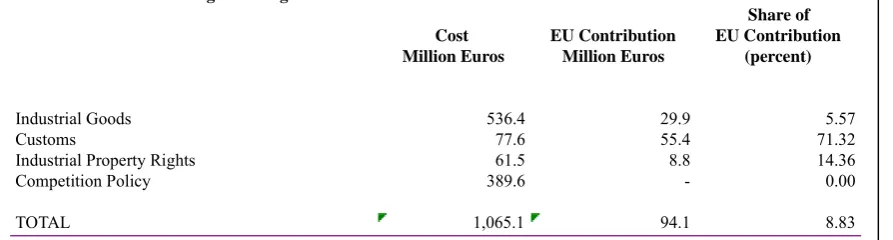
Table 2 shows that the estimated costs of assuming the obligations of the CU has amounted to €1,065.1 million, and that the share of EU contribution in total cost of assuming the obligations of the CU has amounted to 8.83%.
9.
Trade Performance, Foreign Direct Investment and Criticism of the Customs
Union
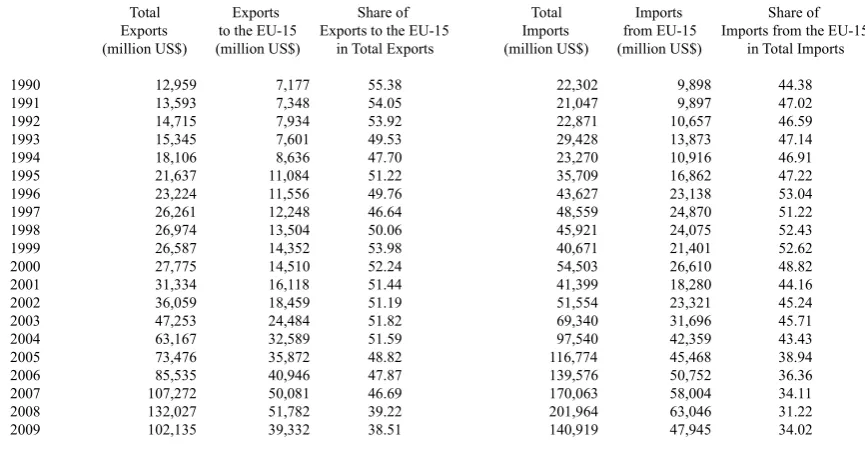
Table 3 shows the developments in Turkish trade prior to and after the formation of the CU. In 1995 Turkish exports to EU-15 amounted to $11.1 billion (51.2% of Turkey’s exports); while imports from the EU-15 amounted to $16.9 billion (47.2% of Turkey’s imports).34 With the formation of the CU the share of imports from the EU-15 in total imports went up from 47.2% in 1995 to 53% in 1996, but then started to decrease reaching 31.2% in 2008. Comparison of the growth rate of imports from the EU-15 prior to the formation of the CU with those observed after the formation of the CU reveals that the average growth rate of imports from the EU-15 has declined from 9.2% experienced during 1990-1995 to -3.1% during the period 1996-2001, but thereafter picked up and increased to 15.6% over the period 2002-2008. On the other hand the effect of the CU on exports seems also to be of limited importance initially. Whereas the annual average growth rate of exports to the EU-15 was 7.5% prior to the formation of the CU, it had declined to 6.4% over the period 1996-2001, but increased thereafter to 17% over the period 2002-2008. Similarly the share of exports to the EU-15 in total exports increased from 51.2% in 1995 to 54% in 1999, but thereafter the share declined to 51.2% in 2002 and further to 39.2 in 2008.
[image:21.595.80.527.269.389.2]
34 Although Austria, Finland and Sweden joined the EU on January 1, 1995; Cyprus, Czech Republic, Estonia, Hungary, Latvia, Lithuania, Malta, Poland, Slovakia, and Slovenia on 1 May 2004; and Bulgaria and Romania on 1 January 2007, we consider in the following for reasons of consistency data for EU-15 consisting of Austria, Belgium, Denmark, Finland, France, Germany, Greece, Ireland, Italy, Luxembourg, Netherlands, Portugal, Spain, Sweden, United Kingdom over the entire period 1990-2009.
Table 2: Costs of Assuming the Obligations of the Customs Union
Share of Cost EU Contribution EU Contribution Million Euros Million Euros (percent)
Industrial Goods 536.4 29.9 5.57
Customs 77.6 55.4 71.32
Industrial Property Rights 61.5 8.8 14.36
Competition Policy 389.6 - 0.00