Attachments to nature: design and eco-emotion
Author Michael Anusas
Address Design Lecturer
Department of Design, Manufacture and Engineering Management Faculty of Engineering
University of Strathclyde James Weir Building 75 Montrose Street Glasgow G1 1XJ Scotland UK
Telephone +44 (0) 141 548 2366 Fax +44 (0) 141 552 7986 E-mail [email protected]
Paper type Theoretical
Abstract
This paper is concerned with how technology influences people’s emotional attachments to nature. The paper proposes two theoretical works in progress: a model which shows how emotions are constructed through social, technological and ecological experience; and a framework which proposes ways in which technology influences the construction of emotional attachments to nature. The aim of these models and frameworks are to enable designers to reframe their perceptions of ecological issues and recognise the behavioural, cultural and social complexities. The paper also hopes to further the relevance of the design and emotion field to sustainable development. The paper emerges from an investigation into an anthropological approach to ecodesign, and one of the key aims of presenting the paper is to understand its relevance of this enquiry to the design and emotion field.
Keywords
Note on terminology
This paper involves inter-disciplinary ideas, and with such studies the use of language can be problematic when terms are interpreted differently across disciplines. To try avoid any misinterpretations, the use of two terms are clarified below.
Environment This word has variation in meaning across, and within, disciplines. In the paper I use brackets or italics, when necessary, to clarify the meaning of the word in its context.
Introduction
The work in this paper has not evolved from the field of design and emotion but from an investigation into an anthropological approach to ecodesign. The motivation to pursue this area of research emerged from two personal experiences which are viewed as important to understanding the context of this paper. The first of these, working in the product
development and built environment industries in the U.K. during 1997 to 2003, and the second travelling in South India in 2003. In industry, the authors practice was centred on two issues, the first a user-centred approach to design, and the second an ecological approach to design. To the author’s observations, user-centred designers rarely addressed ecological issues, and designers concerned with ecology and alternative technologies rarely investigated ‘use’ issues. At this point, the author observed that user’s perceptions, behaviours and use patterns of technologies had a significant influence on the ecological impact of those
technologies. Following this experience, the author spent a short career-break travelling and engaging in rural social research in South India. During this experience the author observed that the most critical factor in determining a societies ecological impact is its embedded cultural practices and values. These cultural issues play a significant role in influencing an individual’s perception of, and attachment to, the natural environment. Building on these observations, the author is now pursuing an academic career to develop a research activity which investigates the behavioural, cultural and social aspects of ecodesign. This research activity is currently based on the idea that:
• Designers need to have new ways of reframing their perceptions of ecological issues to recognise the behavioural, cultural and social complexities.
• Designers need ways of understanding how technology plays a significant cultural role in constructing ecological beliefs, values, perceptions and behaviours.
• If designers can understand ecological issues fuller, and have models and frameworks to do so, then they should be able to create technologies that are more culturally and ecologically sustainable.
and two that technology is a facilitator of ecological behaviour. It is the first part of this extended idea that the author hopes to be of key interest to the conference, that is, that
technology plays a critical part in constructing emotional attachments to nature. Based on this idea the author discusses within this paper:
• A model for emotions which is holistic and shows how emotions are constructed through social, technological and ecological experience.
• A framework which proposes ways in which technology influences the construction of emotional attachments to nature.
Within the paper the author refers to ‘emotional attachments to nature’ using the term ‘eco-emotions’.
The author aims in presenting these ideas is to enable further discussion of the relevance of ecological issues to the design and emotion field. The author hopes to gain constructive criticism and feedback on how these ideas can be developed further.
A brief overview of ecodesign for this paper
In a culture of western economic development, nature is perceived as a resource of materials and energy to enable the realisation of technology for human economic advantage. Over the last few decades, this culture has been shown to be increasingly problematic for the wellbeing of society, most notably promoted by the concept of ‘sustainable development’ (WCED 1987). Significant attention was drawn to the activity of design within this culture by Papanek (1971, 1995), who, along with others, has influenced a number of innovative design responses to these social and (natural) environmental problems. For the purposes of this paper, I group these responses as ‘ecodesign’.
Mainstream ecodesign responses for technological development have be recognised as: ‘Design for the Environment’ (DfE), ‘Life Cycle Analysis’ (LCA), ‘Factor Four’
recognise that people define and influence these ecotechnical relationships, but a sociological enquiry is not the primary focus. The above responses are also concerned with proposing new economic models for design’s relationship with nature, some which are regarded as radical. However these economic responses are still framed within the context of a culture of western economic development and they do not investigate or question this culture in extensive depth.
The above ecodesign responses can be argued to be predominantly driven by a technical enquiry, rather than a cultural one. However, cultural enquiries have been present in
ecodesign discourse since Papanek (1971), and the continued growth of work in this area by authors such as Whiteley (1993), van Hinte (1997, 2004), van Hinte and Bakker (1999), and Thackara (2005), show that the cultural aspects of ecodesign are of increasing significance. Aspects of this discourse are concerned with emotions. Emotions are highly significant in constructing individual and social behaviours (Milton 2002) and design plays a significant role in influencing people’s emotions (Norman 2004; McDonagh et al. 2004). Therefore, design, through emotions, has a key influence on people’s behaviours and their attachments to technology. This growing importance of ‘emotions and ecodesign’ has been substantiated by various authors such as Chapman (2005) with the concept of ‘Emotionally Durable Design’ and through the work of the ‘Eternally Yours’ (van Hinte 1997, 2004).
The aim of this introduction is not to highlight divisions between these different approaches to ecodesign, rather, it is to:
• Propose that a combination of cultural and emotional approaches, together with ecotechnical and economic ones, can create a robust and fuller approach to ecodesign.
• Recognise that ‘emotions and ecodesign’ is an emerging and important field and that there is the need to extend the ideas and knowledge for this area.
The ideas and knowledge put forward in this paper are hoped to further the field of emotions and ecodesign, and be complementary to existing work.
A holistic model of emotion construction for design
makeup and cultural characteristics that are socially constructed. Recent research by Milton (2002, 2005), which draws on research from neurology, psychology, anthropology, sociology and philosophy, argues that emotions are not just innate and/or socially constructed, but that they can also be constructed through non-human relationships.
However emotions come to be, it is generally recognised that they become consciously known through social relationships. Designers need a way of working with emotion that enables them to model both people-technology relationships and people-people relationships. A framework for eco-emotions requires a way of modelling the emotional inter-relationships between people, technology and nature.
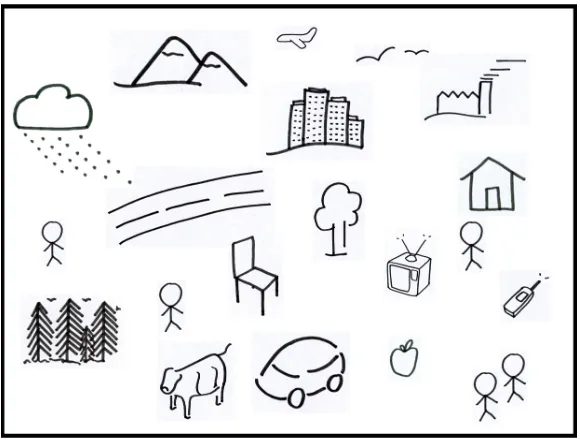
Figure 1, a simplistic illustration of an ‘environment’ in anthropological terms.
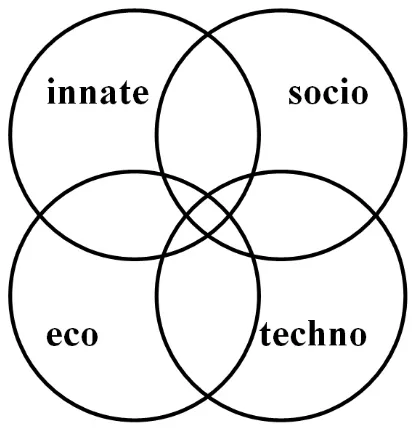
In applying this model to design it needs to be developed further and semantics used which are appropriate to the field of design. Being directly concerned with creating technology, design distinguishes between that and nature, and this needs to be explicit in the model. The model I propose views individual to individual/s relationships as ‘socio-emotional’,
[image:9.595.194.401.332.554.2]individual/social relationships to technology as ‘techno-emotional’ and individual/social relationships to nature as ‘eco-emotional’. Note that the use of the term ‘eco’ is associated specifically with nature here to suit the semantics of the design field (this may not make the terms appropriate to the field of anthropology). The model also includes innate emotions. This developed model represents a ‘holistic model’ of emotion construction for design, and is shown in Figure 2. This model is intentionally developed to be used within a framework which can show design’s role in the construction of eco-emotions.
Figure 2, ‘Holistic model’ of emotion construction for design
Ontologies
attachments and behaviours are often what anthropologists are concerned with. These different apprehensions can be expressed as ontologies.
There are two key commentaries concerning ontologies which can justify the idea of
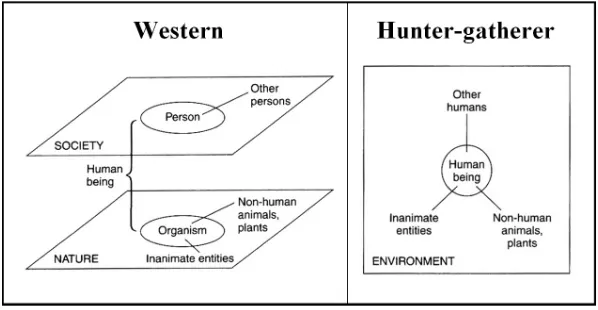
developing a framework for eco-emotions. This is best illustrated first through a comparison of ‘western’ and ‘hunter-gatherer’ ontologies as illustrated by Ingold (2000) in Figure 3. Here Ingold illustrates that it is possible for humans to apprehend their (total) environment in very different ways. Ingold proposes that westerners apprehend a dualistic ‘society:nature’
conceptual representation of their environment (see image on left), and that hunter-gatherers experience their environment through direct engagement without any conceptual
[image:10.595.148.447.381.536.2]representations (see image on right). I propose from this, that hunter-gather’s apprehend all things in their environment on ‘an equal level’ (no dualistic conceptual distinctions). Westerner’s always apprehend a social and/or natural environment, with things in their environment falling into (or attempting to fall into) one of the two conceptual distinctions.
Figure 3, Ontologies of environments. Source: Ingold (2000: 46).
My second point focuses on the westerner’s ontology above and the emotional relationships that result from the duality. Milton’s (2002) research ‘Loving Nature’ investigates people’s attachments to, and emotional relationships with, ‘nature’. Milton’s research shows, that the conceptual idea of nature is valued in a diversity of ways. This diversity occurs between different societies and cultures, and also within sub-cultures and individuals. Milton’s research investigates how different social belief systems in science, religion, magic and capitalism can affect a culture’s relationship with nature. She also investigates how
nature (e.g. in wilderness) define their personal emotional attachment to nature. Milton pursues this work with a social anthropological aim - understanding people. She wishes to know why some people come to value nature more than others. That is, why in the west, some people form very strong emotional attachments to nature and go to extremes to protect it, and other people view nature as a resource with no emotional relationship. Critically, she shows that people can construct strong emotional attachments to nature through social relationships and through direct relationships with nature. With reference to the holistic model above, this implies that eco-emotions can be constructed through socio-emotional and eco-emotional experience. She highlights, that individuals with strong emotional attachments to nature are much more likely to protect nature than those without such an attachment. In the conclusion of ‘Loving Nature’, she argues that our western culture of economic development is one which does not promote an emotional relationship with nature and proposes that ‘a full recognition of the emotional basis of all our actions might help broaden the parameters of public discourse’ (Milton 2002: 151).
From these commentaries, I propose that:
• Ontologies are not ‘fixed’, nor are conceptual representations, and they can be influenced by new models and frameworks.
• The western ontology is problematic as it gives the impression that people are distinct from a ‘natural environment’ and that they conceptualise and exist independently of it (a point supported by Ingold 2000).
• The western ontology may be problematic, but it is clear that it is culturally active and that people construct values and attachments through this ontology. These values and attachments motivate people’s behaviour. People’s behaviours effect (natural)
environmental impacts.
A framework for design’s agency in constructing eco-emotions
This framework proposes various ways that emotional relationships with technology (techno-emotions) can influence the construction of eco-emotions. This framework is based on the author’s own ideas and is presented here as a work-in-progress for discussion. A critical idea underlying this framework is that the intentional human activity of design is a form of human agency that influences people’s emotional attachments to nature. Additionally, that this activity creates technology which then becomes an ‘agent’ within social and ecological relationships.
Mediated A technology that provides a mediated experience of nature. That is through forms of media such as images, television, video games.
Media associative Where eco-emotional media is associated with a technology. For example, cars being associated with visuals of wild or natural environments through advertising.
Situation evocative Where a technology acquires an eco-emotional connotation through its situation of use, in nature. For example, binoculars can be used in various scenarios, but if a child grows up using them within direct experiences of nature, then they become emotionally associated with that experience. Such an object can then evoke eco-emotional
memories for that person regardless of the situation of where the object is experienced at later time. The technology becomes embellished with the meaning of nature, regardless of its physical form.
Integrated A technology that has natural living organisms integrated into its aesthetic or functioning. For example, the architects Hamzah and Yeang’s bioclimatic skyscrapers integrate living botanical systems into their design to please people, and work as air-conditioning and solar shading systems (Hamzah 1998).
Linked Technologies can be constructors of eco-emotions not just through image, association, or object, but also in the way technology is linked to nature. All technologies are linked to nature as they utilise the resources of nature and they have an impact on nature. How people perceive this relationship affects their eco-emotions. This linked aspect is proposed to occur in three different ways as follows.
tangible-linked Where a tangible, clear link to resources or impacts is experienced through the technology. An example is a car exhaust, where the fumes are tangible to the senses. Another example would be inner city power stations, e.g. what was the City of London Sir Giles Gilbert Scott power station (now the Tate Modern gallery).
Thereafter people make the assumption it goes to landfill, or recycling, but they may have no sensory experience of this.
hidden-linked Where the link to resources or impacts is almost completely hidden. An
example is an iPod™ where, it can be argued, that people have little tangible experience of the resources or impacts with regards to the operation, manufacture or distribution of the technology. This is common for many mass-produced products.
This framework shows that the construction of eco-emotions via techno-emotional
relationships is complex and diverse. That is, that techno-emotions are dependent on forms of mediation, situations of experience, on differing levels of sensory tangibility, and conscious and sub-conscious awareness. It also shows that relationships between people, technology and nature do not have clear conceptual distinctions and are never independent of one another. Interactions with a socio, techno or eco aspect of an environment readily crosses over to interact with another aspect, creating a complex field and flow of emotional interactions.
Conclusion
The main omission from this paper is a contextualisation of the work within the field of design and emotions, and therefore a definition of what impact this work might have. There is also the need to address further the contextualisation of the work within the field of emotions and ecodesign. By presenting the work to the conference it is hoped to address this issue and to further understand the relevance of the work.
An aim of the paper has been to continue to widen the discourse, and social relevance, of the field of design and emotions. All activities in a developed society need to be considered within the wider social, environmental and economic concerns of sustainable development. It is therefore hoped that this work furthers the relevance of the field of design and emotions to sustainable development.
develop these ideas further through theoretical and empirical research, across and within different disciplines. Even as works-in-progress they are still hoped to be developed to a level to be useful to current design practice and have the potential to be applied in the development of new sustainable technologies.
Acknowledgements
The author would like to thank the conference reviewers for their helpful and constructive criticism in the development of this paper and also the following academics for their support: Susan A. Batchelor, University of Glasgow; Alex Duffy, University of Strathclyde; Tim Ingold, University of Aberdeen.
References
Antonelli, P and Lovegrove, R. (2004) Supernatural: The Work of Ross Lovegrove. London: Phaidon.
Benyus, J.M. (1997) Biomimicry: Innovation Inspired by Nature. New York: William Morrow.
Butler, J., Holden, K. and Lidwell W. (2003) Universal Principles of Design: 100 Ways to Enhance Usability, Influence Perception, Increase Appeal, Make Better Design Decisions, and Teach Through Design. Gloucester, MA: Rockport Publishers.
Hamzah, T. R. (1998) Bioclimatic Skyscrapers. London: Ellipsis.
Hawken, A., Lovins, H., and Lovins, B. (1999) Natural Capitalism: The Next Industrial Revolution. London: Earthscan.
McDonagh, D., Hekkert, P., van Erp, J. and Gyi, D. (2004) Design and Emotion. London: Taylor & Francis.
McDonough, W. and Braungart, M. (2002) Cradle to Cradle: Remaking the Way We Make Things. New York: Rodale Books.
Milton, K. (2002) Loving Nature: Towards an Ecology of Emotion. London: Routledge.
Milton, K. (2005) “Emotion (or Life, the Universe, Everything).” The Australian Journal of Anthropology, 16(2): 198-211
Norman, D. (2004) Emotional Design: Why We Love (Or Hate) Everyday Things. New York: Basic Books.
Papanek, V. (1971) Design for the Real World: Human Ecology and Social Change. New York: Pantheon Books.
Papanek, V. (1995) The Green Imperative: Natural Design for the Real World. New York: Thames and Hudson.
Thackara, J. (2005) In The Bubble: Designing in a Complex World. Cambridge, MA: MIT Press.
Tzonis, A. (2004) Santiago Calatrava: Complete Works. New York: Rizzoli.
van Hinte, E. and Bakker, C. (1999) Trespassers: Inspirations for Eco-Efficient Design. Rotterdam: Netherlands Design Institute.
van Hinte, E. (1997) Eternally Yours: Visions on Product Endurance. Rotterdam: 010 Publishers.
van Hinte, E. (2004) Eternally Yours: Time in Design. Rotterdam: 010 Publishers.
Weizsäcker, Lovins, A. B. and Lovins, L. H. (1997) Factor Four: Doubling Wealth, Halving Resource Use. London: Earthscan.
Whiteley, N. (1993) Design for Society. London: Reaktion Books.