THE MOTION OF SLOW ELECTRONS
IN ELECTRIC AND MAGNETIC FIELDS
A thesis submitted for
the degree of Doctor of Philosophy in the Australian National University
THE MOTION OF SLOW ELECTRONS IN ELECTRIC AND MAGNETIC FIELDS.
✓
P a ^ e Line
12 9
17 8
25 19, 20
44 18
22
59 18
61
81 2 of te x t
101 10
131 14
146 22
148 9 13
156 24
E R R A T A .
D elete " a s s o c ia te d L egendre function” In s e rt ” L egendre polynom ial” .
D elete ’’ra d iu s ” I n s e rt ’’ra d ii”
D elete ” An exam ple of such a cu rv e is given in sectio n 7. 5”
D elete ’’c u rre n t”
D elete ’’c u rre n t v a lu es” In s e rt " r a tio s ”
D elete ” c u rr e n t r a tio s ” In s e rt " r a tio s R”
D elete th ir d lin e of ta b le com m encing "21. 4”
D elete "diffu sio n ” In s e rt " d isp la c e m e n t” .
D elete sen ten ce b eg in n in g ” It w as d e d u c e d ...’’
In s e rt ” It w as th e re fo re deduced th a t th e p o ssib le e r r o r in k introduced by e r r o r s of 1% in th e r e s i s t o r chain u s e i in se ttin g th e voltages of th e gu ard rin g s w as of the o rd e r of 0. 3%.”
D elete " m e a s u re m e n ts ” In s e rt " c a lc u la tio n s ” . D elete "m ax im u m ” . In s e rt "m in im u m ” . D elete " c u r re n t" D elete " c u r r e n t” In s e rt " th e ”
In s e rt a fte r " d is trib u tio n is ” th e w ords " c o n s is te n t with” .
STATEMENT
The experimental project described in Part I of this thesis was carried out as a joint project with Dr. R.W. Crompton with
the exception of Chapter 4 which was carried out in conjunction with Dr. J.A. Rees*
The author would like to express his deep gratitude to his supervisor, Dr. R.W. Crompton, for invaluable guidance and assistance throughout this project.
He is also indebted to Professor Sir Leonard Huxley for his interest and guidance and to Mr. John Gascoigne who was responsible for the construction of the experimental apparatus used.
He would like to express his thanks to his colleagues of the Ion Diffusion Unit and in particular to Dr. J.A. Rees for their help and cooperation, and to the members of the Research School of Physical Sciences who have assisted in many ways.
The financial assistance of a Commonwealth Postgraduate
TABLE OP CONTENTS
Page . INDEX TO FIGURES
INDEX TO TABLES NOTATION
INTRODUCTION i
PART I. AN INVESTIGATION OF THE LATERAL
DIFFUSION METHOD OF DETERMINING w/d.~
CHAPTER 1. INTRODUCTION AND THEORY
1.1 Historical introduction 1
1.2 Definition of terms 4
1.2.1 Drift Velocity W 4
1.2.2 Diffusion Coefficient D 4
1.2.3 Townsend's Energy Factor 5
1.3 Derivation of the differential equation
diffusion of electrons
describing
6
1.4 Relation between w/d and Townsend's Energy Factor 7
1.5 Experimental method for determining Townsend's Energy
Factor 10
1.6 Solution of the differential equation 12
1.6.1 Pole solution 12
1.6.2 Dipole solution 13
1.7 Modification of method when attachments are present 14
CHAPTER 2. APPARATUS AND MEASUREMENT
2.1 Description of the apparatus 17
2.2 Measuring equipment 19
2.2.1 Electrometer unit 20
2.2.2 Induction balance 21
2.2.3 Condenser units 23
2.2.4 Measuring procedure 24
2.3 Associated electrical equipment 25
2.4.1 Vacuum systems 26
2.4.2 Pressure gauge 27
2.4.3 Gas inlet system 27
CHAPTER 3. RESULTS
3.1 Range of Parameters 28
3.1.1 Electric field strength 28
3.1.2 Pressure measurement 29
3.1.3 Ratio limitation 29
3.1.4 Restriction on divergence of electron stream 29
3.1.5 Chamber length 30
3.1.6 Electrode configuration 30
3.2 Results 31
3.3 Discussion of possible errors 36
3.3.1 Axial alignment 36
3.3.2 Finite size of the source hole 37
3.3.3 Uniformity of the electric field 39
3*3.4 Surface effects 40
3.3.5 Presence of negative ions 41
3.3.6 Temperature effects 42
3.3.7 Solution errors 45
3.3.8 Space charge repulsion 50
3.4 Comparison of results 50
3.5 Discussion 53
CHAPTER 4. MEASUREMENTS IN GASES IN WHICH ELECTRON
ATTACHMENT OCCURS
4.1 Introduction 55
4.2 Previous work done in water vapour 56
4.3 Description of apparatus 57
4.3.1 Vacuum system 57
4.3.2 Gas inlet system 57
4.3.3 Pressure measurement 58
4.4 Analysis of results 58
4.5 Results taken at values of E/p greater than
20 V cm"'-' mm Hg"'”' 60
4.6 Results taken at values of E/p less than
P a g e .
PART I I . INVESTIGATION OF THE VELOCITY
DISTRIBUTION FUNCTION
CHAPTER 5 . THE DISTRIBUTION FUNCTION
5*1 I n t r o d u c t i o n 67
5 . 2 The v e l o c i t y d i s t r i b u t i o n f u n c t i o n f o r e l a s t i c
n on i s o t r o p i c c o l l i s i o n s 71
5 . 3 A p p l i c a t i o n o f t h e d i s t r i b u t i o n f u n c t i o n t o f o r m u l a e
f o r W a n d k-j 74
5*4 S i m p l i f i c a t i o n o f t h e d i s t r i b u t i o n f u n c t i o n when
i s l a r g e 75
5 . 5 S p e c i a l c a s e s o f t h e d i s t r i b u t i o n f u n c t i o n 77
5*5*1 G r a p h i c a l r e p r e s e n t a t i o n 79
CHAPTER 6 . MEASUREMENT OF THE MAGNETIC DEFLECTION
COEFFICIENT
6 . 1 I n t r o d u c t i o n 81
6 . 2 D e s c r i p t i o n o f t h e m e t h o d 85
6 . 3 D e t e r m i n a t i o n o f t h e m a g n e t i c d e f l e c t i o n c o e f f i c i e n t
i n t e r m s o f Wx/ w z and W 86
6 . 3 * 1 E v a l u a t i o n o f 3/ f 88
6 . 4 E v a l u a t i o n o f R i n t e r r a s o f Eh/ k^ a n d
Wx / w z
91CHAPTER 7 . APPARATUS AND MEASUREMENT
7 . 1 D e s c r i p t i o n o f t h e a p p a r a t u s 97
7 . 1 . 1 U n i f o r m i t y o f e l e c t r i c f i e l d 100
7 . 2 M e a s u r i n g e q u i p m e n t 103
7 . 3 A s s o c i a t e d e l e c t r i c a l e q u i p m e n t . 103
7 . 4 Vacuum e q u i p m e n t 104
7 . 4 * 1 Vacuum s y s t e m 104
7 . 4 * 2 P r e s s u r e m e a s u r e m e n t 105
7 . 4 . 3 Gas i n l e t s y s t e m 105
7*5 M a g n e t i c f i e l d c o i l s 106
7 . 6 F a c t o r s d e t e r m i n i n g t h e r a n g e o f p a r a m e t e r s u s e d 108
7 . 6 . 1 D i f f u s i o n m e a s u r e m e n t s 108
CHAPTER 8. MEASUREMENT OF DRIFT VELOCITY 3Y A TIME-OF-FLIGHT METHOD
8.1 Introduction 113
8.2 Method of Bradbury and Nielsen 114
8*3 Errors due to diffusion 117
8.3.1 Errors discussed by Duncan and by Crompton,
Hall and Macklin 117
8.3.2 Investigation by Lowke 118
CHAPTER 9. THE DRIFT VELOCITY APPARATUS
9.1 Description of the apparatus 121
9.1.1 Construction of shutters 123
9.2 Measuring equipment 125
9.3 Associated electrical equipment 126
9.4 Vacuum equipment 126
9.5 The A.C. voltage supply 126
9.5.1 The oscillator 127
9.5.2 Frequency measurement 128
9.5.3 Resistor-capacitor network 128
CHAPTER 10. MEASUREMENT OF THE MAGNETIC DEFLECTION COEFFICIENT j/P IN A DIATOMIC GAS, NITROGEN
10.1 Introduction 130
10.2 Experimental conditions 131
10.2.1 Electric field strength E 131
10.2.2 Pressure p 131
10.2.3 Magnetic field strength B 132
10.2.4 Temperature 132
10.2.5 Gas purity 132
10.3 Measurements of k-j 132
10.4 Measurements of the magnetic deflection coefficient 135
10.5 Results 135
Page CHAPTER 11* MEASUREMENT OF MAGNETIC DEFLECTION
COEFFICIENT 3/f iF"A MONATOMIC GAS, HELIUM
11.1 Introduction 140
A. MEASUREMENT OF DRIFT VELOCITY W
11.2 Experimental conditions 144
11.2*1 Electric field strength E 144
11.2.2 Pressure p 144
11.2*3 Temperature 144
11.2.4 Gas purity 145
11*3 Results 146
B. MEASUREMENT OF MAGNETIC DEFLECTION
COEFFICIENT 3/F
11.4 Experimental conditions 149
11.4.1 Electric field strength E 149
11.4*2 Pressure p 149
11.4.3 Magnetic field strength B 149
11.4*4 Temperature 150
11.4.5 Gas purity 150
11.5 Measurement of k-^ 151
11.6 Measurement of magnetic deflection coefficient 154
11.7 Results and discussion 154
C* FURTHER DEDUCTIONS FROM EXPERIMENTAL RESULTS
11.8 Derivation of mean free path, momentum transfer cross section and mean fractional energy loss on
collision 156
APPENDICES
I To establish formulae for W and D in terms of
microscopic parameters
L
and c A 1II Solution of the diffusion equation A15
III Computer programme to determine X in terms of
Eh/k1 A 28
IV Derivation of the velocity distribution function
for elastic, non isotropic collisions A31
VI Solution of the diffusion equation magnetic field present
with a
A44
VII To determine the value of D/Dg A53
VIII Computer programme to determine R in terms of
Eh/k-j and Wx/ w z A57
IX Uniform electric field A60
X Derivation of expressions for mean
mean fractional energy loss for the where/ is independent of c.
free path and special case
A74
INDEX TO FIGURES,
P a g e .
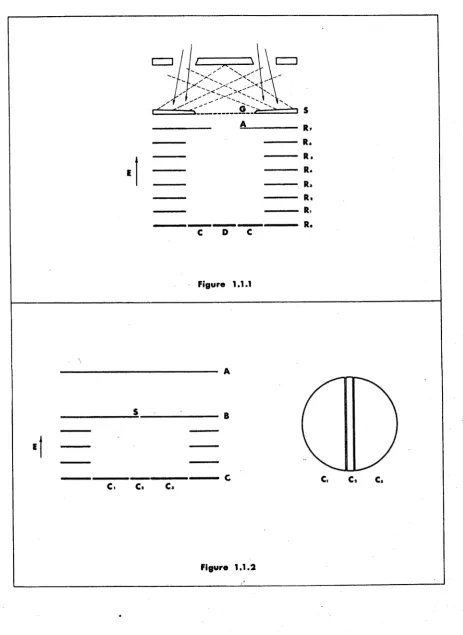
1 . 1 . 1 Townsend’ s D i f f u s i o n A p p a r a t u s . 1
1 . 1 . 2 Townsend’ s M a g n e t i c D e f l e c t i o n A p pa ra t us . 1 1 . 5 . 1 The geo met ry o f t he d i f f u s i o n chamber. 11
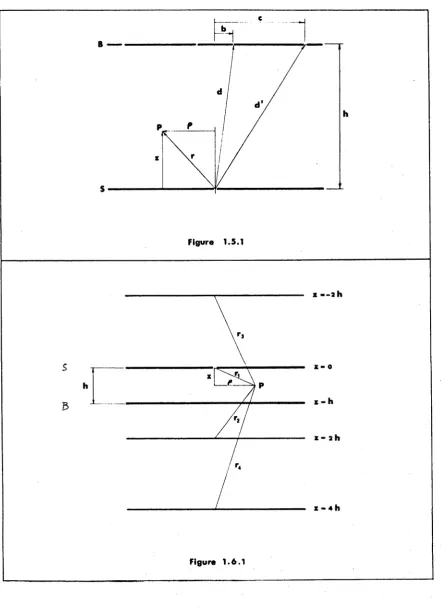
1.6 . 1 Ge o me t ri c p o s i t i o n o f i m a g e s . 11
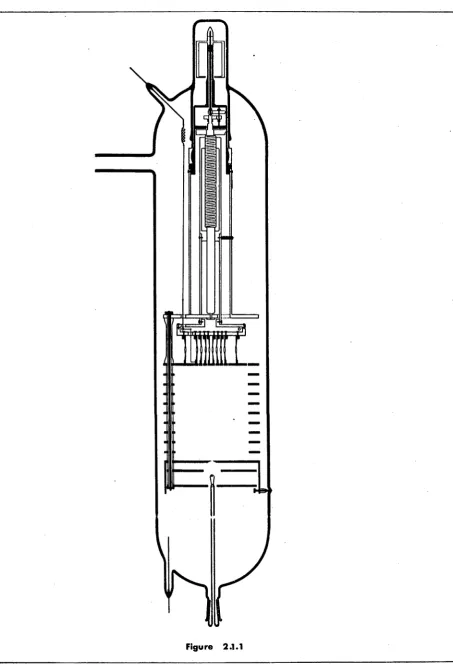
2 . 1 . 1 The d i f f u s i o n a p p a r a t u s . 17
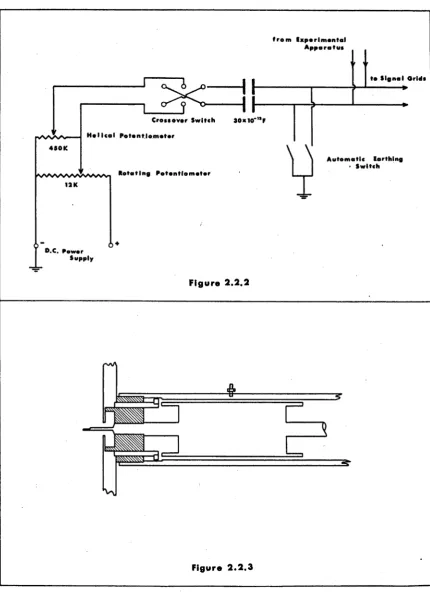
2 . 2 . 1 C i r c u i t diagram o f t h e d o u b l e e l e c t r o m e t e r u n i t . 20 2 . 2 . 2 C i r c u i t diagram o f i n d u c t i o n b a l a n c e . 21
2 . 2 . 3 Diagram o f t h e c o n d e n s e r u n i t . 21
2 . 3 . 1 E l e c t r i c a l s y s t e m a s s o c i a t e d w i t h t h e d i f f u s i o n
a p p a r a t u s . 25
2 . 4 . 1 S c h e m a t i c diagram of vacuum s y s t e m . 25
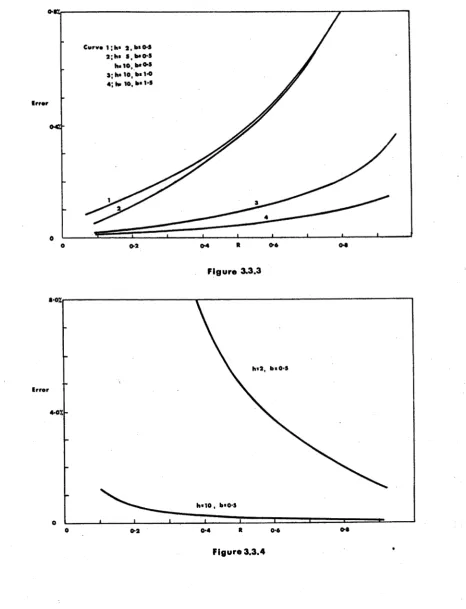
3 . 3 . 1 V a r i a t i o n o f R w i t h a l i g n m e n t e r r o r . 37 3 . 3 . 2 P e r c e n t a g e e r r o r i n X a g a i n s t R f o r an o f f a x i s
s o u r c e f o r v a r y i n g v a l u e s o f b and h. 37 3 . 3 . 3 P e r c e n t a g e e r r o r i n X a g a i n s t R f o r a f i n i t e
s i z e d s o u r c e f o r v a r y i n g v a l u e s o f b and h. 38 3 . 3 . 4 P e r c e n t a g e d i f f e r e n c e i n X b e t w e e n p o l e and d i p o l e
s o l u t i o n s a g a i n s t R f o r v a r y i n g v a l u e s of b and
h . 38
3 . 4 . 1 k.j a g a i n s t E/p i n h y d r o g e n . Comparison o f
r e s u l t s . 50
4 . 5 . 1 k-j a g a i n s t E/p i n w a t e r v a p o u r . 60 4 . 5 * 2 ccq/ p a g a i n s t E/ p i n w a t e r v a p o u r . 60
5 . 5 . 1 D i s t r i b u t i o n f u n c t i o n s . 80
Page • 7.3*1 Electrical system associated with magnetic
deflection apparatus. 103
7.4*1 Schematic diagram of vacuum system. 103
8.2.1 Nielsen and Bradbury Apparatus. 114
9*1*1 Drift velocity apparatus. 121
9.1*2 Construction of shutters 121
9.3*1 Electrical system associated with drift velocity
apparatus. 126
9*5*1 Resistor-capacitor network. 126
10.6.1 Values of 3/p in nitrogen. 139
11.7*1 Values of 3/f in helium. 155
1.1 Geometric construction. A 2
IX.1 Diagram of a guard ring system to produce uniform
electric field. A60
IX.2 Single module of guard ring system to produce a
uniform electric field. A60
INDEX TO TABLES
P a g e .
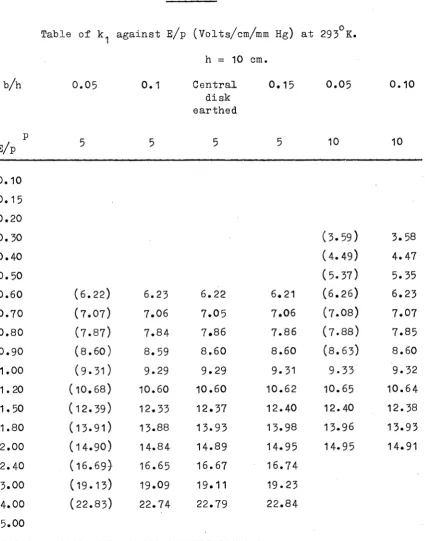
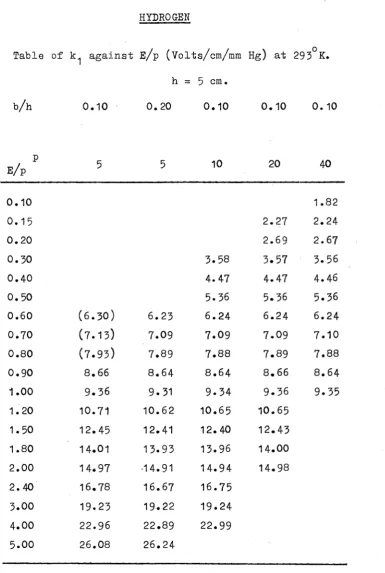
3*2*1 V a l u e s o f k-j i n h y d r o g e n . 32
3*3*1 V a l u e s o f k-| u s i n g a l t e r n a t i v e s o l u t i o n s . 48
3 * 3 . 2 C o m p a r i s o n o f r e s u l t s f o r h = 2 u s i n g a l t e r n a t i v e
s o l u t i o n . 49
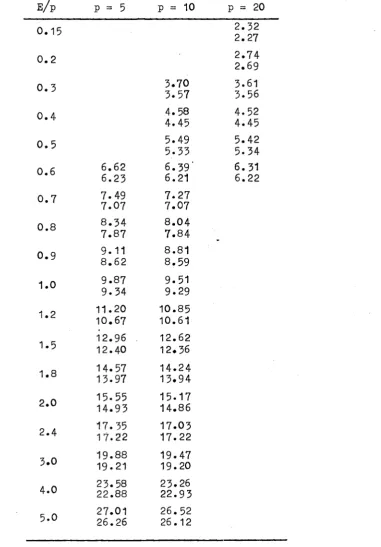
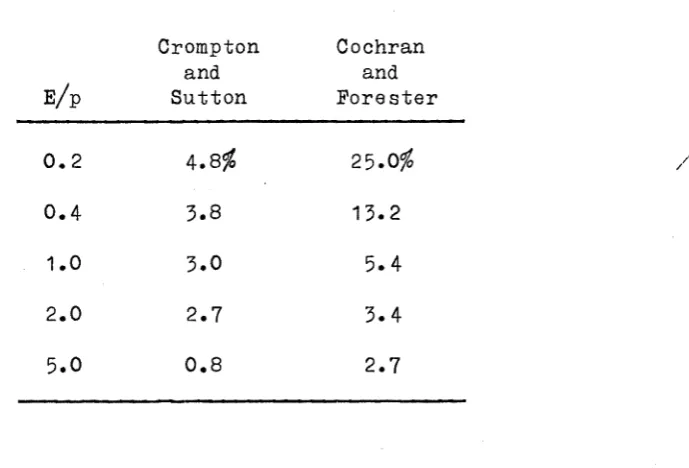
3*4*1 The d i s c r e p a n c y b e t v / e e n t h e p r e s e n t r e s u l t s a nd t h o s e o f Cr o mp t o n and S u t t o n and C o c h r a n and
F o r e s t e r . 51
4 . 5 * 1 R e s u l t s i n w a t e r v a p o u r , E / p ,> 2 0 . 61 4 . 6 . 1 R e s u l t s i n w a t e r v a p o u r , E / p <T 20. 65
6 . 3 . 1 N u m e r i c a l v a l u e s o f F . 89
7 * 6 , 1 P e r c e n t a g e c h a n g e i n Eh/k-j f o r 0 . 1 c h a n g e i n X. 109
1 0 . 3 . 1 k-j i n n i t r o g e n a t 293°K. 133
1 0. 5*1 M a g n e t i c d e f l e c t i o n c o e f f i c i e n t i n n i t r o g e n ,
293°K. 136
1 1. 3* 1 D r i f t v e l o c i t y W x 10 ; i n h e l i u m a t 293°K. 147
1 1 . 5 * 1 k^ i n h e l i u m a t 293^K. 152
1 1 . 5 * 2 d/ < i n h e l i u m a t 293°K. 153
1 1 . 7 * 1 M a g n e t i c d e f l e c t i o n c o e f f i c i e n t 3/ f i n h e l i u m a t
29 3°K. 155
1 1. 8 *1 H e l i u m , 293°K. 157
I X * 1 P e r c e n t a g e d e v i a t i o n f r o m u n i f o r m i t y o f t h e e l e c t r i c f i e l d o f a s y s t e m h a v i n g m t h i c k g u a r d
2 ^Momentum transfer cross section (cm")
Magnetic field strength (gauss)
Velocity of agitation of gas molecules Velocity of agitation of electrons Diffusion coefficient
Electric field strength Electronic charge
Dimensionless factor
Electron velocity distribution Length of diffusion chamber Boltzmann’s constant
krp Townsend's energy factor
*Equivalent mean free path at unit pressure *Equivalent mean free path
Mean free path Molecular mass Electron mass
Particle number density Avogadro’s number
Electron density Pressure (mm Hg)
NOTATION (Continued)
R Current ratio
T Absolute temperature or Mean free time
W Drift velocity (cm/sec)
X Defined on p.25.
a a = aa- cc-j_
aa Electron attachment coefficient
oci Ionization coefficient
\ W/2D
jtA. Mobility, Drift velocity per unit field strength
60 o) = B e/m.
*
The quantities to which these symbols refer throughout the text are equivalent mean free paths and cross sections as defined in
In 1899, Townsend published an important paper in which he showed that the product NQe of Avügadro's number and the charge on an ion was the same for gaseous ions as for monovalent ions in an electrolyte, that is to say, the charges e are the same for
both types of ion. Townsend first established the important
formula for the ratio w/d of the drift velocity W of a group of
ions through a gas to the coefficient of diffusion D of the group. Townsend made use of Maxwell’s equations of transport and implicitly made the assumptions that the mean velocity of agitation of the ions is the same as that of the gas molecules and that the distribution of the velocities is unaffected by the application of the field E.
With these assumptions Townsend showed that
W N0 E e
D R T
ii.
the coefficient of diffusion D of the ions in air at atmospheric pressure was directly measured and, by using the drift velocities
W measured by Zeleny (1898), he was able to obtain the ratio W,/d
and hence the value of N0e.
Townsend turned from this subject to develop his well known theory of sparking in gases.
In 1908 Townsend described a method in which the ratio w/d
v/as measured as a single experimental quantity and this gave the product N0e with much greater accuracy than did his earlier work.
This method is important because it forms the basis of most
of the work described in the present thesis. The experimental
details of this aspect of Townsend's work are described in section 1.1.1.
The differential equation describing the distribution of ions in the steady state can be solved in conformity with the boundary conditions for n at the electrodes and from this equation the ratio R of the currents received by the receiving electrode is found as a
function of w/d and the dimensions of the diffusion chamber.
Since the latter were known, it was possible to deduce w/d from
measurements of R. Townsend found that for positive ions and for
negative ions in damp gases N0e was closely equal to its value for monovalent ions in electrolysis.
In 1913» Townsend and Tizard carried out further measurements in dry air with a stream of electrons generated by ultraviolet
t h a t a b n o r m a l l y s m a l l v a l u e s o f w/ d wer e o b t a i n e d . Townsend
a t t r i b u t e d t h i s e f f e c t t o t h e b r e a k d o w n o f t h e t h e o r y o f e q u i - p a r t i t i o n when a s t r e a m o f v e r y l i g h t , c h a r g e d p a r t i c l e s moves t h r o u g h a g a s u n d e r t h e i n f l u e n c e o f a n e l e c t r i c f i e l d . He was a b l e t o w r i t e
2 in c 2v = k j i M
w h e r e krp i s a f a c t o r whose v a l u e i s e q u a l t o o r g r e a t e r t h a n 1. From m e a s u r e m e n t s o f w/ d a s d e s c r i b e d a b o v e h e was a b l e t o o b t a i n
v a l u e s o f t h e f a c t o r k T ( T o w n s e n d ’ s e n e r g y f a c t o r ) . I t was f o u n d t h a t krj, = f ( E / p ) w h e r e p i s t h e p r e s s u r e o f t h e g a s , a r e s u l t w h i c h i s i n e f f e c t s u g g e s t e d by t h e p r i n c i p l e s o f s i m i l a r i t y .
S u b s i d i a r y e v i d e n c e f o r t h i s d e p a r t u r e f r o m t h e l a w o f e q u i - p a r t i t i o n was o b t a i n e d by c o n s i d e r a t i o n o f t h e d r i f t v e l o c i t y W f o r n e g a t i v e i o n s i n d r y g a s e s . U s i n g a k i n e t i c t h e o r y f o r m u l a f o r t h e d r i f t v e l o c i t y W due t o L a n g e v i n and a s s u m i n g t h a t t h e c o l l i s i o n c r o s s s e c t i o n s o f t h e g a s m o l e c u l e s were o f t h e o r d e r o f m a g n i t u d e g i v e n by t h e k i n e t i c t h e o r y o f g a s e s , and u s i n g h i s m e a s u r e d v a l u e s o f k ^ Townsend was a b l e t o show t h a t t h e r a t i o e/m f o r n e g a t i v e i o n s i n d r y g a s e s was o f t h e o r d e r o f m a g n i t u d e
c o r r e s p o n d i n g t o t h a t o f e l e c t r o n s ( T o w n se nd , " E l e c t r i c i t y i n G a s e s " 1916, p . 1 8 0 ) .
I n t h e p a p e r o f Townsend and T i z a r d ( 1 9 1 3 ) » t h e f i r s t s y s t e m a t i c m e a s u r e m e n t s o f W by t h e m e t h o d o f m a g n e t i c d e f l e c t i o n wer e m a d e.
The t h e o r y o f t h e m e t h o d was s i m p l y t h a t o f t h e H a l l e f f e c t and i s
iv.
These measurements of kip and W for streams of electrons in various gases were resumed immediately after the first World War by Townsend and various colleagues at Oxford and the results were collected in a pamphlet entitled "Motions of Electrons in Gases"
(1925). The results are expressed in the form of tables and
curves in which a number of quantities kp, the RMS velocity of agitation, W, the mean free path at unit pressure L, and the mean energy lost in a collision are all represented as functions of E/p.
These results were again published in Townsend’s book "Electrons in Gases" (1948).
In 1940 Huxley showed that by modifying the form of apparatus used in this work a major improvement could be made in both the flexibility of application and accuracy of the method.
Prior to this either a slit or an aperture of large dimensions had been used as a source of electrons and this provided the
apparatus with several inherent disadvantages. In the first place
it was necessary to postulate that n, the density of electrons, was
constant over the source aperture. In itself this was difficult
to realize and undoubtedly led to inaccuracies in results.
Secondly the formula for R in terms of w/d for the form of apparatus
developed by Townsend required a series solution. For this reason
the formula had limited accuracy and normally involved a large
amount of preliminary calculation. In addition to this, any
apparatus built and reducing the experimental checking of the
consistency of results. The modification proposed by Huxley was
superior in that it was largely free from objection on both these grounds.
The form of apparatus was one in which the source of electrons
took the form of a small hole in the source electrode. Because
this acted as a point source the error in postulating a uniform value of n across the source was therefore very much reduced and the ultimate precision of results could be much higher.
The second advantage of this method lay in the simplicity of
the solution for R in terms of w/d which was now an integral
solution and capable of exact determination. Evaluation of the
formula connecting R and w/d was therefore a relatively simple
matter and the task of recalculating for apparatus of differing
dimensions was no longer arduous. Apparatus could therefore be
built in which the dimensions were chosen to suit experimental conditions and to enable cross checks to be made, rather than to suit existing conditions.
A later development of the theory enabled the values of both
w/d and the electron attachment coefficient to be determined from
a single series of measurements which were very little different
from those in which no attachment processes occur. This method is
discussed very briefly in chapter 4.
vi.
of the same modification to the electron source thereby enabling measurements of this type also to be made with greater accuracy* In this theory the off axis slit in the receiving electrode was
replaced by one bisecting the electrode as described in chapter 6.
This has a dual advantage. In the first place it allowed
measurements to be taken over an infinite variety of electric and magnetic field strengths for a given pressure, rather than at limited combinations of these parameters as required by Townsend’s
method. In this way the method was given greater flexibility and
enabled a wider check of internal consistency to be made. In
addition the theory provided an exact formula relating the current ratio R at the receiving electrode to the ratio Wx/Wz of the drift velocities parallel and perpendicular to the electric field, rather
than the approximate solution for W used by Townsend. Huxley’s
theory for magnetic deflection is described in chapter 6.
The one main drawback to these methods was the doubt as to the form of solution for the point source, namely, whether a pole
solution or a dipole solution applied. This indecision has not yet
been resolved methematically but experimental evidence as set out in chapter 3 has shown that, while the dipole solution appears to be the more precise mathematically, it is indeed the pole solution
which gives consistent results. In any case it is possible in most
these conditions were purposefully chosen for the work described in Part II.
In a later paper (Huxley and Zaazou, 1949), Huxley drew attention to the fact that, when the distribution of electron agitational speeds is considered, the apparent value of k,p, namely k-j, as obtained directly from measurement requires correction to give the value of kj as defined by Townsend (see section 1.4). Furthermore it was pointed out that formulae previously used to derive such microscopic quantities as mean free path and mean fractional energy loss on collision from the measured values of W and D require the inclusion of dimensionless velocity averaging factors similar to that relating k^ and k-j.
In a still later paper ( 1957), a further refinement to the theory enabled formulae for diffusion and drift to be derived
which took into account the variation of mean free path with electron speed.
Up to the present time, considerable work has been carried out in the determination of W and D by Huxley's method (Crompton and
Sutton, 1952, Crompton and Elford, 1963) and also in the
determination of W by magnetic deflection (Hall, 1955) and of electron attachment coefficient (Bagot, 1960).
viii
made. The formula so derived is similar to formulae derived
previously (see for example, Chapman and Cowling, 1952); its
relevance to the present work is discussed in chapter 5*
In the past few years this same problem has been examined theoretically in somewhat greater detail to include the influence
of the relevant inelastic collision processes. Important work in
this regard has been carried out recently by Prost and Phelps
(1961, 1962) and by Heylen and Lewis (i960, 1962). The work of
Phelps et al need only be considered here since that of Heylen and Lewis does not extend to the range of electron energies covered in
the present work. By assuming first the various elastic and
inelastic cross sections based on previous experiment and theory Frost and Phelps were able to use a digital computer to solve the appropriate Boltzmann transport equation and obtain values of the mobility and diffusion coefficient over a range of experimental
parameters. These values were then compared with experimental
measurements and the input cross sections adjusted until a best fit was obtained.
At this point reference to Huxley's modified magnetic deflection
theory (Huxley and Zaazou, 1949) assumes importance. Prom the ratio
R of currents received at the divided electrode in magnetic
deflection experiments it is possible to obtain exactly the ratio
Wx/Wz . By first postulating the form of velocity distribution this
ratio has been used (Hall, 1955) to give a value for the drift
Huxley. However, if the drift velocity is known from independent measurements, the magnetic deflection method will give a precise
value of the numerical factor in the formula linking these quantities. This numerical factor, the magnetic deflection coefficient, is
dependent only on the form of velocity distribution function and on the form of variation of cross section with velocity.
It immediately becomes apparent that the method of magnetic deflection provides a valuable tool in the study of these functions, providing as it does the means of measuring a further macroscopic
quantity independent of those already known. It is the investigation
of this quantity which constitutes the main topic of this thesis. The material in this thesis has for convenience been divided into two parts.
In Part I a systematic investigation of Huxley's method for
determination of values of w/d has been undertaken. In this
determination as many of the parameters as possible have been varied to demonstrate the consistency of the method and the theory upon
which it is based. In addition to the variation of field strength
and pressure, the physical dimensions of the apparatus have been
varied within wide limits. It is in conjunction with this work
that the superiority of the pole solution in the formula linking
the current ratio R with the ratio w/d is shown. The demonstration
that this is indeed a consistent method for determination of w/d is
a necessary forerunner for the work described in Part II.
X.
include work in gases where attachment processes occur is demonstrated in chapter 4*
The second part of the thesis is concerned with an investigation of the distribution function through the method of magnetic deflection. To demonstrate the consistency of the method, the magnetic deflection coefficient is first determined in nitrogen, a gas in which the drift
velocity W and the ratio w/d are already accurately known. These
results are then compared with the theoretical results of Phelps and
others showing excellent agreement. Following the demonstration of
the experimental consistency of the method, the magnetic deflection coefficient is determined in helium where it is not only necessary to
measure
Wx/ w z
but also W (by the method of Bradbury and Nielsen) andk^. As helium is a monatomic gas it is then possible to compare
experimental results with theoretical values of the magnetic
deflection coefficient derived using Huxleyfs simplified treatment. A comparison with the theoretical work of Frost and Phelps is also
made. Since, as will be shown in chapter 11, the dependence of free
AN INVESTIGATION OF THE
LATERAL DIFFUSION METHOD OF DETERMINING
v/p.
CHAPTER 1
INTRODUCTION AND THEORY
1.1 Historical introduction.
Part I of this thesis aims to demonstrate the experimental
consistency of the determination of w/d using the method of
Townsend, further modified by Huxley.
Although much work has been carried out up to the present time using this method, little attempt has been made to assess the overall accuracy of this method and the consistency of the results thereby obtained*
The first direct measurement of w/d made by Townsend (1908)
used the apparatus shown diagrammatically in figure 1.1.1* Ions produced by secondary X-rays from a brass surface S moved
through the grid G and the 1 cm aperture A to the receiving electrode C D C under the influence of an electric field E, maintained uniform by means of a set of guard electrodes R 0 ,
R^, .... Rrj, S. The receiving electrode consisted of an
insulated central disk D and a surrounding annulus C. If i^
Figure 1.1.1
[image:27.536.58.522.66.701.2]C, then Townsend was able to express the ratio w/d as a function of the ratio
R i 1
il + i2
Using the formula
W
N0
EeD =
R T
Townsend was able to demonstrate from a single series of measurements that the value of NQe has the same value for gaseous ions as for monovalent ions in an electrolyte.
It is of interest to note that this original formula of
Townsend (1399) can be derived as follows. As in Townsend’s
derivation it is necessary to assume that the mean velocity of agitation is the same as that of the gas molecules and that the law of distribution of velocities is not affected by E.
If n is the number of ions per unit volume of the gas then
n W = constant n Ee.
The corresponding flux of ions due to diffusion may be represented in terms of an equivalent drift velocity
w = - D/n grad n
where D is the coefficient of diffusion of the ions. It may
be supposed that the equivalent drift w is caused by a force density - grad P, where P is the partial pressure of the ions.
3
n w = - D g r a d n
= - c o n s t a n t g r a d P
wher e t h e c o n s t a n t i s t h e same a s i n t h e f o r m u l a f o r W. On r e m o v i n g t h e g r a d i e n t s b y i n t e g r a t i o n
D n = c o n s t a n t P,
t h e c o n s t a n t o f i n t e g r a t i o n v a n i s h i n g s i n c e P i s p r o p o r t i o n a l
t o n and P = 0 when n = 0 . By d i v i s i o n t h e r e f o r e
W n Ee Ee NQ Ee
D ~ ~~P = kT R T '
wh er e R i s t h e g a s c o n s t a n t .
Townsend and T i z a r d ( 1 9 1 3 ) e x t e n d e d t h i s i n v e s t i g a t i o n u s i n g an a p p a r a t u s shown d i a g r a m m a t i c a l l y i n f i g u r e 1 . 1 . 2 . E l e c t r o n s wer e g e n e r a t e d by t h e a c t i o n o f u l t r a v i o l e t l i g h t on p l a t e A a n d , u n d e r t h e a c t i o n o f t h e e l e c t r i c f i e l d , t r a v e r s e d t h e s p a c e A B, some p a s s i n g t h r o u g h t h e s l i t S, 2 mm w ide and 15 mm l o n g , i n t o a r e g i o n o f u n i f o r m e l e c t r i c f i e l d E, to be c o l l e c t e d a t t h e r e c e i v i n g e l e c t r o d e C. C was d i v i d e d by two s l i t s p a r a l l e l t o S t h e r e b y p r o d u c i n g a c e n t r a l s t r i p C2 , 5 mm w i d e , and two o u t e r s e g m e n t s C-^ and C2 . I f i-}, i 2 and i 3 a r e t h e c u r r e n t s f a l l i n g on C-|, C2 and r e s p e c t i v e l y t h e n t h e
r a t i o w/ d can s i m i l a r l y b e e x p r e s s e d i n t e r m s o f t h e r a t i o
1 2 R “ i'j + i 2 + i ^
by many workers, a summary of which can be found in Healey and Reed (1941) and Townsend (1948).
The modified theory of Huxley, which provides the basis of the work done at the present time, was not used until 1949 by
Huxley and Zaazou. In their apparatus, electrons entered the
diffusion chamber, which had a height h of 1 cm, through a 1 mm
hole in the source electrode. More accurate measurements of
w/d were subsequently made by Crompton and Sutton (1952), using
a similar apparatus, in hydrogen and nitrogen.
More recently similar work has been carried out in this field by Cochran and Forester (1962) and by Warren and Parker
(1963).
1.2 Definition of terms. 1.2.1 Drift Velocity W .
In the absence of an electric field, electrons in an electron cloud will be moving with random agitational
motion with a mean agitational speed c. The velocity of
the centre of mass of the cloud will however be zero. When an electric field E is applied, the centre of mass of the cloud will move with a drift velocity W, where W is parallel to the direction of E.
1.2.2 Diffusion Coefficient D .
5
.
cause a change in any non-uniform distribution. A coefficient of diffusion D may be defined such that, if n is the concentration of electrons per unit volume, the net transport of electrons across a surface of unit area normal to grad n per second is
- D grad n*
1*2.3 Townsendfs Energy Factor.
In the absence of any electric field, electrons in a gas move in straight lines between collisions with a velocity _c and since the electrons are in thermal equilibrium with the gas then the mean energy of the electrons
„ i ~~2 Q = 2m c
is equal to the mean energy of the gas molecules
p
Q =
i
M C oWhen an electric field E is applied the electrons are subjected to an additional force along the direction of the field, their paths tend to be curved and energy is, on the average acquired from the field. In collisions with gas molecules an electron will on the average lose more energy than it gains from the molecule and an
energy Qq of the gas molecules.
Townsend's energy factor k^ may then be defined as
1.3 Derivation of the differential equation describing diffusion of electrons.
By definition 1.2*2 the net transport of electrons per unit time across a surface of area dS due to diffusion is given by
If the electron cloud possesses a drift velocity W then the transport per unit time across dS due to drift is
The total transfer across dS due to drift and diffusion is then
(n W -D grad n) . dS
Taking any arbitrary volume d > which includes the
electron cloud but contains no sources or sinks of electrons,
then the total number of electrons is
Jff
n d T»The net outflow of electrons across the surface of this volume is given by
D grad n . dS
n W . dS
n d 7 =
7
Thus
37 = -
V .
(n W - D
V n).
at — _ _
For a steady state condition, the concentration of electrons at any point is constant, that is,
&
=. 0at
hence
2
D t7 n - W . grad n = 0
For a uniform electric field E, parallel to the axis Oz, W is constant, that is
W
=W
z
=:
W
2 n
and D V n -
w - —
ss 0z
or V 2 n =z
W ^ n
D z (1.3.1)
== n
2H"T
(1-3.2)whe re 2 \ ss v/d.
It is seen from equation (1.3*1) that the distribution
of electrons moving with steady state motion under the action of a uniform field is governed by the ratio of the drift velocity to the diffusion coefficient,
1.4 Relation between w/p and Townsend^ Energy Factor.
If I is the mean free path of electrons between collisions
and
* 6 ( ~2 d / A 2\ \
“ (o
Tz{Lc) ]
1
(77)
(1 •4 . 1)
(1.4.2)
where e and ra are the electronic charge and mass and the
average is taken over all electrons in the swarm. An outline
of the derivation of these formulae is given in Appendix I. From equations (1.4.1) and (1.4•2)
E e -2 d__
3m dc (/ c2) / ■!(/<,)
E e -2 d / / 2\ 2
— ^ c ÄS U 0 ) . c t me
E e a me2
. F
where F is a dimensionless factor depending only on the distribution of i and c through the electron swarm.
The mean agitational energy of the electrons can be expressed as
1 2
- m e k “ M U1 2
T 2
L ; k T T 2
9
Hence __E__e___
k_ — k T T 2
. F
e 2/3 F
k T kT
e E
k T k
where k^ is an alternative form of TownsendTs Energy Factor and is related to k^ through the simple expression
k_ = — F k„ .
T 3 1
Thus
5
= 2X
e E
k T k (1.4.3)
Using values given by Du Mond and Cohen (1953> 1958), equation (1.4.3) can be evaluated to give the value of \ as
__ e_ E_
2k T * k
= 19.794
f-*1
for T = 20°C
= 29 3«16°K.
Thus the solution of equation (1.3*2) will enable k^ to be determined directly in terms of experimental parameters.
It is convenient also to introduce at this point the
quantity D/yU. where j k is the drift velocity per unit field
D
?
D EWE_ 2\
e/k T
k 1___ 39.588
for T = 20 ° C .
Alternatively
D
A
E
W75
E m c
Ee F
ür m e P
from which it can be seen that D/yu is proportional to the mean energy of the electrons and, unlike k^, is independent of the energy of the gas molecules and hence the gas
temperature. D/^ia therefore affords a useful comparison
between results at different temperatures for a given value
of the parameter e/n where N is the molecular number density.
(1952)-The diffusion chamber consists of a pair of parallel metal electrodes separated by a distance h (figure 1 • 5•1)•
The receiving electrode B is divided into insulated portions and consists of a central disk and surrounding annuli.
Electrons are generated by a heated platinum filament and before entering the main chamber pass through a
’’preliminary run” region where the electric field is identical to that in the main chamber. In this way the electrons
acquire an equilibrium energy appropriate to the field before entering the diffusion chamber through a small hole at the centre of the source electrode S.
The concentration of electrons at the receiving electrode is analysed by measuring the ratio R of current falling on the central disk, 0 < ’f b, to the total current falling on the receiving electrode 0 <T ^ c.
Experiments are designed to ensure that the electron concentration at the outer edges of the diffusion chamber is negligible and that the number of electrons which spill over
from the outer receiving annulus on to the region of the
guard electrodes, P )> c, is less than 0.1 % of the total current. In this way the concentration of electrons is zero at the
’’walls” of the chamber and no modification of the theory need be made to include the effects of the containing walls of the
s
3
/
z - - a h
Z - 0
z - h
z - a h
z - 4 h
[image:38.536.67.509.76.685.2]1 2
.
1 . 6 S o l u t i o n o f t h e d i f f e r e n t i a l e q u a t i o n . The d i f f e r e n t i a l e q u a t i o n
V 2 n
b
( 1 . 3 . 2 )c a n be s o l v e d a s i n A p p e n d i x I I wher e t h e s o l u t i o n f o r n u n d e r t h e c o n d i t i o n s o f c y l i n d r i c a l s y mme t ry i s shown t o be
\ z
«5T
A
U r) 2 V W ( X r ) Ps ( o o s e )
(
1.
6.
1)
wh er e K i _ ( ^ r ) i s t h e m o d i f i e d B e s s e l f u n c t i o n o f h a l f
s + 2
i n t e g r a l o r d e r ,
P o ( c o s 0) i s t h e a s s o c i a t e d L e g e n d r e f u n c t i o n , A i s a c o n s t a n t
s
and r i s t h e r a d i a l d i s t a n c e f r om t h e o r i g i n .
F o r t h e c a s e o f a p o i n t s o u r c e o f e l e c t r o n s a t t h e o r i g i n , t h e two p o s s i b l e m a t h e m a t i c a l s o l u t i o n s , d e p e n d i n g on t h e v a l u e o f s c h o s e n , a r e a s f o l l o w s :
1 . 6 . 1 P o l e s o l u t i o n .
I f t h e v a l u e o f s i s c h o s e n a s s = 0 , t h e n t h e s o l u t i o n c o r r e s p o n d s t o t h a t o f a p o l e s o u r c e o f e l e c t r o n s a t t h e o r i g i n and n i s g i v e n a s
- \ ( r - z)
n = A
(
1.
6.
2)
m us t be p l a c e d a t z = - 2 h t o make n = 0 a t z = h .
S i m i l a r l y a f u r t h e r i mage i s t h e n r e q u i r e d a t z = 4h t o c o m p e n s a t e f o r t h e e f f e c t o f t h e f i r s t image a t t h e p l a n e z = 0 , ( s e e f i g u r e 1 • 6 . 1 ) l e a d i n g t o an i n f i n i t e
s e r i e s o f s u c h i mage p a i r s .
I n t e g r a t i n g t h e s o l u t i o n ( 1 . 6 . 2 ) o v e r t h e l o w e r e l e c t r o d e a n d a s s u m i n g t h a t t h e r e i s n e g l i g i b l e c u r r e n t f a l l i n g o u t s i d e r a d i u s ^ = c , t h e r a t i o R o f t h e c u r r e n t t o t h e c e n t r a l d i s k o f r a d i u s b t o t h a t t o t h e w hol e
e l e c t r o d e i s g i v e n by
R h e - X ( d - h )
d
2 2 2
wh er e d = b + h .
. 6 . 2 D i p o l e s o l u t i o n .
I f t h e v a l u e o f s i s c h o s e n a s s = 1, t h e n s o l u t i o n c o r r e s p o n d s t o t h a t o f a d i p o l e s o u r c e e l e c t r o n s a t t h e o r i g i n .
E q u a t i o n ( 1 . 6 • 1 ) now l e a d s t o t h e r e s u l t
( 1 . 6 . 3 )
t h e o f
n = B e
- h r e
r
\ r + 1
\ r z
r ( 1 . 6 . 4 )
w h er e B i s c o n s t a n t .
14
R = 1
\
/
h 1d “ \ h I e - ^ d - h) ( 1 . 6 . 5 )
The c o m p l e t e d e r i v a t i o n o f t h e s e f o r m u l a e i s g i v e n i n A p p e n d i x I I ,
A l t h o u g h e q u a t i o n ( 1 . 6 . 5 ) s a t i s f i e s t h e b o u n d a r y c o n d i t i o n s , g i v i n g a s i t d o e s t h e c o n d i t i o n n = 0 o v e r t h e u p p e r e l e c t r o d e e x c e p t a t r = 0 , i t c a n be shown
e m p i r i c a l l y t h a t e q u a t i o n ( 1 . 6 , 3 ) i s t h e s o l u t i o n w h i c h i s c o n s i s t e n t w i t h e x p e r i m e n t a l r e s u l t s . E q u a t i o n
( 1 . 6 . 3 ) i s u s e d t h r o u g h o u t t h i s wor k.
A d i s c u s s i o n o f t h e two s o l u t i o n s a p p e a r s i n s e c t i o n 3 . 3 . 7 .
1 . 7 M o d i f i c a t i o n o f t h e m e th od when a t t a c h m e n t s a r e p r e s e n t . A l l p r e v i o u s d i s c u s s i o n i n t h i s s e c t i o n h a s d e p e n d e d on t h e f a c t t h a t no n e g a t i v e i o n s a r e f o r m e d by a t t a c h m e n t i n c o l l i s i o n s b e t w e e n e l e c t r o n s a nd m o l e c u l e s a nd t h a t t h e r e i s no i o n i z a t i o n . The m e t h o d , w i t h some m o d i f i c a t i o n , i s a l s o a p p r o p r i a t e t o t h e c a s e w h er e t h e s e p r o c e s s e s do o c c u r .
E q u a t i o n ( 1 . 6 . 3 ) m u s t be m o d i f i e d t o i n c l u d e b o t h a t t a c h m e n t and i o n i z a t i o n c o e f f i c i e n t s w h i c h a r e d e f i n e d b y :
The a t t a c h m e n t c o e f f i c i e n t a , i s t h e numbe r o f i o n s a
f o r me d by a t t a c h m e n t , on t h e a v e r a g e , p e r e l e c t r o n p e r c e n t i m e t r e o f p a t h i n a d i r e c t i o n p a r a l l e l t o t h e
The ionization coefficient a. , is the number of electrons
produced by ionization, on the average, per electron per
centimetre of path in a direction parallel to the
direction of drift.
The formula linking R the current ratio, with k ^ , a& , ou,
and experimental parameters was derived by Huxley (1959) and
modified by Huxley and Hurst (i960). The method as applied
to oxygen was discussed extensively by Bagot (i960) together
with experimental details.
The formula is as follows:
h/dfe exp (\h + \h
j
-l) P b (s) dsh /d& exp (\h +
\h
aa/f f
“ 1)
p a (s) dswhere
= exp
ah( 1
s)
1
(-^h((b/k)2 + s 2 )f ) - exp (-/ah((tyk)2 + (2-s)2)b')J (1.7.1)
R is now the ratio of the current fall ing on the first
annular ring a < b to the total current falling on the
receiving electrode a < ^ < ^0, the central disk, 0 <y<"a,
being earthed. It is assumed that the current which spills
over on to the guard ring
A c
is negligible. In this1 6
.
a 2
a = 3 a 2 *
C
M
2
=Z b 2 +
C
M
A
k i T o w n s e n d f s e n e r g y c o e f f i c i e n t f o r e l e c t r o n s
X h r r e 2kT
Eh
k 1
a a
-a a .l
A
z z +
O
J
.c 2 \ a
Thus t h e r e s u l t a n t R i s a f u n c t i o n R ( k„ , a , a . ) . x 1 a 7 l
I t i s t o be n o t e d t h a t e q u a t i o n ( 1 • 7 • 1 ) a l s o t a k e s i n t o a c c o u n t t h e d i f f u s i o n o f t h e n e g a t i v e i o n s .
I d e a l l y t h e e x p e r i m e n t a l me t ho d c a n b e e x t e n d e d t o t h e m e a s u r e m e n t o f a l l t h r e e q u a n t i t i e s , k ^ , and
s i m u l t a n e o u s l y . T h i s c a n be done by m e a s u r i n g R f o r s i m i l a r e x p e r i m e n t a l c o n d i t i o n s b u t a t t h r e e d i f f e r e n t v a l u e s o f h t h e c h a m b e r l e n g t h . The t h r e e r e s u l t i n g s i m u l t a n e o u s e q u a t i o n s c a n t h e n b e s o l v e d by a c y c l i c p r o c e s s . The v a r i a b l e s a a and a . a r e f i r s t h e l d c o n s t a n t and a f i r s t i a p p r o x i m a t i o n t o k^ f o u n d ; t h e r e a f t e r e a c h v a r i a b l e i s t a k e n i n t u r n and t h e p r o c e s s r e p e a t e d u n t i l a s e t o f v a l u e s
CHAPTER 2
APPARATUS AND MEASUREMENT
D e s c r i p t i o n o f t h e a p p a r a t u s .
The d i f f u s i o n a p p a r a t u s u s e d i n t h e p r e s e n t wor k was
d e s i g n e d and b u i l t by D r. R.W. Cr ompt on and i s d e s c r i b e d a t l e n g t h i n C ro mp t on a n d J o r y ( 1 9 6 2 ) .
The a p p a r a t u s c o n s i s t s e s s e n t i a l l y o f a s o u r c e e l e c t r o d e h a v i n g a 1 mm h o l e a t i t s g e o m e t r i c c e n t r e , i . e . on t h e a x i s o f t h e a p p a r a t u s and a r e c e i v i n g e l e c t r o d e c o n s i s t i n g o f a
c e n t r a l d i s k o f r a d i u s 0 . 5 cm t o g e t h e r w i t h a s e r i e s of
s u r r o u n d i n g i n s u l a t e d a n n u l i o f e x t e r n a l r a d i u s 1 . 0 , 1 . 5 , 2 . 0 a nd 4 . 2 5 cm ( d i m e n s i o n s b e i n g m e a s u r e d t o t h e c e n t r e s o f t h e 0 . 0 2 5 cm g a p s s e p a r a t i n g t h e m ) . The r e c e i v i n g e l e c t r o d e i s m o u n t e d on a s t a i n l e s s s t e e l s c r e w o f 1 mm p i t c h a n d by means
o f a n e x t e r n a l m a g n e t i c d r i v e t h e l e n g t h o f t h e c h a m b e r . h , c a n be s e t a t any r e q u i r e d v a l u e . The f a c e s o f t h e t e n g u a r d e l e c t r o d e s a r e s i t u a t e d a t 1 cm i n t e r v a l s fr om t h e f a c e o f t h e
s o u r c e e l e c t r o d e so t h a t i n t e g r a l v a l u e s f o r t h e l e n g t h o f t h e
e l e c t r o d e c o p l a n a r w i t h t h e f a c e o f any g u a r d e l e c t r o d e .
The t h i c k n e s s e s o f t h e g u a r d r i n g s a n d o f t h e s p a c e r s s e p a r a t i n g them were m e a s u r e d a t t h r e e p o s i t i o n s , e q u a l l y s p a c e d a b o u t t h e c i r c u m f e r e n c e , u s i n g a r e a d i n g m i c r o s c o p e and wer e t h e n a v e r a g e d . The maximum v a r i a t i o n f r o m t h e s e
a v e r a g e s was 0 . 1 5 $ .
G r e a t c a r e was t a k e n i n t h e c o n s t r u c t i o n o f t h e a p p a r a t u s t o e n s u r e c o r r e c t a l i g n m e n t o f t h e s o u r c e h o l e ,
t h e r e c e i v i n g e l e c t r o d e and t h e g u a r d r i n g s y s t e m a n d i t i s c o n s i d e r e d t h a t t h e c e n t r e o f t h e e l e c t r o d e r e m a i n s a t l e a s t t o w i t h i n 0 . 0 2 0 cm o f t h e a x i s a t a l l v a l u e s o f h .
E a c h s e g m e n t o f t h e r e c e i v i n g e l e c t r o d e i s m o u n t e d on a c o p p e r - t o - g l a s s " H o u s e k e e p e r ” s e a l so t h a t t h e r e s i s t a n c e b e t w e e n a ny two a d j a c e n t e l e c t r o d e s e g m e n t s i s g r e a t e r t h a n
14
10 ohm. D u r i n g c o n s t r u c t i o n t h e f a c e o f t h e a s s e m b l e d
e l e c t r o d e was l a p p e d a nd p o l i s h e d t o a h i g h s u r f a c e f i n i s h . The e n t i r e c h a m b e r was t h e n g o l d p l a t e d t o m i n i m i z e c o n t a c t p o t e n t i a l d i f f e r e n c e s o c c u r r i n g o v e r t h e s u r f a c e s o f t h e m e t a l e l e c t r o d e s .
E ac h s e g m e n t o f t h e r e c e i v i n g e l e c t r o d e i s c o n n e c t e d d i r e c t l y t o a t u n g s t e n - t o - g l a s s s e a l i n t h e P y r e x e n v e l o p e . As i n a l l l a t e r e q u i p m e n t , t h e s e s e a l s w er e c o a t e d e x t e r n a l l y
19
o f w a t e r v a p o u r a t t h e s u r f a c e o f t h e g l a s s and so m a i n t a i n s a v e r y h i g h r e s i s t a n c e a c r o s s t h e g l a s s s u r f a c e , t h e r e b y r e d u c i n g l e a k a g e c u r r e n t s .
2 . 2 M e a s u r i n g e q u i p m e n t .
To e n a b l e t h e r a t i o W/D, and h e n c e k ^ , t o b e m e a s u r e d i t was n e c e s s a r y t o know n o t t h e t o t a l c u r r e n t w i t h i n t h e c ha m b e r
- 1 2
w h i c h was o f t h e o r d e r o f 10 amp, b u t t h e d i s t r i b u t i o n o f c u r r e n t f a l l i n g on t h e r e c e i v i n g e l e c t r o d e . A c c o r d i n g l y , m e a s u r e m e n t s wer e made o f t h e c u r r e n t r a t i o R a s d e f i n e d i n
s e c t i o n 1. 5*
As i t was e s s e n t i a l n o t to d i s t o r t t h e e l e c t r o n s t r e a m f a l l i n g on t h e r e c e i v i n g e l e c t r o d e a n u l l m e t h o d o f
m e a s u r e m e n t was u s e d w h e r e b y t h e r e c e i v i n g e l e c t r o d e , t o g e t h e r w i t h i t s a s s o c i a t e d g u a r d r i n g , was m a i n t a i n e d a t e a r t h -
p o t e n t i a l t h r o u g h o u t t h e m e a s u r e m e n t s .
Use was made i n t h i s work o f t h e d o u b l e e l e c t r o m e t e r - i n d u c t i o n b a l a n c e d e v i s e d f o r t h e p r e s e n t work by D r . R.W. C r om pt o n a n d b a s e d on a n e a r l i e r f o r m u s e d by Cr o mp t on and
S u t t o n ( 1 9 5 2 ) .
The s e g m e n t s o f t h e r e c e i v i n g e l e c t r o d e wer e c o n n e c t e d e l e c t r i c a l l y i n t h e r e q u i r e d c o m b i n a t i o n b y f i n e w i r e s w i t h i n
end-pieces. The use of this form of construction provided both adequate shielding and high insulation while the dimensions were chosen to minimize the capacity to earth.
As an additional precaution against interference not only was the apparatus shielded by wire mesh in close proximity to the glass envelope but the laboratory was surrounded by a complete copper shield to exclude all forms of external
electrical interference. The alternating current supply was
also filtered against the more common radio frequencies to prevent interference from this source.
2.2.1 Electrometer unit.
The circuit of the double electrometer unit is shown
in figure 2.2.1. Each valve was a Ferranti, type BDM20,
double tetrode electrometer valve, carefully selected to have the characteristics of each half matched as well as
possible. In each case the signal grid was that drawing
the lower grid current, the control grid being earthed. Average characteristic curves gave the grid current to be
-1 5
of the order of 10 amp but the operating point was
■L+
ig
u
re
2
.2
C o n t r o l s B a i I and B a i I I wer e a d j u s t e d t o g i v e z e r o d e f l e c t i o n o f t h e g a l v a n o m e t e r when b o t h g r i d s were
c o n n e c t e d t o e a r t h , t h a t i s t o e n s u r e e q u a l p o t e n t i a l s
on e a c h a n o d e .
The p l a t e and s c r e e n v o l t a g e s c o u l d be s w i t c h e d i n d e p e n d e n t l y o f t h e f i l a m e n t e n a b l i n g t h e c a t h o d e to
be h e a t e d f o r some t i m e b e f o r e t h e s e v o l t a g e s were a p p l i e d ,
t h u s r e d u c i n g m a r k e d l y t h e t i m e r e q u i r e d t o a c h i e v e
s t a b i l i t y .
O ut o f b a l a n c e c u r r e n t was m e a s u r e d e i t h e r by a p a i r o f s t a n d a r d 1 0 - 0 - 1 0 m i c r o a m m e t e r s o r b y much more
s e n s i t i v e Pye " S c a l a m p ” g a l v a n o m e t e r s . S e n s i t i v i t y s w i t c h e s SS i n s e r i e s w i t h e a c h g a l v a n o m e t e r e n a b l e d t h e s e n s i t i v i t y t o be v a r i e d i n 12 e q u a l s t e p s .
F i l a m e n t h e a t e r c u r r e n t was a p p l i e d f r o m a G o s s e n ’’C o n s t a n t e r ” c o n s t a n t c u r r e n t p o w e r s u p p l y . A r h e o s t a t was p r o v i d e d t o p r e v e n t t h e f i l a m e n t f r o m d r a w i n g l a r g e i n i t i a l c u r r e n t s , t h e r h e o s t a t b e i n g r emove d d u r i n g
o p e r a t i o n . A l l o t h e r v o l t a g e s we re a p p l i e d f r om i n t e r n a l
d r y c e l l s .
2 . 2 . 2 I n d u c t i o n b a l a n c e .
The i n d u c t i o n b a l a n c e c o n s i s t e d o f a l ow r e s i s t a n c e
D.C. po wer s u p p l y ( d e t a i l s o f w hi ch c a n be f o u n d i n B a g o t , I 9 6 0 ) , a r o t a t i n g p o t e n t i o m e t e r d r i v e n by a
f r o m e x p e r i m e n t a l
V V W V W W W W i R o t a t i n g P o t e n t i o m e t e r 1 1 K
4 5 0 K
< ^ 6 ^ .
H e l i c a l P o t e n t i o m e t e r
1
1_________________
f \
t e S i g n a l O r l d c
1__________
»*’’ F
A u t o m a t i c E a r t h i n g S w i t c h
D.C . P o w e r S u p p l y
6 +
F i g u r e 2 . 2 . 2
[image:51.536.67.498.77.674.2]