L I F E +
Environment Policy & Governance
Introduction to LIFE+ Environment Policy & Governance 2010
LIFE+ Environment Policy & Governance in
2010
The Environment Policy & Governance strand of LIFE+ supports pilot projects that contribute to the develop- ment of innovative policy ideas, technologies, meth-ods and instruments. Of the 399 proposals received, the Commission selected 104 projects for funding from a wide range of public and private sector organi-sations. The winning projects, situated in 19 Member States, represent a total investment of €286 million, of which the EU will provide €109 million.
Projects targeting waste and natural resources account for the lion’s share of this funding (some €143 million for 51 projects). The Commission will contribute more than €16 million to 14 projects directly tackling cli-mate change, with a total budget of €40 million. In addition, 12 projects focusing on other issues will also have an indirect impact on greenhouse gas emissions. Water is another important area of focus, with nine projects selected. The remaining projects cover vari-ous topics including air, chemicals, environment and health, forests, innovation, noise, soil protection, stra-tegic approaches, and the urban environment.
Background
LIFE is the EU’s financial instrument supporting envi-ronmental and nature conservation projects through-out the EU and in certain non-EU countries. Since
1992, LIFE has co-financed some 3 500 projects, con-tributing approximately €2.7 billion to the protection of the environment. LIFE+ is the new European finan-cial instrument for the environment with a total budg-et of €2 143 billion for the period 2007-2013. During this period, the Commission will launch one call for LIFE+ project proposals per year.
LIFE+ Environment Policy & Governance is one of three thematic components under the LIFE programme. The other two components, LIFE+ Nature & Biodiversity and LIFE+ Information & Communication, focus re-spectively on improving the conservation status of en-dangered species and habitats; and on disseminating information and raising the profile of environmental issues or providing training and awareness-raising for the prevention of forest fires.
More information on each LIFE+ project is available at:
http://ec.europa.eu/environment/life/project/ Projects/index.cfm
It is also possible to contact the relevant national authorities:
http://ec.europa.eu/environment/life/contact/ nationalcontact/index.htm
LIFE+ Environment Policy & Governance 2010:
Commission funds 104 innovation projects
in 19 countries with
€
109 million
Index of Environment Policy & Governance projects selected in 2010
Location Project number Title of project
AUSTRIA
LIFE10 ENV/AT/000112POLYWOOD Polygeneration of Fuels, Heat and Electricity from Wood
BELGIUM
LIFE10 ENV/BE/000696AGICAL+ Validation of an environmentally friendly system, combining CO2 capture and biofuel production based on algae culture for industrial exhaust application
LIFE10 ENV/BE/000699
DEMETER Sustainable and integrated soil management to reduce environmental effects
CYPRUS
LIFE10 ENV/CY/000721DAIRIUS Sustainable management via energy exploitation of end-of-life dairy products in Cyprus LIFE10 ENV/CY/000723
CYPADAPT Development of a national strategy for adaptation to climate change adverse impacts in Cyprus
CZECH REPUBLIC
LIFE10 ENV/CZ/000649ReStEP Regional Sustainable Energy Policy based on the Interactive Map of Sources LIFE10 ENV/CZ/000651
MEDETOX Innovative Methods of Monitoring of Diesel Engine Exhaust Toxicity in Real Urban Traffic
DENMARK
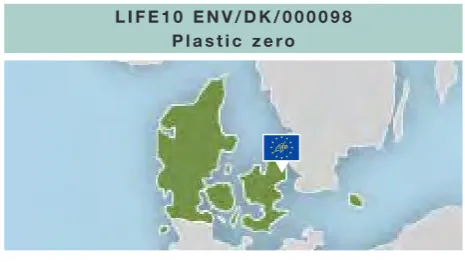
LIFE10 ENV/DK/000098Plastic zero Plastic ZERO - Public Private Cooperation’s for avoiding plastic as a waste
FINLAND
LIFE10 ENV/FI/000059Odourless casting Odour and hazardous emission abatement of foun-dries LIFE10 ENV/FI/000060
ARIT Framework for Sustainable Management of Shooting Ranges LIFE10 ENV/FI/000062
ASROCKS Guidelines for Sustainable Exploitation of Aggregate Resources in Areas with Elevated Arsenic Concentra-tions
LIFE10 ENV/FI/000063
LifeData Knowledge based data services -improving the life cycle and accessibility of environmental data pro-vided for public interest
FRANCE
LIFE10 ENV/FR/000202ICARRE 95 Industrial Platform Demonstrator to achieve 95% recycling of the “end-of-life vehicle” LIFE10 ENV/FR/000207
URBAN LIGHT PLAN An innovative and sustainable plan for managing public lighting and combatting light pollution in Le Mans Métropole
LIFE10 ENV/FR/000208
FO3REST Ozone and Climate Change Impacts on French and Italian Forests: Refinement of criteria and thresholds for forest protection
LIFE10 ENV/FR/000211
HARMONICA HARMOnised Noise Information for Citizens and Authorities LIFE10 ENV/FR/000215
R-URBAN R-URBAN / Participative strategy of development, practices and networks of local resilience for Euro-pean cities
GERMANY
LIFE10 ENV/DE/000126AlternativeBiomass4En-ergy
Sustainable biomass production, processing and demonstration of alternative cropping and energy systems
Location Project number Title of project
LIFE10 ENV/DE/000158
HWC - Jenfelder Au Hamburg Water Cycle - Jenfelder Au
GREECE
LIFE10 ENV/GR/000594WASTEREUSE Best practices for agricultural wastes treatment and reuse in the Mediterranean countries LIFE10 ENV/GR/000596
CONDENSE The condense managing system: production of novel fertilisers from manure and olive mill wastewater LIFE10 ENV/GR/000601
CHARM Chromium in Asopos groundwater system: remedia-tion technologies and measures LIFE10 ENV/GR/000605
Athens-Bio-waste Integrated management of bio-waste in Greece – the case study of Athens LIFE10 ENV/GR/000606
ELINA Integrated green life-cycle management of waste oils and petroleum residues LIFE10 ENV/GR/000610
ISWM-TINOS Development and implementation of a demonstra-tion system on Integrated Solid Waste Management for Tinos in line with the Waste Framework Directive LIFE10 ENV/GR/000617
ArcFUEL Mediterranean fuel maps geodatabase for wildland & forest fire safety LIFE10 ENV/GR/000622
WASP Tool Development and demonstration of a waste preven-tion support tool for local authorities
IRELAND
LIFE10 ENV/IE/000695DEPOTEC Depolymerisation Technology for Rubber with En-ergy Optimisation to produce Carbon Products
ITAL
Y
LIFE10 ENV/IT/000307NO.WA NO WASTE LIFE10 ENV/IT/000308
WW-SIP From Urban Wastewater Treatment Plant to Self Sus-tainable Integrated Platform for Wastewater Refine-ment
LIFE10 ENV/IT/000314
CREWSOD Waste Collection Rewarding System On Demand LIFE10 ENV/IT/000321
ZeoLIFE Water Pollution Reduction and Water Saving Using a Natural Zeolite Cycle LIFE10 ENV/IT/000323
RHM Pilot Plant Integrated Renewable-Hydrogen-Magnesium (RHM) pilot plant for green-energy high-capacity production
LIFE10 ENV/IT/000324
PURA4IPM Pesticides Use Reduction in Agriculture: demonstra-tion of an innovative Integrated Pest Management technology
LIFE10 ENV/IT/000325
SUSTABS New Absorbing Materials and Technologies for Femi-nine Hygiene Products with Reduced Waste LIFE10 ENV/IT/000327
MED-PARTICLES Particles size and composition in Mediterranean countries: geographical variability and short-term health effects
LIFE10 ENV/IT/000331
HIA21 Participated assessment of the health, environmental and socioeconomic impacts deriving from the han-dling of urban waste
LIFE10 ENV/IT/000341
Location Project number Title of project
LIFE10 ENV/IT/000343
GREEN SITE Green Site: supercritical fluid technologies for river and sea dredge sediment remediation
ITAL
Y
LIFE10 ENV/IT/000346SASIES Sludges from agglomerated stones industry for environmental sustainability LIFE10 ENV/IT/000347
UNIZEO Urea-based nitrogenous fertilisers coated with zeolite: reducing drastically pollution due to nitrogen LIFE10 ENV/IT/000356
Gy.Eco Gyproc Eco-friendly LIFE10 ENV/IT/000364
ECOFATTING Environmentally friendly natural products instead of chloroparaffins in the fatting phase of the tanning cycle
LIFE10 ENV/IT/000365
PODEBA Use of poultry dejection for the bathing phase in the tanning cycle LIFE10 ENV/IT/000367
Sustainable Cruise Sustainable Cruise - Prototypes and approaches for raising the waste hierarchy on board and certifying it LIFE10 ENV/IT/000369
LCA4PORTS European Ports Life Cycle Assessment (LCA) LIFE10 ENV/IT/000373
LOWaste LOcal Waste Market for second life products LIFE10 ENV/IT/000380
AQUOR Implementation of a water saving and artificial recharging participated strategy for the quantitative groundwater layer rebalance of the upper Vicenza plain
LIFE10 ENV/IT/000389
INTEGREEN Integration of Traffic and Environmental data for improving green policies in the city of Bolzano LIFE10 ENV/IT/000390
TyRec4LIFE Development and Implementation of Innovative and Sustainable Technologies for the Use of Scrap Tyre Rubber in Road Pavements
LIFE10 ENV/IT/000391
DIAPASON Desert-dust Impact on Air quality through model-Pre-dictions and Advanced Sensors ObservatioNs LIFE10 ENV/IT/000393
IDENTIS WEEE Identification determination traceability integrated system for WEEE LIFE10 ENV/IT/000394
WARBO Water re-born - artificial recharge: innovative tech-nologies for the sustainable management of water resources
LIFE10 ENV/IT/000397
H-REII DEMO Integrated fumes depuration and heat recovery sys-tem in energy intensive industries LIFE10 ENV/IT/000399
EMoNFUr Establishing a monitoring network to assess lowland forest and urban plantation in Lombardy and urban forest in Slovenia
LIFE10 ENV/IT/000400
New Life Environmental recovery of degraded and desertified soils by a new treatment technology for land reconstruction
LIFE10 ENV/IT/000401
Location Project number Title of project
LIFE10 ENV/IT/000404
NOW No more organic waste. A new integrated system to eliminate organic waste in the organised large scale distribution
ITAL
Y
LIFE10 ENV/IT/000407QUADMAP Quiet areas definition and management in action plans LIFE10 ENV/IT/000419
Waste3 Extreme energyfree valorisation of copper metallur-gical waste in heating elements and semiconductive nanoceramic enamels
LIFE10 ENV/IT/000423
B.R.A.V.E. Better Regulation Aimed at Valorising Emas LIFE10 ENV/IT/000427
COLOURED LEAD-FREE
Replacement of toxic lead compounds by new non-toxic substitutes as brilliant aid agent in polychro-matic glazes
LIFE10 ENV/IT/000428
Clash Oil Use of graphite and biolubricants stabilized by engineered active surfaces for the fluxing of trans-mission and gearing
MALTA
LIFE10 ENV/MT/000088DemoEV Demonstration of the feasibility of electric vehicles towards climate change mitigation
THE NETHERLAND
S
LIFE10 ENV/NL/000027PST Aim to realise 95% ELV-recycling in the Netherlands by means of post shredder technology LIFE10 ENV/NL/000028
OMZET Waste water treatment as energy and mineral recovery utility
POLAN
D
LIFE10 ENV/PL/000661Biorewit New soil improvement products for reducing the pollution of soils and waters and revitalizing the soil system
LIFE10 ENV/PL/000662
OIM-WASTE Demonstration Installation for manufacture of light-weight aggregate from sewage sludge and waste silica
ROMANIA
LIFE10 ENV/RO/000726ELSYS Establish an electronic system for exchanging data on shipments of waste LIFE10 ENV/RO/000727
VAL-C&DW Valuating the demolition and construction waste in Buzau County, Romania LIFE10 ENV/RO/000729
EcoWASTES New building materials by eco-sustainable recycling of industrial wastes LIFE10 ENV/RO/000731
MEDWASTE Microwaves ecofriendly alternative for a safe treat-ment of medical waste LIFE10 ENV/RO/000734
ALGAE-GHG Carbon Dioxide Mitigation from Green House Gases in Algal Photosynthetic Systems
SLOVAK REPUBLI
C
LIFE10 ENV/SK/000086Geohealth The impact of geological environment on health status of residents of the Slovak Republic
SPAIN
LIFE10 ENV/ES/000431WET-COMP Wet-laid technology application for textile residues revalorisation in composites industry LIFE10 ENV/ES/000439
Location Project number Title of project
LIFE10 ENV/ES/000442
UNIDIGES Demonstrative plant for manure management of a medium size exploitation by anaerobic digestion and agronomic valorisation of the digestate
SPAIN
LIFE10 ENV/ES/000456MEDICOOL Demonstration of a smart solar cooling/heating system in a pharmaceutical warehouse for validation, demonstration and transfer of an innovative cooling system
LIFE10 ENV/ES/000458
ECOGLAUCA ÉRGON Project of demonstration about the use of Nicotiana glauca as energetic crop in fighting against the climate change and the soil erosion
LIFE10 ENV/ES/000460
REC-POLYOLEFIN Design and development of a demonstrative re-cycling line for the separation of post-consumer polyolefin mixtures
LIFE10 ENV/ES/000469
AGROWASTE Sustainable strategies for integrated management of agroindustrial fruit and vegetable wastes LIFE10 ENV/ES/000470
HTWT High Technology Waste Treatment LIFE10 ENV/ES/000471
Crops for better soil Profitable organic farming techniques based on traditional crops: contrasting soil degradation in the Mediterranean
LIFE10 ENV/ES/000478
NITRATES Repercussion of Agricultural Activities in Nitrate Contamination of Continental Water LIFE10 ENV/ES/000479
BREAD4PLA Demonstration-Plant Project to Produce Poly-Lac-tic Acid (PLA) Biopolymer from Waste Products of Bakery Industry
LIFE10 ENV/ES/000480
RECYSLURRY Valorisation and recycling of slurries produced during manufacturing stone sector to use as raw materials for industrial applications
LIFE10 ENV/ES/000486
AGROLCA-Manager Environmental Sustainability Software Tool for the Agroindustrial Sector LIFE10 ENV/ES/000494
People CO2Cero Mobilisation and empowerment of citizens and key agents in the city, for improvement of urban envi-ronment in the city of Soria (Spain)
LIFE10 ENV/ES/000496
CO2ALGAEFIX COculture2 capture and bio-fixation through microalgal LIFE10 ENV/ES/000511
EUTROMED Demonstrative technique to prevent eutrophication caused by agricultural nitrogen in surface flow water of Mediterranean climate zones
LIFE10 ENV/ES/000514
RECYTRACK Elastomeric “Eco-Friendly” Material based on End-Of-Life Tyres blended with organic Bind Resin for Railway Applications
LIFE10 ENV/ES/000515
NEW JERSEY New Generation of New-Jersey Safe-Barriers Using Recycled Materials and Rubber form End-Of-Life Tyres
LIFE10 ENV/ES/000516
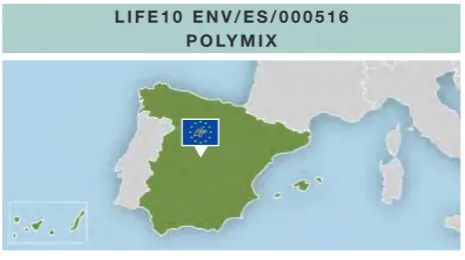
POLYMIX Polymer Wastes in Asphalt Mixes: a Way to Increase Sustainability of Roads Infrastructures LIFE10 ENV/ES/000520
Location Project number Title of project
LIFE10 ENV/ES/000521
AQUATIK Development and validation of advanced monitor-ing system for control of organic priority pollutants in treated wastewater effluents
SPAIN
LIFE10 ENV/ES/000530URWASTECH Innovative Urban Waste Treatment: A Sustainable Approach Using Hydrodynamic and Biological Technologies
SWEDEN
LIFE10 ENV/SE/000035SLIDE IN Life without oil: Slide in - energy efficient and fossil-free public transportation for a sustainable society LIFE10 ENV/SE/000037
PVCFreeBloodBag Public healthcare and plastics makers demonstrate how to remove barriers to PVC-free blood bags in the spirit of REACH
LIFE10 ENV/SE/000038
Wastetofuel Waste to fuel - turning climate hazardous landfills to promoters for development of climate friendly transportation solutions
LIFE10 ENV/SE/000041
HYPER BUS Hyper Bus - Hybrid and plug-in extended range bus system LIFE10 ENV/SE/000042
HYDROFLUSS Hydrofluss - Regeneration of hazardous waste into valuable raw material for the European steel industry
UNITED KINGDOM
LIFE10 ENV/UK/000173LiveWell for LIFE Livewell plate for low impact food in Europe LIFE10 ENV/UK/000175
CLEAR Info Company level environmental accountability report-ing and information LIFE10 ENV/UK/000176
EQual Ensuring quality of waste-derived products to achieve resource efficiency LIFE10 ENV/UK/000182
L I F E 1 0 E N V / AT / 0 0 0 1 1 2 P O LY W O O D
Polygeneration of Fuels, Heat and
Electricity from Wood
Project background
Road traffic is responsible for 28% of greenhouse gases (GHG) in Austria; it also causes levels of particulate matter (PM10, PM 2.5) and nitrogen dioxide (NO2) to exceed statutory limits. Today, particulate matter (both PM10 and PM 2.5), NO2 and PAH (Polycyclic Aromatic Hydro-carbons) are the most critical air pollutants in European cities, with a negative impact on people’s health. The Eu-ropean limit values for PM10 and NO2 cannot be met in many Austrian and European towns and cities. Moreo-ver, many European regions fail to attain the new limit value for PM 2.5. In cities such as Klagenfurt (100 000 inhabitants) the limit value for the PM10 daily average is exceeded on up to 80 days per year. The most urgent problems regarding exhaust emissions from motor traffic are NOx and CO2 emissions, whilst particulate emissions from new vehicles have already been brought down to very low levels. On the other hand, biomass with its low GHG load as of now only has a small share in vehicle fuels and bio-diesel has not solved the NOx problems.
Project objectives
The main objective of the POLYWOOD project is the production of 2.5 million m³/yr of Bio-SNG (synthetic natural gas, Hythane) from woodchips. This alternative fuel source will be used to power compressed natural gas (CNG) vehicles, providing a replacement for vehicles with an internal combustion engine, running on petrol or diesel. By switching away from fossil fuels, the pro-ject aims to cut traffic-related emissions in Klagenfurt, as well as significantly improving air quality and the re-gional CO2 balance.
The City of Klagenfurt has constructed a power plant (heat and electricity) based on combusting gas from wood chip gasification (pyrolysis). The POLYWOOD project is to extend this facility by constructing the world’s first large scale plant to use part of the above gas to generate a prototype synthetic methane-hydrogen gas (Hythane, > 90% methane) called BioSNG., that will be suitable for combustion in conventional CNG vehicles without further adaption. Two high-pressure BioSNG-gas stations will store and supply the CNG vehicles in the region.
The project will stimulate the market for CNG-vehicles and encourage the use of BioSNG instead of diesel or petrol. It will also purchase BioSNG vehicles for the city administration and for on-demand shared-ride taxi ser-vices. The latter demonstrates the long-term effect of
BioSNG under maximum load conditions. Finally, infor-mation campaigns will be an important part of the pro-ject, in order to support the spread of BioSNG.
Expected results:
The POLYWOOD project will:
• Set up an extension plant to produce BioSNG; • Provide 2.5 million m³/yr of BioSNG to fuel some
1 000 CNG vehicles;
• Set up two BioSNG fuel stations; • Set up a taxi share system;
• Replace conventional diesel vehicles with 69 BioSNG
vehicles (20 cars, 44 minibuses and 45 cars for the taxi share scheme);
• Save emissions of 6 000 tonnes/yr of CO2, 8 tonnes/ yr of NOx and 0.7 tonnes/yr of PM10; and.
• Increase the total energy efficiency of the wood chips
at the gasification plant from 73% to 85%, via the polygeneration of fuels, heat and electricity.
Beneficiary:
Type of beneficiary
Local authority
Name of beneficiary
Magistrat der Landeshauptstadt Klagenfurt am Wörthersee
Postal address
Neuer Platz 1 A - 9021 Klagenfurt AUSTRIA
Phone +43 463 537 4884 Fax +43 463 51 16 94
Email [email protected]
Name of contact person
Wolfgang HAFNER
Duration of project:
52 months (01/09/2011 - 31/12/2015)
Total budget in euro: 9,152,158.00
EC contribution in euro with %: 9,681,580.00 (50.00 %)
Generic theme:
L I F E 1 0 E N V / B E / 0 0 0 6 9 6 A G I C A L +
Validation of an environmentally
friendly system, combining CO
2capture and biofuel production
based on algae culture for
industrial exhaust application
Project background
By using an algae culture for carbon capture, it is esti-mated that CO2 emissions and fossil fuel consumption in the lime and glass production industries can be sig-nificantly reduced – by up to 25% for the former (15% for glass production) and 45% for the latter (15% for glass production). This technique also may be applica-ble to other industries, and could be adapted for other production processes that use melting furnaces and generate high CO2 emissions (e.g. the steel or cement industries).
Project objectives
The AGICAL+ project proposes to implement an in-novative solution, based on algae culture and biomass production, which will allow for the CO2 capture of lime or glass furnace fumes and the production of bio-fuel that can be used within the furnaces during the production process.
At pilot scale (1 ha of algae culture), the final aim of this project is to demonstrate that the environmental impact of industries can be reduced up to 360 tonnes/ yr of CO2 emissions and up to 2 460 GJ/yr of fossil fuel in the case of lime and glass production processes. To reach these ambitious environmental objectives, two implementation steps will be necessary. Firstly, the project will launch a pilot prototype and apply the experience gained from this to further refine a second pilot. In the first step, the aim is to reach a capturing of 270 tonnes/yr of CO2, and a production of 1 800 GJ/yr of biomass.
The project will demonstrate the technical economic viability in two representative industrial processes: (i) the implementation of the algae culture pilot for a glass production furnace – the first pilot – will validate the process for fumes with moderate CO2 concentrations and high fume temperatures (600-650 °C) with many pollutants; and (ii) the lime application – the second pilot – will validate the process for high CO2 concen-tration and low temperature (100-125 °C) fumes. To optimise the overall environmental benefit, the energy consumption of the process will be limited as much as possible and thermal energy that is available on the
production site will be used to power the pilot plants. This will be especially critical for the lime pilot because of the limited amount of thermal energy available on the site. In order to limit the operational costs, water that is recovered when harvesting the algae will be recycled and re-injected upstream.
Expected results:
The expected outcome is the pilot scale validation of an innovative environment friendly CO2 capture
sys-tem combined with a biofuel production process. This system will:
• Reduce CO2 emissions by capturing CO2 using mi-cro-algae;
• Produce biofuel from the algae to fuel the industrial furnaces and reduce fossil energy consumption; and • Maximise the use of excess heat from the produc-tion process to reduce the energy needs of the in-stallations.
Beneficiary:
Type of beneficiary
International enterprise
Name of beneficiary
AGC Glass Europe SA.
Postal address
Chaussée de la Hulpe, 17 B - 1170 Bruxelles BELGIUM
Phone +32 71 280 307 Fax +32 71 422 355
Email [email protected]
Name of contact person
Christophe BOONAERT
Duration of project:
59 months (01/11/2011 - 30/09/2016)
Total budget in euro:
9,152,158.00
EC contribution in euro with %:
3.580.329,00 (39.12 %)
Generic theme:
L I F E 1 0 E N V / B E / 0 0 0 6 9 9 D E M E T E R
Sustainable and integrated
soil management to reduce
environmental effects
Beneficiary:
Type of beneficiary
Regional authority
Name of beneficiary
Vlaamse Landmaatschappij (VLM)
Postal address
Gulden Vlieslaan 72 B - 1060 Brussels BELGIUM
Phone +32 9 2448546 Fax +32 9 2448598
Email [email protected]
Name of contact person
Patrick VERSTEGEN
Duration of project:
51 months (01/01/2012 - 30/03/2016)
Total budget in euro:
1,907,092.00
EC contribution in euro with %:
952,353.00 (49.96 %)
Generic theme:
Risk assessment - Pollution control
Project background
The application of different types of animal manure is currently used to maintain, or increase, soil organic matter levels in Flanders (Belgium) and the Nether-lands. Large-scale applications of animal manure, however, increase the risk of nutrient accumulation and losses, especially nitrate leaching and phosphate saturation and leaching. The agricultural sector needs practical know-how and tools to optimise both fertili-sation and organic matter management.
Project objectives
The overall objective of the DEMETER project, in line with the Soil Framework Directive, is to foster sus-tainable soil and nutrient management. This includes guiding and informing farmers on management prac-tices that consider both nutrient and soil organic mat-ter management simultaneously. The project is cen-tred on the principle that sustainable nutrient and soil organic matter management not only concern ferti-lisation practices, but the whole farm management, including tillage practices, crop rotation etc.
The project has four specific objectives:
• To increase awareness among all agricultural stake-holders of the benefits of sustainable soil and nutri-ent managemnutri-ent, as well as of the risks of decreased soil organic matter content;
• To increase knowledge concerning the principles of sustainable nutrient and soil organic matter manage-ment in daily farm practices;
• To provide a practical tool to farmers that will sup-port sustainable soil and nutrient management; and • To enhance the implementation of sustainable soil
and nutrient management in daily farm practices.
Expected results:
Overall, the project expects to attain a higher level of soil organic matter in Flemish and Dutch agricultural soils, cou-pled with a decreased nutrient load in the environment. The following specific results are expected:
• An information package with practical recommen-dations for farmers concerning sustainable soil and nutrient management will be available one year after the start of the project;
• A decision-support tool for farmers will be online within one year of the project start date;
• The support tool will be used by 80 farms over the three years of the project;
• The application of the principles of sustainable soil and nutrient management will enable the participat-ing farms to lower nitrate residues;
• In the pilot areas, monitoring results will show a decrease in the nutrient load in ground and surface water; • There will be at least one agro-environmental
agree-ment aimed at sustainable soil and nutrient manage-ment;
• The information package will be updated, taking into account feedback from the farmers involved in the project;
• Farmers and relevant stakeholders will also be in-formed of the existence of the decision support tool and will take part in demonstration days on sustain-able nutrient and soil management;
L I F E 1 0 E N V / C Y / 0 0 0 7 2 1 D A I R I U S
Sustainable management via
energy exploitation of end-of-life
dairy products in Cyprus
Beneficiary:
Type of beneficiary
Large enterprise
Name of beneficiary
VIVARTIA Cyprus Ltd
Postal address
Nisou Industrial Area, PO Box 17102 CY - 2661 Nicosia
CYPRUS
Phone +357 22443044 Fax +357 22443045
Email [email protected]
Name of contact person
Stefanos PAPADOPOULOS
Duration of project:
36 months (01/02/2012 - 31/01/2015)
Total budget in euro:
1,404,252.00
EC contribution in euro with %:
702,126.00 (50.00 %)
Generic theme:
Industrial waste (including manufacturing)
Project background
The production of milk and dairy products in Cyprus and the rest of Europe has increased significantly dur-ing recent years and this has resulted in larger amounts of non-consumed, returned and expired products - and milk products in particular. Most of these end up in landfills contributing to hazardous leachate genera-tion and uncontrolled gaseous emissions.
Landfilling of these products does not comply with the EU Landfill Directive (1999/31), which imposes strict limits for the disposal of biodegradable wastes. Thus, there is a clear need for the dairy industry to develop sustainable management and treatment strategies. Anaerobic digestion of milk products and simultane-ous methane recovery as a clean renewable energy source can be a highly sustainable solution for expired milk products with environmental, financial and social benefits. Although this process is state-of-the-art in the treatment of sewage sludge and industrial waste-water, very few applications can be found for the treatment of expired products themselves.
Project objectives
The DAIRIUS project’s overall objective is to dem-onstrate an environmentally and financially sustain-able solution for the management and treatment of returned Expired Dairy Products (EDP). It aims to achieve this through the development and testing of a two-phase anaerobic co-digestion process of EDP with other substrates.
The project will analyse the specific details of EDP gen-eration by the dairy industry in Cyprus. It will assess the optimal physical, chemical and biochemical conditions for the anaerobic co-digestion process to maximise biogas yields. This will include determining the ratios of potential substrates, such as manure, in the process through investigations at laboratory scale.
A pilot anaerobic digestion plant will be designed and constructed; biogas from the process will be collected and used to generate energy. Running of the plant will permit further optimisations to the proposed proc-ess. The project will define the optimal plant operat-ing conditions for EDP treatment to maximise biogas yields. It will also describe the best possible processes
for aerobic composting or vermi-composting of the residual digested material.
A cost-benefit analysis, environmental impact assess-ment, and lifecycle analysis will be performed and used to evaluate the exploitation and long-term commerciali-sation potential of the prototype pilot plant. The process is expected to be of wide interest in the dairy sector.
Expected results:
• Clear demonstration of the wide-scale applicability and environmental benefits of anaerobic treatment of EDP;
• Successful generation, collection and use of biogas as a renewable energy product from EDP - as well as residual material for composting; and
L I F E 1 0 E N V / C Y / 0 0 0 7 2 3 C Y PA D A P T
Development of a national
strategy for adaptation to climate
change adverse impacts in Cyprus
Beneficiary:
Type of beneficiary
National authority
Name of beneficiary
Ministry of Agriculture, Natural resources and Environment Department of Environment
Postal address
28th Octobriou, 20-22 CY - 2414 Nicosia CYPRUS
Phone +357 722 408 948 Fax +357 722 774 945
Email [email protected]
Name of contact person
Theodoulos MESIMERIS
Duration of project:
31 months (01/09/2011 - 31/03/2014)
Total budget in euro:
1,358,847.00
EC contribution in euro with %:
678,423.00 (49.93 %)
Generic theme:
Other area - Land use development and planning
Project background
Climate change has already had an impact on Cyprus, a relatively arid island of the Mediterranean region. In the 20th century, levels of precipitation fell at a rate of 1 mm per year, whilst the mean temperature in-creased by 0.5°C. The availability of water resources has fallen by 40% from the estimates made in 1970. Extreme climatic phenomena, especially droughts, are more frequent than before.
The changes to the climate of Cyprus have had an adverse impact on several sectors of the island’s econ-omy, social life and environment. The unsustainable depletion of groundwater caused by uncontrolled wa-ter pumping in many areas has led to sea intrusion into groundwater aquifers and to the deterioration of water quality that is pumped.
Climate change is only expected to further reduce precipitation and increase temperatures in the com-ing years. Agriculture and food security are expected to be threatened. The demand for water will increase with the increase in temperatures, particularly in ag-riculture. Growing dependence on air conditioning is likely to increase energy demand. Other human im-pacts are likely to include an increase in migration to urban areas away from untenable rural livelihoods and increases in heat-related health conditions, including heat stroke, tropical vector-borne diseases - such as malaria - and urban air pollution.
Project objectives
The CYPADAPT project’s main objective is the devel-opment of a National Strategy for Adaptation to Cli-mate Change in Cyprus with the aim of strengthening and increasing the adaptive capacity of the country. The project will use modelling to provide insight into the likely future impacts of climate change on Cyprus. It will work to identify economic and social sectors of Cyprus that are particularly vulnerable to climate change today and in the future. It will also seek to as-sess their adaptive capacity.
It will investigate adaptation measures applied world-wide for each sector and collate them into a database. To help identify which adaptation measures could be the most appropriate for the Cypriot situation, it will develop an innovative multi-criteria analysis (MCA) tool. It will demonstrate use of this tool and acquire valuable feedback to optimise its performance.
To conclude, the project will use the MCA tool to inform the development of a national adaptation plan and then promote the implementation and dissemination of prom-ising adaptation measures for climate change on Cyprus. It will also provide a methodology for monitoring the ef-fectiveness of the proposed adaptation strategy.
Expected results:
• A technical description of climate changes models; • An assessment of Cyprus’s vulnerability to climate
change now and in the future;
• An assessment of current adaptation measures; • A database of adaptation measures applied worldwide; • An MCA tool for selecting the most appropriate
ad-aptation measures;
• National adaptation and monitoring plans for Cy-prus; and
L I F E 1 0 E N V / C Z / 0 0 0 6 4 9 R e S t E P
Regional Sustainable Energy Policy
based on the Interactive Map of
Sources
Beneficiary:
Type of beneficiary
University
Name of beneficiary
Česká zemědělská univerzita v Praze (Czech University of Life Sciences Prague)
Postal address
Kamýcká 129 CZ - 165 21 Prague 6 CZECH REPUBLIC
Phone +420 224 382 733 Fax +420 234 381 801 Email [email protected]
Name of contact person
Pavel TLUSTOŠ
Duration of project:
36 months (01/11/2011 - 31/10/2014)
Total budget in euro:
1,538,534.00
EC contribution in euro with %:
769,134.00 (49.99 %)
Generic theme:
Reduction of emission of greenhouse gases
Project background
The EU Renewables Directive sets targets for each Member State for the proportion of renewable energy generation by 2020. The Czech Republic’s target is to achieve a 13% proportion of energy from renewable sources.
To date, the development of different types of renew-able energy projects in the Czech Republic has been somewhat haphazard and unregulated. A new law is being prepared to address this. Moreover, the project team has identified 82 projects in the Czech Republic from 2005-2009 that it believes have been “wrongly assessed” i.e. have been located in unsuitable areas, inadequately prepared or shown wrongly working re-newable energy sources.
Project objectives
The main objective of the ReStEP project is to develop, test, evaluate and distribute a new, standardised meth-odology for the management of urban and regional planning in the field of proposals and assessments of energy projects. The main focus is the efficient use of natural resources and environmental protection, so that the number of wrongly assessed renewable en-ergy sources (RES) projects is reduced by 50%. The method uses an innovative software tool – an interac-tive map of conditions for renewable and alternainterac-tive energy sources including biofuels.
Specific objectives are to:
• Develop a comprehensive methodology for the as-sessment of building and operating RES and biofuel production plants using an interactive map. The methodology will be included in new legislative and administrative processes and will include a guide for regional authorities;
• Create an innovative tool to aid decision-making on the use of natural resources for energy supply purposes. The aim is to establish the conditions for development of sustainable energy, while preserv-ing biodiversity, food and energy safety, and also taking into account local conditions and environ-mental impacts; and
• Implement this new methodology, including the in-teractive map, and promote its use at regional level, including by towns and municipalities, to public ad-ministrations, business sectors and the wider public.
Expected results:
The main expected result is a reduction of 50% on 2005-09 levels of the number of wrongly assessed RES projects in the period 2015-2019. Other expected results include: • A new methodology for the assessment of invest-ment potential for energy sources (a guide issued by the Ministry of Environment and proposals for legisla-tive amendments);
• An interactive map of the conditions for renewable and alternative energy sources (a software tool avail-able to the public administration via websites, includ-ing a user- manual);
• Communication and educational activities for inves-tors and operainves-tors of RES (workshops, courses includ-ing e-learninclud-ing - 10 events in total); and
L I F E 1 0 E N V / C Z / 0 0 0 6 5 1 M E D E TOX
Innovative Methods of Monitoring
of Diesel Engine Exhaust Toxicity
in Real Urban Traffic
Beneficiary:
Type of beneficiary
Research institution
Name of beneficiary
Institute of Experimental Medicine AS CR, v.v.i. (IEM)
Postal address
Vídeňská 1083
CZ - 142 20 Prague 4 CZECH REPUBLIC
Phone +420 241 062 675 Fax +420 241 062 785 Email [email protected]
Name of contact person
Jan TOPINKA
Duration of project:
60 months (01/09/2011 - 31/08/2016)
Total budget in euro:
1,223,524.00
EC contribution in euro with %:
611,762.00 (50.00 %)
Generic theme:
Air quality management and noise abatement
Project background
Diesel exhaust emitted by internal combustion engines is a key source of urban air pollution. It is not just the tra-ditionally-regulated total mass of particulate matter that is of public concern, but also ultrafine particles of pol-lution. These can readily penetrate deep into the lungs and pass through cell membranes into the bloodstream. Engine exhaust has an adverse effect on many key bod-ily functions (respiratory, circulation and nervous system) and proximity to its source has been correlated with in-creased risk of tumours, asthma, various chronic respira-tory ailments, heart attack, and other illnesses.
Project objectives
The MEDETOX project’s main objective is to dem-onstrate innovative methods to assess the possible health risk connected with the exposure of the general public to diesel exhaust particles under real-life traf-fic conditions in the city of Prague. Diesel emissions from many thousands of trucks passing through large European cities represent serious health risks for the general public. In contrast to laboratory conditions, used in some previous and current studies, this project seeks to evaluate the toxicity of engine exhaust dur-ing operatdur-ing conditions typical for core urban areas, where the engine emissions are of highest concern, as the aggregate dose is the highest.
Specific objectives are:
• To identify the health risks related to emerging fuels and fuel additives and to demonstrate the use of standardised toxicity tests as an appropriate tool for regulatory decisions; and
• To build an effective interdisciplinary network tar-geted at the overall assessment of the health risk potential of engine exhaust during real-time opera-tion of road vehicles and mobile machinery, and the monitoring of the effects of various policy decisions. This will be accomplished by a team of experts in the areas of engines and emissions (TUL), toxicity assessment (IEM) and public policy (ME).
Expected results:
The main result will be a set of standardised protocols for the sampling and toxicity testing of diesel emis-sions under various real-life traffic conditions. These will be used as tools for ‘hazard identification’ and ‘risk assessments’ based on the toxic effects of vehicle emissions. The protocols will include standard meth-odologies for:
• Sampling of engine emissions, particularly diesel exhaust under various traffic conditions;
• Testing cell toxicity of organic extracts from diesel exhaust (OEDE) particles in human lung cells (HEL); • Testing genotoxic potential of OEDE in a cell-free
model system;
L I F E 1 0 E N V / D K / 0 0 0 0 9 8 P l a s t i c z e r o
Plastic ZERO - Public Private
Cooperation’s for avoiding plastic
as a waste
Beneficiary:
Type of beneficiary
Local authority
Name of beneficiary
Municipality of Copenhagen - The Technical and Environmental Administration Department
Postal address
Njalsgade 13259 DK - 1502 Copenhagen V DENMARK
Phone +45 3366 5861 Fax +45 3366 7133 Email [email protected]
Name of contact person
Merete KRISTOFFERSEN
Duration of project:
36 months (01/09/2011 - 31/08/2014)
Total budget in euro:
1,997,308.00
EC contribution in euro with %:
998,571.00 (50.00 %)
Generic theme:
Packaging and plastic waste
Project background
In recent decades, as the amount of plastic used in products, packaging and construction has increased, so the amount of plastic in waste streams has also risen. Unfortunately, while plastics have many useful proper-ties, they are very difficult to recycle as they come in many different types and they need to be separated into polymer types to ensure real recycling - upcycling. Most Member States collect either mixed plastic packaging or plastic bottles only, or they collect rigid and flexible plas-tic packaging separately. Either way, the plasplas-tic will still need to undergo some kind of sorting process if it is to be recycled into new, high-value products.
[image:16.595.321.554.69.200.2]In Greater Copenhagen it is estimated that plastic waste constitutes some 15% of the residual waste destined for incineration. In Hamburg and Malmö this figure is around 8%, and in Riga roughly 20 % of the mixed/landfilled waste is plastic waste.
Project objectives
The objective of the Plastic ZERO project is to reduce the amount of plastic in waste streams, thereby saving non-renewable resources and enabling carbon neutral energy production from waste.
Specific objectives of the project include:
• The establishment of a road map for reducing plas-tic in waste streams;
• The demonstration and documentation of selected measures for the prevention of plastic waste; • The demonstration and documentation of selected
technologies and methods for sorting and recycling plastic waste;
• The development of initiatives to create new green businesses and growth within the recycling sector; and • The dissemination of knowledge, good practices,
technologies and systems to European cities.
Expected results:
• The establishment of an advisory board to assist with the road map development and project sup-port;
• A digital road map and website;
• Identification and testing of at least 10 practical ini-tiatives for plastic waste prevention;
• The establishment of cooperation forums for plastic waste prevention in at least eight value chains;
• The establishment of networks in each partner city – Copenhagen, Hamburg, Malmö and Riga - focus-ing on plastic waste prevention;
• A manual for waste preventive Green Public Pro-curement (GPP);
• Identification of at least five effective collection schemes for plastic waste;
• Identification of at least five effective collection schemes and/or methodologies for implementation by project partners, demonstrating the potential for the removal of at least 25 % of plastic in the re-spective waste streams;
• The provision of guidance and consultancy to at least 150 manufacturing enterprises; and
L I F E 1 0 E N V / F I / 0 0 0 0 5 9 O d o u r l e s s c a s t i n g
Odour and hazardous emission
abatement of foundries
Beneficiary:
Type of beneficiary
Small and medium-sized enterprise
Name of beneficiary
Uudenkaupungin Rautavalimo Oy (Meehanite Technology Oy)
Postal address
Betorantie 30
FIN - 23500 Uusikaupunki FINLAND
Phone +358 40 500 20 55 Fax N/A
Email [email protected]
Name of contact person
Markku TAPOLA
Duration of project:
36 months (01/10/2011-30/09/2014)
Total budget in euro:
1,568,123.00
EC contribution in euro with %:
768,311.00 (49.00 %)
Generic theme:
Air quality management and noise abatement
Project background
Foundries make metal castings from both ferrous and non-ferrous alloys. Metals are turned into compo-nents by melting the metal, pouring it into a mould, and then removing the mould material, or casting. The most commonly used metals are aluminium and cast iron, although steel, magnesium, copper, tin, zinc and other metals can also be used. Most foundries are op-erated by small- and medium-size enterprises (SMEs). There are some 4 000 ferrous and non-ferrous foun-dries in Europe with a combined workforce of around 290 000 employees.
The casting process typically leads to emissions of odorous and hazardous gases, which originate from the following: • Melting shops, especially cupola furnaces but also
in-duction furnaces;
• Moulding shops during the pouring and mould cooling stages;
• Core making, especially the ‘hot box’ system and core curing ovens;
• Sand reclamation; and
• Die casting (metal mould) of aluminium foundries.
Project objectives
The aim of the ‘Odourless casting’ project is to address the problems related to the air pollution control of odor-ous and hazardodor-ous emissions from foundry processes. The goal is to define odorous and hazardous emissions in typical aluminium, steel and iron foundries and to dem-onstrate technically and economically feasible emission abatement techniques for wide-scale implementation. Specific objectives are to:
• Minimise hazardous and odorous emissions from dif-ferent foundry processes by 80-90% at pilot foun-dries by applying the best feasible exhaust air cleaning systems;
• Define the most harmful compounds and odorous concentrations in iron, steel and metal foundries and treat them in the most efficient way;
• Define the odour emission balances of typical foundry processes and pilot foundries as a whole;
• Carry out feasibility studies as pilot tests for the foun-dries to minimise emissions using standardised chemical compound specifications and olfactometric analyses; • Calculate total annual cost estimates for the full-scale
technologies; and
• Publish a design and instruction guide on how to ap-ply cleaning systems for different foundry processes.
Expected results:
• Reduce odour emissions by 80-90% (in comparison with the industry baseline) at the pilot foundries; • Reduce the emission of 11 million kg noxious
com-pounds in the European foundry industry;
• Create a healthier working environment for foundry workers and the people living in the vicinity of these emission sources;
• Provide information on potentially harmful odour emis-sions in ferrous and non-ferrous foundry processes; • Produce data on the performance and cleaning
effi-ciency of the tested abatement techniques in different odour-emitting foundry processes;
• Draw up a design and instruction guide on how to de-fine and apply cleaning systems for odorous and haz-ardous emissions in different foundry processes; and • Produce annual cost and energy consumption
L I F E 1 0 E N V / F I / 0 0 0 0 6 0 A R I T
Framework for Sustainable
Management of Shooting Ranges
Beneficiary:
Type of beneficiary
Research institution
Name of beneficiary
Finnish Environment Institute
Postal address
Mechelininkatu 34 a FIN - 00251 Helsinki FINLAND
Phone +358 400 148618-2342 Fax +358 9 54902490 Email [email protected]
Name of contact person
Jaana SORVARI
Duration of project:
52 months (01/09/2011-31/12/2015)
Total budget in euro:
3,063,970.00
EC contribution in euro with %:
1,477,746.00 (48.23 %)
Generic theme:
Risk assessment - Pollution control
Project background
The problem of managing the environmental and health risks arising from environmental contamina-tion at firing ranges is widely recognised. Firing prac-ticed at outdoor small-arms ranges is creating heav-ily contaminated sites in Finland, as well as in many other countries. Along with the ammunition and clay targets, the activity emits several chemicals into the environment, e.g. heavy metals and metalloids (par-ticularly lead, but also antimony, arsenic and zinc, among others) and polyaromatic hydrocarbons. Some of the potential contaminants (e.g. those present in the paints used in clay targets) have so far been largely unaddressed. Environmental contamination has aris-en from insufficiaris-ent risk managemaris-ent measures. Site studies have shown that the environmental load of ammunition can reach up to several millions of shot or several tonnes of lead per hectare at shotgun firing ranges covering several hectares.
Project objectives
The ARIT project aims to establish a management sys-tem (MS) for managing the environmental risks, in-cluding ecological and health risks, caused by Finnish firing ranges, both active and disused. The MS would extend from the local level to regional and national level, and its realisation would assume implementation of some policy actions and economic policy instru-ments presented and recommended by the project. All firing ranges within the territory of the project will be prioritised using the Finnish KUPPI model. Risk as-sessment will be conducted for the prioritised sites in order to identify the magnitude, scale and targets of risk management actions. The most urgent site will be chosen for remediation. The results from the previous actions will be compiled and a management system constructed.
Expected results:
• Overview of the scale of the firing range problem in Finland, contaminants and risks involved;
• Outline of the risk management alternatives for ac-tive and disused firing ranges;
• Risk-based classification of firing ranges within the regions of South Ostrobothnia and South Savo; • An MS for managing the environmental risks at
macro- and micro-scale;
• Information on the suitability of the demonstrated novel technique for improving firing range soils; • Information on the feasibility, cost-efficiency and
attainable risk reduction of different remediation techniques for firing ranges, including the demon-strated novel remediation method;
• An estimate of the costs of risk management of dis-used firing ranges at national level;
• Recommendations for managing active and disused firing ranges at the regional and national level; • Details of a funding system for remediating Finnish
firing ranges; and
Guidelines for Sustainable
Exploitation of Aggregate
Resources in Areas with Elevated
Arsenic Concentrations
L I F E 1 0 E N V / F I / 0 0 0 0 6 2 A S R O C K S
Beneficiary:
Type of beneficiary
Research institution
Name of beneficiary
Geological Survey of Finland
Postal address
Betonimiehenkuja 4 - PO Box 96 FIN - 02151 Espoo
FINLAND
Phone +358 205502850 Fax +358 2055012
Email [email protected]
Name of contact person
Kirsti LOUKOLA-RUSKEENIEMI
Duration of project:
36 months (01/09/2011 - 31/08/2014)
Total budget in euro:
1,157,301.00
EC contribution in euro with %:
578,671.00 (50.00 %)
Generic theme:
Risk assessment - Pollution control
Project background
Aggregate production is one of the largest industry sec-tors in Finland. Every year, approximately 120 million tonnes of raw materials are extracted from the ground, to be processed and used for construction and infra-structural maintenance. The annual aggregate con-sumption per capita in Finland is among the highest of all EU countries. Many of these natural resources are situated in regions with an elevated groundwater risk, and thus regulated by environmental permits or the land extraction act. In addition, aggregate production may cause a risk in areas with high natural concentra-tions of arsenic in bedrock and soil. At present, there are no restrictions on the use of natural rock aggre-gates or soil originating from non-contaminated areas in civil engineering. However, in the Tampere region in southern Finland, extracted rock aggregates may con-tain high concentrations of arsenopyrite (FeAsS) and high arsenic concentrations have also been detected, particularly in deeper layers of glacial till. The presence of arsenic sulphides in rock leads to a deterioration in the quality of construction material and it can also be-come a source of contamination.
Project objectives
The main objective of the ASROCKS project is to pro-vide guidelines for the exploitation of natural aggre-gate resources (crushed bedrock, sand and gravel) in an area with elevated arsenic concentrations in bed-rock and soil. In addition, guidelines will be developed for the re-use of aggregates in construction sites in areas with a high natural occurrence of arsenic. The demonstration area is the Tampere-Häme region in southern Finland, where natural arsenic (As) in bed-rock and soil is known to be a problem.
Specific objectives are to:
• Identify the current aggregate production areas and planned large construction sites with potential for arsenic hazards;
• Identify the environmental impacts at demon-stration sites. Potential pathways to surface and groundwater will be investigated in sites that show elevated concentration of As. Worst-case scenarios will be defined for the selected sites;
• Develop a risk assessment and risk management procedure at the demonstration sites. The main aim is to develop a decision support model for the aggre-gate production and application in construction sites in areas with a high natural occurrence of arsenic.
Expected results:
• A map of areas with elevated natural concentra-tions of arsenic in bedrock and soil in the Tampere-Häme region;
• A list of production sites of aggregates and planned large construction sites in the area with elevated ar-senic concentrations;
• A description of selected aggregate production sites and a qualitative risk assessment model;
• A conceptual model for qualitative risk assessment; • Results of leaching experiments of selected
aggre-gate materials;
• Risk management tools for sustainable exploitation of aggregate resources in areas with elevated ar-senic concentrations;
• A decision support model of sustainable exploita-tion to support environmental authorities; and • Guidelines for the sustainable exploitation of
L I F E 1 0 E N V / F I / 0 0 0 0 6 3 L i f e D a t a
Knowledge based data services
-improving the life cycle and
accessibility of environmental
data provided for public interest
Beneficiary:
Type of beneficiary
Research institution
Name of beneficiary
Finnish Forest Research Institute
Postal address
Jokiniemenkuja 118 FIN - 01301 Vantaa FINLAND
Phone +358 40 801 5154 Fax +358 10 2112202 Email [email protected]
Name of contact person
Anu KANTOLA
Duration of project:
52 months (01/09/2011 - 31/12/2015)
Total budget in euro:
2,906,601.00
EC contribution in euro with %:
1,351,498.00 (46.51 %)
Generic theme:
Forest management - Soil and landscape protection - Desertification prevention
Project background
In 2006, FOREST EUROPE (The Ministerial Confer-ence on the Protection of Forests in Europe) and the Council for Pan-European Biological and Landscape Diversity Strategy (PEBLDS) jointly recognised sus-tainable forest management to be consistent with the Ecosystem Approach.
Finland is the EU’s most forested country – three quar-ters of its land area is under forest cover – which high-lights the important role of Finland in contributing to sustainable forest management and the ecosystem approach – promoting conservation and environmen-tally, socially and economically sustainable forest man-agement practices, providing benefits for both present and future generations.
Project objectives
The LifeData project aims to identify and demonstrate new management methods and user-application sys-tems for generating an integrated data management process. The project will develop and demonstrate a unique database system linking integrated forest data-bases with those of other participating (LYNET) organi-sations. The data collected will be used to bridge the gap between data/information producers and users, enabling simple access to this integrated information. Specifically the project will:
• Complete and integrate the data of the partici-pating (LYNET) organisations and create a service map;
• Identify the data architecture upon which new da-tabases will be built;
• Build data search systems and user-interface services.
Expected results:
• A service map and data policy for the participating organisations, including guidelines for the demon-stration project;
• Data sets of the organisations will be identified, with general and detailed descriptions;
• Variables defining the data will be identified and standardised for the databases;
• The architecture of data sets and their links to each other will be described so that the new databases and their interfaces and user interfaces can be built or rationalised (updated easily);
L I F E 1 0 E N V / F R / 0 0 0 2 0 2 I C A R R E 9 5
Industrial Platform Demonstrator
to achieve 95% recycling of the
“end-of-life vehicle”
Beneficiary:
Type of beneficiary
Large enterprise
Name of beneficiary
Renault SAS
Postal address
13/15 Quai le Gallo
F- 92100 Boulogne - Billancourt FRANCE
Phone +33 685 07 41 04 Fax N/A
Email [email protected]
Name of contact person
Tony GALLONE
Duration of project:
40 months (01/09/2011 - 01/01/2015)
Total budget in euro:
30,286,899.00
EC contribution in euro with %:
5,545,570.00 (18.31 %)
Generic theme:
End-of-Life Vehicles (ELV’s) and tyres
Project background
European Directive 2000/53/CE related to end-of-life vehicles (ELVs) requires Member States to achieve a reuse and recovery rate of 95% for all ELVs by aver-age weight by 2015. The countries must implement national legislation and tools to ensure that economic operators involved in ELV collection and treatment meet this target.
However, despite significant efforts by European car constructors and other stakeholders, the highest ratio achieved is still only 91%. Non-ferrous metals, plas-tics, glass, foams and textiles make up around 21-26% of an ELV by weight and are thus an important target area for recycling efforts.
Project objectives
The LIFE project ICARRE 95 aims to demonstrate how to recycle 95% of ELVs at a regional scale - up to 30 000 ELVs per year - and to create a model that can be applied and transferred to other sites in France and elsewhere in Europe.
To reach its objective, the project will concentrate its efforts on plastics, foams, glass, textiles and catalytic converters. After firstly outlining an effective process for dismantling the various parts of the recovered car, the beneficiary aims to develop a cradle-to-cradle proc-ess for recycling of non-ferrous metals, plastics, glass, foams and textiles. Such a process identifies and sepa-rates ‘technical’ materials that easily can be reused or recycled in a continuous cycle without losing their in-tegrity and ‘biological’ materials that will biodegrade and must therefore be disposed of appropriately, for example through composting.
One of the major uses foreseen for some of the re-covered ‘technical’ materials are as second-hand com-ponents for use in car repairs or new builds. The ben-eficiary aims to nearly double the amount of recycled materials it uses in its car production within 3-5 years. It will also create a label for the parts, in order to facilitate a market and allow their sale through the company. In addition, the project will create an alternative supply-chain platform using waterways and railways to guar-antee the supply of ELV volumes, second hand
com-ponents and raw materials in and out of the project. Finally, it will create an ICARRE 95 Scientific Committee consisting of representatives of associate industries and academic institutions. This will examine new opportu-nities for developing green skills and know-how.
Expected results:
• Treatment of 30 000 ELVs/yr;
• Contribute to the achievement of 95% recycling of ELVs by weight;
• 15-20% of the weight of an ELV to be reused as second-hand components;
• An increase in recycled materials used in car pro-duction by Renault from some 27 000 tonnes/yr to more than 50 000 tonnes/yr within 3-5 years; and • Savings of up to 11 600 tonnes/yr of CO2, 18 000
L I F E 1 0 E N V / F R / 0 0 0 2 0 7 U R B A N L I G H T P L A N
An innovative and sustainable plan
for managing public lighting and
combatting light pollution in
Le Mans Métropole
Beneficiary:
Type of beneficiary
Local authority
Name of beneficiary
Communauté Urbaine Le Mans Métropole
Postal address
Hôtel de Ville
Place Saint Pierre - Cedex 9 F - 72039 Le Mans
FRANCE
Phone +33 243 473732 Fax +33 243 473627 Email [email protected]
Name of contact person
Jean-Claude BOULARD
Duration of project:
61 months (01/09/2011 - 30/09/2016)
Total budget in euro:
5,167,551.00
EC contribution in euro with %:
1,146,276.00 (22.18 %)
Generic theme:
Reduction of emission of greenhouse gases
Project background
The intensification in the amount of public lighting in the past few decades has led to the emergence of the notion of light pollution. Public lighting also consumes significant amounts of energy. This is not only an economic cost for local authorities, but also contributes importantly to the greenhouse effect, because it generates approximately 110 g of CO2 per kWh consumed. Furthermore, ADEME (the French Agency for the Environment and Energy Management) estimates that 30% to 50% of the light from public lighting in France is pointlessly wasted. This represents 4% of greenhouse gas emissions in France and almost 50% of municipalities’ energy costs.
In 2009, Le Mans Métropole began the implementation of a Local Agenda 21 sustainable development project that incorporates a carbon inventory to allow the meas-urement of greenhouse gas emissions in the area over a long period. An internal diagnosis of the impact of public lighting was conducted providing a baseline figure for its environmental impact.
Project objectives
The URBAN LIGHT PLAN project aims to simultaneously reduce greenhouse gas emissions and light pollution from public lighting in Le Mans. Its goal is to provide im-portant economic benefits to the local authorities as well as reducing the area’s ecological footprint and provide an example of good practice in the management of public lighting to other agglomerations in France and Europe. The project intends to introduce more appropriate and ‘soft’ lighting, particularly seeking to replace lighting that does not currently meet the requirements of Energy Ef-ficiency Certificates. It will also work to introduce more intelligent planning of lighting systems, not only signifi-cantly reducing the number of light points, but seeing lights switched off when not needed.
The beneficiary will adopt public procurement proce-dures that will select public lighting providers that specify the use of systems that meet environmental and ethical criteria, including energy efficiency and the use of recy-clable materials.
As well as reducing energy consumption and associated environmental impact, the planned actions are expected to provide a more environmentally friendly lighting en-vironment, which should notably prevent disturbance of the behaviour patterns of fauna.
At the same time, it is essential that public lighting con-tinues to meet the safety and visual needs of citizens. Engaging the public and business communities around identifying where light savings can be made will be cru-cial to the success of the project. It will work to raise awareness of the problems associated with lighting nui-sances and encourage a more judicious use of light.
Expected results:
• Replacement of almost 65% of the 28 000 light sources in the project’s territory;
• A reduction of 683 tonnes/yr of CO2 emissions;
• A 40% reduction in Le Mans Métropole’s energy costs and a reduction of its ecological footprint; • A reduction in light pollution with associated
ben-efits for sensitive local ecosystems; and