Garbage Collection and the Case for
High-level Low-level Programming
Daniel Frampton
A thesis submitted for the degree of
Doctor of Philosophy at
The Australian National University
Except where otherwise indicated, this thesis is my own original work.
Acknowledgments
This work would not have been possible without the generous support and assistance of many individuals and organizations. I only hope that I have remembered to give you all the credit you deserve.
First, I would like to thank my advisor, Steve, who has been amazing throughout my candidature. He has provided me with incredible opportunities, encouraging me to apply for internships, supporting me in attending several conferences. Most of all, he has helped me to believe in and persist with my research—thank you.
I would also like to express my gratitude to those who have supported me fi nancially: the Australian National University, the Australian Government, IBM, and Microsoft Research.
During my time as a student I have been lucky to be involved with several great research communities, including DaCapo, Microsoft Research's Singularity and Ad vanced Compiler Technology groups, and IBM's Metronome group. Each of these has helped to shape my research, and my involvement with them has been both enjoyable and productive. Thanks specifically to Bjarne, Mark, Vivian and David at MSR, to Dave, David, Mike and Perry at IBM, and to Amer, Eliot, Kathryn, Steve, Tony, and the countless others in DaCapo that make it such a friendly and engaging community.
I would also like to thank my fellow students, particularly Robin and Filip, with whom I have worked most closely. I have greatly enjoyed our many intense discus sions and coding marathons, and look forward to more of the same in the future!
I would also like to express my gratitude to all the developers of Jikes RVM and MMTk, past and present, without whom this research would not have been the same.
For offering to review previous versions of this document, thanks must go to Ker- ryn, Steve, Kathryn, Luke, and Mira. The document is all the better for having your attention, though as always, I claim exclusive ownership of any and all remaining er rors (as unlikely an occurence as this may be!). Particular thanks must go to Kerryn, who not only spent countless hours reviewing my work, but also helped me to tame Illustrator, and waded with me through countless poorly formatted BibTjX entries to get my bibliography under control.
Last of all, I would like to recognize the vast amount of more personal support that I have received throughout this endeavor. Thanks to my parents, Luke, Mira, Danel, Jackie, all of my soccer buddies, and especially to Kerryn, who has helped to make the whole process of finishing infinitely more enjoyable than it otherwise could have been.
Abstract
Modern high-level programming languages have helped to raise the level of abstrac tion at which software is written, increasing reliability and security, while also re ducing development costs. Despite the benefits afforded by high-level languages, low-level applications—such as real-time applications and systems programs—have bucked the general trend and continue to be overwhelmingly written in low-level languages such as C. Software complexity is continuing to escalate, reliability and security are now first-order concerns, and hardware is increasingly turning to more radical designs to deliver performance increases. In this environment, the use of low-level languages as the rule for low-level programming is becoming increasingly questionable.
These trends raise the question: what is holding back the use of high-level lan guages for low-level applications? Two key technical barriers are: 1) the limited expressiveness of high-level languages, which often intentionally abstract over de tail required to implement needed low-level functionality; and 2) the unique perfor mance requirements of low-level applications, which often demand a combination of throughput, responsiveness, and predictability.
My thesis is that high-level languages can and should be used for low-level ap plications, improving security and reliability, reducing development cost, and com bating increasing hardware complexity.
I have addressed this challenge of high-level low-level programming through: 1) the development of high-performance garbage collection mechanisms and algo rithms, in particular those that deliver on the performance requirements of low-level applications; and 2) the use and refinement of a suitably expressive high-level low- level programming approach in the development of garbage collection techniques.
This thesis describes techniques to improve garbage collection performance and introduces two novel garbage collection approaches—Cycle Tracing and Generational
Metronome—that provide the combination of throughput and responsiveness de
manded by low-level applications. This thesis presents a framework for high-level low-level programming that provides tools to construct new abstractions around rel evant low-level features. This thesis also draws on experience gained through engi neering garbage collectors, and shows how visualization can be an invaluable tool in understanding, debugging, and evaluating complex software systems.
These contributions are reinforced through case studies, showing that high-level low-level applications can meet strict performance requirements while maintaining the benefits in design afforded by high-level languages. This work demonstrates that high- level low-level programming is both possible and beneficial, leaving the most signif icant roadblock to adoption a cultural one, not a technical one.
Contents
Acknowledgments vii
Abstract ix
1 Introduction 1
1.1 D efinitions... 1
1.2 Problem S ta te m e n t... 1
1.3 Scope and C ontributions... 2
1.4 Thesis O u tlin e ... 3
2 Garbage Collection 5 2.1 The Anatomy of a Garbage Collector ... 5
2.1.1 Taxonomy of Garbage Collection Algorithms ... 7
2.1.1.1 Object Allocation ... 7
2.1.1.2 Garbage Identification ... 8
2.1.1.3 Garbage R eclam ation... 8
2.1.2 Canonical A lg o rith m s... 9
2.1.2.1 Reference C o u n tin g ... 9
2.1.2.2 M ark -S w eep ... 10
2.1.2.3 Sem i-Space... 10
2.1.2.4 M ark-Com pact... 11
2.1.2.5 M ark-R egion... 13
2.1.3 Generational C o lle ctio n ... 14
2.1.4 Barriers...14
2.2 Garbage Collection for Low-level P rogram s...15
2.2.1 Measuring Garbage Collection Interference...15
2.2.1.1 Throughput... 15
2.2.1.2 Responsiveness and Predictability ... 16
2.3 Concurrent and Incremental Tracing Collection ...17
2.3.1 The Tricolor A bstraction... 17
2.3.2 The Mutator-Collector Race...18
2.3.2.1 Incremental-Update A lgorithm s... 19
2.3.2.2 Snapshot-at-the-Beginning A lgorithm s...19
2.3.3 Incremental and Concurrent C o p y in g ... 20
2.3.3.1 Incremental Copying A lg o rith m s... 20
2.3.3.2 Concurrent Copying Algorithms ...21
2.4 Reference Counting C o lle c tio n ... 22
xii Contents
2.4.1 Reducing Performance O v erh ead s... 23
2.4.1.1 Compiler O ptim ization... 23
2.4.1.2 Deferred Reference C o u n tin g ... 23
2.4.1.3 Coalescing Reference C o u n tin g ... 23
2.4.1.4 Ulterior Reference C o u n tin g ...24
2.4.2 Collecting Cyclic G arb ag e... 24
2.4.2.1 Backup Tracing... 24
2.4.2.2 Trial D eletion...24
2.5 Real-Time C o llectio n ... 25
2.5.1 M e tro n o m e ... 26
2.6 Sum m ary... 27
3 High-Performance Garbage Collection 29 3.1 Effective Prefetch for Garbage C o lle c tio n ... 30
3.1.1 Related W o r k ... 30
3.1.2 Edge E n q u e u in g ... 31
3.1.3 Buffered P refetch ... 31
3.1.4 R e su lts... 32
3.2 Free-Me: Prompt Reclamation of G arbage... 33
3.2.1 Related W o r k ... 34
3.2.2 Runtime M echanism ...34
3.2.2.1 Free List Im plem entation...35
3.2.2.2 Bump Pointer Im plem entations... 35
3.2.3 R e s u lts ... 36
3.2.3.1 Effectiveness of A n a ly sis...36
3.2.3.2 Performance Evaluation ...37
3.3 Sum m ary... 39
4 Cycle Tracing 41 4.1 The Cycle Tracing A lg o rith m ...41
4.1.1 Base Backup Tracing A lg o rith m ...42
4.1.2 A Lightweight Snapshot Write B arrier... 43
4.1.3 Concurrency O p tim iz a tio n ... 44
4.1.4 Marking O ptim ization...47
4.1.5 Sweeping O p tim iz a tio n ... 47
4.1.6 Interaction With The Reference Counter ...47
4.1.7 Invocation H euristics...48
4.2 E v a lu a tio n ... 48
4.2.1 Implementation D e ta il s ... 48
4.2.2 Experimental Platform ...49
4.2.3 B enchm arks... 49
4.2.4 Throughput Limit Study ... 50
4.2.5 Concurrency... 53
Contents xiii
4.3 Sum m ary... 56
5 Generational Metronome 57 5.1 Real-Time Generational C o llectio n ... 57
5.1.1 Key C h allen g es...58
5.1.2 Basic S tr u c tu r e ...59
5.1.3 Three Stage Nursery Life C ycle... 60
5.1.4 Incremental Nursery Collection ... 61
5.1.4.1 Outside Nursery C o lle c tio n ... 61
5.1.4.2 Start of Nursery Collection... 62
5.1.4.3 During Nursery C ollection... 63
5.1.4.4 End of Nursery C o llectio n ... 64
5.1.5 Mature-Nursery Collection Interactions ... 65
5.1.5.1 Mature Collector References to the N u rs e ry ...66
5.1.5.2 Mark State of Promoted O bjects...66
5.1.5.3 Sweeping Objects Stored in Remembered Sets ...66
5.2 Analytical M o d e l ... 67
5.2.1 Definitions... 67
5.2.2 Steady-State Assumption and Time C o n v ersio n ... 68
5.2.3 Bounds for Non-Generational Metronome C ollectors...68
5.2.4 Bounds for Our Generational C o lle cto r...69
5.2.5 Comparison with S y n co p atio n ... 72
5.3 E v a lu a tio n ... 73
5.3.1 Generational versus Non-Generational C om parison...74
5.3.2 Dynamic Nursery S iz e ... 76
5.3.3 Parametrization S tu d ie s ... 76
5.3.4 Start-up versus Steady State B eh av io r... 79
5.4 Sum m ary... 79
6 High-level Low-level Programming 83 6.1 Low-level P ro g ram m in g ...83
6.2 High- versus Low-level L anguages...84
6.3 From Assembler to C ...84
6.3.1 Complexity Drives C h a n g e ...85
6.3.2 Cultural Resistance...85
6.4 Looking F o r w a rd ... 86
6.5 Related Work ... 87
6.5.1 Fortifying a Low-level L anguage... 87
6.5.2 Systems Programming L an g u ag es... 88
6.5.3 Two-Language A p p ro ach es...89
6.5.4 Extending High-level Languages for Low-level Programming . . 89
xiv Contents
7 High-level Low-level Programming with org.vmmagic 93
7.1 The A p p ro a ch ... 93
7.1.1 Key Principles... 93
7.1.2 Requirements and Challenges ... 95
7.1.2.1 Representing D a ta ...95
7.1.2.2 Extending the S em an tics... 97
7.2 A Concrete Fram ework... 98
7.2.1 Type-System E xtensions...99
7.2.1.1 Raw S to r a g e ... 99
7.2.1.2 Unboxed Types ...100
7.2.2 Semantic Extension...100
7.2.2.1 Intrinsic Functions... 101
7.2.22 Semantic R eg im es...102
7.3 D ep lo y m en t...102
7.4 Sum m ary... 103
8 High-Performance and Flexibility with MMTk 105 8.1 Why J a v a ? ... 105
8.2 Low-level Programming Requirements ... 106
8.3 Case Study: An Object Model for Heap T ra v e rs a l... 107
8.3.1 Original D esig n ...107
8.3.2 S o lu tio n ... 107
8.3.3 Performance E valuation... 109
8.4 Case Study: MMTk H arn ess... 110
8.4.1 Harness Architecture... 110
8.4.2 Usage Scenarios...112
8.4.2.1 Unit Testing ...112
8.4.2.2 Garbage Collector Developm ent... 112
8.5 Sum m ary... 113
9 Visualization with TuningFork 115 9.1 In tro d u ctio n ...116
9.2 Related Work ...116
9.3 R eq u irem en ts...117
9.4 TuningFork A rchitecture...118
9.5 Oscilloscope F ig u re ... 119
9.6 Case Study: Unexpected Collector Scheduling D ecisio n s... 123
9.7 Sum m ary... 124
10 Conclusion 125 10.1 Future W o rk ...126
10.1.1 Garbage Collection for Low-level Programs ... 126
Contents xv
List of Figures
2.1 An object graph, showing nodes, edges, and a root... 6
2.2 Bump pointer allocation... 7
2.3 Free list allocation... 8
2.4 An object graph showing reference counts and cyclic garbage...10
2.5 Sliding compacting collection...12
2.6 The mutator-collector race... 18
2.7 Adding an extra node to the mutator-collector race... 19
3.1 Core of tracing loop with node enqueuing... 30
3.2 Core of tracing loop with edge enqueuing...31
3.3 Performance for node enqueuing across architectures and prefetch dis tances... 32
3.4 Performance for edge enqueuing across architectures and prefetch dis tances... 33
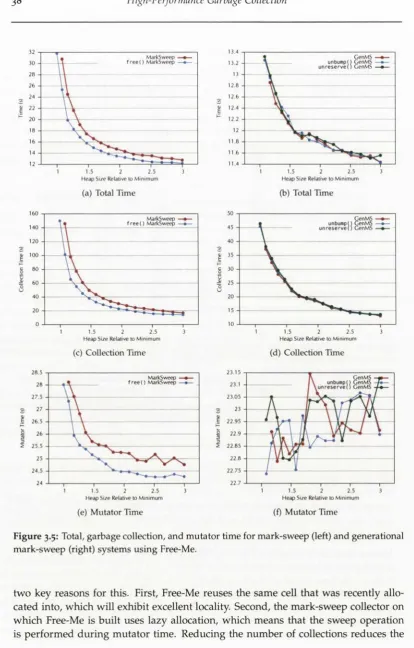
3.5 Total, garbage collection, and mutator time for mark-sweep (left) and generational mark-sweep (right) systems using Free-Me... 38
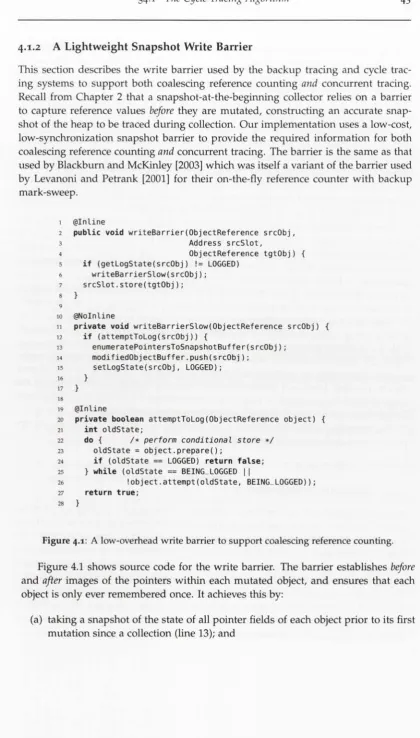
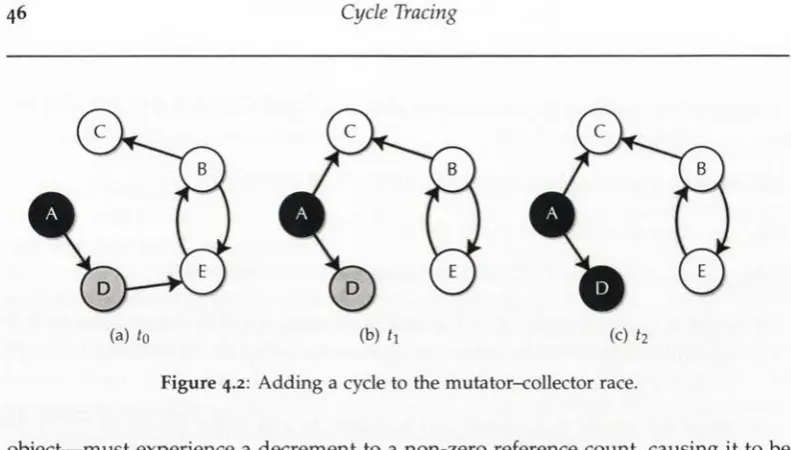
4.1 A low-overhead write barrier to support coalescing reference counting. 43 4.2 Adding a cycle to the mutator-collector race...46
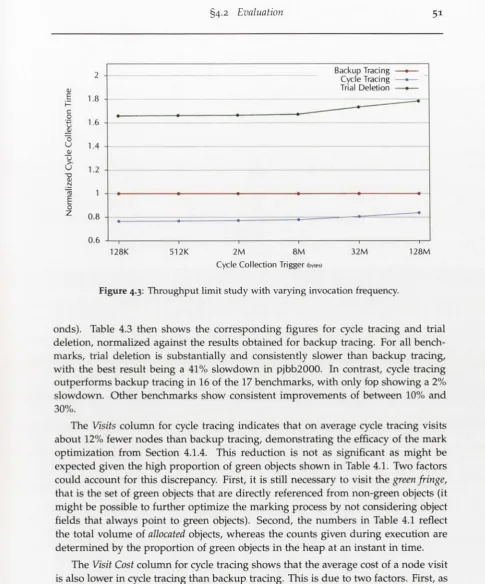
4.3 Throughput limit study with varying invocation freq u e n cy ...51
4.4 Total, mutator, garbage collection, and cycle collection performance for jess... 54
4.5 Total, mutator, garbage collection, and cycle collection performance for javac... 55
4.6 Total, mutator, garbage collection, and cycle collection performance for bloat... 56
5.1 Generational Metronome write barrier pseudo-code... 60
5.2 Initial sequence of nurseries progressing through the three stage life cycle... 60
5.3 References created outside of a nursery collection... 61
5.4 State at the start of the collection of nursery ... 62
5.5 References that may be created during the collection of nursery N^. . . 63
5.6 References that may exist after collection of nursery is complete. . . 65
5.7 Time dilation due to generational collection causes additional alloca tion during a major heap collection, but attenuates all allocation by the survival rate rj(N)... 70
xviii LIST OF FIGURES
5.8 Effect of changing nursery trigger for jess with an 8MB mature collec
tion trigger... 77
5.9 Performance of jess with varying nursery trigger... 78
5.10 Memory usage over time of pjbb2000 under generational and non-generational collection...81
7.1 Unsafe code encapsulated within a safe method...95
7.2 First attempt at an Address type... 98
7.3 Associating a one word payload with Address... 99
7.4 Unboxing with controlled field layout... 100
7.5 Use of intrinsics for Address... 101
8.1 Garbage collection performance for the production configuration before and after the redesign... 108
8.2 Garbage collection performance for the full-heap mark-sweep configura tion before and after the redesign... 108
8.3 MMTk configured to run under a production virtual machine (left) and the MMTk harness (right)...I l l 8.4 Virtualized version of Address... I l l 8.5 MMTk harness unit test that creates cyclic garbage using the MMTk harness scripting language...113
9.1 The architecture of the TuningFork visualization platform... 118
9.2 Folding in the oscilloscope for a task with a period of 45.3515^s... 120 9.3 Oscilloscope view of unexpected and expected scheduling of collector
quanta (colors indicate the type of collection activity occurring, which
List of Tables
3.1 Effectiveness of Free-Me analysis, showing total allocation and the per centage of objects that could be freed by Free-Me and two more restric tive approaches... 37 3.2 Effectiveness of Free-Me analysis for hand-modified versions of three
benchmarks, showing further potential for the Free-Me approach. Per formance for original versions are shown in italics for comparison. . . . 37
4.1 Benchmark statistics showing total allocation, minimum heap size, percentage allocated green (acyclic), and percentage collected due to cyclic garbage...49 4.2 Throughput limit study showing average costs per cycle collection for
backup tracing (invoked after every 8MB of allocation)...52 4.3 Throughput limit study showing average costs per cycle collection for
cycle tracing and trial deletion (invoked after every 8MB of allocation) normalized to backup tracing... 52
5.1 Handling of reference mutations during nursery collections... 64 5.2 Absolute performance for full-heap collector... 74 5.3 Generational Metronome performance relative to full-heap collector. . . 75 5.4 Actual nursery size statistics showing dynamic nursery size variation. . 77
Chapter i
Introduction
This thesis addresses the problem of writing high-quality low-level software, asking
how we can—as well as why we need to—leverage high-level languages for low-level
programming tasks.
l . i Definitions
We start by defining the use of the relative terms high-level language and low-level pro
gramming in this thesis. We use high-level languages to describe languages that provide
type-safety, memory-safety, encapsulation, and strong abstractions over hardware. We define low-level programming as that which requires transparent, efficient access to the underlying hardware an d /o r operating system. Low-level programming in cludes a wide range of applications, but my focus has been on two key applications-.
1) modern language runtimes; and 2) real-time systems.
1.2 Problem Statement
The complexity of computer hardware has increased dramatically, evolving from simple in-order processors with uniform memory access to multicore, heterogeneous, out-of-order, super-scalar processors with non-uniform cache hierarchies. The trend of increasing complexity is only set to continue as hardware designers turn to multi- and many-core designs in order to provide further performance increases [Agarwal et al., 2000].
2 Introduction
In addition to changes in hardware design, greater demands have been placed on software in terms of complexity, with larger, more sophisticated software sys tems, and increased demands for reliability and security. These requirements are extremely challenging for developers of low-level systems software in particular, be cause low-level software is the foundation on which application software is built; without secure, scalable, and reliable low-level software, there is no hope to satisfy software requirements into the future.
Earlier evolutions of computer hardware and software requirements demanded a transition from assembly programming to languages such as C. As hardware and software complexity continue to increase, application programmers are increasingly choosing high-level languages such as C# and Java which raise the level of abstrac tion.
Modern high-level languages, which provide strong abstractions over hardware, have helped to improve how software is written; high-level languages insulate pro grams from changes in hardware, provide concepts such as type- and memory-safety to avoid key classes of programming error, and facilitate building large, secure, and reliable applications in a modular and extensible manner. These high-level program ming trends have, for the most part, not yet reached low-level systems software.
There are exceptions, however, and I have been involved with three research projects that seek to benefit from the application of high-level languages to low-level programming tasks: IBM's Jikes RVM1 (a Java virtual machine written in Java); Mi crosoft's Singularity2 (an operating system written in C#); and IBM's Metronome3 (to allow real-time applications to be written in Java). Each of these projects has helped to shape my research direction.
1.3 Scope and Contributions
Given the potential software engineering advantages of high-level languages, the question one must ask is: "What is preventing the widespread adoption of high-level languages for low-level programming?" The aim of my research has been to identify roadblocks, and develop novel techniques to resolve them.
There are two sources of resistance to bringing high-level low-level programming into the mainstream: technical and social. I seek only to address the technical issues, and have identified three key areas in which the state of the art must be improved to support the goal of high-level low-level programming:
Expressivity. The key to high-level languages is abstraction, yet this abstraction often defeats one of the primary requirements of low-level programming: transpar ent access to detail. To enable high-level low-level programming, it is essential for high-level languages to express necessary low-level aspects, without break ing the high-level language abstractions and thus negating the advantage of
1 http://www.jikesrvm.org
2 http://research, microsoft.com/en-us/projects/singularity/
§i-4 Thesis Outline 3
the language. This thesis describes an approach and a concrete framework, org . vmmagic, for high-level low-level programming in Java.
Garbage collector performance. Low-level code places different demands on run time systems than general application software. While improvements in opti mizing compiler technology have largely resolved the issue of absolute code performance, one of the key benefits of high-level languages— memory safety— relies on garbage collection, which often yields undesirable performance char acteristics in terms of throughput, responsiveness, and predictability. This the sis describes techniques for improving collector performance, as well as two novel garbage collection algorithms that aim to deliver the combination of throughput and responsiveness demanded by low-level applications.
Development tools. The increase in hardware and software complexity has a direct impact on the ability for developers to evaluate, understand, and debug sys tems. Ultimately, the correctness of a low-level program is judged by observed behavior, however, increased complexity makes it difficult to observe and an alyze the behavior of low-level programs. Development tools, in particular those that harness visualization techniques, are well suited to improving this process. This thesis describes TuningFork, a visualization platform for debug ging and evaluating real-time applications running on a real-time Java virtual machine.
This thesis details contributions in each of these areas, with research driven through the development of novel garbage collection approaches for low-level pro grams, including experience using a high-level low-level programming approach.
1.4 Thesis Outline
The body of this dissertation is structured around two key elements arising from the areas listed in the previous section: 1) garbage collection techniques and algorithms, and 2) engineering low-level programs in high-level languages. Garbage collection is discussed first as it provides needed context for the chapters that follow.
Chapter 2 provides an overview of garbage collection and surveys relevant gar bage collection literature. Chapters 3-5 detail contributions to improving garbage collection approaches for low-level systems. Chapter 3 describes novel techniques to improve overall collection performance by improving the performance of fundamen tal mechanisms, while Chapters 4 and 5 discuss new garbage collection algorithms. Chapter 4 describes Cycle Tracing, a technique based on reference counting that pro vides throughput and responsiveness in the face of cyclic garbage. Chapter 5 details
Generational Metronome, a garbage collector that provides improved time and space
behavior while maintaining real-time guarantees.
par-4 Introduction
ticular garbage collectors, are engineered. Chapter 7 identifies the requirements for high-level low-level programming, then describes a concrete framework to support it built on language extension: org . vmmagic. The high-level low-level programming approach is demonstrated in Chapter 8 through a discussion of real-world experi ence. Then, Chapter 9 shows how visualization can be used to help address the problem of understanding low-level programs in the face of increasing hardware and software complexity.
C h ap ter 2
Garbage Collection
Garbage collection is an essential component of modern high-level languages, en abling strong type-safety and memory-safety guarantees. However, garbage collec tion has the potential to adversely affect performance, in terms of throughput, respon
siveness, and predictability. This chapter provides an overview of garbage collection,
covering fundamental algorithms and mechanisms. The focus is on garbage collec tion approaches that have the potential to address all of these performance criteria simultaneously, yielding predictable, highly-responsive, high-throughput systems.
Section 2.1 provides a brief overview of garbage collection, defines necessary terminology, and introduces fundamental algorithms and mechanisms. Section 2.2 dis cusses the performance requirements of low-level programs with respect to garbage collection. Sections 2.3 and 2.4 then describe garbage collection techniques that have the potential to meet the particular performance requirements of low-level program ming. Section 2.3 discusses work on incremental and concurrent tracing garbage col lection: techniques that allow garbage collection to proceed alongside application activity. Section 2.4 then describes an alternative approach based on reference count ing, an inherently incremental approach to garbage collection often used in low-level programming.
2.1 The Anatomy of a Garbage Collector
This section provides a brief overview of garbage collection terminology, algorithms, and mechanisms. For a more complete discussion of the fundamentals of garbage collection see "Garbage Collection: Algorithms for Automatic Dynamic Memory Management" [Jones and Lins, 1996], and "Uniprocessor Garbage Collection Tech niques" [Wilson, 1992].
Programs require data to execute, and this data is typically stored in memory. Memory can be allocated statically (where memory requirements are fixed ahead- of-time), on the stack (tightly binding the lifetime of the data to the currently ex ecuting method), or dynamically, where memory requirements are determined dur ing execution—potentially changing between individual executions of the same pro gram. This dynamically allocated heap memory can be explicitly managed by the program (through primitives such as the C functions malloc and free), or it can be
6 Garbage Collection
Garbage Collected Heap
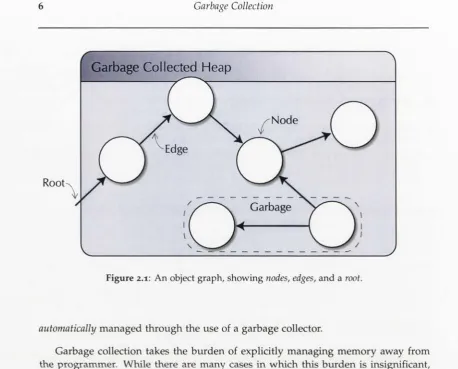
Figure 2.1: An object graph, showing nodes, edges, and a root.
automatically managed through the use of a garbage collector.
Garbage collection takes the burden of explicitly managing memory away from the programmer. While there are many cases in which this burden is insignificant, complex systems with large, shared data-structures make the explicit management of memory both an onerous and error-prone task. The need to manage memory explic itly also compromises software design, forcing additional communication between modules in order to ensure that a global consensus is reached before any shared data is freed.
The role of the garbage collector is to reclaim memory that is no longer required by the application. To assist the discussion of garbage collection, we will view all objects in memory as a directed graph as shown in Figure 2.1. Objects are represented
as nodes, and references between objects are represented as directed edges. There are
also edges originating from outside the object graph—such as values held in program variables—which are known as roots. In accordance with the terminology of Dijkstra et al. [1978], application threads that manipulate this object graph (by allocating new objects and changing the set of edges) are known as mutators, while threads that perform garbage collection work are known as collectors.
Determining precisely when an object will no longer be accessed is difficult in general, so garbage collectors rely on a conservative approximation based on reacha
bility. Any object that is unreachable—that is, there is no path from a root to the node
[image:21.531.20.479.62.431.2]§2.1 The Anatomy of a Garbage Collector 7
2.1.1 Taxonomy of Garbage C ollection Algorithm s
Memory management approaches can be categorized based on how they solve three key sub-problems: object allocation, garbage identification, and garbage reclamation. Naturally, approaches to each of these sub-problems have a synergistic relationship with solutions to other sub-problems. Many memory management approaches are hybrids, drawing on several approaches to each of these sub-problems.
2.1.1.1 Object Allocation
There are two fundamental techniques used for object allocation— bump pointer allo cation, and free list allocation.
Bump pointer allocation. Under bump pointer allocation (see Figure 2.2), memory is allocated by running a cursor across memory, bumping the cursor by the size of each allocation request. Bump pointer allocation is simple and fast at allocation time, but provides no facility for incremental freeing. Given the simplicity of the approach, the design space for bump pointer allocation is quite restricted. One key design consideration is the approach used to allow parallel allocation. Bump pointer alloca tion schemes generally perform synchronized allocation of larger chunks [Garthwaite and White, 1998; Alpern et al., 1999; Berger et al., 2000], which are then assigned to a single thread—allowing fast, unsynchronized bump pointer allocation within the chunk.
Cursor
V
Allocated Free
Figure 2.2: Bump pointer allocation.
Free list allocation. Under free list allocation (see Figure 2.3), memory is divided into cells, which are then maintained in a list—the free list. Throughout this thesis, the free list structure of most interest is the segregated free list, such as that described by Boehm and Weiser [1988].1 The segregated free list scheme (described as a
two-level allocation scheme by Jones and Lins [1996]) attempts to balance the concerns of
fragmentation and throughput performance. In a segregated free list scheme an allo cator manages multiple free lists, each containing a list of empty cells of a single fixed
8 Garbage Collection
size. Because each list contains cells of a fixed size, allocation is fast and no search ing is required. Memory is divided up into larger blocks, each containing cells of a fixed size. Blocks are then managed on a block free list, with empty blocks available for use by any size class. This structure addresses fragmentation for most programs, failing only when a program: 1) allocates many objects of a given size class; 2) keeps a small fraction alive (pinning down many blocks); and then 3) changes allocation patterns to allocate many objects of different size classes. This pathology is generally rare and can be addressed through some form of copying collection.
Head
Figure 2.3: Free list allocation.
2.1.1.2 Garbage Identification
There are two fundamental techniques for identifying garbage data: reference counting
and tracing. Each of these techniques forms the basis for one or more of the canonical
garbage collection algorithms described in more detail in Section 2.1.2.
Reference counting. This method directly identifies garbage. Each object has a ref
erence count, which keeps track of the number of references (incoming edges) to that
object in the object graph. When a reference count falls to zero, the associated object can be considered garbage.
Tracing. This method indirectly identifies garbage by directly identifying all live objects. Tracing involves performing a transitive closure across some part of the ob ject graph—visiting all objects transitively reachable from some set of root edges— identifying each visited object as live. All objects that were not visited during the trace are identified as garbage.
2.1.1.3 Garbage Reclamation
Once objects have been allocated, and those that need to be collected have been identified, there are several techniques that can be used to reclaim the space.
§2.1 The Anatomy of a Garbage Collector 9
Evacuation. Live objects can be evacuated from a region of memory, which once emptied of live data, may be reclaimed in its entirety. This approach requires another region of memory into which the live objects can be copied. Evacuation can be particularly effective when there are very few survivors, and naturally aligns itself with tracing as the approach for identification.
Compaction. Compaction rearranges the memory within the region in-place to al low future allocation into the region. A classic example is sliding compaction [Styger, 1967; Abrahams et al., 1966] where all live data is compressed into a contiguous chunk of used memory, leaving a contiguous chunk of memory free for future allo cation.
Sweep. A sweep is a traversal over allocated objects in the heap, freeing the space associated with objects that have been identified as garbage. Some form of sweep is required by many tracing approaches, because garbage is not identified directly. While sweep generally operates over individual free list cells, it is also possible to use the sweep approach on larger regions of memory.
2.1.2 Canonical Algorithms
This section briefly introduces canonical algorithms that cover the design space laid out above.
2.i.2 .i Reference Counting
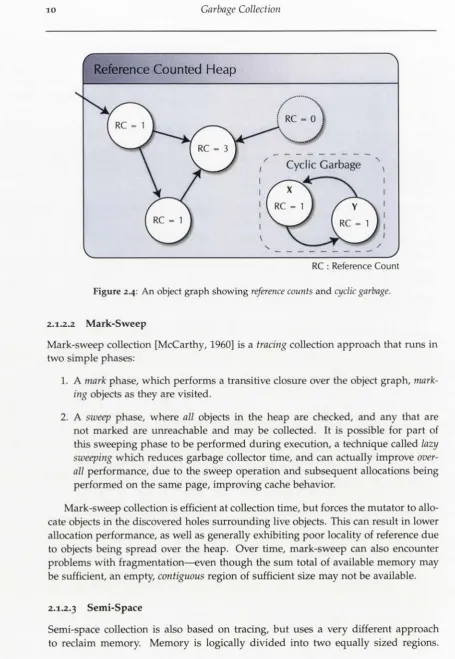
One of the classic forms of garbage collection is reference counting [Collins, I960]. Recall from above that reference counting works by keeping track of the number of incoming edges—or references—to each node in the object graph. When this count drops to zero, the object is known to be unreachable and may be collected. Figure 2.4 shows an object graph with reference counts calculated, and also demonstrates the fundamental weakness of reference counting: cyclic garbage. The objects X and Y are clearly unreachable (there is no path to either of them from any root) but they will never be collected because they still hold counted references to each other. Unless additional work is performed to identify and collect it, cyclic garbage can cause memory leaks.
10 Garbage Collection
Reference Counted Heap
I rc = o
Cyclic Garbage
[image:25.531.20.476.58.718.2]RC : Reference Count
Figure 2.4: An object graph showing reference counts and cyclic garbage.
2.1.2.2 Mark-Sweep
Mark-sweep collection [McCarthy, 1960] is a tracing collection approach that runs in two simple phases:
1. A mark phase, which performs a transitive closure over the object graph, mark ing objects as they are visited.
2. A sweep phase, where all objects in the heap are checked, and any that are not marked are unreachable and may be collected. It is possible for part of this sweeping phase to be performed during execution, a technique called lazy
sweeping which reduces garbage collector time, and can actually improve over
all performance, due to the sweep operation and subsequent allocations being performed on the same page, improving cache behavior.
Mark-sweep collection is efficient at collection time, but forces the mutator to allo cate objects in the discovered holes surrounding live objects. This can result in lower allocation performance, as well as generally exhibiting poor locality of reference due to objects being spread over the heap. Over time, mark-sweep can also encounter problems with fragmentation—even though the sum total of available memory may be sufficient, an empty, contiguous region of sufficient size may not be available.
2.1.2.3 Semi-Space
§2.1 The Anatomy of a Garbage Collector l i
During program execution one region contains objects, while the other region is empty. When garbage collection is triggered, the region containing objects is labeled as the from-space and the empty region is labeled as the to-space. Garbage collection proceeds by performing a transitive closure over the object graph, copying all nodes encountered in from-space into to-space—updating all edges to point to the copied objects in to-space. At the end of collection all reachable objects have been copied out and saved, and all that remains in the from-space is unused. This from-space is now considered empty, and the to-space contains all live objects: a reversal of the roles of the two regions prior to the collection. Initial implementations of copying collectors used a recursive algorithm [Minsky, 1963; Fenichel and Yochelson, 1969] but a simple iterative algorithm was later introduced by Cheney [1970]. In comparison to mark- sweep collection, semi-space collection:
• makes less efficient use of memory as it must hold 50% percent of total memory as a copy reserve to ensure there is space to copy all objects in the worst case;
• can be more expensive at collection time because all live objects must be copied;
• can be cheaper at collection time if very few objects survive, because no sweep phase is required;
• can utilize efficient bump pointer allocation, because free memory is always maintained as a contiguous block; and
• has less problems with fragmentation, because live objects are copied into a contiguous chunk of memory.
2.1.2.4 Mark-Compact
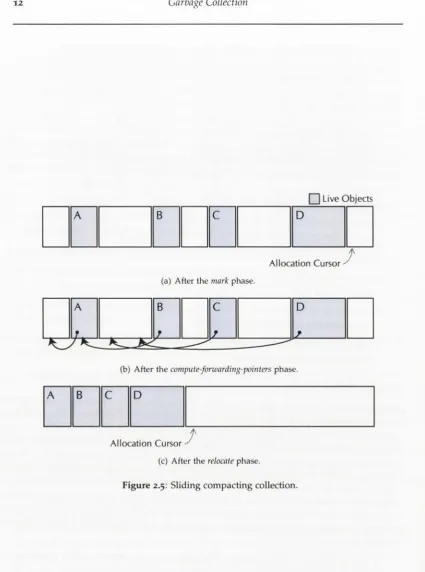
Mark-compact collection aims to combine the benefits of both semi-space and mark- sweep collection. It addresses fragmentation often seen in mark-sweep by compacting objects into contiguous regions of memory, but it does so in place rather than relying on the large copy reserve required by semi-space collection. While this in-place tran sition saves space, it typically involves significant additional collection effort. This is because additional care must be taken to ensure that the target location of a copied object does not contain live data. A simple form is sliding compaction, which logi cally compresses all live objects—in allocation order—into a single contiguous chunk. A simple sliding compaction algorithm—known as the LISP-2 algorithm [Styger, 1967]—proceeds as follows, with the state at the conclusion of key phases shown in Figure 2.5:
1. A mark phase, which performs a transitive closure over the object graph, mark ing objects as they are visited.
12 Garbage Collection
Live Objects
A B C D
Allocation Cursor ^
(a) After the mark phase.
A B C D
f z _ 2 _
(b) After the compute-forwarding-pointers phase.
A B C D
t
Allocation Cursor
[image:27.531.53.479.64.637.2](c) After the relocate phase.
§2.1 The Anatomy of a Garbage Collector 13
3. A forzuarding phase, where all pointers are updated to reflect the addresses calculated in the previous phase. Note that after this phase all references point to future locations of objects, rather than the current location.
4. A relocation phase, where objects are copied to their target locations in address order. The address order is important as it ensures that the target location does not contain live data.
The additional phases of simple compaction algorithms make them significantly more expensive than simple mark-sweep or semi-space collection. While there have been many attempts to reduce this cost—by optimizing the phases, reducing the number of phases, or by implementing the phases as operations on compact repre sentations of the heap [Kermany and Petrank, 2006]—compaction is rarely used as the sole collection strategy in a high-performance system. Compaction is, however, commonly combined with mark-sweep collection (to provide a means to escape frag mentation issues), and is often used alongside semi-space collection [Sansom, 1991] to allow execution to continue when memory is tight.
2.1.2.5 Mark-Region
Mark-Region is a collection approach that combines contiguous allocation and non copying tracing collection. The motivation of this approach is to combine the mutator performance of semi-space with the collection performance of mark-sweep. In terms of allocation, mark-region is similar to semi-space, with objects allocated into con tiguous regions of memory using a bump pointer. In terms of collection, mark-region is similar to mark-sweep, but sweeps entire regions; regions with no reachable objects are made available again for contiguous allocation. Immix [Blackburn and McKin ley, 2008] provides the first detailed analysis and description of a mark-region col lector, although a mark-region approach was previously used in JRockit [Oracle] and IBM [Borman, 2002] production virtual machines. A mark-region collection proceeds as follows:
1. A mark phase, which performs a transitive closure over the object graph, mark
ing regions which contain live objects as each object is visited.
2. A sweep phase, where regions that were not marked in the previous phase are made available for future contiguous allocation.
14 Garbage Collection
2.1.3 Generational Collection
Generational garbage collection [Lieberman and Hewitt, 1983; Moon, 1984; Ungar, 1984] is perhaps the single most important advance in garbage collection since the first collectors were developed in the early 1960s. The generational hypothesis states that most objects have very short lifetimes. Generational collectors are optimized for when this hypothesis holds, and thereby attain greater collection efficiency by focusing collection effort on the most recently allocated objects.
Generational collectors partition the heap into generations based on allocation age. This thesis considers only the basic form of generational collection, where the heap is divided into two generations: the nursery—containing the most recently allocated set of objects—and the mature area—containing all other objects. In order to indepen dently collect the nursery, generational collectors must remember all pointers from the mature space into the nursery. This can be achieved by building a remembered set of pointers created into the nursery, or by remembering regions of the mature space (usually referred to as cards) that contain nursery pointers, and must be scanned at nursery collection time. References from the mature space into the nursery, in combi nation with any other roots (e.g., program variables), then provide the starting point for a transitive closure across all live objects within the nursery. A partial copying collection can be performed during this closure, with live objects evacuated from the nursery into the mature space. When the generational hypothesis holds, this collec tion is very efficient because only a small fraction of nursery objects must be copied into the mature area.
2.1.4 Barriers
Barriers are operations that are injected into mutator code surrounding mutator op
erations that may affect the garbage collector. Barriers are most commonly inserted on read and write operations, and are essential tools for more powerful garbage col lection algorithms. In reference counting collectors, reference write barriers can be used to perform necessary reference count increments and decrements. Generational collectors may also rely on reference write barriers to intercept pointers created from mature objects to nursery objects. Concurrent and incremental garbage collectors may make extensive use of read and write barriers to keep them informed of poten tially destructive changes, and to ensure that mutators are operating on and updating the appropriate data.
§2.2 Garbage Collection for Low-level Programs *5
2.2 Garbage Collection for Low-level Programs
Garbage collection can deliver significant software engineering benefits, but the pres ence of garbage collection can adversely affect application performance. To achieve the requisite combination of throughput and responsiveness demanded by low-level programs, it is necessary to use garbage collection techniques that allow both col lectors and mutators to progress within relatively short time windows. This section discusses how garbage collection can affect mutator performance, and introduces metrics to help quantify the problem. Sections 2.3 and 2.4 then describe existing garbage collection strategies that allow mutator progress during a collection cycle.
Given that the collector operates over the same object graph as mutators, there is the potential for conflict between mutator and collector. In order to safely and ac curately perform collection work, collection algorithms are thus forced to either stop all mutators from proceeding during collection work, impose some synchronization burden onto both collector and mutator, or a combination of both. This has signifi cant potential to affect mutator performance, both directly—in terms of reduced pro cessor time and collector synchronization overheads—as well as indirectly—through changes in mutator locality (positive or negative) and changes in timing behavior due to unpredictable collector interference. Overall throughput performance can suffer if too much processor time is used for garbage collection, or if the choice of collec tion an d /o r allocation technique negatively affects data locality. Predictability can be affected because the amount of time required to perform seemingly identical oper ations can change (even by orders of magnitude) when garbage collection is active. Some activities cannot tolerate significant variation, and so need garbage collectors that provide responsiveness guarantees. Strong responsiveness guarantees typically come with a significant cost to overall throughput, and while this is acceptable for some applications, it is generally not acceptable for low-level programs.
2.2.1 Measuring Garbage Collection Interference
Given that low-level programs may have strict performance requirements in terms of throughput and responsiveness, there is a clear need to both specify what these re quirements are, as well as identify a means to evaluate the characteristics of individual approaches.
2.2.1.1 Throughput
The throughput, or overall execution time required to perform a given task, can be affected by the presence of garbage collection. This effect can be both direct (the collector itself requires resources to run) and indirect, with the choice of collector changing how mutator code is executed.
i6 Garbage Collection
collector predictable, by making it either constant (i.e., independent of the current phase of the collector) or a simple function of the current collector phase (so that it can be compensated for in any calculations). This thesis assumes the former model, where any performance guarantees, along with any mutator time measurements, are inclusive of any garbage collector burden. This approach is suitable for the collectors discussed in this thesis, in which most operations have a fairly uniform cost. The approach would, however, be problematic for work-based collectors such as Baker's collector [Henry G. Baker, 1978], where the cost of individual operations can vary greatly due to the collection state of objects.
In order to compare mutator throughput, total mutator time can be measured for each system across a single workload. This comparison accounts for primary effects (such as the choice of allocator and barrier operations) as well as secondary effects (such as changes in cache locality).
2.2.1.2 Responsiveness and Predictability
Some garbage collectors interrupt the execution of mutators by taking exclusive ac cess to the heap. While this simplifies the synchronization of mutator and collector activity, it has the potential to affect the responsiveness of the application, which is a critical concern for many systems. With responsiveness as a key requirement, it is important to have a metric to measure it. The length of the longest interruption—or maximum pause time—that is imposed on the mutator by a garbage collector is an obvious choice, but maximum pause time can be a poor measure of overall respon siveness. While a mutator cannot make progress during a long collector pause, it is also possible that a mutator may not make sufficient progress if it encounters a sequence of many short pauses.
Looking at the problem from the perspective of an application, suppose we have a unit of application work that is guaranteed to take at most 7ms to complete (as suming the application is given all resources), and that the application is required to complete such a unit of work within 10ms. To guarantee that this is possible (given that the application may execute this unit of work at any moment) we must ensure that for any given 10ms of execution time at least 7ms is given to the mutator. While it is impossible to guarantee such behavior if there are individual collection pauses longer than 3ms, more than three 1ms collection pauses in an individual 10ms window would also not meet the requirement. In order to guarantee that the 7ms application work unit can execute within an arbitrary 10ms window, we can restate our requirement to say that the application must have a minimum mutator utilization (MMU) [Cheng and Blelloch, 2001] of 70% within each 10ms time window.
§2.3 Concurrent and Incremental Tracing Collection 17
as the time window becomes smaller. In the limit, it becomes necessary to introduce additional programming environments that can safely run concurrently to the collec tor, and seamlessly integrate into the high-level language environment [Bollella and Gosling, 2000; Spoonhower et al., 2006; Titzer, 2006; Auerbach et al., 2007b; Spring et al., 2007; Auerbach et al., 2008b].
While minimum mutator utilization handles the key situation in which measur ing pause time is problematic—bursts of many short pauses—it is by no means a perfect metric for measuring responsiveness, or assessing the suitability of a collec tion strategy for real-time systems. In real-time systems it is often possible to use a
slack-based scheduling approach where garbage collection increments are scheduled
around real-time tasks. The correctness of such a system is governed by there be
ing sufficient slack surrounding real-time tasks to execute garbage collection work, although the garbage collector itself may not meet any MMU guarantees. MMU provides an indication of overall responsiveness, and is well suited to many classes of real-time applications, and makes it possible to develop a model to guarantee real-time behavior with only a few high-level application and collector characteris tics. MMU and slack based scheduling can be combined in a hybrid approach, such as the Metronome Tax-and-Spend [Auerbach et al., 2008a] collector, which meets an MMU specification but uses slack to accumulate a surplus of collector work to allow longer periods of sustained mutator utilization.
2.3 Concurrent and Incremental Tracing Collection
Given strict requirements for responsiveness, an obvious goal is to allow mutator progress during a collection cycle. There are two broad approaches to allowing mu tator progress during tracing collection: incremental collection, and concurrent col lection. This thesis uses the term incremental collection to describe systems where a single collection cycle is broken into increments of collector work, but where only mutators or collectors are running at any point in time. Concurrent collection is used to describe systems where both collector and mutator threads are running and pro gressing simultaneously.
Under both concurrent and incremental collection, some form of synchronization between collector and mutator must be performed to ensure that: 1) all garbage is ultimately collected, 2) no live memory is incorrectly collected, and 3) garbage collection is guaranteed to terminate. There is a substantial literature on concurrent garbage collection with seminal work dating back to the 1970s [Steele, 1975; Dijkstra et al., 1978].
2.3.1 The Tricolor Abstraction
i 8 Garbage Collection
White nodes have not been visited by the collector. All nodes start white, and those that remain white at the end of collection are garbage.
Gray nodes have been visited by the collector, but have not yet had their outgoing edges inspected.
Black nodes have been visited by the collector, and all outgoing edges have been traversed.
2.3.2 The Mutator-Collector Race
Figure 2.6 illustrates the fundamental race that an incremental or concurrent tracing collector must address. At 10, the collector has processed A, marking the sole referent B gray (enqueuing it for later processing), and finally marking A black. At t\, the mutator has created an edge from A to C, and removed the edge from B to C. At time t2 the collector resumes execution by processing B, which involves simply marking B as black as there are no outgoing edges from B. C is thus left white at the end of the collection, but it is still live. Jones and Lins [1996, Chapter 8] state the conditions for this race to cause the collection of live data to be:
Cl. A pointer from a black object to a white object is created.
C2. The original reference to the white object is destroyed.
Figure 2.6: The mutator-collector race.
However, as Figure 2.7 shows, the introduction of an intervening node, D, be tween A and B makes it dear that C2 must be modified to account for the white object becoming indirectly unreachable. The following modified condition accounts for this case:
C2'. The original path to the white object is destroyed.
§2-3 Concurrent and Incremental Tracing Collection 19
Figure 2.7: Adding an extra node to the mutator-collector race.
2.3.2.1 Incremental-Update Algorithms
Incremental-update algorithms use write barriers (see Section 2.1.4) to monitor muta tions to the heap and directly ensure that no pointers from black to white objects are created. There are two seminal incremental update algorithms, both dating from the mid 1970s. Dijkstra et al. [1978] describe a conservative approach, marking the target of a new reference gray if it was white, regardless of the color of the source. Steele [1975] describe a less conservative approach, marking the source gray if it was black and the target was white. Abstractly, Steele's algorithm retreats the gray wave-front, while Dijkstra et al.'s advances it. Conservatism in this case affects the volume of
floating garbage: garbage that will not be reclaimed by the current collection cycle and
will consume memory until after the next garbage cycle.
Extension to support multiple mutators. The Doligez-Leroy-Gonthier algorithm [Doligez and Leroy, 1993; Doligez and Gonthier, 1994] is an extension of Dijkstra et al.'s algorithm to work in the case of multiple mutator threads, and has been subsequently implemented for Java [Domani et al., 2000b,a]. The key idea is to use a
handshake mechanism to allow mutators to agree on phase changes without requiring
all mutators to stop. Handshake mechanisms are now frequently used in concurrent collectors to perform operations such as enabling or disabling barriers, flushing or clearing data structures, executing special machine instructions, or changing the color to be used for newly allocated objects.
2.3.2.2 Snapshot-at-the-Beginning Algorithms
20 Garbage Collection
object remembering barrier. The first time an object is mutated during each collection, the original state of every reference in the object is logged, with a pointer to the log recorded in an additional word in the object's header. Any unlogged objects encountered during collection are also logged prior to processing. All of these logged copies of objects make up a virtual before-image of the state of all references as at the start of the collection, which is what is traced by the collector. All snapshot-at-the- beginning approaches may create significant amounts of floating garbage, because they make no attempt to collect any garbage created after the snapshot.
2.3.3 Incremental and Concurrent Copying
While good allocator design may reduce the problem of fragmentation [Johnstone and Wilson, 1998], when attempting to provide strict bounds—on time, space, or utilization—the issue of worst case (rather than common case) fragmentation must be addressed.2
The previous two sections describe techniques to ensure that the correct set of objects were identified as garbage. In the case of either incremental or concurrent copying collection, there is the additional race between the collector relocating an object, and the mutators performing reads and writes of the fields of the object. Section 2.3.3.1 discusses the problem of incremental copying, essentially described as a problem of ensuring that mutators operate on the correct version of an object. Concurrent copying—far more complicated as mutations are allowed to occur during the copy operation of an object—is discussed in Section 2.3.3.2.
2.3.3.1 Incremental Copying Algorithms
Henry G. Baker [1978] introduced an incremental version of the simple semi-space algorithm (see Section 2.1.2.3) for uniprocessors, where small increments of work are performed at each allocation. Because copying progresses incrementally, the system must ensure that mutators see a consistent view of the heap. The simplest method to achieve this—as used in Baker's work—is with a reference read barrier (code that is executed whenever the mutator reads a reference) to maintain a to-space invariant. This invariant ensures that the mutator can only ever access objects that have been fully processed by the collector. When a reference into from-space is encountered, the mutator must perform an additional increment of collection work (and either copy the object or forward the reference if copying has already been performed). Brooks [1984] modifies Baker's algorithm by using a read barrier that unconditionally indirects to the current version of the object, trading off additional space to store a forwarding pointer in every object against a reduction in code size and improved run-time performance.
§2-3 Concurrent and Incremental Tracing Collection 21
Appel et al. [1988] avoid the use of a read barrier altogether by leveraging hard ware protection mechanisms for virtual memory to detect accesses to from-space (a refinement due to Johnson [1992] improves this by reducing the per-page scan ning work required). Ben-Yitzhak et al. [2002] and Kermany and Petrank [2006] also use memory protection based approaches to allow partial compaction during mostly non-moving collection. Click et al. [2005] introduce a similar approach but use cus tom hardware combined with a special mutator read instruction that traps to the collector when the target reference is on a page that is being relocated.
Nettles and O'Toole [1993] require neither a read barrier nor virtual memory hardware protection. Mutators continue to operate on from-space objects (instead of to-space objects) during collection, and use a write barrier on all fields (including non-reference fields) to maintain a mutation log. This mutation log is then used by the collector to create a consistent copy of the heap.3 Meyer [2006] implements the read barrier for a Baker-style collector in custom hardware, which is extended by Stanchina and Meyer [2007] into a hardware-based mostly non-copying collector of similar design.
Eager versus lazy barriers. It is interesting to note that to-space or from-space in variants can be enforced eagerly or lazily [Bacon et al., 2003b] through barrier oper ations. Eager barriers ensure that all references in registers or on the stack meet the invariant, meaning that the barrier is applied to references being brought into the set (e.g., when a reference is read from the heap). Lazy barriers do not enforce an invariant on references held in registers on the stack, but instead ensure that each use of a reference is protected to ensure the invariant is met (e.g., just prior to a reference value being used for any heap operation). For naive implementations there appears to be a clear trade-off: lazy barriers allow more incremental processing (because the stack and registers can be lazily updated), but are likely to do more work because work must be done for every heap access, not just reference accesses. However, as stated by Bacon et al. [2003b], when subjected to aggressive optimization, both oper ations tend towards a common solution, and are therefore similar in terms of cost.
2.3.3.2 Concurrent Copying Algorithms
The copying algorithms described in the previous section do not perform the copying operation concurrently: mutators are either all suspended while copies are made, or stalled if they try to access an object that is being copied. Concurrent mutation and copying of individual objects adds significant complexity. Herlihy and Moss [1992] work around this problem by making objects immutable and maintaining modifica tions as a singly linked list of object versions. A change to an object field thus involves making a copy, updating field values, and then atomically installing the link to the
22 Garbage Collection
new version. If this fails it indicates that there was a race to update and it is necessary to update to the new latest version and retry. Although valuable from a theoretical standpoint, it is hard to see how this algorithm could be implemented efficiently in practice.
Sapphire [Hudson and Moss, 2001] performs copying collection concurrently in Java without the use of a read barrier, by using a write barrier to replicate mutations (of reference and non-reference fields) in older versions of objects to the in-progress copy. Sapphire may provide unexpected results when concurrent updates to an object field occur. Two updates U\ and U2 to a single field / could be committed to memory
in the order U\U2 on the old version of the object, but replicated as U2U\ on the
new version of the object, making it possible for the observed value of the field / to change when the switch from the old version to the new version occurs. While the Java memory model permits this behavior (due to the lack of synchronization) the effect may be surprising to programmers so is generally considered undesirable.
Stopless [Pizlo et al., 2007] provides concurrent copying while maintaining a more understandable memory model than Sapphire through the use of a wide object dur ing copying, where each field has a corresponding status word for synchronization. Fields are individually and atomically copied into the wide object, using an atomic compare-and-swap operation of the field alongside its corresponding status word. Once in the wide object, a second phase of copying returns the object to a normal, narrow object format, again using atomic compare-and-swap operations on the wide object to ensure correctness. Staccato [McCloskey et al., 2008] and Chicken [Pizlo et al., 2008] avoid the need for a wide object by optimistically performing the copy but invalidating and abandoning the copy when mutation occurs by marking the header of each object during each update. Pizlo et al. [2008] also describe Clover, a modification of Stopless that uses a randomly chosen marker value, a, to indicate that an individual field has been forwarded. Mutators use compare-and-swap oper ations to write to fields, and when they detect cc values they read from the new copy of the object. The downside of this approach is that any mutator wanting to write an a value must wait for copying to complete, although a good choice of a would make this quite unlikely. Clover thus trades an absolute guarantee that the mutator will not have to wait for an improvement in execution time.
2.4 Reference Counting Collection
This section discusses reference counting, an alternative to the concurrent and incre mental tracing collectors discussed above, that also allows collector activity to pro ceed alongside mutators. Reference counting, as an inherently incremental approach to collection, is a natural fit for applications that require high levels of responsiveness.