THESES SIS/LIBRARY
R.G. MENZIES LIBRARY BUILDING NO:2 THE AUSTRALIAN NATIONAL UNIVERSITY CANBERRA ACT 0200 AUSTRALIA
TELEPHONE: +61 2 6125 4631 FACSIMILE: +61 2 6125 4063 EMAIL: library,[email protected]
USE OF THESES
This copy is supplied for purposes
of private study and research only.
Passages from the thesis may not be
copied or closely paraphrased without the
by
Cameron Holley
Submitted in fulfilment of the requirements for the degree of
Doctor of Philosophy
of the Australian National University
June 2008
ANU
This thesis contains no material which has been accepted for the award of any other degree
or diploma in any university. To the best of the author’s knowledge, it contains no material
previously published or written by another person, except where due reference is made in the
text.
Deep thanks to my beautiful partner Mercedes for her support, inspiration, love and
patience; to my supervisory panel Neil, Clifford and Monique for their encouragement and
enlightenment; to Wayne and Brendan for making time in Canberra enjoyable, and finally to
Abstract
This thesis empirically examines a bold and profoundly new way of governing
environmental problems. This so called “new environmental governance” (NEG) is palpable
around the globe and aims to overcome the limitations of the interventionist state and its market
alternative to offer more effective and legitimate solutions to today’s most pressing
environmental problems. To counter the pathologies of these traditional approaches, NEG
emphasises a host of novel characteristics including participation, collaboration,
decentralisation, deliberation, flexibility, learning and adaptation and “new” forms of
accountability.
While these unique features have generated significant praise and excitement from scholars,
there has in fact been very few systematic evaluations of NEG programs in practice, and it is
still unclear whether this unique approach will in fact “work”, and if so, when and how.
Responding to these issues, this study seeks to contribute to closing the gap between theory
and practice by examining the conditions under which we can achieve “good” NEG. Focusing
its inquiry around some of the most central, controversial and/or under researched
characteristics of NEG, the thesis provides insights into the conditions under which we can best
achieve successful collaboration, effective learning and adaptation, meaningful participatory
and deliberative governance and effective forms of accountability.
To derive its insights the thesis examines three Australian experiments in NEG that cover
point source pollution, diffuse urban pollution and natural resource management. Comparing
across these diverse cases ensures the study goes beyond the limited existing research by
capturing a wide diversity of conditions and offering unique comparative insights into the
operation of NEG in different policy areas.
The findings that emerge suggest that NEG can work, but it may not be as straightforward
or as effective as many may hope. This conclusion leads the thesis to identify seven key
conditions or pillars of “good” NEG that are central to its success and can provide useful
guidance for practitioners and scholars. The thesis also reveals four additional key insights for
NEG theory. First, the findings suggested that NEG in practice supports claims by both critics
and proponents of N EG ’s novel approach to governance. This leads the thesis to counsel both
sides to put the boxing gloves to one side and better respond to the world as it is rather than as
they would like it to be. Second the thesis’ research confirms the hybridity hypothesis regarding
the interaction between law and new governance. Thirdly, it provides some key insights into the
role of the State, suggesting that it remains strong and active, but pointing to the need for
normative theories to better address the thesis’ findings regarding the risks of State authority.
Table of Contents
C a n d id a te 's D eclaratio n ... ii
A ckno w ledgem ents... iii
A b s tra c t... iv
T able of C o n te n ts ...vi
List of T ables...xii
List of Boxes...xiii
List of acronyms and abbreviations... xiv
C h a p te r 1: Intro d u cin g the New E n vironm ental G o v ern an ce... 1
1.1 Background... 1
1.2 W h a tis N E G ? ... 3
1.3 The Emergence of N E G ... 6
1.4 NEG Scholarship and Empirical Q uestions... 16
1.4.1 Introducing NEG Scholarship...16
1.4.2 Empirical Questions...18
1.4.3 This S tudy...21
1.4.3.1 Research Questions...21
1.4.3.2 Case Studies... 23
1.4.3.3 Contribution... 24
1.5 O utline...26
C h a p te r 2: New E nvironm ental G overnance Theory -...28
2.1 Introduction... 28
2.2 Key Theories in NEG Scholarship... 28
2.2.1 NEG Experiments and Scholarship in the U S A ... 29
2.2.2 NEG Experiments and Scholarship in A ustralia... 36
2.2.3 NEG Experiments and Scholarship in Europe... 42
2.2.4 Sum m ary...44
2.3 The Defining Elements of N E G ... 45
2.3.1 Defining Characteristics of N EG ... 45
2.3.1.1 Collaboration... 46
2.3.1.2 Participatory and Deliberative A spirations...48
2.4 NEG Questions and Debates...57
2.4.1 When and how can NEG achieve successful collaboration?... 57
2.4.1.1 Issues regarding the emergence of successful collaboration.... 57
2.4.1.2 Issues regarding the survival of collaboration... 64
2.4.2 Issues regarding NEG’s Participatory and Deliberative A spirations?... 70
2.4.3 When and how can NEG foster effective learning and adaptation?... 78
2.4.4 Issues regarding “new” forms o f accountability... 79
2.5 C onclusion... 83
C h a p te r 3: M ethodology - exam ining the conditions of “ good” N E G ... 85
3.1 Introduction... 85
3.2 Theoretical Perspectives and Knowledge C la im s...86
3.2.1 Qualitative and Quantitative R esearch...86
3.2.2 Knowledge Claims and Theoretical Perspectives... 88
3.3 Strategies of Inquiry that Inform the Research Project... 90
3.3.1 Why Adaptive Theory?... 90
3.3.2 Why a Collective Case Study ? ...92
3.4 Research Design and Process... 93
3.4.1 Flexibility in Research Process...93
3.4.2 Selecting C ases... 94
3.4.3 Selecting participants...105
3.5 Methods of Data Collection and A nalysis... 107
3.5.1 Methods of Data Collection... 107
3.5.2 Interview ing... 108
3.5.2.1 Rationale for choosing interviewing m ethod... 108
3.5.2.2 Type of interview s...109
3.5.2.3 The questions... 110
3.5.2.4 Interviewing P ro c ess...111
3.5.2.5 Documentary A nalysis... 116
3.5.3 Data A nalysis... 117
3.5.3.1 Transcribing and N V ivo... 118
4.1 Introduction... 128
4.2 Environment Improvement Plan - NEG and Point Source Pollution... 129
4.2.1 Background and History of EIP...129
4.2.2 Overview of EIP and international com parisons... 130
4.2.3 EIP and the defining characteristics of N E G ... 133
4.2.3.1 Collaboration... 133
4.2.3.2 Participatory and Deliberative A spirations...134
4.2.3.3 Learning and adaptation... 136
4.2.3.4 “New” Forms of Accountability...138
4.2.4 Sum m ary...140
4.3 Neighbourhood Environment Improvement Plan - NEG and Complex Environmental Problem s... 141
4.3.1 Background and History of NEIP... 141
4.3.2 Overview of NEIP and International Comparisons... 142
4.3.3 NEIP and the Defining Characteristics of N E G ... 144
4.3.3.1 Collaboration... 144
4.3.3.2 Participatory and Deliberative Aspirations...145
4.3.3.3 Learning and Adaptation... 147
4.3.3.4 “New” Forms of Accountability...148
4.3.4 Sum m ary...150
4.4 Regional Natural Resource Management- NEG and Natural Resources... 150
4.4.1 Background and History of RN RM ... 150
4.4.2 Overview of RNRM and International Comparisons... 153
4.4.3 RNRM and the Defining Characteristics of N E G ... 157
4.4.3.1 Collaboration... 157
4.4.3.2 Participatory and Deliberative A spirations...159
4.4.3.3 Adaptation and Learning... 161
4.4.3.4 “New” forms of Accountability...163
4.4.4 Sum m ary...168
4.5 C onclusion... 168
5.1 Introduction... 170
5.2 Fostering the emergence of collaboration: the legal design of the c ases...172
5.2.1 Overview of design features that support the formation of collaboration 172 5.2.2 Subsidising and reducing transaction costs... 175
5.2.3 Building T ru st... 179
5.2.4 Consensus Decision R u les... 180
5.2.5 Sum m ary...182
5.3 Fostering the Emergence of Successful Collaboration in Practice... 182
5.3.1 Environment Improvement Plans - Collaboration without Trust and Collaboration with Little C au se...183
5.3.2 Neighbourhood Environment Improvement Plans: flawed design and limited su ccess... 194
5.3.3 RNRM - the challenges of nested arrangements... 206
5.4 Discussion and conclusions...216
C h a p te r 6: P articip ato ry and D eliberative A s p ira tio n s ...225
6.1 Introduction... 225
6.2 What kinds of “participation” and “deliberation” do the cases pursue?...226
6.2.1 Participation - inclusiveness and representation... 227
6.2.1.1 Inclusiveness... 227
6.2.1.2 Representativeness... 228
6.2.1.3 Achieve inclusive and representative ideals - impact of legislative design... 229
6.2.2 Deliberative decision m aking...232
6.2.2.1 Negotiation processes... 232
6.2.22 Achieve fair and reasoned negotiation - legislative design... 233
6.2.3 Sum m ary... 235
6.3 Participation and Deliberation in Practice - EIP, NEIP and R N R M ... 238
6.3.1 Participation - include and represent all affected interests... 238
6.3.1.1 Representation patterns across the cases - inclusion, equality and rough balance o f interests?... 238
6.3.1.2 Explanations for representation patterns...244
6.3.2 NEIP sub case 3 and principal-agent representation...251
6.3.3 Deliberative decision making p rocesses...253
C h a p te r 7: A ccountability and L e a rn in g ... 272
7.1 Introduction... 272
7.2 Designing “new” forms of accountability and learning... 275
7.2.1 Accountability... 276
7.2.1.1 Overview of accountability m echanism s...276
7.2.2 Designing accountability for performance... 280
7.2.2.1 Setting performance targets...280
1.2.2.2 Monitoring implementation and progress against targets... 283
1.2.23 S um m ary...284
7.2.3 Learning and Adaptation... 285
7.3 Accountability and learning in practice - findings... 287
7.3.1 EIP - Accountability and learn in g ... 287
7.3.1.1 Accountability - achievements and limitations in a process and performance based regim e... 287
7.3.1.2 Learning - success and limitations of process based learning and adaptive m anagem ent...295
7.3.2 NEIP - accountability and learning... 298
7.3.2.1 Imprecise targets and inept monitoring-the failings of new forms of accountability... 298
7.3.2.2 Learning - failure to implement adaptive management and systematic learn in g ...305
7.3.3 RNRM Accountability and learning... 308
7.3.3.1 Accountability - success and limitations of performance based accountability in natural resource m anagement... 308
7.3.3.2 Learning - adaptive management and systemic learning... 315
7.4 Discussion and C onclusions... 318
C h a p te r 8: M aintaining an d Sustaining C o lla b o ra tio n ...328
8.1 Introduction... 328
8.2 Designing sustainable collaboration: How do the cases intend to sustain collaborative groups?... 330
8.2.1 Overview of design feature that support survival... 330
8.2.2.1 EIP and NEIP c ases...332
8.2.2.2 The RNRM case... 335
8.2.3 Sum m ary...337
8.3 Sustaining successful collaboration in p ractice...338
8.3.1 EIPs - the “lifecycle” of collaboration... 338
8.3.2 NEIPs - breakdowns, stoppages and m alfunctions...348
8.3.3 RNRM - the benefits and limits of funding support...355
8.4 Discussion and C onclusions... 363
Chapter 9: Conclusion - ...371
9.1 Review and background...371
9.1.1 Conditions for achieving “good” N E G ...374
9.2 Insights for theory... 379
9.3 R esearch... 387
9.4 Concluding Com m ents... 388
R eferences...390
Appendix 1: Interview Protocol and Consent F o rm ... 420
Table 2.2: Overview of Some of the Core Institutions in
Democratic Experimentalism
Table 2.3: Illustrations of NEG Experiments in Australia
Table 2.4: Design Principles for Long-Term Cooperation
Table 3.1: Overview of Programs Selected as Case Studies
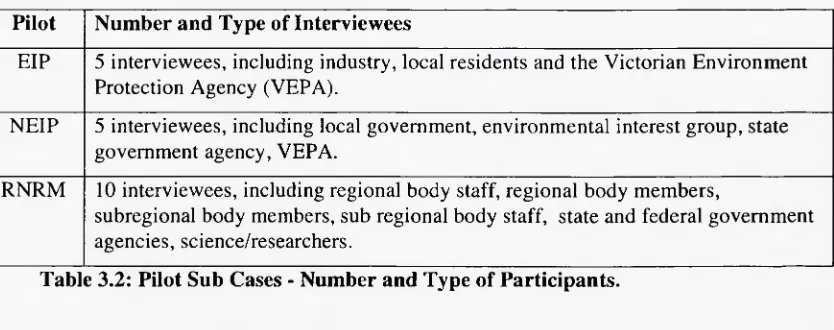
Table 3.2: Pilot Sub Cases - Number and Type of Participants
Table 3.3: Overview of Sub Cases
Table 3.4: Examples of Sampling Approach and Benefits to Study
Table 3.5: Number and Types of Interviews for Each Case
Table 3.6: Examples of Coding Used in Research
Table 4.1: Illustrations of Nested Structures in RNRM
Table 4.2: Overview o f RNRM Targets
Table 5.1: Stakeholders Across the Three Case Studies
Table 5.2: Three Examples of Typical EIP cases
- “Good”, “Poor” and “Leading” Performers
Table 5.3: Background to the Emergence of Collaboration in NEIP 1
Table 5.4: Background to the Emergence of Collaboration in NEIP 2
Table 5.5: Background to the Emergence of Collaboration in NEIP 3
Table 5.6: Background to the Emergence of Collaboration in RNRM
Table 6.1: Illustrative Quotes from Guidelines Regarding
Criteria o f Inclusiveness and Representation
Table 6.2: Illustrative Quotes from Guidelines Regarding Deliberative Criteria
Table 6.3: Overview of Environmental Interest Group Membership in Cases
Table 7.1: Overview o f Accountability Relationships
in the EIP, NEIP and RNRM Cases
Table 7.2: Illustration of Resource Condition and
List of Boxes
Box 1.1: Governing Point Source Pollution - from CAC to NEG 12
Box 1.2: Second Generation Urban Problems - Nominal CAC TO NEG 13
Box 1.3: Natural Resources - From Self Regulation, Information
and Voluntarism to NEG 14
Box 2.1: Overview o f Integrated Catchment M anagement in Australia 38
Box 2.2: Overview of Landcare in Australia 39
Box 2.3: The Benefits of Collaborative Governance 47
Box 2.4: The Benefits of Participation and Deliberation 49
Box 2.5: The Benefits of Learning and Adaptation in Governance 52
Box 2.6: The Benefits of “New” Forms of Accountability 55
Box 3.1: Overview of the NVivo Program and its Suitability to the Study 119
Box 4.1: Types of EIPs 131
Box 4.2: Overview o f Voluntary NEIP 142
Box 4.3: RNRM and International NEG Experiments 155
Box 4.4: Matters for which Regional Targets Must Be Set 165
Box 4.5: Desired National Natural Resource Outcomes 165
Box 5.1: An Illustration of the Direct Application of
Law to Generate Collaboration. 185
Box 6.1: Illustrations of Positive Achievements in
Deliberation in NEIP and RNRM Cases 254
Box 7.1: Example of Objectives that Go Beyond Compliance 290
Box 7.2: Illustrations of Group Review and Adaptation in the EIP Case 297
Box 7.3: NEIP Vision, Targets and Objectives 300
Box 7.4: M onitoring and Evaluation Approaches of NEIP Sub Cases 302
CAC Command and Control
CMA Catchment Management Authorities
CALFED CalFed Bay-Delta Program
CPR Common Pool Resources
CBEP Community Based Environmental Protection
EIP Environment Improvement Plan
EPA Environment Protection Authority
EU European Union
HCP Habitat Conservation Plan
ICM Integrated Catchment Management
JSC Joint Steering Committee
MBI Market Based Instruments
NAP National Action Plan for Salinity and Water Quality
NEG New Environmental Governance
NEIP Neighbourhood Environment Improvement Plan
NHT Natural Heritage Trust
NRM Natural Resource Management
OMC Open Method of Coordination
RCG Regional Coordination Group
RGC Regional Groups Collective
RIS Regional Investment Strategy
RNRM Regional Natural Resource Management
SMEs Small and Medium Sized Enterprises
UK United Kingdom
USA United States of America
VEPA Victorian Environment Protection Authority
Chapter 1 : Introducing the New
Environmental Governance1
1.1 Background
Over the last decade a profoundly innovative and very different approach to environmental
governance has emerged across the globe. This seismic reorientation in both environmental
policymaking processes and the tools employed in their implementation3 has seen the functions
of the State shifting “downwards” to regions, “outwards” to a host of non-state actors and, in
some cases, “upwards” to transnational institutions and organisations.4
In Australia, such trends are clearly evident in collaborative efforts between local
residents, regulators and “big” industries to reduce pollution impacts in Victoria and Western
Australia;5 in attempts to foster partnerships between communities, small and medium sized
enterprises, state agencies, local governments and environmental groups to address diffuse and
complex environmental problems in the neighbourhoods of Victoria; and in broader based
regional initiatives nation wide, involving the establishment of 56 regional natural resource
management bodies. This latter initiative has involved billions of dollars being invested into
wide reaching “partnerships” between federal, state, and local governments, regional
communities, farmers, and industry bodies to try and address natural resource problems.6
Broadly similar endeavours can also be found in the European Union7 where there has
been increasing multiparty collaboration and participation8 via environmental assessment and
1 The research contained in this thesis w as supported by an Australian Research Council Linkage Grant in partnership with the Victorian Environmental Protection Authority. Pursuant to the grant, som e o f this th esis’ research was developed and built upon in the follow in g two joint articles: H olley C and Gunningham N , “Environmental Improvement Plans: Facilitative Regulation in Practice” (2006) 2 3 (6 ) Environmental and Planning Law Journal 448; Gunningham N , H olley C and Shearing C, “Neighbourhood Environment Improvement Plans: Community
Empowerment, Voluntary Collaboration and L egislative D esig n ” (2007) 24(2) Environmental and Planning Law Journal 125. The referencing style in this project follow s the style guid elin es for the Environmental and Planning Law Journal established by Lawbook Company. For ease o f reference it restarts the footnote referencing system in each chapter.
2 NEG is also evident in other areas. See for example: Virtanen P, “Local M anagement o f Global V alues” (2003) 16(3) Society & Nat. Resources 179; Frieder J, Approaching Sustainability (Ian Axford NZ Fellow ship in Public Policy, 1997).
3 Karkkainen B, “ ‘N ew G overnance’ In Legal T hought And In T he World: Som e Splitting A s Antidote To Overzealous Lum ping” (2004) 89 M innesota Law R eview 471 at 4 73.
4 Lawrence G, “Promoting Sustainable D evelopm ent: the Question o f G overnance” Plenary Address XI World Congress o f Rural S o cio lo g y , Trondheim N orw ay, 25-30 July 2 0 0 4 , p 15; Karkkainen B, “Post-Sovereign Environmental G overnance” (20 0 4 ) 4 (1 ) Global Environmental P olitics 72; Pierre J and Peters G, Governance, Politics and the State (M acmillan, 2000).
5 H olley C and Gunningham N , “Environment Improvement Plans: Facilitative Regulation in Practice” (2006) 23 EPLJ 448.
framework directives, the Open Method of Coordination9 and forms of voluntary agreements
with industries.10 The United States o f America (USA) has also been at the forefront of such
trends - most notably in the endeavours of multiple agencies and stakeholders addressing
competing demands on water resources in the San Francisco Bay D elta" and in habitat
conservation planning by landowners, various tiers and agencies of government,
conservationists, independent scientists, and other interested citizens.12
These are just some of the novel and exciting experiments that constitute the new
environmental governance (NEG), and that evidence a fundamental rethink in how we can and
should cope with the pressing environmental problems of our tim e.13 Rather than the traditional
one size fits all, top down, and prescriptive approach used for regulating environmental issues,
NEG broadly seeks to achieve more responsive, effective and legitimate solutions to
environmental problems by emphasising participation and collaboration, multi-level integration,
diversity and decentralisation, deliberation, flexibility, learning and knowledge creation.14
Somewhat surprisingly, although the emergence of NEG is evident around the globe, it is
still unclear whether it will in fact “work”, and if so, when and how .15 While NEG has generated
significant praise as a means to produce innovative and more democratic solutions to
environmental problems, it has also faced a litany of criticisms, including claims that it leads to
lowest common denominator solutions, rent seeking, dominance by self interested economic
actors, and disenfranchised environmental interests.16 Much empirical research is accordingly
still needed to resolve these normative disagreements about the impacts o f N EG .17
8 Scott J and Trubek D , (20 0 2 ) 8(1) “Mind the G ap” European Law Journal 1 at 5-6.
9 Scott J and Holder J, “Law and N ew Environmental Governance in the European U nion” in D e Burca G and Scott J (eds), Law and New Governance in the EU and the US (Hart Publishing, 2 0 0 6 ), p 210, 213, 224; Sabel C and Zeitlin J (2006) “Learning from D ifference: The N ew Architecture o f Experimentalist G overnance in the European U n ion ” European Governance Papers (EU R O G O V ) N o C -07-02 (2007) at http://w w w .C onnex-netow rk.org/eurogov/pdf/epg-connex-C -07-02.pd f at 4 2 -4 6 view ed 10 May 2008.
10 See for example: H olzinger K, Knill C and Schafer A “Rhetoric or Reality? The ‘N ew G overnance’ in EU Environmental P o lic y ” (2 0 0 6 ) 12(3) European Law Journal 403.
11 Freeman J and Farber D , “M odular Environmental Regulation” (2005) 54 Duke Law Journal 795. 12 Karkkainen B, “Toward E cologically Sustainable Dem ocracy?” in Fung A and Wright E (eds), Deepening Democracy: Institutional Innovations in Empowered Participatory Governance (V erso 2003) p 211-212; For earlier background on HCP under endangered species see: Farrier D , “Conserving Biodiversity on Private Land: Incentives for M anagement or Com pensation for Lost Expectations?” (1995) 19 Harvard Environmental Law R eview 303. 13 Salamon L, A Guide to the New Governance (Oxford U P, 200 2 ), p 1.
14 Walker N , “EU Constitutionalism and N ew Governance” in D e Burca G and Scott J (eds), Law and New Governance in the EU and the US (Hart Publishing, 2006) p 22.
15 Trubek D and Trubek L, “The Birth o f a Notion: Som e R eflections on N ew G overnance and R egulation at the Berlin Conference on Law and Society in the 2 1 st Century”, W isconsin Project on Governance and R egulation, EU Centre o f E xcellen ce, U W -M adison, July 31, 2007 at 1-2; K oontz T and Thom as C, “What D o w e K now and N eed to K now About the Environmental Outcom es o f Collaborative M anagem ent” (2006) Decem ber Public Administration R eview 111 at 113; Karkkainen B , “M anaging Transboundary Aquatic Ecosystem s: L esson s From The Great L akes” (2006) 19 Pacific M cG eorge Global B usiness & D evelopm ent Law Journal 20 9 at 212.
16 For an overview see: K oontz and Thom as, n 15 at 113; H om stein D , “C om plexity Theory, Adaptation and Administrative L aw ” (2 0 0 5 ) 54 Duke Law Journal 913 at 949-951.
Questions also remain as to the principles and practical conditions (based on empirical
investigation) that will allow these NEG experiments to be replicated and successfully applied
18
in practice. Furthermore, the broader implications of NEG in practice for understanding the
State (which is arguably “decentred” by such initiatives) and for relationships between
traditional law and new governance remain uncertain.19
Most NEG scholarship has only just begun to grapple with these concerns, having often
remained focused on “first principle” debates regarding the merit of NEG.20 In short, there have
been few systematic evaluations of NEG programs in practice.
Responding to these gaps and pressing research questions, this thesis takes a “hard look” at
NEG in practice and seeks to provide insights into these issues.22 It immerses itself in the details
of “experiments” in NEG in order to answer the question: under what conditions can “good”
NEG be achieved? Conducting a comparative analysis of 80 interviews from 3 leading NEG
programs in Australia, it tests theories, speaks to key debates and draws lessons for the literature
and policy on an array of vital issues for environmental governance.
The purpose of this chapter is to lay out the initial groundwork for this analysis by
outlining the context, focus and aims o f the study. It does this in the following five sections.
Section 1.2 introduces and defines the concept of NEG that informs this thesis. Section 1.3 then
provides some necessary background on the thesis’ inquiry into NEG by outlining, in broad
brush strokes, some of the trends and developments in environmental governance that lead to
the emergence of this important new approach. Section 1.4 then turns to consider NEG
scholarship and outlines in more detail some of the key debates and questions raised in the
literature that are addressed in this thesis. This outline is followed by a discussion of the aims of
this study and its guiding research questions. Section 1.5 concludes by outlining the structure of
the thesis.
1.2 What is NEG?
It is important at the outset to be clear on exactly what is meant by NEG. As the term is
used in this thesis it refers to innovative forms of so called “new governance” in the
18 Karkkainen B, “Collaborative E cosystem G overnance: Scale, C om plexity and D ynam ism ” (2 0 0 1 /2 0 0 2 ) 21 Virginia Environmental Law Journal 189 at 243.
19 Gunningham N , ‘T h e N ew Collaborative Environmental Governance Paper for the International M eeting on Law and Society in the 21 Century, Humboldt U niversity, Berlin, 25-28 July 2007; D e Burca G and Scott J, “Introduction: N ew G overnance, Law and C onstitutionalism ” in D e Burca G and Scott J (eds), Law and New Governance in the EU and the US (Hart Publishing, 2006) p 3-10.
20 Karkkainen, n 15 at 212.
environmental policy arena. But this begs the question of what “new governance” involves?23
Before defining this concept, it is perhaps useful to first make clear exactly what the term
“governance” itself means, since this concept is notoriously vague24 and has been defined in a
variety of ways in a variety of literatures.25
At a broad level,26 it can be understood to mean the “management of the course o f events
in a social system”.27 This may involve various structures, processes and relationships for
managing or influencing events, such as “top down” enforcement of rules by governmental
authorities,28 as well as more “horizontal” relationships where public, private and non
governmental actors29 employ economic incentives, moral suasion, shaming or other innovative
forms of social control.30
The subsequent addition of the term “new” to the concept of “governance” is not intended
to signify governance efforts that are recent in time,31 but rather something that is distinctive
from what has gone before.32 That is, “new governance” is generally characterised as involving
a shift in emphasis away from traditional approaches33 understood as involving representative
democracy, singular authority, centralised and hierarchical commands, rigidity, and uniform
regulatory rules. In its place, NEG involves forms of public governance34 that are “less rigid,
less prescriptive, less committed to uniform outcomes, and less hierarchical in nature” .35
Beyond this, new governance experiments are often depicted in terms of the key
characteristics that they exhibit.36 These characteristics in turn are thought to counter the
23 Gunningham, n 19 at 1; W alker, n 14, p 21-24; D e Burca and Scott, n 19, p 2; Karkkainen, n 3 at 472, 496; L obel O, “Setting the Agenda for N ew Governance Research” (2 0 0 4 ) 89 M innesota Law R eview 498 at 499-501.
241 note that the term governance is defined in the literature in several ways. For instance, Rhodes identifies six separate uses o f the term governance and consequently claim s that governance may have “too many m eanings to be useful” ; Rhodes R, Understanding Governance, Policy Networks, Governance, Reflexivity and Accountability (Open University Press, 1997) p 15, 47; Pierre and Peters, n 4 , p 7.
25 For further see: Head B , “G overnance” (20 0 5 ) in Saunders P and Walter H (eds), Ideas and Influence Social Science and Public Policy in Australia (U N SW Press, 2 0 0 5 ) chapter 5; Kooim an J, Governing as Governance (Sage, 2003); Pierre J and Peters G, Governing Complex Societies (Palgrave, 2005); Rhodes, n 24 at chapter 3.
26 By extension, terms such as “environmental governance” refers to the various structures, processes and
relationships that have materialised, or are m aterialising, for the management and influence o f a course o f even ts in relation to the environment. Burris S, Drahos, P and Shearing C (2005) “Nodal G overnance” Aust. J. Legal Philosophy 30 at 30; Stewart J and Jones G, Renegotiating the Environment (Federation Press, 2003) at 12. 27 Burris, Drahos and Shearing, n 26 at 30. For further discussions o f the concept o f governance see for exam ple: Kooiman, n 25; Pierre and Peters, n 4.
28 Parker C and Braithwaite J, “R egulation” in Cane P and Tushnet M (eds), Oxford Handbook o f Legal Studies
(Oxford University Press, 2 0 0 3 ) p 119; Black J, “Critical R eflection s on Regulation” (2002) 27 Australian Journal o f Legal Philosophy 1; H ead, n 25 at 44.
29 Head, n 25 at 44; Stewart and Jones, n 26 at 11.
30 Parker and Braithwaite, n 28, p 119; Gunningham N (1998) “Introduction” in Gunningham N and Grabosky P (eds),
Smart Regulation (Clarendon Press, 1998) p 4.
31 Although many new governance experim ents are in fact quite “young” - being less than a decade old. 32 D e Burca and Scott, n 19, p 2-3.
perceived pathologies of conventional forms of regulation.37 Although there is little agreement
on38 a single set o f characteristics that offer a definitive “new governance model” per se, some
of the most common characteristics identified by researchers internationally include forms of
governance that are open-textured, participatory, bottom-up, collaborative, consensus
orientated, deliberative, flexible, integrative, pragmatic, adaptive,39 and (at least according to
some NEG theories) involve “new” forms and mechanisms of accountability.40
Consistent with evolving understandings of new governance, not all these characteristics
need be present for a particular program to fall within this category - indeed there are very few
single institutional forms that fully capture the idea of new governance in its entirety.41
However, the more characteristics that are present the stronger the claim that they fall within the
category of new governance.42
Of course, it is important not to overstate the novelty of these characteristics identified in
NEG. Forms of multiparty collaboration and participation, for example, have had a long
history.43 Like most allegations of “newness” the existence of NEG is largely about degree and
emphasis.44 Nevertheless, when compared with dominant approaches that have historically
characterised environmental governance, NEG stands as a distinct and identified trend towards a
“post-regulatory” approach to governing environmental problem s.45 Locating NEG in the
context of previous ways of governing environmental problems is the focus of the next section.
37 Som e common characteristics cited by Karkkainen (Karkkainen, n 3 at 4 7 3 -4 7 4 , 4 9 6 ) include “collaborative, m ulti party, m ulti-level, adaptive, problem -solving” unpinned by aspirations to be more “open-textured, participatory, bottom-up, consensus-oriented, contextual, flexible, integrative, and pragm atic...and adaptive”. Others such as Lobel have argued that new governance is characterised by 8 clusters o f approaches, namely Participation and Partnership, Collaboration, Diversity and Com petition, Decentralization and Subsidiary, Integration o f Policy Dom ains, Flexibility and N on -coerciven ess (or Softness-in-L aw ), Fallibility, Adaptability, and D ynam ic Learning, Law as C om petence and Orchestration (Lobel O, “The R enew Deal: T he Fall O f Regulation And The R ise O f Governance In Contemporary Legal Thought” (2004) 89 M innesota Law R eview 342 at 371-404); See also D e Burca and Scott, n 19, p 2 - 3; Gunningham, n 19.
38 Som e o f these disagreem ents relate to sp ecific com m on characteristics o f new governance, for exam ple discussions around term inologies such as “soft law ”; D e Burca and Scott, n 19, p 3; Lobel, n 23 at 5 0 6-508; Karkkainen, n 3 at 4 8 5 -4 8 9 .
39 W alker, n 14, p 22; Karkkainen, n 3 at 473-474; L obel, n 37 at 371-404; Gunningham, n 19 at 5-6.
40 N otably, the last o f these characteristics - “n ew ” forms o f accountability - has not specifically been raised in any meta-analysis o f new governance o f NEG thus far. N evertheless, for the purposes o f this thesis inquiry, this feature arguably warrants inclusion as a com m on characteristic o f N EG , both because it is an explicit feature o f some individual NEG theories and, as discussed below , accountability is widely seen as central to success o f N E G ’s unique approach to governing. S ee for exam ple Freeman J, “Collaborative Governance in the Administrative State” 45 (1997) U C LA Law R eview 1 at 30, Lawrence, n 4 at 17-18.
41 D e Burca and Scott, n 19, p 3.
42 Gunningham, n 19 at 1; Scott and Trubek, n 8 at 5-6; 43 Head, n 6, p 137.
1.3 The Emergence of NEG
One doesn’t need to have seen Al Gore’s film “An Inconvenient Truth”46 to know that
rapid environmental change is prevalent across the globe.47 The climate crisis, loss o f
biodiversity, degraded land, air pollution, serious degradation to coast and oceans and
deteriorating water and soil quality are amongst the most serious threats to the natural
environm ent.48 These and other environmental challenges, as the World Commission on
Environment and Development49 pointed out 20 years ago, endanger not only nature, but also
health and economic wellbeing.50
Of course, governments, citizens and industry groups are alert to these issues and have
attempted, with variable success, to resolve them using quite different approaches to
environmental governance.51 This section sets the thesis’ research within the context of these
developments by outlining in broad terms the two dominant approaches to environmental
governance, namely command and control and markets before identifying the limitations o f
these approaches that have increasingly led governments, industry and citizens to turn toward
NEG. This turn, as will be illustrated by some specific vignettes offered below, is evident across
a range of environmental policy areas.
Initially, beginning almost 40 years ago, Western governments sought to address
environmental problems by establishing environmental protection agencies. Their main aim was
to improve air and water quality and the designated technique was so called “command and
control” regulation (CAC) of large industries.52 Echoing the Hobessian ideal of a sovereign ruler
exercising top down punitive control over its subjects, this approach involved the “comm and”
of centralised legislatures who set blanket environmental targets (eg. emission standards,
exposure levels or technology standards). Agencies then “controlled” by subsequently
monitoring and policing industries’ compliance and imposing penalties where standards were
breached.53
46 For further on the Inconvenient Truth see http://w w w .clim atecrisis.net.
47 K i-m oon B, United N ations Environment Outlook: Environment for D evelopm ent A ssessm ent (United N ations Environment Programme, 20 0 7 ) p xvi; Lawrence, n 4 at 3.
48 Australian State o f the Environment Com m ittee, Australia State o f the Environment Report 2006 (DEH, 2 0 0 6 ) p 36, 4 9 , 7 4 , 76; K i-m oon, n 4 7 , p xvi; Held D , M cGrew A , Goldblatt D and Perraton J, G lobal Transformations: Politics, Economics and Culture (Polity Press, 1999).
49 Bruntland G, Our common future - The report to the World Commission on Environment and Development
(Oxford University Press, 1987).
50 United Nations Environment Programme, Global Environment Outlook: Environment fo r Development Assessment
(United N ations Environment Programme, 2007) p 4.
51 United Nations, Agenda 21 United Nations Conference on Environment and Development (U N , 1992). 52 H olley and Gunningham, n 5.
Certainly, at least in some circumstances, this CAC approach was relatively effective for
regulating large industries,54 and achieved a number of gains in halting and slowing
environmental degradation.55 However, CAC has also suffered from a number o f significant
limitations. For example, adversarial enforcement by stick waving agencies produced
counterproductive resistance from regulated individuals and firm s.56 Its centralized nature,
reliance on scientific or technocratic knowledge57 and uniform rules have also been widely
berated58 as costly,59 cumbersome, inefficient60 and insensitive to local contextualities.61
This insensitivity, along with the tendency of governments to administer CAC through
departments that are fragmented along ecologically arbitrary, human-defined boundaries, has
also limited the use of CAC for managing more complex environmental problems. These
problems typically involve multiple polluters and require a more holistic, integrated and
localised ecosystem level approach that is beyond centralised and fragmented CAC
mechanisms.62 Even if governments could coordinate agencies to implement CAC in a more
integrated manner, it would arguably be difficult - if not impossible - to licence, inspect and
levy fines on the vast number of dispersed sources o f pollution that cause these problems.63
Finally, CAC has also met with increasing calls for superior forms of citizen inclusion, at least
See discussion in C ole D and Grossman P, “W hen is Command and Control Efficient?” (1 9 9 9 ) 5 W isconsin Law R eview 887.
55 Durant R, Chun Y, Kim B and Lee S, “Toward a N ew G overnance Paradigm for Environmental and Natural Resource M anagem ent in the 21 SI Century?” (20 0 4 ) 35(6) Administration and Society 643 at 6 4 4 & 645. 56 Lazarus R, The Making o f Environmental Law (University o f C hicago Press, 2004) p 90.
57 D e La M othe J, “Re-thinking P olicy in the N ew Republic o f K n ow led ge” (2003) 41 Minerva 195 at 202; Ladeur K, “Coping with Uncertainty: E cological R isks and the Proceduralisation o f Environmental Law ” in G Teubner, L farmer and D Murphy (eds) Environmental Law and Ecological Responsibility (John W iley & Son s, 1994) p 324; Bell S, “Appropriate Policy K now ledge and Institutional and Governance Im plications” (2 0 0 4 ) 6 3 (1 ) Australian Journal o f Public Administration 22 at 25.
58 See for exam ple arguments in: Stavins R and Whitehead B , “Market Based Environmental P o lic y ” in Chetw o M and Esty D (eds), Thinking Ecologically: The Next Generation o f Environmental Policy (Y ale U niversity Press, 1997).
59 See: Cutting R and Cahoon L, “Thinking Outside the Box: Property Rights as a Key to Environmental Protection” (2005) 22 Pace Environmental Law Review 55 at 62 (noting that the current administration has cut $ 4 9 2 million from the EPA budget and the Bush Administration has proposed a five per cent (5%) cut overall for 2005 -2 0 0 6 );
Gunningham, n 30 p 5-7.
60 Stewart R, “A N ew Generation o f Environmental Regulation?” (2 0 0 1 ) 29 Capital University Law Review 21 at 61; Gunningham, n 30 p 5-7, 41-47.
61 Karkkainen B, “Information Forcing Regulation and Environmental G overnance” in D e Burca G and Scott J (eds),
Law and New Governance in the EU and the US (Hart Publishing, 20 0 6 ) p 293.
62 Farrier D , “Fragmented Law in Fragmented Landscapes: the S lo w Evolution o f Integrated Natural Resource M anagement Legislation in N S W ” (2 0 0 2 ) 19(2) EPLJ 89 at 90; Freeman and Farber, n 11 at 8 0 6-814.
other than through its complaints and appeal procedures,64 or indeed the “notice and comment”
and consultation processes that often take place after plans are already far advanced.65
As a direct result of these limits, new approaches to governing environmental problems
have increasingly moved away from this purely State-centred, hierarchical style of
environmental protection66 toward an array of more decentralised approaches.
One of the earliest and most touted of these alternatives was economic or market based
instruments.67 Prominent during the 1980s climate of economic rationalism,68 these market
approaches arose from Adam Sm ith’s vision of an “invisible hand” leading self-maximising
individuals to promote the public interest.69 This approach was expressly concerned with
improving governance outcomes by integrating widely dispersed knowledges of ‘individuals’
that exist away from the centre. As such, markets, at least in theory, can overcome the cost and
limitations of the highly centralised knowledge base of CAC, as well as its sole dependency on
• • 70
government capacities.
In this paradigm, the standard advice from economists was that environment degradation
was occurring because of a failure of markets to value environmental endowments.71 As no
price was emerging in markets to reflect resource scarcity value, the markets were failing to
fulfil fundamental function - rationing scarce assets efficiently.72 What was needed then was
market signals that charged for the use of scarce resources appositely, or alternatively a process
that determined the amount of pollution that the environment could assimilate and allocating
rights to those emissions, letting the market determine the appropriate price.73
Government-led and designed economic and market based instruments (“MBIs”) , 74
subsequently emerged, such as “cap and trade” schemes, subsidies and pollution taxes. Some
prominent MBI approaches to address point source pollution include the acid rain trading
64 This includes its interventionist and adversarial nature that can prompt counterproductive resistance from regulated parties; Lazarus, n 56, p 90.
65 M eadowcroft J, “D eliberative D em ocracy” in Durant R, Fiorino D and O ’Leary R (eds), Environmental Governance Reconsidered (MIT, 2004) at 189.
66 Durant R, Fiorino D and O ’Leary R (eds), Environmental Governance Reconsidered (MIT, 2 0 0 4 ) (and the contributions therein); Karkkainen, n 3 at 4 7 1 ,4 7 4 .
67 Freeman and Färber, n 11 at 814-819.
68 Cutting and Cahoon, n 59 at 62; Gunningham, n 30, p 5-7.
69 A Smith (17 7 6 ) An inquiry into the nature and causes o f the wealth o f nations Edinburgh, available in full text at http://www.adam sm ith.org/sm ith/won-index.htm view ed 30 M ay 2008.
70 Gray J, Hayek on Liberty (3rd ed, Routledge, 1998) p 25-26.
71 Gunningham N and Sinclair D, Leaders and Laggards (G reenleaf Publishing, 2002) p 115; Freeman and Färber, n 11 at 816; Rom a A , “Energy, M oney, and Pollution” (2006) 56 E cological E conom ics 53 4 at 534; Gunningham and Grabosky, n 53, p 8.
scheme in the USA,75 or load based licensing in Australia.76 Economic incentives have also been
used to address more complex “second generation” issues such as local urban air pollution.77
Moreover, subsidies and different market approaches78 such as land acquisitions and payments
have been employed for natural resources, particularly in Europe.
Yet, despite some success, many MBIs have failed,79 or proved to be less environmentally
effective than CAC.80 Furthermore, MBIs tend to operate at the margins of environmental
81
governance - used only to address environmental issues in a limited number o f contexts. In
part, this is because of the difficulty market approaches can face in identifying tradable units
(i.e. fungible commodities) when dealing with complex problems. In addition, efficiency
benefits are often undermined by a variety o f practical and contextual difficulties faced by
governments who seek to develop and rely on MBIs. Indeed, despite their claims to knowledge
mobilisation, many MBIs share with CAC a requirement for centralised planning and
knowledge such as setting the right level for a tax, charge or even capping levels, which can
often be difficult for policy makers in the absence of an existing market reference.82 In
summary, MBIs like CAC suffer from limitations and provide only partial answers to the range
of environmental problems facing society, particularly those of a complex nature.83
Recognising this fact, environmental policy-makers during the 1990s began to search for
governance instruments that overcame some of the limitation of earlier approaches and were
75 Stavins R, “What w e can learn from the Grand P olicy Experiment? L essons from S 0 2 A llow ance Trading”, in Stavins, R (ed), Economics o f the Environment—Selected Readings (John W iley & Son s, 20 0 0 ) p 472.
76 See for exam ple, N S W Environmental Protection Authority, Load-based Licensing A Fairer System that Rewards Cleaner Industry (N SW EPA , 2001). See also N S W Department o f Environment and Conservation “W hat is E m issions Trading?” (N S W D EC ) at http://w w w .epa.nsw .gov.au/Iicensing/em issionstrading.htm v iew ed 30 May 2008.
77 Such as funding to encourage either the replacement or upgrading o f dom estic w ood stoves. See, for exam ple, Western Australia Department o f Environment and Conservation, H alt The Haze 2006 Wood Heater Replacement Program (W A D E C , 2006).
78 C um ow P and Fitzgerald L, “Biobanking in N ew South Wales: Legal Issues in the D esign and Im plem entation o f a Biodiversity O ffsets and Banking Schem e” (2006) 23 EPLJ 298; Gordon S, “Innovative E conom ic M echanism s for Addressing Agricultural Non-Point Source W ater P ollution” (2005) 22 EPLJ 55; Farrier, n 12 at 3 9 9 -4 0 5 .
79 Blackman A and Harrington W, “The U se o f Econom ic Incentives in D evelop in g Countries: L esson s from International E xperience with Industrial Air P ollution” (2000) 9 J. Envt & D ev. 5 at 32; H ow es R, Skea J and W helan B, Clean and Competitive? Environmental Performance in Industry (Earthscan Publications, 1997) Chapter 9. 80 See discussion o f benefits and shortcomings in: Freeman and Farber, n 11 at 815-819; Cutting and C ahoon, n 59 at 62; Gunningham and Grabosky, n 53, p 69-83.
81 See for exam ple Farrier D and Whelan R, “(W hy) D o W e N eed Threatened S p ecies Legislation?” in H utchings P, Lunney D and Dickm an C (eds), Threatened Species Legislation Is It Just An Act? (Royal Z oological S ociety o f N SW , 2004) p 39-41; Gunningham N and Sinclair D , Environmental Partnerships: Combining Sustainability and Commercial Advantage In The Agricultural Sector Publication No. 0 2 /0 0 4 Project N o. A C L -1A (R IR D C , 2 0 0 2 ) at 7-9.
82 L evels may also be subject to lobbying which can reduce effectiveness.; Gunningham and Grabosky, n 53 p 69-83; Freeman and Farber, n 11 at 815-819; Sabel C, Fung A and Karkkainen B, “B eyond Backyard Environm entalism ” (1999) O ctober/N ovem ber Boston R eview 1 at 2-3.
better suited to today’s challenges.84 Some have tried business led voluntary approaches83 or
education and informational strategies such as product labelling and corporate reporting.86
While the former has achieved limited success, general opinion is that it is unlikely to make a
substantial contribution as a stand-alone approach to environmental governance.87 This is
largely because voluntary approaches typically fail to achieve acceptable levels o f industry wide
compliance and, firms are widely seen as “untrustworthy” partners in governance systems,88
whose ostensible support for the environment may not necessarily translate into concrete
business decisions.89
Similarly, across the various forms o f informational strategies some have been shown to
operate quite successfully, such as the Toxic Release Inventory.90 However most forms of
informational regulation have been relegated largely to complements of CAC, rather than a
stand-alone approach themselves. This is largely because their success depends on accurate
information and the willingness and ability of individuals to properly process the released
information and to act on it.91 M isguided or ineffectual responses from the public may
commonly arise if information is inappropriate (eg. too technical for people who are
undereducated, elderly, or poor), difficult to access or irrelevant (eg. third parties may believe
that there isn’t anything they need to know about environmental issues, or at the other end of the
spectrum, it may give rise to "alarmist bias" regardless of what is true).92
More recently, and particularly in the last decade, policy makers and theorists have
increasingly focused on a very different form o f governance involving collaboration between
stakeholders to a extent that would have been unimaginable some years before. In short, the
most profound shift in recent times has been towards N E G .93
This shift is largely premised on explicit or implicit normative claims that NEG
characteristics such as participatory aspirations, deliberation, collaboration and a variety of
84 Gunningham and Sinclair, n 71 ; Kettle D (ed), Environmental Governance: A Report on the Next Generation o f Environmental Policy (Brookings Institution Press, 2 002).
85 Segerson K and D aw son N , “Environmental Voluntary Agreements: Participation and Free Riding” in Orts E and Deketelaere K (eds), Environmental Contracts Com parative Approaches to Regulatory Innovation in United States and Europe (Kluwer Law International, 2001) p 369.
86 Stewart, n 60; W eil D , Fung A , Graham M and Fagotto E, "The E ffectiven ess o f Regulatory D isclosure P o licies” (2006) 25 (1 ) Journal o f P olicy A nalysis and M anagem ent 155 at 156.
87 Gunningham and Sinclair, n 71 p 155; Freeman and Farber, n 11 at 831-832.
88 Gunningham and Sinclair, n 71 p 1 4 5 -1 4 8 ,1 5 5 ; Freeman and Farber, n 11 at 8 3 1-832. 89 Freeman and Farber, n 11 at 832.
90 Fung A and O ’Rourke D , “Reinventing Environmental Regulation from the Grassroots Up: Explaining and Expanding the Su ccess o f the T oxics R elease Inventory” (2 0 0 0 ) 25(2) Environmental M anagement 115; Karkkainen B, “Information as Environmental Regulation: TRI and Performance Benchm arking, Precursor to a N ew Paradigm?” (2001) 89 Geo. L.J. 257.
91 Stewart, n 60 at 141-143.
92 Fung and O ’Rourke, n 90 at 118; W eil et al, n 86 at 161, 164; Sunstein C, “Informational Regulation and Informational Standing: A kins and B eyond” (1999) 147 University o f Pennsylvania Law R eview 613 at 6 2 6 -6 2 9 . 93 Stewart, n 60; “National Sym posium on Second Generation Environmental P olicy and the Law ” (2001) 29(1)
related characteristics can deliver effectiveness, legitimacy and democratic benefits beyond
those provided by traditional approaches to governance.94 Many of these are spelled out in more
detail in chapter 2, but a few illustrations are useful for present purposes.
For example, compared to an exclusive reliance on centralised knowledge to set suitable
CAC standards or caps/taxes in some MBIs, characteristics such as collaboration, participation
and deliberation are said to lead to problem solving which is inclusive of local circumstances
and able to capitalise on the unique local and other knowledges and capacities of multiple public
and private actors. Direct involvement of actors in deliberative styles of governance can also
foster stakeholder ownership and ‘buy in ’ and can give greater voice to marginalised interests
(as opposed to an exclusive reliance on science in CAC or price, competition and the efforts of
professionals in markets).95
Similar processes such as policy learning and adaptation, meanwhile, are thought to ensure
that NEG copes better with the dynamism and complexity of environmental problems than
either CAC (which can be particularly ossified in nature)96 or many MBIs (where significant
post-hoc program corrections to pollution levels and permits set from the centre become very
difficult without undermining the security of ownership rights on which the market itself
depends).97 Collaboration and “new”, as opposed to traditional, forms of accountability m ay98
also help to leverage government expenditure by mobilising the resources of others in
implementation, monitoring and enforcement roles.
To illustrate these benefits and provide some real world examples of the nature and
emergence of NEG, consider, for example, a few vignettes regarding the shift that has occurred
toward NEG style approaches in point source pollution, urban diffuse pollution, and natural
resource issues.99 These are contained below in Boxes 1.1, 1.2 and 1.3 respectively.
94 Lobel, n 23 at 502.
95 Gunningham, n 19 at 1; Durant R, O ’Leary R and Fiorino D , “Introduction” in R Durant, D Fiorino D and O ’Leary R (eds), Environmental Governance Reconsidered (MIT, 2 0 0 4 ) p 4.
96 Orts E, “R eflexive Environmental Law ” (1995) 89 Northwestern University Law R eview 1227 at 1238; Gunningham, n 19 at 1 ; Durant, et al, n 95, p 4.
97 Sabel et al, n 82 at 3.
98 Weber E, “The Question o f Accountability in Historical Perspective: from Jackson to Contemporary Grassroots Ecosystem M anagem ent” (1999) 31(4) Administration and Society 451 at 458.
G O VER N IN G PO IN T SO U R C E PO LLU TIO N
P o in t s o u rc e p o llu tio n p r o b le m s r ela te to th e b illo w in g s m o k e sta c k s , w a s te w a te r o u tfa lls and o th e r s o c a lle d “en d o f p ip e ” p o llu tio n r e le a s e s fro m p o w e r p la n ts, p la stic r e fin e r ie s and o th e r “b ig in d u s tr ie s ” th a t d o t the urban la n d s c a p e .100 T h e c o n v e n tio n a l ap p roach to g o v e r n in g in d u stry p o llu tio n f o llo w e d th e tradition o f the “ lib e r a l-w e lfa r e S ta te ” 101 and th e “ N e w D e a l” e r a 102 in th e U n ite d S ta te s o f A m e r ic a that sa w W e ster n g o v e r n m e n ts c r e a te cen tra lised e n v ir o n m e n ta l a g e n c ie s and e n a c t a raft o f le g is la t io n that p ro h ib ite d , restricted and e n fo r c e d n a rro w ly d e fin e d e n v ir o n m e n ta lly h a rm fu l a c tiv itie s c a u s e d b y in d u s tr ie s ’ o p e r a tio n s .103 A s n o te d a b o v e , th is ap p roach to g o v e r n a n c e is c o m m o n ly term ed C A C .
A fte r a lm o st a d e c a d e o f o p e r a tio n , the lim its o f th e C A C ap p roach to g o v e r n in g p o in t s o u r c e p o llu tio n fr o m la rg e in d u stries w e r e in c r e a sin g ly ap p aren t and th is, in c o n ju n c tio n w ith c a lls fo r g r ea te r p a rticip a tio n led p o lic y m a k e rs to se e k o u t m o r e e f fe c t iv e and le s s c o s tly a lter n a tiv e s that in c r e a s in g ly e m p lo y e d and asp ired to th e p r in c ip le s o f N E G . E x a m p le s o f th e se a p p ro a c h e s in c lu d e e n v ir o n m e n ta l c o n tr a ctin g in W estern E u r o p e , 104 “r eg u la to ry f le x ib ilit y ” in itia tiv e s in th e U n ite d S t a t e s 105 an d E n v ir o n m e n ta l Im p r o v e m e n t P la n s a c ro ss A u s tr a lia .106 W h ile the s p e c if ic fo r m o f th e se a p p ro a c h e s v a r ie s, m o st a im to im part g reater r e s p o n s ib ility to in d u stry and sta k eh o ld er s at m o r e “lo c a lis e d ” in d u stry site le v e ls fo r c o n tr o llin g e n v iro n m en ta l h a r m s .107 T h e y a im to red u ce g o v e r n m e n t c o s ts b y g iv in g th e se p a rties greater d e c is io n m a k in g , m o n ito r in g and im p le m e n ta tio n r o le s , e n h a n c e in n o v a tio n and fo s te r g reater fle x ib ility (and in s o m e varian ts, e n g e n d e r r e f le x iv e and a d a p tiv e le a r n in g ) 108 b y a llo w in g sta k e h o ld e r s, ind ustry and g o v e r n m e n t to c o lla b o r a te , d e lib er a te , and p a r ticip a te , in th e d e s ig n and m o n ito r in g o f m a n a g e m e n t s y s te m s tailored to in d iv id u a l c ir c u m sta n c e s o f e a ch in d u s tr y .109
Box 1.1: Governing Point Source Pollution - from CAC to NEG.
11)0 Hutter B, “Socio-L egal Perspectives on Environmental Law: An O verview ” in Hutter B (ed ), A Reader in Environmental Law (Oxford U niversity Press, 1999) p 10; Gunningham and Sinclair, n 71 p 9.
101 Scott C, “Accountability in the Regulatory State” (20 0 0 ) 2 7 (1 ) Journal o f Law and S ociety 38 at 44. 102 Lobel, n 37.
103 Gunningham and Grabosky, n 53, p 38-50; W eidner H, “Capacity Building for E cological M odernization” (2002) 4 5 (9 ) American Behavioral Scientist 1340 at 1345.
104 Stewart, n 60 at 80-86; S ee also Orts E and D eketelaere K (eds), Environmental Contracts Comparative Approaches to Regulatory Innovation in the United States and Europe (Kluwer, 2001).
G O VE R N IN G DIFFUSE SO U R C E PO LLU TIO N
W h ile c o n tr o llin g the b e h a v io u r o f in d u stries w a s th e ration al p o lic y r e s p o n s e fo r im p r o v in g air and w a ter q u a lity in the 1 9 7 0 s , o th e r p r e ssin g e n v ir o n m e n ta l p r o b le m s q u ic k ly e m e r g e d that c o u ld n o t b e p in n e d o n s in g le in d u s tr ie s .110 T h e s e w e r e e n v ir o n m e n ta l is s u e s that a ro se fr o m th e c u m u la tiv e im p a ct o f m u ltip le and o fte n “ s m a ll” so u r c e s o f p o llu t io n .111 F o r e x a m p le , an urban lo ca l c r e e k m a y b e p o llu te d b y s e d im e n t r u n - o f f fr o m c o n str u c tio n s ite s , sto rm w a ter d isc h a r g e s c o n ta in in g d o g f a e c e s and street litter, p e s tic id e s fr o m h o u s e h o ld la w n s , p e tr o -c h e m ic a ls w a s h e d o f f ro a d s and p o llu tio n fro m sm a ll and m e d iu m s iz e e n te rp r ise s (S M E ). T h e s e s o -c a lle d “ se c o n d g e n e r a tio n ” e n v ir o n m e n ta l c h a lle n g e s in urban areas te n d e d to c ro s s tra d itio n a l g o v e r n m e n t b o u n d a r ie s, fa llin g un der the ju r isd ic tio n o f m u ltip le lo c a l g o v e r n m e n ts , a n d /o r sta te and fed era l a g e n c ie s .
B e c a u s e o f th e se u n iq u e fe a tu r e s, the ap p roach to g o v e r n in g th e se p r o b le m s w a s la r g e ly a d isjo in te d and a d h o c affair, in v o lv in g m u ltip le a g e n c ie s an d g o v e r n m e n ts e x e r c is in g th eir sep a ra te C A C p o w e r s (o r oth er relev a n t p o lic y t o o ls ) . F or e x a m p le , to a d d ress p o llu tio n o f an urban ste a m , an e d u c a tio n and e n fo r c e m e n t c a m p a ig n m a y h a v e b ee n m o u n ted b y a lo c a l g o v e r n m e n t to d is s u a d e litte rin g , a n o th er lo c a l g o v e r n m e n t m a y im p le m e n t a storm w a ter m a n a g e m e n t p lan , th ere m a y b e in c re a se d c o n tr o ls im p o s e d b y a state a g e n c y r e g a r d in g d isc h a r g e to s e w e r s , and a c le a n e r p r o d u ctio n p ro g ra m m a y b e d e v e lo p e d b y an e n v iro n m en ta l reg u la to r w ith certa in S M E s . W h ile th e se a c tio n s m ay b e c r e d ib le , su ch
9»112
u n co o rd in a ted so lu tio n s h a v e te n d e d to a m o u n t to little m o r e than “g o v e r n in g a rou n d the e d g e s .
T h e s e lim ita tio n s h a v e le d p o lic y m a k ers and o th e r sta k eh o ld er s to e x p e r im e n t w ith N E G a p p r o a c h e s su ch as c o m m u n ity b a s e d e n v ir o n m e n ta l p r o t e c t io n 113 and so c a lle d “ c iv ic e n v ir o n m e n ta lis m ” in U S A , 114 as w e ll a s N e ig h b o u r h o o d E n v ir o n m e n ta l Im p r o v e m e n t P la n s in A u s tr a lia ,115 and c o m p a r a b le e x p e r im e n ts in U K .116 L ik e N E G a p p ro a c h e s fo r p o in t so u rc e p o llu tio n , th e s e e x p e r im e n ts are ty p ic a lly c o lla b o r a tiv e , p a rticip a to ry an d d e lib e r a tiv e in natu re. T h at is, th ey draw o n th e u n iq u e k n o w le d g e , c a p a c itie s and r es o u r ce s o f m u ltip le p u b lic and p r iv a te sta k eh o ld er s to d e s ig n , im p le m e n t and m o n ito r str a teg ie s to im p r o v e lo c a l e n v ir o n m e n ta l c o n d itio n s . T h is app roach is in te n d e d to b e f le x ib le and c o n te x tu a l, a llo w in g in stitu tio n a l stru ctu res and s o lu tio n s to b e ta ilo red to e a c h s p e c if ic p r o b le m .117 H o w e v e r , u n lik e en d o f p ip e a p p ro a c h e s, w h ic h fo c u s o n in d iv id u a l in d u stry s it e s , th e s e N E G a p p ro a c h e s e x p lic itly a im to r e s p o n d to th e w is d o m o f e c o s y s te m and a d a p tiv e m a n a g e m e n t b y
110 Gunningham and Sinclair, n 71; Kettle, n 84.
111 Groundwork, Small Firms and the Environment: A Groundwork Status Report (Groundwork Foundation, 1998). " 2 Gunningham N , H olley C and Shearing C, “N eighbourhood Environment Improvement Plans: Com m unity Empowerment, Voluntary Collaboration And L egislative D esig n ” (2007) 24(2) Environmental and Planning Law Journal 125.
1,3 John and M lay, n 63, p 361. 114 S ee for example: John, n 99. 115 Gunningham et al, n i 12.
116 Taylor, n 7, p 2; Craig G, Taylor M and Parkes T, “Protest or Partnership? The Voluntary and Com m unity Sectors in the Policy Process” (2004) 38(3) Social Policy& Administration 221 at 223.